
A family mediation agreement is only valid in Florida if it meets specific legal standards and gets court approval. We at Billie Jo Hopwood Family Law & Mediation, PLLC help families in Melbourne, Florida create agreements that actually hold up.
Using a sample family mediation agreement template gives you a solid starting point, but your situation is unique. This guide shows you what makes agreements enforceable, what components you need, and how to customize templates for your family’s needs.
What Makes Your Mediation Agreement Legally Binding in Florida
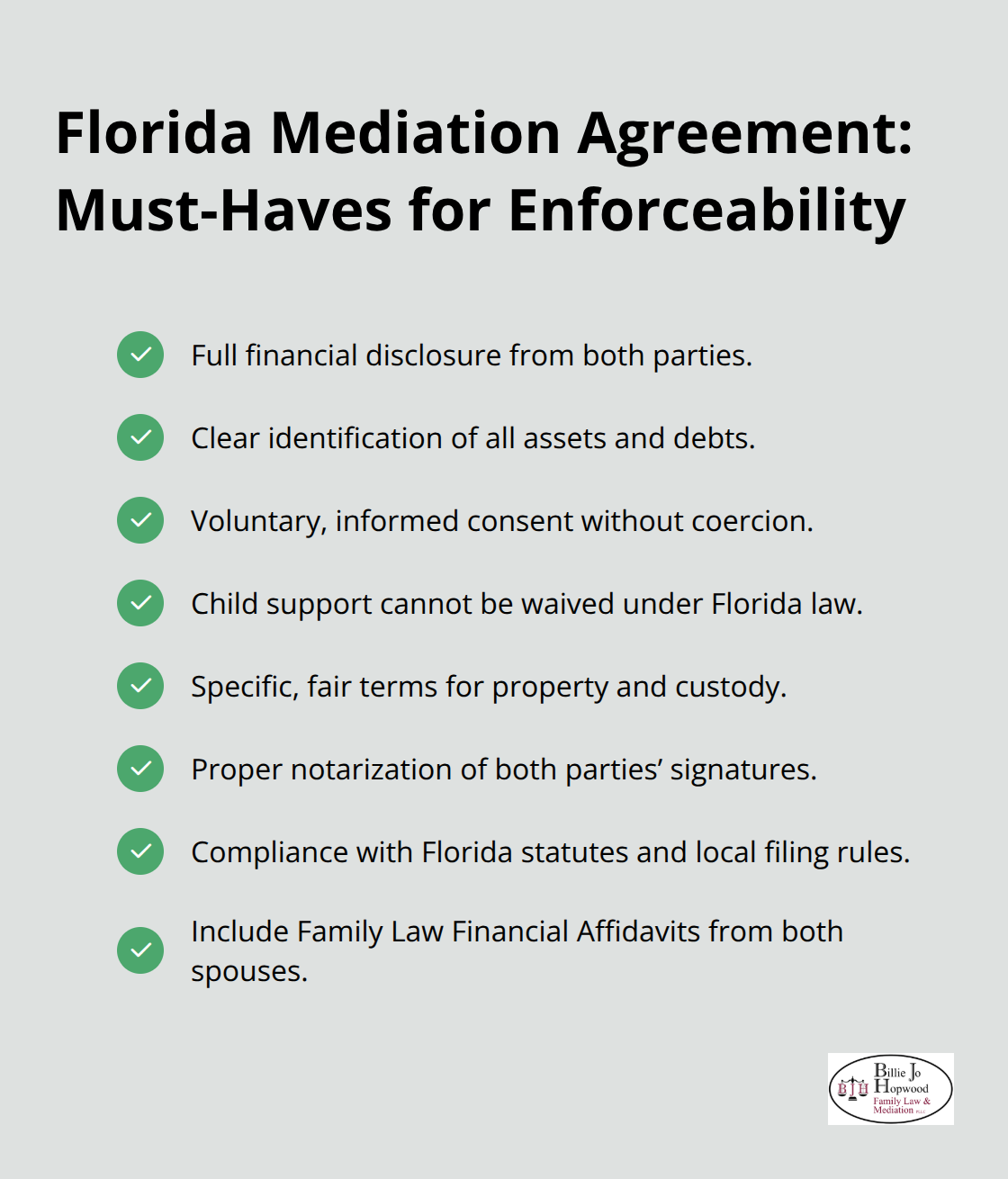
Florida courts enforce mediation agreements only when they meet strict statutory requirements, and missing even one element can render your entire agreement unenforceable. Under Florida law, your mediation agreement must include full financial disclosure from both parties, clear identification of all marital assets and debts, and explicit consent from each spouse without coercion. The agreement also must comply with state-specific rules-for example, you cannot waive child support obligations in Florida, even if both parties agree to do so, because the court considers child support a matter of public policy that protects children. Florida courts reject agreements that lack specificity about property division, fail to address custody arrangements clearly, or contain terms that are grossly unfair to one party. The Brevard County Clerk of Court requires that dissolution of marriage documents filed after mediation include a completed Family Law Financial Affidavit from both parties, which serves as proof of financial disclosure during the mediation process.
How Courts Decide Whether Your Agreement Stands
Florida judges review mediation agreements under a different standard than they apply to contested litigation outcomes. The court focuses on whether both parties had adequate information to make informed decisions, whether they understood the terms they were agreeing to, and whether the agreement reached completion voluntarily without pressure from the other spouse. Courts in Brevard County typically approve straightforward mediation agreements within two to three weeks of filing, provided all documentation is complete and both parties’ signatures are properly notarized. However, if a judge suspects unconscionable terms-meaning one party received dramatically less than their fair share-the court can modify the agreement or reject it entirely. Agreements involving child custody receive extra scrutiny because Florida law requires that all custody arrangements serve the best interests of the child, regardless of what the parents negotiated. Having an attorney review your agreement before signing protects you from court rejection or later enforcement problems. The filing fee with the Brevard Clerk of Court is currently $408, and incomplete filings delay final approval and extend your case timeline significantly.
Red Flags That Courts Will Not Overlook
Agreements that lack specific dates, times, and transfer procedures for child visitation create enforcement problems that courts recognize immediately. If your mediation agreement states vague language like the children will spend time with each parent without defining which days, what hours, or how transitions occur, a judge will likely send the agreement back for revision. Property division terms must identify each asset by its current value and specify who receives what-saying one spouse gets the house without addressing the mortgage, property taxes, or home equity creates post-divorce disputes. Agreements that hide assets or fail to disclose debts are vulnerable to challenge under Florida’s full disclosure requirement, and courts can void such agreements entirely and order the case back to mediation or trial. Another common problem occurs when language contradicts Florida statutes, such as attempting to eliminate alimony when the paying spouse has significantly higher income and the receiving spouse sacrificed career opportunities during the marriage. Courts also reject agreements where one party was not represented by counsel and financial disclosures were highly unbalanced, signaling potential coercion or lack of understanding. Rushing through mediation without proper preparation produces agreements that courts reject-families who gather pay stubs, bank statements, retirement account statements, and home valuations beforehand submit agreements that courts approve on the first submission, while unprepared parties face delays and required revisions that cost additional mediation hours and filing fees.
What Happens When You Customize Your Template
Standard templates provide a foundation, but your family’s circumstances demand specific language that reflects your actual situation. When you adapt template language to address your unique assets, custody arrangements, and support obligations, you create an agreement that courts recognize as thoughtfully negotiated rather than hastily assembled. Courts view customized agreements more favorably because they demonstrate that both parties invested time in understanding what they were accepting. The next section walks you through the essential components that must appear in any mediation agreement, regardless of which template you start with or how much you customize it.
Essential Components Every Family Mediation Agreement Needs
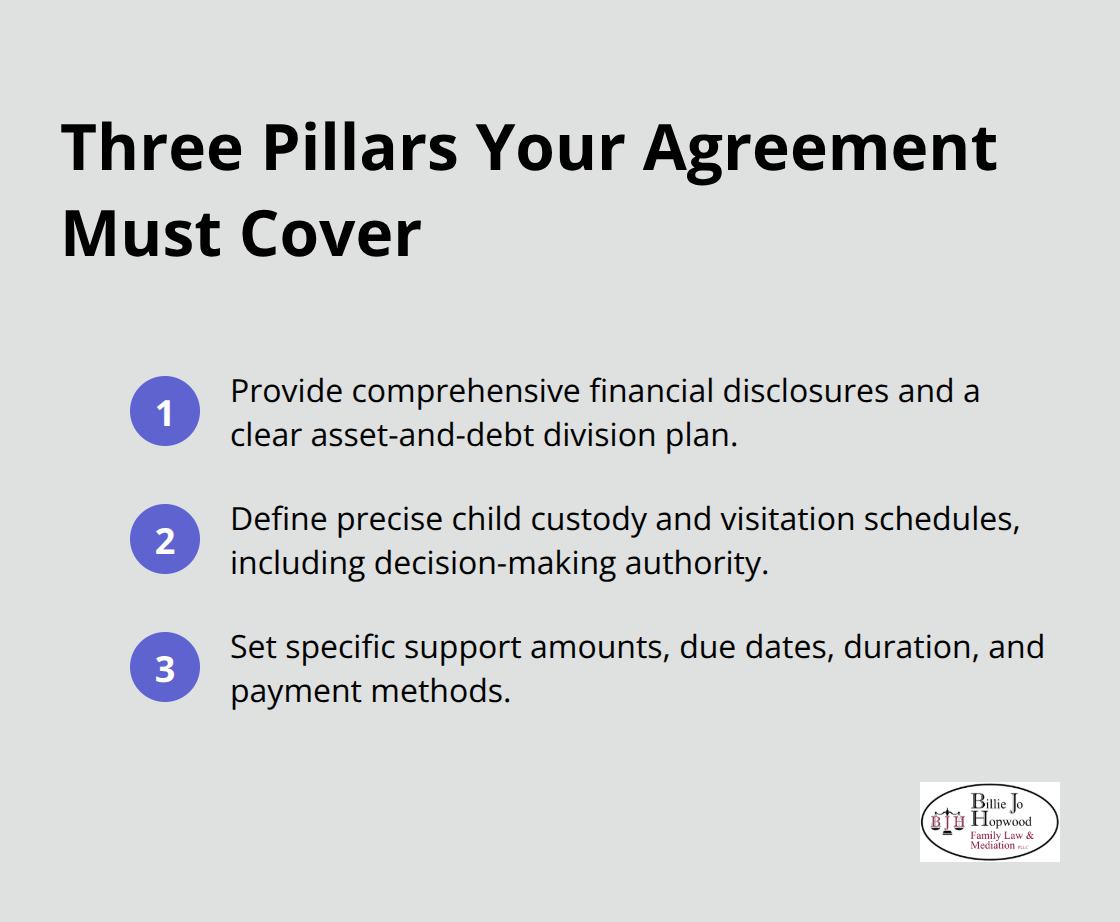
Your mediation agreement lives or dies based on three concrete elements: what financial information you disclose, how you structure custody arrangements, and what payment obligations you commit to. Missing or poorly drafted sections in any of these areas gives courts grounds to reject your agreement or creates enforcement nightmares after your divorce finalizes.
Financial Disclosures and Asset Division
The Brevard County Clerk of Court requires that both parties complete a Family Law Financial Affidavit, which becomes part of your court filing and serves as proof that full financial disclosure occurred during mediation. This affidavit must list all income sources, assets with current values, debts with balances, and monthly expenses-vague estimates or omitted accounts signal to judges that one party hid information, which invalidates everything you negotiated.
Property division language must identify each asset by type and approximate current value: the family home at 123 Main Street with estimated equity of $150,000, the 2020 Toyota with outstanding loan balance of $8,000, the investment account containing approximately $45,000, the pension earned during the marriage with an estimated present value of $120,000. Courts reject agreements that say one spouse gets the house without addressing whether that spouse assumes the mortgage, pays the other spouse for their equity share, or refinances the loan.
Asset division also requires you to specify which party receives retirement accounts and whether a Qualified Domestic Relations Order is needed to transfer funds without tax penalties. Many families overlook this detail and face unexpected tax consequences months after divorce.
Child Custody and Visitation Schedules
Custody and visitation sections demand specificity that standard templates often lack. Your agreement must state exact pickup and drop-off times, specific locations for exchanges, and what happens if one parent is late or unavailable. Courts enforce agreements that say school pickup occurs at 3:15 p.m. at the elementary school main entrance on Tuesday and Thursday; courts reject vague language about reasonable visitation or quality time.
Include which parent makes educational decisions, medical decisions, and religious decisions, because Florida law requires that custody agreements address these areas separately from physical time-sharing. Document the school-year schedule with specific dates when custody transitions occur, then address summer, spring break, and holiday schedules with even-year and odd-year patterns to prevent annual disputes.
Support Obligations and Payment Terms
Support obligations must specify the exact monthly amount for child support or alimony, the due date each month, and the payment method-direct deposit, check, or electronic transfer reduces disputes about whether payments arrived on time. Florida statutes require that child support amounts follow the guidelines unless both parties agree in writing to deviate, and any deviation must include the specific reasons why the guideline amount does not serve the child’s best interests.
Alimony terms must state the duration, whether payments end upon remarriage or death, and whether the amount can be modified if circumstances change significantly. Agreements that omit these enforcement details cost families thousands in additional litigation when one party claims they never understood their obligations or disputes whether payments were made.
Once you understand what components your agreement must contain, the next step involves taking a standard template and adapting it to reflect your family’s actual circumstances, assets, and arrangements.
Customizing Templates to Match Your Actual Family Structure
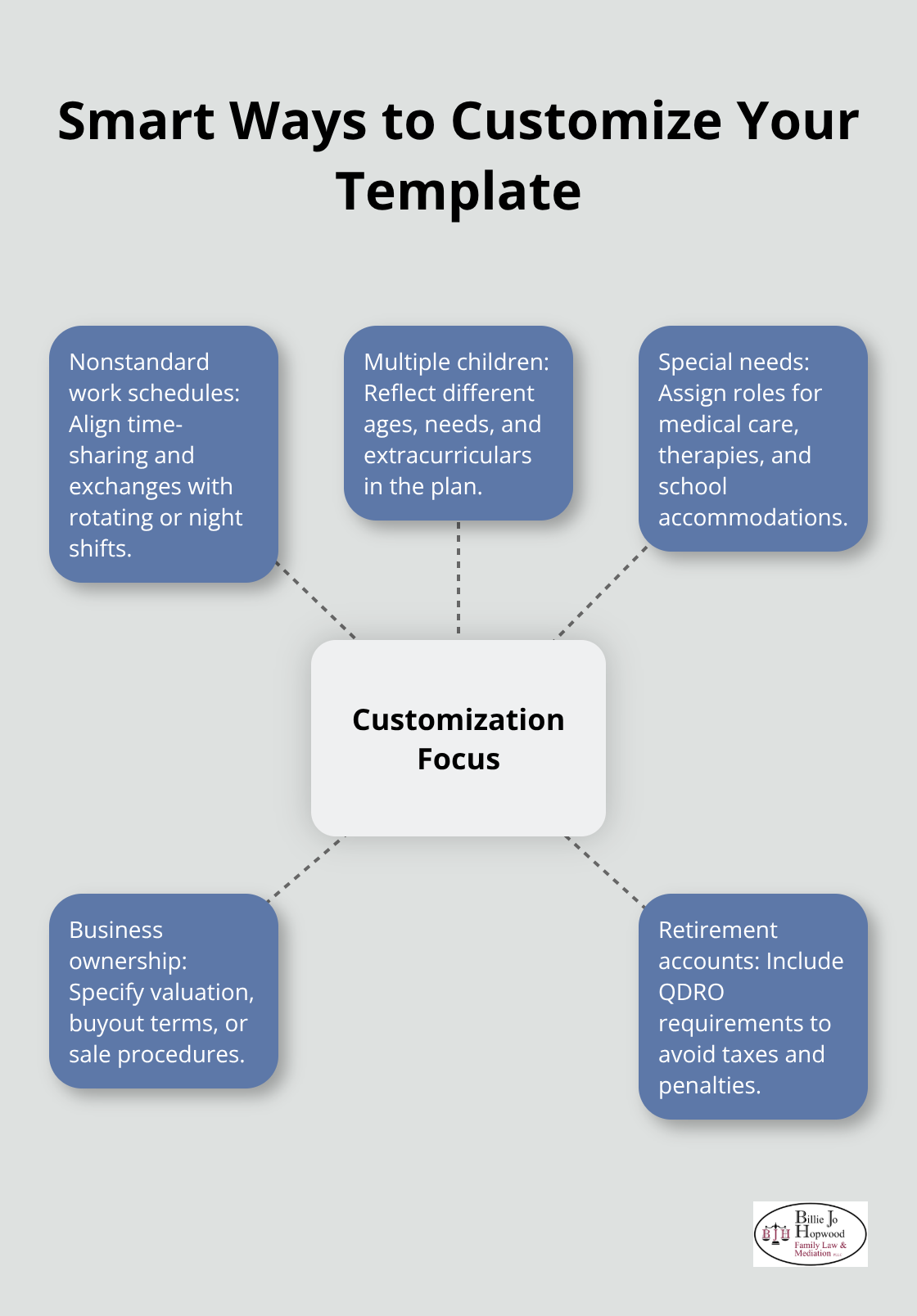
Standard templates provide language for straightforward situations, but most families in Melbourne, Florida face circumstances that demand customization. Your agreement template likely includes generic provisions for two parents with one or two children, equal income levels, and standard work schedules. If your situation differs-one parent works nights, you have three children with different needs, one spouse owns a business, or you have significant retirement accounts-the template language becomes inadequate or actively harmful to your interests.
Identifying Which Sections Need Revision
Start with identifying which template sections apply directly to your situation and which sections require substantial revision. A parent who works a rotating shift cannot use a template that assumes standard 9-to-5 employment, because the custody schedule will fail immediately when the shift pattern changes. Similarly, a family with a child who has autism or ADHD needs customized language addressing which parent coordinates medical appointments, manages school accommodations, and handles behavioral decisions. Generic template language about custody decisions provides no guidance for these practical realities.
How Mediators Help You Customize Language
A skilled mediator asks specific questions about your work schedules, your children’s specific needs, your asset composition, and your financial obligations, then guides you toward language that addresses those realities rather than forcing your family into a template’s predetermined categories. The mediator’s role involves translating your actual circumstances into enforceable language that courts will recognize as legitimate. During mediation sessions, this process ensures your agreement reflects what actually happens in your household rather than what a generic template assumes.
Addressing Property Division With Specificity
Property division customization requires you to identify every significant asset and specify exactly how division occurs. If you own a home worth $250,000 with a $180,000 mortgage, the template language must state whether one spouse retains the home and refinances the loan, whether both spouses remain on the mortgage temporarily while one spouse purchases the other’s equity, or whether the home sells and proceeds divide. A business valued at $300,000 demands language addressing whether one spouse receives the business outright, whether the other spouse receives a note for their equity share, or whether the business sells.
Retirement accounts require specific language about Qualified Domestic Relations Orders, because failing to address this detail creates tax consequences neither spouse anticipated. Mediation helps you avoid the common mistake of creating agreements where one spouse receives assets without corresponding debt responsibility, leaving that spouse underwater financially.
Building Defensible Financial Documentation
When your mediator works with both parties to identify and value all assets during mediation, you create disclosure documentation that courts recognize as thorough and legitimate. This documentation makes your final agreement defensible if either party later claims they were unaware of marital property. The specificity you develop during customization transforms a generic template into a document that reflects your family’s actual financial reality.
Final Thoughts
A sample family mediation agreement template provides the framework you need, but your family’s actual circumstances demand customization that transforms generic language into a document courts will approve. After both parties sign your agreement, you file the completed documents with the Brevard County Clerk of Court, pay the $408 filing fee, and courts typically approve straightforward agreements within two to three weeks. Before you submit anything, have an attorney review your signed agreement to confirm it complies with Florida law and addresses all necessary elements, which prevents costly delays or required revisions.
We at Billie Jo Hopwood Family Law & Mediation, PLLC guide you through mediation in Melbourne, Florida and help you customize agreement language so your final documents meet Florida’s legal requirements. Contact our firm if you need guidance on whether mediation fits your situation or want help preparing for mediation sessions. We discuss your family’s specific circumstances and walk you through the complete mediation process to ensure your sample family mediation agreement reflects your actual needs.