
Family law disputes don’t have to mean courtroom battles and years of conflict. Collaborative family law in Brevard offers families a different path-one where both sides work together with trained professionals to reach solutions that actually work.
At Billie Jo Hopwood Family Law & Mediation, PLLC, we’ve seen how this approach transforms outcomes for families. When you choose collaboration, you’re choosing faster resolution, lower costs, and a process that protects your relationships.
What Collaborative Family Law Actually Is
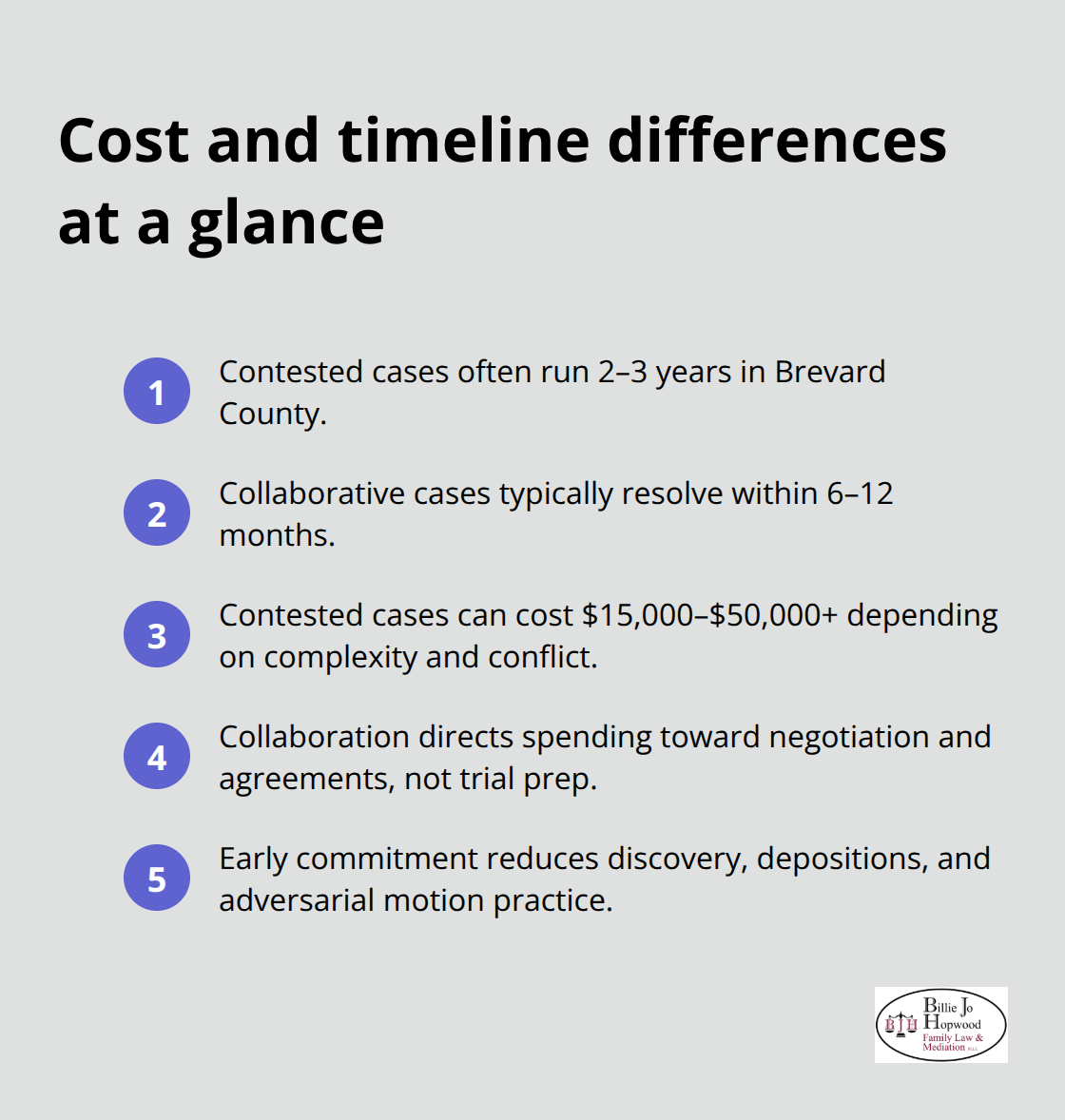
Collaborative family law is a structured process where both spouses and their attorneys commit to reaching a settlement without going to court. Unlike traditional litigation, where each side prepares for battle and a judge imposes an outcome, collaborative law requires both parties to sign an agreement upfront stating they will not litigate. If negotiations fail and either party decides to pursue court, both attorneys must withdraw, forcing the couple to hire new legal representation. This built-in consequence creates real incentive to solve problems cooperatively rather than escalate them. The International Academy of Collaborative Professionals reports that collaborative cases resolve 80% faster than traditional litigation, with most reaching settlement within 6 to 12 months instead of 2 to 3 years.

How the Process Actually Works
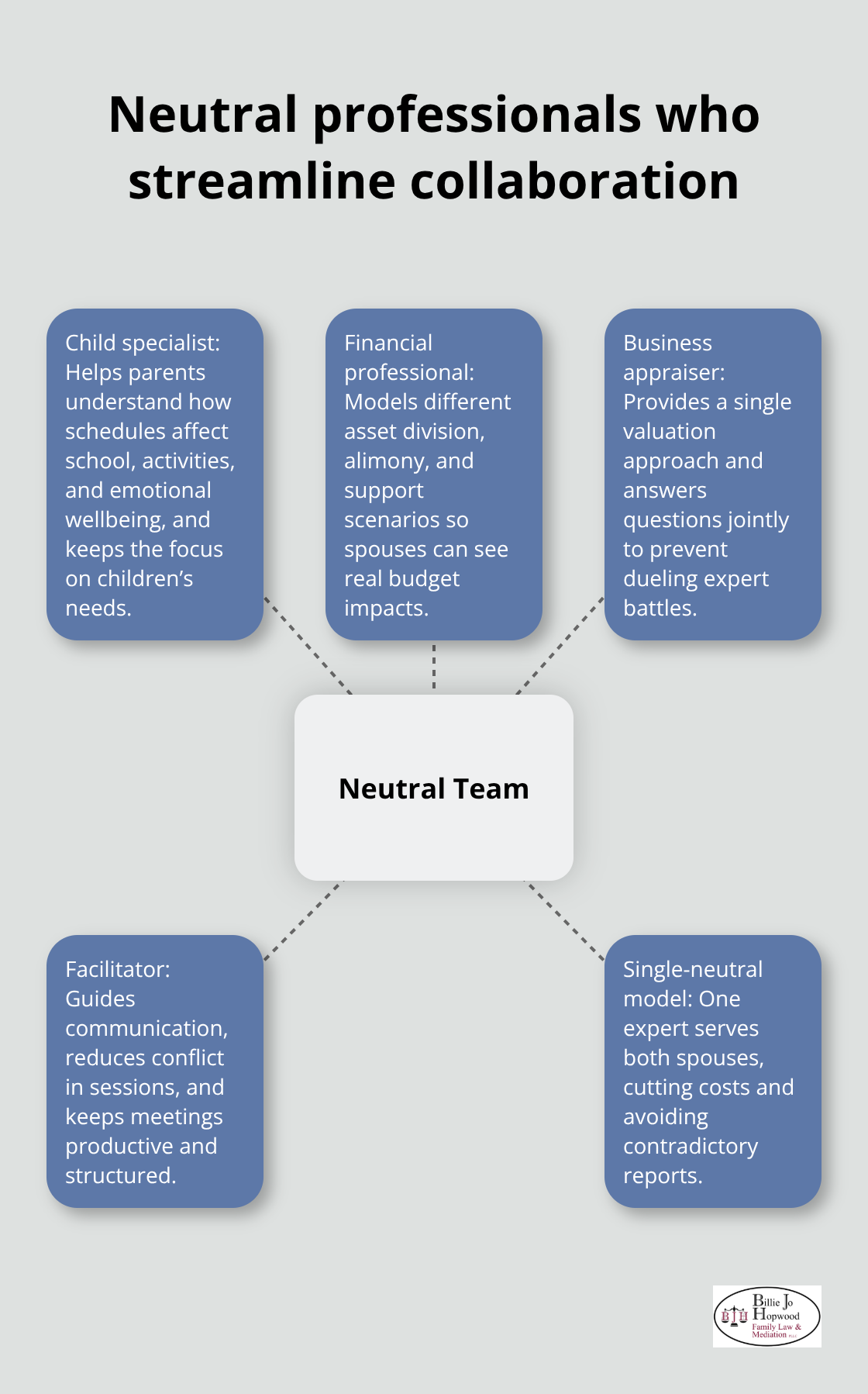
In collaborative family law, both spouses retain separate attorneys who are trained in collaborative methods. These attorneys focus on interest-based negotiation, meaning they identify what each person actually needs rather than just fighting over positions. Sessions happen on the couple’s schedule, not the court’s calendar, which eliminates months of waiting for hearing dates. When complex issues arise-dividing a business, calculating retirement benefits, or assessing child development needs-the couple hires a single neutral professional in that field instead of each side bringing their own professional. This keeps costs down and prevents the adversarial professional-versus-professional battles that run up legal fees. A child specialist may attend some sessions to help parents understand how different custody arrangements affect children’s emotional wellbeing. A financial professional can model different asset division scenarios so both spouses see the actual impact on their post-divorce finances.
Why Families Retain Control Over Outcomes
Families in Brevard choose collaboration because they retain control over outcomes that matter most. In court, a judge decides child custody, alimony amounts, and asset division based on state law and limited information presented during a hearing. In collaborative law, you decide these issues based on your family’s actual values and needs. A parent who wants flexibility with parenting time can build that into an agreement; a spouse who prioritizes financial security can structure support differently than someone prioritizing a clean break. Research from the Florida Academy of Collaborative Professionals shows that agreements reached collaboratively have significantly lower modification rates, meaning families do not end up back in court fighting over the same issues years later. The process costs less because there is no discovery phase where attorneys demand thousands of documents, no depositions where witnesses spend hours answering questions, and no trial preparation. Collaborative cases typically cost 40% to 60% less than contested litigation.
Why This Matters for Families with Children
For families with children, this approach matters most because it models problem-solving rather than conflict, setting the tone for co-parenting after divorce is final. The collaborative process allows both parents to shape parenting arrangements that reflect their family’s unique needs and values. When parents work together to reach agreements (rather than having a judge impose custody terms), they demonstrate to their children that adults can resolve disagreements respectfully. This foundation supports healthier long-term relationships between co-parents and reduces the emotional toll on children during and after the divorce process.
The Collaborative Process Works in Brevard
Initial Commitment and Full Financial Disclosure
The collaborative process in Brevard starts with a formal commitment that shapes everything that follows. Both spouses and their attorneys sign a participation agreement stating upfront that neither party will pursue litigation if negotiations stall. This agreement includes full financial disclosure requirements-both spouses must provide complete documentation of income, assets, debts, and liabilities within the first 30 days. No hiding accounts or downplaying income. Transparency is non-negotiable. The International Academy of Collaborative Professionals reports that cases with complete early disclosure resolve 23% faster than those where information trickles out slowly.
Structured Problem-Solving Sessions on Your Schedule
Once disclosure is complete, the couple schedules structured problem-solving sessions on their own calendar rather than waiting months for court dates. Sessions typically occur every two to three weeks, allowing time between meetings for each spouse to reflect and gather information. A neutral facilitator (often a mental health professional trained in collaborative methods) may attend sessions focused on parenting and communication, helping parents separate their adult relationship issues from their role as co-parents. This is where the real work happens-not in courtrooms under pressure, but in controlled settings where both sides can think clearly and propose solutions.
Building Agreements That Reflect Your Family’s Reality
Building agreements that actually work requires addressing the specific details of your family’s situation rather than applying generic templates. When dividing a business, a single neutral business appraiser meets with both spouses and their attorneys to explain valuation methods and answer questions from both sides simultaneously. This prevents the common litigation scenario where each side’s professional contradicts the other, forcing a judge to guess which valuation is closer to reality. For child custody arrangements, many Brevard families work with a child specialist who helps parents understand how different schedules affect school transitions, extracurricular activities, and emotional stability at different ages. A parent might discover that alternating weeks works poorly for a teenager who plays sports three days a week, so the agreement adjusts to a schedule that keeps the child’s routine intact. Financial professionals can model how different alimony and support amounts affect both spouses’ post-divorce budgets, showing real numbers instead of abstract percentages. When both spouses see that a particular arrangement leaves one person unable to afford housing or childcare, they can adjust terms before signing rather than discovering problems later and returning to court for modifications.
The agreements you build through this process become the foundation for your family’s next chapter-one where the terms you’ve created together actually work for everyone involved.
Advantages of Choosing Collaboration for Your Family
Reduced Stress and Emotional Impact on Children
Collaborative family law eliminates the financial and emotional drain that makes traditional litigation so destructive for families. When divorce stretches across years of court battles, children experience prolonged uncertainty about custody arrangements, repeated exposure to parental conflict during hearings and depositions, and the psychological weight of knowing their living situation remains undecided. Collaborative law compresses this timeline dramatically. Most Brevard families reach final agreements within months rather than years, which means children transition to their new normal faster and spend less time in limbo.
Parents also retain control over parenting schedules instead of accepting whatever a judge imposes based on limited courtroom information. A parent who needs flexibility for work can negotiate that directly with the other parent; a child with specific needs can have those needs built into the custody agreement from the start. The agreements you create together become terms both parents actually support, not court orders they resent, which translates to better compliance and fewer post-divorce conflicts that pull children back into courtroom drama.
Lower Costs Compared to Courtroom Battles
In contested divorce, you pay your attorney to prepare for battle-drafting motions, conducting discovery where the other side demands thousands of documents, taking depositions where witnesses answer questions under oath for hours, and preparing for trial. These activities cost money without resolving anything. The Florida Academy of Collaborative Professionals found that collaborative cases typically cost 40% to 60% less than contested litigation because discovery phases disappear, depositions don’t happen, and trial preparation never occurs.
A contested divorce in Brevard County often runs 2 to 3 years and costs $15,000 to $50,000 or more depending on asset complexity and conflict level. Collaborative cases in the same area typically resolve within 6 to 12 months and cost significantly less because both sides commit upfront to solving problems rather than fighting. Families in Brevard see the difference immediately when they stop paying for adversarial positioning and start paying only for actual negotiation and agreement-building.
Faster Resolution and Greater Control Over Outcomes
Collaborative law delivers speed because both parties work toward settlement rather than toward trial. You eliminate months of waiting for court dates and years of procedural delays that plague contested cases. Most families reach final agreements within months, not years, which allows everyone to move forward with their lives sooner.
Control over outcomes matters most when your family’s unique needs don’t fit standard court templates. A parent with shift work can structure a custody schedule that accommodates their employment; a couple with a family business can negotiate terms that preserve the business while fairly dividing its value; a parent concerned about a child’s special needs can build accommodations directly into the agreement. These personalized solutions emerge from negotiation between people who know their family best, not from a judge applying state law to limited information presented during a hearing.
Final Thoughts
Collaborative family law in Brevard works because it builds agreements on a foundation of mutual respect rather than courtroom victory. When both parents commit to solving problems together, the arrangements you create actually last, and research from the Florida Academy of Collaborative Professionals shows that agreements reached collaboratively have significantly lower modification rates. This stability matters most for children, who benefit from parents working together rather than remaining locked in adversarial positions.
Collaboration works best when both spouses can communicate respectfully, trust each other on key matters, and want to preserve a cooperative relationship after divorce. If your family includes domestic violence, safety concerns, or severe communication breakdown, traditional representation or mediation may be more appropriate. But if you and your spouse share a commitment to solving problems cooperatively and want to protect your children from prolonged conflict, collaborative family law offers a path that aligns with your values.
At Billie Jo Hopwood Family Law & Mediation, PLLC in Melbourne, Florida, we help families in Brevard explore whether collaborative family law fits your situation. Contact us to schedule a consultation and learn how this approach can support your family’s transition to what comes next.