
Family disputes in Florida don’t always require a courtroom battle. Mediation success in Florida happens when both parties commit to finding solutions outside the adversarial process.
We at Billie Jo Hopwood Family Law & Mediation, PLLC have seen firsthand how mediation transforms difficult situations into workable agreements. This blog shares real stories and practical strategies that help families move forward.
Why Florida Courts Push Mediation Before Trial
Florida’s judicial system has made mediation a priority, not a suggestion. Florida Statute 44.102 requires courts to refer appropriate family law cases to mediation, and judges actively encourage parties to resolve disputes outside the courtroom. This isn’t happening by accident. The Florida court system processes over 100,000 family law cases annually, and mediation helps move cases through faster while keeping families out of adversarial battles. When you litigate, you compete against thousands of other cases for court time. Mediation sidesteps this entirely.
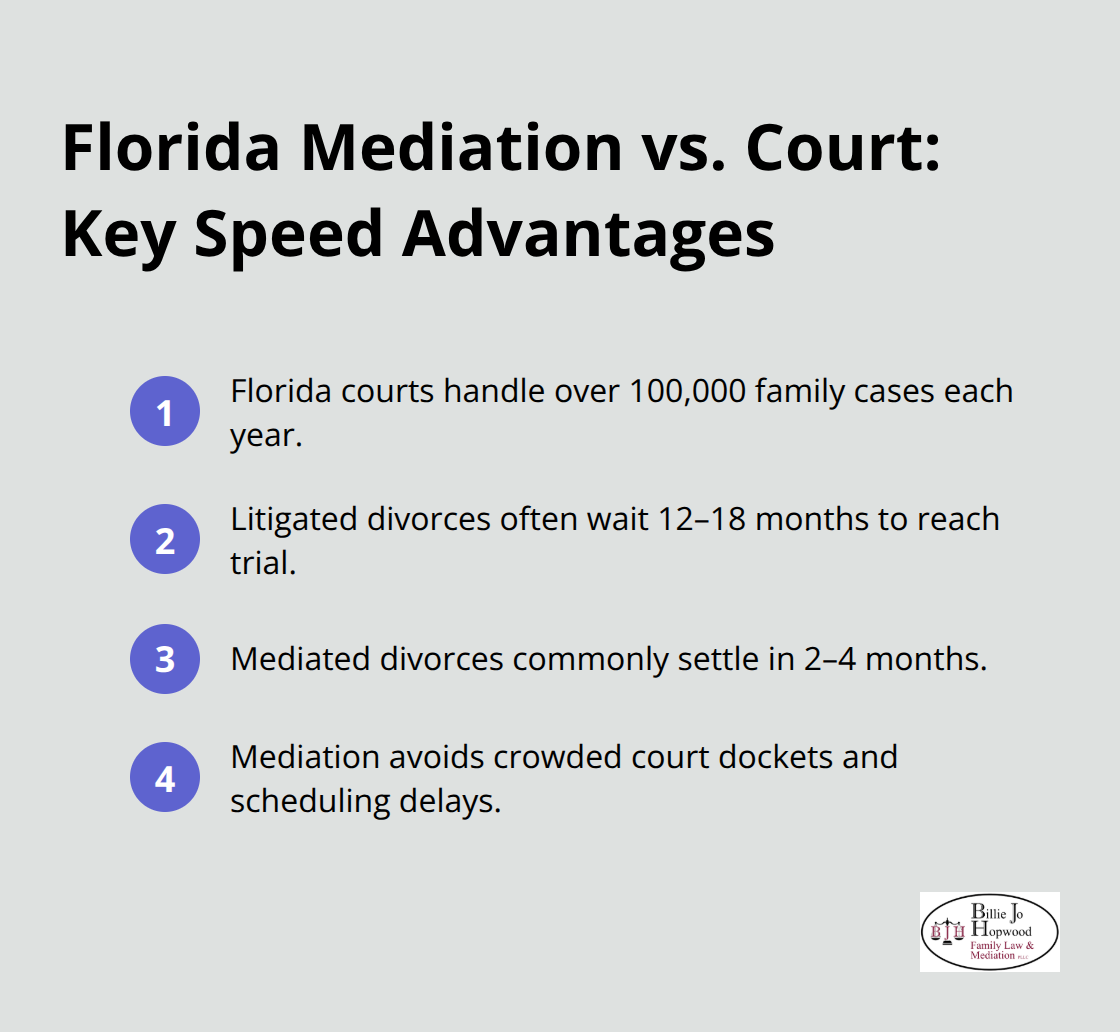
The average contested divorce in Florida takes 12 to 18 months to reach trial, while mediated divorces settle in 2 to 4 months. You control the timeline instead of waiting for the court’s docket.
Litigation Costs Money and Time You Won’t Get Back
Courtroom battles drain resources. A litigated family law case in Florida costs between $15,000 and $30,000 on average, according to data from the American Academy of Matrimonial Lawyers. Mediation typically runs $1,500 to $5,000 total, depending on complexity and the mediator’s hourly rate. That’s a dramatic difference.
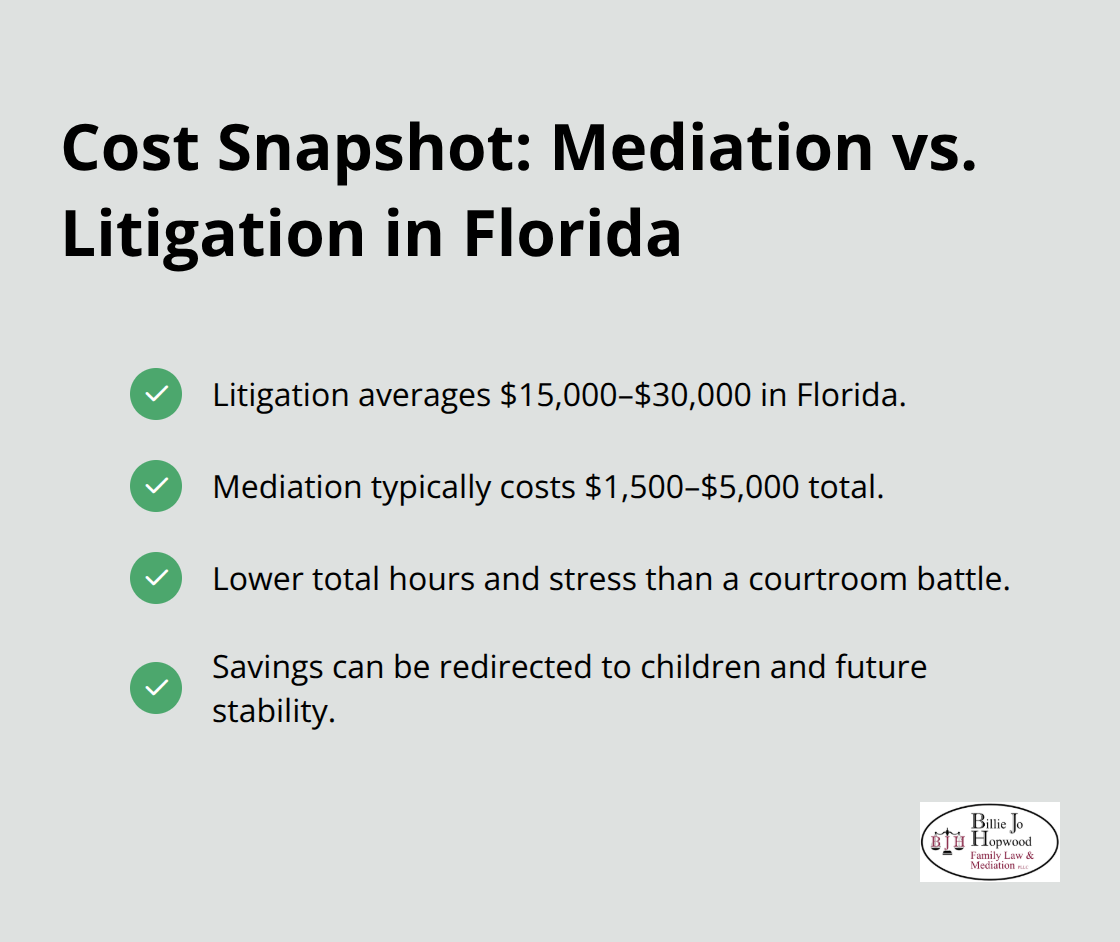
Beyond cost, litigation creates emotional exhaustion. You prepare for trial, attend depositions, respond to discovery requests, and manage conflict with your former partner in front of a judge. Mediation replaces this adversarial structure with collaborative problem-solving. Both parties sit down with a neutral third party who helps identify common ground and craft solutions both can accept. You’re not fighting to win; you’re working to move forward. Florida courts recognize this distinction, which is why judges consistently recommend mediation before trial dates are set.
Mediation Gives You Control Over Your Outcome
The fundamental difference between mediation and litigation comes down to who decides your future. In court, a judge makes binding decisions about custody, property division, support, and other critical family matters. The judge knows nothing about your family’s unique circumstances, your children’s specific needs, or what arrangements actually work for your household.
Mediation puts that power in your hands. You and the other party negotiate terms you both can live with, guided by someone trained in helping families find workable solutions. Families reach agreements in mediation that no judge would have ordered because the solutions fit their actual lives. Parents negotiate custody schedules that work with their jobs. Couples divide assets in ways that make financial sense for both parties. People craft support agreements they can sustain long-term without the resentment that often follows court-imposed orders.
This control matters enormously when you have children, shared history, or ongoing relationships. Mediation acknowledges that you know your situation better than any courtroom ever will. With this foundation in place, real stories from Florida families show exactly how mediation transforms these principles into concrete agreements.
How Florida Families Resolved Their Disputes Without Court
A couple with two children in Brevard County faced a divorce and feared the courtroom battle ahead. The husband wanted primary custody; the mother wanted equal time with them. Their initial positions seemed incompatible. Within three mediation sessions totaling eight hours, they developed a custody schedule that gave both parents meaningful time with the kids while accounting for work schedules and school logistics. The mediator helped them recognize that their actual concern wasn’t winning custody-it was maintaining strong relationships with their children. This shift in perspective changed everything.
Instead of arguing about who deserved more time, they built a plan that worked for everyone. The agreement they reached cost them roughly $3,000 in mediation fees and took six weeks to finalize. A contested custody battle would have consumed $20,000 to $40,000 in legal fees and dragged on for over a year.
Property Division Doesn’t Require a Judge’s Decision
Another Florida family owned a home, retirement accounts, and a small business. The husband and wife disagreed on how to split these assets fairly. In litigation, each side would hire appraisers, argue valuations, and let a judge impose a division neither party controlled. Instead, they chose mediation.
During the process, they discovered that the wife cared more about keeping the family home and a portion of retirement savings, while the husband prioritized his interest in the business. The mediator helped them understand what actually mattered to each person. This insight led to an agreement where the wife retained the home and $150,000 from retirement accounts, while the husband kept the business valued at approximately $180,000. Both parties walked away satisfied because the solution reflected their priorities, not a judge’s interpretation of fairness.
This settlement took four mediation sessions and cost $4,200 total. The alternative-litigation with expert witnesses and depositions-would have exceeded $35,000 and taken 18 months.
Divorce Settlements Happen When People Stop Fighting
A couple married 22 years with adult children entered mediation after their marriage deteriorated. Both parties wanted to part amicably but faced significant uncertainty about alimony and joint investments. The mediator walked them through their financial picture, helping each person understand the other’s concerns about retirement security and lifestyle changes.
Within two sessions, they negotiated an alimony arrangement that provided stability for the lower-earning spouse while remaining sustainable for the higher earner. They also agreed on how to divide investment accounts without forcing liquidation or triggering unnecessary tax consequences. The entire process took three weeks. Their total mediation cost was $2,800. Litigation would have stretched this couple’s resources and created lasting resentment despite their initial desire for civility.
What These Stories Reveal About Mediation
These real situations from Florida families show a consistent pattern: mediation works best when people recognize that dispute resolution costs more in money, time, and emotional energy than problem-solving does. The mediator’s role isn’t to push either party toward compromise-it’s to help both people understand what they actually need and find solutions that address those needs. When families move past positional arguments and focus on their underlying interests (maintaining relationships with children, achieving financial security, or preserving dignity), agreements emerge naturally. The next section explores the practical strategies that make this transformation possible.
How to Prepare for Mediation in Melbourne Florida
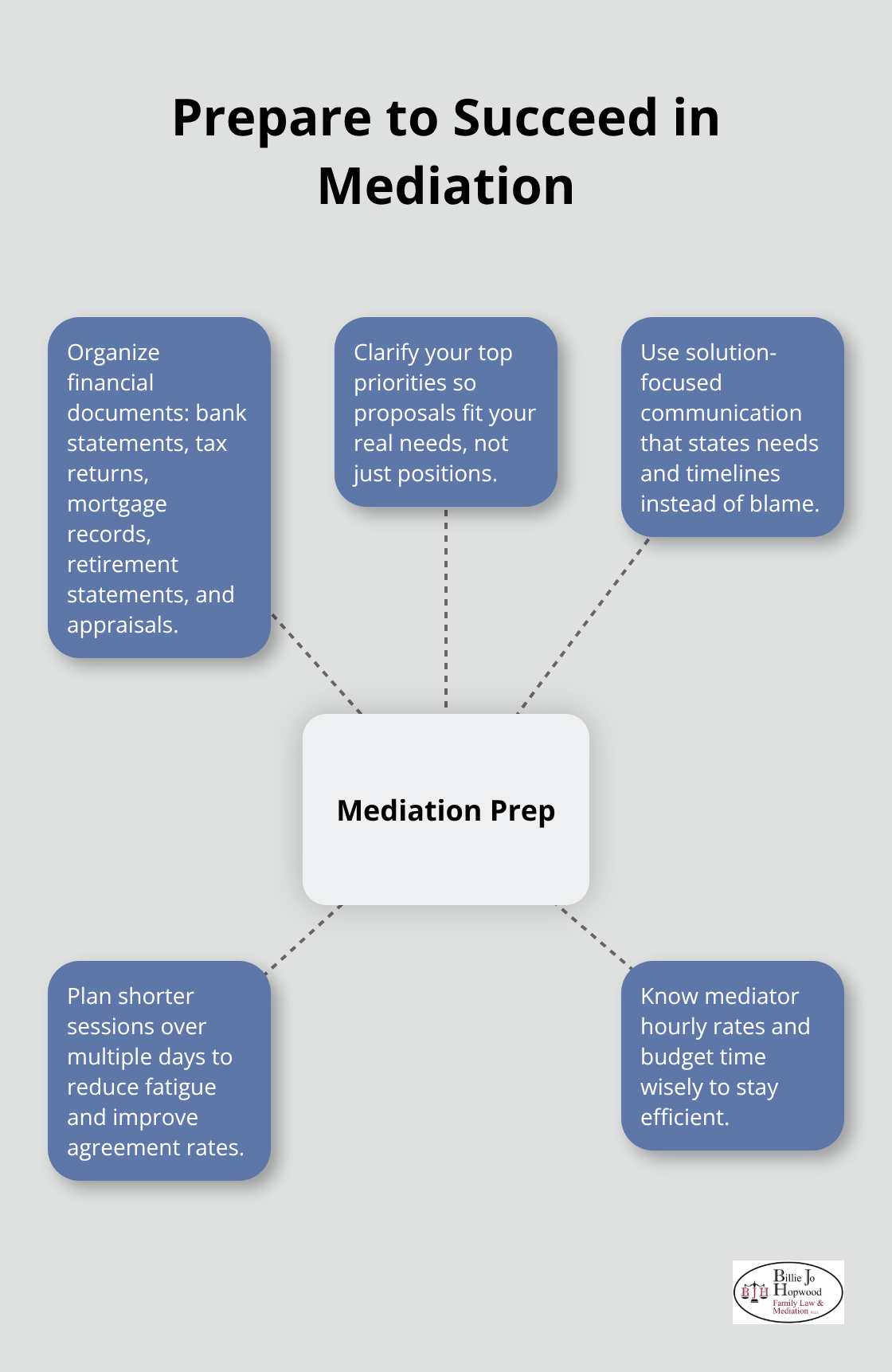
Walking into mediation unprepared guarantees a worse outcome. Arrive with organized financial documents, a clear understanding of your priorities, and realistic expectations about what the other party might accept. Start by gathering bank statements from the past 12 months, tax returns for the last three years, mortgage documents, retirement account statements, and any property appraisals. Disorganization wastes mediation time, and mediators charge hourly rates ranging from $150 to $400 per hour depending on experience and complexity. Every hour spent hunting for documents is money that could have gone toward actually solving your dispute.
Organize Your Financial Picture
Create a simple spreadsheet listing all marital assets with approximate values, all debts with balances, and monthly income from all sources. This task takes three to four hours but prevents confusion during sessions. Know exactly what you own, what you owe, and what you earn before sitting down with the mediator. Mediators at Billie Jo Hopwood Family Law & Mediation, PLLC in Melbourne, Florida work with families who arrive prepared, and the difference in session efficiency is dramatic. Families who bring organized documents settle faster and spend less money overall.
Identify Your Real Priorities
Most people enter mediation saying they want custody, the house, and maximum support. That’s not a priority list; that’s a wish list. Real priorities are different. Do you need primary custody because you’re the primary caregiver, or because you’re afraid of losing your children? Do you want the house because it’s your home, or because you’re angry and want to punish your ex? Do you need support because you genuinely cannot work, or because you’re trying to extract maximum payment? The mediator will ask these questions, and your answers determine whether you reach settlement or waste time posturing.
Communicate Without Blame
Communication during mediation fails when one party attacks, blames, or brings up past grievances. The mediator’s job is to keep discussion focused on future arrangements, not to referee arguments about who caused the divorce. Speak about yourself and your needs rather than criticizing the other person. Instead of saying your ex is irresponsible with money and cannot manage finances, say that you need predictable child support payments deposited by the fifth of each month to cover school expenses and childcare. This shift moves the conversation from blame to solutions.
Research from the American Bar Association shows that mediation sessions lasting under two hours are significantly more likely to reach agreement than those that extend beyond four hours in a single day. Fatigue and frustration set in, making people defensive. Request shorter sessions spread across multiple days if possible.
Listen More Than You Advocate
Come prepared to listen, not just to advocate. When the other party explains their perspective, resist the urge to interrupt or defend yourself. Understanding their actual concerns, not their stated positions, is what opens the door to workable agreements. The mediator’s role is to translate between positions and interests. Your role is to stay focused on moving forward rather than winning the argument (this distinction matters far more than most people realize).
Final Thoughts
Mediation success in Florida happens when families stop fighting and start solving problems together. The real stories throughout this blog show that people who move past courtroom battles and into collaborative problem-solving reach agreements faster, spend less money, and preserve relationships that matter. A couple in Brevard County resolved custody in six weeks for $3,000 instead of spending a year and $40,000 in court, while another family divided complex assets in four sessions because they focused on what actually mattered rather than winning.
You’ll spend between $1,500 and $5,000 through mediation instead of $15,000 to $30,000 in litigation, and you’ll settle in months instead of years. Most importantly, you’ll walk away with an agreement you helped create rather than one a judge imposed on you. The next step is straightforward: gather your financial documents, identify your real priorities, and reach out to a mediator who understands Florida family law.
When you’re ready to explore mediation, Billie Jo Hopwood Family Law & Mediation, PLLC in Melbourne, Florida assists families through these challenging situations with guidance in divorce, custody, alimony, and support matters. You’ve invested time and resources into finding solutions that work, and that commitment to problem-solving becomes the foundation for whatever comes next.