You reach a mediation agreement with your ex-spouse, thinking the hard part is over. Then months later, you discover the other party won’t comply, and you’re left wondering if your agreement actually holds any legal weight.
At Billie Jo Hopwood Family Law & Mediation, PLLC, we see this scenario play out more often than it should. Mediation agreement enforceability depends on specific legal requirements that many people overlook during the process itself.
What Makes Your Mediation Agreement Legally Binding
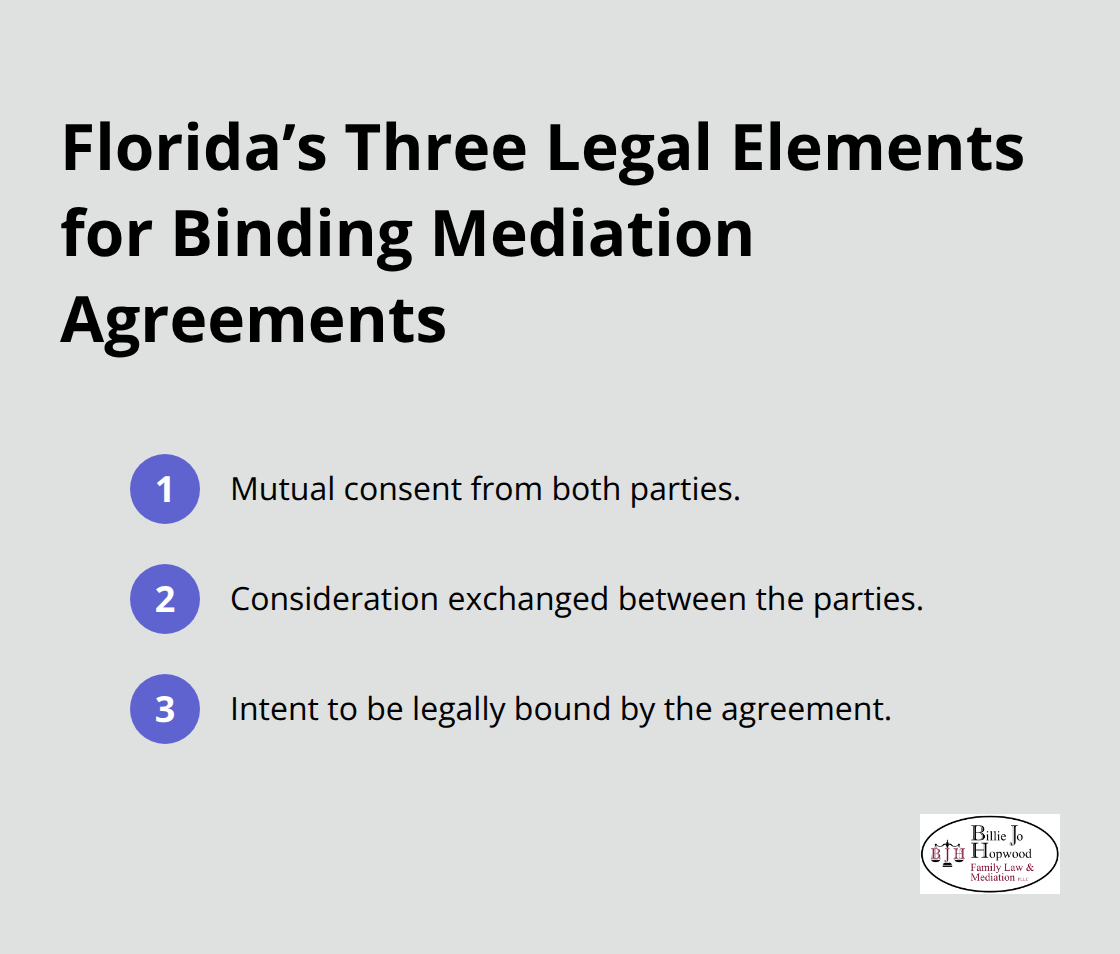
Florida law requires three core elements for a mediation agreement to hold up in court: mutual consent from both parties, consideration (something of value exchanged), and the intent to be legally bound. Without all three, a judge can dismiss your agreement entirely. The Florida Supreme Court has emphasized that mediation agreements are contracts, meaning they follow standard contract law principles. Most people assume that simply reaching an agreement during mediation makes it binding, but that’s incorrect. The agreement must meet specific statutory requirements outlined in Florida Statute 44.102. A written agreement signed by both parties and the mediator creates a strong presumption of enforceability, though even oral agreements can become binding if both parties acknowledge them in writing later.
Written Documentation Prevents Disputes
Your written agreement must include specific, measurable terms that leave no room for interpretation. Instead of writing that one parent will pay child support, the agreement should state the exact dollar amount, payment schedule, method of payment, and what happens if a payment is missed. Florida courts have rejected agreements where parties used vague phrases like reasonable support or fair division of assets because judges cannot enforce terms they cannot define. Incomplete documentation or vague language creates room for courts to rewrite or reject agreements entirely.
Specificity Matters More Than You Think
Include provisions for how the agreement handles future changes in circumstances, such as job loss or income changes. Without modification clauses, either party may claim the agreement no longer works and file a motion to change it. Courts focus on whether disclosure was complete and whether both parties had adequate opportunity to consult with attorneys before signing. A family law attorney should review and strengthen the language before you sign anything-never rely on a mediator alone to draft your final agreement.
What Happens When Disclosure Falls Short
Both parties must have full information and understand the terms without pressure. Courts will examine whether each party received complete financial disclosure and had genuine opportunity to ask questions. If one party hid assets or income during mediation, the agreement becomes vulnerable to challenge. The mediator’s role affects the process quality but not the agreement’s legal validity-what actually matters is that both parties acted with full knowledge and genuine consent.
The difference between an agreement that holds up and one that crumbles in court often comes down to how thoroughly you addressed these enforceability factors during mediation. Understanding these requirements now prevents costly litigation later.
Why Mediation Agreements Crumble in Court
Vague Language Destroys Enforceability
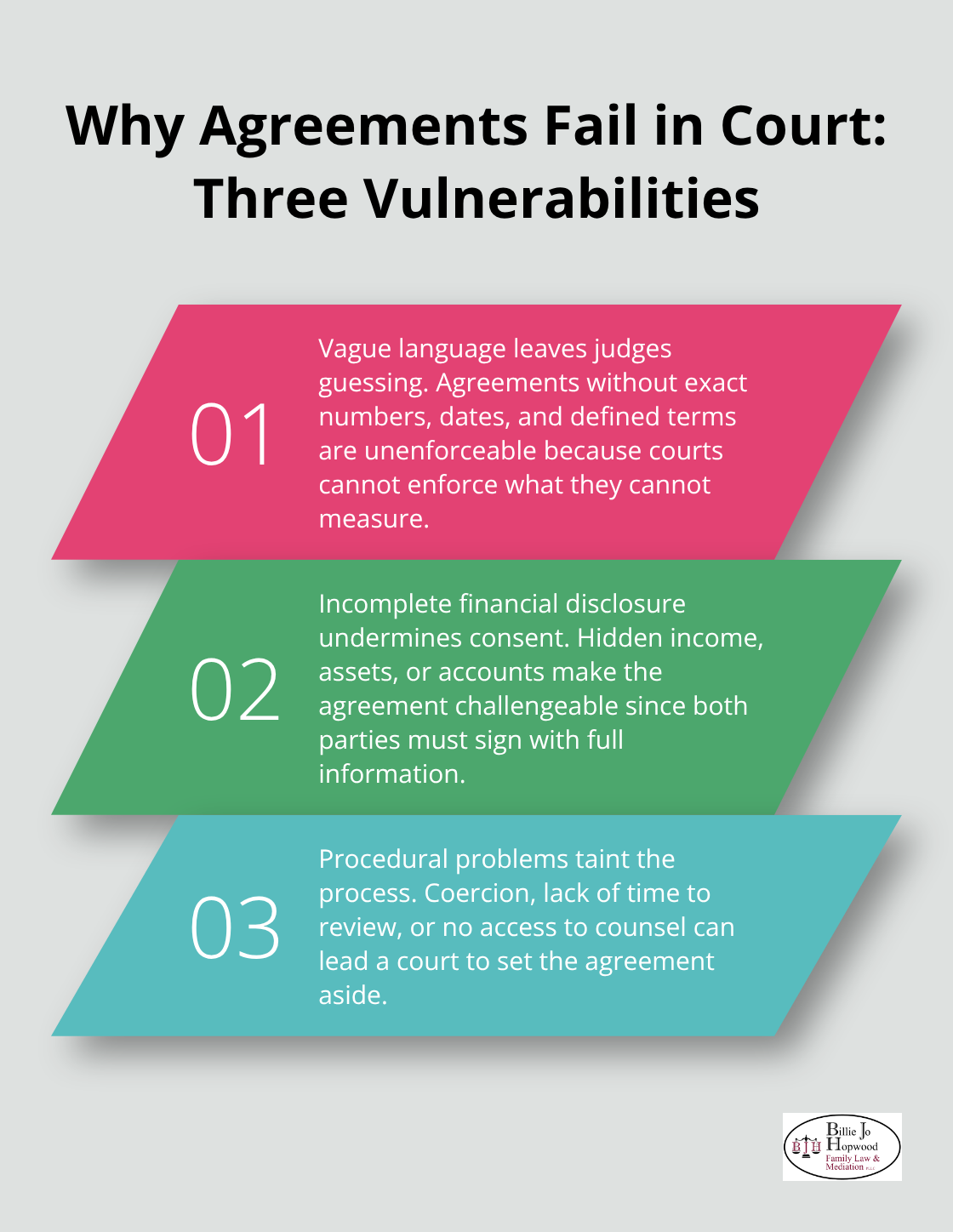
Vague language destroys more mediation agreements than any other factor. Judges throw out agreements when parties use terms like reasonable visitation or appropriate support without defining actual numbers, dates, or conditions. Florida courts cannot enforce what they cannot measure. When an agreement states that one parent will pay for the child’s education, does that mean public university tuition only, or does it include private school, graduate programs, and room and board? A judge cannot guess. The National Council of Juvenile and Family Court Judges found that agreements with specific performance metrics survive court challenges at significantly higher rates than those with general language. Your agreement needs dollar amounts, calendar dates, account numbers, and exact percentages. Ambiguous wording gives the other party a roadmap to challenge enforceability later.
Hidden Assets and Incomplete Financial Disclosure
Incomplete financial disclosure during mediation creates the second major vulnerability. If one party fails to reveal income, hidden assets, retirement accounts, or business ownership, the agreement becomes challengeable under Florida law. Courts examine whether both parties had access to complete financial information before signing. Many people assume mediation feels informal enough that full disclosure happens naturally, but it does not. One party might intentionally omit details about a bonus structure, side income, or appreciated property. Even unintentional omissions matter. Florida Statute 44.102 requires that parties understand what they agreed to based on complete information. If you discover after signing that your ex-spouse hid a significant asset or income stream, you have grounds to challenge the entire agreement. The mediator bears responsibility for facilitating disclosure, but the legal burden falls on both parties to provide truthful financial statements.
Procedural Violations That Invalidate Agreements
Procedural violations during mediation also undermine enforceability. If either party faced pressure, lacked adequate time to review documents, had no access to legal counsel, or the mediator failed to explain the implications of the agreement, courts may set it aside. Florida requires that both parties enter mediation voluntarily and with full understanding of their rights. If one person claims they felt coerced or did not truly comprehend what they were signing, a judge might invalidate the agreement entirely. These procedural issues are harder to prove after the fact, but they remain valid grounds for challenge. Courts scrutinize whether both parties had genuine opportunity to consult with attorneys before signing (not just during mediation, but beforehand as well). The mediator’s conduct during the process directly affects whether a court will uphold the agreement later.
Understanding these three vulnerabilities-vague language, incomplete disclosure, and procedural violations-shows you exactly where agreements fail. The next section addresses how to prevent these problems from happening to your mediation agreement in the first place.
How to Strengthen Your Mediation Agreement
Hire a Family Law Attorney to Review Your Terms
The gap between a mediation agreement that survives court challenges and one that collapses comes down to three practical steps you must take before signing anything. First, hire a family law attorney to review and strengthen the language in your agreement before you finalize it. This is not optional. A mediator facilitates the discussion and helps you reach consensus, but mediators do not draft enforceable legal documents the way attorneys do. Your attorney catches vague language that a mediator might miss and transforms general statements into specific, measurable terms that courts can enforce.
Instead of writing that one parent will handle school expenses, your attorney inserts exact percentages, specifies which schools qualify (public K-12 only, or including college), and defines what expenses count (tuition, fees, books, but not sports or extracurriculars unless otherwise specified). This level of detail takes time, but it prevents years of litigation later. Many people skip this step to save money on legal fees, then spend ten times that amount fighting over what the agreement actually means.
Document Every Agreement with Specific Numbers and Dates
Second, document every single agreement in writing with numbers, dates, and conditions attached. Florida courts cannot enforce oral agreements unless both parties later acknowledge them in writing, and even then, disputes arise about what was actually promised. Your written agreement must include specific dollar amounts for any financial obligation, exact calendar dates for custody exchanges, account numbers for asset divisions, and percentages for any shared expenses.
Avoid phrases like soon, reasonable, or appropriate. Do not write that one parent will pay for the child’s medical insurance without stating the monthly premium amount, the insurance provider name, and what happens if premiums increase. If your agreement addresses retirement accounts, include the account type, the current balance (verified by recent statements), and the exact division method. Courts interpret agreements based on what the words actually say, not what the parties thought they meant.
Build in Provisions for Future Changes
Third, build in provisions that address how the agreement changes when circumstances shift. Include a modification clause that specifies what events trigger renegotiation, such as either parent earning 20 percent more income, job loss lasting more than three months, or the child reaching age 14.
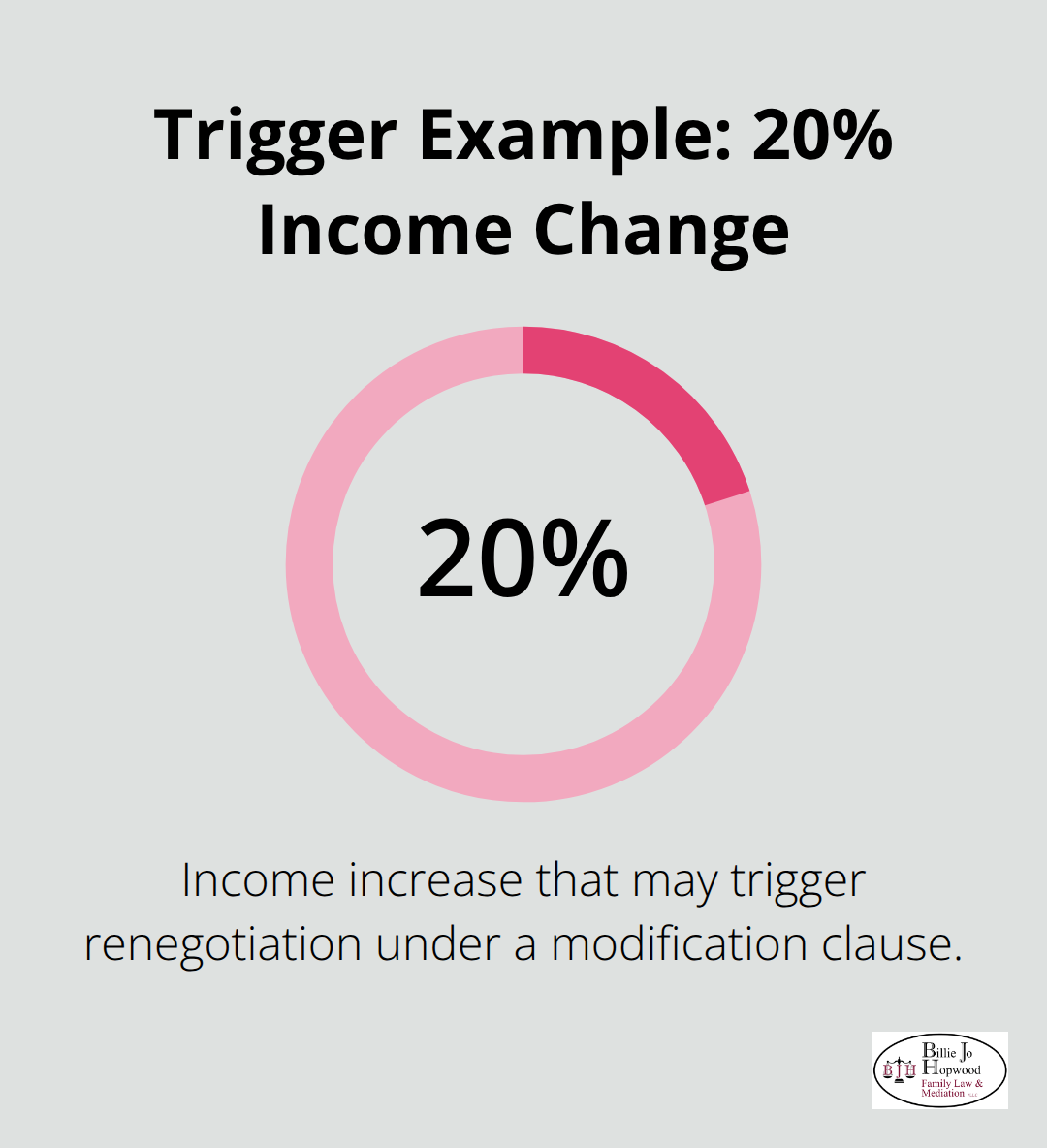
Without these provisions, either party can later claim the agreement no longer works and file a motion to change it, forcing you back to court.
Define exactly how disputes over modifications get resolved, whether through mediation again, arbitration, or court intervention. This forward-planning step eliminates uncertainty and gives both parties a roadmap for handling changes without automatically heading to litigation.
Final Thoughts
Mediation agreement enforceability depends on three actions you must take before signing anything. First, the language in your agreement must be specific enough that a judge can enforce it without guessing what you meant. Second, both parties must have complete financial information and genuine consent without pressure. Third, your agreement needs built-in provisions for how circumstances change over time.
The difference between an agreement that holds up in court and one that crumbles comes down to professional guidance during the drafting stage, not just during mediation itself. A mediator helps you reach consensus, but a family law attorney transforms that consensus into legally enforceable language. Many people think they save money by skipping the attorney review, then spend far more fighting over what their agreement actually means.
Your mediated settlement represents months of difficult conversations and compromise. At Billie Jo Hopwood Family Law & Mediation, PLLC in Melbourne, Florida, we help families navigate mediation agreement enforceability requirements and draft agreements that actually hold up. Contact Billie Jo Hopwood Family Law & Mediation, PLLC to review your mediation agreement or discuss how to approach mediation with enforceability in mind from the start.