
Family conflicts don’t have to end up in court. Mediation for family issues offers a practical path forward when relationships are strained and decisions need to be made.
At Billie Jo Hopwood Family Law & Mediation, PLLC in Melbourne, Florida, we’ve seen how mediation transforms difficult situations into manageable conversations. This guide walks you through when mediation works, what the process looks like, and why many families choose it over litigation.
When Mediation Solves Family Disputes
Divorce and Separation: Taking Control of Your Future
Mediation works best when both parties want to move forward but disagree on the details. Divorce and separation disputes top the list because mediation lets each spouse control the outcome rather than leaving decisions to a judge. Florida is an equitable distribution state, meaning assets and debts acquired during marriage divide fairly-not equally-based on each person’s resources and contributions. Mediation lets couples negotiate this division directly, which means you keep control over how retirement accounts, homes, and debts actually split.
A spouse earning significantly more might reasonably contribute more to shared debts, while a spouse who sacrificed career advancement for childcare can discuss how that factors into asset division. This flexibility disappears in court, where a judge applies the law without knowing your family’s specific circumstances. By promoting cooperation and mutual respect, mediation creates a more positive environment for resolving disputes compared to adversarial court proceedings.
Child Custody and Visitation: Keeping Parents in the Driver’s Seat
Child custody and visitation disagreements are mediation’s sweet spot because parents care deeply about the outcome and want to stay involved in decisions. Courts in Florida increasingly prefer parent-child custody arrangements developed through mediation rather than imposed by judges, because these plans tend to work better for children and parents alike. Mediation also handles property division cleanly by letting you decide which spouse keeps what, rather than watching a judge distribute your belongings.
When you bring financial records, business documents, and a clear picture of shared expenses, the mediator helps you identify what matters most to each person and finds solutions that actually work for your family.
Property Division: Speed and Specificity
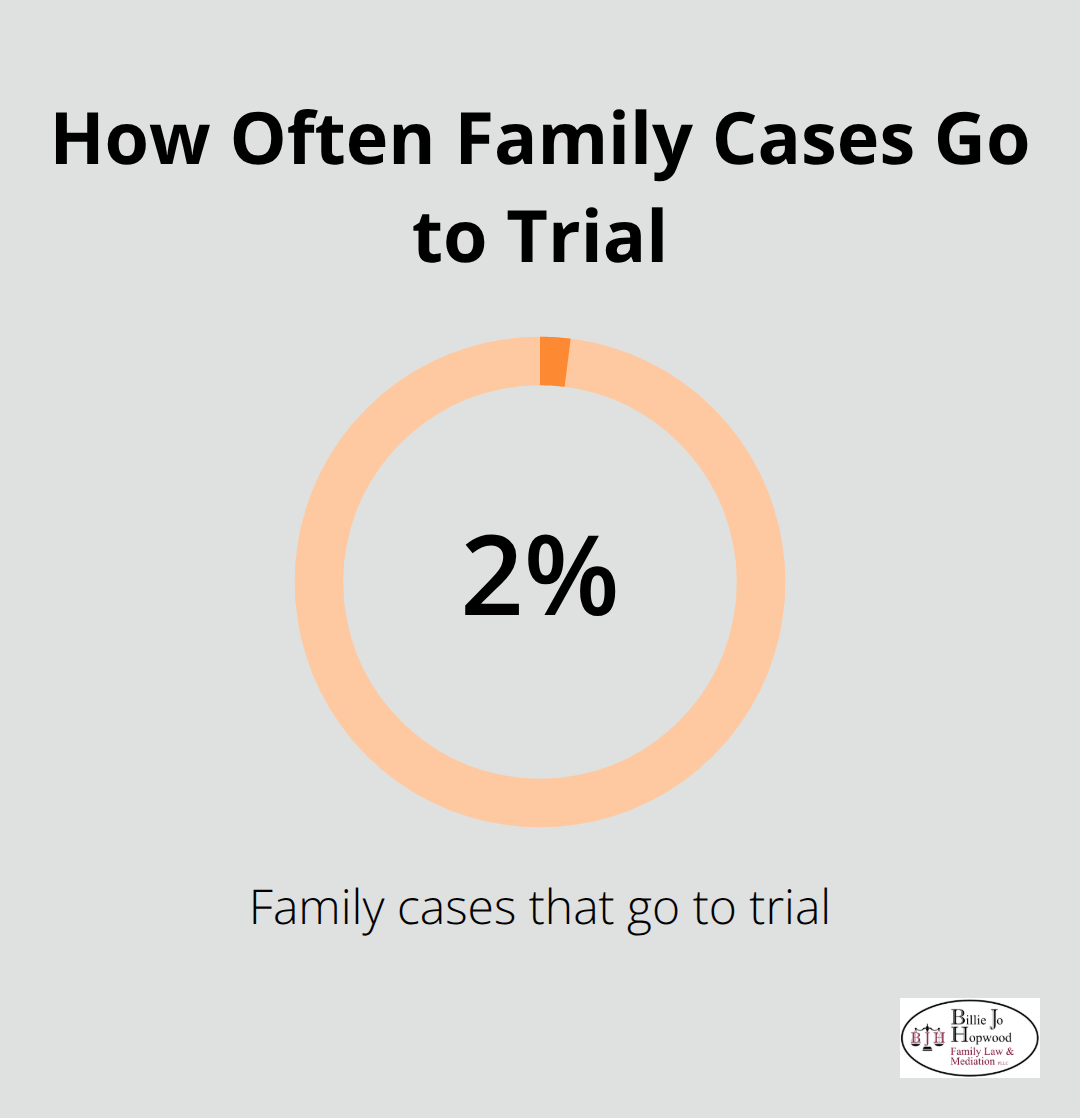
Property disputes resolve faster through mediation because you negotiate directly instead of exchanging court motions for months. Research from court systems shows that under 2% of family cases actually go to trial, which means most families settle anyway-mediation just gets you there faster and at lower cost. The next section walks you through exactly what happens during the mediation process and what you should prepare before your first session.
What Happens During Mediation in Melbourne, Florida
Initial Consultation and Document Preparation
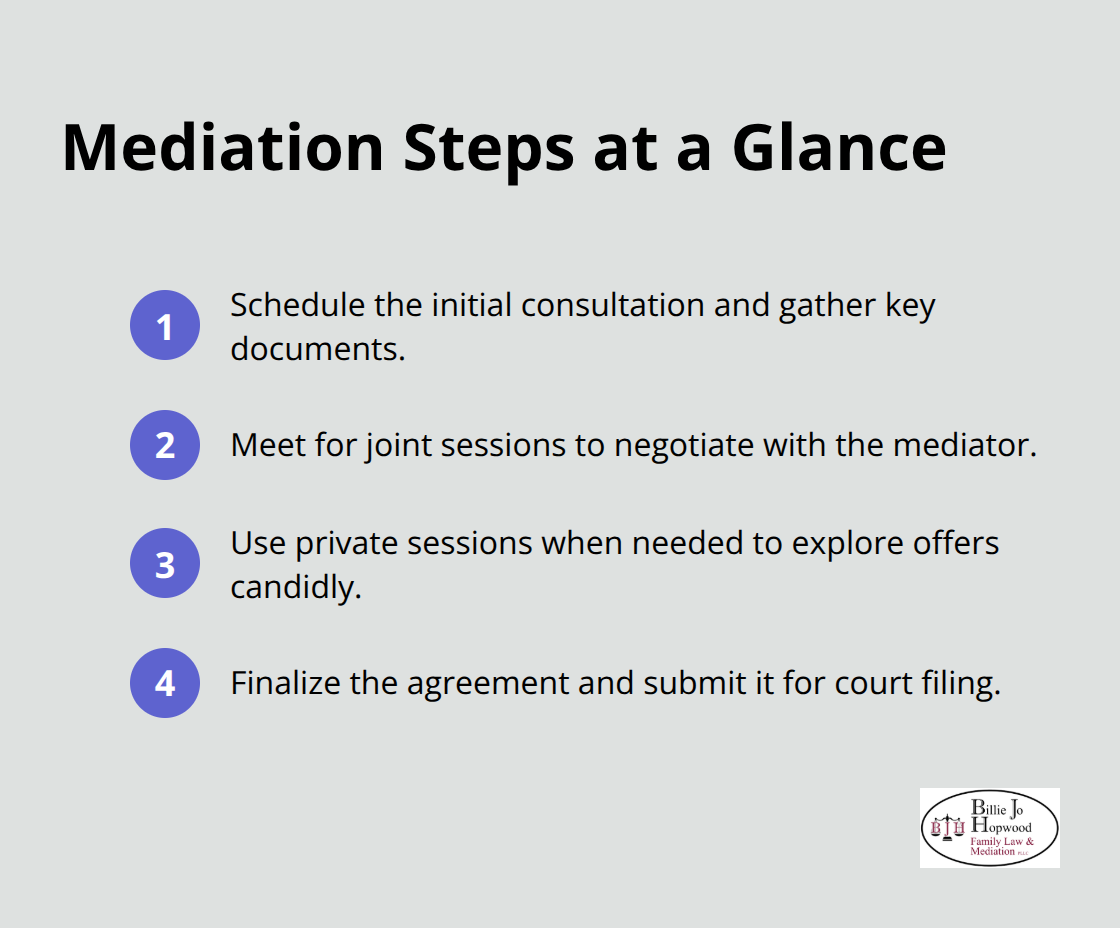
Mediation starts with a clear-eyed assessment of your situation. During your initial consultation, the mediator reviews your financial documents, custody arrangements, and the core issues you need to resolve. Bring tax returns, mortgage statements, retirement account statements, business ownership documents, and anything showing shared debts or assets. The mediator isn’t there to judge who’s right or wrong-they’re there to identify what each person actually needs and find paths forward. This first phase typically takes an hour or two, and many mediators in the Melbourne, Florida area offer flexible scheduling from 9 a.m. to 8 p.m., including weekends, so you don’t have to miss work.
Joint Sessions: Where Negotiation Happens
Once the mediator understands your positions, you’ll move into joint sessions where both parties sit together with the mediator present. This is where real negotiation happens. The mediator keeps the conversation focused, prevents arguments from derailing progress, and helps both sides hear what actually matters to the other person. Don’t expect this to feel comfortable-it won’t always-but structure prevents the conversation from becoming personal attacks.
Private Sessions: Speaking Candidly About Your Limits
If tension rises, the mediator shifts to private sessions, moving between you and the other party to share proposals without everyone in the same room. This shuttle approach works because each side can speak candidly to the mediator about their concerns, their walk-away points, and what they’re willing to compromise on. The mediator carries information back and forth, testing whether movement is possible on specific issues without forcing direct confrontation.
Understanding Costs and Timeline
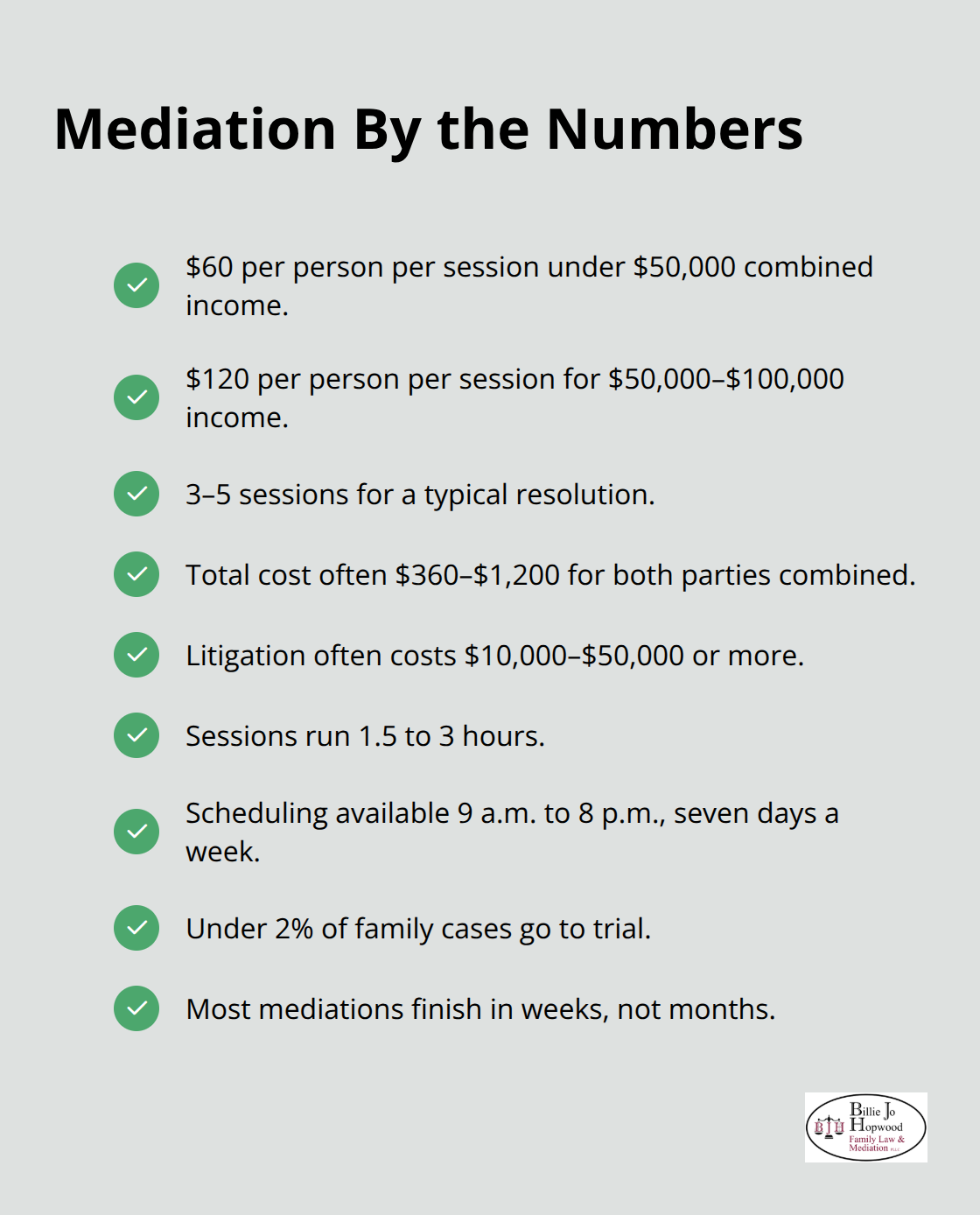
For family mediation in Florida, costs depend on combined household income: under $50,000 total, you pay $60 per person per session; $50,000 to $100,000, you pay $120 per person per session. Sessions typically run 1.5 to 3 hours. The entire process often takes weeks instead of months, and because you controlled the decisions, enforcement tends to go smoother than court-ordered arrangements.
From Agreement to Court Filing
Once both parties reach agreement on the major issues-property split, custody schedule, support amounts-the mediator documents everything in writing. This written agreement becomes your settlement, and you take it to a family law attorney to file with the court. With your mediated agreement in hand, the attorney handles the filing and ensures compliance with Florida law, transforming your negotiated terms into a court-enforceable order.
Advantages of Choosing Mediation Over Court
Lower Costs Compared to Litigation
Litigation devours money and time in ways that blindside families. Court battles involve discovery costs, depositions, multiple attorney appearances, and judge scheduling that stretches cases across months or years. Mediation sidesteps nearly all of this. For a family with combined income under $50,000, you pay $60 per person per mediation session; between $50,000 and $100,000, the cost rises to $120 per person per session. A typical mediation resolves in three to five sessions, putting your total cost between $360 and $1,200 for both parties combined. Litigation routinely costs $10,000 to $50,000 or more because attorneys bill hourly for every motion, every email exchange, and every court appearance.
Court systems report that under 2 percent of family cases actually proceed to trial, which means most families settle anyway-mediation just gets you there without burning through money waiting for a trial date that may never come. Sessions run 1.5 to 3 hours, and mediators in the Melbourne, Florida area offer flexible scheduling from 9 a.m. to 8 p.m. seven days a week, so you don’t lose income taking time off work.
Faster Resolution Timeline
Once you reach agreement through mediation, enforcement works smoother because both parties negotiated the terms directly instead of resisting a judge’s imposed order. That cooperation translates to fewer post-settlement disputes and fewer follow-up attorney consultations to handle violations or modifications. The entire process often takes weeks instead of months, and because you controlled the decisions, your agreement actually functions in real life.
Greater Control Over Outcomes
A judge applies the law mechanically; you apply common sense and knowledge of your actual circumstances. If one spouse spent fifteen years as a stay-at-home parent while the other built a career, mediation lets you factor that sacrifice into asset division and support calculations in ways that reflect your values. In court, the judge sees a balance sheet and income figures, not the reality of your family’s choices.
Child custody arrangements developed through mediation tend to work better because parents design schedules around their children’s actual needs and their own realistic availability, rather than following a template the judge imposed. When you control property division decisions, you keep the assets that matter most to you and trade away items the other person values more (one spouse keeps the house and the other gets retirement accounts, or you split everything differently). That flexibility means your agreement actually functions in real life instead of creating resentment and conflict that leads to modification battles down the road.
Final Thoughts
Mediation for family issues works because it puts decisions back in your hands instead of leaving them to a judge who doesn’t know your family. Families spend $360 to $1,200 total on mediation compared to $10,000 to $50,000 or more on litigation, and most mediations resolve in weeks rather than months. You keep control over outcomes that matter most: how assets split, what custody schedule works for your children, and how support gets calculated based on your actual circumstances rather than a judge’s formula.
Mediation isn’t suitable when domestic violence, controlling behavior, or serious trust issues are present, but for most families dealing with divorce, custody, or property disputes, it offers a faster, more affordable path forward. The process respects both parties’ need to be heard while keeping focus on practical solutions that actually work in real life. Because you negotiated the terms directly, enforcement tends to go smoothly without follow-up disputes.
Contact Billie Jo Hopwood Family Law & Mediation, PLLC in Melbourne, Florida to discuss whether mediation fits your situation and what the next steps look like for your family.