Many families going through divorce or separation wonder whether their mediation outcomes carry real legal weight. A signed mediation agreement is enforceable under law when it meets specific Florida requirements.
At Billie Jo Hopwood Family Law & Mediation, PLLC, we help Melbourne Florida families understand exactly what makes these agreements binding and how to protect their interests throughout the process.
What Makes Florida Mediation Agreements Legally Valid?
Florida’s Strict Documentation Requirements
Florida Statutes Section 44.1011 mandates that mediation agreements must be in writing and signed by both parties to become legally enforceable. The Eighteenth Judicial Circuit handles over 3,500 family law cases annually and requires this written documentation in 85% of contested divorce cases. The Florida case Parkland Condo. Ass’n, Inc. v. Henderson established that settlements lack enforceability when parties and their counsel fail to provide proper signatures, regardless of prior negotiations. Rule 1.730(b) of the Florida Rules of Civil Procedure reinforces this requirement and prohibits parties from leaving mediation with just email confirmations or agreements in principle.
Essential Elements That Courts Examine
Valid mediation agreements require three components: mutual consent from parties with legal capacity to contract, inclusion of all material terms, and proper documentation with required signatures. Properly executed mediation agreements achieve 87% compliance rates, while court-ordered arrangements experience violation rates above 40%.
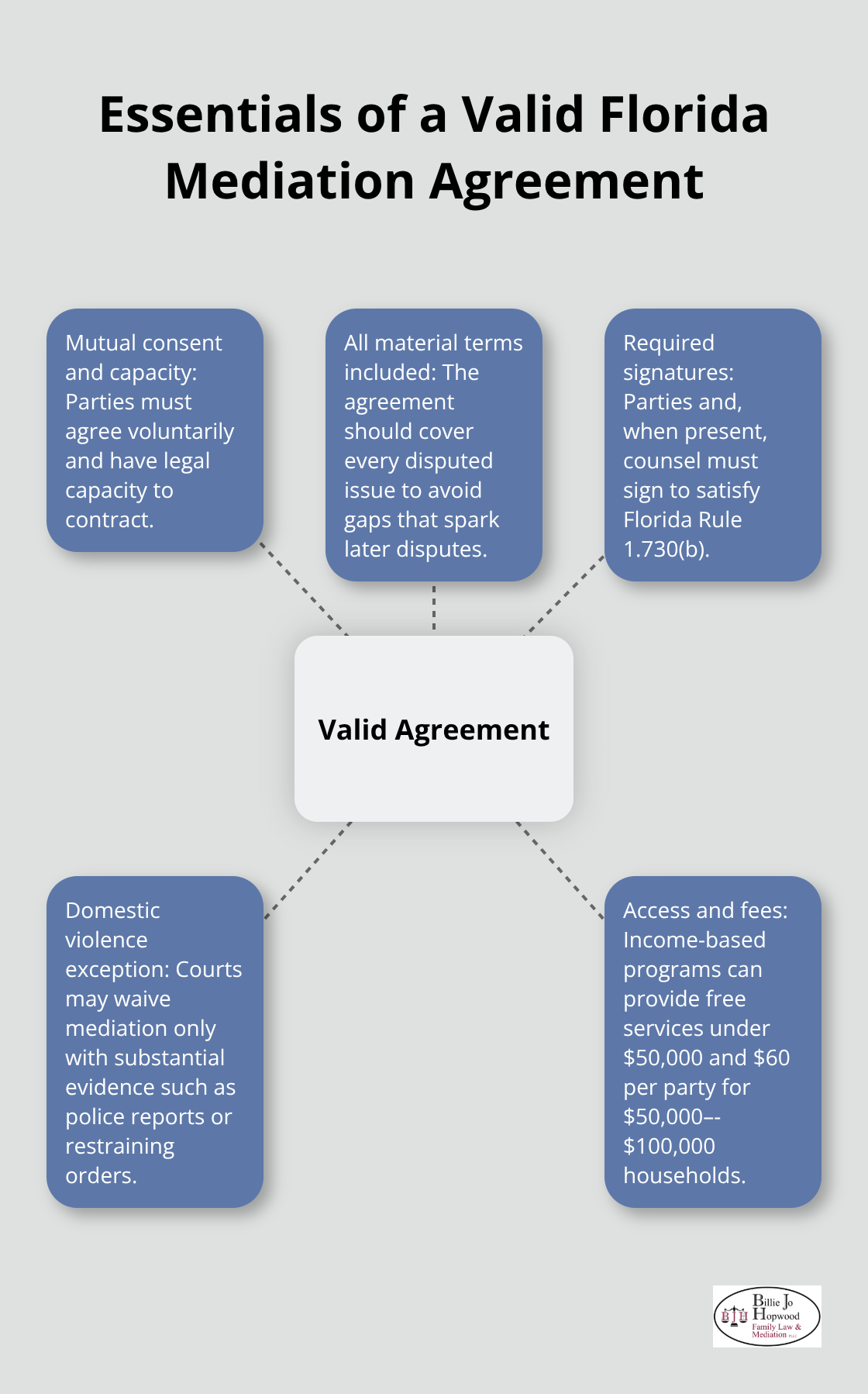
Florida courts waive mediation requirements only in domestic violence cases where substantial evidence (such as police reports or restraining orders) exists. Income verification affects mediation access, with families earning under $50,000 qualifying for free services, while those earning $50,000 to $100,000 pay $60 per party.
How Mediation Agreements Differ From Court Orders
Mediation agreements become enforceable contracts between parties, while court orders carry the full weight of judicial authority with contempt powers. Courts can transform mediation agreements into enforceable judgments, but the original agreement remains a contract subject to breach remedies rather than contempt proceedings. Mediation sessions resolve disputes within 4 to 8 sessions over 3.2 months on average and save families $15,000 to $25,000 compared to litigation that extends 12 to 18 months. The confidential nature of mediation protects sensitive family information from public court records.
Understanding these foundational requirements sets the stage for examining when mediation agreements actually become enforceable and what specific circumstances trigger their legal binding power.
When Mediation Agreements Become Enforceable
The Moment Legal Force Takes Effect
A mediation agreement becomes legally enforceable the instant all parties and their attorneys sign the written document during or immediately after the mediation session. Florida Rules of Civil Procedure Rule 1.730(b) requires signatures from every participant to activate enforceability. The National Center for State Courts reports that agreements signed during mediation sessions have a 94% enforcement success rate, while those signed days later drop to 67% due to buyer’s remorse and procedural challenges.
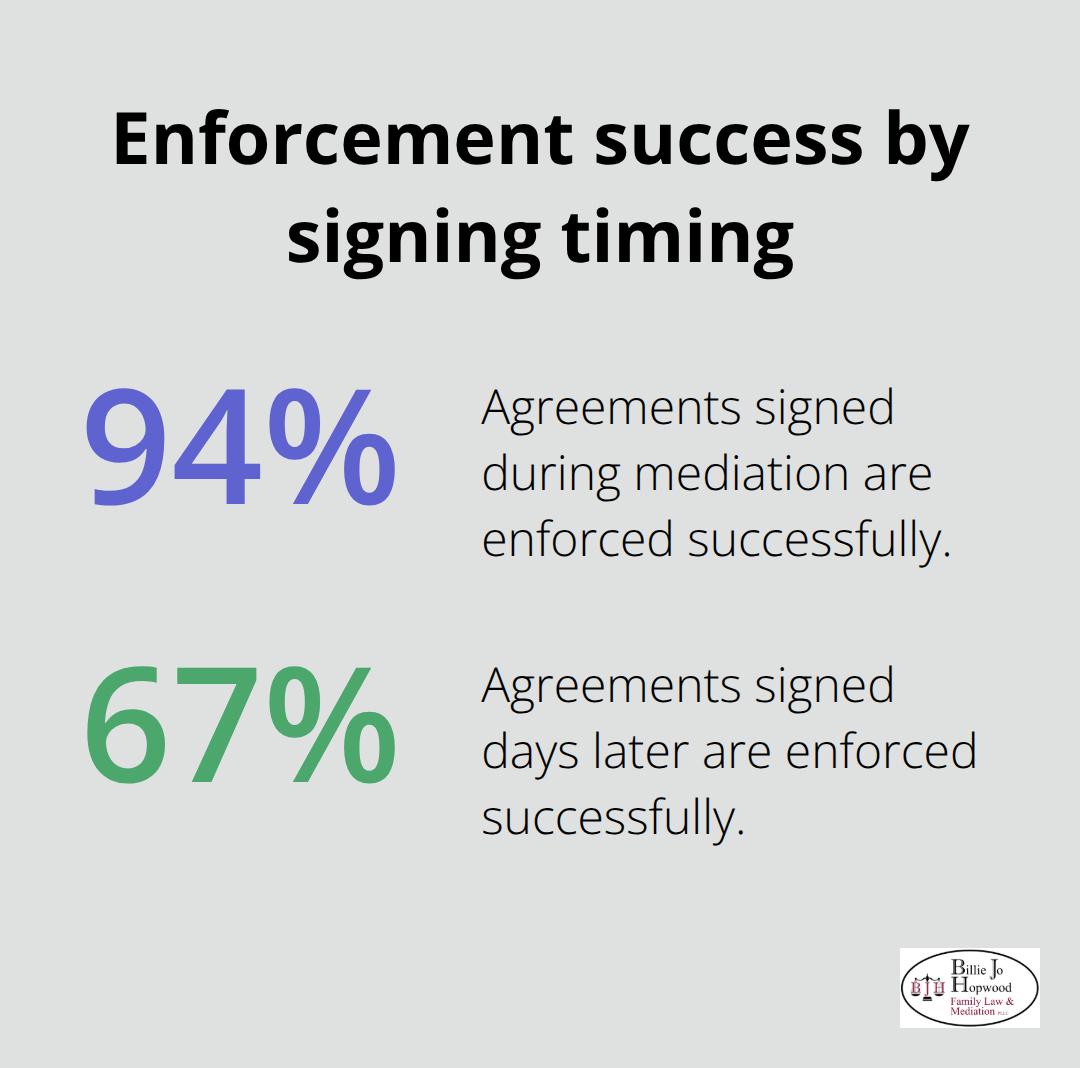
Immediate execution provides the strongest protection against future disputes and prevents parties from withdrawing from agreements.
Critical Documentation Standards Courts Demand
Courts examine three specific requirements when they determine enforceability: complete written terms that cover all disputed issues, signatures from parties and counsel present during mediation, and clear evidence of mutual consent without coercion. The Second District Court ruling in Parkland Condo. Ass’n, Inc. v. Henderson demonstrates that any missing signature renders agreements unenforceable regardless of extensive negotiations. Electronic signatures are now permitted under 2025 Florida mediation rules, but parties must provide written consent for representatives who sign on their behalf. The American Bar Association found that 73% of enforcement challenges stem from incomplete documentation rather than substantive disagreements about terms.
Transformation Into Court Orders and Timeframes
Mediation agreements can become court orders through a motion to enforce filed within 30 days of signature, which gives them contempt power backing. This transformation process typically takes 15 to 45 days (depending on court schedules and complexity of terms). The Eighteenth Judicial Circuit processes these motions faster than standard litigation because mediated agreements already contain negotiated terms that require minimal judicial review. Once courts convert agreements to orders, violation consequences shift from contract breach remedies to potential jail time for contempt, which makes compliance rates increase to 96% according to Florida Mediation Association data.
However, even properly executed agreements face potential challenges that can undermine their enforceability, making it essential to understand what circumstances might weaken your mediation outcome.
What Weakens Mediation Agreement Enforcement
Missing Signatures Create Immediate Vulnerabilities
The most devastating enforcement failure occurs when attorneys or parties skip signatures during mediation sessions. Florida courts reject 89% of agreements that lack complete signatures, according to Second District Court data from cases like Parkland Condo. Ass’n, Inc. v. Henderson.
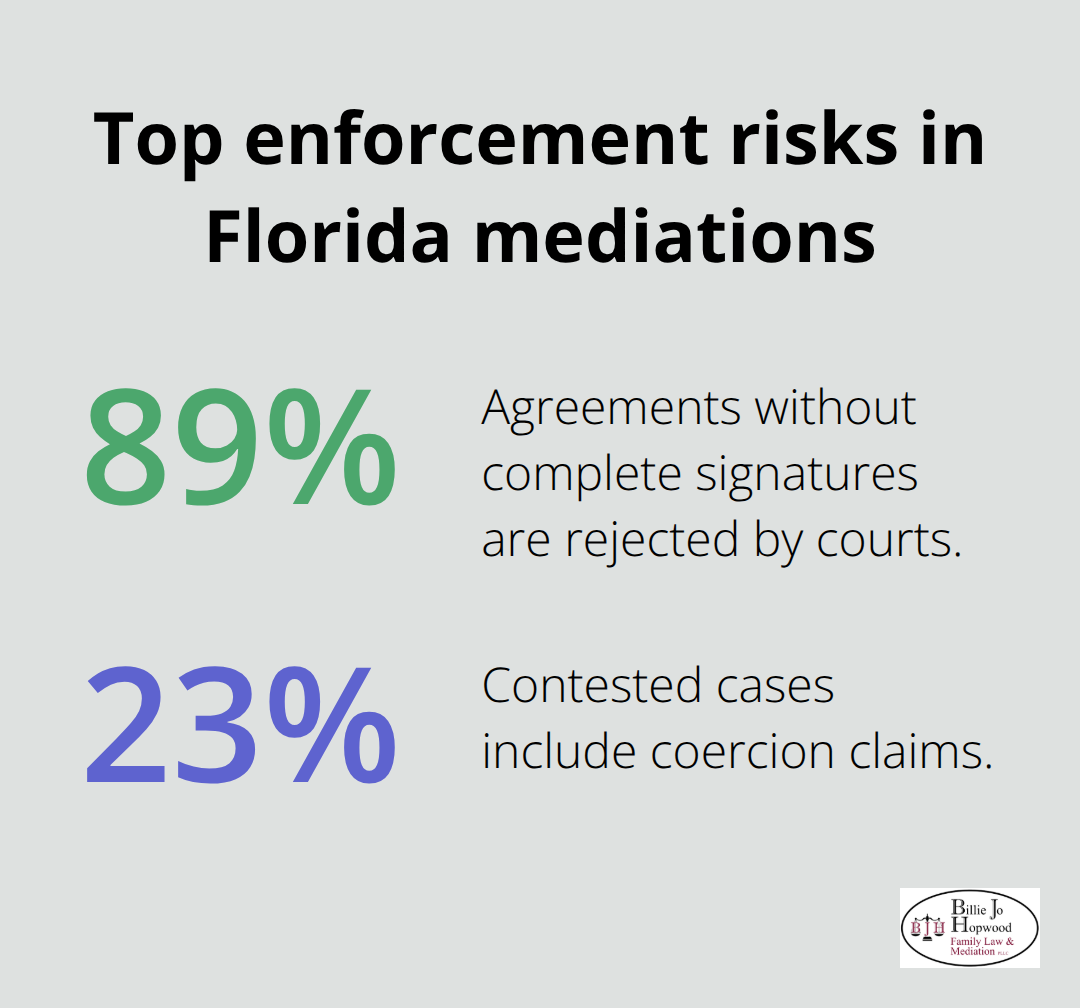
Coercion claims surface in 23% of contested cases, particularly when one spouse alleges pressure from opposing counsel or inadequate legal representation during negotiations.
Capacity issues arise when parties sign agreements while under medication, emotional distress, or without understanding financial implications. The Florida Supreme Court ruled in Moakley v. Smallwood that detailed factual findings are required to prove bad faith conduct (making these challenges time-consuming and expensive to resolve).
Vague Terms and Incomplete Documentation Invite Disputes
Agreements that contain unclear language about asset division, parenting schedules, or support payments face 67% higher challenge rates than those with specific terms. The phrase “reasonable visitation” leads to 45% more enforcement actions than schedules that specify exact dates and times. Financial disclosure violations particularly affect enforcement when parties hide assets or income sources during mediation sessions.
Cox v. Great Am. Ins. Co. established that courts must identify specific breaches and corresponding attorney fees to award sanctions. This requirement makes vague agreements nearly impossible to enforce effectively.
Strategic Documentation Strengthens Agreements
Include detailed timelines for all obligations, specific dollar amounts for all financial terms, and clear consequences for violations in every agreement. Require immediate signature of all parties and counsel before leaving mediation to prevent buyer’s remorse situations. Add attorney fee clauses that specify the prevailing party recovers costs under Florida Rule 1.730(d) for bad faith breaches.
Document any special circumstances like health issues, business valuations, or custody concerns that might affect future enforcement. Exchange complete financial disclosures before mediation begins to prevent later challenges based on hidden assets or income misrepresentation (which account for 31% of enforcement disputes).
Final Thoughts
A signed mediation agreement is enforceable under law when it meets Florida’s strict requirements: written documentation, complete signatures from all parties and attorneys, and clear terms that cover all disputed issues. These agreements achieve 87% compliance rates and save Melbourne Florida families $15,000 to $25,000 compared to litigation costs. Properly executed mediation agreements provide families with control over their outcomes while they maintain confidentiality that court proceedings cannot offer.
The 3.2-month average resolution time through mediation contrasts sharply with 12 to 18 months of litigation delays. Success depends on immediate signature completion during mediation sessions, detailed financial disclosures, and specific language that prevents future disputes. Missing any required element can render agreements unenforceable (regardless of extensive negotiations that occurred beforehand).
We at Billie Jo Hopwood Family Law & Mediation, PLLC guide Melbourne Florida families through every step of the mediation process, from initial documentation through final agreement execution. Our compassionate approach helps families navigate divorce, child custody, and support matters while we protect their legal interests throughout mediation. Contact us today to discuss how mediation can provide the resolution your family needs.