
Court-ordered mediation can feel overwhelming when you’re facing a family law case. The good news is that this process often leads to faster resolutions and lower costs than traditional litigation.
At Billie Jo Hopwood Family Law & Mediation, PLLC, we’ve guided countless clients through court-ordered mediation and helped them understand what to expect. This guide walks you through how the process works, its real benefits, and how to prepare effectively.
How Court-Ordered Mediation Works
What the Judge’s Order Means
When a judge orders mediation in your family law case, you receive a court order that directs you to attend a mediation session before your trial date. This order is not optional-you must participate. The court recognizes that mediation often resolves disputes faster and at lower cost than litigation, which is why judges frequently mandate it early in the process.
The Mediator’s Role and Training
The mediator is a trained mental health professional who understands child development, family dynamics, and the effects of separation. During the session, the mediator meets with both you and the other parent to listen to each side’s concerns and help you develop an agreement on parenting time and custody decisions. The mediator remains neutral and does not take sides. Mediation focuses specifically on custody, visitation, and related parenting issues-not on child support, spousal support, or evidence against the other parent.
What Happens in the Session
Most mediation sessions last up to two hours. The mediator may hold confidential individual meetings with each party to explore options and facilitate negotiation without the other parent present. If you have safety concerns due to domestic violence, tell the mediator immediately so separate rooms or different session times can be arranged. Sessions are confidential under Florida Statutes Chapter 44, meaning discussions are privileged and generally cannot be used as evidence in court.
Building Your Parenting Plan
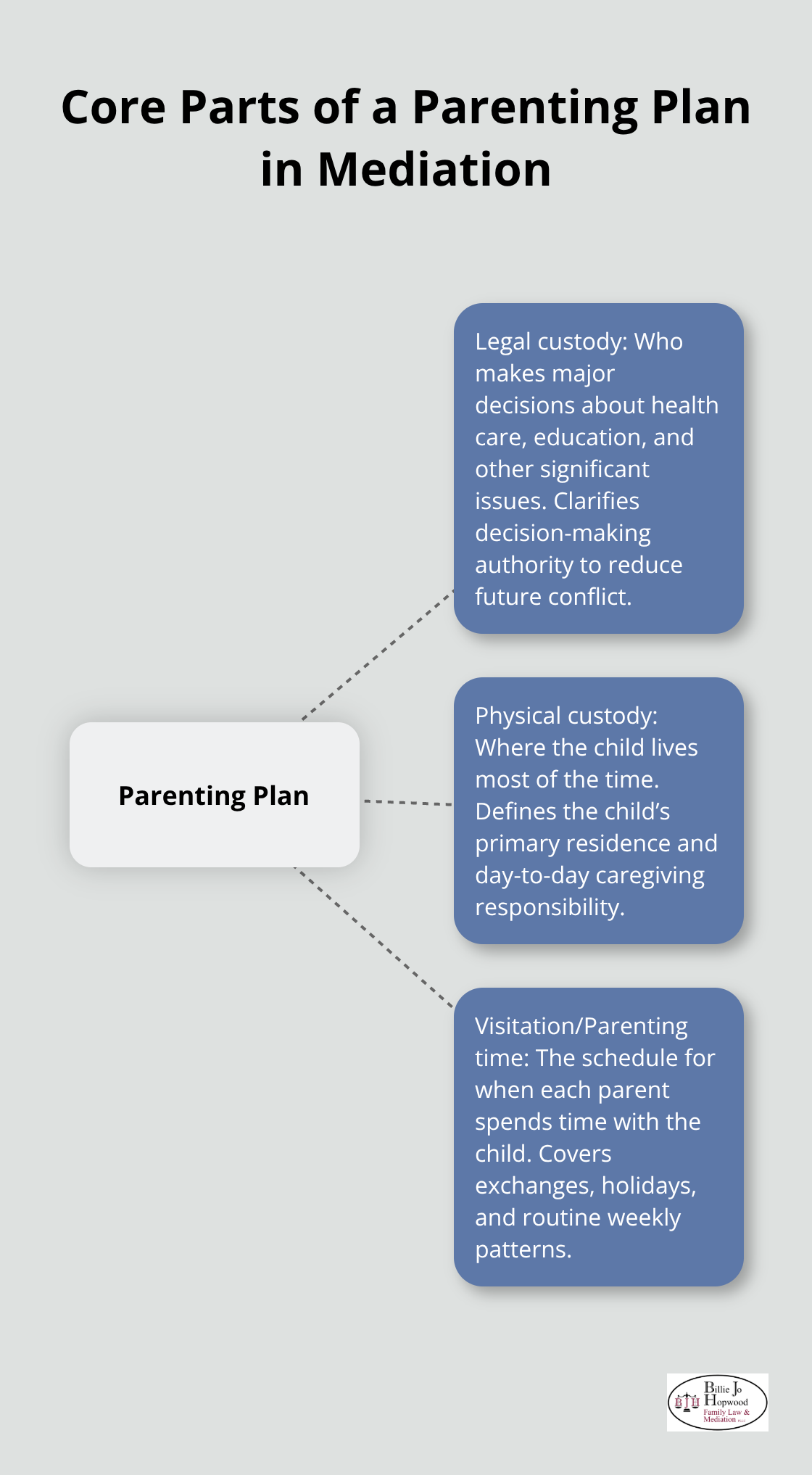
A parenting plan developed during mediation addresses three core areas: legal custody (who makes major decisions about health care and education), physical custody (where the child lives most of the time), and visitation or parenting time schedules. Within 15 days of receiving the court order for mediation, you and the other parent can negotiate with a private mediator if you both agree on one. If you cannot agree on a private mediator, the court’s mediation division will be assigned.
Costs and What Happens Next
The cost of in-house mediation is split equally between parties based on combined income-up to $50,000 combined income costs $60 per person per two-hour session, while $50,000 to $100,000 combined income costs $120 per person per two-hour session. Income above $100,000 makes you ineligible for in-house mediation, though you can hire a private mediator instead.

Indigent parties mediate for free after completing an Affidavit of Indigency with the Clerk’s Office. Once you reach an agreement, it goes in writing and is submitted to the judge for approval. The agreement becomes legally binding only after the judge approves it and issues a court order-until then, it remains an agreement in principle. If you don’t reach an agreement, the judge will decide custody and visitation, which can happen the same day or require you to return to court.
Why Court-Ordered Mediation Saves Time and Money
The Real Cost Difference Between Mediation and Litigation
Court-ordered mediation cuts your family law costs dramatically compared to litigation. In-house mediation in Florida runs $60 to $120 per person per two-hour session depending on your combined household income, while private litigation easily costs $5,000 to $15,000 or more once attorney fees, court costs, and expert witnesses accumulate. A contested custody trial requires multiple court appearances, depositions, document discovery, and potentially psychological evaluations-each adding weeks to your case and hundreds of dollars in fees. Mediation compresses this timeline. Most sessions conclude in one or two meetings, meaning you avoid the back-and-forth scheduling that stretches litigation across months or years.
How Mediation Accelerates Your Case Resolution
If you reach an agreement in mediation, the judge approves it and issues a court order within days. If you don’t reach agreement, you proceed to trial, but you’ve still narrowed the disputed issues, which reduces trial time and costs. The confidentiality of mediation also protects your privacy-nothing discussed leaks into public court records, which matters when sensitive family details are at stake. You control the outcome instead of handing that power to a judge who knows nothing about your family’s unique needs.
Creating Flexible Solutions That Courts Cannot Offer
Mediation gives you flexibility that courtrooms cannot. A judge decides custody and visitation based on legal standards, but your parenting plan in mediation can reflect creative solutions tailored to your children’s schedules, your work demands, and your family’s actual circumstances. You might arrange alternating weeks, split weeks, or a schedule that adjusts seasonally-options a judge would never consider because the courtroom operates within rigid frameworks. This control extends to the tone of your agreement.
Building Cooperation for Your Children’s Benefit
Mediation encourages cooperation and communication between parents, which research shows directly benefits children’s adjustment after separation. Studies consistently demonstrate that children fare better when parents maintain low conflict and work together on parenting decisions, something litigation actively undermines by positioning parents as adversaries. When you walk out of mediation with an agreement you both crafted, you’ve already begun the collaborative parenting relationship your children need. That foundation matters far more than winning arguments in front of a judge, and it sets the stage for the practical steps you’ll take to prepare for your mediation session.
Preparing for Your Court-Ordered Mediation Session
Gather Documents That Strengthen Your Position
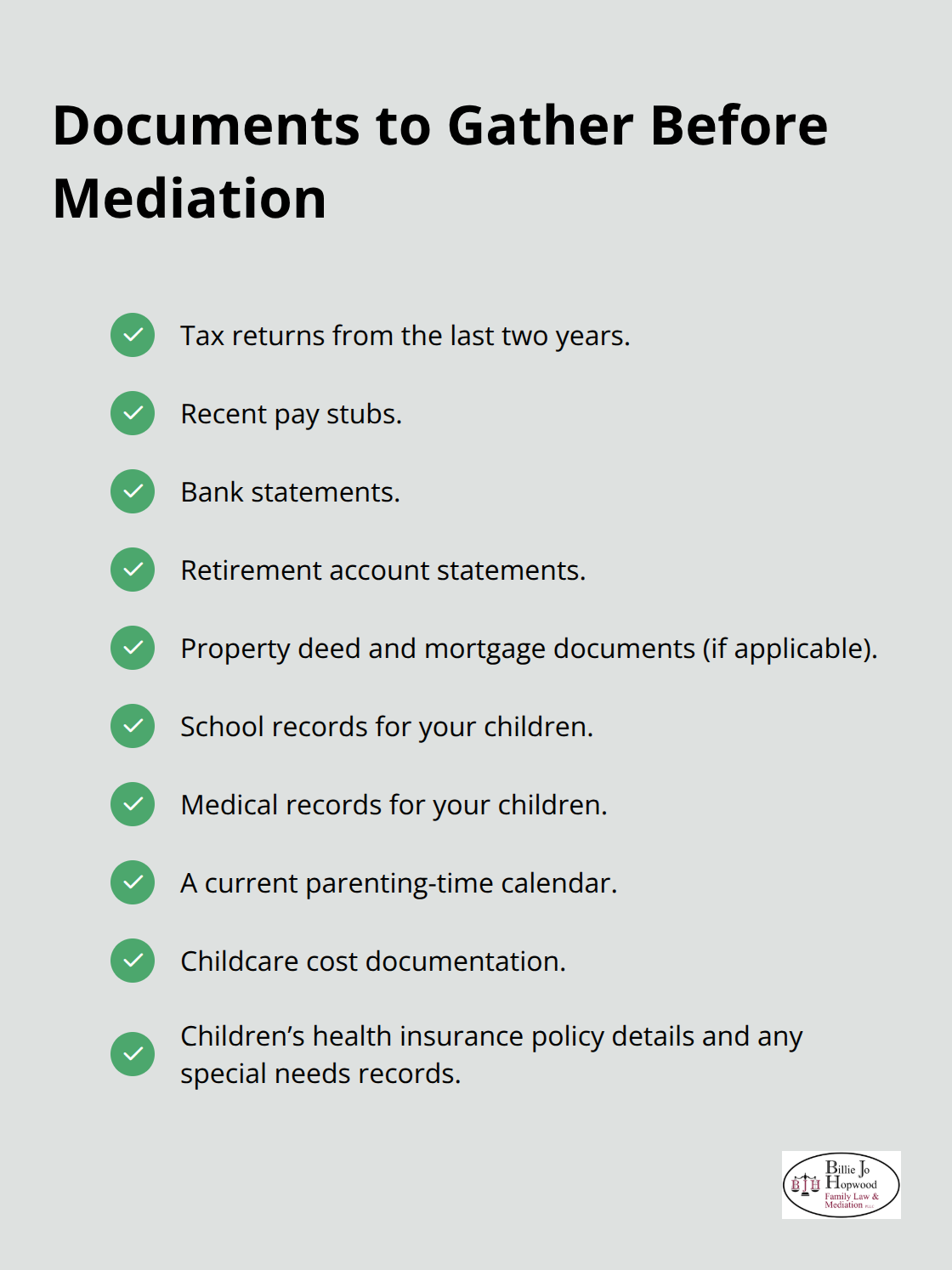
Preparation separates clients who walk out with solid agreements from those who feel blindsided. Start collecting financial documents now-tax returns from the last two years, pay stubs, bank statements, and retirement account statements. The mediator won’t review these in detail like a judge would, but knowing your numbers cold prevents you from making concessions based on guesses. If you own property, pull the deed and any mortgage documents. For child-related issues, compile school records, medical records, and a calendar showing your current parenting time. Most clients underestimate how specific they need to be about schedules. Instead of saying you see the kids on weekends, write down the exact days and times you currently have them.
The mediator uses this baseline to build your parenting plan.
Bring documentation of childcare costs, health insurance policy details covering your children, and records of any special needs or ongoing medical treatment your children receive. This matters because parenting plans must account for who manages appointments and decisions. One critical document people forget: a list of questions for the mediator about how your specific situation will be handled. Organizing documents in a binder with clear tabs helps you reference them quickly during mediation sessions.
Work With Your Attorney Before You Enter Mediation
Your attorney should meet with you before mediation to review your realistic goals and walk through what to expect in the room. This conversation prevents you from making emotionally driven decisions that harm your long-term interests. Tell your attorney what outcome you actually want, not what sounds good in theory. If you need to maintain a flexible work schedule to parent, say that. If you cannot afford to pay substantial child support, discuss it now rather than discovering it during mediation.
Your attorney can advise on what concessions are negotiable and which ones protect your fundamental interests. Many clients arrive at mediation without clear priorities, which leads to unfavorable agreements they regret later. You need to know whether you prefer primary physical custody, shared parenting time, or something in between. You need to understand how child support calculations work in Florida so you recognize a fair offer when you hear one. Do not walk into mediation unprepared on these points.
Understand Your Leverage and Limitations
If the other parent brings an attorney and you do not, you face a disadvantage. You don’t need an attorney present in the mediation room itself-mediators cannot provide legal advice, and their role is to stay neutral-but having one available by phone during breaks gives you real-time guidance when unexpected proposals emerge. Set realistic expectations about what mediation can resolve. It handles custody, visitation, and parenting decisions only. It does not cover child support, spousal support, or property division unless both parties agree to expand the scope. If your case involves disputed assets or alimony, mediation alone will not settle everything, and you’ll need either separate negotiation or litigation on those points.
Final Thoughts
Court-ordered mediation fundamentally changes how your family law case unfolds. Instead of spending months in litigation with mounting attorney fees and court appearances, you move through a structured process designed to produce agreements faster and at a fraction of the cost. The mediator facilitates communication between you and the other parent, helping you build a parenting plan that actually works for your family rather than one imposed by a judge who has never met your children.
If you reach an agreement, the judge approves it and issues a court order within days, giving you certainty and closure. If you don’t reach full agreement, you’ve still narrowed the disputed issues, which reduces what remains to be litigated. Either way, you’ve avoided the adversarial posturing that damages co-parenting relationships long after the case ends, and your children benefit from parents who learned to negotiate rather than fight.
We at Billie Jo Hopwood Family Law & Mediation, PLLC understand that court-ordered mediation raises questions specific to your situation. Our firm in Melbourne, Florida assists families through family law matters including custody, divorce, and support issues. Contact us to discuss how we can help you navigate this critical phase of your case.