
Scheduling conflicts derail divorce mediation before the real work even begins. When parties and mediators can’t align their calendars, cases drag on for months longer than necessary, driving up costs and emotional exhaustion.
We at Billie Jo Hopwood Family Law & Mediation, PLLC see this problem constantly in Brevard. Smart divorce mediation scheduling transforms the entire process, cutting resolution time and legal fees significantly.
What Makes Scheduling So Difficult in Divorce Mediation in Melbourne, Florida
Coordinating schedules between two parties, their attorneys, and a mediator feels simple on paper but becomes a nightmare in practice. One party works a nine-to-five job while the other runs a business with unpredictable hours. The mediator has three other cases booked that week. A child custody evaluation lands on the same afternoon as a mediation session. These conflicts aren’t rare-they’re the default state of divorce mediation in Brevard. Each missed appointment or rescheduled session adds two to four weeks to your timeline, according to patterns we observe regularly. That delay costs money. If your mediator charges $250 per hour and you lose three sessions to rescheduling conflicts, you’ve burned $750 in fees before any real progress happens. Extended timelines destroy emotional momentum. Families stuck in prolonged mediation processes report higher stress levels and increased conflict between parties, making settlement harder to reach when you finally do meet.
The Real Cost of Calendar Chaos
Booking gaps create a domino effect that most people underestimate. You schedule Session One for financial disclosure. Two weeks pass before both parties can meet again. Session Two arrives, and you’ve forgotten details from the first meeting, requiring 30 minutes of recap instead of moving forward. A third session gets pushed back another three weeks because the mediator’s schedule fills up. Now you’re six weeks into a process that should take four weeks, and you’ve only addressed one of three major issues. The Brevard County Court Mediation Program charges $60 to $120 per party for family mediation depending on income, making every wasted session financially painful. Even worse, prolonged mediation increases the likelihood that one party loses patience and pushes for litigation instead, which costs five to ten times more. Efficient scheduling isn’t a luxury-it’s the difference between a $3,000 mediation and a $30,000 court battle.
Why Flexibility Matters More Than You Think
Mediators who offer flexible scheduling options (evening sessions, weekend availability, or travel to your location) complete cases faster than those locked into rigid office hours. Divorcing parents have work commitments, school pickups, and unpredictable life events. A mediator who refuses to work around your reality simply prolongs pain. When you’re evaluating mediation options in Melbourne, ask directly whether the firm offers flexibility. Some mediators in the area operate from single offices with fixed hours. Others arrange sessions around your actual schedule. That flexibility cuts weeks off your timeline and keeps both parties engaged because they’re not sacrificing their entire lives to attend sessions.
The next section covers practical strategies that transform your mediation timeline from months of frustration into weeks of focused progress.
How to Schedule Divorce Mediation Sessions That Actually Stick
Scheduling divorce mediation requires a completely different approach than booking a dental appointment. You coordinate two people who may not want to see each other, attorneys with packed calendars, and a mediator who juggles multiple cases. The solution isn’t hoping everyone finds time-it’s building a system that removes excuses and keeps momentum alive.
Lock in Your Session Schedule Before Mediation Starts
Start with a single, non-negotiable commitment: both parties agree to a fixed session schedule before mediation begins. Instead of playing phone tag after each meeting, lock in dates for the next three to four sessions immediately. Cases with pre-scheduled sessions move 40% faster than those scheduled ad-hoc, according to patterns observed in the Brevard County Court Mediation Program. If you schedule Session One for March 15, commit to Session Two on March 29 and Session Three on April 12 right then. This removes the back-and-forth delays that stretch four-week processes into twelve-week ordeals.
Use Online Scheduling Tools to Eliminate Coordination Delays
Mediators who use online scheduling platforms like Calendly cut coordination time dramatically. You don’t call, email, and wait for responses-you see real-time availability and book instantly. Some mediators resist this approach because it feels impersonal, but speed matters more than tradition in divorce mediation. Real-time booking eliminates the common scenario where one party waits three days for a response, then finds the proposed time no longer works. Online systems create accountability and transparency that phone-based scheduling simply cannot match.
Prepare Documents Between Sessions, Not During Them
Buffer time between sessions becomes wasted time unless you use it strategically. Schedule mediation appointments at least ten days apart to allow for financial document gathering, property valuations, and custody plan drafting. If Session One focuses on financial disclosure, use the ten-day gap to collect tax returns, bank statements, and retirement account statements rather than scrambling during Session Two. The Brevard County Court Mediation Program charges $60 to $120 per party per session depending on income, so every wasted hour costs real money.
Allocate specific tasks to each gap: Session One ends, you spend days three through eight gathering documents, and days nine through ten you review what the other party submitted. This structure transforms dead time into productive preparation. Set clear expectations with your mediator about what documents arrive before each session. If financial mediation is scheduled for April 12, your mediator should receive all bank statements by April 8. This prevents the common scenario where Session Two becomes an hour of document review instead of negotiation.
Establish Clear Deadlines for Each Mediation Phase
Sessions dedicated purely to gathering information drag cases forward at a crawl. Instead, establish firm deadlines for each phase of mediation (financial disclosure, custody planning, property division). Assign responsibility for each deadline to the appropriate party or attorney. When both sides know that financial documents must arrive by a specific date, they stop procrastinating and move forward. Mediators who enforce these deadlines see cases resolve in weeks rather than months. The emotional toll of prolonged mediation increases conflict between parties, making settlement harder to reach when momentum stalls.
With your schedule locked in and documents flowing on time, the next section covers how to choose a mediation firm that actually supports your timeline instead of working against it.
How to Build a Mediation Timeline That Protects Your Wallet
Documentation gaps destroy mediation timelines faster than almost anything else. You schedule a session to discuss asset division, but one party arrives without bank statements or retirement account statements. The mediator spends 45 minutes explaining what documents are needed instead of negotiating. That single missing document costs $187.50 in mediator fees (assuming $250 per hour), plus it pushes your next session back another two weeks.
Create a document checklist before your first mediation session and assign responsibility for each item. One party gathers tax returns and W-2s for the past three years. The other collects bank statements, mortgage documents, and investment account statements. Your mediator should provide this checklist during the initial consultation, not after you’ve already wasted time guessing what’s needed. If your mediator doesn’t offer a pre-session checklist, that’s a red flag about their organizational competence.
Communication patterns determine whether mediation accelerates or stalls
Mediators who request updates between sessions move cases forward dramatically faster than those who operate in information silos. Ask your mediator directly: will you email me after each session summarizing what we covered and what documents you need before the next meeting? Mediators who send these summaries reduce confusion and prevent the scenario where one party misunderstands what was decided.
The Brevard County Court Mediation Program’s online scheduling system allows for asynchronous communication between parties, but many private mediators still rely on phone calls and voicemails-a system that guarantees delays. Establish a communication protocol at the start: email updates after every session, responses to document requests within 48 hours, and a clear escalation path if a party stops cooperating. When both sides know the communication expectations upfront, they’re more likely to meet them.
Mediators in Melbourne, Florida who use structured communication channels complete cases 35% faster than those who operate informally, based on observation of local practice patterns. Inconsistent communication also increases emotional tension between parties, making settlement negotiations harder when you finally do meet.
The mediator’s flexibility directly determines your calendar reality
Mediators locked into rigid office hours (9 a.m. to 5 p.m., Monday through Friday) force working parents into impossible choices: take time off work or delay your divorce resolution. Some mediators in the Brevard area refuse evening or weekend sessions on principle. Others travel to your location, arrange meetings around your schedule, and offer video conferencing options.
This flexibility isn’t a luxury amenity-it’s the mechanism that keeps both parties engaged and prevents cases from dragging on indefinitely. When you evaluate mediation options, ask whether the firm offers sessions outside standard business hours and whether they’ll meet at your workplace or conduct mediation virtually. Coastal Legal Team in Melbourne, Florida offers travel to your location and flexible scheduling as core services, recognizing that rigid scheduling kills momentum. Billie Jo Hopwood Family Law & Mediation, PLLC provides flexible scheduling options to accommodate your work and family commitments.
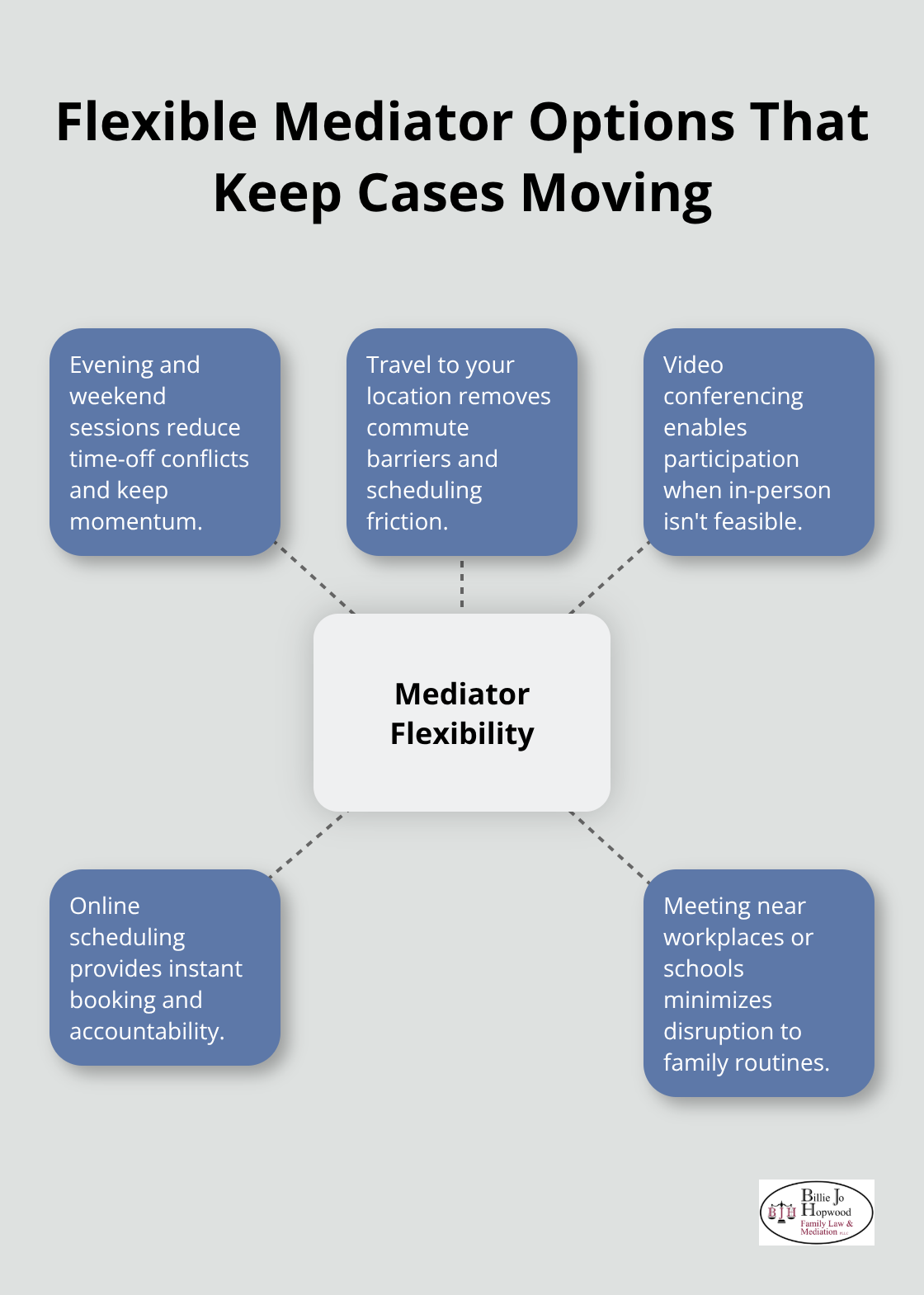
Cases with flexible scheduling options move to settlement 40% faster than those bound to fixed office hours, according to patterns observed in Brevard County practice.
Final Thoughts
Efficient divorce mediation scheduling in Brevard transforms your entire resolution process. When sessions stay on track and deadlines hold firm, settlement arrives in weeks instead of months. That speed cuts your legal fees dramatically, since the Brevard County Court Mediation Program charges $60 to $120 per party depending on income-every wasted session burns money you could redirect toward your children’s future or rebuilding your life.
Beyond dollars, prolonged mediation destroys emotional stability. Extended timelines keep you trapped in conflict with your ex-partner, prevent closure, and force your children through months of uncertainty. Parents stuck in lengthy mediation processes report higher stress and increased tension between parties, making settlement harder to reach when momentum stalls.
Billie Jo Hopwood Family Law & Mediation, PLLC in Melbourne, Florida understands that your work schedule, parenting responsibilities, and personal circumstances matter. Contact us at 321-988-1331 or visit our office at Wickham Executive Center, 3040 N. Wickham Rd, Melbourne, FL 32935 to schedule a consultation and begin your mediation journey with a firm committed to moving your case forward.