
Spousal support mediation offers a faster, more affordable path than court battles when determining alimony in Melbourne, Florida. Rather than letting a judge decide, you and your spouse can work together with a mediator to reach an agreement that works for both of you.
At Billie Jo Hopwood Family Law & Mediation, PLLC, we’ve seen how mediation transforms difficult conversations into productive negotiations. This guide walks you through preparing for mediation, presenting your financial situation clearly, and reaching a fair spousal support agreement.
Understanding Florida Spousal Support Before Mediation
Florida’s approach to spousal support shifted dramatically on July 1, 2023, when Governor DeSantis signed Senate Bill 1416, which eliminated permanent alimony for new divorce cases. This change means the four types of alimony now available are bridge-the-gap, rehabilitative, durational, and temporary support. Bridge-the-gap alimony covers immediate, short-term needs for up to two years and becomes non-modifiable once awarded, making it ideal for covering transition expenses during the divorce process. Rehabilitative alimony funds education, training, or job skills and is capped at five years, requiring a detailed, realistic plan for how the recipient will achieve financial independence. Durational alimony provides support for a set period tied directly to how long the marriage lasted.
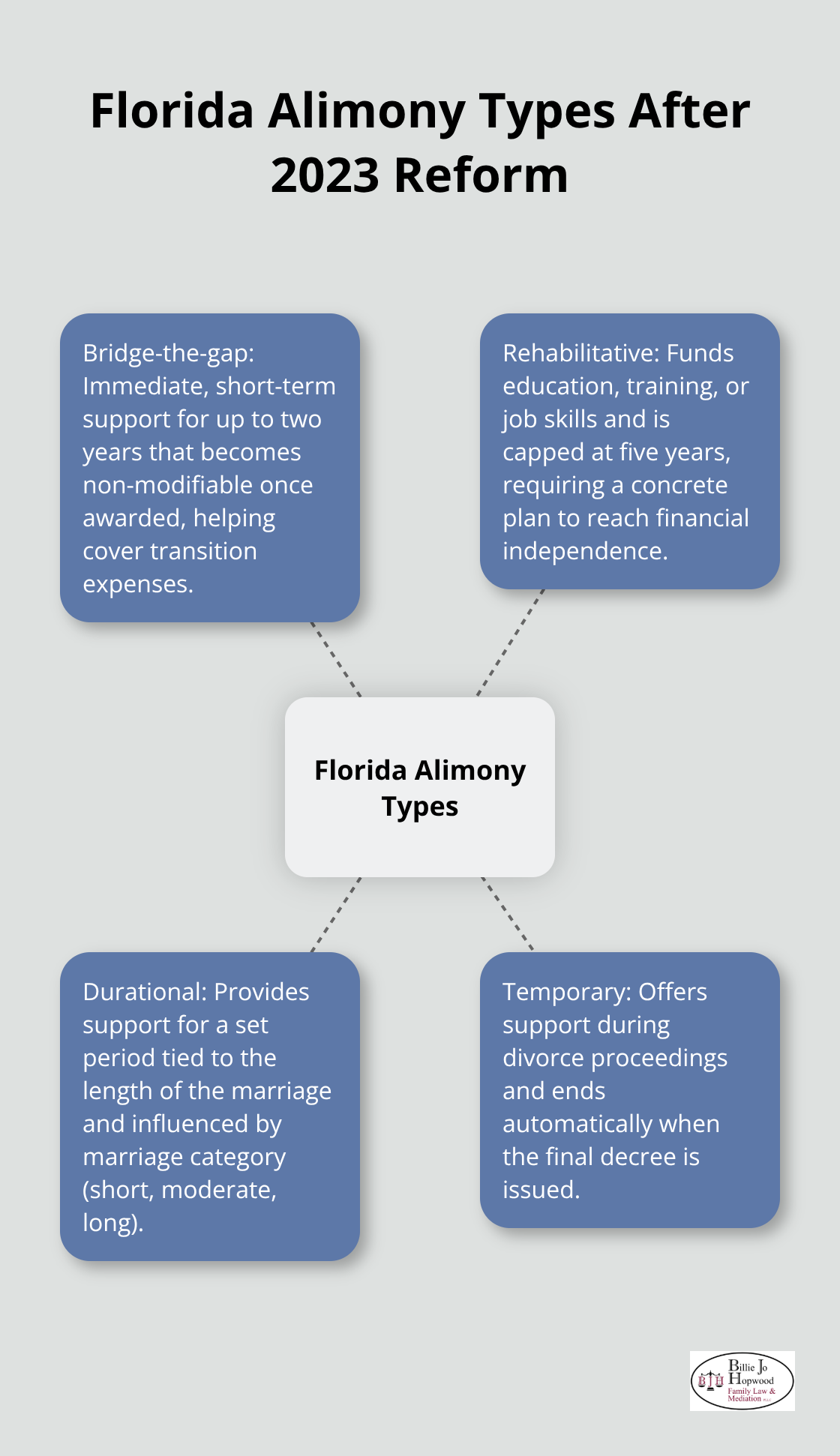
Courts categorize marriages as short-term (under 7 years), moderate-term (7 to 17 years), or long-term (17 years or more), with each category influencing both the type and length of support awarded. Temporary alimony provides support during the divorce proceedings and ends automatically when the final decree is issued.
What Florida Courts Actually Examine
When determining spousal support, Florida courts examine far more than just current salaries. Courts evaluate the complete financial picture, including non-marital assets, retirement accounts, investments, debt obligations, and earning potential. The standard of living established during the marriage carries significant weight-if one spouse maintained a certain lifestyle, courts consider whether spousal support should help preserve that standard. Age and health significantly influence awards; if health limits earning capacity, courts often justify longer or higher support. Non-financial contributions like homemaking and child-rearing receive real consideration and can justify alimony even when one spouse has some earning ability. Courts also weigh each spouse’s education level and vocational skills when assessing earning capacity. Under the Tax Cuts and Jobs Act of 2017, alimony payments are no longer tax-deductible for the payer or taxable income for the recipient in divorces finalized after December 31, 2018-a shift that changes how support amounts should be structured to reflect the after-tax impact.
How Mediation Changes the Outcome
Mediation fundamentally differs from court decisions because you and your spouse control the result rather than having a judge impose one. In court, a judge applies statutory factors to determine support based on the evidence presented, but in mediation, both parties can propose creative solutions that a court might never consider. Mediation typically costs significantly less than litigation while moving faster-court battles over spousal support can stretch months or years, whereas mediation often resolves support terms in weeks. The confidential nature of mediation means discussions cannot be used as evidence if negotiations fail, protecting both parties throughout the process. In mediation, you can address risks specific to your situation, such as how remarriage or cohabitation might affect payments, and structure terms with clear timelines and review dates that work for your family’s circumstances.
Moving Forward With Mediation Strategy
Understanding these distinctions between court-imposed orders and mediated agreements prepares you to make informed decisions about your spousal support case. The flexibility that mediation offers-combined with knowledge of Florida’s four alimony types and what courts examine-positions you to negotiate terms that reflect your actual financial needs and circumstances. With this foundation, preparing your financial documents and setting realistic goals before mediation begins becomes the next logical step in protecting your financial future.
Getting Your Financial House in Order for Mediation
Walking into mediation unprepared with your finances is like showing up to negotiate without knowing your own bottom line-you’ll either accept unfavorable terms or derail the entire process by scrambling for information. Before mediation, you need complete financial documentation that shows exactly where you stand.
Assembling Your Financial Documents
Gather the last three years of tax returns, recent pay stubs covering the last two months, bank statements for all accounts, retirement account statements (including 401(k)s and IRAs), investment portfolios, mortgage documents, car loans, credit card statements, and any other debt obligations. Courts in Florida require this level of transparency anyway, so assembling it now prevents delays and demonstrates good faith to your spouse and the mediator.
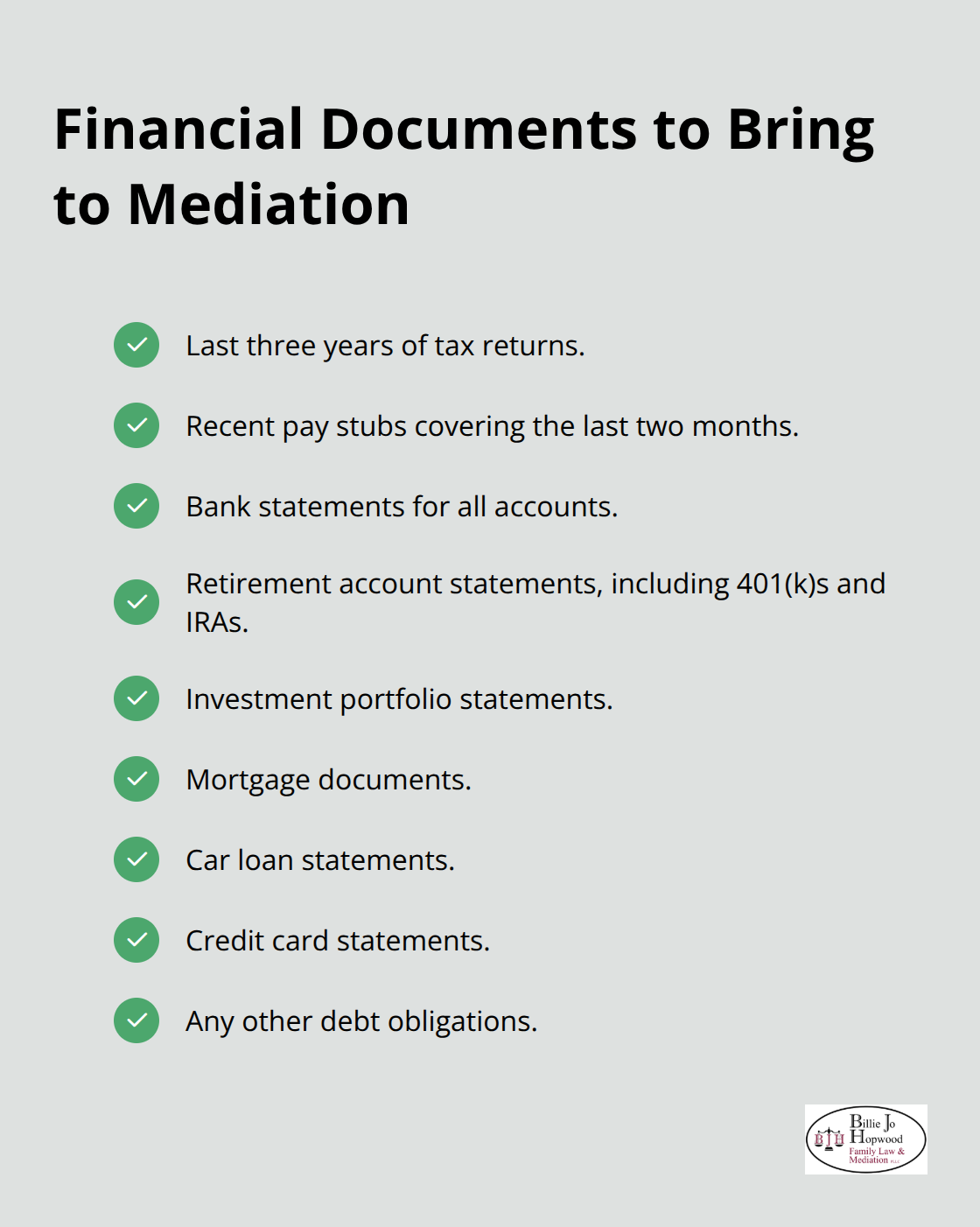
Florida courts evaluate the complete financial picture to determine spousal support, which means hidden assets or downplayed debts will surface during discovery-and if they do, you lose credibility in mediation.
Creating a Realistic Monthly Budget
Create a detailed monthly budget that reflects your actual living expenses, not inflated or minimized numbers. Include housing costs, utilities, groceries, insurance, healthcare, transportation, childcare if applicable, and any other regular expenses. This budget becomes your foundation for determining what spousal support you need or can afford to pay. If you’re the spouse seeking support, your budget demonstrates financial need with specificity that judges and mediators take seriously. If you’re the potential payer, a realistic budget helps you propose sustainable payment terms rather than amounts that strain your finances and lead to modification requests later.
Setting Goals Anchored in Reality
Your goals in mediation must be realistic and anchored in actual numbers, not emotions or what you think is fair in principle. Research what spousal support typically looks like for marriages similar to yours in Brevard County by consulting with a family law attorney who understands local court patterns. The length of your marriage directly influences the type and duration of support available under Florida law-short marriages under seven years rarely qualify for durational alimony, while moderate marriages of seven to seventeen years can justify it for shorter periods, and long marriages over seventeen years historically received permanent alimony before the 2023 law change.
Know which type of alimony fits your situation and what realistic payment ranges look like based on the income difference between spouses and the standard of living during your marriage. Courts often calculate durational alimony using the recipient’s actual needs or 35 percent of the income difference between spouses, whichever is lower, so run both calculations to understand your realistic range. Set a primary goal and a fallback position before mediation begins-if you seek support, decide your ideal monthly amount, your acceptable range, and the duration you can justify. If you’re paying support, determine what you can genuinely afford each month without compromising your own financial stability or ability to meet child support obligations.
Entering Mediation Prepared
Mediation works best when both parties have completed this homework and enter the room ready to negotiate within realistic parameters rather than making demands that the other side cannot accept. With your financial documents organized, your budget finalized, and your goals clearly defined, you’re positioned to present your situation effectively during mediation sessions.
Making Your Financial Case Work in Mediation
Present Your Budget With Clarity and Context
Presenting your financial situation effectively in mediation means moving beyond numbers on a spreadsheet to tell a coherent story about what you actually need or can afford to pay. The mediator and your spouse won’t understand your position unless you frame it clearly, and vague or poorly organized financial presentations often lead to rejected proposals that derail negotiations. Walk through your budget line by line during the mediation session rather than simply handing over documents and expecting others to interpret them. If you’re seeking spousal support, explain why each expense category matters to your financial stability-whether it’s healthcare costs due to a chronic condition, retraining expenses to re-enter the workforce, or housing costs tied to maintaining the marital standard of living. Courts in Florida examine the standard of living established during the marriage as a central factor, so connect your current needs directly to how you lived together during the marriage itself. If you’re paying support, present your own budget with equal transparency to demonstrate that proposed payment amounts won’t force you into financial hardship or prevent you from meeting existing child support obligations. Many mediators recommend using a needs-based approach where you calculate actual monthly expenses first, then determine whether spousal support is appropriate to bridge gaps between income and reasonable living costs. This method proves more persuasive than simply anchoring to a number you think is fair. Bring recent tax returns, pay stubs, and account statements to mediation sessions so you can address questions immediately rather than promising to send documents later-delays create frustration and stall progress.
Choose the Right Alimony Type for Your Situation
Negotiating payment terms and duration requires understanding Florida’s four alimony types and which one actually fits your marriage length and circumstances. Durational alimony, which provides support for a set period tied to marriage length, typically works well in mediation because both parties can agree on a specific end date rather than fighting over permanent or temporary arrangements that courts would impose. If your marriage lasted twelve years, you might negotiate durational support for six to eight years rather than indefinite payments. Bridge-the-gap alimony covering up to two years works particularly well when one spouse needs immediate financial relief while transitioning to independence, and its non-modifiable nature appeals to payers who want certainty. Rehabilitative alimony makes sense when the receiving spouse has a concrete plan-specific training program, degree pursuit, or job certification with a realistic timeline-rather than vague promises of future employment.
Use Benchmarks to Ground Your Proposals
When discussing payment amounts, reference the 35 percent income difference calculation that Florida courts often use: if one spouse earns $80,000 and the other earns $40,000, the income difference is $40,000, and 35 percent of that equals $14,000 annually or roughly $1,167 monthly. This gives both parties a benchmark grounded in judicial practice rather than arbitrary demands.

Propose multiple payment structures during mediation-monthly payments, lump sum options, or hybrid arrangements combining different alimony types-because flexibility often unlocks agreements that rigid positions cannot. Address termination events explicitly in your mediated agreement, including what happens if the recipient remarries, cohabits with a partner, or completes their rehabilitative plan, since these scenarios directly affect payment obligations under Florida law.
Final Thoughts
Spousal support mediation in Melbourne, Florida transfers control of a major financial decision from the courtroom to your negotiating table. You and your spouse craft an agreement that reflects your actual circumstances rather than accepting terms a judge imposes based on statutory factors. Preparation determines outcomes-when you organize financial documents, build honest budgets, and understand which alimony type fits your marriage length, you eliminate delays and confusion that derail negotiations.
Filing your mediated settlement with the court transforms it into a legally binding, enforceable order once the judge approves it. Precision matters at this stage, so payment amounts, frequency, duration, and termination events must be clearly stated in your agreement. Set up a payment tracking system from day one, since Florida law provides enforcement mechanisms like income withholding and asset seizure if payments are missed.
A family law attorney should review your agreement before you sign it to identify tax implications, modification triggers, or enforcement gaps that mediation alone might miss. We at Billie Jo Hopwood Family Law & Mediation, PLLC help families navigate spousal support mediation and understand how agreements affect long-term financial stability. Contact us in Melbourne, Florida to discuss your situation and move forward with confidence.