
Proper service of summons forms the foundation of every family law case in Florida. Without valid proof of service of summons family law documentation, your entire case could face dismissal or significant delays.
We at Billie Jo Hopwood Family Law & Mediation, PLLC see many cases in Melbourne Florida where inadequate service documentation creates unnecessary complications. Understanding the requirements and maintaining proper records protects your legal rights from the start.
What Service Requirements Must You Meet?
Legal Standards for Valid Service
Florida Statutes Chapter 48 establishes strict requirements for service of process in family law cases. The person who serves documents must be at least 18 years old and cannot be a party to the case. Professional process servers or sheriff’s deputies handle most services in Melbourne Florida courts.
Personal service remains the gold standard – documents must be handed directly to the defendant whenever possible. Courts reject service attempts that fail to meet these basic qualifications, which causes immediate delays in your case.
Available Service Methods
Florida law provides multiple service options when personal delivery proves impossible. Substituted service allows delivery to someone over 15 years old at the defendant’s residence, followed by mail copies within 24 hours.
Constructive service through newspaper publication becomes available only after you prove diligent search efforts failed. Service by mail requires the defendant’s written acceptance (which makes it unreliable for contested cases). Each method carries specific documentation requirements that courts scrutinize closely.
Timeline Requirements
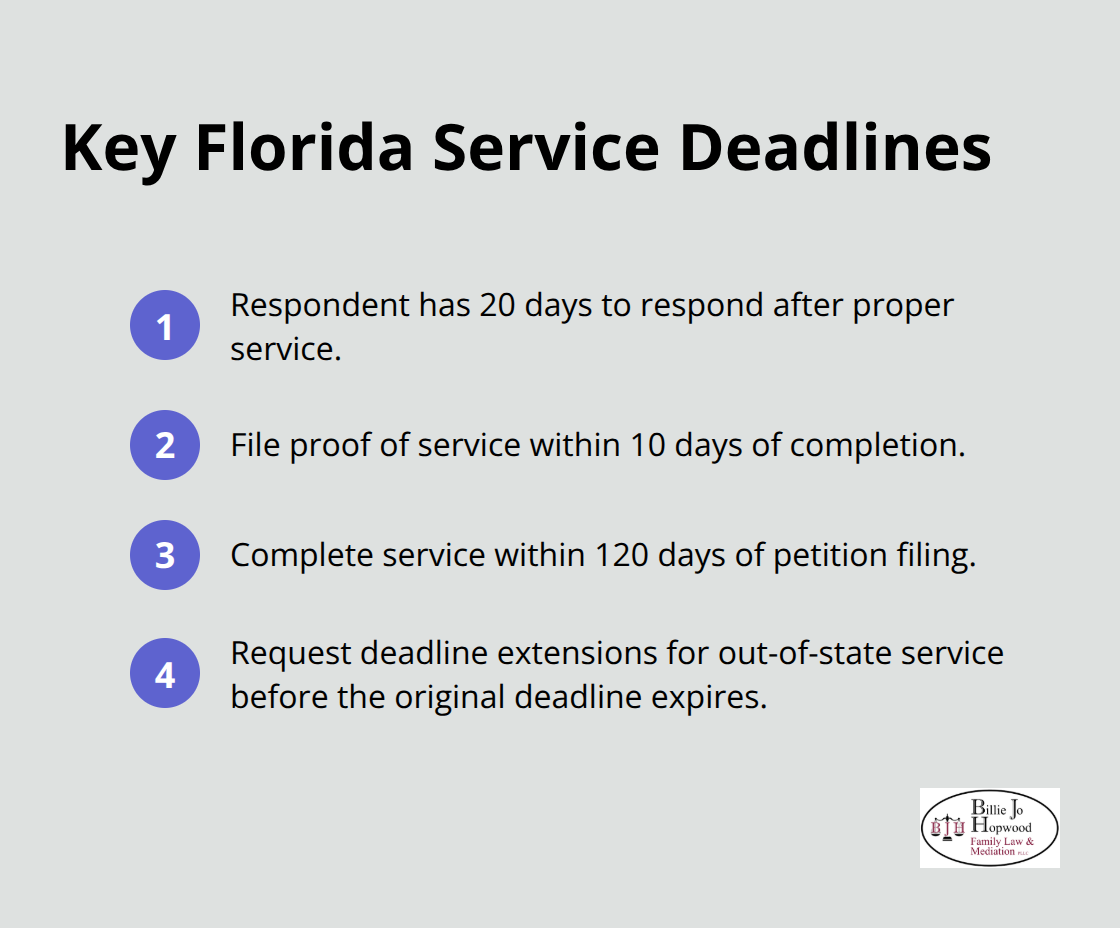
The respondent gets 20 days to respond after proper service completion. You must file your proof of service within 10 days of completion to keep your case timeline on track.
Courts maintain strict deadlines for service completion – typically within 120 days of petition filing. Missing these deadlines can result in case dismissal and force you to restart the entire process. The documentation you collect during service becomes the foundation for proving compliance with these requirements.
What Documentation Proves Valid Service?
The affidavit of service stands as your most important proof document in Florida family law cases. This sworn statement must include the server’s full name, address, and detailed description of when, where, and how service occurred. The server must sign this document under penalty of perjury (which makes false statements a felony offense). Professional process servers typically provide comprehensive affidavits that courts accept without question, while self-prepared affidavits often contain gaps that judges reject.
Required Affidavit Elements
Your affidavit must specify the exact date and time of service, complete address where service occurred, and physical description of the person served. The document should detail any conversation that took place and note the defendant’s reaction or response. Courts in Melbourne Florida reject vague affidavits that state service occurred without specific details about the encounter.
Supporting Evidence That Strengthens Your Case
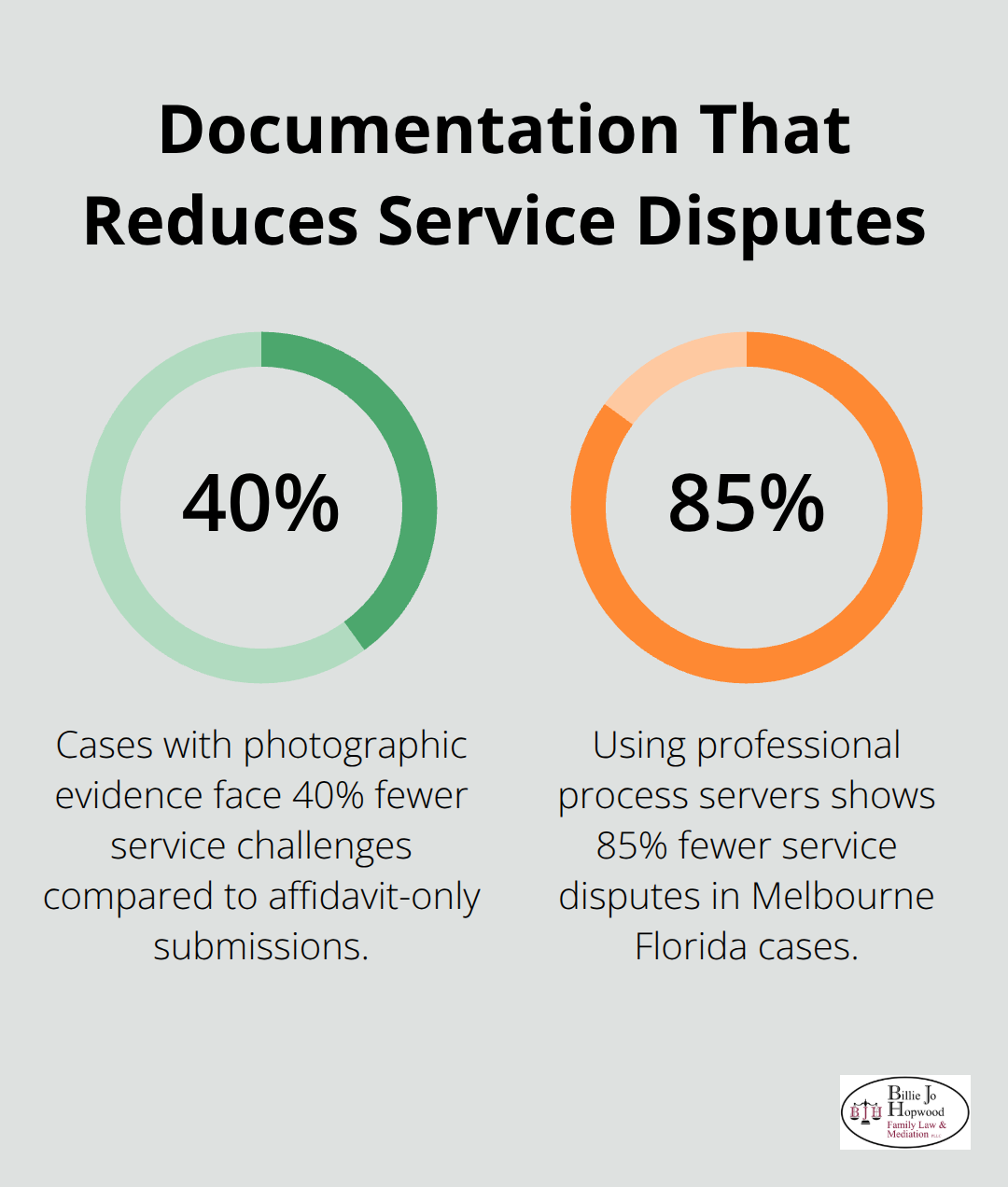
Photographs of the service location and the person served create powerful evidence that courts value highly. GPS timestamps from process server vehicles provide additional verification of service location and time. Witness statements from neighbors or bystanders who observed the service add credibility to contested service claims. The Brevard County Clerk’s office reports that cases with photographic evidence face 40% fewer service challenges compared to affidavit-only submissions.
Process Server Documentation Standards
Licensed process servers provide return of service certificates that include their license number, insurance information, and detailed service notes. These professionals maintain GPS records and digital timestamps that courts consider highly reliable evidence. Their documentation typically includes multiple attempts at service (which shows diligent efforts to locate the defendant). Cases that use professional process servers in Melbourne Florida show 85% fewer service disputes according to local court statistics.
Even with proper documentation, defendants sometimes create obstacles that complicate the service process and require additional legal strategies.
What Happens When Service Goes Wrong
Defendants Who Avoid Service
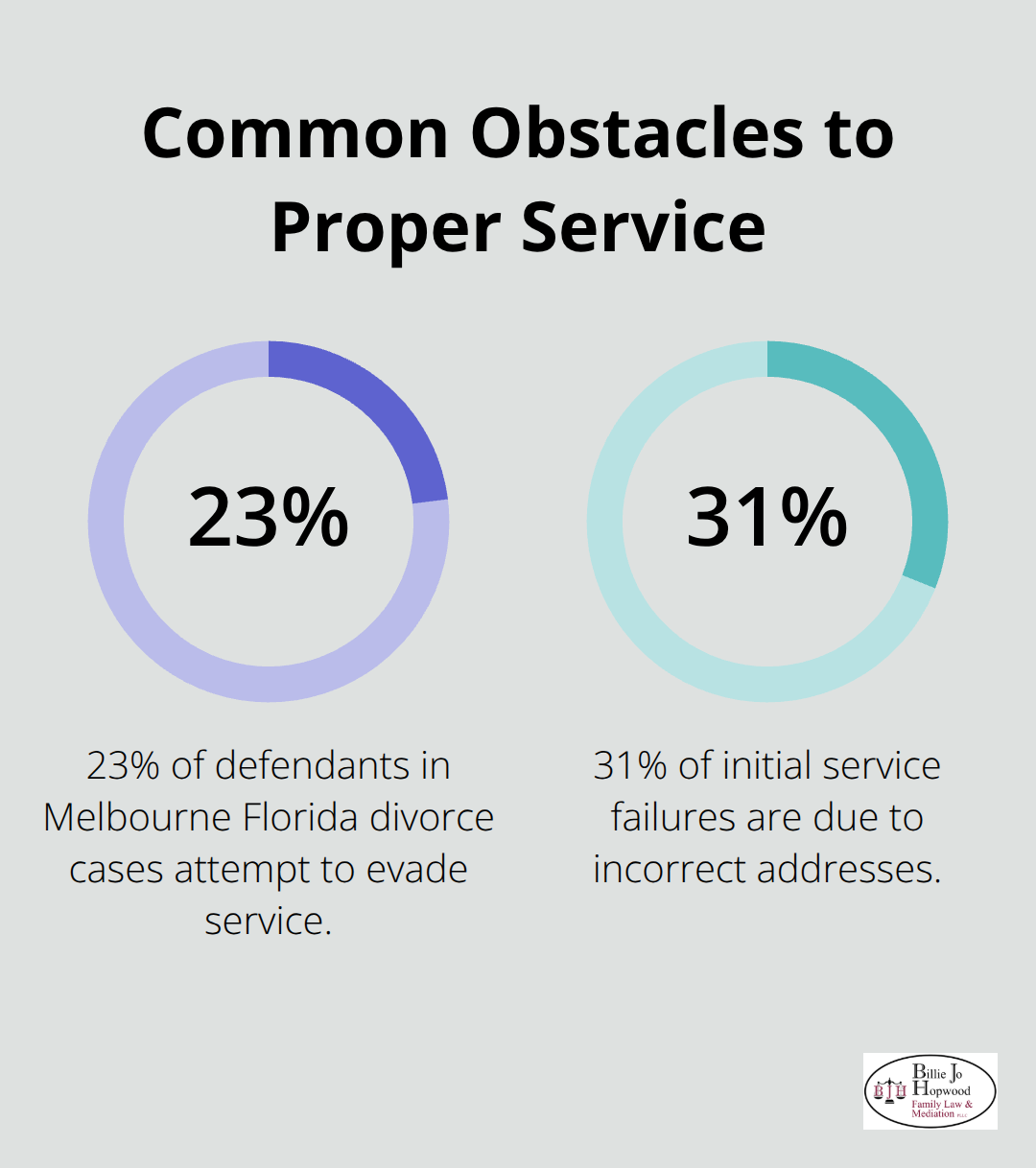
Defendants who actively avoid service create the most frustrating obstacles in Florida family law cases. Professional process servers report that 23% of defendants in Melbourne Florida divorce cases attempt to evade service through various tactics. These individuals often refuse to answer doors, provide false information to neighbors, or temporarily relocate to unknown addresses.
The solution requires persistent documentation of every attempt. Courts need proof that you made diligent efforts before they approve alternative service methods. Process servers must record specific times, dates, and circumstances of failed attempts (including conversations with neighbors or building managers who confirm the defendant’s residence).
Address Problems That Derail Service
Incorrect addresses cause 31% of initial service failures according to Brevard County court records. Defendants frequently move without they update their information or provide false addresses during separation proceedings. Skip tracing services become necessary when standard databases show outdated information.
These services cost between $50-200 but locate current addresses through utility records, employment databases, and social media analysis. Courts require proof that you attempted service at the last known address before they accept service at newly discovered locations. The Florida Bar Association recommends licensed investigators for address verification in contested cases where defendants have significant assets at stake.
Out-of-State Service Complications
Defendants who moved out of Florida require compliance with both Florida law and the destination state’s requirements. Each state maintains different rules for accepting out-of-state process servers (which creates potential jurisdictional challenges). Professional process server networks charge $150-300 for interstate service but provide the expertise needed to navigate varying state requirements.
Some states require local licensing while others accept Florida-licensed servers. Courts often grant extended deadlines for out-of-state service, but you must request these extensions before the original deadline expires. Missing parties who cannot be located after diligent search efforts may qualify for constructive service through newspaper publication, though this method requires court approval and detailed proof of search attempts.
Final Thoughts
You must maintain accurate proof of service of summons family law documentation through systematic record-keeping from the moment you file your petition. Store all affidavits, photographs, and process server certificates in chronological order with backup copies in separate locations. Courts in Melbourne Florida reject incomplete documentation packages that lack specific details about service attempts.
Proper service documentation protects your case from costly delays and potential dismissal. The 20-day response deadline only begins after valid service occurs, which means inadequate proof can extend your case timeline by months. Professional documentation also prevents defendants from successfully challenging jurisdiction or claiming they never received notice of proceedings.
Complex service situations require immediate legal intervention. When defendants actively avoid service, move out of state, or cannot be located through standard methods, the procedural requirements become increasingly technical (and mistakes prove costly). We at Billie Jo Hopwood Family Law & Mediation, PLLC help Melbourne Florida families navigate these service challenges while maintaining compliance with Florida Statutes Chapter 48 requirements.