
You’ve reached a mediation agreement in Brevard County, but questions linger about whether it’s actually enforceable. A mediation agreement that isn’t legally binding can leave you vulnerable to disputes down the road.
At Billie Jo Hopwood Family Law & Mediation, PLLC, we’ve seen families struggle with mediation agreement enforceability in Brevard because they didn’t understand the legal requirements upfront. This guide walks you through what makes an agreement stick, what can challenge it, and how to protect yourself from the start.
What Makes a Mediation Agreement Legally Binding in Brevard
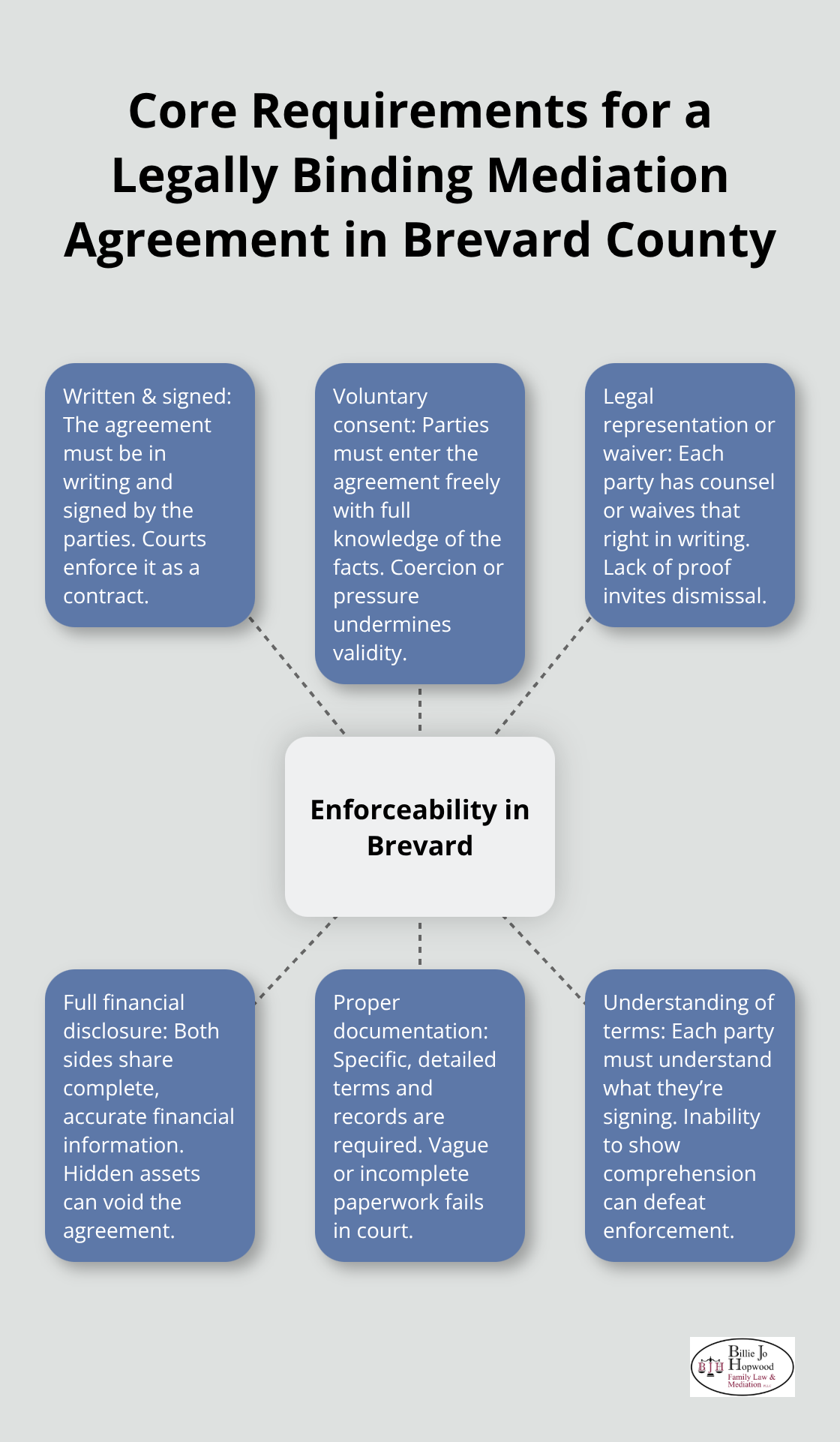
Florida Statutes Section 44.102 sets the bar for enforceability, and it’s not negotiable. A mediation agreement in Brevard County becomes legally binding when it meets specific statutory requirements, and skipping even one step can undermine the entire agreement. Florida law requires that the agreement be in writing, signed by the parties, and entered into voluntarily with full knowledge of the facts. The state also mandates that each party either have legal representation or waive that right in writing. Courts in Brevard County have dismissed agreements that lacked proper documentation or where one party couldn’t prove they understood what they were signing. The enforceability of your mediation agreement hinges on these concrete requirements, not assumptions or verbal promises.
Documentation Standards That Courts Actually Enforce
Written documentation must be detailed enough that a judge can understand exactly what each party agreed to do. Vague language like “we’ll work out the custody schedule later” creates immediate enforceability problems. Courts in Brevard County expect specific terms about property division, child custody arrangements, support obligations, and timelines. The agreement should identify assets by description and value, specify custody schedules down to pickup and drop-off times, and state dollar amounts for support payments. Handwritten agreements or email exchanges typically fail when disputes arise in Brevard County courts. Courts treat the written agreement like a contract that will be enforced exactly as written-because that’s precisely what happens in court.
Voluntary Participation and Complete Financial Transparency
Voluntariness means each party entered the mediation freely without pressure, threats, or manipulation. Courts scrutinize agreements where one spouse had significantly more information about finances than the other. Florida courts have invalidated mediation agreements where one party failed to disclose substantial assets, income sources, or debts. Courts view undisclosed financial information as grounds to void an entire agreement. Both parties must have access to the same financial documents, bank statements, tax returns, and asset valuations before signing. If you discover after signing that your spouse hid income or assets, you have grounds to challenge enforceability. The requirement for full disclosure applies to everything with financial value (including retirement accounts, business interests, real estate, and cryptocurrency holdings).
Why Incomplete Disclosure Undermines Everything
One party’s failure to reveal financial information doesn’t just create a minor problem-it can invalidate the entire mediation agreement. Brevard County courts take this seriously because an agreement built on incomplete information lacks the foundation Florida law requires. When one spouse controls access to financial records or intentionally withholds information about income sources, the other party cannot make informed decisions. This imbalance violates the voluntary participation requirement that Florida Statutes Section 44.102 mandates. Courts have the power to set aside agreements where financial transparency was compromised, which means months or years of mediation work can unravel. Understanding what financial information must be shared (and verifying you actually have it) protects your agreement before you sign.
Common Challenges to Enforceability in Brevard County
Unequal Bargaining Power and Pressure During Mediation
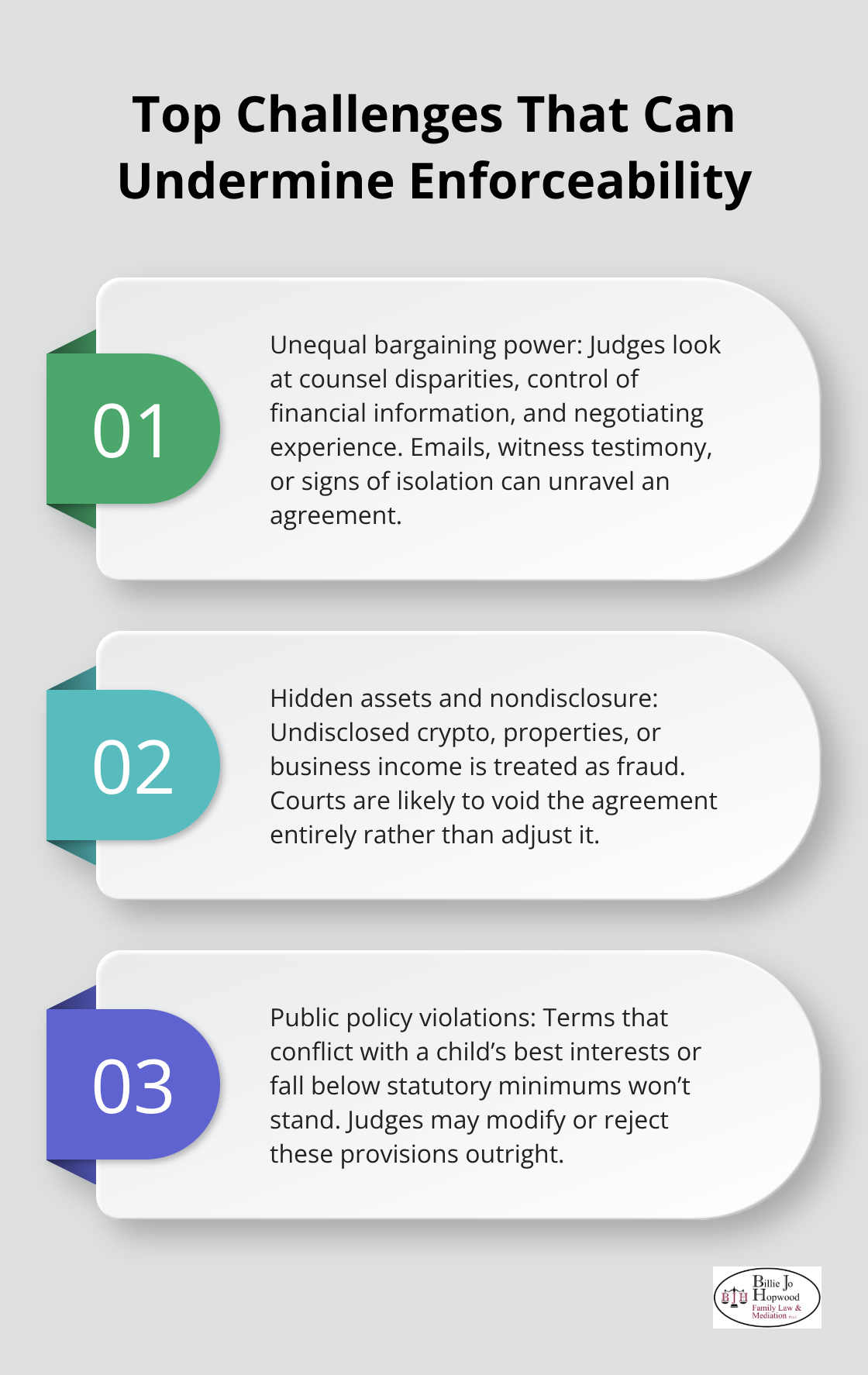
Mediation agreements fail enforceability challenges in Brevard County for concrete reasons, not technicalities. The most common threat comes from claims that one party faced pressure or lacked equal bargaining power during negotiations. Courts examine whether one spouse had a lawyer present while the other didn’t, whether financial information was controlled by one party, or whether one person had significantly more negotiating experience. Brevard County judges look at the actual power dynamics that existed during mediation, not just whether both parties showed up.
If one spouse earned $150,000 annually while the other had no income and no access to financial information, courts question whether that agreement reflects genuine voluntary participation. Documentation proving unequal bargaining power includes email chains showing pressure, witness testimony about threats, or evidence that one party was isolated from financial information. Courts have set aside agreements where one spouse rushed the process or where the mediator failed to confirm both parties understood what they were signing.
Hidden Assets and Nondisclosure
Asset nondisclosure represents the second major enforceability killer in Brevard County mediation agreements. One party hiding cryptocurrency holdings, failing to mention a second property, or underreporting business income gives the other spouse grounds to invalidate the entire agreement. Florida courts treat hidden assets as fraud, which means a judge won’t just adjust the agreement to account for the missing information-they’ll void it completely.
This creates enormous consequences because the nondisclosing party loses the benefit of the agreement they thought they had secured. The discovery of hidden assets (whether intentional or through negligence) transforms an otherwise valid agreement into an unenforceable document. Courts take this violation seriously because it strikes at the heart of what makes mediation work: honest financial disclosure.
Public Policy Violations
Third, agreements that violate Florida public policy get rejected regardless of what both parties signed. Courts won’t enforce agreements where child custody arrangements prioritize one parent’s convenience over the child’s best interests, where support payments fall below statutory minimums, or where one party waives rights to child support entirely. Brevard County judges have authority to modify or reject any mediation provision that contradicts Florida’s public policy on child welfare, spousal support, or equitable property division.
These enforceability threats require attention before you sign. Understanding what courts will and won’t accept helps you build an agreement that actually holds up when disputes arise.
How to Strengthen Your Mediation Agreement
Hire an Attorney Before You Sign
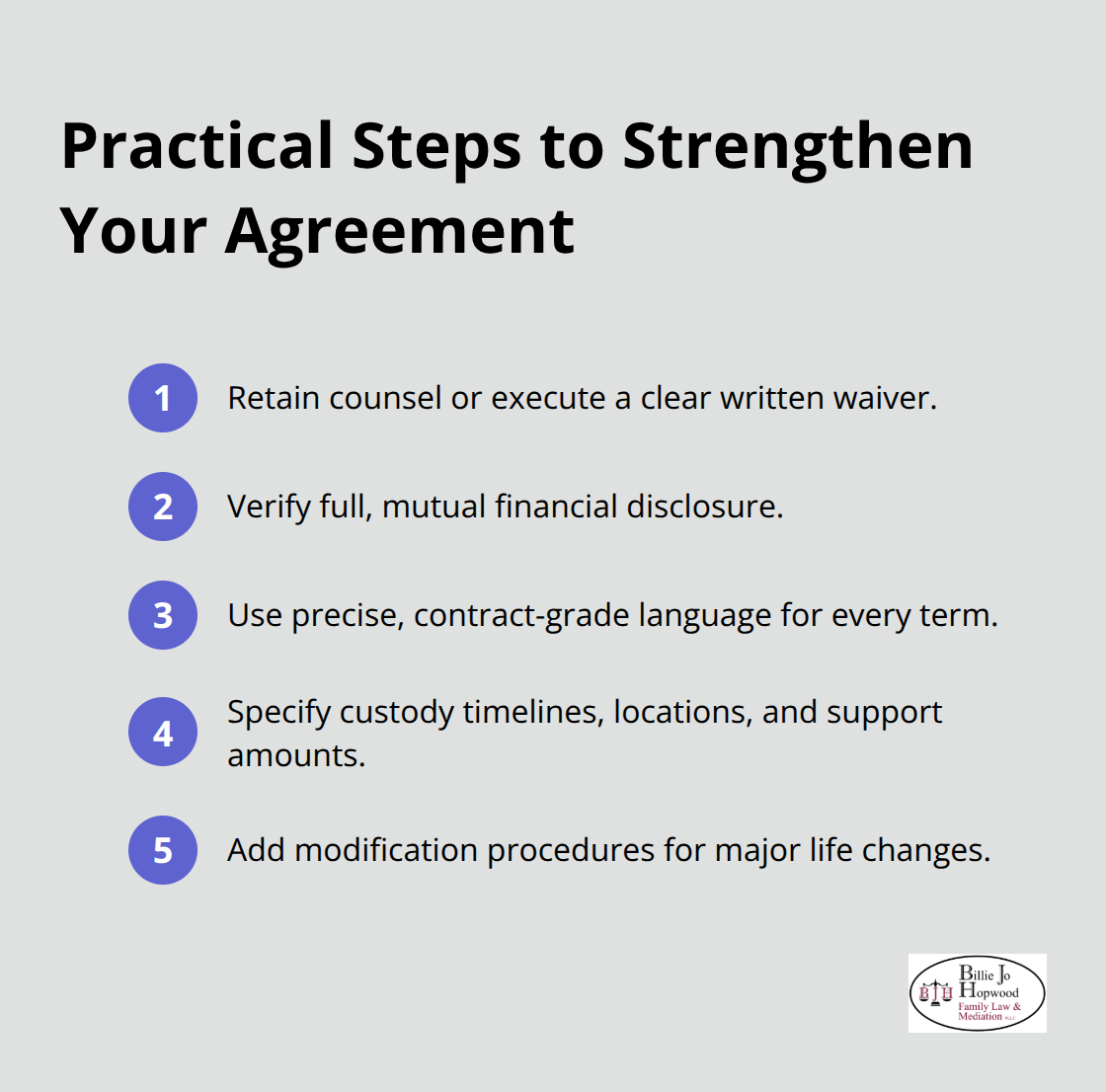
A family law attorney in Brevard County reviews the proposed terms against Florida Statutes Section 44.102 and identifies enforceability gaps before you commit to anything. Many people skip this step to save money, but that false economy costs thousands more when a judge voids your agreement and you’re back in litigation. Your attorney verifies that financial disclosures are complete, that both parties genuinely understood what they were agreeing to, and that the terms don’t violate public policy on child support or custody. They also document that you had legal representation or made a conscious choice to waive it, which eliminates one of the most common enforceability challenges.
Courts in Brevard County look favorably on agreements where both parties had counsel because the documentation proves informed consent. Without this protection, a judge can assume you didn’t fully understand the terms, which gives opposing counsel ammunition to attack the agreement years later. Your attorney catches language that sounds clear to both parties during mediation but becomes ambiguous in court filings, such as vague custody schedules or property descriptions that don’t match public records.
Write Specific Terms That Leave No Room for Interpretation
Your written agreement must specify every obligation with precision that eliminates ambiguity and dispute. Instead of stating that one parent will have custody during summer, your agreement should state June 1 through August 15, with pickup at 9 a.m. on the first day and drop-off at 6 p.m. on the last day. Property division requires descriptions that match deed records exactly: not just the beach house, but the property at 1234 Ocean Avenue, Brevard County, Florida, with a value of $425,000 and the specific mortgage balance owed.
Child support needs the exact monthly amount, the date it’s due, the payment method, and what happens if one parent’s income changes. Courts enforce agreements word-for-word, so ambiguous language creates enforceability problems that would have taken minutes to fix during mediation.
Build in Modification Provisions for Real-World Changes
Include provisions that allow both parties to modify specific terms (like custody schedules or support amounts) if circumstances change materially, such as job loss or substantial income increase, rather than forcing either party back to court for every adjustment. This flexibility actually strengthens enforceability because courts see it as evidence that both parties anticipated real-world changes and planned for them responsibly.
Try to establish a clear process for how modifications happen: whether they require written agreement from both parties, whether they need mediator review, or whether either party can request modification through a specific procedure. Courts in Brevard County respect agreements that include these modification pathways because they show realistic thinking about long-term family circumstances.
Final Thoughts
Mediation agreement enforceability in Brevard hinges on three concrete requirements: written documentation with specific terms, voluntary participation from both parties, and complete financial transparency. Courts won’t enforce agreements that lack any of these elements, which means the work you do during mediation determines whether your agreement actually holds up years later. The enforceability challenges we’ve covered-hidden assets, unequal bargaining power, and public policy violations-aren’t theoretical problems that judges overlook.
Your protection starts before you sign anything. A family law attorney reviews the proposed agreement and catches enforceability gaps that would cost thousands more to fix through litigation later (including verification of financial disclosures, confirmation that both parties understood the terms, and documentation of informed consent). That attorney also confirms nothing violates Florida’s public policy on child support or custody, which eliminates one of the most common attacks on mediation agreements.
The specific language in your agreement matters enormously because courts enforce agreements word-for-word, so precision during mediation saves you from disputes that could have been prevented with clearer writing. We at Billie Jo Hopwood Family Law & Mediation, PLLC help families in Melbourne, Florida navigate mediation agreement enforceability issues before they become problems. If you’re considering mediation or have questions about whether your current agreement meets Florida’s requirements, contact us to discuss your situation.