
Mediation confidentiality is one of the main reasons couples in Melbourne choose mediation to resolve a divorce or other family law matter. When spouses know that what they say at the mediation table generally cannot be repeated in court, they can speak openly, test ideas, and work toward an agreement without worrying that every offer will be used against them later. Florida protects that openness through a specific statute, and understanding its limits is just as important as understanding its protections.
At Billie Jo Hopwood Family Law & Mediation, PLLC, we guide Melbourne and Brevard County families through uncontested divorces and family law mediation so you know exactly what to expect. This guide explains what Florida’s mediation confidentiality law covers, the exceptions that apply, and the mistakes that can weaken the protection, so you can move forward with confidence.
What Florida Law Says About Mediation Confidentiality
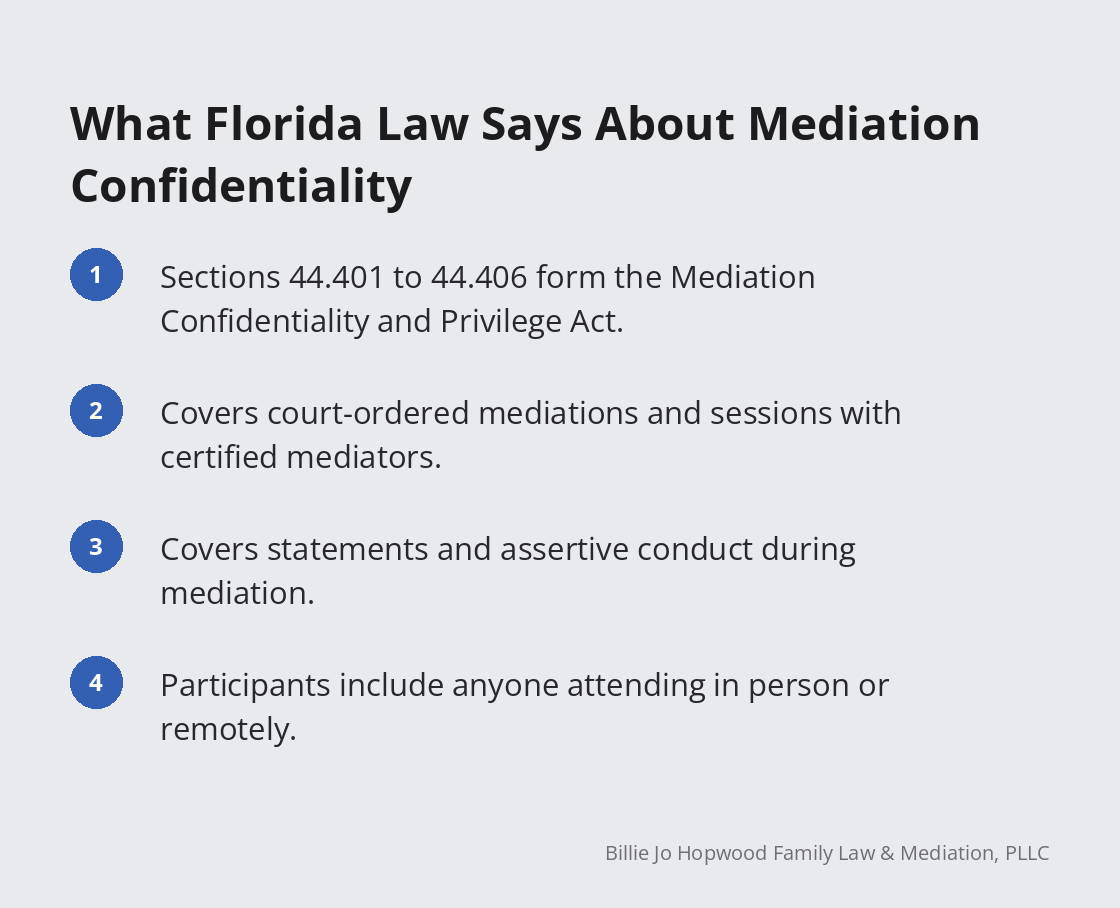
Florida’s rules appear in Sections 44.401 through 44.406 of the Florida Statutes, which may be known by the popular name the Mediation Confidentiality and Privilege Act. These sections create two related protections: a duty of confidentiality that limits what participants may disclose, and a privilege that allows a party to keep mediation communications out of later court proceedings.
Which Mediations the Act Covers
Under Section 44.402, the Act applies to any mediation required by statute, court rule, agency rule or order, or a court order, to any mediation conducted under the Act by express agreement of the parties, and to any mediation facilitated by a mediator certified by the Supreme Court of Florida, unless the parties expressly agree not to be bound. In practice, this means the Act generally applies when a court orders family mediation or when spouses work with a Supreme Court certified mediator, unless the parties expressly agree not to be bound.
What Counts as a Mediation Communication
Section 44.403 defines a mediation communication as an oral or written statement, or nonverbal conduct intended to make an assertion, by or to a mediation participant made during the course of a mediation, or before mediation if made in furtherance of the mediation. That definition is broad. It can include proposals, explanations of a spouse’s concerns, and documents prepared for the session. The statute adds that the commission of a crime during a mediation is not a mediation communication.
Who Is a Mediation Participant
The duty of confidentiality applies to mediation participants. Section 44.403 defines a participant as a mediation party or a person who attends the mediation in person or by telephone, video conference, or other electronic means. This matters in family cases because new spouses, parents, or friends sometimes attend to provide support. When they attend, they generally take on the same duty not to disclose what was said.
How Confidentiality and Privilege Work in Practice
The Act separates two ideas that people often blend together. Confidentiality restricts what participants may share outside the mediation. Privilege controls whether mediation communications can be used as testimony in a later court case. Both protections shape how you should approach your session. If you are considering mediation for your divorce, our divorce mediation services page explains how the process works with our office.
The General Duty Not to Disclose
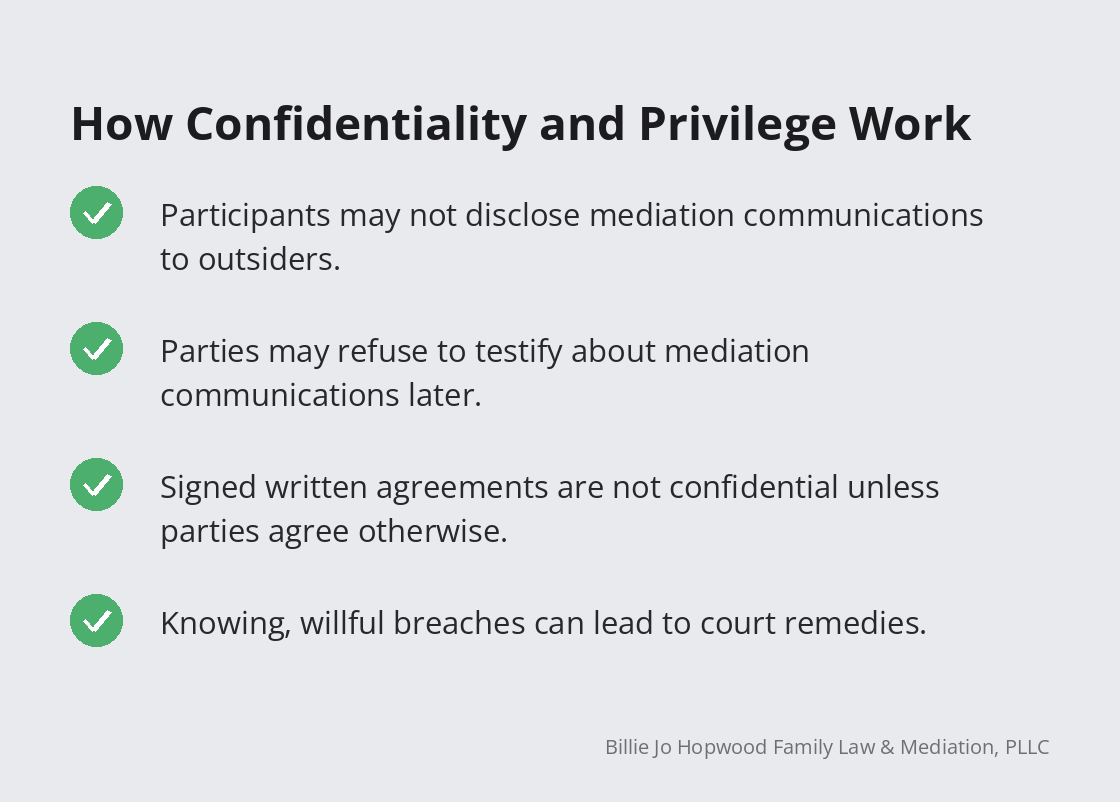
Section 44.405 provides that, except as the section allows, all mediation communications are confidential, and a mediation participant may not disclose a mediation communication to anyone other than another mediation participant or a participant’s counsel. In court-ordered mediation, the statute adds that a violation may also expose the participant to sanctions by the court. In practical terms, spouses should not repeat the other spouse’s mediation statements to friends, relatives, or on social media.
The Privilege to Refuse to Testify
Section 44.405 also gives each mediation party a privilege to refuse to testify, and to prevent any other person from testifying, in a subsequent proceeding regarding mediation communications. Section 44.403 defines a subsequent proceeding as an adjudicative process that follows a mediation, including related discovery. If mediation does not resolve every issue and the case moves to a hearing, the privilege generally keeps what was said in mediation from becoming evidence.
Written Agreements Are Treated Differently
A signed written agreement reached during mediation is not confidential or privileged under Section 44.405 unless the parties agree otherwise. That makes sense, because the parties need to be able to rely on and enforce the terms they agreed to after the mediation ends. If certain terms should remain private, the parties should discuss that with counsel before signing.
Remedies When Someone Breaks Confidentiality
Under Section 44.406, a mediation participant who knowingly and willfully discloses a mediation communication in violation of Section 44.405 may, upon application by a party to a court, be subject to remedies that include equitable relief and compensatory damages, among others. An application for relief must be filed no later than two years after the party had a reasonable opportunity to discover the breach, and in no case more than four years after the breach.
Exceptions and Mistakes That Can Weaken Protection
Mediation confidentiality is strong, but it is not absolute. Knowing the exceptions and avoiding a few common mistakes helps you protect your private discussions.
Statutory Exceptions to Confidentiality
Section 44.405 lists situations in which no confidentiality or privilege attaches to a mediation communication. These include a communication for which confidentiality or privilege has been waived by all parties, a communication willfully used to plan or commit a crime, conceal ongoing criminal activity, or threaten violence, and a communication that requires a mandatory report under chapter 39 or chapter 415, solely for the purpose of making that report. Other exceptions cover communications offered to report, prove, or disprove professional malpractice or misconduct occurring during the mediation, or to establish or refute legally recognized grounds for voiding or reforming a settlement agreement reached during mediation, each for that limited purpose.
Assuming Mediation Hides Existing Evidence
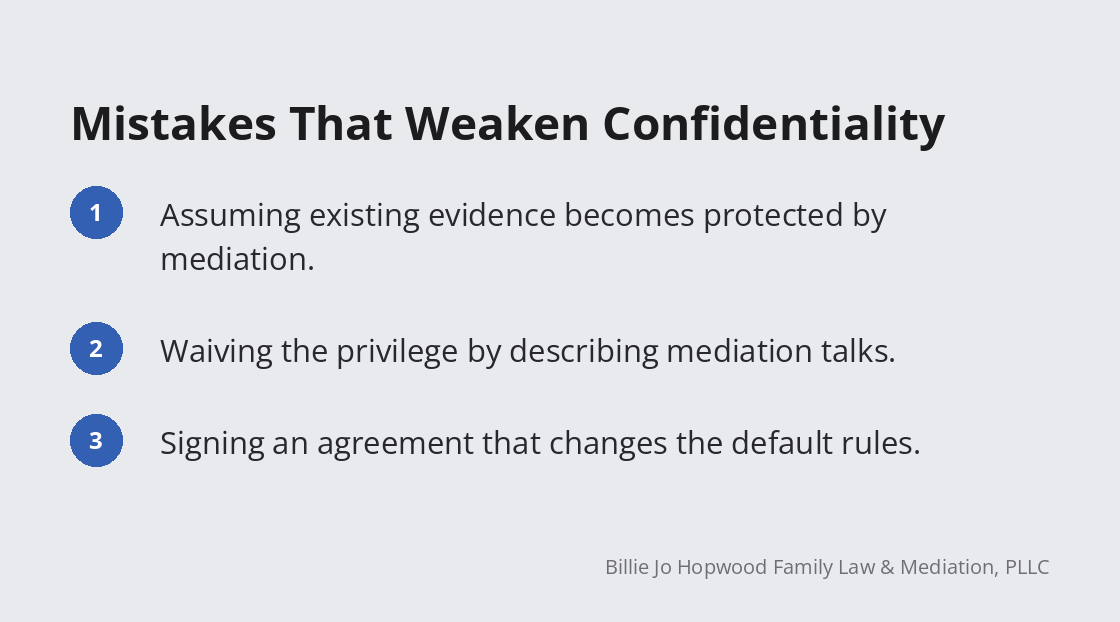
Some people believe that bringing a bank statement or text message to mediation makes it confidential forever. Section 44.405 says otherwise: information that is otherwise admissible or subject to discovery does not become inadmissible or protected from discovery because it was disclosed or used in mediation. Mediation protects what was said in the mediation process, not underlying facts and documents that exist independently.
Waiving the Privilege Without Realizing It
Under Section 44.405, a party that discloses or makes a representation about a privileged mediation communication waives that privilege, but only to the extent necessary for the other party to respond. For example, if one spouse tells the judge what the other spouse supposedly offered at mediation, the other spouse may be allowed to respond about that same communication. The safer approach is to leave mediation discussions out of later filings and testimony unless counsel advises otherwise.
Agreeing to Different Rules Without Reading Them
Section 44.402 allows mediation parties to agree in writing that some or all of the confidentiality, privilege, or remedy provisions will not apply to all or part of a mediation. Read any mediation agreement carefully before signing, and ask questions if it changes the default protections.
Final Thoughts
Mediation confidentiality in Melbourne Florida rests on the Mediation Confidentiality and Privilege Act. Mediation communications are generally confidential, mediation parties have a privilege to refuse to testify about them in a later proceeding, and a participant who knowingly and willfully breaks confidentiality can face remedies under Section 44.406. Signed written agreements, waivers by all parties, certain crimes and threats, and mandatory reports are among the situations the statute treats differently.
Before your session, it helps to prepare a short list of the issues you want to resolve, gather the documents you expect to discuss, and decide in advance who, if anyone, will attend with you. Ask your mediator to explain the confidentiality rules at the start of the session, and raise any concerns about privacy or safety early so they can be addressed before discussions begin. Taking these steps keeps the focus on reaching an agreement.
These protections help spouses speak openly and reach agreements that work for their families. Knowing the limits ahead of time lets you make the most of your mediation session without unwelcome surprises.
If you are considering mediation for an uncontested divorce or another family law matter in Melbourne or anywhere in Brevard County, contact Billie Jo Hopwood Family Law & Mediation, PLLC to discuss your options. We will explain how confidentiality applies to your session and help you move forward with confidence.