
Family disputes don’t have to end in courtroom battles. Mediation law examples show how families across Melbourne, Florida resolve conflicts through collaborative discussion rather than adversarial litigation.
At Billie Jo Hopwood Family Law & Mediation, PLLC, we see firsthand how mediation transforms heated disputes into workable solutions. Real cases demonstrate the power of guided negotiation in family law matters.
What Cases Use Family Mediation Most
Divorce Property Splits Without Court Battles
Divorce mediation resolves the most complex financial disputes without judges who make decisions for families. The Florida Dispute Resolution Center reports that over 70% of mediation cases in 2024 resulted in settlement, with property division cases that represent the largest category.

Couples use mediation to divide retirement accounts, business interests, and real estate while they maintain control over outcomes. Florida’s equitable distribution laws require fair division of marital assets, but mediation allows couples to define what fair means for their situation.
Complex asset splits involve multiple properties, investment portfolios, and debt allocation through structured mediation sessions that cost 40-60% less than litigation. These sessions produce agreements that both parties help create rather than court-imposed decisions.
Child Custody Plans That Actually Work
Child custody mediation produces arrangements that stick long-term because parents create the agreements themselves. Florida courts increasingly mandate mediation for custody disputes, which recognizes that parent-designed plans have an 80% compliance rate compared to 60% for court-ordered arrangements.
Parents address school choices, holiday schedules, and decision-making authority through facilitated discussions that focus on children’s needs rather than parental grievances. These conversations require complete financial disclosure and honest communication about parental capabilities and availability.
The collaborative approach helps parents maintain cooperative relationships that benefit children after divorce proceedings conclude.
Alimony Negotiations Outside the Courtroom
Spousal support mediation resolves financial support disputes faster than traditional litigation (typically in just a few sessions versus months of court proceedings). Divorce mediation allows couples to consider creative support structures like temporary payments during career transitions or educational support for skill development.
The process addresses duration, amount, and modification terms while both parties maintain dignity and privacy. Interest-based negotiation in alimony cases leads to a 93% settlement rate because mediators help identify underlying financial needs rather than focus on legal entitlements alone.
These successful outcomes demonstrate how mediation transforms contentious financial disputes into workable agreements that serve both parties’ long-term interests.
How Mediation Resolves Real Family Disputes
Custody Battles That End in Cooperation
High-conflict custody cases transform through mediation when parents shift focus from battles to solutions. The American Bar Association found that 90% of mediators in Florida reported higher satisfaction rates among participants compared to traditional court outcomes.
Parents who initially demand full custody often reach shared arrangements after mediation sessions reveal common priorities for their children’s wellbeing. A 2022 custody case in Miami-Dade demonstrated how shared priorities can transform demands into collaborative agreements, with parents who created detailed schedules that address school events, medical decisions, and holiday rotations.
These agreements work because both parents contribute to their creation rather than have solutions imposed by judges who lack intimate knowledge of family dynamics. The collaborative process builds trust between parents who must continue their relationship as co-parents.
Property Settlements That Preserve Relationships
Complex asset division through mediation produces creative solutions that litigation cannot match. Couples divide business partnerships by trading ownership stakes for real estate holdings, or they structure retirement account splits to minimize tax penalties for both parties.
The 13th Judicial Circuit Court indicates a 78% settlement rate across 1,200 civil cases that utilize effective mediation strategies, with property division cases that show particularly strong results when couples maintain open communication about financial priorities. These settlements often include payment plans that work within both parties’ budgets rather than forced liquidation of assets.
Mediation allows couples to consider the emotional value of certain assets (like family homes or heirloom jewelry) alongside their financial worth, which creates more satisfying outcomes for everyone involved.
Co-Parenting Plans That Work Long-Term
Long-term co-parenting plans succeed when parents establish clear communication protocols and decision-making frameworks during mediation sessions. These plans address everything from school choice authority to medical emergency procedures, which creates predictable structures that reduce future conflicts.
Interest-based negotiation leads to 93% settlement rates because mediators help parents identify underlying concerns about children’s stability rather than focus on legal entitlements alone. Parents learn to separate their personal grievances from their children’s needs through structured discussions.

The mediation process teaches parents communication skills they use long after their divorce finalizes, which sets the foundation for successful co-parenting relationships. These skills become particularly valuable when families face unexpected challenges or need to modify existing arrangements.
Why Mediation Saves Money and Time
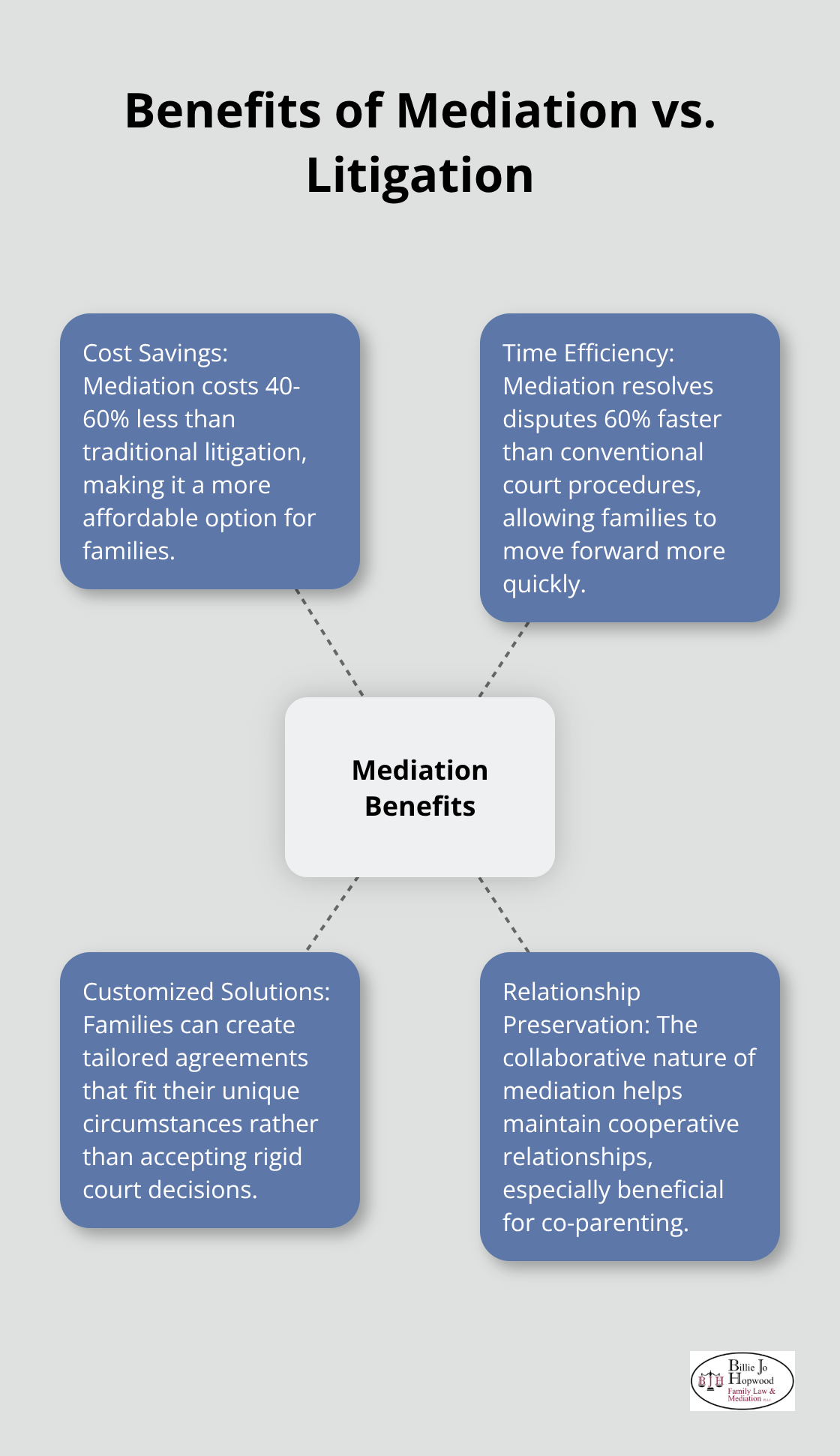
Mediation costs 40-60% less than litigation while it resolves disputes 60% faster than conventional court procedures according to the Florida Dispute Resolution Center. Traditional divorce litigation in Melbourne can cost families $15,000 to $40,000 per party, while mediation typically runs $2,500 to $8,000 total for both parties combined.
Court cases drag on for 12-18 months due to packed court schedules and procedural delays, but mediation sessions wrap up within 4-8 weeks from the initial referral. The American Bar Association reports that 98% of mediation sessions take place within eight weeks of referral, compared to court cases that wait months just for initial hearings.
Financial Protection Through Collaborative Resolution
Litigation burns through retainer fees at $300-500 per hour for attorney time spent in depositions, document discovery, and court appearances that mediation eliminates entirely. Couples avoid expert witness fees for property appraisals and custody evaluations when they reach agreements through guided negotiation instead of adversarial proof requirements.
Mediation prevents the financial destruction that occurs when legal fees consume the very assets couples fight to protect. The 80% compliance rate for mediated agreements means families avoid costly return trips to court for enforcement actions that plague litigated cases.
Relationship Preservation That Benefits Children
Mediation maintains cooperative relationships between divorced spouses, which proves invaluable for successful co-parenting arrangements that litigation destroys through adversarial tactics. Parents who mediate their divorce report 72% higher satisfaction with their co-parenting relationship compared to those who litigated their cases.
Children of mediated divorces show better adjustment outcomes because their parents learned collaborative communication skills during the mediation process rather than battle tactics from courtroom warfare. The confidential nature of mediation protects family privacy and prevents public court records that can embarrass children and damage professional reputations for years to come.
Greater Control Over Final Outcomes
Mediation allows families to create customized solutions that work for their specific circumstances rather than accept one-size-fits-all court decisions. Parents design custody schedules that accommodate work schedules, school activities, and family traditions (instead of standard every-other-weekend arrangements that courts typically impose).
Couples negotiate property division based on their actual needs and priorities rather than rigid legal formulas that may not serve either party well. This control leads to higher satisfaction rates and better long-term compliance with agreements that both parties helped create.
Final Thoughts
Mediation law examples from Melbourne, Florida show how families resolve disputes through collaboration rather than courtroom battles. These real-world applications prove mediation works across divorce property division, child custody arrangements, and spousal support negotiations. Melbourne families choose mediation because it costs 40-60% less than litigation while it preserves relationships that matter most for successful co-parenting.
The 70% settlement rate in Florida mediation cases demonstrates this approach works for complex family disputes that once required lengthy court proceedings. The confidential process allows families to create customized solutions that fit their unique circumstances rather than accept rigid court decisions. Parents design custody schedules around their children’s needs, while couples divide assets based on their actual priorities and financial situations (instead of standard court formulas).
We at Billie Jo Hopwood Family Law & Mediation, PLLC guide Melbourne families through mediation processes that transform conflicts into workable agreements. Families who consider mediation can take the first step by scheduling a consultation to discuss their specific situation. Contact our Melbourne office to learn how mediation can provide the resolution your family needs while it protects your relationships and financial future.