
Uncontested divorce in Melbourne Florida is the path many Brevard County couples choose when they already agree on the major issues and want a clearer, less adversarial process. Agreement alone does not finish the case. Florida still requires a proper petition, residency proof, and a court judgment, and some couples qualify for a streamlined simplified dissolution while others need a regular dissolution with a signed marital settlement agreement.
At Billie Jo Hopwood Family Law & Mediation, PLLC, we guide Melbourne and Brevard County families through uncontested divorce, divorce mediation, and related family law matters so you know exactly what to expect. This guide explains what an uncontested divorce actually is under Florida law, how the process usually moves from agreement to final judgment, and the mistakes that turn an agreed case into an unexpected dispute.
What an Uncontested Divorce in Melbourne Florida Actually Means
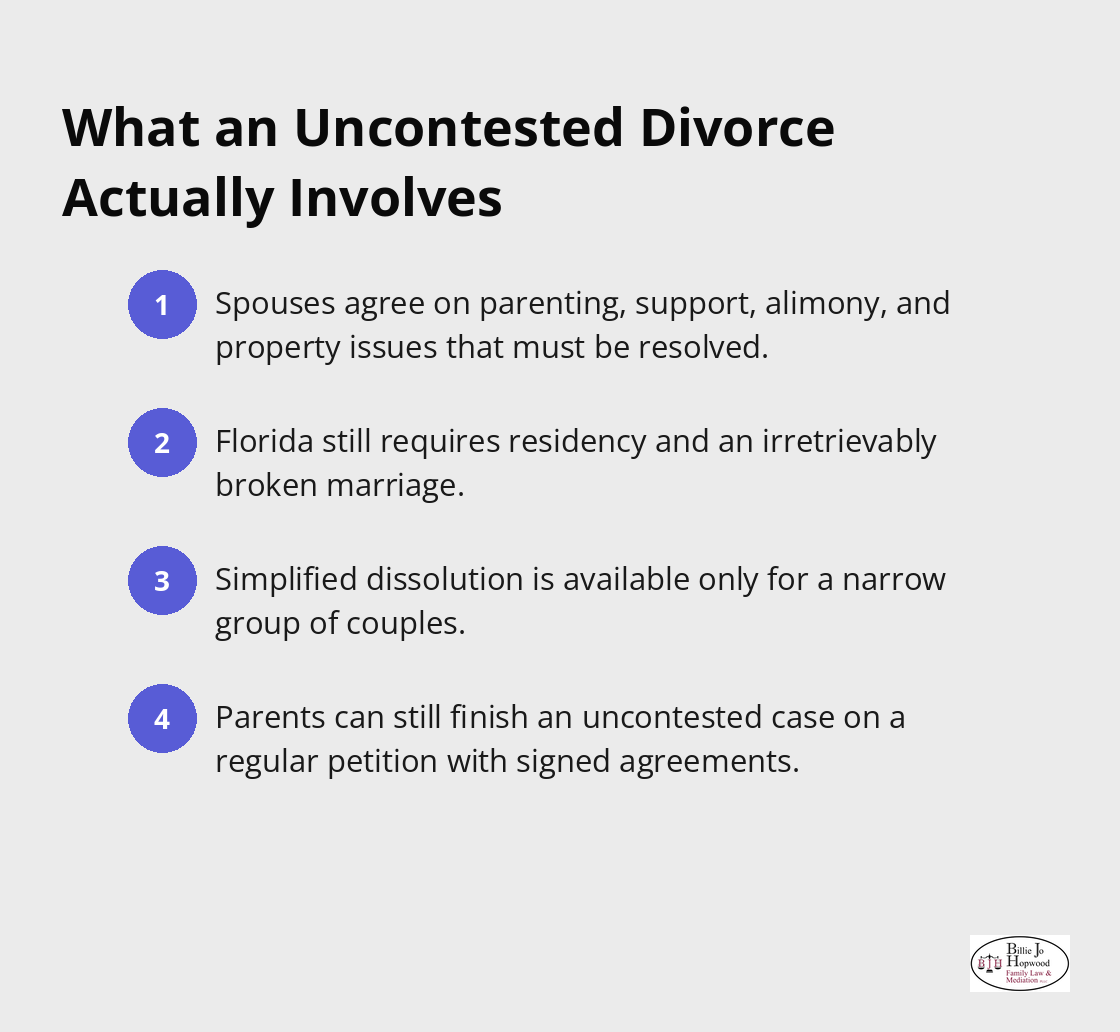
An uncontested divorce is a dissolution of marriage in which the spouses agree on the issues that must be resolved for the court to enter a final judgment. Those issues commonly include parenting and time-sharing if there are minor children, child support, alimony, and division of marital assets and liabilities. Florida does not require spouses to litigate every case. When both people can put a complete agreement in writing, the court can focus on whether the statutory requirements are met rather than on deciding contested facts.
Residency and the Ground of Irretrievable Breakdown
Florida Statute section 61.021 requires that one of the parties to the marriage reside six months in the state before filing the petition for dissolution. Section 61.052 provides that a judgment of dissolution shall not be granted unless the marriage is irretrievably broken or one party has been adjudged incapacitated for at least three years under the guardianship statutes. Most uncontested cases in Melbourne Florida proceed on the irretrievably broken ground, which the parties plead generally and support with evidence at the hearing. Residence may be corroborated by a valid Florida driver license, a Florida voter registration card, a valid Florida identification card, or the testimony or affidavit of a third party, as section 61.052 explains.
Simplified Dissolution Is a Narrow Subset of Uncontested Cases
Florida Family Law Rules of Procedure Rule 12.105 and Form 12.901(a) create a simplified dissolution procedure for couples who meet strict criteria. The parties may use that petition only if they certify under oath that they have no minor or dependent children together, the wife does not have any minor or dependent children born during the marriage and is not pregnant, they have made a satisfactory division of their property and agreed on joint obligations, and the other facts in Form 12.901(a) are true. Official form instructions also require that the spouses are not seeking alimony from each other, are willing to give up the right to trial and appeal, have both signed the petition, and are willing to attend the final hearing together. Couples who do not meet every criterion must use a regular petition even when the case is otherwise uncontested.
Regular Uncontested Dissolution When Children or Support Issues Exist
Many Melbourne Florida families still reach a fully agreed outcome even though simplified dissolution is unavailable. Parents can file a regular petition, exchange required disclosures, complete a parenting plan under the framework in section 61.13, address child support under the chapter 61 guidelines, and submit a marital settlement agreement covering property and any alimony terms. The case remains uncontested when both parties sign and the court finds the agreement consistent with Florida law, including the child’s best interests for parenting issues.
How an Uncontested Divorce Process Actually Moves Forward
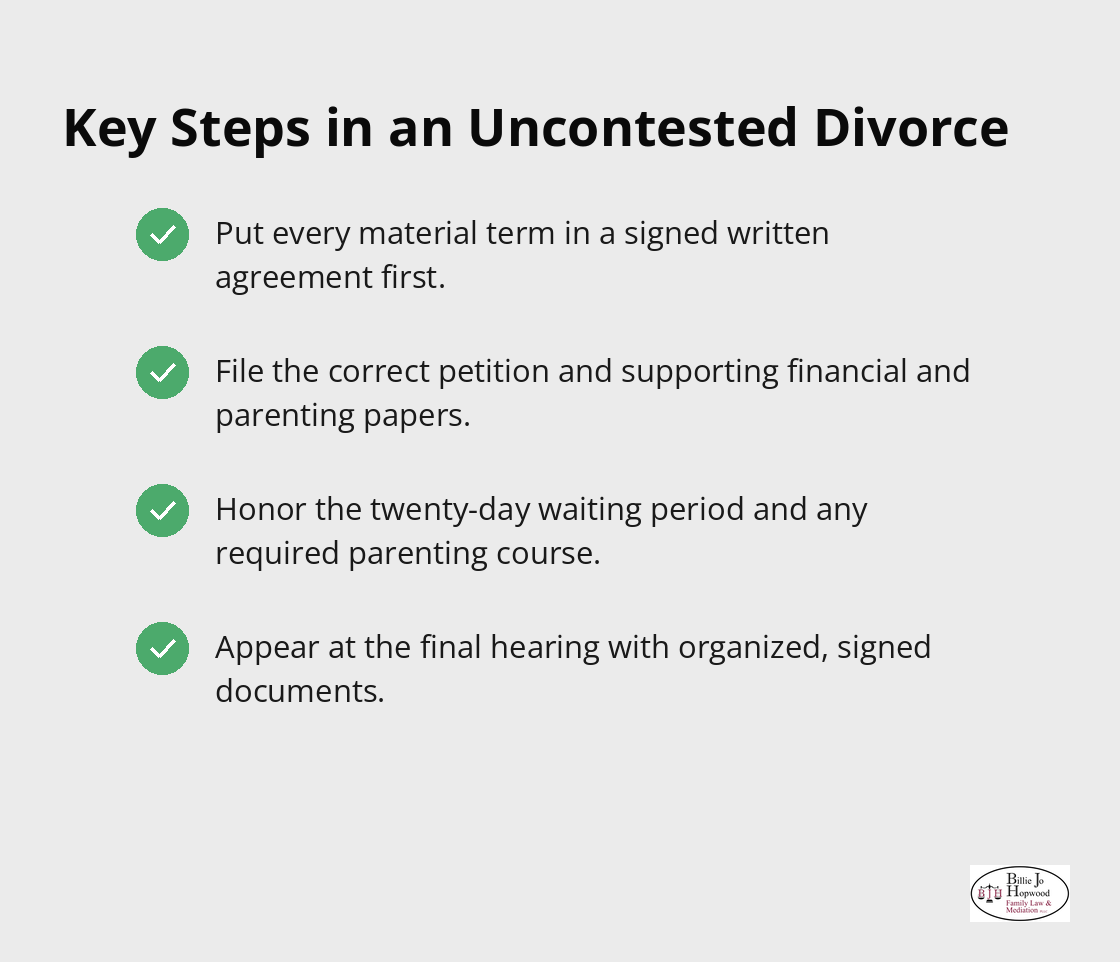
Agreement is the starting point, not the finish line. An uncontested divorce in Melbourne Florida still needs a filed case, proof of residency, paperwork the clerk and judge can rely on, and a final hearing after Florida’s statutory waiting period. Mediation can help spouses reach the written agreement that makes the rest of the process smoother, which is why many Brevard County couples use mediation before or during an uncontested filing.
Reach a Complete Written Agreement First
Courts do not invent missing terms for you in an uncontested case. Spouses need a clear division of marital assets and liabilities under the equitable-distribution framework in section 61.075, which begins with the premise that marital assets and liabilities should be distributed equally unless there is justification for an unequal distribution based on the statute’s listed factors. If there are minor children, the agreement should include a parenting plan and time-sharing schedule that the court can evaluate under section 61.13. Leaving a house, retirement account, debt, or holiday schedule unresolved is one of the fastest ways for an uncontested case to stall.
File the Correct Petition and Supporting Papers
Couples who qualify may file the joint petition for simplified dissolution on Form 12.901(a). Everyone else uses the regular dissolution petition that matches whether there are children, property, or both. Financial affidavits, a marital settlement agreement, and, when children are involved, parenting-plan and child-support paperwork typically travel with the case. In Brevard County, the clerk of the circuit court receives the filing for the Melbourne and surrounding-community cases that belong in that circuit.
Honor the Twenty-Day Waiting Period and Any Parenting Course
Florida Statute section 61.19 provides that no final judgment of dissolution of marriage may be entered until at least twenty days have elapsed from the date of filing the original petition, unless the court finds that injustice would result from the delay and enters judgment earlier. Separately, section 61.21 requires parties in covered dissolution actions involving shared parental responsibility to complete an approved Parent Education and Family Stabilization Course before entry of final judgment, unless the court excuses attendance for good cause. For dissolution actions, the petitioner generally must complete the course within forty-five days after filing, and other parties within forty-five days after service, with proof filed before final judgment.
Appear for the Final Hearing
Even when every issue is agreed, Florida courts still enter a judgment. Simplified dissolution under Rule 12.105 contemplates that the parties appear and that the court examine the petition before granting dissolution if the rule’s requirements and the statutory waiting period are met. Regular uncontested cases likewise end with a hearing at which the judge confirms residency, the irretrievable breakdown of the marriage, and that the submitted agreements are suitable for entry as court orders. Bringing organized signed documents to that hearing keeps an agreed Melbourne Florida divorce from being continued for missing paperwork.
What Commonly Derails an Otherwise Uncontested Divorce
Most problems in uncontested cases are avoidable. They arise when spouses treat verbal understandings as final, overlook statutory requirements that still apply to friendly cases, or discover late that one person never agreed to a detail the other thought was settled. The goal of an uncontested divorce in Melbourne Florida is a durable judgment, not a temporary truce that unravels after entry.
Calling the Case Uncontested Before Every Issue Is Written Down
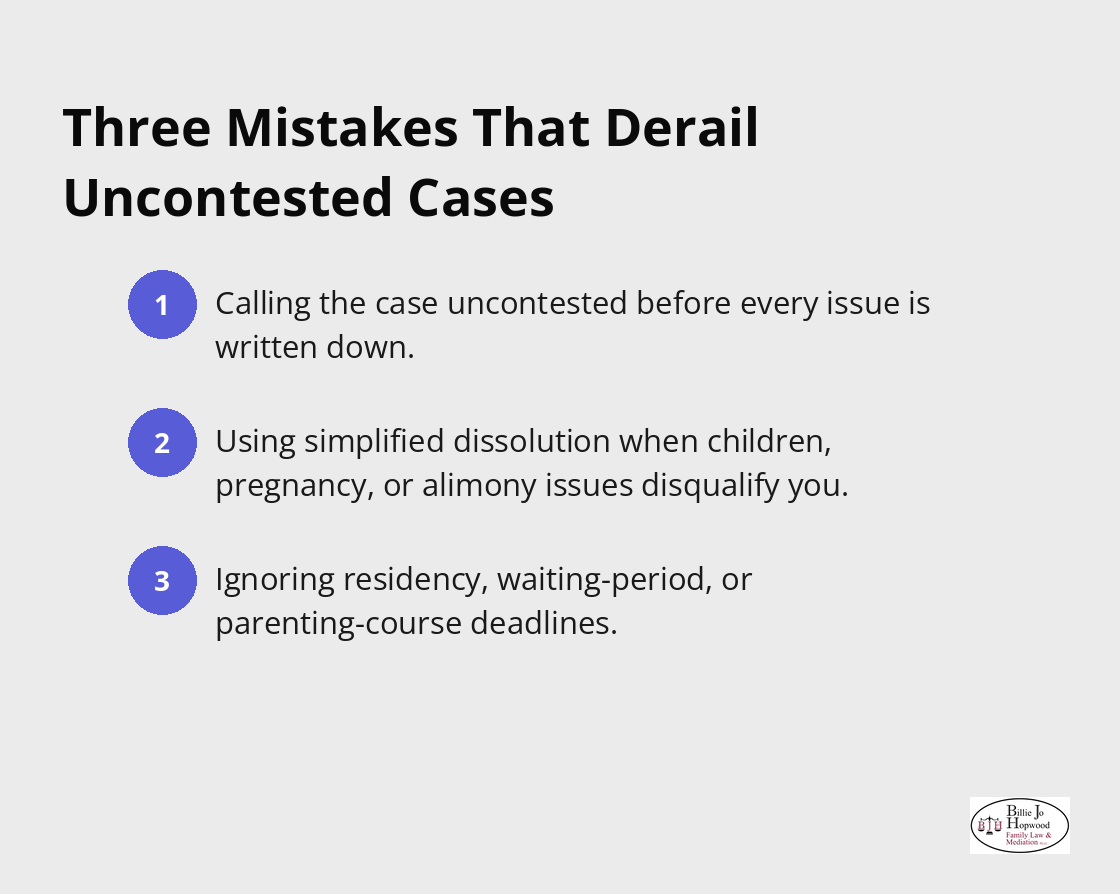
Spouses sometimes agree in conversation that they will share parenting time or sell a home, then file before those terms are specific enough for a judgment. Section 61.075 still requires the court to set apart nonmarital assets and distribute marital assets and liabilities. Section 61.13 still requires workable parenting and support terms when children are involved. Mediation is often the practical way to convert general goodwill into signed schedules, debt allocations, and title-transfer steps before filing.
Choosing Simplified Dissolution When the Couple Does Not Qualify
Form 12.901(a) and Rule 12.105 are unavailable when there are minor or dependent children, when a wife has a minor or dependent child born during the marriage or is pregnant, when the spouses seek alimony, or when they are unwilling to waive trial and appeal rights. Filing the simplified petition in those situations wastes time and can require starting over on a regular petition. An honest eligibility check at the beginning protects the timeline.
Ignoring Residency, Waiting Periods, or Course Deadlines
An agreed case still fails if neither spouse meets the six-month residency rule in section 61.021, if the parties ask for final judgment before the twenty-day period in section 61.19 without a qualifying showing of injustice, or if required parenting-course proof under section 61.21 is missing. These requirements apply in Melbourne Florida and throughout Brevard County just as they do elsewhere in the state. Building them into the case calendar prevents a last-minute continuance after everyone has already negotiated the hard personal issues.
Final Thoughts
Uncontested divorce in Melbourne Florida works when spouses combine genuine agreement with the statutory steps Florida still requires. Section 61.021 sets residency, section 61.052 supplies the irretrievable-breakdown ground, section 61.075 frames property division, section 61.13 governs parenting and support issues, section 61.19 imposes a twenty-day waiting period before final judgment, and section 61.21 addresses the parenting course in covered cases. Simplified dissolution under Rule 12.105 and Form 12.901(a) remains available only for the narrow group of couples who meet every listed condition.
If you and your spouse are ready to resolve a divorce by agreement in Melbourne or elsewhere in Brevard County, or you want help mediating the remaining issues first, contact Billie Jo Hopwood Family Law & Mediation, PLLC to speak with our team. We will review your situation, explain which uncontested path fits, and help you take a practical next step.