
Divorce doesn’t have to mean courtroom battles and mounting legal bills. Mediation in family law offers families in Melbourne, Florida a way to resolve disputes while keeping control of the outcome.
We at Billie Jo Hopwood Family Law & Mediation, PLLC have seen firsthand how this approach reduces conflict and protects children from unnecessary stress.
Why Mediation Costs Less and Moves Faster Than Court
The Economics of Mediation Versus Litigation
Mediation operates on fundamentally different economics than litigation. When you go to court, you pay for discovery processes, multiple attorney appearances, court filing fees, and potentially expert witnesses. A contested divorce in Florida can easily exceed $15,000 to $30,000 or more per person, depending on complexity. Mediation, by contrast, typically costs between $1,000 and $5,000 total for both parties combined, according to data from family law practitioners. You pay for a neutral facilitator’s time rather than two opposing attorneys preparing for battle.
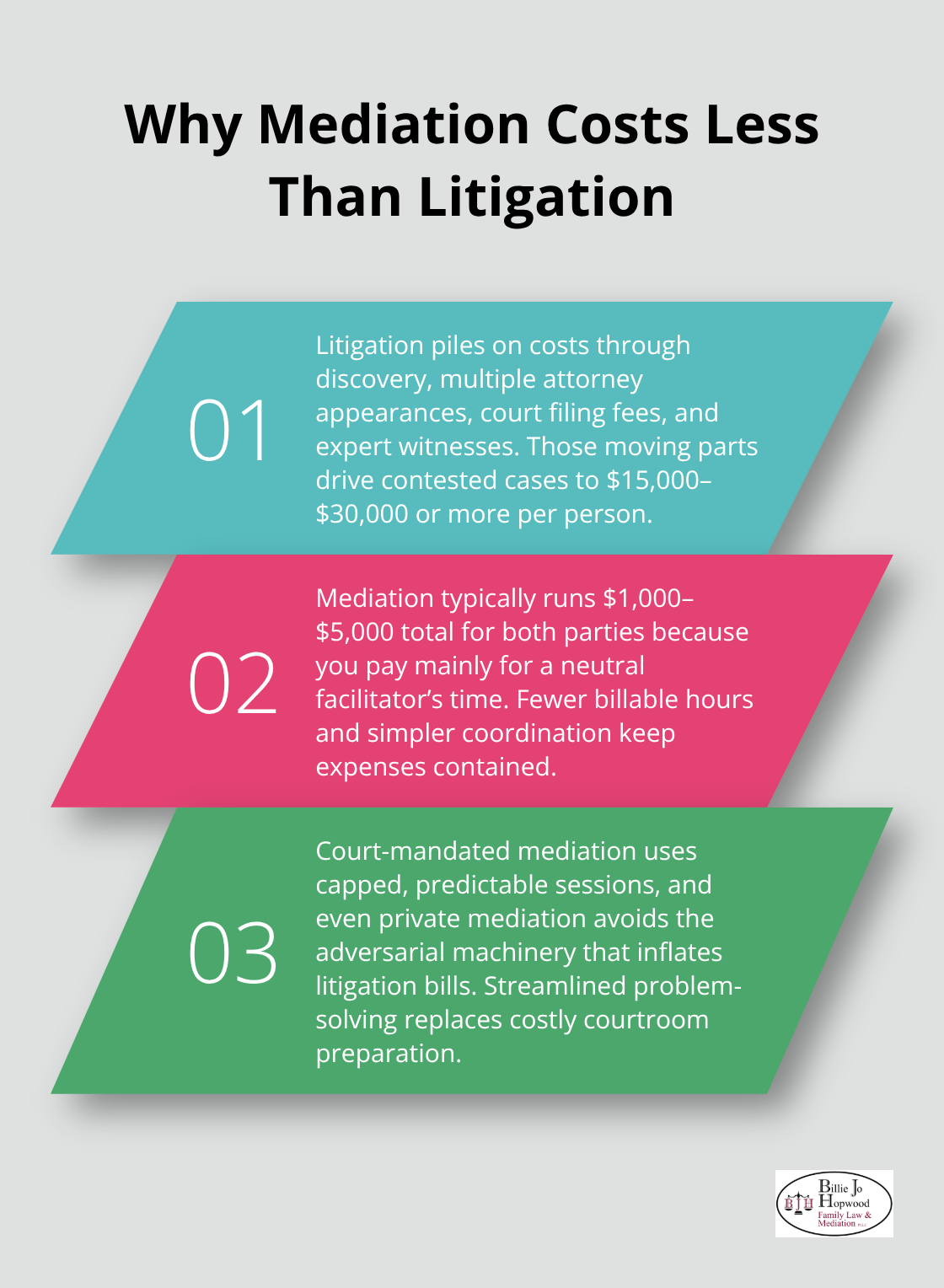
Court-mandated mediation in Florida circuit courts limits sessions to four hours in two sessions, with the possibility of extending to eight hours if the mediator recommends it. This structure makes the timeline predictable and the cost capped. Even private mediation, which allows broader scope than court-ordered sessions, remains significantly cheaper because the process eliminates the adversarial machinery that drives litigation expenses upward.
Speed Advantages That Matter for Your Family
A typical contested divorce takes 6 to 12 months or longer in Florida courts, with delays from scheduling conflicts, discovery disputes, and court backlogs. Mediation can resolve the same issues in weeks or a few months. Many families complete mediation in a single day or across two to three sessions spanning a few weeks.
This speed matters enormously for children, who benefit when parents reach agreement quickly rather than enduring prolonged conflict and uncertainty. You maintain control over the timeline instead of waiting for court availability. The confidentiality of mediation also means your family’s private matters stay out of public court records, unlike litigation where financial details and personal disputes become part of the public docket.
Preparation Accelerates Results
When both parties arrive prepared with organized documents-financial statements, tax returns, and a clear list of issues-mediation moves even faster. Families that invest time upfront in organizing their materials and identifying their priorities often complete the process in fewer sessions. This preparation transforms mediation from a lengthy negotiation into a focused problem-solving session where both parties understand what matters most.
The financial and emotional savings compound when you move quickly. Each month of litigation adds attorney fees, court costs, and stress that mediation avoids entirely. Families in Melbourne, Florida who choose mediation gain not just faster resolution but also the ability to redirect resources toward rebuilding their lives rather than funding courtroom battles.
Why Mediation Gives You Real Control Over Your Family’s Future
Mediation shifts power away from the judge and into your hands. In court, a judge decides everything: how assets get divided, who gets primary custody, what child support looks like, and whether alimony applies. You present your case, the other parent presents theirs, and the judge imposes a decision you may deeply disagree with. In mediation, you and the other parent make every decision together. A mediator facilitates the conversation but does not decide anything for you. This distinction matters because you know your family’s needs better than any judge ever will.
Research from the Coastal Legal Team shows that mediated families often report substantially better post-divorce relationships than those who litigate, partly because both parents retain agency throughout the process. When you control the outcome, you craft solutions that actually work for your specific situation rather than accepting a one-size-fits-all court order.
Children Thrive When Parents Cooperate
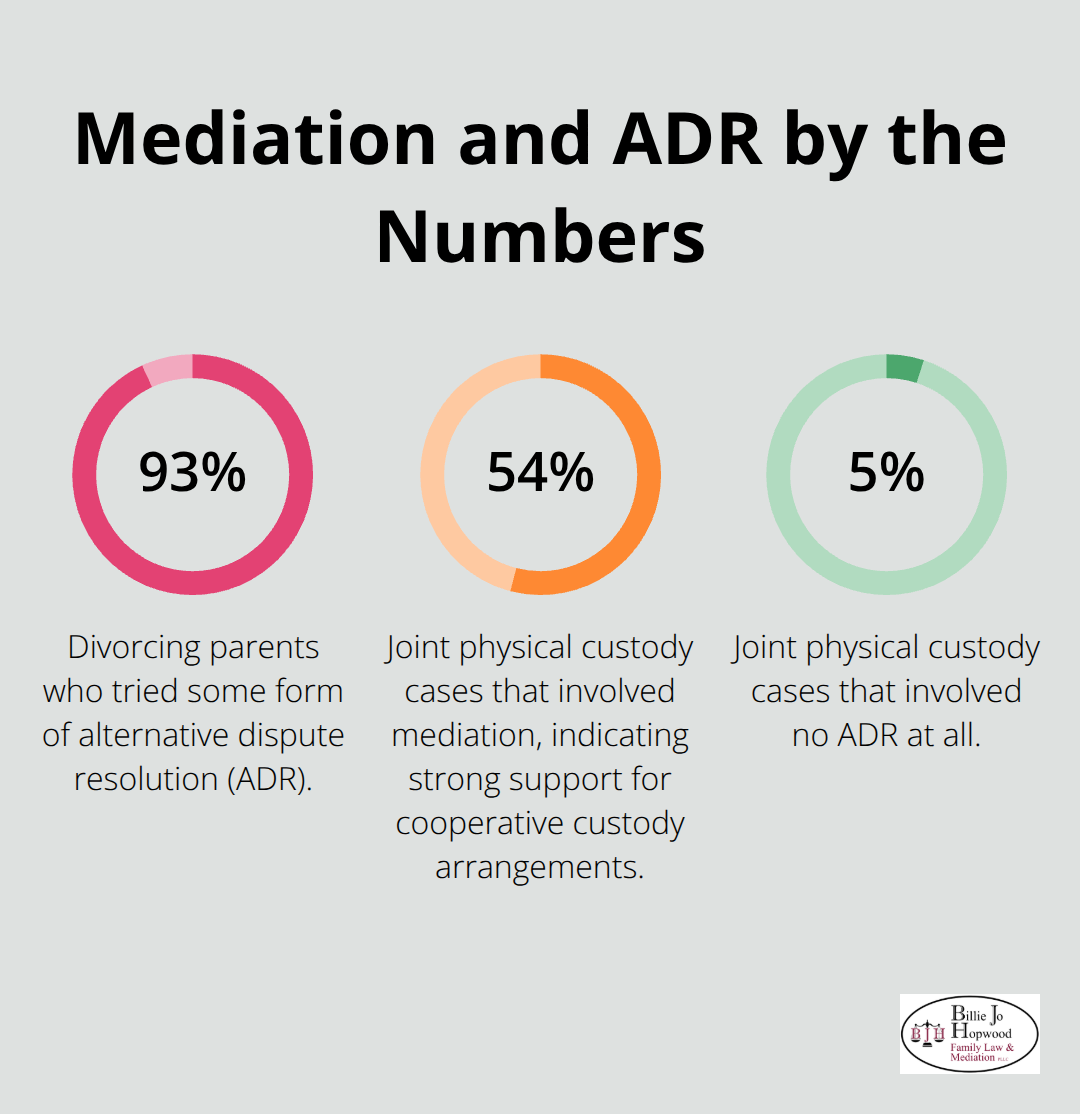
The emotional toll of litigation damages children in measurable ways. Court battles mean months of conflict, hostile exchanges, and parents focused on winning rather than parenting. Mediation removes this adversarial machinery. According to data on alternative dispute resolution outcomes, 93% of divorcing parents tried some form of ADR, with mediation used by just over half. Among those who used mediation, ADR users are almost twice as likely to rate their post-divorce relationship highly.
More importantly, children in these families experience lower stress because parents reach agreement faster and maintain calmer interactions throughout. When both parents participate in mediation, they model cooperation rather than hostility. This translates into tangible benefits: children maintain stronger connections with both parents, experience less anxiety about the future, and adapt more smoothly to the new family structure. Mediation sessions typically last from a few hours to a full day (depending on complexity), meaning the disruptive period stays brief rather than extending through months of court appearances.
Privacy Protects Your Family’s Sensitive Information
Court proceedings are public record. Financial details, personal disputes, custody disagreements, and intimate family conflicts all become part of the public docket that anyone can access. Mediation stays confidential. What you discuss with the mediator and the other parent remains private unless you choose to file a signed agreement with the court. This confidentiality extends to all mediation communications, which are typically not admissible in court if mediation fails and you proceed to litigation.
For families in Melbourne, Florida, this means your children’s behavioral issues, your spouse’s mental health struggles, or your financial vulnerabilities do not become neighborhood gossip or ammunition for future disputes. The confidentiality also creates psychological safety. Parents and children speak more openly when they know private matters stay private, which actually accelerates resolution because both parties can be honest about their concerns without worrying about public exposure. A mediator maintains strict confidentiality protocols and informs all participants of these protections upfront (following established codes of conduct that prioritize confidentiality as a cornerstone of the process).
You Shape Solutions That Fit Your Family
Mediation allows you to craft flexible, creative settlements that fit your family’s actual needs rather than forcing your situation into rigid legal categories. A judge applies state law uniformly, but your family is unique. Perhaps you want a non-traditional custody arrangement that works with your work schedules. Perhaps you want to preserve a family business in a way that protects both parents’ interests. Perhaps you want child support structured differently than the state formula allows. Mediation accommodates these possibilities because you and the other parent decide what works.
This flexibility extends to timing and implementation. You can agree to phase in asset transfers, adjust support payments as circumstances change, or build in review dates to revisit arrangements as children grow. These nuanced solutions emerge from conversation and mutual problem-solving rather than from a judge’s bench. When both parents help create the agreement, they feel invested in making it work, which means better compliance and fewer future disputes.
The ability to shape your own outcome transforms mediation from a process you endure into one that actually serves your family’s interests. This control, combined with the speed and cost savings mediation offers, positions you to move forward with clarity and cooperation. Understanding how to prepare for mediation and what to bring to the table determines whether you maximize these advantages.
What Issues Can Mediation Actually Resolve
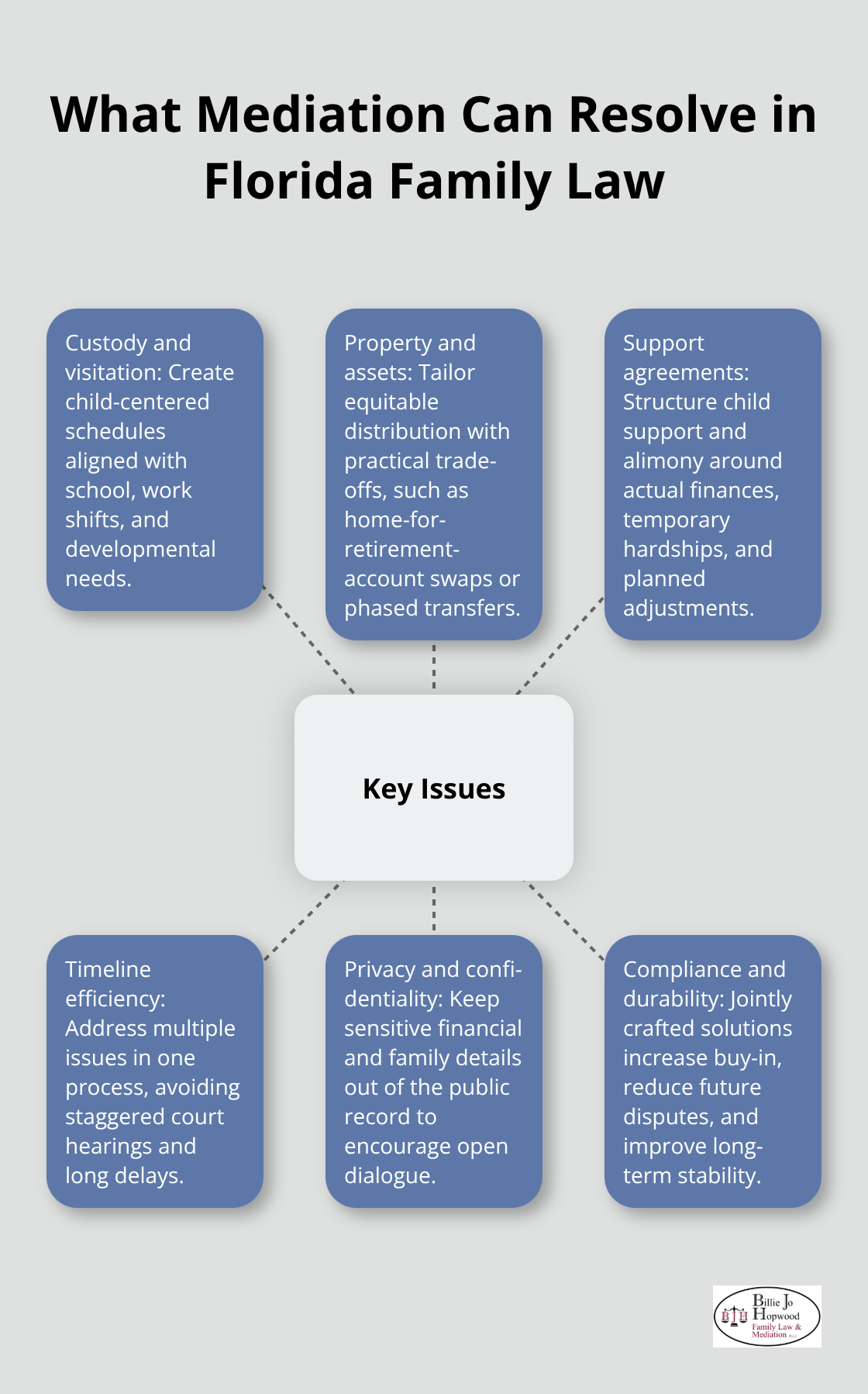
Mediation handles the full range of family law disputes that typically require court intervention, and the practical reality is that most issues settle faster through this process than through litigation. Child custody arrangements, property division, and support agreements all respond well to mediation because both parents can negotiate terms that reflect their actual circumstances rather than accepting a judge’s standardized ruling. The key advantage is that mediation allows you to address multiple issues simultaneously in a single process, whereas court proceedings often drag out as judges schedule separate hearings for custody, property, and support matters across months or years.
Custody and Visitation Arrangements Take Shape Through Real Conversation
Custody disputes represent the most contentious family law issues, yet mediation resolves them successfully in the majority of cases that reach the process. Research on alternative dispute resolution outcomes shows that 54% of joint physical custody cases involved mediation, compared with only 5% that involved no ADR at all, indicating that mediation actively supports cooperative custody arrangements. When both parents sit down with a mediator, they move past the adversarial positioning that dominates court battles and focus instead on what actually works for their children’s schedules, school locations, and emotional needs. A parent working a night shift can negotiate a custody arrangement that aligns with their sleep schedule rather than fighting a judge’s standard 50-50 split that creates logistical chaos. A parent relocating for work can propose a modified visitation schedule that maintains meaningful contact with children while accommodating the move. These practical solutions emerge because you and the other parent control the conversation, not a judge operating under time constraints and limited information about your family’s daily realities.
Asset Division and Property Settlement Become Flexible Negotiations
Florida uses equitable distribution for marital assets and debts, meaning the court aims for fairness rather than a purely equal 50-50 split. However, what counts as fair depends entirely on your family’s circumstances, and mediation lets you define fairness for yourselves. Assets acquired during marriage are negotiable, while inheritances typically stay with the recipient unless commingled with marital assets. In mediation, you can propose creative solutions that a court would never consider: perhaps one parent keeps the family home while the other receives a larger share of retirement accounts, or a family business transfers to the parent most equipped to run it while the other parent receives compensation over time. You might agree to phase in asset transfers over several years rather than forcing an immediate sale or liquidation. These arrangements work because both parents helped design them, and they address the specific financial realities of your situation rather than applying generic legal formulas.
Support Agreements Reflect Actual Financial Circumstances
Child support in Florida follows state formulas when cases reach court, but mediation allows you to structure support differently if both parents agree. Alimony depends on multiple factors-marriage duration, standard of living, earning capacity, education, age, and physical and mental condition of both spouses-yet courts apply these factors rigidly. Mediation lets you negotiate support that accounts for temporary hardship, career transitions, or health issues in ways that court orders cannot accommodate. A parent returning to school can propose lower support temporarily with a plan to increase payments once education completes and earning capacity improves. A parent facing a health crisis can structure support around actual income fluctuations rather than fighting to modify a rigid court order later. These agreements become legally binding once written and signed, and they can be enforced by the court if either party fails to comply, giving you the security of a court order without the inflexibility.
Final Thoughts
Mediation in family law offers families in Melbourne, Florida a fundamentally different path than courtroom litigation. You control the settlement, craft custody arrangements that fit your work schedules, and structure support agreements that reflect your actual financial circumstances rather than accepting a judge’s standardized ruling. The financial difference alone justifies consideration: mediation typically costs $1,000 to $5,000 total compared to $15,000 to $30,000 or more per person in contested court battles, while families resolve mediation in weeks or months instead of the 6 to 12 months litigation demands.
Research shows that mediated families report substantially better post-divorce relationships than those who litigate, and children thrive when parents cooperate rather than battle in court. Confidentiality protects your family’s sensitive information from public record, creating psychological safety that accelerates honest conversation and genuine resolution. When you shape the agreement that governs your family’s future, you invest in making it work rather than resisting a court order imposed from the bench.
If you are considering divorce or facing family law disputes in Melbourne, Florida, the first step is understanding whether mediation fits your situation. We at Billie Jo Hopwood Family Law & Mediation, PLLC assist families through these decisions and guide you toward resolution that protects your interests and your children’s wellbeing. Contact us to discuss how mediation can work for your family.