
Family court mediation in Melbourne, Florida offers a faster and less adversarial path through family disputes than traditional litigation. Most families find mediation reduces costs by 40-60% compared to courtroom battles, while preserving relationships that matter.
We at Billie Jo Hopwood Family Law & Mediation, PLLC have guided countless families through this process. The family court mediation tips in this guide will help you prepare, communicate effectively, and reach agreements that work for your family.
How Family Court Mediation Works in Melbourne, Florida
Family court mediation in Melbourne, Florida operates through a structured process governed by Florida Statutes §44.102. A neutral mediator meets with both parties to facilitate negotiation on contested issues like asset division, child custody, and support arrangements. The mediator does not decide the outcome; instead, they guide conversation toward mutually acceptable solutions. In the Eighteenth Judicial Circuit covering Brevard and Seminole Counties, mediation typically occurs within 60 days of a court-ordered referral. Each session lasts up to three hours, though additional time can be arranged if both parties agree. Before mediation begins, both parties must file current financial affidavits with the court to establish eligibility and determine fees. The Brevard County Self-Help Center can assist with completing required forms if you need guidance, and you can reach them at ProSeCoordinator@brevardclerk.us or call (321) 633-7780.
How Mediation Differs From Litigation
Litigation forces a judge to impose decisions after trial, meaning you lose control over the outcome. Mediation hands control back to you and the other party. In litigation, your case becomes public record. In mediation, everything discussed remains confidential under Florida law. Court battles typically take 12-18 months or longer; mediation often concludes within weeks.
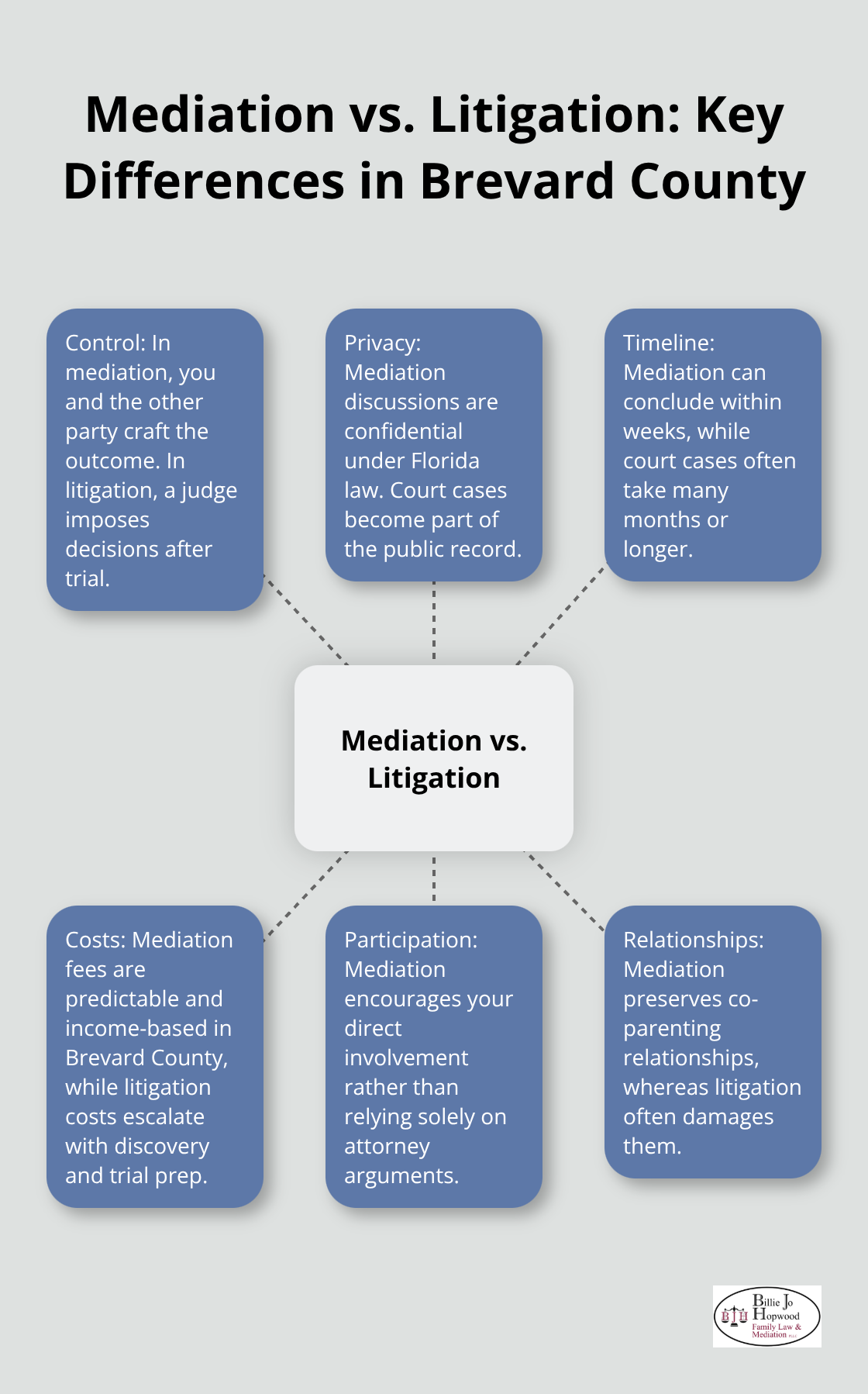
Litigation costs escalate rapidly with discovery, depositions, and trial preparation, while mediation fees in Brevard County are income-based: $60 per party per session if combined income is under $50,000, and $120 per party per session for combined income between $50,000 and $100,000. Litigation creates winners and losers; mediation creates solutions both parties can live with. You participate actively in mediation rather than watching lawyers argue on your behalf. The mediator can propose creative options a judge would never consider. Most importantly, litigation destroys relationships between co-parents. Mediation preserves them.
Why Families Choose Mediation Over Court
Families choose mediation because they retain authority over agreements affecting their children and finances. A judge knows nothing about your family’s unique circumstances, values, or what matters most to you. A mediated agreement reflects your actual priorities. Research consistently shows mediation produces higher satisfaction rates than court-imposed orders because both parties helped craft the solution. You avoid the emotional toll of public testimony and cross-examination. Your children avoid witnessing courtroom conflict. The confidential nature of mediation allows honest discussion without statements being used against you later. Mediation also costs significantly less: studies indicate families save 40-60% in legal fees compared to full litigation. For families in Melbourne, Florida, this difference often means $5,000 to $15,000 in direct savings. Additionally, mediated agreements are more stable. When both parties agree voluntarily, compliance rates are substantially higher than with court orders imposed against someone’s will. Modification disputes arise less frequently.
What Preparation Looks Like Before Your Session
Your success in mediation depends on what you do before the session starts. Gather all financial documents, property records, and debt statements so you understand your complete financial picture. Identify which issues matter most to you and which ones you can compromise on. Work with your attorney to develop a mediation brief that presents your strongest points with supporting evidence (documents, financial records, or witness statements). The mediator uses this brief as their primary reference before the session, so a clear, well-organized brief influences how they approach your case. Discuss your goals with your attorney and establish realistic expectations based on what a court might order if your case went to trial. This comparison helps you evaluate settlement offers when they arrive.
Moving Forward With Confidence
Understanding how mediation works removes much of the anxiety families feel about the process. The structure, timeline, and cost predictability (based on income thresholds in Brevard County) give you a clear roadmap. Your next step involves preparing the specific documents and strategy that will shape your mediation session.
Prepare Documents and Define Your Mediation Goals
Gather Complete Financial Documentation
Preparation determines your mediation outcome more than any other factor. Gather all necessary financial documents you possess: tax returns from the past three years, recent pay stubs, bank statements, investment accounts, retirement account statements, mortgage documents, credit card statements, and any business records if self-employed. The court requires both parties to file current financial affidavits before mediation can proceed under Florida Family Law Rules of Procedure 12.285, and the mediator will reference these affidavits throughout your session.
Without complete financial documentation, you cannot accurately evaluate settlement proposals or identify creative solutions. Many people underestimate what they own or owe because they haven’t reviewed statements in months. Spend time now calculating your net worth and understanding which assets have increased or decreased in value.
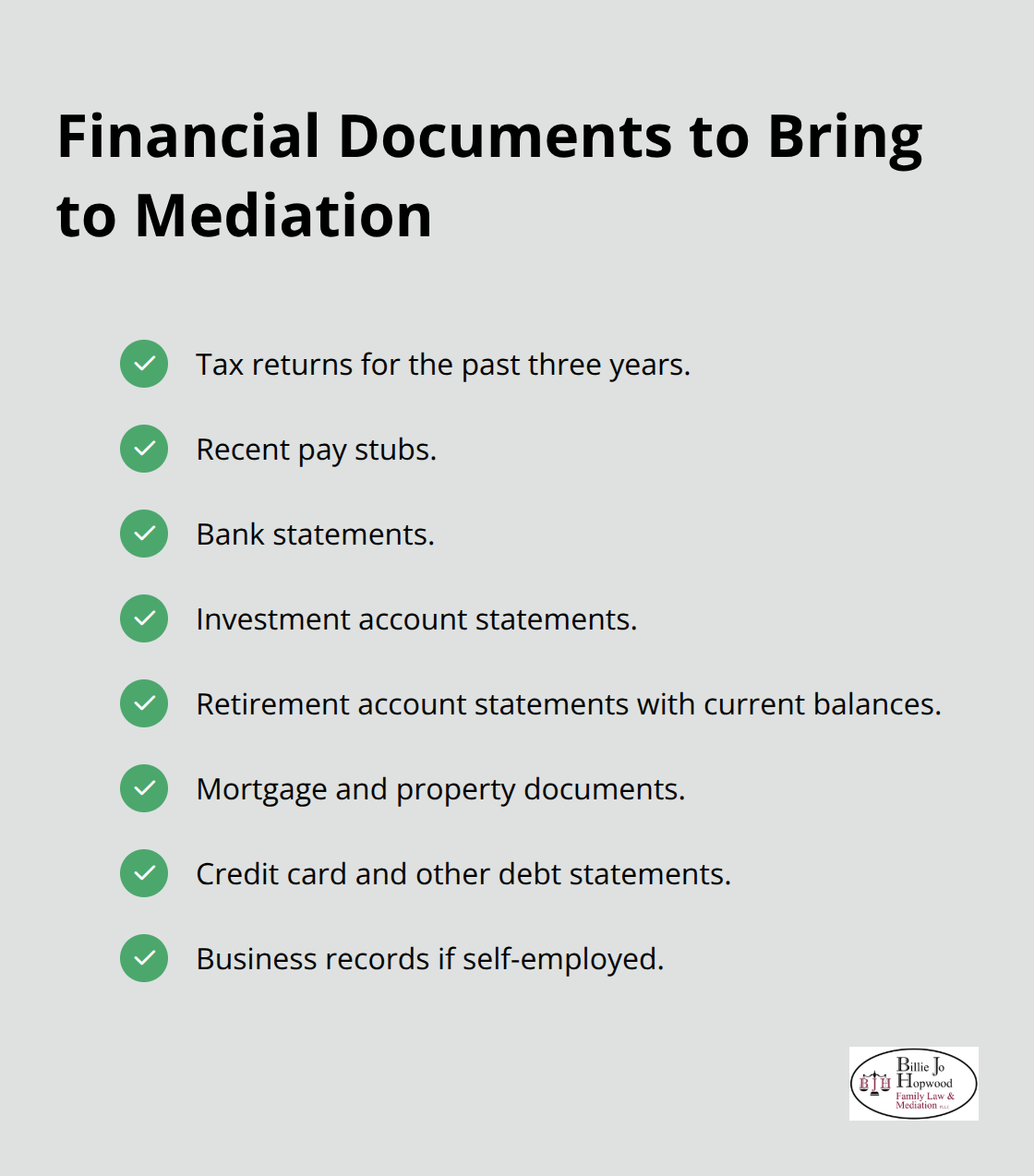
If you own property, gather recent appraisals or comparable sales data for your area. For retirement accounts, request current statements showing vested balances. This groundwork prevents surprises during mediation and ensures you negotiate from accurate information rather than guesses.
Identify Your Priorities and Flexibility Points
Next, identify which issues matter most to your family and where you have flexibility. Create three categories: non-negotiable issues, important but flexible issues, and lower-priority items you can concede. If children are involved, child custody and support arrangements typically occupy the non-negotiable category for most parents. Asset division priorities vary significantly-some families prioritize keeping the family home while others prioritize retirement security.
Be honest about what you actually need versus what you want. Work with your attorney to develop a mediation brief that presents your strongest arguments with supporting evidence. This brief becomes the mediator’s primary reference document, so organize it clearly with the most persuasive points first. Include copies of relevant documents rather than burying evidence in lengthy narratives. The mediator will spend more time reading your brief before the session than they will spend with you during mediation, making document quality directly impact how they perceive your case.
Establish Your Settlement Baseline
Additionally, discuss your best alternative to a negotiated agreement with your attorney-this means understanding what a judge would likely order if your case went to trial. This realistic assessment prevents you from rejecting reasonable settlement offers simply because you hoped for better. Settlement offers that exceed your trial alternative deserve serious consideration, even if they don’t match your initial requests. With your financial picture clear, your priorities defined, and your settlement baseline established, you now possess the foundation necessary to communicate effectively during your mediation session.
How to Communicate Effectively During Mediation
What you say in mediation matters far less than how you say it. The mediator has already read your financial affidavits and your prepared brief before the session starts, so they understand the facts of your case. What they’re watching during mediation is whether you can engage in productive conversation about resolving conflict. Mediators report that 60-70% of impasse situations stem from communication breakdown rather than genuine disagreement over numbers. Your goal is to articulate your needs clearly while remaining open to hearing the other party’s perspective.
State Your Position Without Personal Attacks
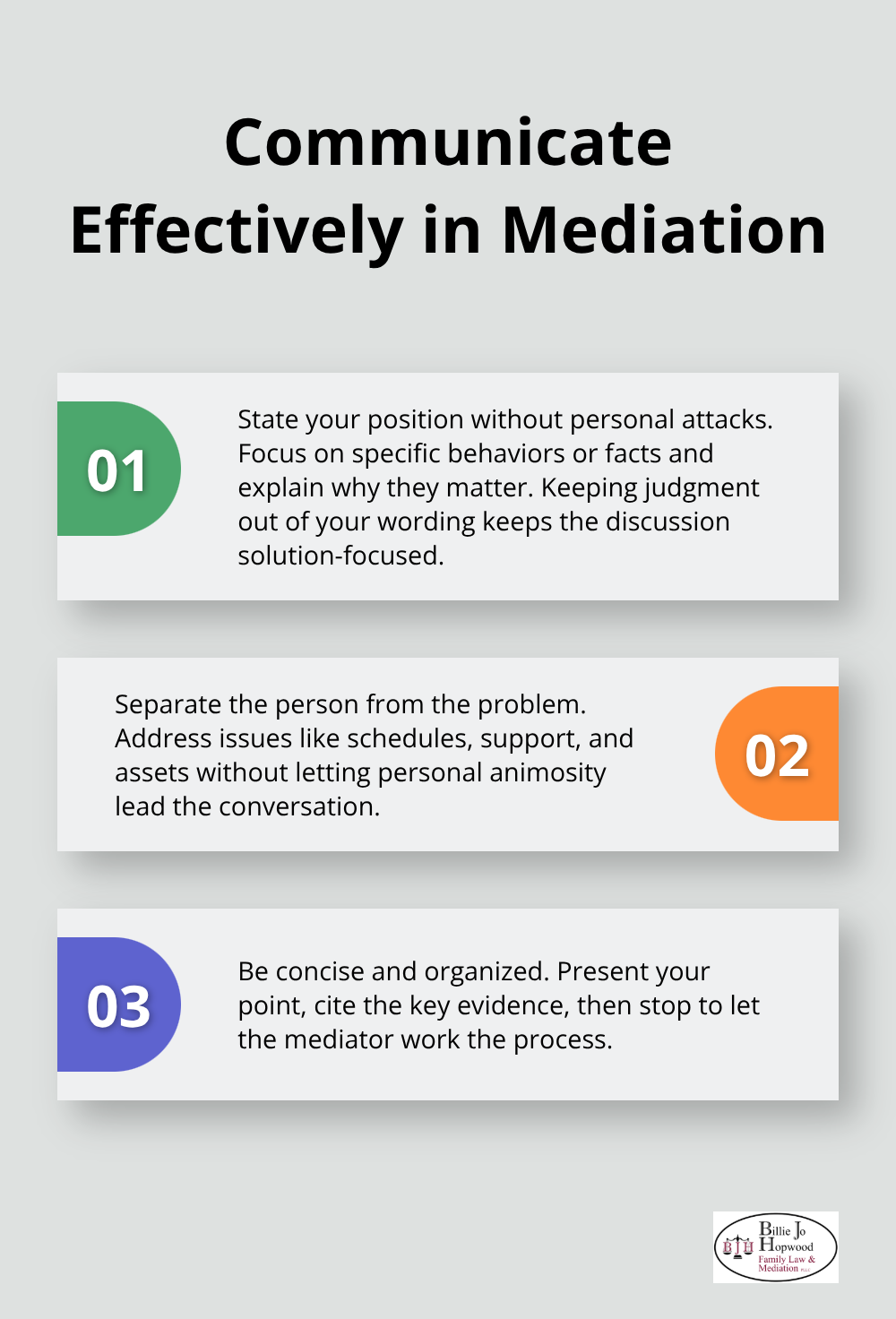
Start by stating your position without attacking the other party’s character or motives. Instead of saying the other parent is irresponsible with money, describe what financial behaviors concern you and why. This shift from judgment to observation keeps the conversation focused on solvable problems rather than personal grievances. During mediation, the other party often says things designed to provoke anger or defensiveness. Your response determines whether mediation continues productively or derails.
Pause before responding to inflammatory statements. Take three seconds to breathe, then address the substance of what was said without matching the emotional tone. The mediator notices restraint and uses it as evidence that settlement is possible. Conversely, escalating emotion signals to the mediator that you cannot negotiate reasonably, which weakens your position in their assessment.
Separate the Person From the Problem
Separate the person from the problem entirely. You may genuinely dislike the other party, but mediation requires discussing specific issues-asset division, custody schedules, support amounts-without letting personal animosity dominate the conversation. The mediator will move between rooms frequently, using shuttle diplomacy to prevent heated exchanges. When you’re in a separate room with your attorney and the mediator, provide clear, factual statements about your position and the evidence supporting it. Avoid venting about the other party’s character; instead, focus on concrete points the mediator can carry to the other side.
Identify Underlying Needs and Interests
Ask questions to clarify what the other party actually needs rather than assuming you know their position. Often what appears as an unreasonable demand masks a legitimate underlying concern. If the other party demands the family home in asset division, they might actually be concerned about stability for children, not greed. Once you identify the real concern, creative solutions emerge. Work with your mediator to propose options that address the other party’s actual need while protecting your interests.
The mediator’s job includes suggesting settlement proposals when impasse occurs, so remain open to their suggestions even if they differ from your initial requests. Your attorney should attend mediation to advise you, but you must participate actively rather than letting your attorney do all the talking. The mediator needs to hear your commitment to resolution directly from you, not filtered through legal representation.
Communicate With Clarity and Precision
When you speak, be concise and organized. Rambling statements lose the mediator’s attention and dilute your strongest points. State your position, provide supporting evidence, then stop talking. This discipline keeps mediation moving forward and demonstrates that you respect both the mediator’s time and the process itself.
Final Thoughts
Mediation offers families in Melbourne, Florida a path forward that preserves both finances and relationships. You’ve learned how mediation works within the Brevard County court system, what preparation looks like, and how to communicate effectively when you’re in the room with a mediator. These family court mediation tips form the foundation for reaching agreements that actually work for your family rather than court-imposed orders that satisfy no one.
After mediation concludes successfully, your mediator drafts a settlement agreement reflecting what both parties negotiated, and your attorney reviews it for legal accuracy before submission to the court. A judge reviews the agreement to confirm it’s fair and legal, then issues a final order that typically takes weeks rather than months. If children are involved, your Parenting Plan must be included in the final agreement and address custody, visitation, decision-making authority, and support obligations clearly.
Once your agreement is finalized, compliance becomes straightforward because both parties helped create it. You’re far more likely to follow an agreement you negotiated than one imposed by a judge, and most mediated agreements remain stable because they reflect each party’s actual priorities. Contact us to discuss how mediation can work for your family and what your next steps should be.