
Divorce mediation in Melbourne, Florida works best when you arrive prepared. Walking in without a mediation preparation checklist leaves you scrambling and vulnerable to poor decisions.
We at Billie Jo Hopwood Family Law & Mediation, PLLC have seen how proper preparation transforms mediation outcomes. This guide walks you through exactly what to gather, how to prepare mentally, and which mistakes to sidestep.
What to Gather Before Divorce Mediation in Melbourne, Florida
Financial Documents Form Your Foundation
Financial documents are non-negotiable. The American Bar Association recommends collecting tax returns for at least three years, current W-2s, recent pay stubs, and complete bank and investment statements. You’ll also need mortgage documents, retirement account statements, and a full accounting of debts including credit cards, car loans, and personal loans.
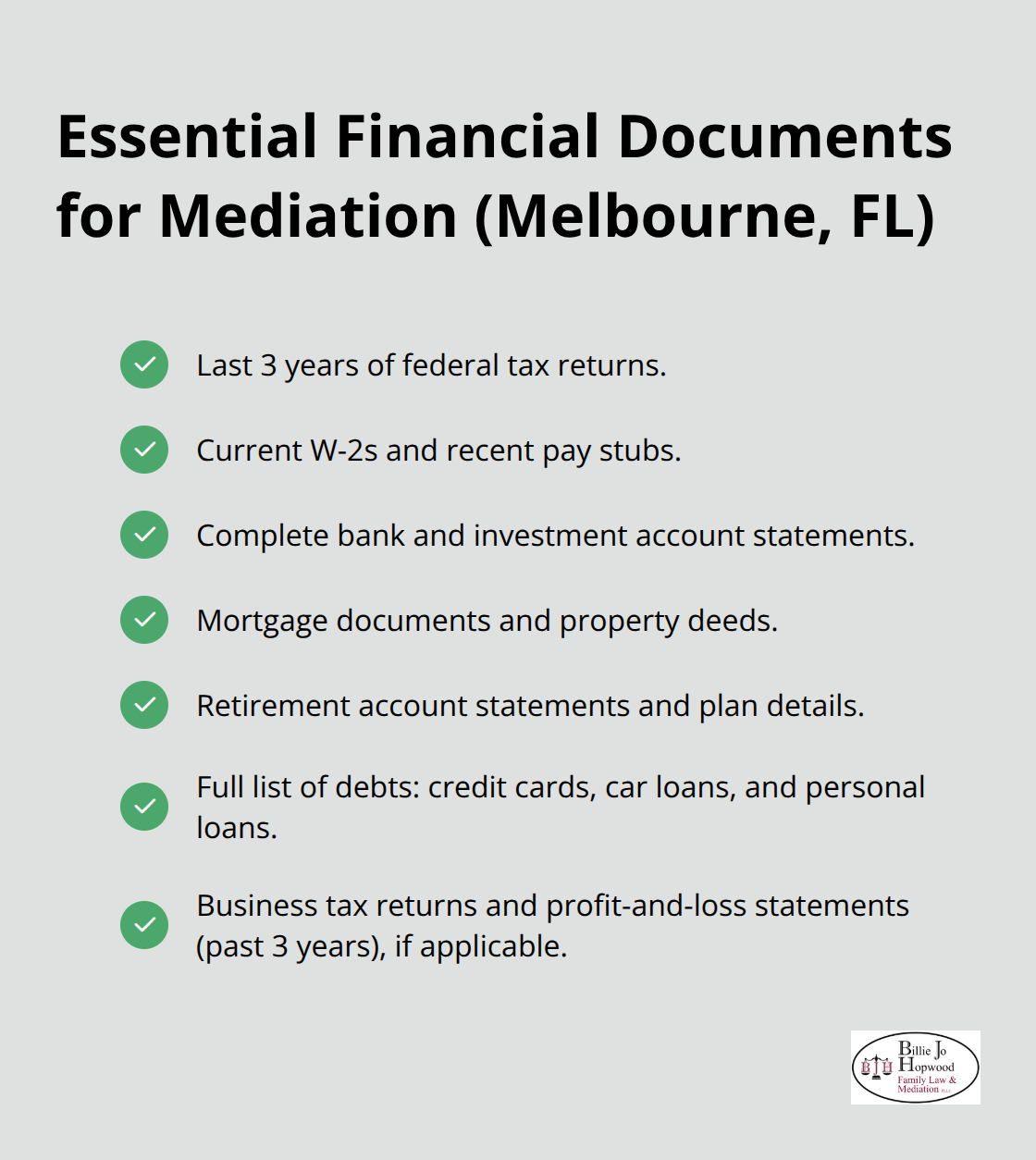
Most people underestimate how many statements they need.
If you have a business, bring three years of business tax returns and profit-and-loss statements. The Association for Conflict Resolution emphasizes that incomplete financial disclosure is the leading reason mediation sessions stall or fail entirely.
Create a Complete Net Worth Statement
A net worth statement lists every asset with its current value and how you determined that value. For your home, pull your most recent appraisal or comparable sales data from your Melbourne, Florida neighborhood. For retirement accounts, get statements showing the account type, current balance, and vesting schedule. For vehicles, use the Kelley Blue Book value or a recent appraisal.
This level of detail prevents arguments about what things are actually worth and keeps your mediation moving forward instead of getting trapped in valuation disputes.
Organize Property and Child Documentation
Bring deeds, mortgage statements, vehicle titles, and insurance policies. For any significant assets, complete appraisals before mediation rather than trying to estimate during sessions. The Association for Conflict Resolution recommends documenting your children’s school schedules, healthcare providers, extracurricular activities, and any special needs or medical conditions.
Organize records showing your involvement in childcare, school pickups, medical appointments, and daily routines. If you have messages, emails, or calendar entries showing cooperation or conflict patterns with the other parent, arrange those chronologically.
Prepare Your Monthly Expense Summary
Create a simple one-page summary of your current monthly expenses including housing, utilities, childcare, healthcare, food, and transportation. This prevents speculation during negotiations and grounds support discussions in reality. Bring organized copies of all documents in both digital and printed formats, labeled clearly and easy to reference.
Your mediator will appreciate walking into a session with a prepared folder rather than loose papers or scattered files. With your financial house in order, you’re ready to address the emotional and mental side of mediation.
How to Prepare Emotionally and Mentally for Mediation
Identify What Actually Matters to You
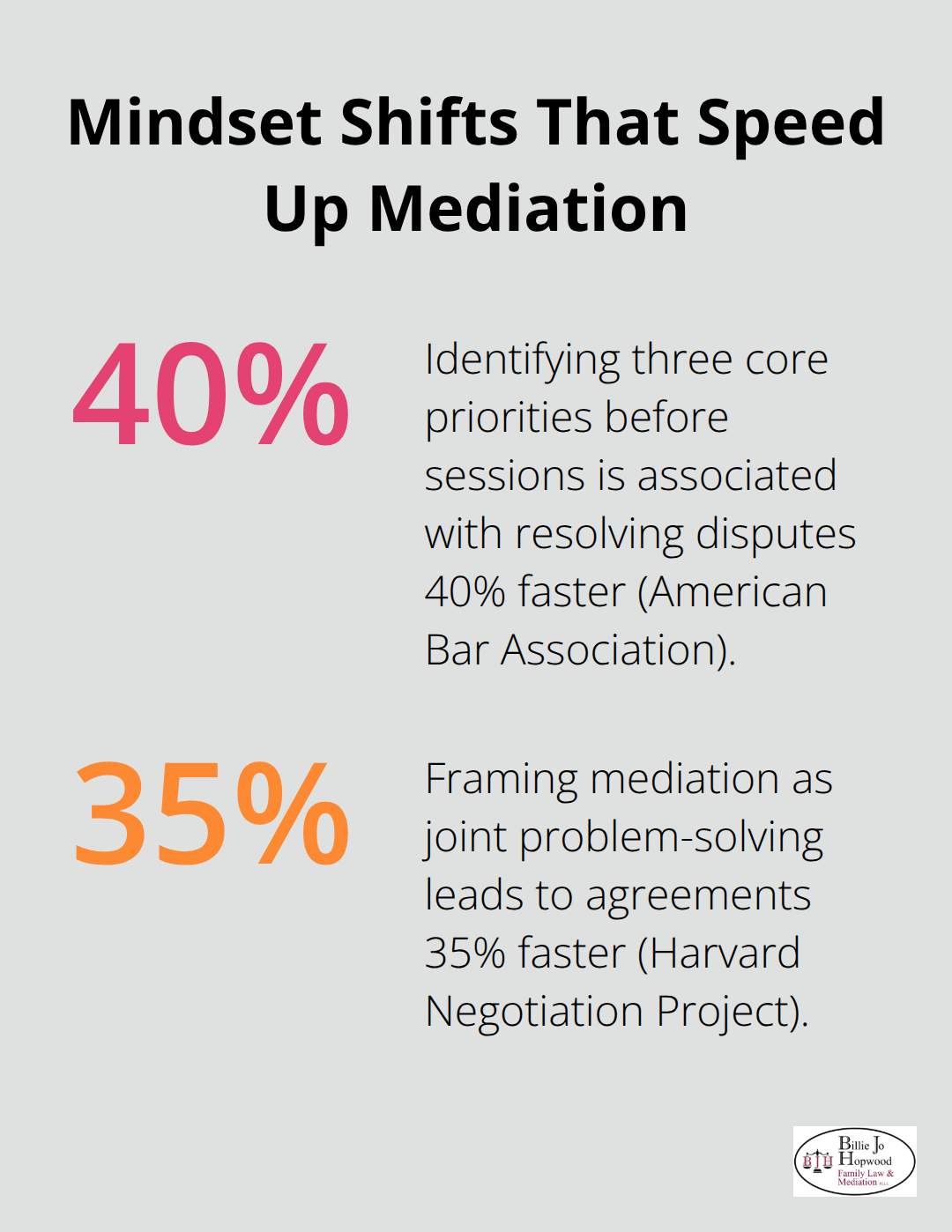
Mediation requires emotional clarity before it requires perfect paperwork. The American Bar Association notes that participants who identify their three core priorities before entering mediation sessions resolve disputes 40% faster than those who approach it without clear direction. Your mental preparation determines whether you negotiate from strength or panic under pressure.
Write down exactly what you want from this mediation, ranked from most to least important. If custody matters most, state that plainly. If keeping the family home ranks first, acknowledge it. This isn’t about what sounds reasonable-it’s about what actually matters to you.
Next, identify what you’re willing to trade. If you want primary custody, you might accept a less favorable asset split. If financial security is paramount, you might compromise on parenting time arrangements. The Harvard Negotiation Project calls this identifying your negotiables versus non-negotiables, and it prevents you from making reactive decisions in the moment. Write these down before mediation starts so you don’t invent them under emotional stress.
Manage Stress by Accepting Discomfort
Stress management during divorce mediation isn’t about staying calm-it’s about staying functional. Acknowledge that mediation will be uncomfortable. You’ll discuss painful topics, hear things you don’t want to hear, and face decisions that have no perfect answer. Expecting discomfort means you won’t interpret it as a sign that mediation is failing.
The Association for Conflict Resolution recommends scheduling mediation sessions when you’re rested and have time to process afterward, not back-to-back with work or childcare obligations. If you have children, arrange care that doesn’t create guilt or distraction during sessions. Bring water and take the breaks your mediator offers-don’t power through.
Realistic expectations mean accepting that mediation won’t feel like a win. It’s supposed to feel like a reasonable compromise that both parties can live with. If you leave mediation feeling entirely satisfied, the other party probably left feeling shortchanged. The goal is mutual discomfort, not mutual joy.
Communicate Your Needs to Your Mediator
Tell your mediator what you need to succeed. If you work better with separate caucus sessions rather than joint meetings, say so. If you need written agendas to stay focused, request them. If certain topics trigger you, mention that privately so the mediator can adjust pacing. Mediators aren’t mind readers, and your preparation includes telling them how to help you move forward.
This honest communication about your emotional needs and boundaries sets the stage for productive sessions. With your mental framework in place, you’re ready to recognize the mistakes that derail mediation and how to sidestep them.
Common Mistakes to Avoid When Preparing for Mediation
Financial Dishonesty Destroys Mediation From the Start
Financial dishonesty destroys mediation faster than any other single factor. The Association for Conflict Resolution reports that incomplete or hidden financial disclosure causes mediation to fail or stall entirely more often than any other problem.
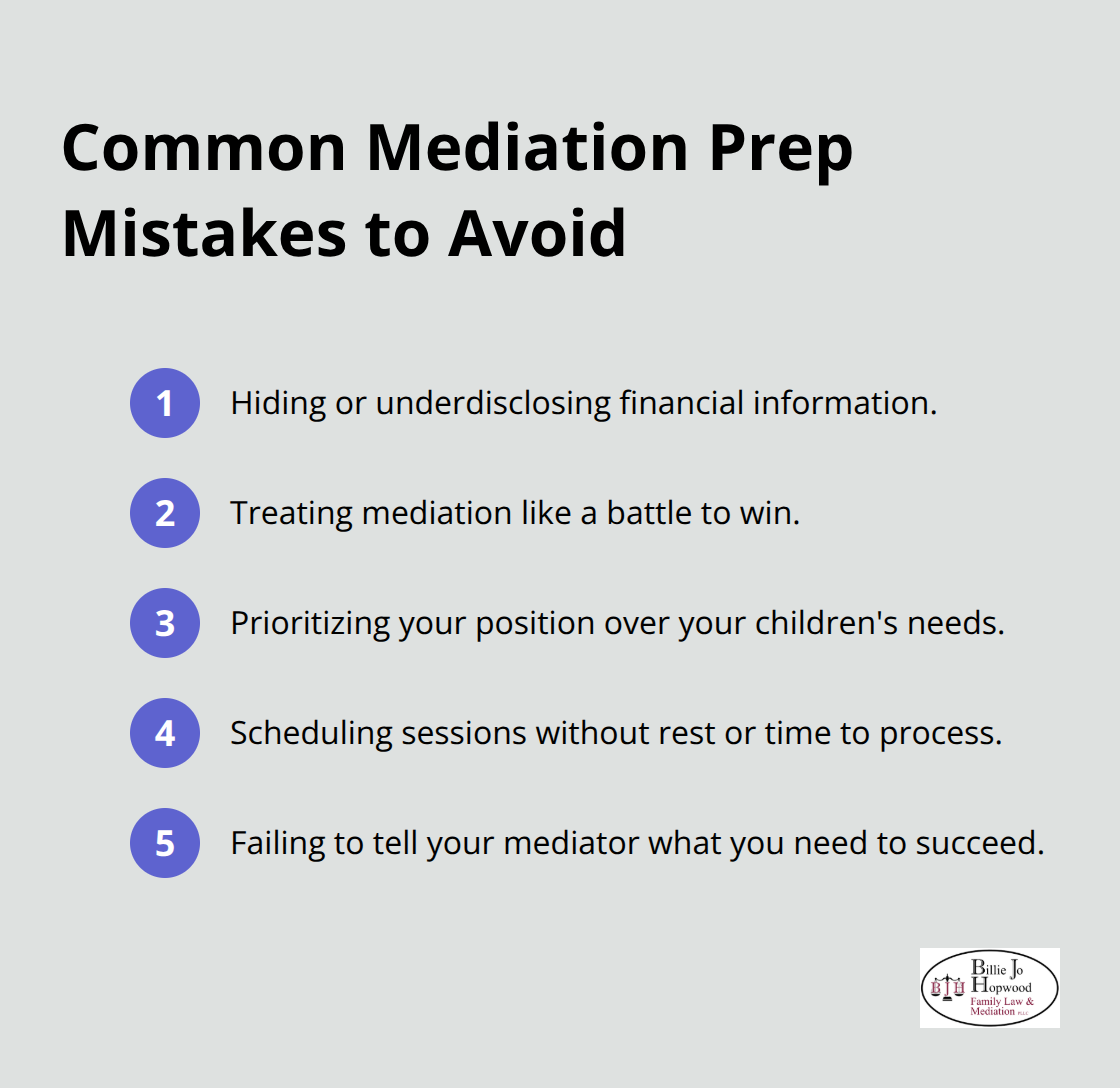
When you withhold bank statements, undervalue assets, or fail to disclose income sources, the mediator cannot work with accurate information, and the other party eventually discovers the deception through discovery or court proceedings anyway.
At that point, you have wasted time and money while destroying any trust that existed. The mediator’s entire job depends on both parties operating from the same factual foundation. Hidden accounts, offshore investments, or intentionally low business valuations surface during enforcement, and courts respond harshly to parties who tried to hide assets during mediation. If you have complex finances, bring everything. If you worry about certain disclosures, discuss those concerns privately with your mediator first, not through simple omission of information.
An Adversarial Mindset Guarantees Worse Outcomes
Approaching mediation as a battle you need to win guarantees a worse outcome than approaching it as a problem you need to solve together. Adversarial thinking means you view every concession as a loss and every disagreement as a personal attack. You dig into positions instead of exploring interests. You interpret the other parent’s requests as threats rather than opening offers.
Research from the Harvard Negotiation Project shows that parties who frame mediation as joint problem-solving reach agreements 35% faster and report higher satisfaction with outcomes than those who treat it as combat. The difference is not about being nice-it is about being strategic. When you focus on what you actually need rather than on defeating the other person, you spot creative solutions neither of you would have found alone. Mediation fails when one or both parents prioritize winning over their children’s stability.
Your Children’s Needs Must Come Before Your Negotiating Position
Courts care about the child’s best interests, and so should you during mediation. If you minimize the other parent’s relationship with your children to strengthen your negotiating position, you build a parenting arrangement on resentment rather than cooperation. Children need both parents, and mediation works when both parents acknowledge that explicitly.
Your children’s school schedules, healthcare continuity, and predictable routines matter more than whether you get an extra weekend per month. Document your children’s needs and your involvement in their daily lives, then use that information to propose parenting plans centered on what serves them, not what punishes the other parent. This child-centered approach transforms mediation from a zero-sum contest into a framework for long-term family stability.
Final Thoughts
Successful mediation preparation requires three concrete actions: gather your financial documents completely, prepare your emotional framework honestly, and commit to a child-centered approach. Your mediation preparation checklist keeps you organized and prevents the scrambling that leads to poor decisions. You now understand what that checklist includes and why each piece matters.
Schedule a consultation with a family law attorney who can review your specific situation before mediation starts. This review catches gaps in your documentation and identifies issues unique to your case, then you can schedule your mediation sessions with realistic spacing that allows you to process between meetings. Spend time writing down your three core priorities and the trade-offs you’re willing to make, gather your financial documents in one organized folder (both digital and printed), create your net worth statement and monthly expense summary, and document your children’s routines and your involvement in their daily lives.
We at Billie Jo Hopwood Family Law & Mediation, PLLC work with families throughout Melbourne, Florida who navigate divorce and custody decisions. Contact our office to discuss your situation and next steps, whether you need support preparing for mediation or representation during the process.