
A parenting plan is one of the most important documents you’ll create after separation or divorce. It shapes your children’s daily lives, your relationship with them, and how you and your co-parent work together.
Melbourne parenting plan mediation offers a faster, less adversarial path to building an agreement that actually works for your family. We at Billie Jo Hopwood Family Law & Mediation, PLLC help parents move past conflict and focus on what matters: creating stability for their children.
What a Parenting Plan Actually Is and Why Florida Courts Require One
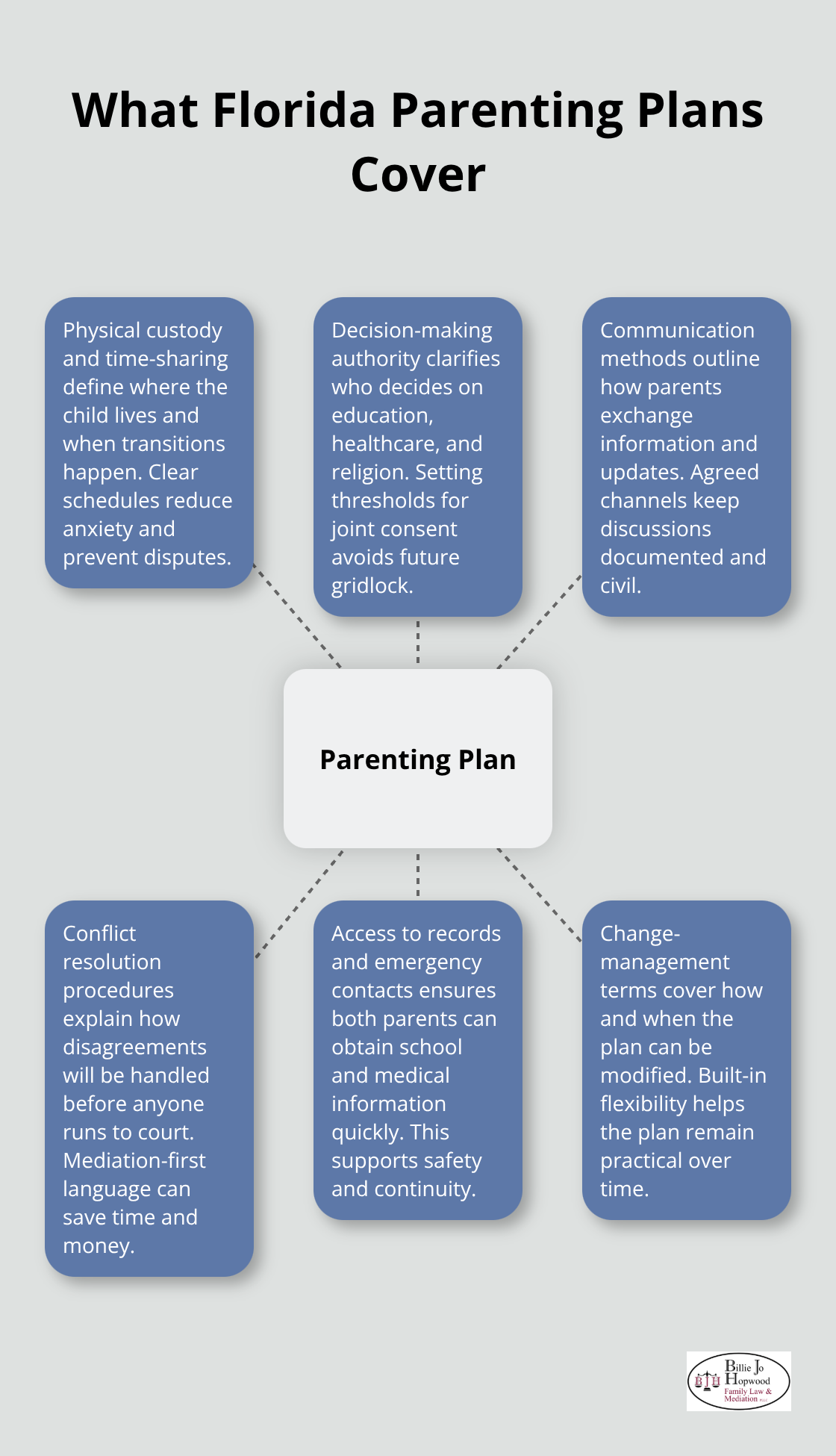
A parenting plan is a legally binding document that outlines how you and your co-parent will raise your children after separation or divorce. In Florida, both parents must submit a parenting plan to the court unless one parent has sole parental responsibility, which is rare and difficult to obtain. The plan covers physical custody (where the child lives and when), decision-making authority (who decides on education, healthcare, and religion), communication methods between parents, and how you’ll handle conflicts.
Florida Statutes 61.13 sets the legal framework, and courts use the best interest of the child standard when evaluating plans. This isn’t a theoretical document-it’s the operational manual for your family’s daily life.
The court won’t impose terms if you and your co-parent agree on a solid plan beforehand, which is why mediation works so effectively in Melbourne. Parents who skip mediation and go straight to court often end up with rigid schedules that don’t match their actual work or childcare needs, yet they still pay $50,000 or more in legal fees.
How Parenting Plans Protect Your Child’s Stability
A well-crafted parenting plan reduces your child’s anxiety by creating predictability. Children thrive when they know where they’ll be, who makes decisions about their health and education, and how their parents will communicate. The plan should specify emergency contacts, who accesses school and medical records, and how major decisions get made. Shared Parental Responsibility (SPR) is the preferred arrangement in Florida because it keeps both parents involved in significant choices.
If you use SPR with Designated Decision-Making Authority (SPR-DD), one parent makes final calls on certain topics while both parents still discuss and collaborate first. The alternative-sole parental responsibility-removes the other parent almost entirely, and courts strongly discourage it unless one parent is absent or poses a safety risk. A detailed plan also prevents the constant conflict that damages children more than the separation itself. Research consistently shows that children adjust better when parents cooperate through a structured agreement rather than fighting over decisions repeatedly.
Three Myths That Mislead Parents in Melbourne
Many parents believe courts punish working parents by reducing their time with children, but Florida courts explicitly do not penalize employment. Your job and reasonable childcare arrangements won’t hurt your parenting time. Another misconception is that whoever has the child more pays less child support-actually, the non-custodial parent typically pays support regardless of how close the time-sharing is.
Finally, parents often think a parenting plan is permanent and unchangeable, which isn’t true. Plans can be modified through mediation or court if circumstances genuinely change (such as a job relocation or significant shift in a child’s needs). Starting with realistic expectations during mediation prevents you from fighting over a plan that no longer fits your family six months later.
What Happens When You Build Your Plan in Mediation
Mediation transforms the parenting plan process from a confrontational battle into a collaborative conversation. A neutral mediator helps you and your co-parent identify what actually matters for your children and your family’s routines. You control the outcome instead of letting a judge impose terms that may not reflect your real life. The mediator guides you toward practical solutions-flexible schedules that work with your jobs, clear communication methods that reduce conflict, and decision-making structures that both parents can follow.
This structured approach means you walk out with a plan you both helped create, not one you resent. That buy-in makes a real difference in whether parents actually follow the agreement long-term.
Key Components Your Parenting Plan Must Address
Your parenting plan needs three concrete elements to function in real life: a time-sharing schedule that matches your actual work and childcare routines, clear decision-making authority so you’re not fighting over every school choice or medical appointment, and communication methods that keep conflict contained.
Time-Sharing Schedules That Reflect Your Real Life
Most parents go wrong with time-sharing schedules during mediation. Many assume a 50/50 split means exactly equal days, but Florida law doesn’t require mathematical precision-it requires what serves your child’s best interests. If you work full-time and your co-parent works flexible hours, a 60/40 or 70/30 schedule often works better than forcing equal overnights that create chaotic transitions. Your plan should specify exact changeover times and locations (not just vague language like “every other weekend”). Include school calendars, holiday schedules, summer arrangements, and who handles transportation. Parents who mediate typically build in flexibility for reasonable requests-allowing the other parent extra time during their work vacation or adjusting pickup times when schedules shift-because they designed the plan together rather than having a judge impose rigid terms.
Decision-Making Authority on Major Parenting Choices
Decision-making authority separates major choices from day-to-day parenting. Shared Parental Responsibility means both parents must discuss and agree on education (school selection, special education services), healthcare (medical procedures, therapy, medication), and religion before committing. If parents can’t agree on these topics, either can petition the court, but mediation prevents that costly step by helping you establish criteria upfront. For example, you might agree that routine medical care (checkups, antibiotics) requires only notification, while surgery or psychiatric medication requires joint consent. Religion often triggers conflict, but many plans specify that each parent can expose the child to their faith during their parenting time without the other parent’s permission-a practical solution courts rarely suggest.
Communication Methods That Reduce Ongoing Conflict
Communication expectations matter as much as the schedule itself. Families using structured communication methods (like the app Talking Parents, which costs roughly $100 to $150 annually and time-stamps all exchanges) report fewer conflicts and maintain documented records if enforcement becomes necessary.
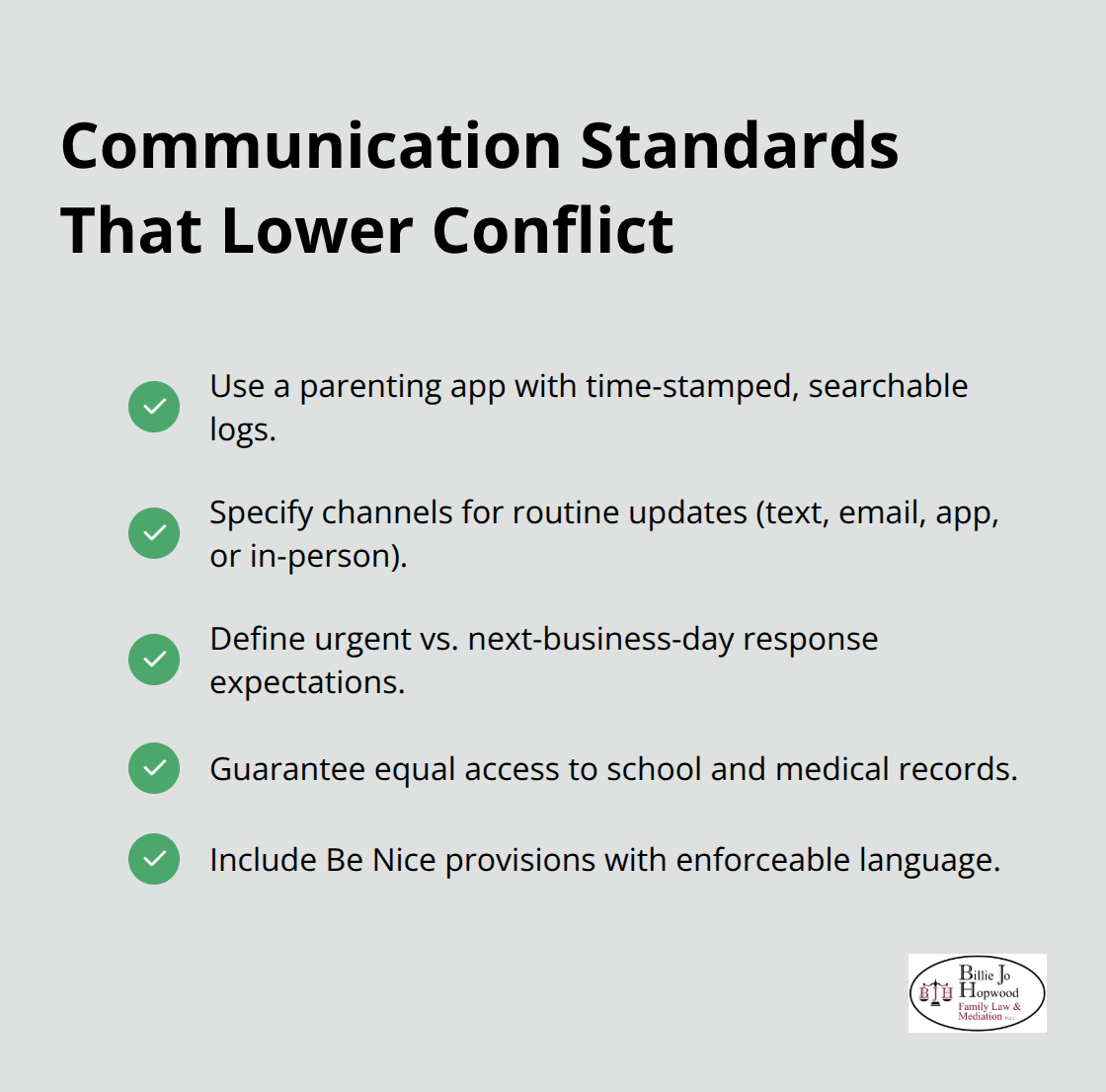
Your plan should specify whether you communicate via text, email, a parenting app, or in-person handoffs, and what topics require immediate response versus next-business-day turnaround. Be Nice provisions-language requiring you to avoid discussing the divorce with your child, grant equal access to school and medical records, and maintain emergency contact information-sound soft but carry legal teeth. Violation of these provisions can trigger contempt charges, so your plan must include expectations both parents actually can follow rather than aspirational language that sets up conflict.
The specificity you build into these three areas during mediation determines whether your agreement holds up over time or falls apart within months. When you move into the mediation process itself, you’ll learn how a neutral mediator helps you translate these components into language that both parents can follow consistently.
Why Mediation Beats Court for Your Parenting Plan
Mediation cuts through the adversarial machinery that makes court proceedings so expensive and emotionally destructive. When you litigate a parenting plan, you pay attorneys to argue, gather evidence for hearings, and wait months for a judge to impose terms neither parent designed. Court battles over parenting plans in Florida routinely exceed $50,000 in legal fees, while mediation typically costs $3,000 to $8,000 total. More importantly, mediation wraps up in one to four sessions over a few weeks, whereas court timelines stretch across months or years. A judge doesn’t know your family’s actual routines, your child’s specific needs, or the flexible arrangements that would actually work.
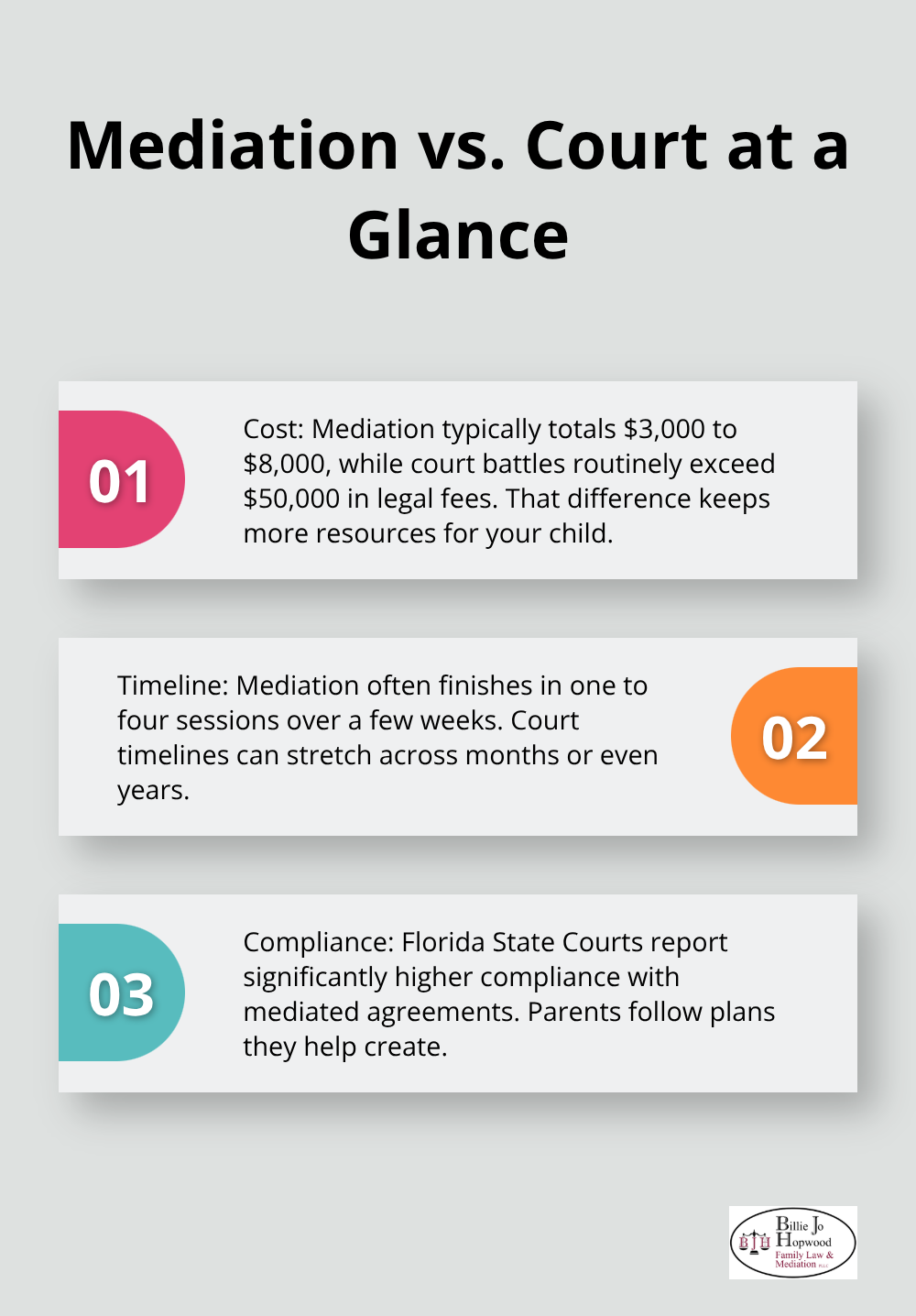
A mediator helps you build those arrangements yourselves. Parents who mediate walk away with plans they helped create, which means they follow them. Parents who lose in court resent the imposed terms and fight over enforcement constantly, dragging the conflict forward for years. The Florida State Courts report that mediated agreements in family cases have significantly higher compliance rates than court-ordered outcomes because both parties invested in the solution rather than losing to an adversary.
What a Mediator Actually Does During Your Sessions
A trained, Florida Supreme Court certified mediator remains neutral and doesn’t decide anything for you or provide legal advice. Instead, the mediator’s job is to help you and your co-parent communicate clearly about what you each need for your children and your family’s logistics. During sessions, the mediator asks targeted questions that force you both to move past anger and explain practical concerns. Why does your work schedule require a certain pickup time? What does your child actually need from each parent? Where is flexibility exist without sacrificing your child’s stability? The mediator reshapes positions into interests you can both address. If you’re stuck on a 50/50 split and your co-parent insists on 60/40, a mediator helps you identify whether the real issue is fairness, parenting time quality, child support calculations, or something else entirely. Once the actual concern surfaces, solutions often emerge that satisfy both of you. Mediation in Melbourne takes place online via video conference according to Brevard County’s system, which means you don’t sit in a room together if tension runs high. The mediator can run shuttle sessions, moving between separate video calls to carry proposals and find common ground. All discussions remain confidential unless you agree otherwise, which removes the fear of statements being used against you later in court. This confidentiality is critical because it allows you to explore options, admit mistakes, and change your mind without creating a legal record.
How Mediators Help You Move Past Stuck Points
When mediation stalls, the mediator suggests creative solutions like graduated summer schedules, technology-based communication platforms, or decision-making criteria neither parent had considered alone. You control whether to accept any proposal, so mediation remains truly voluntary despite the collaborative pressure. The mediator’s role is to facilitate conversation, not to push you toward outcomes you don’t want. If mediation doesn’t produce full agreement, you still have the option to pursue court, but most families find that the mediator’s guidance gets them unstuck. A mediator trained in family dynamics understands how to reframe positions so both parents hear each other’s actual concerns rather than just the demands on the surface.
Preparing for Mediation and What Happens Next
Before your first session, gather documentation that shows your actual life: work schedules, school calendars, existing childcare arrangements, and any court orders already in place. Bring a clear picture of your child’s daily needs, not emotional arguments about fairness. Parents who prepare this way move through mediation faster and spend less on mediator fees. During the initial session, the mediator explains the process, confidentiality rules, and ground rules for respectful communication. You’ll outline your positions on custody, decision-making, and communication methods, then the mediator identifies where you already agree and where work is needed. Subsequent sessions focus on specific components of your parenting plan. You might spend one session on time-sharing schedules, another on decision-making authority, and a final session on communication expectations and conflict resolution methods. If you reach full agreement, the mediator documents the terms, which you can then take to an attorney to formalize into a court-approved plan.
Final Thoughts
A solid parenting plan removes the guesswork from co-parenting and gives your children the stability they need after separation or divorce. Melbourne parenting plan mediation accomplishes this without the expense and emotional toll of court battles. Most families complete mediation in one to four sessions, walking away with a documented agreement ready to formalize with the court-a timeline that beats the months or years litigation requires, and a cost ($3,000 to $8,000) that represents a fraction of what contested court proceedings demand.
We at Billie Jo Hopwood Family Law & Mediation, PLLC help families in Melbourne, Florida move past conflict and focus on creating an agreement that serves your children and your family’s actual needs. Contact us to begin your mediation journey and build the parenting plan your family deserves. Whether you’re starting mediation or need guidance on formalizing your agreement, we’re here to support your co-parenting goals.