
Divorce filing mediation offers a fundamentally different path than courtroom battles. Instead of adversarial litigation, you work with a neutral mediator to reach agreements on property, custody, and support.
We at Billie Jo Hopwood Family Law & Mediation, PLLC have seen firsthand how structured mediation reduces conflict and costs while giving you real control over the outcome. This guide walks you through how the process works and why it matters for your family’s future.
How Structured Mediation Works in Divorce
The Mediator’s Role in Guiding Your Discussion
A mediator is not a judge, therapist, or advocate for either side. In Melbourne, Florida family mediation, the mediator is a court-certified neutral who facilitates conversation between you and your spouse. According to the 18th Judicial Circuit Court, all mediators in Brevard and Seminole counties must complete 16 hours of continuing mediation education every two years to maintain certification. The mediator keeps discussions moving, identifies common ground, and helps you both understand what settlement looks like. They will not tell you what to do, give legal advice, or push you toward any particular outcome.
What you say in mediation stays confidential and cannot be used in court if no agreement is reached. This removes the fear of admissions being held against you later.
The Structured Mediation Process
The process follows a predictable path. You start with an intake where the mediator explains the rules and gets background on your situation. Then you move into joint sessions where both of you discuss issues, or private caucus sessions where the mediator meets with each of you separately to understand your priorities and explore flexibility.
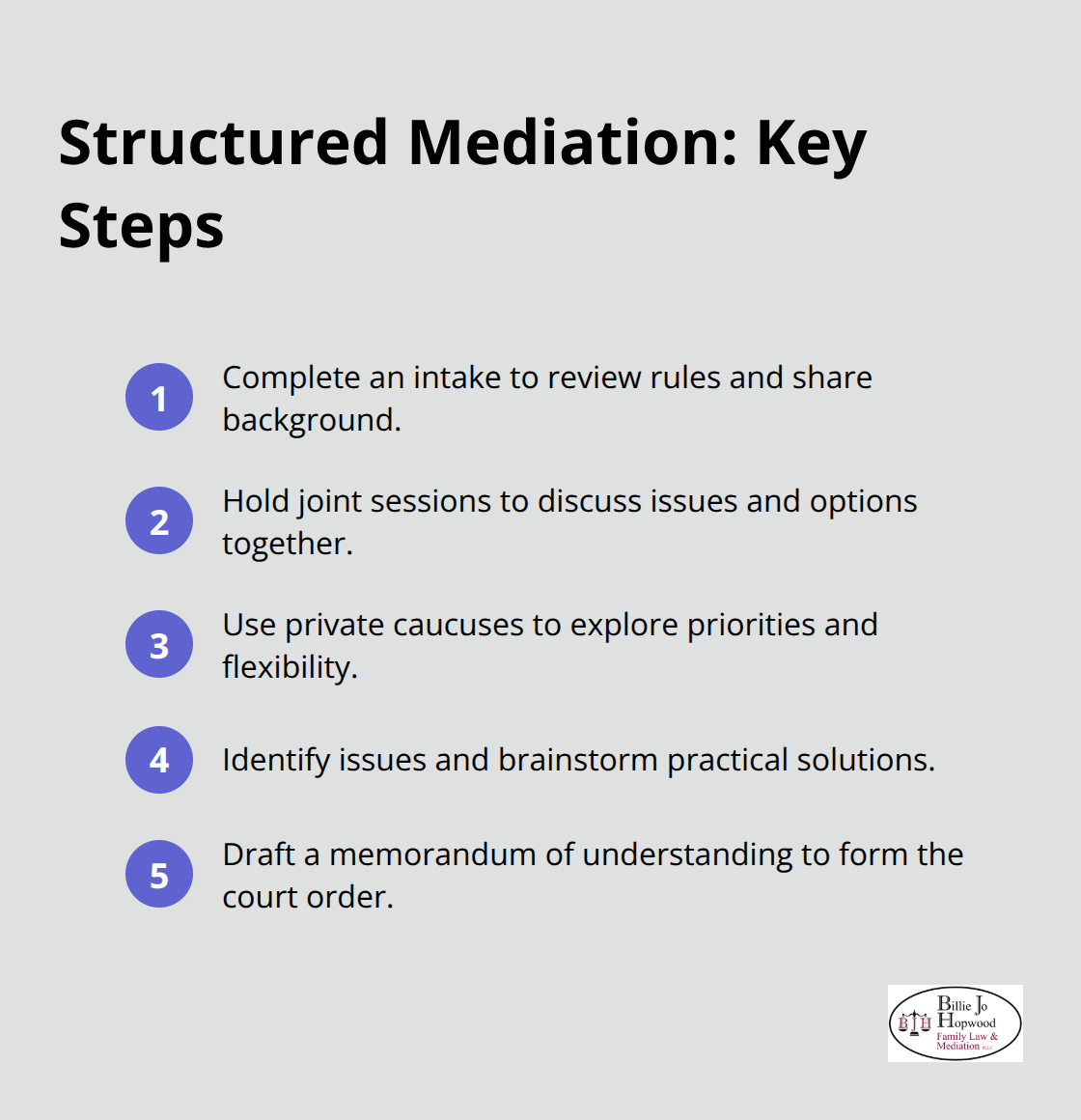
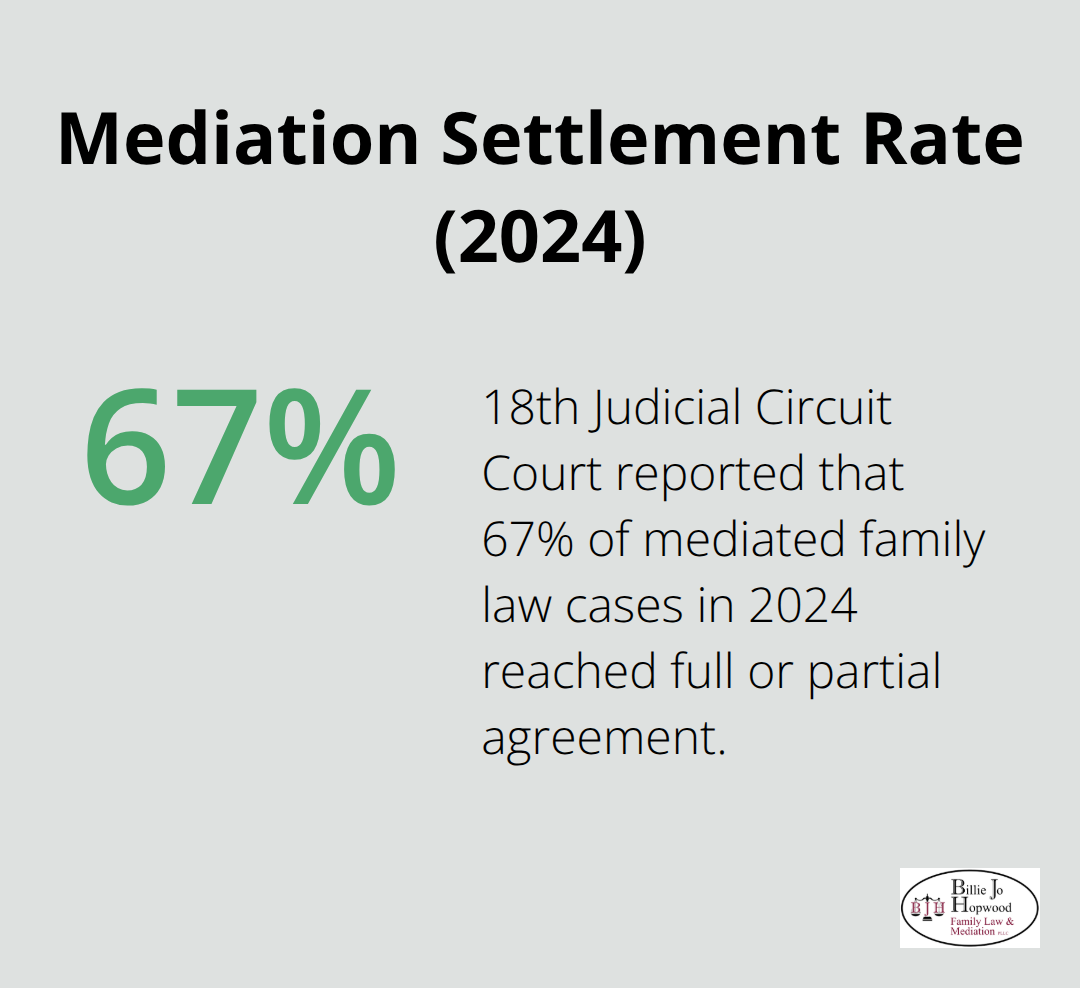
The mediator identifies specific issues like property division, child custody, and support amounts, then helps you brainstorm solutions. Once you reach tentative agreements on each issue, the mediator drafts a memorandum of understanding that becomes the foundation for your final court order. According to the 18th Judicial Circuit Court, roughly 67% of mediated family law cases in 2024 reached full or partial agreement, showing this approach actually works.
Sessions typically run 2 to 4 hours and span multiple meetings over weeks or months depending on complexity. This gives you time to think between sessions rather than making rushed decisions under courtroom pressure.
How Mediation Differs from Litigation
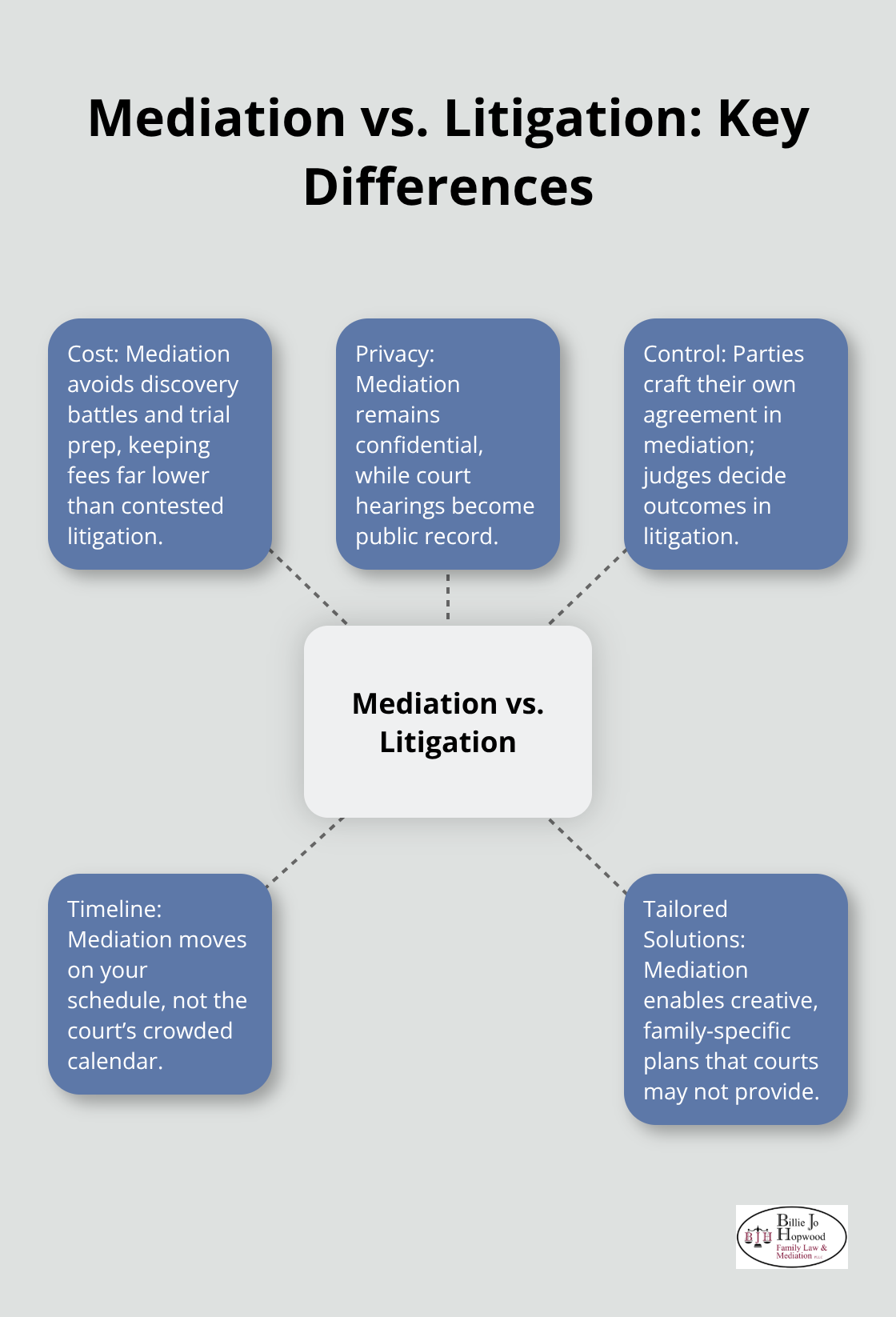
Litigation forces a winner-and-loser outcome because a judge decides everything. Mediation lets you decide. In court, you pay attorney fees for depositions, discovery disputes, expert witnesses, and trial preparation that can easily run $15,000 to $50,000 or more for contested cases. Mediation costs far less because there is no discovery battle, no trial prep, and no judge’s time being billed.
Filing a divorce petition in Brevard County Circuit Court cost $408 in 2024, and mediation fees depend on your combined income: under $50,000 total income costs $60 per party, $50,000 to $100,000 costs $120 per party, and above $100,000 requires private mediation outside the court program.
You also control what the agreement looks like. A judge applies the law mechanically and may order asset splits or custody schedules that do not fit your family’s actual needs. You might end up with a parenting plan that ignores your child’s school schedule or your work reality. In mediation, you can craft creative solutions like phased support, flexible timesharing around travel, or asset exchanges that make sense for your situation.
Court hearings are public record, meaning neighbors, coworkers, and future employers can read details about your finances, parenting disputes, or personal struggles. Mediation keeps those details private between you, your spouse, and the mediator. This privacy advantage alone makes mediation worth considering before you move forward with contested litigation and the financial burden that follows.
Benefits of Starting Your Divorce with Mediation
Lower Costs Compared to Court Battles
Mediation cuts your divorce costs dramatically compared to litigation. Filing a divorce petition in Brevard County costs $408, but add attorney fees for depositions, interrogatories, document requests, and expert witnesses in a contested case and you easily exceed $15,000 to $50,000. Mediation fees in Brevard and Seminole counties run $60 per party for combined household income under $50,000, or $120 per party for income between $50,000 and $100,000. Those numbers are fixed and predictable.
You avoid the hourly meter running during discovery battles, temporary hearings on support and custody, and trial preparation that devours attorney time and your savings account. The 67% settlement rate reported by the 18th Judicial Circuit Court in 2024 means two out of three mediated cases avoid trial entirely, keeping costs in the low thousands rather than five figures.
Faster Resolution and Timeline
The 18th Judicial Circuit Court data shows mediated cases resolve in weeks rather than months, while contested divorces stretch 6 to 12 months or longer depending on court backlogs and discovery disputes. Speed matters when children are involved. Contested litigation forces you to wait for court dates that may not open for months, temporary orders that create uncertainty about custody and support, and depositions that stretch the process further.
Mediation sessions typically last 2 to 4 hours and happen over weeks or months on a schedule you control, not a judge’s calendar. You reach decisions faster, finalize your agreement sooner, and move forward with your life instead of staying trapped in legal limbo.
More Control Over Outcomes and Agreements
You keep control over what the agreement actually says. A judge applies state law mechanically and may order property splits or parenting schedules that ignore your work reality, your child’s school needs, or your family’s actual dynamics. Mediation lets you design solutions that fit your situation, whether that means flexible timesharing for a parent with travel demands, phased support payments tied to income changes, or asset exchanges that make sense for both sides.
That control translates to agreements you can actually live with long-term, reducing conflict and post-divorce disputes that cost money and emotional energy to resolve. When you shape the terms yourself, you invest in outcomes that work for your family’s unique circumstances rather than accepting a one-size-fits-all court order. This foundation of mutual agreement strengthens your ability to co-parent effectively and move forward without ongoing resentment or legal battles.
Common Issues Resolved Through Divorce Mediation in Melbourne, Florida
Mediation in Melbourne, Florida handles the three financial and custody issues that consume most divorce cases: property division, child custody arrangements, and support payments. These are not theoretical problems-they are concrete decisions that affect your bank account, your relationship with your children, and your monthly budget for years after the divorce finalizes. Mediators in Brevard County work through each systematically because the 18th Judicial Circuit Court data shows 67% of mediated cases reach full or partial agreement when structured properly.
Property and Asset Division Without Court Battles
Property division is where mediation shines because creative solutions beat rigid court orders. A judge applies Florida’s equitable distribution law and splits marital assets roughly 50-50 unless circumstances warrant deviation, but equitable does not mean fair to your situation. Mediation lets you negotiate who keeps the house, how retirement accounts get divided, whether one spouse buys out the other’s interest, or if you sell assets and split proceeds. You can agree to unequal splits if it makes sense-one spouse might accept less cash in exchange for keeping the family home, or you might structure payments over time instead of immediate liquidation. These arrangements require flexibility that a courtroom simply cannot provide because judges follow statutory formulas, not family logic.
Child Custody Schedules That Actually Work
Custody mediation focuses on what the 2023 Florida Legislature emphasizes: the best interests of the child standard. This means creating schedules and decision-making authority that serve your child’s school calendar, medical needs, and relationship with both parents-not what the law technically permits. One parent might travel for work, so mediation can build in virtual visitation or adjusted timesharing around that reality. Another family might need flexible pickups because of shift work or school activities. A judge cannot accommodate these details because they hear hundreds of cases and apply standard timesharing schedules. In mediation, you design a parenting plan that prevents future conflicts because it matches how your family actually operates. Sessions typically run 2 to 4 hours across multiple meetings, which gives you time to think about proposals between sessions rather than deciding custody under courtroom pressure.
Support Payments Tied to Real Financial Situations
Alimony and child support calculations follow Florida’s guidelines, but mediation lets you modify those numbers based on actual circumstances. The 2023 Florida Legislature eliminated permanent alimony and introduced new duration limits, but statutory amounts still assume standard income and expenses that may not fit your situation. Mediation allows you to negotiate phased support that changes as circumstances shift, or structured arrangements where one spouse receives more upfront support to finish education or retrain. You can agree to support tied to income changes or tied to specific events like a child turning 18 or finishing college. You might arrange one spouse to pay off the other’s student debt in exchange for lower alimony, or trade asset value for reduced support obligations. These negotiations happen because both sides understand the full financial picture and can see how different arrangements affect both households. Court orders apply the formula mechanically and ignore the real-world impact on either party’s ability to meet obligations.
Final Thoughts
Mediation offers a fundamentally smarter approach to divorce than courtroom battles. You control the outcome, keep costs predictable, and resolve disputes in weeks rather than months. The 67% settlement rate from the 18th Judicial Circuit Court proves that structured mediation works when both parties commit to finding solutions, avoiding the public record exposure of litigation, the unpredictable costs of discovery and trial, and the rigid outcomes a judge imposes.
Starting divorce filing mediation in Melbourne, Florida begins with understanding your options and gathering your financial documents, tax returns, and a clear sense of your priorities before your first session. The 18th Judicial Circuit Mediation Program covers Brevard and Seminole counties and handles dissolution of marriage, paternity, parenting plans, and child support cases, with fees depending on your combined household income (under $50,000 costs $60 per party; between $50,000 and $100,000 costs $120 per party). You can schedule family mediation by email or through the court’s scheduling process, and if you qualify for indigency, you can apply with the Clerk of Court for no-charge status.
We at Billie Jo Hopwood Family Law & Mediation, PLLC understand that divorce filing mediation requires both legal knowledge and compassionate guidance. Based in Melbourne, Florida, we assist families through family law matters including divorce, child custody, alimony, and child support, and having an attorney review mediation proposals protects your interests and ensures compliance with Florida law. Contact us to discuss how mediation can work for your situation and take the first step toward a resolution that serves your family’s future.