Alimony decisions in Brevard County affect your financial future for years to come. The alimony guidelines Brevard courts follow depend on your income, marriage length, and lifestyle during the relationship.
At Billie Jo Hopwood Family Law & Mediation, PLLC, we help you understand what settlement options actually work for your situation. This guide walks you through how alimony gets calculated, what types exist, and how to negotiate terms that protect your interests.
How Alimony Is Calculated in Brevard County
Income Considerations and Wage Calculations
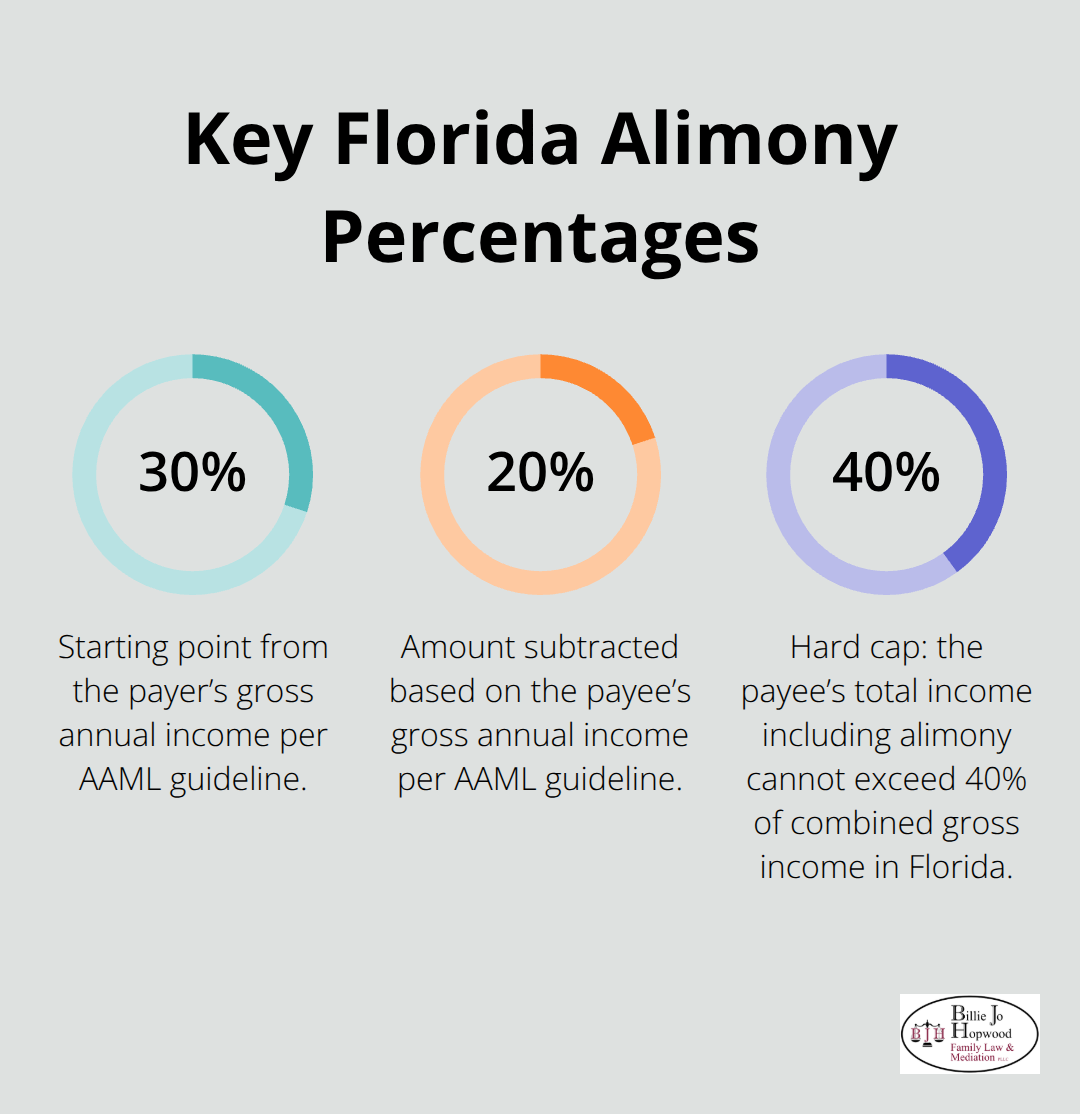
Alimony calculations in Brevard County start with income, but courts examine far more than your salary. They review all income sources, including bonuses, rental income, investment returns, and business profits. If you’re self-employed, courts often impute income based on tax returns from the past three years, which means they may calculate your earnings higher than what you actually reported. The American Academy of Matrimonial Lawyers suggests a rough guideline: approximately 30% of the payer’s gross annual income minus 20% of the payee’s gross annual income. This is not a formula courts must follow, but it gives you a realistic starting point for what settlement discussions might look like.
Your earning capacity matters as much as current income. If you took years away from work to raise children or support your spouse’s career, courts may still assess your ability to earn based on education, skills, and work history. This protects spouses who sacrificed income-earning years but also means you should gather evidence showing realistic earning potential if circumstances have changed. Courts also consider assets and resources beyond monthly income. If you have substantial savings, investment accounts, or property, this factors into whether alimony is needed and how much. The payee’s total income, including any alimony received, cannot exceed 40% of the couple’s combined gross income-this is a hard ceiling in Florida law.
Duration of Marriage and Standard of Living
Your marriage length determines which alimony type applies and for how long. Marriages under 10 years are considered short-term, 10 to 20 years are moderate-term, and 20 years or longer are long-term. For short-term marriages, durational alimony typically runs for up to 50% of the marriage length.
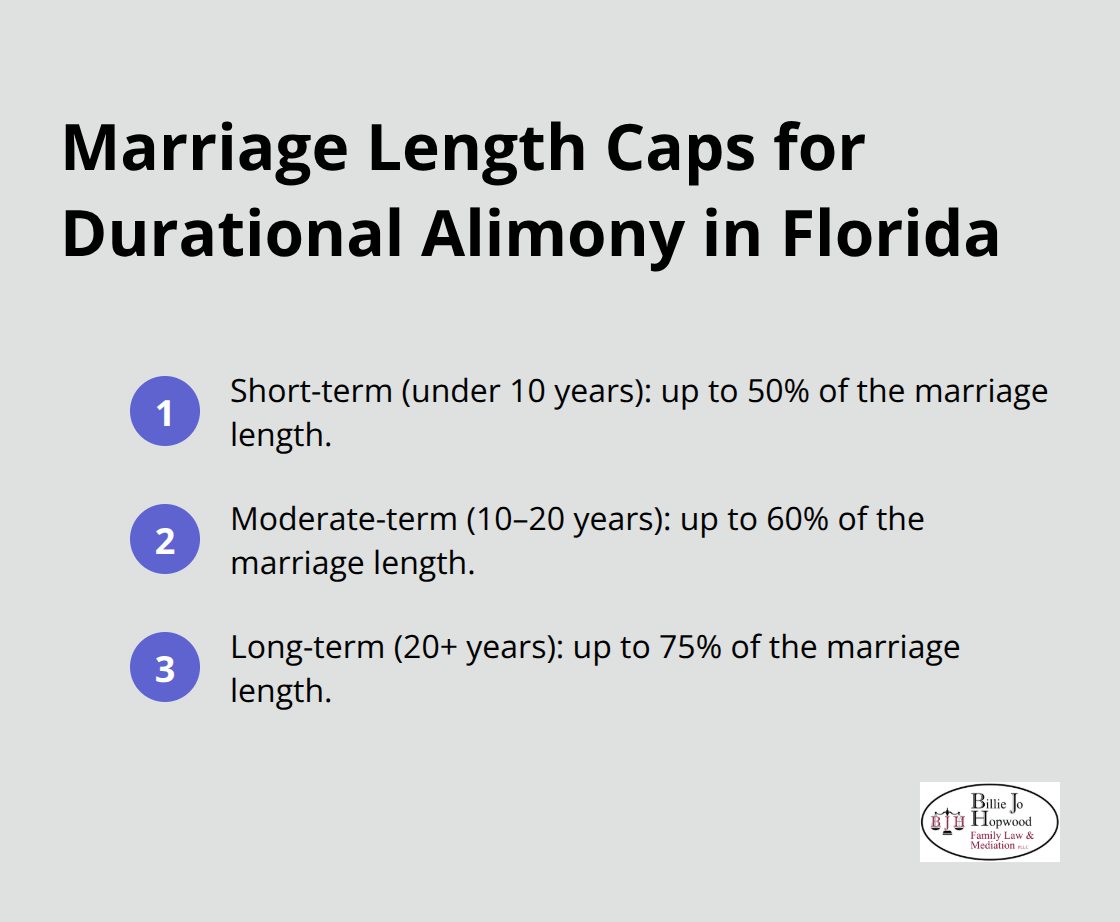
Moderate-term marriages cap at 60% of the marriage duration, while long-term marriages can reach 75%. The court’s reference point is your divorce filing date, not when you stopped living together, which affects how they assess your marital standard of living.
Courts weigh the lifestyle you both enjoyed during marriage heavily-this is the foundation for determining need and ability to pay. The standard of living you maintained together becomes the benchmark for what alimony should preserve after divorce.
Other Factors Courts Review in Alimony Decisions
Your age and health status directly influence alimony decisions. Courts recognize that older spouses or those with health conditions may struggle to become self-supporting, which strengthens arguments for durational or permanent support. Parental responsibilities also matter-if you have custody of children, courts understand childcare limits your earning capacity. Contributions to the marriage beyond finances count too. If you managed the household, raised children, or enabled your spouse’s career advancement, courts recognize this as valuable contribution.
Adultery or financial misconduct by either spouse can shift alimony outcomes significantly. You should gather documentation showing your standard of living during marriage, current financial needs, and any health or age-related limitations to support your position. These factors work together to shape what a court will award, and understanding how they interact helps you prepare for settlement negotiations with realistic expectations about what your case might yield.
Types of Alimony Available in Florida
Temporary Alimony During Divorce Proceedings
Temporary alimony runs only during your divorce case and stops the moment the final decree enters. This type bridges the financial gap while lawyers and courts handle your case. If you earn significantly more than your spouse and the divorce stretches over 18 months, temporary alimony might provide $2,000 to $4,000 monthly depending on income differences and your standard of living. The court awards this based on immediate need and your ability to pay without compromising your own living expenses.
Bridge-the-Gap and Short-Term Support Options
Bridge-the-gap alimony maxes out at two years and cannot be modified once ordered, making it useful for short-term needs like education costs or transitional housing after separation. This type works well when both parties agree that financial support for a defined period solves the problem cleanly. The structure provides certainty-you know exactly when payments end and cannot face requests for modification later.
Rehabilitative Alimony for Career Development
Rehabilitative alimony funds a concrete plan to make your spouse self-supporting through education or career training, typically lasting up to five years. Courts require a detailed plan showing exactly how funds advance employment goals; vague intentions fail. Presenting a clear career plan and budgeting how funds will be used significantly increases approval odds. This approach works best when your spouse has a realistic path back to the workforce and can document the steps needed to reach that goal.
Durational Alimony and Long-Term Support
Durational alimony provides monthly payments for a set number of years after divorce and cannot exceed your marriage length. For a 15-year marriage, durational alimony might run nine years at roughly 60% of the marriage duration, with amounts adjustable if circumstances change substantially. The amount can shift if either party experiences significant financial changes, though the total duration rarely extends beyond the original order.
How Senate Bill 1416 Changed Everything
Permanent alimony existed under old Florida law but Senate Bill 1416, signed into law July 1, 2023, eliminated it entirely. This reform shifted the entire landscape-long marriages no longer automatically trigger lifetime support. Instead, marriages of 20 years or more now qualify for durational alimony running up to 75% of the marriage length, which could mean 15 years of payments rather than indefinite support.
The tax treatment of alimony also changed dramatically. For divorces finalized after January 1, 2019, alimony is no longer deductible by the payer and not taxable to the recipient, reversing decades of practice. This matters enormously-if you pay $24,000 annually in alimony, you cannot deduct it, reducing the benefit to your tax situation. If you receive it, you owe no federal income tax on those payments. When negotiating payment terms and duration, both sides must account for this tax reality.
The American Academy of Matrimonial Lawyers suggests roughly 30% of the payer’s gross annual income minus 20% of the payee’s gross annual income as a starting point, but actual awards vary widely based on marriage length and standard of living. A spouse earning $100,000 annually might face alimony of $10,000 to $15,000 monthly in a long marriage with a dependent spouse, or $2,000 to $3,000 monthly in a short marriage where the other party works.
Duration rules based on marriage length create predictability. Short marriages under ten years cap at 50% of marriage duration, moderate marriages from ten to twenty years cap at 60%, and long marriages of twenty years or more extend to 75%. Judges can deviate from these caps based on specific circumstances, but they provide realistic boundaries for settlement planning. Understanding which type applies to your situation and how the 2023 reform affects your case shapes everything about how you approach negotiations with your spouse.
Negotiating Your Alimony Settlement
Why Mediation Accelerates Settlement
Mediation offers a faster path to settlement than courtroom litigation, and for alimony disputes, speed matters because temporary alimony stops the moment your divorce finalizes. When you sit down with a mediator in Melbourne, Florida, both you and your spouse work toward agreement rather than waiting for a judge to decide. Mediators help you identify what each party actually needs and where compromise exists. The process typically takes weeks or a few months, not years. You control the outcome instead of handing that power to a judge who knows nothing about your relationship or financial realities. Most importantly, mediation costs substantially less than litigation-expect to pay $5,000 to $15,000 in mediation fees versus $25,000 to $50,000 or more in attorney fees for a contested court battle.
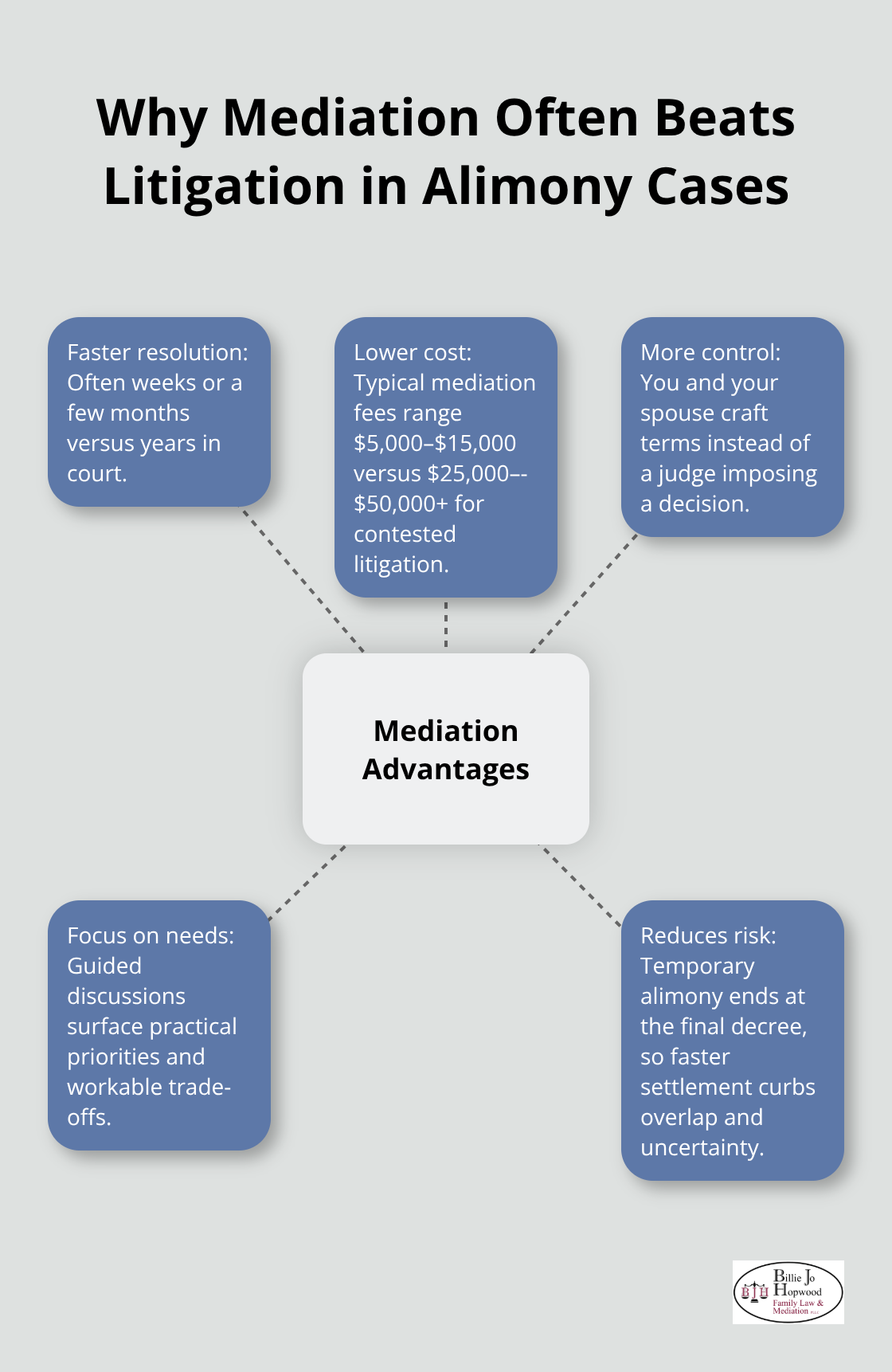
This savings matters when alimony itself will stretch your finances.
Understanding Realistic Payment Ranges
Knowing realistic payment ranges prevents you from anchoring to fantasy figures that waste everyone’s time. If you earn $120,000 annually and your spouse earns $40,000, the American Academy of Matrimonial Lawyers guideline suggests roughly $24,000 yearly (30% of $120,000 minus 20% of $40,000), or $2,000 monthly. In a 12-year marriage, durational alimony might run seven years at that amount. If your marriage lasted 22 years, durational alimony could extend 16 or 17 years at similar or slightly adjusted amounts depending on other factors.
Settlement discussions work best when both parties understand these ranges. Temporary alimony during divorce typically runs 15% to 20% higher than permanent awards because it covers a shorter window and bridges an immediate gap. If you face paying $3,000 monthly in temporary support, expect durational alimony of $2,200 to $2,500 once the divorce concludes. Tax treatment affects real take-home impact-if you receive $24,000 yearly in alimony post-January 2019, you keep all of it with no federal tax liability. If you pay it, you receive no deduction, meaning the actual cost exceeds the payment amount when accounting for taxes you still owe on your income.
Verifying Income and Earning Capacity Claims
This is where settlements collapse if you lack documentation. If your spouse claims reduced earning capacity due to health issues or years away from work, request recent medical records and a detailed plan showing why employment remains impossible. Courts in Brevard County impute income for self-employed spouses using three-year tax return averages, so if your spouse’s business income fluctuates, use that proven formula rather than accepting their claim of current hardship.
If you earned $150,000 five years ago but now earn $90,000, bring tax returns showing the decline-courts won’t assume your income dropped without evidence. Conversely, if your spouse claims you’re capable of earning more than you currently do, prepare education credentials and job market data supporting your actual earning potential. The payee’s total income including alimony cannot exceed 40% of combined gross income, which creates a hard ceiling on what either party can demand. When disagreement stalls negotiations, propose an independent financial evaluation or income verification process rather than litigating the point for months.
Final Thoughts
Alimony guidelines Brevard County courts apply rest on three pillars: your income, your marriage length, and the standard of living you maintained together. The 2023 reform eliminated permanent alimony and tied durational awards to marriage length, which fundamentally shifted how long-term marriages settle. Tax treatment changed too-divorces finalized after January 2019 mean payers receive no deduction and recipients owe no federal tax, a reality that reshapes what settlement numbers actually mean to your household budget.
You strengthen your position by gathering three years of tax returns, documenting your standard of living during marriage, and identifying your realistic earning capacity before settlement talks begin. If you’re self-employed, courts will average your income across three years rather than accepting current-year claims. If health issues or caregiving responsibilities limit your earning potential, collect medical records and documentation showing why employment remains unrealistic (this evidence matters far more than verbal claims).
Settlement through mediation beats courtroom battles on cost, speed, and control-you decide the outcome rather than handing that power to a judge. Contact us at Billie Jo Hopwood Family Law & Mediation, PLLC to discuss how mediation can move your settlement forward and protect your financial future.