
Divorce doesn’t have to mean months of courtroom battles and mounting legal bills. Brevard County divorce mediation offers families a faster, more affordable path forward where both spouses maintain control over the outcome.
At Billie Jo Hopwood Family Law & Mediation, PLLC, we’ve guided countless Melbourne families through this process. This guide walks you through how mediation works, what issues get resolved, and why so many local families choose it over litigation.
How Divorce Mediation Works in Brevard County
A neutral mediator facilitates your divorce settlement without making decisions for you. In Brevard County, mediators are trained, certified professionals who complete 16 hours of continuing education every two years through the Florida Supreme Court system. The mediator listens to both sides, reality-tests positions, and guides you toward practical resolutions. They don’t offer legal advice, but they keep discussions focused and productive. Most mediators in the area are attorneys themselves, which means they understand Florida’s equitable distribution rules even though they won’t tell you what to do. The process typically begins with the mediator explaining how mediation works, followed by joint sessions where you and your spouse discuss goals and values. If tensions run high, the mediator holds separate private sessions with each of you to explore options and concerns. This flexibility sets mediation apart from courtroom proceedings-there’s no rigid structure forcing you into an adversarial stance.
What Mediation Actually Costs in Brevard County
Court-ordered mediation through the Eighteenth Judicial Circuit Mediation Program costs less depending on your household income. If your combined income falls under $50,000, you pay $60 per party for one session. Households earning $50,000 to $99,999 pay $120 per party for a single session. Couples earning over $100,000 must arrange private mediation instead, which costs more but offers greater flexibility and control.
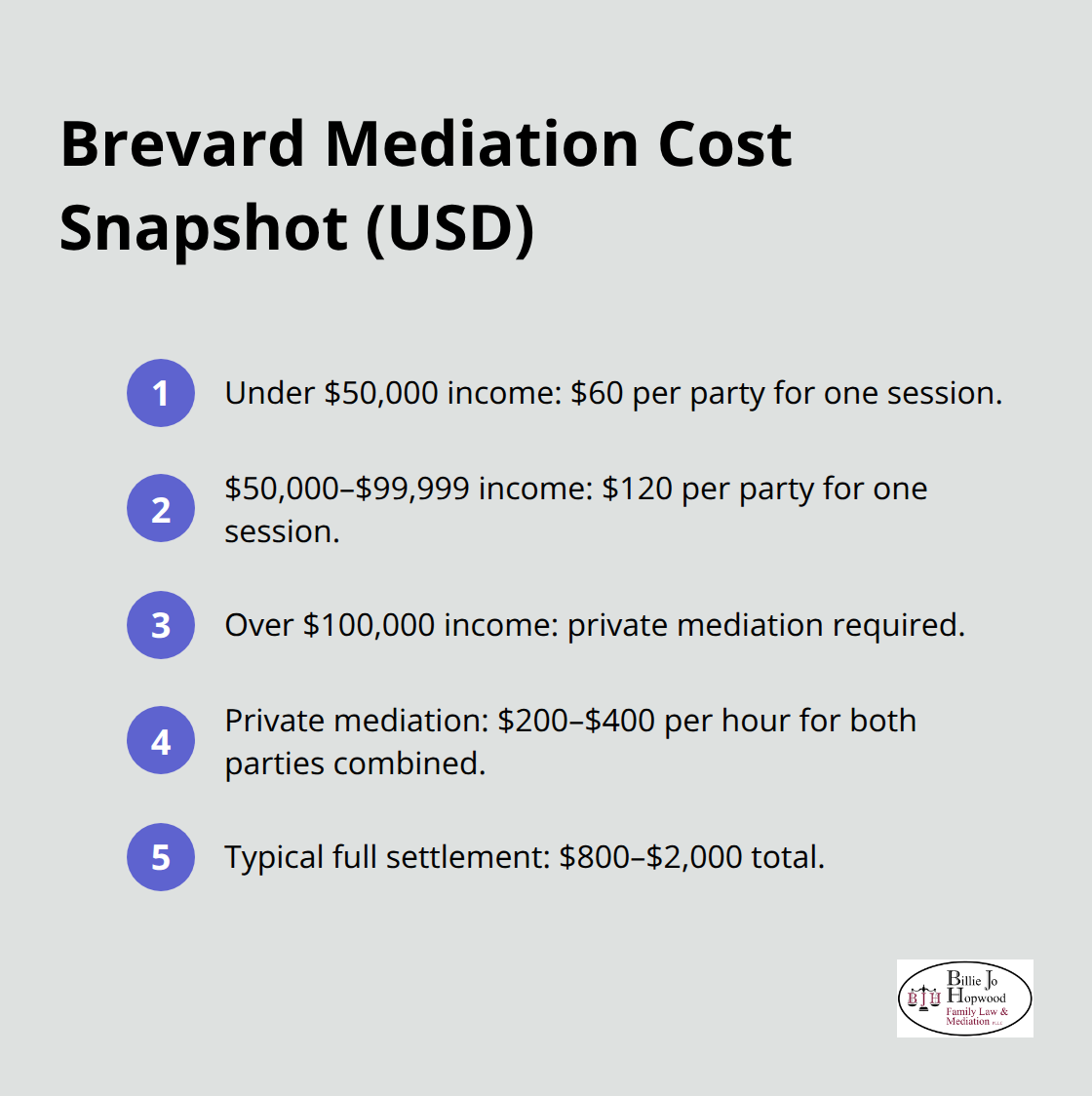
Most divorces settle within one or two sessions according to Florida ADR studies, meaning the total cost often stays well below what litigation costs. Litigation requires depositions, expert witnesses, court delays, and multiple attorney appearances-expenses that routinely exceed $10,000 to $15,000 per side. Private mediation typically costs $200 to $400 per hour for both parties combined, which means a full settlement can cost between $800 and $2,000 total. A certified Florida mediator can verify credentials, discuss your specific custody or asset issues, and provide a realistic estimate for your situation.
Timeline Expectations for Settlement
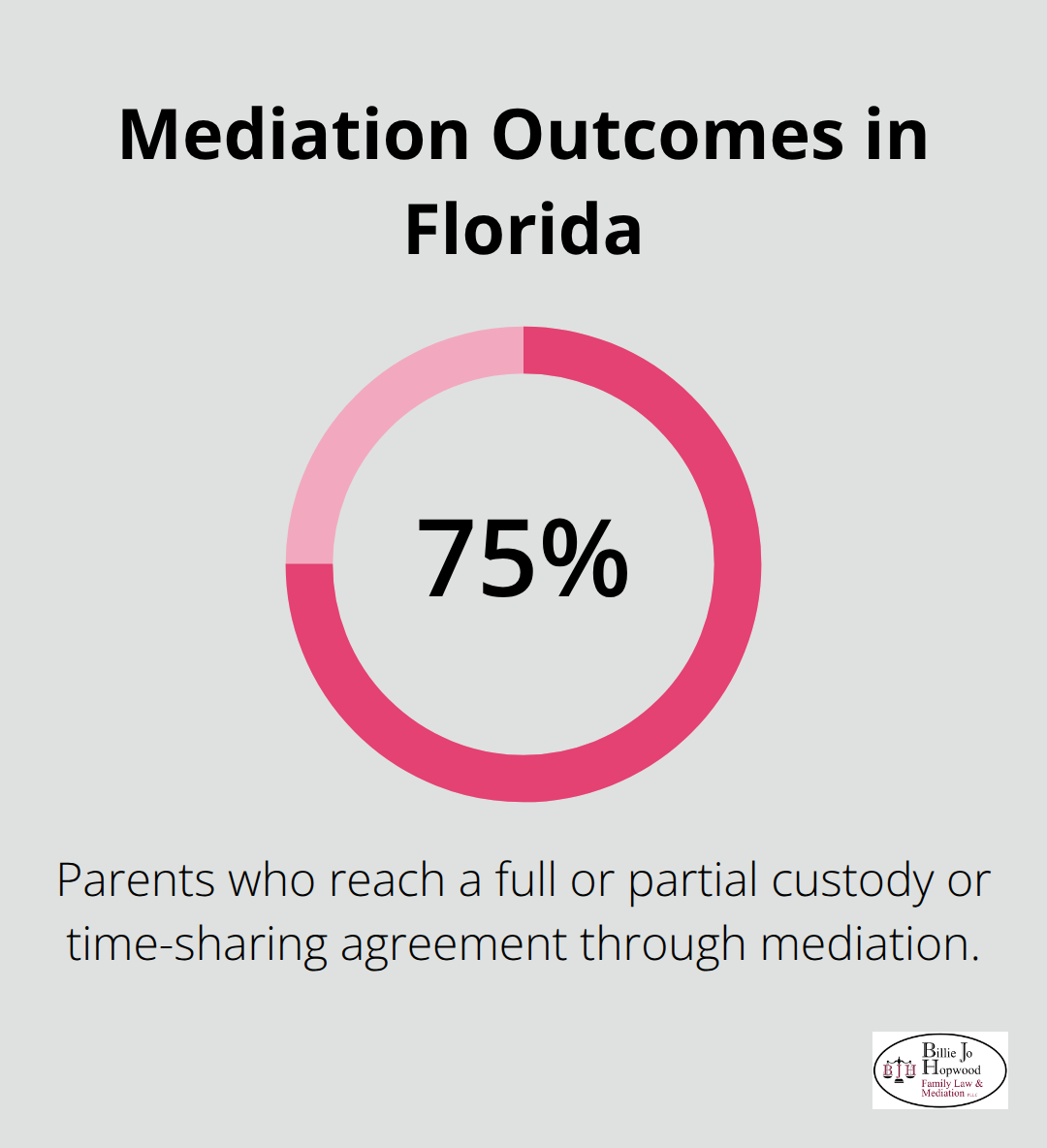
Most mediation sessions in Brevard County take place online via video conference, which saves time and increases scheduling flexibility. A single session usually lasts two to four hours, and many divorces resolve in one or two sessions. If you reach an impasse, efforts typically resume mediation after a cooling-off period rather than forcing you to court immediately. This contrasts sharply with litigation, where court backlogs stretch cases out for 12 to 18 months or longer. Approximately 70 to 80 percent of family law disputes in Florida resolve through mediation according to Florida ADR studies and mediation program reports. About 75 percent of parents who attend mediation reach a full or partial custody or time-sharing agreement, with high satisfaction reported afterward.
Once you reach a mediated settlement agreement, it becomes legally enforceable after both spouses, their attorneys, and a judge sign it-typically within weeks rather than months.
How Property and Custody Issues Move Forward
The mediation framework handles multiple divorce issues simultaneously, which accelerates resolution. You and your spouse address property division, asset distribution, child custody, parenting plans, alimony, and child support all within the same process. The mediator helps you separate emotional reactions from practical financial and parenting decisions. Florida’s equitable distribution law applies whether you mediate or litigate, so the mediator ensures discussions stay grounded in what the law actually permits. This structured approach means you don’t waste time on unrealistic demands or positions that courts would reject anyway. The next section walks through the specific issues that mediation resolves and how each one typically plays out in Brevard County.
Key Issues Addressed During Divorce Mediation
Mediation in Brevard County addresses the three financial and custody issues that consume most divorce negotiations: property division, parenting arrangements, and support payments. Unlike litigation where a judge imposes decisions, mediation lets you and your spouse shape these outcomes together with the mediator’s guidance. Florida’s equitable distribution law applies regardless, but mediation gives you flexibility to structure agreements in ways that work for your specific circumstances rather than accepting a one-size-fits-all court order.
Dividing Property and Assets
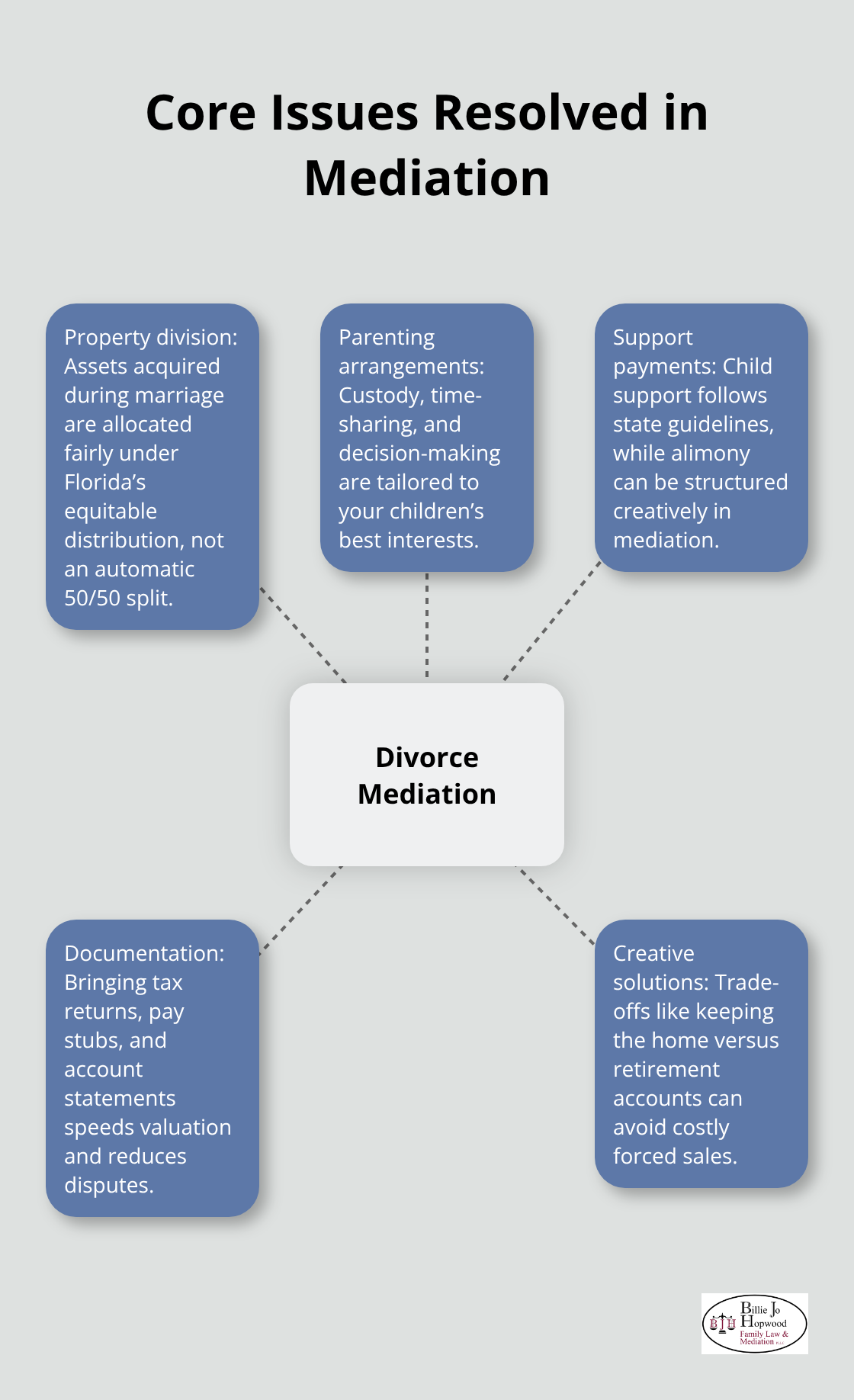
Florida law treats assets acquired during marriage as marital property subject to equitable distribution, meaning fair division rather than automatic 50/50 splits. Inheritances and gifts remain separate property unless you commingled them into joint accounts, which happens more often than many people realize. During mediation, you inventory all marital assets including the family home, retirement accounts, investment portfolios, business interests, and vehicles.
Debts matter equally; credit card balances, mortgages, and loans acquired during marriage must be allocated between spouses.
The mediator helps you value contested assets and explores trade-offs. For example, one spouse might keep the house while the other receives retirement accounts of similar value, avoiding forced sales that destroy long-term wealth. Mediation allows creative solutions that litigation cannot produce. If you own a business, the mediator facilitates discussions about valuation and whether one spouse buys out the other or whether you continue as co-owners.
Preparation matters significantly here. Bring comprehensive financial documents to mediation: tax returns for the past three years, recent pay stubs, bank and credit card statements, mortgage and loan documents, retirement account statements, life insurance policies, and any business records. The mediator cannot advise you on tax implications, but complete documentation prevents disputes over asset values that would otherwise require costly expert appraisals.
Building a Parenting Plan That Works
Child custody mediation centers on developing a parenting plan that addresses custody, time-sharing schedules, and decision-making authority. Florida law prioritizes the best interests of the child, and mediators keep discussions focused on what actually serves your children rather than punishing an ex-spouse. Approximately 75 percent of parents who attend mediation reach a full or partial custody or time-sharing agreement according to Florida ADR studies.
The mediator helps you establish clear schedules for regular parenting time, holiday rotations, and vacation periods. Many Melbourne families benefit from structured schedules that reduce future conflicts. You determine who makes major decisions about education, healthcare, religious upbringing, and extracurricular activities. Some parents choose joint decision-making on major issues while one parent handles day-to-day choices; others assign specific decisions to each parent based on their strengths and involvement.
The mediator reality-tests whether proposed arrangements actually work logistically given work schedules, school locations, and each parent’s availability. Mediation supports a child-centered approach where both parents present a united front on rules and expectations, which research shows reduces emotional harm during the transition. You address practical details like how to exchange the children, communication methods between parents, and how to handle changes to the schedule. Document these specifics in writing during mediation so neither parent misunderstands expectations later.
Calculating Support Obligations
Child support in Florida follows state calculations based on each parent’s gross income and the number of overnight stays with each parent. The mediator does not set support amounts, but they ensure both parents understand how Florida’s formula works and what the likely court order would be. This reality-testing prevents one spouse from demanding unrealistic amounts or refusing fair contributions.
Alimony considerations in Florida include marriage duration, the standard of living established during marriage, each spouse’s financial resources and earning capacity, education level, age, and health. Mediation allows flexibility that courts lack. A spouse with higher earning capacity might receive less alimony if they’re young and educated, even if they earned less during the marriage. Conversely, someone who left the workforce to raise children might receive support even if the marriage lasted only moderate length.
Mediation lets you negotiate bridge support for a limited period while one spouse completes education or training, or permanent support if circumstances truly warrant it. Many couples reach creative solutions like paying alimony through a lump sum transfer rather than monthly payments, which provides certainty and closure. Child support modifications occur when income changes significantly or when children age out of support obligations. Mediation handles these modifications faster than court proceedings, which typically involve multiple filings and hearings.
Bring recent pay stubs, tax returns, and documentation of other income sources to mediation so calculations stay accurate and neither party later claims they misunderstood support obligations. These three areas-property, custody, and support-form the foundation of most divorce settlements, and addressing them systematically in mediation moves you toward closure faster than litigation allows.
Why Mediation Costs Less and Resolves Faster
How Timeline Differences Impact Your Wallet
Litigation in Florida divorce cases routinely stretches 12 to 18 months or longer due to court backlogs, discovery delays, and scheduling conflicts. Mediation typically resolves within one or two sessions conducted online via video conference in Brevard County, meaning most divorces settle in weeks rather than months. The financial difference is stark: litigation costs each spouse $10,000 to $15,000 or more once you factor in depositions, expert witness fees, multiple attorney court appearances, and continuances. Private mediation costs $200 to $400 per hour for both parties combined, which means a complete settlement often totals $800 to $2,000. Even court-ordered mediation through the Eighteenth Judicial Circuit costs just $60 to $120 per party depending on household income. Florida ADR studies show that approximately 70 to 80 percent of family law disputes resolve through mediation, and about 75 percent of parents who attend mediation reach a full or partial custody agreement. These numbers exist because mediation eliminates the financial pressure that pushes people toward unfavorable settlements.
Taking Control Over Settlement Terms
Mediation gives you and your spouse authority over every term in your settlement rather than handing that power to a judge who knows nothing about your family’s actual needs. A judge applies Florida’s equitable distribution law mechanically, dividing assets fairly on paper but sometimes creating impractical outcomes. Mediation lets you trade assets creatively-one spouse keeps the family home while the other receives retirement accounts of equal value, avoiding forced sales that destroy wealth. You set parenting schedules that actually work with your jobs and your children’s school locations instead of accepting a generic custody order. You negotiate alimony and child support that reflects your specific circumstances, not just statutory formulas.
Protecting Your Privacy and Reputation
Mediation also protects your privacy. Court litigation becomes public record, meaning your financial details, custody disputes, and personal conflicts appear in courthouse files anyone can access. Mediation settlements remain confidential under Florida’s Mediation Confidentiality and Privilege Act. This privacy matters especially for business owners and high-income earners who don’t want competitors or the public knowing details about their finances or family disputes.
Reducing Emotional Harm for Your Family
The emotional toll of litigation also matters. Courtroom battles require you to present yourself as an adversary to someone you once loved, which harms your ability to co-parent afterward. Mediation emphasizes collaboration and mutual problem-solving, allowing both parents to present a united front on rules and expectations for children. Research shows this approach reduces emotional harm during the transition and fosters better post-divorce co-parenting dynamics. Most families report high satisfaction with both the mediation process and the results because they shaped the outcome themselves rather than accepting a decision imposed by someone else.
Final Thoughts
Mediation works best when both spouses want to move forward without prolonged conflict and maintain control over how their divorce settles. Brevard County divorce mediation through the Eighteenth Judicial Circuit costs far less than litigation and resolves in weeks rather than months. If your combined household income falls under $100,000, court-ordered mediation provides affordable access to certified mediators, while families earning above that threshold benefit from private mediation’s flexibility and broader scope for creative solutions.
Starting mediation requires scheduling a consultation to discuss your specific situation and gathering the financial and custody documents you’ll need (tax returns, bank statements, retirement account information, and any documentation of assets or debts acquired during your marriage). Arrive with realistic expectations about what’s negotiable and prepare to discuss parenting time, decision-making authority, and how you’ll handle holidays and school schedules if children are involved. This preparation moves you toward resolution faster than courtroom battles ever could.
We at Billie Jo Hopwood Family Law & Mediation, PLLC understand that divorce creates uncertainty and stress for Melbourne families. Contact us to schedule a consultation and take the first step toward closure and stability for your family.