
Child relocation mediation gives Melbourne Florida parents a way to work through one of the hardest questions in family law: what happens when one parent wants to move with a child to a new city or state. A new job, a remarriage, or the need to be closer to extended family can all make a move feel necessary, while the other parent may worry about losing regular time with the child. Florida has a detailed statute that controls these situations, and mediation lets parents use that framework to reach their own agreement rather than leaving the decision entirely to a judge.
At Billie Jo Hopwood Family Law & Mediation, PLLC, we help Melbourne and Brevard County families resolve parenting disputes through mediation and uncontested agreements. This guide explains when Florida’s relocation law applies, how a relocation agreement works, what happens when a parent objects, and how mediation can help both parents build a schedule that keeps the child connected to each of them.
When Florida’s Relocation Law Applies to Your Family
Florida’s parental relocation rules are found in Section 61.13001 of the Florida Statutes. The statute does not cover every change of address. It applies to a specific kind of move, and understanding that definition is the first step in deciding whether a formal agreement or court approval is needed.
What Counts as a Relocation
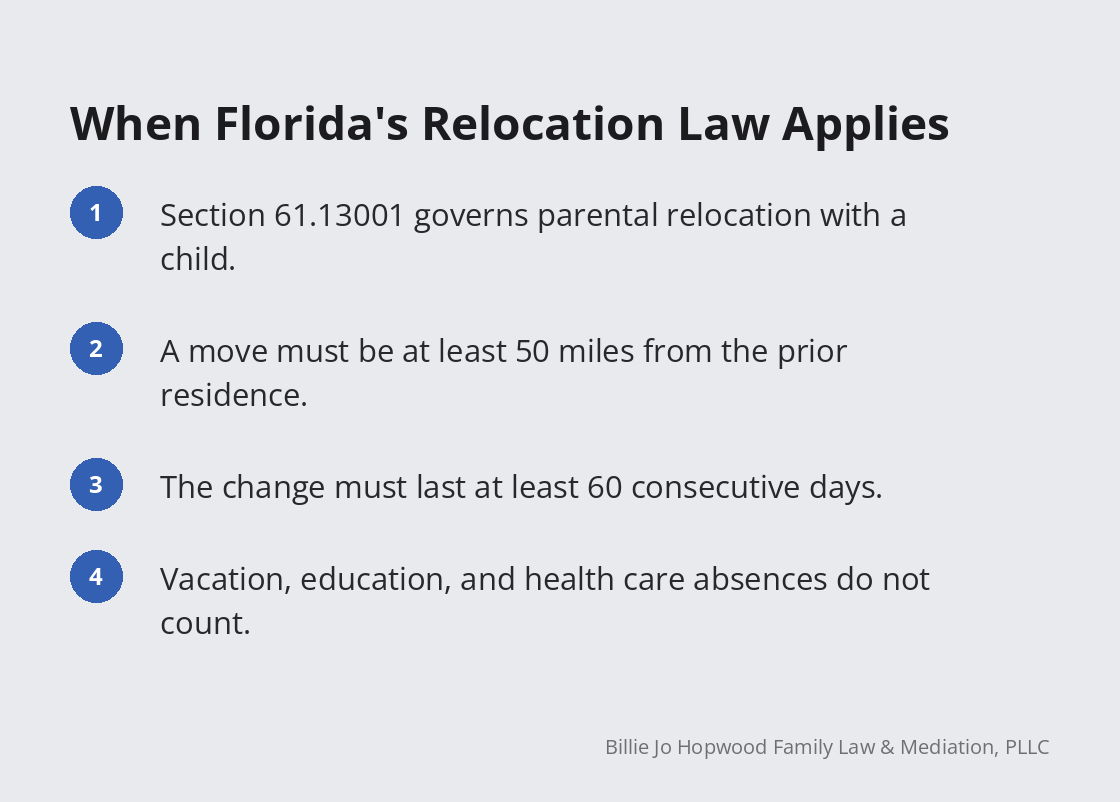
Under Section 61.13001(1)(e), a relocation is a change in the location of a parent’s principal residence from where that parent lived at the time of the last order establishing or modifying time-sharing, or at the time a pending action to establish or modify time-sharing was filed. The new location must be at least 50 miles from that residence, and the change must last for at least 60 consecutive days. Temporary absences for vacation, education, or health care for the child do not count toward that period.
That means a move across Melbourne, or from one Brevard County city to a nearby one, may not trigger the statute at all. A move to another part of the state or out of Florida often will. Because the distance is measured from the residence at the time of the last order or filing, parents should look closely at their existing paperwork before assuming the law does or does not apply.
Who Must Be Part of the Decision
The statute protects more than just the two parents. It refers to every other person entitled to access to or time-sharing with the child, which can include a person with whom the child lives under a court order or who has court-ordered time-sharing or visitation rights. When a relocation is on the table, each of those people has a role in either agreeing to the move or responding to a petition. Leaving someone out can create problems later, so identifying everyone with rights under the current order is an important early step in mediation.
Why the Existing Parenting Plan Matters
Most relocation questions arise because a parenting plan or time-sharing schedule is already in place. A move of the distance the statute describes usually makes the current weekly schedule impractical. That is why a relocation agreement must do more than say yes or no to the move. It must replace the old schedule with one that works across the new distance, which is exactly the kind of practical problem mediation is designed to solve. Our earlier guide on updating a parenting plan by agreement explains how agreed modifications work more generally.
How Child Relocation Mediation Leads to an Agreement
Florida law encourages parents to resolve relocation by agreement whenever they can. Section 61.13001(2) allows the parents and every other person entitled to access or time-sharing to satisfy the statute by signing a written agreement, and mediation is often the setting where that agreement takes shape.
What a Written Relocation Agreement Must Include
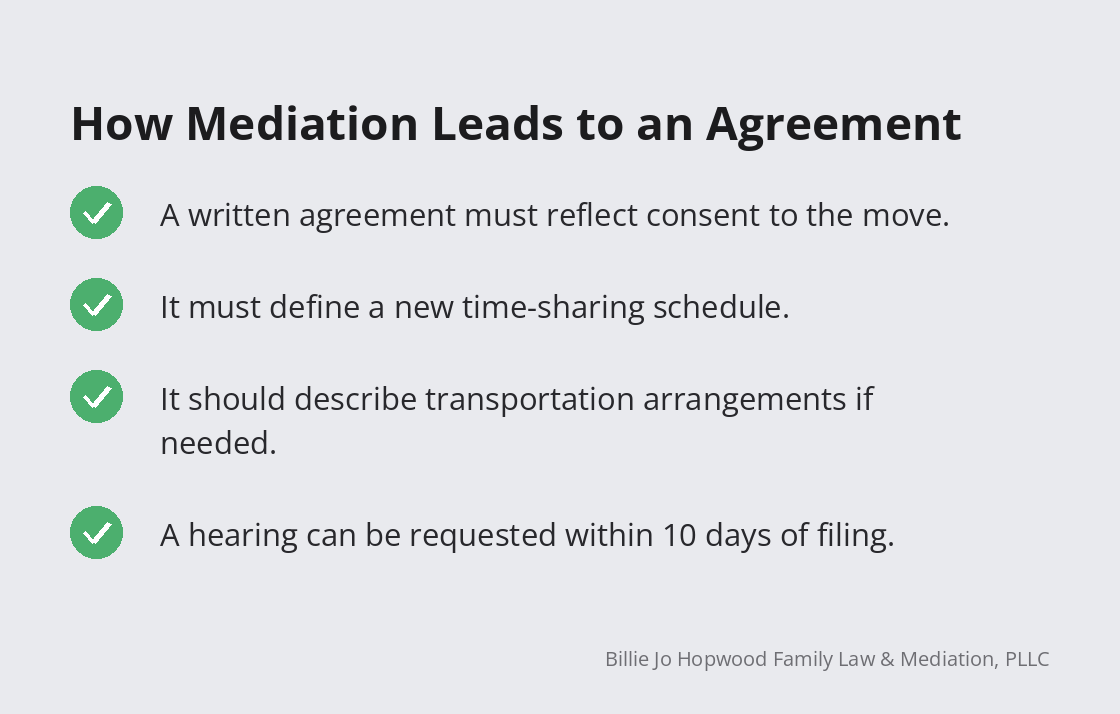
Under Section 61.13001(2)(a), the written agreement must reflect consent to the relocation, define an access or time-sharing schedule for the nonrelocating parent and any other persons entitled to access or time-sharing, and describe any transportation arrangements related to access or time-sharing, if necessary. In mediation, parents can work through each of these pieces in detail, such as how holidays and summers will be divided, how the child will travel between homes, and who will handle exchanges.
Because the parents are the ones designing the plan, they can tailor it to the child’s school calendar, activities, and relationships in ways that a court order might not. A thoughtful agreement also reduces the chance of future disputes, since both parents have already talked through the details that tend to cause friction after a long-distance move.
Court Ratification of the Agreement
When there is already a court case, judgment, or decree dealing with the child’s residence or a time-sharing schedule, Section 61.13001(2)(b) requires the parties to seek ratification of the agreement by court order. The court may ratify it without an evidentiary hearing unless one of the parties requests a hearing in writing within 10 days after the agreement is filed. If no hearing is timely requested, the statute presumes that the relocation is in the best interest of the child, and the court may ratify the agreement without a hearing.
When parents reach agreement through family mediation on contested parenting issues, Section 61.183 also provides that a consent order incorporating the agreement is prepared by the mediator and submitted to the parties and their attorneys for review. Once the parties approve it and the court approves and enters it, the consent order may be enforced in the same manner as any other court order. You can learn more about our approach on our divorce mediation page.
When a Court Refers Parents to Mediation
Mediation is not always something parents choose on their own. Section 44.102(2)(c) provides that in circuits where a family mediation program has been established, and upon a court finding of a dispute, the court shall refer to mediation all or part of custody, visitation, or other parental responsibility issues. The same section provides that, upon motion or request of a party, a court shall not refer a case to mediation if it finds a history of domestic violence that would compromise the mediation process. Section 61.183 separately allows a court to refer parents to mediation when issues such as parental responsibility, primary residence, or access to a child are contested.
What Happens if a Parent Objects to the Move
When the parents cannot agree, the parent who wants to move must follow the formal petition process in Section 61.13001(3). Knowing how that process works can help both parents understand what is at stake if mediation does not succeed, and it often motivates them to keep working toward an agreement.
The Petition and the 20-Day Response Window
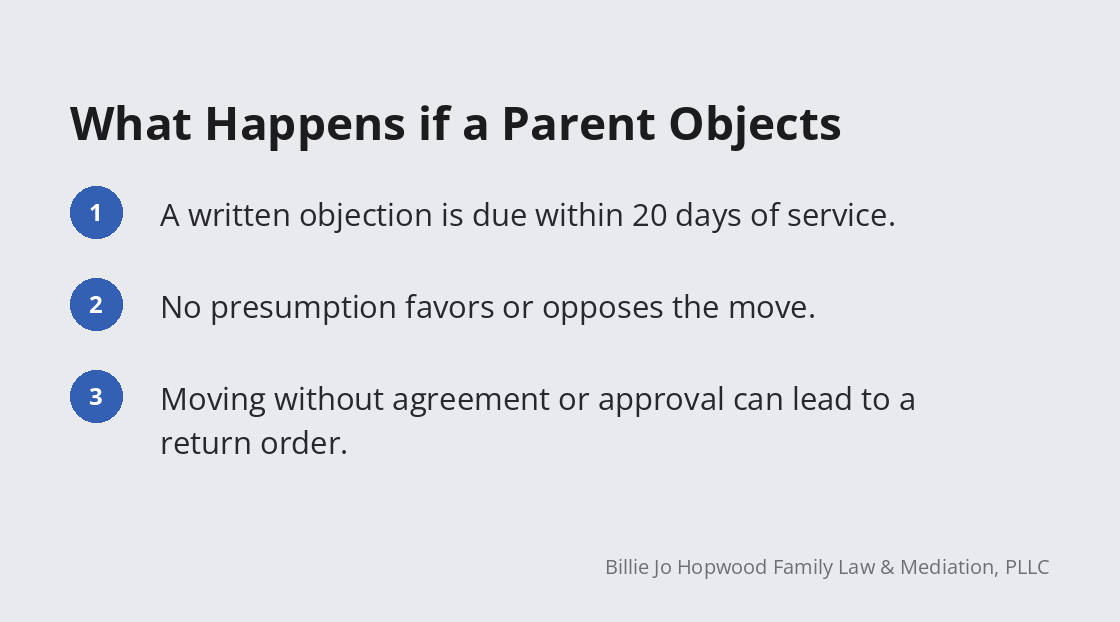
Unless an agreement has been entered, a parent seeking to relocate must file a petition to relocate and serve it on the other parent and every other person entitled to access to or time-sharing with the child. The petition must be signed under oath or affirmation and include information such as the intended new residence, the date of the intended move, a detailed statement of the specific reasons for the move, and a proposal for the revised schedule and transportation arrangements. The statute also requires a notice in capital letters explaining that a written response objecting to the relocation must be filed with the court and served within 20 days after service of the petition.
Timing matters a great deal here. Under Section 61.13001(3)(d), if a timely response objecting to the petition is not filed, it is presumed that the relocation is in the best interest of the child and that the relocation should be allowed, and the court shall, absent good cause, enter an order adopting the schedule and transportation arrangements contained in the petition. Under Section 61.13001(5), an answer objecting to a relocation must be verified and include the specific factual basis for the objection, including a statement of how involved the objecting party currently is or has been in the child’s life.
How a Judge Weighs a Contested Relocation
Section 61.13001(7) states that no presumption arises in favor of or against a request to relocate when the move will materially affect the current schedule of contact, access, and time-sharing. Instead, the court must evaluate a list of factors, including the nature and quality of the child’s relationship with each parent, the child’s age, developmental stage, and needs, the feasibility of preserving the relationship with the nonrelocating parent through substitute arrangements, the child’s preference considering age and maturity, the reasons each parent has for seeking or opposing the move, and any history of substance abuse or domestic violence, among others.
Under Section 61.13001(8), the parent wishing to relocate has the burden of proving by a preponderance of the evidence that relocation is in the best interest of the child. If that burden is met, the burden shifts to the nonrelocating parent to show by a preponderance of the evidence that the proposed relocation is not in the child’s best interest. Section 61.13001(10) gives relocation matters priority on the court’s calendar, and absent good cause, a hearing on a motion for temporary relocation must occur no later than 30 days after the motion is filed, and a nonjury trial must occur no later than 90 days after a notice to set the matter for trial is filed.
Mistakes That Can Undermine a Relocation Case
One of the most serious mistakes is moving the child before there is a written agreement or court approval. Section 61.13001(6) allows a court to grant a temporary order restraining a relocation, order the return of the child if a relocation has already taken place, or order other remedial relief if the child has been relocated without a written agreement of the parties or without court approval. Another common mistake is filing a petition that leaves out the proposed postrelocation schedule and transportation plan, which the statute says can render the petition legally insufficient absent certain circumstances.
On the other side, a parent who receives a petition and ignores it risks the presumption described above. Parents also sometimes assume that a temporary move approved by the court will help them at the final hearing, but Section 61.13001(6)(c) provides that if the court issues a temporary order authorizing relocation before final judgment, the court may not give any weight to the temporary relocation as a factor in its final decision.
Final Thoughts
A proposed move can feel like a turning point for a family, but it does not have to become a courtroom battle. Florida’s relocation statute gives parents a clear path to resolve the issue by written agreement, and child relocation mediation offers a structured, private setting to design a long-distance schedule that protects the child’s relationship with both parents. Understanding the 50-mile and 60-day definition, the requirements for a written agreement, and the deadlines that apply when a parent objects can help you make informed decisions from the start.
If you are considering a move with your child or have received a petition to relocate, our team at Billie Jo Hopwood Family Law & Mediation, PLLC can help you explore your options and work toward an agreement that fits your family. Contact our Melbourne office to schedule a consultation and learn how mediation may help you move forward.