Florida family law mediation rules can feel overwhelming if you’re facing divorce or custody issues. At Billie Jo Hopwood Family Law & Mediation, PLLC, we’ve seen how understanding these rules upfront prevents costly mistakes and protects your interests.
This guide walks you through what Florida requires, what mediators must do, and where people go wrong.
When Florida Requires You to Go to Mediation
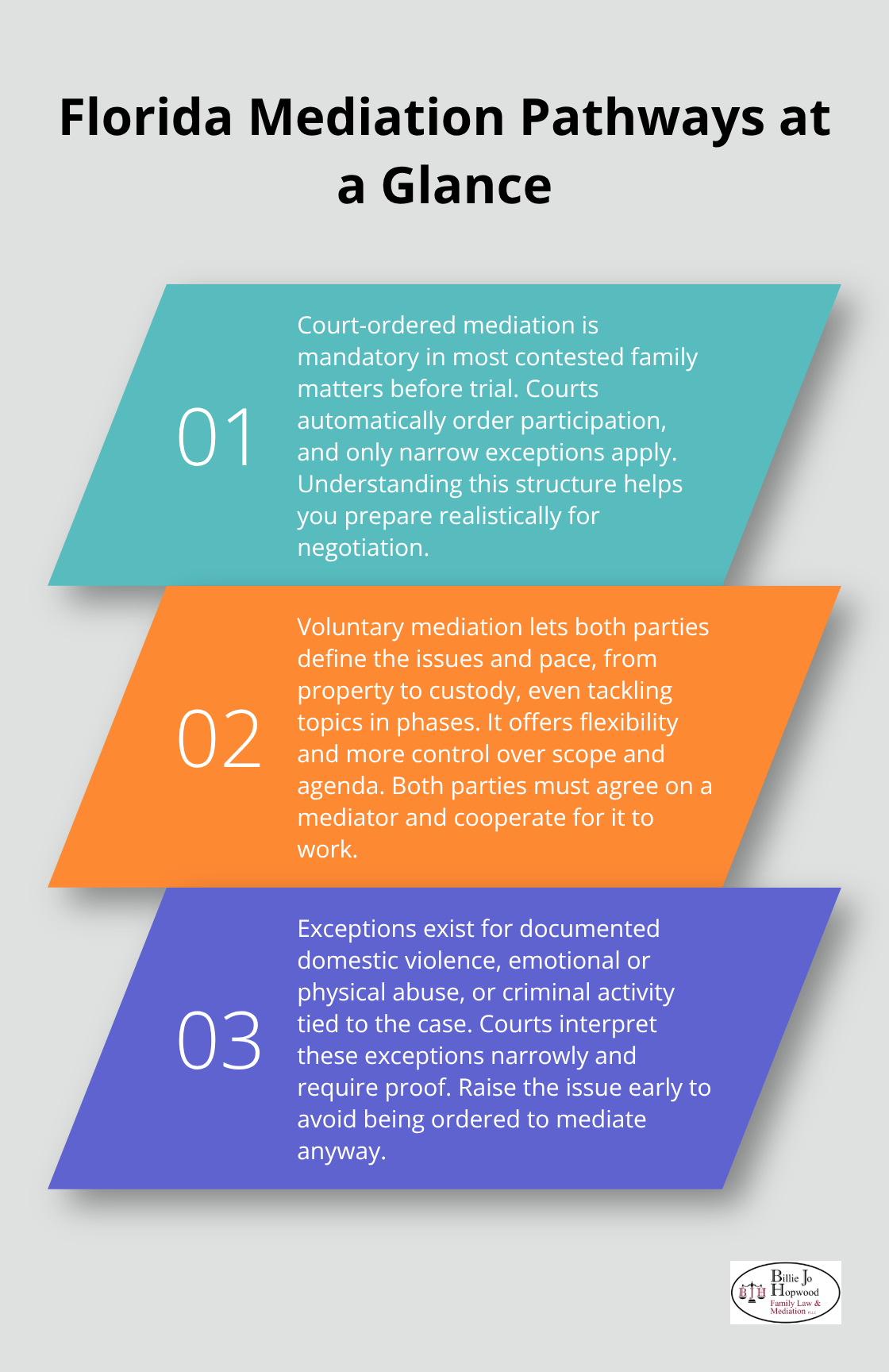
Florida law mandates mediation in most contested family law cases before you can take your dispute to trial. Under Florida Statute 44.102, all contested family matters-including divorce, custody, child support, and alimony disputes-must go through mediation unless specific exceptions apply. The court will order mediation in your case automatically, meaning you do not have a choice about participating. This is not optional. The only way out is if your case falls under narrow exceptions: a history of domestic violence between you and the other party, documented emotional or physical abuse, or evidence of criminal activity directly related to your case. Simply having concerns about the other person is not enough to avoid mediation. Even if a temporary protective order exists, Florida courts still frequently require mediation to proceed, so do not assume you are automatically exempt.
What the 75-Day Timeline Means for Your Case
Once the court orders mediation, you have 75 days from your first conference to complete it. This deadline is firm, and missing your scheduled mediation session without good cause can result in court sanctions, including having to pay the mediator’s fees and potentially facing other penalties. If you cannot attend a scheduled session, contact the court and the mediator immediately to reschedule. Courts take this deadline seriously because mediation moves cases forward quickly. Unlike litigation, which stretches months or years, mediation under Florida law must happen fast. Court-ordered mediation typically resolves cases within weeks, often in a single three-hour session. This compressed timeline works in your favor if you arrive prepared, but it works against you if you show up unprepared or with unrealistic expectations about what you can achieve.
Voluntary Mediation Gives You More Control Over Scope
If you and the other party agree to mediation before the court orders it, you enter voluntary mediation. This option exists for couples who want to resolve issues outside the court system entirely. Voluntary mediation allows you and the other party to define exactly what issues the mediator will address-property division, custody, support, or any combination. Court-ordered mediation has a narrower scope; the mediator may not cover every final issue, and unresolved matters return to the judge. With voluntary mediation, you control the agenda. You decide whether to include all issues or tackle them in phases. This flexibility is powerful if you want to craft solutions that work for your family rather than accept whatever a judge imposes. However, voluntary mediation requires both parties to cooperate and agree on a mediator. If the other party refuses to mediate voluntarily, the court will eventually order it anyway, and you lose the advantage of defining the process on your own terms.
How Exceptions to Mandatory Mediation Work in Practice
Florida recognizes that mediation does not work in every situation. If you have experienced domestic violence, emotional abuse, or physical abuse from the other party, you may qualify for an exception. You must document this history and present it to the court. Criminal activity directly tied to your case also qualifies as an exception. However, courts interpret these exceptions narrowly. A temporary protective order does not automatically exempt you from mediation-the court may still require it. You must prove that mediation itself would be unsafe or unproductive. If you believe your case qualifies for an exception, raise this issue with the court before your mediation date is set. Waiting until the last minute weakens your position and may result in the court ordering mediation anyway.
Who Certifies Florida Mediators and What That Means for You
Florida Supreme Court certification is the only credential that matters when evaluating a mediator. All mediators handling family law cases in Florida must complete rigorous training and pass certification requirements set by the Florida Supreme Court. This is not a suggestion or preference-it is a legal mandate. The certification process requires mediators to complete comprehensive training in mediation techniques, ethics, and Florida family law before they can legally conduct sessions. Once certified, mediators must complete 16 hours of continuing mediation education every two years to maintain their credential. This ongoing requirement matters because it keeps mediators current on changes to Florida law and best practices.
Verify Mediator Credentials Before Your Session
When you sit down with a mediator, you can verify their certification status through the Florida Supreme Court’s official records. If a mediator cannot produce proof of current certification, walk away. An uncertified mediator has no legal authority to conduct your session, and any agreement reached may not hold up in court. You have the right to request documentation of certification before your first session begins. Courts expect you to confirm this credential, and mediators understand this expectation. Do not hesitate to ask questions about qualifications or training background.
Confidentiality Rules Protect Your Statements-With Important Limits
Everything you say during mediation is confidential under Florida’s Mediation Confidentiality and Privilege Act. This protection is powerful. Your settlement discussions cannot be used against you in court if mediation fails and your case goes to trial. The mediator cannot testify about what was said.
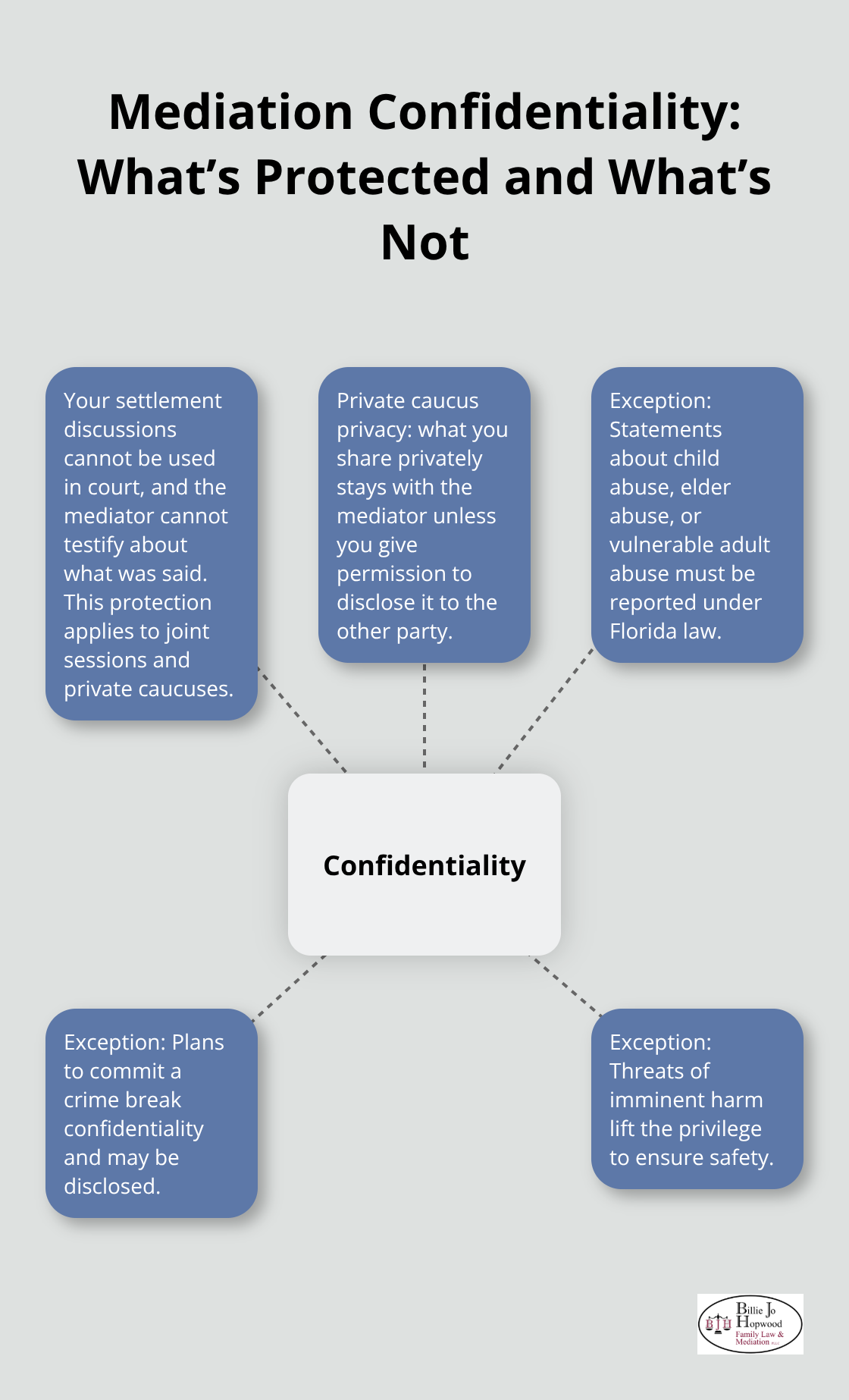
Neither party can introduce statements made during mediation as evidence. This confidentiality applies to joint sessions and private caucuses where the mediator meets with you alone. What you disclose in a private caucus stays between you and the mediator unless you give permission to share it with the other party.
This confidentiality rule is absolute-with three specific exceptions. Statements about child abuse, elder abuse, or vulnerable adult abuse must be reported. Plans to commit a crime also break confidentiality. Threats of imminent harm lift the privilege. Outside these narrow exceptions, mediation discussions remain sealed. This protection encourages honesty. You can explore settlement options, admit weaknesses in your position, and test ideas without fear that your words will be weaponized later. The confidentiality shield makes mediation fundamentally different from court proceedings, where every statement becomes part of the public record.
Written Agreements Must Be Signed Before They Become Binding
Reaching verbal agreement during mediation is only half the battle. Florida law requires that any settlement be put in writing and signed by all parties before it becomes legally binding. The mediator will draft a memorandum of understanding or deed of agreement that spells out every term you negotiated. Read this document carefully. Verify that it reflects what you actually agreed to. Ambiguities now become disputes later.
Once you and the other party sign the written agreement, it becomes a contract enforceable by the court. You cannot change your mind after signing based on buyer’s remorse or second thoughts. The court will enforce the terms as written. If you want attorney review before signing, request time to have your lawyer examine the agreement. This is your right. Some mediators build in a review period specifically for this purpose. Do not skip this step if cost concerns you-spending a few hundred dollars on attorney review now prevents thousands in litigation costs if disputes arise over what the agreement means.
After both parties sign, the agreement goes to the court for approval in a brief hearing. The judge reviews it to confirm it was reached voluntarily and does not violate Florida law. In most cases, the judge approves it without modification. Once approved, the agreement becomes a court order with full enforcement power. If either party violates the terms later, the other party can return to court to enforce it. This enforcement mechanism transforms your negotiated settlement into something the court will actively protect.
Common Mistakes People Make During Mediation in Florida
Arrive Unprepared and Waste Critical Time
Walking into mediation without financial documents is the fastest way to waste time and money. People frequently show up without bank statements, tax returns, or any clear picture of their assets and debts. Florida courts expect you to know your financial situation before mediation starts. If you cannot answer basic questions about what you own, what you owe, or what income flows into your household, the mediator cannot help you reach a real settlement. The 75-day timeline does not extend because you forgot documents at home. Mediation typically resolves in a single three-hour session or across a few sessions spanning weeks. Every hour counts.
Bring complete financial records before your first session: bank and credit card statements for the past 12 months, mortgage documents, retirement account statements, tax returns from the past two years, recent pay stubs, and investment account records. Include any documentation of debts or liabilities. If you own a business or rental property, bring profit-and-loss statements and appraisals.
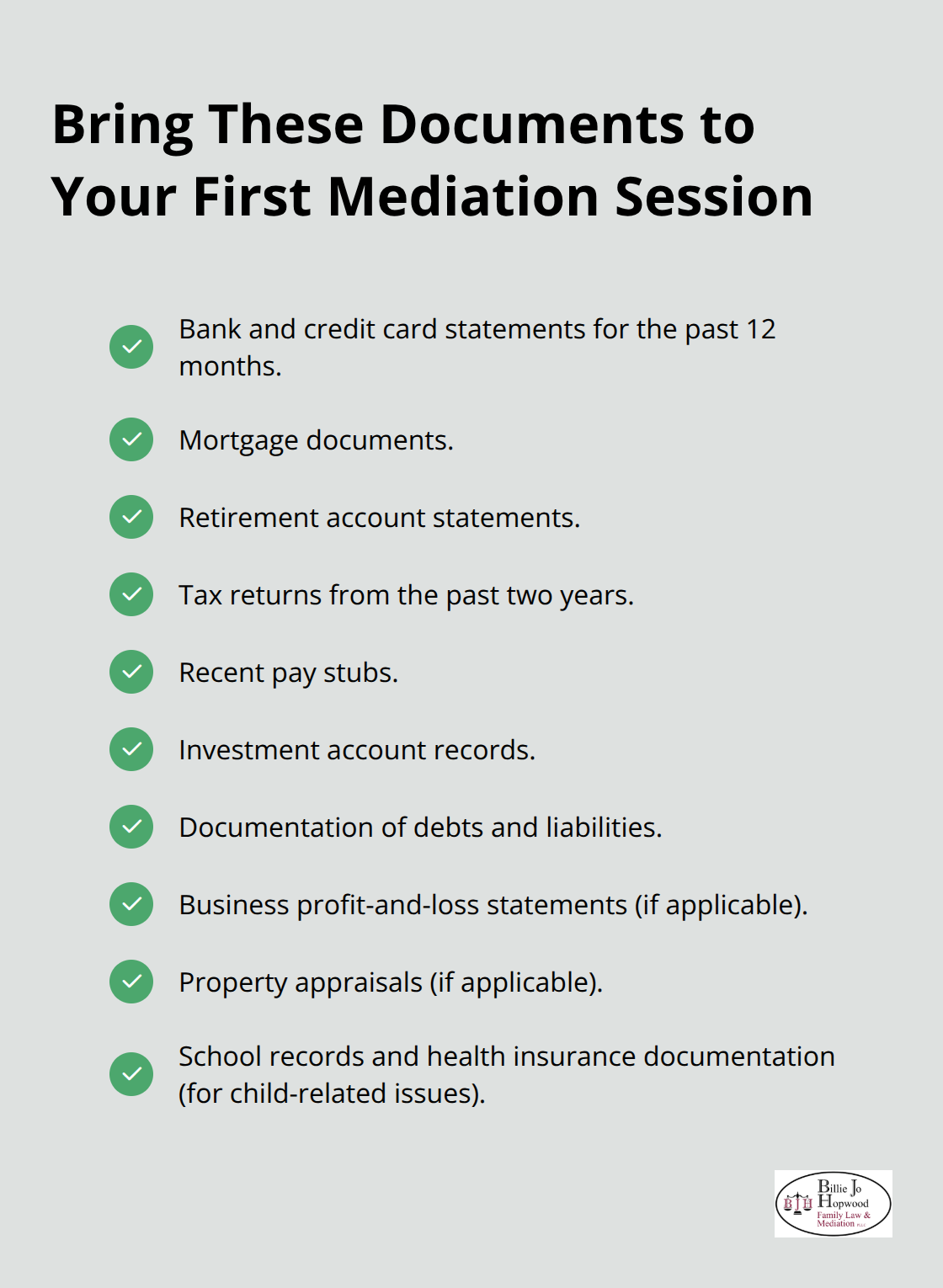
For child-related issues, gather school records and health insurance documentation. The other party will exchange these same records, so hiding information or arriving with incomplete data wastes everyone’s time and signals bad faith to the mediator.
Enter With Unrealistic Expectations About Outcomes
Many people approach mediation believing they will convince the mediator to side with them or that the process exists to validate their position. That is not how mediation works. The mediator is neutral and does not decide who is right or wrong. You will not get everything you are asking for-that is the fundamental reality of settlement negotiation. Florida courts expect you to identify your top three to five priorities and determine what you are willing to concede to reach agreement.
If your goal is 100 percent custody, 100 percent of assets, and zero spousal support, you are not mentally prepared for mediation and should delay until you reset your expectations with an attorney. Unrealistic demands derail negotiations quickly. The other party will reject your position outright, and the mediator will struggle to find common ground. Successful mediation requires both sides to move toward the middle. You must accept that compromise is the only path forward.
Miss Sessions or Arrive Late Without Consequences
Missing scheduled sessions or arriving late signals to the mediator and the other party that you do not take the process seriously. Courts sanction people who fail to attend mediation without good cause, and those sanctions include paying the mediator’s fees-typically $120 to $240 per party per session depending on your income level under Florida’s fee schedule. One missed session can cost you hundreds of dollars and extend your timeline beyond the 75-day requirement, triggering additional court involvement.
If you cannot attend, contact the mediator and court immediately to reschedule rather than simply not showing up. Courts view no-shows as contempt and may impose additional penalties beyond mediator fees. Your case will stall, and the judge may order you to pay the other party’s attorney fees for delays you caused. Custodial parents who deny court-ordered visitation face similar enforcement actions. Treat mediation dates with the same respect you would give a court appearance.
Final Thoughts
Florida family law mediation rules create a structured path that moves your case forward efficiently while protecting your rights and controlling costs. Mandatory mediation in contested family matters, strict 75-day timelines, certified mediators bound by confidentiality, and written agreements that become enforceable court orders form the backbone of this system. Following these rules prevents delays, reduces expenses, and gives you control over outcomes rather than leaving decisions to a judge.
People who succeed in mediation arrive prepared with financial documents, enter with realistic expectations about compromise, and treat scheduled sessions with the seriousness they deserve. Those who struggle typically show up unprepared, demand outcomes the other party will never accept, or miss sessions without consequences. The difference between these outcomes often comes down to preparation and mindset.
We at Billie Jo Hopwood Family Law & Mediation, PLLC in Melbourne, Florida help families navigate mediation and understand what Florida family law mediation rules mean for their specific situation. Having qualified professionals review your agreement before signing and advising you on realistic settlement positions transforms mediation from an intimidating process into a manageable path forward.