
Family law mediation in Melbourne offers a faster, more affordable path than court battles. When families face divorce, custody disputes, or property division, mediation keeps control in your hands rather than leaving decisions to a judge.
At Billie Jo Hopwood Family Law & Mediation, PLLC, we’ve seen how mediation transforms difficult situations into workable solutions. This guide walks you through local strategies that help Melbourne families resolve conflicts while protecting relationships and finances.
Why Mediation Beats Court for Melbourne Families
Speed Matters When Your Family’s Future Is at Stake
Litigation in Florida family law cases moves slowly. Court calendars in Brevard County back up months, sometimes years, before judges hear contested custody or property disputes. Mediation compresses this timeline dramatically. Most mediation sessions resolve in weeks rather than waiting through multiple court appearances. Families reach binding agreements in a fraction of the time court requires.
Costs Add Up Fast in Courtroom Battles
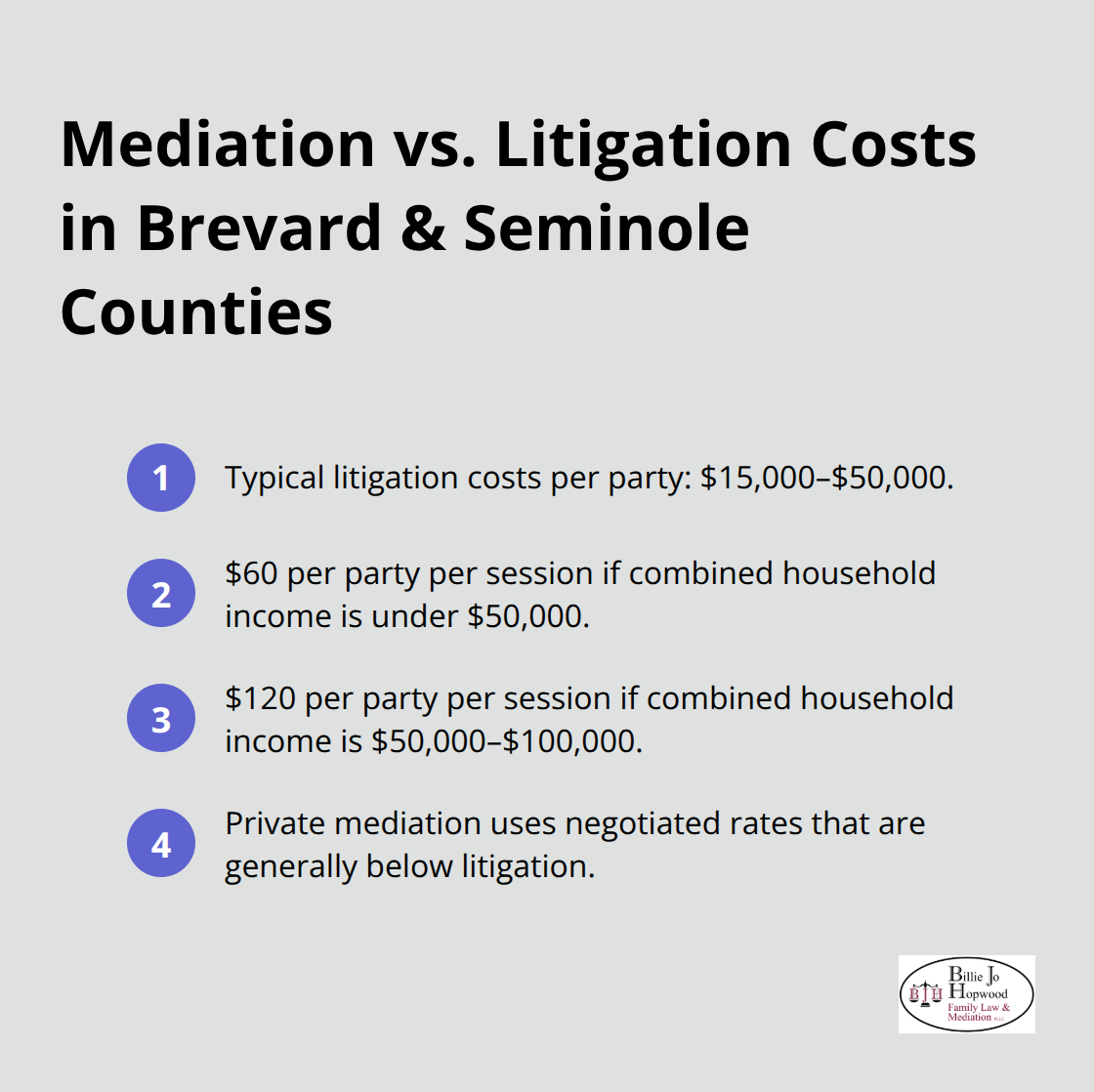
The cost difference between mediation and litigation proves stark. Court litigation in family law routinely costs $15,000 to $50,000 per party when attorney fees, court costs, and expert witnesses accumulate. Mediation in Brevard and Seminole counties follows a means-tested fee structure: families earning under $50,000 combined income pay $60 per party per session, while those earning $50,000 to $100,000 pay $120 per party. Families with higher incomes access private mediation at negotiated rates, which still undercut litigation expenses substantially.
You Control the Outcome, Not a Judge
You retain control of outcomes in mediation rather than accepting whatever a judge decides. A judge sees your case for hours; a mediator works with you over sessions to understand your priorities, your children’s needs, and your financial reality. This fundamental difference shifts power back to you and your family.
Local Knowledge Changes Everything
Melbourne mediators understand the local landscape in ways distant judges cannot. They know how Brevard County schools operate, what custody arrangements work in our community, and how local employment patterns affect child support calculations. Mediators trained through the Florida Supreme Court system bring consistency and credibility to the process. They cannot force agreements or impose decisions, but they identify realistic solutions grounded in local practice.
Cooperation Protects Your Children’s Future
When you preserve relationships through mediation, your children benefit most directly. Parents who negotiate custody and parenting plans together maintain communication channels necessary for co-parenting decisions about school, healthcare, and extracurricular activities. Litigation creates adversarial positions that damage these relationships permanently. Research consistently shows children adjust better after divorce when parents cooperate. Mediation builds that cooperation from the start rather than destroying it through courtroom battles. With these advantages clear, understanding the specific family law issues Melbourne residents face helps you recognize where mediation applies to your situation.
Common Family Law Issues Melbourne Residents Face
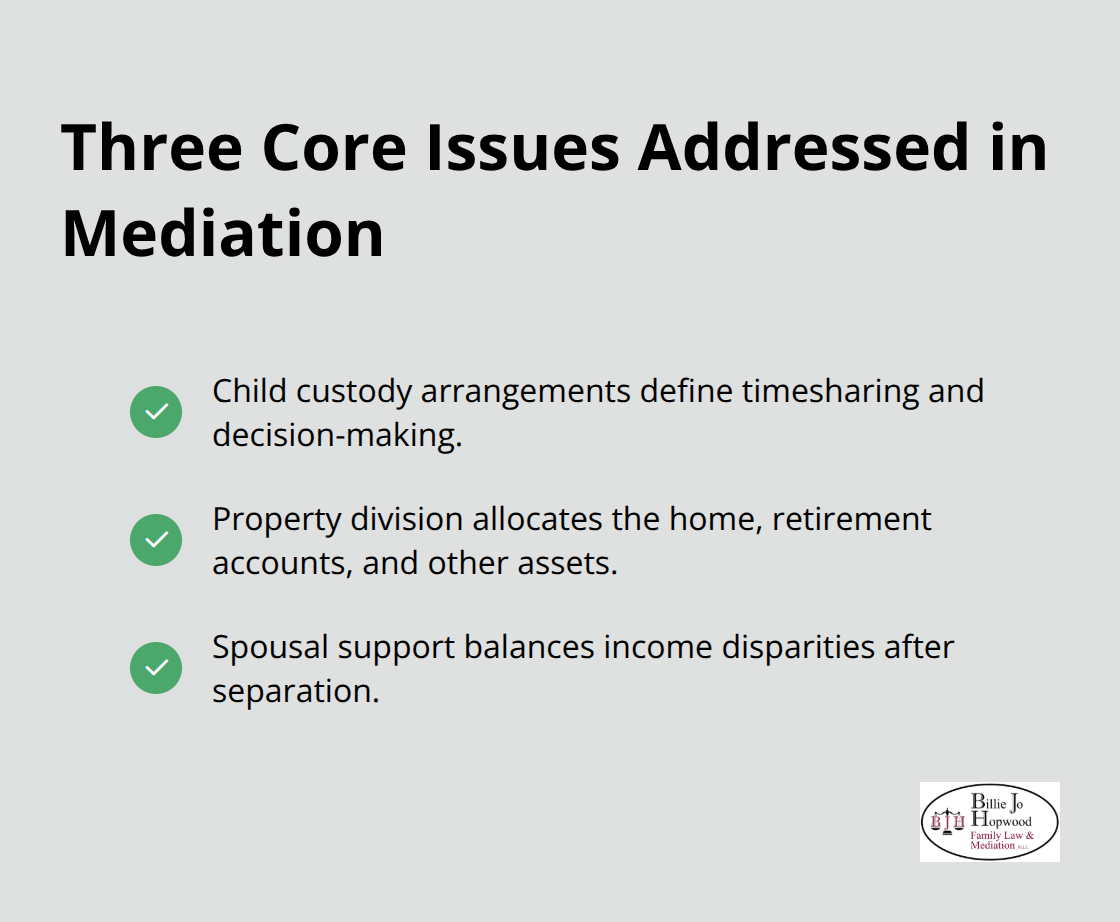
Divorce in Melbourne triggers three interconnected problems that families must resolve simultaneously. Child custody arrangements determine where children live and how parents share decision-making authority. Property division splits marital assets accumulated during the marriage, from the family home to retirement accounts. Spousal support addresses financial dependency when one partner earned significantly less during the marriage. These issues overlap constantly, making mediation particularly valuable because a single negotiation process addresses all three rather than fighting them separately in court.
Custody Disputes Shape Children’s Lives
Custody disputes dominate family law in Brevard County because Florida courts prioritize the best interests of the child standard, which remains deliberately vague. Parents disagree on timesharing schedules, school selection, healthcare decisions, and which parent handles extracurricular activities. Mediation lets parents craft specific arrangements matching their actual lives rather than accepting generic court orders. One parent works nights while the other manages daytime responsibilities, creating natural custody patterns a mediator can formalize into sustainable agreements.
Property Division Requires Strategic Thinking
Property division becomes contentious when couples accumulated significant assets during marriage. The family home represents the largest asset for most Melbourne families, but retirement accounts, business ownership, and investment portfolios create additional complexity. Spouses often hold conflicting views about what constitutes fair distribution, especially when one partner sacrificed career advancement to raise children. Mediation allows couples to weight different assets differently based on their priorities rather than splitting everything equally by formula.
Spousal Support Calculations Affect Long-Term Finances
Spousal support calculations in Florida depend on income, earning capacity, standard of living during marriage, and marriage length according to Florida Statute 61.08. One spouse earning $35,000 annually while the other earned $120,000 creates support obligations that extend years into the future. Mediation permits flexible support arrangements including temporary support during job retraining, support ending when a recipient remarries, or gradual reductions as earning capacity increases. These negotiated terms often prove more workable than rigid court-imposed support orders because both parties helped design them.
Understanding these three core issues prepares you to move forward with mediation. The next section walks you through practical steps to start the mediation process in Melbourne.
Practical Steps to Start Mediation in Melbourne
Locate a Qualified Mediator in Brevard County
Three concrete steps move you from decision to action. First, locate a mediator qualified to handle family law in Brevard County. Florida Supreme Court certification matters significantly because certified mediators complete 16 hours of continuing education every two years and maintain training standards across the state. You can verify mediator credentials through the Florida State Courts website or contact Brevard County Court Administration directly at the Viera location to request qualified mediator referrals. The court maintains lists of approved mediators who handle divorce, custody, child support, and property division cases.
Gather Financial Documents Before Your First Session
Second, collect financial documents before your first session because mediators cannot negotiate fairly without complete income and asset information. Pull together recent tax returns for both spouses, mortgage statements, bank account records, retirement account statements, and documentation of any business ownership or investment accounts. This preparation typically takes one to two weeks and prevents delays once mediation sessions begin. Having these documents ready accelerates the entire process and allows the mediator to focus on negotiation rather than information collection.
Understand the Mediation Timeline and Costs
Third, understand that mediation in Brevard and Seminole counties follows a structured timeline. Initial consultations with a mediator last approximately one hour and cost $60 per party if your combined household income falls below $50,000 annually, or $120 per party for combined income between $50,000 and $100,000 according to the court’s means-tested fee schedule. Most families resolve custody and property disputes within three to five mediation sessions, though complex cases involving significant assets may require additional meetings. Each session typically spans two to three hours, and mediators maintain strict confidentiality about discussions unless law requires disclosure.
How the Mediation Process Unfolds
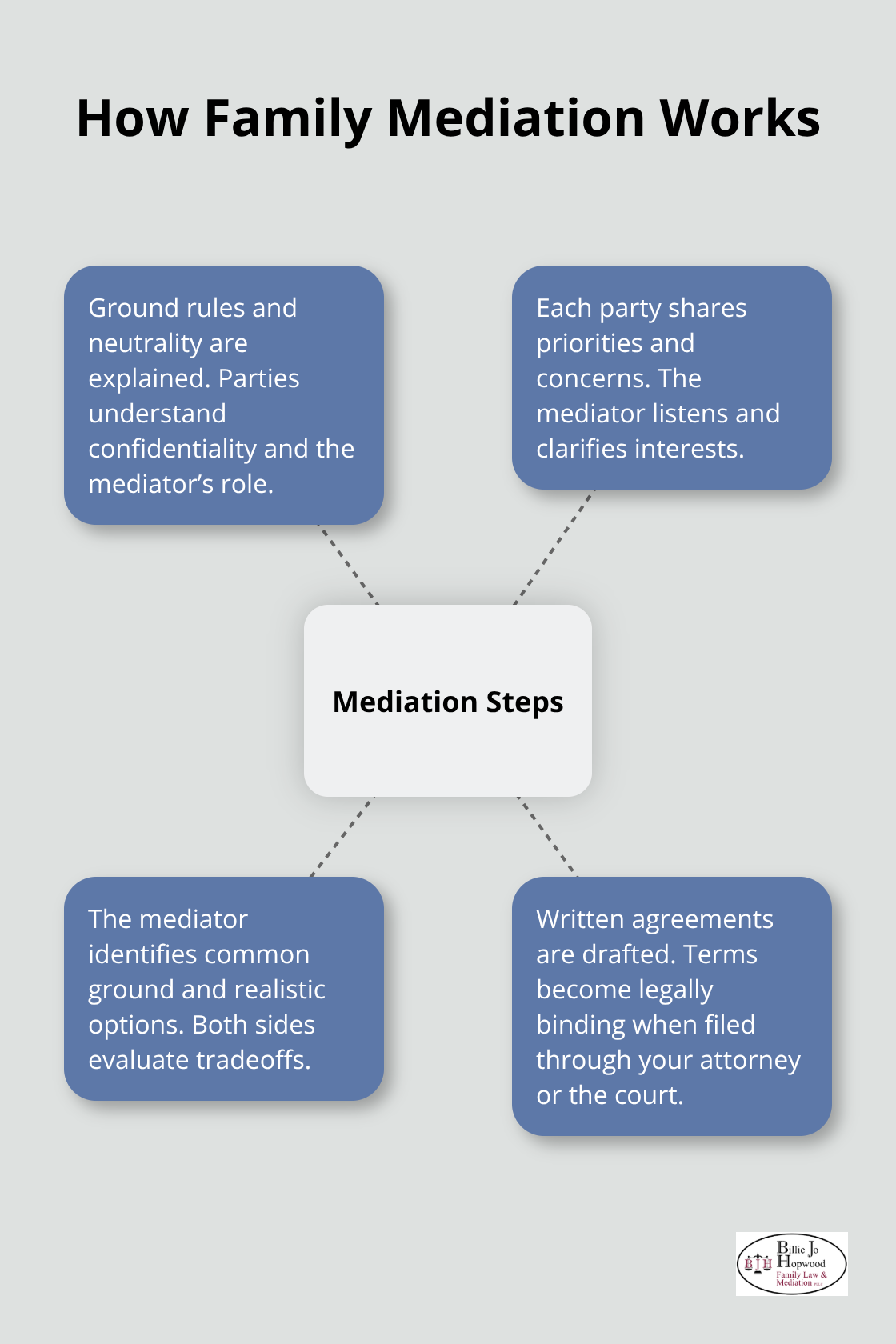
The mediation process itself follows a predictable pattern. The mediator explains ground rules and neutrality, each party describes their priorities, the mediator identifies common ground and realistic options, and finally both parties work toward written agreements that become legally binding once properly documented through your attorney or the court. This structured approach combined with the mediator’s training in Florida family law creates a framework where productive negotiation replaces adversarial positioning. Sessions move forward systematically, addressing one issue at a time until all major concerns reach resolution.
Final Thoughts
Family law mediation in Melbourne puts decisions back in your hands rather than leaving outcomes to a judge. You control the timeline, the costs stay manageable, and your relationships with your children and co-parent remain intact for the future. Most families complete mediation within weeks, not months or years, because both parties commit to negotiation rather than courtroom battles.
Mediation works even when disagreements exist between parents who hold conflicting views on custody, support, or property division. The confidentiality of mediation sessions protects your privacy throughout the process, and once you reach written agreements, they become legally binding and enforceable. Your priorities shape the agreements you reach, not judicial formulas applied to thousands of cases annually.
At Billie Jo Hopwood Family Law & Mediation, PLLC, we help Melbourne families navigate family law mediation with compassion and practical guidance. Contact us today to discuss how mediation can work for your family’s specific situation and move toward the peaceful resolution you deserve.