
Family law mediation in Florida offers a path forward when relationships end, but many people feel uncertain about what happens in the room.
We at Billie Jo Hopwood Family Law & Mediation, PLLC know that preparation and clear communication make the difference between mediation that stalls and mediation that resolves your situation. This guide walks you through what to expect, how to prepare, and the strategies that actually work.
What Happens During Florida Family Law Mediation
The Mediation Process and Timeline
Florida requires mandatory mediation in most family law cases, and understanding the actual mechanics of the process removes much of the anxiety people carry into the room. A Florida Supreme Court-certified mediator guides discussions but never makes decisions for you-that’s a critical distinction that changes how the process works. From the moment you arrive, the mediator establishes ground rules, clarifies their neutral role, and gives both parties space to share initial positions.
The first session typically lasts up to three hours, though complex cases often require additional sessions scheduled within 60 days of the court’s referral order. You’ll need to bring a completed financial affidavit showing assets, debts, income, and expenses-this isn’t optional, and without it, you won’t receive the court’s order to proceed. Most initial mediation conferences happen via Zoom unless you file an objection requesting in-person attendance.
What You Must Bring and Pay
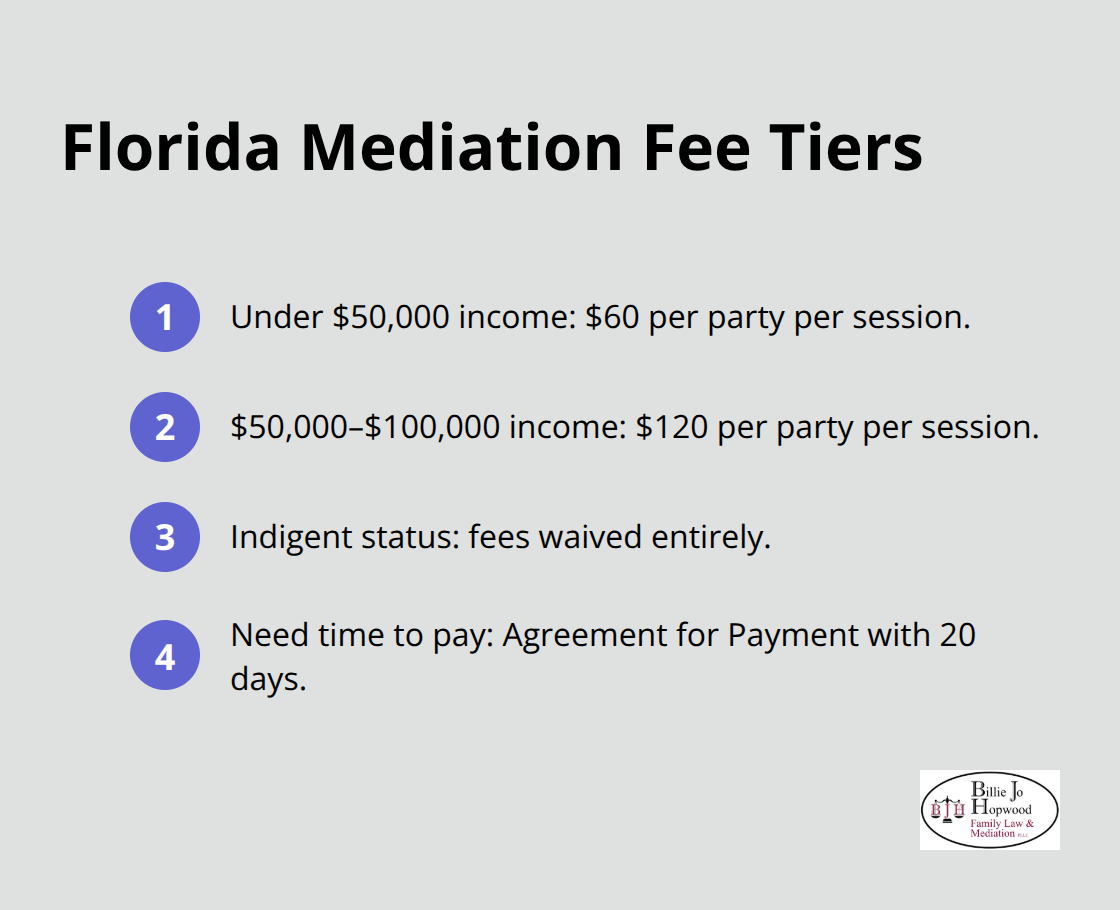
If you have children, you must bring a drafted Parenting Plan to mediation; forms are available from the Florida State Courts website or your county Clerk of Court. The cost depends on your household income-if your combined gross income is under $50,000, you’ll pay $60 per party per session; between $50,000 and $100,000, it’s $120 per party per session. Those deemed indigent have fees waived entirely. If you can’t pay at scheduling, you can enter an Agreement for Payment with 20 days to settle the bill.
The Mediator’s Role and Your Control
The mediator’s job is to guide you toward your own solutions, not impose them. Property division, child custody and visitation, child support, and alimony all come to the table in mediation. You control the outcomes and can craft arrangements that a judge would never approve-flexible custody schedules, creative asset divisions, or payment plans tailored to your actual situation. This flexibility is why mediation often works better than litigation for families.
The mediator won’t give legal advice, so consider consulting an attorney before signing any agreement to understand tax consequences and long-term implications. If tensions run high, the mediator will work with you separately, shuttling between rooms to keep conversations productive. This structure matters because it allows honest negotiation without the adversarial heat of a courtroom.
From Settlement to Court Approval
If you reach a settlement, the mediator drafts an agreement covering all resolved issues. This document goes to the court for approval, and uncontested divorces typically move straight to a final decree if terms meet legal requirements. Even if some issues remain contested, mediation narrows the battlefield significantly-you might walk away with custody and support resolved, leaving only property division for trial. That alone saves time and money.
The process respects confidentiality throughout; nothing said in mediation can be used against you in court if talks break down. This protection encourages honest conversation because you’re not building a trial record with every statement. With the mediation framework clear, your next move is preparing the documents and mindset that actually move negotiations forward.
Preparing Documents That Actually Move Mediation Forward
Gather Your Financial Records First
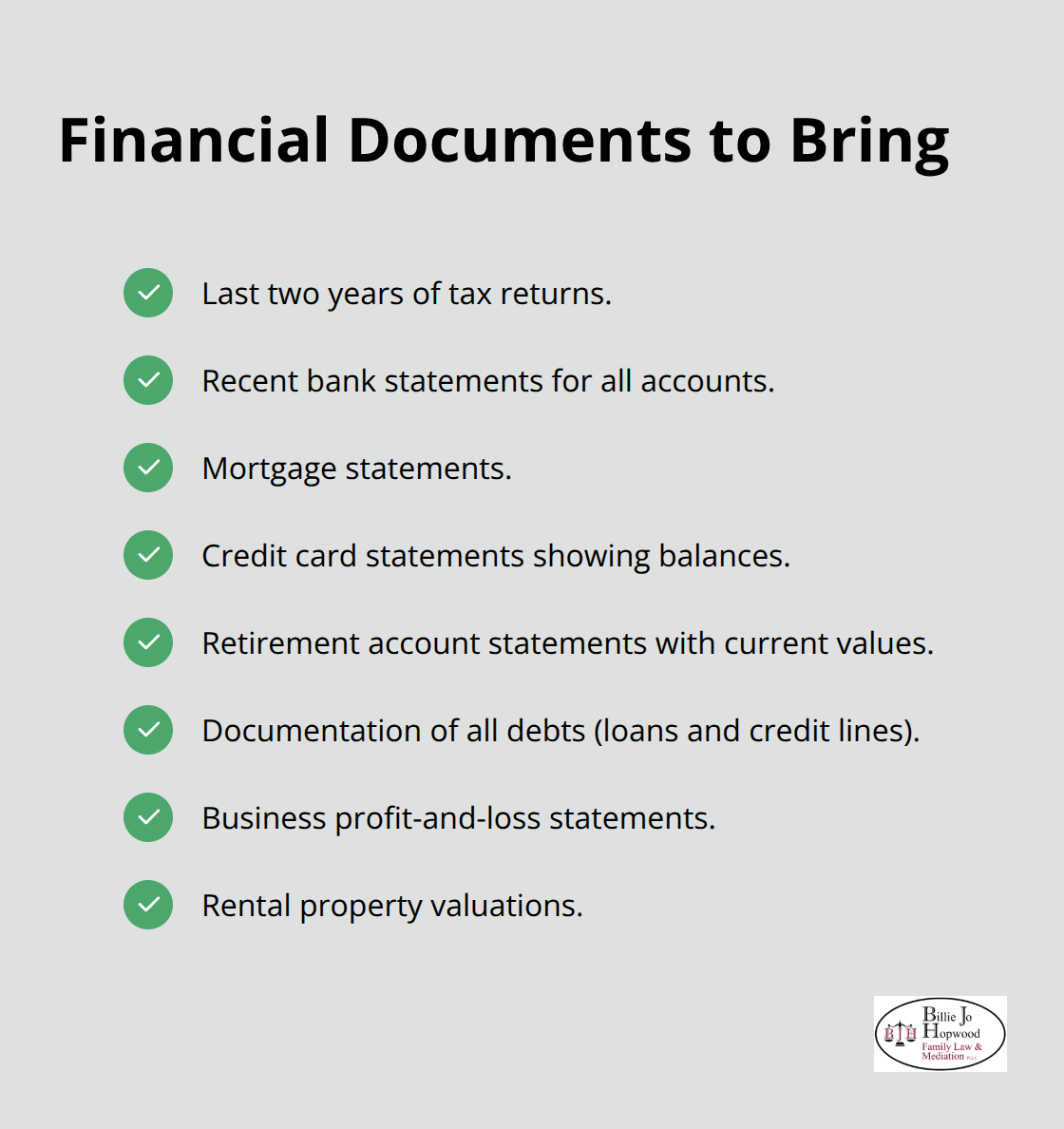
Walking into mediation without your financial records is like showing up to a negotiation blindfolded. Florida law requires both parties to file current financial affidavits before the court issues your Order of Referral, and this requirement exists for a reason-the mediator cannot guide productive discussions about property division, support, or custody without seeing the full financial picture. Bring your last two years of tax returns, recent bank statements from all accounts, mortgage statements, credit card statements showing balances, and retirement account statements with current values. Document any debts including loans and credit lines. If you own a business or rental property, bring profit-and-loss statements and property valuations.
The Florida State Courts website provides the official financial affidavit form, and accuracy matters because inaccurate disclosures can invalidate agreements later or trigger court sanctions. Don’t estimate-pull actual statements. If accounts are held jointly, get statements for both names. This groundwork takes three to four hours but prevents the mediator from wasting session time (at $60 to $120 per party per session) asking for missing documents or scheduling follow-up meetings.
Identify Your Core Interests, Not Just Your Positions
Clarity about what you actually want separates people who leave mediation satisfied from those who feel they compromised too much. Write down your priorities in order: Is keeping primary custody of your children non-negotiable, or would you accept a 50-50 schedule if spousal support covers your mortgage? Can you accept less alimony if you retain the family home, or is a clean break with equal asset division more important?
Most people conflate positions with interests-you might say you want the house, but your real interest is housing stability for your kids or avoiding relocation. A mediator skilled at untangling these motivations will help you find solutions you didn’t see, but only if you’ve done honest internal work first. Identify three to five core interests and rank them.
Know Your Bottom Line Before You Sit Down
Establish your actual bottom line: the point where you walk away and go to trial. Know your numbers. If child support guidelines say you owe $800 monthly, decide whether you can sustain that or whether $650 is your realistic floor. If the marital home is worth $400,000 with a $150,000 mortgage, know whether you’d accept $100,000 in equity or whether you need $125,000 to feel the division was fair.
This precision prevents the common mediation trap where you agree to something in the moment and regret it within weeks because you hadn’t thought through the actual impact on your monthly budget or long-term financial security. Proper preparation leads to productive mediation sessions, and with your documents organized and your priorities clear, you’re ready to enter the mediation room with confidence and direction-and that preparation directly shapes how the mediator guides your discussions toward solutions that actually work for your family.
How to Actually Influence the Mediation Room
The mediator’s job is to facilitate; your job is to shape the conversation toward outcomes that protect your interests. Most people walk into mediation hoping the other party will suddenly become reasonable, but that’s not how negotiation works. What happens in the mediation room depends on how you communicate, what you listen for, and whether you stay anchored to solutions or get pulled into blame cycles that waste time and money.
The difference between mediation that costs $500 total and mediation that drags into multiple sessions costing $1,500 or more often comes down to how deliberately you engage in those first hours.
State Your Position Without Attacking the Person
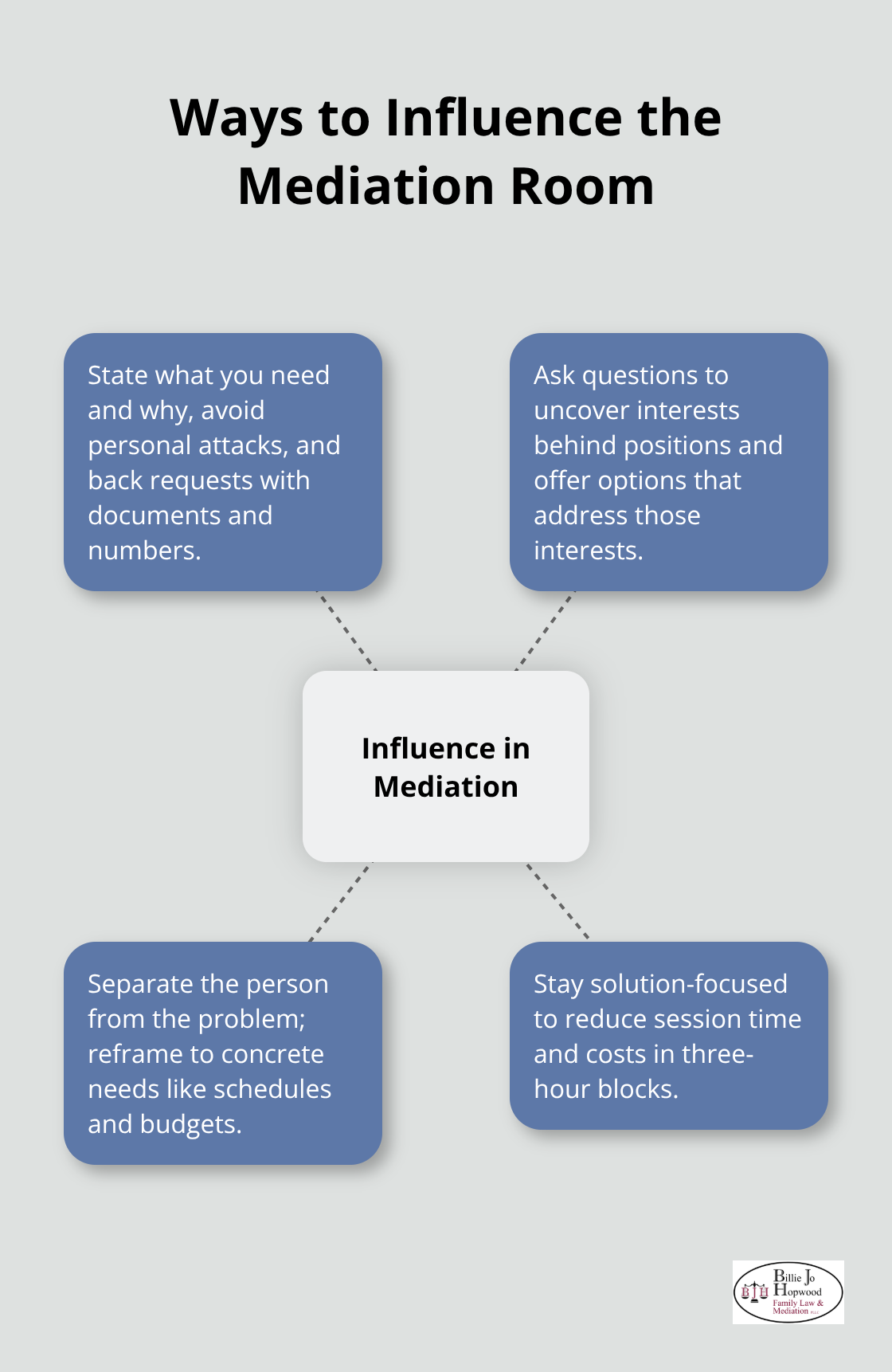
Say what you need and why you need it, then stop. Don’t explain why the other party is wrong or unreasonable-that triggers defensiveness and shuts down listening. If you need primary custody because your work schedule is flexible and the children’s school is three blocks from your home, state that fact. If you need $1,200 monthly in child support because your income is $2,800 and childcare costs $900 monthly, show the math. Mediators respond to specific, documented positions far more than to emotional arguments or character attacks. The Florida Supreme Court-certified mediators working in these sessions have heard anger and blame hundreds of times; what moves them is clarity backed by facts. When you present information without personal attacks, the other party can actually hear you instead of spending mental energy defending themselves. This matters because mediation sessions last three hours per block, and every minute spent on conflict is a minute not spent solving problems.
Listen for Interests Hidden Behind Positions
The other party says they want the house. That’s their position. Their actual interest might be avoiding relocation disruption for the kids, maintaining a sense of stability, or keeping the home as an investment. Ask questions instead of assuming. What specifically about the house matters to them? If it’s stability for the children, you might offer a longer timeline before sale, a right of first refusal if they want to buy you out later, or a custody schedule that keeps the kids in the same school district even if they move. If it’s financial-they see the house as their security-you might offer a larger share of retirement accounts in exchange for you keeping the home. Mediators skilled at this work will help you dig into these motivations, but you accelerate the process when you ask genuine questions and listen to the answers without planning your rebuttal. This approach cuts session time dramatically because you solve actual problems instead of trading rigid positions back and forth.
Separate the Problem from the Person and Stay on Track
You might feel angry at the other party. That anger is valid. But in the mediation room, anger is a liability that costs you money and delays resolution. Focus on what needs to happen, not on what they did wrong. Instead of saying, “You never helped with the kids and you shouldn’t get equal custody,” say, “I need a schedule that keeps the children in their current school and provides consistency on weeknights because they need that structure.” The second approach gives the mediator something concrete to work with. It also prevents the other party from spending the session defending their parenting or justifying their choices. Cases that should settle in two sessions stretch to four because parties cannot move past blame. The moment you shift from character judgment to problem-solving, the energy in the room changes. The mediator can actually help you build agreements instead of refereeing conflict.
Final Thoughts
After you reach an agreement in mediation, the mediator drafts a settlement document covering all resolved issues, and you must review this agreement carefully before signing to understand tax consequences and long-term financial implications. If questions arise about how child support calculations work or whether the property division meets Florida law requirements, ask the mediator directly-they provide guidance on these matters, though they cannot give legal advice. Consulting an attorney before you sign protects your interests and prevents costly mistakes that could affect your finances for years.
Even if Florida family law mediation doesn’t resolve everything, you’ve narrowed the issues significantly and eliminated the need for a full trial on every matter. Cases that might have required months of litigation now proceed with only one or two contested issues remaining, which saves thousands in legal fees and reduces the emotional toll on your family. After the court approves your agreement and issues the final decree, you implement the terms by transferring assets, updating custody schedules, and establishing support payments according to the timeline you negotiated.
If circumstances change later-your income shifts, the children’s needs evolve, or custody arrangements no longer work-you can pursue modifications through the court with proper documentation of the changed conditions. Contact our Melbourne office if you’re uncertain whether an agreement protects your interests or need guidance navigating the legal requirements of Florida family law mediation, and we’ll discuss your situation with you directly.