
A marital settlement agreement in Melbourne Florida is the document that turns a couple’s decisions about ending their marriage into a clear, enforceable plan. When spouses can agree on how to divide what they own and owe, and how they will raise their children going forward, the agreement becomes the foundation of an uncontested divorce. A well-written agreement can save months of conflict, while a vague or incomplete one can lead to confusion and disputes long after the divorce is final.
At Billie Jo Hopwood Family Law & Mediation, PLLC, we help couples in Melbourne and throughout Brevard County reach practical agreements through mediation and uncontested divorce so you can move forward with confidence. This guide explains what a marital settlement agreement actually does, how couples build one through mediation, and the mistakes that most often cause problems later.
What a Marital Settlement Agreement Actually Does
A marital settlement agreement is a written contract between spouses that resolves the issues a court would otherwise decide in a divorce. Once the court reviews and approves it, the agreement is typically incorporated into the final judgment, which means its terms carry the weight of a court order.
Before drafting begins, it helps to understand the basic legal requirements for a Florida divorce and the issues the agreement must address.
The Basic Requirements for a Florida Divorce
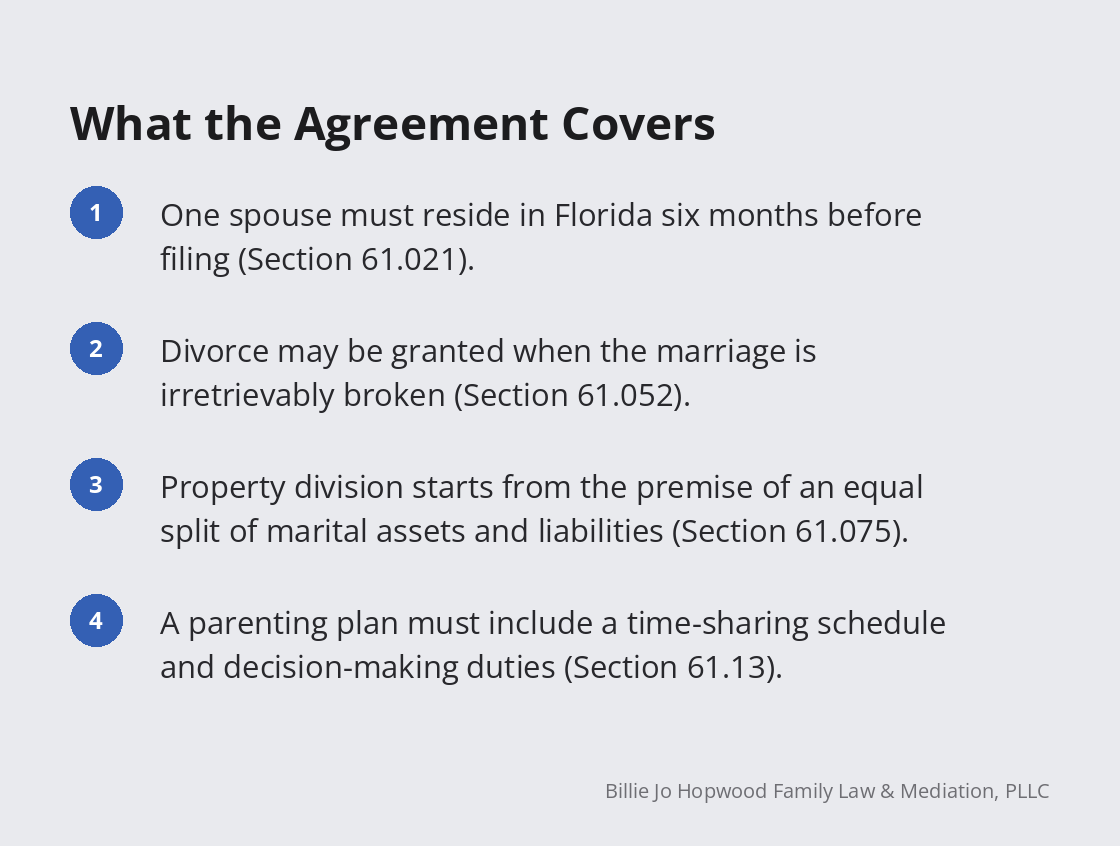
Florida law sets a few threshold requirements that apply whether a divorce is contested or uncontested. Under Section 61.021 of the Florida Statutes, one of the spouses must reside in Florida for six months before the petition for dissolution of marriage is filed.
Section 61.052 provides that a judgment of dissolution may be granted when the marriage is irretrievably broken, with a separate path based on the mental incapacity of a spouse. In an uncontested divorce, the spouses generally agree that the marriage is irretrievably broken, and the settlement agreement then addresses everything else.
Dividing Property and Debts
Property division is often the heart of the agreement. Section 61.075 directs a court to set apart each spouse’s nonmarital assets and liabilities and, when dividing marital assets and liabilities, to begin with the premise that the distribution should be equal unless there is a justification for an unequal distribution based on relevant factors.
Spouses who reach their own agreement can tailor that division to their circumstances. One spouse may keep the house while the other keeps a retirement account, or the couple may decide who will be responsible for each credit card and loan. Clear identification of each item, and of who receives it, helps prevent disagreements later.
It is also worth discussing practical details that are easy to overlook, such as who will keep the family pets, how personal belongings and vehicles will be divided, and how joint accounts will be closed. Settling these smaller questions in writing keeps them from becoming flashpoints after the divorce, when emotions may still be raw and communication may be harder.
Parenting Plans and Time-Sharing
When a couple has minor children, the agreement works alongside a parenting plan. Section 61.13 requires a court-approved parenting plan to describe how the parents will share daily tasks associated with raising the child, include a time-sharing schedule, designate who is responsible for health care, school-related matters, and other activities, and describe how the parents will communicate with the child.
Parents who agree on these issues are in the best position to design a schedule that fits their work, the children’s school, and the realities of life on the Space Coast. A thoughtful plan anticipates holidays, summer breaks, and how exchanges will happen.
How Couples Build a Settlement Agreement Through Mediation
Mediation gives spouses a structured, private setting to work through each issue with the help of a neutral mediator. Rather than having a judge make decisions for the family, the spouses keep control over the outcome.
The process generally moves from gathering information to negotiating terms to putting the final agreement in writing.
Gathering Information and Preparing
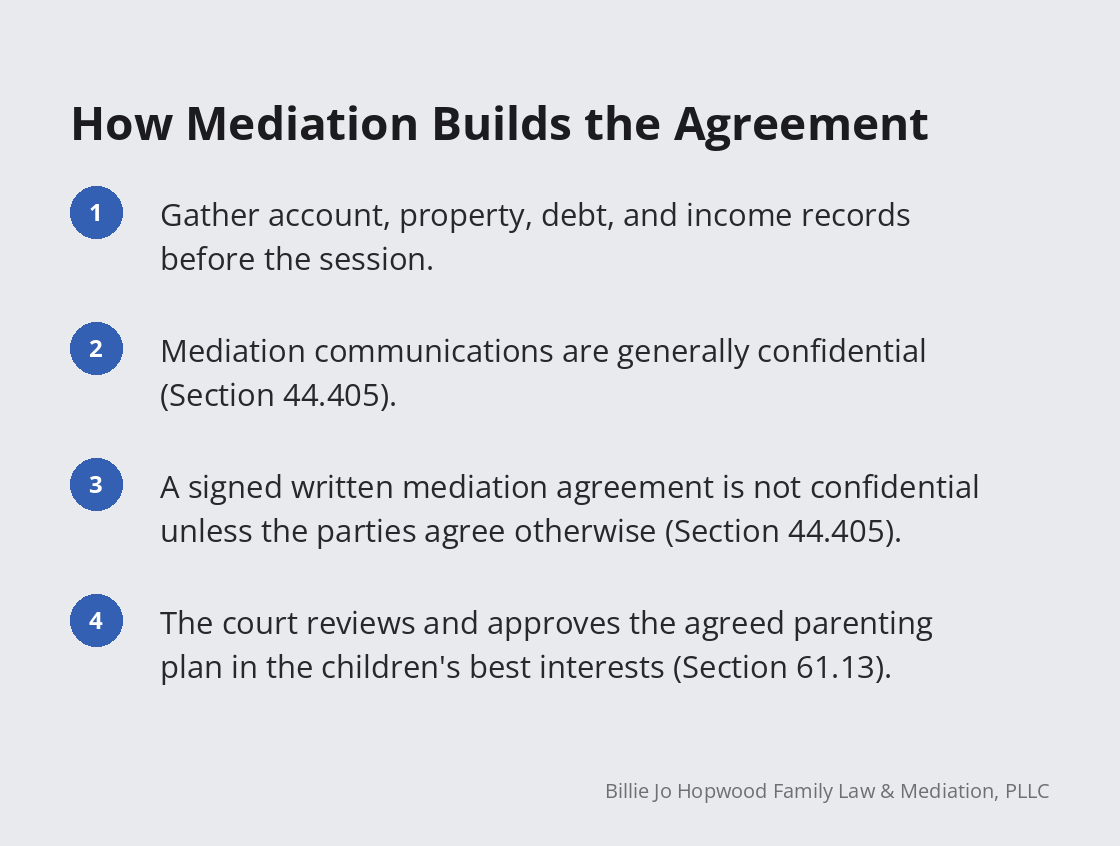
Productive mediation starts with good information. Each spouse should gather records about bank and retirement accounts, real estate, vehicles, debts, and income, along with any premarital or inheritance records that may show property is nonmarital.
Parents should also think about the children’s routines, activities, and needs before the session. Coming prepared allows the mediator to focus the conversation on solutions rather than on tracking down missing documents.
Reaching Agreement in a Private Setting
Florida law protects the privacy of mediation. Under Section 44.405, mediation communications are generally confidential, with limited exceptions, which encourages spouses to speak openly and explore options without worrying that every idea will be used against them later.
In some cases, mediation is not optional. Section 44.102 provides that in circuits where a family mediation program has been established, a court that finds a dispute shall refer all or part of custody, visitation, or other parental responsibility issues to mediation. Even when it is not required, many couples choose mediation because it tends to reduce conflict.
Understanding the Mediator’s Role
A mediator does not decide who is right or wrong and does not impose a result. Instead, the mediator helps each spouse understand the issues, keeps the discussion focused and respectful, and helps the couple test whether a proposed solution will actually work in daily life.
That neutral role is especially valuable when emotions are running high. Many couples find that having a calm third party in the room makes it easier to move past old arguments and focus on the decisions that matter most, such as where the children will spend the school week or how the family home will be handled.
Putting the Agreement in Writing
Once the spouses reach terms, the agreement is written down and signed. Section 44.405 states that there is no confidentiality or privilege attached to a signed written agreement reached during mediation unless the parties agree otherwise, which allows the agreement to be filed with the court and enforced.
The court then reviews the agreement as part of the final hearing. When a time-sharing schedule is agreed to by the parties and approved by the court, Section 61.13 does not require the court to evaluate every statutory factor and make the specific written findings of fact it must make when it creates or modifies a schedule itself, but the court still decides parenting matters in accordance with the best interests of the children.
Mistakes That Can Undermine a Marital Settlement Agreement
A settlement agreement is only as strong as its wording and the information behind it. Many problems that surface after divorce can be traced back to a few avoidable mistakes.
Taking the time to address these issues during mediation can spare your family from returning to court later. It also helps to read every page of the final draft slowly, ask questions about anything that is unclear, and make sure the written terms match what you believe was agreed at the table before anyone signs.
Leaving Terms Vague or Incomplete
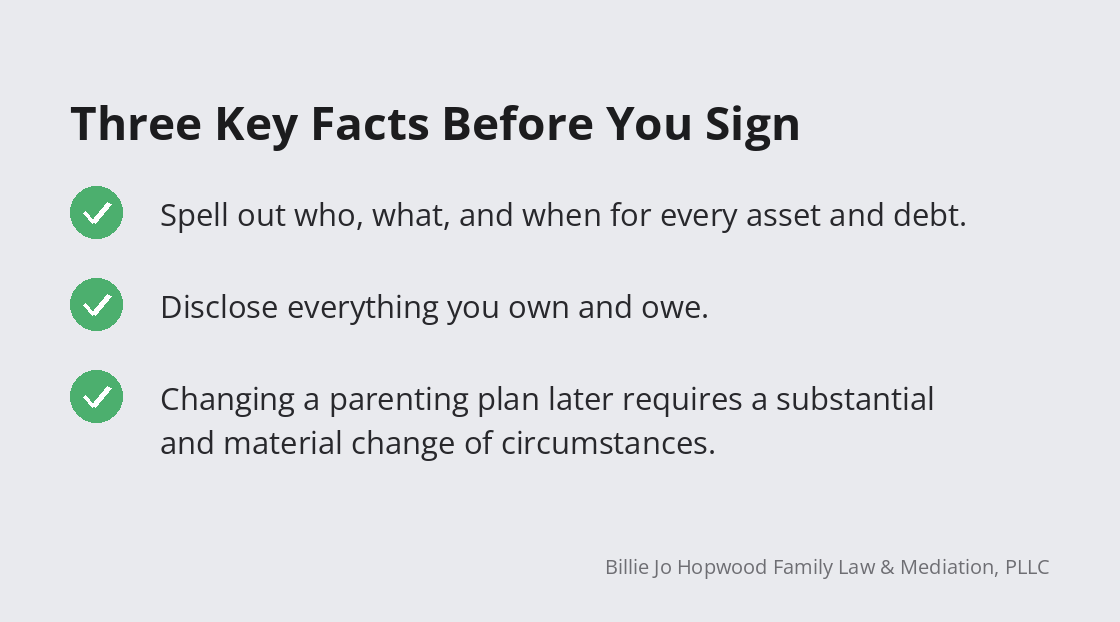
Phrases such as the parents will share holidays or the house will be sold eventually invite disagreement. A strong agreement specifies who, what, and when, including deadlines for transferring titles, refinancing loans, and dividing accounts.
Overlooking an asset or debt entirely can be just as damaging. Reviewing a complete list of property and liabilities before signing helps make sure nothing is left unresolved.
Not Fully Disclosing Assets and Debts
An agreement built on incomplete information is fragile. Both spouses should be honest and thorough about what they own and owe, because hidden assets or undisclosed debts can lead to disputes and challenges after the divorce is final.
Full disclosure also builds trust during mediation. When each spouse can see the complete financial picture, it becomes much easier to agree on a fair division.
Assuming the Agreement Can Easily Be Changed
Some terms in a divorce are difficult to change later. Under Section 61.13, modification of a parenting plan and time-sharing schedule requires a showing of a substantial and material change of circumstances, and the court applies the best interests of the child.
That standard means parents should take the time to build a plan they can live with. If circumstances do change, an uncontested modification may still be possible when both parents agree, but it is better to plan carefully at the start.
Final Thoughts
A marital settlement agreement in Melbourne Florida gives you and your spouse the opportunity to decide the future of your family on your own terms. Understanding the legal requirements, building the agreement through mediation, and avoiding common drafting mistakes can help you reach a resolution that lasts.
If you and your spouse are already in agreement on most issues, you may also find our guide to uncontested divorce in Melbourne Florida helpful as you plan the next steps.
If you are ready to resolve your divorce through agreement, contact Billie Jo Hopwood Family Law & Mediation, PLLC to speak with our team in Melbourne. We’ll help you understand your options, prepare for mediation, and move forward with confidence.