Family conflicts don’t have to end in courtroom battles. Melbourne Florida family mediation offers a practical alternative where both parties work toward solutions that actually stick.
We at Billie Jo Hopwood Family Law & Mediation, PLLC have seen firsthand how mediation transforms difficult situations into manageable ones. This approach puts you in control of the outcome instead of leaving decisions to a judge.
How Mediation Actually Works in Melbourne Florida
The Mediator’s Role in Guiding Discussions
A neutral mediator does not decide who wins or loses. Instead, they facilitate conversations between you and the other party to find solutions you both can live with. The mediator keeps discussions on track, asks clarifying questions, and helps identify common ground. In Melbourne Florida, mediators must be certified by the Florida Supreme Court, meaning they have completed formal training and adhere to strict ethical standards. The mediator cannot give legal advice, take sides, or force you toward any agreement. What they do is create a structured environment where productive negotiation happens. This distinction matters because it means you remain in control throughout the process.
The Mediation Timeline and Structure
The typical mediation in Brevard County follows a predictable structure. Most cases reach resolution in 4 to 8 sessions over roughly 3.2 months, compared to 12 to 18 months for litigation. Your first session covers confidentiality rules, explains the mediator’s role, and may include joint discussions where both parties speak together, followed by private caucus meetings where the mediator meets with each side separately. What you say in a private caucus stays confidential unless you explicitly agree otherwise.
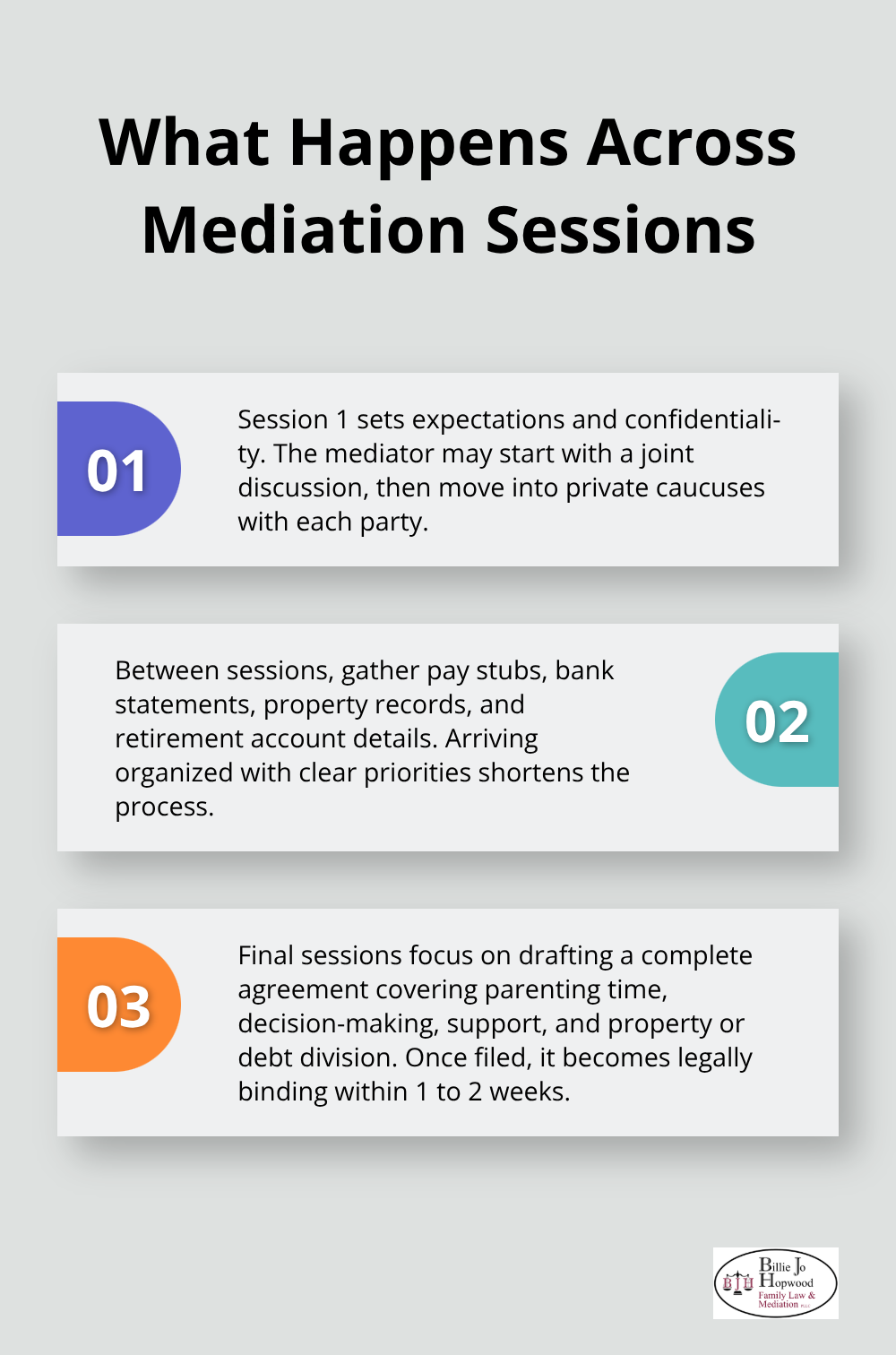
Between sessions, you will gather documents like pay stubs, bank statements, property records, and retirement account information. Preparation matters significantly-families who arrive organized and with clear priorities tend to resolve faster. The final sessions involve the mediator drafting a complete mediation agreement covering parenting time, decision-making authority, child support calculations, and property or debt division. Once signed and filed with the court, this agreement becomes legally binding within 1 to 2 weeks.
Cost Comparison: Mediation Versus Litigation
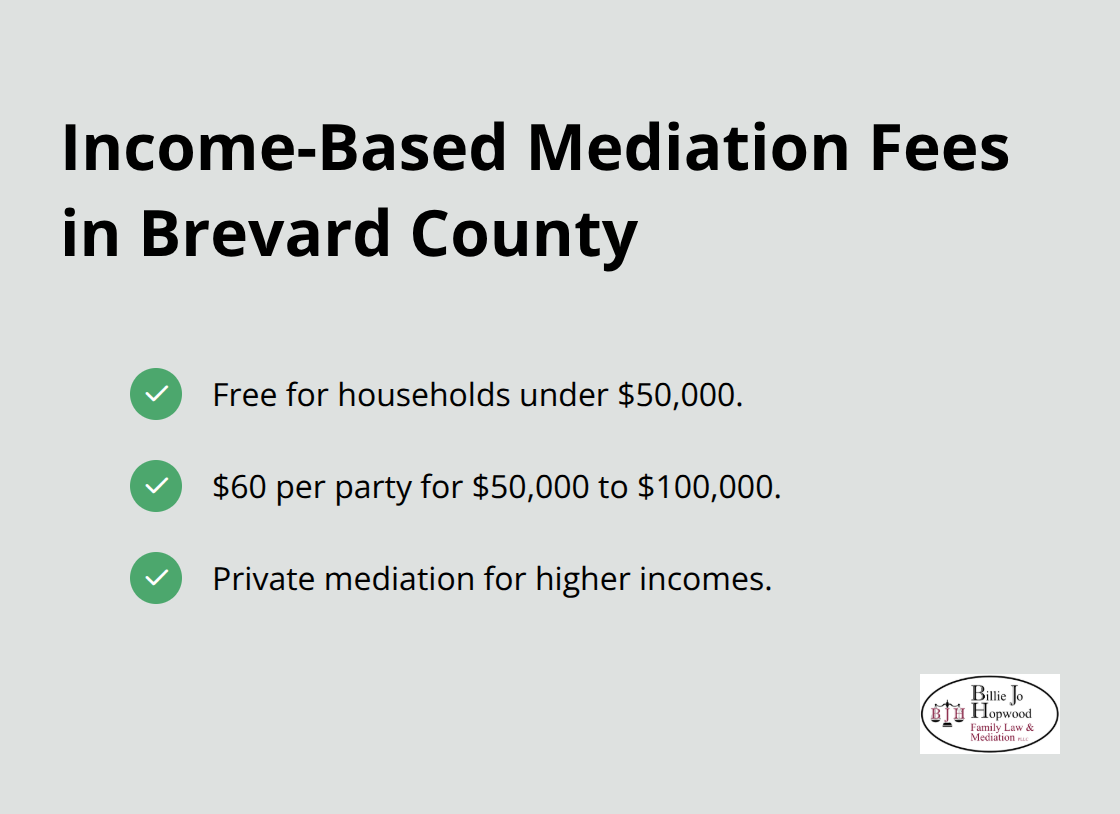
Mediation costs roughly $200 to $400 per hour total for private sessions, though court-ordered mediation in Brevard uses income-based fees: free for households under $50,000, $60 per party for $50,000 to $100,000, and private mediation for higher incomes. Litigation, by contrast, runs $15,000 to $25,000 more overall because attorney fees typically range from $300 to $500 per hour per party, court filing fees accumulate, and you face extended waiting periods.
Speed Advantage in Melbourne Florida
The 18th Judicial Circuit currently handles about 3,500 family law cases annually with dockets backed up 6 to 9 months, whereas mediation can be scheduled within 2 to 4 weeks. This speed advantage matters when children are involved or financial uncertainty weighs on your family. The faster timeline also means you move toward resolution while emotions remain manageable and both parties retain motivation to negotiate in good faith. When you contact Billie Jo Hopwood Family Law & Mediation, PLLC at 321-988-1331, you can begin scheduling your mediation sessions and preparing the documents that will support your case. Understanding these practical details about how mediation works positions you to make informed decisions about the issues you will address in your agreement.
Why Mediation Saves Money and Time
The Real Cost of Litigation in Melbourne Florida
Mediation in Melbourne Florida delivers concrete financial advantages that transform your family’s situation. Court litigation costs families in Brevard County 40-60% more than mediation because attorney fees alone run $300 to $500 per hour per party, and you face extended court delays. The 18th Judicial Circuit currently has dockets backed up 6 to 9 months, meaning your case sits waiting while stress and uncertainty mount. Mediation, by contrast, schedules within 2 to 4 weeks and resolves most disputes in 4 to 8 sessions spanning roughly 3.2 months total.
Speed Matters When Children Are Involved
For families with children, this speed advantage changes everything. Your kids benefit from faster resolution and reduced parental conflict during the process. Private mediation costs $200 to $400 per hour total, and court-ordered mediation in Brevard uses income-based fees that make it accessible: free for households under $50,000 combined income and $60 per party for $50,000 to $100,000. When you calculate the attorney time saved, court filing fees avoided, and months reclaimed from your life, the financial case for mediation becomes undeniable.
Agreements That Actually Hold Up
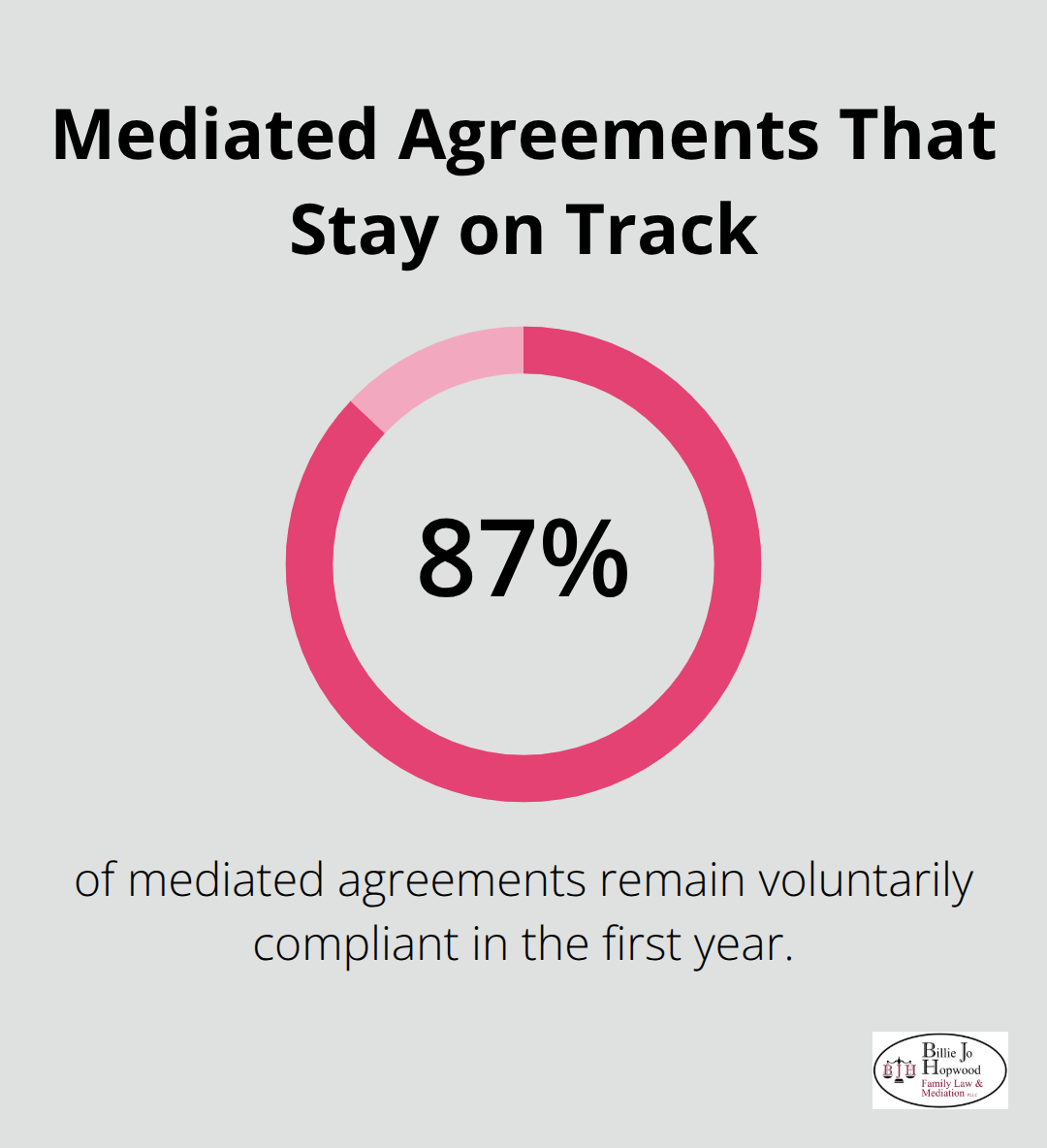
Mediation produces agreements that stick far better than court orders. Research shows 87 percent of mediated agreements remain voluntarily compliant in the first year, whereas court-ordered arrangements experience violation rates exceeding 40 percent.
This difference reflects a fundamental truth: when you negotiate solutions yourself rather than having a judge impose them, you build agreements aligned with your family’s actual needs and values.
You control whether your parenting schedule accommodates shift work, whether asset division keeps the family home intact, or whether support arrangements reflect income changes you anticipate. A mediation agreement becomes legally binding within 1 to 2 weeks after filing with the court, giving you certainty without prolonged litigation. The reduced stress during the process matters too-families moving through mediation avoid the adversarial tension of courtroom battles and preserve the communication patterns necessary for ongoing co-parenting.
What Happens After You Reach Agreement
Once you and the other party sign a mediation agreement, the mediator submits it to the court for approval. The court reviews the document to confirm it addresses all required issues (parenting time, decision-making authority, child support, and property division) and protects any children’s interests. Within 1 to 2 weeks of filing, the agreement becomes legally enforceable, and your case moves forward without trial. This streamlined path means you avoid months of additional court appearances, discovery disputes, and the unpredictability of a judge’s ruling. The agreement you crafted together becomes the foundation for your family’s next chapter, shaped by your priorities rather than a courtroom decision.
What Family Mediation Actually Resolves
Mediation in Melbourne Florida handles the three financial and custody issues that consume most family law disputes. The 18th Judicial Circuit requires mediation for dissolution of marriage and paternity cases before trial, meaning you will work through these matters with a neutral mediator regardless of whether you choose mediation voluntarily. Property division, custody arrangements, and support calculations represent 85 percent of contested divorces in Florida, and mediation addresses all three with precision and flexibility that courtroom decisions simply cannot match. When you sit down with a mediator, you negotiate real solutions to concrete problems, not abstract principles about what a judge might order.
Property and Asset Division Through Mediation
Property and asset division through mediation lets you customize how you split marital assets rather than accepting a judge’s interpretation of equitable distribution. You might keep the family home while the other party receives retirement accounts, or you might split a business valuation in ways that reflect its true operating value instead of a standard formula. Mediation accommodates these nuanced arrangements because the mediator helps you identify what each party actually values and then structures trades that satisfy both sides.
Custody and Parenting Time Negotiations
Custody and parenting time mediation negotiates overnight schedules, holiday rotations, school district decisions, and relocation terms with the same flexibility. If you work shift work or your child performs better in one household during the school week, mediation builds those realities into the parenting plan rather than imposing a generic 50-50 split. The mediator works with both parties to create arrangements that reflect your family’s actual circumstances and priorities.
Child Support and Alimony Calculations
Child support and alimony calculations in mediation follow Florida’s income shares model, but you retain control over how income counts toward that calculation, whether either party receives credit for non-monetary contributions, and how future income changes trigger modifications. The Brevard County court system requires all parenting plan modifications to proceed through mediation when primary residence changes, school districts shift, or extracurriculars expand, meaning mediation serves not just your initial divorce but your family’s ongoing adjustments.
Modifications and Future Changes
Modifications triggered by income changes of 15 percent or more mandate mediation, giving you a structured process to address financial shifts without returning to court. You can draft agreements that anticipate future family changes and build in mechanisms for handling modifications as your circumstances evolve. This forward-thinking approach prevents disputes from escalating into costly court battles years down the road.
Final Thoughts
Melbourne Florida family mediation succeeds because it recognizes a fundamental truth: your family’s future depends more on how you resolve disputes than on who wins in court. When you choose mediation, you preserve the relationships that matter most, and parents who negotiate custody arrangements together maintain the communication patterns necessary for effective co-parenting long after the agreement is signed. Children benefit from reduced conflict during the process and from parenting plans shaped by their actual needs rather than a judge’s standard formula.
Mediated agreements stick because both parties helped create them. You negotiated the terms, identified your priorities, and crafted solutions that reflect your family’s specific circumstances, producing voluntary compliance at rates exceeding 87 percent in the first year compared to violation rates above 40 percent for court-ordered arrangements. The structured negotiation process teaches you how to discuss difficult topics productively, a skill that serves your family for years beyond the initial resolution.
At Billie Jo Hopwood Family Law & Mediation, PLLC in Melbourne, we understand that family law matters demand compassion alongside legal guidance. When you contact us at 321-988-1331, you gain access to a team committed to helping you navigate mediation with clarity and confidence. Learn more about how we support Melbourne families in building sustainable agreements and moving forward with respect.