
Family law matters touch some of the most personal aspects of your life, from divorce and custody decisions to support arrangements. Understanding what a family law attorney does and how they support you through these challenges is the first step toward protecting your interests.
At Billie Jo Hopwood Family Law & Mediation, PLLC, we guide clients through the complexities of family law in Melbourne, Florida. A family law attorney’s job description goes far beyond courtroom appearances-it includes strategic planning, negotiation, and advocacy tailored to your unique situation.
What Family Law Attorneys Handle
Divorce and separation cases demand far more than filing paperwork. A family law attorney manages asset division, debt allocation, and property settlement negotiations. In Florida, courts follow equitable distribution rules, meaning assets and debts acquired during your marriage are divided fairly but not necessarily 50/50. Your attorney determines which assets are separate property (like inheritances) and which are marital property subject to division. They also identify hidden assets that one spouse may attempt to conceal-a problem that occurs in roughly 20 to 30 percent of high-conflict divorces according to forensic accountants. This investigative work directly impacts your financial outcome.

Child Custody and Visitation Decisions
Child custody arrangements require attorneys to understand Florida’s best-interest standard, which considers factors like each parent’s involvement in the child’s life, stability, and ability to meet the child’s needs. Modern family law attorneys craft parenting plans that reflect your family’s actual schedule and your child’s needs rather than relying on outdated custody models. A University of Virginia study published in The Journal of Consulting and Clinical Psychology found that nonresident parents who worked through mediation with attorney support were three times more likely to see their children weekly and four times more likely to talk to them weekly compared to parents who litigated. Your attorney negotiates visitation schedules, overnight arrangements, and decision-making authority for education and healthcare. They also address practical logistics like transportation costs, school calendar coordination, and how technology fits into parenting time.
Support Obligations and Financial Arrangements
Child support calculations in Florida follow state guidelines based on both parents’ incomes, the number of children, and custody arrangements, but attorneys negotiate beyond these baseline numbers. They address additional expenses like private school tuition, extracurricular activities, health insurance, and childcare costs that the formula doesn’t automatically capture. Alimony decisions depend on marriage duration, standard of living during the marriage, each spouse’s earning capacity, education, age, and health status. An attorney prevents you from agreeing to terms you cannot sustain or missing opportunities for support you deserve. They also structure support modifications when circumstances change (such as job loss, income increases, or changes in custody arrangements), keeping your agreements enforceable and fair over time.
How Attorneys Navigate Your Specific Situation
Your attorney’s role extends beyond these three core areas. They handle the procedural requirements that vary across Florida’s court system, manage deadlines that affect your case outcome, and communicate with opposing counsel to move negotiations forward. The strength of your attorney-client relationship directly influences how well you navigate separation and divorce, which is why finding the right fit matters from your first consultation.
How Your Attorney Guides You Through Every Step
Establish Clear Communication From the Start
Your attorney translates the law into a practical roadmap for your specific situation rather than making decisions for you. During your first consultation, identify three personal qualities you want in representation-responsiveness, empathy, cost-consciousness-and be honest about how organized you are with documents. Highly organized clients reduce attorney fees significantly because less time goes toward organizing materials and information. If you struggle with organization, acknowledge this upfront and allow your attorney to help manage your documents and records.
Establish a preferred communication method early, usually email, and agree on response expectations to avoid unnecessary billing from multiple small inquiries. Bundle questions into fewer, more comprehensive emails to keep costs down. This approach prevents small conversations from accumulating into substantial fees over time.
Understand Your Options and Their Consequences
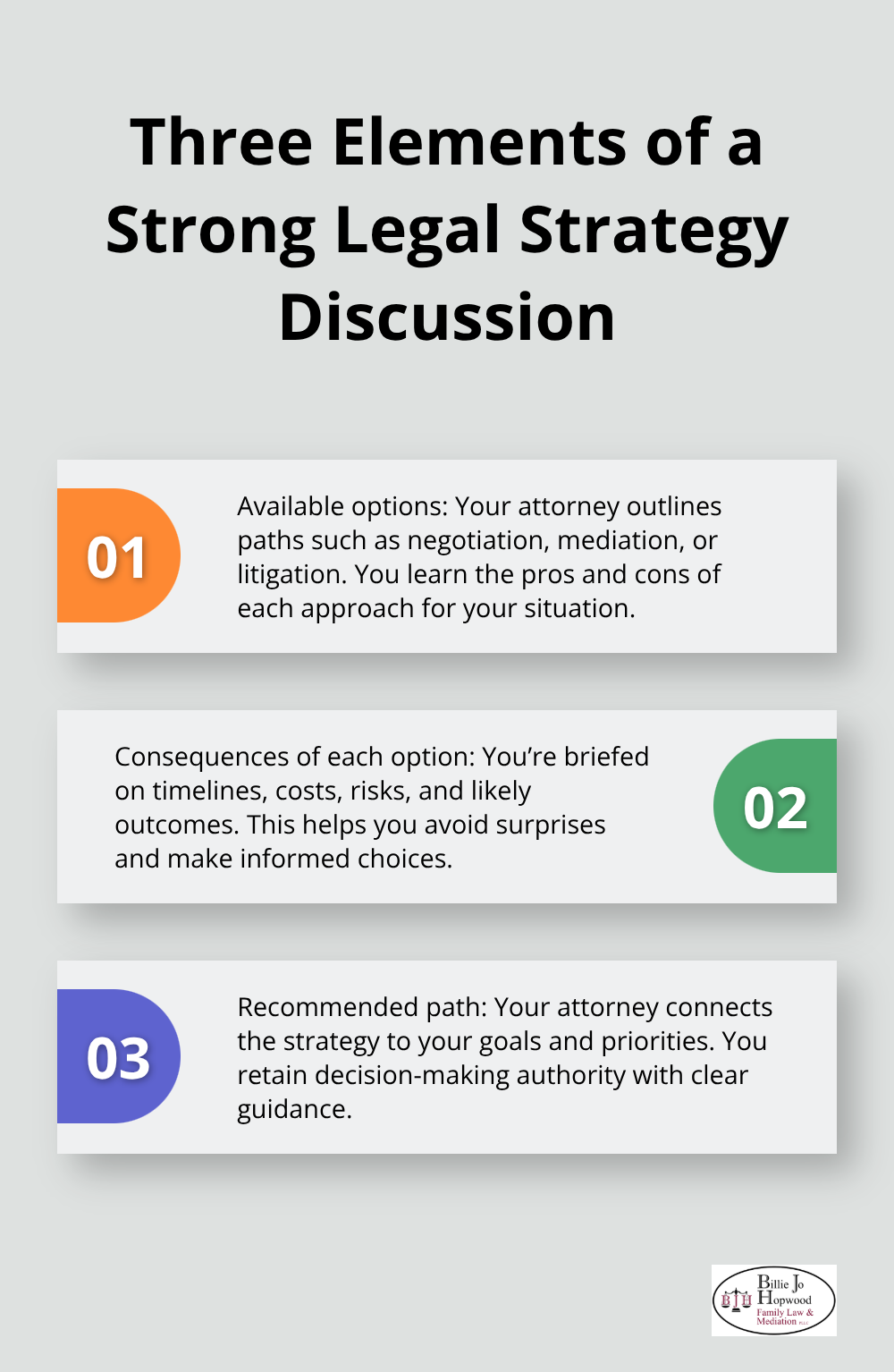
Your attorney explains the rationale behind every recommendation and answers the question “why” so you understand your options and the consequences of each choice. This transparency prevents surprises later and builds the trust that determines how well you navigate the process. Strategy discussions always include three elements: the available options, the consequences of each option, and your attorney’s recommended path aligned with your goals.
Your attorney presents choices clearly without pushing you toward one outcome. If the attorney-client relationship isn’t working, speak up early rather than letting concerns fester. If you want more frequent updates or a different communication style, request adjustments that a reasonable attorney should accommodate.
Prepare for Court and Settlement Negotiations
Court representation requires your attorney to understand Florida’s procedural rules, filing deadlines, and how judges in your specific circuit interpret family law. When litigation becomes necessary, your attorney manages discovery (exchanging financial documents and evidence), responds to motions, and prepares you for depositions where the opposing party’s attorney questions you under oath.
Settlement negotiations happen both before and during litigation, and your attorney handles these discussions with opposing counsel to move toward resolution. Honesty is essential throughout this process-disclose all relevant facts, even embarrassing ones, because your attorney cannot effectively advocate for you with incomplete information.
Move Forward With Confidence in Your Legal Strategy
The strength of your attorney-client relationship directly influences how well you navigate separation and divorce. Your attorney’s role is to present choices clearly and keep you informed at every stage, which means you maintain control over the decisions that affect your family’s future. With this foundation in place, you’re ready to explore how mediation can complement your attorney’s guidance and potentially resolve your case more efficiently than traditional litigation.
Why a Family Law Attorney Protects Your Future in Melbourne, Florida
Florida’s family law system contains procedural requirements and substantive rules that shift depending on your specific situation. An attorney prevents costly mistakes that self-represented clients make regularly. Missing a filing deadline can result in losing your right to claim certain assets or modify support obligations, and judges in different Florida circuits interpret equitable distribution rules differently. A family law attorney knows how judges in your specific court handle property division, custody modifications, and support calculations, which directly influences settlement strategy. Without this local knowledge, you might accept a settlement offer that undervalues your position or overlook negotiation opportunities that protect your long-term interests.
Uncover Hidden Assets and Allocate Debt Fairly
Your financial security depends on thorough asset identification and accurate valuation during divorce proceedings. Hidden assets appear in approximately 20 to 30 percent of high-conflict divorces according to forensic accountants, and your attorney knows which questions to ask and which documents to request during discovery to uncover them. Debt allocation matters equally-your attorney prevents you from accepting responsibility for debts you didn’t incur or missing opportunities to assign joint debt fairly based on spending patterns and income.
Present Evidence That Demonstrates Your Fitness as a Parent
In custody disputes, an attorney presents evidence about your involvement in your child’s life, your stability, and your ability to meet their needs in ways that align with Florida’s best-interest standard. Courts make custody decisions based on documented facts, not on what sounds reasonable in conversation. An attorney structures your case evidence to demonstrate your fitness as a parent and your commitment to your child’s welfare.
Navigate Local Court Systems With Confidence
The financial and emotional stakes of family law proceedings demand representation from someone who understands how your local court system operates and what judges actually decide in cases similar to yours. This knowledge shapes every negotiation and protects your interests throughout the process.
Final Thoughts
A family law attorney’s job description extends far beyond courtroom appearances. Your attorney manages asset division, negotiates custody arrangements, calculates support obligations, and handles the procedural complexities that determine your case outcome. They translate Florida’s equitable distribution rules and best-interest standards into practical strategies tailored to your situation, preventing costly mistakes that self-represented clients make regularly.
The strength of your attorney-client relationship directly influences how well you navigate separation and divorce. An attorney who communicates clearly, explains the rationale behind recommendations, and respects your decision-making authority provides the foundation you need during this difficult time. They leverage local knowledge about how judges in your specific Florida circuit actually decide cases and structure your strategy accordingly.
Finding the right attorney starts with identifying three personal qualities you want in representation and scheduling consultations with at least two to three attorneys to compare their approaches. During these consultations, evaluate their experience with cases similar to yours, their billing practices, and whether their communication style matches your preferences.

At Billie Jo Hopwood Family Law & Mediation, PLLC in Melbourne, Florida, we guide families through divorce, custody, and support matters with compassionate representation-contact our firm to schedule your initial consultation and take the first step toward protecting your interests.