
Family law legal fees can feel overwhelming when you’re facing a divorce, custody dispute, or mediation. Most people don’t understand how attorneys charge or what costs to expect.
We at Billie Jo Hopwood Family Law & Mediation, PLLC know that transparent pricing matters. This guide breaks down fee structures, common expenses, and practical ways to keep costs manageable.
How Family Law Attorneys Charge for Your Case
Hourly Billing: The Traditional Model
Family law attorneys most commonly charge by the hour, with rates typically ranging from $150 to $500 per hour depending on experience and location. You pay for every minute an attorney spends on your case, which creates real uncertainty about your final bill. This model works reasonably well for straightforward matters like uncontested divorces with minimal assets, but contested custody disputes or complex asset divisions often spiral into unpredictable expenses.
The fundamental problem with hourly billing is that it rewards longer work rather than efficient resolution. An attorney billing hourly has no financial incentive to settle quickly or work efficiently. About 50 percent of law firms now offer flat fee options, a clear signal that clients want cost predictability upfront instead of this uncertainty.
Flat Fee Arrangements: Knowing Your Total Cost
Flat fee arrangements charge one fixed price for a specific service or phase of your case, making budgeting straightforward and eliminating surprises. A simple divorce with no children might cost $2,500 to $4,000 flat, while a contested custody dispute could run $5,000 to $8,000 depending on complexity. Flat fees work best when the scope is clearly defined-both you and your attorney must agree exactly what’s included and what triggers additional charges.
Flat fees work particularly well for document preparation and uncontested filings, where the work is predictable and standardized. Technology-driven automation makes many routine family law tasks more standardized, enabling transparent flat-fee arrangements that benefit both clients and firms.
Retainer Agreements: A Hybrid Approach
Retainer agreements sit between hourly and flat fee models. You pay an upfront sum (often $1,500 to $5,000) that the attorney bills against as they work, with invoices showing how much of your retainer remains. If your case costs more than the retainer, you pay the overage; if it costs less, you may receive a refund.
This structure provides some cost predictability while allowing flexibility for cases that develop unexpectedly. Many attorneys prefer retainers because they establish a financial commitment from the client and improve cash flow for the firm.
Choosing the Right Fee Structure for Your Situation
The strongest move is asking your attorney to offer a menu of options rather than forcing you into one model. Flat fees work well for straightforward matters, while hourly or capped billing makes sense for high-conflict cases where unpredictable issues arise. Getting a clear written estimate upfront-including what’s included, what costs extra, and how many sessions or hours you can expect-prevents the financial chaos that derails many families.
Discuss these structures before your first meeting so you understand exactly what you’re paying for. Beyond attorney fees, however, you’ll encounter other costs that vary significantly based on your specific situation.
Beyond Attorney Fees: What Else You’ll Pay
Court Costs Add Up Quickly
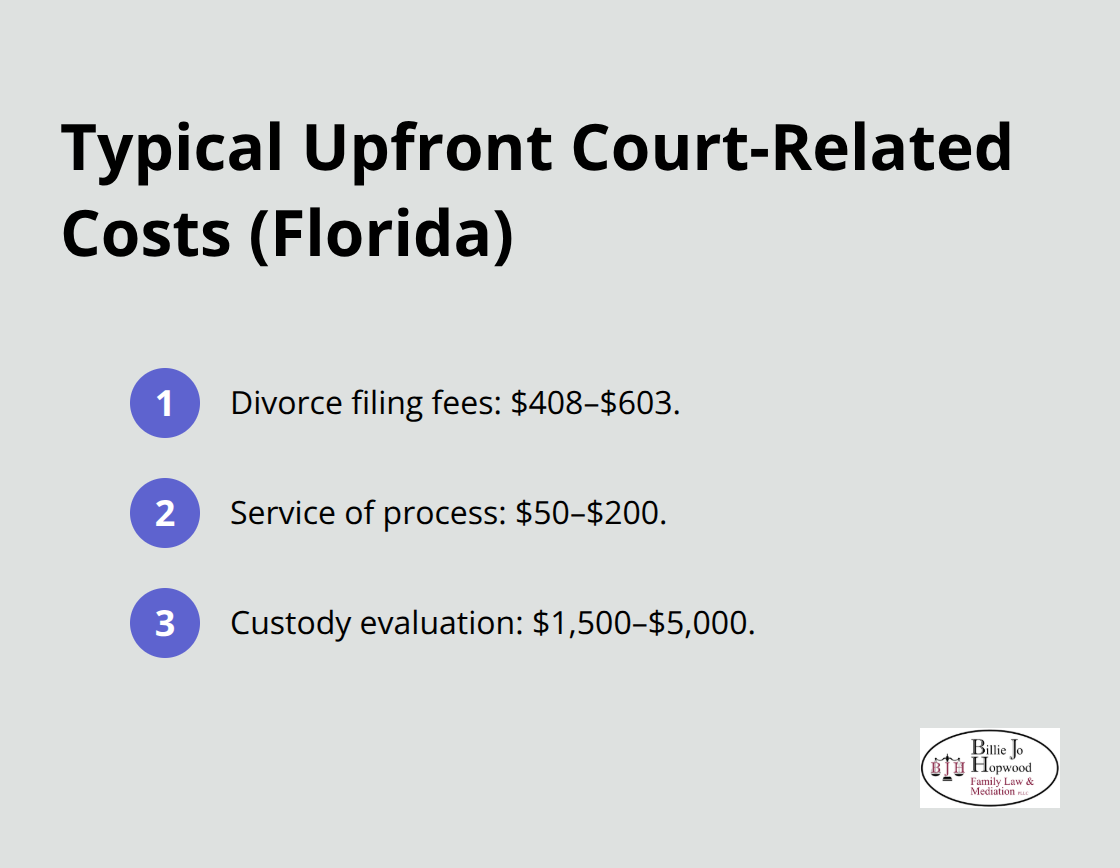
Court filing fees, evaluation costs, and mediation expenses accumulate fast once your case moves forward. Florida divorce filing fees run $408 to $603 depending on the county, and that’s just the initial paperwork. You’ll also pay service of process fees to notify your spouse, typically $50 to $200. If your case involves child custody disputes, the court may order a custody evaluation by a mental health professional, which costs $1,500 to $5,000 and comes out of your pocket before trial even starts.
These hidden expenses blindside families who only budgeted for attorney fees, leaving them scrambling to find money mid-case.
Mediation Costs Far Less Than Litigation
Private mediation typically costs between $3,000 and $8,000 total, with attorney-mediators charging $250 to $500 per hour and nonattorney mediators ranging from $100 to $350 per hour depending on credentials and location. If you split the fee 50-50 with your spouse, your share drops significantly. Flat-rate mediation packages commonly range from $4,000 to $5,500 and may include unlimited hours or a capped number of sessions, though you should verify what’s included-some packages cover settlement drafts while others don’t.
Court-sponsored mediation costs far less or nothing at all. Florida’s court-ordered mediation charges $120 to $240 per session, or $60 to $120 per spouse if combined income falls under $100,000, making it accessible for families with limited resources. The real advantage of mediation is predictability: you know upfront what you’ll pay, whereas litigation spirals unpredictably as discovery drags on and hearings multiply.
Preparation Determines Your Final Bill
A spouse’s preparation and willingness to compromise dramatically affect mediation length and cost. Arriving with organized financial documents and clear priorities can settle a case in two to three sessions rather than stretching it across months. You control this variable directly-the work you do before mediation sessions begins translates into lower fees and faster resolution. This cost control starts with choosing the right process, not just the right attorney, which brings us to the practical strategies that reduce your overall expenses.
Ways to Reduce Your Family Law Legal Expenses
Mediation Costs Far Less Than Litigation
Mediation stops the financial bleeding that litigation causes. When you litigate, your attorney bills for discovery requests, depositions, motions, court appearances, and endless back-and-forth communication that stretches across months or years. Private mediation costs between $3,000 and $8,000 total, with attorney-mediators charging $250 to $500 per hour and nonattorney mediators ranging from $100 to $350 per hour. Split that fee 50-50 with your spouse, and your personal cost drops dramatically compared to litigation, where each side’s attorney fees accumulate independently. Flat-rate mediation packages commonly range from $4,000 to $5,500 and may include unlimited hours or a capped number of sessions, giving you genuine cost certainty before your first session. Court-sponsored mediation costs even less-Florida’s court-ordered mediation charges $120 to $240 per session, or $60 to $120 per spouse if combined income falls under $100,000. Most cases settle in two to three sessions, whereas contested litigation often stretches across multiple years with custody evaluations ($1,500 to $5,000), expert witnesses, and trial preparation adding thousands more. Mediation also eliminates the emotional escalation that drives up litigation costs; when both parties remain calm and focused on interests rather than positions, the process moves faster and cheaper.
Organize Your Documents Before You Meet Your Attorney
Your preparation directly controls what you pay. Attorneys bill for time spent organizing your financial documents, searching for bank statements you should have collected, and clarifying information you could have provided upfront. Arrive at mediation or your attorney’s office with financial disclosures organized by category-bank accounts, retirement accounts, real estate, debts, income sources-and you eliminate hours of billable work. A simple spreadsheet listing all assets with approximate values and ownership percentages can reduce mediation sessions from five to two. If child custody is at issue, prepare a detailed parenting proposal that addresses school schedules, healthcare decisions, and holiday arrangements before your first meeting. This preparation prevents attorneys from charging you to draft what you could have outlined yourself. Technology makes this easier than ever; convert images of documents to PDFs, organize files by year and category, and create a shared folder your attorney can access directly. This approach cuts administrative time and reduces the back-and-forth communication that inflates bills. Gather twelve months of bank and credit card statements before your first consultation. Many families waste hundreds in attorney time because they schedule meetings before collecting basic financial information.
Establish Fee Terms at Your Initial Consultation
Discussing fees at the start of your relationship with an attorney prevents the shock of a bloated bill later. Ask your attorney to provide a written estimate that specifies the retainer amount, what’s included in that retainer, what hourly rate applies to any overage, and what additional costs might emerge. Request clarity on communication costs-some firms charge for email responses while others bundle communication into their standard rate. Ask specifically whether your flat fee covers settlement drafting or whether that triggers extra charges. This conversation should happen during your initial consultation, not weeks into the process when you’ve already accumulated hours. Get everything in writing, not as a verbal promise. If your attorney resists providing a written fee agreement, that’s a warning sign about their approach to transparency. Many attorneys reserve five to ten minutes at the end of the initial consultation specifically to review the legal services agreement and answer fee questions. Take that time seriously and ask for clarification on any term you don’t understand. If your case is complex, ask about milestone-based fees tied to case phases-initiation, discovery, negotiation, final decree-rather than open-ended hourly billing. This structure aligns your attorney’s financial incentive with efficient resolution rather than prolonging the process.
Final Thoughts
Family law legal fees don’t have to derail your finances when you understand your options and take control of the process. Hourly billing creates uncertainty for complex cases, flat fees provide the cost predictability most families want, and retainers offer flexibility when your situation might shift unexpectedly. The single most important step is establishing fee terms at your initial consultation with a written estimate that specifies retainer amounts, hourly rates, what’s included, and what triggers additional charges.
Your preparation directly controls your final bill more than any other factor. Organized financial documents, clear priorities, and a detailed parenting proposal eliminate hours of billable work and can reduce mediation sessions from five to two. Mediation typically costs between $3,000 and $8,000 total-far less than litigation, which spirals across months or years with mounting attorney bills and court costs ($1,500 to $5,000 for custody evaluations alone).
We at Billie Jo Hopwood Family Law & Mediation, PLLC understand that family law matters demand both compassionate guidance and financial clarity. Contact us to discuss how mediation can protect your family’s financial future while resolving your legal matter efficiently.