
Child support disagreements often leave parents feeling stuck between expensive court battles and uncertainty about fair outcomes. Fair child support mediation offers a different path-one where both parents work together to reach agreements that actually work for their families.
At Billie Jo Hopwood Family Law & Mediation, PLLC, we’ve seen how mediation transforms these conversations from adversarial to collaborative. This guide walks you through what mediation looks like and why many Melbourne, Florida families choose it over litigation.
How Mediation Works vs. Court Litigation
The Judge Decides in Court, You Decide in Mediation
In court, a judge makes binding decisions about child support after reviewing evidence, financial documents, and arguments from both sides. You have limited control over the outcome, and the process follows rigid procedural rules that can stretch over months or even years. Litigation operates as an adversarial system-each parent’s attorney presents their case to convince the judge their client deserves a favorable ruling. The Florida Department of Revenue can automatically open a child support case and issue wage-withholding orders, which means the state moves forward with enforcement regardless of whether you want court involvement.
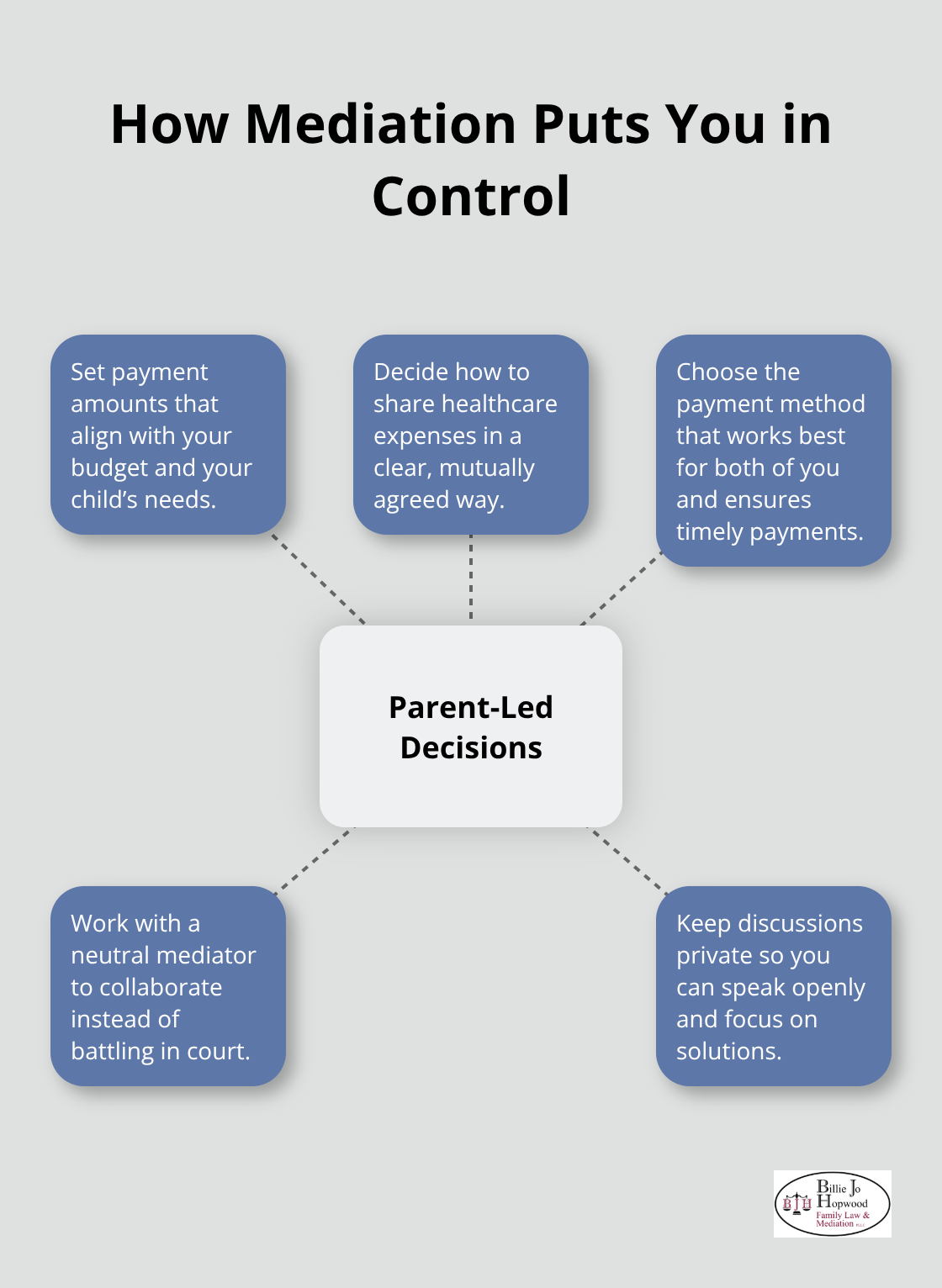
Mediation flips this dynamic entirely. Instead of a judge imposing a decision, a neutral mediator facilitates conversations where you and the other parent work toward an agreement together. You retain control over every detail-from payment amounts to how healthcare expenses are handled to the specific payment method that works best for your situation.
Why Control Matters in Your Agreement
Court proceedings are public record, and the final order reflects what a judge believes is fair based on Florida’s child support guidelines, which combine each parent’s monthly net income according to Florida’s Child Support Guidelines Worksheet. This means a stranger in a robe determines the financial terms that affect your family for years.
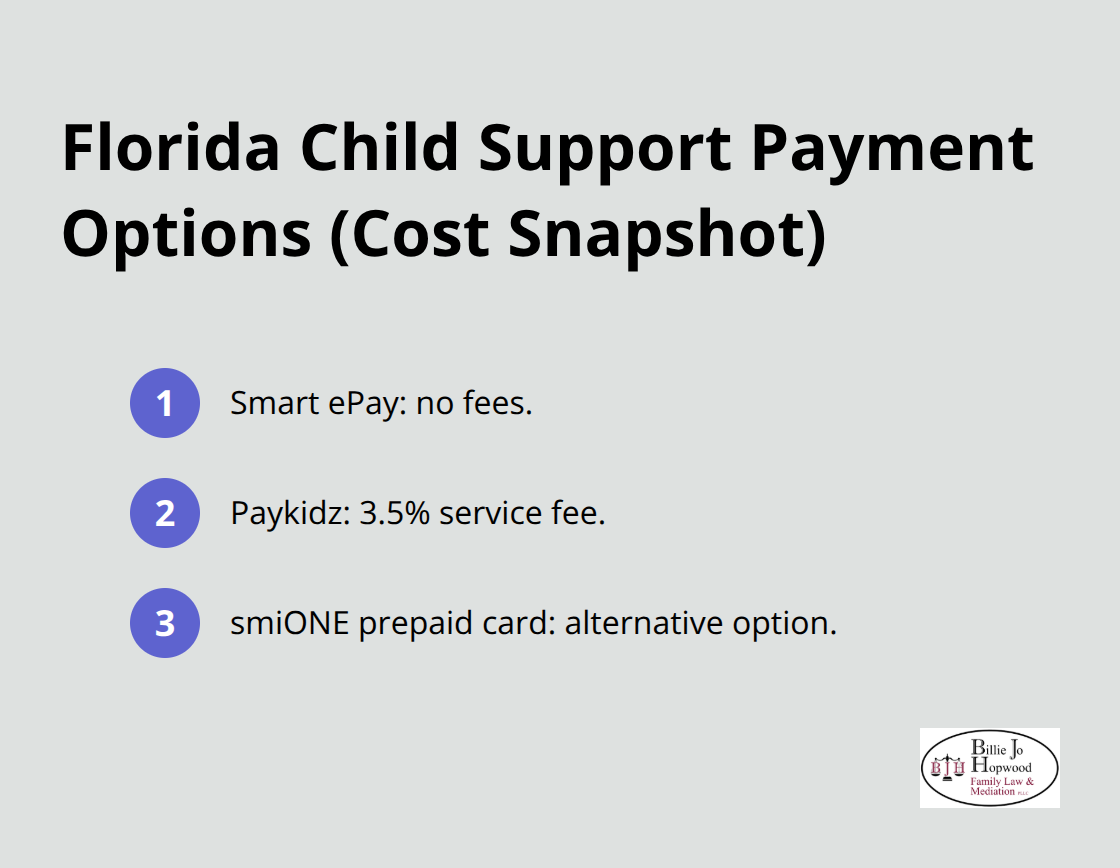
Mediation lets you choose the lowest-cost payment option that ensures timely payments. The Florida Child Support Program offers multiple payment options including Smart ePay with no fees, Paykidz with a 3.5% service fee, and smiONE prepaid cards. You select what works for your situation rather than accepting whatever the court assigns.
Confidentiality and Speed Change Everything
Mediation is confidential, so discussions cannot be used as evidence in court if you don’t reach an agreement. This means you can speak openly without fear. The process typically resolves in weeks rather than months, and because both parents helped create the plan, agreements reached in mediation tend to stick-parents follow orders they designed themselves far more consistently than orders imposed by a judge.
You’ll need accurate financial information from both parents, including Family Law Financial Affidavits showing monthly net income, but the calculation process becomes collaborative rather than combative. This approach aligns with Florida law, which requires parents to attempt mediation before a custody trial, recognizing that cooperation produces better outcomes for children than adversarial courtroom battles.
What Happens When You Choose Mediation
The shift from litigation to mediation changes not just the timeline but the relationship between parents moving forward. When both parents participate in creating the support arrangement, they understand the reasoning behind each number and feel invested in making the plan work. This foundation of mutual agreement reduces future disputes and modifications.
Understanding these differences helps you recognize why mediation produces faster resolutions and lower costs than litigation for families who want genuine input into their child support arrangement. The next section explores the specific benefits that make mediation the preferred choice for many Melbourne, Florida parents facing child support decisions.
Why Mediation Costs Far Less Than Court
Litigation devours money in ways that sneak up on families. Court battles in Florida typically require attorney fees ranging from several thousand to tens of thousands of dollars, depending on complexity and how long the case drags through the system. You pay for every hour your attorney spends preparing documents, attending hearings, waiting in courtrooms, and responding to discovery requests from the other side. Meanwhile, court filing fees, expert witness costs for financial evaluations, and mandatory evaluations add thousands more before a judge ever makes a decision.
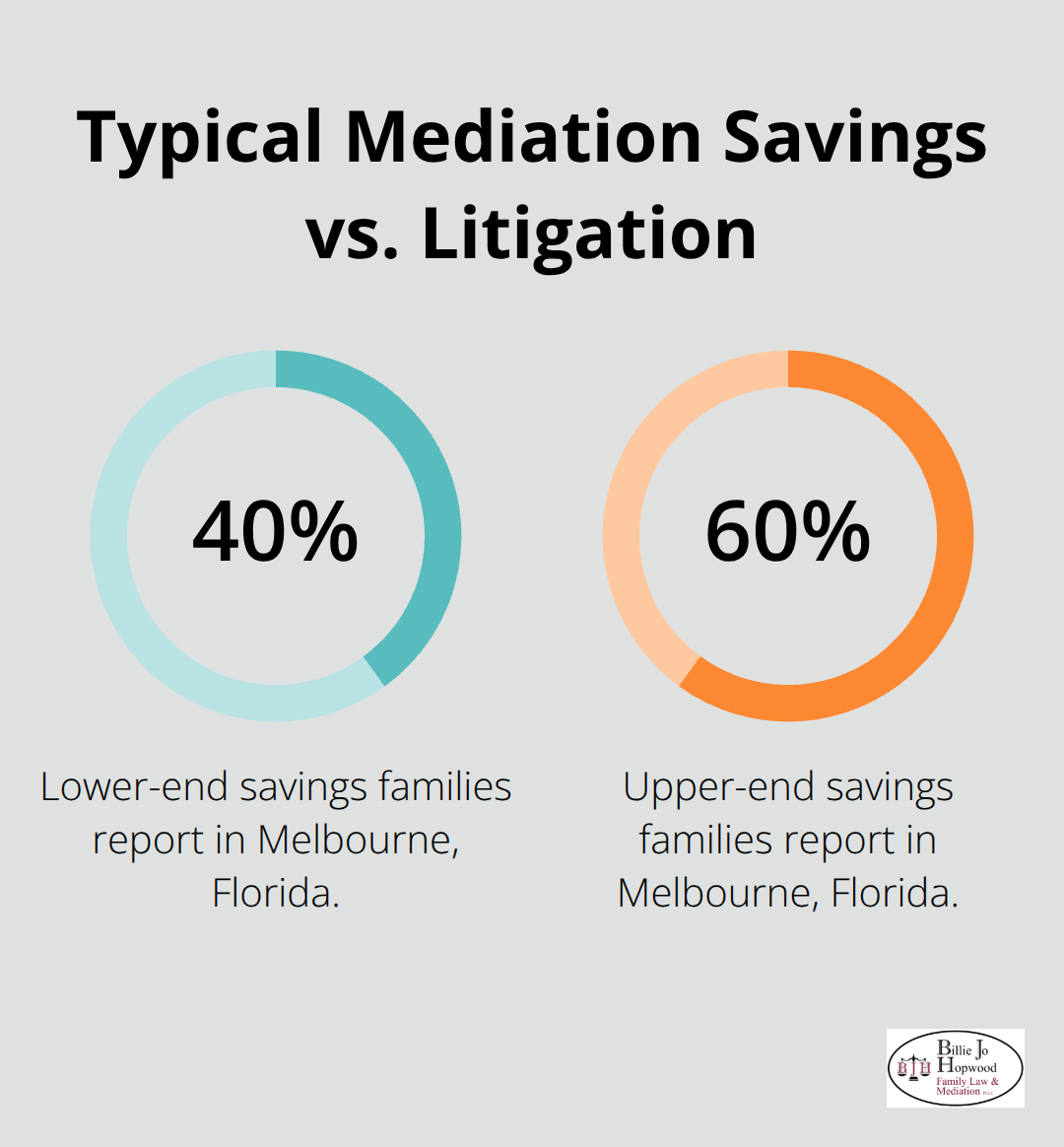
Mediation strips away these layers of expense. The mediator’s fee splits between both parents, typically costing far less per hour than two separate attorneys billing simultaneously. You avoid court filing fees entirely. No expert witnesses. No prolonged discovery processes. Most mediation cases resolve in a handful of sessions, meaning you pay for actual progress rather than procedural delays. Families in Melbourne, Florida consistently report spending 40 to 60 percent less on mediation than they would on contested litigation, though costs vary based on case complexity and whether you hire an attorney for consultation outside mediation.
Agreements You Create Stick Far Better Than Court Orders
Court orders fail at alarming rates because parents resent terms they had no hand in creating. The moment a judge imposes a support amount, one parent typically views it as unfair and begins looking for ways to challenge or modify it. Mediation agreements follow the opposite trajectory. When both parents negotiate the support amount themselves, they understand the calculation behind every dollar and feel ownership of the outcome.
This psychological investment translates into compliance. Parents follow agreements they designed themselves far more consistently than orders imposed from the bench. Fewer modifications mean fewer attorney consultations down the road. Fewer disputes mean no additional court filings or enforcement proceedings.
Stability Saves Money Across Years
The State Disbursement Unit processes each payment and distributes funds smoothly when both parents understand and accept the arrangement. This stability saves money across years, not just months. Additionally, mediation preserves your relationship with the other parent, which matters enormously when you coordinate parenting time, school schedules, and healthcare decisions for years ahead.
A collaborative process now prevents expensive conflicts later. When parents work together to establish support terms, they build a foundation for ongoing cooperation. This foundation reduces the likelihood of future disputes that would require additional legal intervention or court involvement. The financial benefits extend well beyond the initial mediation sessions.
How Payment Methods Affect Your Bottom Line
The Florida Child Support Program offers multiple payment options, and your choice directly impacts total costs. Smart ePay carries no fees, while Paykidz charges a 3.5% service fee, and smiONE prepaid cards present another alternative. In mediation, you select the lowest-cost payment option that ensures timely payments rather than accepting whatever the court assigns.
This control over payment logistics represents another way mediation reduces unnecessary expenses that families face in litigation scenarios.
Understanding these cost differences helps you recognize why mediation produces financial savings that extend far beyond attorney fees. The next section explores the specific benefits that make mediation the preferred choice for many Melbourne, Florida parents facing child support decisions.
What Gets Resolved in Mediation Sessions
Mediation tackles the three areas that create the most friction in child support disputes: calculating the correct payment amount, handling changes in circumstances, and deciding who covers healthcare and education costs. These issues consume court time and attorney fees because litigation forces rigid adherence to formulas without room for creative solutions that actually fit your family’s situation. Mediation addresses each area through direct negotiation where both parents understand the math and reasoning behind every decision.
Income Calculations That Actually Reflect Your Reality
Florida’s Child Support Guidelines Worksheet requires each parent to file a Family Law Financial Affidavit within 45 days, showing monthly net income calculated by subtracting taxes and court-approved deductions from gross income. This step one of the formula matters enormously because it determines everything that follows. In mediation, both parents review these affidavits together, which immediately surfaces discrepancies and prevents the calculation errors that plague contested cases.
The combined monthly net income from both parents then determines the basic monthly obligation based on the number of children involved. For two children, the baseline obligation sits around $1,803 according to Florida’s Guidelines Worksheet, though this figure varies significantly based on combined income. In mediation, you calculate each parent’s percentage of financial responsibility by dividing their individual net income by the combined total, then apply that percentage to the basic obligation. This transparency means no surprises and no accusations of hidden income later.
Time-sharing arrangements dramatically affect these numbers in ways that court calculations sometimes miss. When both parents have 73 or more overnight visits per year with the child (roughly 20 percent of annual time), the formula applies a time-sharing adjustment that lowers the higher-income parent’s share. Mediation lets you accurately input your actual time-sharing plan rather than estimating or fighting over hours. Precise time-sharing data can shift support amounts by thousands of dollars annually, making accuracy critical to fairness.
Adjusting Orders When Life Actually Changes
Life circumstances shift constantly, yet court orders remain static until someone files a modification request, which costs money and court time. Mediation establishes a foundation for addressing changes collaboratively without returning to court. When a parent loses employment, experiences a significant income change, or shifts to part-time work, mediation allows you to recalculate support immediately rather than waiting for a court date months away.
The Florida Department of Revenue can automatically modify orders when circumstances change substantially, but mediation gives you control over how that modification happens and ensures both parents agree the change reflects reality. Healthcare and educational expenses deserve separate attention because they sit outside the basic support calculation. These costs get allocated proportionally based on each parent’s financial responsibility percentage, meaning the parent with higher income typically covers a larger share.
In mediation, you address these expenses directly and decide whether one parent will pay certain costs entirely while the other covers different expenses, creating a division that works better than the proportional split the formula produces. This flexibility prevents disputes over who owes what when unexpected medical or educational needs arise.
Final Thoughts
Fair child support mediation transforms how families move forward after separation or divorce. Rather than accepting a judge’s decision imposed from the bench, you and the other parent build an agreement together that reflects your actual circumstances and priorities. This collaborative approach creates stability for your children while preserving the co-parenting relationship you’ll maintain for years ahead.
Gather your financial documents, including recent pay stubs and tax returns, so both parents can calculate accurate net income using the Family Law Financial Affidavit. Identify your time-sharing arrangement and any special expenses your children require, then address these concrete details during productive mediation sessions where both parents work toward terms that feel fair and sustainable. When circumstances change, you adjust together rather than filing expensive modification requests.
Melbourne, Florida families benefit from understanding that mediation isn’t about splitting differences down the middle or accepting whatever the other parent demands. We at Billie Jo Hopwood Family Law & Mediation, PLLC assist families through these challenging decisions with compassionate guidance grounded in family law, and our team in Melbourne, Florida helps you move forward with confidence. Contact us to discuss how mediation can support your family’s journey toward stability and cooperation.