
Creating a parenting schedule after separation requires balancing two parents’ work demands, a child’s school commitments, and everyone’s emotional needs. The right parenting time mediation options can transform what feels like an impossible puzzle into a workable plan that serves your family.
We at Billie Jo Hopwood Family Law & Mediation, PLLC know that fixed schedules work for some families while others need flexibility. This guide walks you through proven schedule models, mediation strategies, and practical tools to build a sustainable arrangement.
Schedule Models That Actually Work
Alternating Weeks: The Straightforward Approach
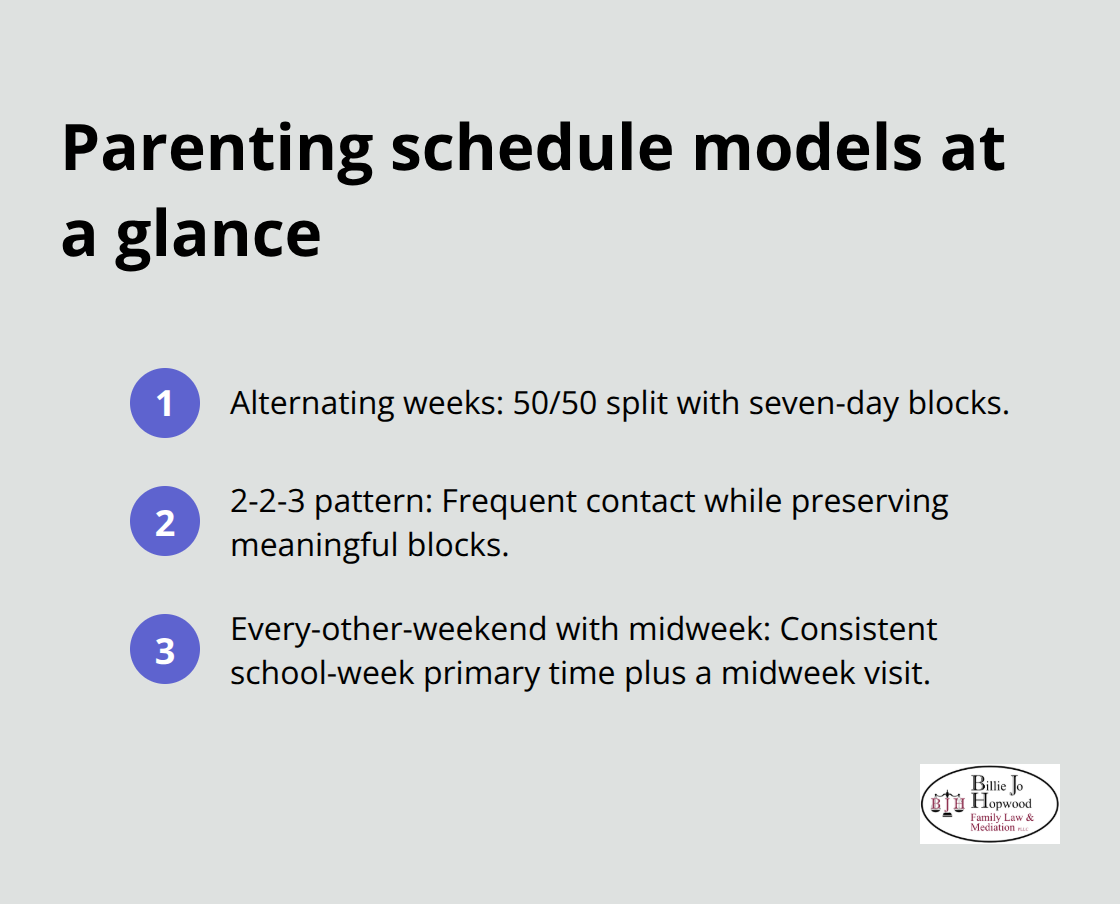
The alternating week schedule remains the most straightforward option for parents with relatively predictable work arrangements. One parent has the child Monday through Sunday, then the other parent takes the next full week. This 50/50 split gives each parent seven consecutive days, which creates stability for children and allows parents to plan their work schedules around known parenting weeks. However, this model works best when both parents live within reasonable distance-frequent transitions strain younger children, and research on parental involvement shows that longer, less-frequent transitions reduce adjustment stress.
The 2-2-3 Pattern: Balancing Frequency and Duration
The 2-2-3 schedule offers a middle ground: each parent takes two consecutive days, then the other parent takes two days, followed by the parent with two days taking three. This pattern repeats, creating more frequent contact while still providing meaningful blocks of time. Many working parents prefer this structure because it aligns with typical work weeks and reduces the gap between parenting periods.
Every-Other-Weekend with Midweek Contact
The every-other-weekend model with midweek visits works well for parents whose work schedules demand consistency during business hours. One parent maintains primary custody during the school week while the other parent visits midweek-typically Wednesday or Thursday evening-and has every other weekend from Friday through Sunday. This arrangement means children spend roughly 60-70% of time with one parent and 30-40% with the other, which court data shows aligns with many families’ actual circumstances. The key to this model’s success is the midweek contact; without it, the non-primary parent loses continuity, and children report feeling disconnected.
Seasonal Adjustments for Changing Work Patterns
For families with seasonal work patterns-retail jobs with holiday surges, teaching positions with summer breaks, or construction with weather-dependent schedules-a tiered approach works better than forcing a single rigid model year-round. Parents might use 50/50 alternating weeks during school months when work schedules stabilize, then shift to extended summer blocks when one parent has more availability. Holiday scheduling demands separate attention because winter and spring breaks don’t fit neatly into weekly patterns.
Rather than applying the regular schedule during holidays, effective plans specify exact dates-December 20 through January 2 with one parent, spring break weeks splitting at the midpoint, and summer vacation divided into two or three blocks depending on family preferences and parental work demands.
These foundational models provide the framework, but the real work happens when you sit down to identify which structure fits your family’s unique constraints and your child’s needs.
Building Your Parenting Plan Through Mediation
Start with Your Actual Schedule, Not Your Ideal One
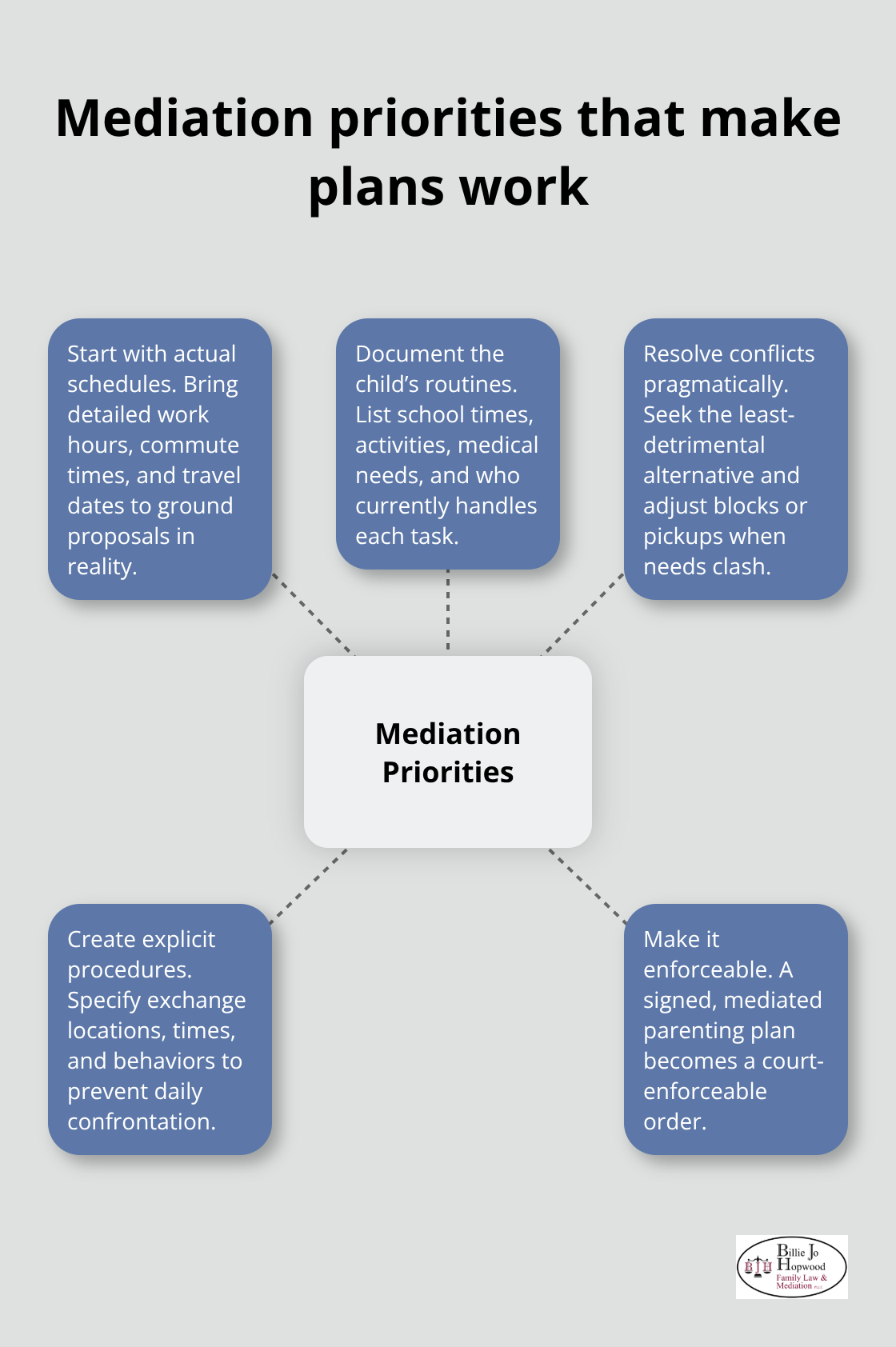
Mediation works because it forces both parents to articulate what they actually need rather than what they think they deserve. Write down your work schedule in detail-not just your job title, but your actual hours, commute time, and any unpredictable demands. If you work retail with variable shifts, document that. If you travel monthly, specify those dates. One parent’s constraint might be a 6 AM start time that makes morning school drop-offs impossible; another’s might be evening classes three nights per week. These concrete details matter far more than general statements about involvement. Courts and mediators see parents claim they want 50/50 time, then admit they work 60-hour weeks. The mediator bridges that gap between what parents want and what their lives actually allow.
Bring your calendar to mediation-a physical or digital one showing your actual availability. This grounds the conversation in reality and prevents you from proposing schedules you cannot sustain.
Document Your Child’s Needs and Current Routines
Your child’s schedule deserves equal detail. Document school start and end times, extracurricular activities with specific days and locations, medical appointments, and any special needs. A child with ADHD who requires consistent homework support at the same time each evening needs a different parenting schedule than a child with no special considerations. The mediator will ask how each parent currently handles these responsibilities, and your answer should be specific. If you manage homework three nights weekly, that information shapes which parent should have weeknight custody during school weeks.
Parents often focus on equal time rather than meaningful time. A mediator will redirect this toward what actually serves the child. Research on parental involvement shows that consistency and predictability matter more to children than raw percentages of time. A child who sees one parent every Wednesday evening and every other weekend, with that parent actively involved in school and medical decisions, reports better adjustment than a child who has 40% of nights scattered across the week with minimal structure.
Navigate Conflicting Needs and Find Workable Solutions
Conflict surfaces when parents’ needs genuinely clash-one parent’s preferred schedule works against the other’s employment or creates excessive transitions for the child. The mediator’s role is not to declare a winner but to find what researchers call the least-detrimental alternative. If one parent cannot do midweek pickups due to work location, the mediator asks whether extended weekends work instead. If a child is seven years old and struggles with frequent transitions, the mediator might recommend longer blocks of time with each parent rather than alternating weeks.
The mediator also identifies inflexible positions masquerading as necessities. A parent who insists on specific holiday weeks because of family tradition needs to explain why the child’s other parent cannot have that tradition too, or why the child cannot split the holiday. This is where many parents discover they can compromise. A parent unwilling to let the other parent make medical decisions without approval is expressing control, not protecting the child. The mediator names this directly and asks whether a system of notification followed by decision-making authority actually harms the child.
Create Explicit Procedures to Prevent Daily Conflict
High-conflict parents often need explicit procedures for custody exchanges to prevent daily confrontation. Instead of vague language like “parents will exchange the child at a mutually convenient location,” an effective plan specifies: exchanges occur in the parking lot of the public library on Main Street, both parents remain in their vehicles, and the parent arriving picks up the child from the sidewalk at 5 PM sharp on Fridays. This removes negotiation from every single exchange and protects the child from witnessing conflict.
Documentation of these agreements matters. A parenting plan produced by a mediator becomes court-enforceable once both parents sign. This document should specify legal custody, physical custody, the school-year schedule with exact dates, summer vacation division, holiday schedules with specific years assigned, child support amounts, and how future modifications occur. Parents who skip mediation and rely on handshake agreements discover years later that one parent’s interpretation differs from the other’s, and children suffer while parents litigate.
Understand the Financial Reality of Your Choice
Mediation costs significantly less than court-typically between $1,500 and $5,000 total compared to $15,000 to $50,000 or more for contested custody litigation. This savings alone makes mediation worth pursuing, but the real benefit is that both parents shape the outcome rather than a judge imposing one. Once you have a written plan in place, the next step involves the practical tools and systems that help you and the other parent maintain the schedule and communicate effectively about changes.
Keeping Your Parenting Schedule on Track
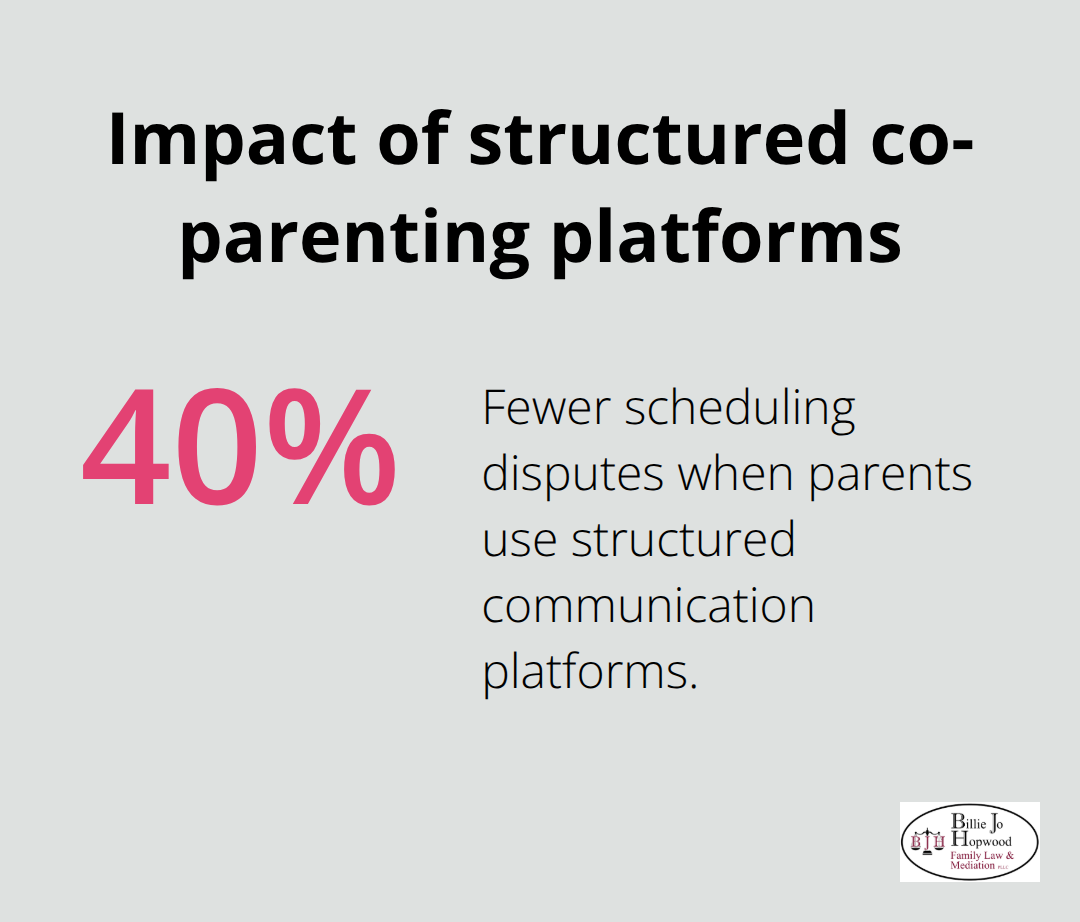
The parenting plan you create through mediation means nothing without systems to execute it consistently and communicate changes when life inevitably disrupts the best-laid schedules. Most parents fail not because their agreement is flawed but because they lack tools to manage the ongoing coordination that shared parenting demands. A 2023 report from the Association of Family and Conciliation Courts found that parents who used structured communication platforms reported 40% fewer scheduling disputes than those relying on text messages or phone calls.
Digital Tools That Prevent Scheduling Conflicts
The difference between a parenting schedule that works and one that creates constant friction often comes down to whether you have explicit systems in place before the first transition occurs. Digital co-parenting platforms like Custody X Change and OurFamilyWizard handle calendar management, expense tracking, and communication logging in ways that prevent the he-said-she-said conflicts that plague shared parenting. These platforms cost between $100 and $200 annually and serve a specific purpose: they create an objective record that both parents can reference when disputes arise about who agreed to what.
OurFamilyWizard includes a messaging feature that flags hostile language in real time, prompting parents to rephrase before sending. This matters because research shows that hostile communication during exchanges predicts long-term adjustment problems in children, even when the hostility is not directed at the child. The calendar function syncs with both parents’ phones and sends automatic reminders for upcoming exchanges, reducing the last-minute scrambling that leads to missed pickups. When a parent needs to request a schedule change, the platform creates a dated record of the request and the other parent’s response, eliminating disputes about whether permission was granted.
Documentation Protects Both Parents and Your Child
Documentation of schedule changes protects both parents and the child. When one parent requests a swap-asking to move a weekend because of a work obligation-the requesting parent should send a written message through the platform or email, not rely on a verbal agreement that gets forgotten or misremembered. The other parent should respond in writing, and the agreement should specify the exact dates being swapped and when the makeup time occurs. Without this documentation, a parent can later claim they never agreed to the change, forcing the other parent to either violate the original court order or create conflict.
Establishing Communication Protocols That Work
For communication between parents about non-scheduling matters-a child’s medical appointment, academic concerns, or behavioral issues-establish a protocol that separates urgent from routine information. Urgent matters like a child’s injury or illness warrant a phone call, but routine updates about grades or school activities work better through asynchronous messaging that does not demand an immediate response. One parent’s evening emergency is another parent’s 3 AM wake-up call, and framing communication appropriately reduces resentment.
Parents should agree on response time expectations-typically 24 hours for non-urgent messages-and stick to those boundaries. This prevents constant back-and-forth about decisions that one parent can reasonably handle alone. A child’s routine dental cleaning does not require both parents’ approval; a recommendation for orthodontia that costs $5,000 does. Clarifying this in the parenting plan prevents unnecessary conflict about decisions that fall within one parent’s authority.
Creating Decision-Making Boundaries
Parents in high-conflict situations benefit from a communication protocol that specifies what topics require mutual decision-making and what topics allow one parent to act independently. This clarity prevents the constant negotiation that exhausts both parents and confuses children about who actually makes decisions. When both parents understand which decisions belong to whom, they stop second-guessing each other’s choices and focus instead on supporting the child’s stability.
The most sustainable parenting schedules are those that parents actually follow because the systems supporting them make compliance easier than deviation. Structured platforms, written documentation, and clear communication protocols transform a parenting plan from a document that sits in a drawer into a living system that both parents use daily.
Final Thoughts
A sustainable parenting schedule rests on three foundations: realistic logistics that match your actual life, explicit procedures that prevent daily conflict, and systems that keep both parents accountable. Parents who succeed at shared parenting are not those with perfect circumstances or unlimited flexibility-they are the ones who wrote down their constraints, listened to the other parent’s constraints, and built a plan around what actually works rather than what sounds fair in theory. The parenting time mediation options you explore with a mediator allow you to shape your own outcome rather than accept a judge’s generic template.
Mediation costs a fraction of litigation, produces more detailed and practical agreements, and builds the communication foundation you will need for years of co-parenting. Parents who mediate report higher satisfaction with their arrangements and lower rates of future disputes because they had a voice in creating the plan. The mediation process teaches you how to negotiate schedule changes without returning to court, how to separate your emotions from your child’s needs, and how to find solutions that serve everyone involved.
As your child grows, work circumstances change, and life unfolds in unexpected directions, your schedule will need adjustment. We at Billie Jo Hopwood Family Law & Mediation, PLLC in Melbourne, Florida understand that moving forward with your parenting plan requires more than a signed document. Contact us to discuss how we can help you build a schedule that works for your family.