
Divorce doesn’t have to mean endless court battles and mounting legal bills. The divorce mediation process in Florida offers a faster, more affordable way to resolve your case while keeping control in your hands.
At Billie Jo Hopwood Family Law & Mediation, PLLC, we guide families through mediation from start to finish, helping you reach fair agreements on assets, custody, and support without the courtroom stress.
How Divorce Mediation Starts in Florida
Financial Disclosure Sets the Foundation
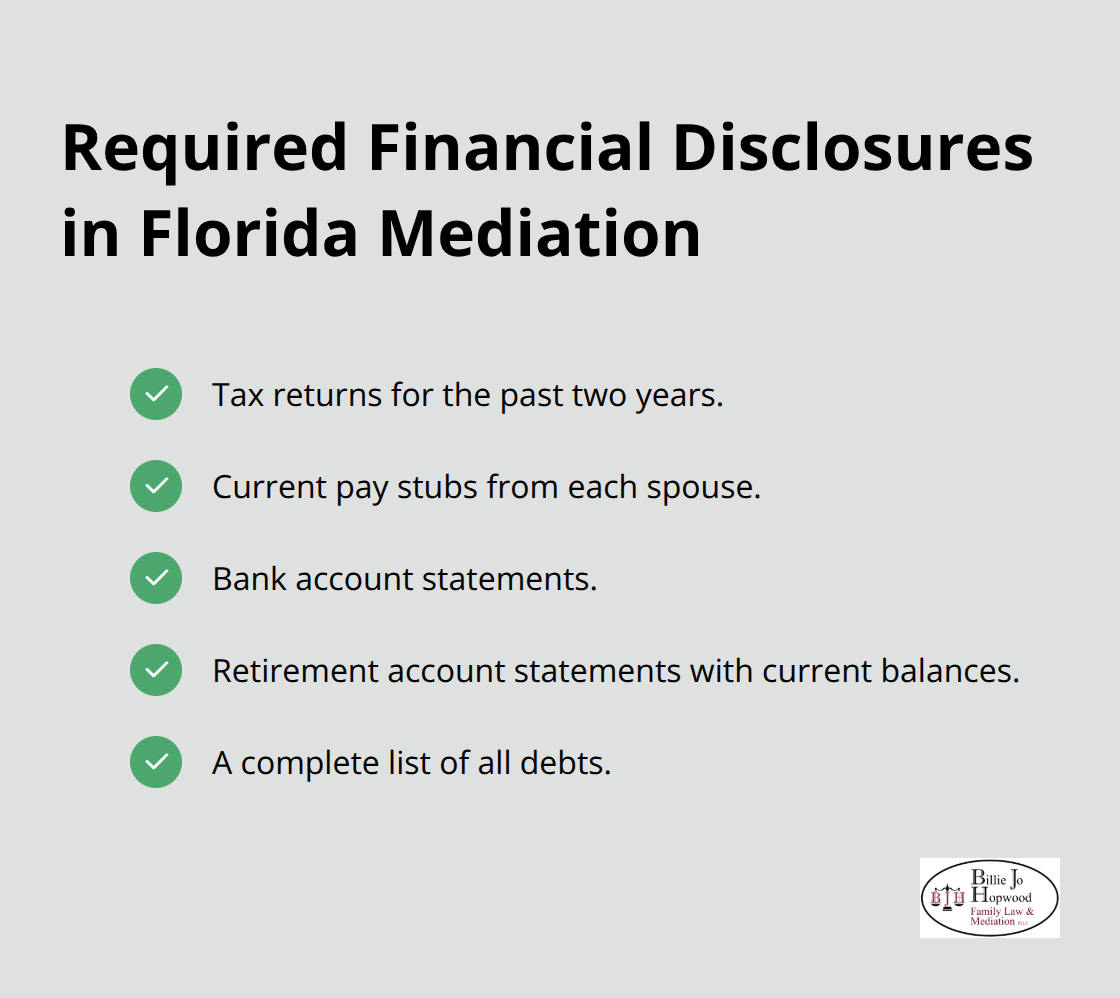
Florida courts require financial disclosure before mediation begins, and this step separates serious cases from ones that stall. Under Florida Rule 12.285, both spouses must exchange tax returns from the past two years, current pay stubs, bank statements, retirement account statements, and a complete list of debts before sitting down with a mediator. This transparency prevents negotiation breakdowns later when hidden assets or liabilities surface.
Many mediators in Melbourne won’t schedule sessions until these documents are in hand, so gathering them early saves weeks.
The Initial Consultation
The initial consultation with a mediator typically lasts 30 to 60 minutes and covers the scope of issues-assets, custody, support-and logistics like whether sessions will occur in person or remotely. Mediators ask both parties about their goals and non-negotiables, though this information remains confidential between the mediator and each individual. Florida law protects mediation communications under the Mediation Confidentiality and Privilege Act, meaning what you say in private sessions cannot be used against you in court if mediation fails.
What a Mediator Actually Does
A mediator does not decide outcomes or provide legal advice; that distinction matters because it shapes how the process works. The mediator identifies the actual issues, clarifies positions, and presents settlement options the parties might not have considered alone. In practice, a skilled mediator in a high-conflict divorce will use shuttle mediation, where each spouse stays in a separate room and the mediator carries proposals back and forth. This structure reduces emotional flare-ups and keeps negotiations focused on numbers and schedules rather than blame.
Session Length and Costs
Most mediation sessions in Florida last four to six hours, though complex cases with significant assets or custody disputes often require two or three sessions spread over weeks. Mediators typically charge between $200 and $400 per hour, and fees are usually split between the parties unless the settlement agreement specifies otherwise. A mediator’s role is to move the conversation forward, not to judge fairness-that is why having your own attorney present or consulting one before and after mediation protects your interests and ensures you understand the legal implications of any agreement you reach.
What Mediation Actually Resolves
Asset Division and Property Valuation
Mediation in Florida addresses every major issue that divides divorcing couples, but the real work happens when you stop arguing about positions and start talking about numbers. Asset division dominates most mediations because marital property in Florida must split equitably under Florida Statutes 61.075, meaning fairly but not necessarily 50-50. A mediator will ask both parties to value the family home, retirement accounts, vehicles, and any business interests, then guide you toward a split that reflects each person’s contributions to the marriage and future earning capacity.
Bring recent appraisals, mortgage statements, and retirement account statements showing current balances; mediators in Melbourne routinely see cases stall because one spouse undervalued a 401(k) or forgot about a second property. If you own a business, the mediator will likely recommend a professional valuation before settlement, since business value directly affects how much liquid assets the other spouse receives. Florida courts also examine whether each spouse has non-marital property-assets owned before marriage or inherited separately-which stays with that person and does not enter the division calculation.
Child Support and the Statutory Formula
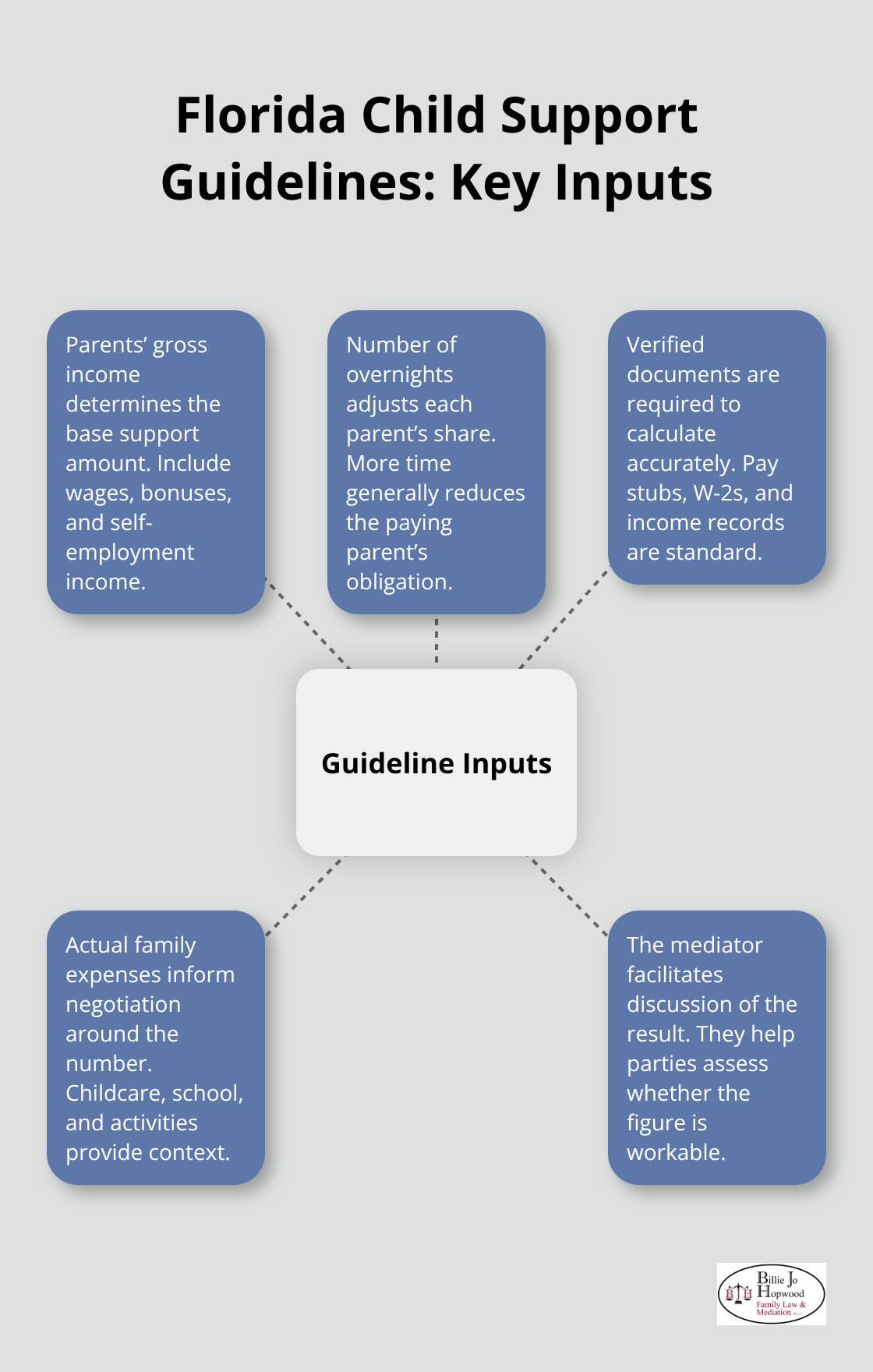
Child custody and support calculations follow Florida’s statutory framework, which removes much guesswork from mediation. Florida Statutes 61.30 establishes the Child Support Guidelines, a formula based on both parents’ gross income and the number of overnights each parent has with the children. A mediator will ask for recent pay stubs, W-2s, and any self-employment income to run this calculation, then discuss whether the number feels realistic given your family’s actual expenses for childcare, school, and activities.
The parenting plan itself-who has the children on which days, who decides medical and school matters, how holidays split-becomes much easier to negotiate once you accept the support number. Many parents resist the statutory amount initially, but mediators point out that a judge will apply the same formula if you go to trial, so settling near that figure saves litigation costs.
Alimony and Spousal Support Negotiations
Alimony works differently because Florida Statutes 61.08 gives judges wide discretion based on marriage length, age, health, earning capacity, and standard of living during the marriage. Short marriages under 10 years rarely produce permanent alimony, but one spouse’s decision to stay home with children or leave a career often justifies temporary support lasting a few years. A mediator will help you understand what a judge might award, then let you decide whether to settle at that level or risk trial uncertainty.
Come to mediation with tax returns from the past three years and a realistic budget for post-divorce living expenses; mediators who work in Melbourne frequently see settlements collapse because a spouse had no idea what monthly expenses actually total. Understanding your true financial picture before you sit down with a mediator transforms the negotiation from abstract positions into concrete numbers that both sides can work with.
From Agreement to Court Approval
The Mediator Drafts Your Settlement Agreement
Once you and your spouse reach consensus on all issues-assets, custody, support-the mediator drafts a Mediated Marital Settlement Agreement (MSA) that documents every term. This document is not a casual summary; it becomes the legal foundation for your divorce judgment, so accuracy matters enormously. The mediator will present a draft, usually the same day you settle, and both parties review it carefully before signing. Florida courts require specific language in settlement agreements, particularly for child support calculations and parenting time, so many mediators use templates that comply with Florida Statutes 61.075 and 61.30 rather than starting from scratch.
Do not sign anything you do not fully understand. Your attorney should review the draft before you put pen to paper, even if mediation was supposed to save attorney fees. A mistake in the MSA-like listing the wrong property address or stating child support amounts inconsistently-creates expensive problems later when the court refuses to approve the agreement or when enforcement fails because the language is ambiguous.
The Court Reviews and Approves Your Agreement
After both parties sign the MSA, your attorney files it with the court along with a petition for dissolution of marriage. Florida courts approve most settlement agreements within 30 to 60 days, provided the agreement complies with state law and does not appear to harm minor children. The judge reviews the document to confirm child support meets the statutory guideline amount, that parenting time is specific enough to enforce, and that the property division does not obviously favor one spouse.
If the judge spots problems-for example, if alimony is set below what the guidelines suggest without written justification-the court may reject the agreement and send it back for revision. Once approved, the judge signs a Final Judgment of Dissolution of Marriage, and you are legally divorced.
Implementation Begins Immediately After Judgment
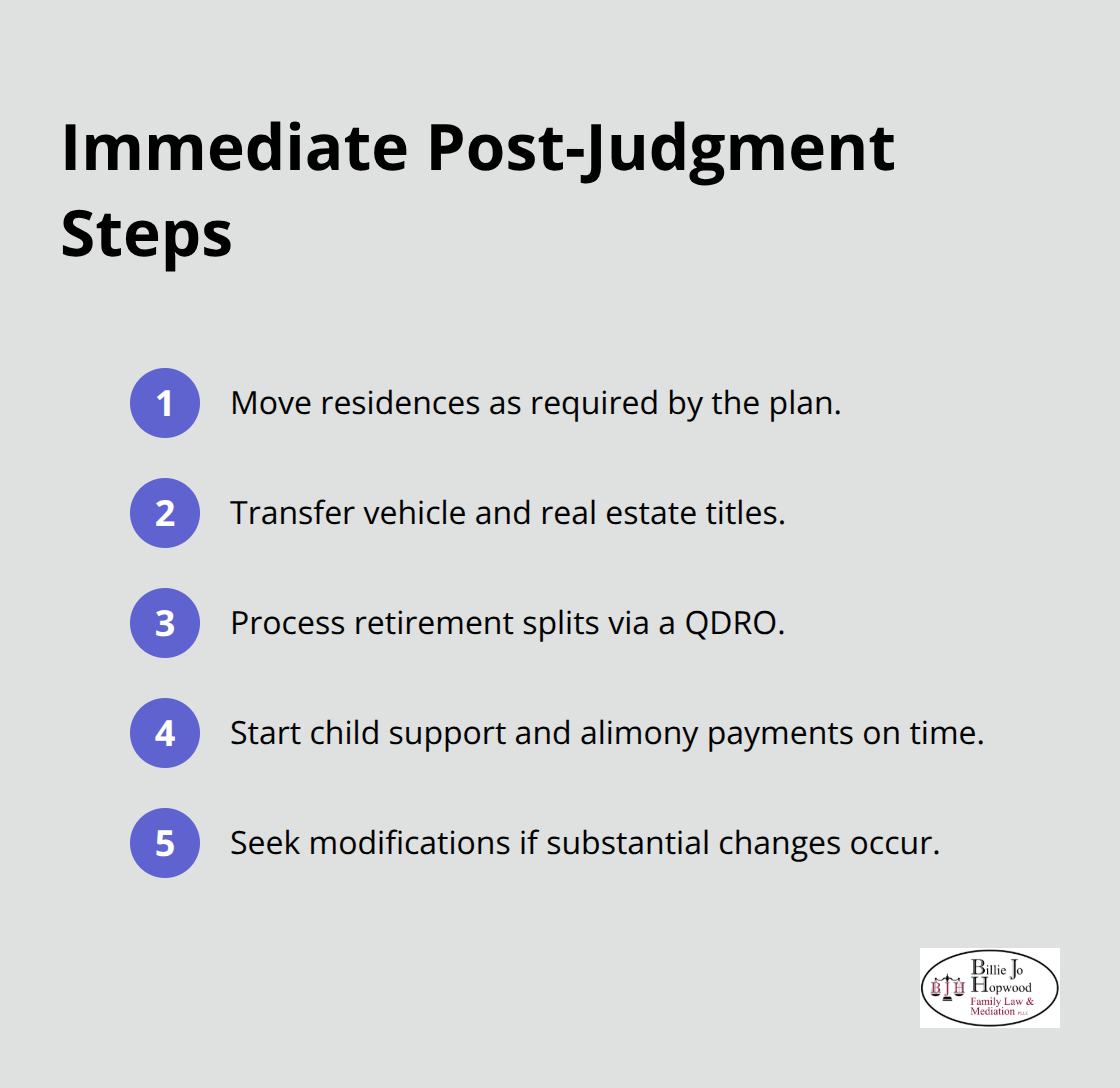
Implementation starts right away: one spouse moves out if necessary, title transfers happen for vehicles and real estate, retirement accounts split per the QDRO (Qualified Domestic Relations Order) that your attorney prepares, and child support and alimony payments start on the date specified in the judgment. Life changes fast after settlement, so many people find that their circumstances shift within months-a job loss, a child’s special needs, relocation-and they need to modify support or parenting time.
Modifications Are Possible When Circumstances Change
Florida allows modifications through a straightforward motion process if circumstances have changed substantially since the final judgment, so the settlement is not truly final in that sense. Keep copies of your judgment and mediation agreement accessible, document all support payments, and photograph any property you received to prove you complied with the agreement’s terms.
Final Thoughts
Mediation puts control back in your hands instead of handing power to a judge who knows nothing about your family’s actual needs. The divorce mediation process in Florida moves faster than litigation, costs significantly less, and protects your privacy by keeping sensitive matters out of the public court record. You walk away with an agreement tailored to your life, not a generic court order that ignores your children’s specific circumstances or your financial reality.
After settlement, your focus shifts to implementation: transfer titles, update beneficiaries on retirement accounts, set up child support payments, and document everything carefully. Life changes quickly after divorce, and circumstances that felt stable may shift within months-a job loss, a child’s new needs, or relocation can all trigger the need for modifications. Florida law allows you to adjust support or parenting time without returning to full litigation when substantial changes occur.
The path forward starts with a conversation about your situation and whether mediation makes sense for your family. Contact Billie Jo Hopwood Family Law & Mediation, PLLC to discuss your case and explore your options. We serve Melbourne and the surrounding area, and we stand ready to help you move from conflict toward resolution.