
A parenting plan mediation Brevard process starts with one goal: creating a schedule that works for both parents and protects your children’s stability.
When parents work together to design their custody arrangement, they avoid costly court battles and reduce the stress their kids experience during transitions. We at Billie Jo Hopwood Family Law & Mediation, PLLC help families build practical schedules that account for school, activities, and real-world logistics.
Why a Structured Parenting Plan Matters in Brevard
A structured parenting plan stops conflict before it starts. When both parents agree on specific pickup times, overnight schedules, and holiday arrangements, there’s no room for disagreement about who’s responsible for what. Florida Statute 61.13 requires comprehensive parenting plans that address daily schedules, school-year and holiday arrangements, and dispute-resolution procedures, which means the court won’t approve vague agreements anyway. Parents who mediate their custody arrangements report fewer ongoing disputes because the schedule itself becomes the answer to scheduling questions. Without a written plan, parents rehash the same arguments repeatedly, burning money on attorney fees and emotional energy that could go toward their children.
Children thrive with consistency across two homes
Children’s stress levels drop significantly when they know what to expect. A child who understands she spends Monday through Thursday with one parent and Friday through Sunday with the other can plan her week around stable routines for meals, homework, and bedtime. Research from the University of Florida shows children fare better when custody decisions are mediated, with reduced stress and improved long-term outcomes compared to court battles. The difference isn’t small: mediated arrangements create predictability that helps kids maintain school performance, manage anxiety, and build confidence in both households. When schedules shift constantly or parents fight over changes, children absorb that conflict and their grades, behavior, and emotional health suffer. A practical parenting plan aligned with your child’s actual school calendar and activity commitments eliminates the chaos that litigation creates.
Florida law demands specifics, not handshake agreements
Florida courts won’t sign off on custody arrangements that lack detail. The statute requires you to specify time-sharing schedules, decision-making responsibilities, and communication protocols. Courts also expect explicit handling of holidays, vacation time, and how transportation works between homes.
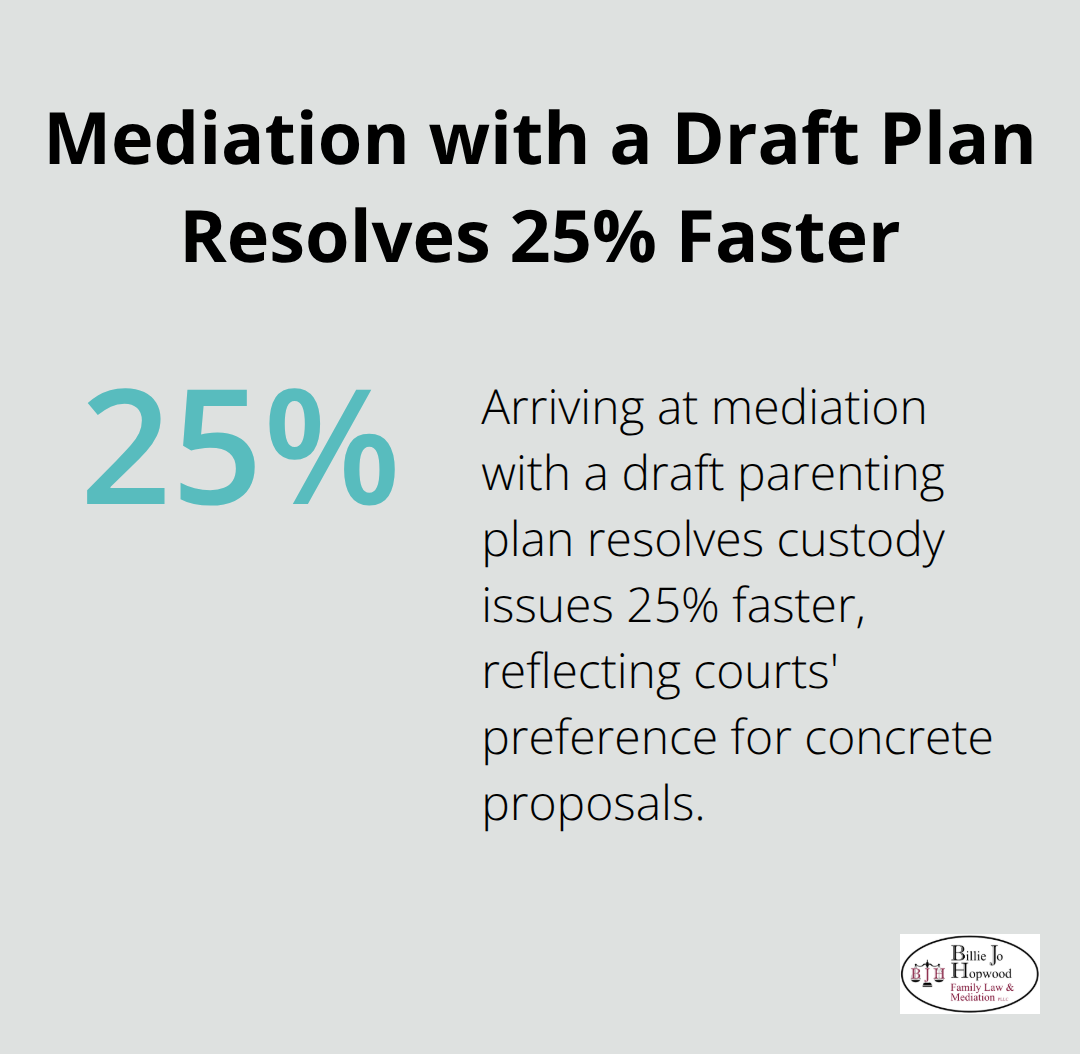
The Florida Department of Children and Families notes that arriving at mediation with a draft parenting plan can resolve custody issues 25 percent faster, which shows how much courts value concrete proposals. If you walk into court without these specifics, the judge fills in the blanks for you-and you won’t like the result. Mediation forces both parents to think through logistics beforehand, producing an agreement that holds up legally and actually works in practice.
What happens when you skip the details
Vague custody agreements create problems that surface months or years later. One parent assumes the child spends every other weekend at the other home; the other parent thought it was every third weekend. A school closure happens, and neither parent knows who’s responsible for childcare. A parent’s work schedule changes, and the entire arrangement falls apart because the original plan had no flexibility clause. These conflicts land families back in court, where a judge imposes a solution neither parent wanted. The mediation process forces you to address these scenarios upfront, preventing costly disputes down the road.
Moving forward with a practical schedule
The next step involves building a schedule that actually fits your family’s life. Your work hours, your child’s school calendar, extracurricular activities, and transportation logistics all shape what works on paper versus what works in reality. Mediation helps you account for these real-world factors and create a plan both parents can follow consistently.
Building a Schedule That Actually Works
Your child’s school calendar and work schedule form the foundation of any practical parenting plan. Start by mapping out a typical two-week period-mark school days, after-school activities, your work hours, and the other parent’s availability. This exercise reveals scheduling conflicts immediately. If you work until 6 p.m. and your child’s school pickup happens at 3 p.m., one parent must handle pickup consistently. If your child has soccer on Tuesday and Thursday evenings, that parent needs custody during those days or a clear transportation agreement. A practical schedule mirrors reality rather than forcing reality to fit a template. Research from the Florida Department of Children and Families found that parents who arrive at mediation with a draft parenting plan resolve custody issues 25 percent faster because they’ve already identified what actually works logistically. The schedule should reflect your child’s existing routine first, then allocate custody time around those fixed points.
Holidays and vacations require explicit agreements
This is where vague plans collapse. One parent assumes Thanksgiving means the full week; the other thinks it means just Thursday and Friday. Extended school breaks like winter and summer vacation need specific date ranges, pickup times, and transportation responsibility. Many families alternate major holidays by year, which prevents the same parent from always missing Christmas or always hosting Thanksgiving. Spring break and summer vacation deserve attention because they disrupt the regular school-year schedule. Your agreement should specify whether summer is split into two-week blocks, alternating months, or some other arrangement that fits both parents’ work schedules. Holiday plans should also address birthdays, religious observances, and any family traditions that matter to your household. A detailed holiday schedule prevents the scramble that occurs every November when neither parent knows whose turn it is or who’s responsible for transportation.
Communication protocols stop constant renegotiation
The schedule itself is only half the battle. Parents need explicit protocols for how they’ll handle schedule changes, emergency situations, and the inevitable disruptions that arise. Establish which communication channel you’ll use for routine updates and which for urgent matters. Some families use a co-parenting app like Talking Parents, which creates a documented record and reduces conflict because messages are timestamped and visible. Define what counts as a valid reason to swap custody time and how much notice is required.
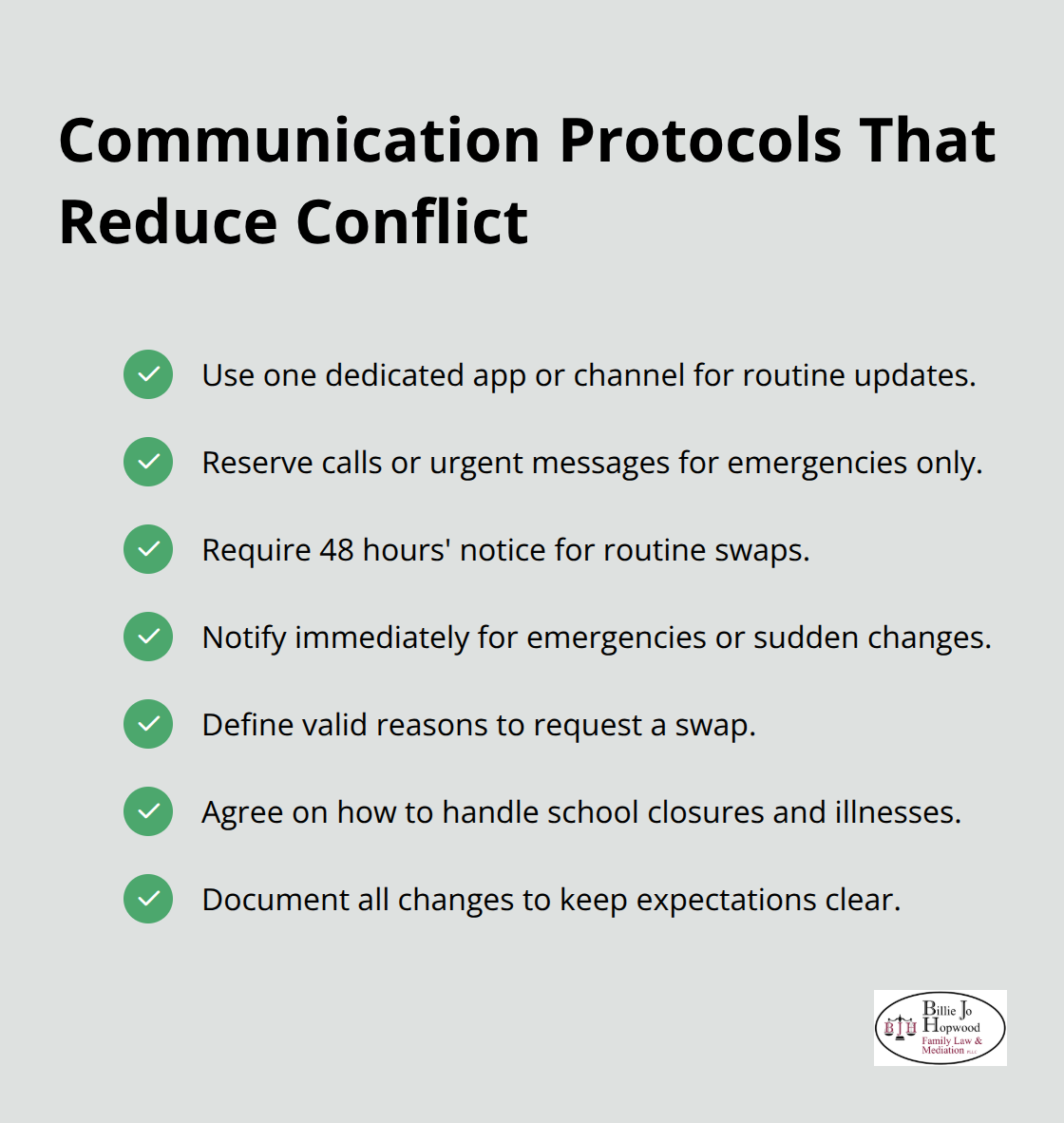
A common approach is 48 hours’ notice for routine swaps and immediate notification for emergencies. Include language about how to handle school closures due to weather, sudden illness, or unexpected work schedule changes. Without these protocols, parents end up in constant negotiation, which exhausts both of you and confuses your child about what to expect. A mediated plan that addresses these specifics up front means you’re not reinventing the wheel every time something unexpected happens.
Transportation logistics prevent daily friction
Who picks up the child from school? Who drives to soccer practice? What happens if one parent runs late? These questions sound simple until they’re not addressed in writing. Your parenting plan should specify pickup and drop-off locations, time windows, and who pays for transportation to activities. If one parent lives 20 minutes from school and the other lives 5 minutes away, the closer parent likely handles school pickup on their custody days. If activities fall on the other parent’s time, you need a clear agreement about whether that parent transports the child or the primary custodian does. Late pickups create resentment fast-define what “late” means and what happens if it occurs repeatedly. Transportation agreements also address safety (car seats, seatbelts, licensed drivers only) and cost-sharing for activities that benefit the child across both households. When transportation logistics are written down, neither parent guesses or improvises, and your child gets to activities on time.
Flexibility clauses keep plans alive as circumstances change
Life happens. A parent’s job changes, a child’s interests shift, or a school schedule gets reorganized. A rigid parenting plan breaks under these pressures and sends families back to court. Build flexibility into your agreement by specifying how temporary changes work and when a change requires formal modification. For example, you might allow either parent to request a one-time schedule swap with 48 hours’ notice, but if a parent needs a permanent change (like a new work shift), that triggers a mediation session before any adjustment takes effect. Include language about how the plan adapts as your child ages-a schedule that works for a 7-year-old won’t work for a 16-year-old. Address potential relocation by stating what happens if one parent moves more than 50 miles away and how that affects custody time. A plan with built-in flexibility mechanisms survives real life and keeps both parents out of the courtroom.
The next step involves addressing the obstacles that emerge during mediation itself-the disagreements that surface when parents sit down to negotiate these details.
Common Obstacles Parents Face During Mediation
Overnight custody schedules expose the first real conflict in mediation. Parents often arrive with competing assumptions about what 50/50 custody means in practice. One parent believes it’s a strict week-on, week-off rotation; the other assumes it’s alternating weekends with weekday custody going to the primary caregiver. Florida custody research shows that 50/50 custody often fails unless both parents live within about 10 minutes of each other, have compatible work schedules, and share parenting values. When a parent works nights and the other works days, a rigid 50/50 split doesn’t work logistically. Transition points themselves become friction zones-if a child switches homes every three days, the logistics of packing, transporting, and managing two sets of belongings create exhaustion that compounds over months.
Mediators reshape the overnight conversation
Mediators address this conflict by proposing a school-week custody arrangement with alternating weekends plus one mid-week overnight, which preserves school routines while maintaining substantial time with the other parent. This variation works better than strict 50/50 because it reduces transitions and aligns with the child’s actual school schedule. The key disagreement parents need to resolve isn’t the percentage of time but the specific days and times that actually fit both households’ rhythms. A mediator with strong conflict-resolution skills shortens timelines and reduces emotional strain by redirecting these conversations toward practical solutions rather than abstract fairness arguments.
Parenting styles clash when schedules don’t align them
Different parenting styles between homes create tension that a schedule alone cannot fix. One parent enforces strict bedtimes and screen limits; the other allows flexibility. One parent prioritizes academic achievement while the other emphasizes play and creativity. Parents often want the mediation agreement to enforce their parenting philosophy across both homes, which is unrealistic and creates ongoing conflict. A functional agreement acknowledges that each parent runs their household differently and focuses instead on non-negotiable safety standards and communication about major decisions like education and healthcare. This shift-from philosophy battles to practical boundaries-allows both parents to maintain their approach while protecting the child’s well-being across both homes.
Financial responsibilities tied to custody time generate the most heated disputes
One parent assumes the higher-earning parent covers all child-related expenses; the other believes costs split proportionally to custody time. Childcare, healthcare, extracurricular activities, and camps all carry price tags that need allocation. Without clear language, one parent pays for soccer camp while the other refuses to contribute, leaving the child out of activities. The agreement should specify which parent pays for what and how unexpected costs get split. If one parent’s custody schedule requires childcare while the other’s doesn’t, that parent shouldn’t bear the full childcare expense alone. Mediation works when parents shift from fighting about fairness in the abstract to solving the specific financial problems their custody arrangement creates. Clear allocation of expenses (healthcare, activities, childcare) prevents resentment and ensures your child participates fully in both households.
Final Thoughts
Mediation produces parenting agreements that actually survive contact with real life. When both parents sit down with a mediator to design a schedule, they think through logistics, financial responsibilities, and communication protocols before signing anything. This upfront work prevents the constant renegotiation and courtroom battles that plague families who skip mediation and let a judge impose a schedule neither parent wanted. Research shows mediated parenting plans achieve compliance rates over 80 percent, which translates to fewer disputes about who’s responsible for what and less stress for your children.
Parenting plan mediation in Brevard typically resolves custody disputes in two to four sessions, compared to months or years in contested litigation. The cost difference matters significantly: mediation runs three to eight thousand dollars total for both parties, while litigated divorces can reach fifteen to thirty thousand dollars per spouse. That savings leaves resources available for your children’s actual needs instead of attorney fees.

The path forward starts with finding a mediator who understands parenting plans and has experience with Brevard families. Interview at least two mediators, verify their experience with child custody arrangements, and understand their approach to handling disagreements. Contact Billie Jo Hopwood Family Law & Mediation, PLLC to discuss how mediation can help your family build a schedule that protects your children’s stability and reduces conflict between households.