
Family conflicts don’t have to end in court. We at Billie Jo Hopwood Family Law & Mediation, PLLC have seen countless families resolve their disputes through mediation instead of litigation.
Family mediation examples show how real people move past anger and reach agreements that work for everyone. The stories in this post prove that transformation is possible when both sides are willing to talk.
How Mediation Transforms High-Conflict Family Disputes
When Families Feel Stuck, Mediation Opens a Path Forward
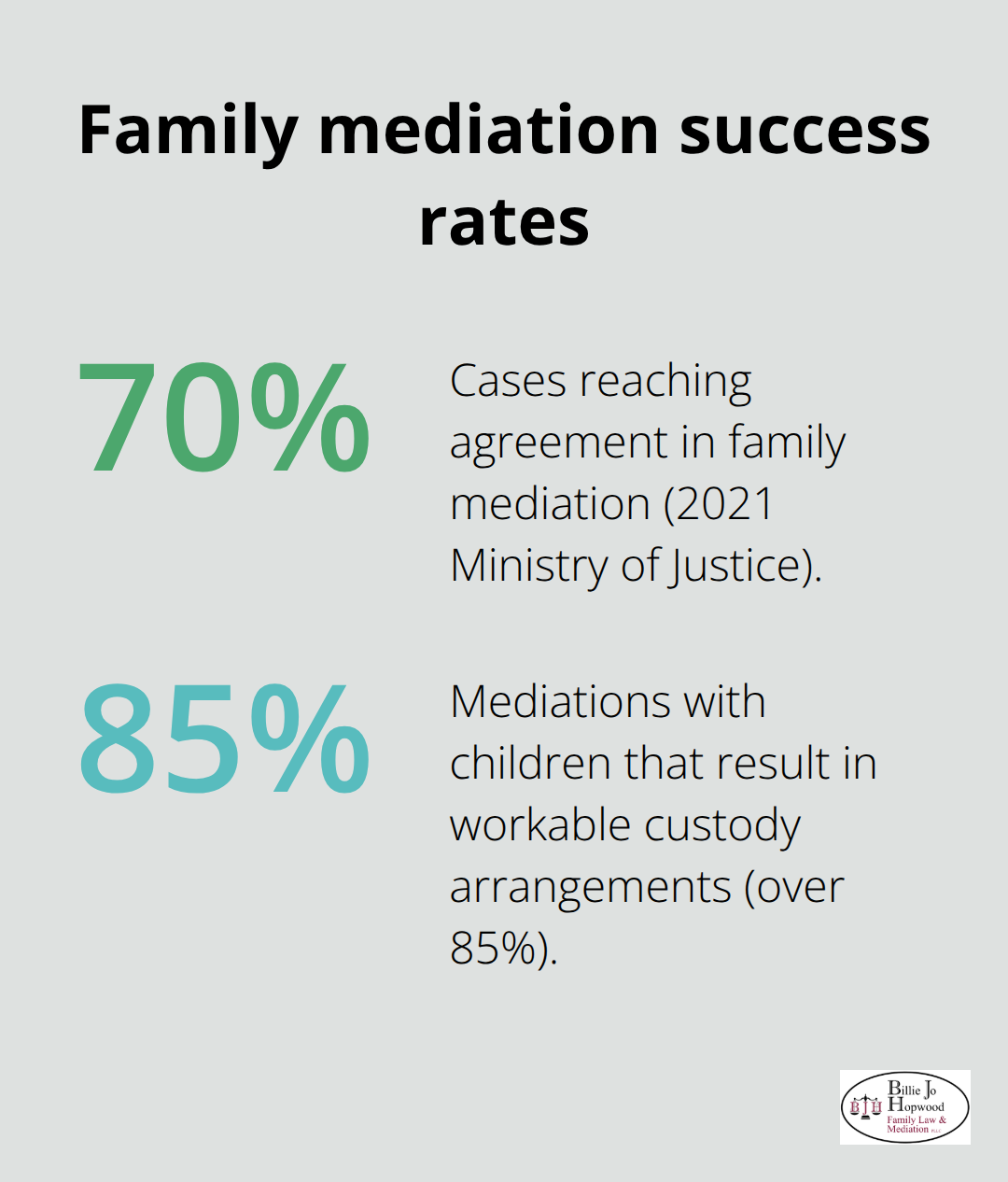
When custody battles intensify, property disputes multiply, and communication collapses, families assume litigation is their only path forward. Mediation proves this assumption wrong. A 2021 Ministry of Justice report found that 70 percent of family mediation cases reach agreement, and when children are involved, over 85 percent of mediations result in workable custody arrangements. These numbers matter because they show mediation works even in situations where families feel trapped.
Real Custody Disputes Resolved Through Structure
Emily and Brian spent eighteen months in escalating conflict over parenting time. Their communication had deteriorated so badly that any conversation about their children turned hostile within minutes. When they entered mediation with a neutral facilitator, the structure changed everything. Instead of trading accusations about the past, the mediator guided them toward concrete proposals about school pickups, holiday schedules, and medical decision-making. Within four sessions, they had a detailed parenting plan aligned with their children’s school calendar and extracurricular activities. The confidential nature of mediation-where statements made during sessions cannot be used in court-gave them permission to speak honestly without fear their words would be weaponized later.
Protecting Business Value in Property Division
Carlos and Jamie faced a different challenge: they owned a family business worth significant money and disagreed fundamentally on how to divide it. Traditional litigation would have forced a judge to decide, potentially destroying the business in the process. Their mediator brought in a financial neutral to fairly value the enterprise and structure a buyout arrangement. This approach preserved the business, kept both parties’ financial interests intact, and avoided the legal fees that would have consumed tens of thousands of dollars.
Building Communication Frameworks for Blended Families
Blended family situations create their own friction. When stepparents, biological parents, and children from multiple relationships must coordinate decisions about healthcare, education, and living arrangements, mediation establishes clear communication frameworks that prevent future disputes. A structured mediation process lets all parties voice concerns without judgment, then builds agreements around practical responsibilities. The mediator’s role is strictly neutral-they do not take sides or provide legal advice-but their presence enforces respectful dialogue and keeps discussions focused on solutions rather than blame. Families consistently report that mediation produces more durable agreements than court orders because the people affected had a genuine voice in shaping the outcome.
These transformations happen because mediation shifts power back to the people involved. The next section examines the specific techniques mediators use to guide families from conflict toward resolution.
How Mediators Guide Families From Conflict to Agreement
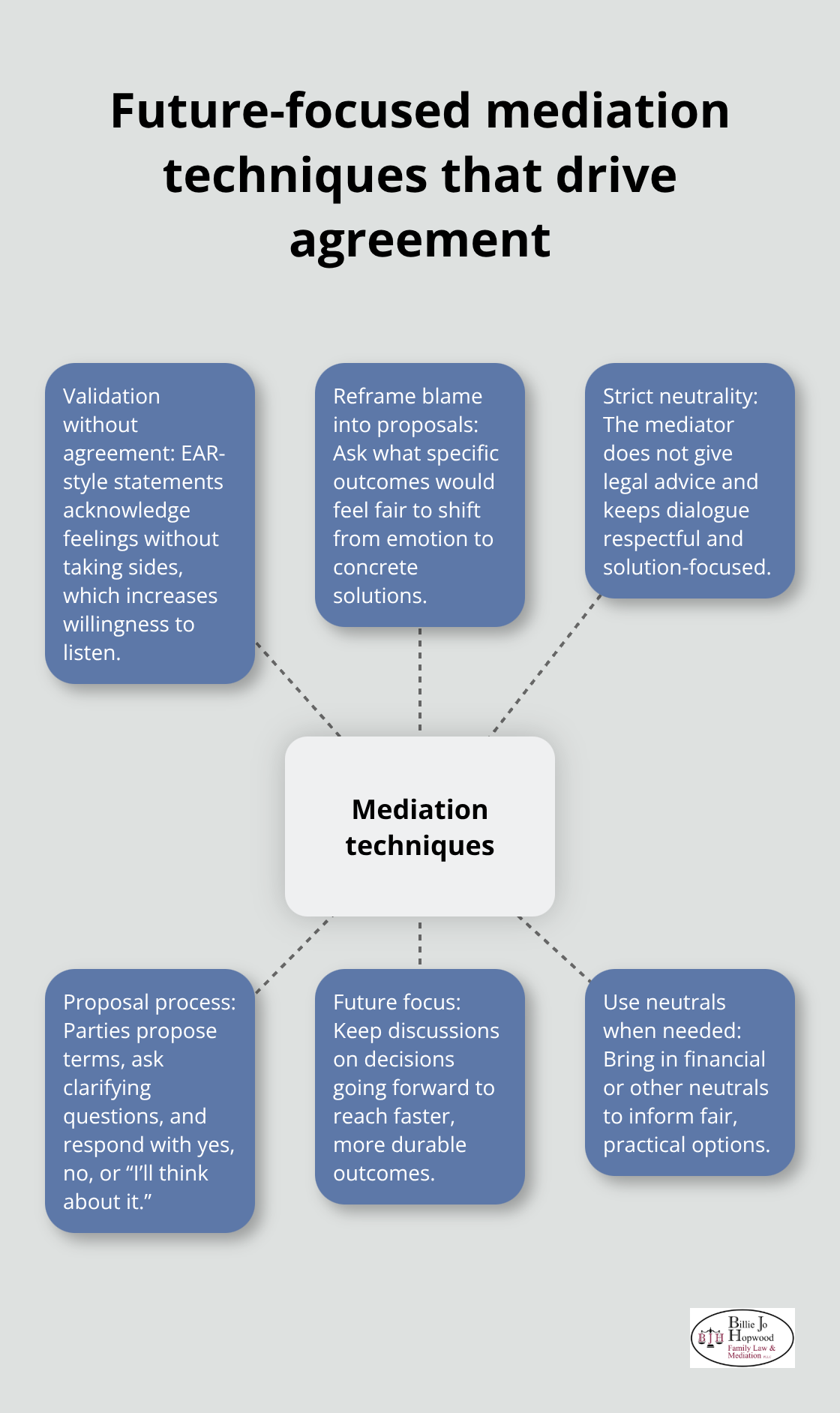
Mediators do not force families to agree. Instead, they use deliberate techniques that shift how people communicate and what they focus on. The most effective mediators stop families from rehashing the past and push them toward concrete proposals about the future. Research on high-conflict mediation shows that dwelling on past grievances rarely produces insight or change. Instead, mediators who keep discussions strictly future-focused achieve faster agreements and more durable outcomes. When Emily and Brian’s mediator heard them blame each other for the custody conflict, the mediator redirected: rather than exploring who caused the breakdown, they asked what specific arrangements would work for school pickups and holiday schedules.
This single shift moved them from accusation to problem-solving within minutes.
Validation Without Agreement
A mediator’s first job is making both parties feel heard, but this does not mean the mediator agrees with them. Validation and agreement are different tools. When one parent says the other parent is irresponsible, a skilled mediator responds with something like: I hear that you have serious concerns about reliability and consistency in parenting. This approach acknowledges the emotion and concern without endorsing the judgment. The party feels seen without the mediator taking sides. Research on family mediation in England and Wales shows that when mediators use empathy-focused statements paired with attention and respect (what mediators call EAR statements), participants become more willing to listen to the other side. The mediator’s tone and choice of words signal that they focus on solving the problem, not on determining who was right or wrong.
Turning Blame Into Concrete Decisions
Reframing negative language into actionable proposals is where transformation actually happens. When Carlos said Jamie was trying to steal the family business, the mediator did not debate whether that was true. Instead, the mediator asked: What specific outcome would feel fair to you regarding the business? This question forced Carlos to move from emotion to proposal. Suddenly, the conversation became about valuation methods, buyout timelines, and cash flow rather than character attacks. Mediators trained in high-conflict family mediation understand that asking how someone feels typically keeps them stuck in emotion. Asking what they think about a specific decision moves them toward solutions. The mediator might ask: What do you think about a timeline where the valuation is completed within sixty days? This structure gives both parties thinking time, prevents rushed agreements, and lets them own the decisions they make.
How Proposals Build Durable Agreements
Families report that agreements reached through this proposal-based approach hold up better after mediation ends because both sides genuinely chose the outcome rather than having it imposed by a judge. The mediator’s role is strictly neutral-they do not take sides or provide legal advice-but their presence enforces respectful dialogue and keeps discussions focused on solutions rather than blame. When mediators present options to families (rather than asking probing questions about the past), they keep the conversation objective and solution-focused. This technique works because it shifts control back to the people involved. Each party shapes the final agreement through their own proposals and responses, which creates stronger commitment to the outcome. The structured proposal process-where one party proposes specific terms, the other asks clarifying questions, and both respond with yes, no, or “I’ll think about it”-prevents circular arguments and moves families toward resolution.
The techniques mediators use in Melbourne, Florida, and across the country share one common thread: they move families away from who was wrong and toward what works for everyone going forward. Understanding these methods reveals why mediation produces faster resolutions and lower costs than litigation-the focus shifts entirely to building agreements rather than proving fault.
Why Mediation Costs Far Less Than Court Battles in Melbourne, Florida
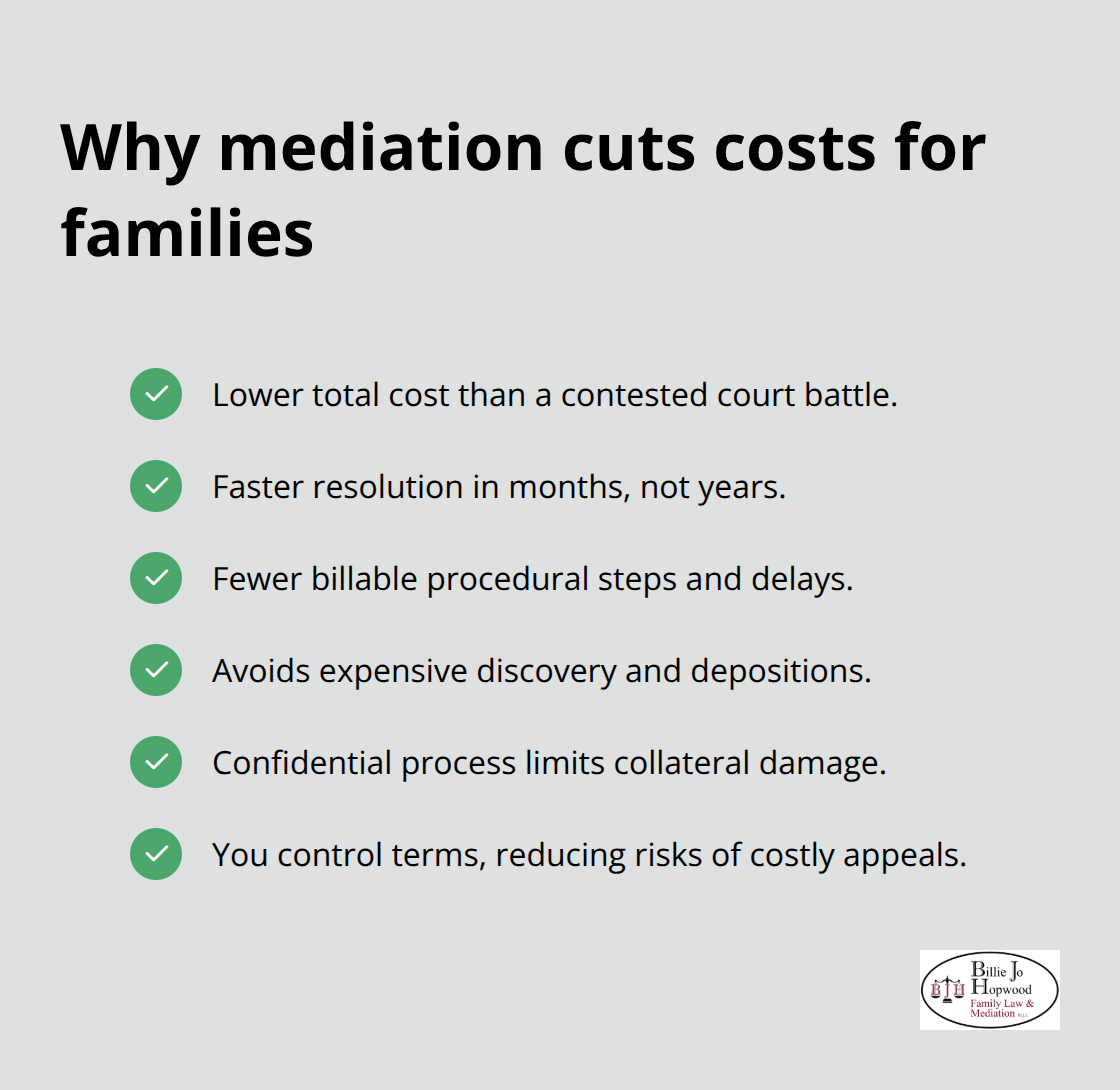
Litigation consumes money in ways mediation simply does not. A contested divorce in court averages between $15,000 and $30,000 per person when attorneys handle discovery, depositions, and trial preparation. Mediation typically costs $1,500 to $5,000 total for both parties combined, depending on case complexity and the number of sessions needed. The National Audit Office in the UK documented that mediation costs significantly less than court proceedings, easing financial burden and reducing pressure on the court system. The difference matters most for families with modest means who cannot afford prolonged legal warfare.
How Speed Reduces Your Total Costs
Court timelines stretch across months or years; mediation resolves most cases within four to eight sessions spread over two to four months. Speed translates directly to savings because you pay mediators hourly rather than attorneys billing for endless procedural steps that court rules demand. When Carlos and Jamie used mediation to resolve their business dispute, they avoided discovery costs alone, which would have consumed thousands of dollars just to exchange documents and deposition testimony. A 2021 Ministry of Justice report found that 70 percent of family mediation cases reach agreement, and when children are involved, over 85 percent of mediations result in workable arrangements. These completion rates prove mediation actually finishes what it starts, whereas litigation often drags on through appeals and post-judgment motions that generate additional legal bills.
You Control Every Decision, Not a Judge
Mediation lets you shape every term of your agreement before it becomes binding. A judge decides custody, property division, and alimony based on state law and whatever evidence fits into a narrow courtroom timeframe. You cannot appeal a judge’s ruling on parenting time without proving the decision was an abuse of discretion, a nearly impossible standard. Emily and Brian structured their parenting plan around their children’s actual school calendar and extracurricular schedule rather than accepting a generic every-other-weekend arrangement a judge might impose. They controlled whether holidays rotated annually, how medical decisions would be made, and how communication would happen between households. Once you reach agreement in mediation and convert it to a court order, the arrangement is just as legally binding as any judgment, but you designed it.
Privacy Protects Your Family’s Sensitive Information
The confidentiality of mediation also protects your family’s privacy in ways court proceedings never do. Court files become public record; anyone can access details about your finances, parenting conflicts, and personal matters. Mediation communications remain confidential and are typically not admissible in court if mediation fails (with limited exceptions for child abuse, criminal acts, or threats). Families report that this privacy gives them freedom to speak honestly without worrying their words will appear in newspaper archives or become weaponized in future disputes.
Why Mediation Removes Financial Pressure
The cost and timeline pressures of litigation force families into impossible choices. Mediation removes those pressures and lets you build agreements that actually reflect what your family needs. You avoid the financial drain that makes families settle cases unfavorably just to stop the bleeding of legal fees. Instead, you invest in a process designed to reach fair outcomes without the overhead that traditional litigation demands.
Final Thoughts
The family mediation examples throughout this post show that transformation happens when families shift from blame to problem-solving. Emily and Brian moved from eighteen months of hostile conflict to a workable parenting plan in four sessions, while Carlos and Jamie preserved their family business instead of watching it destroyed by litigation costs. These outcomes resulted from a structured process where both parties maintained control over decisions that affected their lives and their children’s futures.
Mediation works because it removes the adversarial framework that courts impose. You negotiate to build an agreement that actually works for your family rather than fighting to win. The speed, cost savings, and privacy of mediation create space for honest conversation that litigation destroys, and when you reach agreement through mediation, you own the outcome in a way that no court order can replicate.
If your family faces conflict around custody, property division, alimony, or communication breakdowns, mediation offers a path forward that protects your relationships and your finances. We at Billie Jo Hopwood Family Law & Mediation, PLLC understand that family disputes require compassion alongside clear guidance, and we assist families through challenging legal situations in Melbourne, Florida. Contact Billie Jo Hopwood Family Law & Mediation, PLLC to explore how mediation can help your family move forward with confidence and clarity.