
Getting married involves big financial decisions, and a prenuptial agreement helps protect both partners. Many couples assume litigation is the only path forward, but prenuptial mediation alternatives offer faster, less adversarial ways to reach agreement.
At Billie Jo Hopwood Family Law & Mediation, PLLC, we work with couples who want to plan ahead without unnecessary conflict. This guide walks you through your real options for creating a prenuptial agreement that works for your situation.
Why Prenuptial Agreements Protect Your Future
A prenuptial agreement isn’t about expecting failure-it’s about having clarity before marriage begins. Without one, state law determines how assets split if divorce happens, and those default rules often don’t match what either partner wants. In Florida, equitable distribution means courts divide marital property fairly but not necessarily equally, which can lead to lengthy disputes and substantial legal fees. The average contested divorce in Florida costs between $15,000 and $30,000 per person when litigation occurs, according to legal cost surveys. A prenuptial agreement written during mediation costs a fraction of that amount and eliminates guesswork about who keeps what. When both partners negotiate terms together with a neutral mediator, they control the outcome instead of leaving decisions to a judge who knows nothing about their values or priorities.
What Gets Protected Beyond Just Money
Most people think prenuptial agreements only address bank accounts and investments, but they cover far more practical ground. Debt matters enormously-if one partner enters marriage with substantial student loans or business debt, a prenuptial agreement clarifies whether that remains separate property or becomes shared responsibility. Business ownership is another critical area; if you own a company or plan to start one, a prenuptial agreement protects your stake and prevents forced sale if the marriage ends.

Real estate brought into the marriage can be designated as separate property, keeping family homes or inherited land outside division disputes. Retirement accounts, which often represent the largest asset couples own, can be addressed specifically so neither person loses years of contributions. These practical protections matter far more than dramatic asset protection for wealthy couples-they apply equally to anyone with meaningful financial history or future earning potential.
How Mediated Prenups Reduce Conflict
When marriages end without a prenuptial agreement, financial disagreements drag on for years. Mediated prenuptial agreements eliminate this uncertainty by establishing terms upfront while both partners still communicate reasonably. The process itself-sitting down with a neutral mediator to discuss finances openly-often strengthens the relationship by forcing conversations couples avoid otherwise. Family mediation has grown significantly in popularity over the past year precisely because it costs less and feels less adversarial than attorney-negotiated versions where one lawyer represents each side. Both partners work together toward a mutually beneficial agreement rather than positioning themselves as opponents. If children enter the picture later, a clear prenuptial agreement prevents financial conflict from affecting parenting arrangements.
Moving Forward with Professional Support
The right professional guidance transforms prenuptial planning from a source of tension into an opportunity for honest communication. A neutral mediator helps both partners voice concerns and priorities without the adversarial positioning that traditional attorney negotiations create. This collaborative approach produces agreements that reflect what both people actually want, not what one side can force the other to accept. The next section explores how mediation works as an alternative to traditional negotiation and why many couples find it the most effective path forward.
Mediation as an Alternative to Traditional Negotiation
How Mediation Changes the Prenuptial Process
Mediation fundamentally transforms how prenuptial agreements take shape. When couples hire separate attorneys to negotiate terms, each lawyer represents one partner’s interests, creating an adversarial dynamic from the start. The mediator approach reverses this entirely-one neutral professional helps both partners communicate directly about what matters to each of them. This shift matters because prenuptial negotiations often fail when attorneys position their clients as opponents rather than partners planning a future together. Mediation keeps conversations focused on solving problems together instead of winning points. A neutral mediator guides these discussions so both voices receive equal attention and negotiations stay balanced. The mediator never makes decisions for the couple; instead, they help clarify what each person needs and explore solutions that work for both. This collaborative framework produces agreements that actually reflect what both partners want, not compromises forced through aggressive negotiation tactics.
The Financial Reality of Mediation
Cost differences between mediation and traditional attorney negotiation are substantial. Traditional attorney-negotiated prenups typically cost between $2,500 and $5,000 per side because lawyers spend hours drafting, revising, and exchanging proposals.
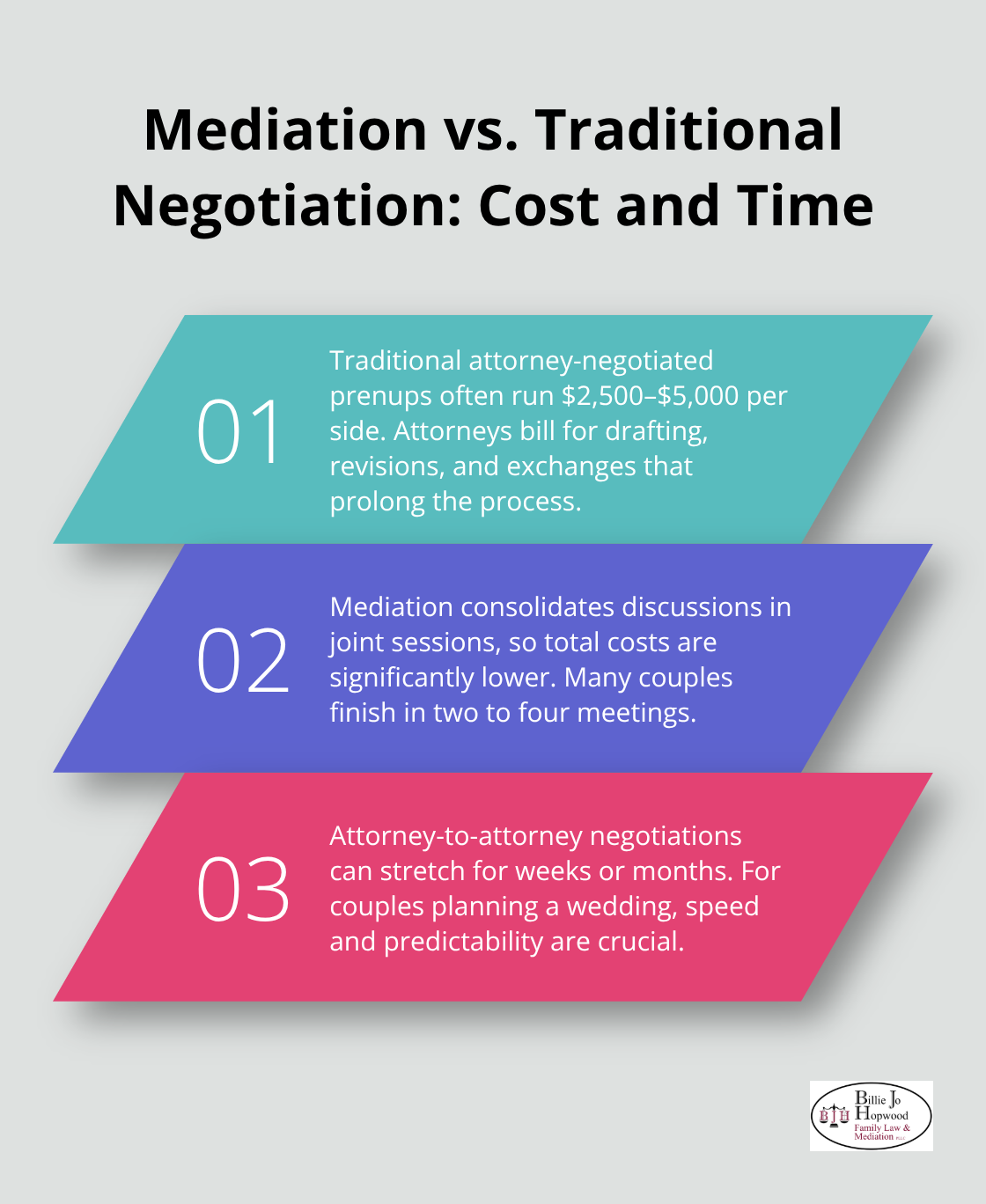
Mediated prenuptial agreements cost significantly less because both partners work through issues simultaneously rather than going back and forth through separate counsel. The timeline also shifts dramatically-mediation typically resolves prenuptial planning in two to four sessions, while attorney-negotiated versions extend for weeks or months. Couples preparing for weddings cannot afford that delay. Speed and affordability combine to make mediation the practical choice for most couples.
Building Stronger Financial Communication
Mediation addresses the emotional foundation of marriage differently than traditional negotiation. When both partners sit together with a neutral mediator to discuss finances, retirement, and property, they establish patterns of honest communication about money that actually strengthen the relationship. Couples who mediate prenups report feeling more secure about their financial future precisely because they negotiated terms together rather than having lawyers fight over them. This collaborative process means both people understand every provision in the agreement and feel ownership over the final document. The conversations that happen during mediation often reveal priorities and concerns that couples would never address otherwise, creating a stronger financial partnership before marriage even begins.
What Comes Next in Your Planning
Understanding how mediation works sets the stage for exploring other approaches to prenuptial planning. While mediation offers clear advantages, other methods exist that couples can use alone or in combination with mediation to create comprehensive protection.
Beyond Mediation: Other Paths to Your Prenuptial Agreement
Mediation works exceptionally well for most couples, but it is not the only legitimate approach to prenuptial planning. Collaborative law represents a structured alternative where both partners hire separate attorneys who commit contractually to resolve issues outside court. In collaborative prenuptial work, each attorney brings their client to structured four-way meetings where everyone negotiates face-to-face. The critical difference from traditional litigation is the agreement itself-if collaborative negotiations fail, both attorneys must withdraw, meaning neither side can later use them in court. This creates genuine incentive for settlement because attorneys lose the case if collaboration breaks down.
Understanding Collaborative Law Costs and Timeline
Collaborative prenuptial planning typically costs between $3,000 and $6,000 total, falling between mediation and traditional attorney-negotiated agreements. Some couples prefer this approach because each partner has dedicated legal counsel present during discussions, offering real-time advice about whether proposed terms protect their interests. The structured format with scheduled meetings also appeals to couples who want professional guidance but find sitting together in mediation uncomfortable. However, the collaborative process takes longer than mediation-usually four to eight weeks-making it less ideal for couples with approaching wedding dates.
The Single-Attorney Approach and Its Risks
Working directly with a single attorney who drafts a prenuptial agreement for both partners creates efficiency but introduces obvious conflicts of interest that Florida courts scrutinize heavily. Courts want evidence that both partners understood their rights and entered the agreement voluntarily, which becomes harder to prove when one attorney represents both sides. Some couples use this approach anyway, particularly when finances are straightforward and one partner defers to the other’s preferences, but this carries real legal risk if either person later challenges the agreement’s enforceability.
Combining Methods for Maximum Protection
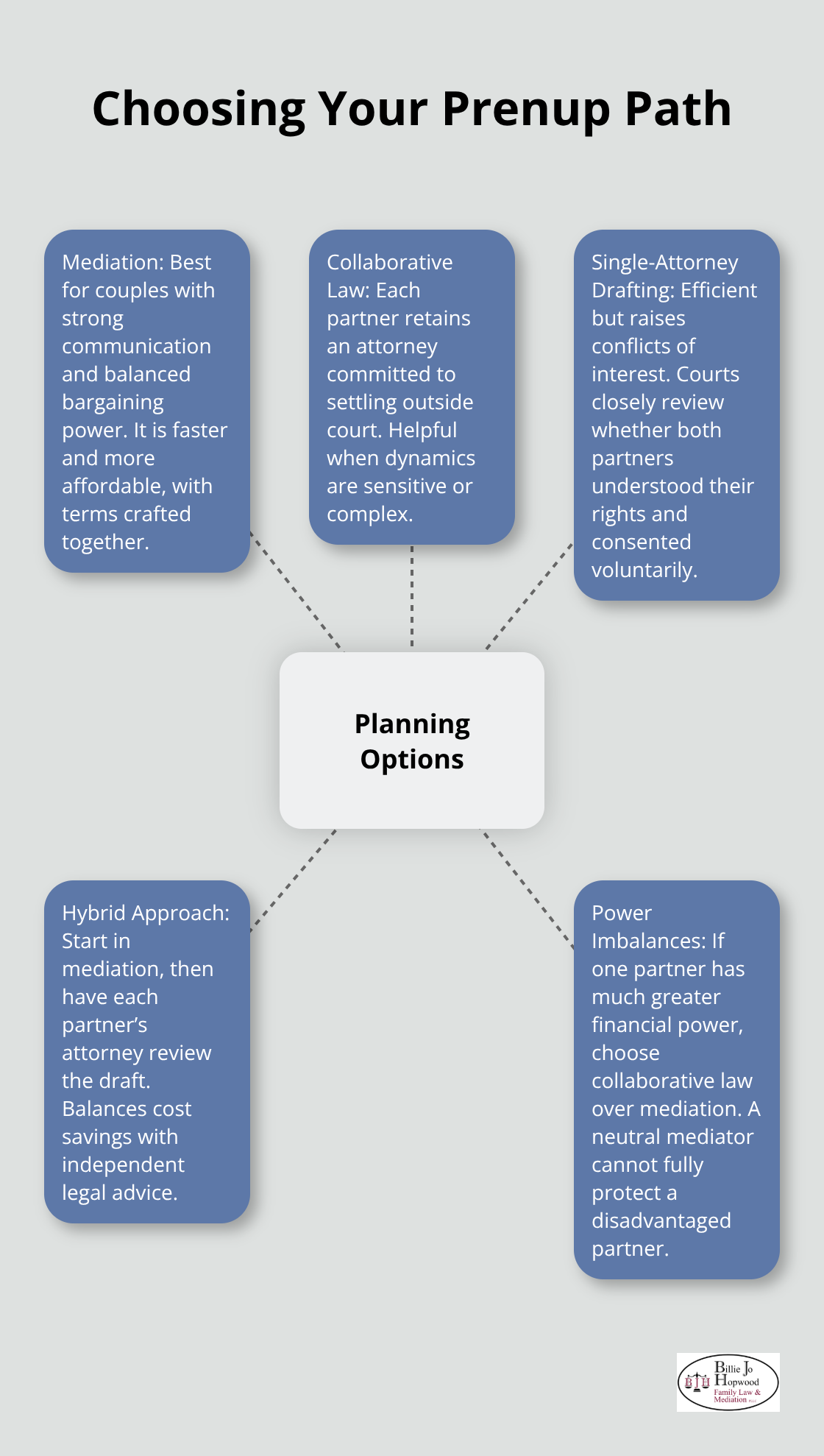
The smartest approach combines methods strategically based on your specific situation. Couples with significant assets or business interests often start with mediation to establish general principles, then have each partner’s attorney review the draft separately before finalizing. This hybrid approach costs more than pure mediation but less than full collaborative process, while ensuring both partners received independent legal counsel. Couples where one partner has much greater financial power should skip mediation entirely and use collaborative law, since mediation assumes roughly equal bargaining positions-when power imbalances exist, a neutral mediator cannot fully protect the disadvantaged partner.
Matching Your Approach to Your Circumstances
Couples marrying quickly before major financial decisions occur can use basic mediation efficiently. Couples with blended families, substantial retirement accounts, or business ownership benefit from attorney involvement because these situations involve complex tax and legal consequences that mediators cannot address. The wrong choice wastes money and creates unnecessary conflict; the right choice protects both partners while preserving the relationship as you begin marriage.
Final Thoughts
Prenuptial mediation alternatives give you real control over your financial future without the conflict and expense that traditional litigation creates. Whether you choose mediation, collaborative law, or a combination of approaches, the key is selecting a method that matches your specific circumstances and relationship dynamics. Couples with straightforward finances and strong communication benefit most from mediation’s speed and affordability, while those with complex assets, business interests, or power imbalances need attorney involvement to protect both partners adequately.
Professional guidance transforms prenuptial planning from a source of tension into an opportunity for honest conversation about money and priorities. A neutral mediator or experienced family law attorney helps both partners understand their rights, explore options, and reach agreements that actually reflect what you both want. When couples negotiate together with professional support, they build stronger financial partnerships before marriage even begins.
We at Billie Jo Hopwood Family Law & Mediation, PLLC help couples navigate prenuptial planning with compassion and clarity. Whether you need mediation, legal guidance, or a combination approach, contact us today and let our team guide you through the process to create an agreement that protects both partners.