A Brevard County parenting plan is a legal document that outlines how you and your co-parent will share time with your children and make decisions about their upbringing. This plan becomes the foundation for your family’s routine after separation or divorce.
We at Billie Jo Hopwood Family Law & Mediation, PLLC help families in Brevard County create parenting plans that work for everyone involved. This guide walks you through what goes into a solid plan and how to get one in place.
What Parenting Plans Actually Do
The Legal Framework That Governs Your Child’s Life
A parenting plan in Brevard County is far more than a scheduling document-it’s the legal framework that governs your child’s life after separation or divorce. Florida law requires every custody case to include a parenting plan that specifies time-sharing arrangements, decision-making authority, and how you’ll handle everything from school pickups to medical emergencies. The court won’t finalize your custody order without one. This isn’t optional paperwork; it’s the document that determines whether you get equal time with your child or majority time, who decides which school they attend, and what happens if one parent wants to relocate.
Courts in Brevard County use parenting plans to enforce consistency and reduce conflict between parents. When disputes arise later-and they often do-the judge looks directly at what your parenting plan says. If it’s vague or incomplete, you’ll end up back in court paying attorney fees to clarify something that should have been settled years earlier.
Florida’s Specific Requirements
Florida’s requirements are specific and non-negotiable. Your parenting plan must describe the daily child-rearing tasks each parent handles, include a detailed time-sharing schedule covering weekdays, weekends, holidays, and school transitions, and designate who makes decisions about healthcare, education, and religious upbringing. You also need to specify communication methods between parents, outline how you’ll exchange the child, and include a dispute resolution process-preferably mediation before court.
The American Academy of Pediatrics and American Psychological Association emphasize that stable routines and ongoing contact with both parents directly support child development, which is why Florida courts take these details seriously. Courts presume that equal time-sharing serves the child’s best interests unless proven otherwise, but that presumption only works if your plan actually supports it with realistic, workable schedules. Vague language like “whenever works” or “as agreed” creates enforceability problems.
Moving Forward With Mediation Support
If you and your co-parent struggle to agree on the details, the Brevard/Seminole Court Mediation Program handles family law mediation specifically for time-sharing and parenting plan disputes. This mediation option provides an efficient first step before you file with the court, allowing both parents to work through disagreements with a trained mediator present. The process remains confidential, and mediators help you translate your family’s actual needs into language the court will recognize and enforce.
What Actually Goes Into Your Parenting Plan
The Three Core Elements That Make a Plan Work
Your parenting plan needs three concrete elements working together, and skipping any one of them creates real problems down the road. The first is your time-sharing schedule, which must specify exactly when each parent has the child-not vague language like “reasonable visitation” but actual days, times, and transitions. Florida courts presume equal time-sharing (roughly 50-50) serves the child’s best interests unless you can prove otherwise, according to Florida Statute 61.13. This means if you want unequal time-sharing, your plan needs to explain why that arrangement actually benefits your child, not just why it’s convenient for you.
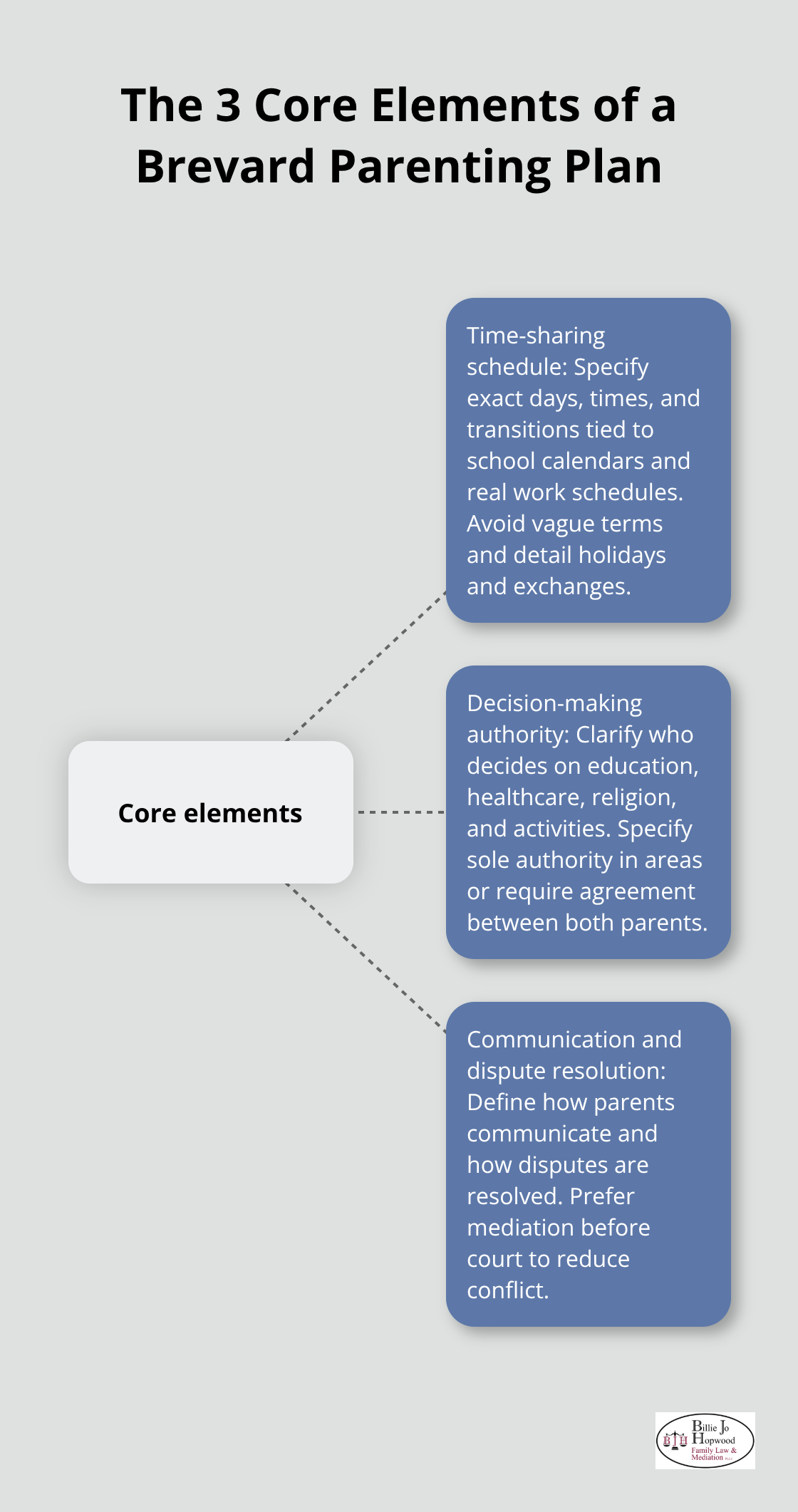
The second element is decision-making authority-who decides about school enrollment, healthcare, religious upbringing, and extracurricular activities. Florida law requires you to designate this clearly, either giving one parent sole authority over specific areas or requiring both parents to agree. The third element is your communication method and dispute resolution process, because parents who can’t talk directly need a structured way to handle disagreements without involving children in conflict.
Building a Time-Sharing Schedule That Actually Works
Your time-sharing schedule should align with your child’s school calendar and your actual work schedules, not an idealized version of your life. If you work retail with rotating shifts, a rigid Monday-Wednesday-Friday schedule won’t work-the plan needs flexibility built in. Include specific pickup and dropoff times, designate neutral exchange locations to reduce conflict, and specify who handles transportation for school, extracurricular activities, and medical appointments. Holiday schedules matter more than you’d think; rotating Thanksgiving or Christmas between parents prevents annual arguments. The Brevard/Seminole Court Mediation Program specifically handles parenting plan modifications and disputes, offering a faster, cheaper alternative to court when circumstances change.
Managing Health Insurance and Medical Costs
Health insurance and medical costs must be allocated between parents, with one parent typically carrying the primary plan and the other reimbursing their share based on income. Florida’s income shares model for child support means both parents’ earnings determine how medical expenses are split. Parenting coordinators, permitted under Florida law, can help high-conflict families manage these details without constant court involvement. Your plan should include a relocation clause specifying that moving more than 50 miles from the other parent requires notice and a modification process, since relocation disputes frequently land families back in court. Document everything in your final plan-vague agreements become expensive problems when one parent’s memory doesn’t match the other’s, and the court will look to what you actually wrote when disputes arise later.
Getting Your Parenting Plan Approved and in Place
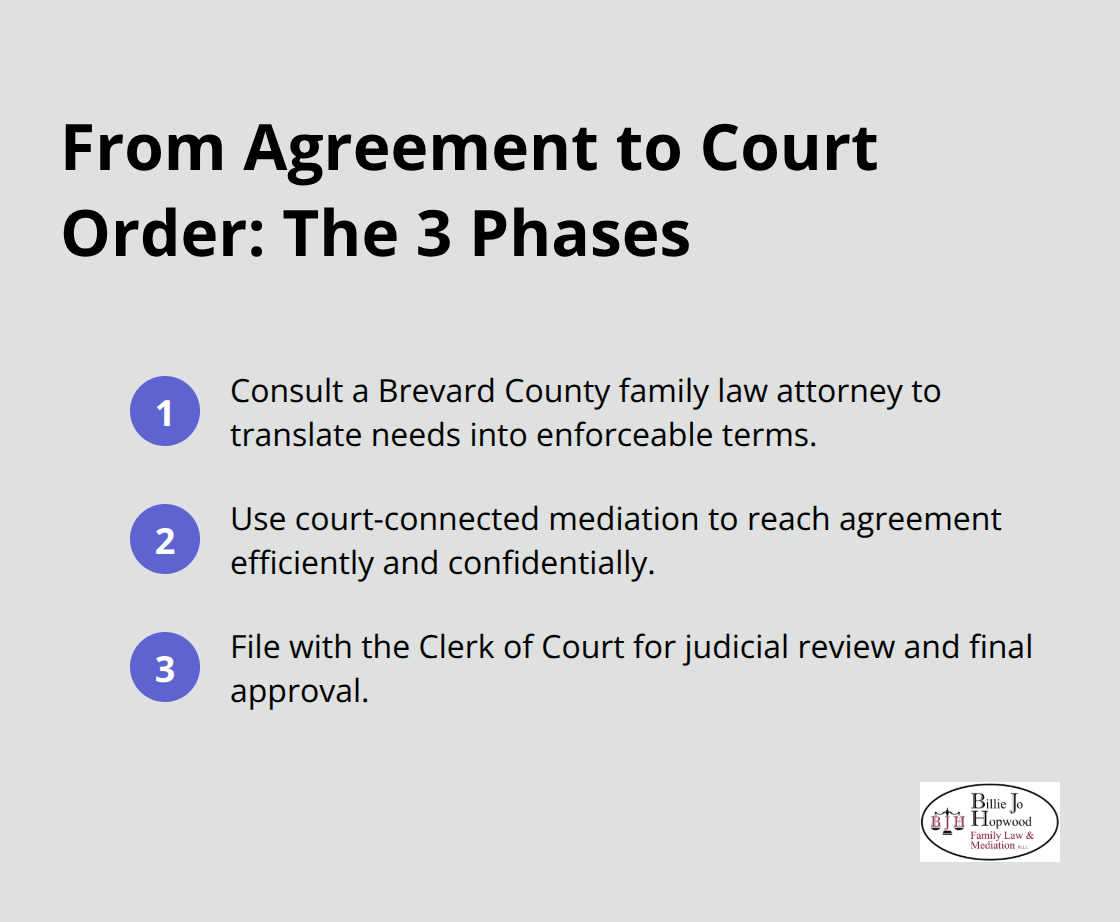
Most parents in Brevard County underestimate how much work goes into turning a parenting plan concept into a court-approved document. The path from initial agreement to final order involves three distinct phases, and cutting corners in any of them creates enforceability problems later.
Working With a Family Law Attorney
Start with a family law attorney who understands Brevard County’s specific court procedures and local judges’ expectations. An attorney translates your family’s actual needs into enforceable terms, specifying exact times rather than vague phrases like “reasonable visitation.” The attorney also drafts language that the Brevard County Clerk of Court will accept without requiring revisions, saving you time and additional filing fees.
Using Mediation to Reach Agreement
If you and your co-parent disagree on the details, the Brevard/Seminole Court Mediation Program provides a structured first step before filing with the court. Family mediation through this program costs $60 per party if your combined income falls below $50,000, or $120 per party if combined income ranges from $50,000 to $100,000. If combined income exceeds $100,000, you’ll need private mediation, which typically costs $150 to $300 per hour depending on the mediator. Mediators certified by the Florida Supreme Court facilitate these discussions without providing legal advice, keeping the process confidential and focused on reaching agreement rather than preparing for court. Sessions happen online via video conference, which simplifies scheduling around your existing parenting time and school calendars.
Negotiating Terms That Prevent Future Disputes
Negotiating the actual terms requires both parents to be honest about work schedules, travel commitments, and the child’s needs rather than using the parenting plan as a leverage tool. The most successful plans include specific details that prevent future disputes: exact pickup and dropoff times, designated neutral exchange locations (many Brevard County families use public libraries or police station parking lots), and clear protocols for illness or emergencies. Document whether one parent handles health insurance and how the other reimburses their share of medical costs based on income, since Florida’s income shares model requires this allocation. Include a relocation clause that specifies moving more than 50 miles from the other parent triggers a modification process, because relocation disputes frequently land families back in court.
Filing and Court Approval
Once you and your co-parent finalize the terms, your attorney files the parenting plan with the Brevard County Clerk of Court along with your marital settlement agreement or custody petition. The court reviews the plan to confirm it meets Florida’s requirements and serves the child’s best interests. Courts presume equal time-sharing serves the child’s best interests unless proven otherwise, so if your plan allocates unequal time, the court expects an explanation of why that arrangement actually benefits your child. After the judge approves and signs the order, the parenting plan becomes legally binding, and violations can result in makeup time orders, financial penalties, or custody modifications against the non-compliant parent.
Final Thoughts
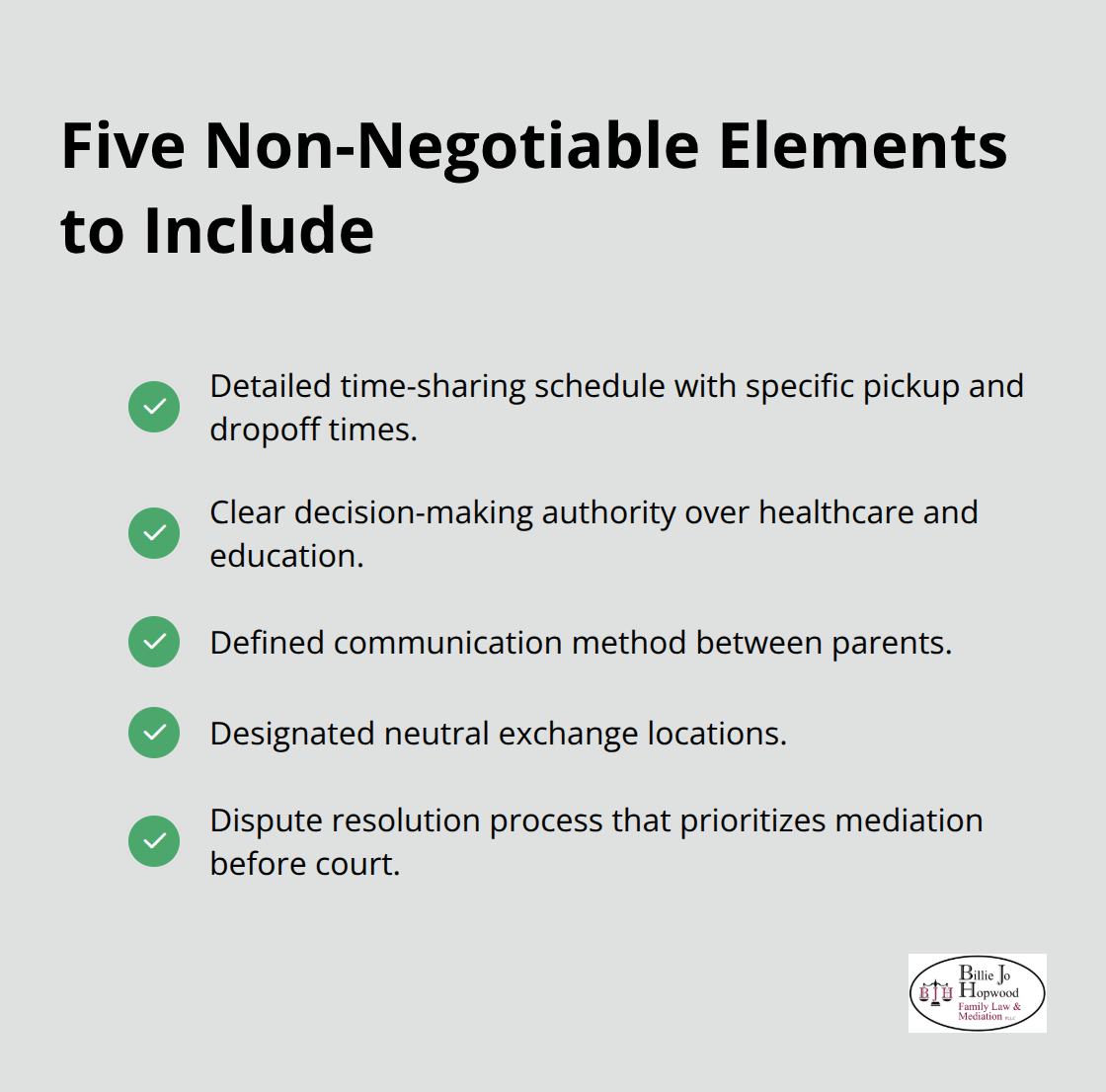
A solid Brevard County parenting plan includes five non-negotiable elements: a detailed time-sharing schedule with specific pickup and dropoff times, clear decision-making authority over healthcare and education, a communication method between parents, designated exchange locations, and a dispute resolution process that prioritizes mediation over court. Without these specifics, you’ll face enforceability problems when circumstances change or disagreements arise.
The plan also needs to address health insurance allocation, relocation procedures, and emergency protocols so both parents understand their responsibilities without ambiguity.
Brevard County offers concrete resources that most families overlook. The Brevard/Seminole Court Mediation Program handles parenting plan disputes for $60 to $120 per party depending on combined income, providing a faster and cheaper alternative to court litigation. Mediators certified by the Florida Supreme Court facilitate these sessions online, which simplifies scheduling around your existing parenting time. If your combined income exceeds $100,000, private mediation remains available through local providers.
Your parenting arrangement changes when your family’s circumstances change. Major life events like job loss, relocation, or changes in work schedules justify modifications, and the court retains jurisdiction to adjust the plan if it serves your child’s best interests. We at Billie Jo Hopwood Family Law & Mediation, PLLC help Brevard County families create parenting plans that work and guide you through modifications when life shifts.