
Divorce with children involved forces you to make decisions that shape your family’s future. Child custody mediation in Brevard offers a path where you and your co-parent work together instead of fighting in court.
We at Billie Jo Hopwood Family Law & Mediation, PLLC help families build parenting plans that actually work. This guide shows you how mediation gives you control over the outcome your children deserve.
Why Mediation Beats Court for Custody Decisions
How Mediation and Court Litigation Differ Fundamentally
Mediation and court litigation represent two entirely different paths to resolving custody disputes in Brevard County. In court, a judge makes the final decision about your child’s living arrangements and parental responsibilities after hearing arguments from both sides. The process is adversarial by design-your attorney argues against the other parent’s attorney, and you present competing evidence to convince a judge that your position is better. Mediation flips this dynamic entirely. You and your co-parent work with a neutral third party to find solutions you both can accept. The mediator doesn’t decide anything for you; they facilitate conversations, help you understand each other’s priorities, and guide you toward agreements that serve your child’s actual needs rather than winning points in a courtroom.
Why Parents Reach Agreement in Mediation
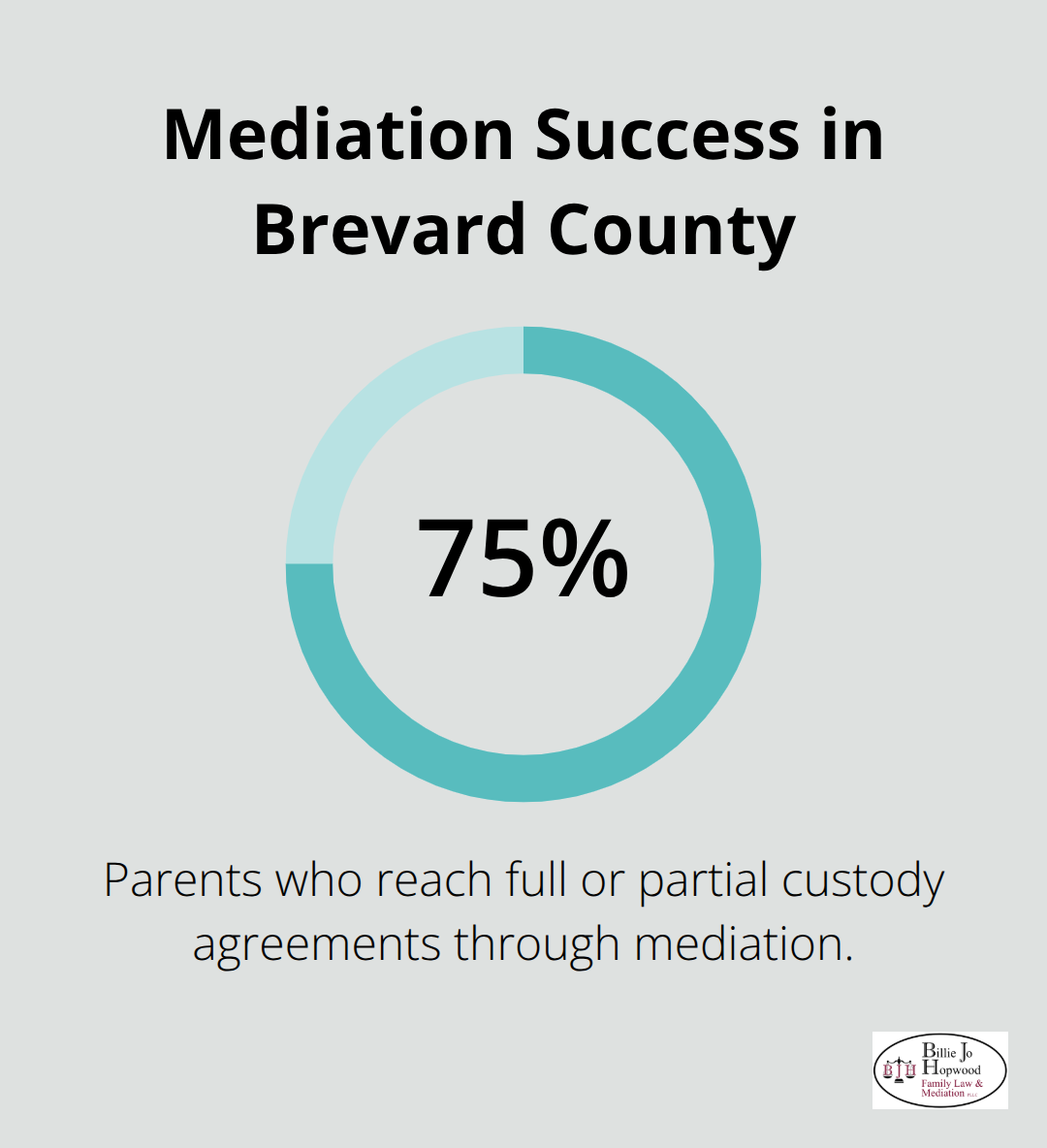
Florida State Courts data shows that about 75% of parents who attend mediation in Brevard County reach full or partial custody agreements, which means most families actually find common ground when given the right environment. This success rate reflects a fundamental shift in how you approach the problem. Instead of opposing each other, you collaborate.
The mediator creates space for both parents to express what matters most-whether that’s maintaining a strong relationship with your child, preserving your work schedule, or ensuring stability in your child’s school and social life. When you participate in creating the agreement, you feel ownership of it rather than resentment toward a judge’s imposed decision.
The Financial and Time Reality
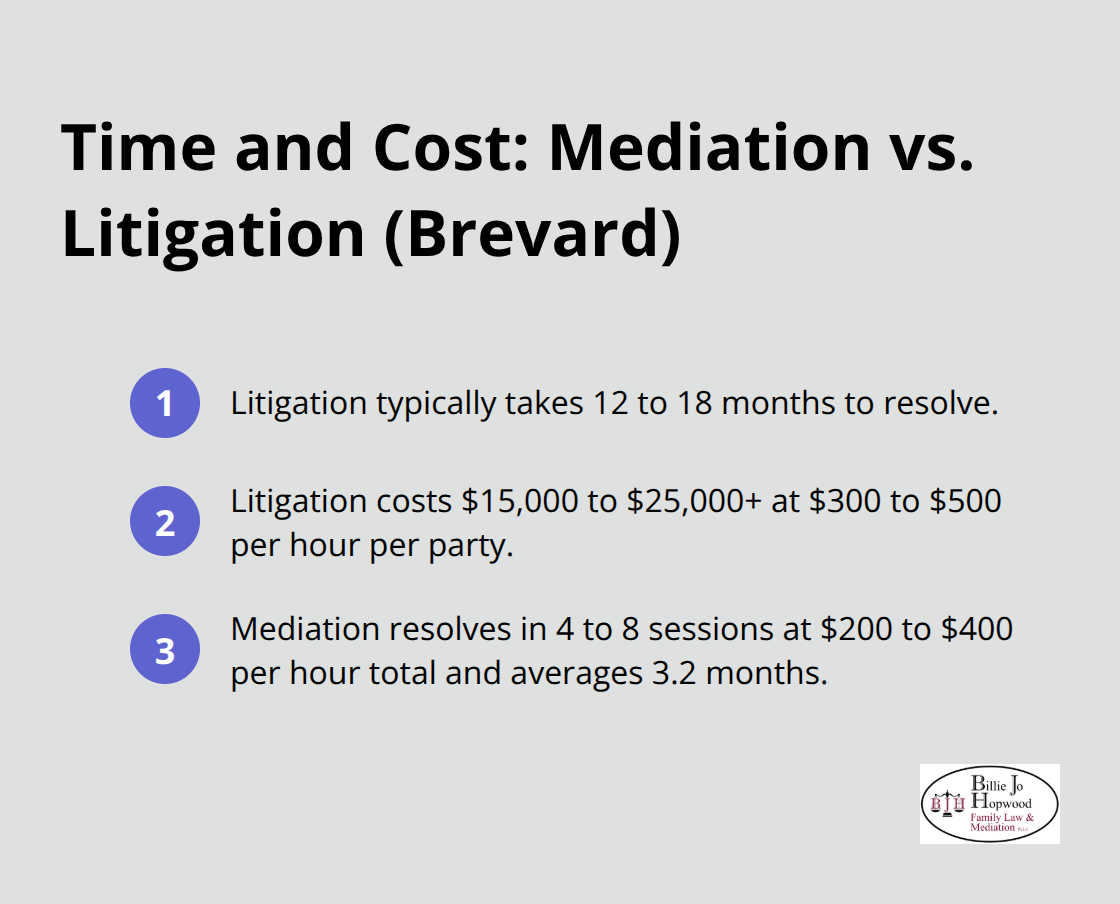
The financial and time differences between these two paths are stark. Litigation in Brevard typically takes 12 to 18 months and costs families $15,000 to $25,000 or more when you factor in attorney fees at $300 to $500 per hour per party, court fees, depositions, and discovery costs. Mediation resolves most cases in 4 to 8 sessions that cost about $200 to $400 per hour total and average completion in 3.2 months according to Florida State Courts data. You save money on discovery, depositions, and prolonged attorney involvement. You also reclaim months of your life that litigation would consume.
Compliance and Privacy Matter More Than You Think
Court orders come with enforcement challenges-research shows over 40% of court-ordered arrangements have violations in the first year because parents resent decisions imposed on them. Mediated agreements have an 87% voluntary compliance rate because both parents helped create them. When you reach agreement through mediation, you also keep the process private instead of having custody details become public court records, which matters significantly for professionals and business owners in the Melbourne area concerned about their reputation. Your parenting plan stays confidential, and your family’s circumstances don’t appear in public databases.
What Happens Next in Your Mediation Journey
Understanding these differences helps you see why mediation offers real advantages for your family’s future. The next step involves learning what actually happens during mediation sessions and how to prepare for conversations that will shape your child’s life going forward.
What Makes Mediation Work in Brevard Custody Cases
Focus on Your Child’s Actual Needs, Not Winning Arguments
Effective custody mediation in Brevard hinges on honest conversations about what your child actually needs, not what each parent wants to win. You discuss your child’s school schedule, their relationship with extended family, healthcare requirements, and emotional attachment to each parent rather than debating who deserves more time. Florida courts use specific best interest factors when custody disputes reach trial-including the child’s age and health, emotional ties to each parent, the stability of each home environment, and each parent’s ability to meet the child’s needs. Mediation lets you address these factors voluntarily before a judge ever evaluates them. You control the narrative instead of having a judge interpret your parenting capacity from limited courtroom testimony. The Eighteenth Judicial Circuit in Brevard County mandates mediation in about 85% of contested divorce cases, which means understanding how to navigate these conversations effectively saves you from eventual court involvement.
Gather Documentation That Demonstrates Stability
Start with concrete information: your child’s current school, their medical providers, their extracurricular activities, and the daily routines that matter most. When you bring this documentation to mediation, you shift the conversation from emotional arguments to practical arrangements that preserve what your child already knows and values. This approach grounds discussions in reality rather than competing claims about parenting capacity.
Build a Parenting Plan With Practical Details
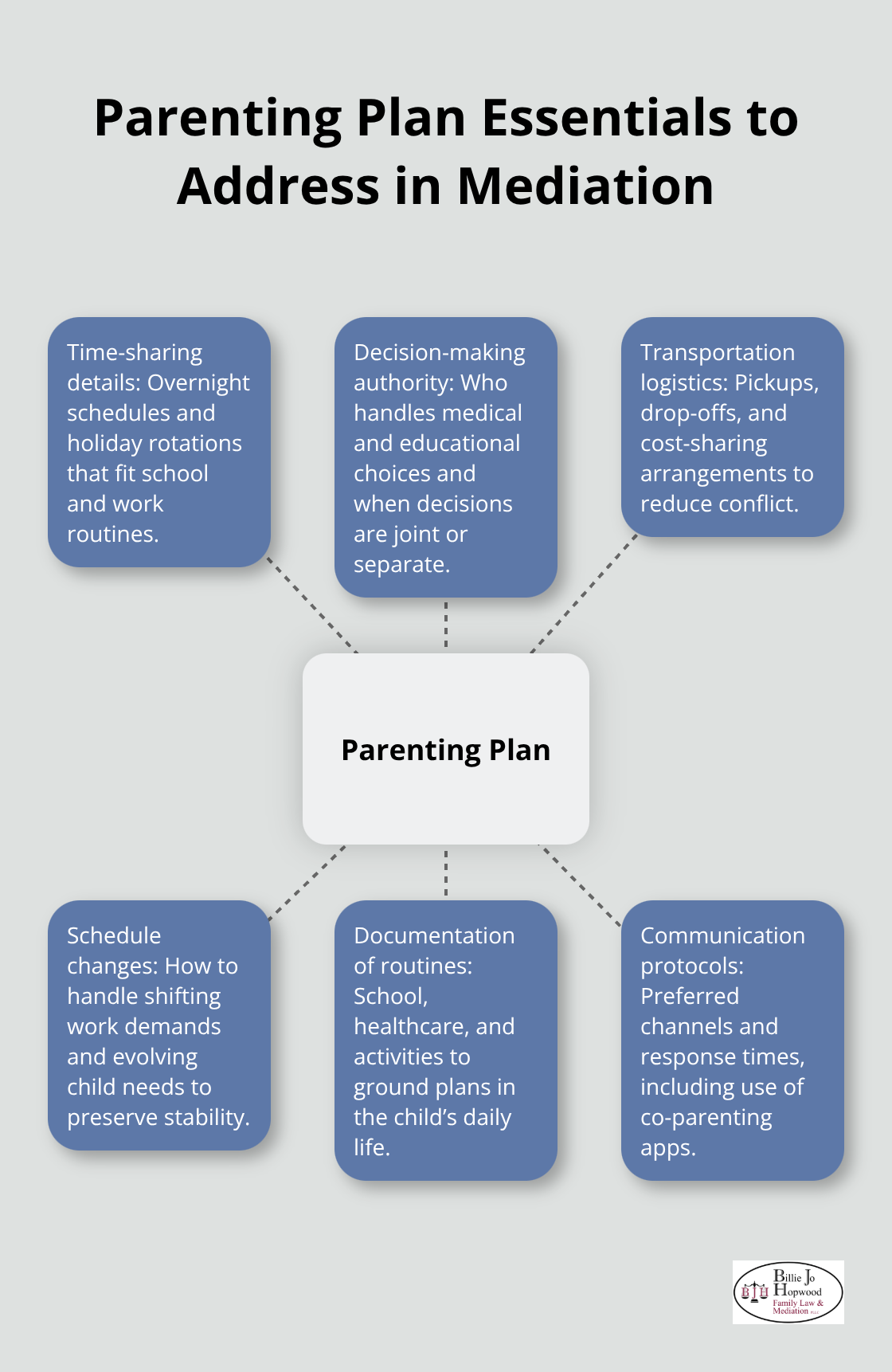
Creating a parenting plan that actually functions requires thinking beyond custody percentages. The plan needs to address overnight schedules, holiday rotations, transportation logistics, decision-making authority for medical and educational matters, and how you’ll handle schedule changes when work demands shift or your child’s needs evolve. Families in Brevard who mediate typically finish their agreements in 3.2 months according to Florida State Courts data, which means you reach clarity quickly enough to implement plans before problems arise.
A detailed parenting plan demonstrates stability and continuity to courts if modification disputes later emerge, so investing time in specifics during mediation protects both parents.
Address Specific Scenarios Before They Become Conflicts
Address whether parents will split holidays evenly, alternate them yearly, or divide them within the same year. Clarify who attends school conferences, who makes healthcare decisions independently versus jointly, and what happens if one parent needs to relocate for work. Include provisions for summer breaks, spring breaks, and how communication happens when the child is with the other parent. The mediator helps you think through scenarios you haven’t considered-like what happens when your child gets sick during the other parent’s time, or how you’ll handle sports tournaments that fall on transition days. This level of detail prevents future conflicts because both parents understand expectations upfront rather than discovering disagreements months into the arrangement.
Move Forward With Confidence Into Implementation
Once you’ve created a comprehensive parenting plan through mediation, the real work of co-parenting begins. The next chapter covers how to actually implement these agreements and maintain the cooperative relationship that makes shared parenting successful.
Custody Arrangements Families Choose in Mediation
Shared Custody With Equal Time-Sharing
Most families in Brevard County reach one of three primary custody structures during mediation, though the specific details matter far more than the label. Shared custody with roughly equal time-sharing works well when both parents live close to each other and maintain consistent schedules. Florida courts encourage shared parental responsibility, and mediation helps you build schedules that actually function with your work commitments and your child’s school calendar. One parent might have the child Monday through Wednesday evenings plus every other weekend, while the other parent has Thursday through Sunday.
The advantage is clear: your child maintains strong relationships with both parents without one parent feeling sidelined. Research from Florida State Courts shows that mediated arrangements with clear schedules have an 87% voluntary compliance rate, meaning parents actually follow through because they helped design them. However, equal time-sharing only works if both parents can commit to consistency. If your work schedule shifts unpredictably or you travel frequently, equal time-sharing creates constant rescheduling conflicts that undermine the stability your child needs.
Primary Custody With Scheduled Visitation
Primary custody with scheduled visitation becomes the practical choice when one parent has significantly more parenting capacity due to work stability, proximity to the child’s school, or existing daily routines. The primary custodian provides the home base where the child lives most of the time, typically 60 to 80 percent, while the other parent has defined overnight visits and weekends. This arrangement preserves continuity for your child’s school, friendships, and activities while still protecting the other parent’s relationship with the child.
The structure works because it acknowledges real differences in each parent’s capacity rather than forcing an artificial balance that neither parent can sustain. Your child benefits from a stable primary residence while maintaining meaningful contact with the other parent through regular, predictable visitation.
Holiday and Summer Break Schedules
Holiday and summer schedules require separate attention in either custody structure because they disrupt normal routines and often trigger conflict if not addressed explicitly. Families in Brevard who mediate typically allocate holidays by splitting them within the same year-one parent takes Thanksgiving, the other takes Christmas; one parent gets spring break in odd years, the other in even years-or by alternating entire holiday seasons yearly.
Summer break needs a specific plan addressing whether the child spends the entire summer with one parent, splits it evenly, or rotates weekly. The mediator pushes you to think through logistics like who handles transportation to summer camp, whether overnight visitation changes during summer months, and how you’ll communicate schedule changes. Families that fail to address these details in mediation face constant disputes once school ends because neither parent anticipated how the arrangement would function in practice.
Addressing Transportation and Transition Points
Transportation logistics often create unexpected friction in custody arrangements. Clarify who picks up and drops off the child at school, activities, and the other parent’s home. Specify whether one parent covers all transportation costs or you split them. Address what happens when the child needs to travel between homes on school days versus weekends, and whether either parent will handle longer drives for summer visitation or holiday exchanges.
Transition points-the moments when your child moves between homes-matter more than most parents realize. Some families benefit from neutral exchange locations like school or a community center rather than meeting at home, which reduces conflict and protects your child from witnessing tension. Others find that one parent dropping off and the other picking up works better than simultaneous exchanges.
Decision-Making Authority and Communication
Specify who makes decisions about medical care, education, extracurricular activities, and religious upbringing. Some parents share all major decisions equally; others assign specific categories to each parent. For example, one parent might handle educational decisions while the other manages healthcare choices. Include how you’ll communicate about your child’s needs, whether through text, email, or a co-parenting app, and establish response time expectations for urgent matters.
The mediator helps you think through scenarios you haven’t considered-like what happens when your child gets sick during the other parent’s time, or how you’ll handle sports tournaments that fall on transition days. This level of detail prevents future conflicts because both parents understand expectations upfront rather than discovering disagreements months into the arrangement.
Final Thoughts
Your child’s adjustment after divorce depends far more on how you and your co-parent interact than on custody percentages or schedules. When parents cooperate through child custody mediation in Brevard, children experience less conflict and maintain stronger relationships with both of you. Research consistently shows that children adjust better when they see their parents working together rather than fighting in court, and mediation creates that cooperative environment by design.
Court litigation removes your control over outcomes because a judge makes decisions based on limited courtroom testimony and legal arguments, then imposes an arrangement neither parent fully accepts. Mediation keeps decision-making power in your hands so you decide what works for your family’s specific circumstances, your work schedules, your child’s needs, and your living situations. You create agreements that reflect your actual life rather than fitting into a judge’s standard template, which matters because you understand your family’s complexity far better than any judge ever will.
Life changes constantly, and mediated agreements adapt more easily than court orders because you’ve already practiced working together. We at Billie Jo Hopwood Family Law & Mediation, PLLC help families in Melbourne navigate child custody mediation by guiding you toward agreements that serve your children’s actual needs-contact us to discuss how mediation can give your family the cooperative foundation that makes shared parenting work long-term.