
Divorce mediation offers a faster, more affordable path through separation than courtroom battles. We at Billie Jo Hopwood Family Law & Mediation, PLLC guide clients through each divorce mediation step with clarity and support.
This guide walks you through the entire process, from your first meeting to final settlement. You’ll understand what to expect and how to protect your interests along the way.
What Divorce Mediation Actually Is in Melbourne, Florida
The Core of Mediation: Control and Clarity
Divorce mediation is a structured negotiation where a neutral third party helps you and your spouse reach agreements on asset division, parenting arrangements, and support without stepping into a courtroom. A mediator does not decide outcomes for you-they facilitate conversation, clarify positions, and help generate settlement options both parties can accept. The process works because it shifts control from a judge to you. You shape the agreement instead of having terms imposed by someone unfamiliar with your family’s needs.
Speed and Cost Advantages Over Litigation
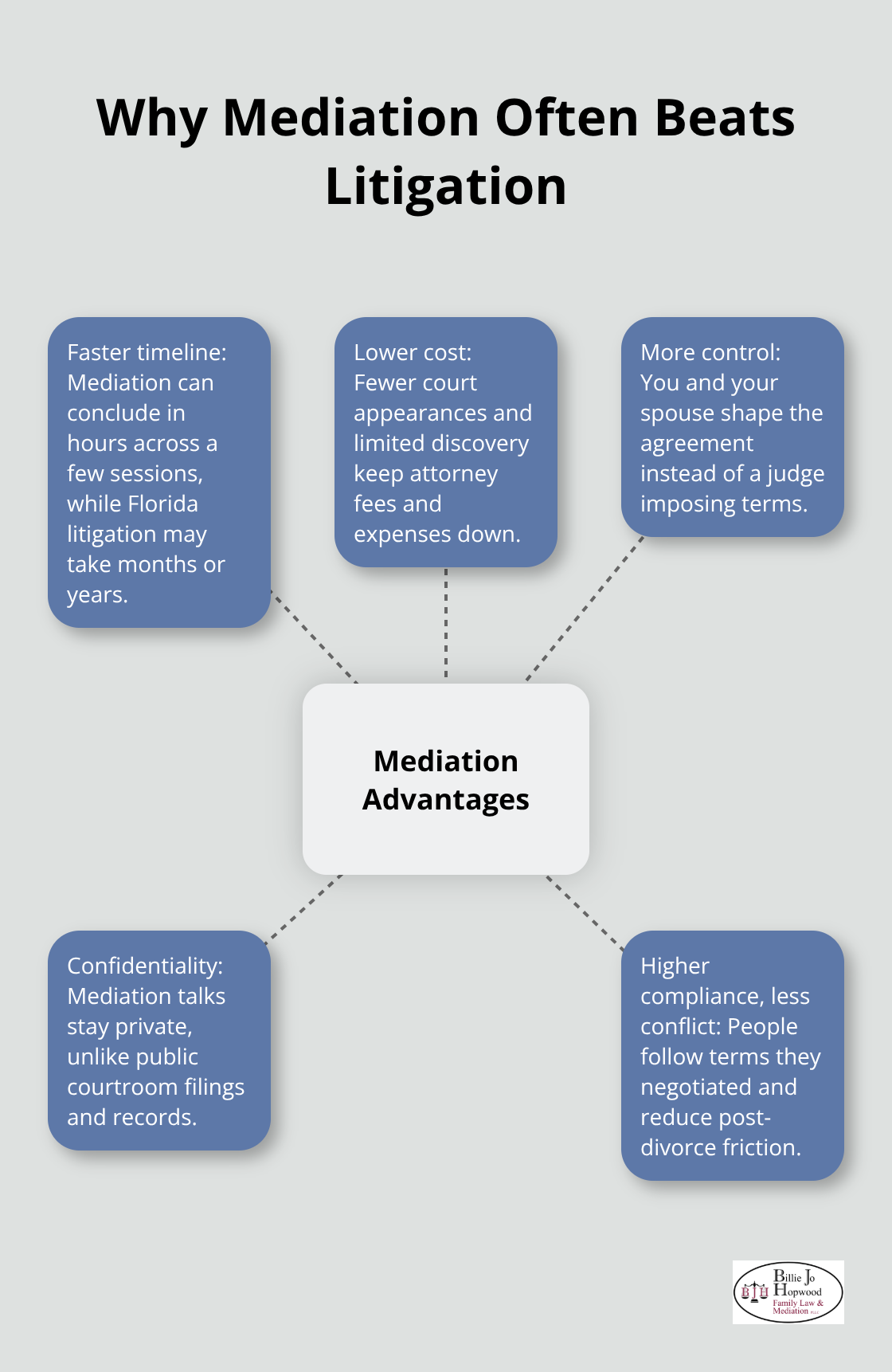
Mediation typically resolves disputes in a few hours across multiple sessions, whereas contested litigation in Florida can drag on for months or years. The cost difference is substantial. Mediation costs significantly less than litigation because you avoid lengthy court appearances, discovery disputes, and trial preparation. Court cases require depositions, motions, and formal proceedings that multiply legal fees quickly.
Privacy Protection Through Confidentiality
Mediation also keeps financial details private. Court records are public, meaning your asset division, income, and parenting arrangements become part of the public record. Mediation conversations remain confidential under Florida’s Mediation Confidentiality and Privilege Act, protecting sensitive information from public view.
How Mediation Differs From Courtroom Divorce
In court, a judge makes final decisions on custody, property division, and support based on state law and the evidence presented. You have limited input once litigation begins. The judge may order outcomes neither spouse finds satisfactory because the ruling reflects legal standards, not family preferences. Mediation flips this dynamic. You and your spouse control what gets decided. If you cannot reach agreement on an issue, mediation ends and you proceed to court-but mediation often prevents that outcome entirely.
Studies show mediated settlements produce higher long-term compliance than court-imposed orders because both parties agreed to the terms. You follow a parenting schedule or support payment you negotiated more reliably than one a judge ordered. Mediation also reduces conflict. The collaborative tone helps preserve relationships, which matters significantly when children are involved. Co-parenting after divorce requires ongoing communication, and mediation’s problem-solving approach supports that better than adversarial litigation. Court proceedings emphasize winning and losing, which hardens positions and damages family relationships further.
Timing: The Six-Month Waiting Period
Another practical difference lies in timing. Florida imposes a mandatory six-month waiting period from petition filing to finalization regardless of dispute resolution method. However, mediation can resolve all contested issues within weeks, allowing you to move through the waiting period with a complete settlement agreement ready for court approval rather than fighting over details during those six months. This preparation phase sets the stage for addressing the specific issues that mediation handles best.
How the Mediation Process Unfolds
Your First Session: Setting the Foundation
Your first mediation session sets the tone for everything that follows. The mediator explains the ground rules, outlines confidentiality protections under Florida law, and asks each spouse to describe their primary concerns and goals. This initial meeting typically lasts two to three hours and costs between $300 and $500 depending on the mediator’s hourly rate. Arrive with a list of specific questions and topics you want addressed-vague goals produce vague agreements. The mediator gauges what each party wants to accomplish, whether that’s minimizing conflict around parenting time, dividing retirement accounts fairly, or establishing reasonable alimony terms. They also assess whether both spouses will negotiate in good faith. If domestic violence, ongoing abuse, or severe trust erosion exists, the mediator may recommend alternative dispute resolution methods instead.
Private and Joint Meetings
Once ground rules are established, the mediator meets with both spouses and their attorneys together, then holds private sessions to understand each person’s priorities without the other present. This confidentiality protects candid discussion. You should have your attorney present during mediation to explain legal implications, protect your rights, and review any proposed terms before you agree to them. An attorney is not optional in this process-they’re essential.
Gathering Financial and Family Documents
Information exchange comes next. Bring comprehensive financial records: mortgage statements, deed of trust documents, retirement account statements, investment account records, tax returns from the last three years, recent pay stubs, and a complete list of debts with current balances. Also gather family documents including children’s birth certificates, school and health records, marriage certificate, any prenuptial or marital agreements, wills or trusts, and life insurance policy details. Florida uses equitable distribution for asset division, meaning the court aims for fairness rather than a strict 50/50 split. Inheritances stay separate property unless you commingled them with marital funds-the mediator needs to know this distinction.
Negotiation Rounds and Settlement Options
The negotiation rounds that follow involve the mediator proposing settlement options and testing whether both sides can accept proposed terms on custody arrangements, property division, and support calculations. Child support in Florida follows state formulas based on income and parenting time percentages, though mediation can address how to structure payments. Alimony factors include marriage duration, standard of living, each spouse’s earning capacity, education level, age, and physical or emotional condition. Negotiations may span multiple sessions. If progress stalls, the mediator suggests new angles or holds additional private meetings to break through impasses.
Drafting and Reviewing Your Settlement Agreement
Once both parties reach tentative agreement on all issues, your attorney drafts a formal settlement agreement that incorporates the mediated terms. Do not sign this agreement until your attorney reviews it thoroughly and confirms the terms align with your legal rights and Florida law. The mediator cannot provide legal advice, so your attorney’s independent review is your final safeguard before binding yourself to the settlement. With your agreement finalized and reviewed, you move into the next phase: addressing the specific issues that mediation resolves most effectively, from custody arrangements to financial divisions.
What Mediation Actually Resolves in Melbourne, Florida
Mediation in Melbourne, Florida handles the financial and parenting issues that consume most divorce disputes. These three areas represent where couples spend the most time negotiating, and where mediation produces the strongest outcomes because both parties shape the final terms rather than accepting a judge’s decision. Understanding what mediation can address helps you prepare realistic expectations and gather the right documentation before your first session.
Parenting Time and Custody Arrangements
Parenting time arrangements sit at the center of most mediation discussions when children are involved. Florida courts apply the best interest standard to custody decisions, but mediation lets you define what that means for your family rather than having a judge interpret it. The mediator helps you and your spouse work through specific details: which parent handles school decisions, how holidays split between households, whether overnight visits happen on weekends or weekdays, and how you communicate about parenting issues.
These practical arrangements matter far more than a custody label. One parent might have primary physical custody while the other has substantial parenting time on alternating weekends and one weeknight per week. Another arrangement might involve a 50/50 split with alternating weeks. Florida’s parenting time guidelines suggest a minimum of 20 percent time with the non-primary parent, but mediation lets you exceed these minimums if both parents want more involvement.
Your attorney should review any parenting plan to confirm it aligns with Florida law and protects your parental rights, but the mediator facilitates the actual negotiations.
Child Support Calculations and Structures
Child support calculations follow Florida’s income shares model, which considers both parents’ income, the number of overnights each parent has, and childcare costs. The state formula provides a baseline, but mediation can address how you structure payments, whether one parent pays the other’s health insurance premiums, and how you handle future adjustments if income changes significantly.
Asset and Debt Division
Asset and debt division requires the most documentation but often concludes faster than parenting arrangements because numbers are concrete. Florida uses equitable distribution, meaning fair rather than equal. The mediator helps you categorize what’s marital property versus separate property, which affects how items divide. A house purchased during marriage is marital property; an inheritance received during marriage stays separate unless you deposited it into a joint account.
Retirement accounts accumulated during the marriage split as marital property, with specific procedures for dividing 401(k)s and IRAs without tax penalties. The mediator does not calculate these divisions independently but facilitates discussion about who keeps the house, how you divide property, assets, and financial responsibilities, and who assumes which debts. Your attorney handles the technical language that transfers these assets legally.
Alimony Terms and Options
Alimony depends on factors including how long you were married, the income gap between spouses, your standard of living during marriage, and each person’s earning capacity. Florida recognizes multiple alimony types: temporary support during the divorce process, bridge-the-gap alimony for short-term adjustments after divorce, rehabilitative alimony if one spouse needs time to become self-sufficient, durational alimony for marriages of moderate length, and permanent alimony only for longer marriages where one spouse cannot become self-sufficient.
The mediator discusses these options and helps you evaluate what works for your situation. Courts review mediated agreements on alimony to verify the terms comply with Florida law and reflect the statutory factors, so your attorney’s input matters significantly before you commit to any alimony arrangement.
Final Thoughts
Your mediation agreement becomes a binding document once both spouses and your attorneys sign it, then moves to court for judicial review. The judge verifies that you entered the agreement voluntarily, that terms comply with Florida law, and that no coercion occurred. This approval process typically takes weeks rather than months because the judge reviews a completed settlement rather than presiding over contested disputes, and after court approval, your mediation agreement becomes part of the final divorce decree that legally ends your marriage and enforces all terms regarding property division, custody arrangements, and support payments.
Post-divorce life involves practical transitions beyond the legal paperwork. If you share custody, you implement the parenting schedule you negotiated; if you receive or pay alimony or child support, those payments begin according to the terms you agreed to. The collaborative nature of mediation often leaves families better positioned for these transitions than litigation does, since you negotiated terms together rather than fighting over them, which means you understand the reasoning behind each agreement and can implement them more smoothly.
The problem-solving approach you developed during the divorce mediation steps carries forward into co-parenting relationships and other post-divorce interactions. Contact Billie Jo Hopwood Family Law & Mediation, PLLC in Melbourne to discuss your mediation options and next steps.