
Parenting disputes during family separation hit hard, and the stakes feel impossibly high when your children are caught in the middle. We at Billie Jo Hopwood Family Law & Mediation, PLLC know that parents in Melbourne, Florida often struggle to separate their own pain from what their kids actually need.
These parenting disputes mediation tips focus on one goal: protecting your children while you work through disagreements with your co-parent. The strategies ahead show you how to communicate better, create stability, and find solutions that genuinely work for your family.
How to Talk to Your Co-Parent Without Letting Kids Pay the Price
Focus on Your Child’s Needs, Not Your Own Preferences
Your children don’t care about who was right in the argument that led to separation. They care about feeling safe, loved, and free from the burden of adult conflict. Research from the American Academy of Pediatrics shows that children exposed to ongoing parental conflict experience higher rates of anxiety, behavioral problems, and difficulty concentrating at school. Kids whose parents communicate respectfully about parenting decisions show better emotional adjustment and stronger relationships with both parents.
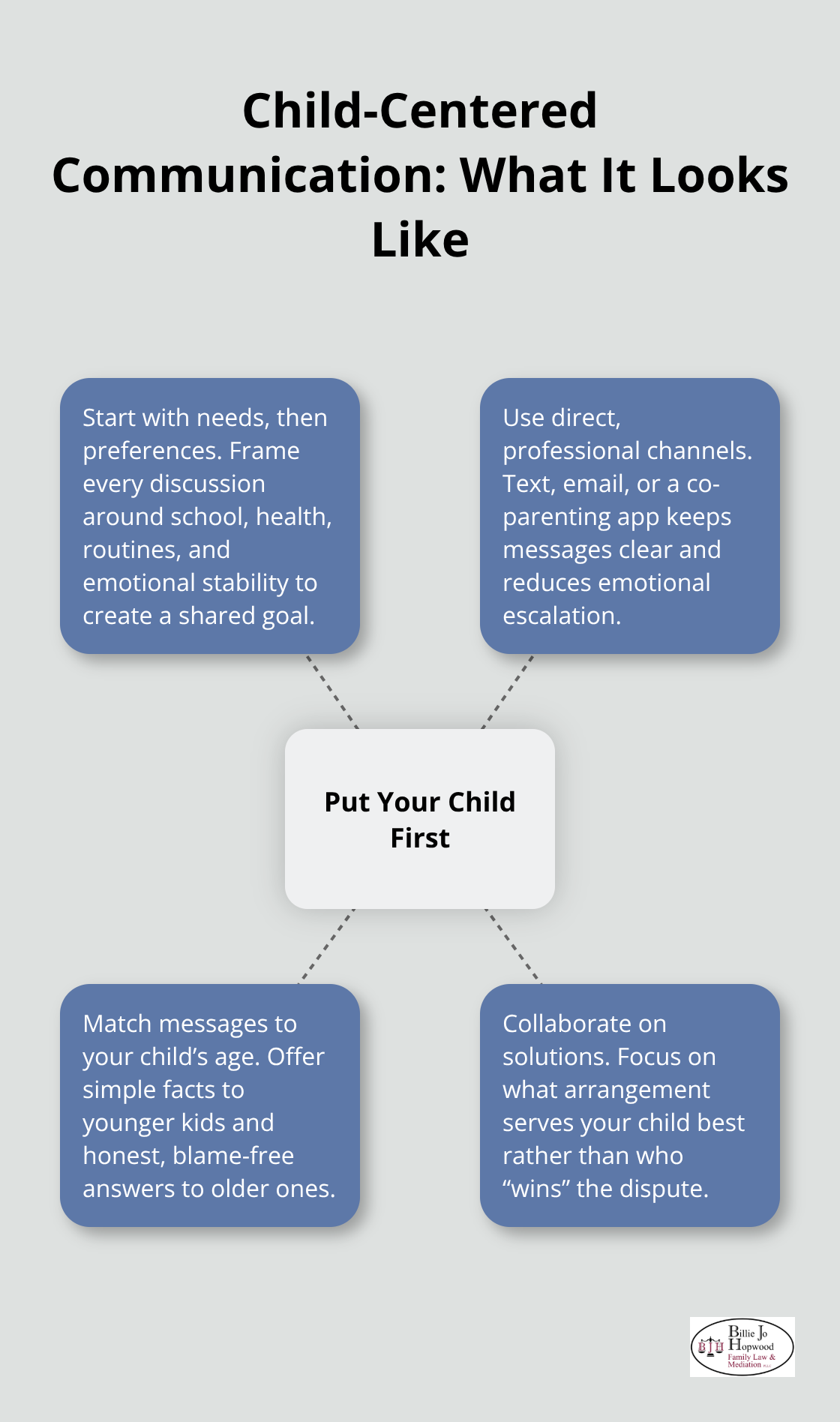
Accept a hard truth: your conversations with your co-parent need to address your child’s needs first, your preferences second. This isn’t about being nice for niceness’s sake. It’s practical. When you frame discussions around what your child needs for school, health, activities, or emotional stability, you give both parents a shared goal. Instead of debating who gets more time or who makes decisions, you ask what arrangement actually serves your child best. This shift in focus defuses defensiveness because you’re not attacking your co-parent’s character or choices. You’re solving a problem together.
Communicate Directly and Keep Conversations Professional
Never use your child as a messenger between households. This seems obvious until you’re frustrated and your child is standing right there. Telling your child to relay messages to the other parent puts them in an impossible position: they become responsible for adult communication, they carry emotional weight that isn’t theirs, and they often feel they need to choose sides. Instead, communicate directly with your co-parent through text, email, or a co-parenting app like Our Family Wizard, which creates a written record and keeps conversations professional.
If you struggle with direct communication, a mediator can facilitate these conversations in a structured way that prevents escalation. Mediation in Melbourne helps parents make this transition through structured conversations with a neutral third party who keeps discussions focused on your child’s wellbeing rather than past grievances.
Match Your Words to Your Child’s Age and Understanding
Keep what you say to your child age-appropriate and factual. Young children don’t need to understand the reasons behind custody arrangements or financial disagreements. Older children deserve honest answers to direct questions, but answers that focus on logistics and reassurance, not blame or details meant for adults. This approach protects their emotional development while maintaining their trust in both parents.
When disputes arise over parenting decisions, the way you handle communication sets the tone for how your child processes the separation itself. The next section explores how you create the physical and emotional stability your child needs while these conversations happen.
Building Stability When Disputes Escalate
Parenting disputes thrive in chaos. When routines crumble, boundaries blur, and emotions run hot, your child feels the instability directly. Children in separated households need predictability more than ever.
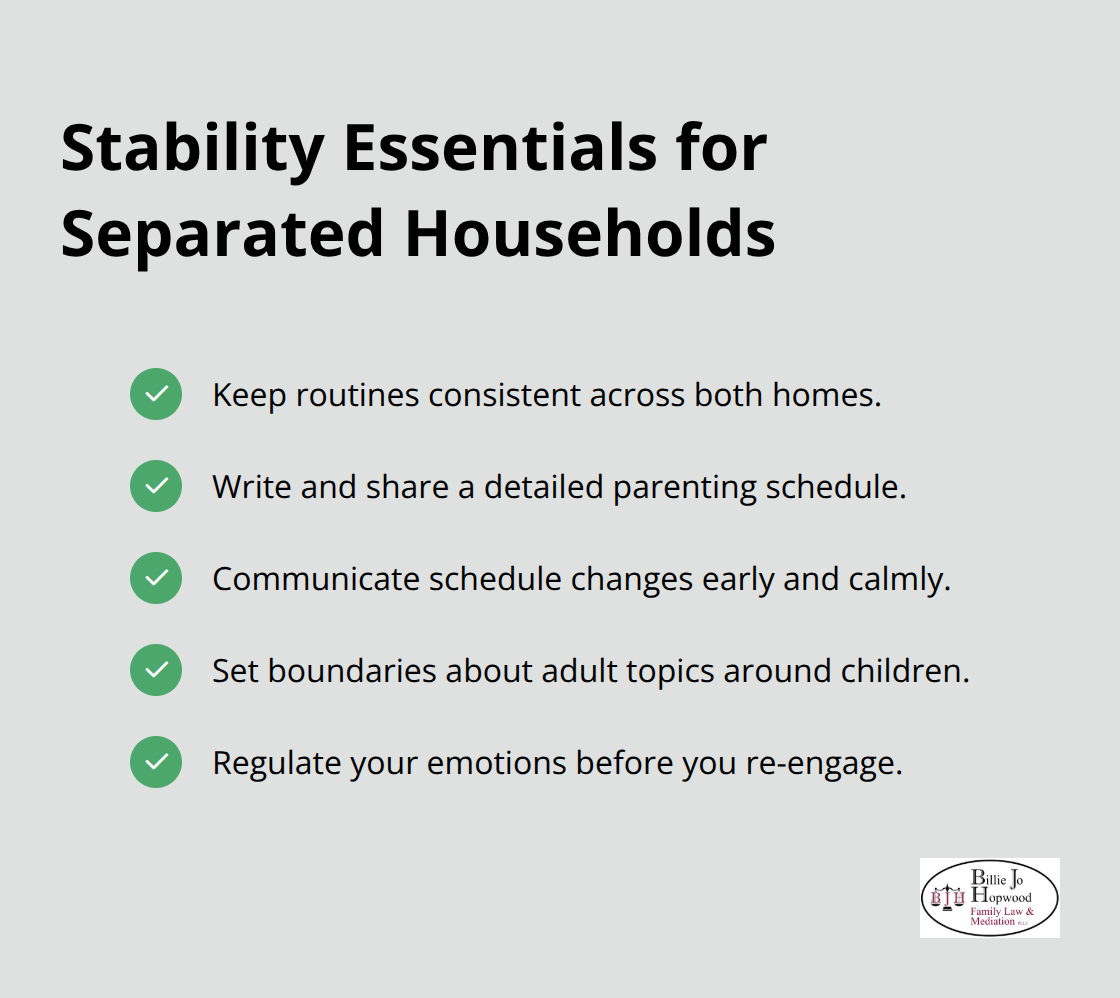
A study from the University of Virginia found that children with consistent routines across both homes showed significantly lower anxiety levels and better academic performance than those experiencing frequent schedule changes. This isn’t about rigid control; it’s about giving your child the security of knowing what comes next. Your child needs to know which parent picks them up from school on Tuesday, what time dinner happens, and where they sleep each night. These details matter far more than you might think.
Create a Written Schedule Both Parents Follow
Start with a written parenting schedule that both you and your co-parent commit to following. Use a shared calendar tool like Google Calendar or a co-parenting app such as Our Family Wizard so there’s no confusion about who has the child and when. Melbourne courts generally favor joint custody arrangements when possible, which means both parents share decision-making authority. Your schedule should specify drop-off and pick-up times, locations, and who handles transportation. Include school days, overnight stays, and holiday arrangements. When disputes arise about changes to this schedule, refer back to the written agreement instead of making reactive decisions. This removes emotion from logistics and protects your child from last-minute instability.
Handle Schedule Changes Carefully and Communicate Them Early
If changes become necessary, make them gradually and communicate them clearly to your child in advance so they have time to adjust. Avoid the temptation to use schedule flexibility as a punishment or reward against your co-parent. Your child pays the price for that inconsistency through increased stress and behavioral problems.
Set Firm Boundaries About What You Discuss in Front of Your Child
Boundaries between you and your co-parent prevent disputes from bleeding into your child’s daily life. Set clear limits about what you will and won’t discuss in front of your child. Financial arguments, relationship grievances, and custody disagreements stay between adults. When your co-parent brings up a contentious topic near your child, calmly say you’ll address it separately and change the subject. This boundary protects your child from feeling caught in the middle.
Manage Your Own Emotions So Your Child Doesn’t Absorb Them
Equally important is managing your own emotional response when your co-parent frustrates you. Children absorb parental stress like sponges. Research from the American Psychological Association shows that children exposed to high parental conflict display elevated cortisol levels (the stress hormone), which affects their sleep, immune function, and ability to learn. If you feel anger rising during an interaction with your co-parent, take a break. Step into another room, take three deep breaths, and return when you can speak calmly. Your child doesn’t need to witness your frustration. They need to see a parent who handles difficult situations with composure. This models emotional regulation and teaches them that strong feelings don’t require explosive reactions.
When you establish these foundations-predictable schedules, clear boundaries, and emotional control-you create the conditions where disputes lose their power to harm your child. The next step involves recognizing when professional help can move you past these disputes entirely.
Mediation as Your Path Forward
How Mediation Stops the Escalation
Court battles create a cycle that feeds on itself. When you file for custody in Brevard County, filing fees run around $409 as of 2023, and that’s before attorney fees and court costs pile up. If mediation fails and the case moves to trial, a custody evaluation may cost $1,500 to $6,000 and take several weeks.
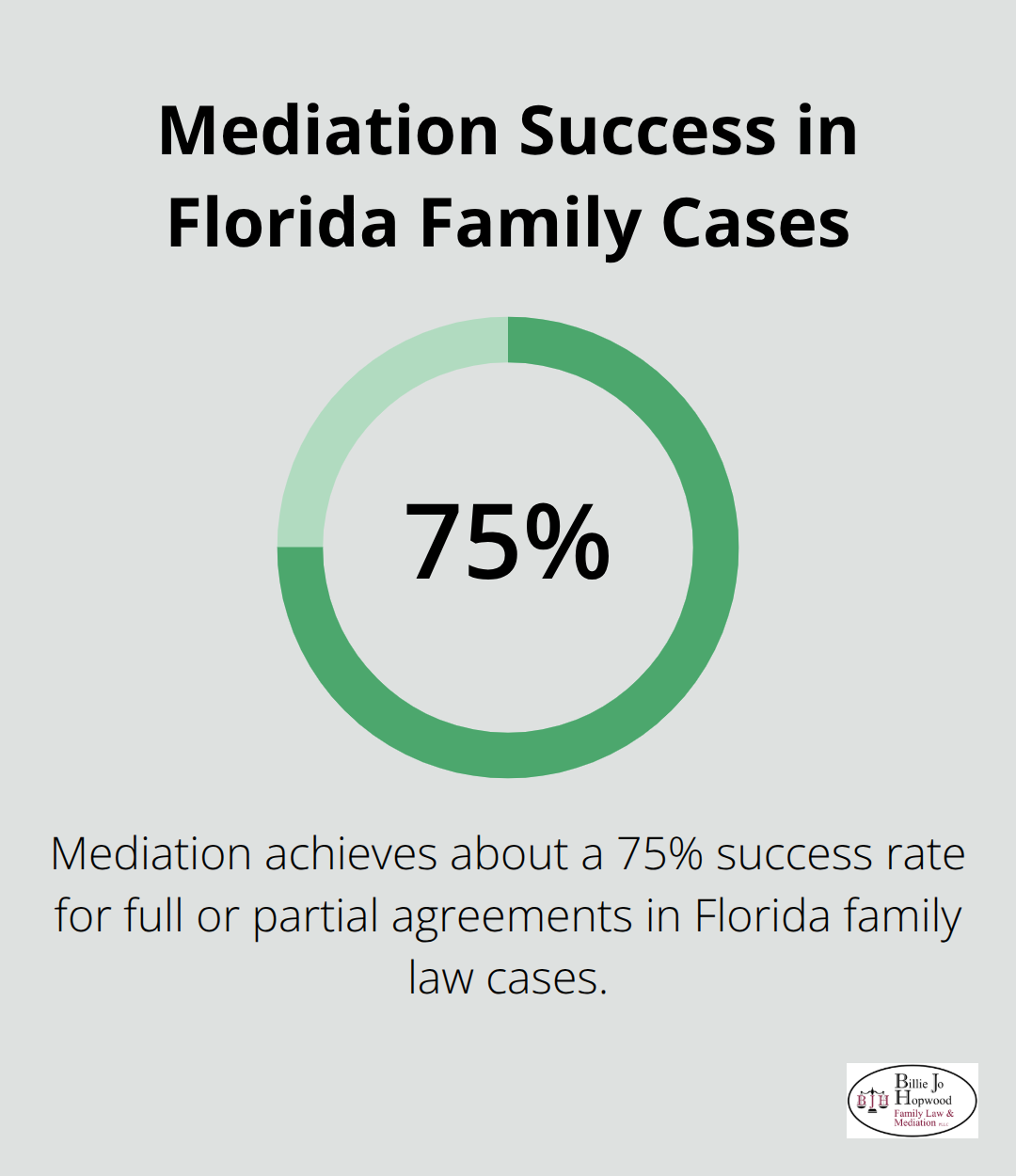
A neutral mediator, trained and certified by the Florida Supreme Court, guides you and your co-parent toward solutions you both control instead of handing the decision to a judge who doesn’t know your family. Mediation achieves about a 75% success rate for full or partial agreements in Florida family law cases. The mediator doesn’t decide outcomes or provide legal advice-you and your co-parent make the decisions together. This matters because when you design the parenting plan yourself, you create something that actually fits your lives instead of following a template the court imposes.
Speed and Confidentiality Work in Your Favor
Mediation happens faster than court proceedings. You schedule sessions on your timeline, not the court’s calendar. In Seminole and Brevard counties, family mediations occur online via video conference, which means you avoid hours spent driving to courthouse meetings. Confidentiality during mediation fosters open conversation in ways court proceedings never can. What you say in mediation stays confidential, with disclosures allowed only as required by law. This means you can explore solutions, acknowledge frustrations, and work toward compromise without worrying that your words become evidence against you later.
A Detailed Plan Prevents Future Disputes
A well-crafted parenting plan addresses daily routines, education decisions, medical care, and extracurricular activities with enough specificity that both parents know exactly what’s expected. You specify drop-off times, exchange locations, how you’ll handle school emergencies, and which parent makes healthcare decisions. This level of detail prevents the disputes that drag families back into conflict months or years later. Mediation also improves post-divorce communication because you’ve practiced resolving disagreements with a neutral person present. You learn how to separate the issue from the person, how to listen when your co-parent explains their perspective, and how to propose solutions that work for both of you. These skills carry forward into your long-term co-parenting relationship.
Understanding the Cost Structure
If you qualify as indigent, you can file an Application for Indigency with the Clerk of Court and access family mediation for free. Otherwise, combined income-based fees apply: under $50,000 annual household income costs $60 per party, and $50,000 to $100,000 costs $120 per party. Families earning over $100,000 must pursue private mediation. We at Billie Jo Hopwood Family Law & Mediation, PLLC can help you prepare documents that support a stronger parenting plan, even if you handle mediation without an attorney present.
Final Thoughts
Your child’s wellbeing comes first, and that principle guides every decision you make during a parenting dispute. The parenting disputes mediation tips covered in this post all point toward one outcome: a stable, cooperative arrangement where your child feels secure and loved by both parents. When you focus on your child’s needs instead of winning against your co-parent, when you maintain consistent routines and manage your emotions, and when you choose mediation over court battles, you protect what matters most.
Separation transforms your role as a parent rather than ending it. You and your co-parent remain partners in raising your child, even though you’re no longer partners in marriage. This shift in perspective changes everything-instead of viewing mediation as a loss or compromise, you see it as an opportunity to design a parenting arrangement that actually works for your family’s unique circumstances.
Melbourne, Florida families have access to resources that make this transition smoother, and we at Billie Jo Hopwood Family Law & Mediation, PLLC stand ready to help you navigate family law matters including custody arrangements and child support. Contact us today to learn how we can support your family through this process.