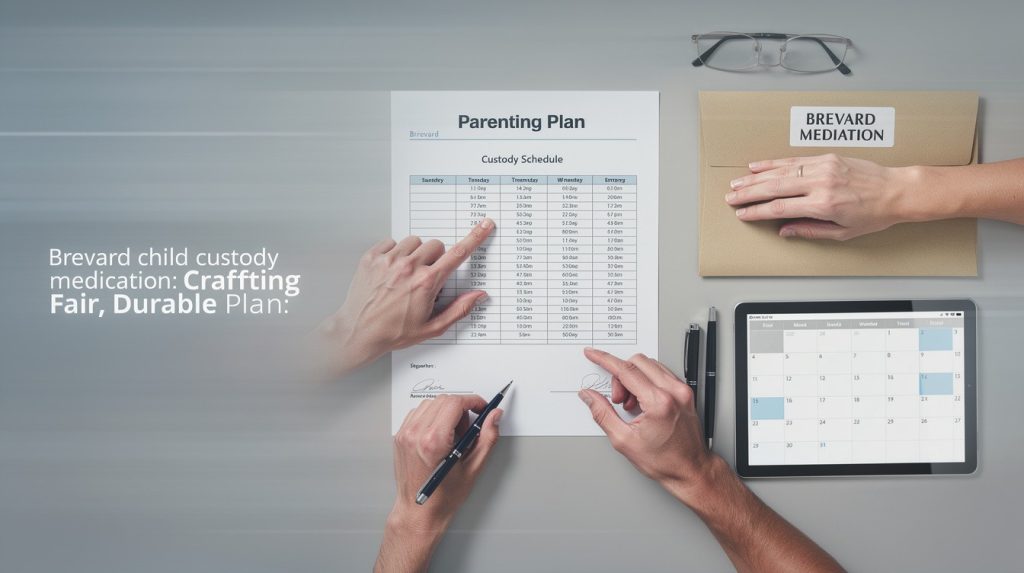
Custody disputes test families in ways that courtroom battles often make worse. We at Billie Jo Hopwood Family Law & Mediation, PLLC see parents in Brevard choosing mediation because it puts their children’s needs first instead of fueling conflict.
Brevard child custody mediation works differently than litigation. You and your co-parent shape the plan together, which means you’re more likely to stick with it.
How Custody Mediation Actually Works in Brevard
The Structure of Mediation Sessions
Custody mediation in Brevard is a structured process where you and your co-parent meet with a neutral third party to reach your own agreement about time-sharing and decision-making for your children. A trained, court-certified mediator facilitates conversation but does not make decisions or offer legal advice. The mediator helps you both communicate clearly, understand each other’s concerns, and identify common ground. Sessions typically last about 1.5 hours, and you pay per party per session.
Mediator Qualifications and Confidentiality
Brevard County mediators hold certification from the Florida Supreme Court and complete at least 16 hours of continuing education every two years. The process is confidential, meaning what you discuss stays private and cannot be used against you in court if mediation fails. This confidentiality removes the fear of having statements weaponized later, which allows parents to speak more openly.
How to Prepare for Mediation
Mediation works best when both parents come prepared with financial documents, a proposed calendar of time-sharing, and a clear list of priorities. You and your co-parent negotiate terms you both accept, then document those terms in a parenting plan that the court can enforce.
Why Mediated Plans Stick Better Than Court Orders
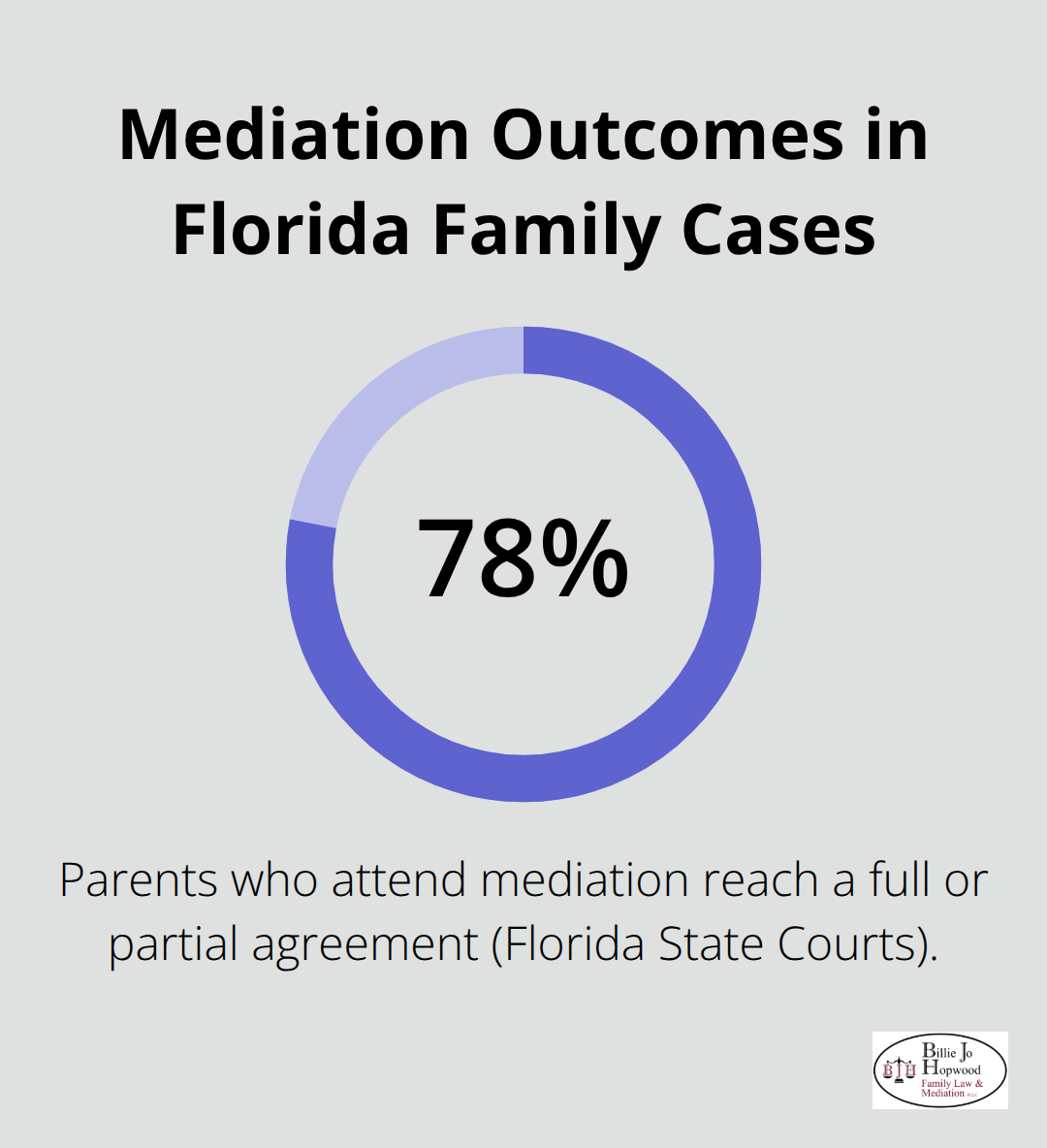
Parents invest in solutions they craft themselves. Nearly 78 percent of parents who attend mediation reach a full or partial agreement, according to Florida State Courts data. When a judge imposes a custody order from the bench, you get a decision neither parent fully wanted. When you create the plan together, you follow it because you built it.
Court battles drain finances, take months or years, and expose children to ongoing conflict as evidence gets presented and emotions escalate.
Mediation costs a fraction of litigation and resolves disputes in weeks, not years. Brevard families choose mediation because it protects their children from courtroom trauma while giving them control over the outcome. If safety concerns exist (such as domestic violence), mediation can include safeguards or be replaced with alternatives. For most families navigating custody disagreements, mediation produces fairer, more durable plans than adversarial court processes. The next step involves understanding what makes a custody plan actually work for your family’s unique situation.
What Should Go Into Your Custody Plan
Decision-Making Authority
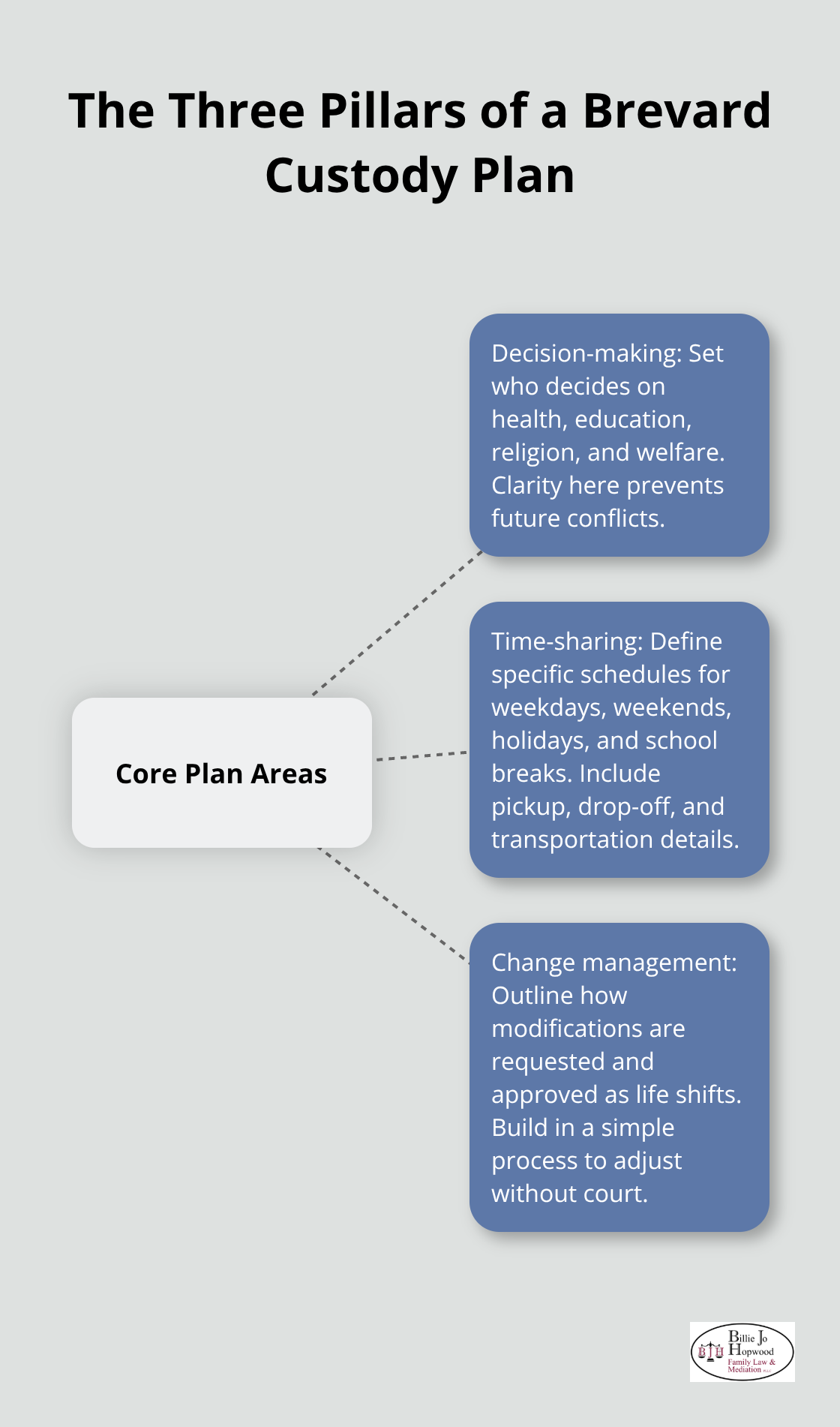
A solid custody plan addresses three concrete areas: who makes decisions about your child’s life, when your child spends time with each parent, and how you handle changes when life shifts. A comprehensive parenting plan should clearly specify decision-making authority for health, education, religion, and welfare. This means you write down who decides if your child gets braces, which school they attend, what religion they practice, and how medical emergencies are handled.
Vague language creates future conflict. Instead of saying you’ll decide health matters together, specify that either parent can consent to routine medical care but both must agree on surgery or major treatment. For education, state explicitly whether both parents must approve school choice or if one parent decides. Include who pays for each category of expenses: health insurance premiums, uninsured medical costs, childcare, extracurriculars, and college savings.
Time-Sharing Schedules and Holiday Arrangements
Detailed, calendar-based parenting time schedules that include weekdays, weekends, holidays, and school breaks reduce post-divorce disputes significantly. Your schedule should specify exact pickup and drop-off times, locations, and who handles transportation. You write out holiday arrangements for Thanksgiving, Christmas, Easter, spring break, summer break, and birthday celebrations. You anticipate relocation provisions now: if one parent wants to move more than 50 miles away, what happens to the schedule? You build in a modification process that allows you to adjust the plan as your children grow without returning to court each time. You create a straightforward process for changing the plan, including notice requirements and timelines for both parents to respond.
Managing Changes and Emergencies
Life changes fast when children are involved. A parenting coordinator can help manage ongoing disputes without court involvement, which is recommended for high-conflict situations. You include contingency plans for emergencies and medical decisions when parents disagree, specifying who obtains temporary authority if one parent becomes unavailable. If your child is old enough, you involve their preferences appropriately-not by letting them choose a parent, but by acknowledging their input about activities, school preferences, or scheduling adjustments. Age-appropriate involvement reduces children’s anxiety about the plan.
Enforcement and Dispute Resolution
You document your final agreement formally and file it with the court in Brevard County to make it enforceable. A step-by-step dispute-resolution clause that escalates issues from mediation to court only if necessary protects both parents from costly litigation over minor disagreements. These specific, workable details transform a custody plan from a general framework into a document that actually guides your family’s daily life. The strength of your plan depends on how thoroughly you address the practical realities your family will face, which leads directly into understanding the obstacles that commonly arise during mediation and how to work through them.
What Actually Derails Custody Mediation
Emotional Volatility Stops Progress Fast
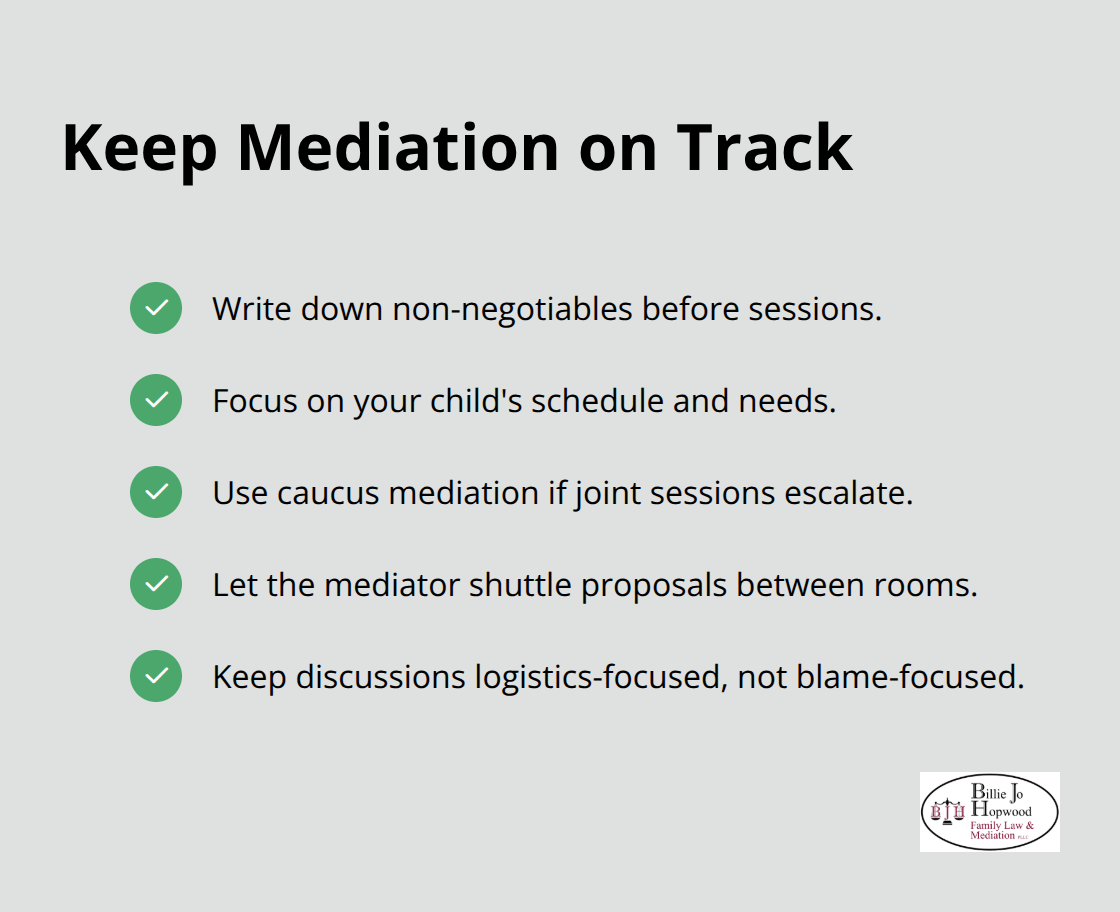
Emotional volatility during mediation sessions destroys more agreements than genuine disagreement about parenting ever does. Parents walk in angry, hurt, or defensive, and that raw emotion floods the conversation before anyone addresses the actual custody issues. When one parent attacks the other’s parenting ability or brings up infidelity, the mediator redirects, but the damage to trust compounds. The National Council of Juvenile and Family Court Judges recommends that parents preparing for mediation write down their non-negotiables beforehand and practice staying focused on your child’s schedule and needs rather than your co-parent’s failures. Separating emotion from logistics works. If you cannot sit in the same room without escalating, caucus mediation lets you meet separately with the mediator, who shuttles proposals between you. This approach removes the face-to-face confrontation that triggers defensiveness.
Parenting Philosophy Disagreements Hide Control Issues
Disagreements about parenting philosophy often mask deeper control issues. One parent insists on strict bedtimes while the other allows flexibility, or one demands private school while the other prefers public education. These conflicts feel personal because they are personal, but in mediation, your job is narrowing the decision to what actually affects your child’s wellbeing and what is simply preference. The American Psychological Association emphasizes that children thrive with consistency, not uniformity across both households. Your child can have different bedtimes at mom’s and dad’s without harm. What matters is that each parent’s home provides stability and safety. Write these distinctions into your parenting plan explicitly: which decisions require both parents’ agreement and which decisions each parent makes independently in their own home. This prevents endless renegotiation.
Financial Disagreements Require Real Numbers
Financial disagreements in custody mediation surface when parents debate who pays for extracurriculars, health insurance, or uninsured medical costs. Bring actual numbers to mediation: your child’s current health insurance premium, average monthly childcare costs, school expenses. The American Bar Association found that detailed cost-sharing language reduces post-mediation disputes significantly. If one parent earns substantially more, proportional contribution often feels fairer than 50/50 splits, but both parents must agree on the formula upfront.
Logistical Constraints Shape Realistic Schedules
Logistical concerns around pickup times, transportation, and holiday exchanges cause friction when parents live far apart or work inflexible schedules. Build your time-sharing schedule around actual logistics: if school pickup is at 3 p.m. and one parent works until 5 p.m., that parent cannot handle afternoon pickup without childcare costs. Acknowledge these constraints honestly in mediation rather than creating a plan that collapses within weeks because it ignores real-world timing. Your mediator’s role is helping you move past blame and toward workable solutions that reflect how your family actually lives.
Final Thoughts
A mediated custody plan in Brevard succeeds because you built it together with your co-parent. When you negotiate terms directly, you own the outcome in ways a judge’s order never creates. That investment means you follow the plan because you helped shape it, and compliance rates reflect this commitment far better than court-imposed orders do.
Flexibility embedded in your plan prevents small changes from becoming courtroom battles. You write in how to modify the schedule when your child’s activities shift, how to handle relocation requests, and what happens when work schedules change. Life with children is unpredictable, and a mediated plan bends under pressure rather than breaking like a rigid court order would.
Co-parenting relationships improve when mediation replaces litigation, and Brevard child custody mediation produces plans that last because they reflect how your family actually functions. We at Billie Jo Hopwood Family Law & Mediation, PLLC help families in Melbourne and throughout Brevard County build these durable agreements, and we’re ready to discuss your situation.