
Alimony disputes often become the most contentious part of divorce proceedings. When you’re facing decisions about spousal support, mediation for alimony decisions offers a path forward that puts control back in your hands instead of leaving it to a judge.
At Billie Jo Hopwood Family Law & Mediation, PLLC, we’ve seen how mediation transforms these conversations in Melbourne, Florida. Rather than fighting through litigation, you can work toward fair outcomes that both parties can actually live with.
Understanding Alimony and Its Role in Divorce
Alimony is a court-ordered payment from one spouse to the other after divorce. It addresses the financial imbalance that divorce creates, particularly when one spouse earned significantly more or when one spouse stepped back from their career to support the family. Florida courts award alimony based on two primary factors: the requesting spouse’s financial need and the other spouse’s ability to pay. The goal isn’t punishment-it’s helping both parties maintain a reasonable standard of living after the marriage ends. In 2023, Florida’s alimony reform through Senate Bill 1416 eliminated permanent alimony entirely and created four distinct types of support, each tied to specific circumstances and marriage length. This shift means judges now have clearer guidelines, and you have better opportunities to negotiate terms that actually fit your situation rather than accepting a one-size-fits-all court decision.
How Marriage Length Shapes Alimony Duration
The length of your marriage directly determines how long alimony can last. Short marriages under 10 years typically result in alimony lasting about half the marriage duration, while moderate marriages between 10 and 20 years can produce support lasting up to 60 percent of the marriage length. Long marriages of 20 years or more can lead to alimony lasting up to 75 percent of the marriage duration. For example, in a 15-year marriage, a judge could award durational alimony for approximately nine years. These timelines reflect Florida’s policy that longer marriages create deeper financial interdependence, which justifies longer recovery periods. The American Academy of Matrimonial Lawyers suggests a baseline calculation of 30 percent of the higher-earning spouse’s gross income minus 20 percent of the lower-earning spouse’s gross income, though Florida courts have discretion to deviate based on individual circumstances. Understanding these parameters before mediation gives you realistic expectations about what’s negotiable and what falls within judicial standards.
The Four Types of Alimony Florida Courts Award
Temporary alimony provides support during the divorce case itself and ends when the final decree is issued. Bridge-the-gap alimony addresses short-term needs after divorce, lasting no longer than two years and covering transition expenses like moving costs or temporary housing adjustments. Rehabilitative alimony supports a spouse who has a concrete plan to increase earning capacity through education or job training, with duration tied to completing that plan rather than a fixed calendar period. Durational alimony offers fixed-period support that cannot exceed the marriage length and provides stability when neither spouse qualifies for permanent support. A mediator helps you identify which type fits your actual financial situation rather than defaulting to whatever a judge might impose. Someone earning $45,000 annually with no recent work history needs different support than someone earning $75,000 who took time out for childcare. Bringing detailed financial documents-recent pay stubs, tax returns, bank statements, and a realistic post-divorce budget-to mediation ensures you’re discussing real numbers rather than guesses.
What Determines Your Alimony Amount
Florida courts calculate alimony based on need and the other spouse’s ability to pay, not on a fixed formula. The requesting spouse’s financial need must be genuine and documented through actual expenses, not assumptions. The paying spouse’s income, assets, and financial obligations all factor into what they can reasonably contribute. Courts also consider whether one spouse sacrificed career advancement to support the family, which can justify higher or longer support. Age and health matter too-someone nearing retirement or facing health challenges may have limited earning capacity. The standard of living you maintained during the marriage sets the baseline for what’s considered reasonable post-divorce support. Property division can offset alimony needs; a significant asset award to one spouse may reduce ongoing support obligations. Mediation allows you to present these factors directly and negotiate amounts that reflect your actual circumstances rather than waiting for a judge to decide.
Preparing Your Financial Picture for Mediation
Successful alimony mediation requires complete financial transparency from both parties. You need current pay stubs, tax returns from the past two years, bank statements, and a detailed list of monthly expenses for your post-divorce household. Include all debts-mortgages, car loans, credit cards-because they affect what each spouse can actually afford. Calculate your realistic post-divorce budget by listing housing, utilities, insurance, food, transportation, and other regular costs. If you’re seeking rehabilitative alimony, develop a concrete plan showing how education or training will increase your earning capacity and when you’ll complete it. If you’re the paying spouse, document your income sources, existing financial obligations, and any retirement plans that affect your long-term ability to pay. Bringing organized, accurate financial information to mediation positions both parties to reach fair agreements quickly rather than spending months in discovery disputes.
Why Mediation Gives You Control Over Alimony
A Judge Decides in Minutes; You Decide in Mediation
When you go to court, a judge makes your alimony decision in roughly 15 to 30 minutes based on paperwork and testimony. That judge doesn’t know your family, your actual living expenses, or why your situation doesn’t fit neatly into standard guidelines.
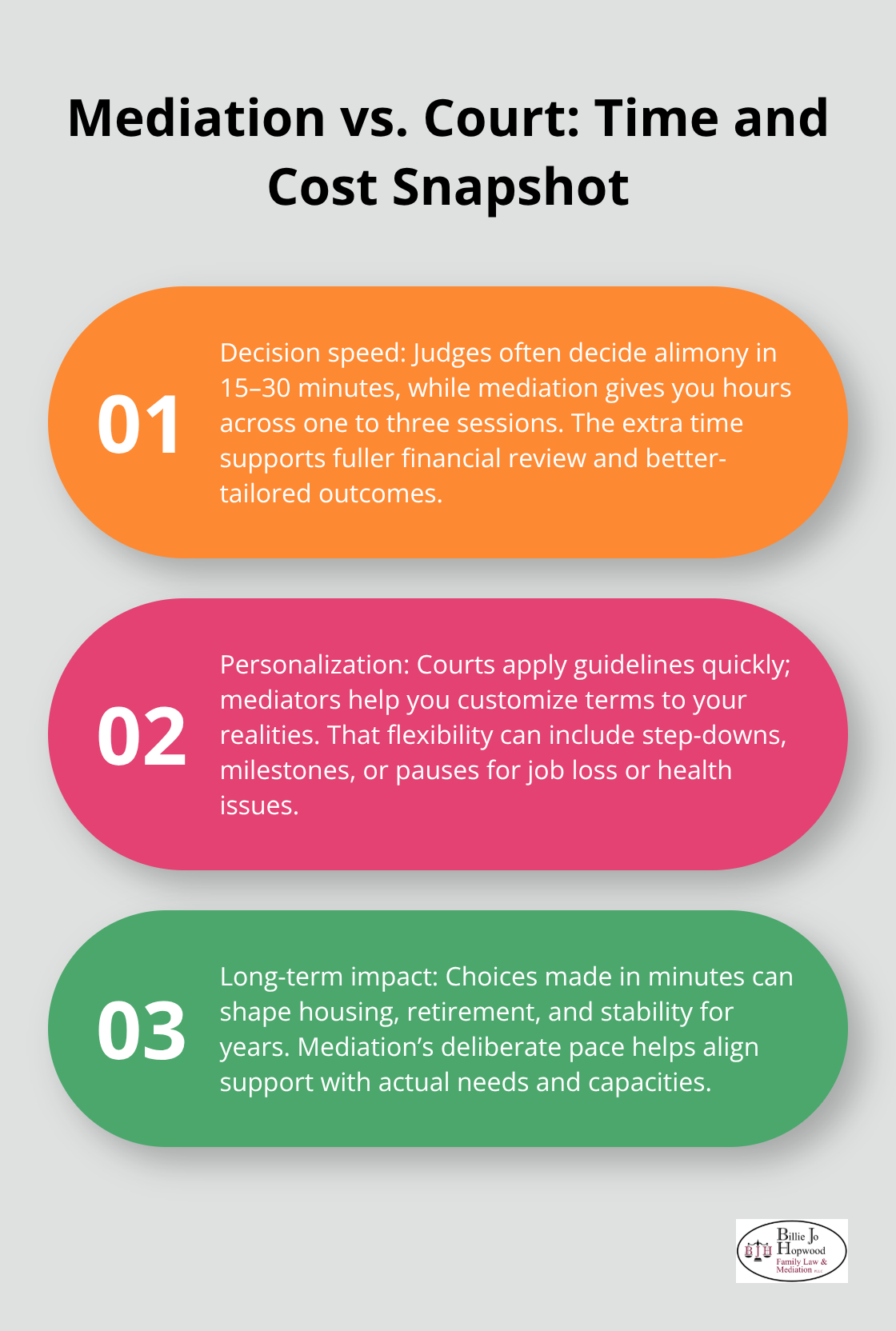
Mediation flips this entirely. You and your spouse sit down with a neutral mediator and decide together what alimony looks like for your specific circumstances. This matters because alimony affects your housing, your ability to retire, and your financial stability for years or decades.
Customizing Alimony Terms to Your Life
In mediation, you control whether alimony takes the form of a lump sum, monthly payments with step-downs as your earning capacity increases, or terms tied to specific milestones like finishing a degree. You decide if it ends when you remarry, reaches a certain age, or meets other conditions that make sense for both of you. A judge cannot offer that flexibility. If you want alimony to pause during periods of unemployment or adjust when one spouse faces health issues, mediation lets you write those protections directly into your agreement. You’re not arguing in front of a stranger in a courtroom; you’re negotiating real solutions with someone who understands your finances because you’ve both brought complete financial disclosures to the table.
Mediation Costs Far Less Than Court
Mediation also costs substantially less than litigation. A typical contested alimony hearing requires depositions, expert witnesses, discovery disputes, and multiple court appearances that easily run $15,000 to $40,000 or more per spouse in legal fees. Mediation usually takes one to three sessions totaling 6 to 12 hours, costing a fraction of that amount because you avoid discovery battles and courtroom time. You move faster too-mediation typically resolves in weeks or a few months, while court cases drag on for 12 to 24 months. That speed matters emotionally. You’re not spending two years in conflict, wondering if the other spouse will challenge your income claims or hire an expert to dispute your expenses.
Privacy and Dignity Throughout the Process
You reach a decision, both sides sign off, and the agreement becomes binding without a judge ever stepping in. In Melbourne, Florida, where families want to move forward with dignity and minimal disruption, mediation respects both the financial realities and the emotional toll of alimony disputes. You avoid the public record aspect of court too-your financial details, income, and personal circumstances stay private instead of becoming part of a public court file that anyone can access. This privacy protection extends throughout the entire mediation process, keeping sensitive family information confidential while you work toward resolution.
Moving From Control to Fair Outcomes
The control you gain in mediation translates directly into agreements that both parties can actually live with long-term. When you shape the terms yourself rather than accepting a judge’s ruling, you’re more likely to follow through on payments and feel the arrangement is genuinely fair. This foundation of mutual agreement sets the stage for how mediation actually guides fair alimony outcomes-a process that depends on both parties presenting their financial information openly and working together to identify solutions that work.
How Fair Alimony Mediation Actually Works
The mediation process for alimony decisions in Melbourne, Florida succeeds because it forces both spouses to confront actual numbers instead of fighting over emotions or assumptions. When you walk into a mediation session, the neutral mediator does not decide anything for you. Instead, the mediator creates space for you and your spouse to present complete financial information, identify where your interests overlap, and build solutions that reflect your real circumstances rather than generic court formulas. This approach works because alimony is not abstract-it is a monthly payment that affects whether you can keep your home, retire on schedule, or maintain the lifestyle you had during marriage. The mediator’s role is to keep both parties focused on those concrete realities while preventing the conversation from spiraling into blame or resentment.
Transparency Creates the Foundation for Fair Terms
Mediation starts with financial disclosure, and this step determines everything that follows. You and your spouse each bring recent pay stubs, tax returns from the past two years, bank statements, mortgage documents, and a detailed breakdown of your monthly expenses. The American Academy of Matrimonial Lawyers baseline formula-30 percent of the higher earner’s gross income minus 20 percent of the lower earner’s gross income-gives both parties a starting reference point, though your actual agreement will deviate based on what your numbers show. A spouse earning $80,000 annually has a different capacity to pay than one earning $120,000, and a spouse with $2,500 in monthly post-divorce expenses faces different needs than one with $4,000. The mediator ensures both parties understand each other’s financial reality. If one spouse claims they cannot afford $2,000 monthly in alimony but their financial statements show $8,000 in discretionary spending, that contradiction becomes visible immediately. This transparency prevents the months of discovery disputes and expert battles that run up litigation costs. You are not hiding income or inflating expenses to gain advantage; you are laying out the facts so both parties can negotiate from the same baseline.
Building Solutions Around Real Constraints and Opportunities
Once both parties understand the financial picture, the mediator helps identify common ground by separating what is fixed from what is negotiable. If the paying spouse has a mortgage that cannot be refinanced and retirement obligations that are non-negotiable, those constraints shape what alimony can realistically be. If the receiving spouse has a concrete plan to complete job training within 18 months and increase earnings from $35,000 to $55,000 annually, that trajectory affects whether rehabilitative alimony makes sense or whether durational alimony with a step-down schedule works better. The mediator facilitates this discussion in separate rooms if needed, allowing each spouse to talk candidly with their attorney about what they can accept without feeling pressured by the other party’s presence. You might propose $2,400 monthly for five years, and your spouse counters with $1,800 for six years. A mediator helps you evaluate whether the longer duration or lower monthly amount better protects your financial stability or respects the paying spouse’s retirement timeline. This negotiation happens within the guardrails of Florida law-you cannot agree to something that violates statutory limits-but within those boundaries, the solutions are entirely yours to shape.
Customized Terms That Reflect Your Actual Situation
One couple structures alimony as a lump sum to avoid ongoing conflict, while another arranges monthly payments with automatic adjustments tied to cost-of-living increases. A third ties the alimony amount to specific milestones like completing a degree or reaching a certain age. These customized terms emerge because mediation treats alimony as a problem to solve together rather than a battle to win. The paying spouse might request that alimony pauses during periods of unemployment or adjusts when health issues limit earning capacity. The receiving spouse might want protections that ensure payments continue if the other spouse relocates or changes jobs. Mediation allows both parties to write these protections directly into their agreement without waiting for a judge to consider them. You control the outcomes and decide whether alimony takes the form of a lump sum, monthly payments with step-downs as earning capacity increases, or terms tied to specific milestones. You decide if it ends when you remarry, reaches a certain age, or meets other conditions that make sense for both of you. A judge cannot offer that flexibility. In Melbourne, Florida, where families want to move forward with dignity and minimal disruption, mediation respects both the financial realities and the emotional toll of alimony disputes. You reach a decision, both sides sign off, and the agreement becomes binding without a judge ever stepping in. Your financial details, income, and personal circumstances stay private instead of becoming part of a public court file that anyone can access.
Final Thoughts
Mediation for alimony decisions puts you in control of outcomes that shape your financial life for years to come. Unlike court, where a judge makes your alimony decision in minutes based on paperwork alone, mediation lets you and your spouse work together to build terms that fit your actual circumstances. You decide the amount, duration, payment structure, and any special conditions that protect both parties.
The financial advantages matter significantly. Mediation costs a fraction of what litigation demands, saving you thousands in legal fees while resolving your alimony dispute in weeks or a few months instead of years. Your financial information stays private instead of becoming part of a public court record, and you avoid the emotional toll of prolonged conflict and courtroom battles.
Start with complete financial transparency and realistic expectations grounded in Florida law. Bring your pay stubs, tax returns, and detailed expense lists to mediation, and work with a mediator who keeps both parties focused on actual numbers rather than emotions or assumptions. Contact Billie Jo Hopwood Family Law & Mediation, PLLC in Melbourne, Florida to discuss how mediation can resolve your alimony situation while protecting your financial future.