
Custody schedules created through court orders often leave families feeling frustrated and inflexible. At Billie Jo Hopwood Family Law & Mediation, PLLC, we’ve seen how parenting plan mediation transforms this process by putting your family’s actual needs first.
When both parents work together with a neutral mediator, the result is a schedule that works for everyone-including your children.
Why Mediation Breaks Through Parental Communication Barriers
How Mediators Reframe Custody Conversations
Mediation fundamentally changes how divorced or separating parents talk to each other. Without a neutral third party, conversations about custody become adversarial-one parent’s proposal triggers a defensive response, and both sides dig in. A mediator interrupts this pattern by reframing discussions around the child’s needs rather than parental positions. Research from the Chicago Bar Association in Summer 2024 found that children prioritize quality time with both parents over a specific quantity of hours, yet parents locked in conflict rarely hear this message from each other.
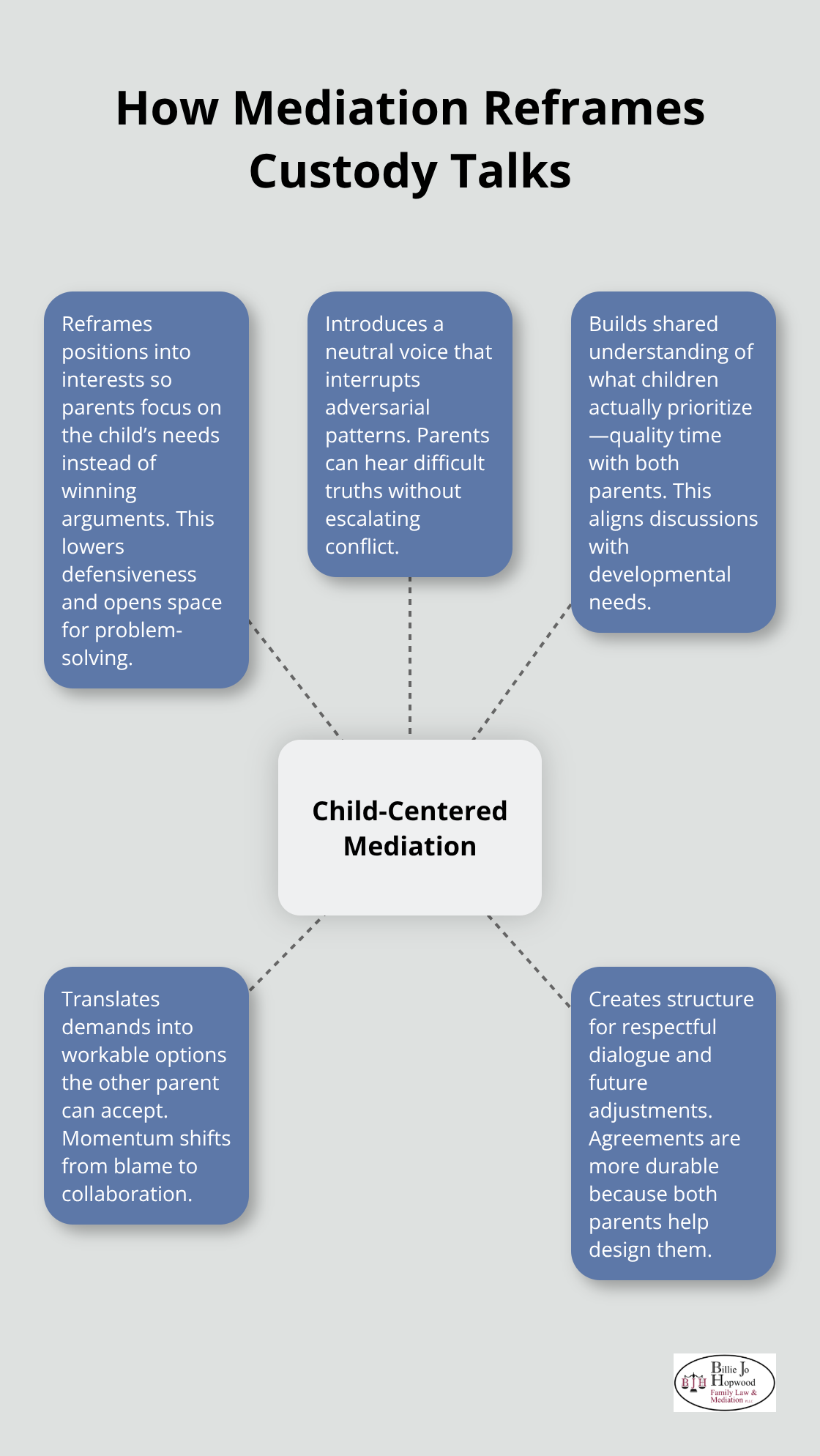
Mediation creates the space where this shift happens.
Instead of arguing about who gets more weekends, parents discuss what schedule allows their child to maintain strong relationships with both of them while attending soccer practice and staying connected to school friends. The mediator translates demands into interests and helps each parent see the other’s genuine concern for the child. This is not theoretical-it’s practical communication restructuring.
When Parents Stop Competing, Solutions Emerge
When parents stop viewing custody negotiations as a zero-sum competition, they naturally generate schedules neither would have considered alone. One parent might realize their work schedule actually permits midweek overnights they’d dismissed as impossible. The other might recognize that a consistent Thursday evening exchange works better than rigid weekly swaps. These discoveries happen because mediation removes the pressure to win and replaces it with collaborative problem-solving.
Mediators Protect What Courts Cannot
A neutral mediator also protects the child’s best interests in ways courtroom advocacy cannot. Judges apply statutory factors to custody decisions, but they work from limited information presented during hearings. A mediator, by contrast, spends time understanding each family’s actual constraints-rotating shift work, school calendars, extended family relationships, the child’s age and maturity, home stability, and financial realities.
The mediator asks hard questions that attorneys sometimes skip: Can your child thrive on a 50/50 schedule when one parent works nights? Does your child need consistency in schooling location more than equal parenting time? What happens if one parent relocates for a job? Flexible arrangements that emerge from mediation address these specifics, whereas court orders impose standardized templates that often miss what matters most.
Why Mediated Plans Stick
A schedule that works on paper frequently fails in practice because it ignores the child’s developmental needs or a parent’s actual availability. Mediation eliminates this gap. Parents leave with a plan they’ve built together, understand completely, and feel motivated to honor because they shaped it. That commitment translates into fewer post-divorce conflicts and better stability for the child. With this foundation in place, the next step involves understanding which specific custody schedule models actually work for different family situations.
What Should a Parenting Plan Actually Include
A workable parenting plan lives in the details. Courts in Tennessee require a Permanent Parenting Plan in every divorce involving minor children, but mediation produces plans far more nuanced than statutory minimums. The schedule itself matters less than whether it reflects how your family actually functions. If you work rotating shifts, a traditional Monday-to-Friday custody split fails immediately. If your child attends school in one parent’s district, a 50/50 residential swap creates instability that harms academic performance.
Start With Your Family’s Real Constraints
Mediation forces you to map your actual constraints before you draft any language. Collect concrete data: your work hours including commute time, your child’s school calendar and extracurricular commitments, distance between homes, and your child’s age. A four-year-old needs shorter transitions between parents than a teenager who can manage weekly swaps. The Chicago Bar Association found in Summer 2024 that children prioritize quality time with both parents, not equal clock hours, so your plan should prioritize meaningful interaction over mechanical splits.
One parent’s midweek overnight plus a full weekend day often produces better outcomes than rigid alternating weeks because the child maintains stronger weekly connection to both households. This approach reflects what actually matters to your child’s development and emotional security.
Transportation and Exchange Logistics Determine Success
Transportation logistics determine whether a schedule survives first contact with reality. If exchanging your child requires a 45-minute drive, weekly handoffs drain both parents and stress the child. Specify exactly where and when exchanges happen.
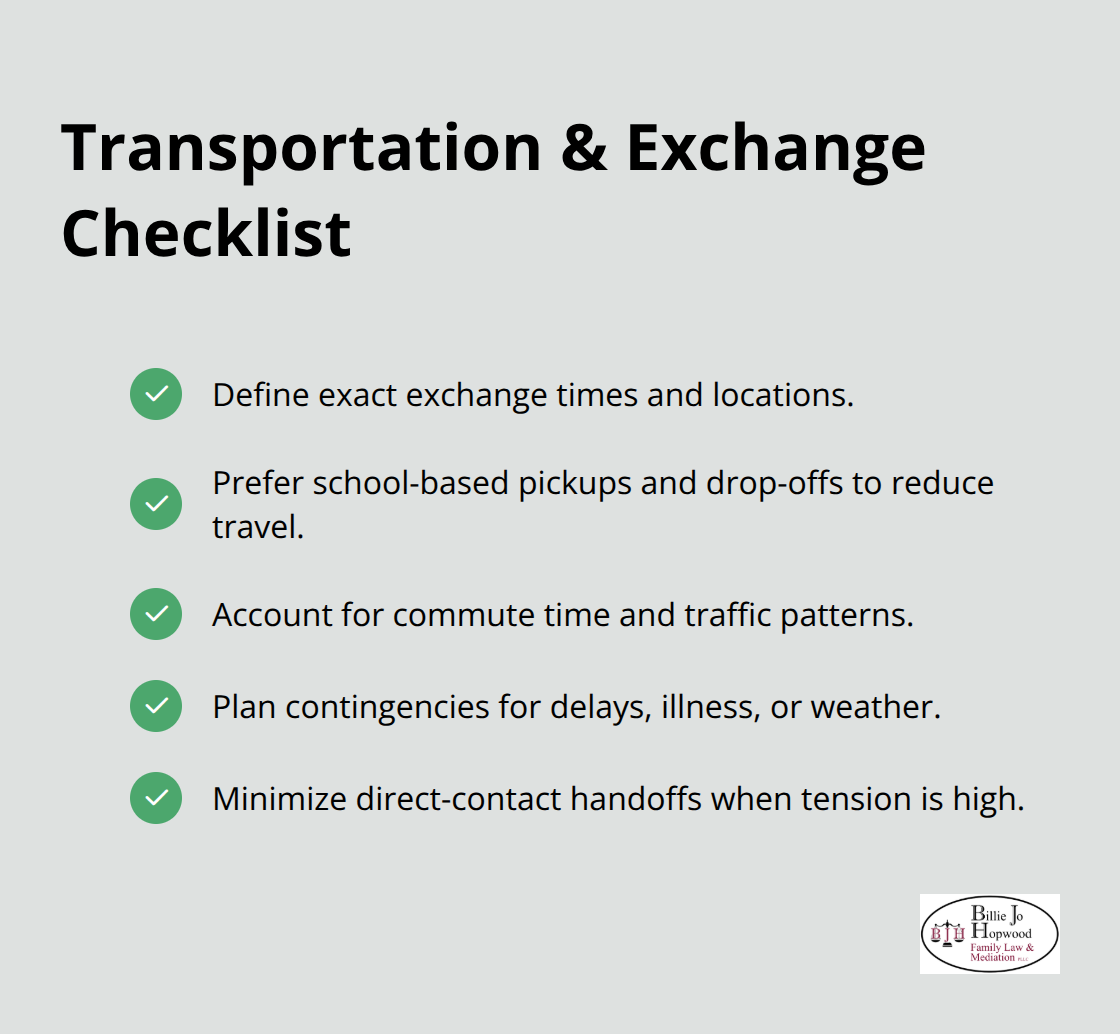
School pickup and drop-off locations work better than neutral meeting points because they eliminate redundant travel. Some families use school-based exchanges entirely, reducing direct contact and timing disputes.
Holiday and Vacation Time Requires Separate Planning
Holiday and vacation allocation deserves its own planning because standard schedules collapse during school breaks. Specify Thanksgiving, Christmas, spring break, and summer vacation in writing rather than leaving them to annual negotiation. The plan should state whether holidays rotate yearly, split within a single day, or follow a fixed pattern. Summer vacation requires particular attention because six weeks of uninterrupted time with one parent upends the regular schedule. Many workable plans extend one parent’s summer time to four weeks while the other receives two, rather than splitting it 50/50, because children adjust better to longer blocks.
Decision-Making Authority for Education and Healthcare
Decision-making authority for education and healthcare cannot remain vague. Tennessee law recognizes sole and joint legal custody, with joint custody meaning both parents share authority over major decisions about schooling, medical treatment, and religious upbringing. If you share legal custody, your plan must specify how you’ll handle disagreements. Will you consult before enrolling your child in private school, or can one parent decide unilaterally? What happens if one parent wants a medical procedure the other opposes?
Mediation forces you to answer these questions now rather than litigating them later. Establish a communication protocol for routine updates on grades, medical appointments, and activities. Tools like OurFamilyWizard create documented records of shared information, reducing conflict and protecting both parents if disputes arise. Your plan should also address who carries health insurance, how medical expenses split beyond insurance coverage, and whether routine decisions like haircuts or dental cleanings require mutual consent or fall within one parent’s authority.
Specificity Prevents Post-Separation Conflict
The more specific your written plan, the fewer post-separation conflicts emerge. Vague terms about “reasonable visitation” or “as agreed” invite disputes when circumstances change or parents disagree on interpretation. Clear language about custody schedules, decision-making processes, and financial responsibilities creates a foundation both parents understand and can follow. This clarity becomes especially valuable when emotions run high or schedules shift unexpectedly. With these foundational elements in place, you’re ready to examine which specific custody schedule models actually work for different family situations and how mediation helps you select the right one for your circumstances.
Which Custody Schedule Actually Works for Your Family
The 50/50 equal split dominates custody conversations, but it fails for most families in practice. Tennessee courts recognize that equal parenting time means roughly 50 percent of the year with each parent, yet this framework ignores how children actually live. A child attending school in one district cannot thrive on weekly alternations between two homes 20 miles apart. A parent working rotating 12-hour shifts cannot maintain a rigid Monday-to-Friday schedule. Mediation reveals these incompatibilities before you commit to a schedule that collapses within weeks.
Why the 2-2-3 Model Outperforms Equal Splits
The 2-2-3 model works better than 50/50 splits for most school-age children. One parent has the child for two days, the other for two days, then the first parent for three consecutive days. This schedule creates longer blocks that feel like home rather than constant transition. If you work standard 9-to-5 hours and your co-parent does the same, a 2-2-3 arrangement with midweek overnights on the alternate parent’s off days maintains stronger weekly connection than alternating full weeks.
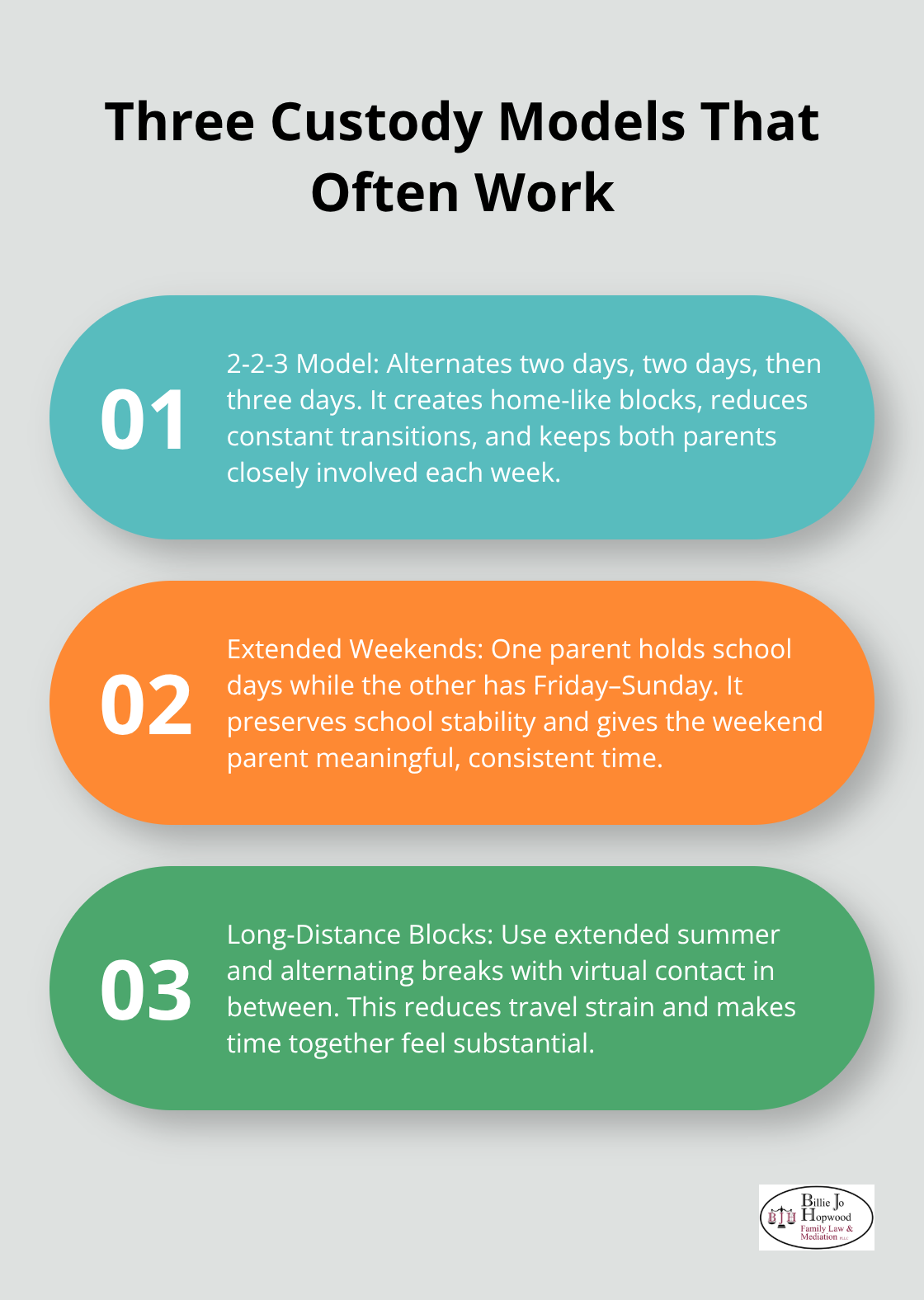
The child sees both parents regularly without the psychological toll of constant packing and moving.
Extended Weekends Preserve School Stability
Extended weekend arrangements with one parent taking Friday through Sunday while the other maintains school-day custody often prove more sustainable than equal splits, particularly when one parent has been the primary caregiver. This model preserves the child’s school stability, keeps extracurricular routines consistent, and gives the secondary parent meaningful weekend time that feels substantial rather than squeezed into a compressed schedule.
Primary Custodian Arrangements with Scheduled Visitation
Primary custodian arrangements work well when one parent has historically provided most daily care and the other prioritizes quality time over quantity. The visitation parent might have every other weekend plus one weeknight dinner and overnight, plus two weeks in summer. This transparency prevents constant renegotiation and allows both parents to plan their lives with certainty.
Long-Distance Parenting Requires Different Thinking
Long-distance parenting demands completely different thinking. If parents live more than two hours apart, extended blocks become necessary because frequent short transitions waste time in transit. One parent might have the child for full summer breaks and alternating school breaks, while the other maintains video contact and strategic visits. Mediation helps you map your actual constraints before selecting a model. Your work schedule, your child’s school calendar, distance between homes, your child’s age and activity commitments, and each parent’s genuine availability determine which schedule survives contact with reality. A mediator asks whether you can truly maintain a schedule or whether you are describing what you wish were possible. Parents frequently commit to arrangements they cannot sustain, then return to court for modifications. Mediation forces honest assessment now. The schedule that works is the one you will actually follow because it accommodates your real life, not an idealized version of it.
Final Thoughts
Parenting plan mediation produces measurably better outcomes than litigation because it centers on your family’s actual needs rather than courtroom arguments. When you work with a neutral mediator, you build a schedule together instead of accepting one imposed by a judge who spent limited time understanding your constraints. Parents who mediate report higher satisfaction with their arrangements and fewer post-separation conflicts because they shaped the plan themselves and feel invested in making it work.
The schedules that survive long-term are the ones tailored to your specific circumstances-a 2-2-3 model works for one family while extended weekends serve another better, and long-distance parenting requires completely different thinking than co-parenting in the same town. Your child’s age, school location, extracurricular commitments, and each parent’s actual work schedule determine what works, not generic templates. Customized plans also address the details that court orders frequently overlook: transportation logistics, holiday allocation, decision-making authority for education and healthcare, and communication protocols all matter enormously to whether your plan functions smoothly.
If you are ready to create a parenting plan that works for your family, we at Billie Jo Hopwood Family Law & Mediation, PLLC are here to guide you through the process. Based in Melbourne, Florida, we assist families through challenging legal situations including custody arrangements and parenting plan development. Contact us to begin parenting plan mediation in Melbourne, Florida and build a schedule that reflects your family’s unique needs rather than fighting over one in court.