Blog

Immediate Family: Legal Definition Explained

The term “immediate family” carries significant legal weight in Florida courts and family law proceedings. Understanding how immediate family is defined by law affects your rights in inheritance, medical decisions, and custody matters.

At Billie Jo Hopwood Family Law & Mediation, PLLC, we see families navigate these definitions daily in Melbourne Florida. Legal recognition determines who can make life-changing decisions on your behalf.

Who Qualifies as Your Immediate Family

Spouses and Children Form the Legal Foundation

Florida law places spouses and children at the center of immediate family definitions. Your spouse receives automatic inheritance rights when you die without a will and inherits your entire estate if you have no children from previous relationships. When children exist from other marriages, your spouse inherits 50% while children split the remaining half according to Florida Statutes.

Children include biological offspring, legally adopted children, and stepchildren in most contexts. The Family and Medical Leave Act recognizes spouses and dependent children under 21 as immediate family members. This grants eligible employees up to 12 weeks of unpaid leave for care responsibilities.

Parents and Siblings Hold Secondary Legal Status

Parents rank directly after spouses and children in inheritance law. If you die without a spouse or children, your parents inherit your entire estate under Florida’s intestate succession rules. Siblings only inherit when no spouse, children, or parents survive you.

The FMLA includes parents in its immediate family definition for leave purposes but excludes siblings entirely. Immigration law follows similar patterns – U.S. citizens can petition for parents to receive permanent resident status. The law categorizes them as immediate family alongside spouses and unmarried children under 21.

Adoptive Relationships Receive Full Legal Recognition

Adopted children and parents receive identical legal treatment to biological relationships in Florida courts. Adoption creates permanent legal bonds that grant full inheritance rights, medical decision-making authority, and family leave benefits.

Stepchildren face more complex recognition that depends on legal adoption status and specific circumstances. Half-siblings typically receive equal treatment to full siblings in inheritance matters, while step-siblings without formal adoption may lack legal standing in family decisions.

A hub and spoke chart showing the hierarchy of immediate family members in Florida law, with Spouses, Children, Parents, and Siblings as the main categories.

These family definitions become particularly important when courts must determine who has the authority to make critical decisions on your behalf during medical emergencies or legal proceedings.

What Legal Powers Do Immediate Family Members Hold

Inheritance Rights Create Financial Security

Immediate family members receive automatic inheritance protection under Florida’s intestate succession laws. Your spouse inherits your entire estate when no children exist from other relationships, while children from previous marriages trigger a 50-50 split between spouse and children according to Florida Statutes. Parents inherit everything when you die without a spouse or children, which creates a clear financial safety net for blood relatives.

Over 100,000 executors have navigated estate settlements more efficiently when they understand these automatic inheritance rules. Joint accounts and payable-upon-death accounts bypass probate entirely and transfer directly to spouses through Florida’s Tenancy By Entireties recognition. Non-probate assets move faster than traditional inheritance, often within weeks rather than months of death.

Medical Decisions Rest with Family Members

Florida law grants immediate family members automatic authority to make medical decisions when you cannot communicate your wishes. Spouses hold primary decision-making power, followed by adult children, then parents. Hospitals and medical facilities recognize this hierarchy without additional legal documentation in emergency situations.

The Family and Medical Leave Act provides eligible employees with 12 weeks of unpaid leave to care for immediate family members who face serious health conditions. Companies with 50 or more employees must honor FMLA requests for spouses, children, and parents. This protection covers medical appointments, surgery recovery, and long-term care needs.
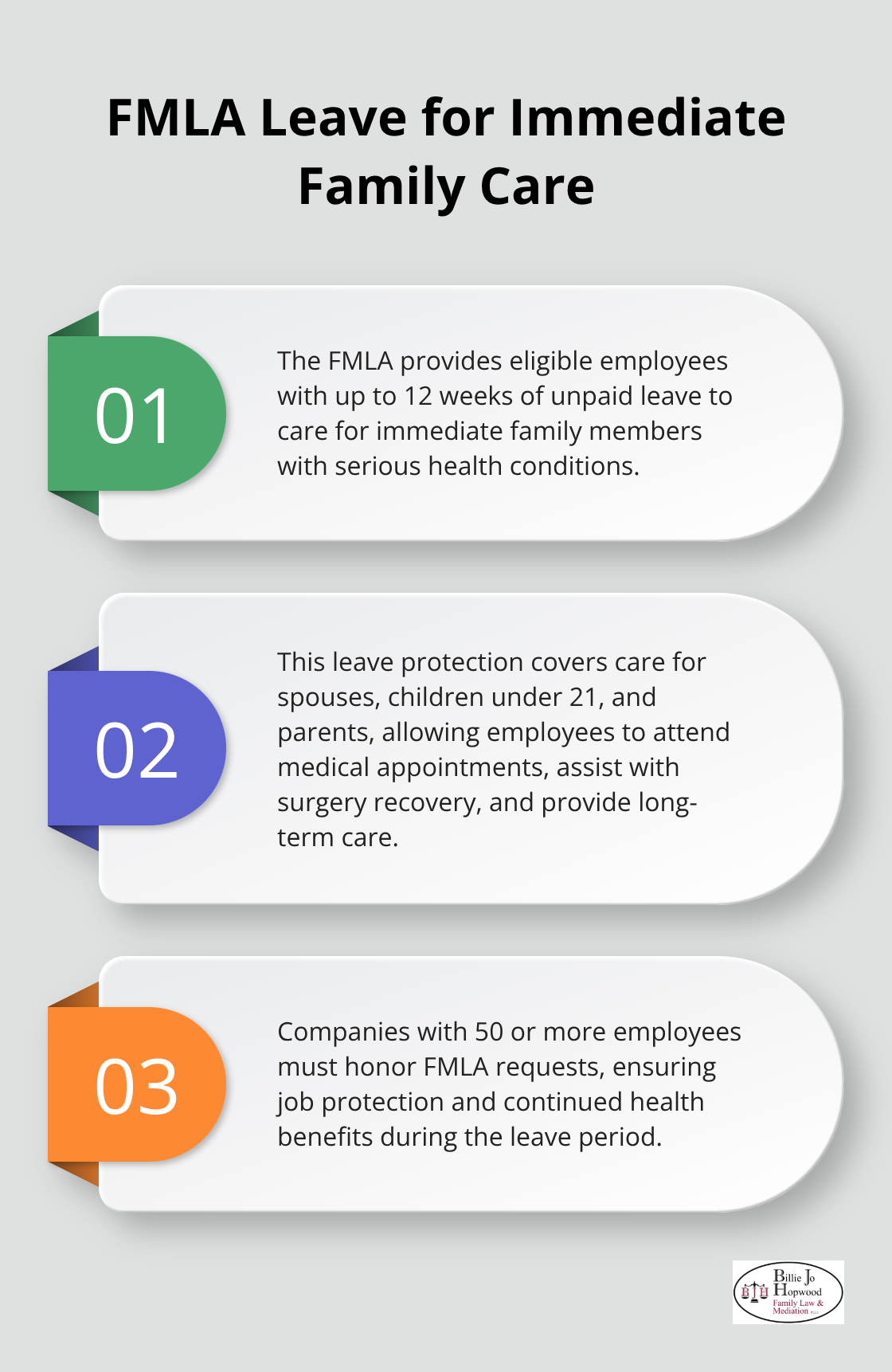
An ordered list chart showing three key points about the Family and Medical Leave Act (FMLA) provision for immediate family care. - immediate family defined by law

Employment Benefits Extend Family Protection

Federal law mandates that companies recognize immediate family definitions for bereavement leave and emergency time off. The Financial Industry Regulatory Authority prohibits brokers from selling certain securities to immediate family members (which prevents conflicts of interest that could harm family finances). Immigration law allows U.S. citizens to petition for permanent resident status for spouses, unmarried children under 21, and parents, which streamlines the family reunification process.

These legal powers become particularly complex when families face divorce proceedings or custody disputes that challenge traditional family structures.

When Does Family Status Matter Most in Legal Disputes

Divorce proceedings transform immediate family definitions into battlegrounds where legal recognition determines custody rights and financial obligations. Florida courts require both spouses to provide complete financial disclosures within 45 days of petition filing, and failure to comply severely damages your case according to family law. Regular dissolution cases mandate mediation in most Florida counties before final hearings, where immediate family status affects who can testify on your behalf and who gains decision-making authority over children.

Custody Decisions Hinge on Family Relationships

Child custody determinations in Florida prioritize shared parental responsibility between biological and adoptive parents unless detrimental to the child. Step-parents without formal adoption lack automatic custody rights even after years of care, which creates legal vulnerabilities during divorce. Grandparents and other extended family members face strict limitations on visitation rights unless they can prove immediate family members cannot provide adequate care.

The state follows income-based child support guidelines that typically end at age 18, but immediate family status determines which relatives can petition for custody modifications when circumstances change. Courts recognize biological connections over emotional bonds when legal adoption has not occurred.

An ordered list chart showing three important aspects of divorce proceedings in Florida, including the financial disclosure requirement. - immediate family defined by law

Medical Emergencies Reveal Family Authority Gaps

Hospital emergency rooms follow strict hierarchies when patients cannot make medical decisions, with spouses holding primary authority followed by adult children and parents. Unmarried partners face complete exclusion from medical decisions regardless of relationship length, while divorced spouses lose all decision-making power once divorce finalizes.

Medical facilities require legal documentation to recognize non-traditional family structures. Long-term partners without marriage certificates cannot authorize treatments or access patient information (even during life-threatening emergencies).

Estate Administration Creates Complex Challenges

Estate administration becomes complex when no immediate family exists – Florida law allows estates to escheat to the state when no relatives are found. Probate courts recognize Tenancy By Entireties for married couples, allowing automatic asset transfer without court intervention, but unmarried couples must navigate lengthy probate processes even with joint accounts.

Intestate succession laws ignore personal relationships that lack legal recognition. Close friends and unmarried partners receive nothing unless specifically named in valid wills, regardless of their emotional significance to the deceased.

Final Thoughts

Immediate family defined by law creates a clear hierarchy that affects your most important life decisions. Florida courts recognize spouses, children, and parents as primary family members with automatic inheritance rights, medical decision-making authority, and employment protection benefits. Adoptive relationships receive full legal recognition, while step-relationships and unmarried partnerships face significant limitations without formal legal documentation.

These definitions become particularly important during divorce proceedings, medical emergencies, and estate administration. The law prioritizes legal relationships over emotional bonds, which can create unexpected challenges for non-traditional family structures. Courts apply these strict definitions regardless of the emotional significance of relationships that lack legal recognition.

We at Billie Jo Hopwood Family Law & Mediation, PLLC help Melbourne Florida families navigate these complex legal definitions. Our approach to family law matters provides the guidance families need to protect their rights and interests through challenging legal situations. Contact us today to discuss how these family definitions may affect your specific circumstances.

Mediation Law Examples: Real-World Applications

Family disputes don’t have to end in courtroom battles. Mediation law examples show how families across Melbourne, Florida resolve conflicts through collaborative discussion rather than adversarial litigation.

At Billie Jo Hopwood Family Law & Mediation, PLLC, we see firsthand how mediation transforms heated disputes into workable solutions. Real cases demonstrate the power of guided negotiation in family law matters.

What Cases Use Family Mediation Most

Divorce Property Splits Without Court Battles

Divorce mediation resolves the most complex financial disputes without judges who make decisions for families. The Florida Dispute Resolution Center reports that over 70% of mediation cases in 2024 resulted in settlement, with property division cases that represent the largest category.

Pie chart showing 70% of mediation cases in Florida resulted in settlement in 2024

Couples use mediation to divide retirement accounts, business interests, and real estate while they maintain control over outcomes. Florida’s equitable distribution laws require fair division of marital assets, but mediation allows couples to define what fair means for their situation.

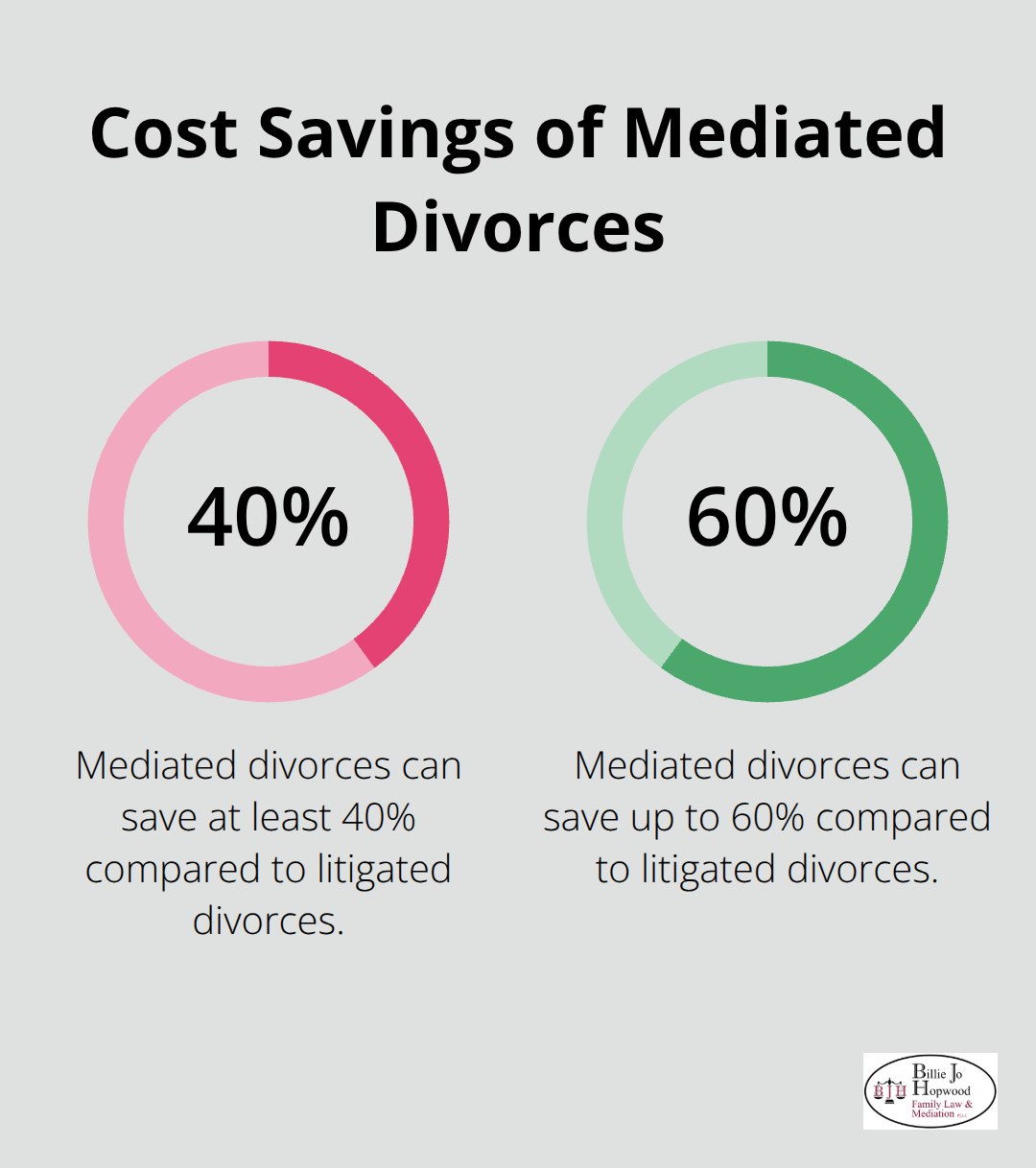
Complex asset splits involve multiple properties, investment portfolios, and debt allocation through structured mediation sessions that cost 40-60% less than litigation. These sessions produce agreements that both parties help create rather than court-imposed decisions.

Child Custody Plans That Actually Work

Child custody mediation produces arrangements that stick long-term because parents create the agreements themselves. Florida courts increasingly mandate mediation for custody disputes, which recognizes that parent-designed plans have an 80% compliance rate compared to 60% for court-ordered arrangements.

Parents address school choices, holiday schedules, and decision-making authority through facilitated discussions that focus on children’s needs rather than parental grievances. These conversations require complete financial disclosure and honest communication about parental capabilities and availability.

The collaborative approach helps parents maintain cooperative relationships that benefit children after divorce proceedings conclude.

Alimony Negotiations Outside the Courtroom

Spousal support mediation resolves financial support disputes faster than traditional litigation (typically in just a few sessions versus months of court proceedings). Divorce mediation allows couples to consider creative support structures like temporary payments during career transitions or educational support for skill development.

The process addresses duration, amount, and modification terms while both parties maintain dignity and privacy. Interest-based negotiation in alimony cases leads to a 93% settlement rate because mediators help identify underlying financial needs rather than focus on legal entitlements alone.

These successful outcomes demonstrate how mediation transforms contentious financial disputes into workable agreements that serve both parties’ long-term interests.

How Mediation Resolves Real Family Disputes

Custody Battles That End in Cooperation

High-conflict custody cases transform through mediation when parents shift focus from battles to solutions. The American Bar Association found that 90% of mediators in Florida reported higher satisfaction rates among participants compared to traditional court outcomes.

Parents who initially demand full custody often reach shared arrangements after mediation sessions reveal common priorities for their children’s wellbeing. A 2022 custody case in Miami-Dade demonstrated how shared priorities can transform demands into collaborative agreements, with parents who created detailed schedules that address school events, medical decisions, and holiday rotations.

These agreements work because both parents contribute to their creation rather than have solutions imposed by judges who lack intimate knowledge of family dynamics. The collaborative process builds trust between parents who must continue their relationship as co-parents.

Property Settlements That Preserve Relationships

Complex asset division through mediation produces creative solutions that litigation cannot match. Couples divide business partnerships by trading ownership stakes for real estate holdings, or they structure retirement account splits to minimize tax penalties for both parties.

The 13th Judicial Circuit Court indicates a 78% settlement rate across 1,200 civil cases that utilize effective mediation strategies, with property division cases that show particularly strong results when couples maintain open communication about financial priorities. These settlements often include payment plans that work within both parties’ budgets rather than forced liquidation of assets.

Mediation allows couples to consider the emotional value of certain assets (like family homes or heirloom jewelry) alongside their financial worth, which creates more satisfying outcomes for everyone involved.

Co-Parenting Plans That Work Long-Term

Long-term co-parenting plans succeed when parents establish clear communication protocols and decision-making frameworks during mediation sessions. These plans address everything from school choice authority to medical emergency procedures, which creates predictable structures that reduce future conflicts.

Interest-based negotiation leads to 93% settlement rates because mediators help parents identify underlying concerns about children’s stability rather than focus on legal entitlements alone. Parents learn to separate their personal grievances from their children’s needs through structured discussions.

Ordered list chart showing three benefits of interest-based negotiation in co-parenting plans - mediation law examples

The mediation process teaches parents communication skills they use long after their divorce finalizes, which sets the foundation for successful co-parenting relationships. These skills become particularly valuable when families face unexpected challenges or need to modify existing arrangements.

Why Mediation Saves Money and Time

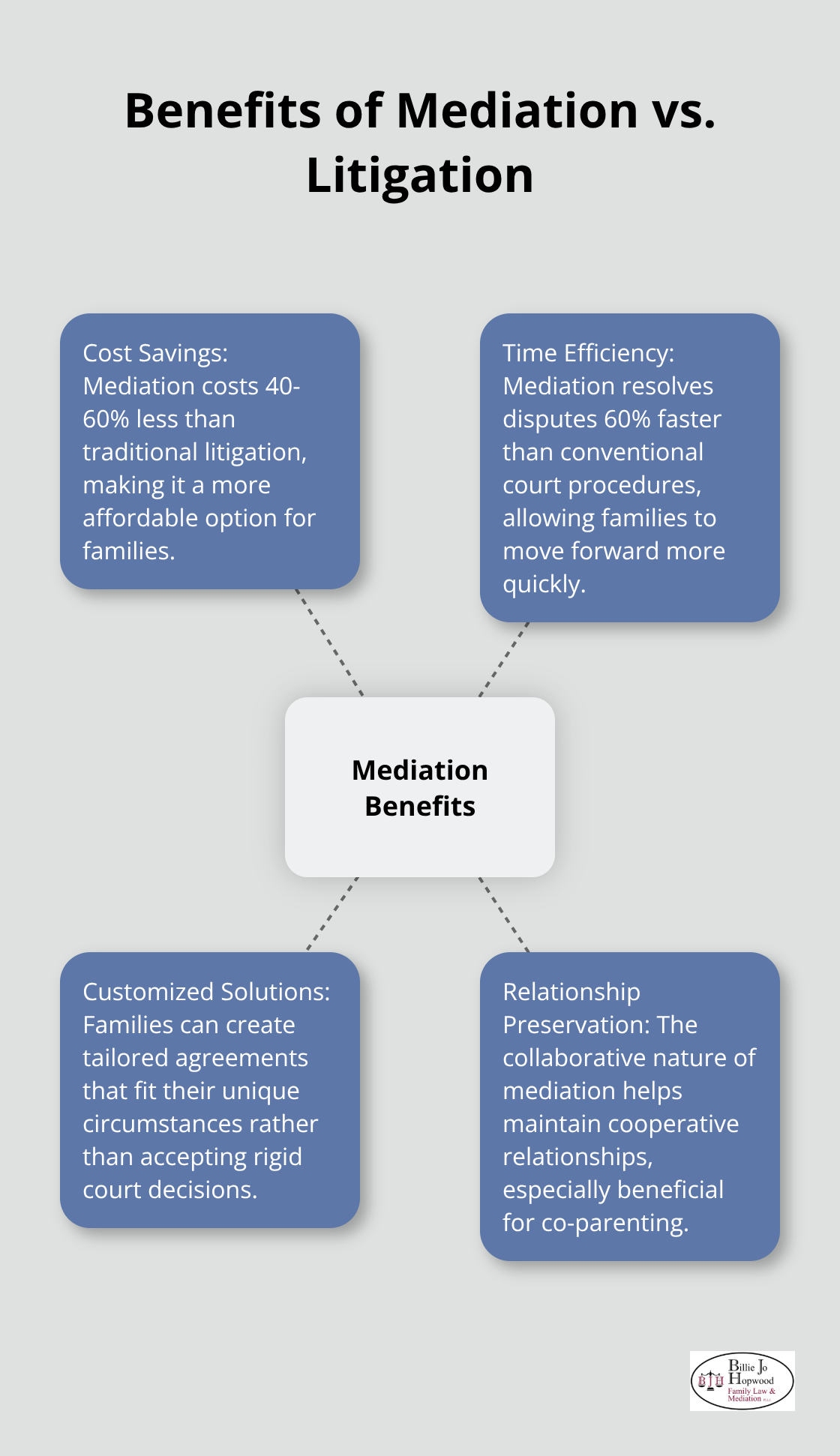
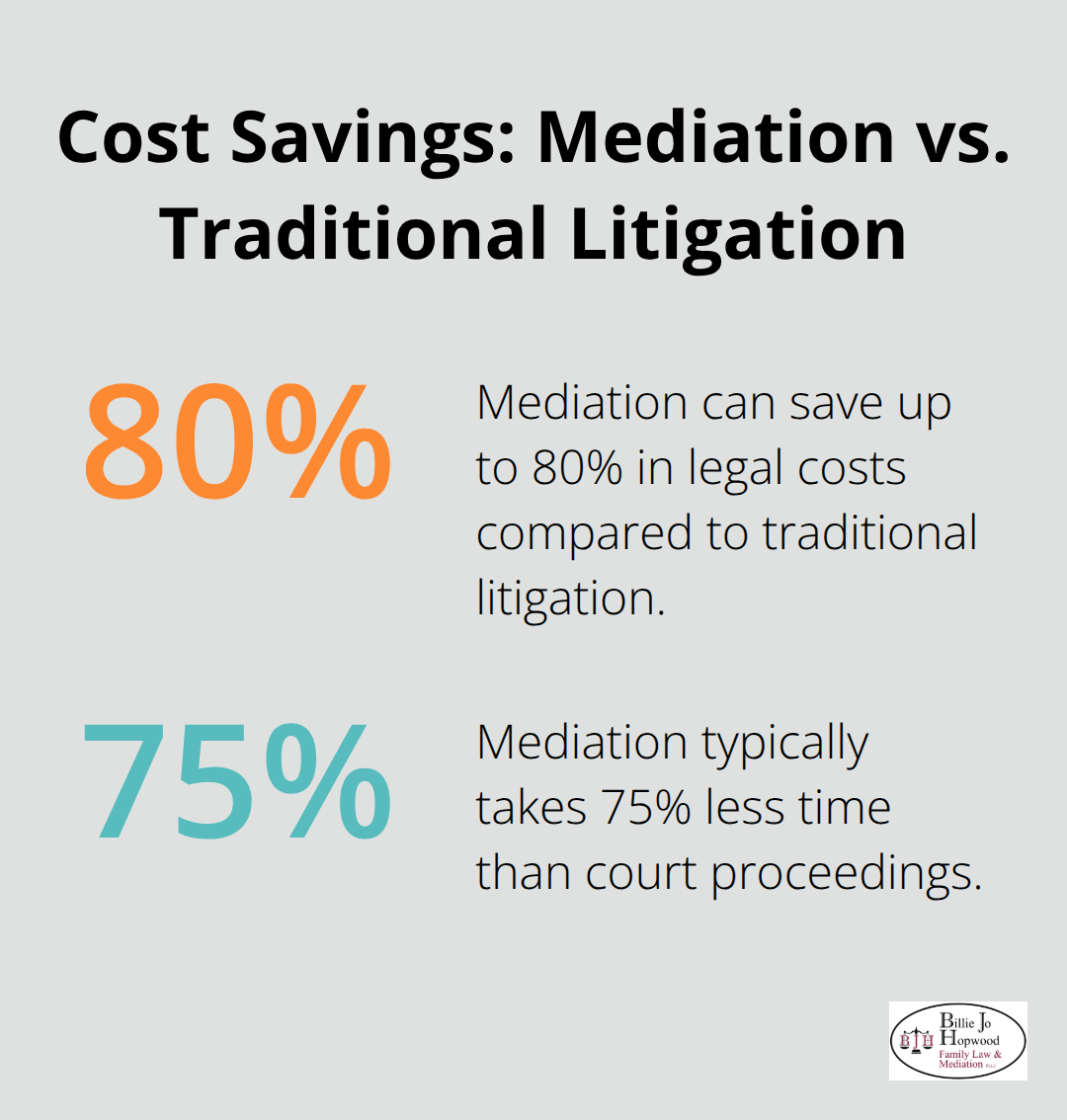
Mediation costs 40-60% less than litigation while it resolves disputes 60% faster than conventional court procedures according to the Florida Dispute Resolution Center. Traditional divorce litigation in Melbourne can cost families $15,000 to $40,000 per party, while mediation typically runs $2,500 to $8,000 total for both parties combined.

Court cases drag on for 12-18 months due to packed court schedules and procedural delays, but mediation sessions wrap up within 4-8 weeks from the initial referral. The American Bar Association reports that 98% of mediation sessions take place within eight weeks of referral, compared to court cases that wait months just for initial hearings.

Hub and spoke chart illustrating the benefits of mediation compared to litigation in terms of cost and time savings - mediation law examples

Financial Protection Through Collaborative Resolution

Litigation burns through retainer fees at $300-500 per hour for attorney time spent in depositions, document discovery, and court appearances that mediation eliminates entirely. Couples avoid expert witness fees for property appraisals and custody evaluations when they reach agreements through guided negotiation instead of adversarial proof requirements.

Mediation prevents the financial destruction that occurs when legal fees consume the very assets couples fight to protect. The 80% compliance rate for mediated agreements means families avoid costly return trips to court for enforcement actions that plague litigated cases.

Relationship Preservation That Benefits Children

Mediation maintains cooperative relationships between divorced spouses, which proves invaluable for successful co-parenting arrangements that litigation destroys through adversarial tactics. Parents who mediate their divorce report 72% higher satisfaction with their co-parenting relationship compared to those who litigated their cases.

Children of mediated divorces show better adjustment outcomes because their parents learned collaborative communication skills during the mediation process rather than battle tactics from courtroom warfare. The confidential nature of mediation protects family privacy and prevents public court records that can embarrass children and damage professional reputations for years to come.

Greater Control Over Final Outcomes

Mediation allows families to create customized solutions that work for their specific circumstances rather than accept one-size-fits-all court decisions. Parents design custody schedules that accommodate work schedules, school activities, and family traditions (instead of standard every-other-weekend arrangements that courts typically impose).

Couples negotiate property division based on their actual needs and priorities rather than rigid legal formulas that may not serve either party well. This control leads to higher satisfaction rates and better long-term compliance with agreements that both parties helped create.

Final Thoughts

Mediation law examples from Melbourne, Florida show how families resolve disputes through collaboration rather than courtroom battles. These real-world applications prove mediation works across divorce property division, child custody arrangements, and spousal support negotiations. Melbourne families choose mediation because it costs 40-60% less than litigation while it preserves relationships that matter most for successful co-parenting.

The 70% settlement rate in Florida mediation cases demonstrates this approach works for complex family disputes that once required lengthy court proceedings. The confidential process allows families to create customized solutions that fit their unique circumstances rather than accept rigid court decisions. Parents design custody schedules around their children’s needs, while couples divide assets based on their actual priorities and financial situations (instead of standard court formulas).

We at Billie Jo Hopwood Family Law & Mediation, PLLC guide Melbourne families through mediation processes that transform conflicts into workable agreements. Families who consider mediation can take the first step by scheduling a consultation to discuss their specific situation. Contact our Melbourne office to learn how mediation can provide the resolution your family needs while it protects your relationships and financial future.

Family Law Lawyers Offering Payment Plans

Family law cases often create financial stress when legal fees seem overwhelming. Many people avoid getting the help they need because they can’t afford large upfront payments.

We at Billie Jo Hopwood Family Law & Mediation, PLLC understand that finding family law lawyers that take payments can make the difference between getting proper representation and going without legal help. Payment plans allow you to spread costs over time while still receiving quality legal services.

Understanding Payment Plans for Family Law Services

Types of Payment Arrangements Available

Family law payment plans come in three main forms that work differently than traditional legal billing. Hourly payment plans allow you to pay monthly installments against your attorney’s hourly rate instead of large retainer fees upfront. Fixed monthly payment plans spread a predetermined total cost across several months and give you predictable expenses. Hybrid arrangements combine elements of both approaches, where you pay a smaller initial retainer followed by structured monthly payments as your case progresses.

Traditional Billing Creates Financial Barriers

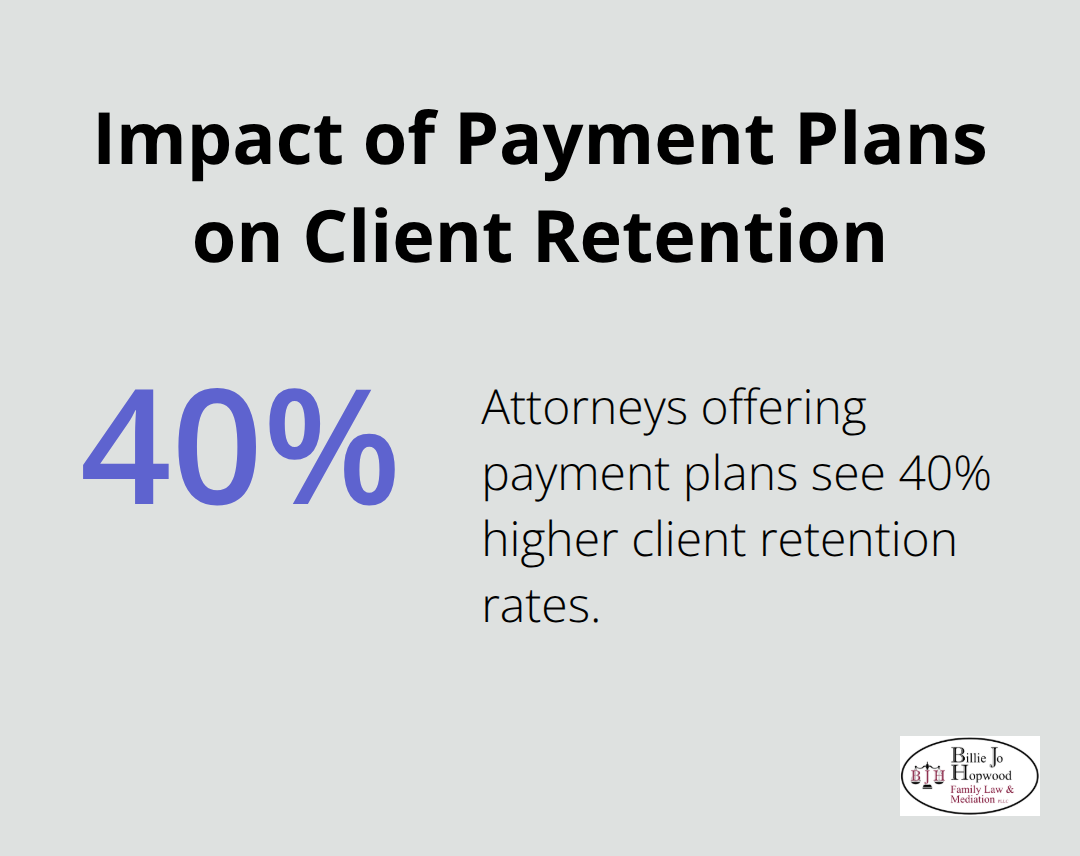
Traditional family law billing requires substantial upfront retainers, often $3,000 to $10,000 before work begins. This approach forces many people to delay legal action or represent themselves poorly. Payment plans eliminate this barrier and accept smaller initial payments (typically $500 to $1,500), then spread remaining costs over 3 to 12 months. The Florida Bar reports that attorneys who offer payment plans see 40% higher client retention rates because people can access legal services when they need them most rather than wait to save money.

Bar chart showing 40% higher client retention rates for attorneys offering payment plans

Payment Plans Reduce Financial Stress During Legal Proceedings

Flexible payment arrangements provide immediate financial relief during already stressful family situations. Monthly payments of $200 to $800 fit better into household budgets than single large payments. Many attorneys structure payments to align with your income schedule, whether weekly, biweekly, or monthly. Some firms offer automatic payment options through debit cards or bank transfers and eliminate the worry of missed payments. This predictability helps you budget for other necessities while your divorce or child support case moves forward.

The next step involves understanding exactly how these payment structures work in practice and what documentation attorneys require to set up these arrangements.

How Payment Plans Work in Family Law Cases

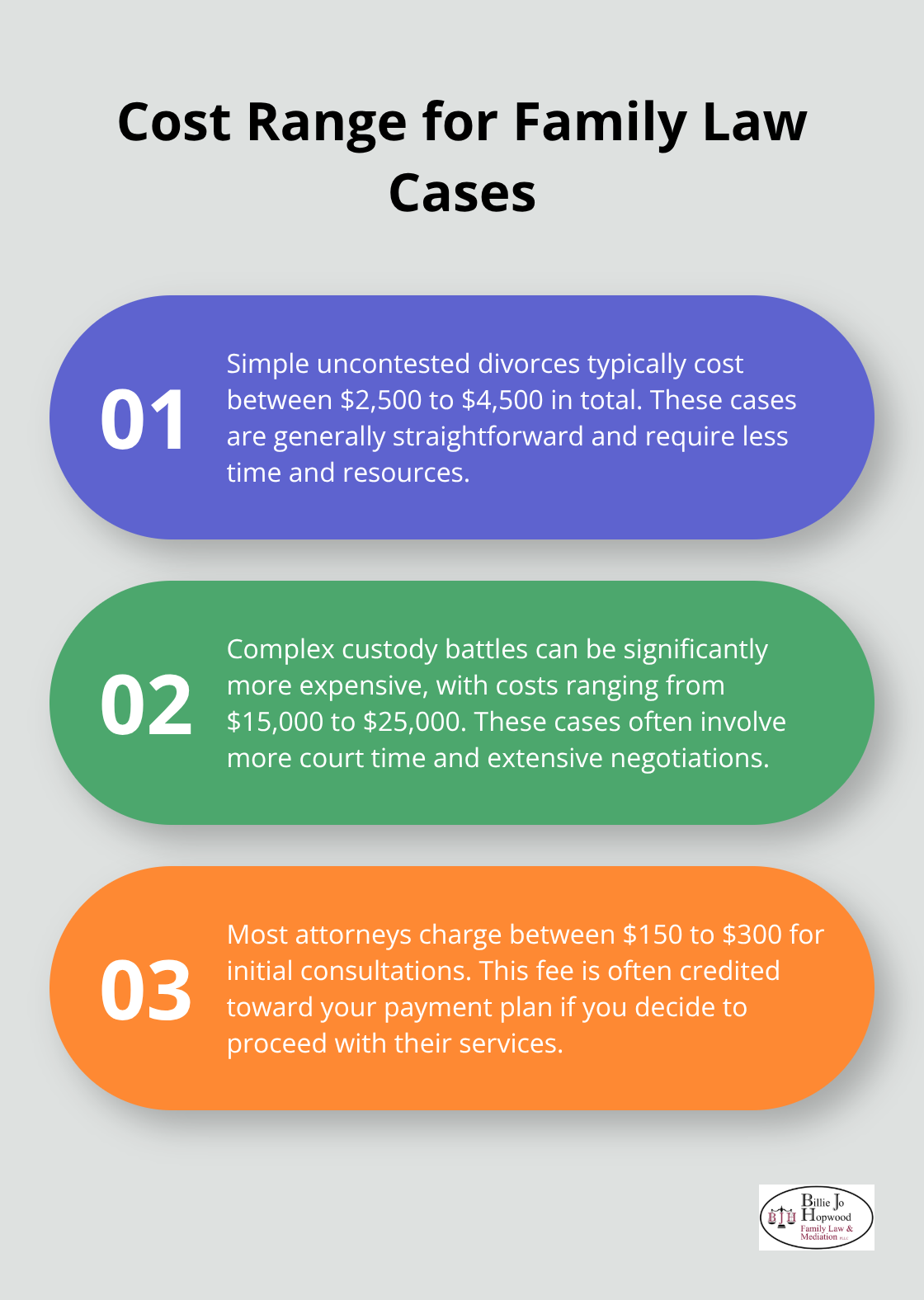
The payment plan process starts during your initial consultation when attorneys assess your case value and financial capacity. Most family law attorneys charge $150 to $300 for initial consultations, which they credit toward your payment plan if you proceed. During this meeting, attorneys evaluate case complexity, estimate total costs, and determine your monthly payment capability. Simple uncontested divorces might cost $2,500 to $4,500 total, while complex custody battles can reach $15,000 to $25,000. Attorneys typically require proof of income, monthly expenses, and basic financial information to structure realistic payment terms.

Ordered list chart showing cost ranges for simple uncontested divorces and complex custody battles - family law lawyers that take payments

Initial Consultation and Fee Assessment Process

Attorneys conduct thorough financial assessments before they propose payment structures. They review your income statements, monthly obligations, and available resources to determine what you can afford. Most attorneys ask for recent pay stubs, bank statements, and a list of monthly expenses during this evaluation. This information helps them calculate sustainable payment amounts that won’t strain your budget. The assessment also includes discussion of case timeline and potential complications that might affect total costs.

Monthly Payment Structure Options

Payment plans typically span 6 to 18 months depending on case complexity and your financial situation. Attorneys calculate monthly payments by dividing estimated total costs minus your initial payment across the agreed timeframe. For an $8,000 divorce case with $1,500 down, you would pay approximately $540 monthly over 12 months. Most firms require automatic payments through bank transfers or credit cards to maintain consistent cash flow. Some attorneys offer seasonal payment adjustments for clients with variable income (such as teachers or seasonal workers).

Documentation and Agreement Requirements

Payment plan agreements must include specific terms that protect both parties from misunderstandings. These contracts specify total case costs, monthly payment amounts, late fee penalties (usually $25 to $50), and consequences for missed payments. Most attorneys require signed agreements that state legal work may pause if payments become 30 days overdue. Florida Bar guidelines require attorneys to maintain detailed records of all payment arrangements and provide clients with monthly statements that show payments received and remaining balances.

The next step involves finding attorneys who offer these flexible payment options and knowing what questions to ask during your search.

Finding Family Law Attorneys Who Offer Flexible Payment Options

Ask Direct Financial Questions During Consultations

Most attorneys don’t advertise payment plans prominently, so you must ask specific questions during initial consultations. Ask what percentage of clients use payment plans and request examples of typical arrangements for cases like yours. Inquire about minimum down payments, monthly payment ranges, and maximum plan duration. Request details about late payment penalties and what happens if you miss payments. Florida attorneys who regularly offer payment plans can provide immediate answers and show you sample agreements. Those who seem hesitant or vague likely don’t have established payment programs.

Identify Payment Plan Warning Signs

Avoid attorneys who demand full payment within 60 days or charge excessive late fees above $50 per missed payment. Red flags include attorneys who won’t put payment terms in writing, require credit checks for payment plans, or charge interest on monthly payments. Some attorneys use payment plans as marketing tools but still expect large lump sum payments during your case. The Florida Bar prohibits attorneys from charging unreasonable fees, so monthly payments that exceed 25% of your take-home income indicate potential problems. Attorneys who pressure you to borrow money or use credit cards instead of offering genuine payment plans don’t prioritize client financial wellness.

Compare Payment Structures Across Multiple Firms

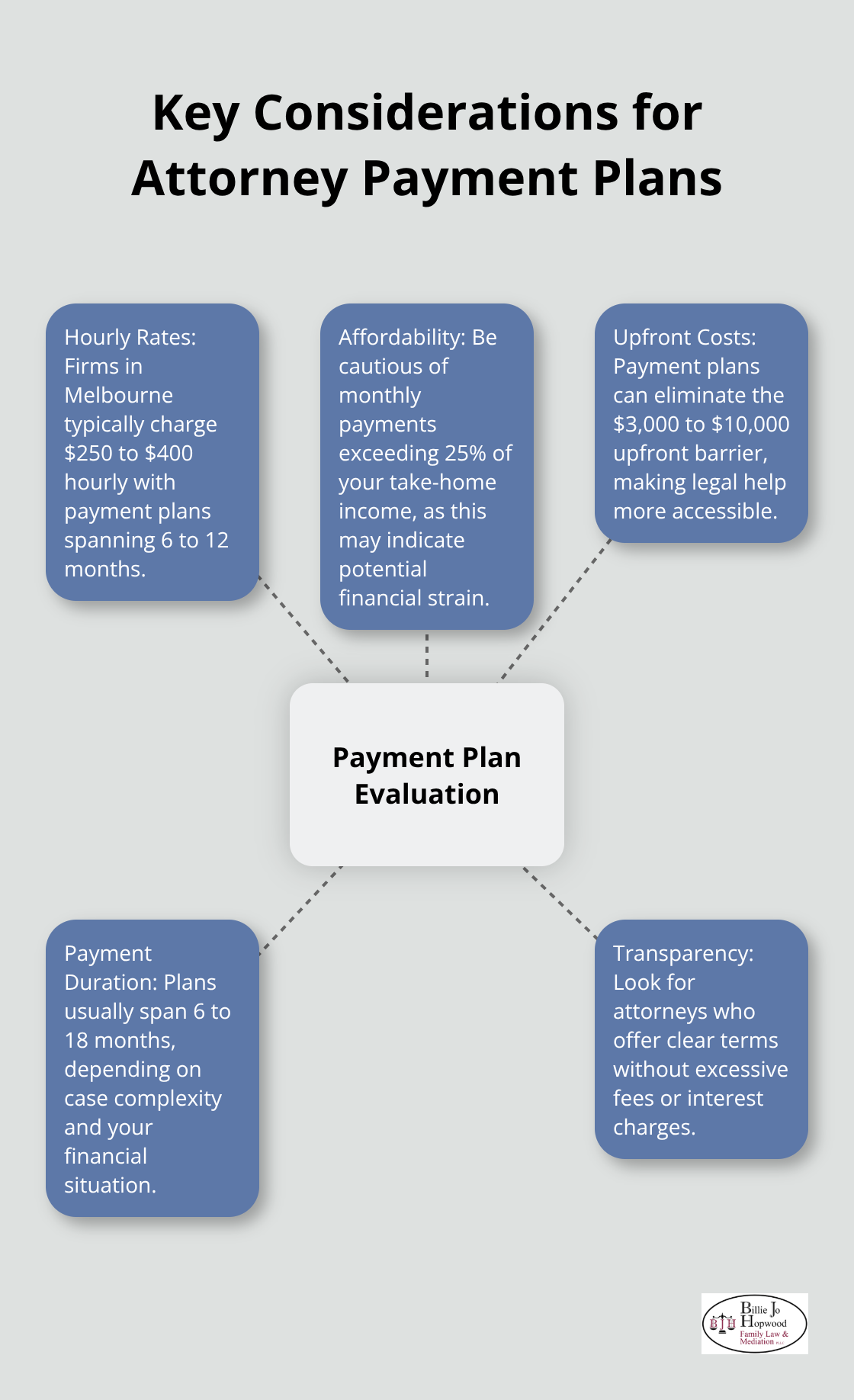
Contact at least three family law firms to compare their payment options and total costs. Some attorneys offer fixed monthly payments of $300 to $600 regardless of case complexity, while others calculate payments based on estimated total costs. Many attorneys in Melbourne offer unbundled legal services, where you can pay for specific tasks rather than full representation. Firms in Melbourne typically charge $250 to $400 hourly with payment plans that span 6 to 12 months. Document each firm’s down payment requirements, monthly amounts, and total estimated costs for accurate comparison. Ask about automatic payment discounts and seasonal payment adjustments for variable income (particularly helpful for teachers or seasonal workers). The best payment plans align with your budget while they provide comprehensive legal representation throughout your case.

Hub and spoke chart illustrating important factors to evaluate in attorney payment plans - family law lawyers that take payments

Evaluate Attorney Experience with Payment Plans

Choose attorneys who have established payment plan systems rather than those who offer them occasionally. Experienced attorneys can predict case costs more accurately and structure realistic payment schedules. They maintain clear documentation systems and provide regular payment statements. Ask how long the firm has offered payment plans and what percentage of their clients use these arrangements. Attorneys with extensive payment plan experience understand financial pressures families face and work to accommodate your needs while maintaining quality representation. Many families choose mediation because it offers a more private and flexible way to resolve disputes.

Final Thoughts

Payment plans transform family law representation from an unaffordable luxury into an accessible necessity. These arrangements eliminate the $3,000 to $10,000 upfront barrier that prevents many families from getting proper legal help. Monthly payments of $200 to $800 fit household budgets better than large lump sums, while automatic payment options reduce stress during difficult times.

When you select payment arrangements, prioritize attorneys who offer transparent terms without excessive late fees or interest charges. Compare down payment requirements, monthly amounts, and total costs across multiple firms. Avoid attorneys who pressure you toward credit cards or loans instead of genuine payment plans (these tactics often indicate poor financial practices).

Family law lawyers that take payments understand the financial pressures families face during legal proceedings. We at Billie Jo Hopwood Family Law & Mediation, PLLC provide compassionate guidance through divorce, child custody, alimony, and child support matters while we work within your budget constraints. Start by scheduling consultations with attorneys who offer established payment programs and ask direct questions about payment structures.

How to Navigate Financial Mediation in Divorce

Divorce brings complex financial decisions that can overwhelm even the most prepared couples. Financial mediation divorce offers a collaborative path forward that protects both your assets and your family’s well-being.

At Billie Jo Hopwood Family Law & Mediation, PLLC, we guide Melbourne Florida families through this process with clarity and compassion. The right approach can save you thousands in legal fees while preserving important relationships.

What Makes Financial Mediation Different

Financial Mediation Saves Time and Money

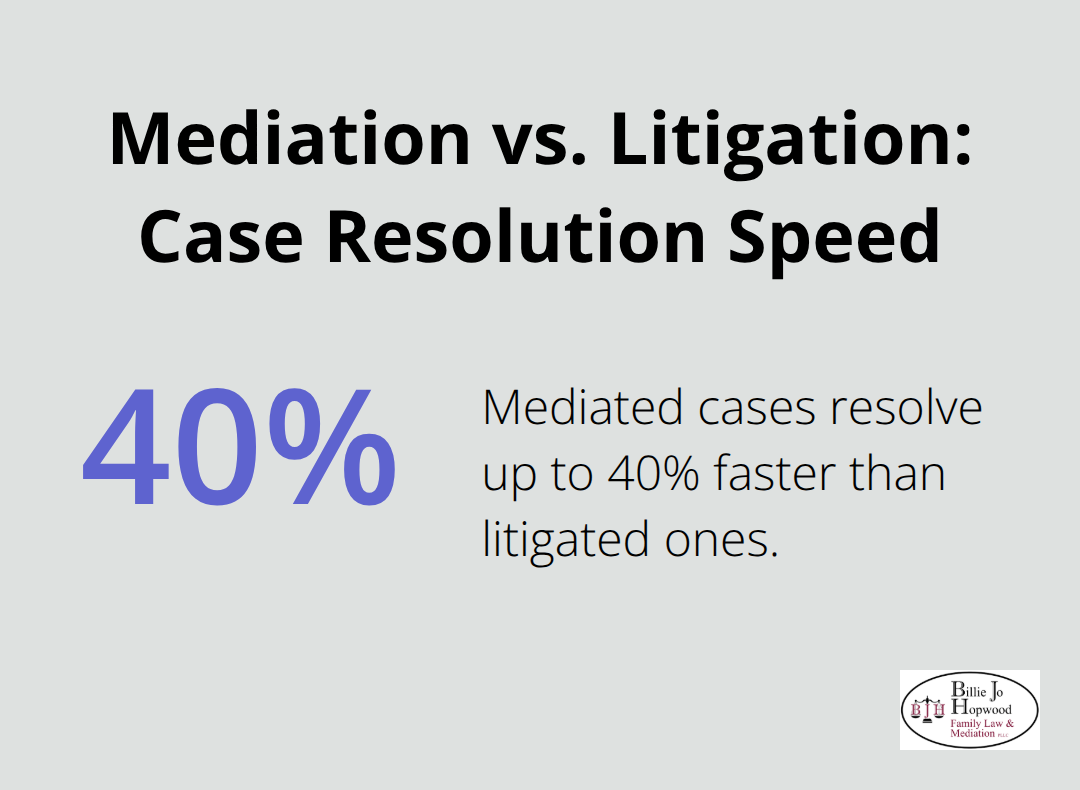
Financial mediation in Melbourne Florida transforms how couples handle divorce finances. Traditional litigation costs an average of $15,000 to $30,000 per spouse, while mediation typically runs $3,000 to $8,000 total for both parties. The process takes 2-4 months compared to 12-18 months in court.

Chart comparing the cost of mediation ($3,000 to $8,000) to traditional litigation ($15,000 to $30,000 per spouse) - financial mediation divorce

You meet with a neutral mediator who helps both spouses reach agreements on asset division, debt allocation, and support payments. Florida courts mandate mediation for custody disputes, and many judges now require it for financial matters before they allow trials. The mediator doesn’t make decisions but facilitates productive conversations between you and your spouse.

You Control Your Financial Future

Mediation puts you in the driver’s seat. Court battles leave financial decisions to a judge who doesn’t know your family’s unique circumstances. In mediation, you craft solutions that work for your specific situation.
You can structure asset division over time, create flexible support arrangements, or protect business interests through creative agreements. The process remains confidential (unlike public court hearings where your financial details become part of the permanent record). Florida’s equitable distribution law still applies, but mediation allows you to negotiate what fair means for your family rather than accept a judge’s interpretation.

When Mediation Works Best

Financial mediation succeeds when both spouses can communicate respectfully and share complete financial information. It works particularly well for couples with complex assets, business ownership, or retirement accounts that need careful division.

Mediation fails when domestic violence exists, when one spouse hides assets, or when someone refuses to negotiate in good faith. High-conflict situations where emotions override logic also benefit more from structured litigation (though these cases often cost significantly more). The key is honest financial disclosure – when you hide income or assets, you destroy trust and derail the entire process.

The success of your mediation depends heavily on the preparation you complete before your first session.

Key Financial Issues Addressed in Mediation

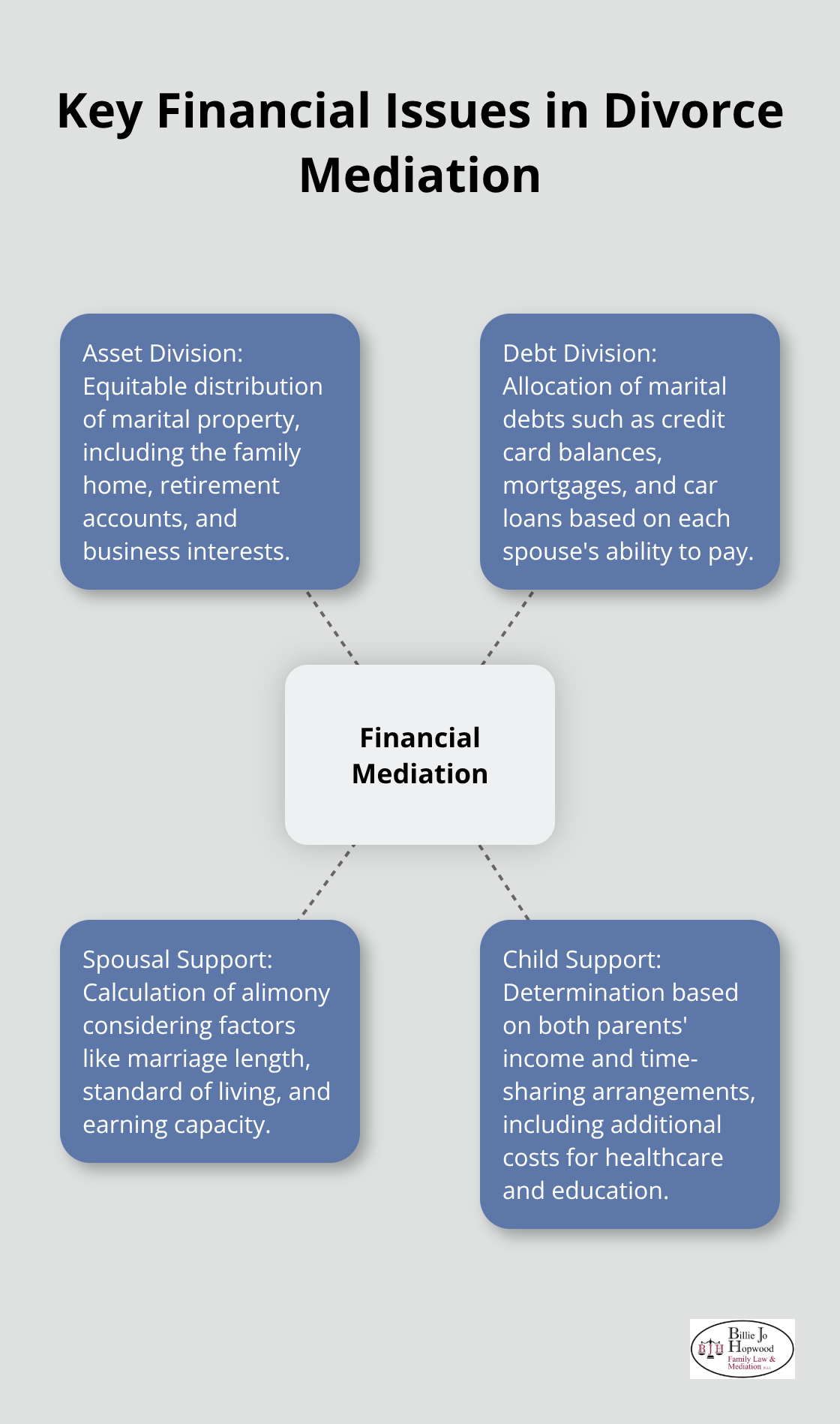
Mediation addresses three major financial areas that determine your post-divorce financial stability. Asset division covers everything from your home equity to retirement accounts, with Florida’s equitable distribution law requiring fair but not necessarily equal splits. Marital assets include anything acquired during marriage regardless of whose name appears on the title, while separate property like inheritances or pre-marital assets typically stays with the original owner. Debt division follows the same principles – credit card balances, mortgages, and car loans accumulated during marriage get allocated based on each spouse’s ability to pay and benefit received from the debt.

Hub and spoke chart showing the main financial issues addressed in divorce mediation: Asset Division, Debt Division, Spousal Support, and Child Support - financial mediation divorce

Asset Division Requires Strategic Planning

Florida courts divide marital property based on multiple factors including each spouse’s economic circumstances, contributions to the marriage, and future financial needs. Your family home often represents the largest asset, and couples must decide whether to sell and split proceeds or allow one spouse to buy out the other’s interest. Retirement accounts need careful handling since early withdrawals trigger tax penalties (401k plans require Qualified Domestic Relations Orders to avoid these penalties). Business valuations become complex when one spouse owns a company, as the court must determine whether appreciation resulted from marital efforts or separate property growth.

Spousal Support Calculations Follow Strict Guidelines

Alimony calculations in Florida consider eleven statutory factors including marriage length, standard of living, and each spouse’s earning capacity. Marriages lasting less than seven years rarely qualify for permanent alimony, while marriages over seventeen years often do. The 2023 alimony reform eliminated permanent alimony for most cases and capped duration at 75% of marriage length for long-term marriages. Tax implications changed dramatically after 2018 – alimony payments are no longer tax-deductible for payers or taxable income for recipients, making the true cost much higher than pre-2019 divorces.

Child Support Follows State Guidelines

Florida uses an income shares model that calculates support based on both parents’ combined monthly income and overnight time-sharing. The state’s child support guidelines cover children up to age 18 or graduation from high school, whichever comes later. Health insurance, daycare costs, and extracurricular activities get added to base support amounts. Educational expenses beyond high school require separate agreements since Florida law doesn’t mandate college support. Parents often negotiate private school tuition, tutoring costs, and college savings contributions during mediation rather than leave these decisions for future court battles.

Success in these financial negotiations depends heavily on thorough preparation before you enter the mediation room.

Preparing for Financial Mediation Sessions

What Documents Do You Need for Financial Mediation

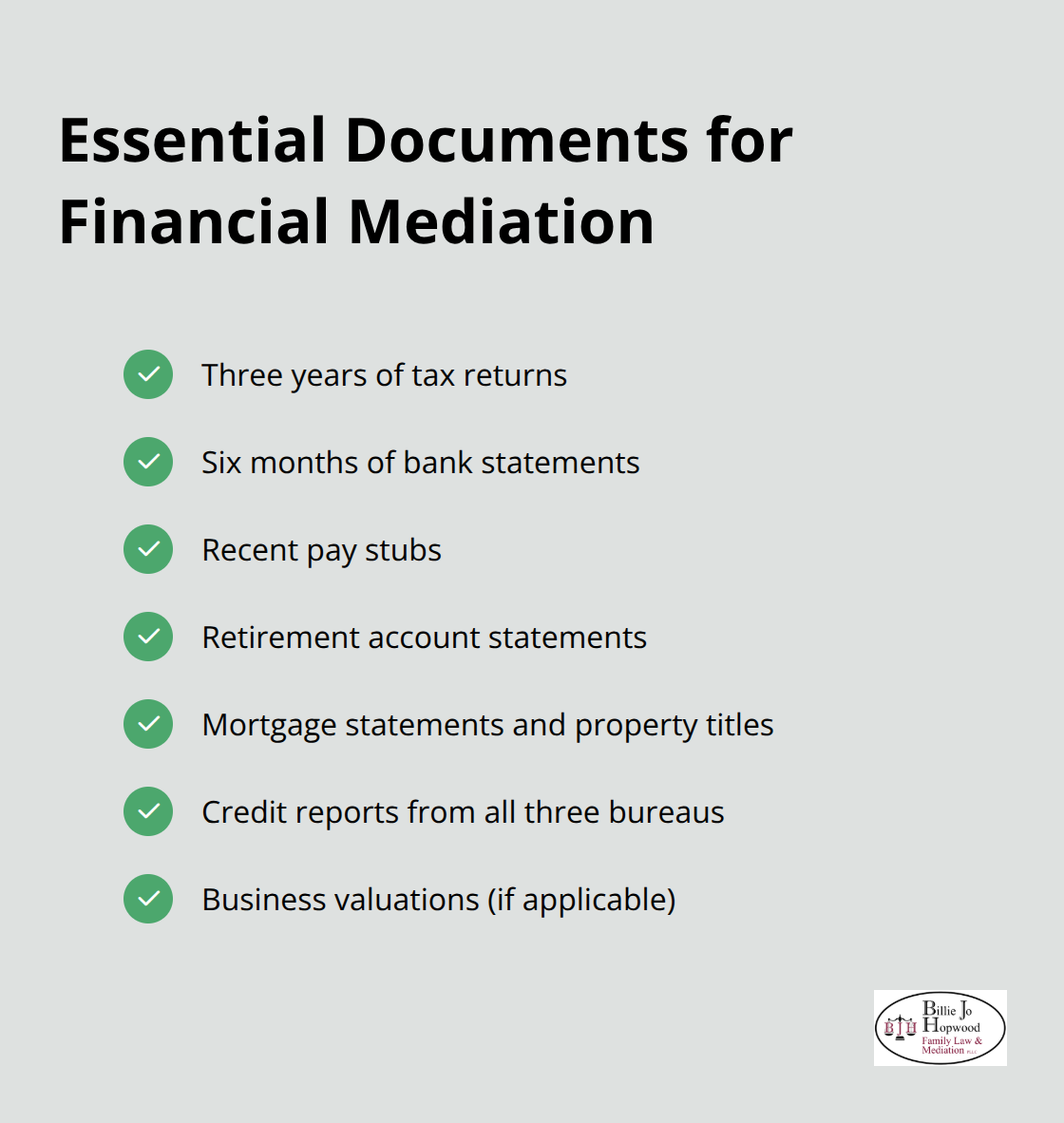
Financial mediation demands complete documentation of your financial life, and missing paperwork stops negotiations before they begin. Florida Family Law Rules require both parties to submit comprehensive Financial Affidavits within 45 days of the divorce petition (this includes three years of tax returns, six months of bank statements, pay stubs, retirement account statements, and complete records of all assets and debts). You must provide mortgage statements, vehicle titles, business valuations, and insurance policies alongside these core documents. Credit reports from all three bureaus expose hidden debts that catch many couples off guard during disclosure. Property appraisals become necessary for real estate, collectibles, or business interests worth more than $10,000. Courts impose sanctions for incomplete disclosures, and judges routinely reject settlements based on inadequate financial information.

Checklist of essential documents required for financial mediation, including tax returns, bank statements, pay stubs, retirement account statements, and property records

Set Specific Financial Goals Before Your First Session

Successful mediation begins with clear priorities rather than vague hopes for fairness. Write down your three most important financial objectives – whether you want to keep the family home, protect retirement savings, or minimize child support modifications. Research comparable divorce settlements in your income bracket and asset range to understand realistic outcomes. Florida’s equitable distribution law considers eleven factors including marriage duration, economic circumstances, and contributions to marital assets, so a 50-50 split rarely occurs. Calculate your post-divorce budget including housing, transportation, and childcare costs to understand what support amounts you actually need versus what sounds fair. Identifying your priorities helps you focus negotiations on what matters most rather than getting distracted by minor issues.

Choose Your Mediator Based on Financial Complexity

Your mediator’s background determines whether complex financial issues get resolved effectively or create future disputes. Mediators with accounting or financial planning experience handle business valuations, tax implications, and retirement division more competently than those with general mediation training. Ask potential mediators about their largest asset division case and how they handled Qualified Domestic Relations Orders for retirement accounts. Schedule initial consultations with at least two mediators to compare their approaches to debt allocation and spousal support calculations. The cheapest mediator costs more in the long run when agreements fail or require court intervention to resolve ambiguities.

Final Thoughts

Financial mediation divorce delivers measurable advantages over traditional litigation that extend far beyond immediate cost savings. Court battles average $15,000 to $30,000 per spouse and drag on for 12-18 months, while mediation typically costs $3,000 to $8,000 total and resolves within 2-4 months. These savings preserve resources for your family’s future rather than fund prolonged conflict.

The collaborative approach protects your children from courtroom drama while it maintains privacy around sensitive financial matters. Unlike public court records that expose your assets and debts permanently, mediation discussions remain confidential. You retain control over creative solutions that judges might never consider (from flexible payment schedules to business protection strategies).

We at Billie Jo Hopwood Family Law & Mediation, PLLC guide Melbourne Florida families through this process with the compassion and clarity you deserve. Our firm assists families through challenging legal situations that include divorce, child custody, alimony, and child support matters. The path forward begins when you understand your options and take that first step toward resolution.

Solutions-Based Family Law: A Modern Approach

At Billie Jo Hopwood Family Law & Mediation, PLLC, we believe in a modern approach to family law that puts solutions first. Solutions-based family law focuses on collaborative problem-solving and long-term family well-being.

This approach differs significantly from traditional adversarial methods, offering numerous benefits for families navigating legal challenges. In this post, we’ll explore how solutions-based family law works in Melbourne, Florida, and why it might be the right choice for your family.

What Is Solutions-Based Family Law?

A Collaborative Approach to Family Legal Matters

Solutions-based family law represents a modern, forward-thinking approach to resolving family legal issues. This method prioritizes collaborative problem-solving and focuses on the long-term well-being of families. In Melbourne, Florida, this approach has gained popularity as more families seek alternatives to traditional adversarial methods.

The Core: Working Together, Not Against Each Other

At the heart of solutions-based family law lies the principle of collaboration. This approach encourages parties to work together to find mutually beneficial solutions. For instance, in a child custody case, parents might collaborate with a mediator to create a parenting plan that suits both parties and (most importantly) benefits the child.

Shifting Away from Courtroom Battles

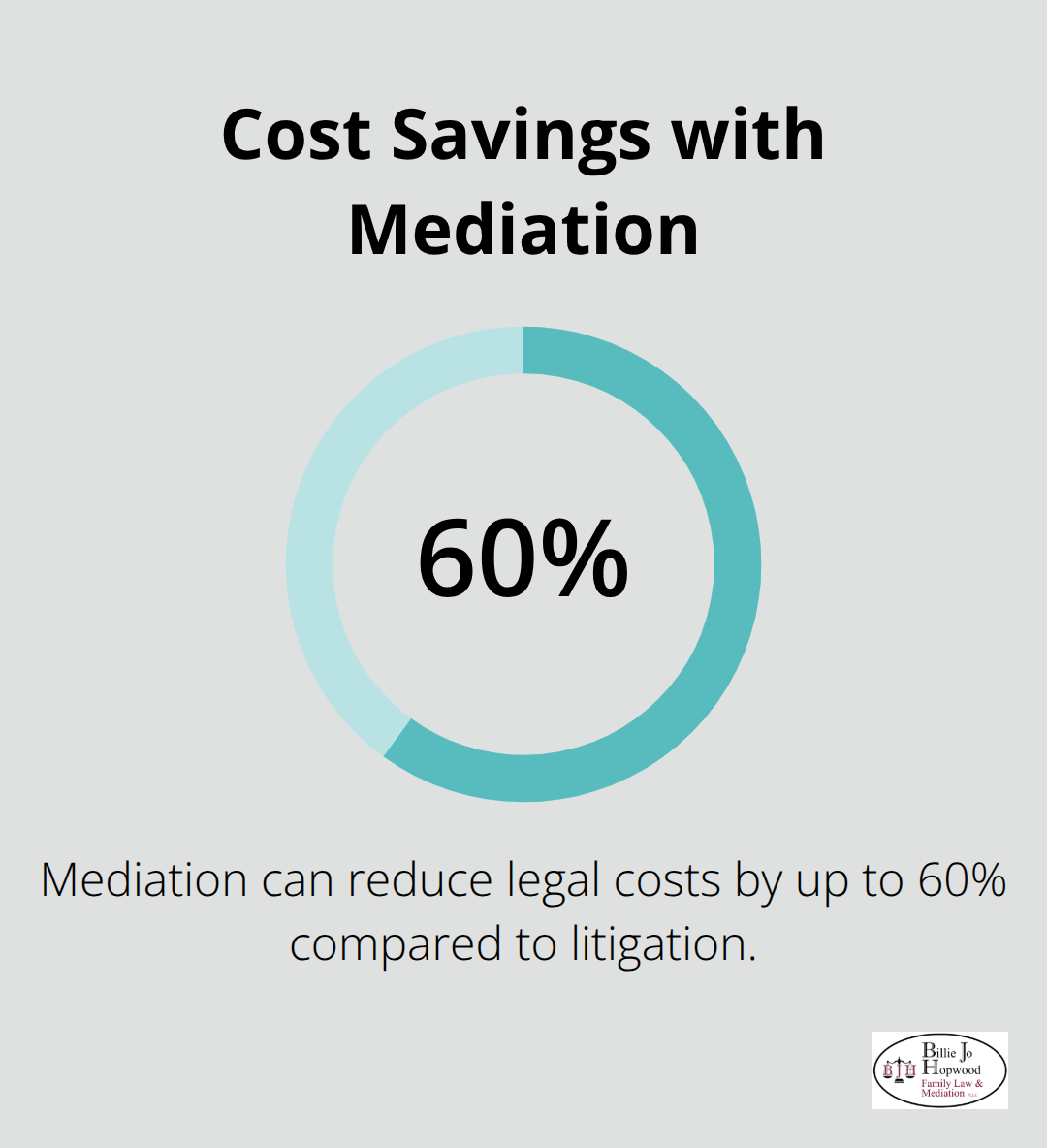
Solutions-based family law aims to keep families out of the courtroom whenever possible. This shift can result in significant time and cost savings. A study by the American Bar Association found that mediation can reduce legal costs by up to 60% compared to litigation. This approach not only saves money but also helps preserve family relationships.

A chart showing that mediation can reduce legal costs by up to 60% compared to litigation

Positive Outcomes for Families

The benefits of solutions-based family law extend far beyond immediate legal resolutions. Families who choose this method often report improved post-divorce relationships and better co-parenting dynamics. These positive outcomes align well with Melbourne, Florida’s community values, which emphasize strong family ties.

Available Services in Melbourne, Florida

Families in Melbourne, Florida have access to various solutions-based family law services. These include:

  1. Mediation
  2. Collaborative divorce
  3. Negotiation-focused legal representation

These methods allow families to navigate legal challenges while preserving relationships and focusing on future well-being. As we explore the key components of solutions-based family law in the next section, you’ll gain a deeper understanding of how this approach can benefit your family during challenging times.

How Solutions-Based Family Law Works in Melbourne, Florida

Solutions-based family law in Melbourne, Florida centers on three key elements: problem-solving, communication, and future-focused planning. This approach transforms family disputes from adversarial battles into collaborative efforts.

Collaborative Problem-Solving Takes Center Stage

In solutions-based family law, problem-solving becomes the primary focus. This method encourages families to work together to find mutually beneficial solutions. For example, in a property division case, both parties might work with a financial advisor to create a fair distribution plan that considers each person’s long-term financial stability.

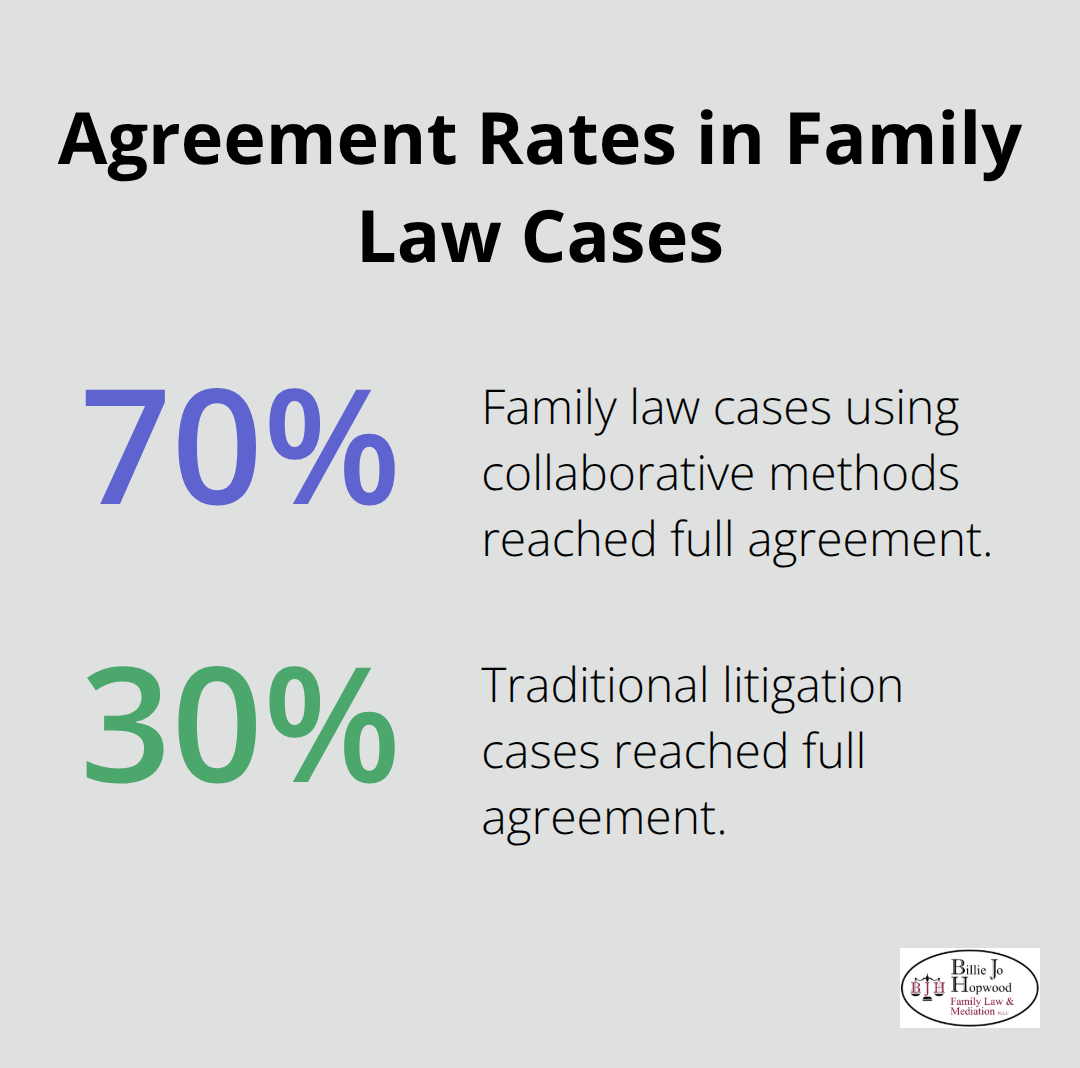
A study by the Florida Dispute Resolution Center revealed that 70% of family law cases using collaborative methods reached full agreement (compared to only 30% of traditional litigation cases). This significant difference underscores the effectiveness of collaborative problem-solving in family law matters.

A chart comparing agreement rates: 70% for collaborative methods vs. 30% for traditional litigation - solutions based family law

Effective Communication Strategies Foster Understanding

Communication forms the backbone of solutions-based family law. Family law professionals in Melbourne, Florida often employ specific techniques to facilitate productive discussions. These may include:

  1. Active listening exercises
  2. Neutral language training
  3. Emotion management techniques

These strategies help parties express their needs clearly and understand each other’s perspectives, which leads to more constructive negotiations. In a child custody case, parents might use these communication tools to create a detailed parenting plan that addresses both parties’ concerns and prioritizes the child’s well-being.

Long-Term Family Well-Being Takes Priority

Solutions-based family law in Melbourne, Florida places a strong emphasis on long-term outcomes. This approach considers the future implications of decisions made during the legal process, rather than focusing solely on immediate resolutions.

When addressing alimony, for instance, a solutions-based approach might involve creating a plan that not only meets immediate financial needs but also includes provisions for future career development or retraining. This forward-thinking strategy helps ensure that both parties can maintain financial stability long after the legal proceedings conclude.

The focus on long-term well-being often leads to more satisfying and sustainable outcomes for families in Melbourne, Florida. By addressing not just the legal aspects but also the emotional and practical considerations of family law matters, families can build a stronger foundation for their future.

As we move forward, let’s explore how these principles translate into practical applications in various family law scenarios.

Putting Solutions-Based Family Law into Action in Melbourne, Florida

Mediation: A Powerful Tool for Resolution

Mediation stands at the forefront of solutions-based family law in Melbourne, Florida. Many families find success through this process, where a neutral third party facilitates discussions between the involved parties. This approach often leads to faster, less expensive, and more satisfying outcomes compared to traditional litigation.

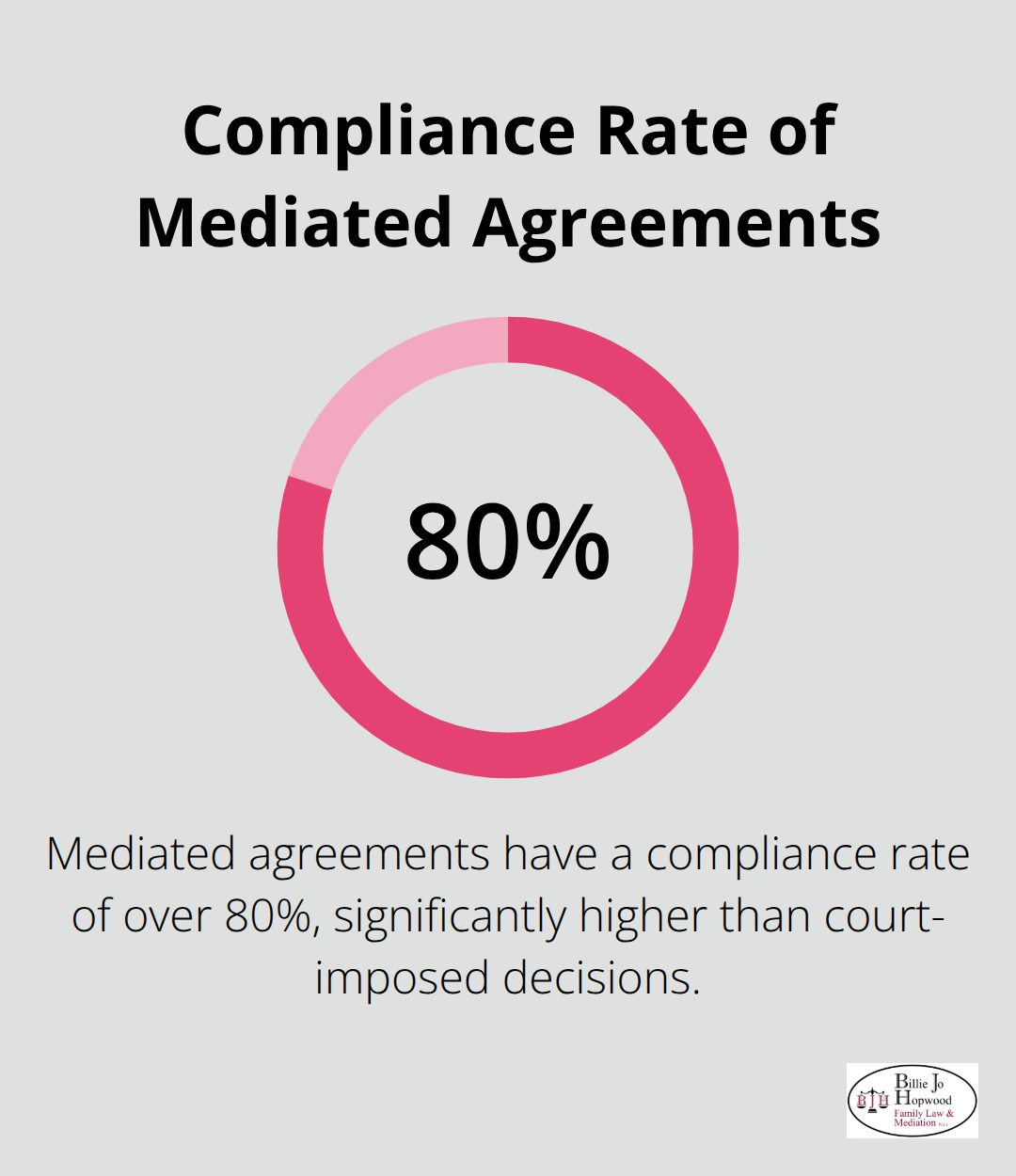
A recent example in Melbourne showcases the effectiveness of mediation. A divorcing couple resolved their property division issues in just three sessions, saving thousands in potential legal fees. The Florida Court System reports that mediated agreements have a compliance rate of over 80% (significantly higher than court-imposed decisions).

A chart showing that mediated agreements have a compliance rate of over 80% - solutions based family law

Tailoring Parenting Plans for Family Success

Solutions-based family law excels in creating customized parenting plans. Melbourne, Florida has witnessed a shift towards more flexible and child-centered arrangements. These plans address the unique needs of each family, going beyond basic custody schedules.

A recent case illustrates this approach. Parents with varying work schedules developed a plan that accommodated their shifts while ensuring quality time for their child with both parents. This creative solution reduced conflict and resulted in a happier child.

Innovative Financial Solutions in Divorce

Financial settlements in divorce cases benefit greatly from solutions-based approaches. Melbourne, Florida sees more creative and equitable financial arrangements that consider long-term stability for both parties.

One innovative solution involves the use of a Qualified Domestic Relations Order (QDRO) to divide retirement assets. This method allows for a tax-free transfer of funds (potentially saving thousands in taxes). Another approach gaining traction is the use of a divorce financial analyst to create comprehensive financial plans that account for future needs and goals.

Collaborative Law: A Team Approach

Collaborative law represents another key aspect of solutions-based family law in Melbourne. This method involves a team of professionals working together to resolve family law issues outside of court. The team typically includes attorneys, financial advisors, and mental health professionals.

In a recent Melbourne case, a collaborative approach helped a high-conflict couple reach an agreement on complex property division and custody issues. The involvement of a neutral financial expert and a child specialist provided valuable insights that led to a mutually beneficial solution.

Alternative Dispute Resolution Techniques

Solutions-based family law in Melbourne also incorporates various alternative dispute resolution techniques. These methods aim to resolve conflicts without resorting to litigation. Examples include:

  1. Early neutral evaluation
  2. Parenting coordination
  3. Arbitration

These techniques provide families with options tailored to their specific needs and circumstances. They often result in faster resolutions and help preserve family relationships.
Final Thoughts

Solutions-based family law provides a modern approach to resolve legal matters in Melbourne, Florida. This method prioritizes collaboration, communication, and long-term family well-being, which leads to more satisfying outcomes for all parties involved. Families can navigate challenging legal situations while preserving relationships and reducing emotional stress through this problem-solving focused approach.

The benefits of solutions-based family law include significant cost savings and higher compliance rates with agreements. Mediation, collaborative law, and customized parenting plans have helped Melbourne families find positive resolutions to complex issues. Families in Melbourne can find paths to resolution that align with their unique needs and circumstances through these flexible and creative methods.

Billie Jo Hopwood Family Law & Mediation, PLLC understands the importance of solutions-based family law. Our team guides families through challenging legal situations with care (and expertise). We encourage Melbourne residents to consider this modern approach when addressing family law matters, as it often results in more sustainable outcomes for all involved.

Family Law Register of Actions: What Is It?

At Billie Jo Hopwood Family Law & Mediation, PLLC, we often encounter clients who are unfamiliar with the Family Law Register of Actions. This essential document plays a significant role in family law cases in Melbourne, Florida.

The Register of Actions serves as a comprehensive record of all events and filings in a legal case. Understanding this document can help you stay informed about your case’s progress and important deadlines.

What Is the Family Law Register of Actions in Melbourne, Florida?

The Family Law Register of Actions stands as a cornerstone document in Melbourne, Florida’s legal system. This comprehensive record tracks every event and filing in a family law case, serving as an official timeline from the initial filing to the final resolution.

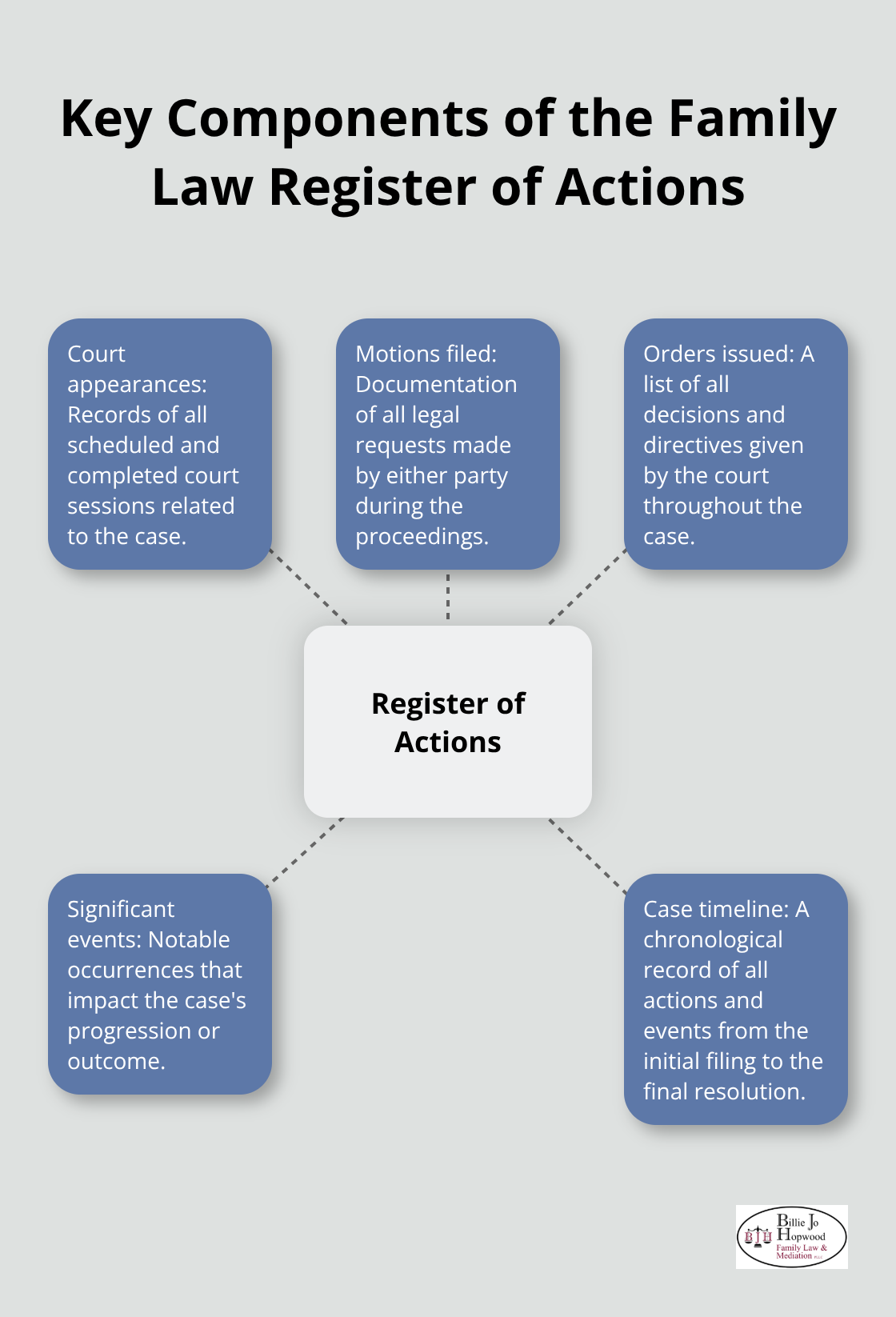
Key Components of the Register

The register includes several essential elements:

  1. Court appearances
  2. Motions filed
  3. Orders issued
  4. Other significant events

Each entry typically contains the date, a brief description of the action, and the party responsible for the action. For example, it might show when a party filed a petition for divorce, when the other party submitted responses, or when the court scheduled a hearing.

A hub and spoke chart showing the key components of the Family Law Register of Actions: court appearances, motions filed, orders issued, significant events, and case timeline.

Practical Applications

The Register of Actions proves invaluable for quickly assessing a case’s status. It’s particularly useful when:

  1. An attorney takes over a case from another lawyer
  2. A client needs a rapid update on their case progress
  3. Identifying missed deadlines or upcoming court dates

This tool ensures all parties stay informed about case developments (a critical aspect of effective legal representation).

Distinctions from Other Legal Documents

Unlike other legal documents, the Register of Actions doesn’t contain detailed information about the case’s substance. It doesn’t serve as a repository for legal arguments or evidence. Instead, it functions more like a table of contents for the case file.

This distinction holds importance because while the register provides a quick overview, it doesn’t replace the need to review actual court filings and orders for their full content. Attorneys and clients alike must understand this limitation to avoid misinterpretation of the case’s progress or details.

Accessing the Register

In Melbourne, Florida, parties can typically access the Register of Actions through the county clerk’s office or online court portals (depending on the specific court system). Some jurisdictions may require a small fee or registration to access these records electronically.

Understanding the Family Law Register of Actions proves essential for anyone involved in a family law case in Melbourne, Florida. As we move forward, let’s explore the significance of this document in family law proceedings and how it impacts case management and strategy.

Why the Register of Actions Matters in Family Law

A Chronological Roadmap for Cases

The Register of Actions serves as a detailed timeline of all events in a family law case. This chronological record allows attorneys and parties to understand the progression of legal proceedings quickly. In a divorce case, for example, the register might show the date of initial filing, responses from the other party, and subsequent motions or hearings. This timeline enables quick comprehension of the case’s history without the need to sift through voluminous files.

Effective Deadline Tracking

One of the most practical applications of the Register of Actions is its role in deadline management. Family law cases often involve numerous time-sensitive filings and court appearances. The register acts as a reliable reference point for upcoming due dates, which helps prevent costly oversights. Missing a deadline can significantly affect the outcome of a case, making this feature of the register particularly valuable.

Strategic Tool for Case Preparation

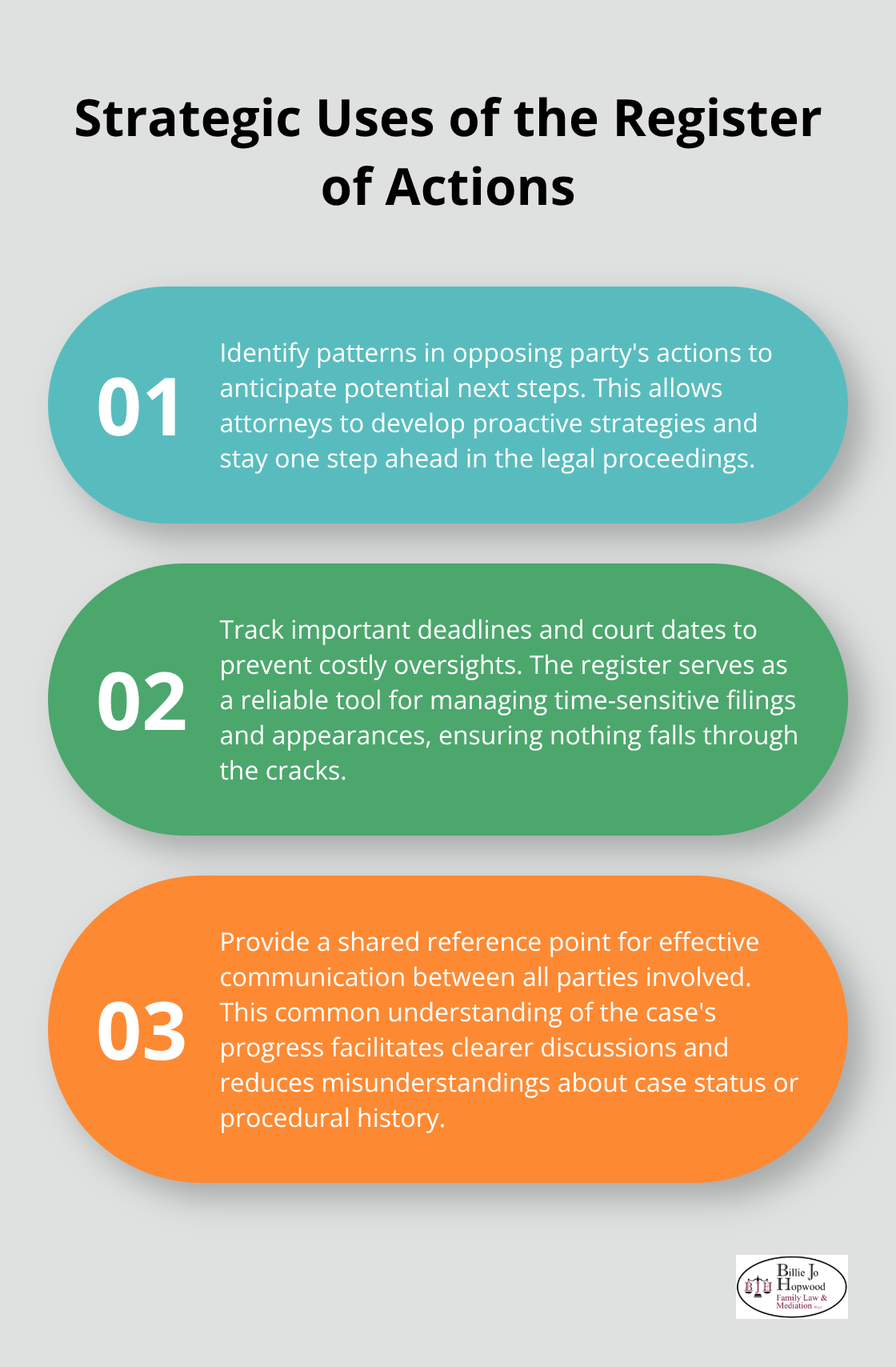
Attorneys use the Register of Actions as a strategic tool for case preparation. By reviewing the register, lawyers can:

  1. Identify patterns in the opposing party’s actions
  2. Anticipate potential next steps
  3. Plan their strategy accordingly

For instance, if the register shows multiple requests for continuances from the other party, it might indicate a delay tactic that needs to be addressed. This insight allows for more informed decision-making and proactive case management.

An ordered list chart showing three strategic uses of the Register of Actions: identifying patterns, tracking deadlines, and providing a shared reference point.

Legal Reference and Communication Aid

The Register of Actions also serves as a common reference point for all parties involved in a case. It provides a shared understanding of the case’s progress, which can facilitate more effective communication between attorneys, clients, and the court. This shared knowledge base can streamline discussions and reduce misunderstandings about case status or procedural history.

The Register of Actions transcends its role as a mere record. It functions as a dynamic tool that supports effective case management and informed decision-making in family law matters. Its contents and implications can significantly impact the course of legal proceedings in Melbourne, Florida’s family courts. As we move forward, we’ll explore how to access and interpret this vital document effectively.

Navigating the Register of Actions in Melbourne

Accessing the Register

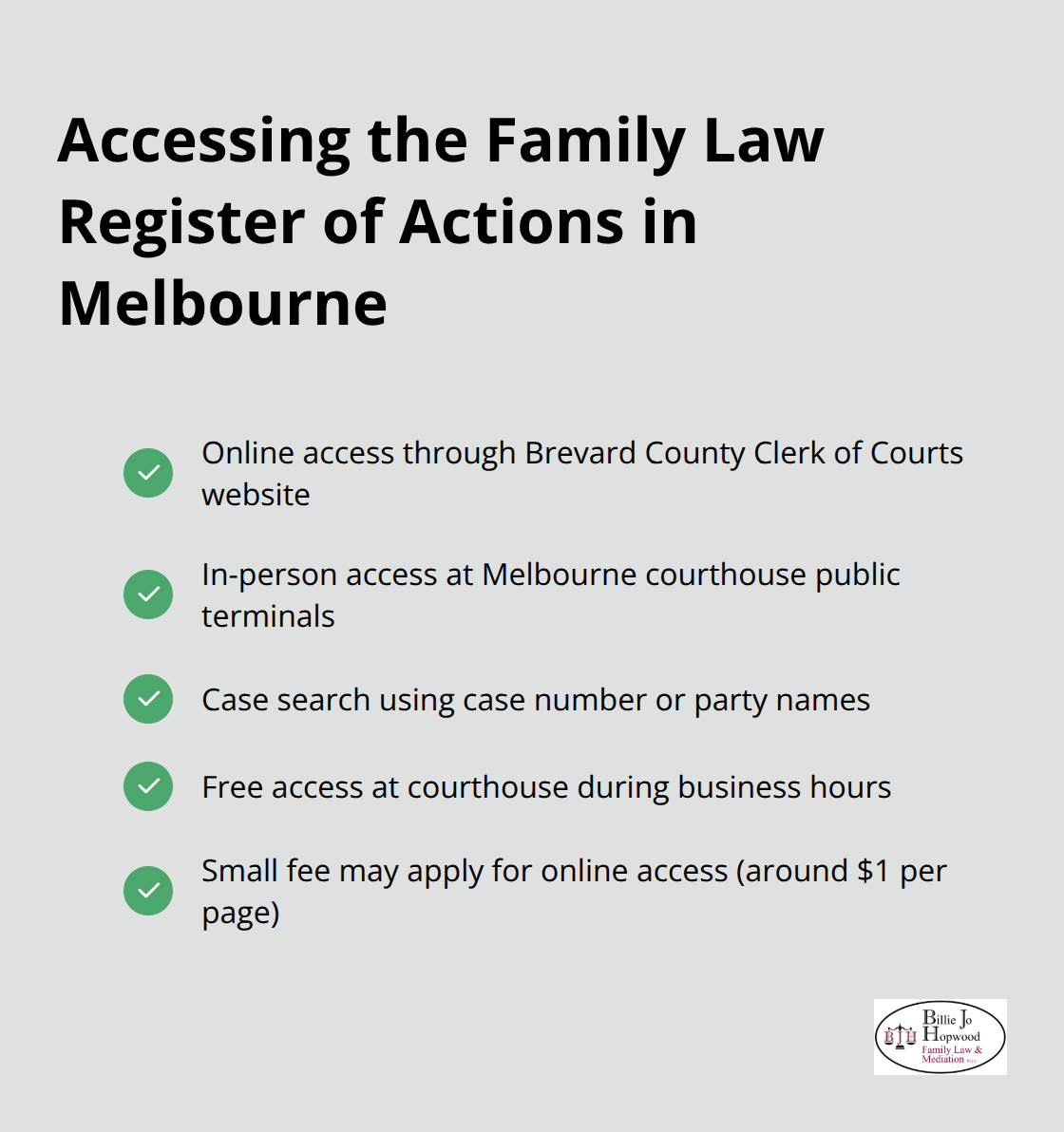
The Family Law Register of Actions in Melbourne, Florida is maintained by the Brevard County Clerk of Courts. You can access these records through multiple channels:

  1. Online: Visit the Brevard County Clerk of Courts website. Select “Court Records” and then “Case Search.” You’ll need to provide basic case information (such as the case number or party names). Some records may require a small fee for access (typically around $1 per page).
  2. In-person: The Melbourne courthouse offers public access terminals during regular business hours. These terminals provide free access to case records, including the Register of Actions.
A checkmark list chart showing five ways to access the Family Law Register of Actions in Melbourne, including online access, in-person access, case search methods, free access at the courthouse, and potential fees for online access.

Understanding the Information

The Register of Actions presents information in a chronological format. Each entry represents a specific event or filing in your case. Key elements to focus on include:

  1. Date: When the action occurred
  2. Description: A brief explanation of the action (e.g., “Motion for Temporary Relief Filed”)
  3. Filed By: The party responsible for the action
  4. Judge: The presiding judge for the action (if applicable)

Pay close attention to entries marked as “Order” or “Judgment,” as these often indicate significant decisions in your case. Also, look for upcoming hearing dates or deadlines for submitting documents.

Decoding Common Abbreviations

Family law registers often use abbreviations to save space. Here are some frequently encountered terms:

  • PET: Petitioner
  • RESP: Respondent
  • MTN: Motion
  • CONT: Continued (hearing rescheduled)
  • MSJ: Motion for Summary Judgment
  • OSC: Order to Show Cause

Understanding these abbreviations will help you quickly grasp the nature of each entry in the register.

Utilizing the Register Effectively

To make the most of the Register of Actions:

  1. Review it regularly to stay informed about your case progress
  2. Use it to prepare for upcoming events in your case
  3. Consult with your attorney about any entries you don’t understand

The Register of Actions serves as a valuable tool for tracking the progress of your family law case in Melbourne, Florida. It provides a clear timeline of events and can help you stay organized throughout the legal process.

Final Thoughts

The Family Law Register of Actions serves as a vital tool for navigating family law cases in Melbourne, Florida. This comprehensive document provides a clear, chronological record of all events and filings, which enables efficient tracking of important deadlines and court dates. Regular review of the register allows parties to stay informed about their case’s status and prepares them for upcoming events.

Understanding how to access and interpret the Family Law Register of Actions empowers individuals to take a more active role in their cases. It provides a shared reference point for all parties involved, which facilitates clearer communication and reduces potential misunderstandings about case status or procedural history. This knowledge can lead to more informed decision-making in family law matters.

At Billie Jo Hopwood Family Law & Mediation, PLLC, we recognize the importance of keeping our clients well-informed throughout their legal journey. Our team guides you through every aspect of your family law case, including helping you understand and utilize resources like the Family Law Register of Actions. We provide the support and representation you need during challenging legal situations in Melbourne, Florida.

How to Choose a Divorce Mediator in Melbourne Florida

Choosing a divorce mediator in Melbourne, Florida is a critical step in navigating the complexities of ending a marriage. The right mediator can make a significant difference in the outcome and overall experience of the divorce process.

At Billie Jo Hopwood Family Law & Mediation, PLLC, we understand the importance of finding a skilled and trustworthy professional to guide you through this challenging time. This guide will help you identify key factors to consider when selecting a divorce mediator in Melbourne, Florida.

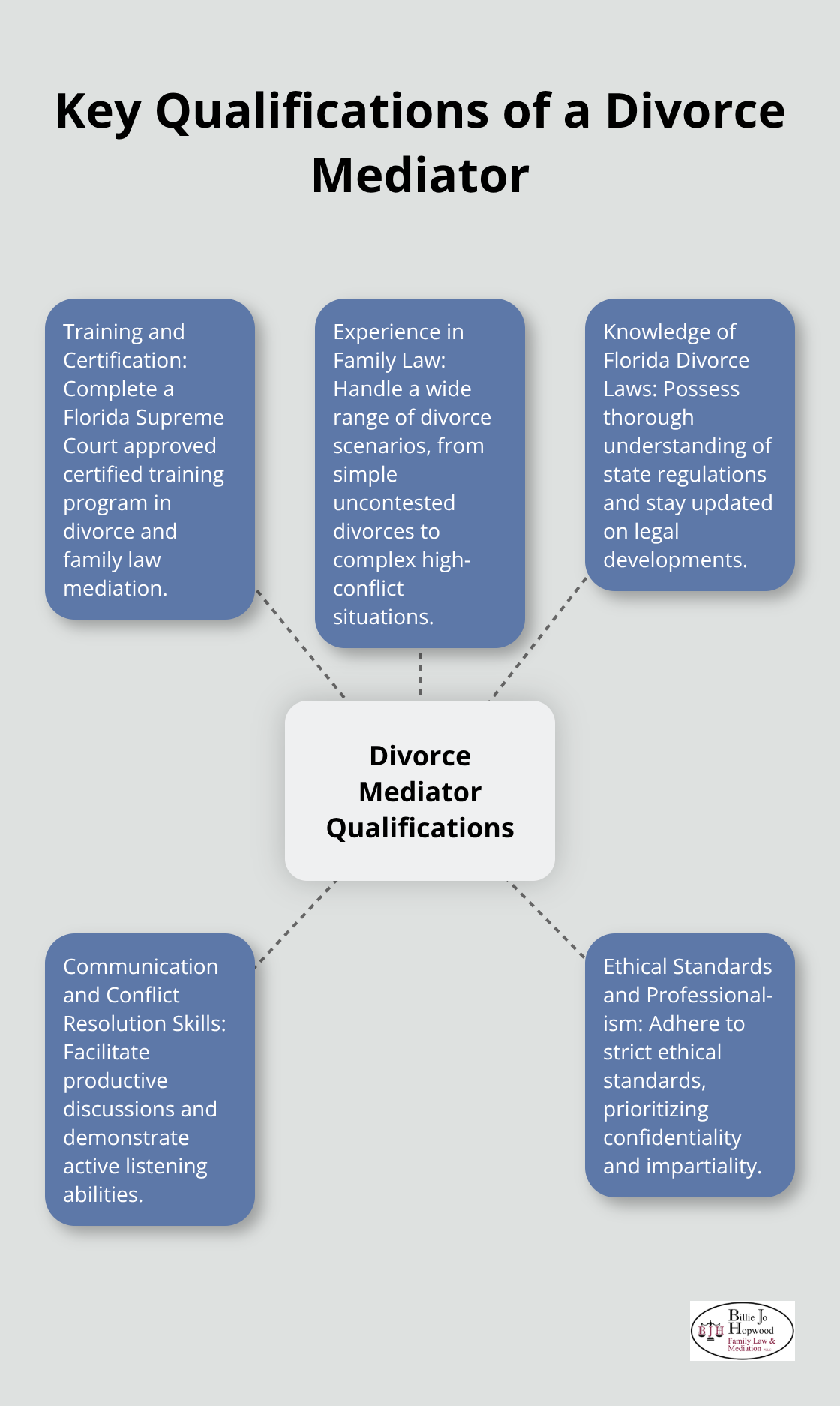
What Qualifications Should a Divorce Mediator Have?

Hub and spoke chart showing five key qualifications of a divorce mediator: Training and Certification, Experience in Family Law, Knowledge of Florida Divorce Laws, Communication and Conflict Resolution Skills, and Ethical Standards and Professionalism. - choosing a divorce mediator in melbourne florida

When selecting a divorce mediator in Melbourne, Florida, you must consider specific qualifications that ensure they can handle your case effectively.

Training and Certification

Florida law requires mediators to complete a certified training program approved by the Florida Supreme Court. This specialized training equips mediators with the necessary skills to navigate complex family dynamics and legal issues. Ask potential mediators about their certification and any additional training they’ve completed in divorce and family law mediation.

Experience in Family Law

A mediator’s experience in handling diverse family law cases is invaluable. Look for professionals who have dealt with a wide range of divorce scenarios (from simple uncontested divorces to complex cases involving high-conflict situations or substantial assets). The Florida Chapter of the Association of Family and Conciliation Courts reports that mediators with extensive experience often achieve better outcomes for families.

Knowledge of Florida Divorce Laws

Your mediator should possess a thorough understanding of Florida’s divorce laws and procedures. This knowledge is essential for guiding you through the legal aspects of your divorce and ensuring that any agreements comply with state regulations. Ask potential mediators about their familiarity with recent changes in Florida family law and how they stay updated on legal developments.

Communication and Conflict Resolution Skills

Effective communication forms the foundation of successful mediation. A skilled mediator should facilitate productive discussions, even in high-tension situations. They should demonstrate active listening skills and the ability to reframe issues constructively. The American Bar Association notes that mediators with strong conflict resolution skills can significantly reduce the time and emotional strain associated with divorce proceedings.

Ethical Standards and Professionalism

A reputable divorce mediator adheres to strict ethical standards and maintains a high level of professionalism. They should prioritize confidentiality, impartiality, and the best interests of all parties involved. Ask about their code of ethics and how they handle potential conflicts of interest.

As you consider these qualifications, it’s important to also evaluate how comfortable you feel with the mediator. The next section will explore the significance of compatibility and trust in choosing the right divorce mediator for your situation.

Why Trust Matters in Divorce Mediation

Evaluating Mediator Approach

Every mediator has a unique style. Some take a more directive approach, while others facilitate discussions. Understanding a mediator’s methods is essential for your comfort during the process. Ask potential mediators to describe their techniques and how they handle disagreements. This insight will help you determine whether their methods align with your needs.

Ensuring Neutrality and Fairness

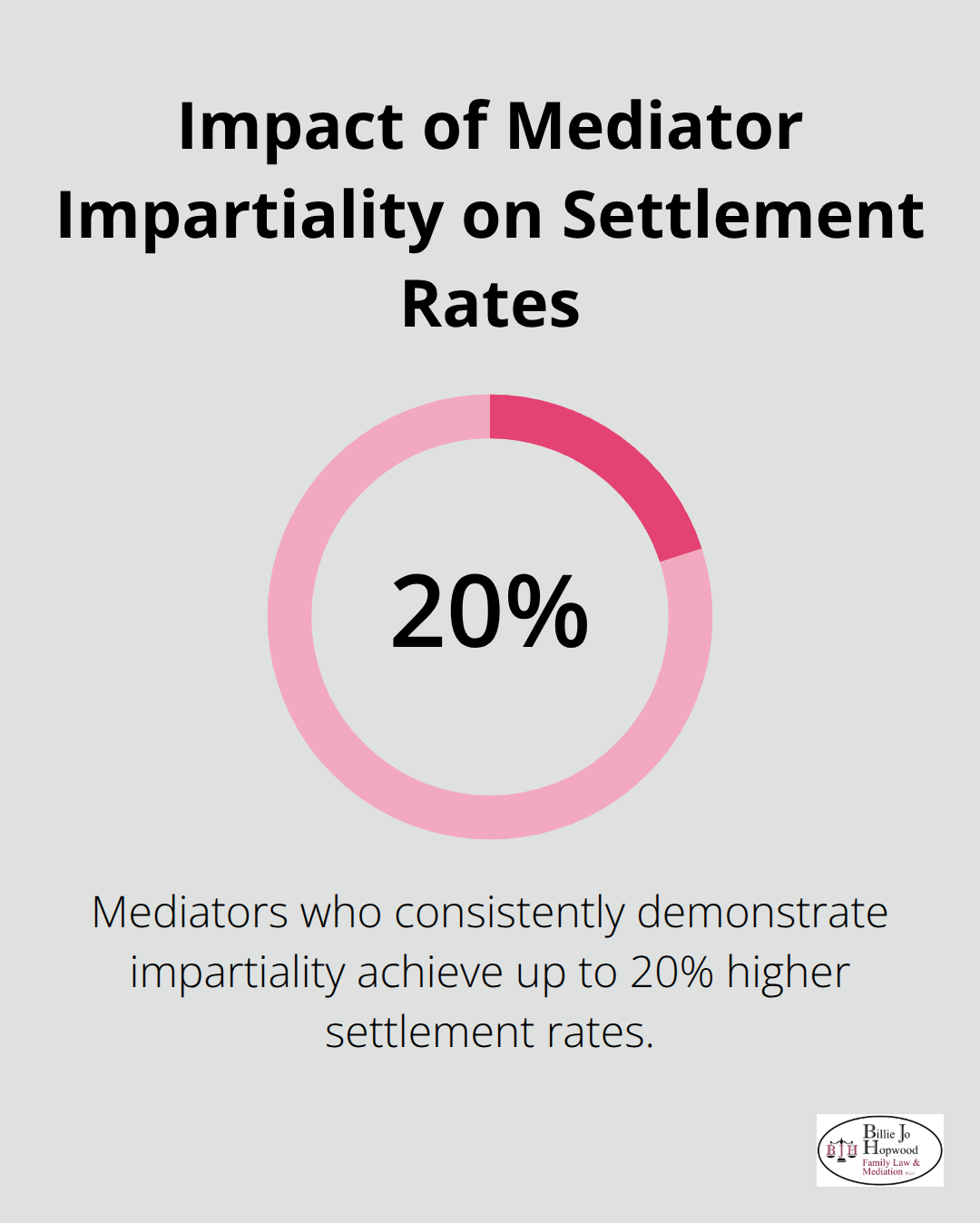
A cornerstone of effective mediation is the mediator’s ability to remain neutral and impartial. During initial consultations, observe how the mediator interacts with you. Do they show bias? Do they pay attention to both parties’ concerns? A study by the Florida Dispute Resolution Center found that mediators who consistently demonstrate impartiality achieve higher settlement rates (up to 20% more than those who don’t).

Percentage chart showing that mediators who consistently demonstrate impartiality achieve 20% higher settlement rates. - choosing a divorce mediator in melbourne florida

Assessing Personal Compatibility

Your comfort level with the mediator can significantly impact the mediation’s success. Pay attention to how you feel during your initial meeting. Are you at ease discussing personal matters? Does the mediator create an environment where you feel heard and respected? These factors can influence your willingness to engage openly in the process.

Verifying Reputation

Don’t hesitate to ask for references or seek out client testimonials. While confidentiality prevents mediators from sharing specific case details, they can often provide general feedback from past clients. Online reviews and local bar association recommendations can also offer valuable insights into a mediator’s reputation and effectiveness.

Building a Foundation of Trust

Trust forms the bedrock of successful mediation. A mediator you trust can guide you through complex negotiations, help you navigate emotional hurdles, and facilitate productive conversations (even in high-conflict situations). This trust becomes particularly important when discussing sensitive topics like finances or child custody arrangements. Mediation offers a platform for spouses to discuss important topics in a more cooperative setting.

As you consider these factors, you’ll want to prepare a list of questions to ask potential mediators. The next section will outline key inquiries that can help you make an informed decision about your divorce mediator in Melbourne, Florida.

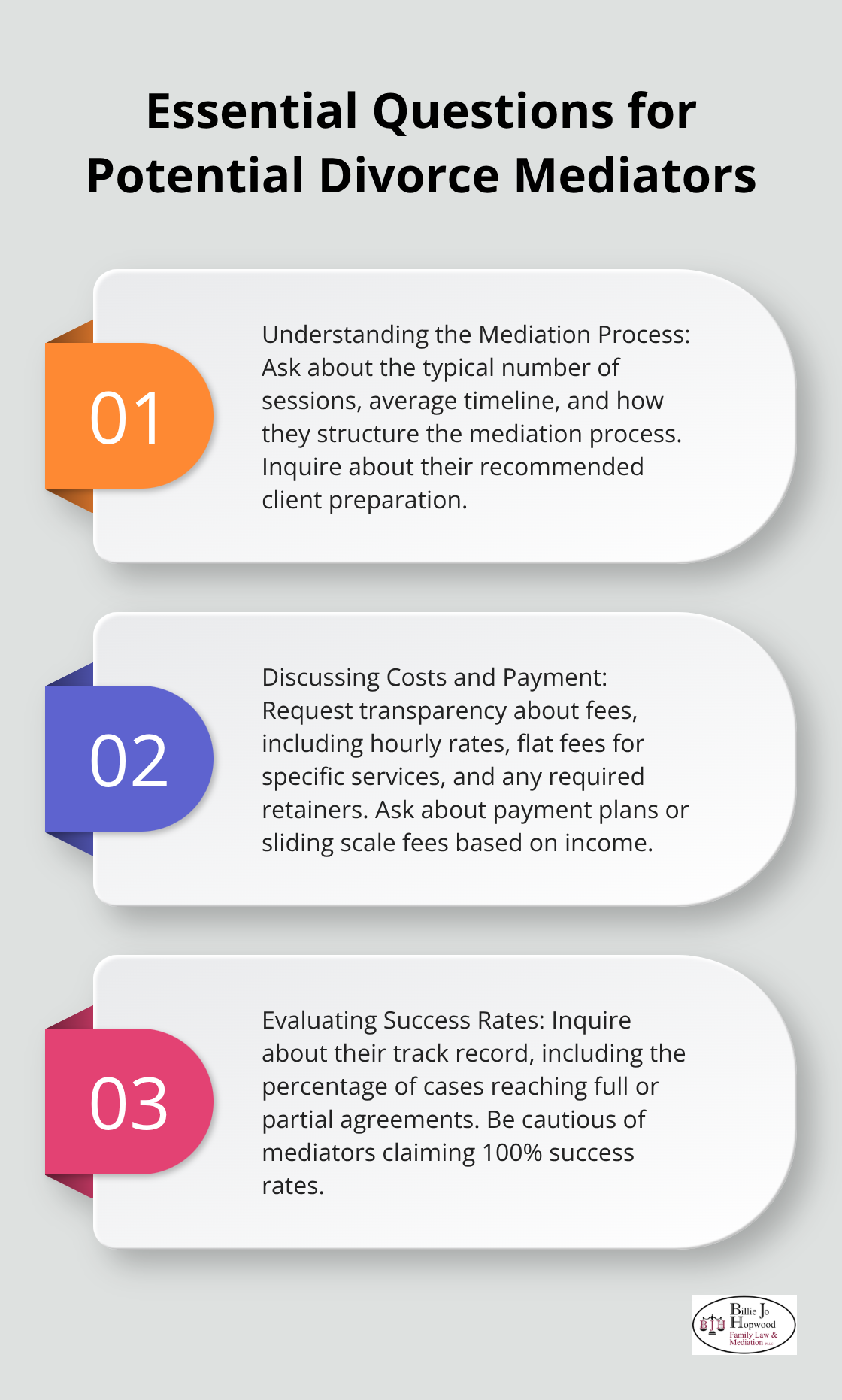
Essential Questions for Potential Divorce Mediators

Ordered list chart showing three essential questions to ask potential divorce mediators: Understanding the Mediation Process, Discussing Costs and Payment, and Evaluating Success Rates.

Understanding the Mediation Process

Ask about the mediator’s specific process. How many sessions do they typically conduct? What’s the average timeline from start to finish? A study by the Florida Dispute Resolution Center found that mediations lasting between 3 to 5 sessions had the highest success rates (75% reaching full agreements). Ask how they structure these sessions and what preparation they recommend for clients.

Discussing Costs and Payment

Transparency about fees is essential. Ask about their hourly rate, any flat fees for specific services, and if they require a retainer. A recent survey by the Florida Bar revealed that the average cost of divorce mediation in Melbourne ranges from $200 to $400 per hour. Inquire if they offer payment plans or sliding scale fees based on income. Understanding the full financial picture upfront will prevent surprises later.

Evaluating Success Rates

While past performance doesn’t guarantee future results, it’s worth asking about their track record. What percentage of their cases reach full agreements? How many partial agreements? The American Bar Association reports that skilled mediators achieve full agreements in 70-80% of cases. However, be cautious of mediators claiming 100% success rates, as this may indicate a pressure to settle rather than truly addressing all issues.

Collaboration with Other Professionals

Ask about their policy on involving other professionals. Do they work with financial advisors or child psychologists when needed? A comprehensive approach can lead to more sustainable agreements. Mediators who collaborate with financial planners report a 30% increase in client satisfaction with property division outcomes.

Handling High-Conflict Situations

Inquire about their experience and strategies for managing high-conflict divorces. How do they maintain neutrality and ensure both parties feel heard? What techniques do they use to de-escalate tense situations? Their answers will provide insight into their ability to handle complex emotional dynamics.

Final Thoughts

Choosing a divorce mediator in Melbourne, Florida can shape the outcome of your divorce proceedings. The right mediator will guide you through this challenging process with empathy, professionalism, and skill. You should prioritize qualifications, experience, and a strong understanding of Florida divorce laws when making your selection.

A mediator who fosters trust, maintains neutrality, and aligns with your communication style will prove invaluable. Research potential mediators thoroughly, ask probing questions about their process, and evaluate their track record. This investment in finding the right mediator can lead to more satisfactory outcomes and reduced stress.

Billie Jo Hopwood Family Law & Mediation, PLLC understands the complexities of divorce and the importance of skilled mediation. Our team provides guidance through challenging legal situations (including divorce, child custody, and support matters). We encourage you to approach the selection of a divorce mediator with careful consideration to ensure you make the best choice for your unique situation.

The Divorce Mediation Process in Melbourne Florida Step-by-Step

At Billie Jo Hopwood Family Law & Mediation, PLLC, we understand that divorce can be a challenging process.

The divorce mediation process in Melbourne, Florida offers a more amicable and cost-effective alternative to traditional litigation.

This step-by-step guide will walk you through the key stages of divorce mediation, from initial consultation to final agreement.

What Is Divorce Mediation in Melbourne Florida?

Definition and Process

Divorce mediation in Melbourne, Florida is a voluntary process where a neutral third party, called a mediator, assists couples in navigating the complexities of ending their marriage. This approach promotes open communication and collaboration between spouses, which leads to mutually agreeable solutions.

Advantages of Mediation

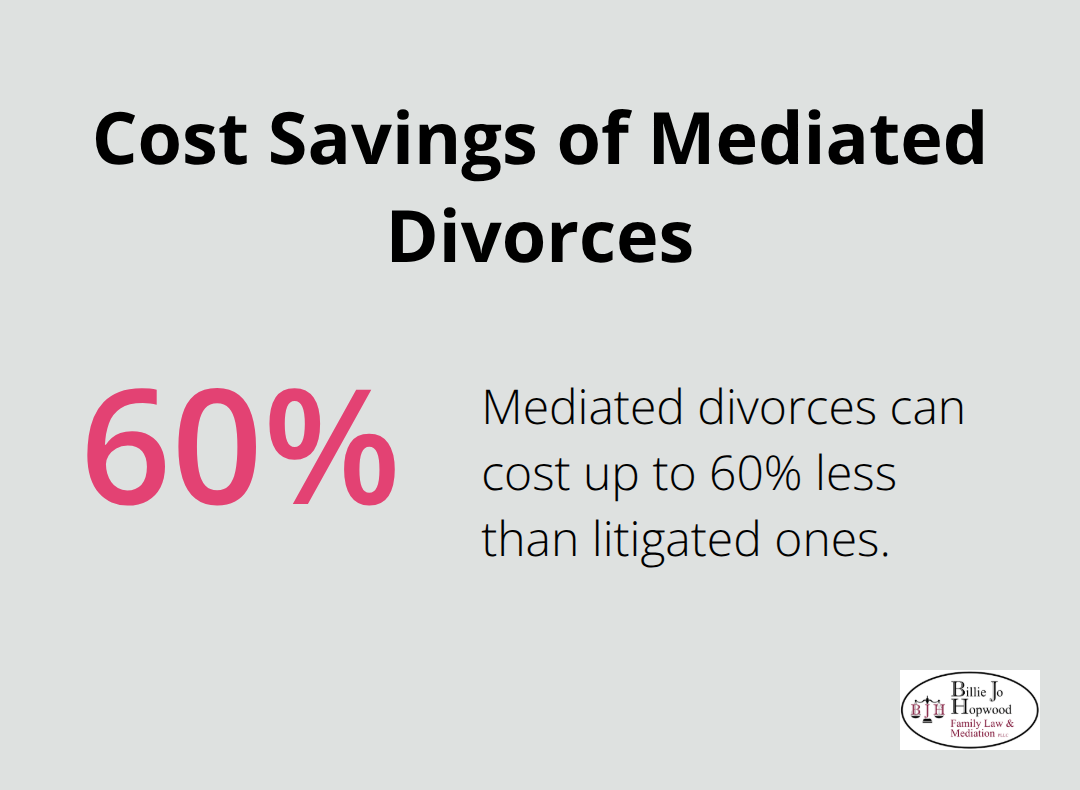
Mediation offers several benefits over traditional litigation. It’s typically more cost-effective; a study by the Florida Dispute Resolution Center found that mediated divorces can cost up to 60% less than litigated ones. Time is another factor; while court battles can extend for months (or even years), mediation often resolves issues in a matter of weeks.

Bar chart showing that mediated divorces can cost up to 60% less than litigated divorces - the divorce mediation process in melbourne florida

The Mediator’s Role

A skilled mediator acts as a facilitator, not a decision-maker. They guide discussions, ensure both parties are heard, and help identify common ground. In Melbourne, mediators must complete a Florida Supreme Court certified training program, which ensures they’re well-equipped to handle various scenarios.

Confidentiality and Control

One of the key advantages of mediation is confidentiality. Unlike court proceedings (which are public record), mediation discussions remain private. This can be particularly beneficial when dealing with sensitive family matters or financial information.

Moreover, mediation puts control in the hands of the divorcing couple. Rather than having a judge make decisions about their future, spouses work together to craft solutions that best fit their unique circumstances. This collaborative approach often results in more satisfactory outcomes and better compliance with agreements post-divorce.

Suitability and Effectiveness

While mediation proves effective for many couples, it’s not suitable for every situation. Cases involving domestic violence or severe power imbalances may require alternative approaches. However, for many couples in Melbourne, Florida, mediation serves as an effective tool to transform the divorce process from an adversarial battle into a constructive dialogue.

As we move forward, let’s explore the key steps involved in the divorce mediation process, starting with the initial consultation and preparation phase.

How Does the Divorce Mediation Process Work in Melbourne, Florida?

Preparation: The Foundation of Successful Mediation

The divorce mediation process in Melbourne, Florida begins with thorough preparation. Each spouse must gather relevant financial documents (tax returns, bank statements, property valuations). The Florida Family Law Rules of Procedure mandate full financial disclosure, which sets the stage for productive negotiations.

We recommend that you create a list of priorities and concerns before the first session. Couples who enter mediation with clear goals often reach more satisfactory agreements.

Mediation Sessions: Structured Dialogue

Mediation sessions typically last 2-4 hours. Most cases in Melbourne resolve within 3-5 meetings. During these sessions, the mediator facilitates discussions on key issues such as asset division, parenting plans, and support arrangements.

Skilled mediators employ various techniques to maintain productive conversations. They might use caucusing (meeting with each spouse separately) to address concerns privately. This approach can help overcome impasses and encourage compromise.

Ordered list chart showing three key steps in the divorce mediation process: Preparation, Mediation Sessions, and Agreement Crafting - the divorce mediation process in melbourne florida

Crafting the Agreement: Documenting Decisions

As you reach agreements on various issues, the mediator will draft a Memorandum of Understanding. This document outlines the terms you’ve agreed upon. Review this carefully, as it forms the basis of your final settlement agreement.

In Florida, parenting plans must include specific details. They should address time-sharing schedules, decision-making responsibilities, and communication protocols. The more specific these plans are, the less likely conflicts will arise in the future.

Legal Review and Finalization: Ensuring Compliance

Once a comprehensive agreement exists, each spouse should have it reviewed by their own attorney. This step protects your rights and ensures that the agreement complies with Florida law.

After any necessary revisions, submit the final agreement to the court for approval. In Brevard County (where Melbourne is located), this process typically takes 2-4 weeks. Once approved by a judge, the agreement becomes a binding court order.

Flexibility and Customization

The divorce mediation process, while structured, remains flexible enough to accommodate the unique needs of each couple. Many couples in Melbourne find that they can navigate their divorce with less stress and conflict through this collaborative approach.

As we move forward, let’s explore how mediation addresses common issues in divorce, such as property division and child custody arrangements.

How Does Mediation Address Key Divorce Issues in Melbourne, Florida?

Divorce mediation in Melbourne, Florida tackles several critical areas that often cause conflict between separating couples. This process provides a platform for couples to reach fair and lasting agreements on various aspects of their divorce.

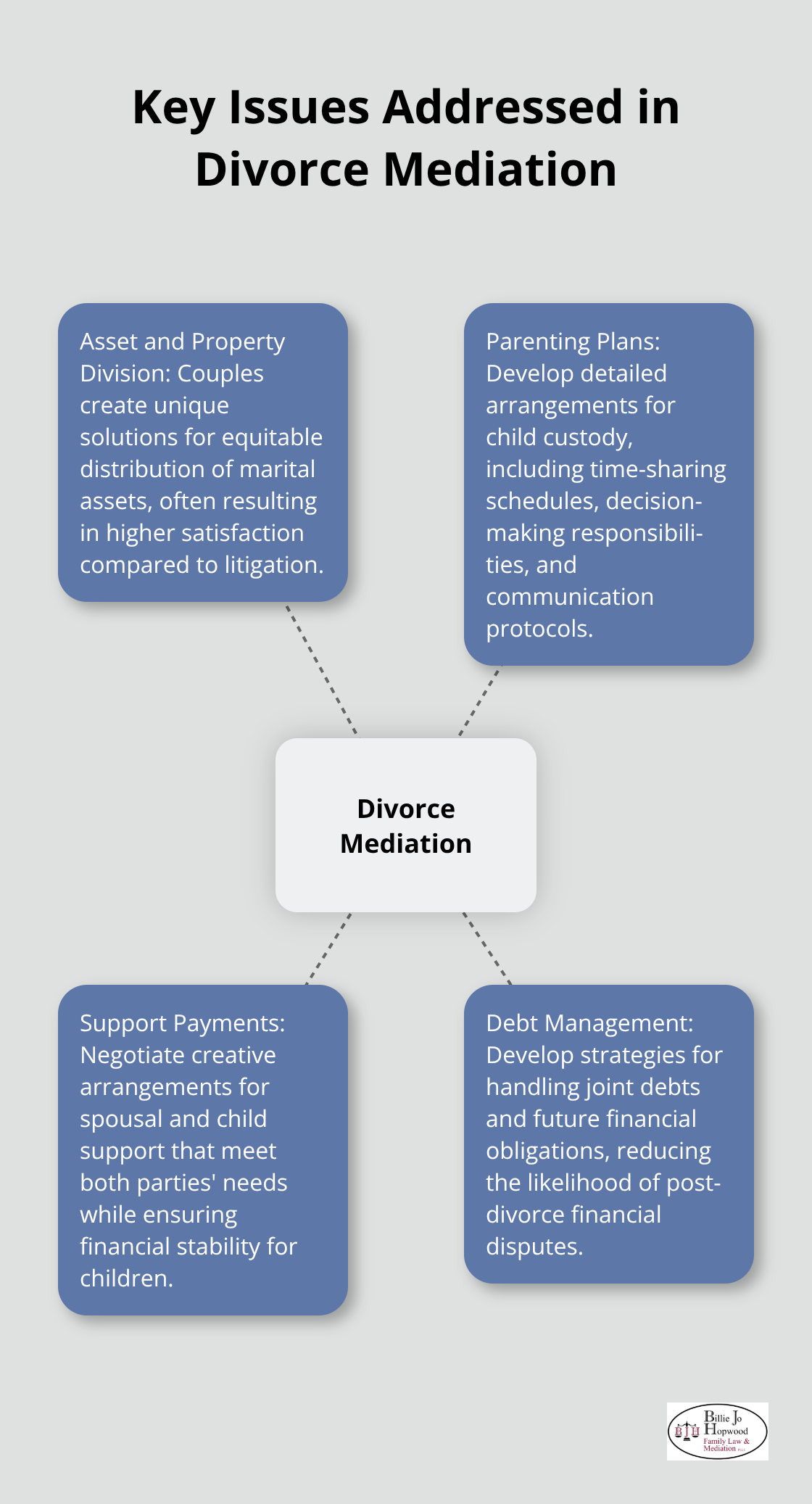
Hub and spoke chart showing four main issues addressed in divorce mediation: Asset and Property Division, Parenting Plans, Support Payments, and Debt Management

Asset and Property Division

Florida law mandates an equitable distribution of marital assets. This doesn’t always translate to a 50/50 split. Mediation allows couples to create unique solutions that fit their specific situation. For example, one spouse might retain the family home in exchange for a larger portion of retirement accounts.

A 2022 Florida Bar study revealed that couples who mediated property division reported 30% higher satisfaction with the outcome compared to those who litigated. This statistic underscores the value of collaborative decision-making in asset allocation.

Effective Parenting Plans

Child custody arrangements often become the most emotionally charged aspect of divorce. Mediation offers parents an opportunity to develop detailed parenting plans that prioritize their children’s well-being. These plans typically include:

  • Time-sharing schedules
  • Decision-making responsibilities
  • Communication protocols
  • Holiday and vacation arrangements

Research from the University of Florida indicates that children whose parents mediated custody arrangements experienced reduced stress and improved long-term outcomes compared to those whose parents engaged in court battles.

Support Payment Determination

While Florida follows specific guidelines for spousal and child support calculations, mediation allows for some flexibility. Couples can negotiate creative support arrangements that meet both parties’ needs while ensuring financial stability for children.

For instance, some couples opt for a lump sum payment or asset transfer instead of traditional monthly alimony payments. This approach can provide a clean break and minimize ongoing financial entanglements.

Debt and Financial Responsibility Management

Debt division (often overlooked in divorce proceedings) plays a crucial role in the mediation process. Couples can develop strategies for handling joint debts and future financial obligations. This might involve agreements on specific credit card payments or underwater mortgage management.

A recent American Academy of Matrimonial Lawyers survey found that couples who addressed debt division in mediation were 40% less likely to face post-divorce financial disputes.

Final Thoughts

The divorce mediation process in Melbourne, Florida provides a less adversarial and more cost-effective alternative to traditional litigation. It empowers couples to craft tailored solutions for their unique circumstances through open communication and collaboration. A skilled mediator guides discussions, defuses tensions, and identifies creative solutions to complex issues.

Mediation transforms a potentially bitter process into a constructive dialogue, allowing greater control over the outcome and preserving privacy. It often leads to agreements that both parties honor long-term and sets a positive tone for future interactions (particularly beneficial when children are involved). Selecting the right mediator significantly impacts the outcome of your divorce.

Billie Jo Hopwood Family Law & Mediation, PLLC supports families through challenging legal situations with compassion. Our team understands the nuances of divorce mediation in Melbourne, Florida and stands ready to guide you through each step. Choosing mediation invests in a more amicable future for you and your family.

Uncontested Divorce Mediation in Melbourne Florida

Uncontested divorce mediation in Melbourne, Florida offers a smoother path to ending a marriage. This approach allows couples to resolve their differences amicably, without the need for courtroom battles.

At Billie Jo Hopwood Family Law & Mediation, PLLC, we’ve seen firsthand how mediation can save time, money, and emotional stress. Let’s explore how this process works and why it might be the right choice for your divorce.

What Is Uncontested Divorce Mediation?

The Essence of Uncontested Divorce

Uncontested divorce mediation offers a cooperative approach for couples to end their marriage in Melbourne, Florida. This process allows spouses to reach agreements on all major issues without court intervention. The Florida Courts report that uncontested divorces can conclude in 4 to 8 weeks after filing all required forms, which highlights the efficiency of this method.

Mediation’s Role in Uncontested Divorces

A neutral third party (the mediator) facilitates discussions between divorcing couples in uncontested divorces. This professional helps spouses navigate complex issues and arrive at mutually beneficial agreements. The American Bar Association notes that mediation often yields higher satisfaction rates among divorcing couples compared to traditional litigation.

Contrasting Mediation with Traditional Divorce

Mediation in Melbourne provides a more collaborative environment than traditional divorce proceedings. Couples maintain direct control over the outcome, rather than leaving decisions to a judge. This approach often results in more personalized solutions that address each family’s unique needs.

Cost and Privacy Benefits

Mediated divorces typically cost 40-60% less than litigated divorces. This substantial cost reduction allows couples to preserve more of their assets for their post-divorce lives. Additionally, the confidential nature of mediation protects privacy, unlike court proceedings which become public record. This aspect proves particularly valuable for those who wish to keep their personal matters out of the public eye.

Infographic showing that mediated divorces typically cost 40-60% less than litigated divorces - uncontested divorce mediation melbourne florida

Impact on Children and Family Dynamics

Choosing uncontested divorce mediation in Melbourne, Florida can pave the way for more amicable separations. This approach sets the stage for better post-divorce relationships, especially when children are involved. The Florida Chapter of the Association of Family and Conciliation Courts indicates that children of parents who mediate their divorce often experience less stress and adapt better to family changes.

As we move forward, let’s explore the specific steps involved in the uncontested divorce mediation process in Melbourne, and how it can benefit couples seeking a smoother transition to their new lives.

How Uncontested Divorce Mediation Works in Melbourne

Initial Consultation and Assessment

Uncontested divorce mediation in Melbourne starts with a comprehensive initial consultation. During this meeting, a mediator assesses the couple’s situation, explains the process, and determines if uncontested divorce suits their case. This foundational step sets the stage for a successful mediation.

The Florida Courts report that approximately 80% of divorces resolve through negotiations rather than court battles. This statistic highlights the effectiveness of mediation in resolving marital disputes.

Infographic showing that approximately 80% of divorces resolve through negotiations rather than court battles - uncontested divorce mediation melbourne florida

Identifying and Discussing Key Issues

Once mediation begins, couples identify and discuss key issues. These typically include property division, child custody, child support, and alimony. A skilled mediator facilitates these discussions, ensuring both parties have equal opportunities to express their concerns and desires.

In Melbourne (and throughout Florida), mediators must meet certification requirements established by the Florida Supreme Court. This certification ensures that mediators possess the necessary skills to handle complex family law matters effectively.

Negotiating and Drafting Agreements

The next phase involves negotiation and agreement drafting. This is where the mediator’s expertise shines, as they help couples find common ground and develop solutions that work for both parties. The goal is to create a comprehensive marital settlement agreement that addresses all aspects of the divorce.

A study by the American Bar Association found that mediated divorces often result in higher compliance rates with agreements (likely due to the collaborative nature of the process, where both parties actively participate in decision-making).

Filing Paperwork with the Court

The final step involves filing the necessary paperwork with the court. In Melbourne, this includes submitting the marital settlement agreement, financial affidavits, and other required documents. Once filed, an uncontested divorce can finalize in approximately 4 to 8 weeks, significantly faster than contested divorces.

It’s worth noting that in Brevard County (which includes Melbourne), only the petitioner must attend the final hearing for an uncontested divorce. This streamlined process further reduces stress and time commitments for divorcing couples.

As we explore the advantages of choosing mediation for uncontested divorce, you’ll see how this process can save time, money, and emotional energy compared to traditional litigation methods.

Why Choose Mediation for Your Uncontested Divorce?

Hub and spoke chart illustrating the key benefits of choosing mediation for uncontested divorce

Financial Advantages

Uncontested divorce mediation in Melbourne, Florida offers substantial cost savings. Mediated divorces typically cost 40-60% less than litigated divorces. The Florida Bar reports that a mediated divorce in Melbourne might cost $3,000 to $8,000, compared to $15,000 to $30,000 for a litigated divorce. These figures demonstrate the financial wisdom of choosing mediation, allowing couples to retain more of their assets for their post-divorce lives.

Swift Resolution

Mediation concludes faster than court proceedings. While litigated divorces can extend for months or years, mediated divorces in Melbourne often resolve within 4 to 8 weeks after filing all required forms. This quick resolution allows couples to move forward with their lives, reducing stress and uncertainty.

Privacy Protection

Mediation sessions in Melbourne remain confidential, unlike court proceedings which become public record. The Florida Mediation Confidentiality and Privilege Act ensures that discussions during mediation stay private (with few exceptions such as child abuse reporting). This confidentiality proves invaluable for couples who wish to keep their personal matters out of the public eye.

Promoting Amicable Relationships

Mediation fosters cooperative problem-solving, which can lead to more amicable post-divorce relationships. This benefit becomes particularly important for couples with children. The Florida Chapter of the Association of Family and Conciliation Courts reports that children of parents who mediate their divorce often experience less stress and adapt better to family changes.

Customized Solutions

Mediation allows couples to create tailored solutions that address their unique circumstances. Unlike court-imposed decisions, mediated agreements can incorporate creative solutions that work best for both parties. This flexibility often results in more satisfactory outcomes and increases the likelihood of compliance with the agreement terms.

Final Thoughts

Uncontested divorce mediation in Melbourne, Florida provides a faster, more cost-effective, and less stressful alternative to traditional litigation. This approach empowers couples to make decisions about their future, instead of relying on a judge’s ruling. Mediation saves money, protects privacy, and maintains better relationships post-divorce (especially important when children are involved).

Mediation sets the stage for more effective communication and problem-solving in the future. The customized solutions that emerge from mediation often lead to higher satisfaction and compliance rates. Selecting an experienced mediator in Melbourne is key to a successful uncontested divorce.

Billie Jo Hopwood Family Law & Mediation, PLLC offers guidance through the mediation process, helping families transition to their new chapter. We encourage those considering divorce in Melbourne to explore mediation as an option. This process allows both parties to move forward with confidence and peace of mind.

Preparing for Divorce Mediation in Melbourne Florida

Divorce mediation offers a collaborative approach to ending a marriage in Melbourne, Florida. At Billie Jo Hopwood Family Law & Mediation, PLLC, we’ve seen firsthand how proper preparation can lead to smoother negotiations and better outcomes.

This guide will walk you through how to prepare for divorce mediation in Melbourne, Florida, covering essential steps and strategies. By following these tips, you’ll be better equipped to navigate the mediation process and work towards a fair resolution.

What Is Divorce Mediation in Melbourne Florida?

Definition and Purpose

Divorce mediation in Melbourne, Florida involves a neutral third party who assists couples in resolving their disagreements to reach a mutually acceptable divorce settlement. This process aims to reduce conflict and promote cooperation between spouses, often leading to more satisfactory outcomes for all parties involved.

Mediation vs. Traditional Litigation

Mediation differs significantly from courtroom battles. In Melbourne, this approach puts control in the hands of the divorcing couple, not a judge. This often results in faster resolutions and substantial cost savings. The Florida Dispute Resolution Center reports that mediated cases resolve up to 40% faster than litigated ones.

Chart showing that mediated cases resolve up to 40% faster than litigated ones - how to prepare for divorce mediation in melbourne florida

The Melbourne Mediation Process

The mediation process in Melbourne typically starts with an initial meeting to establish ground rules. Subsequent sessions focus on specific issues such as property division or child custody. According to the Brevard County Clerk of Courts, most divorce mediations in Melbourne conclude within three to four sessions.

Advantages of Mediation

Choosing mediation in Melbourne offers several benefits:

  1. Cost-Effective: Mediation generally costs less than going to trial (average costs range from $3,000 to $8,000, compared to $15,000 to $30,000 for litigation).
  2. Higher Compliance: The Florida Bar reports that mediated settlements have a compliance rate exceeding 80%, significantly higher than court-imposed judgments.
  3. Better Post-Divorce Relationships: Couples who choose mediation often maintain improved relationships after divorce (particularly beneficial for co-parenting).
  4. Tailored Solutions: Mediation allows for more creative solutions customized to your family’s unique needs, which isn’t always possible in the rigid structure of a courtroom.

Preparing for Your First Mediation Session

As you prepare for your first mediation session, consider gathering relevant financial documents, identifying your priorities, and reflecting on potential compromises. These steps will help you enter the mediation process with clarity and confidence, setting the stage for productive negotiations and a fair resolution.

How to Prepare for Divorce Mediation

Proper preparation sets the foundation for successful divorce mediation in Melbourne, Florida. We recommend the following steps to ensure you’re ready for your mediation sessions.

Organize Your Financial Information

Start by collecting all relevant financial documents. This includes:

  • Tax returns for the past three years
  • Recent pay stubs
  • Bank statements
  • Credit card statements
  • Mortgage documents
  • Retirement account statements
  • List of assets and debts

The Florida Courts report that a complete financial picture can accelerate the mediation process by up to 30%. Create a detailed spreadsheet of your assets and liabilities to provide a clear overview of your financial situation.

Identify Your Priorities

Take time to reflect on what matters most to you in the divorce settlement. Is it keeping the family home? Maintaining a specific custody arrangement? Or securing a certain level of financial support? The American Bar Association indicates that clients who clearly define their priorities are 40% more likely to reach a satisfactory agreement in mediation.

Create a Parenting Plan Draft

If you have children, develop a preliminary parenting plan. Include details such as:

  • Custody arrangements
  • Visitation schedules
  • Holiday and vacation time
  • Decision-making responsibilities for education, healthcare, and religious upbringing

The Florida Department of Children and Families notes that couples who arrive at mediation with a draft parenting plan resolve custody issues 25% faster than those who don’t.

Understand Florida Divorce Laws

Familiarize yourself with Florida’s divorce laws. Key areas to research include:

  • Equitable distribution of marital assets
  • Alimony guidelines
  • Child support calculations
  • Parental responsibility laws

The Florida Bar offers free online resources that explain these laws in detail. A few hours spent reviewing this information can significantly enhance your ability to negotiate effectively during mediation.

Hub and spoke chart illustrating four key areas of Florida divorce laws: equitable distribution, alimony guidelines, child support calculations, and parental responsibility laws - how to prepare for divorce mediation in melbourne florida

Prepare Emotionally

Emotional preparation is just as important as financial and legal preparation. Try to:

  • Practice stress-management techniques (such as deep breathing or meditation)
  • Seek support from friends, family, or a therapist
  • Focus on long-term goals rather than short-term emotions

Emotional readiness can make a substantial difference in your ability to negotiate calmly and rationally during mediation sessions.

As you complete these preparation steps, you’ll find yourself well-equipped to navigate the mediation process. The next section will explore strategies to employ during your actual mediation sessions for the best possible outcomes.

How to Navigate Mediation Sessions Successfully

Practice Active Listening and Clear Communication

Effective communication forms the foundation of successful mediation. Focus on your spouse’s statements without interruption. Paraphrase their points to confirm understanding. When expressing your views, use “I” statements to avoid blame and promote collaboration. For example, replace “You never consider my needs” with “I feel overlooked when my needs aren’t addressed.”

The Harvard Negotiation Project found that couples who used active listening techniques were 30% more likely to reach mutually satisfactory agreements in mediation. This approach improves understanding and reduces tension in the room.

Chart showing that couples using active listening techniques are 30% more likely to reach mutually satisfactory agreements in mediation

Adopt a Problem-Solving Mindset

Approach mediation with a problem-solving attitude rather than a win-lose mentality. Find solutions that address both parties’ interests. The American Arbitration Association reports that mediation participants who prioritized problem-solving were 40% more likely to reach full agreements compared to those who approached sessions competitively.

To implement this strategy, create a list of your top three priorities before each session. During discussions, refer to this list to ensure you address what truly matters. Prepare multiple solutions for each issue to increase the likelihood of finding common ground.

Manage Your Emotions Effectively

Divorce mediation can trigger strong emotions. Use stress-management techniques to maintain composure. Practice deep breathing exercises or brief meditation before each session. The Mayo Clinic suggests that even a 5-minute meditation can significantly reduce stress levels.

If you feel overwhelmed during sessions, request a short break. Use this time to regain composure and refocus on your objectives. A calm demeanor enhances your ability to make rational decisions and communicate effectively.

Work Collaboratively with Your Mediator

Your mediator serves as a neutral third party to facilitate discussions and help you reach an agreement. Provide them with all necessary information and be open to their suggestions. A study by the Mediation Quarterly found that parties who actively engaged with their mediator resolved disputes 25% faster than those who didn’t.

Try to view your mediator as a valuable resource (rather than an adversary). Their experience and impartiality can help you navigate complex issues and find creative solutions.

Stay Focused on Long-Term Goals

During mediation, it’s easy to get caught up in short-term emotions. However, maintaining a focus on your long-term goals leads to better outcomes. The Journal of Family Psychology reports that couples who prioritized long-term objectives were 35% more likely to report satisfaction with their mediation results one year post-divorce.

Create a list of your long-term goals (e.g., financial stability, positive co-parenting relationship) and review it before each session. This practice will help you make decisions aligned with your future well-being.

Final Thoughts

Proper preparation for divorce mediation in Melbourne, Florida sets the stage for productive negotiations and fair resolutions. Effective communication, a problem-solving mindset, and emotional management contribute to successful mediation sessions. The benefits of mediation extend beyond immediate resolution, fostering better post-divorce relationships and reducing financial strain.

Billie Jo Hopwood Family Law & Mediation, PLLC guides families through challenging legal situations with compassion. Our team has observed how thorough preparation and a cooperative approach transform the divorce process. We support clients as they navigate this difficult transition.

Knowing how to prepare for divorce mediation in Melbourne, Florida empowers individuals to approach the process with confidence. Mediation offers a path to a more positive future for families in Melbourne. Our firm stands ready to assist you in achieving the best possible outcome for your unique situation.