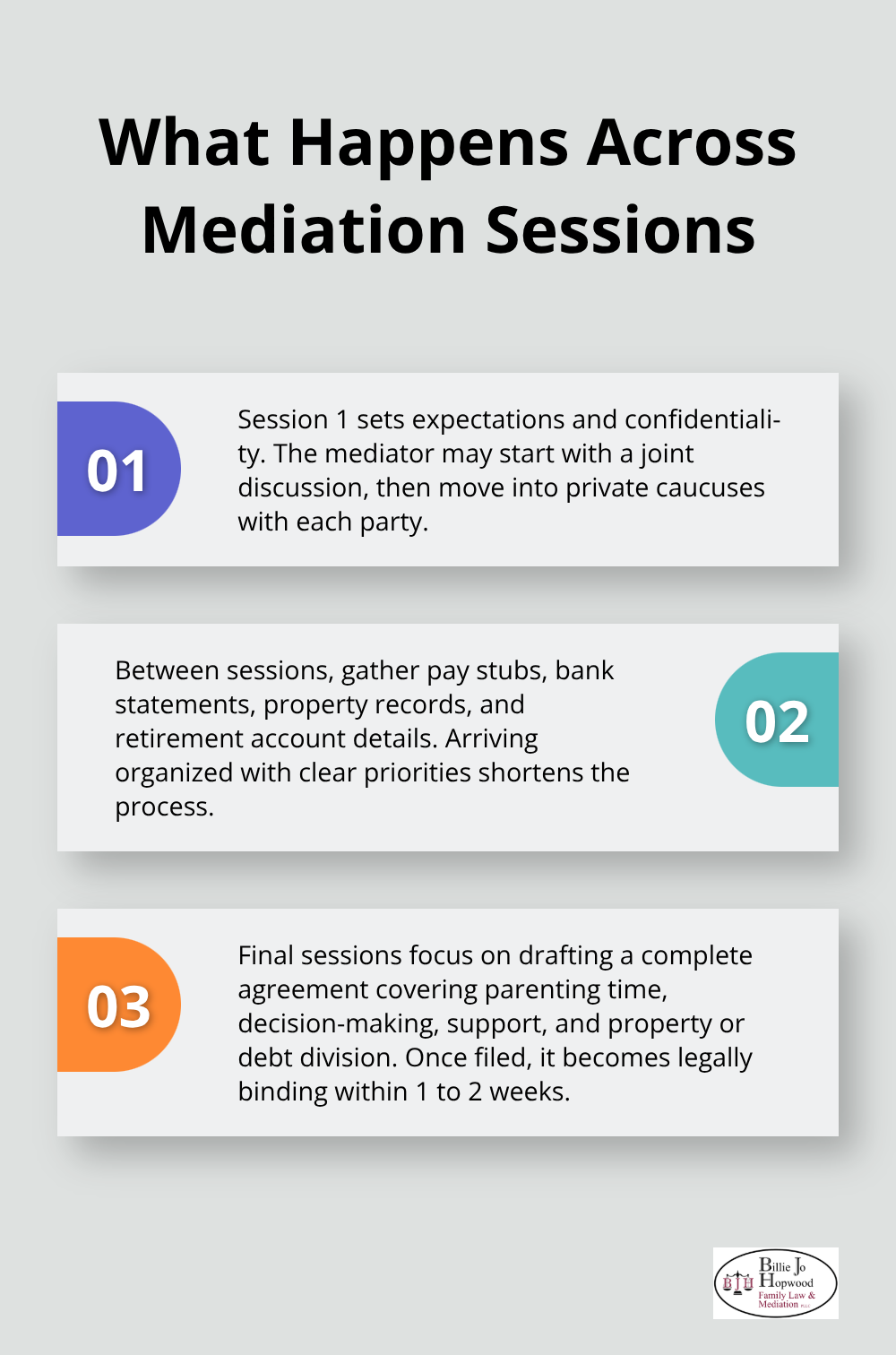
Blog

Mediation Cost Brevard Florida: Understanding Fees and Options

Mediation cost in Brevard Florida varies widely depending on your situation and the type of service you choose. At Billie Jo Hopwood Family Law & Mediation, PLLC, we help families understand exactly what they’ll pay before committing to the process.

This guide breaks down typical fees, hidden expenses, and practical ways to reduce what you spend on mediation.

What You’ll Actually Pay for Mediation in Brevard County

Court-Ordered Mediation Fee Structure

Court-ordered mediation in Brevard County follows a strict fee structure that depends on your household income. If your combined gross income falls below $50,000 annually, mediation costs nothing through the court system. Households earning between $50,000 and $100,000 pay $120 per party for a session, while those above $100,000 must pursue private mediation since court-annexed services become unavailable. This income-based model means many families in Brevard can access mediation affordably, but you must file an application with the Clerk of Court to prove indigency status.
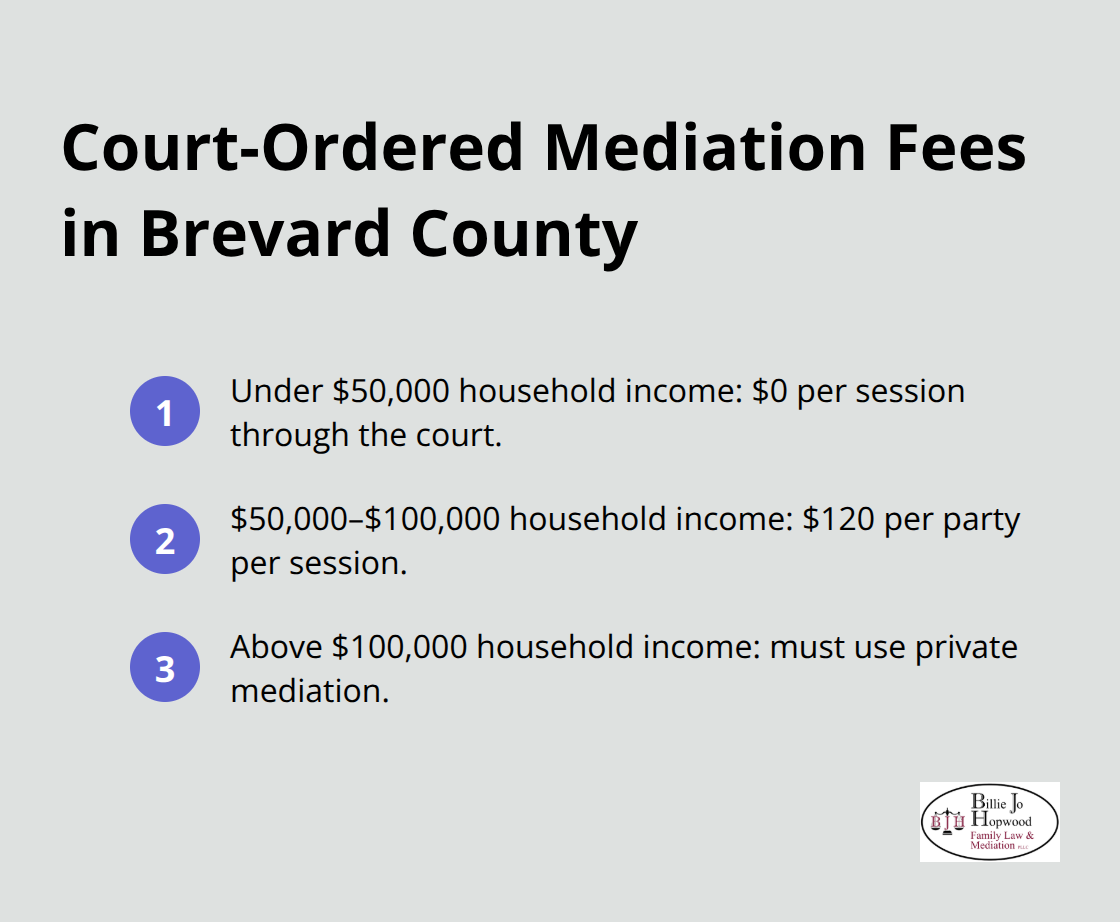
Income-based court mediation fee tiers in Brevard County - Mediation cost Brevard Florida

Private Mediation Pricing and Options

Private mediation typically costs between $175 and $300 per hour depending on the mediator’s experience and your income level, with most sessions running three hours total. The Florida Dispute Resolution Center reports that more than 75% of family law mediations result in full or partial agreements, making the upfront cost a worthwhile investment compared to litigation expenses that routinely exceed $10,000. If you earn below $100,000 annually, court mediation remains your most cost-effective option since the sliding scale makes it accessible. For higher earners, private mediators in the Melbourne area offer flexible payment arrangements, and some charge reduced rates for straightforward cases involving only property division or custody scheduling.

Why Mediation Costs Less Than You Think

The real decision isn’t whether mediation costs too much-it’s whether you can afford not to use it. Court litigation in Brevard County requires mandatory mediation before trial anyway, so you pay mediation fees regardless. The difference is that private mediation lets you control timing, choose your mediator, and potentially resolve issues faster than waiting for court-ordered sessions. Come prepared with financial records, asset lists, and clear priorities to keep sessions focused and minimize the number of hours needed. Understanding these costs positions you to make informed decisions about which hidden expenses you should anticipate next.

Beyond the Hourly Rate

Administrative and Filing Fees Add Up Fast

Most people focus on the mediator’s hourly fee and multiply it by session length, but that calculation misses several expenses that add up quickly in Brevard County mediation. Court filing fees, document preparation, and administrative processing can total $300 to $600 depending on whether you need certified copies or formal memoranda of understanding. The Florida Supreme Court requires all mediators to complete 16 hours of continuing education every two years, and some pass this cost to clients through slightly higher hourly rates, so expect rates to creep upward over time.

Travel Costs and Document Preparation

If your mediator is located outside Melbourne or requires travel time, you may pay mileage fees ranging from $0.50 to $1 per mile, plus the mediator’s hourly rate for travel itself. Some mediators in Brevard bill travel time at half-rate, others at full rate, so confirm this upfront. You’ll also need to gather financial documents-bank statements, tax returns, mortgage papers, retirement account statements-and organizing these takes time you might otherwise bill to yourself or pay someone else to prepare.

Follow-Up Sessions and Implementation Expenses

Follow-up sessions often become necessary when parties want to revisit agreements or need clarification before signing final documents. A single three-hour mediation session might resolve straightforward custody schedules, but complex property division or spousal support calculations frequently require a second session costing another $525 to $900 in private mediation. Court-ordered mediation in Brevard adds $120 per party per additional session if income falls in that bracket. Implementation costs emerge after mediation concludes-filing the memorandum of understanding with the court costs money, and if you later need to modify the agreement, that’s another mediation session or court filing. Set aside 20 percent above your estimated mediation costs as a buffer for these hidden expenses, keeping your total budget realistic and preventing financial surprises that derail settlement progress. Understanding what lies beneath the surface of mediation fees prepares you to explore practical strategies for controlling these costs without sacrificing quality outcomes.

How to Cut Mediation Costs Without Sacrificing Results

Mediation consistently outperforms litigation on cost, but the real savings come from strategic choices you make before and during the process. The Florida Dispute Resolution Center reports that more than 75% of family law mediations result in full or partial agreements, meaning most cases settle affordably without trial expenses that routinely exceed $10,000 to $25,000 in Brevard County. Court litigation forces you to pay mediation fees anyway since judges mandate it before trial, so you’re essentially choosing between controlled mediation costs now or inflated expenses later. The decision to mediate rather than litigate immediately cuts your exposure by eliminating attorney hourly billing for depositions, motions, discovery, and courtroom appearances.

Income-Based Mediation Rates in Brevard County

If you earn under $100,000 annually, court-ordered mediation at $120 per party per session becomes your cheapest path forward compared to private mediation at $175 to $300 per hour. Start by filing an indigency application with the Clerk of Court to confirm your eligibility for reduced rates, since many families qualify but never ask. This single step can reduce your total mediation costs by 50 to 70 percent, making court-annexed services far more affordable than private alternatives for lower-income households.

Preparation Determines Your Final Bill

Preparation determines whether your mediation session costs $525 or $2,100, making this the single highest-impact cost control lever available. Gather your last three years of tax returns, recent pay stubs, bank statements covering the last six months, credit card statements, mortgage documents, and retirement account statements before your first session-disorganized parties waste hours searching for information while the meter runs. Create a detailed inventory of marital assets and debts, including real estate values, vehicle titles, retirement accounts, and digital assets like cryptocurrency, because mediators charge hourly to help you identify what you own.

Write down your three non-negotiable priorities and your acceptable range on secondary issues, which keeps conversations focused and prevents circular arguments that consume billable hours. This preparation work (typically two to four hours of your own time) eliminates expensive mediator time spent organizing information or clarifying what you actually own.
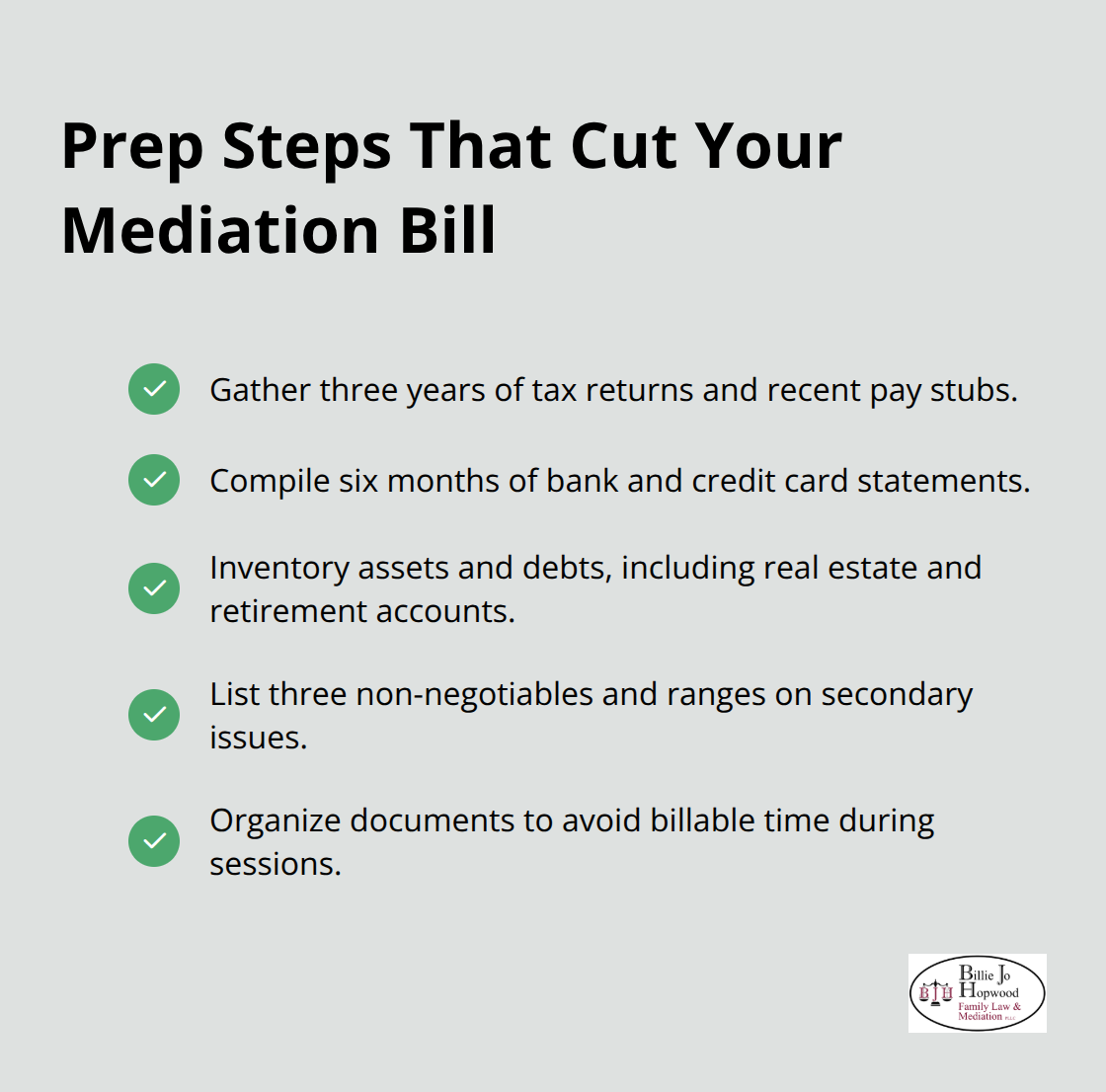
Checklist to prepare for Brevard family mediation and reduce hours

Flexible Payment Plans and Sliding Scale Fees

Mediators offering flexible payment plans or sliding scale fees based on combined household income deserve serious consideration, as rates drop substantially for lower-income families-some charge $150 per hour for households under $100,000 while charging $300 for those above $200,000. Contact multiple mediators in the Melbourne area to compare their fee structures and payment options before committing to anyone. Many mediators reduce rates for straightforward cases involving only property division or custody scheduling, so transparency about your situation upfront can unlock lower pricing.

Pre-Mediation Consultations Save Money

Schedule a consultation beforehand to understand exactly what documentation your mediator needs and what agreement timeline is realistic, since surprises during sessions inflate costs immediately. This conversation (often free or low-cost) prevents you from arriving unprepared and wasting billable hours while your mediator explains what information matters. Asking about follow-up session costs and implementation expenses during this initial call ensures no financial surprises derail your settlement progress.

Final Thoughts

Mediation cost in Brevard Florida depends on your income, case complexity, and whether you choose court-ordered or private services. Court-ordered mediation at $120 per party per session remains unbeatable for households earning under $100,000 annually, while private mediation between $175 and $300 per hour offers flexibility and faster resolution for those with higher incomes. The hidden expenses-administrative fees, travel costs, follow-up sessions, and implementation charges-typically add 20 percent to your initial estimate, so you should build that buffer into your budget to prevent financial surprises.

Preparation work before your first session cuts mediation costs dramatically by reducing billable mediator hours. You should gather financial documents, create an asset inventory, and identify your three non-negotiable priorities before mediation starts, which eliminates expensive hours spent organizing information during sessions. Request a pre-mediation consultation to confirm documentation requirements and understand realistic timelines, and contact multiple mediators to compare sliding scale fees and flexible payment plans since rates drop substantially for lower-income families.

The investment in mediation pays dividends that extend far beyond cost savings-the Florida Dispute Resolution Center reports that more than 75 percent of family law mediations result in full or partial agreements, and 85 percent of participants felt satisfied with the process compared to roughly 50 percent in litigation. Mediation preserves family relationships, keeps disputes private, and lets you control outcomes instead of accepting court-imposed terms.
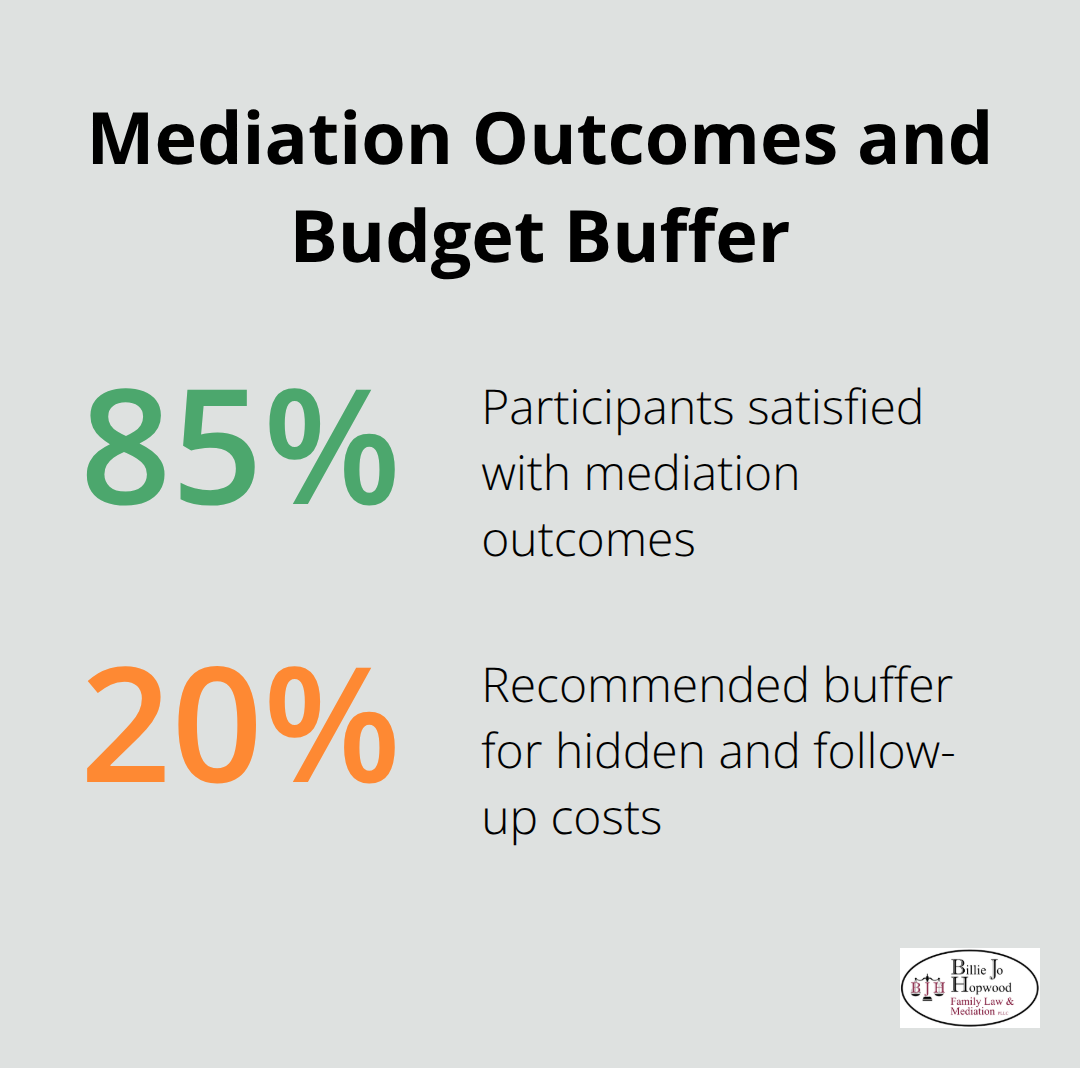
Key percentages for mediation success and budgeting in Brevard County - Mediation cost Brevard Florida

Contact us at Billie Jo Hopwood Family Law & Mediation, PLLC in Melbourne to discuss your situation and understand exactly what mediation will cost in your case.
Child Custody Mediation Steps: A Practical Guide

Child custody disputes put families through unnecessary stress and expense. At Billie Jo Hopwood Family Law & Mediation, PLLC, we’ve seen how mediation transforms these conflicts into workable solutions.

This guide walks you through the child custody mediation steps so you understand what to expect and how to protect your relationship with your child.

What Happens During Child Custody Mediation in Melbourne, Florida

The Mediation Structure and What to Expect

Child custody mediation in Melbourne, Florida is a structured negotiation where a neutral mediator helps both parents develop a parenting plan focused on your child’s needs. The mediator does not make decisions for you-instead, they facilitate communication, help you understand each other’s concerns, and guide you toward mutually acceptable arrangements. Florida courts often require mediation before custody disputes go to trial, which means you’ll likely face this process if custody remains unresolved. The mediator addresses specific issues like time-sharing schedules, decision-making authority over medical and educational matters, holiday arrangements, and transportation logistics. Most custody mediations in Florida run approximately three hours, though some cases require additional sessions depending on complexity and the number of unresolved issues.

Why Mediation Produces Better Outcomes Than Court

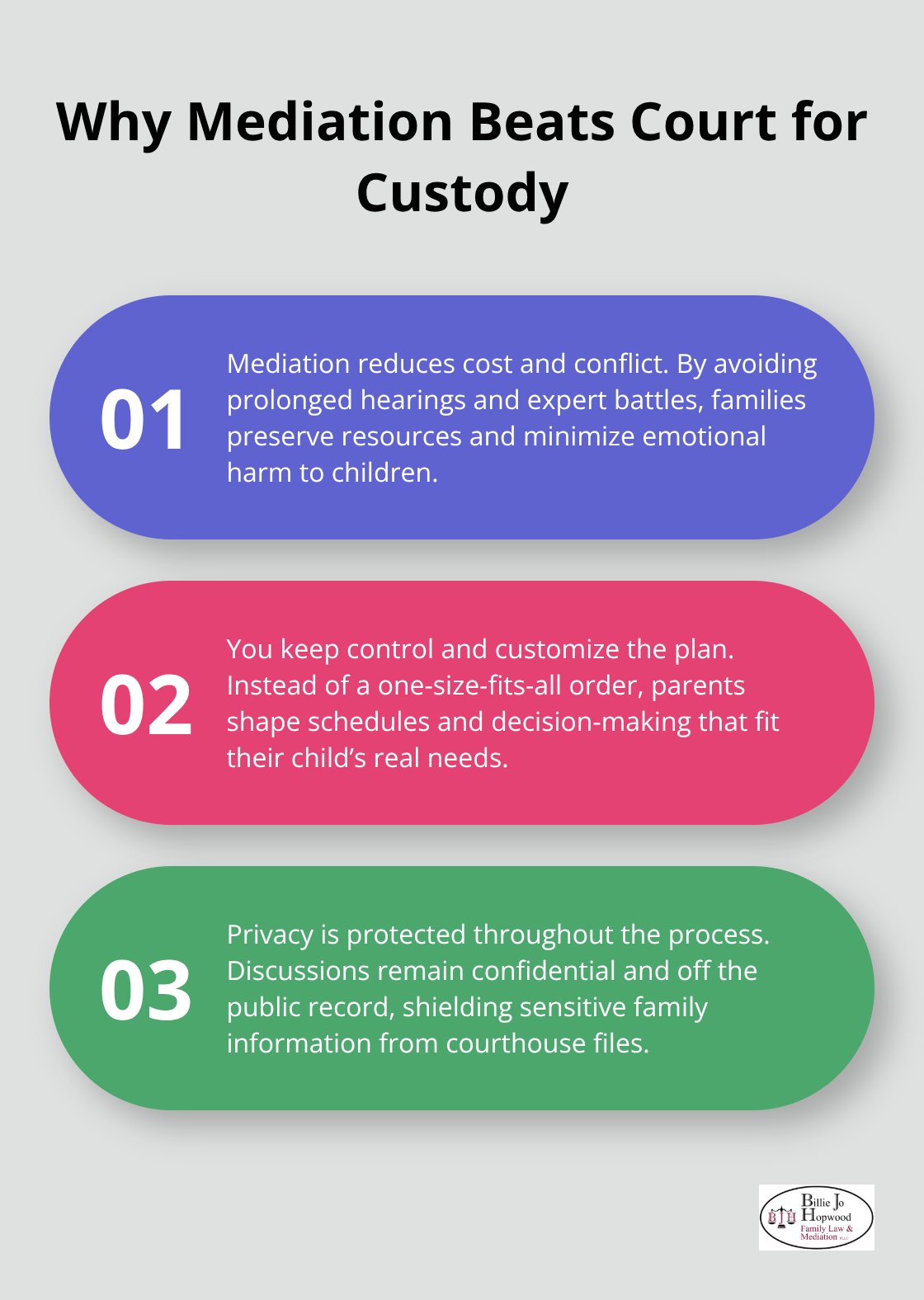
Court battles over custody drain finances and damage parent-child relationships. Litigation costs thousands in attorney fees, court costs, and expert witness expenses, while mediation typically costs a fraction of that amount. Parents who reach custody agreements through mediation report significantly better long-term co-parenting relationships than those who litigated. A court-imposed custody order leaves one parent feeling defeated, which poisons cooperation for years. Mediation forces both parents to engage constructively with each other’s perspectives, building the foundation for effective parenting after divorce. Unlike courtroom litigation where a judge imposes a custody order, mediation keeps control in your hands-you decide what works for your family, not a stranger in a robe. When you control the outcome through mediation, you create a parenting plan that actually reflects your family’s unique needs rather than generic judicial templates.

Three reasons mediation outperforms courtroom litigation in Florida custody cases - child custody mediation steps

You also maintain privacy; mediation discussions remain confidential and off the public record, protecting your family’s sensitive information from courthouse files.

How Florida Law Supports Mediation and Parental Authority

Florida Statutes establish that natural guardianship of minor children is held jointly by both parents during the child’s minority unless a court orders otherwise. This legal framework means both parents retain meaningful authority over custody and parenting decisions, which mediation acknowledges and preserves. When parents reach a mediated agreement, that agreement becomes a binding court order once the judge approves it-giving your negotiated solution the same legal weight as a contested trial verdict. If mediation does not produce agreement, the mediator reports an impasse to the court and your case proceeds to hearings or trial, but the mediation process will have narrowed the disputed issues and informed subsequent steps. Florida’s approach recognizes that parents working collaboratively through mediation produce more stable, child-centered parenting plans than adversarial courtroom battles. The state supports virtual mediation options in many family law cases, making the process accessible regardless of scheduling conflicts or distance.

Understanding these fundamentals prepares you for the actual mediation steps ahead, where preparation and strategy determine whether you reach an agreement that truly serves your child’s interests.

Getting Ready for Child Custody Mediation in Melbourne, Florida

Gather Documentation Two Weeks Before Mediation

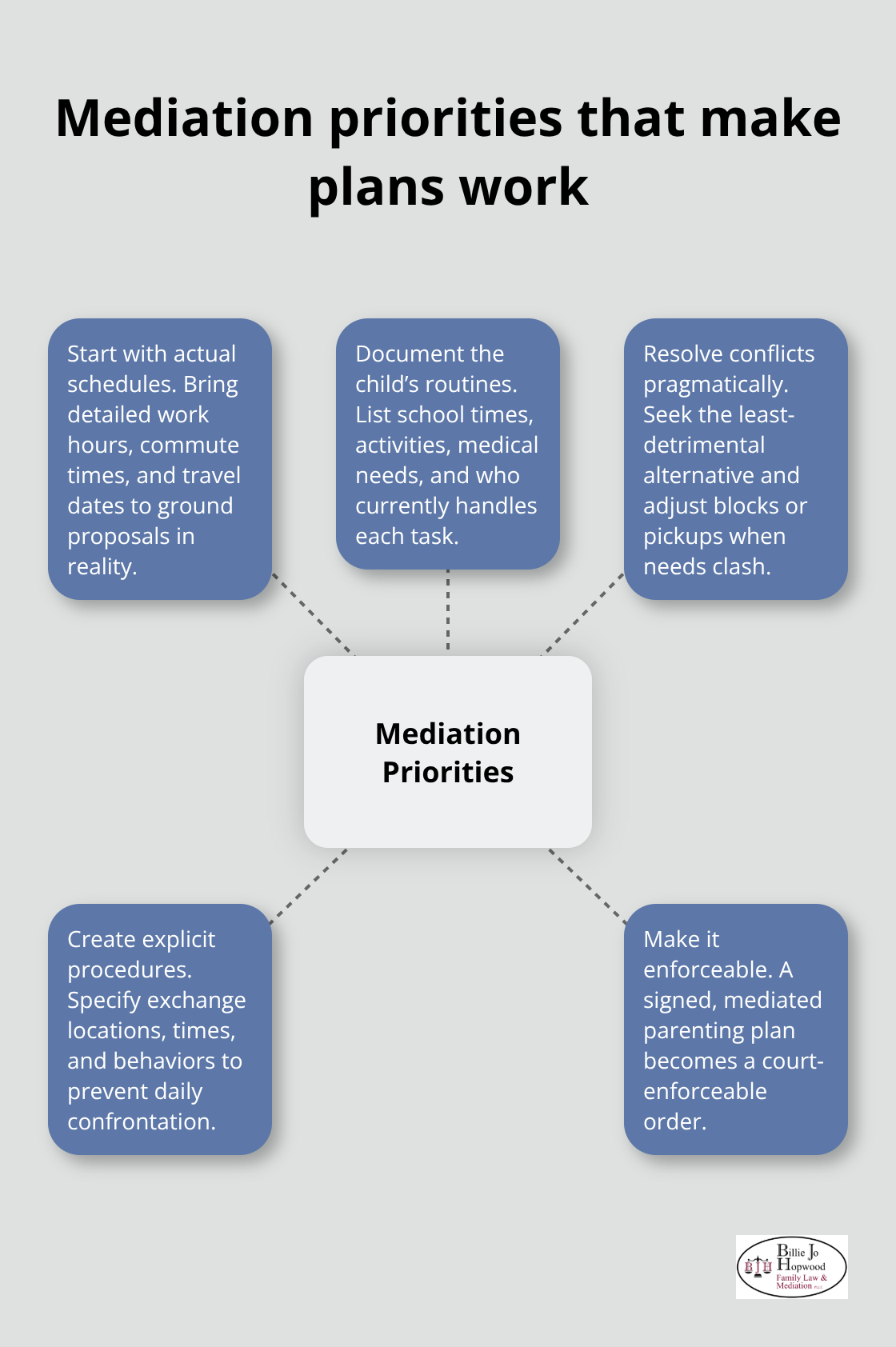
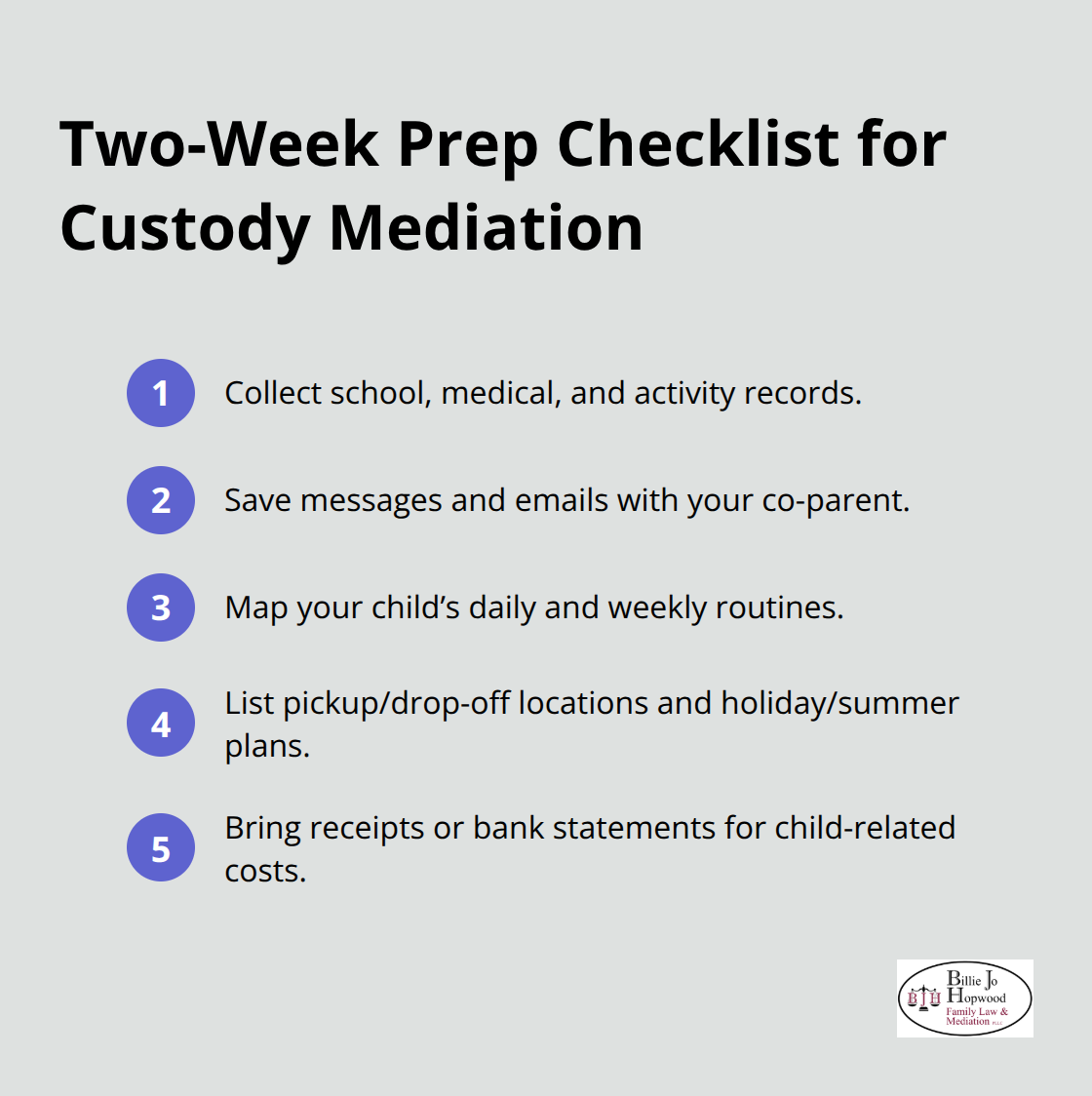
Preparation determines whether mediation succeeds or fails. Two weeks before your mediation session, you should gather school records, medical appointment histories, extracurricular activity schedules, and housing details. Print or save all communications with your co-parent so you can reference specific incidents if needed. Create a detailed packet showing your child’s daily and weekly routines, including wake times, meal schedules, homework support, and bedtime. Document exact pickup and drop-off locations you propose, holiday and summer plans, and how you’ll share child-related costs like daycare, health insurance, and activity fees. Bring receipts or bank statements proving these expenses so the mediator understands the financial reality of your situation.

Compact checklist of documents and details to gather two weeks before mediation

Prepare Your Parenting Plan One Week Before

One week before mediation, you should draft a parenting plan that includes your preferred time-sharing schedule, decision-making authority over medical and educational matters, transportation arrangements, and communication protocols with your co-parent. Research common custody schedules like the 2-2-5-5 rotation to understand practical trade-offs before the session. Create a must-have versus nice-to-have list so you know which issues matter most and where you can show flexibility. This preparation prevents you from making reactive decisions during the actual mediation.

Organize Materials 48 Hours Before the Session

Forty-eight hours before mediation, you should print three copies of every document and organize them in labeled folders. Arrive fifteen minutes early on the day of mediation, dress professionally, eat a full meal beforehand, silence your phone, and bring a notebook to capture agreements as they emerge.

Navigate the Mediation Session Itself

During the session, the mediator will make opening statements and establish an agreed agenda for discussion. The mediator typically starts with easier topics to build momentum before addressing contentious issues. Most custody mediations last approximately three hours, though complex cases may require additional sessions. The mediator may use private caucus sessions (meeting with each parent separately to understand concerns and de-escalate conflicts without the other parent present). Focus your opening statement on your child’s needs rather than your co-parent’s failures. Establish clear boundaries during discussions: no blaming, no threats, and no using your child as a messenger. If safety concerns or power imbalances exist, discuss these with the mediator beforehand and request safer formats like separate sessions or virtual mediation.

Finalize Your Agreement

When the mediator suggests terms, you should evaluate whether they serve your child’s best interests rather than rejecting proposals out of stubbornness. If you reach agreement, the mediator drafts a detailed settlement including the specific parenting plan and exact schedules. Review this document carefully before signing because it becomes a binding court order once the judge approves it. This agreement controls your custody arrangement for years, so accuracy matters tremendously. Once you understand what a finalized agreement looks like, the next step involves making that agreement work long-term through proper documentation and adjustment strategies.

Making Your Mediation Agreement Stick

Your mediated custody agreement holds value only if both parents follow it consistently. The moment you sign that settlement, the real work starts. Many parents discover that their carefully negotiated parenting plan fails within months because they never formalized it properly or planned for how life changes would affect the arrangement. The agreement must be filed with the court and approved by a judge to become a binding order, not just a handshake between parents. Your mediator will have drafted a detailed settlement document that specifies exact pickup times, drop-off locations, holiday schedules, and decision-making authority. Before you leave mediation, confirm that every detail in the written agreement matches what you actually agreed to during discussions. An attorney should review the document before you sign because errors in the written agreement create expensive problems later.

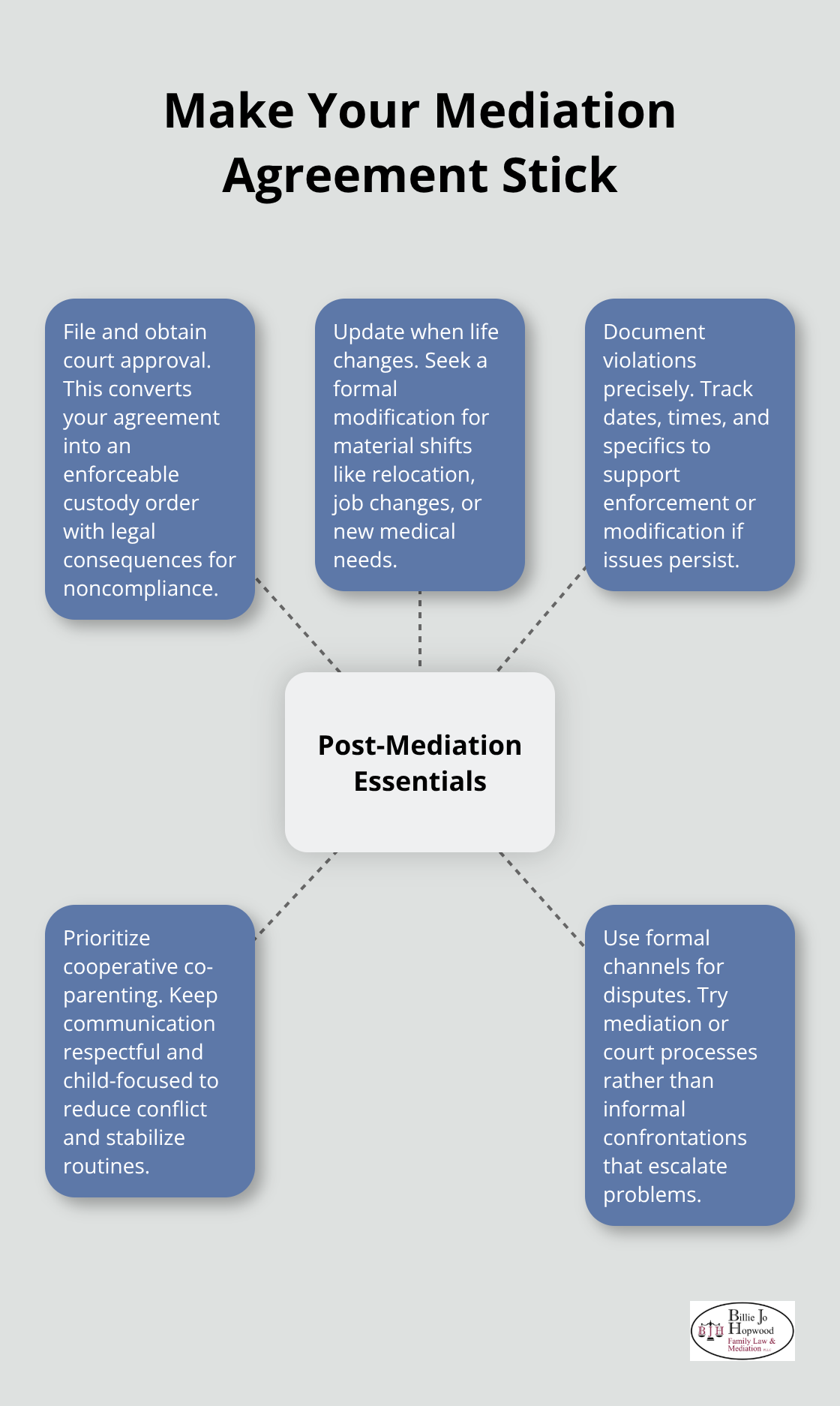
Key actions to formalize, update, and enforce a mediated custody agreement - child custody mediation steps

Once the judge signs off, that order controls your custody arrangement for years, making accuracy during the drafting phase non-negotiable.

File Your Agreement and Obtain Court Approval

The mediated settlement document does not become legally binding until a judge approves it. Your mediator handles the initial drafting, but you must submit the agreement to the court for formal approval. This step transforms your negotiated arrangement into an enforceable custody order. Without court approval, the agreement remains a contract between parents rather than a legal custody order. The filing process typically takes several weeks, so plan accordingly if you need the order in place quickly. Once the judge signs the order, both parents must follow it or face potential contempt charges.

Update Your Agreement When Circumstances Change

Many parents fail to update their agreements when circumstances change, which creates conflict and confusion. Your child’s needs evolve as they age, your work schedule may shift, and one parent might relocate. Florida courts expect parents to modify custody orders through formal amendment when material changes occur rather than making informal adjustments that nobody documents. If your child develops a medical condition requiring different scheduling, if your job changes significantly, or if your co-parent moves, these qualify as material changes that warrant amendment. Filing a modification request with the court costs less than litigating a full custody dispute and protects both parents by creating a clear, updated legal record. Parents who communicate proactively about schedule changes before problems escalate maintain better relationships with their co-parents and avoid returning to court repeatedly. Establish a communication protocol early where you discuss potential schedule adjustments with your co-parent before either parent makes unilateral changes.

Document Violations and Enforce the Order

If your co-parent consistently violates the custody order, you must document every instance with dates, times, and specific violations. This documentation becomes critical if you need to file a contempt motion or pursue modification through the court. Violations that go unaddressed signal acceptance and weaken your position if enforcement becomes necessary later. Keep records in a secure location and avoid confrontational communication about violations. Instead, address violations through formal channels or mediation if the pattern continues.

Build a Cooperative Co-Parenting Relationship

A cooperative co-parenting relationship requires setting aside the hurt from your custody dispute and focusing on your child’s stability. Your child benefits immensely when both parents maintain consistent routines, communicate respectfully about decisions, and avoid badmouthing the other parent. Parents who cooperate report that their children have fewer behavioral problems, better school performance, and less anxiety about the divorce itself. Use neutral communication channels like email or co-parenting apps rather than text messages that escalate conflict easily. Many families find that scheduling regular co-parenting check-ins every month or every quarter prevents small disagreements from becoming major disputes. These conversations should focus on your child’s development, upcoming events, and potential schedule adjustments rather than rehashing relationship grievances. If your co-parent violates the custody order repeatedly or refuses to cooperate on important decisions, you may need to return to mediation or pursue enforcement through the court rather than attempting to resolve everything informally.

Final Thoughts

Child custody mediation steps in Melbourne, Florida offer families a realistic path forward that courtroom battles cannot match. When you work through mediation, you maintain control over decisions that affect your child’s life rather than surrendering that authority to a judge. The process costs significantly less than litigation, protects your family’s privacy, and produces custody arrangements that both parents actually follow because they helped create them.

After you reach a mediated agreement, your real responsibility starts. That custody order only works if both parents commit to following it consistently and communicate respectfully about your child’s needs. Many families discover that the cooperative mindset they developed during mediation carries forward into their co-parenting relationship, reducing conflict and creating stability for their children.

If circumstances change significantly, you should update your agreement through the court rather than making informal adjustments that create confusion. Document any violations your co-parent commits and address them through proper channels. Contact Billie Jo Hopwood Family Law & Mediation, PLLC in Melbourne, Florida if you need support navigating mediation or formalizing your custody agreement.

Child Custody Mediation Brevard: Navigating Joint Decisions in Divorce

Divorce with children involved forces you to make decisions that shape your family’s future. Child custody mediation in Brevard offers a path where you and your co-parent work together instead of fighting in court.

We at Billie Jo Hopwood Family Law & Mediation, PLLC help families build parenting plans that actually work. This guide shows you how mediation gives you control over the outcome your children deserve.

Why Mediation Beats Court for Custody Decisions

How Mediation and Court Litigation Differ Fundamentally

Mediation and court litigation represent two entirely different paths to resolving custody disputes in Brevard County. In court, a judge makes the final decision about your child’s living arrangements and parental responsibilities after hearing arguments from both sides. The process is adversarial by design-your attorney argues against the other parent’s attorney, and you present competing evidence to convince a judge that your position is better. Mediation flips this dynamic entirely. You and your co-parent work with a neutral third party to find solutions you both can accept. The mediator doesn’t decide anything for you; they facilitate conversations, help you understand each other’s priorities, and guide you toward agreements that serve your child’s actual needs rather than winning points in a courtroom.

Why Parents Reach Agreement in Mediation

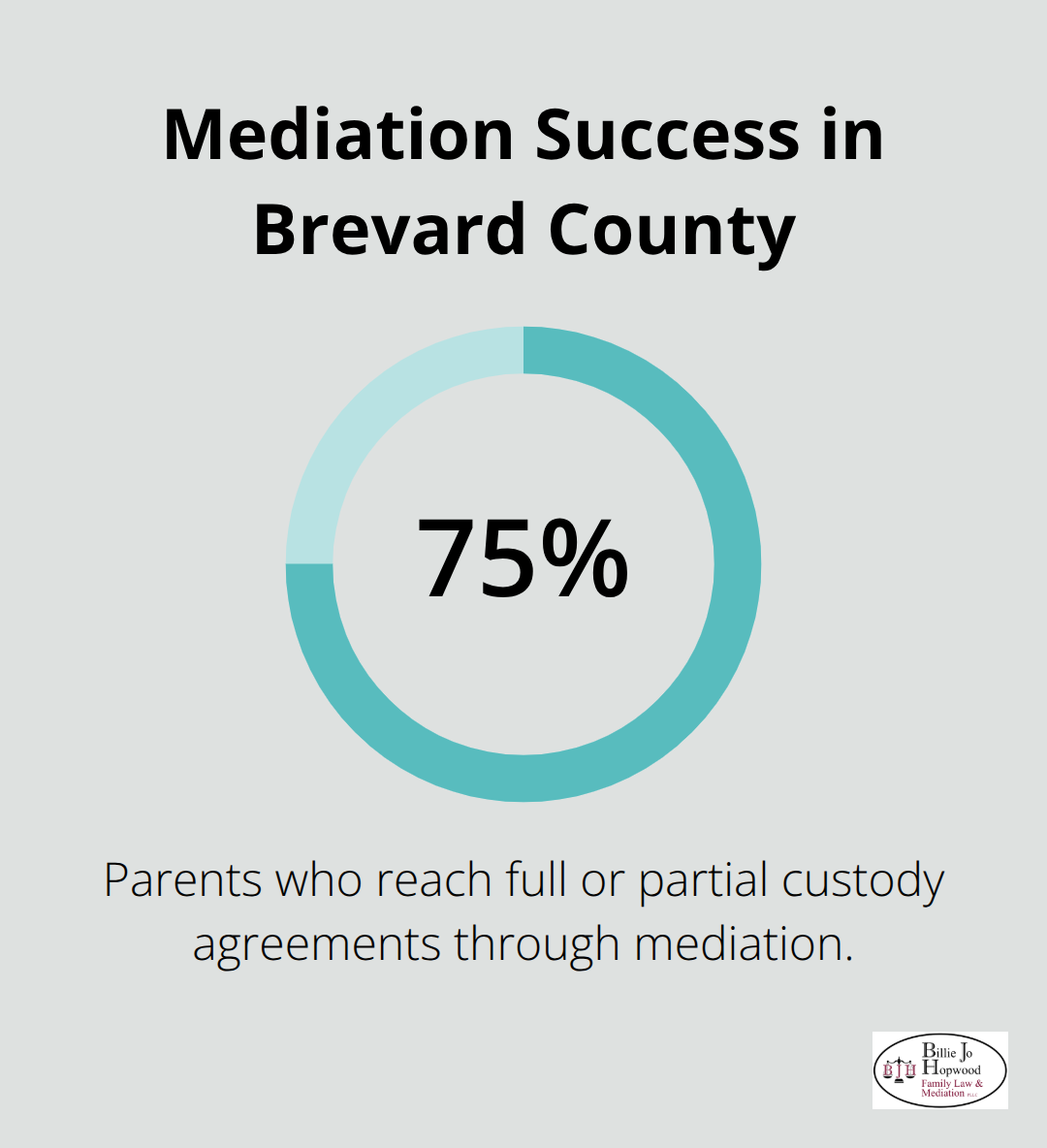
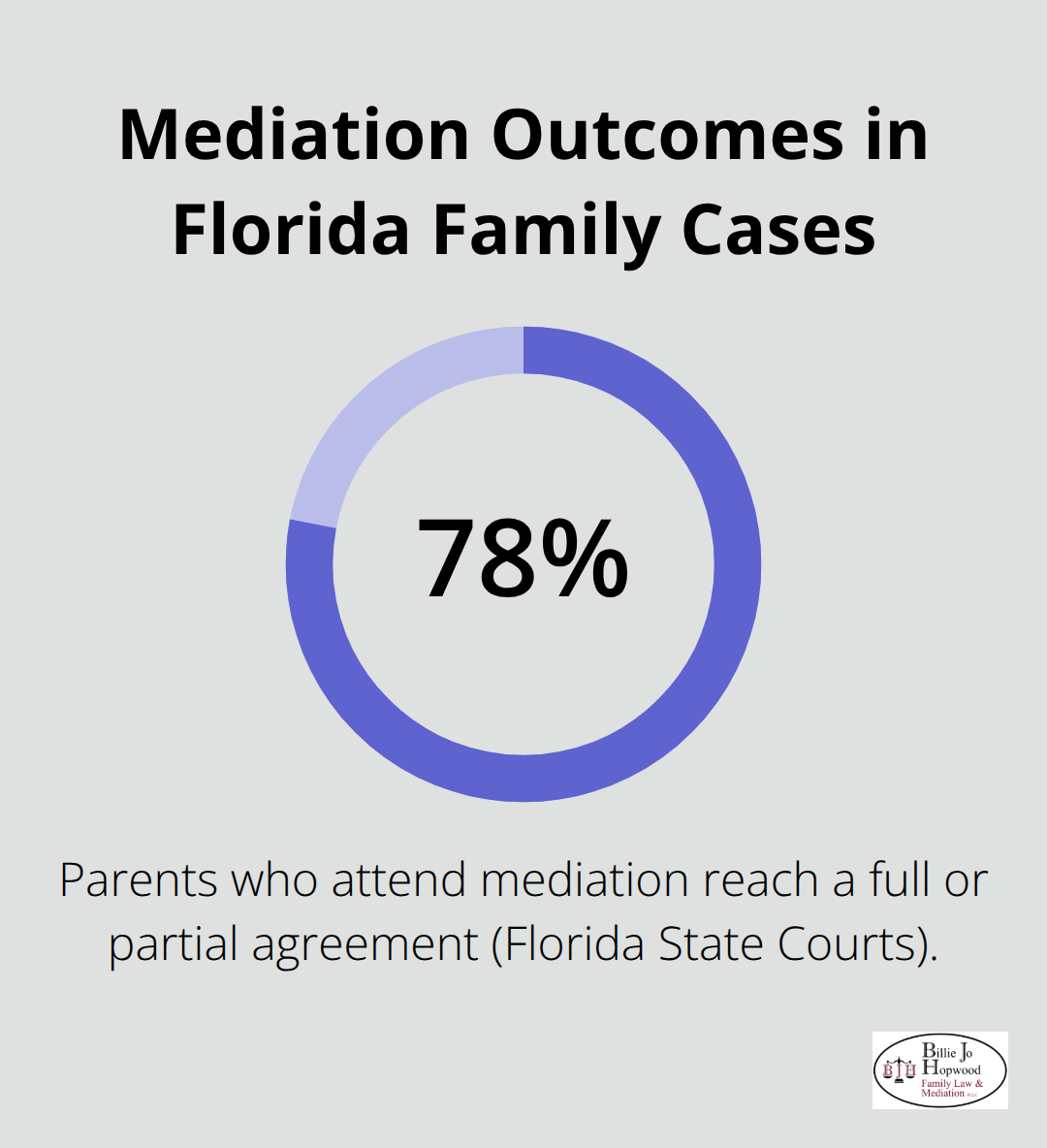
Florida State Courts data shows that about 75% of parents who attend mediation in Brevard County reach full or partial custody agreements, which means most families actually find common ground when given the right environment. This success rate reflects a fundamental shift in how you approach the problem. Instead of opposing each other, you collaborate.

Chart showing the percentage of parents who reach agreements through mediation in Brevard County. - Child custody mediation Brevard

The mediator creates space for both parents to express what matters most-whether that’s maintaining a strong relationship with your child, preserving your work schedule, or ensuring stability in your child’s school and social life. When you participate in creating the agreement, you feel ownership of it rather than resentment toward a judge’s imposed decision.

The Financial and Time Reality

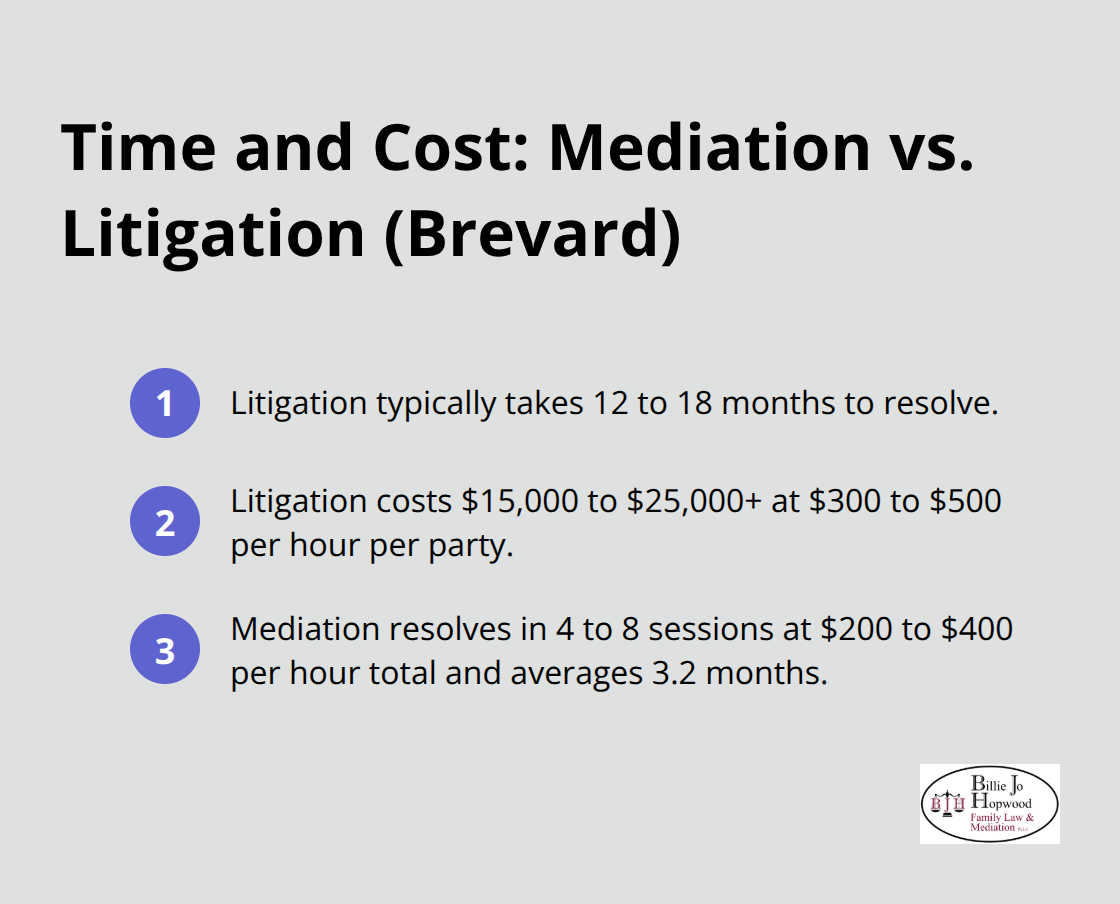
The financial and time differences between these two paths are stark. Litigation in Brevard typically takes 12 to 18 months and costs families $15,000 to $25,000 or more when you factor in attorney fees at $300 to $500 per hour per party, court fees, depositions, and discovery costs. Mediation resolves most cases in 4 to 8 sessions that cost about $200 to $400 per hour total and average completion in 3.2 months according to Florida State Courts data. You save money on discovery, depositions, and prolonged attorney involvement. You also reclaim months of your life that litigation would consume.

Compact list comparing timeframes and costs of litigation versus mediation in Brevard County.

Compliance and Privacy Matter More Than You Think

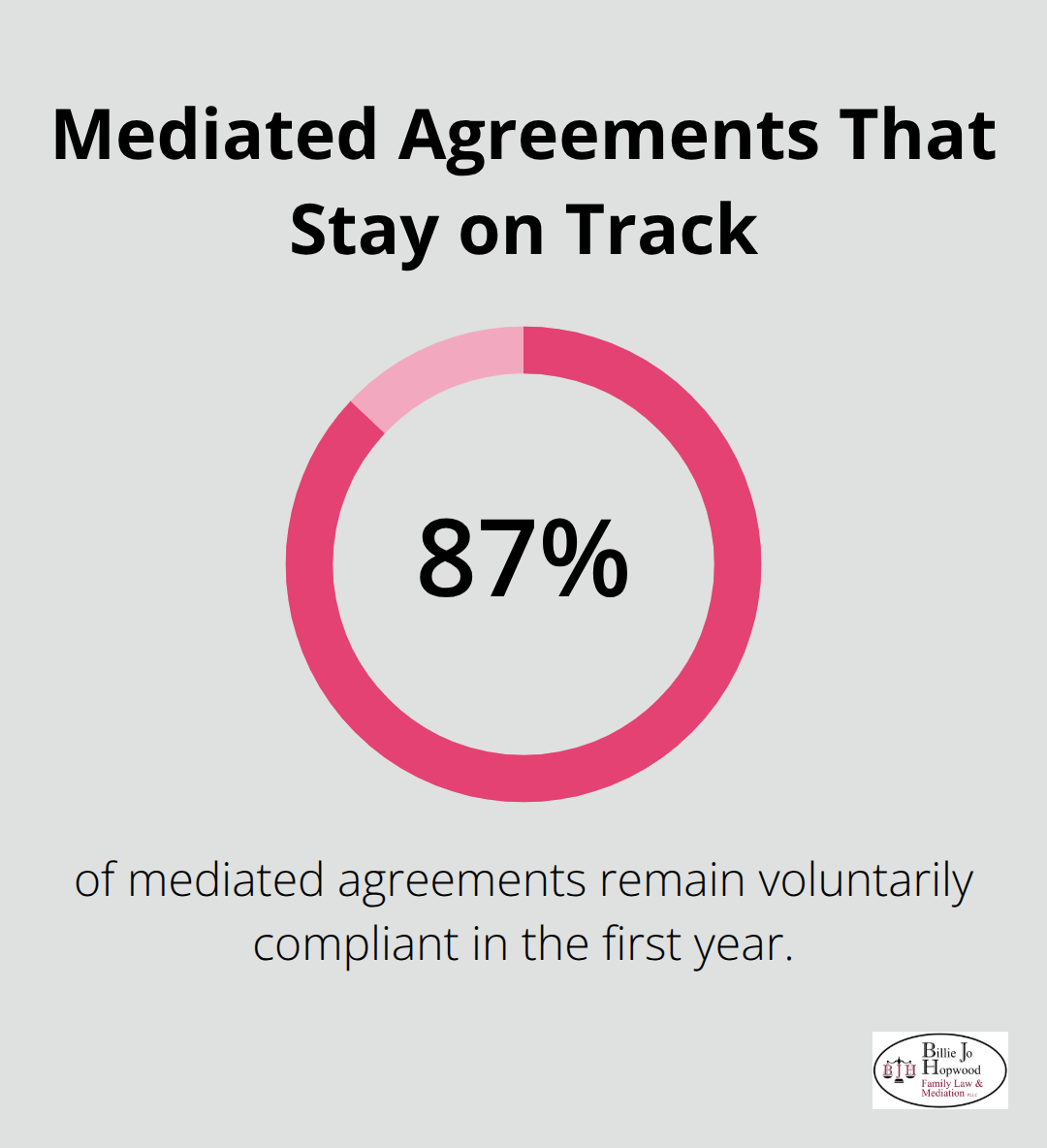
Court orders come with enforcement challenges-research shows over 40% of court-ordered arrangements have violations in the first year because parents resent decisions imposed on them. Mediated agreements have an 87% voluntary compliance rate because both parents helped create them. When you reach agreement through mediation, you also keep the process private instead of having custody details become public court records, which matters significantly for professionals and business owners in the Melbourne area concerned about their reputation. Your parenting plan stays confidential, and your family’s circumstances don’t appear in public databases.

What Happens Next in Your Mediation Journey

Understanding these differences helps you see why mediation offers real advantages for your family’s future. The next step involves learning what actually happens during mediation sessions and how to prepare for conversations that will shape your child’s life going forward.

What Makes Mediation Work in Brevard Custody Cases

Focus on Your Child’s Actual Needs, Not Winning Arguments

Effective custody mediation in Brevard hinges on honest conversations about what your child actually needs, not what each parent wants to win. You discuss your child’s school schedule, their relationship with extended family, healthcare requirements, and emotional attachment to each parent rather than debating who deserves more time. Florida courts use specific best interest factors when custody disputes reach trial-including the child’s age and health, emotional ties to each parent, the stability of each home environment, and each parent’s ability to meet the child’s needs. Mediation lets you address these factors voluntarily before a judge ever evaluates them. You control the narrative instead of having a judge interpret your parenting capacity from limited courtroom testimony. The Eighteenth Judicial Circuit in Brevard County mandates mediation in about 85% of contested divorce cases, which means understanding how to navigate these conversations effectively saves you from eventual court involvement.

Gather Documentation That Demonstrates Stability

Start with concrete information: your child’s current school, their medical providers, their extracurricular activities, and the daily routines that matter most. When you bring this documentation to mediation, you shift the conversation from emotional arguments to practical arrangements that preserve what your child already knows and values. This approach grounds discussions in reality rather than competing claims about parenting capacity.

Build a Parenting Plan With Practical Details

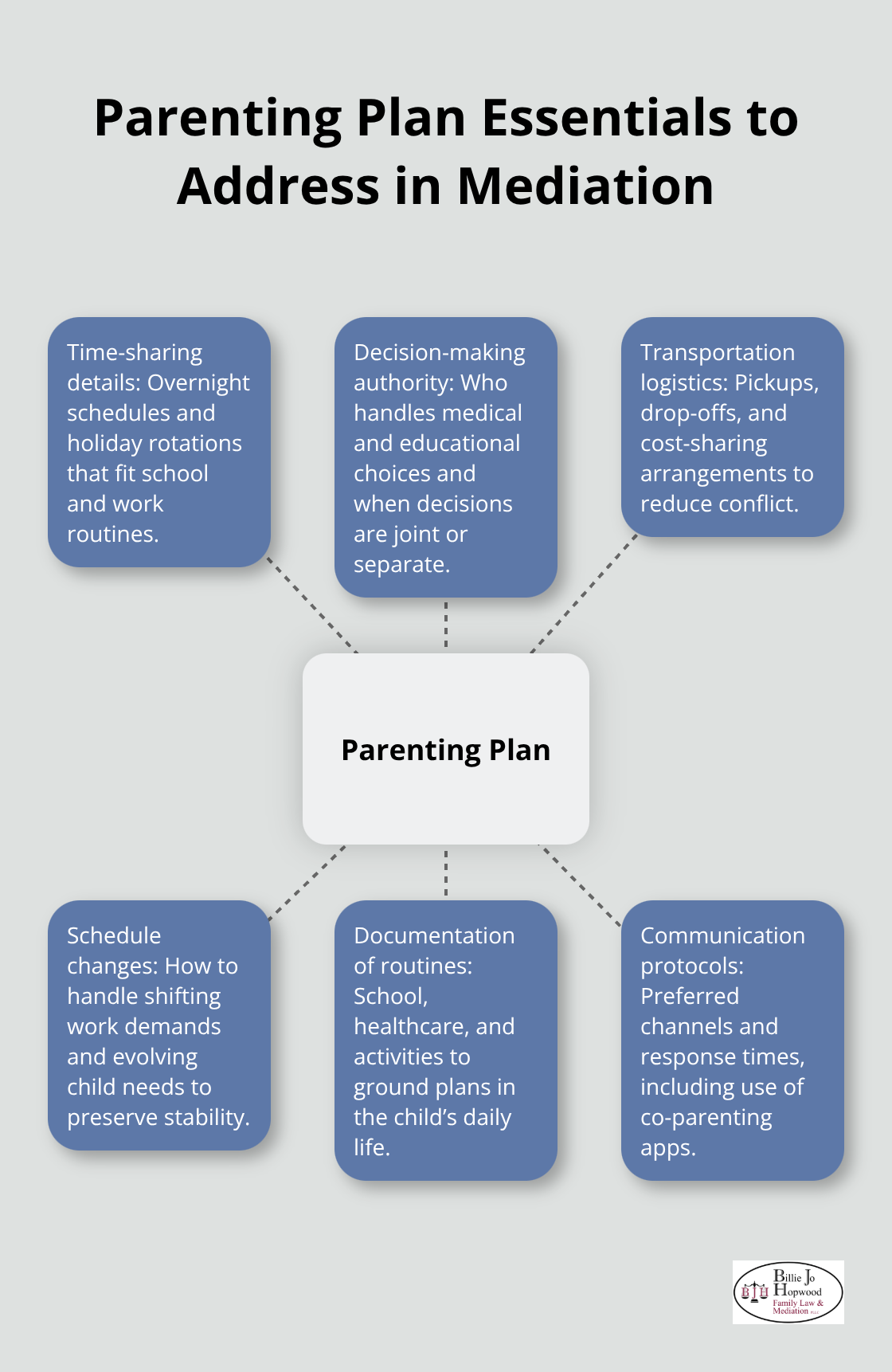
Creating a parenting plan that actually functions requires thinking beyond custody percentages. The plan needs to address overnight schedules, holiday rotations, transportation logistics, decision-making authority for medical and educational matters, and how you’ll handle schedule changes when work demands shift or your child’s needs evolve. Families in Brevard who mediate typically finish their agreements in 3.2 months according to Florida State Courts data, which means you reach clarity quickly enough to implement plans before problems arise.

Hub-and-spoke chart outlining essential components of a parenting plan created in mediation. - Child custody mediation Brevard

A detailed parenting plan demonstrates stability and continuity to courts if modification disputes later emerge, so investing time in specifics during mediation protects both parents.

Address Specific Scenarios Before They Become Conflicts

Address whether parents will split holidays evenly, alternate them yearly, or divide them within the same year. Clarify who attends school conferences, who makes healthcare decisions independently versus jointly, and what happens if one parent needs to relocate for work. Include provisions for summer breaks, spring breaks, and how communication happens when the child is with the other parent. The mediator helps you think through scenarios you haven’t considered-like what happens when your child gets sick during the other parent’s time, or how you’ll handle sports tournaments that fall on transition days. This level of detail prevents future conflicts because both parents understand expectations upfront rather than discovering disagreements months into the arrangement.

Move Forward With Confidence Into Implementation

Once you’ve created a comprehensive parenting plan through mediation, the real work of co-parenting begins. The next chapter covers how to actually implement these agreements and maintain the cooperative relationship that makes shared parenting successful.

Custody Arrangements Families Choose in Mediation

Shared Custody With Equal Time-Sharing

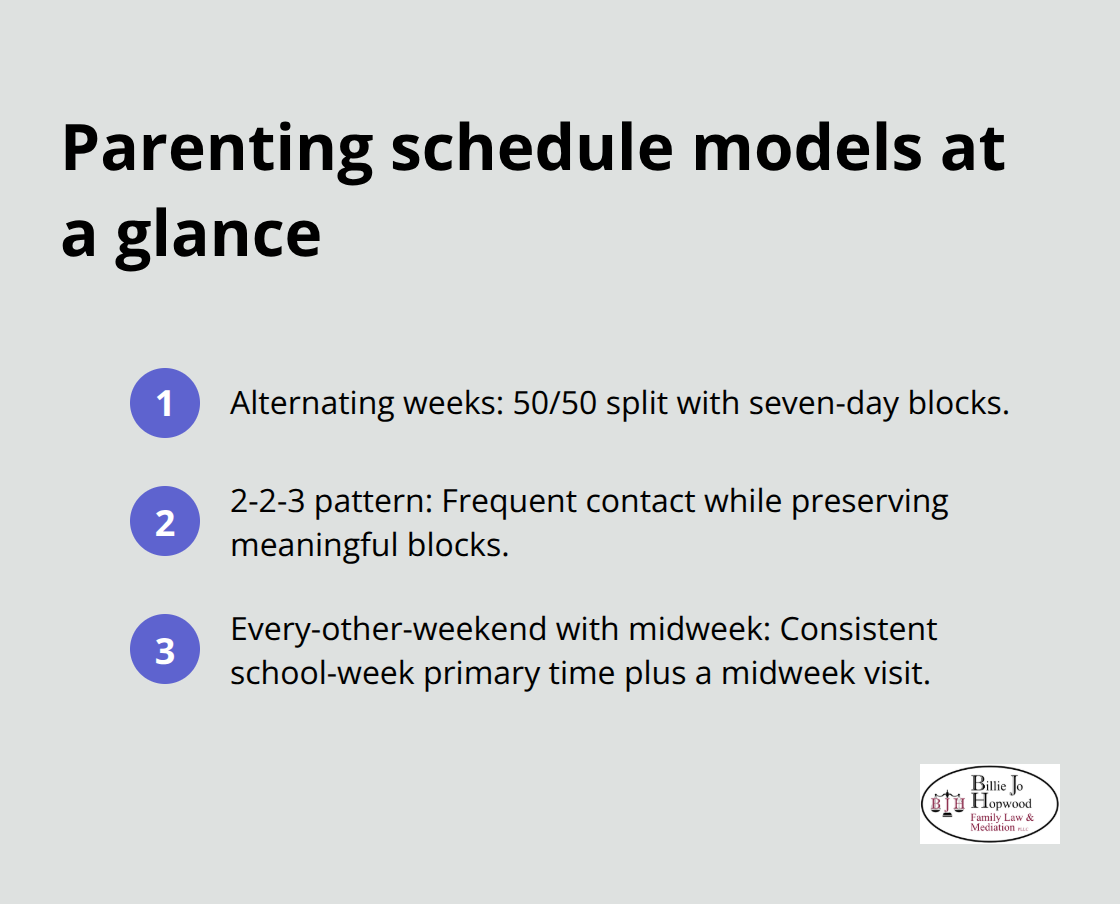
Most families in Brevard County reach one of three primary custody structures during mediation, though the specific details matter far more than the label. Shared custody with roughly equal time-sharing works well when both parents live close to each other and maintain consistent schedules. Florida courts encourage shared parental responsibility, and mediation helps you build schedules that actually function with your work commitments and your child’s school calendar. One parent might have the child Monday through Wednesday evenings plus every other weekend, while the other parent has Thursday through Sunday.

The advantage is clear: your child maintains strong relationships with both parents without one parent feeling sidelined. Research from Florida State Courts shows that mediated arrangements with clear schedules have an 87% voluntary compliance rate, meaning parents actually follow through because they helped design them. However, equal time-sharing only works if both parents can commit to consistency. If your work schedule shifts unpredictably or you travel frequently, equal time-sharing creates constant rescheduling conflicts that undermine the stability your child needs.

Primary Custody With Scheduled Visitation

Primary custody with scheduled visitation becomes the practical choice when one parent has significantly more parenting capacity due to work stability, proximity to the child’s school, or existing daily routines. The primary custodian provides the home base where the child lives most of the time, typically 60 to 80 percent, while the other parent has defined overnight visits and weekends. This arrangement preserves continuity for your child’s school, friendships, and activities while still protecting the other parent’s relationship with the child.

The structure works because it acknowledges real differences in each parent’s capacity rather than forcing an artificial balance that neither parent can sustain. Your child benefits from a stable primary residence while maintaining meaningful contact with the other parent through regular, predictable visitation.

Holiday and Summer Break Schedules

Holiday and summer schedules require separate attention in either custody structure because they disrupt normal routines and often trigger conflict if not addressed explicitly. Families in Brevard who mediate typically allocate holidays by splitting them within the same year-one parent takes Thanksgiving, the other takes Christmas; one parent gets spring break in odd years, the other in even years-or by alternating entire holiday seasons yearly.

Summer break needs a specific plan addressing whether the child spends the entire summer with one parent, splits it evenly, or rotates weekly. The mediator pushes you to think through logistics like who handles transportation to summer camp, whether overnight visitation changes during summer months, and how you’ll communicate schedule changes. Families that fail to address these details in mediation face constant disputes once school ends because neither parent anticipated how the arrangement would function in practice.

Addressing Transportation and Transition Points

Transportation logistics often create unexpected friction in custody arrangements. Clarify who picks up and drops off the child at school, activities, and the other parent’s home. Specify whether one parent covers all transportation costs or you split them. Address what happens when the child needs to travel between homes on school days versus weekends, and whether either parent will handle longer drives for summer visitation or holiday exchanges.

Transition points-the moments when your child moves between homes-matter more than most parents realize. Some families benefit from neutral exchange locations like school or a community center rather than meeting at home, which reduces conflict and protects your child from witnessing tension. Others find that one parent dropping off and the other picking up works better than simultaneous exchanges.

Decision-Making Authority and Communication

Specify who makes decisions about medical care, education, extracurricular activities, and religious upbringing. Some parents share all major decisions equally; others assign specific categories to each parent. For example, one parent might handle educational decisions while the other manages healthcare choices. Include how you’ll communicate about your child’s needs, whether through text, email, or a co-parenting app, and establish response time expectations for urgent matters.

The mediator helps you think through scenarios you haven’t considered-like what happens when your child gets sick during the other parent’s time, or how you’ll handle sports tournaments that fall on transition days. This level of detail prevents future conflicts because both parents understand expectations upfront rather than discovering disagreements months into the arrangement.

Final Thoughts

Your child’s adjustment after divorce depends far more on how you and your co-parent interact than on custody percentages or schedules. When parents cooperate through child custody mediation in Brevard, children experience less conflict and maintain stronger relationships with both of you. Research consistently shows that children adjust better when they see their parents working together rather than fighting in court, and mediation creates that cooperative environment by design.

Court litigation removes your control over outcomes because a judge makes decisions based on limited courtroom testimony and legal arguments, then imposes an arrangement neither parent fully accepts. Mediation keeps decision-making power in your hands so you decide what works for your family’s specific circumstances, your work schedules, your child’s needs, and your living situations. You create agreements that reflect your actual life rather than fitting into a judge’s standard template, which matters because you understand your family’s complexity far better than any judge ever will.

Life changes constantly, and mediated agreements adapt more easily than court orders because you’ve already practiced working together. We at Billie Jo Hopwood Family Law & Mediation, PLLC help families in Melbourne navigate child custody mediation by guiding you toward agreements that serve your children’s actual needs-contact us to discuss how mediation can give your family the cooperative foundation that makes shared parenting work long-term.

Brevard County Parenting Plan: A Practical Guide

A Brevard County parenting plan is a legal document that outlines how you and your co-parent will share time with your children and make decisions about their upbringing. This plan becomes the foundation for your family’s routine after separation or divorce.

We at Billie Jo Hopwood Family Law & Mediation, PLLC help families in Brevard County create parenting plans that work for everyone involved. This guide walks you through what goes into a solid plan and how to get one in place.

What Parenting Plans Actually Do

The Legal Framework That Governs Your Child’s Life

A parenting plan in Brevard County is far more than a scheduling document-it’s the legal framework that governs your child’s life after separation or divorce. Florida law requires every custody case to include a parenting plan that specifies time-sharing arrangements, decision-making authority, and how you’ll handle everything from school pickups to medical emergencies. The court won’t finalize your custody order without one. This isn’t optional paperwork; it’s the document that determines whether you get equal time with your child or majority time, who decides which school they attend, and what happens if one parent wants to relocate.

Courts in Brevard County use parenting plans to enforce consistency and reduce conflict between parents. When disputes arise later-and they often do-the judge looks directly at what your parenting plan says. If it’s vague or incomplete, you’ll end up back in court paying attorney fees to clarify something that should have been settled years earlier.

Florida’s Specific Requirements

Florida’s requirements are specific and non-negotiable. Your parenting plan must describe the daily child-rearing tasks each parent handles, include a detailed time-sharing schedule covering weekdays, weekends, holidays, and school transitions, and designate who makes decisions about healthcare, education, and religious upbringing. You also need to specify communication methods between parents, outline how you’ll exchange the child, and include a dispute resolution process-preferably mediation before court.

The American Academy of Pediatrics and American Psychological Association emphasize that stable routines and ongoing contact with both parents directly support child development, which is why Florida courts take these details seriously. Courts presume that equal time-sharing serves the child’s best interests unless proven otherwise, but that presumption only works if your plan actually supports it with realistic, workable schedules. Vague language like “whenever works” or “as agreed” creates enforceability problems.

Moving Forward With Mediation Support

If you and your co-parent struggle to agree on the details, the Brevard/Seminole Court Mediation Program handles family law mediation specifically for time-sharing and parenting plan disputes. This mediation option provides an efficient first step before you file with the court, allowing both parents to work through disagreements with a trained mediator present. The process remains confidential, and mediators help you translate your family’s actual needs into language the court will recognize and enforce.

What Actually Goes Into Your Parenting Plan

The Three Core Elements That Make a Plan Work

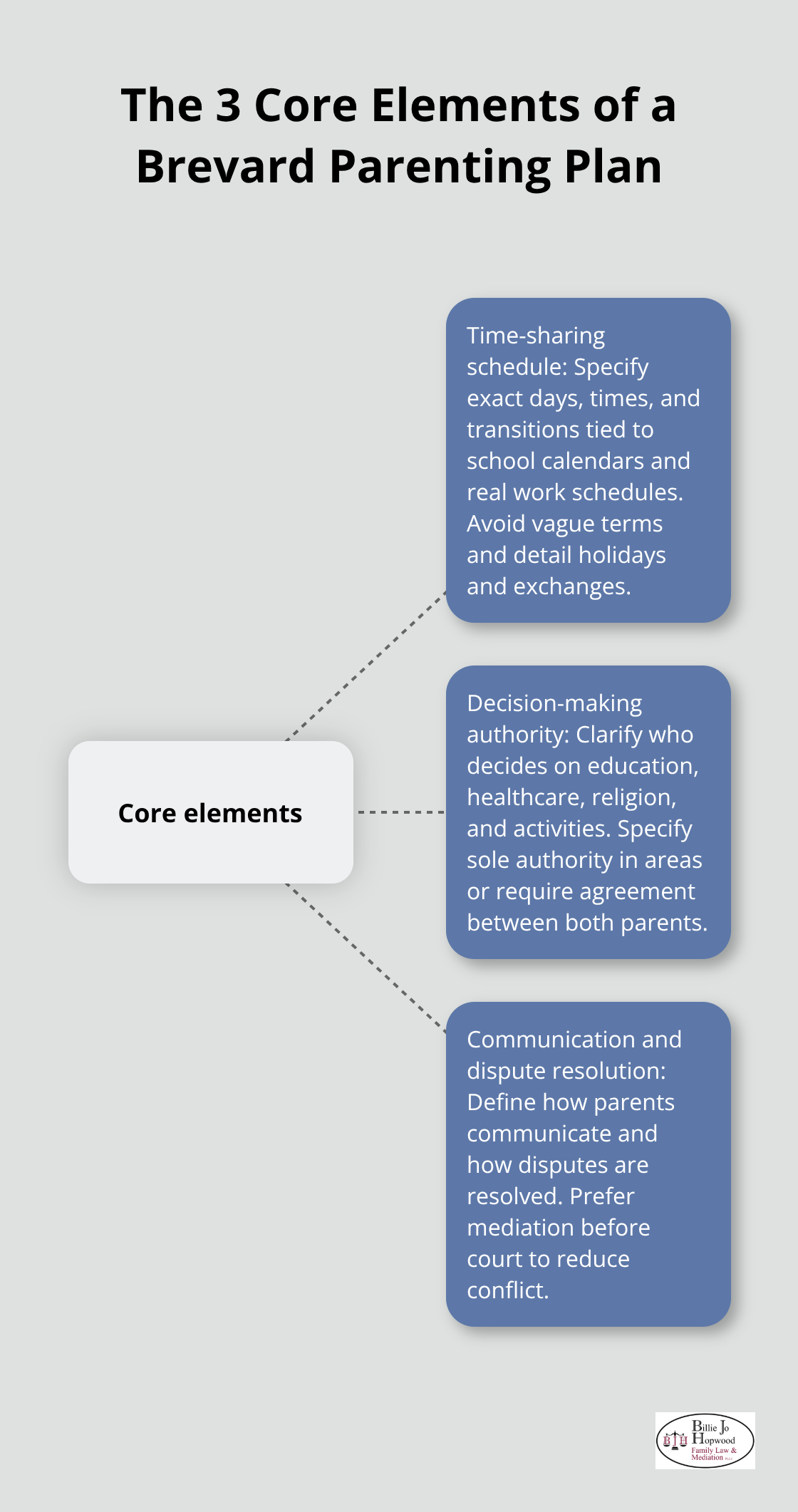
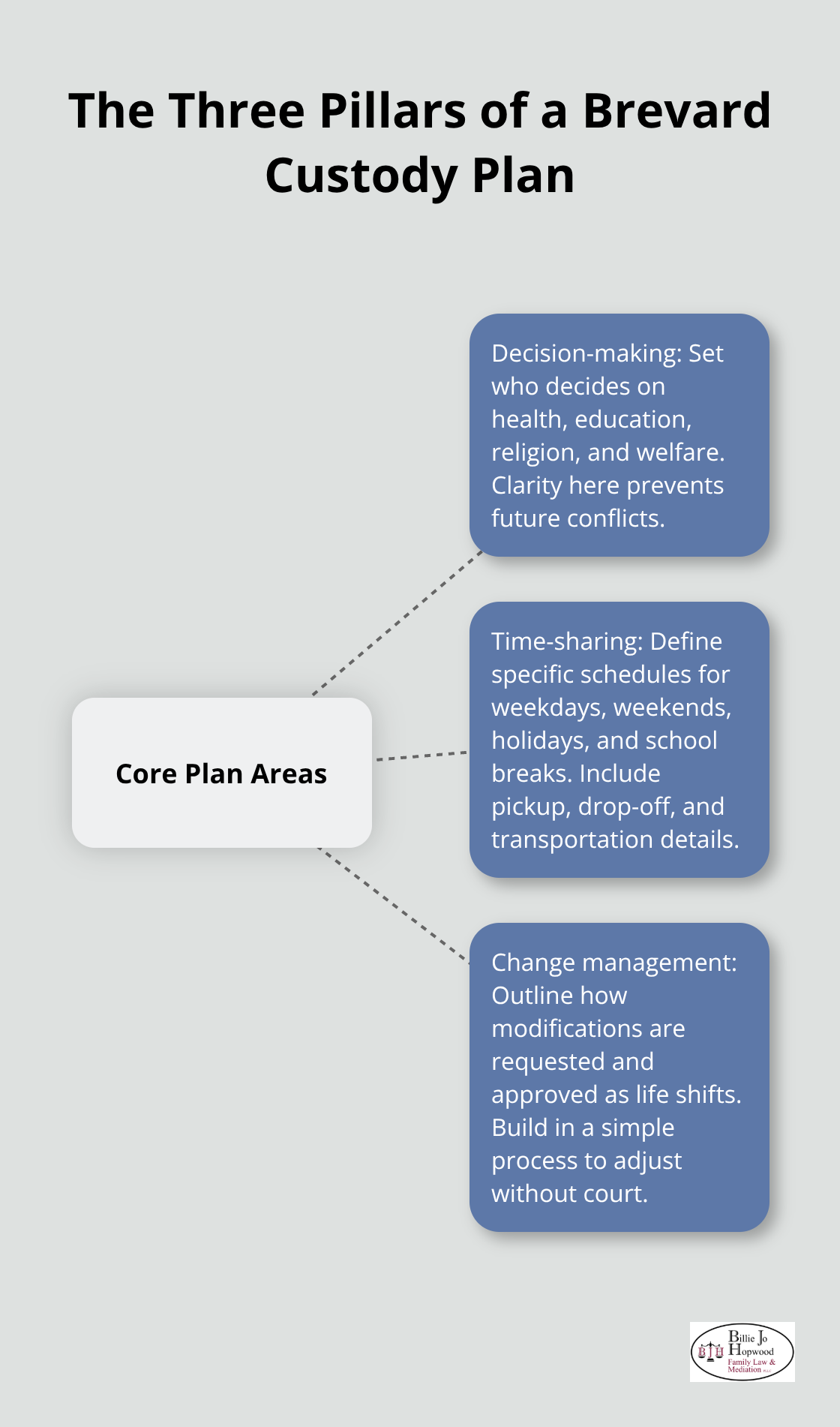
Your parenting plan needs three concrete elements working together, and skipping any one of them creates real problems down the road. The first is your time-sharing schedule, which must specify exactly when each parent has the child-not vague language like “reasonable visitation” but actual days, times, and transitions. Florida courts presume equal time-sharing (roughly 50-50) serves the child’s best interests unless you can prove otherwise, according to Florida Statute 61.13. This means if you want unequal time-sharing, your plan needs to explain why that arrangement actually benefits your child, not just why it’s convenient for you.

Visualization of the three core elements in a Brevard County parenting plan

The second element is decision-making authority-who decides about school enrollment, healthcare, religious upbringing, and extracurricular activities. Florida law requires you to designate this clearly, either giving one parent sole authority over specific areas or requiring both parents to agree. The third element is your communication method and dispute resolution process, because parents who can’t talk directly need a structured way to handle disagreements without involving children in conflict.

Building a Time-Sharing Schedule That Actually Works

Your time-sharing schedule should align with your child’s school calendar and your actual work schedules, not an idealized version of your life. If you work retail with rotating shifts, a rigid Monday-Wednesday-Friday schedule won’t work-the plan needs flexibility built in. Include specific pickup and dropoff times, designate neutral exchange locations to reduce conflict, and specify who handles transportation for school, extracurricular activities, and medical appointments. Holiday schedules matter more than you’d think; rotating Thanksgiving or Christmas between parents prevents annual arguments. The Brevard/Seminole Court Mediation Program specifically handles parenting plan modifications and disputes, offering a faster, cheaper alternative to court when circumstances change.

Managing Health Insurance and Medical Costs

Health insurance and medical costs must be allocated between parents, with one parent typically carrying the primary plan and the other reimbursing their share based on income. Florida’s income shares model for child support means both parents’ earnings determine how medical expenses are split. Parenting coordinators, permitted under Florida law, can help high-conflict families manage these details without constant court involvement. Your plan should include a relocation clause specifying that moving more than 50 miles from the other parent requires notice and a modification process, since relocation disputes frequently land families back in court. Document everything in your final plan-vague agreements become expensive problems when one parent’s memory doesn’t match the other’s, and the court will look to what you actually wrote when disputes arise later.

Getting Your Parenting Plan Approved and in Place

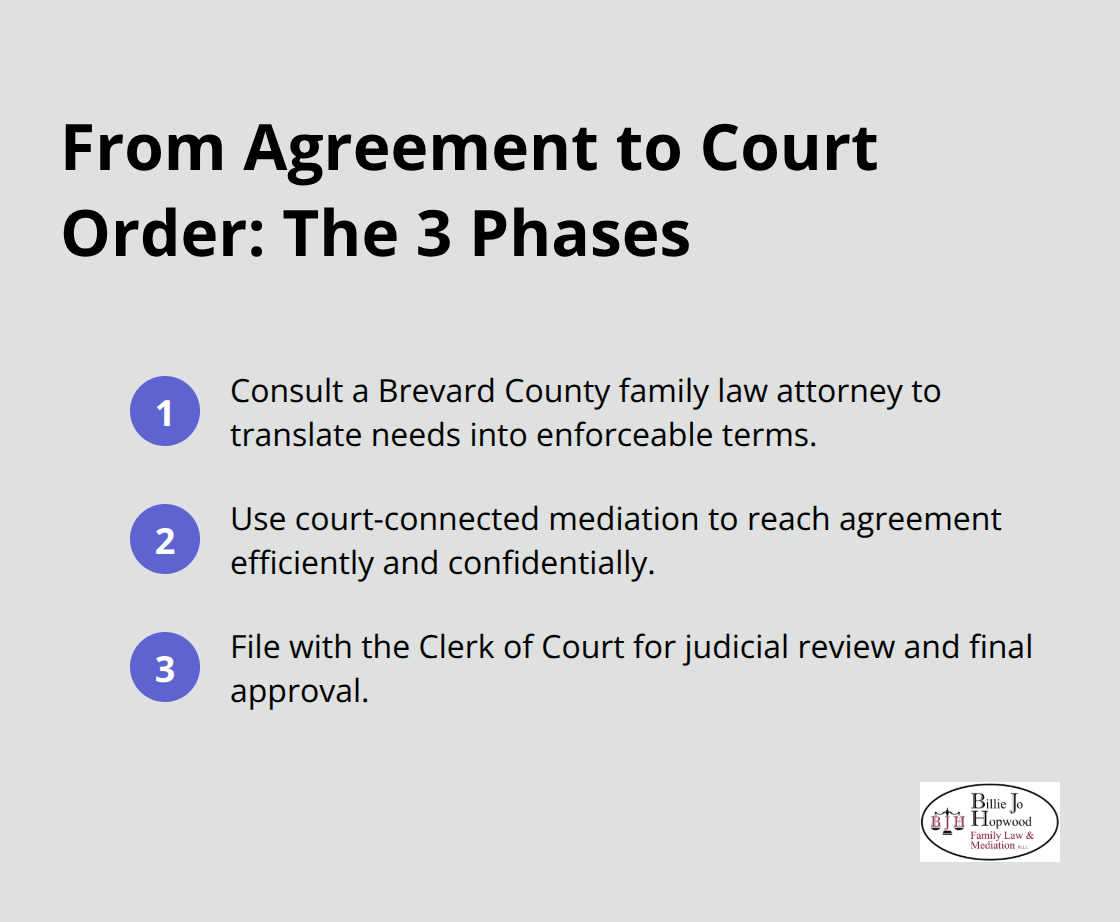
Most parents in Brevard County underestimate how much work goes into turning a parenting plan concept into a court-approved document. The path from initial agreement to final order involves three distinct phases, and cutting corners in any of them creates enforceability problems later.

Compact list of the three phases to get a parenting plan approved in Brevard County

Working With a Family Law Attorney

Start with a family law attorney who understands Brevard County’s specific court procedures and local judges’ expectations. An attorney translates your family’s actual needs into enforceable terms, specifying exact times rather than vague phrases like “reasonable visitation.” The attorney also drafts language that the Brevard County Clerk of Court will accept without requiring revisions, saving you time and additional filing fees.

Using Mediation to Reach Agreement

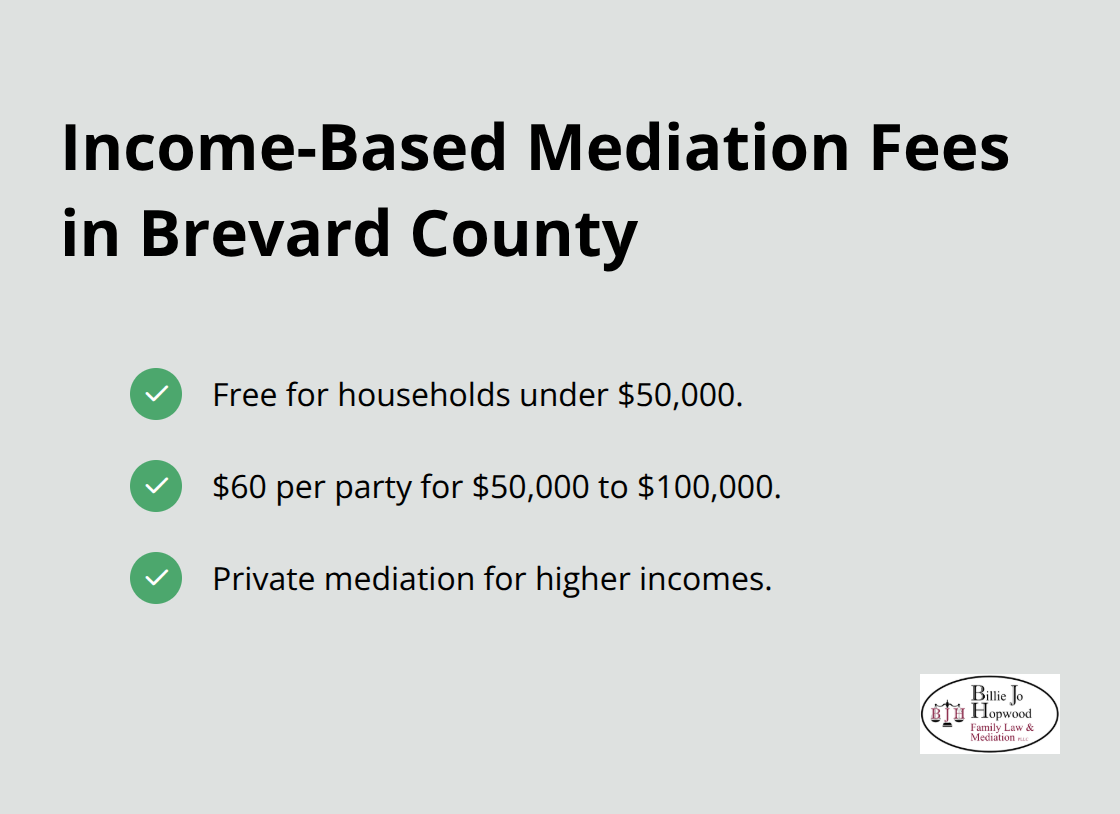
If you and your co-parent disagree on the details, the Brevard/Seminole Court Mediation Program provides a structured first step before filing with the court. Family mediation through this program costs $60 per party if your combined income falls below $50,000, or $120 per party if combined income ranges from $50,000 to $100,000. If combined income exceeds $100,000, you’ll need private mediation, which typically costs $150 to $300 per hour depending on the mediator. Mediators certified by the Florida Supreme Court facilitate these discussions without providing legal advice, keeping the process confidential and focused on reaching agreement rather than preparing for court. Sessions happen online via video conference, which simplifies scheduling around your existing parenting time and school calendars.

Negotiating Terms That Prevent Future Disputes

Negotiating the actual terms requires both parents to be honest about work schedules, travel commitments, and the child’s needs rather than using the parenting plan as a leverage tool. The most successful plans include specific details that prevent future disputes: exact pickup and dropoff times, designated neutral exchange locations (many Brevard County families use public libraries or police station parking lots), and clear protocols for illness or emergencies. Document whether one parent handles health insurance and how the other reimburses their share of medical costs based on income, since Florida’s income shares model requires this allocation. Include a relocation clause that specifies moving more than 50 miles from the other parent triggers a modification process, because relocation disputes frequently land families back in court.

Filing and Court Approval

Once you and your co-parent finalize the terms, your attorney files the parenting plan with the Brevard County Clerk of Court along with your marital settlement agreement or custody petition. The court reviews the plan to confirm it meets Florida’s requirements and serves the child’s best interests. Courts presume equal time-sharing serves the child’s best interests unless proven otherwise, so if your plan allocates unequal time, the court expects an explanation of why that arrangement actually benefits your child. After the judge approves and signs the order, the parenting plan becomes legally binding, and violations can result in makeup time orders, financial penalties, or custody modifications against the non-compliant parent.

Final Thoughts

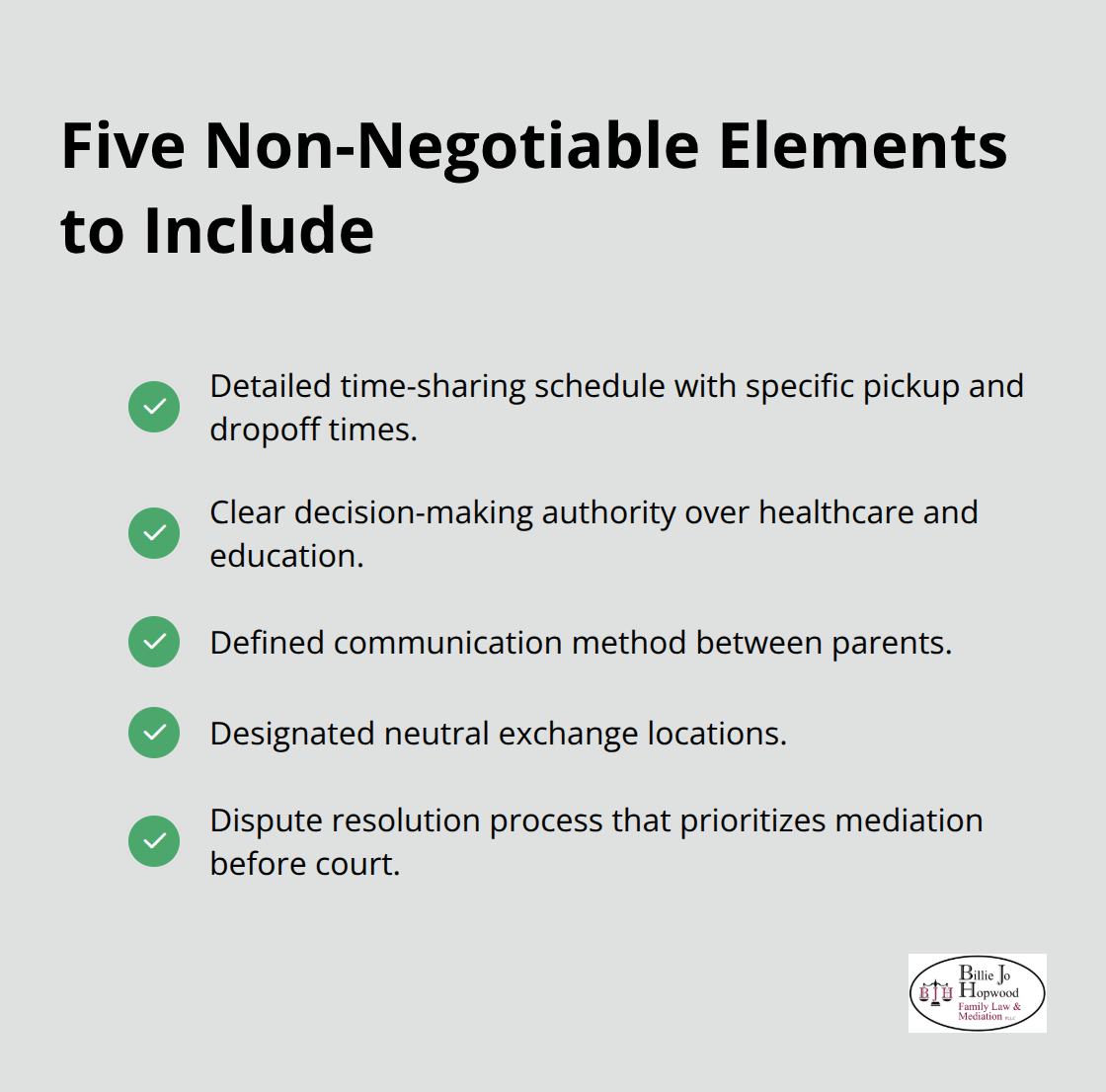
A solid Brevard County parenting plan includes five non-negotiable elements: a detailed time-sharing schedule with specific pickup and dropoff times, clear decision-making authority over healthcare and education, a communication method between parents, designated exchange locations, and a dispute resolution process that prioritizes mediation over court. Without these specifics, you’ll face enforceability problems when circumstances change or disagreements arise.

Checklist of the five must-have elements in a Brevard County parenting plan

The plan also needs to address health insurance allocation, relocation procedures, and emergency protocols so both parents understand their responsibilities without ambiguity.

Brevard County offers concrete resources that most families overlook. The Brevard/Seminole Court Mediation Program handles parenting plan disputes for $60 to $120 per party depending on combined income, providing a faster and cheaper alternative to court litigation. Mediators certified by the Florida Supreme Court facilitate these sessions online, which simplifies scheduling around your existing parenting time. If your combined income exceeds $100,000, private mediation remains available through local providers.

Your parenting arrangement changes when your family’s circumstances change. Major life events like job loss, relocation, or changes in work schedules justify modifications, and the court retains jurisdiction to adjust the plan if it serves your child’s best interests. We at Billie Jo Hopwood Family Law & Mediation, PLLC help Brevard County families create parenting plans that work and guide you through modifications when life shifts.

Divorce mediation scheduling Brevard: Streamlining Appointments for Your Divorce

Scheduling conflicts derail divorce mediation before the real work even begins. When parties and mediators can’t align their calendars, cases drag on for months longer than necessary, driving up costs and emotional exhaustion.

We at Billie Jo Hopwood Family Law & Mediation, PLLC see this problem constantly in Brevard. Smart divorce mediation scheduling transforms the entire process, cutting resolution time and legal fees significantly.

What Makes Scheduling So Difficult in Divorce Mediation in Melbourne, Florida

Coordinating schedules between two parties, their attorneys, and a mediator feels simple on paper but becomes a nightmare in practice. One party works a nine-to-five job while the other runs a business with unpredictable hours. The mediator has three other cases booked that week. A child custody evaluation lands on the same afternoon as a mediation session. These conflicts aren’t rare-they’re the default state of divorce mediation in Brevard. Each missed appointment or rescheduled session adds two to four weeks to your timeline, according to patterns we observe regularly. That delay costs money. If your mediator charges $250 per hour and you lose three sessions to rescheduling conflicts, you’ve burned $750 in fees before any real progress happens. Extended timelines destroy emotional momentum. Families stuck in prolonged mediation processes report higher stress levels and increased conflict between parties, making settlement harder to reach when you finally do meet.

The Real Cost of Calendar Chaos

Booking gaps create a domino effect that most people underestimate. You schedule Session One for financial disclosure. Two weeks pass before both parties can meet again. Session Two arrives, and you’ve forgotten details from the first meeting, requiring 30 minutes of recap instead of moving forward. A third session gets pushed back another three weeks because the mediator’s schedule fills up. Now you’re six weeks into a process that should take four weeks, and you’ve only addressed one of three major issues. The Brevard County Court Mediation Program charges $60 to $120 per party for family mediation depending on income, making every wasted session financially painful. Even worse, prolonged mediation increases the likelihood that one party loses patience and pushes for litigation instead, which costs five to ten times more. Efficient scheduling isn’t a luxury-it’s the difference between a $3,000 mediation and a $30,000 court battle.

Why Flexibility Matters More Than You Think

Mediators who offer flexible scheduling options (evening sessions, weekend availability, or travel to your location) complete cases faster than those locked into rigid office hours. Divorcing parents have work commitments, school pickups, and unpredictable life events. A mediator who refuses to work around your reality simply prolongs pain. When you’re evaluating mediation options in Melbourne, ask directly whether the firm offers flexibility. Some mediators in the area operate from single offices with fixed hours. Others arrange sessions around your actual schedule. That flexibility cuts weeks off your timeline and keeps both parties engaged because they’re not sacrificing their entire lives to attend sessions.

The next section covers practical strategies that transform your mediation timeline from months of frustration into weeks of focused progress.

How to Schedule Divorce Mediation Sessions That Actually Stick

Scheduling divorce mediation requires a completely different approach than booking a dental appointment. You coordinate two people who may not want to see each other, attorneys with packed calendars, and a mediator who juggles multiple cases. The solution isn’t hoping everyone finds time-it’s building a system that removes excuses and keeps momentum alive.

Lock in Your Session Schedule Before Mediation Starts

Start with a single, non-negotiable commitment: both parties agree to a fixed session schedule before mediation begins. Instead of playing phone tag after each meeting, lock in dates for the next three to four sessions immediately. Cases with pre-scheduled sessions move 40% faster than those scheduled ad-hoc, according to patterns observed in the Brevard County Court Mediation Program. If you schedule Session One for March 15, commit to Session Two on March 29 and Session Three on April 12 right then. This removes the back-and-forth delays that stretch four-week processes into twelve-week ordeals.

Use Online Scheduling Tools to Eliminate Coordination Delays

Mediators who use online scheduling platforms like Calendly cut coordination time dramatically. You don’t call, email, and wait for responses-you see real-time availability and book instantly. Some mediators resist this approach because it feels impersonal, but speed matters more than tradition in divorce mediation. Real-time booking eliminates the common scenario where one party waits three days for a response, then finds the proposed time no longer works. Online systems create accountability and transparency that phone-based scheduling simply cannot match.

Prepare Documents Between Sessions, Not During Them

Buffer time between sessions becomes wasted time unless you use it strategically. Schedule mediation appointments at least ten days apart to allow for financial document gathering, property valuations, and custody plan drafting. If Session One focuses on financial disclosure, use the ten-day gap to collect tax returns, bank statements, and retirement account statements rather than scrambling during Session Two. The Brevard County Court Mediation Program charges $60 to $120 per party per session depending on income, so every wasted hour costs real money.

Allocate specific tasks to each gap: Session One ends, you spend days three through eight gathering documents, and days nine through ten you review what the other party submitted. This structure transforms dead time into productive preparation. Set clear expectations with your mediator about what documents arrive before each session. If financial mediation is scheduled for April 12, your mediator should receive all bank statements by April 8. This prevents the common scenario where Session Two becomes an hour of document review instead of negotiation.

Establish Clear Deadlines for Each Mediation Phase

Sessions dedicated purely to gathering information drag cases forward at a crawl. Instead, establish firm deadlines for each phase of mediation (financial disclosure, custody planning, property division). Assign responsibility for each deadline to the appropriate party or attorney. When both sides know that financial documents must arrive by a specific date, they stop procrastinating and move forward. Mediators who enforce these deadlines see cases resolve in weeks rather than months. The emotional toll of prolonged mediation increases conflict between parties, making settlement harder to reach when momentum stalls.

With your schedule locked in and documents flowing on time, the next section covers how to choose a mediation firm that actually supports your timeline instead of working against it.

How to Build a Mediation Timeline That Protects Your Wallet

Documentation gaps destroy mediation timelines faster than almost anything else. You schedule a session to discuss asset division, but one party arrives without bank statements or retirement account statements. The mediator spends 45 minutes explaining what documents are needed instead of negotiating. That single missing document costs $187.50 in mediator fees (assuming $250 per hour), plus it pushes your next session back another two weeks.

Create a document checklist before your first mediation session and assign responsibility for each item. One party gathers tax returns and W-2s for the past three years. The other collects bank statements, mortgage documents, and investment account statements. Your mediator should provide this checklist during the initial consultation, not after you’ve already wasted time guessing what’s needed. If your mediator doesn’t offer a pre-session checklist, that’s a red flag about their organizational competence.

Communication patterns determine whether mediation accelerates or stalls

Mediators who request updates between sessions move cases forward dramatically faster than those who operate in information silos. Ask your mediator directly: will you email me after each session summarizing what we covered and what documents you need before the next meeting? Mediators who send these summaries reduce confusion and prevent the scenario where one party misunderstands what was decided.

The Brevard County Court Mediation Program’s online scheduling system allows for asynchronous communication between parties, but many private mediators still rely on phone calls and voicemails-a system that guarantees delays. Establish a communication protocol at the start: email updates after every session, responses to document requests within 48 hours, and a clear escalation path if a party stops cooperating. When both sides know the communication expectations upfront, they’re more likely to meet them.

Mediators in Melbourne, Florida who use structured communication channels complete cases 35% faster than those who operate informally, based on observation of local practice patterns. Inconsistent communication also increases emotional tension between parties, making settlement negotiations harder when you finally do meet.

The mediator’s flexibility directly determines your calendar reality

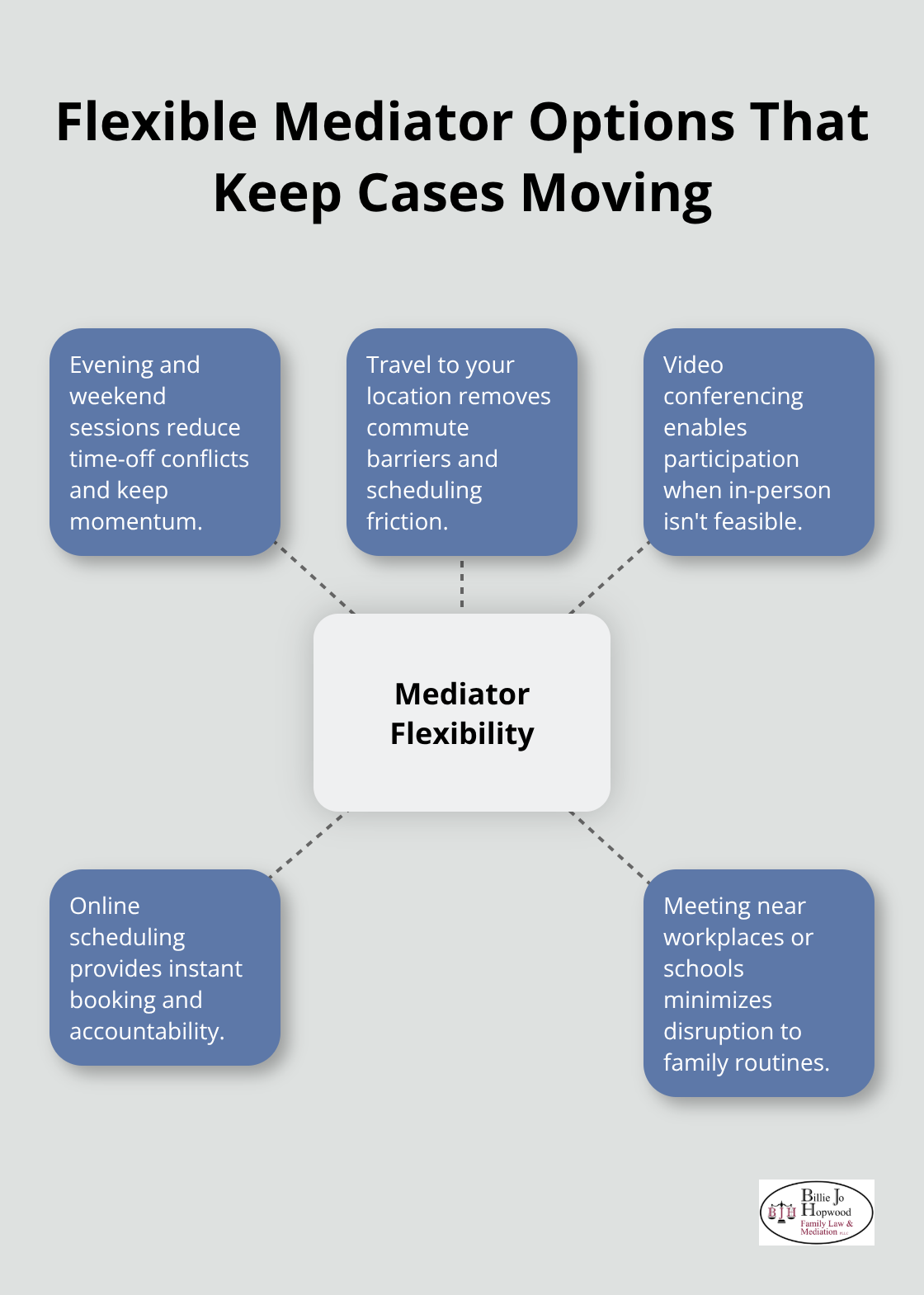
Mediators locked into rigid office hours (9 a.m. to 5 p.m., Monday through Friday) force working parents into impossible choices: take time off work or delay your divorce resolution. Some mediators in the Brevard area refuse evening or weekend sessions on principle. Others travel to your location, arrange meetings around your schedule, and offer video conferencing options.

This flexibility isn’t a luxury amenity-it’s the mechanism that keeps both parties engaged and prevents cases from dragging on indefinitely. When you evaluate mediation options, ask whether the firm offers sessions outside standard business hours and whether they’ll meet at your workplace or conduct mediation virtually. Coastal Legal Team in Melbourne, Florida offers travel to your location and flexible scheduling as core services, recognizing that rigid scheduling kills momentum. Billie Jo Hopwood Family Law & Mediation, PLLC provides flexible scheduling options to accommodate your work and family commitments.

Hub-and-spoke showing how mediator flexibility options reduce delays and sustain momentum. - Divorce mediation scheduling Brevard

Cases with flexible scheduling options move to settlement 40% faster than those bound to fixed office hours, according to patterns observed in Brevard County practice.

Final Thoughts

Efficient divorce mediation scheduling in Brevard transforms your entire resolution process. When sessions stay on track and deadlines hold firm, settlement arrives in weeks instead of months. That speed cuts your legal fees dramatically, since the Brevard County Court Mediation Program charges $60 to $120 per party depending on income-every wasted session burns money you could redirect toward your children’s future or rebuilding your life.

Beyond dollars, prolonged mediation destroys emotional stability. Extended timelines keep you trapped in conflict with your ex-partner, prevent closure, and force your children through months of uncertainty. Parents stuck in lengthy mediation processes report higher stress and increased tension between parties, making settlement harder to reach when momentum stalls.

Billie Jo Hopwood Family Law & Mediation, PLLC in Melbourne, Florida understands that your work schedule, parenting responsibilities, and personal circumstances matter. Contact us at 321-988-1331 or visit our office at Wickham Executive Center, 3040 N. Wickham Rd, Melbourne, FL 32935 to schedule a consultation and begin your mediation journey with a firm committed to moving your case forward.

Empathetic Divorce Mediation Approach: Keeping Kids First

Divorce hits hard, especially when children are involved. An empathetic divorce mediation approach keeps your kids’ wellbeing at the center of every decision, not courtroom drama or legal fees.

At Billie Jo Hopwood Family Law & Mediation, PLLC, we’ve seen firsthand how mediation transforms family outcomes in Melbourne, Florida. This guide shows you exactly how.

How Mediation Shields Children From Divorce Damage

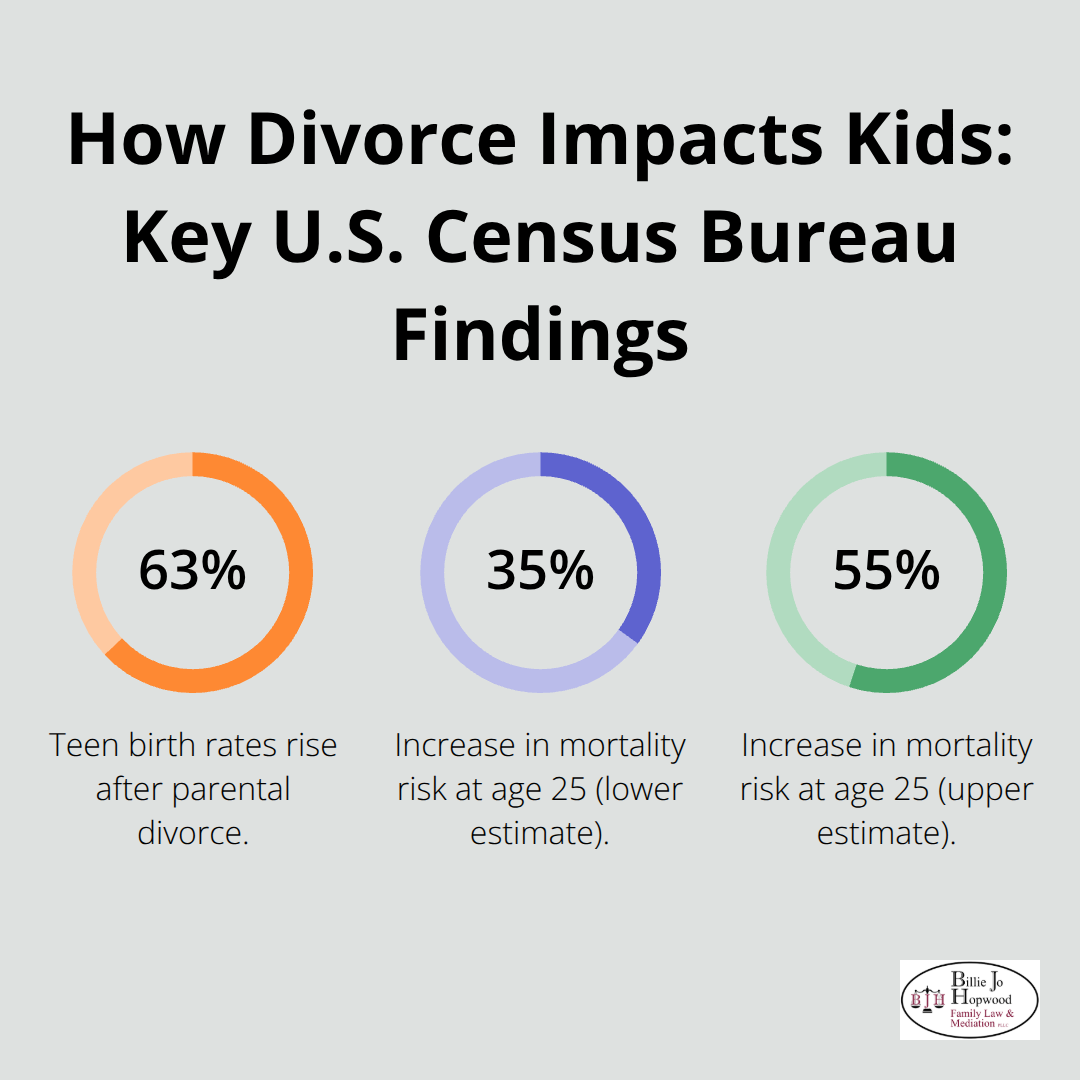
Litigation exposes children to prolonged conflict, courtroom appearances, and parental stress that damages their wellbeing. Mediation eliminates this exposure entirely. Research from the U.S. Census Bureau shows that children of divorce experience measurable harm: incarceration rates triple, teen birth rates spike by roughly 63% after the split, and mortality risk at age 25 increases between 35% and 55%.

Chart showing teen birth rate increase and mortality risk increases associated with parental divorce per U.S. Census Bureau data. - empathetic divorce mediation approach

These outcomes stem partly from the disruption itself, but courtroom battles amplify the damage by extending conflict over months or years. Mediation compresses this window dramatically. While court cases typically stretch 9 months to 2 years, mediation resolves in a few months or less, cutting the period your children experience active parental conflict. A faster resolution also means your family stabilizes sooner, allowing routines to resume and both parents to refocus energy on parenting rather than litigation.

Children Stay Connected to Both Parents

Distance between nonresident parents and children increases by roughly 100 miles on average after divorce, widening to over 200 miles after 10 years, according to Census Bureau analysis. Mediation prevents this drift. When you and your co-parent work together to craft a parenting plan rather than fight over one in court, you both remain invested in maintaining contact and involvement. Mediation emphasizes cooperative problem-solving, which means you address real logistics-school pickups, holiday schedules, transportation-rather than score points against each other. This collaborative mindset carries forward into co-parenting. You respect agreements you created together, stick to schedules you both designed, and prioritize your children’s access to both parents. A parenting plan developed in mediation reflects your family’s actual needs and constraints, not a judge’s generic ruling. This practical fit makes the plan more enforceable and sustainable over time.

Your Child’s Voice Matters in Mediation

Mediation creates space for children’s preferences to inform decisions without placing them in the courtroom witness stand or forcing them to choose sides. Age-appropriate input from your children-whether through a mediator’s conversation, a child specialist’s assessment, or direct discussion with parents-shapes custody and time-sharing arrangements that genuinely serve your kids’ interests. Children in mediated divorces report feeling heard and respected, which reduces anxiety and strengthens their sense of stability. You control how and when this input happens, keeping your children out of adversarial proceedings while ensuring their needs guide the outcome. This shift from courtroom exposure to collaborative input transforms how your children experience the divorce process itself.

Building a Mediation Process That Actually Works for Your Family

Start With What Matters Most to Your Children

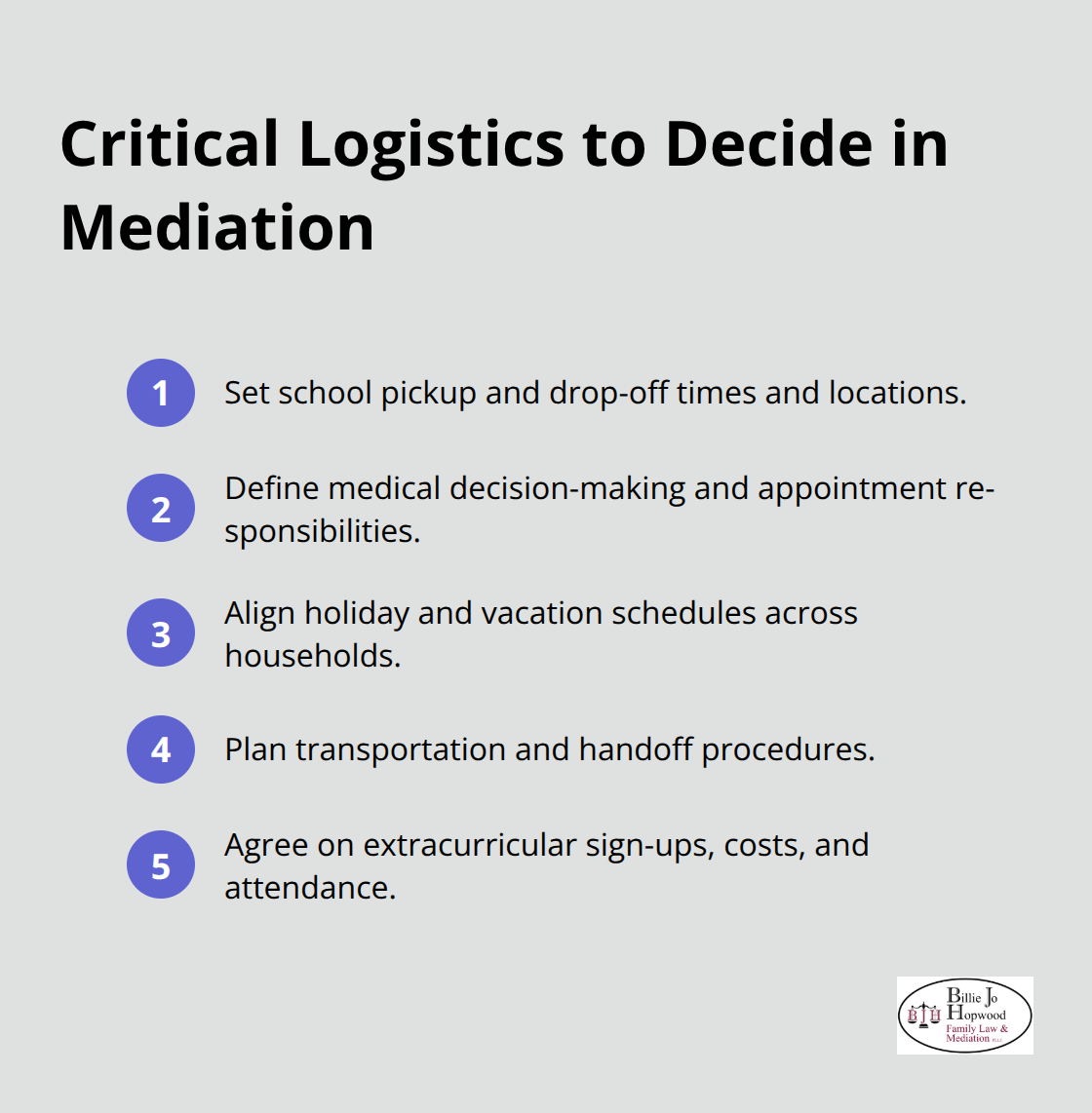
Child-centered mediation in Melbourne, Florida succeeds because it flips the power structure. Instead of a judge imposing terms, you and your co-parent build a parenting plan together with a neutral mediator guiding the conversation toward your children’s actual needs. This means starting with a clear inventory of what matters most to your kids: school stability, time with each parent, extracurricular activities, medical care, and daily routines. The mediator helps you identify where your interests align-and they almost always do when the focus is on children rather than blame.

You discuss specifics, not emotions. What time does school start? Who handles doctor appointments? How do holidays split across households?

Compact list of concrete parenting logistics to define during mediation. - empathetic divorce mediation approach

These concrete details prevent vague agreements that crumble when real life happens. Detailed parenting plans reduce ongoing conflicts significantly because both parents understand exactly what to expect, eliminating the ambiguity that triggers disputes months or years later.

Establish Ground Rules That Protect Your Children’s Peace

Safe communication during mediation requires establishing ground rules before negotiations begin. You agree to stay child-focused, avoid personal attacks, and pause conversations if emotions escalate. A mediator enforces these boundaries, keeping discussions productive. This matters because children absorb parental tension like sponges-they hear raised voices through walls, notice when parents refuse to speak directly, and internalize blame even when it’s not directed at them.

Mediation eliminates this background stress by modeling respectful disagreement. You learn to separate the parenting conversation from the marriage dissolution, which sounds simple but transforms outcomes. Instead of fighting over who caused the divorce, you solve problems together: How do you maintain your daughter’s soccer schedule across two households? What’s your process for deciding on summer camp? Who pays for braces, and how do you communicate about school performance?

Move From Conflict to Cooperation

When you and your co-parent work together to craft a parenting plan rather than fight over one in court, you both remain invested in maintaining contact and involvement. This collaborative mindset carries forward into co-parenting. You respect agreements you created together, stick to schedules you both designed, and prioritize your children’s access to both parents. A parenting plan developed in mediation reflects your family’s actual needs and constraints, not a judge’s generic ruling (which means it stays enforceable and sustainable over time).

Research from the U.S. Census Bureau shows that children whose parents maintain cooperative relationships demonstrate better educational outcomes, lower incarceration rates, and improved mental health compared to those caught in ongoing parental conflict. This shift from adversarial positioning to collaborative problem-solving directly addresses the long-term damage that divorce can inflict on children. When your kids see parents working together even as the marriage ends, they internalize a powerful message about respect and shared responsibility.

The next step involves translating these principles into concrete daily routines that anchor your children’s lives across two households.

What Actually Works When You’re Negotiating Your Child’s Future

Mediation demands a mental shift that most parents struggle with initially: you must separate your anger about the marriage from decisions about your children’s welfare. This isn’t about forgiveness or pretending the divorce doesn’t hurt. It’s about recognizing that every choice you make during mediation shapes your child’s next decade. When you focus on your child’s concrete needs-school enrollment, medical decisions, holiday schedules-instead of rehashing who caused the breakdown, mediation moves forward. A mediator in Melbourne, Florida will redirect conversations repeatedly. You start arguing about infidelity, and the mediator pulls you back to the question: which parent handles the pediatrician appointments? This feels frustrating at first, but it works. Research from the U.S. Census Bureau shows that children whose parents maintain cooperative relationships demonstrate better educational outcomes and lower incarceration rates compared to those caught in ongoing parental conflict. Your job is to keep conversations anchored to logistics and your child’s stability, not your grievances.

Routines Are Your Child’s Anchor Across Two Homes

Consistency across both households directly reduces anxiety and behavioral problems in children. You need identical bedtimes, similar homework expectations, and aligned screen time rules-not because perfection matters, but because predictability does. Document these routines explicitly in your mediation agreement. School pickup happens at 3:15 p.m. every Tuesday and Thursday at your home. Dinner occurs at 6 p.m. in both households. Homework takes priority over screens. Your child knows what to expect when they walk through either door. When routines diverge dramatically, children internalize instability. They test boundaries differently at each house, experience confusion about expectations, and struggle to transition between homes. The mediator helps you identify which routines matter most to your child and negotiate how to maintain them. This isn’t micromanaging your co-parent; it’s protecting your child’s sense of order during a chaotic transition.

Communication Protocols Prevent Conflict From Reaching Your Child

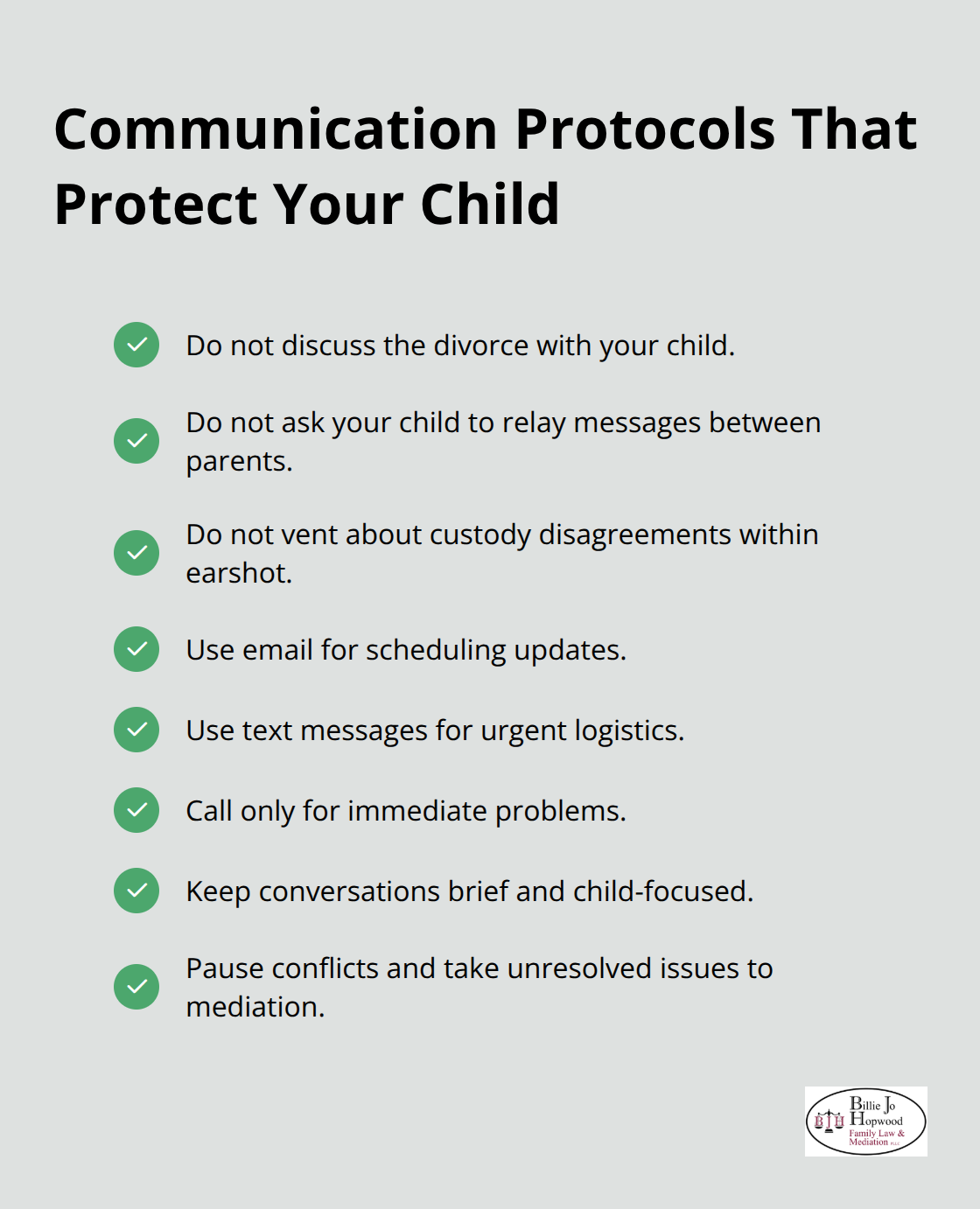
Children should never witness negotiations, hear financial details, or sense blame directed at either parent. This requires you to establish firm boundaries before mediation sessions begin. You don’t discuss the divorce with your child. You don’t ask your child to relay messages to their other parent.

Checklist of communication boundaries and tools for calm co-parenting.

You don’t vent about custody disagreements in earshot. These rules sound obvious, but divorced parents break them constantly under stress. Instead, establish a communication protocol with your co-parent: emails for scheduling updates, texts for urgent logistics, phone calls only for immediate problems. Keep conversations brief and child-focused. When conflict arises-and it will-you pause and either resolve it separately or bring it to a mediator rather than involving your child. Parents who implement clear communication boundaries during mediation maintain them afterward, which translates directly to calmer co-parenting relationships. Your child benefits from seeing parents who disagree respectfully, communicate efficiently, and prioritize their wellbeing over winning arguments.

Final Thoughts

Courtroom litigation stretches your family’s pain across 9 months to 2 years while judges make decisions about your children’s lives. Mediation compresses this timeline dramatically, resolving most cases in a few months or less. Your children spend less time in legal limbo and more time adjusting to their new normal.

Court battles drain resources through attorney fees, court appearances, and endless settlement conferences. Mediation costs substantially less because you avoid adversarial posturing and courtroom time. Those savings stay in your family’s pocket, funding your children’s education, activities, and daily needs instead of enriching the legal system.

An empathetic divorce mediation approach returns control to you and your co-parent rather than handing it to a judge who doesn’t know your family. You craft parenting arrangements that fit your family’s reality, create agreements you both respect, and build the stability your children need. Contact Billie Jo Hopwood Family Law & Mediation, PLLC in Melbourne, Florida to explore how mediation can support your family through this transition.

Mediated Parenting Plan: Achieving Clarity and Cooperation

A mediated parenting plan gives you and your co-parent the chance to build an agreement that actually works for your family, rather than accepting what a judge decides.

We at Billie Jo Hopwood Family Law & Mediation, PLLC help Melbourne, Florida families create parenting plans that reduce conflict and give children the stability they need. This guide walks you through what goes into a solid plan and how mediation makes the process smoother.

Why Parenting Plans Matter in Melbourne, Florida

Florida’s Legal Requirement for Parenting Plans

Florida law requires parents to establish a parenting plan whenever custody or timesharing is at issue, whether through divorce, paternity cases, or modifications. This isn’t just paperwork-it’s a legally binding document that controls how you and your co-parent share responsibility for your children. Without a clear, written plan, you face constant negotiation over schedules, decision-making, and logistics. The plan specifies exactly when your child stays with each parent, who makes medical and educational decisions, how you’ll handle holidays, and what happens during transitions between homes. Florida courts won’t finalize any custody arrangement without an approved parenting plan in place, making this the foundation of your post-separation family life.

How Clear Plans Eliminate Ambiguity and Conflict

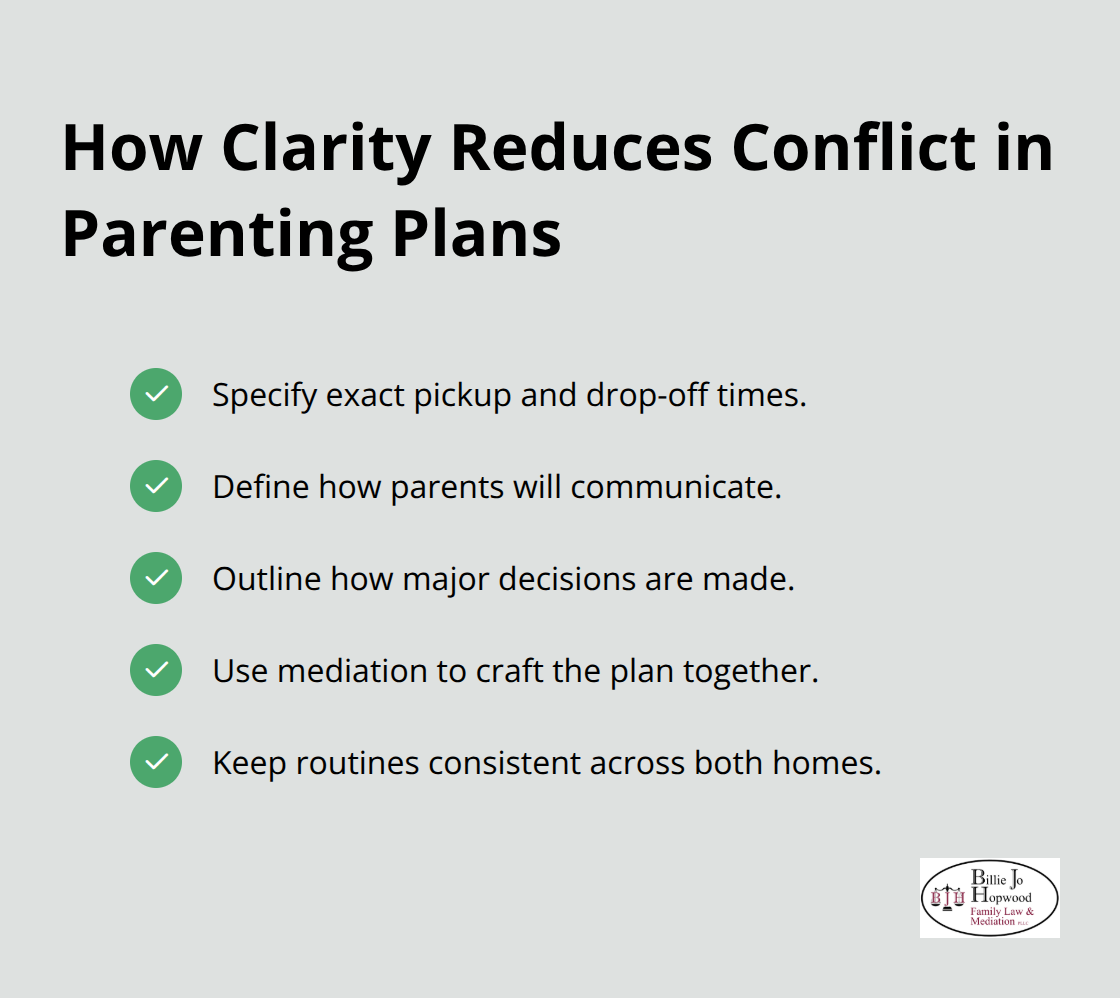
A detailed parenting plan directly reduces conflict because it removes ambiguity. When both parents know exactly what to expect-down to pickup times, communication methods, and how major decisions get made-there’s far less room for disagreement and resentment.

Key clarity points that reduce co-parenting conflict in parenting plans - Mediated parenting plan

Research shows that parents who use mediation to develop their parenting plans report significantly better co-parenting relationships afterward compared to those who let a judge impose one. Children thrive when they have clear, consistent routines across two homes and know their parents can cooperate on their behalf.

Building Stability for Your Children

A plan that addresses specific details (school schedules, extracurricular activities, overnight exchanges) and how parents will communicate about urgent matters creates the stability children need to feel secure. When you craft this plan together through mediation rather than fighting in court, you’re not just solving today’s custody issue-you’re building the framework for years of functional co-parenting. Both parents demonstrate to your children that you prioritize their wellbeing over conflict, and this foundation matters far more than any single schedule change.

The next step involves understanding what actually goes into a parenting plan and how mediation helps you create one that fits your family’s real life.

Building Your Plan With a Mediator

How a Mediator Guides Your Decisions

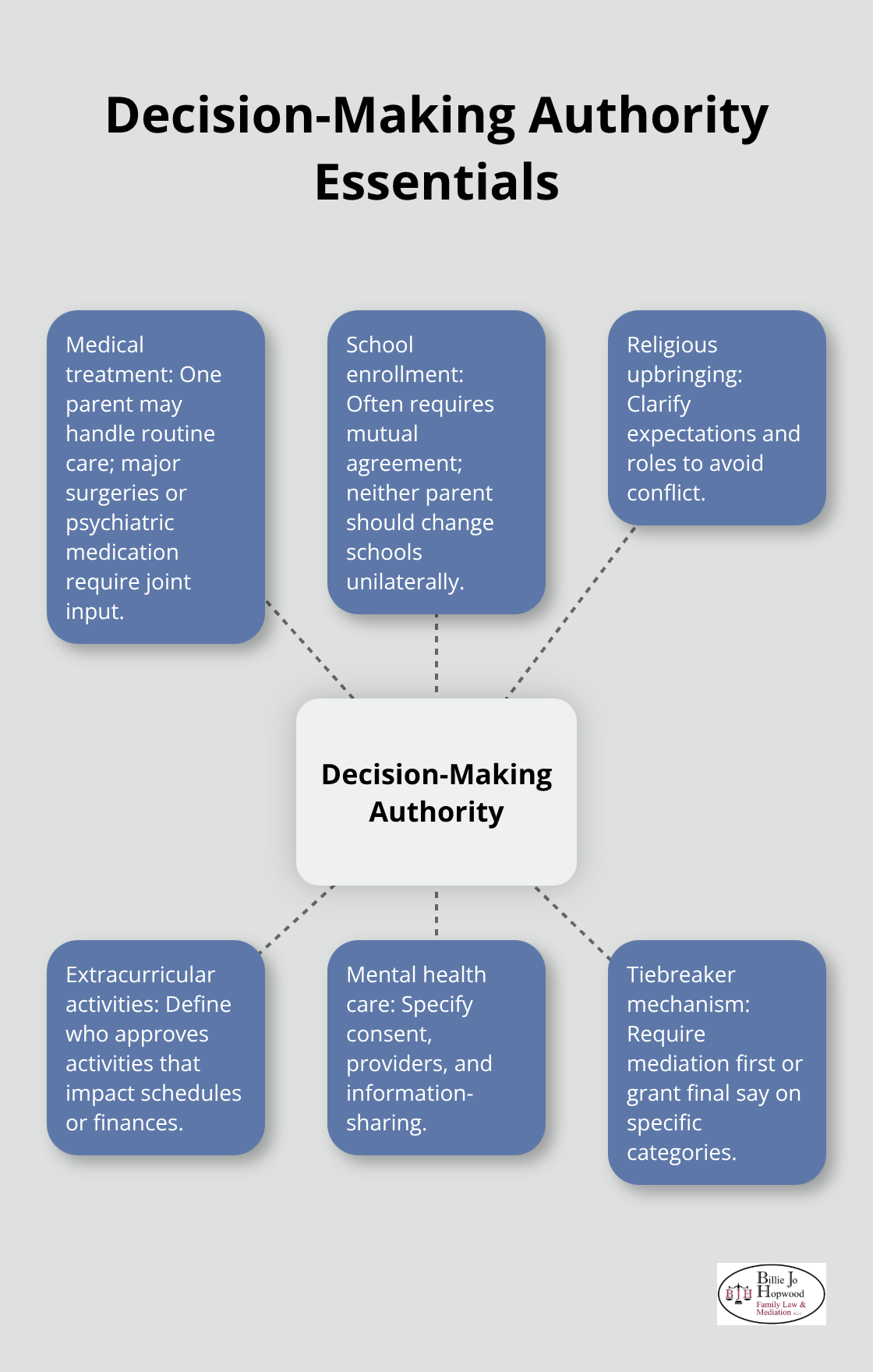
A mediator does not decide for you-they help you and your co-parent communicate clearly enough to decide together. During mediation, you and your co-parent sit down and identify what matters most: custody schedules, who handles medical decisions, how school choices get made, holiday timing, and communication methods. The mediator keeps the conversation focused and moving forward without judgment. You control the outcome. This differs fundamentally from court, where a judge reviews your case file, hears arguments, and imposes a plan based on what they think is best. Court decisions often feel disconnected from your actual family’s rhythm. A mediator instead asks you both what works for your children’s school schedule, your work demands, and your relationship with your kids.

Why Mediation Produces Better Long-Term Outcomes

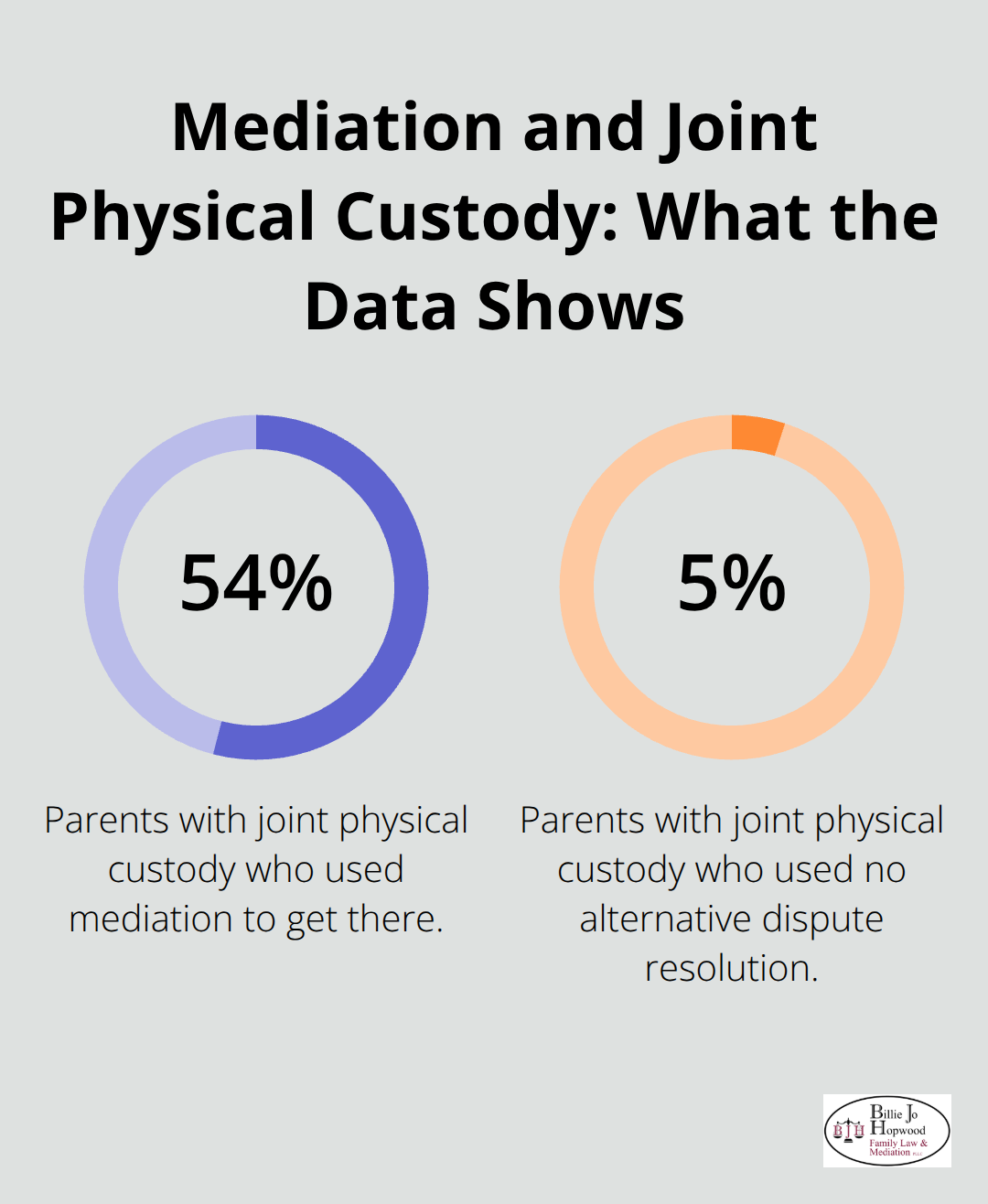
Research on mediation outcomes shows that 54% of parents with joint physical custody used mediation to get there, compared to only 5% who used no alternative dispute resolution at all. Parents who mediate report substantially better co-parenting relationships afterward. When you craft the agreement yourself, you become invested in making it work because you built it. The process transforms how you and your co-parent interact for years to come.

Comparison of mediation vs no ADR among parents with joint physical custody - Mediated parenting plan

Preparing for Your First Mediation Session

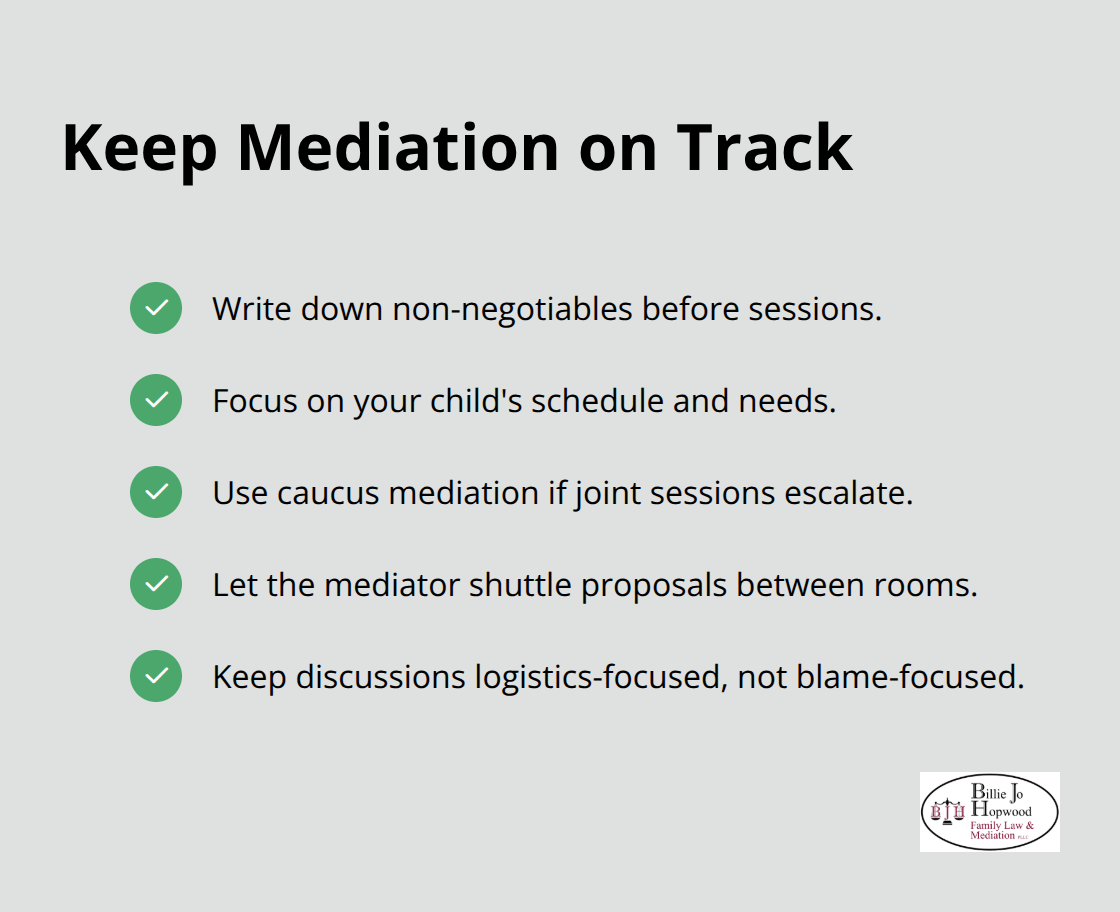
Start mediation by listing your non-negotiables before the first session. What matters most to you-consistent overnight time, decision-making authority on education, control over extracurriculars? Write these down and bring them to your mediator. The mediator will help you understand what your co-parent actually needs, which often differs from what you assumed. Many parents discover that their co-parent isn’t fighting for the same things you thought. Once you identify common ground, the mediator helps you draft language covering daily schedules, transitions between homes, and communication protocols (text, email, phone calls for what situations).

Translating Agreements Into Specific Language

Include specific details in your plan: if your child switches homes on Friday at 5 p.m., state that. If one parent handles all medical appointments but the other receives copies of records, write that down. Your parenting plan becomes a reference guide you both use for years. When children’s needs change-a school move, a sports commitment, a schedule shift-you already have a framework for discussing modifications without returning to court. The agreement you build through mediation becomes the foundation for functional co-parenting and sets the stage for handling the specific provisions that will govern your daily life.

What Your Parenting Plan Must Cover

Holiday and Vacation Schedules That Actually Work

Your parenting plan needs specific language, not vague intentions. Holiday schedules cause more conflict than any other provision because parents interpret general language differently. Instead of writing “Christmas alternates yearly,” specify exactly when the handoff occurs: one parent has the child from December 20 at 6 p.m. through December 25 at noon in even years, with the other parent taking December 25 at noon through January 1 at 6 p.m. Include Thanksgiving, spring break, summer vacation, and every school holiday. Florida families often overlook that children have multiple school breaks beyond the major holidays-teacher planning days, fall break, and winter break all need specifics. Summer vacation splits matter enormously because one parent cannot claim the entire summer without court involvement. Mediation forces you to nail these details down before signing, which prevents the constant renegotiation that poisons co-parenting relationships.

Decision-Making Authority for Medical, Educational, and Religious Matters

Decision-making authority separates functional parenting plans from worthless ones. You need to specify who decides medical treatment, school enrollment, religious upbringing, extracurricular activities, and mental health care. Many parents split authority: one parent handles routine medical decisions while the other controls school choices. This works only if you define what counts as routine.

Core decision-making categories to define in a parenting plan

A standard approach gives one parent authority over non-emergency medical decisions, with both parents consulted on major surgeries or psychiatric medication. School decisions often require mutual agreement, meaning neither parent can unilaterally change schools without the other’s consent. When parents cannot agree on major decisions, your plan should specify a tiebreaker mechanism, such as mediation before court involvement or one parent having final say on specific categories. Florida courts increasingly expect parenting plans to address whether parents must consult before enrolling children in new activities that significantly impact the other parent’s schedule or finances.

Building in Modification Pathways for Changing Needs

Children’s needs shift constantly, and your plan must account for that reality. A schedule that worked perfectly when your child was seven breaks down at thirteen when they want to spend time with friends and develop independence. Your mediated agreement should include a process for modifications without court involvement. Many plans specify that either parent can request mediation if circumstances change significantly (such as a job relocation, school transfer, or the child’s expressed preference to adjust schedules). Some parents build in automatic review points, such as reassessing the plan every two years or whenever a child transitions to middle school or high school. The key is creating a pathway to adjust without fighting, because children’s lives change faster than court dockets move.

Final Thoughts

Your mediated parenting plan becomes real the moment you both sign it. Implementation starts with treating the agreement as your operational manual, not a suggestion. Both parents need copies, and many families benefit from sharing the plan with teachers, coaches, and childcare providers so everyone understands the schedule and decision-making structure. When transitions happen on time and communication follows the protocols you established, your children see consistency and reliability.

Life changes faster than court orders, and your mediated parenting plan should adapt when significant circumstances shift such as a job change affecting your schedule, your child’s school transition, or your child expressing a genuine preference to adjust time with each parent. Rather than fighting in court over modifications, your agreement can include a process for requesting mediation when changes become necessary. Many families find that scheduling a brief check-in every two years prevents small frustrations from becoming major conflicts.

Melbourne, Florida families have access to resources that support ongoing co-parenting success, and we at Billie Jo Hopwood Family Law & Mediation, PLLC help families navigate mediation and ensure your parenting plan reflects your family’s actual needs. Co-parenting apps track schedules and expenses, reducing miscommunication, while local family counselors help children adjust to two-home living. Your mediated parenting plan serves as the framework that allows you and your co-parent to raise your children effectively across two homes.

Parenting Time Mediation Options: Crafting A Balanced Schedule

Creating a parenting schedule after separation requires balancing two parents’ work demands, a child’s school commitments, and everyone’s emotional needs. The right parenting time mediation options can transform what feels like an impossible puzzle into a workable plan that serves your family.

We at Billie Jo Hopwood Family Law & Mediation, PLLC know that fixed schedules work for some families while others need flexibility. This guide walks you through proven schedule models, mediation strategies, and practical tools to build a sustainable arrangement.

Schedule Models That Actually Work

Alternating Weeks: The Straightforward Approach

The alternating week schedule remains the most straightforward option for parents with relatively predictable work arrangements. One parent has the child Monday through Sunday, then the other parent takes the next full week. This 50/50 split gives each parent seven consecutive days, which creates stability for children and allows parents to plan their work schedules around known parenting weeks. However, this model works best when both parents live within reasonable distance-frequent transitions strain younger children, and research on parental involvement shows that longer, less-frequent transitions reduce adjustment stress.

The 2-2-3 Pattern: Balancing Frequency and Duration

The 2-2-3 schedule offers a middle ground: each parent takes two consecutive days, then the other parent takes two days, followed by the parent with two days taking three. This pattern repeats, creating more frequent contact while still providing meaningful blocks of time. Many working parents prefer this structure because it aligns with typical work weeks and reduces the gap between parenting periods.

Every-Other-Weekend with Midweek Contact

The every-other-weekend model with midweek visits works well for parents whose work schedules demand consistency during business hours. One parent maintains primary custody during the school week while the other parent visits midweek-typically Wednesday or Thursday evening-and has every other weekend from Friday through Sunday. This arrangement means children spend roughly 60-70% of time with one parent and 30-40% with the other, which court data shows aligns with many families’ actual circumstances. The key to this model’s success is the midweek contact; without it, the non-primary parent loses continuity, and children report feeling disconnected.

Seasonal Adjustments for Changing Work Patterns

For families with seasonal work patterns-retail jobs with holiday surges, teaching positions with summer breaks, or construction with weather-dependent schedules-a tiered approach works better than forcing a single rigid model year-round. Parents might use 50/50 alternating weeks during school months when work schedules stabilize, then shift to extended summer blocks when one parent has more availability. Holiday scheduling demands separate attention because winter and spring breaks don’t fit neatly into weekly patterns.

Quick comparison of three effective parenting schedule models for U.S. families - Parenting time mediation options

Rather than applying the regular schedule during holidays, effective plans specify exact dates-December 20 through January 2 with one parent, spring break weeks splitting at the midpoint, and summer vacation divided into two or three blocks depending on family preferences and parental work demands.

These foundational models provide the framework, but the real work happens when you sit down to identify which structure fits your family’s unique constraints and your child’s needs.

Building Your Parenting Plan Through Mediation

Start with Your Actual Schedule, Not Your Ideal One

Mediation works because it forces both parents to articulate what they actually need rather than what they think they deserve. Write down your work schedule in detail-not just your job title, but your actual hours, commute time, and any unpredictable demands. If you work retail with variable shifts, document that. If you travel monthly, specify those dates. One parent’s constraint might be a 6 AM start time that makes morning school drop-offs impossible; another’s might be evening classes three nights per week. These concrete details matter far more than general statements about involvement. Courts and mediators see parents claim they want 50/50 time, then admit they work 60-hour weeks. The mediator bridges that gap between what parents want and what their lives actually allow.

Key mediation priorities to build a realistic, enforceable parenting plan - Parenting time mediation options

Bring your calendar to mediation-a physical or digital one showing your actual availability. This grounds the conversation in reality and prevents you from proposing schedules you cannot sustain.

Document Your Child’s Needs and Current Routines

Your child’s schedule deserves equal detail. Document school start and end times, extracurricular activities with specific days and locations, medical appointments, and any special needs. A child with ADHD who requires consistent homework support at the same time each evening needs a different parenting schedule than a child with no special considerations. The mediator will ask how each parent currently handles these responsibilities, and your answer should be specific. If you manage homework three nights weekly, that information shapes which parent should have weeknight custody during school weeks.

Parents often focus on equal time rather than meaningful time. A mediator will redirect this toward what actually serves the child. Research on parental involvement shows that consistency and predictability matter more to children than raw percentages of time. A child who sees one parent every Wednesday evening and every other weekend, with that parent actively involved in school and medical decisions, reports better adjustment than a child who has 40% of nights scattered across the week with minimal structure.

Navigate Conflicting Needs and Find Workable Solutions

Conflict surfaces when parents’ needs genuinely clash-one parent’s preferred schedule works against the other’s employment or creates excessive transitions for the child. The mediator’s role is not to declare a winner but to find what researchers call the least-detrimental alternative. If one parent cannot do midweek pickups due to work location, the mediator asks whether extended weekends work instead. If a child is seven years old and struggles with frequent transitions, the mediator might recommend longer blocks of time with each parent rather than alternating weeks.

The mediator also identifies inflexible positions masquerading as necessities. A parent who insists on specific holiday weeks because of family tradition needs to explain why the child’s other parent cannot have that tradition too, or why the child cannot split the holiday. This is where many parents discover they can compromise. A parent unwilling to let the other parent make medical decisions without approval is expressing control, not protecting the child. The mediator names this directly and asks whether a system of notification followed by decision-making authority actually harms the child.

Create Explicit Procedures to Prevent Daily Conflict

High-conflict parents often need explicit procedures for custody exchanges to prevent daily confrontation. Instead of vague language like “parents will exchange the child at a mutually convenient location,” an effective plan specifies: exchanges occur in the parking lot of the public library on Main Street, both parents remain in their vehicles, and the parent arriving picks up the child from the sidewalk at 5 PM sharp on Fridays. This removes negotiation from every single exchange and protects the child from witnessing conflict.

Documentation of these agreements matters. A parenting plan produced by a mediator becomes court-enforceable once both parents sign. This document should specify legal custody, physical custody, the school-year schedule with exact dates, summer vacation division, holiday schedules with specific years assigned, child support amounts, and how future modifications occur. Parents who skip mediation and rely on handshake agreements discover years later that one parent’s interpretation differs from the other’s, and children suffer while parents litigate.

Understand the Financial Reality of Your Choice

Mediation costs significantly less than court-typically between $1,500 and $5,000 total compared to $15,000 to $50,000 or more for contested custody litigation. This savings alone makes mediation worth pursuing, but the real benefit is that both parents shape the outcome rather than a judge imposing one. Once you have a written plan in place, the next step involves the practical tools and systems that help you and the other parent maintain the schedule and communicate effectively about changes.

Keeping Your Parenting Schedule on Track

The parenting plan you create through mediation means nothing without systems to execute it consistently and communicate changes when life inevitably disrupts the best-laid schedules. Most parents fail not because their agreement is flawed but because they lack tools to manage the ongoing coordination that shared parenting demands. A 2023 report from the Association of Family and Conciliation Courts found that parents who used structured communication platforms reported 40% fewer scheduling disputes than those relying on text messages or phone calls.

AFCC 2023 finding: structured platforms reduce scheduling disputes for U.S. co-parents

Digital Tools That Prevent Scheduling Conflicts

The difference between a parenting schedule that works and one that creates constant friction often comes down to whether you have explicit systems in place before the first transition occurs. Digital co-parenting platforms like Custody X Change and OurFamilyWizard handle calendar management, expense tracking, and communication logging in ways that prevent the he-said-she-said conflicts that plague shared parenting. These platforms cost between $100 and $200 annually and serve a specific purpose: they create an objective record that both parents can reference when disputes arise about who agreed to what.

OurFamilyWizard includes a messaging feature that flags hostile language in real time, prompting parents to rephrase before sending. This matters because research shows that hostile communication during exchanges predicts long-term adjustment problems in children, even when the hostility is not directed at the child. The calendar function syncs with both parents’ phones and sends automatic reminders for upcoming exchanges, reducing the last-minute scrambling that leads to missed pickups. When a parent needs to request a schedule change, the platform creates a dated record of the request and the other parent’s response, eliminating disputes about whether permission was granted.

Documentation Protects Both Parents and Your Child

Documentation of schedule changes protects both parents and the child. When one parent requests a swap-asking to move a weekend because of a work obligation-the requesting parent should send a written message through the platform or email, not rely on a verbal agreement that gets forgotten or misremembered. The other parent should respond in writing, and the agreement should specify the exact dates being swapped and when the makeup time occurs. Without this documentation, a parent can later claim they never agreed to the change, forcing the other parent to either violate the original court order or create conflict.

Establishing Communication Protocols That Work

For communication between parents about non-scheduling matters-a child’s medical appointment, academic concerns, or behavioral issues-establish a protocol that separates urgent from routine information. Urgent matters like a child’s injury or illness warrant a phone call, but routine updates about grades or school activities work better through asynchronous messaging that does not demand an immediate response. One parent’s evening emergency is another parent’s 3 AM wake-up call, and framing communication appropriately reduces resentment.

Parents should agree on response time expectations-typically 24 hours for non-urgent messages-and stick to those boundaries. This prevents constant back-and-forth about decisions that one parent can reasonably handle alone. A child’s routine dental cleaning does not require both parents’ approval; a recommendation for orthodontia that costs $5,000 does. Clarifying this in the parenting plan prevents unnecessary conflict about decisions that fall within one parent’s authority.

Creating Decision-Making Boundaries

Parents in high-conflict situations benefit from a communication protocol that specifies what topics require mutual decision-making and what topics allow one parent to act independently. This clarity prevents the constant negotiation that exhausts both parents and confuses children about who actually makes decisions. When both parents understand which decisions belong to whom, they stop second-guessing each other’s choices and focus instead on supporting the child’s stability.

The most sustainable parenting schedules are those that parents actually follow because the systems supporting them make compliance easier than deviation. Structured platforms, written documentation, and clear communication protocols transform a parenting plan from a document that sits in a drawer into a living system that both parents use daily.

Final Thoughts

A sustainable parenting schedule rests on three foundations: realistic logistics that match your actual life, explicit procedures that prevent daily conflict, and systems that keep both parents accountable. Parents who succeed at shared parenting are not those with perfect circumstances or unlimited flexibility-they are the ones who wrote down their constraints, listened to the other parent’s constraints, and built a plan around what actually works rather than what sounds fair in theory. The parenting time mediation options you explore with a mediator allow you to shape your own outcome rather than accept a judge’s generic template.

Mediation costs a fraction of litigation, produces more detailed and practical agreements, and builds the communication foundation you will need for years of co-parenting. Parents who mediate report higher satisfaction with their arrangements and lower rates of future disputes because they had a voice in creating the plan. The mediation process teaches you how to negotiate schedule changes without returning to court, how to separate your emotions from your child’s needs, and how to find solutions that serve everyone involved.

As your child grows, work circumstances change, and life unfolds in unexpected directions, your schedule will need adjustment. We at Billie Jo Hopwood Family Law & Mediation, PLLC in Melbourne, Florida understand that moving forward with your parenting plan requires more than a signed document. Contact us to discuss how we can help you build a schedule that works for your family.

Brevard child custody mediation: Crafting Fair, Durable Plans

Custody disputes test families in ways that courtroom battles often make worse. We at Billie Jo Hopwood Family Law & Mediation, PLLC see parents in Brevard choosing mediation because it puts their children’s needs first instead of fueling conflict.

Brevard child custody mediation works differently than litigation. You and your co-parent shape the plan together, which means you’re more likely to stick with it.

How Custody Mediation Actually Works in Brevard

The Structure of Mediation Sessions

Custody mediation in Brevard is a structured process where you and your co-parent meet with a neutral third party to reach your own agreement about time-sharing and decision-making for your children. A trained, court-certified mediator facilitates conversation but does not make decisions or offer legal advice. The mediator helps you both communicate clearly, understand each other’s concerns, and identify common ground. Sessions typically last about 1.5 hours, and you pay per party per session.

Mediator Qualifications and Confidentiality

Brevard County mediators hold certification from the Florida Supreme Court and complete at least 16 hours of continuing education every two years. The process is confidential, meaning what you discuss stays private and cannot be used against you in court if mediation fails. This confidentiality removes the fear of having statements weaponized later, which allows parents to speak more openly.

How to Prepare for Mediation

Mediation works best when both parents come prepared with financial documents, a proposed calendar of time-sharing, and a clear list of priorities. You and your co-parent negotiate terms you both accept, then document those terms in a parenting plan that the court can enforce.

Why Mediated Plans Stick Better Than Court Orders

Parents invest in solutions they craft themselves. Nearly 78 percent of parents who attend mediation reach a full or partial agreement, according to Florida State Courts data. When a judge imposes a custody order from the bench, you get a decision neither parent fully wanted. When you create the plan together, you follow it because you built it.

Court battles drain finances, take months or years, and expose children to ongoing conflict as evidence gets presented and emotions escalate.

Percentage of parents reaching a full or partial agreement in mediation

Mediation costs a fraction of litigation and resolves disputes in weeks, not years. Brevard families choose mediation because it protects their children from courtroom trauma while giving them control over the outcome. If safety concerns exist (such as domestic violence), mediation can include safeguards or be replaced with alternatives. For most families navigating custody disagreements, mediation produces fairer, more durable plans than adversarial court processes. The next step involves understanding what makes a custody plan actually work for your family’s unique situation.

What Should Go Into Your Custody Plan

Decision-Making Authority

A solid custody plan addresses three concrete areas: who makes decisions about your child’s life, when your child spends time with each parent, and how you handle changes when life shifts. A comprehensive parenting plan should clearly specify decision-making authority for health, education, religion, and welfare. This means you write down who decides if your child gets braces, which school they attend, what religion they practice, and how medical emergencies are handled.

Core areas every Brevard parenting plan should cover - Brevard child custody mediation

Vague language creates future conflict. Instead of saying you’ll decide health matters together, specify that either parent can consent to routine medical care but both must agree on surgery or major treatment. For education, state explicitly whether both parents must approve school choice or if one parent decides. Include who pays for each category of expenses: health insurance premiums, uninsured medical costs, childcare, extracurriculars, and college savings.

Time-Sharing Schedules and Holiday Arrangements

Detailed, calendar-based parenting time schedules that include weekdays, weekends, holidays, and school breaks reduce post-divorce disputes significantly. Your schedule should specify exact pickup and drop-off times, locations, and who handles transportation. You write out holiday arrangements for Thanksgiving, Christmas, Easter, spring break, summer break, and birthday celebrations. You anticipate relocation provisions now: if one parent wants to move more than 50 miles away, what happens to the schedule? You build in a modification process that allows you to adjust the plan as your children grow without returning to court each time. You create a straightforward process for changing the plan, including notice requirements and timelines for both parents to respond.

Managing Changes and Emergencies

Life changes fast when children are involved. A parenting coordinator can help manage ongoing disputes without court involvement, which is recommended for high-conflict situations. You include contingency plans for emergencies and medical decisions when parents disagree, specifying who obtains temporary authority if one parent becomes unavailable. If your child is old enough, you involve their preferences appropriately-not by letting them choose a parent, but by acknowledging their input about activities, school preferences, or scheduling adjustments. Age-appropriate involvement reduces children’s anxiety about the plan.

Enforcement and Dispute Resolution

You document your final agreement formally and file it with the court in Brevard County to make it enforceable. A step-by-step dispute-resolution clause that escalates issues from mediation to court only if necessary protects both parents from costly litigation over minor disagreements. These specific, workable details transform a custody plan from a general framework into a document that actually guides your family’s daily life. The strength of your plan depends on how thoroughly you address the practical realities your family will face, which leads directly into understanding the obstacles that commonly arise during mediation and how to work through them.

What Actually Derails Custody Mediation

Emotional Volatility Stops Progress Fast

Emotional volatility during mediation sessions destroys more agreements than genuine disagreement about parenting ever does. Parents walk in angry, hurt, or defensive, and that raw emotion floods the conversation before anyone addresses the actual custody issues. When one parent attacks the other’s parenting ability or brings up infidelity, the mediator redirects, but the damage to trust compounds. The National Council of Juvenile and Family Court Judges recommends that parents preparing for mediation write down their non-negotiables beforehand and practice staying focused on your child’s schedule and needs rather than your co-parent’s failures. Separating emotion from logistics works. If you cannot sit in the same room without escalating, caucus mediation lets you meet separately with the mediator, who shuttles proposals between you. This approach removes the face-to-face confrontation that triggers defensiveness.

Practical tactics to reduce emotional escalation in custody mediation - Brevard child custody mediation

Parenting Philosophy Disagreements Hide Control Issues

Disagreements about parenting philosophy often mask deeper control issues. One parent insists on strict bedtimes while the other allows flexibility, or one demands private school while the other prefers public education. These conflicts feel personal because they are personal, but in mediation, your job is narrowing the decision to what actually affects your child’s wellbeing and what is simply preference. The American Psychological Association emphasizes that children thrive with consistency, not uniformity across both households. Your child can have different bedtimes at mom’s and dad’s without harm. What matters is that each parent’s home provides stability and safety. Write these distinctions into your parenting plan explicitly: which decisions require both parents’ agreement and which decisions each parent makes independently in their own home. This prevents endless renegotiation.

Financial Disagreements Require Real Numbers

Financial disagreements in custody mediation surface when parents debate who pays for extracurriculars, health insurance, or uninsured medical costs. Bring actual numbers to mediation: your child’s current health insurance premium, average monthly childcare costs, school expenses. The American Bar Association found that detailed cost-sharing language reduces post-mediation disputes significantly. If one parent earns substantially more, proportional contribution often feels fairer than 50/50 splits, but both parents must agree on the formula upfront.

Logistical Constraints Shape Realistic Schedules

Logistical concerns around pickup times, transportation, and holiday exchanges cause friction when parents live far apart or work inflexible schedules. Build your time-sharing schedule around actual logistics: if school pickup is at 3 p.m. and one parent works until 5 p.m., that parent cannot handle afternoon pickup without childcare costs. Acknowledge these constraints honestly in mediation rather than creating a plan that collapses within weeks because it ignores real-world timing. Your mediator’s role is helping you move past blame and toward workable solutions that reflect how your family actually lives.

Final Thoughts

A mediated custody plan in Brevard succeeds because you built it together with your co-parent. When you negotiate terms directly, you own the outcome in ways a judge’s order never creates. That investment means you follow the plan because you helped shape it, and compliance rates reflect this commitment far better than court-imposed orders do.

Flexibility embedded in your plan prevents small changes from becoming courtroom battles. You write in how to modify the schedule when your child’s activities shift, how to handle relocation requests, and what happens when work schedules change. Life with children is unpredictable, and a mediated plan bends under pressure rather than breaking like a rigid court order would.

Co-parenting relationships improve when mediation replaces litigation, and Brevard child custody mediation produces plans that last because they reflect how your family actually functions. We at Billie Jo Hopwood Family Law & Mediation, PLLC help families in Melbourne and throughout Brevard County build these durable agreements, and we’re ready to discuss your situation.

Melbourne Florida Family Mediation: A Path to Amicable Resolutions

Family conflicts don’t have to end in courtroom battles. Melbourne Florida family mediation offers a practical alternative where both parties work toward solutions that actually stick.

We at Billie Jo Hopwood Family Law & Mediation, PLLC have seen firsthand how mediation transforms difficult situations into manageable ones. This approach puts you in control of the outcome instead of leaving decisions to a judge.

How Mediation Actually Works in Melbourne Florida

The Mediator’s Role in Guiding Discussions

A neutral mediator does not decide who wins or loses. Instead, they facilitate conversations between you and the other party to find solutions you both can live with. The mediator keeps discussions on track, asks clarifying questions, and helps identify common ground. In Melbourne Florida, mediators must be certified by the Florida Supreme Court, meaning they have completed formal training and adhere to strict ethical standards. The mediator cannot give legal advice, take sides, or force you toward any agreement. What they do is create a structured environment where productive negotiation happens. This distinction matters because it means you remain in control throughout the process.

The Mediation Timeline and Structure

The typical mediation in Brevard County follows a predictable structure. Most cases reach resolution in 4 to 8 sessions over roughly 3.2 months, compared to 12 to 18 months for litigation. Your first session covers confidentiality rules, explains the mediator’s role, and may include joint discussions where both parties speak together, followed by private caucus meetings where the mediator meets with each side separately. What you say in a private caucus stays confidential unless you explicitly agree otherwise.

Three-step overview of the mediation timeline and session flow in Melbourne, Florida.

Between sessions, you will gather documents like pay stubs, bank statements, property records, and retirement account information. Preparation matters significantly-families who arrive organized and with clear priorities tend to resolve faster. The final sessions involve the mediator drafting a complete mediation agreement covering parenting time, decision-making authority, child support calculations, and property or debt division. Once signed and filed with the court, this agreement becomes legally binding within 1 to 2 weeks.

Cost Comparison: Mediation Versus Litigation

Mediation costs roughly $200 to $400 per hour total for private sessions, though court-ordered mediation in Brevard uses income-based fees: free for households under $50,000, $60 per party for $50,000 to $100,000, and private mediation for higher incomes. Litigation, by contrast, runs $15,000 to $25,000 more overall because attorney fees typically range from $300 to $500 per hour per party, court filing fees accumulate, and you face extended waiting periods.

Checklist of court-ordered mediation fees by household income tier in Brevard County, Florida. - Melbourne Florida family mediation

Speed Advantage in Melbourne Florida

The 18th Judicial Circuit currently handles about 3,500 family law cases annually with dockets backed up 6 to 9 months, whereas mediation can be scheduled within 2 to 4 weeks. This speed advantage matters when children are involved or financial uncertainty weighs on your family. The faster timeline also means you move toward resolution while emotions remain manageable and both parties retain motivation to negotiate in good faith. When you contact Billie Jo Hopwood Family Law & Mediation, PLLC at 321-988-1331, you can begin scheduling your mediation sessions and preparing the documents that will support your case. Understanding these practical details about how mediation works positions you to make informed decisions about the issues you will address in your agreement.

Why Mediation Saves Money and Time

The Real Cost of Litigation in Melbourne Florida

Mediation in Melbourne Florida delivers concrete financial advantages that transform your family’s situation. Court litigation costs families in Brevard County 40-60% more than mediation because attorney fees alone run $300 to $500 per hour per party, and you face extended court delays. The 18th Judicial Circuit currently has dockets backed up 6 to 9 months, meaning your case sits waiting while stress and uncertainty mount. Mediation, by contrast, schedules within 2 to 4 weeks and resolves most disputes in 4 to 8 sessions spanning roughly 3.2 months total.

Speed Matters When Children Are Involved

For families with children, this speed advantage changes everything. Your kids benefit from faster resolution and reduced parental conflict during the process. Private mediation costs $200 to $400 per hour total, and court-ordered mediation in Brevard uses income-based fees that make it accessible: free for households under $50,000 combined income and $60 per party for $50,000 to $100,000. When you calculate the attorney time saved, court filing fees avoided, and months reclaimed from your life, the financial case for mediation becomes undeniable.

Agreements That Actually Hold Up

Mediation produces agreements that stick far better than court orders. Research shows 87 percent of mediated agreements remain voluntarily compliant in the first year, whereas court-ordered arrangements experience violation rates exceeding 40 percent.

Percentage of mediated agreements that remain voluntarily compliant in the first year. - Melbourne Florida family mediation

This difference reflects a fundamental truth: when you negotiate solutions yourself rather than having a judge impose them, you build agreements aligned with your family’s actual needs and values.

You control whether your parenting schedule accommodates shift work, whether asset division keeps the family home intact, or whether support arrangements reflect income changes you anticipate. A mediation agreement becomes legally binding within 1 to 2 weeks after filing with the court, giving you certainty without prolonged litigation. The reduced stress during the process matters too-families moving through mediation avoid the adversarial tension of courtroom battles and preserve the communication patterns necessary for ongoing co-parenting.

What Happens After You Reach Agreement

Once you and the other party sign a mediation agreement, the mediator submits it to the court for approval. The court reviews the document to confirm it addresses all required issues (parenting time, decision-making authority, child support, and property division) and protects any children’s interests. Within 1 to 2 weeks of filing, the agreement becomes legally enforceable, and your case moves forward without trial. This streamlined path means you avoid months of additional court appearances, discovery disputes, and the unpredictability of a judge’s ruling. The agreement you crafted together becomes the foundation for your family’s next chapter, shaped by your priorities rather than a courtroom decision.

What Family Mediation Actually Resolves

Mediation in Melbourne Florida handles the three financial and custody issues that consume most family law disputes. The 18th Judicial Circuit requires mediation for dissolution of marriage and paternity cases before trial, meaning you will work through these matters with a neutral mediator regardless of whether you choose mediation voluntarily. Property division, custody arrangements, and support calculations represent 85 percent of contested divorces in Florida, and mediation addresses all three with precision and flexibility that courtroom decisions simply cannot match. When you sit down with a mediator, you negotiate real solutions to concrete problems, not abstract principles about what a judge might order.

Property and Asset Division Through Mediation

Property and asset division through mediation lets you customize how you split marital assets rather than accepting a judge’s interpretation of equitable distribution. You might keep the family home while the other party receives retirement accounts, or you might split a business valuation in ways that reflect its true operating value instead of a standard formula. Mediation accommodates these nuanced arrangements because the mediator helps you identify what each party actually values and then structures trades that satisfy both sides.

Custody and Parenting Time Negotiations

Custody and parenting time mediation negotiates overnight schedules, holiday rotations, school district decisions, and relocation terms with the same flexibility. If you work shift work or your child performs better in one household during the school week, mediation builds those realities into the parenting plan rather than imposing a generic 50-50 split. The mediator works with both parties to create arrangements that reflect your family’s actual circumstances and priorities.

Child Support and Alimony Calculations

Child support and alimony calculations in mediation follow Florida’s income shares model, but you retain control over how income counts toward that calculation, whether either party receives credit for non-monetary contributions, and how future income changes trigger modifications. The Brevard County court system requires all parenting plan modifications to proceed through mediation when primary residence changes, school districts shift, or extracurriculars expand, meaning mediation serves not just your initial divorce but your family’s ongoing adjustments.

Modifications and Future Changes

Modifications triggered by income changes of 15 percent or more mandate mediation, giving you a structured process to address financial shifts without returning to court. You can draft agreements that anticipate future family changes and build in mechanisms for handling modifications as your circumstances evolve. This forward-thinking approach prevents disputes from escalating into costly court battles years down the road.

Final Thoughts

Melbourne Florida family mediation succeeds because it recognizes a fundamental truth: your family’s future depends more on how you resolve disputes than on who wins in court. When you choose mediation, you preserve the relationships that matter most, and parents who negotiate custody arrangements together maintain the communication patterns necessary for effective co-parenting long after the agreement is signed. Children benefit from reduced conflict during the process and from parenting plans shaped by their actual needs rather than a judge’s standard formula.

Mediated agreements stick because both parties helped create them. You negotiated the terms, identified your priorities, and crafted solutions that reflect your family’s specific circumstances, producing voluntary compliance at rates exceeding 87 percent in the first year compared to violation rates above 40 percent for court-ordered arrangements. The structured negotiation process teaches you how to discuss difficult topics productively, a skill that serves your family for years beyond the initial resolution.

At Billie Jo Hopwood Family Law & Mediation, PLLC in Melbourne, we understand that family law matters demand compassion alongside legal guidance. When you contact us at 321-988-1331, you gain access to a team committed to helping you navigate mediation with clarity and confidence. Learn more about how we support Melbourne families in building sustainable agreements and moving forward with respect.