Blog

Child Custody Mediation Brevard: Crafting a Plan You Can Live With

Child custody disputes often feel overwhelming, but they don’t have to end in court. At Billie Jo Hopwood Family Law & Mediation, PLLC, we help families in Brevard create custody arrangements through mediation that actually work for everyone involved.

This guide walks you through how child custody mediation in Brevard works and shows you how to build a plan that fits your family’s real life.

How Child Custody Mediation Works in Brevard

Child custody mediation in Brevard County follows a structured yet flexible process that moves families toward agreement without courtroom battles. Most mediations conclude within two to four sessions, according to Florida mediation program data, compared to contested custody litigation that often stretches across months or years. The initial session sets the tone: a trained mediator explains confidentiality rules, establishes ground rules for respectful communication, and allows each parent to express their concerns about custody arrangements. This first meeting typically lasts two to three hours and focuses on understanding each parent’s priorities, the child’s current routines, and any scheduling constraints tied to work or school obligations. Subsequent sessions narrow the focus to specific issues-time-sharing schedules, decision-making authority, transportation logistics, and how you’ll handle disagreements down the road. Florida Statute 61.13 requires comprehensive parenting plans that address daily schedules, school-year and holiday arrangements, and dispute-resolution procedures, so mediators guide you toward compliance with these legal requirements from the start.

What the Mediator Actually Does

The mediator’s role differs fundamentally from a judge or attorney. This neutral third party doesn’t make decisions for you or provide legal advice; instead, they facilitate clear communication between parents and help identify common ground. A mediator explains your options, asks clarifying questions about your family’s unique circumstances, and points out practical concerns you might overlook. For example, if one parent proposes alternating weeks, the mediator explores whether that disrupts your child’s school routine, creates transportation headaches, or conflicts with either parent’s work schedule. Approximately 75 percent of parents who attend mediation reach full or partial agreement in custody matters, according to Florida ADR studies. This success rate reflects the mediator’s skill in helping parents move past emotional conflict toward solutions focused on the child’s stability and well-being.
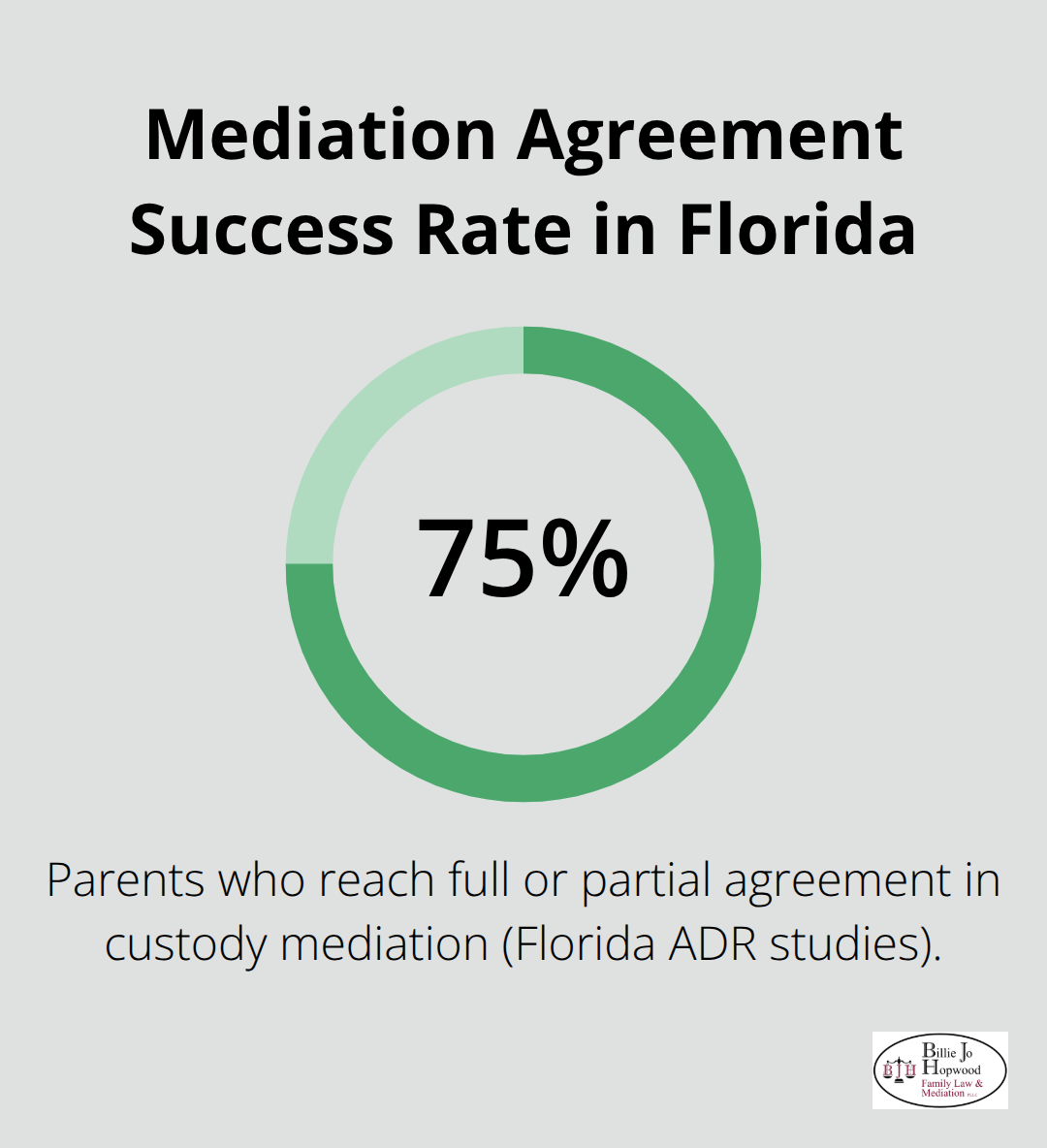
Share of parents who reach agreement through child custody mediation in Florida - child custody mediation Brevard

The mediator balances empathy with problem-solving, ensuring both voices are heard while keeping discussions anchored to practical details.

Why Mediation Beats Litigation for Custody

Courtroom custody battles hand control to a judge who knows nothing about your family’s daily realities. The judge decides your child’s schedule, decision-making authority, and how disputes get resolved-outcomes that rarely satisfy either parent completely. Mediation inverts this power dynamic: you and the other parent retain control over every aspect of the agreement. You decide whether 50/50 shared custody works, whether one parent has primary custody with visitation rights, or whether a customized schedule better serves your child’s needs. You set communication protocols for routine updates and emergencies. You determine how major decisions about education, healthcare, and religion will be made. Mediation costs significantly less than litigation because it typically requires only two to four sessions rather than months of court appearances, discovery disputes, and attorney fees. The confidentiality of mediation protects sensitive family information from becoming public record, unlike courtroom proceedings. Parents who craft their own agreements through mediation maintain better post-divorce relationships and help children maintain closer bonds with both parents compared to families who litigate custody. The agreement you create in mediation becomes binding once a judge signs it, giving you the legal weight of a court order without the adversarial process that damages co-parenting relationships.

Moving Forward with Your Custody Plan

Once mediation produces an agreement, the next phase involves translating that agreement into a formal parenting plan that meets Florida’s statutory requirements. Your mediator helps you document all the details you’ve negotiated-time-sharing schedules, holiday arrangements, decision-making responsibilities, and communication methods-in language that courts recognize and enforce. This documentation step matters because vague agreements create confusion and conflict later. A clear, detailed plan prevents misunderstandings about pickup times, school event attendance, and how you’ll handle unexpected changes in circumstances. The plan you’ve crafted through mediation reflects your family’s actual needs rather than a judge’s generic template, which means both parents understand exactly what they’ve agreed to and why it works for your children.

Building a Custody Plan Around Your Child’s Real Life

Map Your Child’s Weekly Routine First

Your child’s daily routine dictates what custody arrangement actually works. Before mediation sessions begin, track your child’s typical week for two weeks: school start and end times, extracurricular activities, work schedules for both parents, and any special needs requiring consistency. This data becomes your foundation. If your child attends school from 8 a.m. to 3 p.m. and you work until 6 p.m., a Monday-through-Wednesday custody schedule with the other parent fails unless someone handles the gap between school dismissal and your arrival home. Many Brevard families discover during mediation that their initial custody ideas clash with practical logistics. One parent proposes alternating weeks, but the child’s soccer practice happens Tuesday and Thursday evenings with the other parent’s household. The mediator identifies this conflict immediately and helps you redesign the schedule around the child’s commitments rather than forcing the child to adapt to an inflexible arrangement. Florida law requires parenting plans to specify daily schedules and school-year arrangements, so documenting these details during mediation prevents court battles later when schedules inevitably shift. Work with your mediator to map out a typical school week first, then layer in summer and holiday variations once the foundation is solid.

Honor Holidays and Vacation Traditions

Holiday and vacation schedules demand equal attention during mediation because they create the most contentious disputes in custody arrangements. Florida courts expect parenting plans to address spring break, winter holidays, summer vacation, and significant dates like birthdays and Father’s Day or Mother’s Day. Rather than assuming a 50/50 split of every holiday, work backward from your child’s preferences and existing family traditions. Does your child spend Christmas with one grandparent every year? That matters. Does the other parent have a non-negotiable week in July for a family reunion? That deserves accommodation. Mediation allows you to preserve these meaningful traditions while creating fair access for both parents. Approximately 75 percent of parents reach agreement through mediation partly because mediators help shift focus from rigid equal division toward creative solutions that honor what actually matters to your family. One effective approach discussed during mediation is alternating major holidays year to year, so one parent hosts Christmas in odd years while the other hosts in even years, then switching for Thanksgiving. Summer vacation can split into two blocks, with each parent taking consecutive weeks when school ends, giving your child stability rather than constant transitions.

Handle Logistics with Clear Agreements

Transportation logistics also need explicit agreements: who picks up the child from school on transition days, who handles transportation to activities during the other parent’s time, and what happens if someone runs late. These specifics prevent daily friction and protect your child from becoming a messenger or feeling responsible for logistics failures. Clear language about pickup locations, time windows, and communication methods removes ambiguity that breeds conflict. Your mediator helps you document these details so both parents understand their responsibilities without room for misinterpretation.

Build Flexibility Into Your Plan

Life changes. One parent gets a job promotion requiring occasional travel. The other parent relocates within Brevard County for better housing. Your child joins a competitive sports team requiring weekend tournaments. A rigid custody schedule breaks under this weight, but an agreement built with flex points survives. During mediation, discuss how you’ll handle temporary schedule changes without returning to court. Can you swap weeks with 48-hours notice if circumstances demand it? Do you have a protocol for handling unexpected conflicts, or must every deviation become a formal modification?
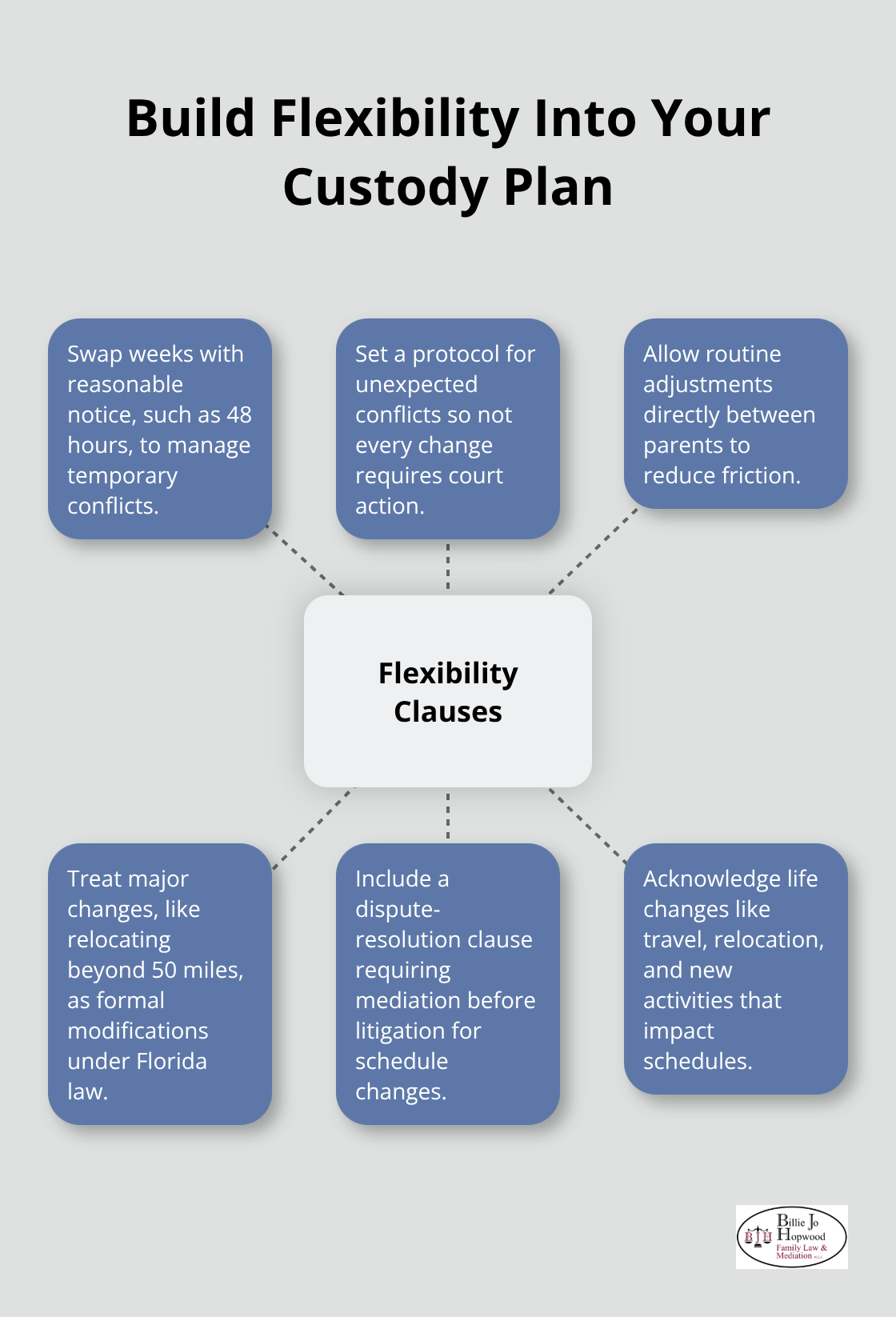
Key flexibility clauses that keep custody plans workable over time

Some families agree that routine adjustments happen between parents directly, while major changes like relocating beyond 50 miles trigger the formal modification process Florida law requires. The mediator helps you draft language that gives both parents confidence in the plan’s stability while acknowledging that perfect adherence to a custody schedule is impossible. Including a dispute-resolution clause in your agreement means you commit to mediation again before litigation if disagreements arise about schedule changes. This approach costs far less than court modification proceedings and preserves the co-parenting relationship your child depends on.

Move From Planning to Implementation

Custody plans that survive post-divorce life include flexibility mechanisms from the start, but translating those plans into daily reality requires clear communication and realistic expectations. The next section explores the specific custody arrangements that work best for different family situations and how to evaluate which model fits your circumstances.

Common Custody Arrangements and What Works Best

Fifty-fifty shared custody sounds fair in theory, but it often fails in practice for Brevard families. When each parent has the child exactly half the time, transitions happen every three or four days, which disrupts school routines, extracurricular consistency, and the child’s sense of stability. A child bouncing between two households every few days spends disproportionate time packing and unpacking while adjusting to different rules and expectations. Research on Florida custody arrangements shows that 50/50 schedules work best only when both parents live within ten minutes of each other, work compatible schedules, and have genuinely aligned parenting values.
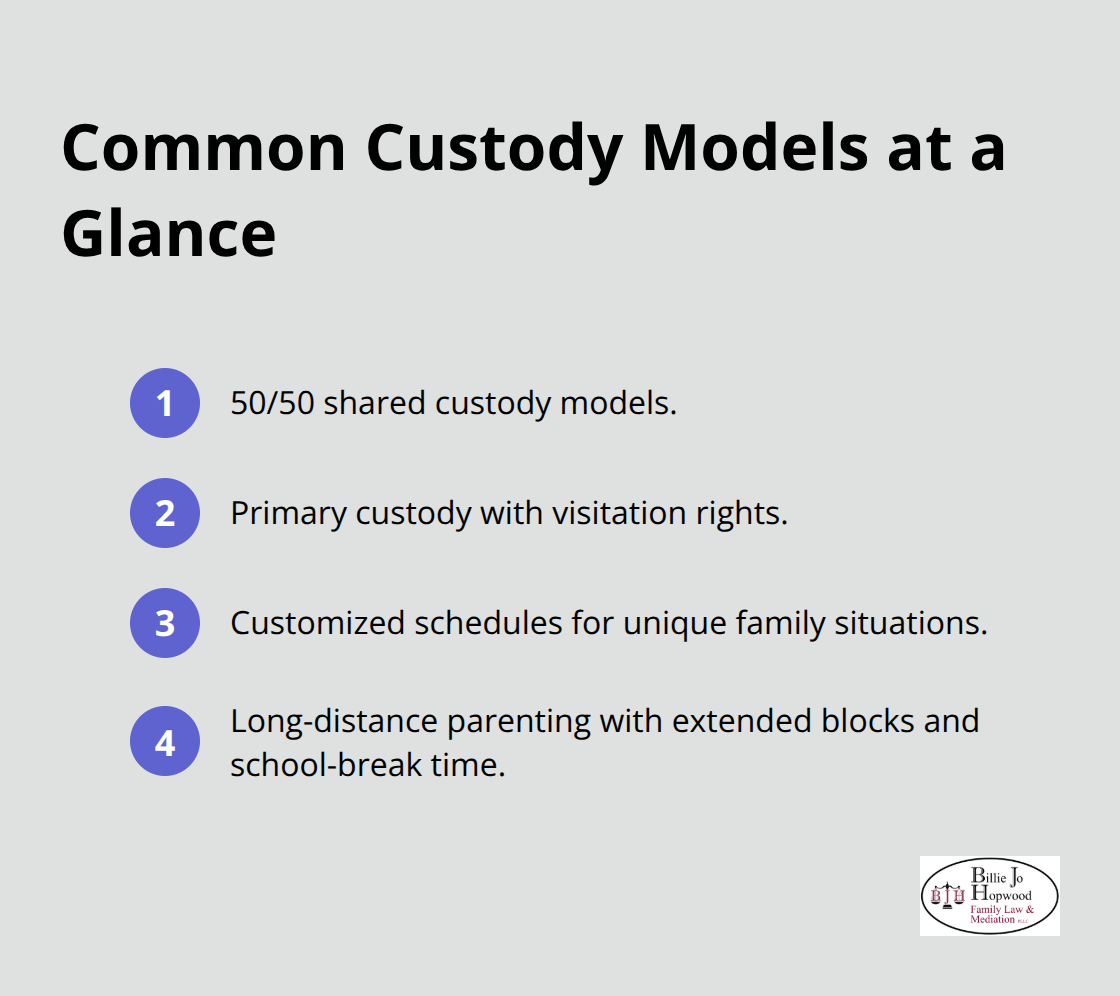
Overview of typical custody arrangements used by Brevard families - child custody mediation Brevard

50/50 Shared Custody Models

If your child attends school in one parent’s neighborhood, that parent should have school-night custody because the child needs to arrive well-rested and prepared. During mediation, many parents abandon rigid 50/50 splits in favor of schedules that prioritize school stability. One effective variation involves one parent having school-week custody while the other has alternating weekends plus one mid-week overnight. This keeps your child in one home during the school week, strengthens homework routines, and reduces the logistical chaos of managing two households’ worth of supplies simultaneously. The child still maintains strong connection with the other parent through substantial weekend and mid-week time. Florida courts approve these arrangements readily because they demonstrably serve the child’s educational and emotional needs better than artificial equality.

Primary Custody with Visitation Rights

Primary custody with visitation rights works when one parent has been the child’s primary caregiver or when work schedules make shared custody impractical. The parent with primary custody makes day-to-day decisions, maintains the child’s primary residence, and handles school enrollment and medical care. The other parent typically receives every other weekend, one mid-week overnight, and shared holiday time. This model provides your child with consistency and a stable home base while guaranteeing the other parent meaningful ongoing contact. Many Brevard families structure visitation to include Thursday or Friday overnight stays so the child spends a full weekend day with that parent rather than arriving Saturday morning and leaving Sunday evening.

Customized Schedules for Unique Family Situations

When one parent works rotating shifts or travels frequently for work, mediation helps craft schedules that match actual availability. Rather than forcing a parent into a standard every-other-weekend arrangement they cannot sustain, mediators help design schedules reflecting real-world constraints. Some parents with unpredictable work schedules claim specific weeks during summer vacation or designate extended holiday periods they can reliably take.

If one parent works nights and sleeps days, custody during that parent’s sleeping hours makes no sense for the child. A schedule matching the parent’s sleep pattern and your child’s waking hours creates genuine parenting time rather than phantom custody. Families with significant age gaps between children sometimes use different custody schedules for each child, keeping teenagers with one parent while younger children split time differently. Blended families often negotiate schedules accommodating the other parent’s stepsiblings or the child’s step-parent’s work demands.

Long-distance parenting requires extended blocks rather than frequent transitions. If one parent lives more than 50 miles away, Florida law mandates specific procedures for relocation, but mediation helps you design a schedule that works practically. Rather than every-other-weekend visits requiring four-hour drives, extended summer blocks and school breaks provide deeper connection time. The mediation process reveals which custody model actually serves your child because it forces you to answer concrete questions about daily logistics, school needs, and work realities instead of assuming a standard arrangement will function.

Final Thoughts

The custody arrangements you craft through child custody mediation in Brevard stick because they reflect your family’s actual life rather than a judge’s assumptions. When both parents participate in designing the schedule, addressing logistics, and building flexibility into the agreement, they understand why each piece matters. This ownership transforms a custody plan from a court document into a working agreement you both commit to honoring.

Starting mediation in Brevard County begins with contacting a qualified family law mediator who understands Florida’s statutory requirements and your family’s specific circumstances. Bring documentation of your child’s current schedule, school information, and any existing custody arrangements to that first meeting. Come prepared to listen to the other parent’s perspective without defensiveness, knowing that the mediator’s role is to help both of you find common ground.

At Billie Jo Hopwood Family Law & Mediation, PLLC, we help families in Melbourne and throughout Brevard navigate custody mediation with compassion and practical guidance. Whether you need help designing a custody schedule, understanding Florida’s parenting plan requirements, or preparing for mediation sessions, contact us to guide you through the process. The custody plan you create through mediation becomes the foundation for your family’s post-separation life, so getting it right matters profoundly.
Child custody mediation timeline: From Filing to Final Order

Child custody mediation in Melbourne, Florida moves through distinct phases, each with its own timeline and requirements. Understanding what happens at each stage helps you prepare mentally and practically for the process ahead.

We at Billie Jo Hopwood Family Law & Mediation, PLLC walk families through this journey regularly, and we’ve created this guide to show you exactly what to expect from your initial consultation all the way to your final court order.

Initial Consultation and Case Assessment

Your initial consultation sets the tone for the entire mediation process, and preparation at this stage directly impacts how quickly you’ll reach an agreement. The first meeting typically lasts 30 to 60 minutes and focuses on understanding your custody goals, assessing what documentation you’ll need, and creating a realistic timeline for resolution. During this consultation, you’ll discuss the specifics of your parenting situation-where your child currently lives, how much time each parent spends with them, and what changes you’re seeking in the custody arrangement. The mediator will ask about any safety concerns, the child’s school and medical needs, and both parents’ work schedules. This is where you should be completely honest about what matters most to you. If your primary goal is maintaining equal time with your child, state it clearly. If you’re concerned about relocation or need flexibility for work travel, bring that up now. Vague goals waste time later.

Gathering Your Documents Before the First Session

Collect your documents at least two weeks before your first mediation session. You’ll need tax returns from the last three years, recent bank statements and investment account statements, property deeds and mortgage information, business records or valuations if either parent owns a business, and insurance policies with beneficiary information. Additionally, compile your child’s school records, medical records, and vaccination history. Create a detailed timeline showing where your child has lived since birth, which parent provided primary care during each period, and any significant changes in the parenting arrangement. If you have a current custody order or parenting plan, bring copies. Take screenshots or print emails showing communication patterns with the other parent, especially if there are concerns about reliability or responsiveness. Document your work schedule, including any flexibility you have for parenting time. If you’ve already created a proposed parenting schedule, prepare it in writing. The Florida Courts require parenting plans to address decision-making authority for medical, educational, and religious matters, so think through how you want these responsibilities divided. Disorganized parents typically take longer to reach agreements-mediators report that families who arrive prepared often resolve custody matters in a single 2 to 3-hour session, while unprepared families may need multiple sessions spanning weeks.

Identifying Your Core Issues and Non-Negotiables

Before your mediation begins, identify which issues actually matter and which ones you’re willing to negotiate. Most custody disputes center on three core questions: where will the child live most of the time, how much time will each parent have, and who makes major decisions about education, medical care, and religion. If you’re fighting about minor details like which parent buys school supplies or who attends every soccer game, you’re creating unnecessary delays. Write down your non-negotiable items-these are typically safety concerns, relocation needs, or fundamental parenting philosophies-and distinguish them from preferences you can adjust. If the other parent wants the child every other weekend but you want every weekend, that’s negotiable. If the other parent has a substance abuse problem and you need safeguards around parenting time, that’s non-negotiable. Mediators in Florida work most effectively when both parents narrow disputes to genuine conflicts. Families that approach mediation with realistic expectations and flexibility on secondary issues tend to settle faster and with less ongoing conflict. Set a written agenda for your mediation sessions listing the two or three most important issues first, and plan to address them before moving to secondary concerns. This preparation positions you to move directly into the mediation process itself, where the real work of building your custody agreement takes place.

What Happens During Your Mediation Sessions

Once your documents are organized and your priorities are clear, you enter the active mediation phase where agreements actually get built. In Melbourne, Florida, most family mediators conduct initial sessions that run two to three hours, though the length depends entirely on how complex your custody situation is.

The Joint Opening Session

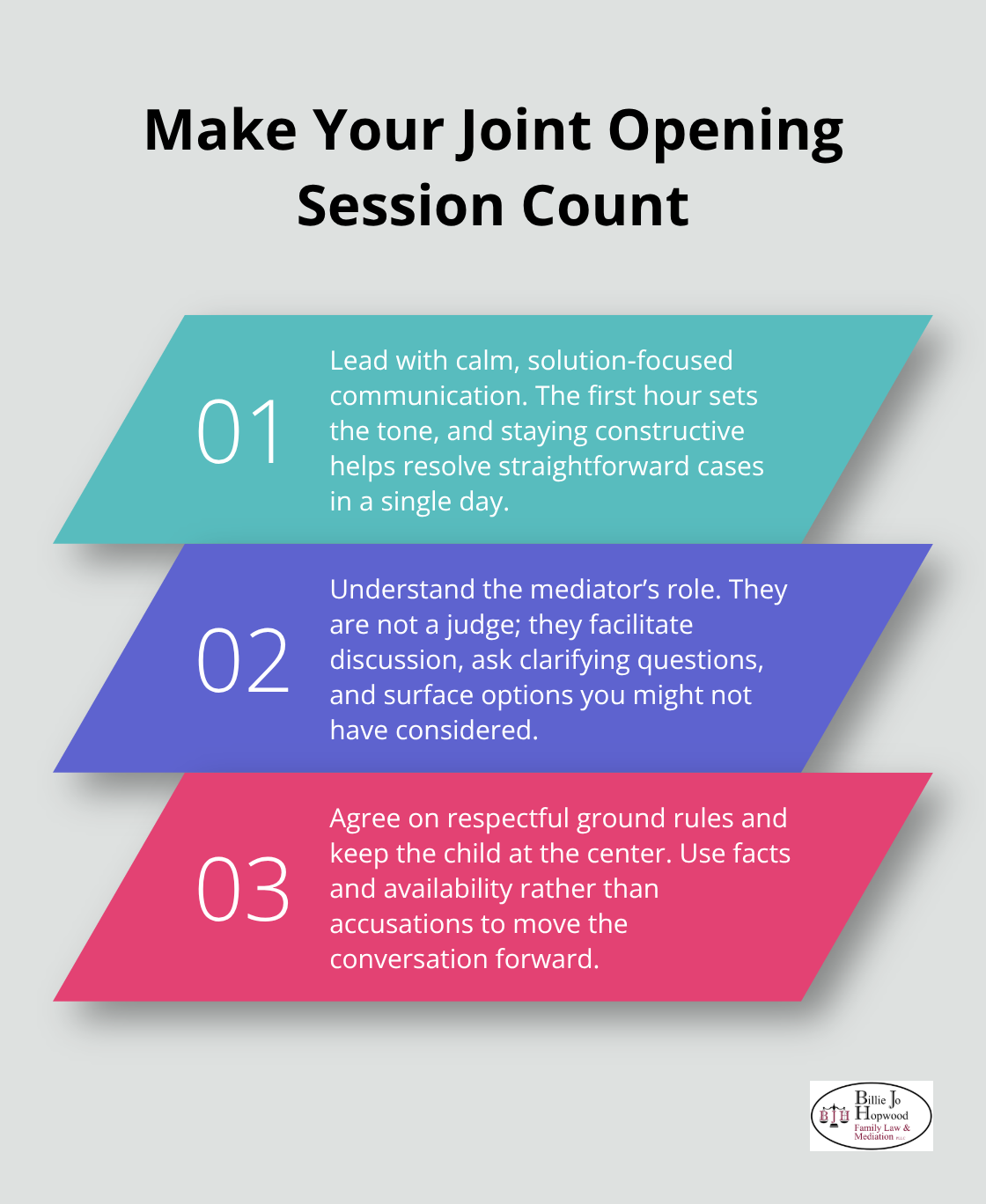
The mediator will start with a joint session where both parents and the mediator meet together to review the issues you’ve identified and establish ground rules for respectful communication. This opening session matters more than you might think-mediators report that families who stay calm and solution-focused during the first hour typically resolve straightforward custody matters in a single day, while those who rehash old conflicts or make accusations often need multiple sessions stretched across weeks. The mediator is not a judge and will not make decisions for you. Instead, they facilitate conversation, ask clarifying questions about your child’s needs and each parent’s capabilities, and help you explore options you may not have considered.

Three ways to keep the joint opening session productive during child custody mediation - Child custody mediation timeline

Shuttle Mediation for High-Conflict Situations

If tensions run high between you and the other parent, the mediator will separate you into individual rooms and shuttle back and forth, presenting proposals and testing whether movement is possible on specific issues. This shuttle mediation approach works well in high-conflict situations because it removes the pressure of face-to-face negotiation while keeping momentum toward resolution. You’ll present your position without the other parent interrupting or escalating emotions. The mediator then carries your proposals to the other room and returns with counteroffers or questions that move the conversation forward.

Presenting Fact-Based Arguments in Separate Sessions

During separate sessions, bring concrete information about your proposed schedule, your work flexibility, and your reasoning tied directly to your child’s wellbeing rather than your preferences. A mediator in Brevard or Seminole County will listen carefully to safety concerns, school schedules, extracurricular activities, and each parent’s availability. If you claim you need primary custody because you want more time with your child, that’s a preference. If you need primary custody because the other parent works irregular night shifts and your child’s school starts at 7:45 a.m., that’s a fact-based argument the mediator can work with.

Building Your Parenting Plan Agreement

Come prepared to discuss specific parenting time arrangements-not vague concepts like 50/50 custody, but actual calendar dates and times. For example, Monday through Wednesday evenings with one parent, Thursday through Sunday with the other, with specific pickup and drop-off times. Decision-making authority for medical care, education, and religion requires separate discussion from physical time-sharing, so prepare your position on each. The mediator will draft a preliminary custody agreement once both parents move toward consensus, and you’ll review it carefully before signing. Florida courts require that any mediated settlement agreement be in writing and signed by all parties to be enforceable, so nothing becomes final until you’ve approved the language in writing. Most families in Melbourne report that having a written parenting plan template prepared beforehand (even a rough draft) cuts mediation time significantly because the mediator can work from your framework rather than building one from scratch.

Once you and the other parent reach agreement on your parenting plan, the mediator prepares the final settlement document for both of you to sign. This signed agreement then moves into the court filing phase, where your mediated plan transforms into an official court order.

Moving Your Mediated Agreement Into Court

Your signed mediation agreement is not yet a court order, and that distinction matters enormously. Once both parents sign the settlement document, you must file it with the Brevard or Seminole County court to transform your private agreement into an enforceable legal order.

Filing Your Settlement Agreement With the Court

The filing process in Florida requires you to submit the mediated settlement agreement along with a proposed Final Judgment on Parenting Plan, which incorporates the custody terms you negotiated. Florida Rule of Civil Procedure 1.730 mandates that any mediated settlement agreement be in writing and signed by all parties to be enforceable, so your mediator will prepare documents that meet this requirement. File these documents at the courthouse or electronically through the court’s filing system; electronic filing is now standard in most Florida courts and typically costs between $50 and $100 in filing fees. If you cannot afford these fees, you can apply for Civil Indigent Status with the Clerk of Court to reduce or eliminate them.

What the Court Reviews in Your Agreement

After filing, the court typically reviews your agreement within 7 to 14 days to confirm that the parenting plan serves your child’s best interests and complies with Florida law. Courts rarely reject mediated agreements that both parents signed voluntarily, but the judge will examine whether decision-making authority is clearly assigned, whether the parenting schedule is specific enough to follow, and whether child support is addressed if applicable. Most judges approve mediated custody agreements without requiring you to appear in court, which is one of mediation’s strongest advantages over litigation.

Timeline From Filing to Final Order

The timeline from filing to final order typically spans 2 to 4 weeks in Melbourne, Florida, though this varies based on court backlogs and how quickly you submit all required documents. Once the judge approves your agreement and signs the Final Judgment on Parenting Plan, you receive an official court order that governs custody and parenting time going forward. This order is now legally binding and enforceable through the court system. If either parent violates the order later, the other parent can file a Motion for Contempt to enforce compliance.

Obtaining and Storing Your Final Order

Keep multiple certified copies of your final order because you will need them for school enrollment, medical providers, and childcare facilities. Request certified copies from the Clerk of Court when you file; they typically cost $1 to $2 per page. Some families file their final order within days of mediation completion, while others wait weeks because they delayed organizing documents or submitting paperwork. The families who move fastest are those who prepare their filing documents during mediation itself, working with their mediator or attorney to confirm everything is court-ready before both parents sign the settlement agreement. This approach eliminates the gap between settlement and court approval, and you will receive your final order within 10 to 14 days rather than 30 to 45 days.

Final Thoughts

The child custody mediation timeline from initial consultation to final court order typically spans four to eight weeks, though families who prepare thoroughly often compress this into three to four weeks. Your journey begins with a 30 to 60-minute consultation where you clarify your goals and gather documents, moves into active mediation sessions lasting two to three hours, and concludes when the judge signs your Final Judgment on Parenting Plan. The speed of your process depends almost entirely on preparation and willingness to negotiate on secondary issues.

Once your mediated agreement is signed, filing with the Brevard or Seminole County court takes one to two weeks, and court approval typically follows within 7 to 14 days. Request certified copies of your final order immediately after the judge signs it, as you will need these for school enrollment, medical providers, and childcare facilities. Store multiple copies in a safe location and keep one accessible for reference.

After your final order is issued, your custody arrangement becomes legally binding and enforceable. If circumstances change significantly-your work schedule shifts, the other parent relocates, or your child’s needs evolve-you can file a Motion to Modify the parenting plan rather than returning to full mediation. Contact our Melbourne office to speak with someone who can address your concerns about your child custody mediation timeline and help you navigate your specific situation.

Melbourne Parenting Plan Mediation: Building Your Co-Parenting Agreement

A parenting plan is one of the most important documents you’ll create after separation or divorce. It shapes your children’s daily lives, your relationship with them, and how you and your co-parent work together.

Melbourne parenting plan mediation offers a faster, less adversarial path to building an agreement that actually works for your family. We at Billie Jo Hopwood Family Law & Mediation, PLLC help parents move past conflict and focus on what matters: creating stability for their children.

What a Parenting Plan Actually Is and Why Florida Courts Require One

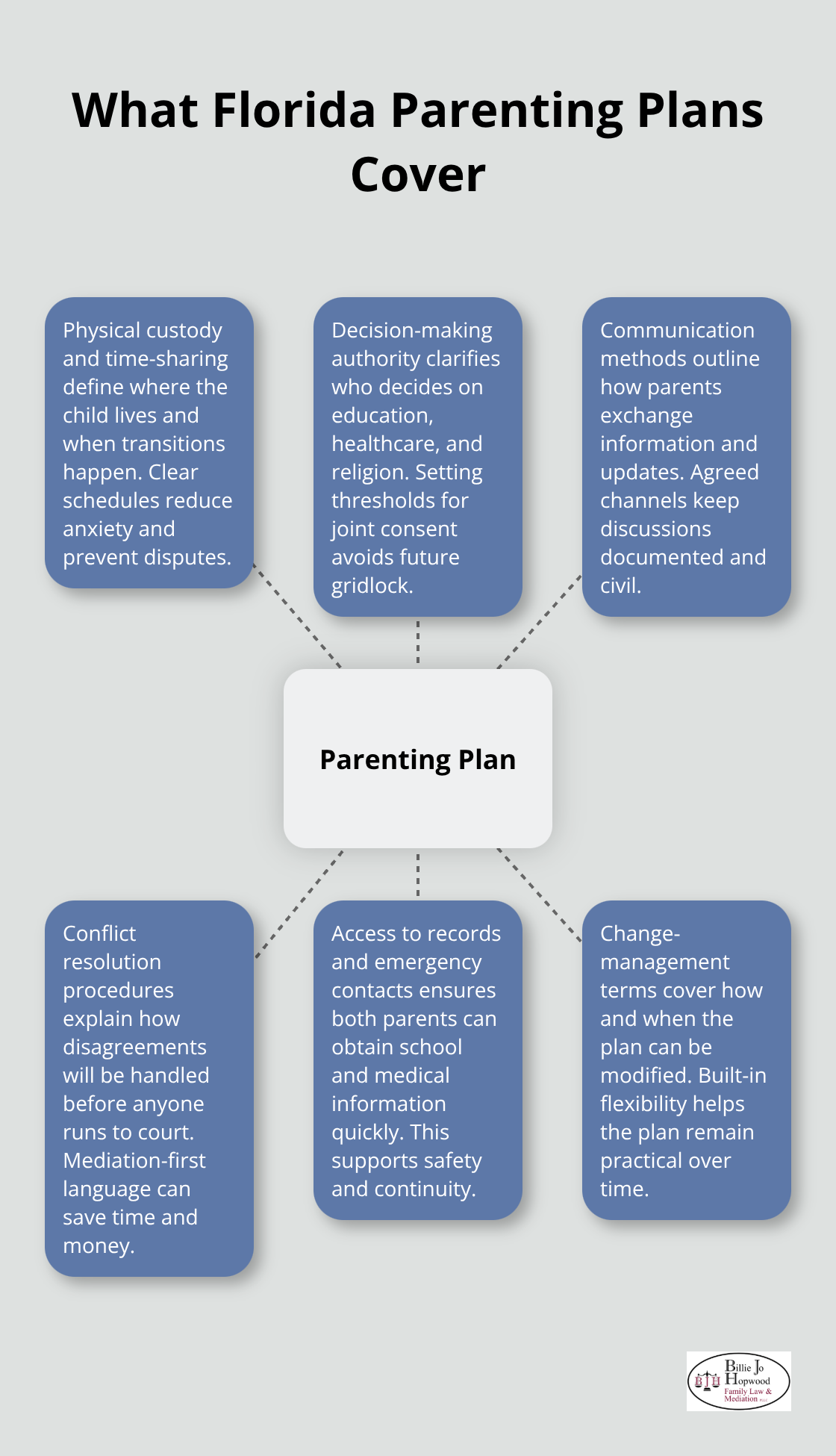
A parenting plan is a legally binding document that outlines how you and your co-parent will raise your children after separation or divorce. In Florida, both parents must submit a parenting plan to the court unless one parent has sole parental responsibility, which is rare and difficult to obtain. The plan covers physical custody (where the child lives and when), decision-making authority (who decides on education, healthcare, and religion), communication methods between parents, and how you’ll handle conflicts.

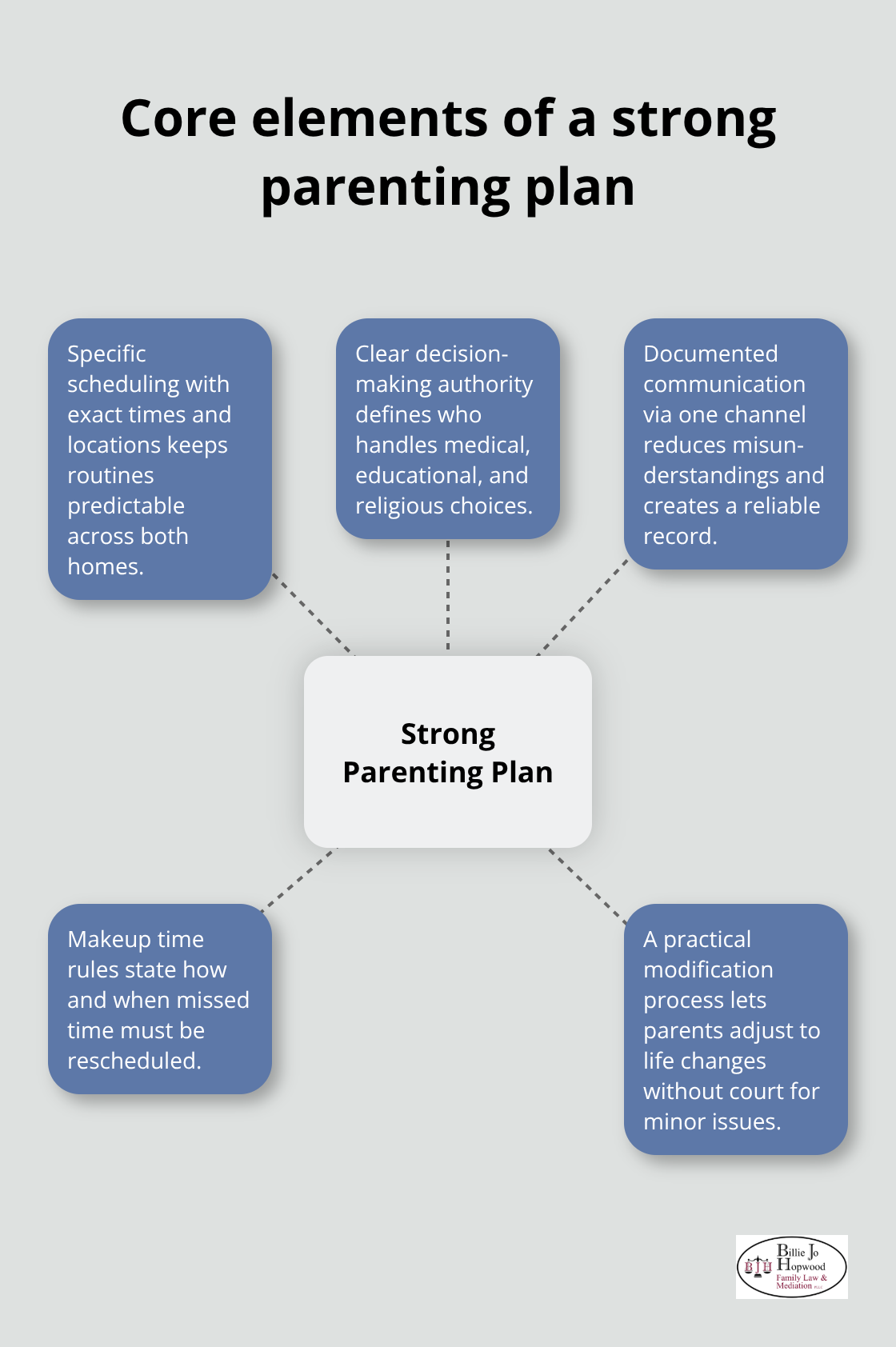
Hub-and-spoke visual showing the core elements covered in a Florida parenting plan

Florida Statutes 61.13 sets the legal framework, and courts use the best interest of the child standard when evaluating plans. This isn’t a theoretical document-it’s the operational manual for your family’s daily life.

The court won’t impose terms if you and your co-parent agree on a solid plan beforehand, which is why mediation works so effectively in Melbourne. Parents who skip mediation and go straight to court often end up with rigid schedules that don’t match their actual work or childcare needs, yet they still pay $50,000 or more in legal fees.

How Parenting Plans Protect Your Child’s Stability

A well-crafted parenting plan reduces your child’s anxiety by creating predictability. Children thrive when they know where they’ll be, who makes decisions about their health and education, and how their parents will communicate. The plan should specify emergency contacts, who accesses school and medical records, and how major decisions get made. Shared Parental Responsibility (SPR) is the preferred arrangement in Florida because it keeps both parents involved in significant choices.

If you use SPR with Designated Decision-Making Authority (SPR-DD), one parent makes final calls on certain topics while both parents still discuss and collaborate first. The alternative-sole parental responsibility-removes the other parent almost entirely, and courts strongly discourage it unless one parent is absent or poses a safety risk. A detailed plan also prevents the constant conflict that damages children more than the separation itself. Research consistently shows that children adjust better when parents cooperate through a structured agreement rather than fighting over decisions repeatedly.

Three Myths That Mislead Parents in Melbourne

Many parents believe courts punish working parents by reducing their time with children, but Florida courts explicitly do not penalize employment. Your job and reasonable childcare arrangements won’t hurt your parenting time. Another misconception is that whoever has the child more pays less child support-actually, the non-custodial parent typically pays support regardless of how close the time-sharing is.

Finally, parents often think a parenting plan is permanent and unchangeable, which isn’t true. Plans can be modified through mediation or court if circumstances genuinely change (such as a job relocation or significant shift in a child’s needs). Starting with realistic expectations during mediation prevents you from fighting over a plan that no longer fits your family six months later.

What Happens When You Build Your Plan in Mediation

Mediation transforms the parenting plan process from a confrontational battle into a collaborative conversation. A neutral mediator helps you and your co-parent identify what actually matters for your children and your family’s routines. You control the outcome instead of letting a judge impose terms that may not reflect your real life. The mediator guides you toward practical solutions-flexible schedules that work with your jobs, clear communication methods that reduce conflict, and decision-making structures that both parents can follow.

This structured approach means you walk out with a plan you both helped create, not one you resent. That buy-in makes a real difference in whether parents actually follow the agreement long-term.

Key Components Your Parenting Plan Must Address

Your parenting plan needs three concrete elements to function in real life: a time-sharing schedule that matches your actual work and childcare routines, clear decision-making authority so you’re not fighting over every school choice or medical appointment, and communication methods that keep conflict contained.

Time-Sharing Schedules That Reflect Your Real Life

Most parents go wrong with time-sharing schedules during mediation. Many assume a 50/50 split means exactly equal days, but Florida law doesn’t require mathematical precision-it requires what serves your child’s best interests. If you work full-time and your co-parent works flexible hours, a 60/40 or 70/30 schedule often works better than forcing equal overnights that create chaotic transitions. Your plan should specify exact changeover times and locations (not just vague language like “every other weekend”). Include school calendars, holiday schedules, summer arrangements, and who handles transportation. Parents who mediate typically build in flexibility for reasonable requests-allowing the other parent extra time during their work vacation or adjusting pickup times when schedules shift-because they designed the plan together rather than having a judge impose rigid terms.

Decision-Making Authority on Major Parenting Choices

Decision-making authority separates major choices from day-to-day parenting. Shared Parental Responsibility means both parents must discuss and agree on education (school selection, special education services), healthcare (medical procedures, therapy, medication), and religion before committing. If parents can’t agree on these topics, either can petition the court, but mediation prevents that costly step by helping you establish criteria upfront. For example, you might agree that routine medical care (checkups, antibiotics) requires only notification, while surgery or psychiatric medication requires joint consent. Religion often triggers conflict, but many plans specify that each parent can expose the child to their faith during their parenting time without the other parent’s permission-a practical solution courts rarely suggest.

Communication Methods That Reduce Ongoing Conflict

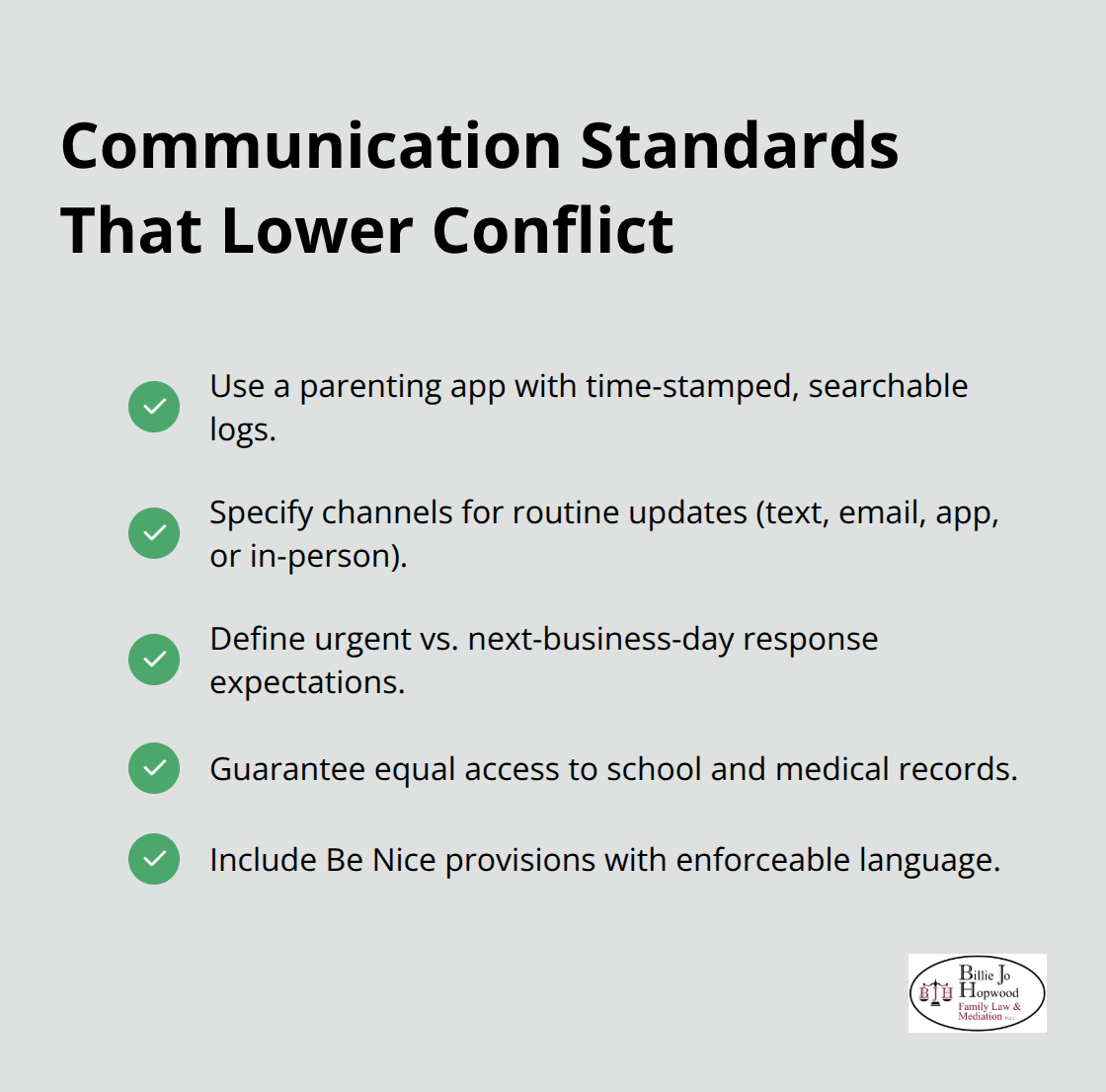
Communication expectations matter as much as the schedule itself. Families using structured communication methods (like the app Talking Parents, which costs roughly $100 to $150 annually and time-stamps all exchanges) report fewer conflicts and maintain documented records if enforcement becomes necessary.

Checklist of communication practices that reduce co-parenting conflict - Melbourne parenting plan mediation

Your plan should specify whether you communicate via text, email, a parenting app, or in-person handoffs, and what topics require immediate response versus next-business-day turnaround. Be Nice provisions-language requiring you to avoid discussing the divorce with your child, grant equal access to school and medical records, and maintain emergency contact information-sound soft but carry legal teeth. Violation of these provisions can trigger contempt charges, so your plan must include expectations both parents actually can follow rather than aspirational language that sets up conflict.

The specificity you build into these three areas during mediation determines whether your agreement holds up over time or falls apart within months. When you move into the mediation process itself, you’ll learn how a neutral mediator helps you translate these components into language that both parents can follow consistently.

Why Mediation Beats Court for Your Parenting Plan

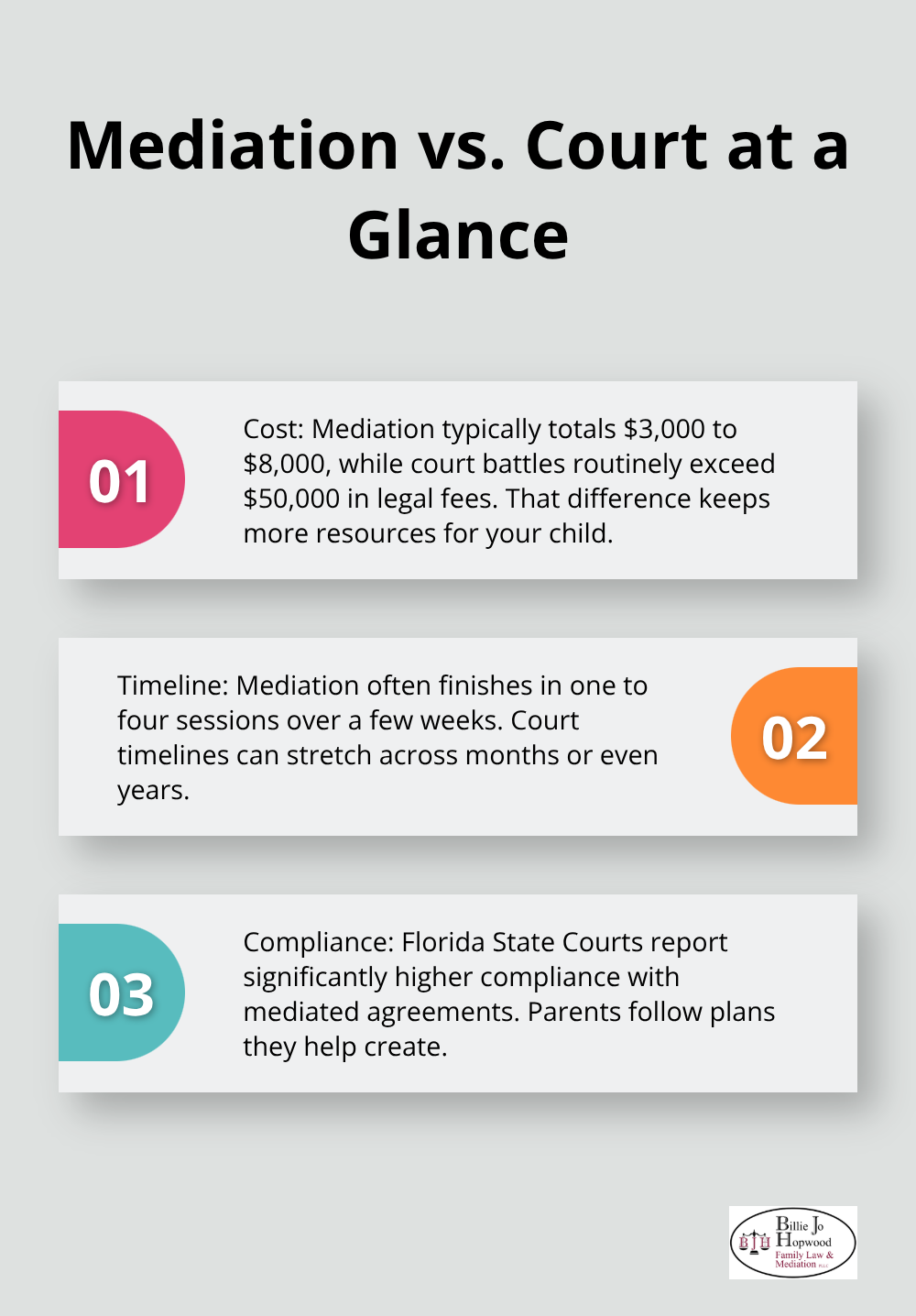
Mediation cuts through the adversarial machinery that makes court proceedings so expensive and emotionally destructive. When you litigate a parenting plan, you pay attorneys to argue, gather evidence for hearings, and wait months for a judge to impose terms neither parent designed. Court battles over parenting plans in Florida routinely exceed $50,000 in legal fees, while mediation typically costs $3,000 to $8,000 total. More importantly, mediation wraps up in one to four sessions over a few weeks, whereas court timelines stretch across months or years. A judge doesn’t know your family’s actual routines, your child’s specific needs, or the flexible arrangements that would actually work.

Three-point comparison of mediation and court for parenting plans in Florida - Melbourne parenting plan mediation

A mediator helps you build those arrangements yourselves. Parents who mediate walk away with plans they helped create, which means they follow them. Parents who lose in court resent the imposed terms and fight over enforcement constantly, dragging the conflict forward for years. The Florida State Courts report that mediated agreements in family cases have significantly higher compliance rates than court-ordered outcomes because both parties invested in the solution rather than losing to an adversary.

What a Mediator Actually Does During Your Sessions

A trained, Florida Supreme Court certified mediator remains neutral and doesn’t decide anything for you or provide legal advice. Instead, the mediator’s job is to help you and your co-parent communicate clearly about what you each need for your children and your family’s logistics. During sessions, the mediator asks targeted questions that force you both to move past anger and explain practical concerns. Why does your work schedule require a certain pickup time? What does your child actually need from each parent? Where is flexibility exist without sacrificing your child’s stability? The mediator reshapes positions into interests you can both address. If you’re stuck on a 50/50 split and your co-parent insists on 60/40, a mediator helps you identify whether the real issue is fairness, parenting time quality, child support calculations, or something else entirely. Once the actual concern surfaces, solutions often emerge that satisfy both of you. Mediation in Melbourne takes place online via video conference according to Brevard County’s system, which means you don’t sit in a room together if tension runs high. The mediator can run shuttle sessions, moving between separate video calls to carry proposals and find common ground. All discussions remain confidential unless you agree otherwise, which removes the fear of statements being used against you later in court. This confidentiality is critical because it allows you to explore options, admit mistakes, and change your mind without creating a legal record.

How Mediators Help You Move Past Stuck Points

When mediation stalls, the mediator suggests creative solutions like graduated summer schedules, technology-based communication platforms, or decision-making criteria neither parent had considered alone. You control whether to accept any proposal, so mediation remains truly voluntary despite the collaborative pressure. The mediator’s role is to facilitate conversation, not to push you toward outcomes you don’t want. If mediation doesn’t produce full agreement, you still have the option to pursue court, but most families find that the mediator’s guidance gets them unstuck. A mediator trained in family dynamics understands how to reframe positions so both parents hear each other’s actual concerns rather than just the demands on the surface.

Preparing for Mediation and What Happens Next

Before your first session, gather documentation that shows your actual life: work schedules, school calendars, existing childcare arrangements, and any court orders already in place. Bring a clear picture of your child’s daily needs, not emotional arguments about fairness. Parents who prepare this way move through mediation faster and spend less on mediator fees. During the initial session, the mediator explains the process, confidentiality rules, and ground rules for respectful communication. You’ll outline your positions on custody, decision-making, and communication methods, then the mediator identifies where you already agree and where work is needed. Subsequent sessions focus on specific components of your parenting plan. You might spend one session on time-sharing schedules, another on decision-making authority, and a final session on communication expectations and conflict resolution methods. If you reach full agreement, the mediator documents the terms, which you can then take to an attorney to formalize into a court-approved plan.

Final Thoughts

A solid parenting plan removes the guesswork from co-parenting and gives your children the stability they need after separation or divorce. Melbourne parenting plan mediation accomplishes this without the expense and emotional toll of court battles. Most families complete mediation in one to four sessions, walking away with a documented agreement ready to formalize with the court-a timeline that beats the months or years litigation requires, and a cost ($3,000 to $8,000) that represents a fraction of what contested court proceedings demand.

We at Billie Jo Hopwood Family Law & Mediation, PLLC help families in Melbourne, Florida move past conflict and focus on creating an agreement that serves your children and your family’s actual needs. Contact us to begin your mediation journey and build the parenting plan your family deserves. Whether you’re starting mediation or need guidance on formalizing your agreement, we’re here to support your co-parenting goals.

Mediation Cost Brevard: Understanding Fees and Value

Family law disputes drain finances fast. Court battles in Brevard routinely cost $15,000 to $30,000 or more when you factor in attorney fees, court costs, and lengthy proceedings.

Mediation cost in Brevard runs significantly lower. We at Billie Jo Hopwood Family Law & Mediation, PLLC help families understand exactly what they’ll pay and why mediation delivers better financial outcomes than litigation.

What You’ll Actually Pay for Mediation in Brevard

Private mediators in Brevard charge between $200 and $400 per hour total, split between both parties. A typical two-hour session runs $400 to $800 combined, meaning each person pays roughly $200 to $400. Most families resolve disputes in four to eight sessions, totaling $1,600 to $6,400 in mediation fees alone.

Court-Ordered Mediation Costs Far Less

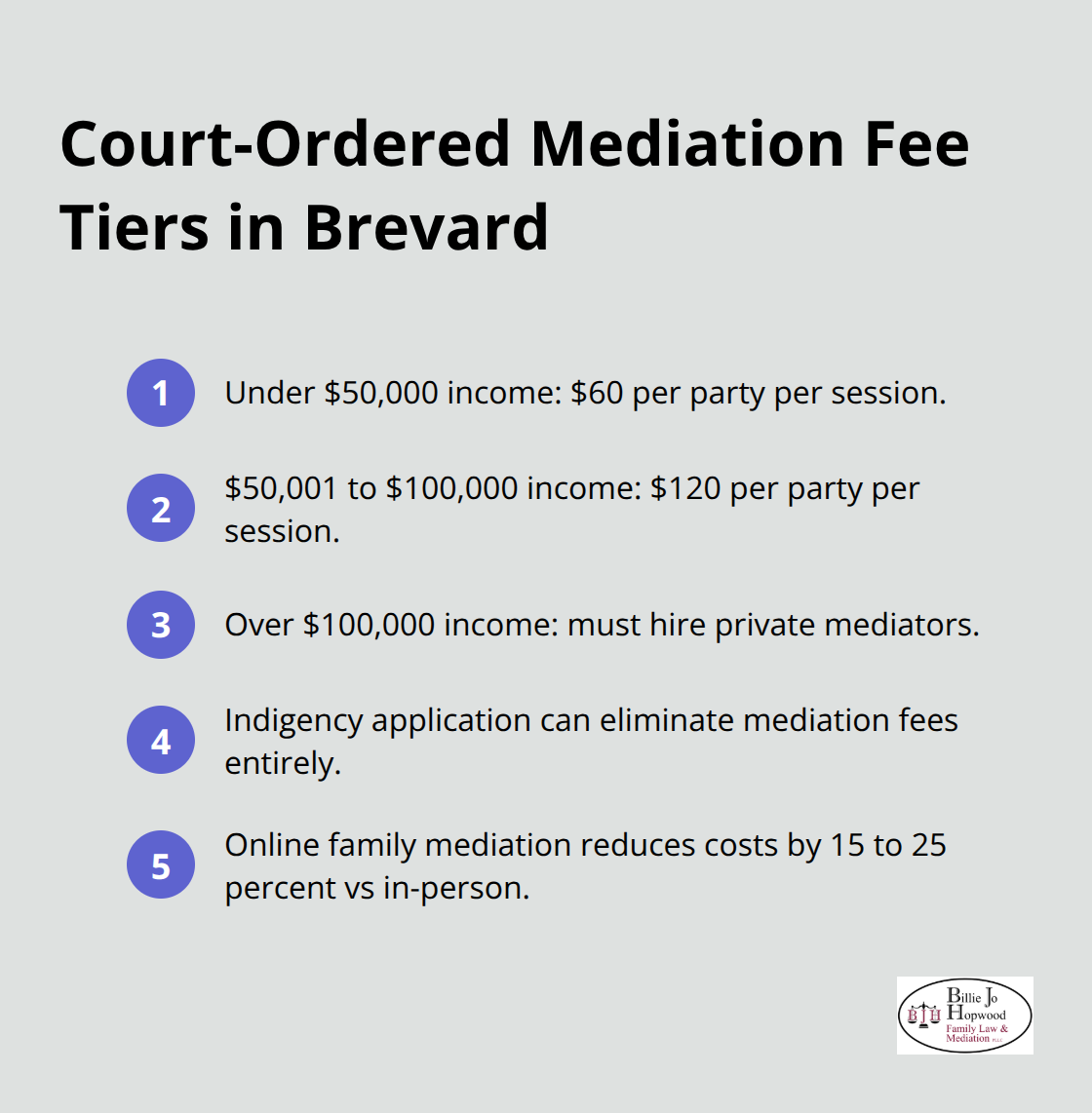
The Eighteenth Judicial Circuit offers sliding-scale fees based on combined household income. Families earning under $50,000 pay $60 per party per session, while those earning $50,001 to $100,000 pay $120 per party per session. Families exceeding $100,000 must hire private mediators instead. If you qualify as low-income, an indigency application filed with the Clerk of Court eliminates mediation fees entirely.

Sliding-scale court-ordered mediation fees and discounts for Brevard County families. - Mediation cost Brevard

Online family mediation through Brevard County reduces costs by 15 to 25 percent compared to in-person sessions because you skip travel time and facility expenses.

Filing and Administrative Charges Add Up

Dissolution of marriage filing in Brevard County costs $409, a fixed court cost you cannot avoid. Florida requires comprehensive financial disclosures within 45 days of filing, including bank statements, tax returns, and property valuations. Asset valuations add real money to your tab: retirement account valuations run $150 to $400 each, real estate appraisals cost $300 to $600, and business valuations range from $2,000 to $5,000. Parenting classes cost $25 to $50 per person and must be completed within 45 days of filing. After mediation concludes, attorney review of your agreement runs $300 to $800, and legal drafting costs another $500 to $1,200.

When Mediation Costs Climb Higher

Complex cases demand additional spending. Forensic accounting for hidden assets or business income costs $3,000 to $10,000. Child custody evaluations by mental health professionals range from $1,500 to $4,000. If domestic violence is present, shuttle mediation (where the mediator meets with each party separately) can double facility costs. Specialized mediators handling high-conflict custody disputes charge $400 to $600 per hour instead of standard rates.

Preparation Costs Often Go Unnoticed

Most families underestimate what they spend before the first mediation session. Two to four hours with an attorney preparing your case costs $300 to $1,600 at standard rates, and paralegals charge $50 to $100 per hour to organize documents and financial records. The combination of mediator fees, preparation time, asset valuations, and filing costs typically runs $2,500 to $8,000 total across all sessions and preparation-still dramatically cheaper than litigation‘s $15,000 to $50,000-plus price tag. Understanding these individual costs helps you budget accurately and identify where you can cut expenses without sacrificing the quality of your mediation process.

Why Litigation Costs Devastate Families in Brevard

Litigation in Brevard County destroys family budgets in ways mediation never does. Attorney fees alone run $200 to $400 per hour per party, and a contested divorce typically demands 40 to 100 hours of work, landing families with bills between $8,000 and $40,000 just for legal representation. Court filing fees of $409, discovery costs ranging from $15,000 to $50,000 for complex cases, and custody evaluations at $1,500 to $5,000 accumulate rapidly, pushing families toward $15,000 to $50,000 or more before trial even begins. The Eighteenth Judicial Circuit handles roughly 2,800 divorce cases annually, creating court backlogs that stretch contested cases across 12 to 24 months. Mediation resolves most disputes in 4 to 8 weeks, meaning litigation families lose months of income, productivity, and peace of mind while their cases languish in the system.

How Lost Work Time Multiplies Your True Cost

The financial damage accelerates when parents miss work for depositions, court appearances, and attorney consultations. One parent earning $50,000 annually loses roughly $1,000 per week in productivity during a six-month litigation battle, adding $24,000 in opportunity costs on top of attorney fees and court expenses. These hidden costs rarely appear on invoices, yet they represent real money that families never recover. Litigation forces you to choose between your job and your case repeatedly, a choice mediation families never face.

Litigation Triggers Expensive Investigations and Valuations

Litigation forces families to disclose every financial detail, triggering expensive valuations and forensic accounting that mediation avoids entirely. When disputes involve hidden assets or business interests, forensic accountants charge $3,000 to $10,000 to uncover and document everything, costs that skyrocket when the other party fights transparency. These investigations consume months and drain resources that could support your children instead. Mediation allows both parties to control what information surfaces and how much investigation actually occurs.

The Damage to Your Children and Future Relationships

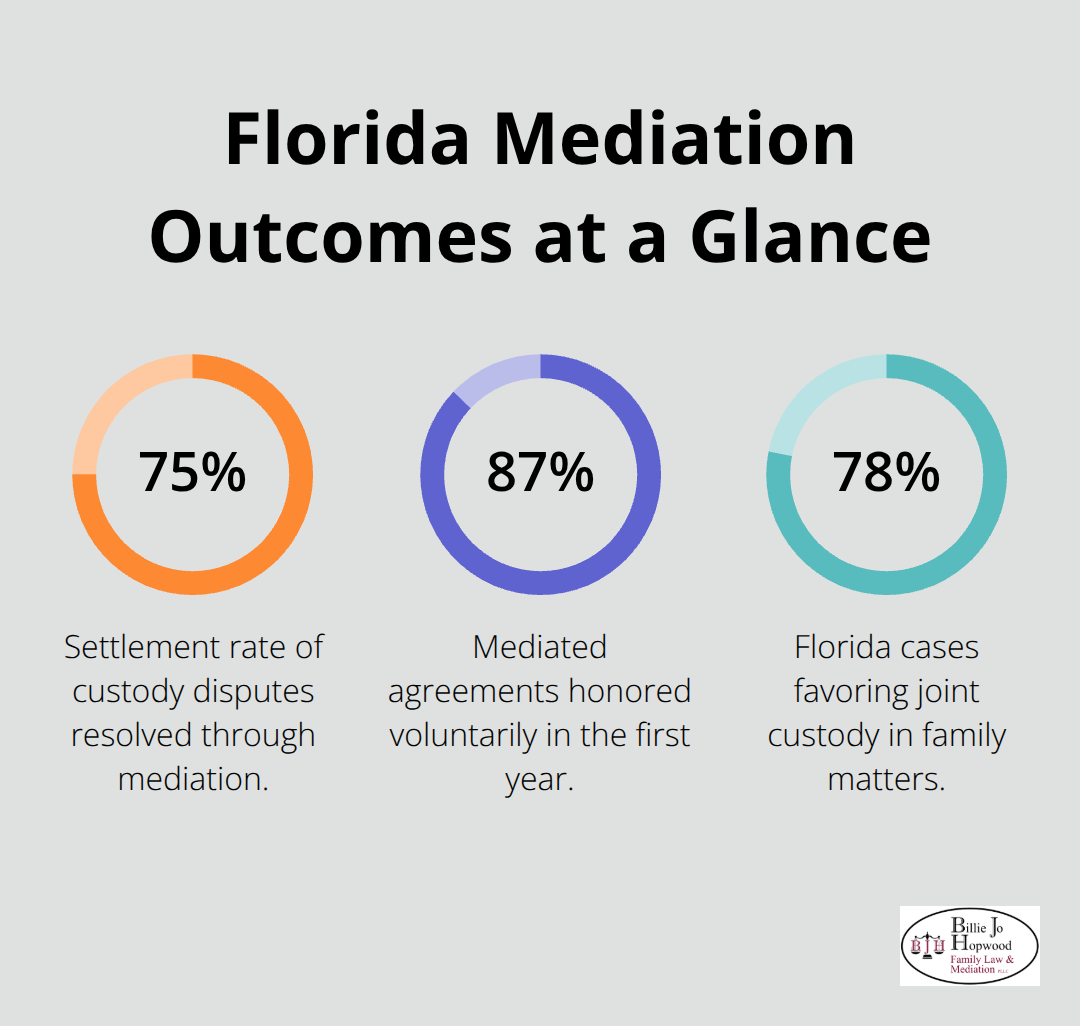
Children suffer measurable harm from prolonged court battles; research from Florida State Courts data shows children in contested litigation experience higher stress levels and behavioral problems compared to those whose parents mediate. Litigation also destroys relationships permanently, making co-parenting nearly impossible after a judge imposes orders neither parent willingly accepted. Florida courts favor joint custody in roughly 78 percent of cases, meaning most parents will share decision-making for years after divorce. This reality makes the relationship damage from litigation especially costly-you cannot escape the person you fought against in court.

Why Mediated Agreements Actually Stick

Mediation preserves communication and cooperation, allowing parents to modify arrangements without returning to court every time circumstances change. Mediation achieves settlement in roughly 75 percent of custody disputes according to Florida court statistics, with 87 percent of mediated agreements honored voluntarily in the first year because both parties helped create the terms. Court orders face significantly higher violation rates because one parent feels the judge imposed unfair conditions, requiring costly contempt motions and enforcement actions that mediation families never face. When you craft your own agreement, you follow it-when a judge imposes one, you fight it.

Key Florida family mediation outcome percentages: settlement, compliance, and joint custody prevalence.

The financial and emotional toll of litigation extends far beyond what most families anticipate. Understanding these hidden costs reveals why mediation offers not just savings, but a fundamentally different path forward. The next section examines the specific factors that shape mediation pricing in Brevard and how your case complexity influences what you’ll actually pay.

What Drives Your Mediation Bill in Brevard

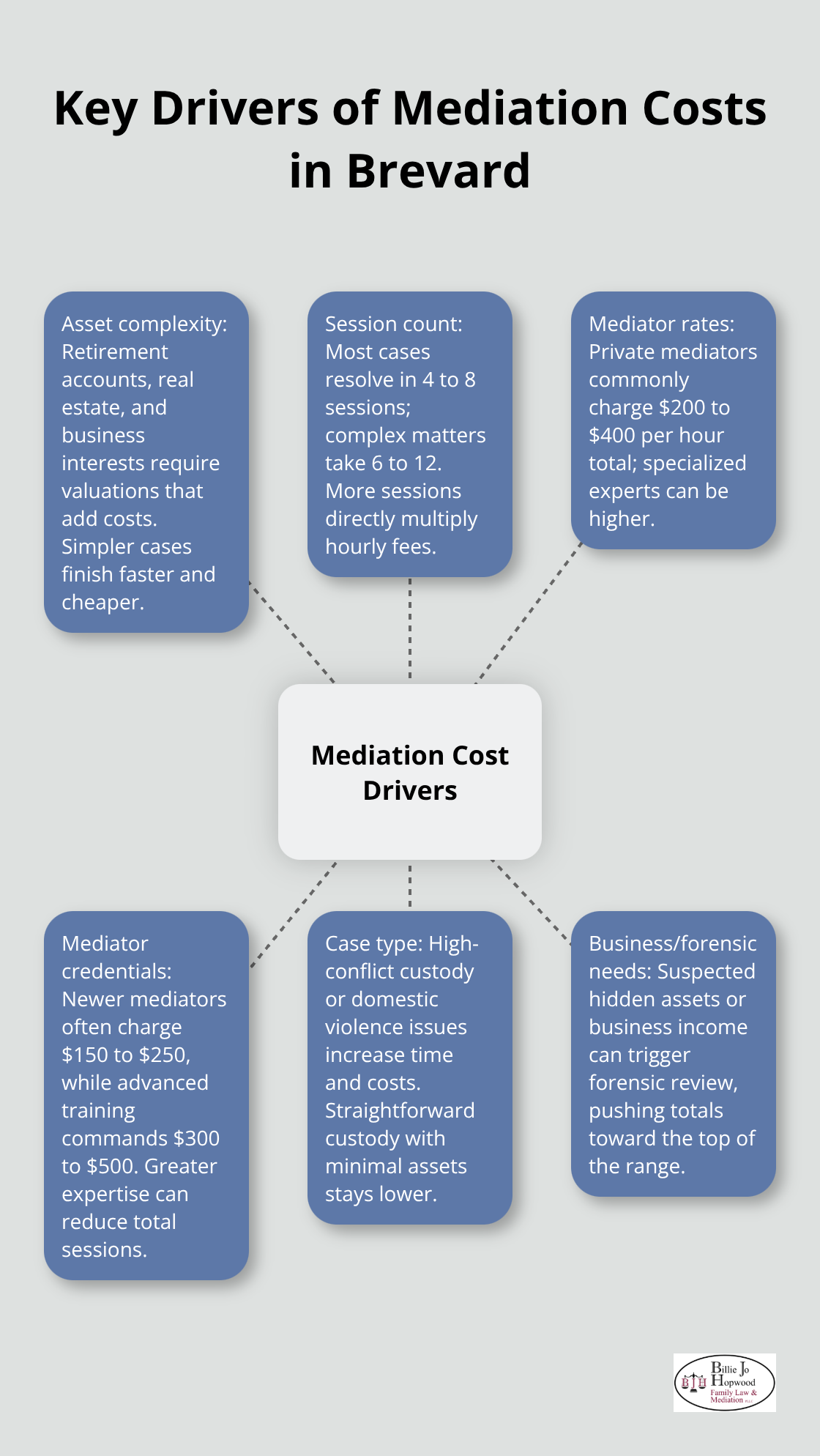
Your mediation cost in Brevard depends on three factors that work together to determine your final bill. Asset complexity matters enormously-a straightforward custody dispute with minimal property costs far less than a case involving retirement accounts, real estate, or business interests. Families with straightforward arrangements typically spend $1,600 to $3,200 across four sessions, while cases requiring asset valuations, forensic review, or high-conflict custody assessments climb toward $4,000 to $8,000. The Eighteenth Judicial Circuit reports that most custody mediations resolve within 4 to 8 sessions, but contested asset divisions or business valuations often demand 6 to 12 sessions, directly multiplying your hourly costs. Private mediators in Brevard charge $200 to $400 per hour total, meaning a complex case requiring ten sessions at two hours each costs $4,000 to $8,000 before any asset valuation fees.

Hub-and-spoke diagram showing the primary factors that drive mediation costs in Brevard County. - Mediation cost Brevard

Your mediator’s background also influences pricing significantly-newer mediators with basic Florida Supreme Court certification charge closer to $150 to $250 per hour, while mediators holding master’s degrees and specialized training in high-conflict custody or domestic violence issues command $300 to $500 per hour.

How Your Case Complexity Shapes What You Pay

Asset-heavy disputes demand significantly more mediation time and often require external valuations. Retirement account divisions involving 401k rollovers, pensions, or IRAs require $150 to $400 per account valuation, adding to your total cost. Real estate appraisals run $300 to $600 each if you own multiple properties, and business valuations range from $2,000 to $5,000 depending on company size and profitability. Hidden assets or suspected financial misconduct trigger forensic accounting at $3,000 to $10,000, costs that mediation sometimes avoids entirely because both parties control disclosure voluntarily rather than facing court-ordered discovery. Custody disputes involving special needs children, substance abuse concerns, or documented parental conflict require mediators trained in these areas, justifying higher hourly rates. Cases with domestic violence history often demand shuttle mediation where the mediator meets separately with each party, doubling facility costs but protecting safety. Straightforward custody arrangements with cooperative parents and minimal assets resolve quickly and inexpensively, while contested arrangements with multiple properties and high conflict stretch timelines and expenses dramatically.

Mediator Training and Credentials Impact Your Bottom Line

Florida Supreme Court certification is mandatory for all mediators, requiring 16 hours of continuing education every two years, but this baseline certification does not guarantee specialized knowledge. Mediators holding master’s degrees in counseling, social work, or family therapy typically understand family dynamics more deeply and navigate high-conflict situations more effectively, justifying their $350 to $500 per hour rates. Mediators with parenting coordination certification or domestic violence training bring specialized skills that reduce session count for difficult cases, potentially saving you money despite higher hourly rates. Experienced mediators with proven settlement records close cases faster than newer practitioners, meaning a $400 per hour mediator with a 90 percent settlement rate may cost less total than a $250 per hour mediator requiring extra sessions. Interview potential mediators about their settlement success rates and ask specifically whether they have handled cases similar to yours-a mediator experienced with business owner divorces understands valuation issues that a general family mediator might miss, reducing confusion and extra sessions.

Final Thoughts

Mediation cost in Brevard ranges from $1,600 to $8,000 depending on case complexity, mediator qualifications, and session count, while litigation routinely exceeds $15,000 to $50,000 when you add attorney fees, court costs, and discovery expenses. The financial advantage of mediation proves undeniable, but the real value extends beyond dollars saved-mediation resolves disputes in weeks rather than months, preserves your ability to co-parent effectively, and produces agreements both parties actually follow because they helped create them. Court-ordered mediation through the Eighteenth Judicial Circuit costs even less for families earning under $100,000, with sliding-scale fees as low as $60 per party per session for combined incomes under $50,000.

Straightforward custody cases with minimal assets typically run $1,600 to $3,200 total, while asset-heavy disputes or high-conflict situations climb toward $4,000 to $8,000 when valuations and specialized mediators enter the picture. Preparation costs like financial disclosures, asset appraisals, and attorney consultation add $500 to $2,000 depending on your situation, and the filing fee of $409 plus parenting class costs of $25 to $50 per person represent fixed expenses you cannot avoid. Building a realistic budget means identifying your case complexity honestly, gathering documents early, and selecting a mediator whose experience matches your needs rather than simply choosing the lowest hourly rate.

Contact us at Billie Jo Hopwood Family Law & Mediation, PLLC to discuss your situation and learn how mediation resolves family disputes affordably without the devastating costs litigation demands. We help Melbourne families navigate mediation costs and identify the most affordable path forward, whether you qualify for court-ordered mediation or need private mediation. Your path forward starts with a conversation about what mediation actually costs and why it delivers real savings compared to court battles.

Divorce Filing Mediation: Start Your Case with Structured Mediation

Divorce filing mediation offers a fundamentally different path than courtroom battles. Instead of adversarial litigation, you work with a neutral mediator to reach agreements on property, custody, and support.

We at Billie Jo Hopwood Family Law & Mediation, PLLC have seen firsthand how structured mediation reduces conflict and costs while giving you real control over the outcome. This guide walks you through how the process works and why it matters for your family’s future.

How Structured Mediation Works in Divorce

The Mediator’s Role in Guiding Your Discussion

A mediator is not a judge, therapist, or advocate for either side. In Melbourne, Florida family mediation, the mediator is a court-certified neutral who facilitates conversation between you and your spouse. According to the 18th Judicial Circuit Court, all mediators in Brevard and Seminole counties must complete 16 hours of continuing mediation education every two years to maintain certification. The mediator keeps discussions moving, identifies common ground, and helps you both understand what settlement looks like. They will not tell you what to do, give legal advice, or push you toward any particular outcome.

What you say in mediation stays confidential and cannot be used in court if no agreement is reached. This removes the fear of admissions being held against you later.

The Structured Mediation Process

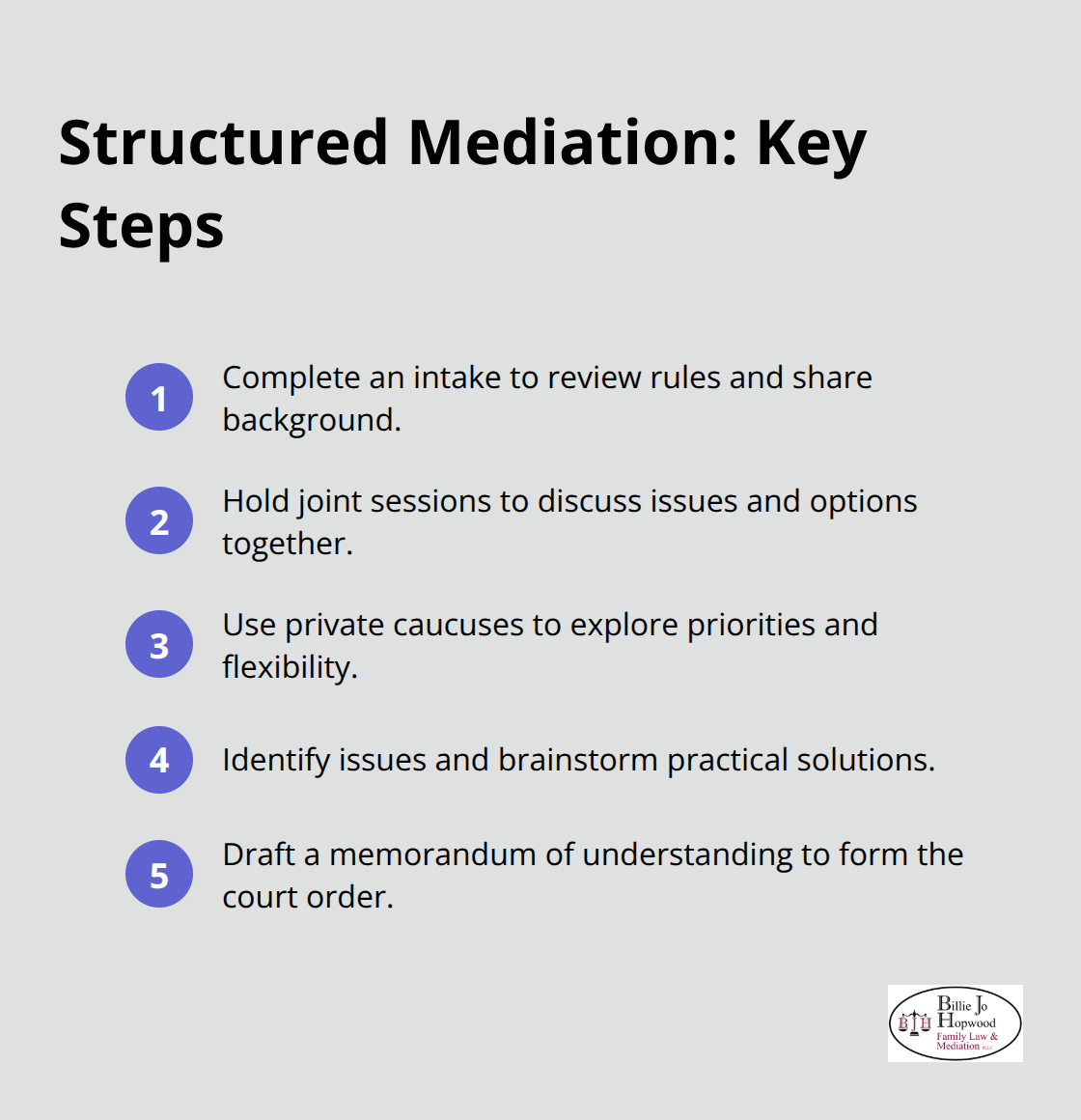
The process follows a predictable path. You start with an intake where the mediator explains the rules and gets background on your situation. Then you move into joint sessions where both of you discuss issues, or private caucus sessions where the mediator meets with each of you separately to understand your priorities and explore flexibility.

Five key steps most divorce mediations follow, from intake to a memorandum of understanding

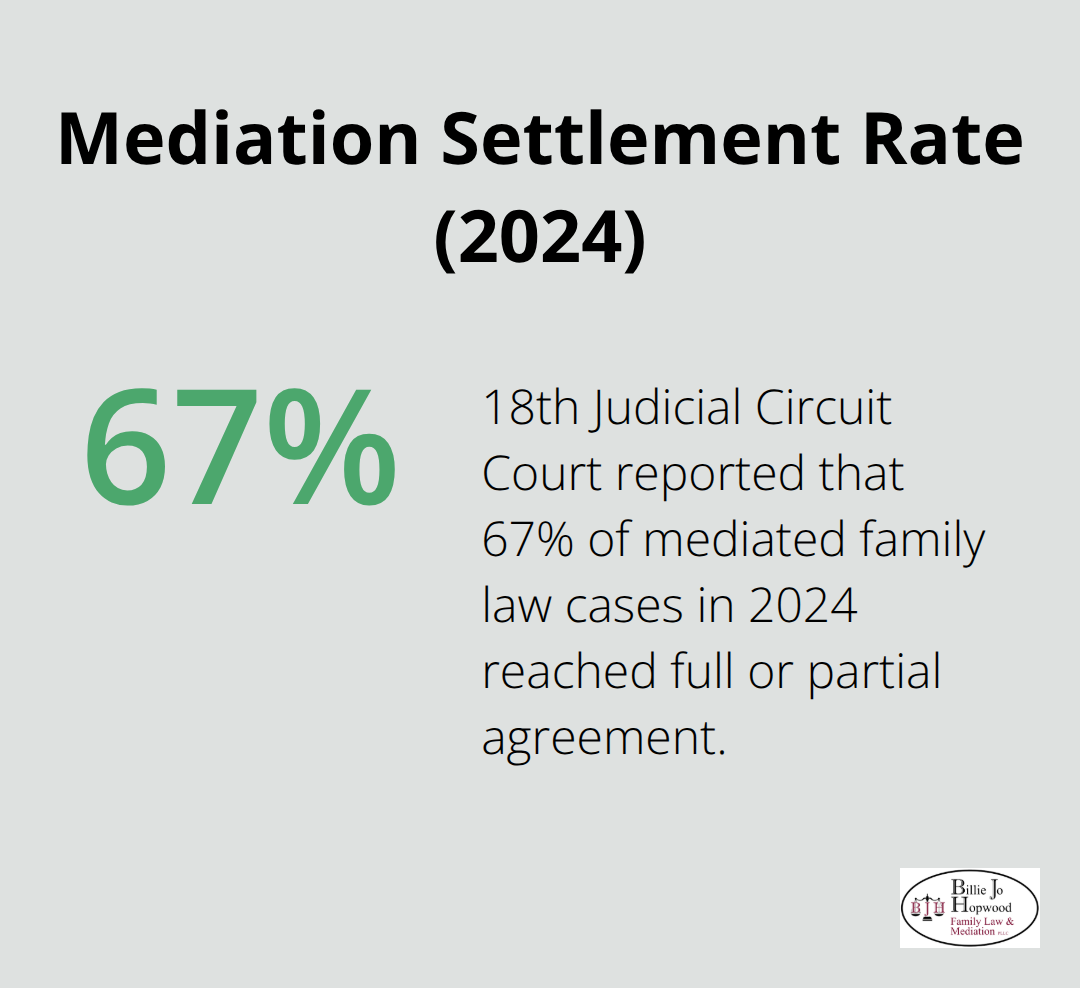
The mediator identifies specific issues like property division, child custody, and support amounts, then helps you brainstorm solutions. Once you reach tentative agreements on each issue, the mediator drafts a memorandum of understanding that becomes the foundation for your final court order. According to the 18th Judicial Circuit Court, roughly 67% of mediated family law cases in 2024 reached full or partial agreement, showing this approach actually works.

Sessions typically run 2 to 4 hours and span multiple meetings over weeks or months depending on complexity. This gives you time to think between sessions rather than making rushed decisions under courtroom pressure.

How Mediation Differs from Litigation

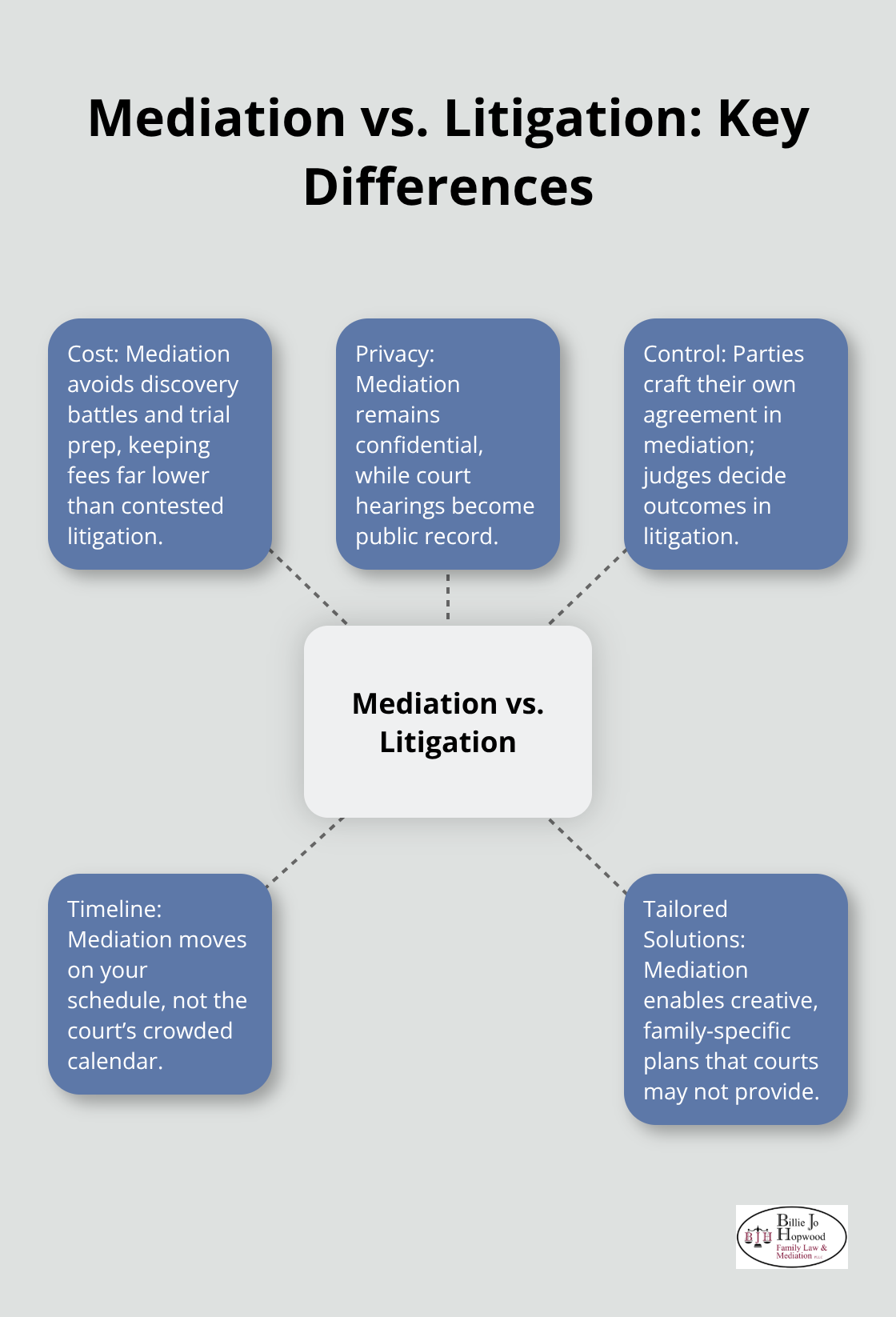
Litigation forces a winner-and-loser outcome because a judge decides everything. Mediation lets you decide. In court, you pay attorney fees for depositions, discovery disputes, expert witnesses, and trial preparation that can easily run $15,000 to $50,000 or more for contested cases. Mediation costs far less because there is no discovery battle, no trial prep, and no judge’s time being billed.

A hub-and-spoke diagram comparing mediation with litigation on cost, privacy, control, timeline, and tailored solutions - divorce filing mediation

Filing a divorce petition in Brevard County Circuit Court cost $408 in 2024, and mediation fees depend on your combined income: under $50,000 total income costs $60 per party, $50,000 to $100,000 costs $120 per party, and above $100,000 requires private mediation outside the court program.

You also control what the agreement looks like. A judge applies the law mechanically and may order asset splits or custody schedules that do not fit your family’s actual needs. You might end up with a parenting plan that ignores your child’s school schedule or your work reality. In mediation, you can craft creative solutions like phased support, flexible timesharing around travel, or asset exchanges that make sense for your situation.

Court hearings are public record, meaning neighbors, coworkers, and future employers can read details about your finances, parenting disputes, or personal struggles. Mediation keeps those details private between you, your spouse, and the mediator. This privacy advantage alone makes mediation worth considering before you move forward with contested litigation and the financial burden that follows.

Benefits of Starting Your Divorce with Mediation

Lower Costs Compared to Court Battles

Mediation cuts your divorce costs dramatically compared to litigation. Filing a divorce petition in Brevard County costs $408, but add attorney fees for depositions, interrogatories, document requests, and expert witnesses in a contested case and you easily exceed $15,000 to $50,000. Mediation fees in Brevard and Seminole counties run $60 per party for combined household income under $50,000, or $120 per party for income between $50,000 and $100,000. Those numbers are fixed and predictable.

You avoid the hourly meter running during discovery battles, temporary hearings on support and custody, and trial preparation that devours attorney time and your savings account. The 67% settlement rate reported by the 18th Judicial Circuit Court in 2024 means two out of three mediated cases avoid trial entirely, keeping costs in the low thousands rather than five figures.

Percentage of mediated family law cases that reached full or partial agreement in 2024 per the 18th Judicial Circuit Court - divorce filing mediation

Faster Resolution and Timeline

The 18th Judicial Circuit Court data shows mediated cases resolve in weeks rather than months, while contested divorces stretch 6 to 12 months or longer depending on court backlogs and discovery disputes. Speed matters when children are involved. Contested litigation forces you to wait for court dates that may not open for months, temporary orders that create uncertainty about custody and support, and depositions that stretch the process further.

Mediation sessions typically last 2 to 4 hours and happen over weeks or months on a schedule you control, not a judge’s calendar. You reach decisions faster, finalize your agreement sooner, and move forward with your life instead of staying trapped in legal limbo.

More Control Over Outcomes and Agreements

You keep control over what the agreement actually says. A judge applies state law mechanically and may order property splits or parenting schedules that ignore your work reality, your child’s school needs, or your family’s actual dynamics. Mediation lets you design solutions that fit your situation, whether that means flexible timesharing for a parent with travel demands, phased support payments tied to income changes, or asset exchanges that make sense for both sides.

That control translates to agreements you can actually live with long-term, reducing conflict and post-divorce disputes that cost money and emotional energy to resolve. When you shape the terms yourself, you invest in outcomes that work for your family’s unique circumstances rather than accepting a one-size-fits-all court order. This foundation of mutual agreement strengthens your ability to co-parent effectively and move forward without ongoing resentment or legal battles.

Common Issues Resolved Through Divorce Mediation in Melbourne, Florida

Mediation in Melbourne, Florida handles the three financial and custody issues that consume most divorce cases: property division, child custody arrangements, and support payments. These are not theoretical problems-they are concrete decisions that affect your bank account, your relationship with your children, and your monthly budget for years after the divorce finalizes. Mediators in Brevard County work through each systematically because the 18th Judicial Circuit Court data shows 67% of mediated cases reach full or partial agreement when structured properly.

Property and Asset Division Without Court Battles

Property division is where mediation shines because creative solutions beat rigid court orders. A judge applies Florida’s equitable distribution law and splits marital assets roughly 50-50 unless circumstances warrant deviation, but equitable does not mean fair to your situation. Mediation lets you negotiate who keeps the house, how retirement accounts get divided, whether one spouse buys out the other’s interest, or if you sell assets and split proceeds. You can agree to unequal splits if it makes sense-one spouse might accept less cash in exchange for keeping the family home, or you might structure payments over time instead of immediate liquidation. These arrangements require flexibility that a courtroom simply cannot provide because judges follow statutory formulas, not family logic.

Child Custody Schedules That Actually Work

Custody mediation focuses on what the 2023 Florida Legislature emphasizes: the best interests of the child standard. This means creating schedules and decision-making authority that serve your child’s school calendar, medical needs, and relationship with both parents-not what the law technically permits. One parent might travel for work, so mediation can build in virtual visitation or adjusted timesharing around that reality. Another family might need flexible pickups because of shift work or school activities. A judge cannot accommodate these details because they hear hundreds of cases and apply standard timesharing schedules. In mediation, you design a parenting plan that prevents future conflicts because it matches how your family actually operates. Sessions typically run 2 to 4 hours across multiple meetings, which gives you time to think about proposals between sessions rather than deciding custody under courtroom pressure.

Support Payments Tied to Real Financial Situations

Alimony and child support calculations follow Florida’s guidelines, but mediation lets you modify those numbers based on actual circumstances. The 2023 Florida Legislature eliminated permanent alimony and introduced new duration limits, but statutory amounts still assume standard income and expenses that may not fit your situation. Mediation allows you to negotiate phased support that changes as circumstances shift, or structured arrangements where one spouse receives more upfront support to finish education or retrain. You can agree to support tied to income changes or tied to specific events like a child turning 18 or finishing college. You might arrange one spouse to pay off the other’s student debt in exchange for lower alimony, or trade asset value for reduced support obligations. These negotiations happen because both sides understand the full financial picture and can see how different arrangements affect both households. Court orders apply the formula mechanically and ignore the real-world impact on either party’s ability to meet obligations.

Final Thoughts

Mediation offers a fundamentally smarter approach to divorce than courtroom battles. You control the outcome, keep costs predictable, and resolve disputes in weeks rather than months. The 67% settlement rate from the 18th Judicial Circuit Court proves that structured mediation works when both parties commit to finding solutions, avoiding the public record exposure of litigation, the unpredictable costs of discovery and trial, and the rigid outcomes a judge imposes.

Starting divorce filing mediation in Melbourne, Florida begins with understanding your options and gathering your financial documents, tax returns, and a clear sense of your priorities before your first session. The 18th Judicial Circuit Mediation Program covers Brevard and Seminole counties and handles dissolution of marriage, paternity, parenting plans, and child support cases, with fees depending on your combined household income (under $50,000 costs $60 per party; between $50,000 and $100,000 costs $120 per party). You can schedule family mediation by email or through the court’s scheduling process, and if you qualify for indigency, you can apply with the Clerk of Court for no-charge status.

We at Billie Jo Hopwood Family Law & Mediation, PLLC understand that divorce filing mediation requires both legal knowledge and compassionate guidance. Based in Melbourne, Florida, we assist families through family law matters including divorce, child custody, alimony, and child support, and having an attorney review mediation proposals protects your interests and ensures compliance with Florida law. Contact us to discuss how mediation can work for your situation and take the first step toward a resolution that serves your family’s future.

Brevard Florida Family Mediation: Building Bridges Before Court

Family conflict doesn’t have to end in a courtroom battle. Brevard Florida family mediation offers a faster, more affordable path forward where you keep control of the decisions that matter most.

At Billie Jo Hopwood Family Law & Mediation, PLLC, we’ve seen how mediation transforms difficult situations into workable solutions. This guide shows you exactly how the process works and why it works.

Why Mediation Costs Less and Finishes Faster

The Real Price of Litigation in Brevard County

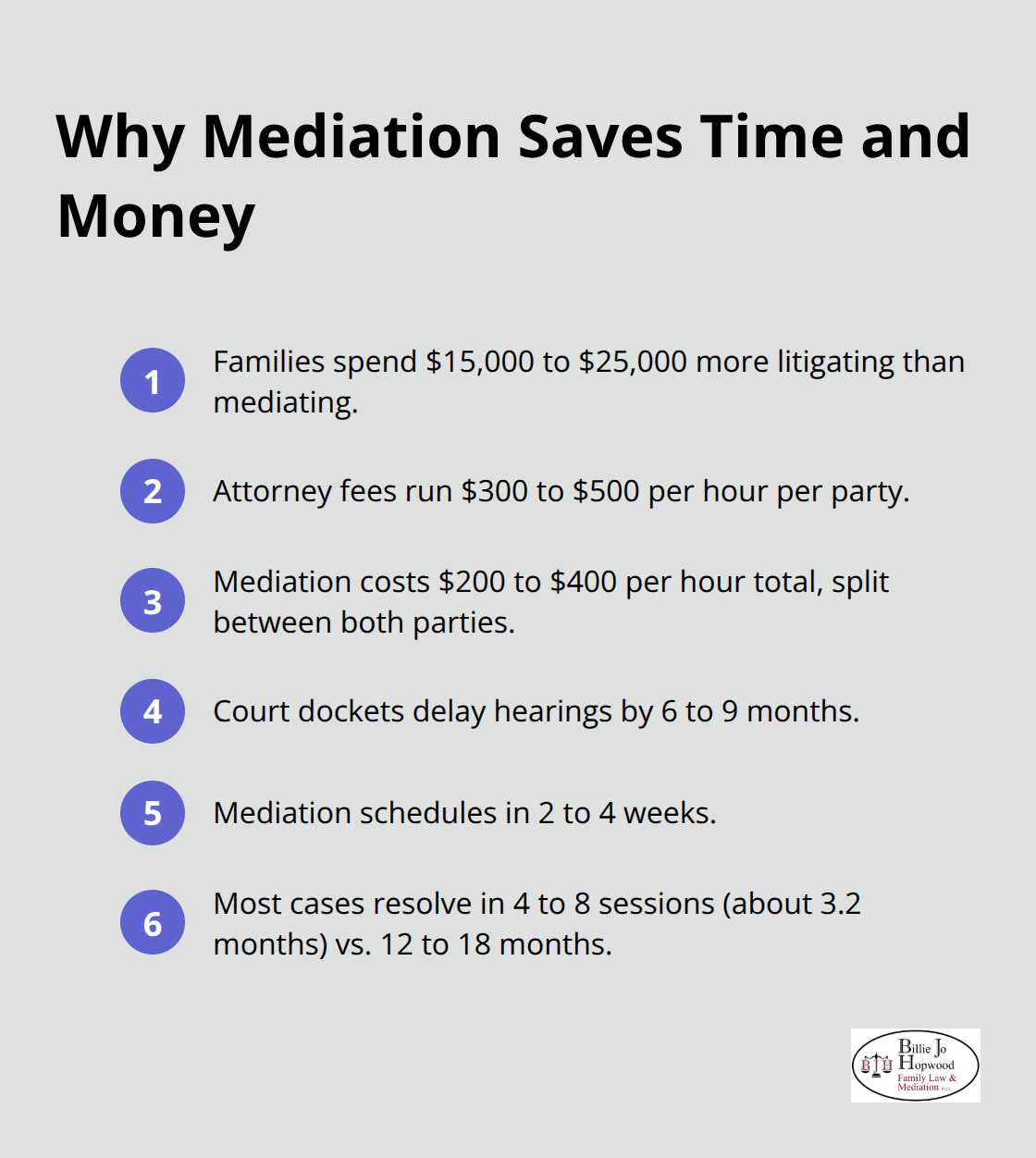
Court litigation in Brevard County drains finances and time in ways most families don’t anticipate. According to Florida State Courts data, families typically spend $15,000 to $25,000 more pursuing litigation compared to mediation. Attorney fees alone run $300 to $500 per hour per party, and that’s before court costs, discovery expenses, and depositions pile up. Mediation sessions cost $200 to $400 per hour total and split between both parties, cutting your actual hourly expense roughly in half.

How Scheduling Delays Add Up

The Eighteenth Judicial Circuit handles over 3,500 family law cases annually, meaning court dockets back up 6 to 9 months before you see a judge. Mediation scheduling happens in 2 to 4 weeks. Most disputes resolve in 4 to 8 sessions, wrapping up in approximately 3.2 months versus the 12 to 18 months litigation typically requires. That difference matters when you’re missing time with your children or waiting to move forward with your life.

Timeline and cost contrasts between mediation and litigation

You Decide the Outcome, Not a Judge

Control over outcomes separates mediation from court decisions in one critical way: you decide what happens, not a judge. In court, a judge reviews your case for perhaps a few hours and makes rulings on parenting time, asset division, and support amounts based on legal standards and their interpretation of facts. Mediation lets you craft solutions that actually fit your family’s needs.

One parent works night shifts while the other manages school pickups; mediation accommodates that reality. You both value flexibility in holiday schedules rather than rigid court-ordered arrangements; mediation builds that in. You want to preserve an amicable relationship for your children’s sake; mediation encourages that cooperation from start to finish.

Compliance Rates Tell the Real Story

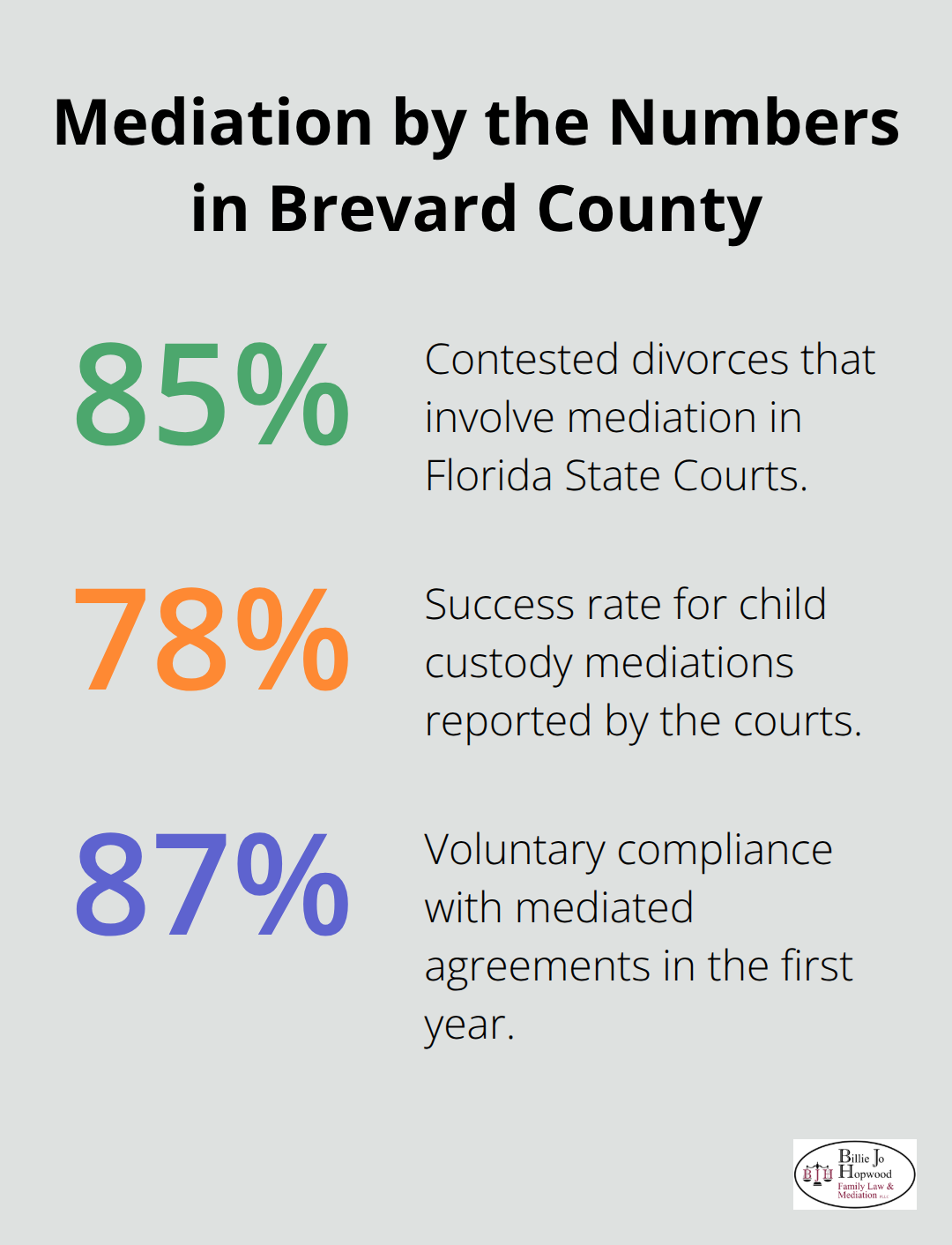
The Florida State Courts data shows 87% voluntary compliance with mediated agreements in the first year, compared to 40% or higher violation rates for many court-ordered arrangements. Once your mediation agreement is filed with the court, it becomes legally binding within 1 to 2 weeks and carries the same enforceability as a court judgment. This higher compliance rate means fewer return trips to court and less conflict down the road.

Understanding these advantages sets the stage for what actually happens inside a mediation session and how the process moves you toward resolution.

What Disputes Does Mediation Actually Resolve in Brevard County

Mediation in Brevard County handles the three categories that consume most family law court time: custody arrangements, support modifications, and asset division. According to Florida State Courts data, approximately 85% of contested divorces involve mediation, and the success rate for child custody mediations reaches 78%. These numbers reflect real families working through disputes that would otherwise drag through months of litigation.

Key mediation statistics from Florida State Courts data - Brevard Florida family mediation

The Eighteenth Judicial Circuit requires mediation for dissolution of marriage and paternity cases before trial, giving you a structured opportunity to settle without a judge’s involvement. Understanding which disputes mediation addresses and how it handles them helps you prepare realistic expectations and identify what actually gets resolved at the table.

Custody and Parenting Time Takes Priority

Child custody disputes drive the majority of mediation orders in Brevard County. Parents negotiate overnight schedules, holiday rotations, and relocation requests that affect time-sharing arrangements. Mediation works here because it lets you address what matters most to your family rather than fitting your situation into a judge’s standard template. One parent may need flexibility for shift work; another may prioritize consistency for school performance. Mediation accommodates both priorities simultaneously.

All parenting plan modifications require mediation even when parents seek changes to primary residence, school district, or extracurricular involvement, according to Florida State Courts data. The mediator guides you through these conversations without dictating outcomes, helping you move from positions like “I want primary custody” to workable proposals like alternating school weeks with flexibility during summer break. This collaborative approach produces agreements parents actually follow, with 87% voluntary compliance in the first year compared to violation rates exceeding 40% for court-ordered arrangements.

Support Modifications and Income Changes

Child support and alimony modifications automatically trigger mediation when income changes exceed 15% or involuntary job loss occurs, per Florida State Courts data. Modifications involving shared custody changes, medical expenses, or college costs typically go to mediation before court hearings. The mediator helps you calculate what changed since the original order and what adjustment makes sense now.

Income dropped 20% after a layoff; the mediator helps quantify how that affects child support. One parent now covers private school tuition; the mediator helps you decide whether to adjust support or split the cost differently. These conversations happen in a private, confidential setting rather than in open court where details become public record. Court-ordered mediation in Brevard follows an income-based fee structure: free mediation for combined income under $50,000; $60 per party for income between $50,000 and $100,000; and over $100,000 requires private mediators at approximately $200 to $500 per hour, according to the court mediation program.

Property and Asset Division Reaches Fair Splits

Property division mediation covers everything from the marital home and vehicles to retirement accounts and business interests. Florida law starts with a 50/50 equitable distribution unless deviations are justified, but mediation lets you negotiate splits that actually work for both of you. One parent keeps the home with a mortgage adjustment; the other takes the investment portfolio and retirement accounts. You divide a family business by one parent purchasing the other’s share over time rather than forcing a sale. You split the pension differently than Florida guidelines would suggest because one parent sacrificed career growth for childcare.

Mediation produces these customized outcomes without a judge reviewing your case for a few hours and issuing orders based on legal standards alone. You bring property records, retirement account statements, and business valuations to mediation, and the mediator helps you work through who keeps what and how to handle joint debts. Most disputes resolve in 4 to 8 sessions within approximately 3.2 months, letting you move forward with clarity rather than waiting 12 to 18 months for trial. Once you understand what mediation resolves, the next step involves learning how the actual process unfolds from your first consultation through your final agreement.

How Mediation Moves From First Conversation to Final Agreement

Schedule Your Mediation and Prepare Your Documents

Your first call to schedule mediation matters more than most people realize. When you contact a mediator in Melbourne, Florida, you answer basic questions about your situation, the issues you need to resolve, and whether court has already ordered mediation or you’re choosing it voluntarily. This initial conversation determines timing and cost structure. Court-ordered mediation in Brevard follows an income-based fee schedule: free mediation for combined household income under $50,000; $60 per party for income between $50,000 and $100,000; and over $100,000 requires private mediators at approximately $200 to $500 per hour according to the court mediation program. Private mediation outside court orders typically costs $200 to $400 per hour total, split between both parties. You’ll schedule your first session within 2 to 4 weeks, far faster than court dockets that push 6 to 9 months into the future.

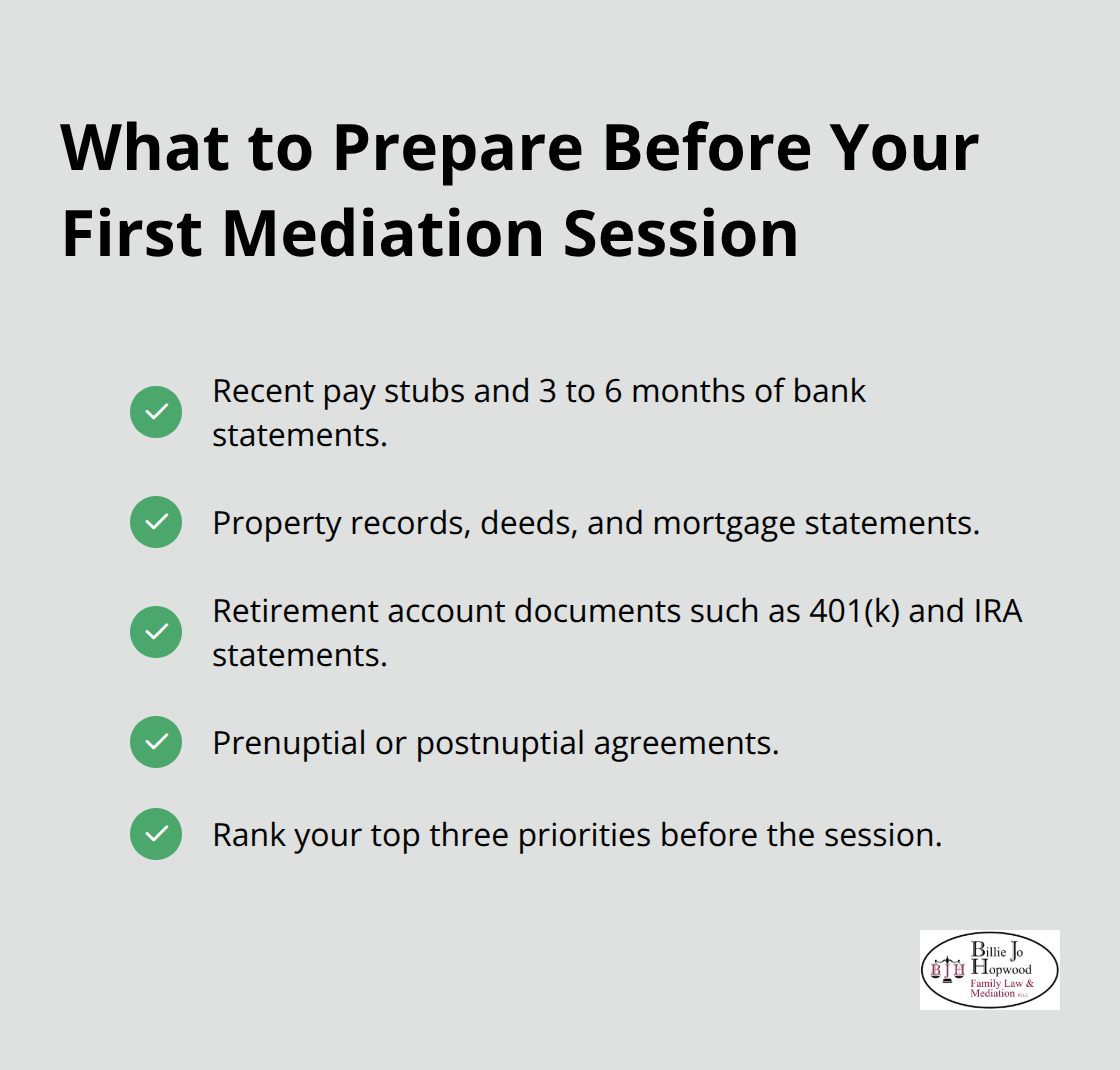
Before that first session, organize your financial documents: recent pay stubs, bank statements from the last 3 to 6 months, property records including deeds and mortgage statements, retirement account documentation like 401(k) and IRA statements, and any prenuptial or postnuptial agreements. Identify your three highest priorities in advance-custody schedule, support amount, or which assets matter most-and rank them.

Checklist of documents and priorities to bring to mediation - Brevard Florida family mediation

This preparation prevents wasted session time and keeps discussions focused on what actually matters to your family.

Understand Confidentiality and the First Session Structure

The mediator opens your first session by outlining the process, establishing ground rules, and confirming both parties understand confidentiality protections. Florida mediation discussions remain confidential and inadmissible in court if mediation fails, which encourages honest conversation without fear your words will be used against you later. The mediator then guides structured dialogue on each issue, sometimes holding joint sessions where you both speak and listen, and sometimes using separate caucus meetings where the mediator shuttles between rooms to understand each person’s concerns privately. This flexibility helps manage high emotions and safety concerns without derailing progress.

Navigate Sessions and Reach Agreements

Most disputes resolve in 4 to 8 sessions over approximately 3.2 months according to Florida State Courts data, though complex cases involving business assets or custody disputes may require additional meetings. Once you reach agreement on an issue, the mediator documents it. When all issues are resolved, the mediator drafts your complete mediation agreement covering parenting time, decision-making authority, child support calculations, and property or debt division with specific deadlines for actions like transferring property or closing joint accounts.

Finalize and File Your Agreement

You review this agreement with an attorney if desired-many people do-before signing. Once signed and filed with the court, your mediation agreement becomes legally binding within 1 to 2 weeks and carries the same enforceability as a court judgment. If mediation stalls on particular issues, you have clear options: take a break and resume later, schedule additional sessions to work through remaining problems, or move forward with partial agreements on resolved issues while pursuing informal post-mediation negotiations on the rest. This structured approach combined with flexibility produces outcomes that actually work for your family rather than forcing you into a judge’s standard template.

Final Thoughts

Brevard Florida family mediation transforms what could stretch into years of courtroom conflict into months of collaborative problem-solving where you control the outcome. Families save $15,000 to $25,000 by mediating instead of litigating, with sessions costing $200 to $400 per hour split between both parties versus $300 to $500 per hour per party in court fees. Most disputes wrap up in 4 to 8 sessions over approximately 3.2 months, compared to 12 to 18 months waiting for trial dates in crowded dockets.

Mediation preserves what matters most: your relationship with your children and your ability to make decisions that fit your family’s actual life rather than a judge’s legal template. Court orders follow standardized approaches and judicial preferences, while mediation agreements reflect your priorities, work schedules, values around parenting, and financial realities. This difference shows up in compliance rates-87% of people follow mediated agreements voluntarily in the first year, compared to violation rates exceeding 40% for many court-ordered arrangements.

Starting mediation means scheduling your first session within 2 to 4 weeks, organizing your financial documents, and identifying your three highest priorities before you walk in. Once you reach agreement, your mediation agreement becomes legally binding within 1 to 2 weeks of filing with the court, carrying the same enforceability as any judge’s ruling. Contact Billie Jo Hopwood Family Law & Mediation, PLLC in Melbourne, Florida to discuss your situation and take the first step toward resolution that works for your family.

Mediation for Alimony Decisions: Guiding Fair Outcomes

Alimony disputes often become the most contentious part of divorce proceedings. When you’re facing decisions about spousal support, mediation for alimony decisions offers a path forward that puts control back in your hands instead of leaving it to a judge.

At Billie Jo Hopwood Family Law & Mediation, PLLC, we’ve seen how mediation transforms these conversations in Melbourne, Florida. Rather than fighting through litigation, you can work toward fair outcomes that both parties can actually live with.

Understanding Alimony and Its Role in Divorce

Alimony is a court-ordered payment from one spouse to the other after divorce. It addresses the financial imbalance that divorce creates, particularly when one spouse earned significantly more or when one spouse stepped back from their career to support the family. Florida courts award alimony based on two primary factors: the requesting spouse’s financial need and the other spouse’s ability to pay. The goal isn’t punishment-it’s helping both parties maintain a reasonable standard of living after the marriage ends. In 2023, Florida’s alimony reform through Senate Bill 1416 eliminated permanent alimony entirely and created four distinct types of support, each tied to specific circumstances and marriage length. This shift means judges now have clearer guidelines, and you have better opportunities to negotiate terms that actually fit your situation rather than accepting a one-size-fits-all court decision.

How Marriage Length Shapes Alimony Duration

The length of your marriage directly determines how long alimony can last. Short marriages under 10 years typically result in alimony lasting about half the marriage duration, while moderate marriages between 10 and 20 years can produce support lasting up to 60 percent of the marriage length. Long marriages of 20 years or more can lead to alimony lasting up to 75 percent of the marriage duration. For example, in a 15-year marriage, a judge could award durational alimony for approximately nine years. These timelines reflect Florida’s policy that longer marriages create deeper financial interdependence, which justifies longer recovery periods. The American Academy of Matrimonial Lawyers suggests a baseline calculation of 30 percent of the higher-earning spouse’s gross income minus 20 percent of the lower-earning spouse’s gross income, though Florida courts have discretion to deviate based on individual circumstances. Understanding these parameters before mediation gives you realistic expectations about what’s negotiable and what falls within judicial standards.

The Four Types of Alimony Florida Courts Award

Temporary alimony provides support during the divorce case itself and ends when the final decree is issued. Bridge-the-gap alimony addresses short-term needs after divorce, lasting no longer than two years and covering transition expenses like moving costs or temporary housing adjustments. Rehabilitative alimony supports a spouse who has a concrete plan to increase earning capacity through education or job training, with duration tied to completing that plan rather than a fixed calendar period. Durational alimony offers fixed-period support that cannot exceed the marriage length and provides stability when neither spouse qualifies for permanent support. A mediator helps you identify which type fits your actual financial situation rather than defaulting to whatever a judge might impose. Someone earning $45,000 annually with no recent work history needs different support than someone earning $75,000 who took time out for childcare. Bringing detailed financial documents-recent pay stubs, tax returns, bank statements, and a realistic post-divorce budget-to mediation ensures you’re discussing real numbers rather than guesses.

What Determines Your Alimony Amount

Florida courts calculate alimony based on need and the other spouse’s ability to pay, not on a fixed formula. The requesting spouse’s financial need must be genuine and documented through actual expenses, not assumptions. The paying spouse’s income, assets, and financial obligations all factor into what they can reasonably contribute. Courts also consider whether one spouse sacrificed career advancement to support the family, which can justify higher or longer support. Age and health matter too-someone nearing retirement or facing health challenges may have limited earning capacity. The standard of living you maintained during the marriage sets the baseline for what’s considered reasonable post-divorce support. Property division can offset alimony needs; a significant asset award to one spouse may reduce ongoing support obligations. Mediation allows you to present these factors directly and negotiate amounts that reflect your actual circumstances rather than waiting for a judge to decide.

Preparing Your Financial Picture for Mediation

Successful alimony mediation requires complete financial transparency from both parties. You need current pay stubs, tax returns from the past two years, bank statements, and a detailed list of monthly expenses for your post-divorce household. Include all debts-mortgages, car loans, credit cards-because they affect what each spouse can actually afford. Calculate your realistic post-divorce budget by listing housing, utilities, insurance, food, transportation, and other regular costs. If you’re seeking rehabilitative alimony, develop a concrete plan showing how education or training will increase your earning capacity and when you’ll complete it. If you’re the paying spouse, document your income sources, existing financial obligations, and any retirement plans that affect your long-term ability to pay. Bringing organized, accurate financial information to mediation positions both parties to reach fair agreements quickly rather than spending months in discovery disputes.

Why Mediation Gives You Control Over Alimony

A Judge Decides in Minutes; You Decide in Mediation

When you go to court, a judge makes your alimony decision in roughly 15 to 30 minutes based on paperwork and testimony. That judge doesn’t know your family, your actual living expenses, or why your situation doesn’t fit neatly into standard guidelines.

Three-point comparison of decision speed, personalization, and long-term impact for mediation versus court. - Mediation for alimony decisions

Mediation flips this entirely. You and your spouse sit down with a neutral mediator and decide together what alimony looks like for your specific circumstances. This matters because alimony affects your housing, your ability to retire, and your financial stability for years or decades.

Customizing Alimony Terms to Your Life

In mediation, you control whether alimony takes the form of a lump sum, monthly payments with step-downs as your earning capacity increases, or terms tied to specific milestones like finishing a degree. You decide if it ends when you remarry, reaches a certain age, or meets other conditions that make sense for both of you. A judge cannot offer that flexibility. If you want alimony to pause during periods of unemployment or adjust when one spouse faces health issues, mediation lets you write those protections directly into your agreement. You’re not arguing in front of a stranger in a courtroom; you’re negotiating real solutions with someone who understands your finances because you’ve both brought complete financial disclosures to the table.

Mediation Costs Far Less Than Court

Mediation also costs substantially less than litigation. A typical contested alimony hearing requires depositions, expert witnesses, discovery disputes, and multiple court appearances that easily run $15,000 to $40,000 or more per spouse in legal fees. Mediation usually takes one to three sessions totaling 6 to 12 hours, costing a fraction of that amount because you avoid discovery battles and courtroom time. You move faster too-mediation typically resolves in weeks or a few months, while court cases drag on for 12 to 24 months. That speed matters emotionally. You’re not spending two years in conflict, wondering if the other spouse will challenge your income claims or hire an expert to dispute your expenses.

Privacy and Dignity Throughout the Process

You reach a decision, both sides sign off, and the agreement becomes binding without a judge ever stepping in. In Melbourne, Florida, where families want to move forward with dignity and minimal disruption, mediation respects both the financial realities and the emotional toll of alimony disputes. You avoid the public record aspect of court too-your financial details, income, and personal circumstances stay private instead of becoming part of a public court file that anyone can access. This privacy protection extends throughout the entire mediation process, keeping sensitive family information confidential while you work toward resolution.

Moving From Control to Fair Outcomes

The control you gain in mediation translates directly into agreements that both parties can actually live with long-term. When you shape the terms yourself rather than accepting a judge’s ruling, you’re more likely to follow through on payments and feel the arrangement is genuinely fair. This foundation of mutual agreement sets the stage for how mediation actually guides fair alimony outcomes-a process that depends on both parties presenting their financial information openly and working together to identify solutions that work.

How Fair Alimony Mediation Actually Works

The mediation process for alimony decisions in Melbourne, Florida succeeds because it forces both spouses to confront actual numbers instead of fighting over emotions or assumptions. When you walk into a mediation session, the neutral mediator does not decide anything for you. Instead, the mediator creates space for you and your spouse to present complete financial information, identify where your interests overlap, and build solutions that reflect your real circumstances rather than generic court formulas. This approach works because alimony is not abstract-it is a monthly payment that affects whether you can keep your home, retire on schedule, or maintain the lifestyle you had during marriage. The mediator’s role is to keep both parties focused on those concrete realities while preventing the conversation from spiraling into blame or resentment.

Transparency Creates the Foundation for Fair Terms

Mediation starts with financial disclosure, and this step determines everything that follows. You and your spouse each bring recent pay stubs, tax returns from the past two years, bank statements, mortgage documents, and a detailed breakdown of your monthly expenses. The American Academy of Matrimonial Lawyers baseline formula-30 percent of the higher earner’s gross income minus 20 percent of the lower earner’s gross income-gives both parties a starting reference point, though your actual agreement will deviate based on what your numbers show. A spouse earning $80,000 annually has a different capacity to pay than one earning $120,000, and a spouse with $2,500 in monthly post-divorce expenses faces different needs than one with $4,000. The mediator ensures both parties understand each other’s financial reality. If one spouse claims they cannot afford $2,000 monthly in alimony but their financial statements show $8,000 in discretionary spending, that contradiction becomes visible immediately. This transparency prevents the months of discovery disputes and expert battles that run up litigation costs. You are not hiding income or inflating expenses to gain advantage; you are laying out the facts so both parties can negotiate from the same baseline.

Building Solutions Around Real Constraints and Opportunities

Once both parties understand the financial picture, the mediator helps identify common ground by separating what is fixed from what is negotiable. If the paying spouse has a mortgage that cannot be refinanced and retirement obligations that are non-negotiable, those constraints shape what alimony can realistically be. If the receiving spouse has a concrete plan to complete job training within 18 months and increase earnings from $35,000 to $55,000 annually, that trajectory affects whether rehabilitative alimony makes sense or whether durational alimony with a step-down schedule works better. The mediator facilitates this discussion in separate rooms if needed, allowing each spouse to talk candidly with their attorney about what they can accept without feeling pressured by the other party’s presence. You might propose $2,400 monthly for five years, and your spouse counters with $1,800 for six years. A mediator helps you evaluate whether the longer duration or lower monthly amount better protects your financial stability or respects the paying spouse’s retirement timeline. This negotiation happens within the guardrails of Florida law-you cannot agree to something that violates statutory limits-but within those boundaries, the solutions are entirely yours to shape.

Customized Terms That Reflect Your Actual Situation

One couple structures alimony as a lump sum to avoid ongoing conflict, while another arranges monthly payments with automatic adjustments tied to cost-of-living increases. A third ties the alimony amount to specific milestones like completing a degree or reaching a certain age. These customized terms emerge because mediation treats alimony as a problem to solve together rather than a battle to win. The paying spouse might request that alimony pauses during periods of unemployment or adjusts when health issues limit earning capacity. The receiving spouse might want protections that ensure payments continue if the other spouse relocates or changes jobs. Mediation allows both parties to write these protections directly into their agreement without waiting for a judge to consider them. You control the outcomes and decide whether alimony takes the form of a lump sum, monthly payments with step-downs as earning capacity increases, or terms tied to specific milestones. You decide if it ends when you remarry, reaches a certain age, or meets other conditions that make sense for both of you. A judge cannot offer that flexibility. In Melbourne, Florida, where families want to move forward with dignity and minimal disruption, mediation respects both the financial realities and the emotional toll of alimony disputes. You reach a decision, both sides sign off, and the agreement becomes binding without a judge ever stepping in. Your financial details, income, and personal circumstances stay private instead of becoming part of a public court file that anyone can access.

Final Thoughts

Mediation for alimony decisions puts you in control of outcomes that shape your financial life for years to come. Unlike court, where a judge makes your alimony decision in minutes based on paperwork alone, mediation lets you and your spouse work together to build terms that fit your actual circumstances. You decide the amount, duration, payment structure, and any special conditions that protect both parties.

The financial advantages matter significantly. Mediation costs a fraction of what litigation demands, saving you thousands in legal fees while resolving your alimony dispute in weeks or a few months instead of years. Your financial information stays private instead of becoming part of a public court record, and you avoid the emotional toll of prolonged conflict and courtroom battles.

Start with complete financial transparency and realistic expectations grounded in Florida law. Bring your pay stubs, tax returns, and detailed expense lists to mediation, and work with a mediator who keeps both parties focused on actual numbers rather than emotions or assumptions. Contact Billie Jo Hopwood Family Law & Mediation, PLLC in Melbourne, Florida to discuss how mediation can resolve your alimony situation while protecting your financial future.

Mediation Agreement Enforceability: Keeping Your Settlement Secure

You reached a mediation agreement in your divorce, and now you need to know it will actually hold up in court. A mediation agreement is only as strong as the foundation you build during and after the process.

At Billie Jo Hopwood Family Law & Mediation, PLLC, we see families protect their settlements by understanding what makes mediation agreement enforceability possible under Florida law. This guide walks you through the legal requirements, common pitfalls, and concrete steps to keep your settlement secure.

What Florida Law Actually Requires for Your Settlement

The Written Agreement Standard

Florida Statute 44.102 sets a clear standard: your mediation agreement must be in writing and signed by both parties to be enforceable. This isn’t optional. Courts in Florida will not enforce a handshake or a verbal agreement, no matter how sincere both sides were during mediation. The statute requires that the agreement contain all material terms-exact dollar amounts, deadlines, asset descriptions, and custody schedules with specific days and times.

Key elements that make a Florida divorce mediation agreement enforceable

Vague language like “reasonable support” or “as agreed” creates enforceability problems later. When one party refuses to follow the agreement, you file a Motion to Enforce the Mediation Settlement in the original court, and the judge will examine whether your written document actually says what you claim it says. If the terms are ambiguous, the court may refuse to enforce them or interpret them against the party who drafted the agreement. This is why drafting matters from day one.

Signatures and Electronic Documentation

Signatures carry real weight in Florida mediation law. Both spouses must sign the final agreement; as of April 1, 2025, authorized representatives with full settlement authority can sign in civil mediations, but family law mediations in divorce still require both parties’ signatures. Electronic signatures are valid if the platform provides a reliable execution record-DocuSign and Adobe Sign both create audit trails that courts accept. The signed agreement becomes a contract immediately, but it gains stronger enforcement power once you file it with the court and a judge approves it, which typically takes two to four weeks. At that point it becomes a court order, giving you access to contempt findings and wage garnishment if the other party violates it.

Intent, Disclosure, and Legal Review

Your mutual intent and good faith during mediation also matter, though courts will not second-guess a settlement just because one party later regrets the bargain. What courts do examine is whether both parties had full financial disclosure, understood the terms they were signing, and signed voluntarily without coercion or threats. Your attorney should review the final agreement before you sign-even if they were not present at the mediation table-to catch calculation errors, missing terms, and language that could haunt you later. This step prevents costly disputes over what the agreement actually obligates you to do, and it protects your interests before you commit to the settlement. Understanding these requirements positions you to identify the common pitfalls that derail many mediation agreements after they leave the mediation room.

Common Reasons Mediation Agreements Fail and How to Prevent Them

Ambiguous Language Destroys Enforceability

Vague language destroys enforceability faster than almost anything else. Courts in Florida refuse to guess what you meant when you wrote terms like “reasonable support” or “flexible custody arrangements.” The American Bar Association reports that financial deception ranks among the top reasons mediation agreements fail enforcement, but poor drafting runs a close second. When you sit down to sign your agreement, every dollar amount must be exact, every deadline must specify a date and time, and every asset must be described with precision.

Instead of writing “John receives the house,” write “John receives the residence located at 1234 Maple Street, Brevard County, Florida, with legal description provided as Exhibit A, transfer to occur by June 15, 2026, with deed prepared by John’s attorney and recorded within five business days.” This level of detail prevents the other party from later claiming they thought something different or that the terms were too vague to enforce. If you file a Motion to Enforce the Mediation Settlement and the language is ambiguous, the judge interprets it against the drafter, which means sloppy wording costs you money and time.

Hidden Assets and Incomplete Financial Disclosure

Hidden assets and incomplete financial disclosure create a second category of failure that leads directly to court challenges. One party fails to disclose retirement accounts, rental properties, or business interests during mediation, signs the agreement anyway, and later the other party discovers the concealment. Florida courts can void the agreement or reopen it for modification if fraud or nondisclosure is proven, but proving it requires evidence and additional litigation.

Before you walk into mediation in Melbourne or anywhere in Florida, both parties must exchange complete tax returns for the past three years, bank statements, retirement account statements, real estate deeds, and documentation of any business ownership. This exchange should happen before the mediation session, not during it, so both sides have time to review and verify.

Checklist of documents both parties should exchange before mediation - Mediation agreement enforceability

If one party refuses to disclose or produces incomplete documents, your attorney must flag this immediately and insist on full disclosure before any agreement is signed. The burden of proof falls on the party claiming disclosure was complete, which means you need a documented paper trail showing what was exchanged and when.

Legal Review Before Signing Prevents Costly Mistakes

Signing without legal review is the mistake most parties make, and it is entirely preventable. Your attorney does not need to sit at the mediation table to protect you, but they absolutely must review the final agreement before you sign. Courts cannot undo a settlement just because you later regret it, but they can enforce it against you with full force.

An attorney catches calculation errors in child support that deviate from Florida guidelines, identifies missing terms like health insurance responsibility or tax filing status, and spots language that obligates you in ways you did not intend. Two hours of legal review before signing saves thousands in enforcement disputes afterward. This review step transforms a risky handshake into a defensible contract that holds up when tested in court.

Once you understand what causes agreements to fail, the next step is taking concrete action to protect your settlement after mediation concludes.

Securing Your Agreement After Mediation

Act Within 24 Hours of Signing

The mediation room door closes behind you, agreement in hand, and the real work starts immediately. Within 24 hours of signing, you need a clear action plan. First, obtain a fully executed copy with all signatures from the mediator or the other party’s attorney. Second, have your attorney review it right away for any last-minute errors or missing terms that slipped through. Do not wait days or weeks to do this review; ambiguities that seemed minor in the mediation room become expensive problems once the agreement is filed.

Organize Your Documentation Package

Gather all supporting documents referenced in the agreement-asset schedules, parenting plans, property descriptions, and support calculations-and organize them in a single folder with the original signed agreement. This documentation package becomes your evidence if enforcement becomes necessary later. Calendar every deadline in the agreement with reminders set for two weeks before each one, so you stay ahead of performance obligations and catch any delays immediately.

File Your Agreement with the Court

Filing the agreement with the court transforms a binding contract into a court order, which gives you access to enforcement tools that a standalone contract does not provide. Work with your attorney to prepare the Motion to File Mediation Settlement Agreement and supporting paperwork, then submit it to the clerk in Brevard County within two to four weeks of signing-the sooner you file, the sooner the judge can approve it. Courts typically process and approve mediation agreements within two to four weeks if there are no issues, but delays happen when documents are incomplete or terms appear inconsistent with Florida law.

Steps and timing to file your mediation agreement and obtain court approval - Mediation agreement enforceability

Leverage Court Order Enforcement Power

Once a judge signs the order, you move from contract enforcement to contempt enforcement, meaning the other party faces fines or wage garnishment for violations instead of just a damages claim. This shift in enforcement power makes court approval worth the effort and paperwork. The other party now faces real consequences for non-performance, not merely a civil lawsuit.

Build Your Enforcement Documentation Trail

Documentation throughout the entire process-emails confirming performance, photos of completed obligations, bank statements showing payments, dated text messages-creates the paper trail you need if you ever file a Motion to Enforce the Mediation Settlement. Keep copies of every communication with the other party about implementation, every receipt for payments made, and every confirmation of assets transferred. If the other party fails to perform, this documentation proves the breach and strengthens your position in enforcement court.

Final Thoughts

Your mediation agreement holds up in court only when you treat it as a legal document from the moment you sign it, not as a handshake that will sort itself out later. The foundation for mediation agreement enforceability rests on three pillars: a written agreement with precise terms, complete financial disclosure from both parties, and legal review before you commit. Courts in Florida will not rewrite a settlement because you regret it, but they will enforce it with full force once it becomes a court order.

The moment to seek legal guidance is before you sign, not after. Your attorney should review the final agreement while you still have the chance to request changes, catch errors in child support calculations, and verify that all material terms are included. If you are in Melbourne or anywhere in Brevard County, this review step is non-negotiable, because after you sign, your options narrow significantly and courts will hold you to the language you agreed to.

We at Billie Jo Hopwood Family Law & Mediation, PLLC understand that mediation offers a path forward that avoids the cost and conflict of trial, but only when the agreement that results is actually enforceable. If you are preparing for mediation or have already reached a settlement that needs protection, contact us to review your agreement and move forward with confidence in your settlement.

Alimony Guidelines Brevard: Understanding Your Settlement Options

Alimony decisions in Brevard County affect your financial future for years to come. The alimony guidelines Brevard courts follow depend on your income, marriage length, and lifestyle during the relationship.

At Billie Jo Hopwood Family Law & Mediation, PLLC, we help you understand what settlement options actually work for your situation. This guide walks you through how alimony gets calculated, what types exist, and how to negotiate terms that protect your interests.

How Alimony Is Calculated in Brevard County

Income Considerations and Wage Calculations

Alimony calculations in Brevard County start with income, but courts examine far more than your salary. They review all income sources, including bonuses, rental income, investment returns, and business profits. If you’re self-employed, courts often impute income based on tax returns from the past three years, which means they may calculate your earnings higher than what you actually reported. The American Academy of Matrimonial Lawyers suggests a rough guideline: approximately 30% of the payer’s gross annual income minus 20% of the payee’s gross annual income. This is not a formula courts must follow, but it gives you a realistic starting point for what settlement discussions might look like.

Your earning capacity matters as much as current income. If you took years away from work to raise children or support your spouse’s career, courts may still assess your ability to earn based on education, skills, and work history. This protects spouses who sacrificed income-earning years but also means you should gather evidence showing realistic earning potential if circumstances have changed. Courts also consider assets and resources beyond monthly income. If you have substantial savings, investment accounts, or property, this factors into whether alimony is needed and how much. The payee’s total income, including any alimony received, cannot exceed 40% of the couple’s combined gross income-this is a hard ceiling in Florida law.

Visual summary of Florida alimony percentages: 30/20 guideline and 40% income cap. - Alimony guidelines Brevard

Duration of Marriage and Standard of Living

Your marriage length determines which alimony type applies and for how long. Marriages under 10 years are considered short-term, 10 to 20 years are moderate-term, and 20 years or longer are long-term. For short-term marriages, durational alimony typically runs for up to 50% of the marriage length.

Quick reference for Florida’s durational alimony caps by marriage length: 50%, 60%, 75%.

Moderate-term marriages cap at 60% of the marriage duration, while long-term marriages can reach 75%. The court’s reference point is your divorce filing date, not when you stopped living together, which affects how they assess your marital standard of living.

Courts weigh the lifestyle you both enjoyed during marriage heavily-this is the foundation for determining need and ability to pay. The standard of living you maintained together becomes the benchmark for what alimony should preserve after divorce.

Other Factors Courts Review in Alimony Decisions

Your age and health status directly influence alimony decisions. Courts recognize that older spouses or those with health conditions may struggle to become self-supporting, which strengthens arguments for durational or permanent support. Parental responsibilities also matter-if you have custody of children, courts understand childcare limits your earning capacity. Contributions to the marriage beyond finances count too. If you managed the household, raised children, or enabled your spouse’s career advancement, courts recognize this as valuable contribution.

Adultery or financial misconduct by either spouse can shift alimony outcomes significantly. You should gather documentation showing your standard of living during marriage, current financial needs, and any health or age-related limitations to support your position. These factors work together to shape what a court will award, and understanding how they interact helps you prepare for settlement negotiations with realistic expectations about what your case might yield.

Types of Alimony Available in Florida

Temporary Alimony During Divorce Proceedings

Temporary alimony runs only during your divorce case and stops the moment the final decree enters. This type bridges the financial gap while lawyers and courts handle your case. If you earn significantly more than your spouse and the divorce stretches over 18 months, temporary alimony might provide $2,000 to $4,000 monthly depending on income differences and your standard of living. The court awards this based on immediate need and your ability to pay without compromising your own living expenses.

Bridge-the-Gap and Short-Term Support Options

Bridge-the-gap alimony maxes out at two years and cannot be modified once ordered, making it useful for short-term needs like education costs or transitional housing after separation. This type works well when both parties agree that financial support for a defined period solves the problem cleanly. The structure provides certainty-you know exactly when payments end and cannot face requests for modification later.

Rehabilitative Alimony for Career Development

Rehabilitative alimony funds a concrete plan to make your spouse self-supporting through education or career training, typically lasting up to five years. Courts require a detailed plan showing exactly how funds advance employment goals; vague intentions fail. Presenting a clear career plan and budgeting how funds will be used significantly increases approval odds. This approach works best when your spouse has a realistic path back to the workforce and can document the steps needed to reach that goal.

Durational Alimony and Long-Term Support

Durational alimony provides monthly payments for a set number of years after divorce and cannot exceed your marriage length. For a 15-year marriage, durational alimony might run nine years at roughly 60% of the marriage duration, with amounts adjustable if circumstances change substantially. The amount can shift if either party experiences significant financial changes, though the total duration rarely extends beyond the original order.

How Senate Bill 1416 Changed Everything

Permanent alimony existed under old Florida law but Senate Bill 1416, signed into law July 1, 2023, eliminated it entirely. This reform shifted the entire landscape-long marriages no longer automatically trigger lifetime support. Instead, marriages of 20 years or more now qualify for durational alimony running up to 75% of the marriage length, which could mean 15 years of payments rather than indefinite support.

The tax treatment of alimony also changed dramatically. For divorces finalized after January 1, 2019, alimony is no longer deductible by the payer and not taxable to the recipient, reversing decades of practice. This matters enormously-if you pay $24,000 annually in alimony, you cannot deduct it, reducing the benefit to your tax situation. If you receive it, you owe no federal income tax on those payments. When negotiating payment terms and duration, both sides must account for this tax reality.

The American Academy of Matrimonial Lawyers suggests roughly 30% of the payer’s gross annual income minus 20% of the payee’s gross annual income as a starting point, but actual awards vary widely based on marriage length and standard of living. A spouse earning $100,000 annually might face alimony of $10,000 to $15,000 monthly in a long marriage with a dependent spouse, or $2,000 to $3,000 monthly in a short marriage where the other party works.

Duration rules based on marriage length create predictability. Short marriages under ten years cap at 50% of marriage duration, moderate marriages from ten to twenty years cap at 60%, and long marriages of twenty years or more extend to 75%. Judges can deviate from these caps based on specific circumstances, but they provide realistic boundaries for settlement planning. Understanding which type applies to your situation and how the 2023 reform affects your case shapes everything about how you approach negotiations with your spouse.

Negotiating Your Alimony Settlement

Why Mediation Accelerates Settlement

Mediation offers a faster path to settlement than courtroom litigation, and for alimony disputes, speed matters because temporary alimony stops the moment your divorce finalizes. When you sit down with a mediator in Melbourne, Florida, both you and your spouse work toward agreement rather than waiting for a judge to decide. Mediators help you identify what each party actually needs and where compromise exists. The process typically takes weeks or a few months, not years. You control the outcome instead of handing that power to a judge who knows nothing about your relationship or financial realities. Most importantly, mediation costs substantially less than litigation-expect to pay $5,000 to $15,000 in mediation fees versus $25,000 to $50,000 or more in attorney fees for a contested court battle.

Hub-and-spoke graphic showing mediation advantages: speed, cost, control, focus, and reduced risk. - Alimony guidelines Brevard

This savings matters when alimony itself will stretch your finances.

Understanding Realistic Payment Ranges

Knowing realistic payment ranges prevents you from anchoring to fantasy figures that waste everyone’s time. If you earn $120,000 annually and your spouse earns $40,000, the American Academy of Matrimonial Lawyers guideline suggests roughly $24,000 yearly (30% of $120,000 minus 20% of $40,000), or $2,000 monthly. In a 12-year marriage, durational alimony might run seven years at that amount. If your marriage lasted 22 years, durational alimony could extend 16 or 17 years at similar or slightly adjusted amounts depending on other factors.

Settlement discussions work best when both parties understand these ranges. Temporary alimony during divorce typically runs 15% to 20% higher than permanent awards because it covers a shorter window and bridges an immediate gap. If you face paying $3,000 monthly in temporary support, expect durational alimony of $2,200 to $2,500 once the divorce concludes. Tax treatment affects real take-home impact-if you receive $24,000 yearly in alimony post-January 2019, you keep all of it with no federal tax liability. If you pay it, you receive no deduction, meaning the actual cost exceeds the payment amount when accounting for taxes you still owe on your income.

Verifying Income and Earning Capacity Claims

This is where settlements collapse if you lack documentation. If your spouse claims reduced earning capacity due to health issues or years away from work, request recent medical records and a detailed plan showing why employment remains impossible. Courts in Brevard County impute income for self-employed spouses using three-year tax return averages, so if your spouse’s business income fluctuates, use that proven formula rather than accepting their claim of current hardship.

If you earned $150,000 five years ago but now earn $90,000, bring tax returns showing the decline-courts won’t assume your income dropped without evidence. Conversely, if your spouse claims you’re capable of earning more than you currently do, prepare education credentials and job market data supporting your actual earning potential. The payee’s total income including alimony cannot exceed 40% of combined gross income, which creates a hard ceiling on what either party can demand. When disagreement stalls negotiations, propose an independent financial evaluation or income verification process rather than litigating the point for months.

Final Thoughts

Alimony guidelines Brevard County courts apply rest on three pillars: your income, your marriage length, and the standard of living you maintained together. The 2023 reform eliminated permanent alimony and tied durational awards to marriage length, which fundamentally shifted how long-term marriages settle. Tax treatment changed too-divorces finalized after January 2019 mean payers receive no deduction and recipients owe no federal tax, a reality that reshapes what settlement numbers actually mean to your household budget.

You strengthen your position by gathering three years of tax returns, documenting your standard of living during marriage, and identifying your realistic earning capacity before settlement talks begin. If you’re self-employed, courts will average your income across three years rather than accepting current-year claims. If health issues or caregiving responsibilities limit your earning potential, collect medical records and documentation showing why employment remains unrealistic (this evidence matters far more than verbal claims).

Settlement through mediation beats courtroom battles on cost, speed, and control-you decide the outcome rather than handing that power to a judge. Contact us at Billie Jo Hopwood Family Law & Mediation, PLLC to discuss how mediation can move your settlement forward and protect your financial future.

Parenting Plan Melbourne: Structuring Co-Parenting for Stability

Co-parenting after separation requires more than good intentions. A solid parenting plan Melbourne provides the framework that keeps children stable while reducing conflict between parents.

We at Billie Jo Hopwood Family Law & Mediation, PLLC see firsthand how the right structure transforms co-parenting relationships. This guide walks you through building a plan that actually works for your family.

What Makes a Strong Parenting Plan

Specific Times and Locations Matter

A strong parenting plan must specify exact times, not vague language. Instead of saying your child spends time with each parent, state that Monday through Friday exchanges happen at 3:15 p.m. at the school pickup location, and Friday evening transitions to the other parent at 6:00 p.m. at home. Research from the Raising Children Network shows that children thrive when routines are predictable and consistent across both households. The 12th Judicial Circuit in Florida approves four parenting plan frameworks-Basic, Long Distance, Highly Structured, and Safety Focused-each with detailed instructions and assessments to match your family’s actual situation.

Your plan should assign who handles school drop-offs, after-school care, bedtime routines, homework supervision, and extracurricular activities. Without this level of detail, parents end up negotiating the same issues repeatedly, creating conflict that children absorb.

Visualization of the key components that make a parenting plan effective

Clear Decision-Making Authority

Decision-making authority must be equally clear. Specify which parent makes medical decisions, educational choices, religious upbringing decisions, and major purchases. Many plans assign joint decision-making for significant matters while giving each parent authority over day-to-day choices in their home.

Communication Channels and Documentation

Communication between parents matters more than most people realize. About 85 percent of families using mediation report satisfaction with the process, according to the Florida Dispute Resolution Center, partly because mediation establishes communication frameworks that stick. Try a single channel-email, a co-parenting app like OurFamilyWizard or TalkingParents, or scheduled phone calls-rather than mixing texts, calls, and in-person conversations that breed misunderstandings.

Percentage of families reporting satisfaction with mediation in Florida - parenting plan Melbourne

Document everything. When you use a communication tool consistently, you create a record that protects both parents and prevents disputes about what was agreed (this documentation becomes critical if enforcement becomes necessary later). The plan should also include makeup time provisions for when one parent misses scheduled time due to illness, work emergencies, or travel, with clear conditions about how quickly that time must be rescheduled.

Over 75 percent of family law mediations result in full or partial agreements, the Florida Dispute Resolution Center reports, because mediation helps families build realistic plans they can actually follow rather than court-imposed orders that ignore real-world logistics. These structured agreements set the stage for addressing the conflicts that inevitably arise during co-parenting.

Common Challenges in Co-Parenting and How to Address Them

When Parenting Styles Clash

Co-parents often disagree on everything from screen time rules to bedtime hours to how strictly homework gets enforced. One parent runs a structured household with early bedtimes and limited devices; the other takes a relaxed approach. Rather than fight over whose way is right, the practical solution is to allow each parent autonomy within their own home while maintaining consistency on non-negotiables that directly affect the child’s health or safety. Bedtime can shift between households, but both parents should agree that the child attends school on time and receives necessary medical care. This separation of concerns eliminates endless battles over parenting philosophy while protecting what actually matters.

Handling Changes in Circumstances

When circumstances change-a job relocation, a new partner, a school transfer, or financial shifts-the original plan becomes unworkable. Florida courts recognize that life happens, and modifications are possible when there is a substantial change in circumstances. Rather than ignore the broken plan and create a new conflict, file a formal modification request with the court. This keeps everything documented and prevents years of resentment over an agreement neither parent can follow. Changes in a child’s needs matter too. A teenager may want different scheduling than a six-year-old, and a plan should adapt as your child grows.

Resolving Disputes Without Court Involvement

Disputes between co-parents rarely resolve themselves through willpower or repeated arguments. Mediation offers a structured alternative where a neutral third party helps both parents communicate without the expense and timeline of court intervention. Sessions typically last about three hours and focus on identifying each parent’s concerns and exploring solutions together. Mediation costs around $300 per hour for unrepresented parties in Florida, substantially less than litigation that can stretch years and drain tens of thousands in legal fees. The Florida Dispute Resolution Center reports that over 75 percent of family law mediations produce full or partial agreements, meaning most families actually reach workable solutions outside a courtroom.

When mediation produces an agreement, the mediator creates a memorandum of understanding that becomes legally binding once signed and filed with the court. Documentation tools matter during disputes too. If one parent consistently violates the plan-missing exchanges, refusing to pay for activities, or interfering with scheduled time-use a co-parenting app like OurFamilyWizard or TalkingParents to record every violation with dates and times. This documentation becomes critical evidence if you later need to pursue enforcement through the court. Attempt resolution directly first to show good faith and often prevent escalation. Only after genuine attempts at cooperation fail should you involve attorneys or courts. These enforcement steps and documentation practices set the stage for creating a plan that actually holds up in your specific Melbourne community.

Creating a Parenting Plan That Works in Melbourne Florida

Choose the Right Framework for Your Family

The 12th Judicial Circuit in Florida provides four approved parenting plan frameworks-Basic, Long Distance, Highly Structured, and Safety Focused-each designed to match different family situations. The Basic plan works for families with straightforward schedules and low conflict. The Long Distance plan addresses travel logistics when parents live far apart. The Highly Structured plan provides detailed timetables for complex work schedules or multiple children with different activities.

Compact list of the four approved parenting plan frameworks and their purposes - parenting plan Melbourne

The Safety Focused plan includes provisions when child safety concerns exist. Each framework comes with specific instructions and assessments to help you choose correctly rather than guessing. Using these circuit-approved forms matters because they ensure consistency with what Melbourne courts expect and accept. Starting with the right framework prevents costly modifications later.

File With or Without an Attorney

The 12th Judicial Circuit provides Pro Se forms and instructions if you file without an attorney. However, working with a family law professional ensures your plan actually protects your rights and your child’s interests. An attorney can identify gaps in your plan that you might miss and ensure the document meets all local requirements.

Build Flexibility Into Your Agreement

Flexibility prevents your plan from becoming obsolete within months. Specify makeup time provisions that actually work-if one parent misses a weekend due to illness, state exactly how many days must be rescheduled and by when, rather than leaving it vague. Include contingency plans for school closures, weather emergencies, or unexpected work demands. Address how you’ll handle schedule changes when your child starts new activities or switches schools. Document exchange locations and times precisely, but also include a process for requesting changes when life shifts.

Create a Modification Process That Works

Many parents fail here. They create rigid plans that ignore reality, then abandon the plan entirely when circumstances change. Instead, establish a modification process that doesn’t require court intervention for minor adjustments. Co-parenting apps like OurFamilyWizard and TalkingParents let both parents propose and track changes in real time, creating a documented trail that protects everyone. This documentation becomes critical if disputes arise later-you’ll have clear evidence of what was agreed, what changed, and who agreed to each modification.

Final Thoughts

A parenting plan Melbourne that actually works combines three essential elements: specific scheduling with exact times and locations, clear decision-making authority for medical and educational choices, and documented communication between parents. Without these foundations, co-parents spend years renegotiating the same conflicts while children absorb the tension. The 12th Judicial Circuit’s four approved frameworks-Basic, Long Distance, Highly Structured, and Safety Focused-give you a proven starting point rather than forcing you to build from scratch.

Mediation transforms how families approach these plans. When both parents work with a neutral mediator, they move beyond blame and defensiveness into problem-solving mode. The Florida Dispute Resolution Center reports that over 75 percent of family law mediations produce full or partial agreements, and about 85 percent of participants report satisfaction with the process (this matters because mediation-built plans reflect real-world logistics and both parents’ actual concerns, making them far more likely to stick than court-imposed orders). Mediation also costs around $300 per hour compared to litigation that stretches years and drains tens of thousands in legal fees.

Your parenting plan will need adjustments as circumstances change, so build flexibility into your agreement from the start with clear modification processes and makeup time provisions. Use co-parenting apps to document changes and communication, creating a trail that protects everyone if disputes arise. When conflicts emerge that you cannot resolve directly, contact our firm in Melbourne, Florida to explore how mediation and professional guidance can help you structure a parenting plan that serves your family’s actual needs.