Blog

Family Law Legal Terms Every Parent Should Know

Family law legal terms can feel overwhelming when you’re navigating custody arrangements, support obligations, or court procedures. Parents in Melbourne, Florida often find themselves confused by unfamiliar language that shapes critical decisions about their children and finances.

We at Billie Jo Hopwood Family Law & Mediation, PLLC created this guide to break down the terminology you’ll encounter. Understanding these terms puts you in control of your family’s future.

Parental Responsibility and Time-Sharing in Florida

Understanding Parental Responsibility and Time-Sharing

Florida courts no longer use the word custody, instead referring to parental responsibility and time-sharing. Parental responsibility defines who makes major decisions about your child’s education, healthcare, religion, and extracurricular activities. Time-sharing describes where your child lives and how many days they spend with each parent. These two concepts operate independently, which means one parent can hold parental responsibility for educational decisions while time-sharing is split evenly. Courts increasingly favor shared parental responsibility whenever safe, according to the Florida Chapter of the Association of Family and Conciliation Courts. In shared arrangements, both parents must consult on major decisions, though one parent can hold ultimate decision-making authority if disagreements arise. Sole parental responsibility goes to one parent only, typically when abuse, neglect, or serious instability exists.

Selecting a Time-Sharing Schedule That Works

Your time-sharing schedule comes in several formats, each with distinct advantages. The 1-week-on/1-week-off rotation provides consistency for school routines but requires frequent transitions. The 2-2-5-5 schedule alternates two days with one parent, two days with the other, then five days with the first parent again, reducing adjustment time for young children. The 3-4-4-3 rotation works well for parents with flexible work schedules.
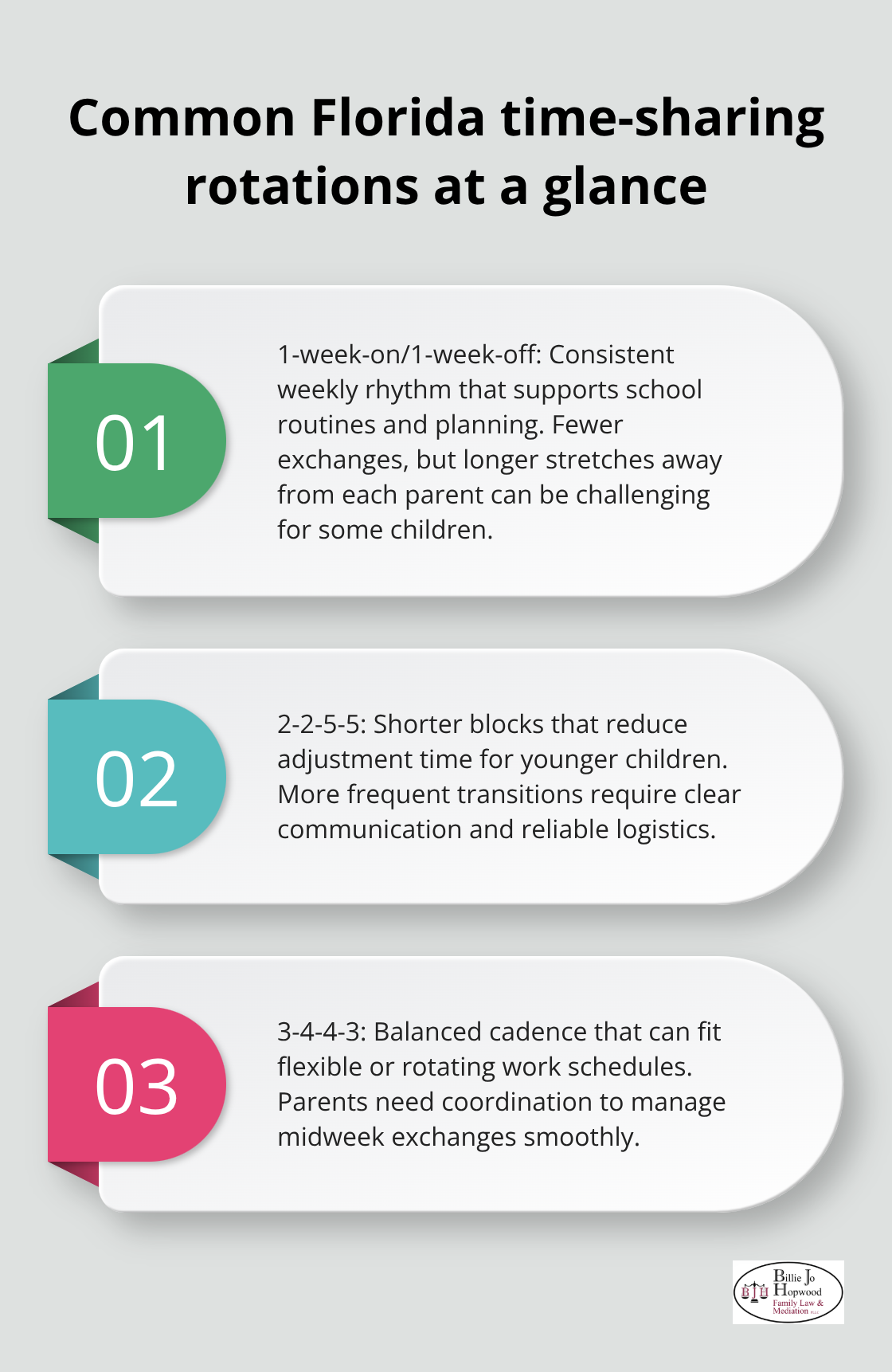
Infographic comparing 1-week-on/1-week-off, 2-2-5-5, and 3-4-4-3 time-sharing schedules - family law legal terms

Courts evaluate each parent’s involvement in daily life, home stability, health, and ability to support the child’s relationship with the other parent before deciding arrangements. Your parenting plan must specify these details in writing, including transportation responsibilities, exchange locations, and holiday schedules, turning general principles into actionable logistics.

Building a Practical Parenting Plan

Your parenting plan becomes your operational manual for raising your child across two households. A well-drafted plan reduces ongoing conflict because expectations are explicit rather than assumed. Include contingencies for school changes, emergency procedures, and unexpected schedule conflicts. Courts in the 12th Judicial Circuit offer four standardized parenting plans-Basic, Long Distance, Highly Structured, and Safety Focused-designed to address different family scenarios. The Basic plan suits parents with standard scheduling needs. Long Distance accommodates parents separated geographically. Highly Structured works for families needing detailed daily routines. Safety Focused prioritizes protection when domestic violence or substance misuse is a concern.

When Circumstances Change

When both parents agree on all terms, courts typically approve uncontested arrangements quickly if they serve the child’s best interests. This path avoids lengthy litigation and preserves resources for your family’s future. If circumstances change significantly-a job relocation, health issues, behavioral concerns, or evolving child needs-you can petition for modification by showing substantial material change. Courts take these requests seriously because stability matters for child development, yet they also recognize that rigid plans fail real families. Financial support obligations often tie directly to your time-sharing arrangement and parental responsibility designation, which is why the next section addresses how courts calculate and adjust child support payments.

How Child Support and Financial Obligations Connect to Your Family Structure

Income Shares Model and Time-Sharing Impact

Your time-sharing arrangement directly determines your child support obligation in Florida. The state calculates child support using the income shares model, which considers both parents’ gross monthly income and the percentage of time each parent spends with the child. A parent earning $60,000 annually with 40% time-sharing pays less than a parent earning the same amount with only 20% time-sharing.
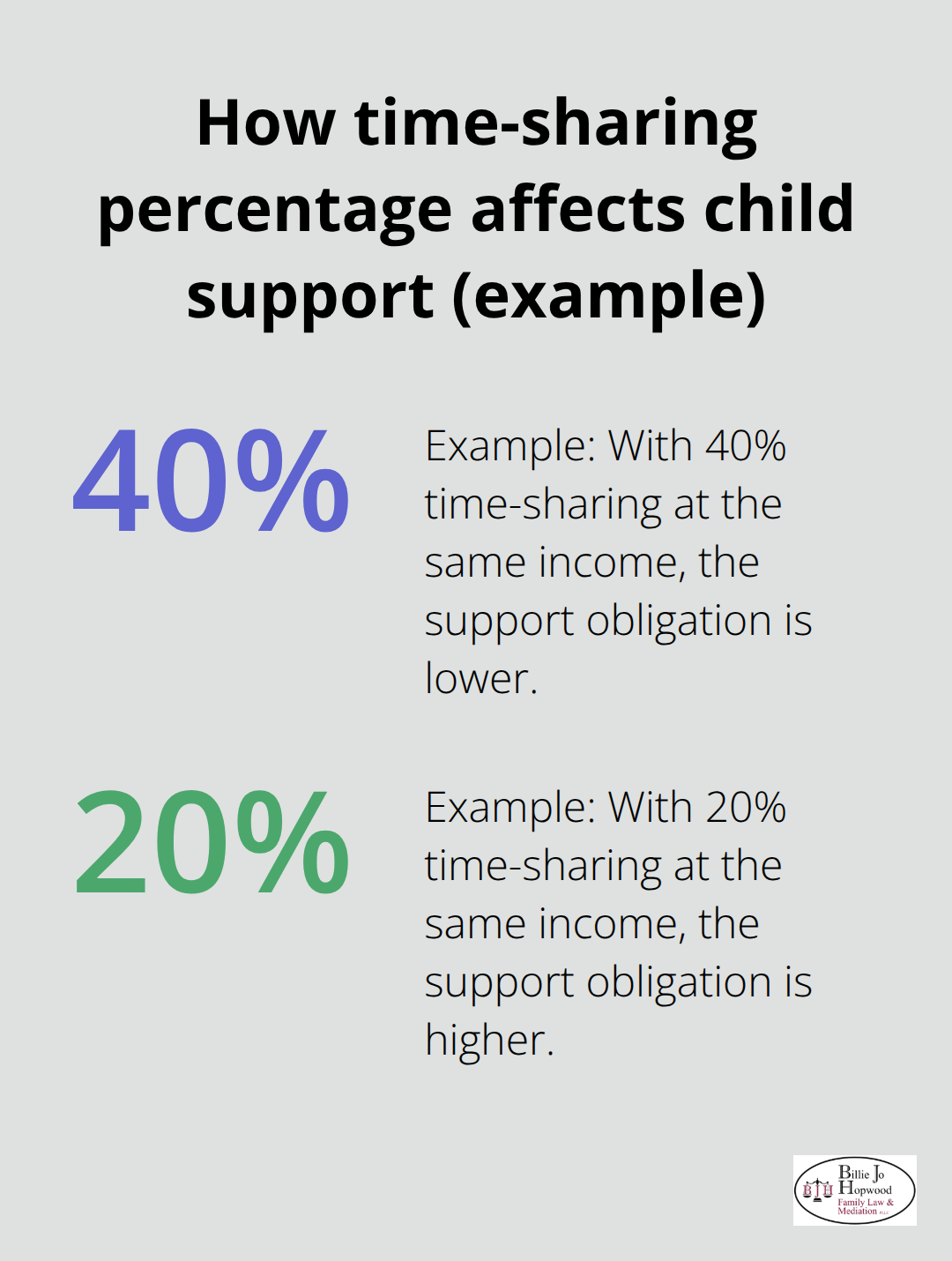
Chart showing example time-sharing percentages of 40% and 20% and their effect on support amounts - family law legal terms

Florida courts start with a baseline calculation, then adjust for factors like healthcare costs, childcare expenses, and other children from different relationships.

Petitioning for Modifications When Life Changes

When circumstances shift-job loss, income increase, relocation affecting time-sharing, or health changes-either parent can petition for modification by demonstrating a substantial material change. Courts take these requests seriously because support amounts must reflect current reality, not outdated financial snapshots. The modification process typically takes 4-6 weeks from petition to hearing, though agreement between parents accelerates the timeline significantly.

Alimony Awards Based on Marriage Duration and Income Gap

Alimony awards in Florida depend primarily on marriage duration and the income gap between spouses. Marriages lasting under 10 years typically receive short-term alimony, while longer marriages may qualify for durational or permanent awards. A spouse who earned $45,000 annually while the other earned $120,000 has stronger grounds for support than spouses with similar earning potential. Courts examine each spouse’s ability to maintain the standard of living established during marriage and consider whether one spouse sacrificed career advancement for family responsibilities.

Equitable Distribution of Assets and Debts

Property division follows equitable distribution principles, meaning assets and debts divide fairly but not necessarily equally. Retirement accounts, real estate, vehicles, and business interests all fall into this calculation. A business valued at $500,000 might split 60/40 rather than 50/50 if one spouse’s separate property contributions or post-divorce earning capacity justify the disparity.

Financial Disclosure Requirements and Asset Transparency

You’ll need comprehensive financial disclosure including tax returns, bank statements, investment account statements, and property valuations-hiding assets carries serious legal consequences and can invalidate settlements. Melbourne parents navigating these financial terms benefit from early clarity about their actual income, assets, and obligations because vague or incomplete information leads to disputes that cost thousands in additional legal fees. Once you understand how support and property division work, the court procedures and documentation required to formalize these arrangements become your next focus.

How Court Documents Shape Your Family Law Case

Filing Your Petition Correctly

Your petition marks the official start of your family law case, and the document itself demands precision because courts reject incomplete or incorrectly formatted filings, forcing you to resubmit and delaying resolution. Your petition must state your grounds for divorce, identify all children, specify what you’re requesting regarding parental responsibility and time-sharing, and include financial information if child support or alimony is involved. Florida courts require you to file in the county where you or your spouse live, or where your child has lived for at least six consecutive months. The filing fee in Brevard County runs approximately $408 for an uncontested dissolution, though contested cases cost significantly more when you factor in attorney fees and court costs.
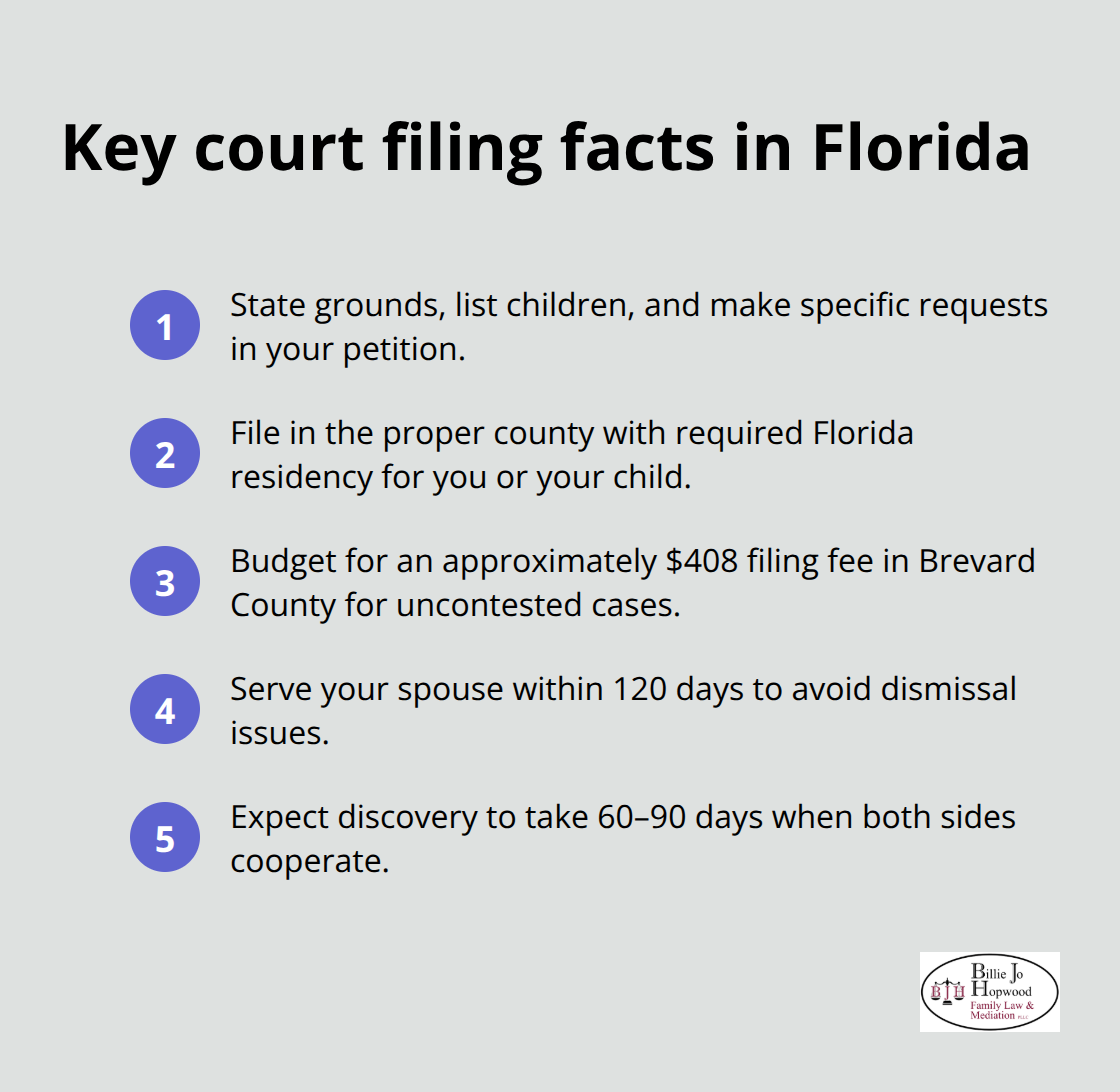
Compact list of essential Florida family law filing details and timelines

Serving Your Spouse Within Legal Timeframes

Once filed, you must serve your spouse with copies of all documents within a specific timeframe-typically within 120 days-or the court may dismiss your case entirely. Many parents underestimate how critical proper service is; a spouse who claims they never received documents can challenge the entire proceeding, forcing you to start over. Courts take service violations seriously because they affect your spouse’s right to respond and defend their interests.

Exchanging Financial Information Through Discovery

Discovery is where the real financial transparency happens, and it’s non-negotiable in contested cases. You’ll exchange tax returns covering the last three years, current bank statements, investment account statements, retirement account statements, property valuations, and a detailed financial affidavit listing all income sources and monthly expenses. If your spouse owns a business, you may need business tax returns and potentially a professional valuation. The discovery process typically takes 60 to 90 days when both sides cooperate, but uncooperative spouses can drag it out through requests for extensions or incomplete responses.

Protecting Against Financial Disclosure Violations

Courts in the 12th Judicial Circuit take financial disclosure violations seriously-judges have ordered sanctions, attorney fee shifts, and even contempt findings against parents who hide assets or provide false information. Settlement agreements must rest on complete and accurate financial information because a settlement built on hidden assets can face challenges for fraud later. Transparency at this stage prevents costly disputes that emerge years after your case closes.

Drafting Settlement Agreements That Address Real-World Changes

Once both sides have disclosed everything and negotiated terms, your settlement agreement becomes the blueprint for your final court order. That order is legally binding and enforceable, meaning if your ex fails to pay child support on time or violates the time-sharing schedule, you have concrete grounds to return to court for enforcement. A well-drafted settlement agreement prevents future disputes by addressing contingencies-what happens if one parent relocates, loses income, or faces a health crisis. Agreements that account for these scenarios withstand real-world changes rather than falling apart when circumstances shift.

Final Thoughts

Family law legal terms shape decisions that affect your children, finances, and future stability. Parental responsibility, time-sharing, child support calculations, equitable distribution, and settlement agreements aren’t just legal jargon-they’re the framework that determines how your family operates after divorce or separation. When you understand these terms, you move from confusion to clarity, and clarity gives you control over outcomes that matter most.

The terminology covered in this guide reflects how Florida courts actually work. Parental responsibility and time-sharing replace outdated custody language because they better describe what parents actually do: make decisions and spend time with their children. Income shares models for child support connect directly to your time-sharing percentage because courts recognize that parenting time affects financial obligations. Equitable distribution doesn’t mean equal division; it means fair division based on each spouse’s contributions and circumstances.

Parents in Melbourne, Florida benefit from understanding these family law legal terms before walking into mediation or court. Contact Billie Jo Hopwood Family Law & Mediation, PLLC to discuss your situation and explore the path forward that protects your family’s interests.
How to Create Legal Relations Between Family Members

Family relationships often benefit from clear legal documentation. When family members have an intention to create legal relations between family, written agreements protect everyone involved and prevent misunderstandings.

We at Billie Jo Hopwood Family Law & Mediation, PLLC help families in Melbourne, Florida establish these protections through proper legal channels. This guide walks you through the process of formalizing your family’s legal interests.

What Legal Agreements Do Families Actually Need

Prenuptial and Cohabitation Agreements

Prenuptial agreements protect assets before marriage and address property division if the marriage ends, with the ability to outline spousal support terms that Florida law would otherwise determine. Cohabitation agreements work similarly for unmarried couples living together, specifying how expenses are shared, debts are allocated, and assets are divided if the relationship ends-a critical document since Florida does not automatically recognize palimony claims without a written agreement. Postnuptial agreements function like prenups but are signed after marriage, allowing couples to modify their property rights or clarify financial responsibilities mid-relationship.

Family Loans and Financial Transactions

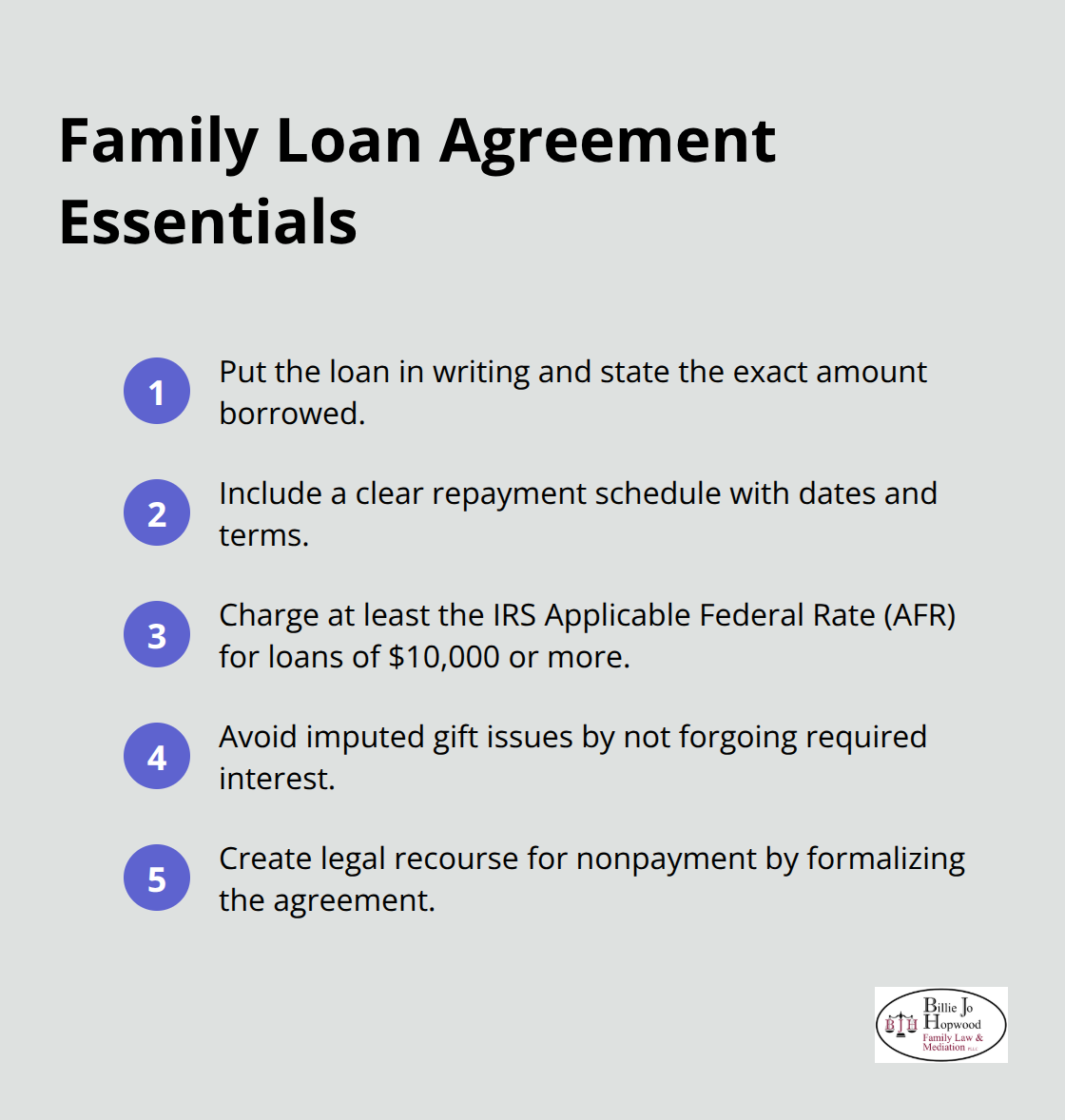
Family loan agreements formalize borrowing between relatives, documenting the amount, repayment schedule, and interest rate, which matters significantly for tax purposes since the IRS requires loans of $10,000 or more to charge interest at the applicable federal rate or risk the IRS treating foregone interest as a taxable gift. Without documentation, a parent who loans $50,000 to a child for a home down payment has no legal recourse if the child refuses to repay.

Key elements and protections for family loan agreements under U.S. tax rules - intention to create legal relations between family

Guardianship, Custody, and Estate Planning

Guardianship documents establish who makes medical and financial decisions if a family member becomes incapacitated, while custody arrangements and parenting plans detail how children will be raised and where they will live. Estate planning documents-wills, trusts, and powers of attorney-direct how assets pass to heirs and who manages affairs after death.

Why Written Documentation Matters

Verbal agreements are nearly impossible to enforce, and without clarity, disputes drain time and money. Florida courts will not honor informal understandings between family members. Unmarried couples who accumulate joint property without a cohabitation agreement face losing access to shared assets if the relationship ends because Florida law does not automatically divide property for unmarried partners the way it does for divorcing spouses.

When Families Need Formal Legal Relations

Situations requiring formal legal relations include any significant financial transaction between family members, planning for incapacity or death, establishing custody arrangements, or protecting assets in new relationships. The next step involves identifying which specific agreements fit your family’s circumstances and understanding how to draft them correctly.

Building Your Legal Foundation in Melbourne, Florida

Identify Your Specific Legal Need

Starting the process of creating legal relations between family members requires clarity about what you need and honest communication with the people involved. Most families postpone this work because they assume it signals distrust, but the opposite is true-formal documentation prevents the misunderstandings that actually damage relationships. The first step is identifying your specific situation. Are you getting married and want to protect assets from a previous relationship? Are you lending money to a family member and need the IRS to recognize it as a loan rather than a gift? Are you setting up guardianship for a child or aging parent? The type of agreement you need depends entirely on your circumstances.

Avoid Conflating Different Agreements

Families often conflate different agreements and end up with the wrong document. A cohabitation agreement does not address child support, and a prenuptial agreement cannot establish medical decision-making authority. Write down the outcome you want and the people affected by it, then you will know what legal document fits.

Gather Your Financial Information

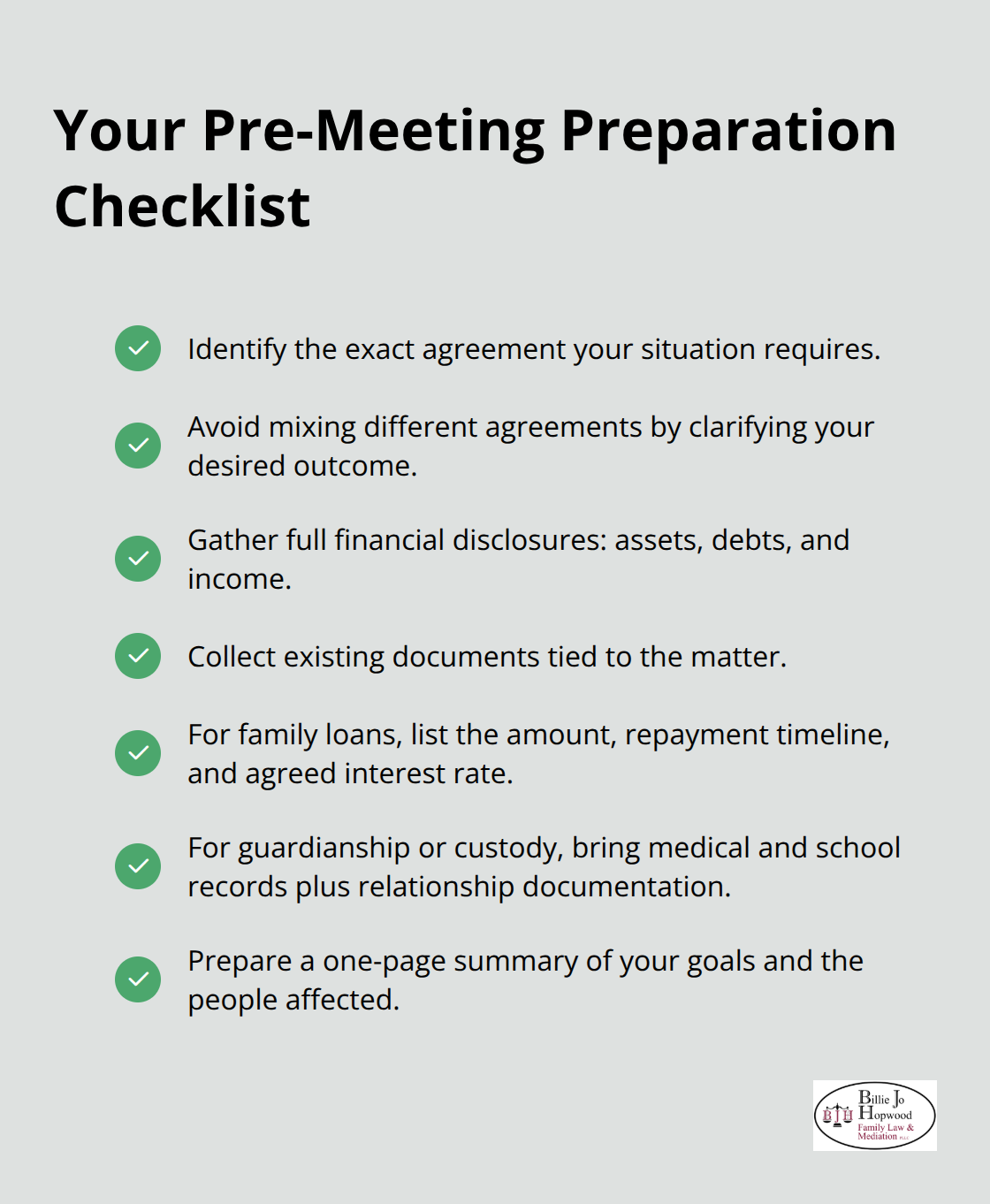
Once you identify the agreement type, gather your financial information and any existing documents related to the situation. For family loans, you need the loan amount, the repayment timeline, and the interest rate you both agree on. The IRS publishes applicable federal rates monthly, and loans over $10,000 must charge at least that rate or risk the IRS treating forgone interest as a taxable gift.

Checklist of documents and information to prepare before meeting a family law attorney - intention to create legal relations between family

For prenuptial or cohabitation agreements, both parties must disclose all assets, debts, and income completely and honestly. Incomplete disclosure is grounds for a court to invalidate the agreement later, making full transparency non-negotiable.

Organize Documents Before Meeting an Attorney

For guardianship or custody matters, gather medical records, school records, and documentation of your relationship with the person you want to protect. The more organized you are before meeting with a family law attorney, the faster the process moves and the lower your costs. Many families arrive at initial consultations with scattered documents and vague ideas about what they want, which extends the timeline and increases fees. Prepare a one-page summary of your situation, the agreement you need, and the outcome you want.

Next Steps With Professional Guidance

A family law attorney in Melbourne, Florida will guide you from there on the specific documents required and any additional information needed to draft them correctly. The consultation itself clarifies which agreements fit your family’s needs and what timeline to expect for completion.

Documents That Protect Your Family

Prenuptial and Postnuptial Agreements

Prenuptial agreements and postnuptial agreements protect families across all income levels, not just wealthy individuals with massive estates. They address the financial reality of modern relationships where both partners bring assets, debts, or children from previous relationships into a new marriage. A prenuptial agreement signed before marriage lets both parties specify how property acquired before marriage stays separate, how income earned during marriage is divided, and what happens to spousal support if the marriage ends. A postnuptial agreement accomplishes the same goals but you sign it after marriage, which makes it useful when circumstances change-such as one spouse inheriting property or receiving a business promotion. Florida law permits both types and enforces them if both parties had independent legal advice, made full financial disclosure, and signed voluntarily without pressure.

How Florida Courts Handle Property Without Agreements

Without these agreements, Florida’s equitable distribution rules apply automatically. The court divides marital assets and debts based on factors like length of marriage, each spouse’s contribution, and future economic circumstances. For a 15-year marriage, that court process costs thousands in attorney fees and months of litigation, whereas a postnuptial agreement drafted upfront costs far less and gives you control over the outcome.

Guardianship Documents and Powers of Attorney

Guardianship documents and estate planning tools serve different purposes but work together to protect your family’s interests across multiple scenarios. Guardianship establishes who makes medical and financial decisions if you become incapacitated. A durable power of attorney for healthcare and a financial power of attorney accomplish this without court involvement, which is faster and less expensive than petitioning for guardianship. These documents take effect immediately and remain valid if you lose capacity, unlike court-ordered guardianship which requires ongoing court supervision.

Wills, Trusts, and Tax Planning

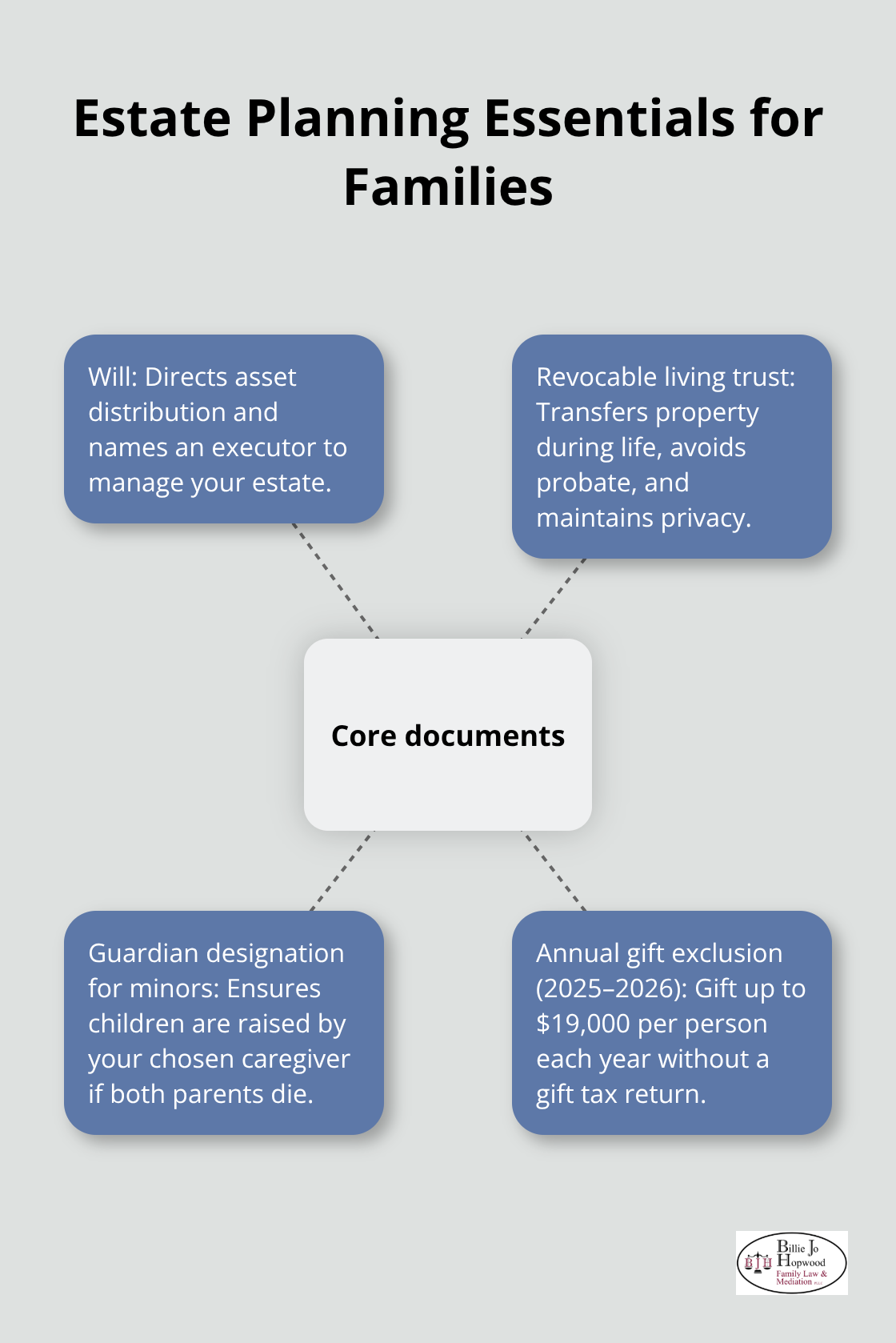
A will directs how your assets pass to heirs and names an executor to manage your estate. A revocable living trust lets you transfer property during your lifetime, avoid probate entirely, and maintain privacy since trusts are not filed with the court like wills are. If you have minor children, a will also designates a guardian to raise them if both parents die-something no other document accomplishes. The IRS allows you to gift up to $19,000 per person annually in 2025 and 2026 without filing a gift tax return, and a properly structured estate plan uses this annual exclusion along with your lifetime exemption to minimize tax liability for your heirs.

Core estate planning tools and tax advantages for U.S. families

What Happens Without Legal Documents

Without these documents, Florida intestacy law determines who inherits your property and who raises your children, which rarely matches what families actually want. A family law attorney in Melbourne, Florida can review your situation and recommend which documents fit your specific circumstances.

Final Thoughts

Formalizing family legal relations transforms vague intentions into enforceable protections that safeguard everyone involved. When family members establish clear written agreements, they eliminate the ambiguity that breeds conflict and costly disputes. A prenuptial agreement, cohabitation contract, family loan document, or guardianship designation costs far less upfront than litigation or intestacy proceedings that ignore your actual wishes.

The intention to create legal relations between family members signals maturity and respect, not distrust. Families who formalize their arrangements report greater peace of mind because they know exactly what happens if circumstances change. Contact Billie Jo Hopwood Family Law & Mediation, PLLC to discuss your situation and learn which legal documents protect your family’s interests.
A consultation clarifies your options, the timeline for completion, and what to expect moving forward. Your family’s legal security depends on taking action now rather than waiting until a crisis forces difficult decisions under pressure.

How to Navigate Family Court Mediation Successfully

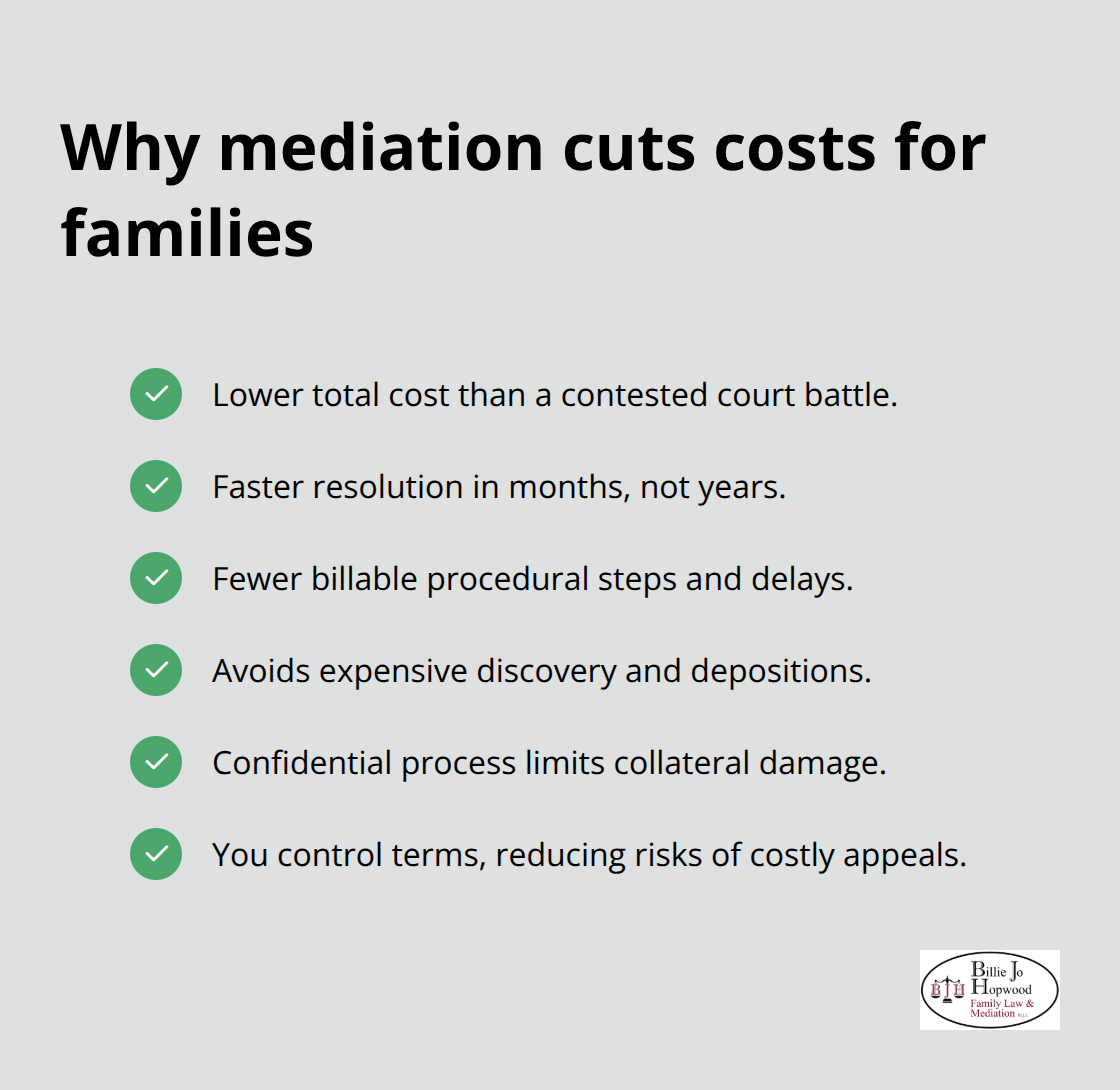
Family court mediation in Melbourne, Florida offers a faster and less adversarial path through family disputes than traditional litigation. Most families find mediation reduces costs by 40-60% compared to courtroom battles, while preserving relationships that matter.

We at Billie Jo Hopwood Family Law & Mediation, PLLC have guided countless families through this process. The family court mediation tips in this guide will help you prepare, communicate effectively, and reach agreements that work for your family.

How Family Court Mediation Works in Melbourne, Florida

Family court mediation in Melbourne, Florida operates through a structured process governed by Florida Statutes §44.102. A neutral mediator meets with both parties to facilitate negotiation on contested issues like asset division, child custody, and support arrangements. The mediator does not decide the outcome; instead, they guide conversation toward mutually acceptable solutions. In the Eighteenth Judicial Circuit covering Brevard and Seminole Counties, mediation typically occurs within 60 days of a court-ordered referral. Each session lasts up to three hours, though additional time can be arranged if both parties agree. Before mediation begins, both parties must file current financial affidavits with the court to establish eligibility and determine fees. The Brevard County Self-Help Center can assist with completing required forms if you need guidance, and you can reach them at ProSeCoordinator@brevardclerk.us or call (321) 633-7780.

How Mediation Differs From Litigation

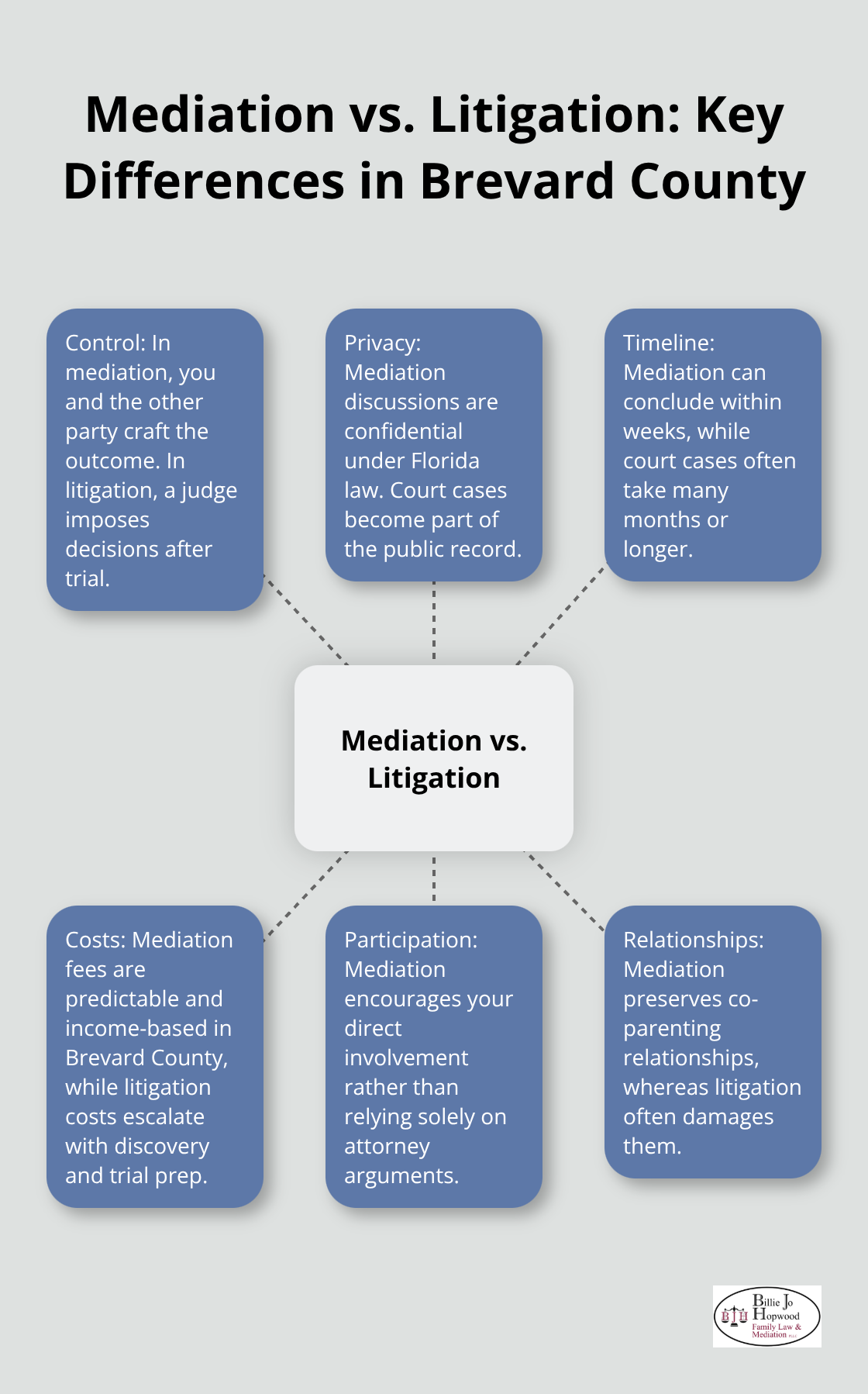
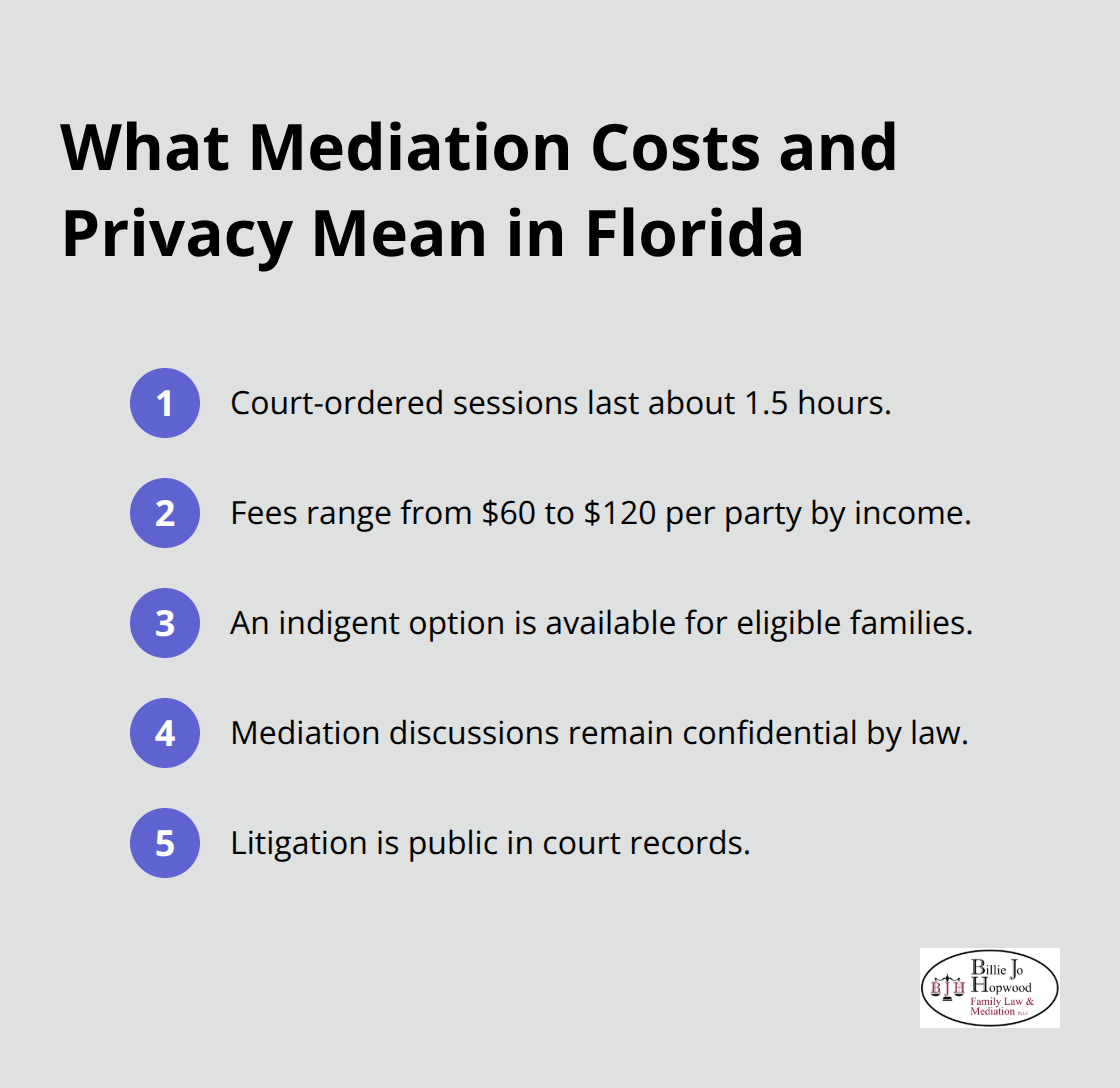
Litigation forces a judge to impose decisions after trial, meaning you lose control over the outcome. Mediation hands control back to you and the other party. In litigation, your case becomes public record. In mediation, everything discussed remains confidential under Florida law. Court battles typically take 12-18 months or longer; mediation often concludes within weeks.

Visual summary of how mediation differs from litigation for families in Melbourne, Florida - family court mediation tips

Litigation costs escalate rapidly with discovery, depositions, and trial preparation, while mediation fees in Brevard County are income-based: $60 per party per session if combined income is under $50,000, and $120 per party per session for combined income between $50,000 and $100,000. Litigation creates winners and losers; mediation creates solutions both parties can live with. You participate actively in mediation rather than watching lawyers argue on your behalf. The mediator can propose creative options a judge would never consider. Most importantly, litigation destroys relationships between co-parents. Mediation preserves them.

Why Families Choose Mediation Over Court

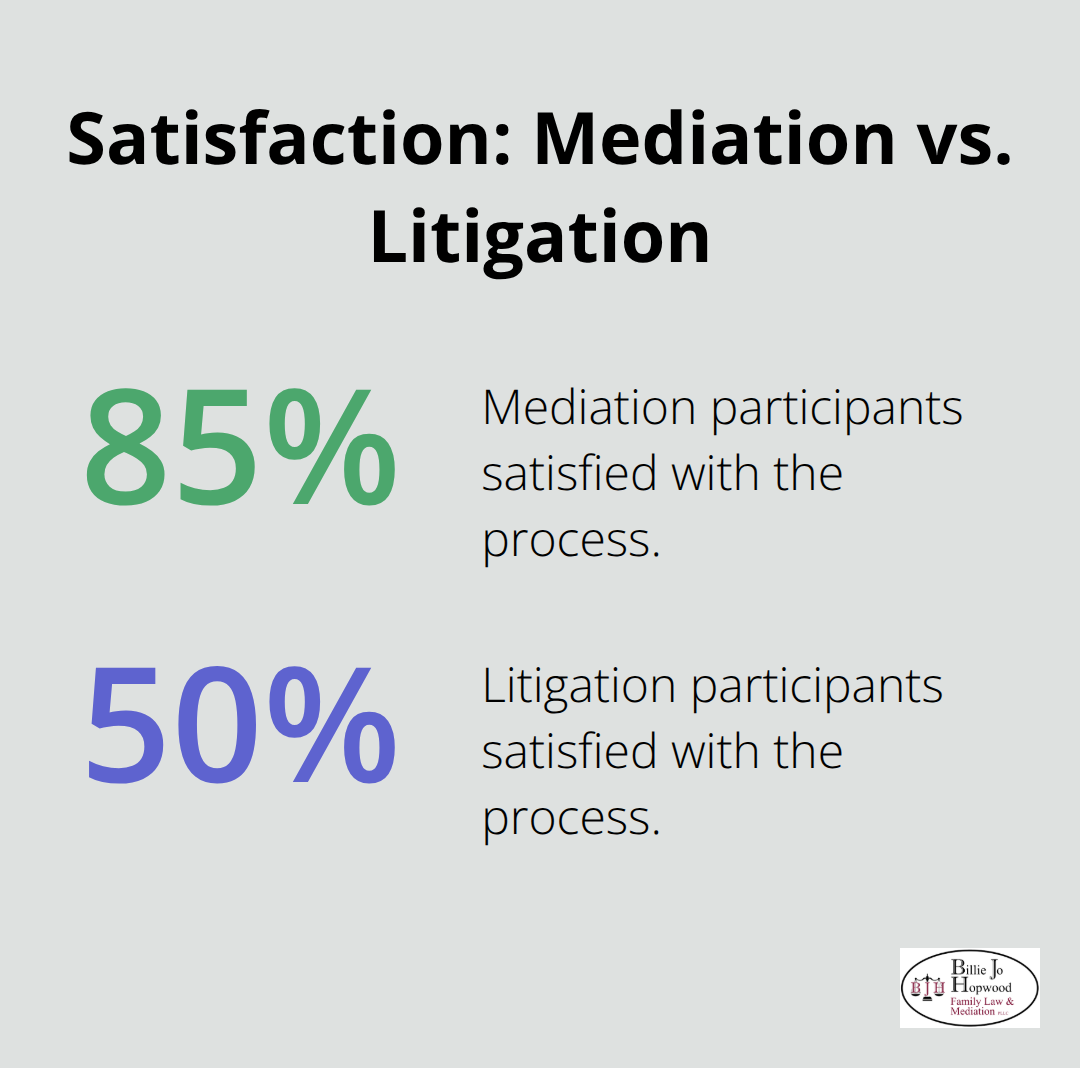
Families choose mediation because they retain authority over agreements affecting their children and finances. A judge knows nothing about your family’s unique circumstances, values, or what matters most to you. A mediated agreement reflects your actual priorities. Research consistently shows mediation produces higher satisfaction rates than court-imposed orders because both parties helped craft the solution. You avoid the emotional toll of public testimony and cross-examination. Your children avoid witnessing courtroom conflict. The confidential nature of mediation allows honest discussion without statements being used against you later. Mediation also costs significantly less: studies indicate families save 40-60% in legal fees compared to full litigation. For families in Melbourne, Florida, this difference often means $5,000 to $15,000 in direct savings. Additionally, mediated agreements are more stable. When both parties agree voluntarily, compliance rates are substantially higher than with court orders imposed against someone’s will. Modification disputes arise less frequently.

What Preparation Looks Like Before Your Session

Your success in mediation depends on what you do before the session starts. Gather all financial documents, property records, and debt statements so you understand your complete financial picture. Identify which issues matter most to you and which ones you can compromise on. Work with your attorney to develop a mediation brief that presents your strongest points with supporting evidence (documents, financial records, or witness statements). The mediator uses this brief as their primary reference before the session, so a clear, well-organized brief influences how they approach your case. Discuss your goals with your attorney and establish realistic expectations based on what a court might order if your case went to trial. This comparison helps you evaluate settlement offers when they arrive.

Moving Forward With Confidence

Understanding how mediation works removes much of the anxiety families feel about the process. The structure, timeline, and cost predictability (based on income thresholds in Brevard County) give you a clear roadmap. Your next step involves preparing the specific documents and strategy that will shape your mediation session.

Prepare Documents and Define Your Mediation Goals

Gather Complete Financial Documentation

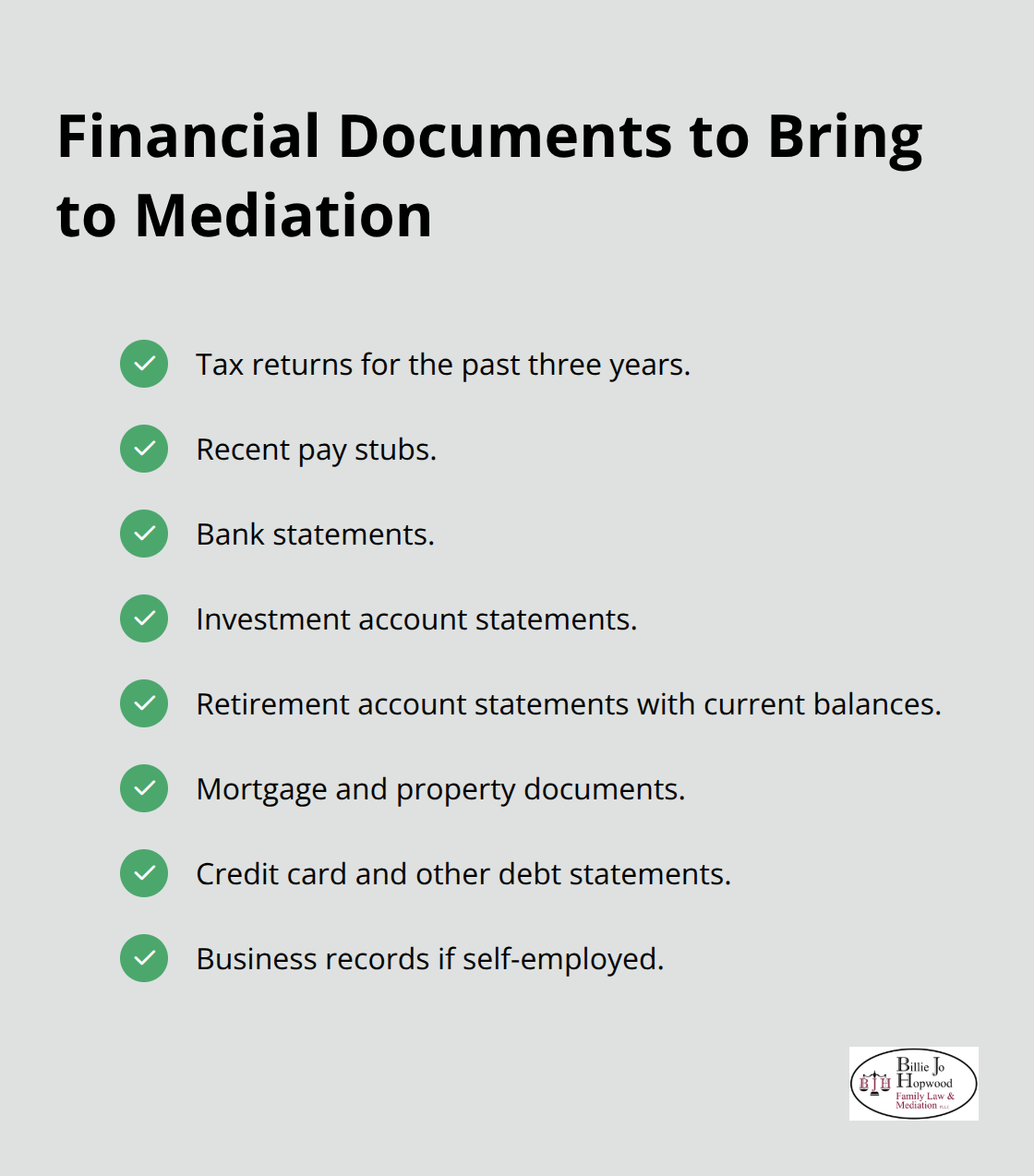
Preparation determines your mediation outcome more than any other factor. Gather all necessary financial documents you possess: tax returns from the past three years, recent pay stubs, bank statements, investment accounts, retirement account statements, mortgage documents, credit card statements, and any business records if self-employed. The court requires both parties to file current financial affidavits before mediation can proceed under Florida Family Law Rules of Procedure 12.285, and the mediator will reference these affidavits throughout your session.

Without complete financial documentation, you cannot accurately evaluate settlement proposals or identify creative solutions. Many people underestimate what they own or owe because they haven’t reviewed statements in months. Spend time now calculating your net worth and understanding which assets have increased or decreased in value.

Checklist of key financial records for Florida family mediation - family court mediation tips

If you own property, gather recent appraisals or comparable sales data for your area. For retirement accounts, request current statements showing vested balances. This groundwork prevents surprises during mediation and ensures you negotiate from accurate information rather than guesses.

Identify Your Priorities and Flexibility Points

Next, identify which issues matter most to your family and where you have flexibility. Create three categories: non-negotiable issues, important but flexible issues, and lower-priority items you can concede. If children are involved, child custody and support arrangements typically occupy the non-negotiable category for most parents. Asset division priorities vary significantly-some families prioritize keeping the family home while others prioritize retirement security.

Be honest about what you actually need versus what you want. Work with your attorney to develop a mediation brief that presents your strongest arguments with supporting evidence. This brief becomes the mediator’s primary reference document, so organize it clearly with the most persuasive points first. Include copies of relevant documents rather than burying evidence in lengthy narratives. The mediator will spend more time reading your brief before the session than they will spend with you during mediation, making document quality directly impact how they perceive your case.

Establish Your Settlement Baseline

Additionally, discuss your best alternative to a negotiated agreement with your attorney-this means understanding what a judge would likely order if your case went to trial. This realistic assessment prevents you from rejecting reasonable settlement offers simply because you hoped for better. Settlement offers that exceed your trial alternative deserve serious consideration, even if they don’t match your initial requests. With your financial picture clear, your priorities defined, and your settlement baseline established, you now possess the foundation necessary to communicate effectively during your mediation session.

How to Communicate Effectively During Mediation

What you say in mediation matters far less than how you say it. The mediator has already read your financial affidavits and your prepared brief before the session starts, so they understand the facts of your case. What they’re watching during mediation is whether you can engage in productive conversation about resolving conflict. Mediators report that 60-70% of impasse situations stem from communication breakdown rather than genuine disagreement over numbers. Your goal is to articulate your needs clearly while remaining open to hearing the other party’s perspective.

Three proven communication practices for successful mediation

State Your Position Without Personal Attacks

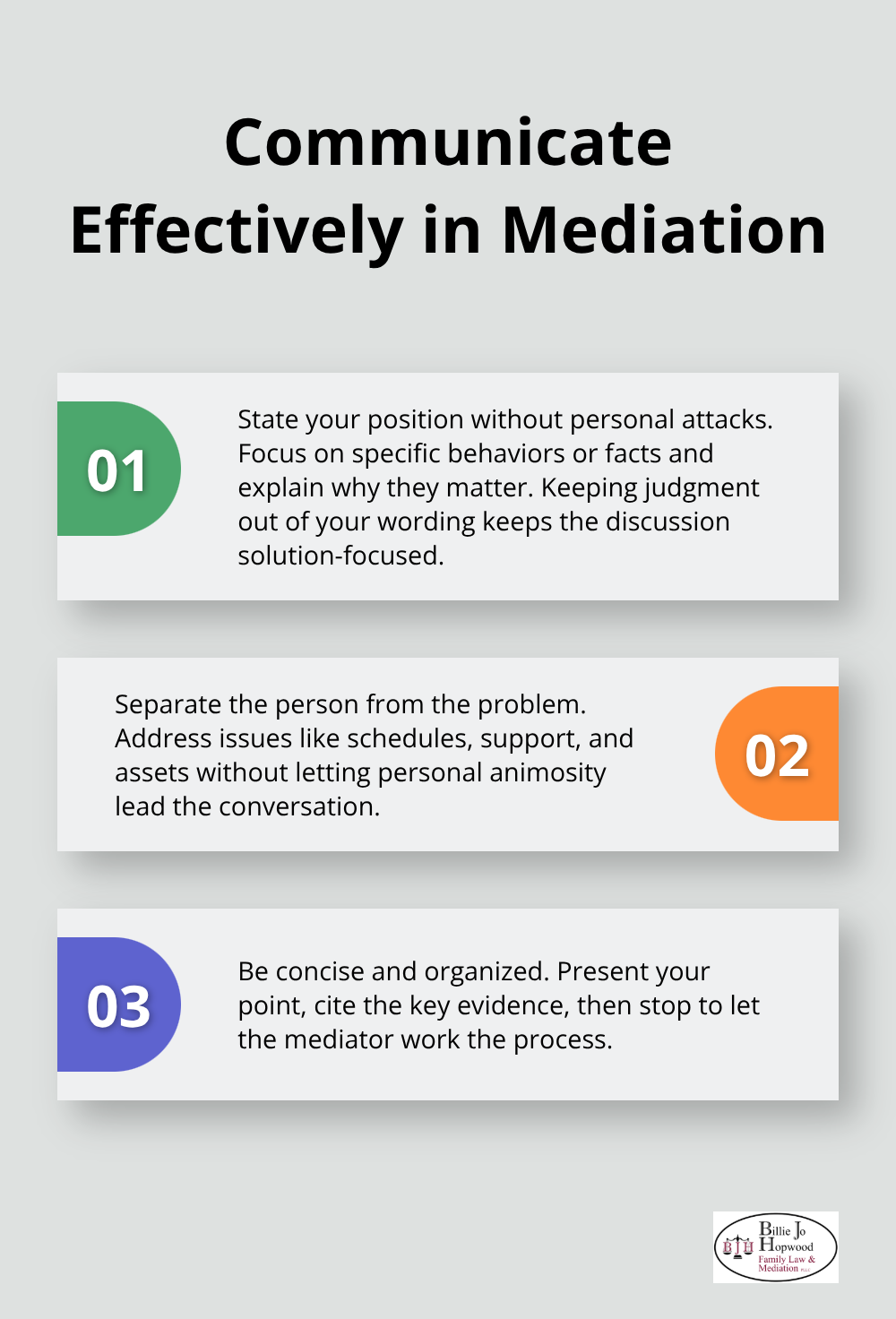
Start by stating your position without attacking the other party’s character or motives. Instead of saying the other parent is irresponsible with money, describe what financial behaviors concern you and why. This shift from judgment to observation keeps the conversation focused on solvable problems rather than personal grievances. During mediation, the other party often says things designed to provoke anger or defensiveness. Your response determines whether mediation continues productively or derails.

Pause before responding to inflammatory statements. Take three seconds to breathe, then address the substance of what was said without matching the emotional tone. The mediator notices restraint and uses it as evidence that settlement is possible. Conversely, escalating emotion signals to the mediator that you cannot negotiate reasonably, which weakens your position in their assessment.

Separate the Person From the Problem

Separate the person from the problem entirely. You may genuinely dislike the other party, but mediation requires discussing specific issues-asset division, custody schedules, support amounts-without letting personal animosity dominate the conversation. The mediator will move between rooms frequently, using shuttle diplomacy to prevent heated exchanges. When you’re in a separate room with your attorney and the mediator, provide clear, factual statements about your position and the evidence supporting it. Avoid venting about the other party’s character; instead, focus on concrete points the mediator can carry to the other side.

Identify Underlying Needs and Interests

Ask questions to clarify what the other party actually needs rather than assuming you know their position. Often what appears as an unreasonable demand masks a legitimate underlying concern. If the other party demands the family home in asset division, they might actually be concerned about stability for children, not greed. Once you identify the real concern, creative solutions emerge. Work with your mediator to propose options that address the other party’s actual need while protecting your interests.

The mediator’s job includes suggesting settlement proposals when impasse occurs, so remain open to their suggestions even if they differ from your initial requests. Your attorney should attend mediation to advise you, but you must participate actively rather than letting your attorney do all the talking. The mediator needs to hear your commitment to resolution directly from you, not filtered through legal representation.

Communicate With Clarity and Precision

When you speak, be concise and organized. Rambling statements lose the mediator’s attention and dilute your strongest points. State your position, provide supporting evidence, then stop talking. This discipline keeps mediation moving forward and demonstrates that you respect both the mediator’s time and the process itself.

Final Thoughts

Mediation offers families in Melbourne, Florida a path forward that preserves both finances and relationships. You’ve learned how mediation works within the Brevard County court system, what preparation looks like, and how to communicate effectively when you’re in the room with a mediator. These family court mediation tips form the foundation for reaching agreements that actually work for your family rather than court-imposed orders that satisfy no one.

After mediation concludes successfully, your mediator drafts a settlement agreement reflecting what both parties negotiated, and your attorney reviews it for legal accuracy before submission to the court. A judge reviews the agreement to confirm it’s fair and legal, then issues a final order that typically takes weeks rather than months. If children are involved, your Parenting Plan must be included in the final agreement and address custody, visitation, decision-making authority, and support obligations clearly.

Once your agreement is finalized, compliance becomes straightforward because both parties helped create it. You’re far more likely to follow an agreement you negotiated than one imposed by a judge, and most mediated agreements remain stable because they reflect each party’s actual priorities. Contact us to discuss how mediation can work for your family and what your next steps should be.

Is Family Mediation Legally Binding?

You’ve reached a settlement in mediation, but you’re wondering if that agreement actually holds legal weight. The answer depends on several factors, and we at Billie Jo Hopwood Family Law & Mediation, PLLC want you to understand what makes a mediation agreement legally binding.

A handshake and good intentions won’t protect your rights. Knowing the difference between a binding agreement and one that courts will reject is the foundation of a secure settlement.

What Makes Your Mediation Agreement Legally Binding

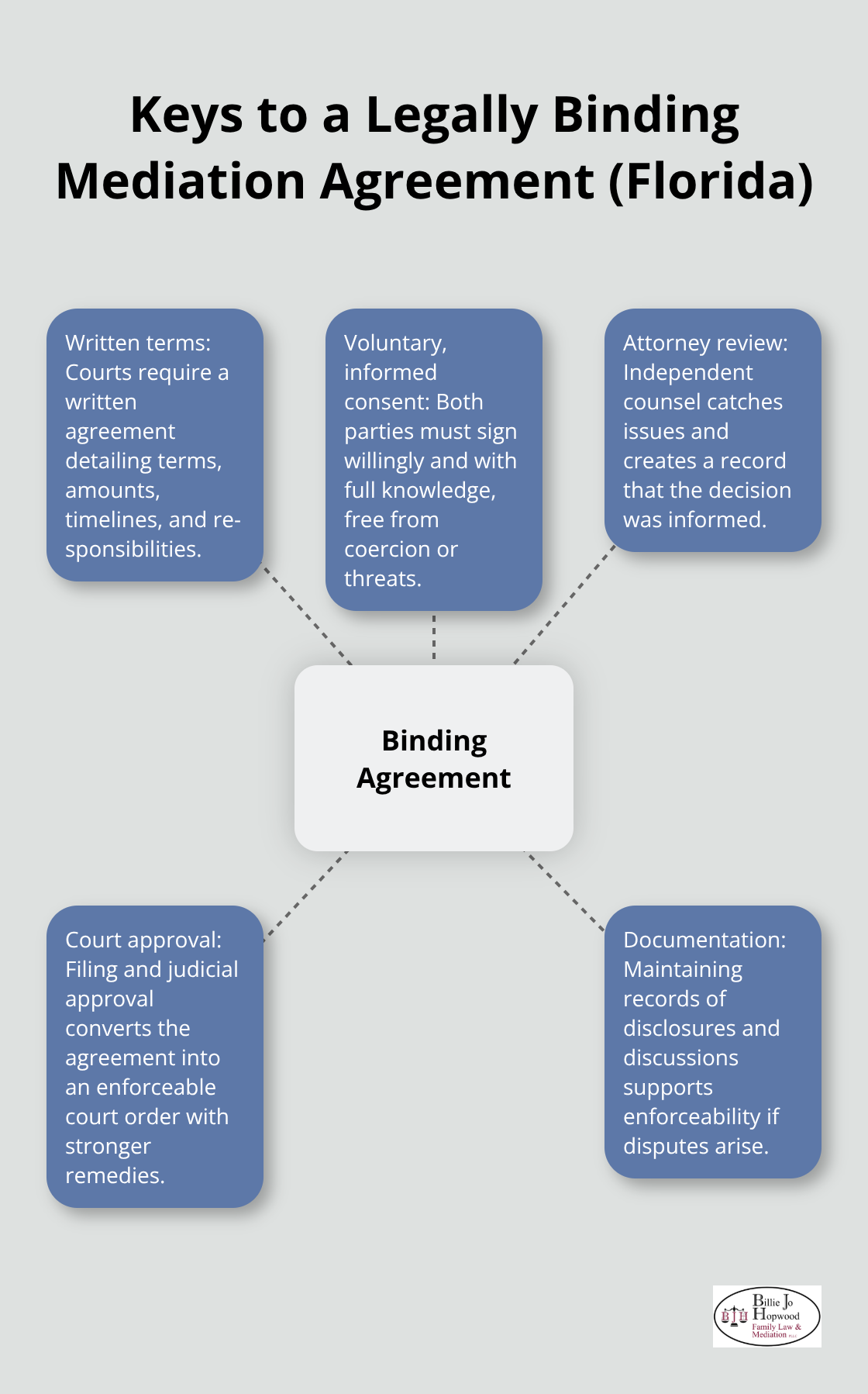
A mediation agreement becomes legally binding only when it meets specific legal requirements that courts will enforce. The first requirement is written documentation-verbal agreements, no matter how sincere both parties are, will not hold up in court. Florida courts require mediation agreements to be in writing, clearly stating all terms, amounts, timelines, and responsibilities. Without a written record, you have no proof of what was agreed upon, and disputes over what was said become impossible to resolve.

Both parties must sign voluntarily and with full knowledge

The second requirement is that both parties must enter the agreement voluntarily and with full knowledge of what they’re signing. This means you cannot face coercion, threats, or misleading information when you accept terms. Courts will reject agreements reached under duress or where one party failed to disclose important financial information. Your signature alone is not enough-both parties must sign, and ideally, both should have independent legal counsel review the agreement before signing. Courts take this seriously because they want assurance that both sides understood the implications.

If you later claim you didn’t understand what you signed, courts will look at whether you had the opportunity to consult an attorney. Having an attorney present during mediation or reviewing the final agreement before you sign creates a clear record that you made an informed decision. Many family law attorneys recommend requesting time between the final mediation session and the signing to review all terms with counsel. This pause prevents rushed decisions and catches potential problems, like child support calculations that don’t comply with Florida guidelines or property divisions that are unconscionable.

Core elements that make a mediation agreement enforceable in Florida - is family mediation legally binding

Court approval transforms your agreement into an enforceable order

Not all mediation agreements require court approval, but those involving children or support obligations benefit greatly from it. When you file your mediation agreement with the court and a judge approves it, it becomes a court order. This matters because if someone violates a court order, the court can impose penalties including contempt of court charges, fines, or wage garnishment (depending on the violation’s severity). A mediation agreement that sits unsigned and unfiled is merely a contract, and enforcing it requires a separate breach-of-contract lawsuit.

Court incorporation gives you stronger enforcement options if problems arise later. The difference between a signed mediation agreement and a court-approved one is substantial-one relies on contract law, while the other carries the full power of judicial authority. When you move forward with filing your agreement, you’ll want to understand what happens when agreements fail to meet these standards.

When Courts Won’t Enforce Your Mediation Agreement

Not every mediation agreement survives judicial scrutiny. Courts in Florida will refuse to enforce agreements tainted by fraud, hidden information, or coercion, and they’ll also reject terms that violate state law. Understanding what disqualifies an agreement from enforcement protects you from signing something that looks binding but crumbles under pressure.

Fraud and incomplete financial disclosure kill enforceability

Courts take a hard line on fraud and undisclosed assets. If one party hides income, minimizes property value, or deliberately misrepresents financial circumstances during mediation, the entire agreement can be voided. The American Bar Association found that financial deception ranks among the top reasons mediation agreements fail enforcement challenges. If your ex-spouse failed to disclose a business account, investment property, or significant debt before you signed, you have grounds to challenge the agreement in court.

The burden falls on the disclosing party to provide complete financial documentation before settlement discussions conclude. Courts expect both parties to exchange tax returns, bank statements, retirement account statements, and documentation of all major assets. If disclosure happens after signing, judges view this as a red flag that undermines the entire agreement’s validity. One party claiming they forgot about an asset or didn’t think it mattered won’t satisfy a court. Intentional concealment carries even heavier consequences because judges may impose sanctions beyond simply voiding the agreement.

Duress, threats, and power imbalances render agreements unenforceable

If you signed under threat, intimidation, or extreme pressure, courts will invalidate the agreement regardless of what the paper says. Duress doesn’t require physical violence. Courts recognize psychological coercion, financial threats, custody threats, or threats to report immigration status as sufficient grounds to void mediation agreements.

If your spouse threatened to drain joint accounts, take children out of state, or expose personal information unless you agreed to unfavorable terms, that constitutes duress. Courts examine the totality of circumstances surrounding the signing-they ask whether you had reasonable time to consult an attorney, whether you felt pressured to sign immediately, and whether the agreement heavily favors one party. Domestic violence history between parties strengthens duress arguments because courts understand the power dynamics involved. If a protective order exists or existed, courts scrutinize mediation agreements more carefully. This is why Florida law allows courts to exempt couples from mandatory mediation when domestic violence is present.

Terms violating Florida law cannot survive enforcement

Some provisions, no matter how willingly both parties signed, cannot be enforced because they conflict with Florida statutes. Child support cannot be waived or eliminated through private agreement, even if both parents consent. Florida Statute 61.08 mandates that child support calculations follow state guidelines based on income and custody percentages. Courts will modify or reject any mediation clause attempting to avoid this obligation.

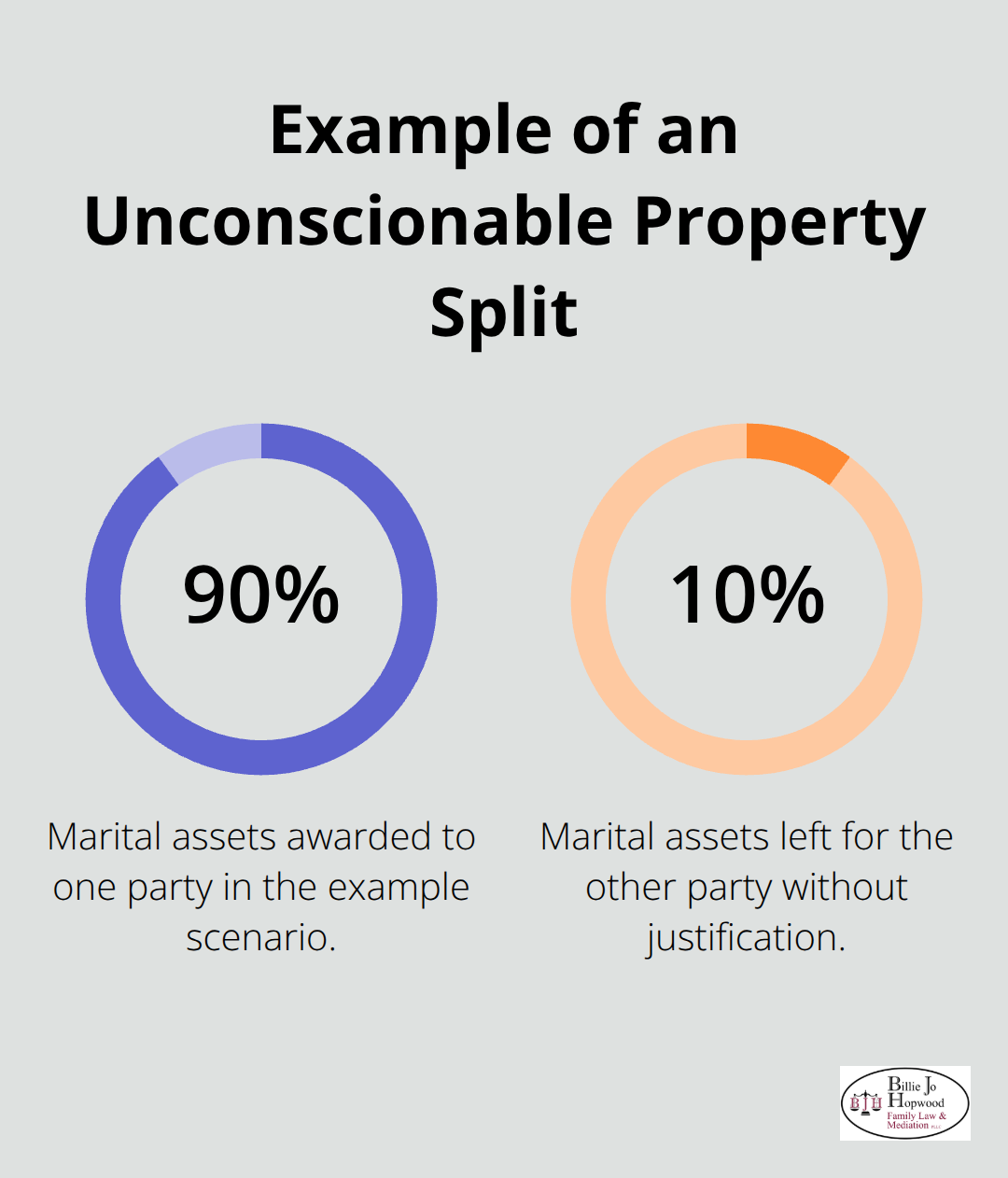
Similarly, unconscionable property divisions may be challenged. If one party receives 90 percent of marital assets while the other receives 10 percent without legitimate justification, courts view this as potentially unconscionable and may refuse enforcement.

Visualization of a 90/10 marital asset division example mentioned in the article - is family mediation legally binding

Custody arrangements that fail to serve the child’s best interests also face rejection. Courts will not enforce agreements where both parents agreed to custody terms that endanger the child or provide inadequate support for the child’s needs. Before you sign any mediation agreement, verify that support calculations match Florida guidelines and that property divisions reflect equitable distribution principles. These legal safeguards exist to protect you, but only if you understand them before you commit to terms that courts may later refuse to honor.

How to Protect Your Mediation Agreement

Bring an Attorney into Your Mediation Process

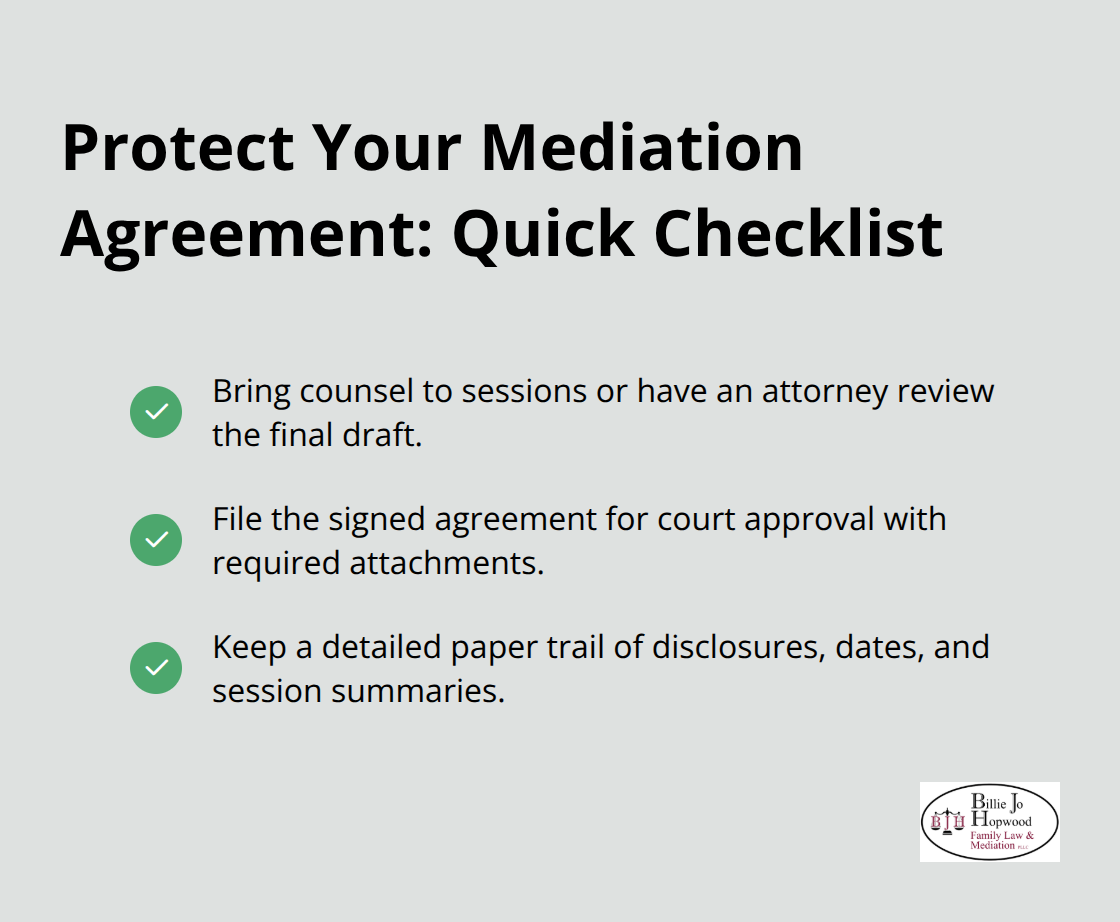
An attorney’s involvement during mediation transforms your protection from theoretical to concrete. Having counsel present during settlement discussions-or at minimum reviewing the final agreement before you sign-strengthens your position significantly. When an attorney participates in mediation sessions, they catch problematic language, verify financial disclosures are complete, and flag terms that conflict with Florida law. Many mediators expect both parties to bring counsel because it reinforces the agreement’s enforceability.

If you cannot afford an attorney during the entire process, prioritize having one review the draft agreement for two to three hours before signing. This targeted review costs significantly less than litigation but identifies major issues like child support calculations that deviate from Florida guidelines, property divisions lacking equitable distribution, or custody provisions that courts will reject. Your attorney should verify that all assets were disclosed, that income figures match tax returns, and that neither party faced pressure when agreeing to terms.

Understand the Enforceability Difference Between Signed and Court-Approved Agreements

A signed mediation agreement and a court-approved one offer vastly different enforcement options if problems arise later. A signed but unfiled agreement functions as a contract enforceable through breach-of-contract lawsuits, which require proving damages and often take months to resolve. A court-ordered agreement carries judicial authority, meaning violations trigger contempt of court proceedings and judges can impose immediate remedies like wage garnishment or fines without requiring you to file a separate lawsuit.

File your mediation agreement with the court promptly after both parties sign. Include a cover letter requesting judicial approval and attach all supporting documents showing the agreement complies with Florida law. Courts typically approve agreements within two to four weeks if they contain no red flags.

Actionable steps to strengthen enforceability of your mediation agreement

Once approved and entered as a court order, your agreement gains enforcement muscle that a standalone contract lacks. If your spouse violates a court-ordered provision months or years later, you can file a motion to enforce rather than starting fresh litigation.

Document Everything Throughout the Mediation Process

Documentation creates the paper trail that protects you if disputes arise later. Keep copies of all financial disclosures exchanged, notes on what was discussed, and proof of when each party received information. These records become critical if someone later claims they didn’t understand terms or weren’t fully informed. Courts examine documentation to determine whether both parties had genuine opportunity to make informed decisions.

Write down dates when you received financial statements, emails confirming what was discussed, and any agreements reached during preliminary sessions. If your mediator sends written summaries after each session, save those documents. This documentation proves that you acted in good faith and had access to complete information when you signed the final agreement. Courts rely heavily on these records when evaluating whether an agreement should be enforced or challenged.

Final Thoughts

A mediation agreement’s enforceability rests on three pillars: proper documentation, voluntary consent, and compliance with Florida law. Whether family mediation is legally binding depends entirely on how you structure and execute your agreement. A written document signed by both parties creates a contract, but filing that agreement with the court transforms it into an enforceable order backed by judicial authority.

An attorney reviewing your draft agreement catches problems that could render it unenforceable and verifies financial disclosures are complete. You don’t need counsel present for every mediation session, but having someone examine the final agreement before you sign protects your rights substantially. Courts expect both parties to have had opportunity to consult independent counsel, and documentation of that review strengthens your agreement’s enforceability.

We at Billie Jo Hopwood Family Law & Mediation, PLLC assist families through family law matters including divorce, child custody, alimony, and child support in Melbourne, Florida. If you need guidance formalizing your mediation settlement or want to discuss whether your agreement meets enforceability standards, contact our office to schedule a consultation.

Is Family Mediation Free?

Family mediation often costs significantly less than going to court, but the price varies depending on your situation. At Billie Jo Hopwood Family Law & Mediation, PLLC, we help families in Melbourne understand what they’ll actually pay.

Whether family mediation is free depends on your circumstances-some court programs cover costs, while others require payment. This guide breaks down the real expenses you might face and shows you where to find affordable options.

What You’ll Actually Pay for Family Mediation in Florida

Private Mediator Rates in the Melbourne Area

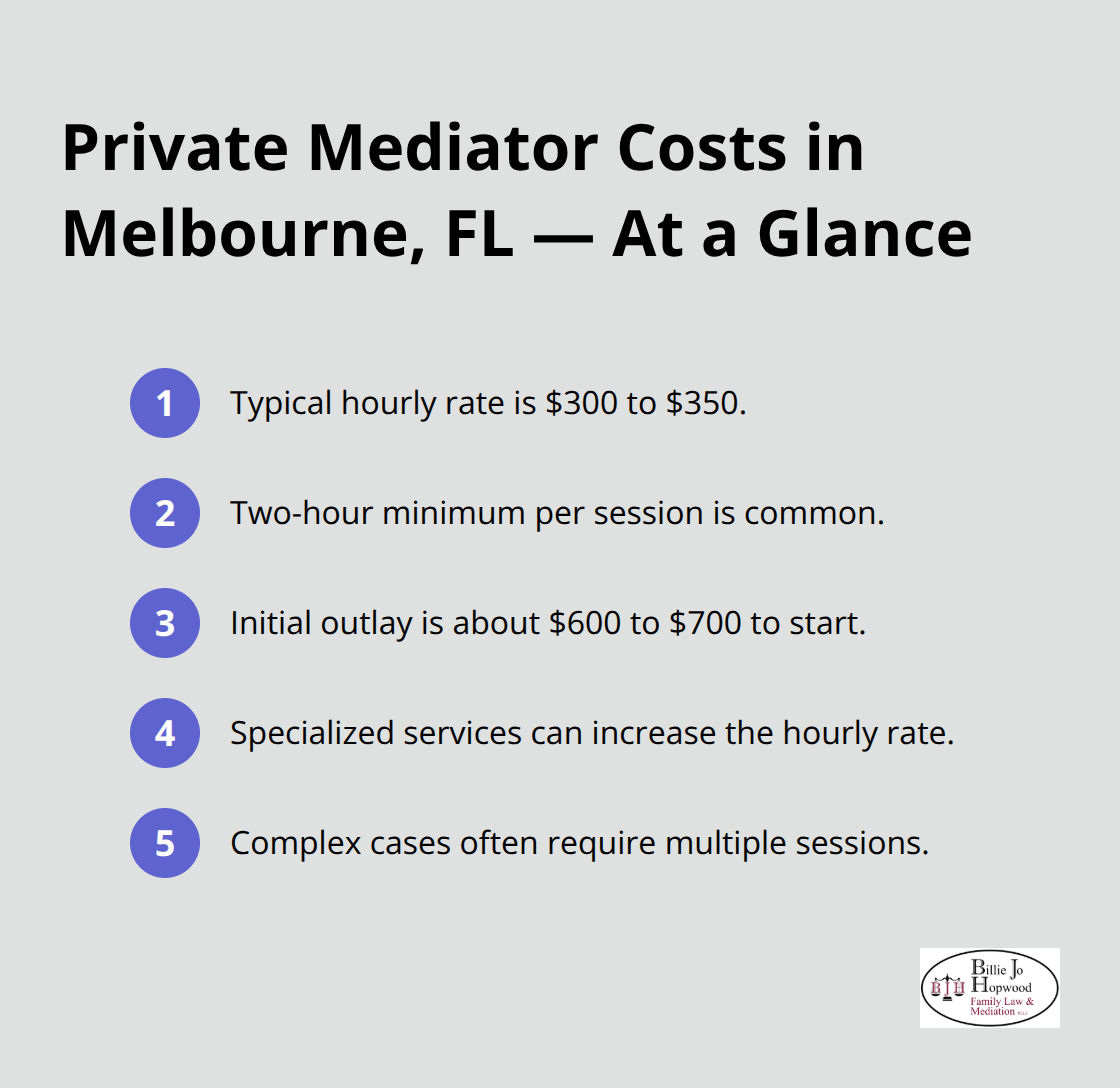
Private mediators in the Melbourne area typically charge between $300 and $350 per hour, with most requiring a minimum engagement of two hours per session. Your initial investment starts around $600 to $700 just to begin the process. Some mediators offer specialized services like high-conflict custody mediation or parenting coordination, which command higher rates.

Key private mediation cost facts for Melbourne, Florida, including hourly rates, minimums, and complexity factors. - is family mediation free

The hourly structure means you control how many sessions you need, though complex family situations often require multiple appointments.

Court-Ordered Mediation on a Sliding Scale

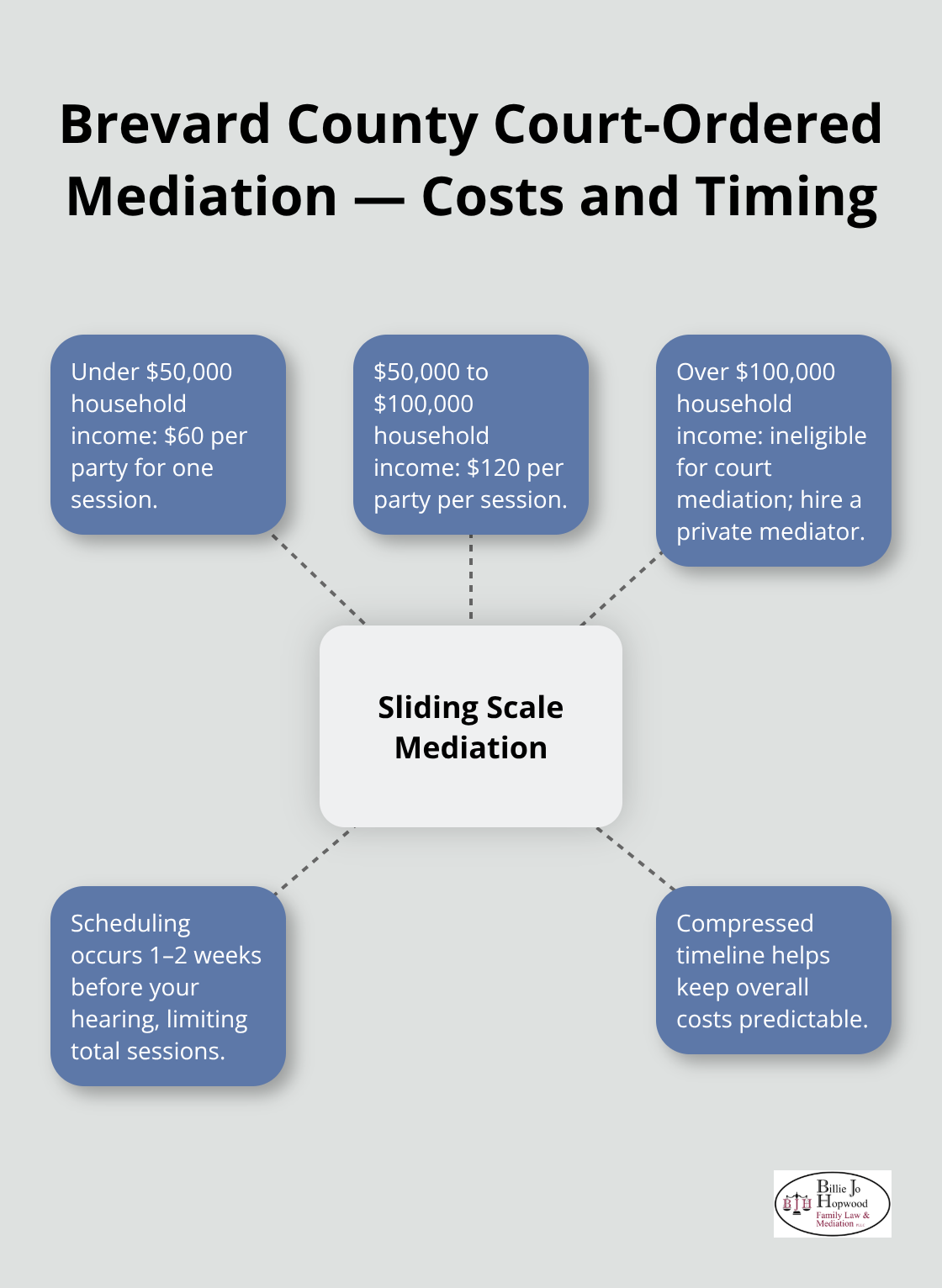
Court-ordered mediation in Brevard County operates on a sliding scale based on household income. If your combined household income falls under $50,000, you pay $60 per party for one session. Between $50,000 and $100,000, the cost rises to $120 per party per session.

Hub-and-spoke diagram showing Brevard County court-ordered mediation sliding scale, eligibility, and scheduling timeline.

If you earn over $100,000, you become ineligible for court mediation and must hire a private mediator instead. The real advantage of court-ordered mediation is that it happens relatively quickly-typically within 1-2 weeks before your scheduled hearing-which limits your total sessions and keeps costs predictable.

Hidden Costs Beyond Mediator Fees

Beyond the mediator’s hourly rate, additional expenses emerge that many people overlook. If you need an attorney to draft and file the final agreement after mediation, that cost ranges from $500 to $2,000 depending on complexity. Child interviews, which mediators may request on an individual basis, don’t typically add fees but require your time and coordination. If mediation fails and you proceed to court, you’ll face filing fees, expert witness costs if custody evaluations are needed, and attorney fees for trial representation.

Why Mediation Saves Money Compared to Litigation

Most people spend $1,500 to $3,000 total on mediation compared to $5,000 to $15,000 or more on contested litigation. The faster resolution also means lower emotional costs for your family and children. Understanding these cost differences helps you make an informed decision about whether mediation fits your situation. The next section explores when mediation becomes free or nearly free through court programs and community resources.

When Family Mediation Costs Nothing or Almost Nothing

Court-Ordered Mediation on a Sliding Scale

Court-ordered mediation in Brevard County makes family mediation affordable for most people earning under $100,000 annually. If your combined household income falls below $50,000, you pay just $60 per party for one session through the court system. Households earning between $50,000 and $100,000 pay $120 per party per session. The court schedules these sessions within 1-2 weeks before your hearing, which means you typically complete mediation in one or two appointments rather than dragging the process across months. This compressed timeline directly controls your total cost-you’re not paying for endless sessions.

Mediation remains mandatory for custody and visitation disputes under Florida Family Code Section 3170, and the court system treats it as a public service, not a profit center. The mediators conducting court-ordered sessions hold at least a Master’s Degree and receive specialized training in domestic violence, substance abuse, and family dynamics, so you’re not sacrificing quality for the low price.

Free Mediation Through Legal Aid Organizations

If you earn over $100,000, court mediation becomes unavailable and you must turn to private mediators or legal aid resources. Brevard County Legal Aid provides free family law assistance including mediation for qualifying low-income families, covering divorce, custody, and domestic violence matters. The Center for Mediation & Training offers six completely free online divorce and family mediation sessions on Wednesday evenings, addressing disputes over child support, custody, and unpaid arrears. These sessions run at 5:30 PM and 6:30 PM Eastern Time and are co-mediated by two trained mediators under supervision. If six sessions aren’t enough, the center provides additional mediation on a sliding scale for those unable to attend the set times.

Legal Aid of Manasota and other regional programs across Florida also cover family law mediation for eligible clients. The reality is stark: if your household income sits below $100,000, you have multiple pathways to free or near-free mediation through court programs and community organizations. Above that threshold, you’ll pay private mediator rates, making the decision between mediation and litigation a clearer financial trade-off.

What Happens When You Exceed Income Limits

Families earning over $100,000 face a different financial landscape. Private mediators in the Melbourne area charge between $300 and $350 per hour, with most requiring a minimum engagement of two hours per session. Your initial investment starts around $600 to $700 just to begin the process. Some mediators offer specialized services like high-conflict custody mediation or parenting coordination, which command higher rates. The hourly structure means you control how many sessions you need, though complex family situations often require multiple appointments. Understanding these cost differences helps you make an informed decision about whether mediation fits your situation and how it compares to the expense of contested litigation.

How Mediation Saves Money Against Litigation

Attorney Fees in Contested Cases Cost Far More

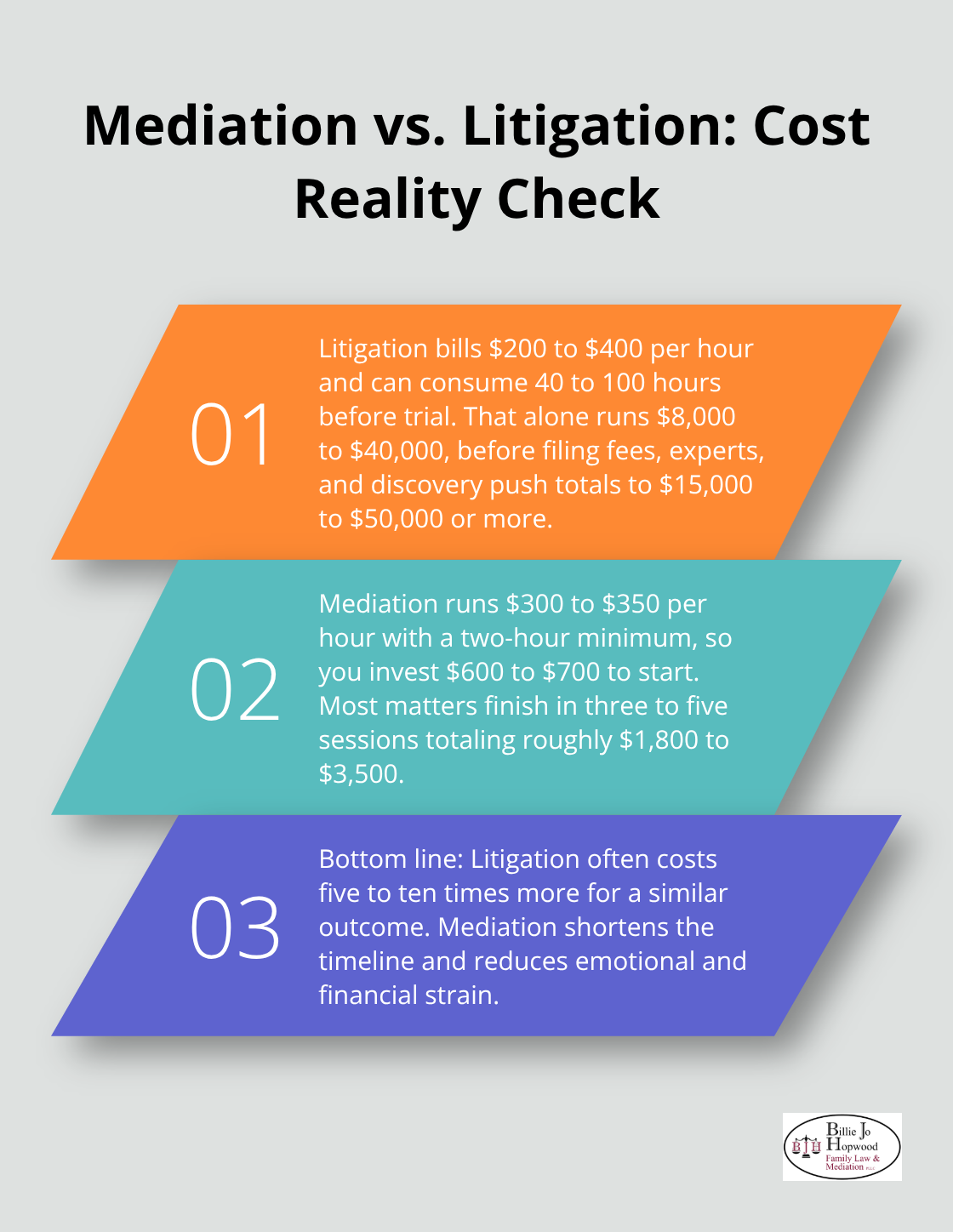
Contested divorce cases drain your bank account far faster than mediation ever will. When you litigate, your attorney charges hourly rates typically between $200 and $400 per hour in the Melbourne area, and contested cases consume 40 to 100 hours of legal work before trial. That alone puts you at $8,000 to $40,000 in attorney fees.

Three key comparisons showing how mediation costs and timelines differ from litigation in Melbourne, Florida. - is family mediation free

Court filing fees of $300 to $500, expert witness costs for custody evaluations that run $1,500 to $5,000, and discovery expenses for document review and depositions push your total to $15,000 to $50,000 or more. A mediator handling the same family situation charges $300 to $350 per hour with a two-hour minimum, meaning you spend $600 to $700 for an initial session and typically complete mediation in three to five sessions totaling $1,800 to $3,500. Litigation costs five to ten times more than mediation for the same outcome.

Time Extends Your Legal Expenses

Contested cases drag across 12 to 24 months while you attend hearings, wait for judge availability, and endure multiple continuances. Each court appearance requires additional attorney time and carries emotional weight. Mediation compresses the timeline to 4 to 8 weeks from start to agreement, which means your attorney spends fewer hours on your case and you stop paying legal fees faster. Court filing deadlines, discovery disputes, and motion practice all vanish in mediation.

The Real Cost of Prolonged Conflict

If you earn $50,000 annually, every month spent in litigation costs you real income and opportunity, not just attorney fees. The fastest path to closure preserves your earning capacity and shields your children from prolonged conflict. Families in Melbourne facing custody disputes should calculate their true litigation costs before assuming mediation expenses will match what they’d spend fighting in court.

Final Thoughts

Family mediation in Florida costs far less than litigation, and for many families in Melbourne, it costs nothing at all. If your household income falls below $100,000, court-ordered mediation through Brevard County operates on a sliding scale that keeps expenses between $60 and $120 per session. Legal aid organizations and community mediation centers offer free or low-cost services to qualifying families, while private mediation at $300 to $350 per hour remains dramatically cheaper than contested court battles that routinely exceed $15,000 to $50,000 in total legal expenses.

You control the timeline with mediation, typically completing the process in 4 to 8 weeks rather than enduring 12 to 24 months of litigation. Fewer attorney hours means lower legal bills, and no discovery disputes, motion practice, or expert witness fees accumulate. Your children avoid prolonged conflict while you preserve your earning capacity and emotional energy.

Whether family mediation is free depends on your income and which program you choose, but the financial advantage remains clear regardless of which path you take. We at Billie Jo Hopwood Family Law & Mediation, PLLC in Melbourne help families navigate these decisions and find solutions that fit their circumstances. Contact us to discuss your situation and explore the most cost-effective path forward for your family.

Family Mediation Examples That Transform Conflicts

Family conflicts don’t have to end in court. We at Billie Jo Hopwood Family Law & Mediation, PLLC have seen countless families resolve their disputes through mediation instead of litigation.

Family mediation examples show how real people move past anger and reach agreements that work for everyone. The stories in this post prove that transformation is possible when both sides are willing to talk.

How Mediation Transforms High-Conflict Family Disputes

When Families Feel Stuck, Mediation Opens a Path Forward

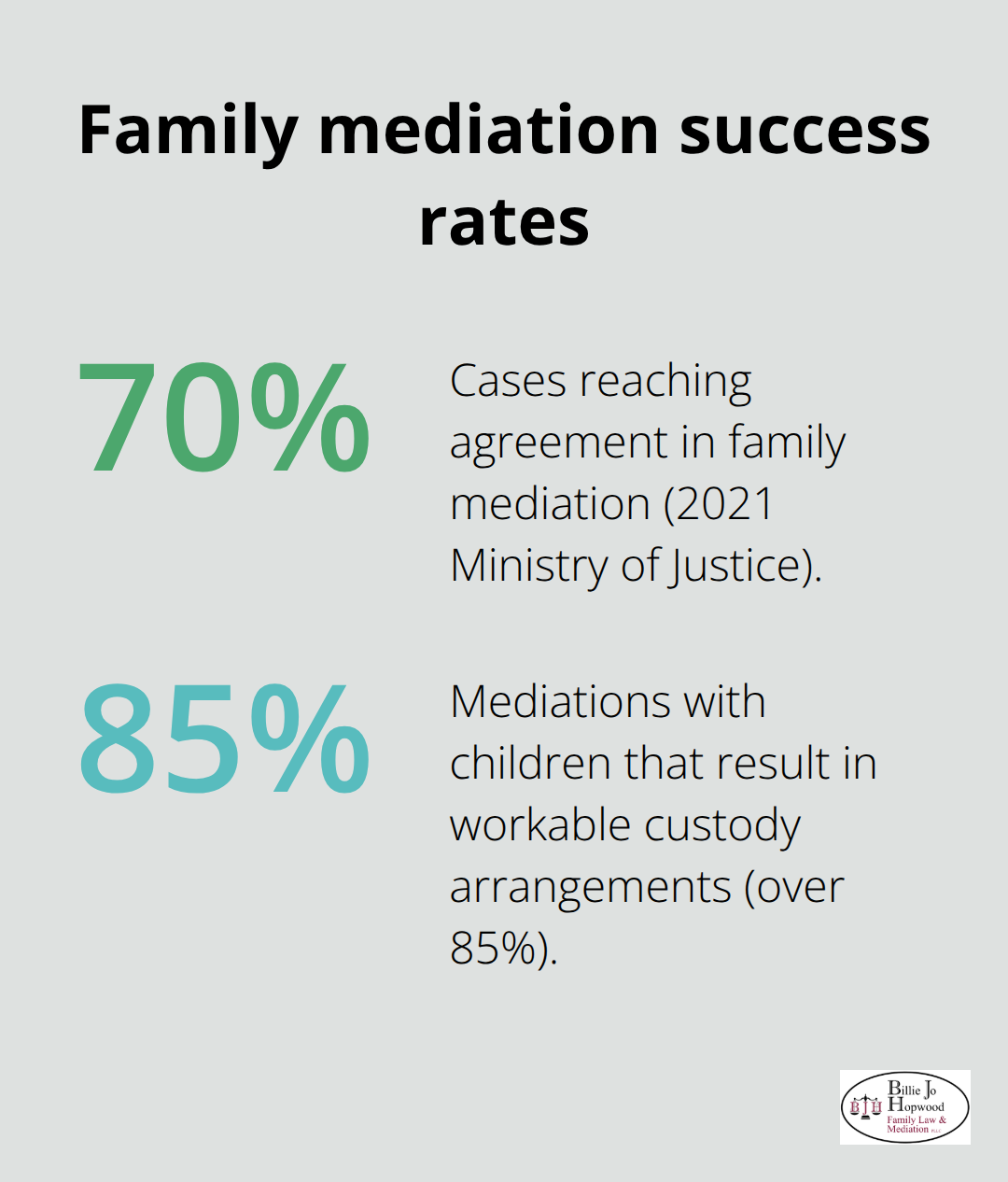
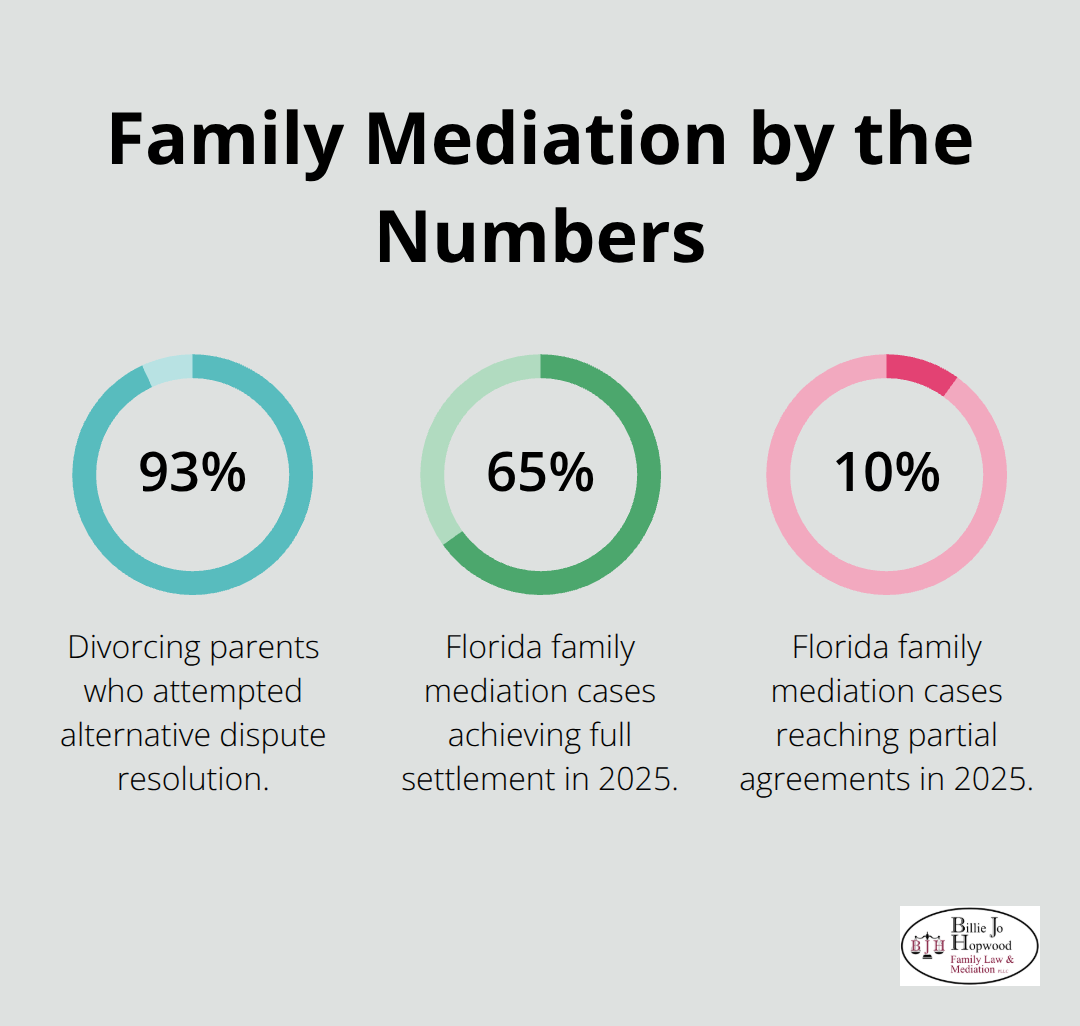
When custody battles intensify, property disputes multiply, and communication collapses, families assume litigation is their only path forward. Mediation proves this assumption wrong. A 2021 Ministry of Justice report found that 70 percent of family mediation cases reach agreement, and when children are involved, over 85 percent of mediations result in workable custody arrangements. These numbers matter because they show mediation works even in situations where families feel trapped.

Chart showing success rates for family mediation and custody arrangements

Real Custody Disputes Resolved Through Structure

Emily and Brian spent eighteen months in escalating conflict over parenting time. Their communication had deteriorated so badly that any conversation about their children turned hostile within minutes. When they entered mediation with a neutral facilitator, the structure changed everything. Instead of trading accusations about the past, the mediator guided them toward concrete proposals about school pickups, holiday schedules, and medical decision-making. Within four sessions, they had a detailed parenting plan aligned with their children’s school calendar and extracurricular activities. The confidential nature of mediation-where statements made during sessions cannot be used in court-gave them permission to speak honestly without fear their words would be weaponized later.

Protecting Business Value in Property Division

Carlos and Jamie faced a different challenge: they owned a family business worth significant money and disagreed fundamentally on how to divide it. Traditional litigation would have forced a judge to decide, potentially destroying the business in the process. Their mediator brought in a financial neutral to fairly value the enterprise and structure a buyout arrangement. This approach preserved the business, kept both parties’ financial interests intact, and avoided the legal fees that would have consumed tens of thousands of dollars.

Building Communication Frameworks for Blended Families

Blended family situations create their own friction. When stepparents, biological parents, and children from multiple relationships must coordinate decisions about healthcare, education, and living arrangements, mediation establishes clear communication frameworks that prevent future disputes. A structured mediation process lets all parties voice concerns without judgment, then builds agreements around practical responsibilities. The mediator’s role is strictly neutral-they do not take sides or provide legal advice-but their presence enforces respectful dialogue and keeps discussions focused on solutions rather than blame. Families consistently report that mediation produces more durable agreements than court orders because the people affected had a genuine voice in shaping the outcome.

These transformations happen because mediation shifts power back to the people involved. The next section examines the specific techniques mediators use to guide families from conflict toward resolution.

How Mediators Guide Families From Conflict to Agreement

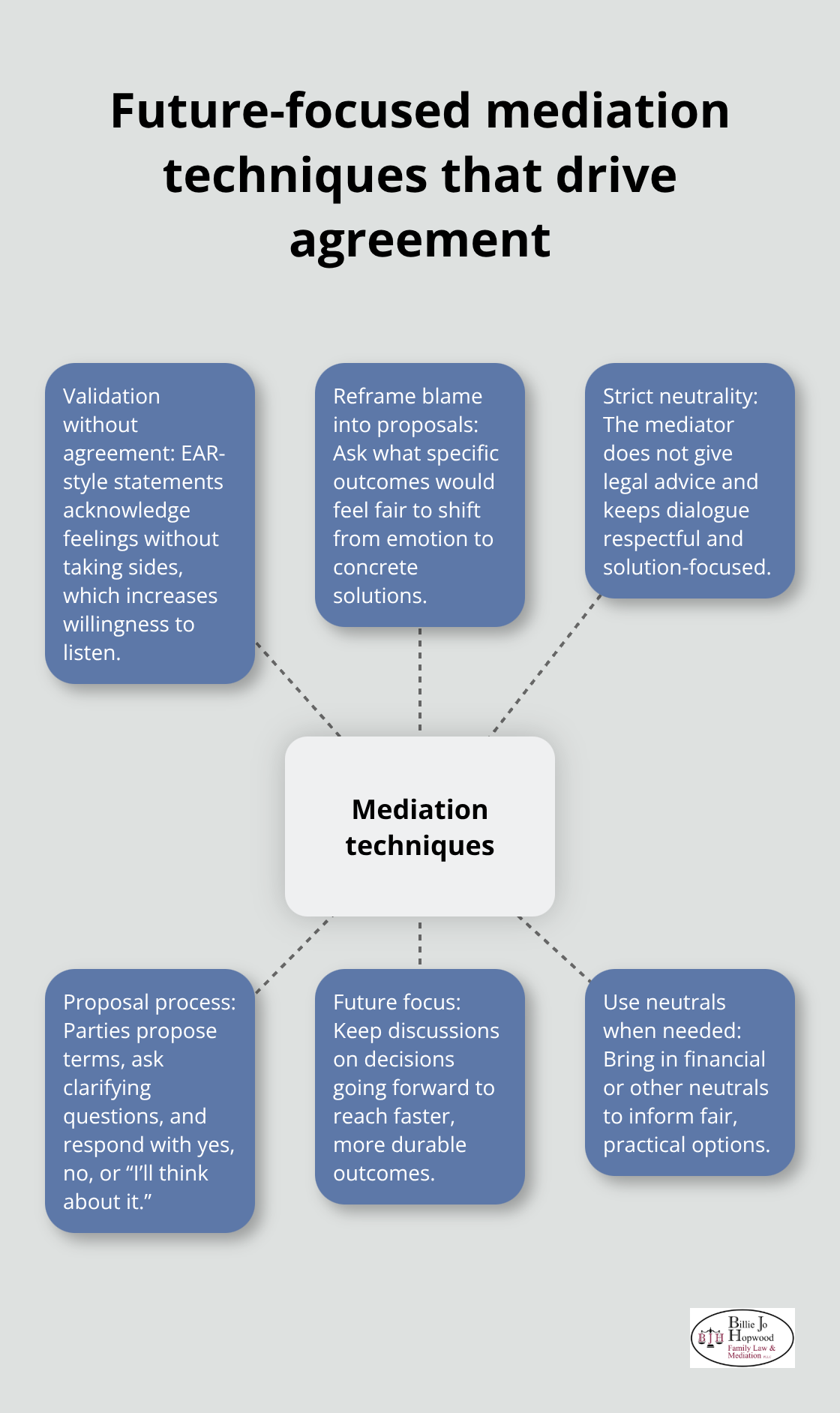
Mediators do not force families to agree. Instead, they use deliberate techniques that shift how people communicate and what they focus on. The most effective mediators stop families from rehashing the past and push them toward concrete proposals about the future. Research on high-conflict mediation shows that dwelling on past grievances rarely produces insight or change. Instead, mediators who keep discussions strictly future-focused achieve faster agreements and more durable outcomes. When Emily and Brian’s mediator heard them blame each other for the custody conflict, the mediator redirected: rather than exploring who caused the breakdown, they asked what specific arrangements would work for school pickups and holiday schedules.

Hub-and-spoke diagram of core mediation techniques that move families from conflict to agreement - family mediation examples

This single shift moved them from accusation to problem-solving within minutes.

Validation Without Agreement

A mediator’s first job is making both parties feel heard, but this does not mean the mediator agrees with them. Validation and agreement are different tools. When one parent says the other parent is irresponsible, a skilled mediator responds with something like: I hear that you have serious concerns about reliability and consistency in parenting. This approach acknowledges the emotion and concern without endorsing the judgment. The party feels seen without the mediator taking sides. Research on family mediation in England and Wales shows that when mediators use empathy-focused statements paired with attention and respect (what mediators call EAR statements), participants become more willing to listen to the other side. The mediator’s tone and choice of words signal that they focus on solving the problem, not on determining who was right or wrong.

Turning Blame Into Concrete Decisions

Reframing negative language into actionable proposals is where transformation actually happens. When Carlos said Jamie was trying to steal the family business, the mediator did not debate whether that was true. Instead, the mediator asked: What specific outcome would feel fair to you regarding the business? This question forced Carlos to move from emotion to proposal. Suddenly, the conversation became about valuation methods, buyout timelines, and cash flow rather than character attacks. Mediators trained in high-conflict family mediation understand that asking how someone feels typically keeps them stuck in emotion. Asking what they think about a specific decision moves them toward solutions. The mediator might ask: What do you think about a timeline where the valuation is completed within sixty days? This structure gives both parties thinking time, prevents rushed agreements, and lets them own the decisions they make.

How Proposals Build Durable Agreements

Families report that agreements reached through this proposal-based approach hold up better after mediation ends because both sides genuinely chose the outcome rather than having it imposed by a judge. The mediator’s role is strictly neutral-they do not take sides or provide legal advice-but their presence enforces respectful dialogue and keeps discussions focused on solutions rather than blame. When mediators present options to families (rather than asking probing questions about the past), they keep the conversation objective and solution-focused. This technique works because it shifts control back to the people involved. Each party shapes the final agreement through their own proposals and responses, which creates stronger commitment to the outcome. The structured proposal process-where one party proposes specific terms, the other asks clarifying questions, and both respond with yes, no, or “I’ll think about it”-prevents circular arguments and moves families toward resolution.

The techniques mediators use in Melbourne, Florida, and across the country share one common thread: they move families away from who was wrong and toward what works for everyone going forward. Understanding these methods reveals why mediation produces faster resolutions and lower costs than litigation-the focus shifts entirely to building agreements rather than proving fault.

Why Mediation Costs Far Less Than Court Battles in Melbourne, Florida

Litigation consumes money in ways mediation simply does not. A contested divorce in court averages between $15,000 and $30,000 per person when attorneys handle discovery, depositions, and trial preparation. Mediation typically costs $1,500 to $5,000 total for both parties combined, depending on case complexity and the number of sessions needed. The National Audit Office in the UK documented that mediation costs significantly less than court proceedings, easing financial burden and reducing pressure on the court system. The difference matters most for families with modest means who cannot afford prolonged legal warfare.

How Speed Reduces Your Total Costs

Court timelines stretch across months or years; mediation resolves most cases within four to eight sessions spread over two to four months. Speed translates directly to savings because you pay mediators hourly rather than attorneys billing for endless procedural steps that court rules demand. When Carlos and Jamie used mediation to resolve their business dispute, they avoided discovery costs alone, which would have consumed thousands of dollars just to exchange documents and deposition testimony. A 2021 Ministry of Justice report found that 70 percent of family mediation cases reach agreement, and when children are involved, over 85 percent of mediations result in workable arrangements. These completion rates prove mediation actually finishes what it starts, whereas litigation often drags on through appeals and post-judgment motions that generate additional legal bills.

You Control Every Decision, Not a Judge

Mediation lets you shape every term of your agreement before it becomes binding. A judge decides custody, property division, and alimony based on state law and whatever evidence fits into a narrow courtroom timeframe. You cannot appeal a judge’s ruling on parenting time without proving the decision was an abuse of discretion, a nearly impossible standard. Emily and Brian structured their parenting plan around their children’s actual school calendar and extracurricular schedule rather than accepting a generic every-other-weekend arrangement a judge might impose. They controlled whether holidays rotated annually, how medical decisions would be made, and how communication would happen between households. Once you reach agreement in mediation and convert it to a court order, the arrangement is just as legally binding as any judgment, but you designed it.

Privacy Protects Your Family’s Sensitive Information

The confidentiality of mediation also protects your family’s privacy in ways court proceedings never do. Court files become public record; anyone can access details about your finances, parenting conflicts, and personal matters. Mediation communications remain confidential and are typically not admissible in court if mediation fails (with limited exceptions for child abuse, criminal acts, or threats). Families report that this privacy gives them freedom to speak honestly without worrying their words will appear in newspaper archives or become weaponized in future disputes.

Why Mediation Removes Financial Pressure

The cost and timeline pressures of litigation force families into impossible choices. Mediation removes those pressures and lets you build agreements that actually reflect what your family needs. You avoid the financial drain that makes families settle cases unfavorably just to stop the bleeding of legal fees. Instead, you invest in a process designed to reach fair outcomes without the overhead that traditional litigation demands.

Checklist of ways mediation reduces legal costs and pressure compared to litigation - family mediation examples

Final Thoughts

The family mediation examples throughout this post show that transformation happens when families shift from blame to problem-solving. Emily and Brian moved from eighteen months of hostile conflict to a workable parenting plan in four sessions, while Carlos and Jamie preserved their family business instead of watching it destroyed by litigation costs. These outcomes resulted from a structured process where both parties maintained control over decisions that affected their lives and their children’s futures.

Mediation works because it removes the adversarial framework that courts impose. You negotiate to build an agreement that actually works for your family rather than fighting to win. The speed, cost savings, and privacy of mediation create space for honest conversation that litigation destroys, and when you reach agreement through mediation, you own the outcome in a way that no court order can replicate.

If your family faces conflict around custody, property division, alimony, or communication breakdowns, mediation offers a path forward that protects your relationships and your finances. We at Billie Jo Hopwood Family Law & Mediation, PLLC understand that family disputes require compassion alongside clear guidance, and we assist families through challenging legal situations in Melbourne, Florida. Contact Billie Jo Hopwood Family Law & Mediation, PLLC to explore how mediation can help your family move forward with confidence and clarity.

Sample Family Mediation Agreement Templates and Examples

A family mediation agreement is only valid in Florida if it meets specific legal standards and gets court approval. We at Billie Jo Hopwood Family Law & Mediation, PLLC help families in Melbourne, Florida create agreements that actually hold up.

Using a sample family mediation agreement template gives you a solid starting point, but your situation is unique. This guide shows you what makes agreements enforceable, what components you need, and how to customize templates for your family’s needs.

What Makes Your Mediation Agreement Legally Binding in Florida

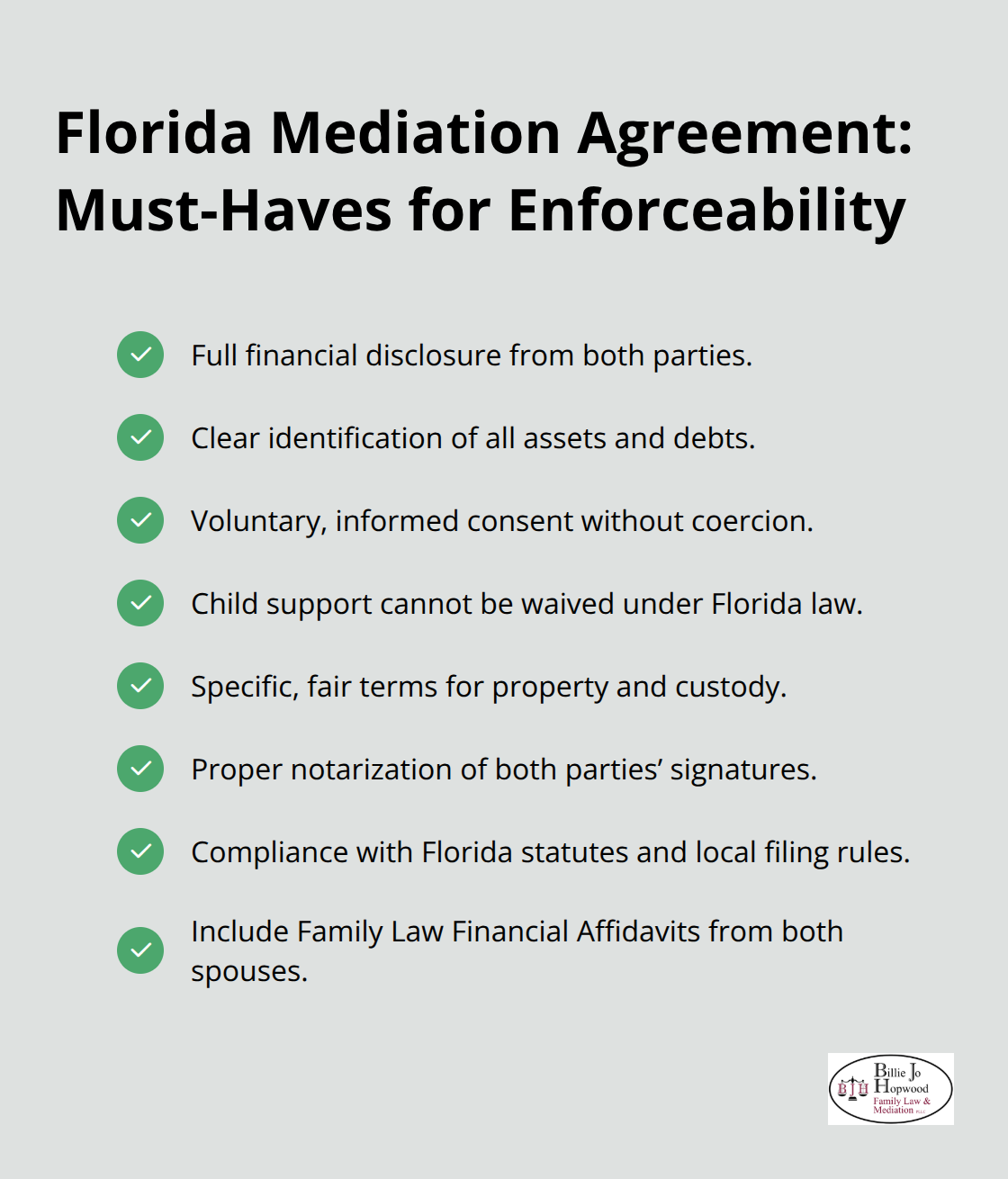
Florida courts enforce mediation agreements only when they meet strict statutory requirements, and missing even one element can render your entire agreement unenforceable. Under Florida law, your mediation agreement must include full financial disclosure from both parties, clear identification of all marital assets and debts, and explicit consent from each spouse without coercion. The agreement also must comply with state-specific rules-for example, you cannot waive child support obligations in Florida, even if both parties agree to do so, because the court considers child support a matter of public policy that protects children. Florida courts reject agreements that lack specificity about property division, fail to address custody arrangements clearly, or contain terms that are grossly unfair to one party. The Brevard County Clerk of Court requires that dissolution of marriage documents filed after mediation include a completed Family Law Financial Affidavit from both parties, which serves as proof of financial disclosure during the mediation process.

Checklist of Florida mediation agreement legal requirements for court approval

How Courts Decide Whether Your Agreement Stands

Florida judges review mediation agreements under a different standard than they apply to contested litigation outcomes. The court focuses on whether both parties had adequate information to make informed decisions, whether they understood the terms they were agreeing to, and whether the agreement reached completion voluntarily without pressure from the other spouse. Courts in Brevard County typically approve straightforward mediation agreements within two to three weeks of filing, provided all documentation is complete and both parties’ signatures are properly notarized. However, if a judge suspects unconscionable terms-meaning one party received dramatically less than their fair share-the court can modify the agreement or reject it entirely. Agreements involving child custody receive extra scrutiny because Florida law requires that all custody arrangements serve the best interests of the child, regardless of what the parents negotiated. Having an attorney review your agreement before signing protects you from court rejection or later enforcement problems. The filing fee with the Brevard Clerk of Court is currently $408, and incomplete filings delay final approval and extend your case timeline significantly.

Red Flags That Courts Will Not Overlook

Agreements that lack specific dates, times, and transfer procedures for child visitation create enforcement problems that courts recognize immediately. If your mediation agreement states vague language like the children will spend time with each parent without defining which days, what hours, or how transitions occur, a judge will likely send the agreement back for revision. Property division terms must identify each asset by its current value and specify who receives what-saying one spouse gets the house without addressing the mortgage, property taxes, or home equity creates post-divorce disputes. Agreements that hide assets or fail to disclose debts are vulnerable to challenge under Florida’s full disclosure requirement, and courts can void such agreements entirely and order the case back to mediation or trial. Another common problem occurs when language contradicts Florida statutes, such as attempting to eliminate alimony when the paying spouse has significantly higher income and the receiving spouse sacrificed career opportunities during the marriage. Courts also reject agreements where one party was not represented by counsel and financial disclosures were highly unbalanced, signaling potential coercion or lack of understanding. Rushing through mediation without proper preparation produces agreements that courts reject-families who gather pay stubs, bank statements, retirement account statements, and home valuations beforehand submit agreements that courts approve on the first submission, while unprepared parties face delays and required revisions that cost additional mediation hours and filing fees.

What Happens When You Customize Your Template

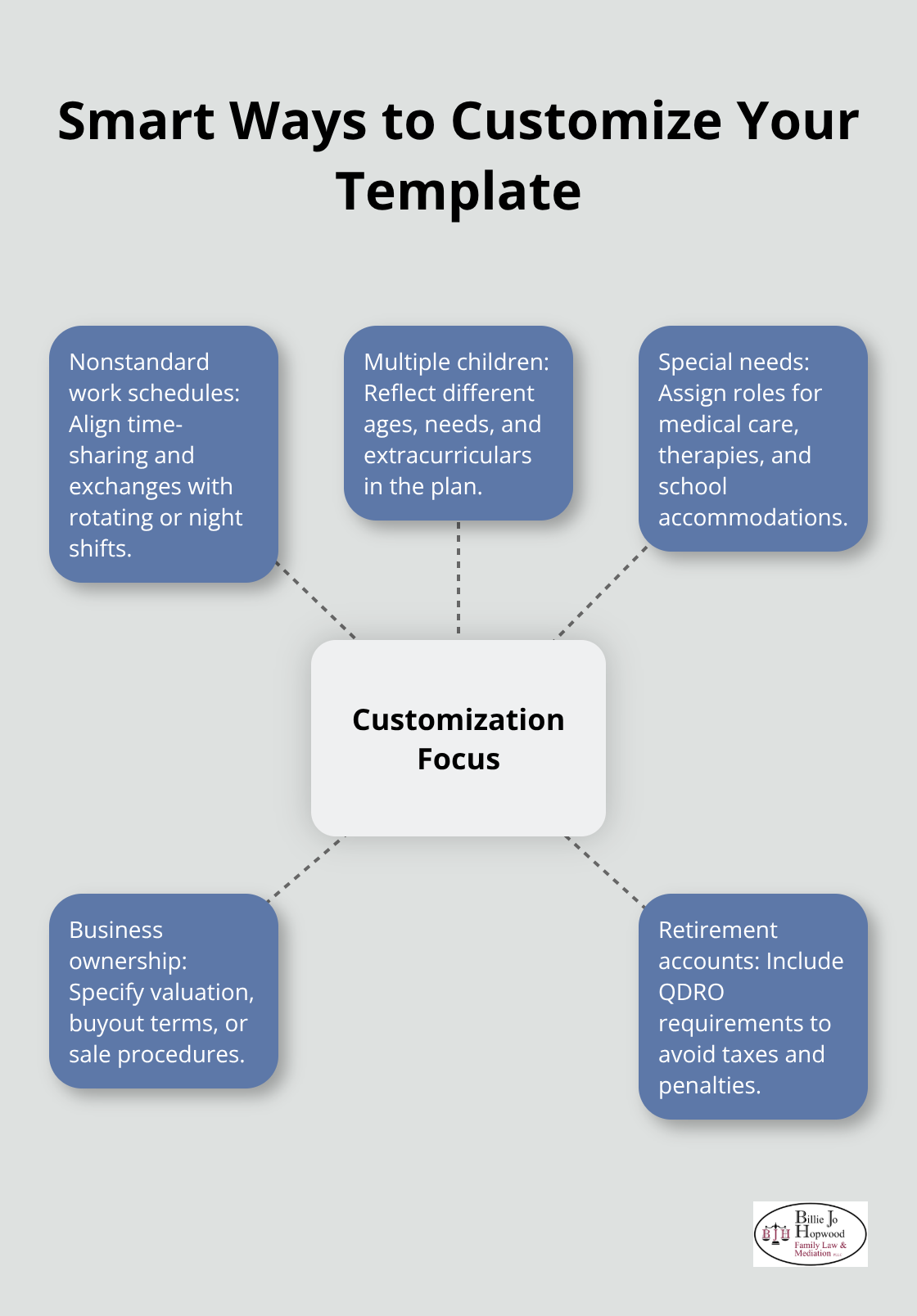
Standard templates provide a foundation, but your family’s circumstances demand specific language that reflects your actual situation. When you adapt template language to address your unique assets, custody arrangements, and support obligations, you create an agreement that courts recognize as thoughtfully negotiated rather than hastily assembled. Courts view customized agreements more favorably because they demonstrate that both parties invested time in understanding what they were accepting. The next section walks you through the essential components that must appear in any mediation agreement, regardless of which template you start with or how much you customize it.

Essential Components Every Family Mediation Agreement Needs

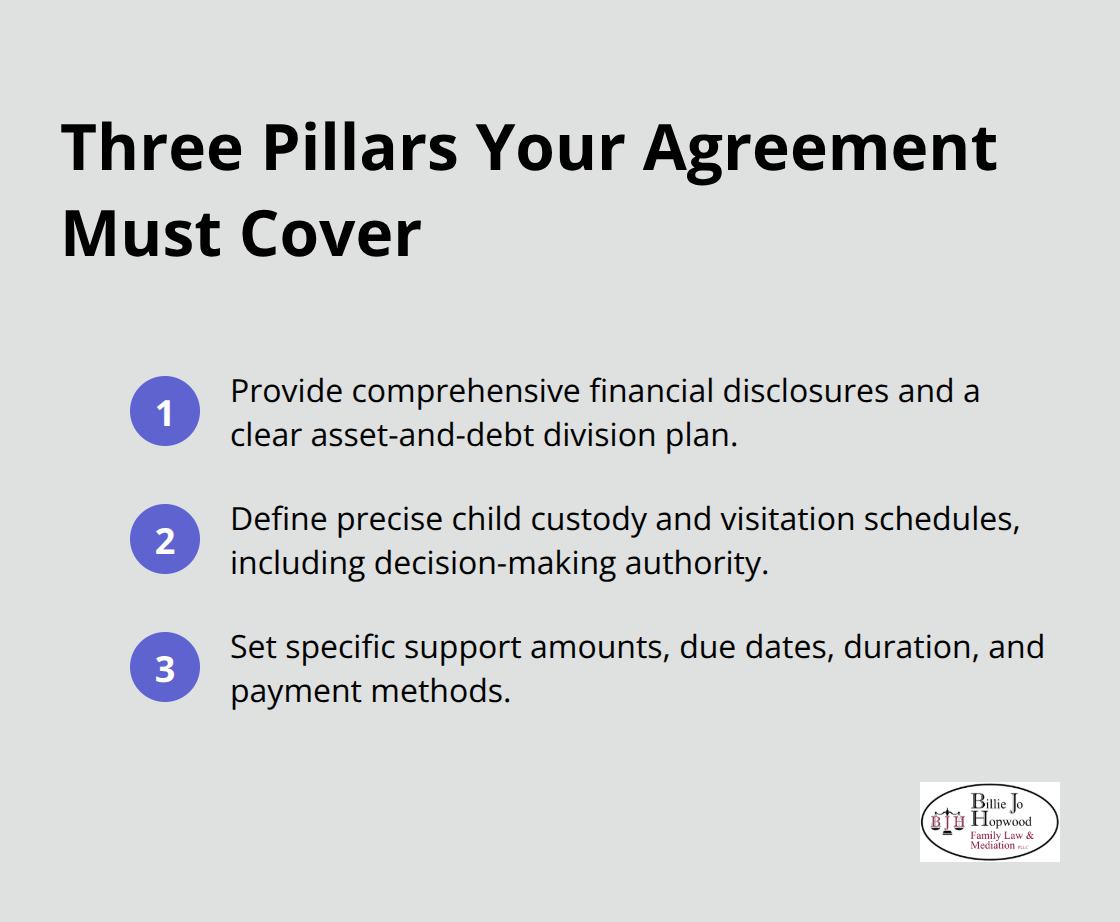
Your mediation agreement lives or dies based on three concrete elements: what financial information you disclose, how you structure custody arrangements, and what payment obligations you commit to. Missing or poorly drafted sections in any of these areas gives courts grounds to reject your agreement or creates enforcement nightmares after your divorce finalizes.

Compact list of core sections in a Florida family mediation agreement - sample family mediation agreement

Financial Disclosures and Asset Division

The Brevard County Clerk of Court requires that both parties complete a Family Law Financial Affidavit, which becomes part of your court filing and serves as proof that full financial disclosure occurred during mediation. This affidavit must list all income sources, assets with current values, debts with balances, and monthly expenses-vague estimates or omitted accounts signal to judges that one party hid information, which invalidates everything you negotiated.

Property division language must identify each asset by type and approximate current value: the family home at 123 Main Street with estimated equity of $150,000, the 2020 Toyota with outstanding loan balance of $8,000, the investment account containing approximately $45,000, the pension earned during the marriage with an estimated present value of $120,000. Courts reject agreements that say one spouse gets the house without addressing whether that spouse assumes the mortgage, pays the other spouse for their equity share, or refinances the loan.

Asset division also requires you to specify which party receives retirement accounts and whether a Qualified Domestic Relations Order is needed to transfer funds without tax penalties. Many families overlook this detail and face unexpected tax consequences months after divorce.

Child Custody and Visitation Schedules

Custody and visitation sections demand specificity that standard templates often lack. Your agreement must state exact pickup and drop-off times, specific locations for exchanges, and what happens if one parent is late or unavailable. Courts enforce agreements that say school pickup occurs at 3:15 p.m. at the elementary school main entrance on Tuesday and Thursday; courts reject vague language about reasonable visitation or quality time.

Include which parent makes educational decisions, medical decisions, and religious decisions, because Florida law requires that custody agreements address these areas separately from physical time-sharing. Document the school-year schedule with specific dates when custody transitions occur, then address summer, spring break, and holiday schedules with even-year and odd-year patterns to prevent annual disputes.

Support Obligations and Payment Terms

Support obligations must specify the exact monthly amount for child support or alimony, the due date each month, and the payment method-direct deposit, check, or electronic transfer reduces disputes about whether payments arrived on time. Florida statutes require that child support amounts follow the guidelines unless both parties agree in writing to deviate, and any deviation must include the specific reasons why the guideline amount does not serve the child’s best interests.

Alimony terms must state the duration, whether payments end upon remarriage or death, and whether the amount can be modified if circumstances change significantly. Agreements that omit these enforcement details cost families thousands in additional litigation when one party claims they never understood their obligations or disputes whether payments were made.

Once you understand what components your agreement must contain, the next step involves taking a standard template and adapting it to reflect your family’s actual circumstances, assets, and arrangements.

Customizing Templates to Match Your Actual Family Structure

Standard templates provide language for straightforward situations, but most families in Melbourne, Florida face circumstances that demand customization. Your agreement template likely includes generic provisions for two parents with one or two children, equal income levels, and standard work schedules. If your situation differs-one parent works nights, you have three children with different needs, one spouse owns a business, or you have significant retirement accounts-the template language becomes inadequate or actively harmful to your interests.

Hub-and-spoke infographic showing key customization areas for Florida family mediation agreements - sample family mediation agreement

Identifying Which Sections Need Revision

Start with identifying which template sections apply directly to your situation and which sections require substantial revision. A parent who works a rotating shift cannot use a template that assumes standard 9-to-5 employment, because the custody schedule will fail immediately when the shift pattern changes. Similarly, a family with a child who has autism or ADHD needs customized language addressing which parent coordinates medical appointments, manages school accommodations, and handles behavioral decisions. Generic template language about custody decisions provides no guidance for these practical realities.

How Mediators Help You Customize Language

A skilled mediator asks specific questions about your work schedules, your children’s specific needs, your asset composition, and your financial obligations, then guides you toward language that addresses those realities rather than forcing your family into a template’s predetermined categories. The mediator’s role involves translating your actual circumstances into enforceable language that courts will recognize as legitimate. During mediation sessions, this process ensures your agreement reflects what actually happens in your household rather than what a generic template assumes.

Addressing Property Division With Specificity

Property division customization requires you to identify every significant asset and specify exactly how division occurs. If you own a home worth $250,000 with a $180,000 mortgage, the template language must state whether one spouse retains the home and refinances the loan, whether both spouses remain on the mortgage temporarily while one spouse purchases the other’s equity, or whether the home sells and proceeds divide. A business valued at $300,000 demands language addressing whether one spouse receives the business outright, whether the other spouse receives a note for their equity share, or whether the business sells.

Retirement accounts require specific language about Qualified Domestic Relations Orders, because failing to address this detail creates tax consequences neither spouse anticipated. Mediation helps you avoid the common mistake of creating agreements where one spouse receives assets without corresponding debt responsibility, leaving that spouse underwater financially.

Building Defensible Financial Documentation

When your mediator works with both parties to identify and value all assets during mediation, you create disclosure documentation that courts recognize as thorough and legitimate. This documentation makes your final agreement defensible if either party later claims they were unaware of marital property. The specificity you develop during customization transforms a generic template into a document that reflects your family’s actual financial reality.

Final Thoughts

A sample family mediation agreement template provides the framework you need, but your family’s actual circumstances demand customization that transforms generic language into a document courts will approve. After both parties sign your agreement, you file the completed documents with the Brevard County Clerk of Court, pay the $408 filing fee, and courts typically approve straightforward agreements within two to three weeks. Before you submit anything, have an attorney review your signed agreement to confirm it complies with Florida law and addresses all necessary elements, which prevents costly delays or required revisions.

We at Billie Jo Hopwood Family Law & Mediation, PLLC guide you through mediation in Melbourne, Florida and help you customize agreement language so your final documents meet Florida’s legal requirements. Contact our firm if you need guidance on whether mediation fits your situation or want help preparing for mediation sessions. We discuss your family’s specific circumstances and walk you through the complete mediation process to ensure your sample family mediation agreement reflects your actual needs.

What Is Family Mediation? Complete Definition Guide

Family mediation offers a different path when relationships end or family conflicts arise. Instead of fighting in court, both parties work with a neutral mediator to reach agreements that work for everyone.

At Billie Jo Hopwood Family Law & Mediation, PLLC, we guide families through this process in Melbourne, Florida, helping them understand what family mediation actually means and how it can resolve disputes faster and with less expense than traditional litigation.

What Family Mediation Actually Is

The Core Definition and Structure

Family mediation is a structured negotiation process where a neutral third party-the mediator-helps both parties communicate and reach binding agreements on family matters. Unlike court litigation, where a judge imposes decisions after hearing arguments, mediation puts control directly into the hands of the people involved. In the 18th Judicial Circuit covering Brevard and Seminole counties, family mediation addresses dissolution of marriage, paternity, parenting plan modifications, and child support disputes. The mediator does not give legal advice, take sides, or decide outcomes. Instead, the mediator facilitates discussion, helps clarify priorities, and guides both parties toward customized solutions they can live with.

Florida-certified mediators must complete specialized dispute-resolution training and maintain certification by completing 16 hours of continuing education every two years. This means the person guiding your mediation has real credentials and ongoing professional development, not just volunteer status.

How Mediation Differs from Court Litigation

Court litigation forces a winner-and-loser outcome. A judge reviews evidence, hears arguments, and imposes terms neither party may want. Mediation flips this dynamic entirely. You and your former partner actively shape the agreement, which means the final result reflects what actually matters to your family rather than what a judge thinks is fair.

Research cited by Mediate.com found that 93 percent of divorcing parents attempted alternative dispute resolution, with over half choosing mediation specifically. The success rate for family mediation in Florida reached approximately 70 to 80 percent in 2025, with about 65 percent achieving full settlement and another 10 percent reaching partial agreements. Cost differences are stark: mediation typically involves far fewer attorney hours and court appearances, often saving families thousands of dollars compared to litigation.

Key family mediation statistics on ADR attempts and settlement outcomes in Florida - family mediation definition

What Mediation Actually Costs

A court-ordered mediation session in Brevard or Seminole counties lasts approximately 1.5 hours and costs between $60 and $120 per party depending on combined household income, with an indigent option available for eligible families. Mediation sessions are confidential unless disclosure is required by law, meaning what you discuss stays private. Litigation, by contrast, happens in public court records.

Quick facts on session length, fees, indigent option, and confidentiality - family mediation definition

Common Misconceptions About the Process

Many people mistakenly believe mediators will pressure them toward unfair deals or that mediation requires both parties to want reconciliation. Mediators maintain strict impartiality and cannot push either party. You retain complete authority to accept or reject any proposal. Mediation also works without requiring you to want the relationship to succeed-only that you’re willing to negotiate practical solutions for finances, custody, and support.

Another common misconception is that mediation is slower than court. In reality, scheduling mediation sessions is typically much faster than waiting for court hearings, and most cases resolve within weeks to a few months rather than the months or years litigation can demand. These time and cost advantages make mediation particularly attractive for families in Melbourne, Florida, who want to move forward without prolonged court battles.

Key Benefits of Family Mediation in Melbourne, Florida

Cost Savings Compared to Traditional Divorce

Mediation in Melbourne, Florida costs substantially less than litigation because you avoid the endless cycle of court filings, depositions, and attorney billable hours that litigation demands. A single mediation session through the 18th Judicial Circuit costs between $60 and $120 per party for 1.5 hours, compared to litigation where a contested divorce can easily exceed $15,000 to $30,000 in combined legal fees. You control the pace and depth of negotiation rather than waiting months between court hearings scheduled at the judge’s convenience.

Most families complete mediation within weeks to a few months, whereas litigation typically stretches 12 to 24 months or longer. The 2025 Florida mediation data shows that approximately 65 percent of cases reach full settlement and another 10 percent reach partial agreements, meaning roughly three-quarters of families walk away with binding agreements without ever stepping into a courtroom. Every month spent in litigation adds another layer of attorney fees and emotional exhaustion for everyone involved, especially children caught in the middle.

Faster Resolution Without Court Delays

Mediation eliminates the waiting game that defines court proceedings. You schedule sessions at times that work for both parties rather than waiting for the judge’s calendar to open. Most people complete mediation in one session; some need two or three, and very complex cases may require two consecutive days. This speed matters because prolonged uncertainty takes a real toll on families trying to move forward.

Greater Control Over Outcomes for Both Parties

What makes mediation genuinely powerful is that you keep decision-making authority instead of handing it to a judge who knows nothing about your family’s actual needs. In court, a judge imposes terms based on legal standards and what they believe is fair-not what works for your household. Mediation allows you to craft agreements around your children’s school schedules, your work commitments, and financial realities that a judge cannot address.

Parents who mediate custody arrangements report greater satisfaction with the outcome because the schedule reflects real life, not a template. You negotiate spousal support, child support, and asset division with the flexibility to include creative solutions (such as phased alimony or one parent keeping the family home longer) that courts cannot order. This control directly reduces post-settlement conflict because both parties shaped the agreement together rather than resenting a judge’s decision.

Why Mediated Agreements Stick

For families in Melbourne, Florida, this collaborative approach translates to faster healing, lower ongoing legal costs, and children who experience less parental conflict during and after the process. Settlements reached through mediation tend to be more durable, with less post-agreement conflict due to the collaborative nature of the process. Both parties invested in creating the solution, which means they’re more likely to honor it.

Understanding these financial and practical advantages helps families recognize when mediation fits their situation-and when other factors might push them toward court instead.

When Family Mediation Works Best

Ideal Situations for Mediation Success

Mediation succeeds when both parties want to resolve disputes without court involvement and are willing to negotiate in good faith. The 2025 Florida mediation data shows that approximately 70 to 80 percent of family cases reach settlement, but this outcome depends heavily on the specific circumstances of your situation. Couples dissolving a marriage with relatively straightforward asset division, no significant power imbalances, and a shared commitment to protecting children from conflict are ideal candidates for mediation.

Core conditions that support successful family mediation

If you have minor children and both parents want to minimize disruption to their routines, mediation allows you to design parenting schedules that actually fit your family’s life rather than accepting a judge’s standard template.

Cases That Respond Well to Mediation

Dissolution of marriage cases where both parties acknowledge basic facts about income, property, and debts move through mediation faster because you skip the expensive discovery phase that litigation demands. Parenting plan modifications and child support adjustments also respond exceptionally well to mediation because parents understand their children’s needs better than any judge and can adjust arrangements as circumstances change without returning to court. The mediator in Brevard or Seminole counties facilitates these conversations while remaining completely neutral, which means both parties feel heard even when disagreements exist about specific terms.

Red Flags That Signal Court Intervention Is Necessary

Mediation becomes problematic when domestic violence, significant mental health crises, substance abuse, or severe power imbalances exist between parties. If one partner controls finances completely, has a history of intimidating the other, or has been arrested for violence, mediation cannot function because the intimidated party cannot negotiate freely. Court intervention protects vulnerable parties by removing them from direct negotiation and having a judge impose protections.

Child abuse allegations, threats of parental abduction, or situations where one parent actively prevents the other from seeing children also require court orders rather than mediation because these cases demand legal enforcement mechanisms that mediation cannot provide. If either party refuses to disclose financial information honestly or attempts to hide assets, mediation stalls immediately and litigation becomes necessary. Similarly, if one party shows no willingness to compromise or uses mediation as a delay tactic while continuing hostile behavior, court proceedings move the case forward more efficiently.

When Mediators Recommend Court Instead

The 18th Judicial Circuit recognizes these limitations, and mediators are trained to identify when cases lack the basic conditions for productive mediation and recommend court intervention instead. Spending weeks in failed mediation attempts wastes money and emotional energy when litigation would resolve matters faster in genuinely unsafe or uncooperative situations.

Final Thoughts

Choosing family mediation in Melbourne, Florida means selecting a path that prioritizes your family’s actual needs over prolonged court battles. The family mediation definition extends beyond a simple legal process-it represents a commitment to resolving disputes with dignity, speed, and control over your own future. We at Billie Jo Hopwood Family Law & Mediation, PLLC understand this distinction and help families navigate every stage from initial preparation through final agreement.

The collaborative process itself sets a healthier tone for post-separation life compared to adversarial court environments. Parents who mediated custody arrangements report greater satisfaction because they designed schedules that actually work for their children and their own lives. The agreement you created together becomes something both parties respect and follow, which reduces future conflicts and the need for additional court involvement.

If mediation doesn’t fully resolve every issue, you still gain clarity about where disagreements remain and what each party truly needs. This clarity often leads to faster resolution if litigation becomes necessary, or it may reveal that a second mediation session can bridge remaining gaps. Contact Billie Jo Hopwood Family Law & Mediation, PLLC in Melbourne, Florida to discuss whether mediation fits your family’s situation and how we can guide you toward resolution with confidence and clarity.

How to Prepare for Mediation in Family Law Cases

Family law mediation works best when you arrive prepared. We at Billie Jo Hopwood Family Law & Mediation, PLLC know that understanding how to prepare for mediation in family law cases reduces stress and leads to better outcomes.

This guide walks you through gathering documents, understanding what happens during sessions, and approaching mediation with a clear strategy.

What Documents Do You Need Before Mediation

Gathering the right documents before mediation is non-negotiable. You cannot negotiate effectively without understanding your financial position, and the mediator cannot help you reach a fair agreement without complete information. Start by collecting every financial record from the past six months: pay stubs, bank statements for all accounts, credit card statements, and investment account statements. Proper preparation can cut mediation time by up to 30%, which means less time spent in sessions and lower overall costs. If you own retirement accounts like a 401(k) or IRA, pull those statements too. Pension information matters equally. Many people underestimate how much these accounts factor into property division, and missing them during mediation creates problems later when your agreement needs court approval.

Organize Your Financial Picture Completely

Create a spreadsheet listing every asset and liability with current values. Include your home, vehicles, jewelry, business interests, and any accounts held jointly or separately. For liabilities, list mortgages, car loans, credit card debt, and personal loans with outstanding balances. Do not omit small accounts or old debts thinking they are insignificant. The completeness of your disclosure directly affects settlement fairness and legal compliance. Gather health and life insurance documents showing premiums, deductibles, and beneficiaries, since these costs factor into child support and alimony calculations. Pull any existing prenuptial or postnuptial agreements and prior court orders. Organize everything in a labeled binder or digital folder with clear tabs so you can locate information quickly during mediation sessions.

Document Your Children’s Needs and History

If custody or child support is part of your mediation, compile school enrollment records, medical records, and proof of any special needs or ongoing treatments. Create a timeline showing how caregiving responsibilities have been divided since separation and who primarily cared for the children. Gather documentation of your work history, current employment status, and education level. If you have concerns about the other parent’s parenting, prepare a factual list with specific examples and dates rather than general complaints. Keep communication records like text messages or emails that demonstrate parenting patterns or relevant agreements. This evidence helps the mediator understand your situation without relying on he-said-she-said arguments. An attorney can review your preparation materials before mediation begins so you understand which documents strengthen your position and which ones raise questions you should address upfront.

Prepare Your Position for Productive Discussions

Organize your documents in a labeled binder with clear tabs for quick reference during sessions. Wear business-appropriate attire and arrive early to settle in before mediation starts. Prepare clarifying questions about terms like “child support guidelines” or “equitable distribution” so you understand proposals when they arise. This groundwork positions you to discuss solutions rather than spend session time searching for information or asking basic questions about how Florida law applies to your case.

What Happens Inside a Mediation Session

The Mediator’s Role and Neutrality Standards

A certified mediator in Melbourne, Florida follows strict neutrality rules set by the Florida Supreme Court and cannot favor either party or give legal advice. The mediator keeps discussions moving forward rather than deciding who wins. The mediator asks clarifying questions, helps you understand the other parent’s perspective, and suggests solutions when conversations stall. This neutrality protects both parties and creates space for honest negotiation without fear of bias.

How Sessions Flow and What to Expect

Initial sessions typically run two to four hours. The mediator explains ground rules, sets a confidential tone, and allows each party to share their perspective without interruption. This structure matters because about 70 percent of family law mediations reach full or partial agreements according to the Florida Dispute Resolution Center, which means most people who show up prepared actually walk out with solutions. Sessions happen in person or increasingly via video, with Brevard and Seminole County courts now offering online family mediation as standard practice. When scheduling, contact your county court administration or clerk’s office directly by email to confirm dates and whether your case qualifies for court mediation or requires private mediation.

Topics the Mediator Will Guide You Through

Expect discussions to cover property division, child custody arrangements called parenting plans in Florida, time-sharing schedules, child support, alimony, and debt allocation.

Checklist of common mediation topics including property, parenting, schedules, support, alimony, and debt. - how to prepare for mediation family law

The mediator guides you through each topic methodically rather than jumping around, which keeps negotiations focused and efficient. If emotions escalate, request a short break to regroup, or the mediator may use caucusing-a technique where the mediator meets privately with each party to understand concerns and explore solutions without the other person present. This approach prevents arguments and allows people to speak candidly about fears or flexibility points they would not voice in joint sessions.

Your Control Over the Outcome

Bring your organized binder of documents because the mediator will reference financial records, parenting timelines, and asset lists to ground discussions in facts. You control the outcome entirely-you are never required to agree to anything that feels unfair, and the mediator cannot force a settlement. This means your preparation, realistic goals, and willingness to listen directly determine whether mediation succeeds or whether you move toward litigation. Understanding these dynamics helps you approach sessions with confidence and clarity about what you can influence.

How to Win at Mediation Before You Walk In

Mediation outcomes depend almost entirely on preparation, not on luck or the mediator’s preferences. The difference between people who leave with agreements and those who leave frustrated is the clarity they bring to the table. Start by ranking your priorities ruthlessly. Do not list everything as equally important. Identify the three to five issues that actually matter to your financial future or your children’s wellbeing, then assign each one a realistic outcome you could accept. For example, if child custody matters most, decide what time-sharing schedule works with your job and living situation, then identify which financial concessions you would make to secure that arrangement. If property division is your primary concern, calculate what percentage of assets you need to feel the settlement is fair, then determine which custody or support terms would offset a smaller share. This ranking forces honest conversations with yourself before you sit down with the mediator.

People who enter mediation without this clarity waste session time circling back to the same points, which costs money and extends timelines. Mediation sessions in Melbourne, Florida cost between $60 and $120 per party depending on income level for court mediation, or higher for private mediators, so every wasted hour directly affects your wallet.

Build Your Negotiation Strategy with an Attorney

Contact a family law attorney at least two weeks before your first mediation session. Bring your organized documents and your ranked priorities, then ask the attorney to identify which proposals are realistic under Florida law and which ones courts would reject. An attorney will tell you that Florida’s child support guidelines follow a specific formula based on income and time-sharing percentages, so proposing child support outside that range wastes mediation time. The same applies to alimony and property division, where Florida courts start from a 50/50 assumption but allow deviations for specific reasons.

Your attorney should explain what those reasons are and whether your situation qualifies. This conversation prevents you from anchoring negotiations on unrealistic numbers that damage your credibility. If you propose something the mediator knows violates Florida law, you lose leverage in all future proposals because the other party and mediator will assume you do not understand the process. Develop two to three alternative proposals for each major issue before mediation starts. For property division, prepare different asset split scenarios so you can respond to counteroffers without requesting breaks to recalculate. For child custody, draft different time-sharing calendars that accommodate your work schedule and your children’s school calendar. This flexibility signals you came prepared and willing to problem-solve, which increases the likelihood that the other party will reciprocate with reasonable offers instead of rigid positions.

Master the Communication Patterns That Work

Enter every mediation session with a mindset that the other parent or spouse is not your enemy; they are a problem to solve alongside you. This shift changes how you speak and listen. Use active listening by restating what the other person said before responding, which accomplishes two things: it confirms you understood correctly, and it signals respect even if you disagree. When emotions rise, which they will in custody or alimony discussions, request a break instead of pushing through anger. The mediator expects this and will not judge you for stepping out for ten minutes to breathe.

When you resume, keep your language factual and specific. Instead of saying the other parent is irresponsible, describe the specific incident or pattern that concerns you with dates and details. This approach prevents arguments and gives the mediator concrete information to work with when meeting privately with the other party during caucusing sessions. Avoid absolute language like always or never, which triggers defensiveness. Say the other parent has missed three school events in the past year rather than claiming they never show up. The mediator will use your factual statements to help the other party understand your concerns without feeling attacked, which opens doors to compromise. People who stay calm and specific reach agreements about 70 percent of the time according to the Florida Dispute Resolution Center, while those who become emotional or accusatory see mediation collapse and move toward litigation.

Final Thoughts

Preparing for mediation in family law cases requires three concrete actions: organize your documents completely, rank your priorities honestly, and develop realistic proposals with an attorney before your first session. People who complete this groundwork walk into mediation with confidence and leave with agreements roughly 70 percent of the time. Those who skip preparation waste session time, damage their credibility, and often end up in litigation anyway, which costs significantly more money and takes months longer to resolve.

The documents you gather, the communication patterns you practice, and the strategy you build with legal counsel directly determine whether mediation succeeds. You control the outcome entirely-the mediator cannot force you to accept anything unfair, and the other party cannot surprise you if you understand Florida law and have thought through your alternatives beforehand. This preparation transforms mediation from a stressful guessing game into a structured problem-solving process where both sides know what is realistic and what is not.

After mediation concludes and you reach an agreement, a Memorandum of Understanding is drafted and reviewed by both parties and their attorneys to confirm clarity and legal compliance. Once signed, the agreement becomes legally binding after court approval, which typically takes two to three weeks in Melbourne, Florida. We at Billie Jo Hopwood Family Law & Mediation, PLLC guide families through every stage of this process, and we help you understand how to prepare for mediation in family law cases while ensuring your agreement protects your interests and your children’s wellbeing-contact us today to discuss your situation and begin moving toward resolution.

Is Mediation Compulsory in Family Law?

Family law cases in Florida often involve mediation, but the question remains: is mediation compulsory in family law?

The answer depends on your specific situation and the type of case you’re facing. At Billie Jo Hopwood Family Law & Mediation, PLLC, we help families understand when courts require mediation and when you can choose it voluntarily.

When Florida Courts Order Mediation

Florida courts don’t universally mandate mediation in every family law case, but many situations require it before trial proceeds. The 18th Judicial Circuit, which covers Brevard and Seminole counties, handles mediation in dissolution of marriage and paternity cases as part of the court process. Courts typically order mediation when disputes remain unresolved after initial filings, particularly in custody and visitation disagreements where the child’s interests are at stake. Some counties may require at least one mediation session before contested issues move forward in court, though temporary orders can still be issued while mediation occurs. The decision to mandate mediation depends on your case type and location within Florida, so checking with your local court clerk or mediation program is essential to understand your specific requirements.

Cases That Trigger Mediation Requirements

Custody and parenting disputes almost always trigger mediation requirements because courts prioritize arrangements that serve children’s welfare. When parents cannot agree on time-sharing schedules or parenting plans, mediation becomes the expected step before judicial decisions are imposed. Divorce cases involving contested property division, spousal support, or child support often require mediation for unresolved issues. The 18th Judicial Circuit reports that family mediations address these matters regularly, with sessions currently conducted online via video conference in Seminole County and scheduled through county-specific processes in Brevard County. Cases involving domestic violence, child abuse, neglect, substance abuse concerns, or significant power imbalances may be exempt from mediation to protect safety, with courts providing alternative resolutions instead.

Exemptions That Courts Recognize

Courts don’t force mediation when safety concerns outweigh collaboration benefits. Domestic violence cases typically qualify for exemptions because the power imbalance makes genuine negotiation impossible. Child abuse or neglect allegations, serious substance abuse issues, or documented mental health crises can also disqualify cases from standard mediation requirements. Emergency situations involving immediate child safety threats allow courts to skip mediation and proceed directly to protective orders or temporary rulings. You can request an exemption through a motion filed with the court and supported by documentation of the barrier to mediation. The court determines exemptions on a case-by-case basis, so your specific circumstances matter more than general rules.

Understanding Your Local Requirements

Your location within Florida significantly affects whether mediation becomes mandatory in your case. The 18th Judicial Circuit serves Brevard and Seminole counties with specific mediation programs and procedures that differ from other regions. Contact your local court clerk or mediation program to confirm whether your case type requires mediation before proceeding to trial. Some jurisdictions screen cases before mediation to identify barriers to participation and determine appropriateness. Understanding these local requirements early in your case helps you prepare financially and emotionally for the mediation process ahead.

Voluntary Mediation as an Alternative Path

Many families assume mediation only happens when a court orders it, but choosing mediation voluntarily often produces better outcomes than waiting for mandatory requirements. Voluntary mediation puts you in control of the process and timeline rather than following a court’s schedule. The Florida Dispute Resolution Center reports that over 75% of family law mediations result in full or partial agreements, meaning most families who enter mediation actually resolve their disputes without trial. When you initiate mediation before court involvement, you avoid the delays inherent in litigation schedules, which can stretch cases across months or years. Voluntary mediation also means you choose your mediator based on experience and compatibility rather than accepting a court-assigned option, giving you influence over someone who will facilitate deeply personal decisions about your family’s future.

The Financial Reality of Choosing Mediation Early

The cost difference between voluntary mediation and court litigation is substantial and measurable. Florida mediation fees start at around $300 per hour for unrepresented parties, though the 18th Judicial Circuit offers court-administered mediation at significantly lower rates depending on household income: $60 per party for combined income under $50,000, and $120 per party for income between $50,000 and $100,000. A typical mediation session lasts about three hours, meaning you might spend $900 at private rates or just $180 to $360 through court programs. Court litigation, by contrast, involves discovery costs, multiple court appearances, attorney fees that accumulate across months, and expert witness expenses that routinely exceed $5,000 to $15,000 or more. Families who complete mediation within two to four sessions spend a fraction of what litigation demands, and this savings increases dramatically if you avoid trial preparation and courtroom proceedings. About 85% of mediation participants express satisfaction with the process compared to just 50% satisfaction with litigation, according to available research, meaning you save money while feeling better about the outcome.

Comparison of participant satisfaction with mediation versus litigation

Speed and Control in Your Own Hands

Mediation typically resolves issues within months rather than the one to three years litigation often requires. You schedule sessions around your availability instead of waiting for court dockets, and you can negotiate directly with your former partner or spouse through the mediator’s guidance rather than exchanging information through formal discovery processes. The mediator facilitates discussion and keeps conversations productive without making decisions for you, which means every agreement reflects what you actually want rather than what a judge imposes. If mediation reaches a full agreement, you draft a memorandum of understanding that becomes legally binding once signed and filed with the court, eliminating the uncertainty of waiting for a judge’s ruling. This speed matters especially in custody situations where prolonged disputes create instability for children, and in financial matters where market conditions and business values shift during lengthy litigation.

How Voluntary Mediation Works in Melbourne, Florida

You initiate the process by contacting a Florida Supreme Court-certified mediator or requesting mediation through your local court system. The mediator schedules sessions that work for both parties and conducts the process (often online via video conference in Seminole County) in a neutral setting.

Five quick steps for starting voluntary mediation in Melbourne, Florida - is mediation compulsory in family law

During sessions, you present your interests and concerns while the mediator helps you understand each other’s positions and explore solutions that satisfy both sides. The mediator may hold private caucuses with each party to address sensitive issues or clarify positions without the other person present. Once you and your former partner reach agreement on contested issues, the mediator helps draft the memorandum of understanding, which you can then have reviewed by an attorney before signing and filing with the court.

Why Mediation Produces Better Long-Term Outcomes

Mediation empowers you to solve problems yourselves by focusing on mutual interests and future arrangements rather than adversarial positions. Customized solutions that you both create tend to stick better than court-imposed decisions because you feel ownership over the outcome. This matters tremendously in custody situations where you and your former partner must maintain ongoing collaboration for years to come. Mediation also preserves family relationships and reduces public exposure of personal matters, keeping your disputes out of public court records. When both parties participate in creating the agreement, compliance rates increase and future disputes over the terms decrease significantly.

What to expect during the mediation process itself requires understanding the mediator’s role and how confidentiality protections work to keep your family’s private matters private.

What Happens During Mediation Sessions

The Mediator’s Role in Family Disputes

Florida Supreme Court-certified mediators do not act as judges or decision-makers. Instead, they facilitate conversations between you and your former partner to help you both understand each other’s positions and explore workable solutions. The mediator keeps discussions organized and productive, prevents conversations from becoming hostile, and helps you identify common ground you might not see on your own.

During a typical session in Melbourne, Florida, the mediator explains the process and ground rules, then asks each party to describe their interests and concerns without interruption. This structured approach often reveals that both parents care deeply about children’s stability or that both spouses want fair financial outcomes-points of agreement that become the foundation for settlement.

The mediator may hold private caucuses with each party separately to address sensitive issues, test the strength of your positions, or explore creative solutions without the other person present. These private meetings let you speak candidly about your bottom-line needs without strategic posturing, which frequently leads to breakthroughs that seemed impossible in joint sessions. Mediators trained in family law understand the emotional complexity of divorce and custody disputes, so they adjust their approach based on each party’s communication style and emotional state.

Confidentiality Protections in Mediation

Confidentiality protections during mediation are absolute and legally binding under Florida law. Everything discussed in mediation sessions stays confidential-the mediator cannot disclose what you said, what offers you made, or what positions you explored to anyone outside the process, including judges if the case later goes to trial. This confidentiality applies to both joint sessions and private caucuses, meaning you can speak freely without worrying that your words will be used against you in court.

The only exceptions to confidentiality occur when someone discloses abuse, threatens harm, or reveals ongoing criminal activity, at which point the mediator has legal obligations to report. This protection fundamentally changes how people negotiate in mediation compared to litigation, where every statement becomes a court record and potential ammunition. You can admit mistakes, acknowledge the other party’s valid concerns, or explore creative solutions without fear that these conversations will haunt you later.

Once you reach agreement and sign a memorandum of understanding, that document becomes legally binding and enforceable through the court system, but the negotiation process itself remains private. This privacy extends to keeping your family’s financial details, parenting disagreements, and personal circumstances out of public court records, which matters tremendously for protecting your reputation and children’s privacy.

Mediation Versus Litigation in Melbourne, Florida

In litigation, a judge makes binding decisions about custody, property division, and support based on the evidence presented and applicable law, which means you surrender control to someone unfamiliar with your family’s unique circumstances. The judge applies legal standards that may not align with what you believe is fair or what your children actually need, and you have limited ability to customize the outcome.

Litigation also creates an adversarial environment where attorneys present competing narratives and attack each other’s credibility, which damages relationships you may need to maintain, especially in custody situations. Court proceedings become public record, meaning neighbors, colleagues, or anyone with internet access can read details about your finances, parenting disputes, or personal conflicts.

Mediation reverses these dynamics entirely-you and your former partner control the outcome through direct negotiation, which means agreements reflect what actually works for your family rather than what legal standards dictate. You maintain relationships because you solve problems together rather than fight in court, which produces dramatically better long-term cooperation in co-parenting arrangements. The process stays private, protecting your dignity and your children’s privacy.

Central benefits of mediation compared to litigation for Florida families - is mediation compulsory in family law

Most importantly, mediated agreements have significantly higher compliance rates because both parties feel ownership over terms they created themselves, whereas court-ordered decisions generate resentment and frequent violations that lead to expensive enforcement battles.

Final Thoughts

The answer to whether mediation is compulsory in family law depends on your case type, location within Florida, and the specific circumstances you face. Florida courts don’t universally require mediation in every family law matter, but custody disputes and contested divorces typically trigger mandatory mediation requirements before trial proceeds. Understanding your local court’s requirements matters because the 18th Judicial Circuit serving Brevard and Seminole counties operates differently than other Florida regions, so contact your court clerk to confirm what applies to your situation.

Voluntary mediation makes sense for families who want to avoid the expense and emotional toll of litigation while maintaining relationships that matter for co-parenting. Mediation costs $300 per hour at private rates or as little as $60 to $120 per party through court programs, whereas litigation routinely exceeds $5,000 to $15,000 in total expenses. Speed matters too-mediation typically resolves disputes within months rather than the years litigation demands, and about 85% of mediation participants express satisfaction with the process compared to just 50% with litigation.

If you’re considering mediation in Melbourne, Florida, contact a Florida Supreme Court-certified mediator or your local court’s mediation program to understand your specific requirements and options. We at Billie Jo Hopwood Family Law & Mediation, PLLC help families navigate these decisions by explaining when courts require mediation and when voluntary mediation makes financial and emotional sense. Contact us to discuss your family law matter and explore whether mediation aligns with your goals.