Blog

What Does a Family Law Lawyer Do?

Family law matters touch some of the most important decisions in your life. Whether you’re facing divorce, custody disputes, or property division, understanding what a family law lawyer does helps you navigate these challenges with clarity.

At Billie Jo Hopwood Family Law & Mediation, PLLC, we work with families throughout Melbourne, Florida who need guidance through complex legal situations. A family law lawyer’s job description covers far more than courtroom appearances-it includes strategy, negotiation, and protecting your interests at every step.

What Family Law Lawyers Actually Handle

Divorce and Separation Matters

Family law lawyers manage a broad range of legal matters that directly affect your finances, relationships, and custody of your children. Divorce cases require a lawyer to handle everything from filing initial paperwork to negotiating settlement terms or representing you in court if litigation becomes necessary. The American Bar Association confirms that family lawyers help with marriage dissolution, prenuptial agreements, and separation arrangements. A lawyer prepares detailed financial disclosures, reviews tax returns and retirement account statements, and negotiates terms that reflect both parties’ actual situations.

Custody, Support, and Alimony

Child custody and support represent another major responsibility. Lawyers work to establish custody agreements, visitation schedules, and child support calculations based on state formulas. In Florida, child support follows specific guidelines tied to each parent’s income and custody arrangement. Alimony and property division demand careful attention because Florida operates as an equitable distribution state, meaning marital assets and debts are divided fairly but not necessarily equally. Inheritances typically remain separate property unless you deposit them into joint accounts, which can change their status. A family lawyer also helps protect non-marital assets by documenting their origin and keeping them separate throughout the divorce process.

Beyond Core Divorce Issues

Lawyers handle adoption proceedings, establishment of paternity, guardianship matters, and estate planning that intersects with family concerns. They also manage cases involving domestic violence, restraining orders, and modification of existing custody or support orders when circumstances change significantly. This coordination with financial professionals, child specialists, or mediators matters because complex cases with substantial assets, business ownership, or custody disputes require perspectives that extend beyond legal documents alone.

Strategic Guidance and Realistic Expectations

A lawyer explains how Florida law applies to your specific circumstances-for example, how the length of your marriage, your standard of living, and each spouse’s earning capacity factor into alimony calculations. They advise you on the risks of proceeding to court versus settling through mediation, helping you understand realistic outcomes rather than unrealistic expectations. When selecting a lawyer, prioritize practitioners who handle 80% or more family law cases rather than general practice lawyers, as specialized experience directly impacts the quality of your representation. They draft custody proposals that align with your children’s needs and coordinate with other professionals when your case benefits from additional perspectives. Understanding these strategic choices positions you to make informed decisions about whether mediation, negotiation, or litigation serves your family’s interests best.

How Family Law Lawyers Support Your Case

Financial Analysis and Cost Management

A family law lawyer translates legal complexity into actionable strategy tailored to your situation. Your lawyer reviews financial documents like tax returns, pay stubs, and retirement account statements to build an accurate picture of marital assets and income. They identify which assets remain non-marital property and which fall under Florida’s equitable distribution rules. The National Law Journal reports that average attorney fees run around $391 per hour, making it essential that your lawyer works efficiently. During initial consultations, discuss billing structure upfront-whether hourly, flat fee, or retainer-based-so you understand costs before committing.
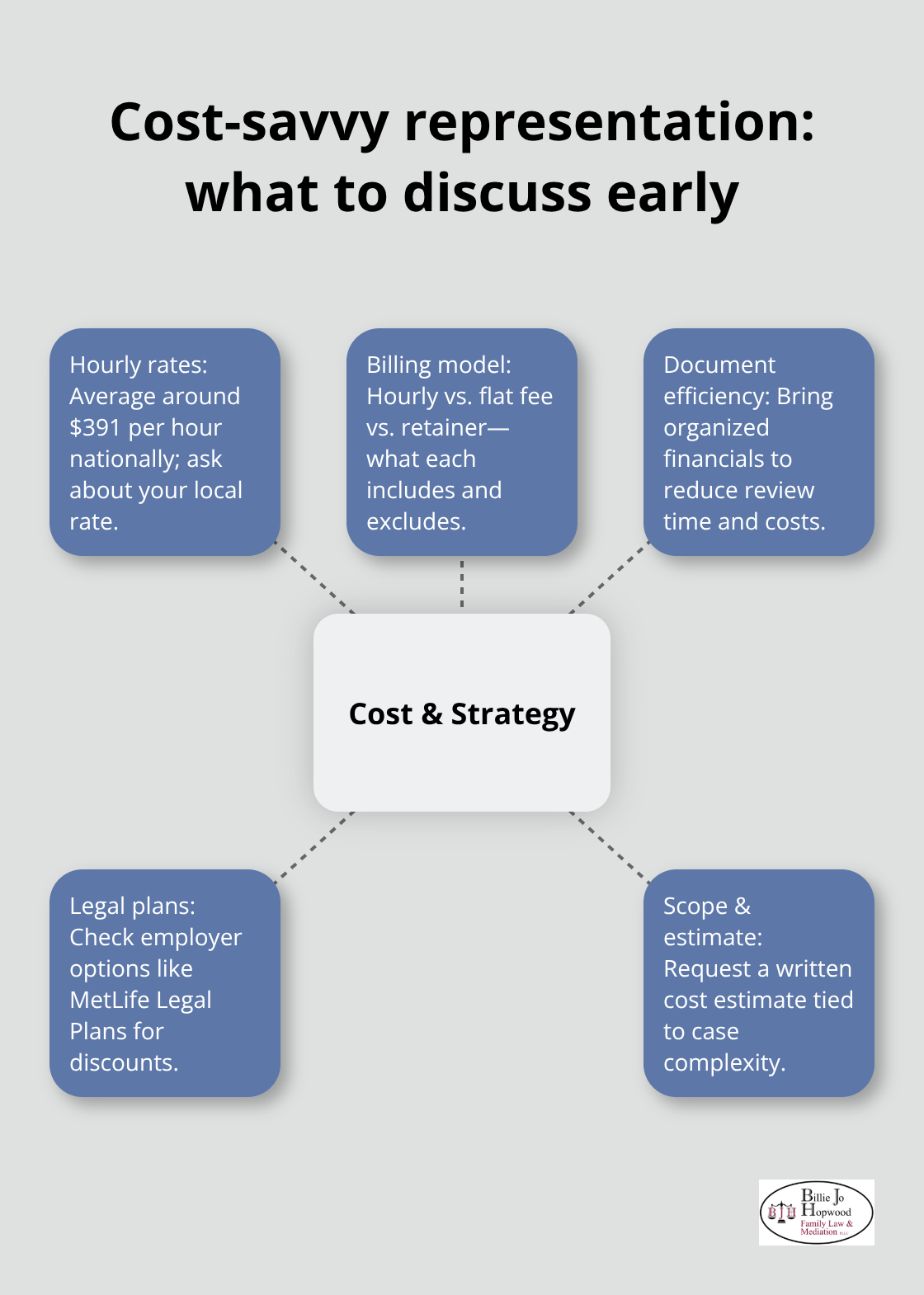
Hub-and-spoke of early cost and strategy topics to cover with your family law lawyer. - family law lawyer job description

Many clients benefit from employer-provided legal plans like MetLife Legal Plans, which offer discounted access to family law counsel if budget concerns exist.

Understanding Florida Law and Your Position

Your lawyer explains how Florida law specifically impacts your case: the length of your marriage, your standard of living, and each spouse’s earning capacity directly influence alimony calculations. This guidance prevents you from pursuing unrealistic settlement terms or undervaluing your position before negotiations begin. Your lawyer also handles all documentation-filing divorce petitions, financial disclosure forms, custody proposals, and settlement agreements-ensuring paperwork meets Florida court requirements and deadlines.

Negotiation and Strategic Representation

Your lawyer negotiates directly with the opposing party’s counsel to resolve disputes over asset division, custody arrangements, and support amounts, which often prevents costly litigation. When mediation makes sense for your family, a lawyer experienced in mediation explains how that process works and what outcomes remain negotiable versus what state formulas dictate (like child support calculations).
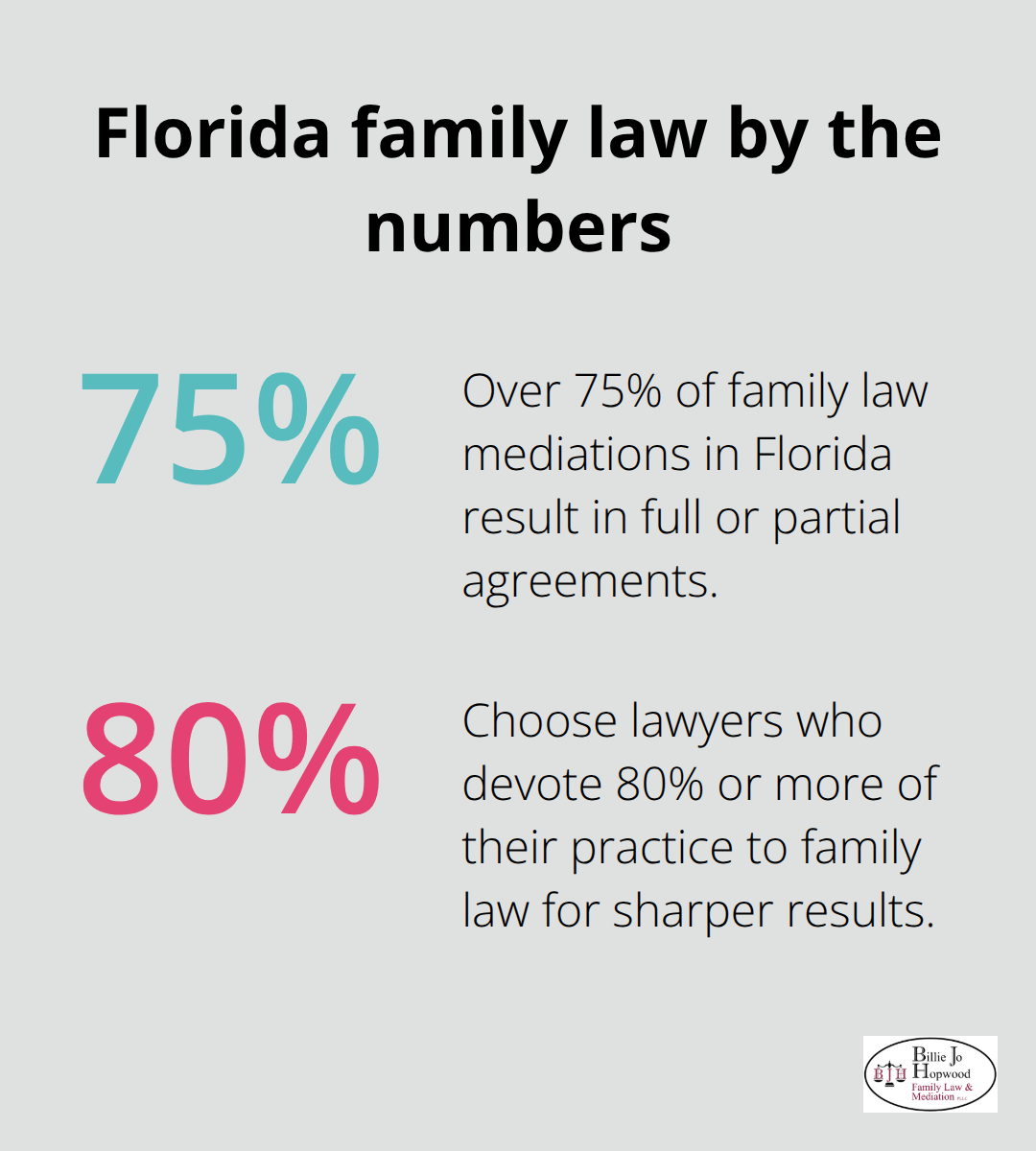
Key Florida family law percentages: mediation agreement rates and specialization focus. - family law lawyer job description

If your case proceeds to trial, your lawyer presents evidence, examines witnesses, and argues your position before a judge. The Florida Dispute Resolution Center reports that over 75% of family law mediations yield full or partial agreements, indicating that skilled negotiation frequently resolves matters without trial.

Building Effective Communication

Communication matters enormously-establish preferred contact channels early, typically email for substantive matters, to create records and reduce miscommunication. Ask your lawyer to explain the reasoning behind recommendations so you understand available options and likely consequences. If you disagree with a proposed strategy, discuss it openly; ultimately you decide how your case proceeds within ethical bounds. A responsive attorney adjusts communication frequency to your preferences rather than overwhelming you with unnecessary updates or leaving you in the dark.

When you’re ready to move forward with representation, selecting a lawyer who aligns with your communication style and understands your priorities sets the foundation for effective collaboration throughout your case.

How to Choose a Family Law Lawyer in Melbourne, Florida

Identify Your Priorities Before Consulting

Start by identifying what matters most to you in legal representation. Write down three non-negotiable qualities-responsiveness, cost transparency, and understanding of mediation-before you schedule any consultations. This approach prevents you from being swayed by charisma or reputation alone. Then schedule initial consultations with at least two, preferably three, lawyers to compare their approaches.
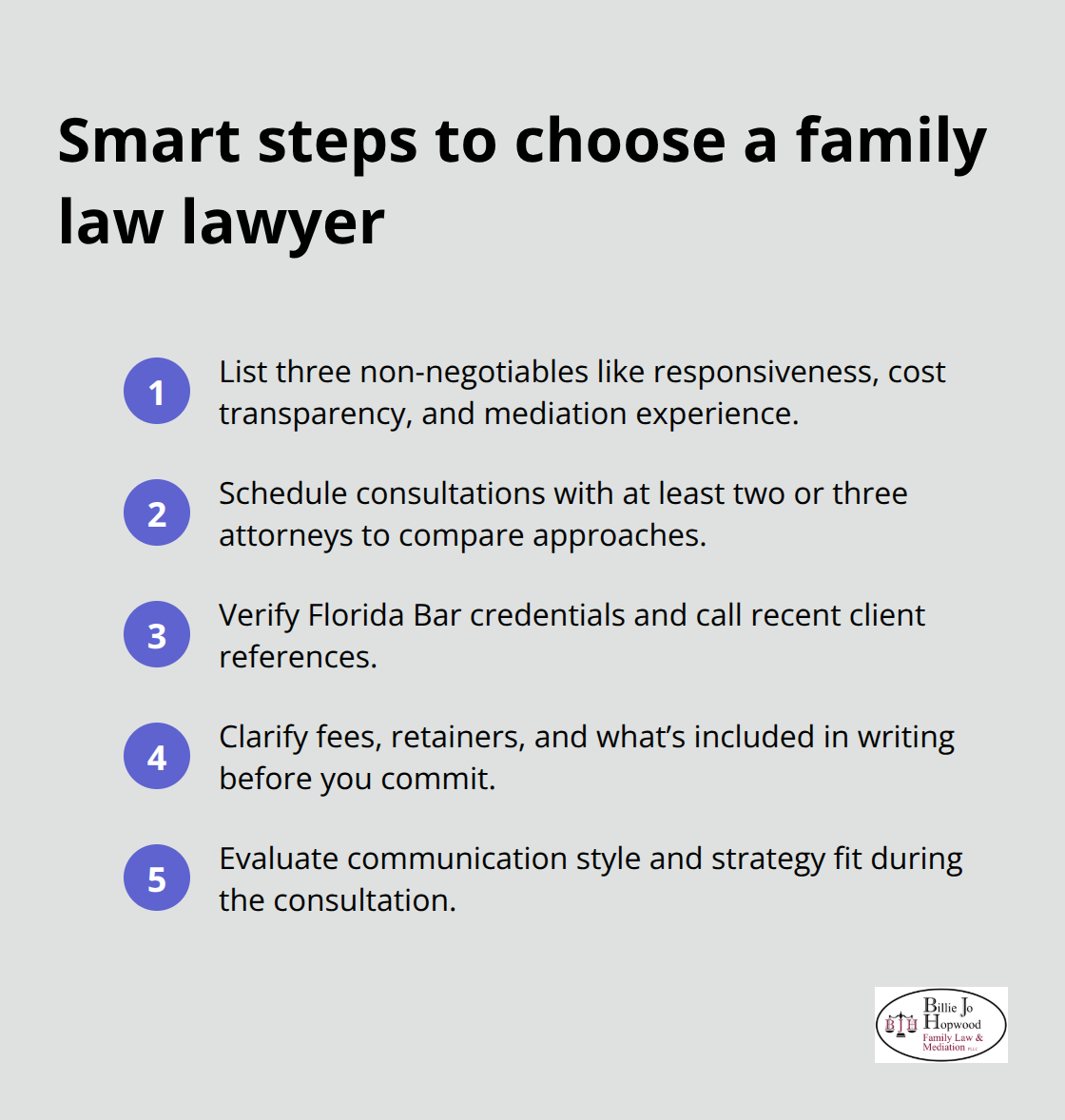
Compact checklist of steps to select the right family law lawyer in Melbourne, Florida.

Many offer free or low-cost initial meetings, though be cautious about extremely inexpensive options with newer practitioners if your case involves substantial assets or custody disputes.

Assess Experience and Practice Focus

During consultations, ask directly about their experience with cases matching yours. How many divorces have they handled in the past year? What percentage of their practice focuses on family law? Lawyers who dedicate 80% or more of their practice to family law typically deliver sharper results than general practitioners juggling multiple practice areas. Ask about their typical timeline for cases similar to yours and whether they recommend mediation early or pursue litigation first. This reveals their philosophy and whether it aligns with your goals.

Verify Credentials and Check References

Request references from recent clients-not just names, but specific permission to contact them about their experience. Call at least two references and ask about responsiveness, whether the lawyer explained strategy clearly, and if the final outcome matched expectations. The Florida Bar Association website allows you to verify credentials, confirm active licensing, and check for disciplinary history or complaints. This step takes fifteen minutes and eliminates lawyers with ethical problems.

Understand Fees and Cost Structure

Cost transparency separates trustworthy lawyers from those who hide fees until you’re already committed. Ask upfront whether they bill hourly, use retainers, or charge flat fees for specific services. The National Law Journal reports average family law fees around $391 per hour, but Melbourne rates vary. Request a written estimate of likely total costs based on your case complexity and whether mediation or litigation seems probable. Discuss what services fall within the retainer and what costs extra. If your employer offers legal plans like MetLife Legal Plans, ask if the lawyer accepts them.

Evaluate Communication Style and Strategy Approach

During your consultation, assess how the lawyer explains Florida law to you. Can they articulate how the length of your marriage, your standard of living, and each spouse’s earning capacity factor into alimony without overwhelming you with jargon? Do they listen more than they talk, asking questions about your goals and concerns? A lawyer who spends the consultation explaining their credentials rather than understanding your situation is showing you how they’ll operate. Pay attention to how they handle your questions about strategy. Strong lawyers explain available options, realistic consequences of each path, and their recommended direction with clear reasoning. They don’t dismiss mediation as weak or push litigation as the only serious approach. If they seem defensive about your questions or dismiss your concerns, that’s a signal to move forward with another candidate. Trust your instinct about fit-a lawyer with an impressive track record won’t serve you well if their communication style creates stress rather than reducing it.

Final Thoughts

A family law lawyer’s job description extends far beyond courtroom appearances-these professionals guide you through financial analysis, negotiate settlements, manage complex paperwork, and explain how Florida law applies to your specific circumstances. Your lawyer protects non-marital assets, verifies that child support calculations follow state formulas accurately, and negotiates alimony terms reflecting your actual earning capacity and standard of living. Without this guidance, you risk accepting unfavorable terms, missing legal deadlines, or overlooking assets that should remain yours.

Starting your search for representation requires identifying your priorities first. Write down three qualities that matter most to you, then schedule consultations with at least two lawyers to compare their approaches. Ask about their experience with cases like yours, verify their credentials through the Florida Bar Association, and assess whether their communication style reduces stress rather than creating it.

We at Billie Jo Hopwood Family Law & Mediation, PLLC understand that family law matters demand compassionate guidance paired with strong legal knowledge. Based in Melbourne, Florida, we assist families through divorce, child custody, alimony, and child support matters. When you’re ready to move forward, contact our firm to discuss how we can support your family through this challenging time.
How to Find Legal Assistant Jobs in Family Law

Legal assistant family law jobs require specific skills and knowledge that set candidates apart in a competitive field. We at Billie Jo Hopwood Family Law & Mediation, PLLC understand what employers look for when hiring legal assistants in family law practices.

This guide walks you through where to find positions, what qualifications matter most, and how to build an application that gets noticed.

Where to Find Family Law Legal Assistant Jobs in Melbourne, Florida

Job Boards for Legal Positions

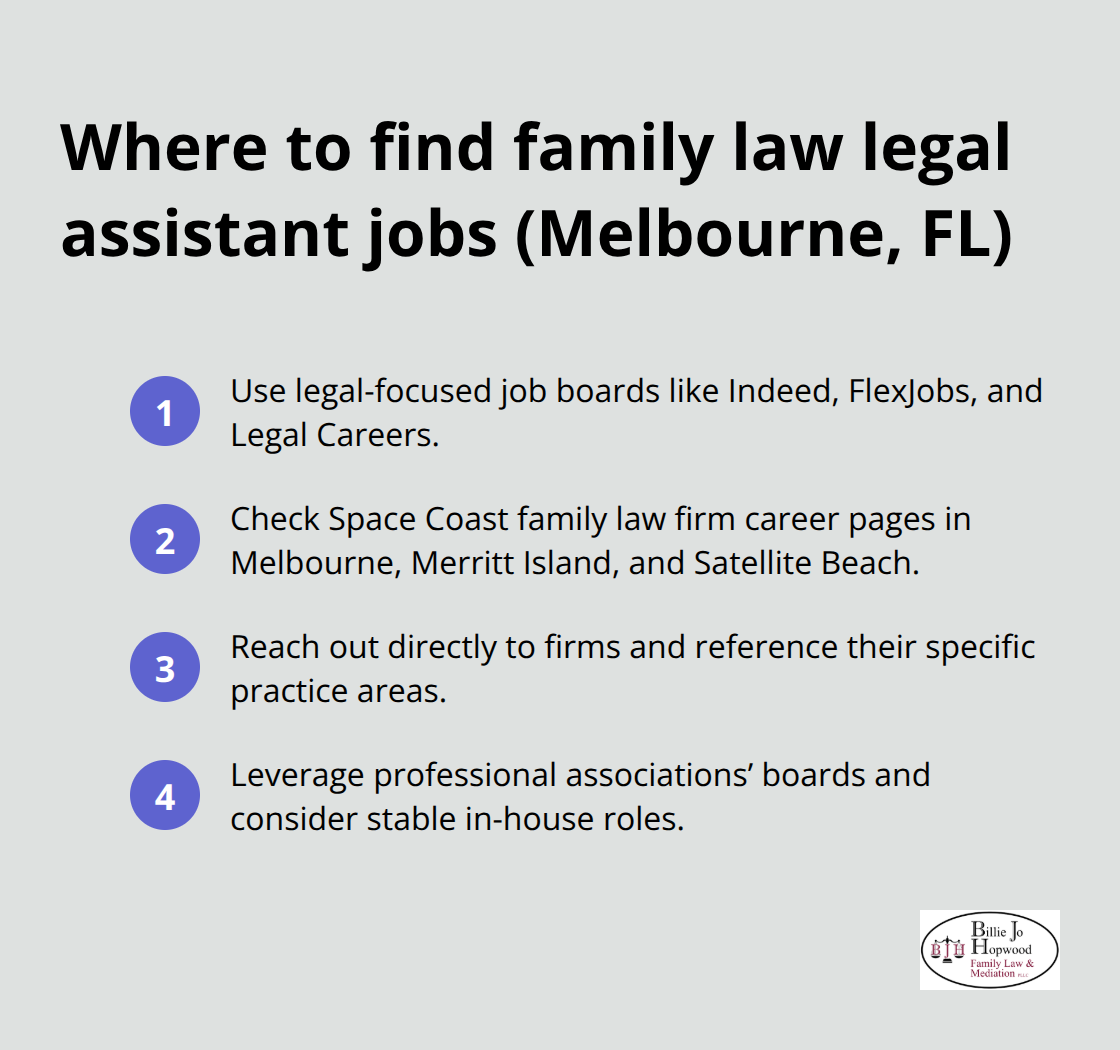
Start your search on job boards that filter for legal positions rather than general employment sites. Indeed remains the largest job board for paralegal and legal assistant roles, and Melbourne, Florida postings regularly list family law positions paying $36,000 to $58,000 annually depending on experience and hours. FlexJobs and Legal Careers host vetted family law openings, though they charge subscription fees. These platforms offer specificity-you can search directly for family law legal assistant roles instead of scrolling through unrelated positions. When searching, use keywords like Legal Assistant, Litigation Paralegal, and Paralegal to cast a wider net, since many family law firms list positions under these general titles. Pay attention to job descriptions mentioning Florida e-File experience and court filing proficiency, as these skills appear consistently in Melbourne-area family law postings and signal firms handling active caseloads.

Law Firm Career Pages and Direct Contact

Law firm websites in the Space Coast area post openings before they appear on national boards. Visit the career pages of family law practices in Melbourne, Merritt Island, Satellite Beach, and nearby communities directly-smaller firms frequently hire this way and may offer more personalized consideration. When contacting firms directly, mention specific practice areas they handle (divorce, custody, child support, equitable distribution) to show you understand their work rather than sending generic applications.

Professional Associations and Networking Events

Professional associations like the Florida Paralegal Association and local Brevard County bar associations maintain job boards and networking events where family law firms recruit. Attending these events gives you direct contact with hiring attorneys and office managers, which carries far more weight than an online application. Many in-house legal positions at regional employers also handle family law matters, and these roles offer stability with higher compensation reaching $65,000 or more annually plus comprehensive benefits.

Compact list of top places to search for family law legal assistant roles in Melbourne, Florida - legal assistant family law jobs

The skills employers want in family law legal assistants go beyond simply knowing where to apply-they require specific competencies that make candidates stand out in this competitive field.

What Skills Do Family Law Employers Actually Want

Document Preparation and Filing Competence

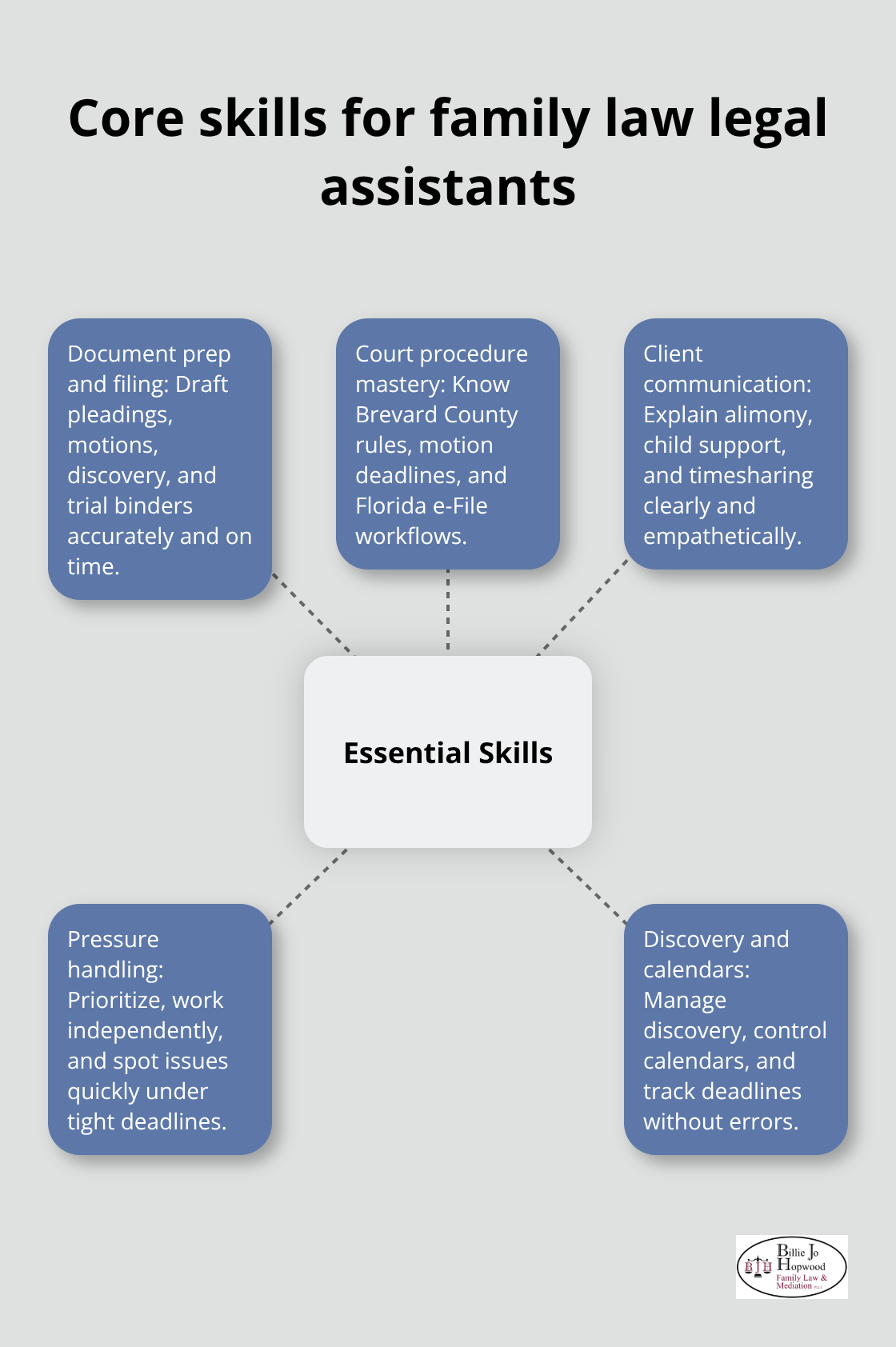
Florida family law firms hiring legal assistants prioritize practical courtroom competence over generic paralegal credentials. Document preparation sits at the absolute center of this work-you draft pleadings, motions, discovery requests, and trial binders repeatedly, and mistakes cost clients money and court time. Melbourne-area firms consistently list Florida e-File system proficiency as a non-negotiable requirement because missing filing deadlines destroys cases.

Hub-and-spoke diagram of essential skills for family law legal assistants - legal assistant family law jobs

Court procedure knowledge matters more than theory; you need to understand Brevard County filing rules, motion deadlines under Florida Statutes, and how equitable distribution cases actually move through the court system. If you handled federal and state filings in civil litigation or personal injury work, translate that directly into family law language on your resume-discovery management, calendar control, and deadline tracking transfer perfectly to divorce and custody matters.

Client Communication and Emotional Intelligence

Client interaction abilities separate candidates who get hired from those who don’t. Family law clients arrive stressed, angry, or heartbroken, and your ability to communicate clearly without legal jargon prevents misunderstandings that lead to malpractice claims. Firms in the Space Coast area prioritize assistants who can explain alimony calculations, child support guidelines, and timeshare schedules in plain English. You coordinate mediation sessions, prepare clients for depositions, and often become the first voice they hear when calling the office-this matters enormously in a practice devoted exclusively to family law.

Working Under Pressure and Managing Complexity

Strong judgment under pressure, independence in managing competing priorities, and the ability to spot issues quickly separate high performers from average ones. If you worked in litigation before, emphasize your experience managing complex discovery, organizing case files, and working with minimal supervision. Probate administration or estate work strengthens your candidacy for cases involving asset division, since you already understand valuation and property distribution concepts (knowledge that directly applies when attorneys divide marital assets). The highest-paid legal assistant roles in Melbourne reach $65,000 to $70,000 annually, and those positions consistently require candidates who combine technical filing skills with genuine client communication ability and the maturity to work in emotionally charged situations without becoming emotionally involved yourself.

These technical and interpersonal skills form the foundation of what employers seek, but how you present these abilities on your application determines whether you actually land an interview.

How to Stand Out When Applying for Family Law Legal Assistant Roles

Translate Your Experience Into Family Law Language

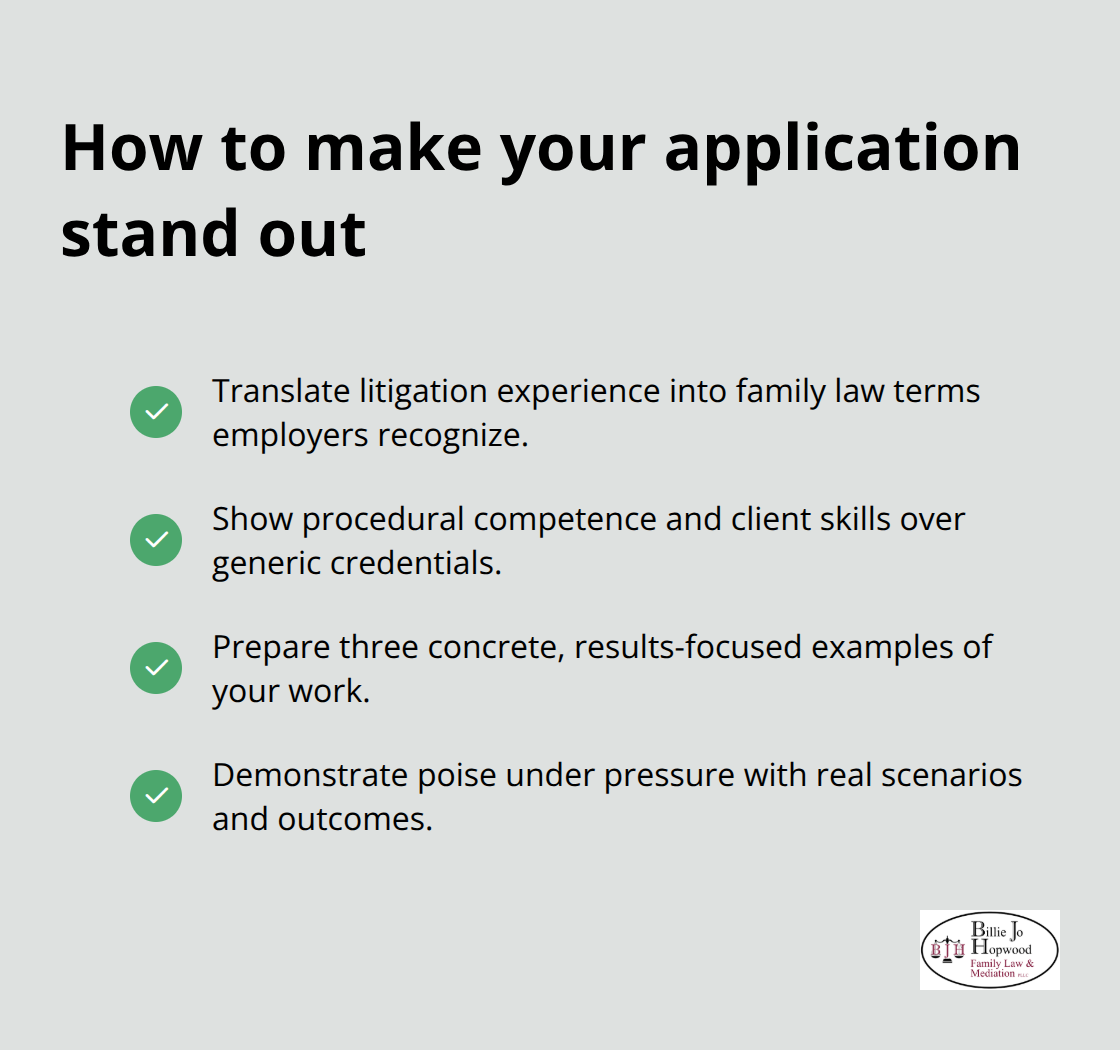
Your resume needs to translate your litigation background into family law language that hiring attorneys immediately recognize. If you handled discovery, document management, or court filings in civil litigation or personal injury work, reframe these experiences explicitly for family law contexts. Instead of writing you managed civil case files, write that you organized discovery in multi-party disputes and maintained calendars for filing deadlines-skills directly applicable to tracking motion schedules in divorce cases. Melbourne-area family law firms receiving dozens of applications per opening will spend 30 seconds scanning your resume, so place your strongest family law-adjacent experience in the first third. Mention Florida e-File experience prominently if you have it, since this appears in nearly every Melbourne family law posting.

Checklist of actions to strengthen a family law legal assistant application

Emphasize Practical Competence Over Credentials

If you lack direct family law experience, emphasize your proficiency with court procedures, deadline management, and client communication instead. Certifications matter far less than demonstrated competence-a National Association for Legal Assistants paralegal certification strengthens applications marginally, but actual experience drafting documents and managing court filings matters exponentially more. Don’t list generic skills like Microsoft Word; instead, mention specific tools firms use daily: Casetext for legal research, Westlaw or LexisNexis if you have access, or practice management software like Clio if you’ve used it.

Prepare Concrete Examples of Your Work

Employers want concrete examples of cases you managed successfully, not abstract descriptions of your abilities. Prepare three specific examples showing how you handled time-sensitive situations, prevented filing errors, or improved case efficiency. For instance, describe a discovery project where you organized hundreds of documents, created a usable index, and caught inconsistencies the attorney missed. Explain a situation where you flagged a missed filing deadline before it became catastrophic, or detail how you communicated a complex legal concept to a confused client without jargon.

Demonstrate Your Ability to Handle Pressure

When you interview at family law firms in Brevard County, mention that you understand the emotional weight of these cases-you worked with stressed clients and maintained professionalism under pressure. Frame your experience managing competing priorities by referencing actual situations: you juggled three trial preparations simultaneously, coordinated with opposing counsel on discovery disputes, or prepared trial binders under compressed timelines. These concrete examples demonstrate you won’t need extensive training and can handle the demanding pace of active family law caseloads immediately.

Final Thoughts

Finding legal assistant family law jobs in Melbourne, Florida requires focused action on multiple fronts simultaneously. Start your search on Indeed and specialized legal job boards this week using the keywords and location filters outlined throughout this guide. Visit law firm career pages in Melbourne, Merritt Island, and Satellite Beach directly rather than waiting for postings to appear nationally, and attend Florida Paralegal Association events or Brevard County bar association networking sessions where you can meet hiring attorneys face-to-face.

Your resume and interview preparation determine whether you actually land the role once you identify openings. Translate your litigation background into family law language by reframing discovery management, court filing experience, and deadline control as directly applicable to divorce and custody cases. Prepare three concrete examples showing how you handled time-sensitive situations, prevented filing errors, or communicated complex legal concepts to stressed clients without jargon.

Employers in Brevard County family law practices want candidates who understand court procedures, manage deadlines without errors, and maintain professionalism while supporting clients through difficult transitions. If you need guidance understanding how family law cases actually work or want to see the practice area you’re entering firsthand, Billie Jo Hopwood Family Law & Mediation, PLLC in Melbourne offers resources and insight into the field. Your combination of litigation experience and focused preparation positions you to compete successfully for legal assistant family law jobs throughout the Space Coast.

What Does a Family Law Attorney Do?

Family law matters touch some of the most personal aspects of your life, from divorce and custody decisions to support arrangements. Understanding what a family law attorney does and how they support you through these challenges is the first step toward protecting your interests.

At Billie Jo Hopwood Family Law & Mediation, PLLC, we guide clients through the complexities of family law in Melbourne, Florida. A family law attorney’s job description goes far beyond courtroom appearances-it includes strategic planning, negotiation, and advocacy tailored to your unique situation.

What Family Law Attorneys Handle

Divorce and separation cases demand far more than filing paperwork. A family law attorney manages asset division, debt allocation, and property settlement negotiations. In Florida, courts follow equitable distribution rules, meaning assets and debts acquired during your marriage are divided fairly but not necessarily 50/50. Your attorney determines which assets are separate property (like inheritances) and which are marital property subject to division. They also identify hidden assets that one spouse may attempt to conceal-a problem that occurs in roughly 20 to 30 percent of high-conflict divorces according to forensic accountants. This investigative work directly impacts your financial outcome.

Estimated share of high-conflict divorces that involve hidden assets, based on forensic accountants. - family law attorney job description

Child Custody and Visitation Decisions

Child custody arrangements require attorneys to understand Florida’s best-interest standard, which considers factors like each parent’s involvement in the child’s life, stability, and ability to meet the child’s needs. Modern family law attorneys craft parenting plans that reflect your family’s actual schedule and your child’s needs rather than relying on outdated custody models. A University of Virginia study published in The Journal of Consulting and Clinical Psychology found that nonresident parents who worked through mediation with attorney support were three times more likely to see their children weekly and four times more likely to talk to them weekly compared to parents who litigated. Your attorney negotiates visitation schedules, overnight arrangements, and decision-making authority for education and healthcare. They also address practical logistics like transportation costs, school calendar coordination, and how technology fits into parenting time.

Support Obligations and Financial Arrangements

Child support calculations in Florida follow state guidelines based on both parents’ incomes, the number of children, and custody arrangements, but attorneys negotiate beyond these baseline numbers. They address additional expenses like private school tuition, extracurricular activities, health insurance, and childcare costs that the formula doesn’t automatically capture. Alimony decisions depend on marriage duration, standard of living during the marriage, each spouse’s earning capacity, education, age, and health status. An attorney prevents you from agreeing to terms you cannot sustain or missing opportunities for support you deserve. They also structure support modifications when circumstances change (such as job loss, income increases, or changes in custody arrangements), keeping your agreements enforceable and fair over time.

How Attorneys Navigate Your Specific Situation

Your attorney’s role extends beyond these three core areas. They handle the procedural requirements that vary across Florida’s court system, manage deadlines that affect your case outcome, and communicate with opposing counsel to move negotiations forward. The strength of your attorney-client relationship directly influences how well you navigate separation and divorce, which is why finding the right fit matters from your first consultation.

How Your Attorney Guides You Through Every Step

Establish Clear Communication From the Start

Your attorney translates the law into a practical roadmap for your specific situation rather than making decisions for you. During your first consultation, identify three personal qualities you want in representation-responsiveness, empathy, cost-consciousness-and be honest about how organized you are with documents. Highly organized clients reduce attorney fees significantly because less time goes toward organizing materials and information. If you struggle with organization, acknowledge this upfront and allow your attorney to help manage your documents and records.

Establish a preferred communication method early, usually email, and agree on response expectations to avoid unnecessary billing from multiple small inquiries. Bundle questions into fewer, more comprehensive emails to keep costs down. This approach prevents small conversations from accumulating into substantial fees over time.

Understand Your Options and Their Consequences

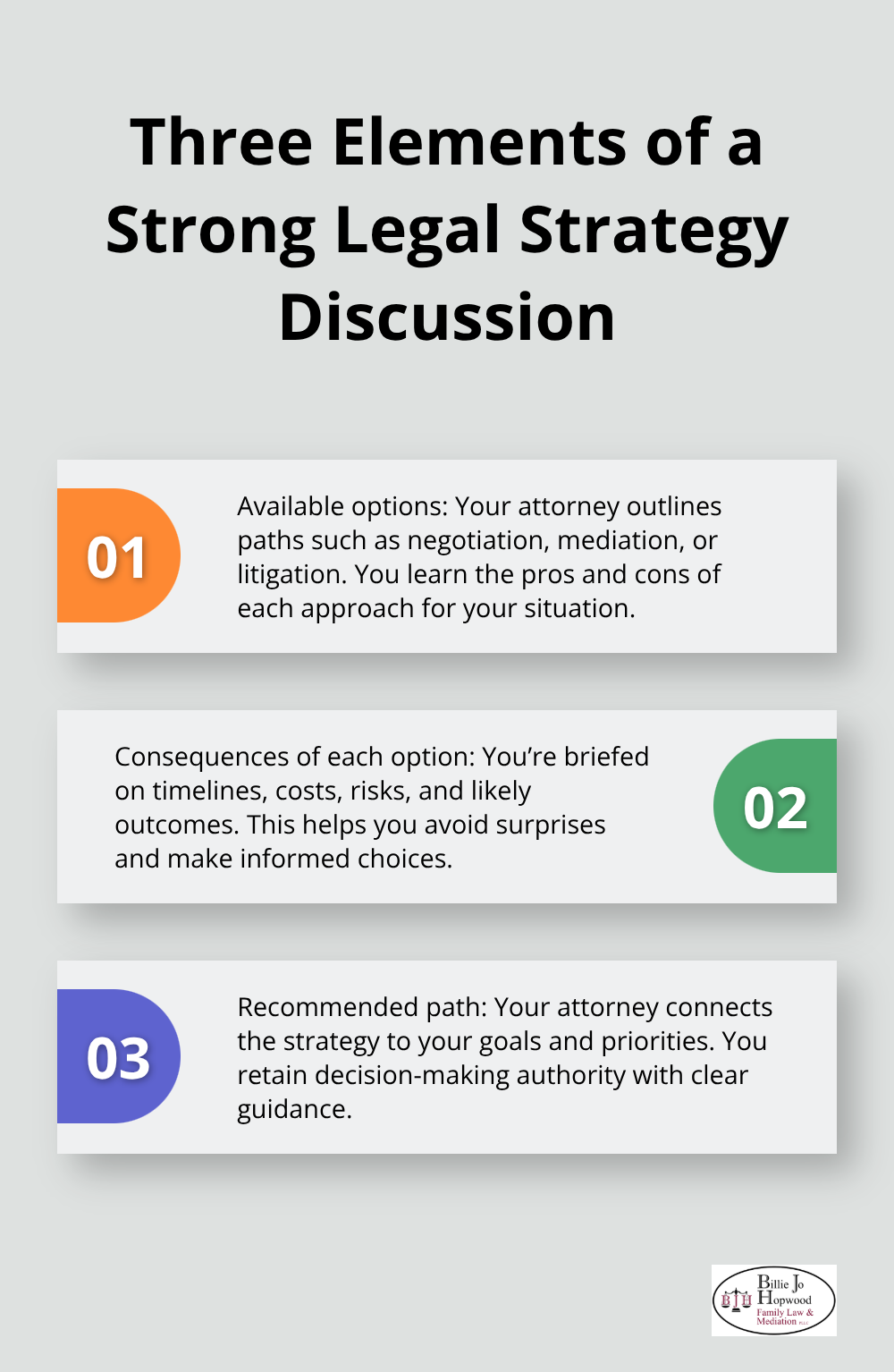
Your attorney explains the rationale behind every recommendation and answers the question “why” so you understand your options and the consequences of each choice. This transparency prevents surprises later and builds the trust that determines how well you navigate the process. Strategy discussions always include three elements: the available options, the consequences of each option, and your attorney’s recommended path aligned with your goals.

The three core components your attorney should cover in every strategy discussion. - family law attorney job description

Your attorney presents choices clearly without pushing you toward one outcome. If the attorney-client relationship isn’t working, speak up early rather than letting concerns fester. If you want more frequent updates or a different communication style, request adjustments that a reasonable attorney should accommodate.

Prepare for Court and Settlement Negotiations

Court representation requires your attorney to understand Florida’s procedural rules, filing deadlines, and how judges in your specific circuit interpret family law. When litigation becomes necessary, your attorney manages discovery (exchanging financial documents and evidence), responds to motions, and prepares you for depositions where the opposing party’s attorney questions you under oath.

Settlement negotiations happen both before and during litigation, and your attorney handles these discussions with opposing counsel to move toward resolution. Honesty is essential throughout this process-disclose all relevant facts, even embarrassing ones, because your attorney cannot effectively advocate for you with incomplete information.

Move Forward With Confidence in Your Legal Strategy

The strength of your attorney-client relationship directly influences how well you navigate separation and divorce. Your attorney’s role is to present choices clearly and keep you informed at every stage, which means you maintain control over the decisions that affect your family’s future. With this foundation in place, you’re ready to explore how mediation can complement your attorney’s guidance and potentially resolve your case more efficiently than traditional litigation.

Why a Family Law Attorney Protects Your Future in Melbourne, Florida

Florida’s family law system contains procedural requirements and substantive rules that shift depending on your specific situation. An attorney prevents costly mistakes that self-represented clients make regularly. Missing a filing deadline can result in losing your right to claim certain assets or modify support obligations, and judges in different Florida circuits interpret equitable distribution rules differently. A family law attorney knows how judges in your specific court handle property division, custody modifications, and support calculations, which directly influences settlement strategy. Without this local knowledge, you might accept a settlement offer that undervalues your position or overlook negotiation opportunities that protect your long-term interests.

Uncover Hidden Assets and Allocate Debt Fairly

Your financial security depends on thorough asset identification and accurate valuation during divorce proceedings. Hidden assets appear in approximately 20 to 30 percent of high-conflict divorces according to forensic accountants, and your attorney knows which questions to ask and which documents to request during discovery to uncover them. Debt allocation matters equally-your attorney prevents you from accepting responsibility for debts you didn’t incur or missing opportunities to assign joint debt fairly based on spending patterns and income.

Present Evidence That Demonstrates Your Fitness as a Parent

In custody disputes, an attorney presents evidence about your involvement in your child’s life, your stability, and your ability to meet their needs in ways that align with Florida’s best-interest standard. Courts make custody decisions based on documented facts, not on what sounds reasonable in conversation. An attorney structures your case evidence to demonstrate your fitness as a parent and your commitment to your child’s welfare.

Navigate Local Court Systems With Confidence

The financial and emotional stakes of family law proceedings demand representation from someone who understands how your local court system operates and what judges actually decide in cases similar to yours. This knowledge shapes every negotiation and protects your interests throughout the process.

Final Thoughts

A family law attorney’s job description extends far beyond courtroom appearances. Your attorney manages asset division, negotiates custody arrangements, calculates support obligations, and handles the procedural complexities that determine your case outcome. They translate Florida’s equitable distribution rules and best-interest standards into practical strategies tailored to your situation, preventing costly mistakes that self-represented clients make regularly.

The strength of your attorney-client relationship directly influences how well you navigate separation and divorce. An attorney who communicates clearly, explains the rationale behind recommendations, and respects your decision-making authority provides the foundation you need during this difficult time. They leverage local knowledge about how judges in your specific Florida circuit actually decide cases and structure your strategy accordingly.

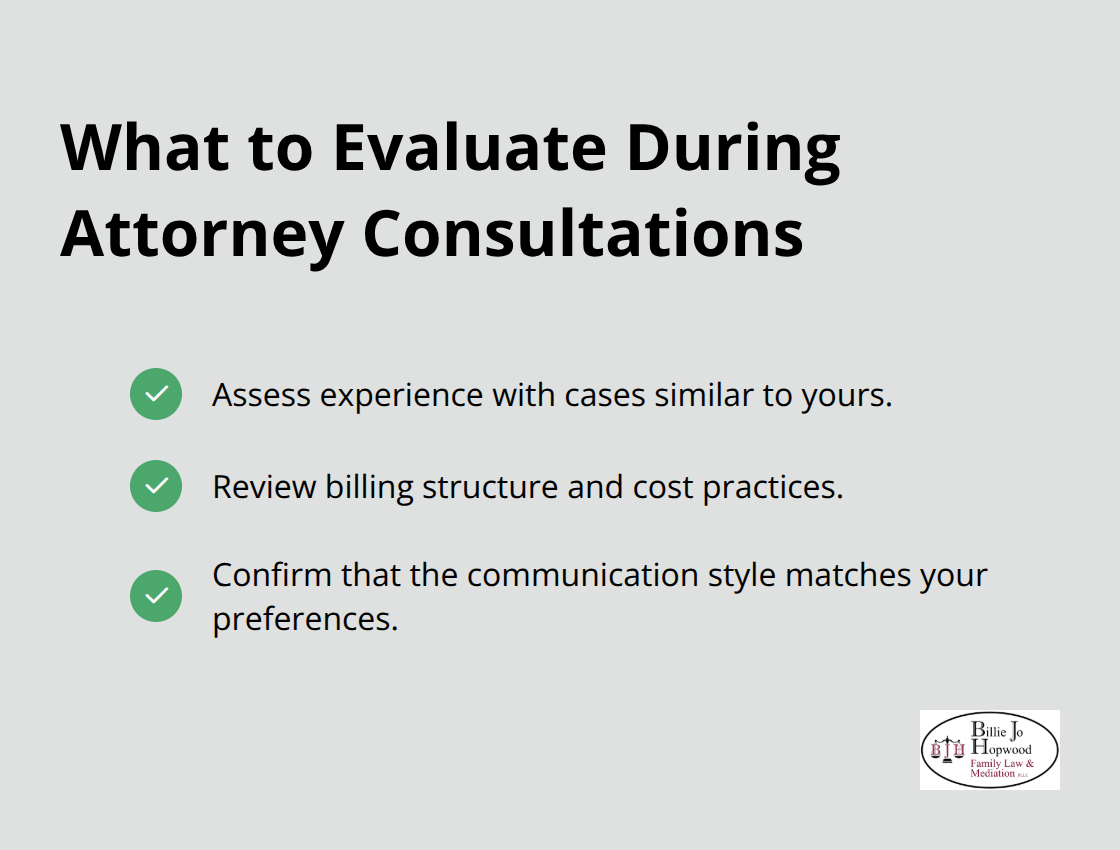
Finding the right attorney starts with identifying three personal qualities you want in representation and scheduling consultations with at least two to three attorneys to compare their approaches. During these consultations, evaluate their experience with cases similar to yours, their billing practices, and whether their communication style matches your preferences.

Key criteria to assess when meeting with potential family law attorneys in Florida.

At Billie Jo Hopwood Family Law & Mediation, PLLC in Melbourne, Florida, we guide families through divorce, custody, and support matters with compassionate representation-contact our firm to schedule your initial consultation and take the first step toward protecting your interests.

How Much Do Family Law Paralegals Earn?

Family law paralegals play a vital role in our legal system, helping attorneys serve families through divorce, custody, and mediation matters. If you’re considering this career path, understanding the family law paralegal salary landscape is essential for making informed decisions about your future.

We at Billie Jo Hopwood Family Law & Mediation, PLLC work alongside talented paralegals every day, and we know firsthand how compensation varies based on experience, location, and education. This guide breaks down what you can realistically earn at different career stages.

Salary Range for Family Law Paralegals in the United States

National Average Salary Data

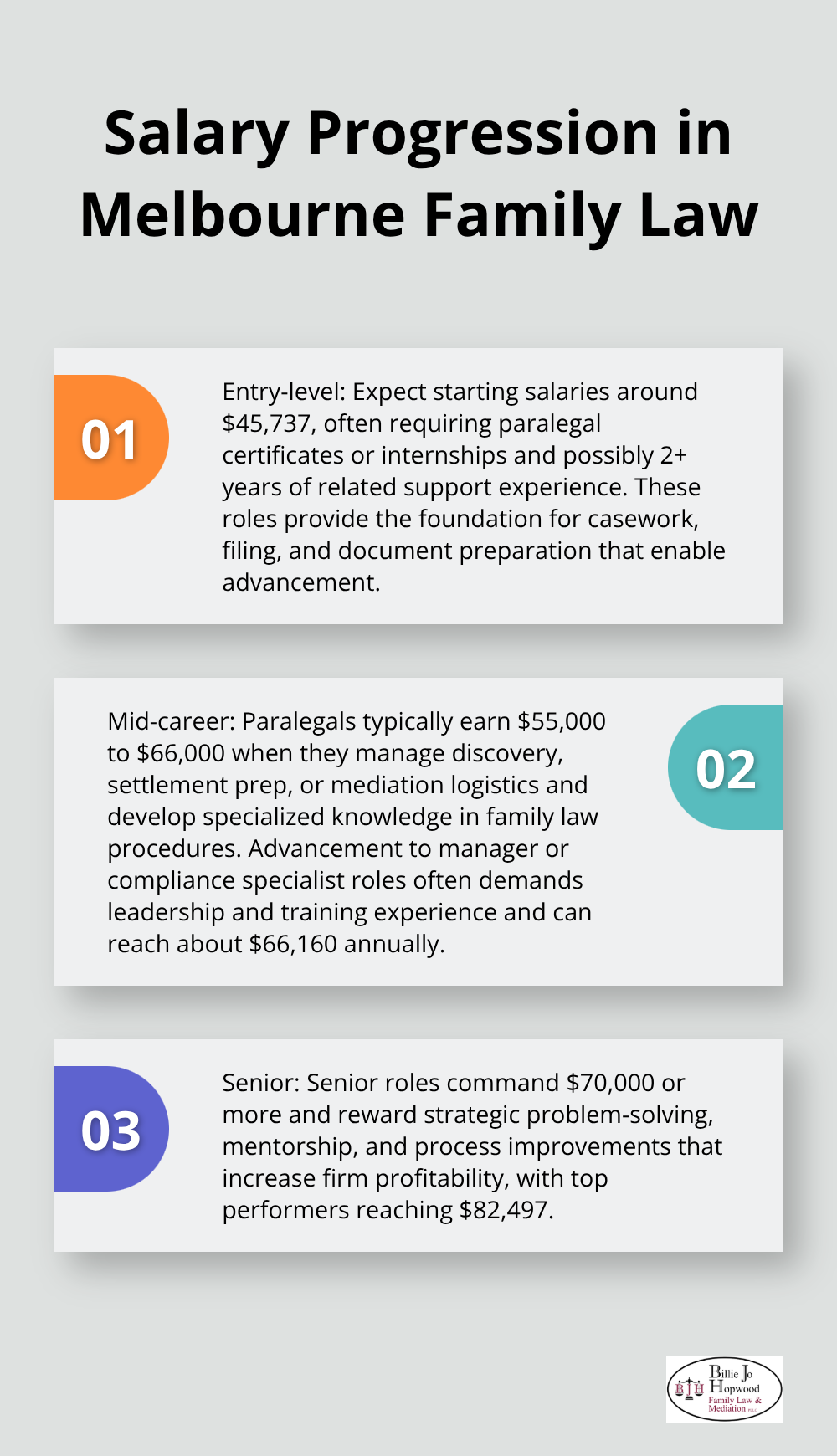
The median paralegal in the United States earns $61,010 per year, according to the U.S. Bureau of Labor Statistics. Family law paralegals working in legal services specifically earn a median of $59,800 annually, slightly below the overall median, while those in federal government positions command $77,940. Entry-level family law paralegals in Melbourne, Florida start around $45,737 per year, while certified paralegals in the area average $45,556 annually. The real money appears at the mid-to-senior level: paralegal managers and compliance specialists in Melbourne earn approximately $66,160 per year, and top performers in the field reach $82,497. Experience matters enormously-a paralegal with 2+ years in personal injury or litigation work typically earns $45,000 to $55,000 in Melbourne, while those with specialized skills in family law documentation and settlement negotiation command the higher end.

What Drives Your Paycheck in Family Law

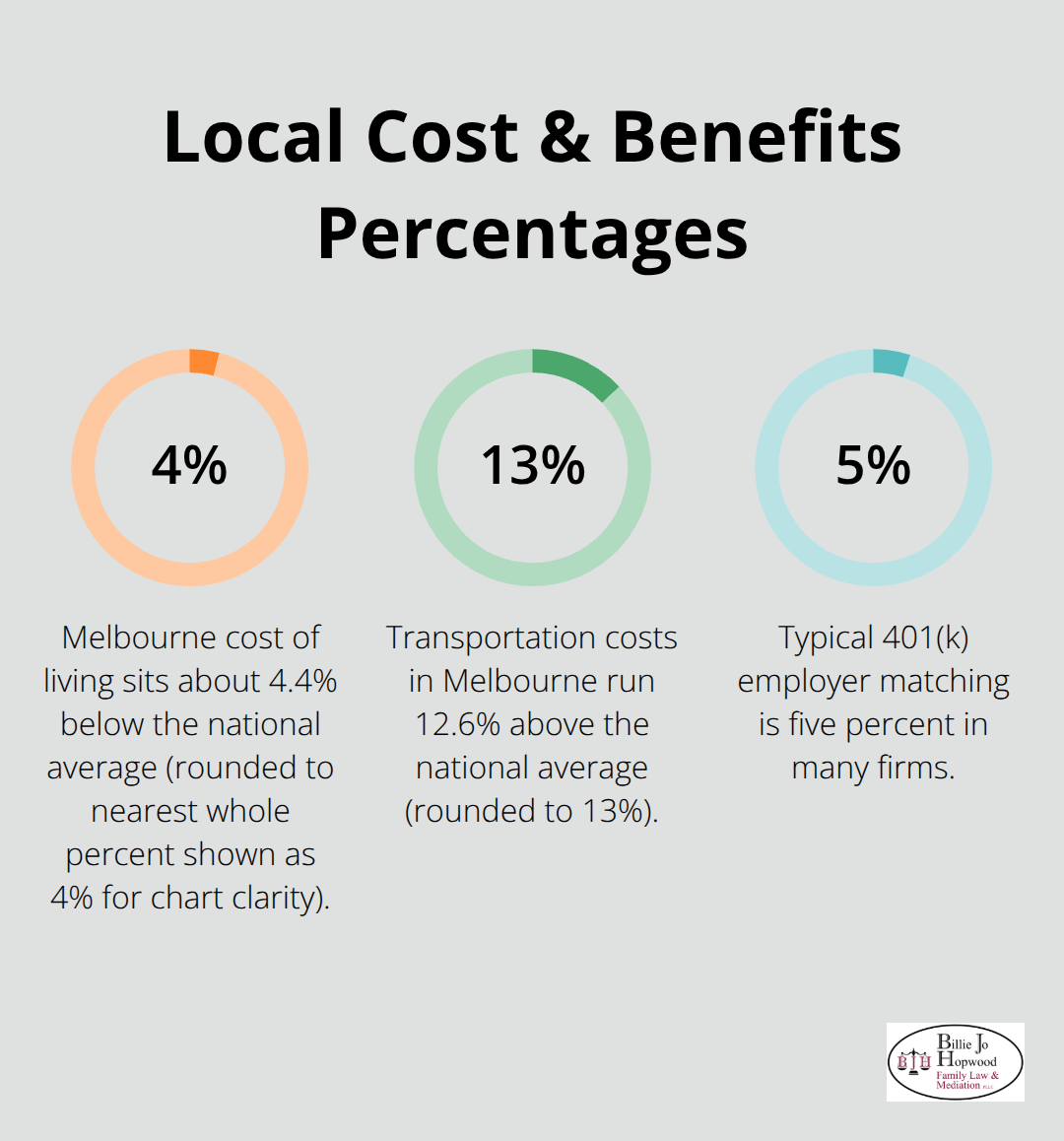
Location and firm size create the largest wage gaps. Melbourne’s cost of living sits about 4.4% below the national average, yet two-bedroom rentals run roughly $1,470 monthly. A paralegal earning $55,366 in Melbourne stretches further than the same salary in Miami or Tampa, but transportation costs in the area run 12.6% above the national average, eating into take-home pay. Smaller family law firms typically pay $30,000 to $60,000 annually, while larger practices and those handling high-net-worth divorces offer $65,000 or more. Certification amplifies earning potential significantly-certified paralegals prove they’ve met rigorous standards in legal research, writing, and ethics, justifying higher compensation. The field projects flat growth through 2034 with about 39,300 openings annually driven mainly by replacement demand, meaning your salary negotiation power depends heavily on your credentials and location-specific experience.

Chart showing local percentage figures: cost of living, transportation, 401(k) match - family law paralegal salary

Building Toward Higher Compensation

The path from entry-level to senior roles adds roughly $10,000 or more annually. Most Melbourne firms offer health insurance, 401(k) matching, and paid time off as standard benefits, with hybrid schedules increasingly common. Moving into specialized niches like family law mediation support or high-asset divorce preparation positions you for the $66,000 to $74,000 range. Practical advancement requires staying current with legal research tools like LexisNexis and Westlaw, plus building knowledge of your jurisdiction’s family law procedures. Paralegals advance fastest when they develop deep understanding of custody law, property valuation processes, and mediation documentation-skills that directly reduce attorney workload and increase firm profitability. These competencies open doors to better compensation packages and leadership opportunities within family law firms.

Building Your Career Path in Family Law

Starting Out: Entry-Level Positions and Requirements

Entry-level paralegals in Melbourne earn around $45,737 annually, according to ZipRecruiter data, but this starting point depends heavily on your education and willingness to learn. Most Melbourne firms hiring entry-level paralegals require 2+ years of experience in litigation or personal injury work, which seems contradictory until you realize many hire from within legal support roles or accept candidates with paralegal certificates plus relevant internships. The Bureau of Labor Statistics reports that entry requires either an associate degree, a paralegal certificate, or a bachelor’s degree; some employers will train candidates with only high school diplomas if they demonstrate strong writing and organizational skills. Starting salaries in this range mean a single paralegal in Melbourne lives comfortably on roughly $49,200 annually according to local cost-of-living estimates, but family support requires approximately $66,600 yearly. You should secure paralegal certification through an accredited program that includes family law coursework, then pursue internships at firms handling divorce and custody matters. This combination positions you to earn $50,000 to $55,000 within 3-5 years.

Mid-Career Growth: Developing Specialized Knowledge

Mid-career advancement happens when you develop specialized knowledge that reduces attorney workload in measurable ways. Paralegals earning $55,000 to $65,000 annually typically manage document discovery in high-net-worth divorces, prepare settlement agreements, or coordinate mediation logistics-tasks requiring deep understanding of family law procedures specific to Florida. Paralegal managers and compliance specialists in Melbourne reach $66,160 per year, but these roles demand demonstrated leadership and the ability to train junior staff. The jump from entry to mid-career adds roughly $10,000 to $20,000 annually, with the top performers in Melbourne reaching $74,153 or higher. You accelerate advancement when you become proficient with legal research tools like LexisNexis and Westlaw, master your jurisdiction’s property valuation requirements for asset division, and build relationships with judges and court staff that streamline filing processes.

Senior Roles: Leadership and Strategic Impact

Senior paralegal roles commanding $70,000 or more rarely go to candidates who simply complete assigned tasks-they go to those who anticipate problems, mentor junior staff, and generate efficiency improvements that increase firm profitability. These positions require you to think strategically about case management, identify bottlenecks in document workflows, and implement systems that other paralegals can follow. Your advancement into senior ranks depends on demonstrating that you understand not just family law procedures, but the business side of running a legal practice. Firms in Melbourne value paralegals who can manage complex custody cases, high-asset divorces, or mediation coordination while simultaneously training newer team members and contributing to firm operations.

Benefits and Additional Compensation Beyond Base Salary

Health Insurance, Retirement Plans, and Cost Savings

Family law firms in Melbourne offer health insurance, 401(k) matching, and paid time off as standard benefits. When you evaluate a position paying $55,000 annually, factor in that employer-sponsored health coverage saves you roughly $200 to $400 monthly compared to individual plans, while 401(k) matching at five percent adds another $2,750 yearly to your retirement savings. Hybrid schedules have become increasingly common in Florida legal practices, allowing you to work two to three days remotely weekly, which reduces transportation costs that run 12.6% above the national average in Melbourne.

Checklist of common benefits offered by family law firms in Melbourne

A $55,000 base salary with full benefits, hybrid flexibility, and paid time off actually totals closer to $65,000 in total compensation when you calculate the employer contributions and cost savings.

Performance Bonuses and Case-Based Incentives

Larger family law practices often tie bonuses to case closures or settlement achievements, paying paralegals an extra $2,000 to $5,000 annually when they help resolve high-asset divorces or complex custody matters efficiently. These incentive structures reward paralegals who develop skills that directly impact firm profitability. The difference between firms that offer performance bonuses and those that don’t can add $24,000 to $60,000 over a five-year career span, making this a significant negotiation point when you evaluate job offers.

Professional Development and Continuing Education Support

Continuing education support matters enormously because maintaining paralegal certification requires ongoing coursework, and firms that cover these costs demonstrate genuine investment in your career growth. Paralegals advancing from $55,000 toward the $66,000 to $74,000 range need opportunities to develop advanced skills in property valuation, mediation documentation, and Florida-specific custody procedures. When you negotiate your position, ask directly whether the firm reimburses paralegal certification maintenance, covers courses in family law technology platforms like LexisNexis, or offers tuition assistance for bachelor’s degree completion. These investments accelerate your path to senior roles commanding $70,000 or more and signal that a firm views you as a long-term asset rather than temporary support staff.

Final Thoughts

Three-stage progression from entry-level to senior paralegal salaries in Melbourne - family law paralegal salary

Family law paralegal salary expectations in Melbourne range from $45,737 for entry-level positions to $82,497 for experienced professionals, with mid-career roles typically earning $55,000 to $66,000 annually. Your actual compensation depends on three interconnected factors: your location and its cost of living, your education and certifications, and the size and focus of your employer. Melbourne’s relatively affordable housing compared to other Florida markets makes these salaries stretch further, though transportation costs run higher than the national average.

The clearest pathway to increased compensation involves moving from entry-level tasks into roles where you reduce attorney workload in measurable ways. Paralegals who master legal research tools, understand Florida’s property valuation requirements, and build relationships with court staff command higher salaries and advance faster. Performance bonuses, health insurance, 401(k) matching, and hybrid schedules add substantial value beyond your base salary, often increasing total compensation by $10,000 or more annually.

If you’re pursuing a family law paralegal salary trajectory in Melbourne, obtain paralegal certification with family law coursework, gain 2+ years of relevant experience, and continuously develop skills that directly impact case outcomes. We at Billie Jo Hopwood Family Law & Mediation, PLLC recognize that competitive compensation attracts talented professionals who serve families through divorce, custody, and mediation matters. Visit our firm to learn how we support families in Melbourne through challenging legal situations.

How to Prove Service of Summons in Family Law Cases?

Proper service of summons forms the foundation of every family law case in Florida. Without valid proof of service of summons family law documentation, your entire case could face dismissal or significant delays.

We at Billie Jo Hopwood Family Law & Mediation, PLLC see many cases in Melbourne Florida where inadequate service documentation creates unnecessary complications. Understanding the requirements and maintaining proper records protects your legal rights from the start.

What Service Requirements Must You Meet?

Legal Standards for Valid Service

Florida Statutes Chapter 48 establishes strict requirements for service of process in family law cases. The person who serves documents must be at least 18 years old and cannot be a party to the case. Professional process servers or sheriff’s deputies handle most services in Melbourne Florida courts.

Personal service remains the gold standard – documents must be handed directly to the defendant whenever possible. Courts reject service attempts that fail to meet these basic qualifications, which causes immediate delays in your case.

Available Service Methods

Florida law provides multiple service options when personal delivery proves impossible. Substituted service allows delivery to someone over 15 years old at the defendant’s residence, followed by mail copies within 24 hours.

Constructive service through newspaper publication becomes available only after you prove diligent search efforts failed. Service by mail requires the defendant’s written acceptance (which makes it unreliable for contested cases). Each method carries specific documentation requirements that courts scrutinize closely.

Timeline Requirements

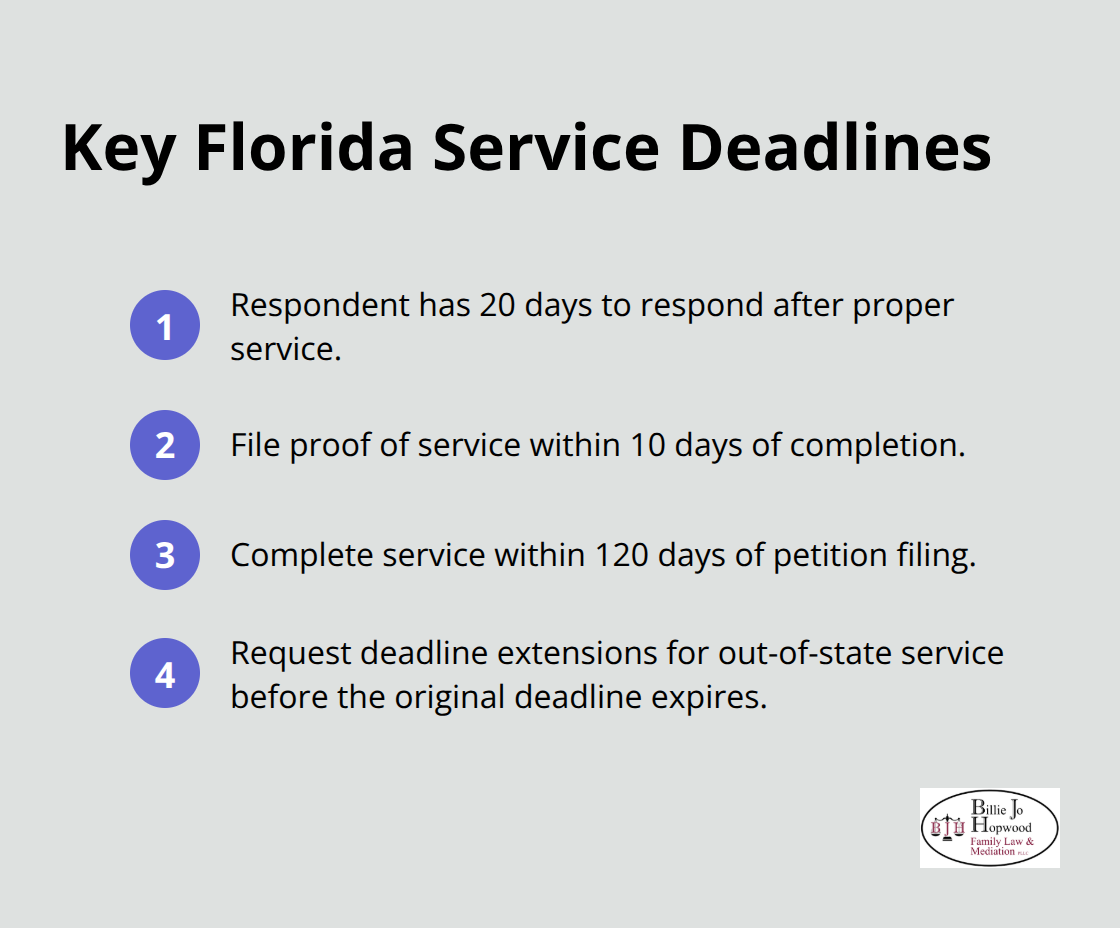
The respondent gets 20 days to respond after proper service completion. You must file your proof of service within 10 days of completion to keep your case timeline on track.

Courts maintain strict deadlines for service completion – typically within 120 days of petition filing. Missing these deadlines can result in case dismissal and force you to restart the entire process. The documentation you collect during service becomes the foundation for proving compliance with these requirements.

Timeline checklist for Florida family law service deadlines - proof of service of summons family law

What Documentation Proves Valid Service?

The affidavit of service stands as your most important proof document in Florida family law cases. This sworn statement must include the server’s full name, address, and detailed description of when, where, and how service occurred. The server must sign this document under penalty of perjury (which makes false statements a felony offense). Professional process servers typically provide comprehensive affidavits that courts accept without question, while self-prepared affidavits often contain gaps that judges reject.

Required Affidavit Elements

Your affidavit must specify the exact date and time of service, complete address where service occurred, and physical description of the person served. The document should detail any conversation that took place and note the defendant’s reaction or response. Courts in Melbourne Florida reject vague affidavits that state service occurred without specific details about the encounter.

Supporting Evidence That Strengthens Your Case

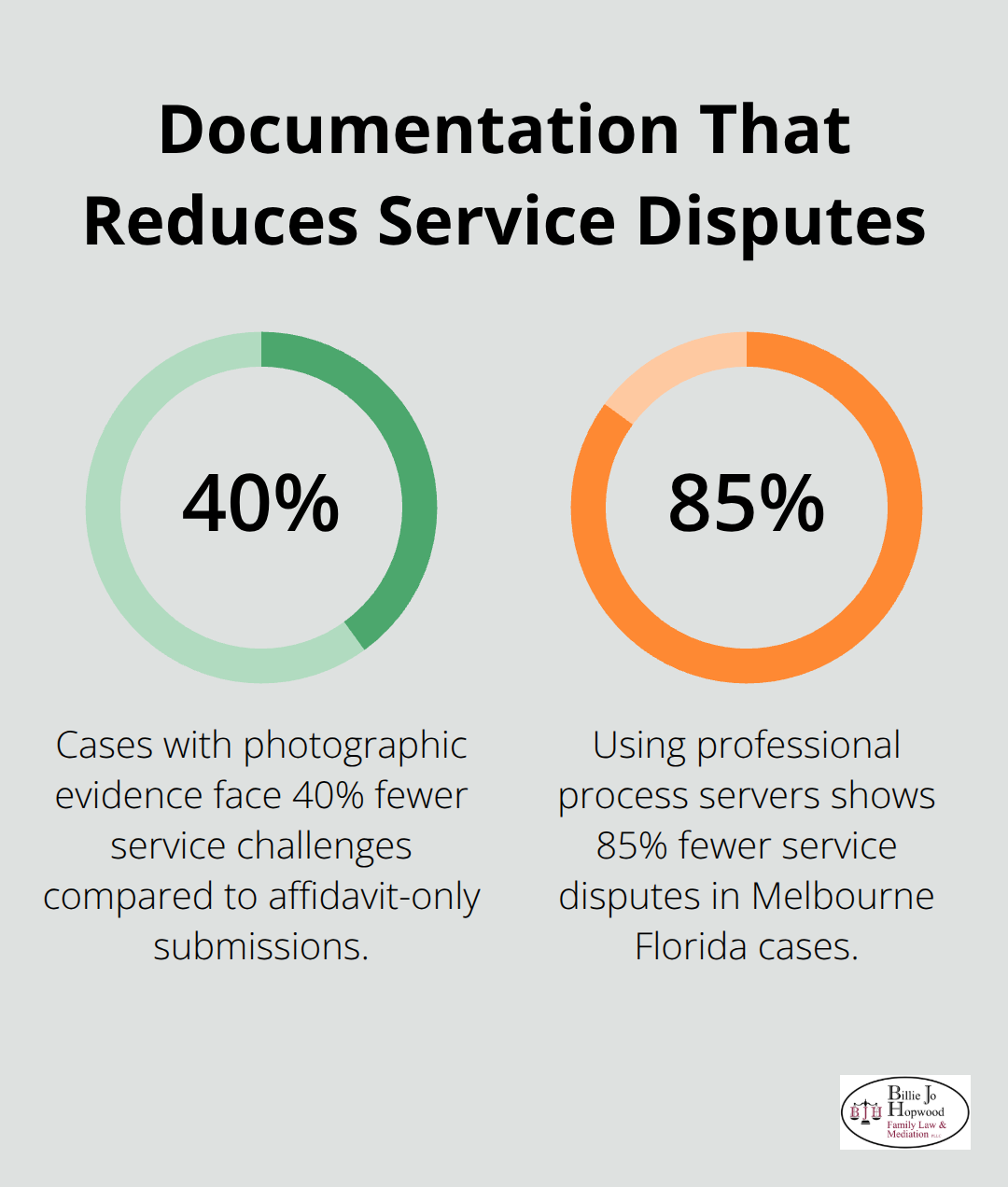
Photographs of the service location and the person served create powerful evidence that courts value highly. GPS timestamps from process server vehicles provide additional verification of service location and time. Witness statements from neighbors or bystanders who observed the service add credibility to contested service claims. The Brevard County Clerk’s office reports that cases with photographic evidence face 40% fewer service challenges compared to affidavit-only submissions.

Process Server Documentation Standards

Licensed process servers provide return of service certificates that include their license number, insurance information, and detailed service notes. These professionals maintain GPS records and digital timestamps that courts consider highly reliable evidence. Their documentation typically includes multiple attempts at service (which shows diligent efforts to locate the defendant). Cases that use professional process servers in Melbourne Florida show 85% fewer service disputes according to local court statistics.

Percent reductions in service challenges with stronger documentation

Even with proper documentation, defendants sometimes create obstacles that complicate the service process and require additional legal strategies.

What Happens When Service Goes Wrong

Defendants Who Avoid Service

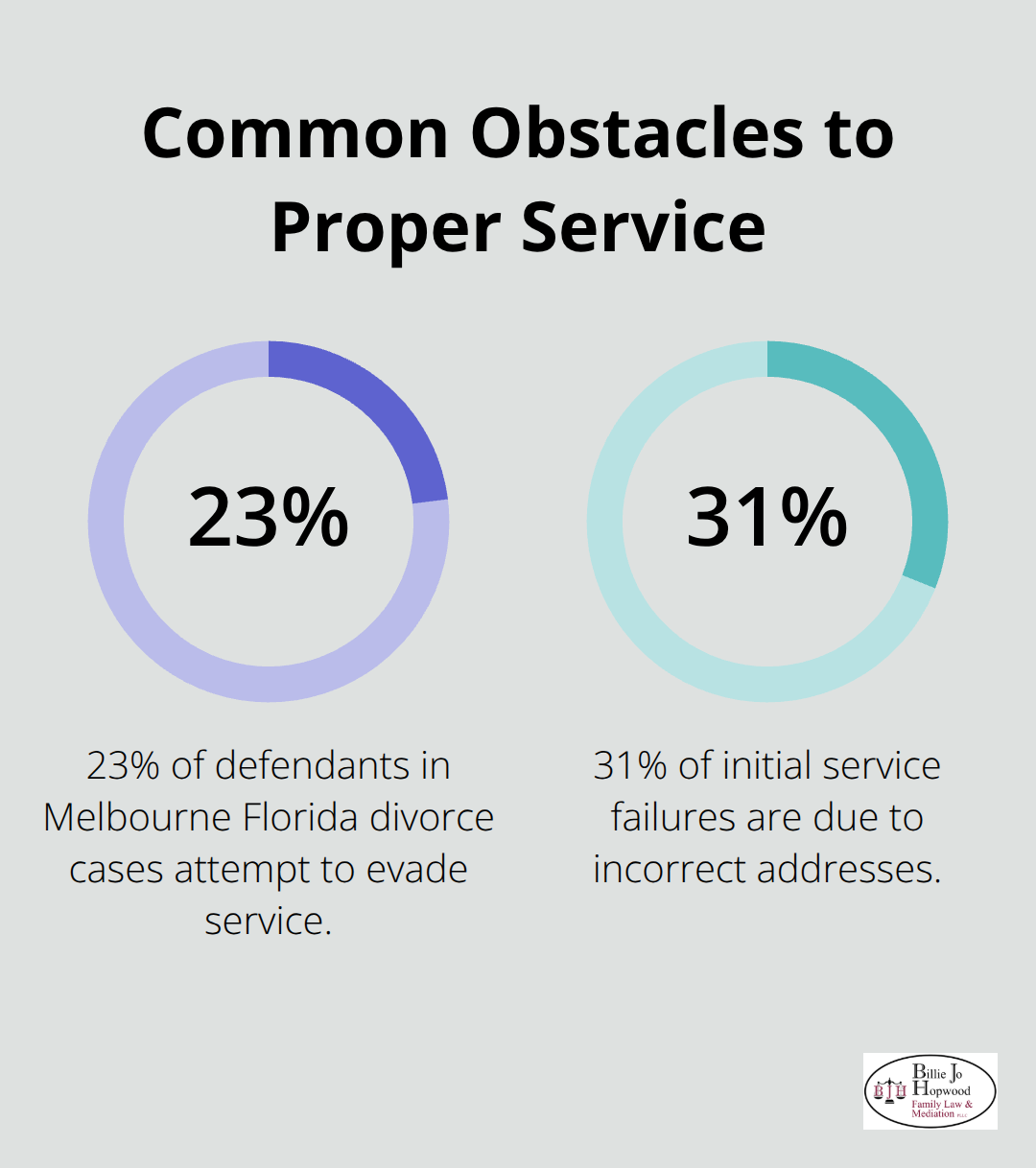
Defendants who actively avoid service create the most frustrating obstacles in Florida family law cases. Professional process servers report that 23% of defendants in Melbourne Florida divorce cases attempt to evade service through various tactics. These individuals often refuse to answer doors, provide false information to neighbors, or temporarily relocate to unknown addresses.

Percentages showing evasion and address-related service failures - proof of service of summons family law

The solution requires persistent documentation of every attempt. Courts need proof that you made diligent efforts before they approve alternative service methods. Process servers must record specific times, dates, and circumstances of failed attempts (including conversations with neighbors or building managers who confirm the defendant’s residence).

Address Problems That Derail Service

Incorrect addresses cause 31% of initial service failures according to Brevard County court records. Defendants frequently move without they update their information or provide false addresses during separation proceedings. Skip tracing services become necessary when standard databases show outdated information.

These services cost between $50-200 but locate current addresses through utility records, employment databases, and social media analysis. Courts require proof that you attempted service at the last known address before they accept service at newly discovered locations. The Florida Bar Association recommends licensed investigators for address verification in contested cases where defendants have significant assets at stake.

Out-of-State Service Complications

Defendants who moved out of Florida require compliance with both Florida law and the destination state’s requirements. Each state maintains different rules for accepting out-of-state process servers (which creates potential jurisdictional challenges). Professional process server networks charge $150-300 for interstate service but provide the expertise needed to navigate varying state requirements.

Some states require local licensing while others accept Florida-licensed servers. Courts often grant extended deadlines for out-of-state service, but you must request these extensions before the original deadline expires. Missing parties who cannot be located after diligent search efforts may qualify for constructive service through newspaper publication, though this method requires court approval and detailed proof of search attempts.

Final Thoughts

You must maintain accurate proof of service of summons family law documentation through systematic record-keeping from the moment you file your petition. Store all affidavits, photographs, and process server certificates in chronological order with backup copies in separate locations. Courts in Melbourne Florida reject incomplete documentation packages that lack specific details about service attempts.

Proper service documentation protects your case from costly delays and potential dismissal. The 20-day response deadline only begins after valid service occurs, which means inadequate proof can extend your case timeline by months. Professional documentation also prevents defendants from successfully challenging jurisdiction or claiming they never received notice of proceedings.

Complex service situations require immediate legal intervention. When defendants actively avoid service, move out of state, or cannot be located through standard methods, the procedural requirements become increasingly technical (and mistakes prove costly). We at Billie Jo Hopwood Family Law & Mediation, PLLC help Melbourne Florida families navigate these service challenges while maintaining compliance with Florida Statutes Chapter 48 requirements.

Is Your Lawyer Board Certified in Family Law?

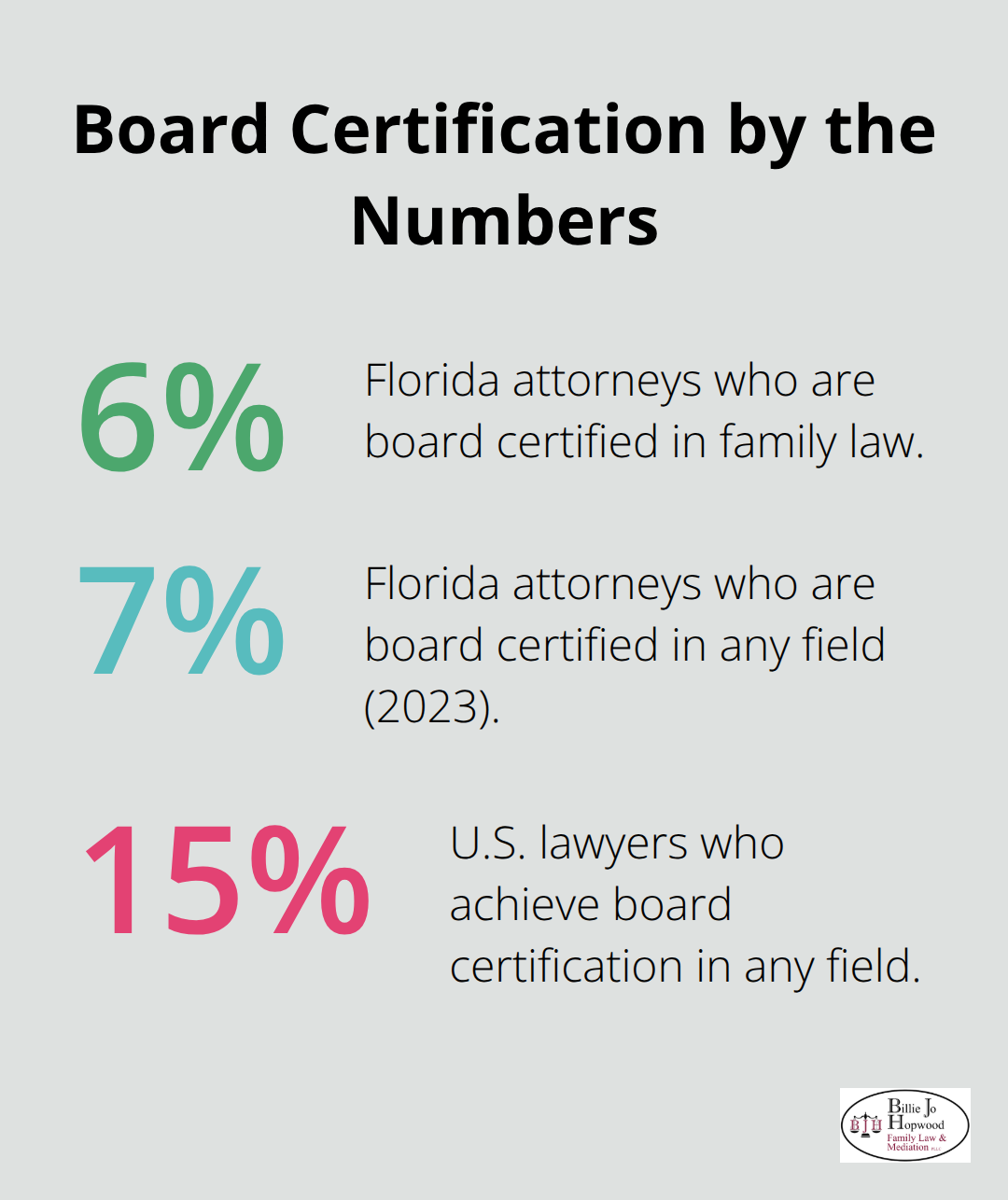
When facing divorce or custody matters in Melbourne Florida, your attorney’s qualifications can make or break your case. Only 6% of Florida attorneys hold board certified family law credentials.

At Billie Jo Hopwood Family Law & Mediation, PLLC, we understand how this distinction impacts your family’s future. Board certification represents the highest level of legal competence in family matters.

What Makes Board Certification Different

The Rigorous Path to Certification

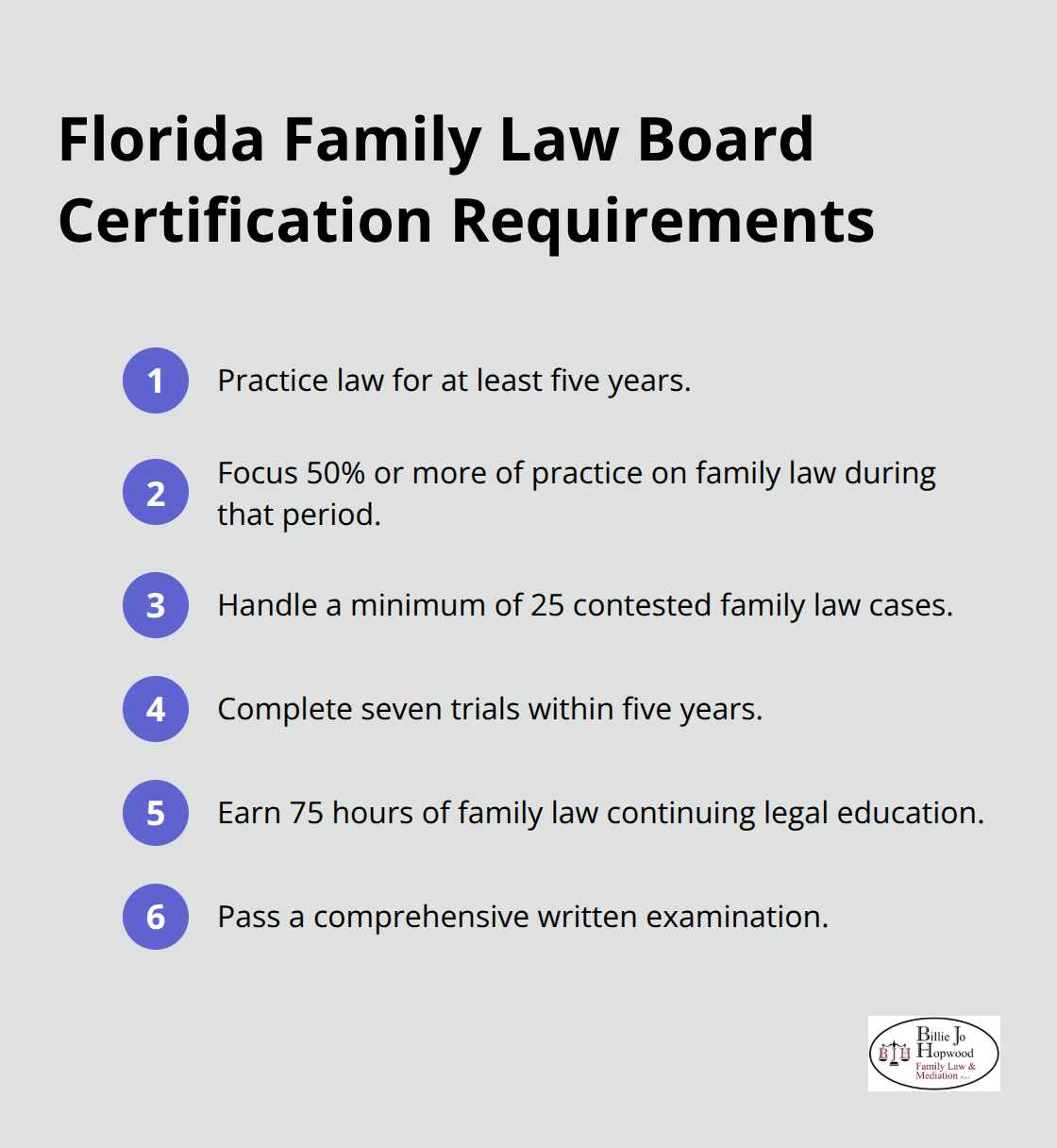
Board certification in family law requires far more than a law degree and state bar admission. The Florida Bar mandates that attorneys practice law for at least five years before they can apply, with 50% or more of their practice focused on family law matters during this period. Candidates must handle a minimum of 25 contested family law cases and complete seven trials within five years before their application. The Florida Bar requires 75 hours of continuing legal education in family law topics during this timeframe. Only after attorneys meet these requirements can they attempt the comprehensive written examination that tests their knowledge of Florida family law statutes and procedural rules.

Ordered list of the Florida Bar’s key requirements for family law board certification - board certified family law

Beyond Basic Legal Practice

Licensed attorneys can practice family law immediately after they pass the bar exam, but board certified attorneys have proven their competence through peer evaluations and rigorous tests. The American Bar Association reports that only about 15% of lawyers achieve board certification in any field (making these credentials rare). In Florida, merely 7% of all attorneys hold board certification as of 2023. This distinction matters because certified attorneys must recertify every five years and complete ongoing education to maintain their status.

Percentages showing rarity of board certification among attorneys in Florida and nationwide - board certified family law

The Peer Review Process

The certification process includes evaluations from judges, opposing counsel, and other legal professionals who can attest to the attorney’s skill level and ethical standards in actual practice situations. These professionals observe how attorneys handle cases, interact with clients, and conduct themselves in court proceedings. The review process examines not just legal knowledge but also professional behavior and ethical conduct throughout real family law cases.

This rigorous vetting process creates a clear advantage when you need to verify whether your attorney possesses the advanced qualifications necessary for complex family law matters.

Why Board Certification Delivers Superior Results

Board certified family law attorneys handle complex financial matters with precision that general practitioners cannot match. These attorneys possess advanced training in asset valuation, business appraisals, and property division strategies that prove invaluable in high-net-worth divorces. The Florida Bar requires certified attorneys to demonstrate trial experience in at least seven contested cases, which means they have proven courtroom skills under pressure. This trial experience translates directly to better negotiation outcomes, as opposing counsel recognizes the certified attorney’s willingness and ability to take cases to trial when necessary.

Strategic Advantages in Custody Disputes

Certified attorneys understand Florida’s custody statutes at a granular level, which includes recent changes to time-sharing calculations and parental responsibility guidelines. Their mandatory 75 hours of continuing education in family law topics means they stay current on evolving case precedents and procedural modifications. This knowledge becomes critical when they craft parenting plans that courts will approve or when they challenge custody arrangements that don’t serve children’s best interests. The peer review process these attorneys undergo includes evaluations from family court judges (providing insight into judicial preferences and courtroom dynamics that can influence case outcomes).

Financial and Settlement Outcomes

Studies from the American Bar Association show that clients represented by certified attorneys achieve more favorable financial settlements compared to those who use general practitioners. Certified attorneys leverage their deep understanding of Florida’s equitable distribution laws to identify hidden assets and protect clients from unfavorable property divisions. Their experience with complex financial instruments, retirement accounts, and business valuations helps clients avoid costly mistakes during asset division negotiations. The recertification requirement every five years means these attorneys maintain current knowledge of tax implications and financial strategies that impact long-term client outcomes (making their advice more valuable over time).

Courtroom Performance and Trial Skills

Board certified attorneys demonstrate superior courtroom performance due to their proven trial experience and ongoing education requirements. They understand evidence rules, procedural requirements, and judicial expectations that can make or break a case. Their certification process includes peer evaluations from judges who observe their courtroom conduct and legal arguments firsthand. This combination of trial experience and judicial feedback creates attorneys who can navigate complex family court proceedings with confidence and skill. When you need to verify your attorney’s qualifications and certification status, several reliable methods can help you make an informed decision.

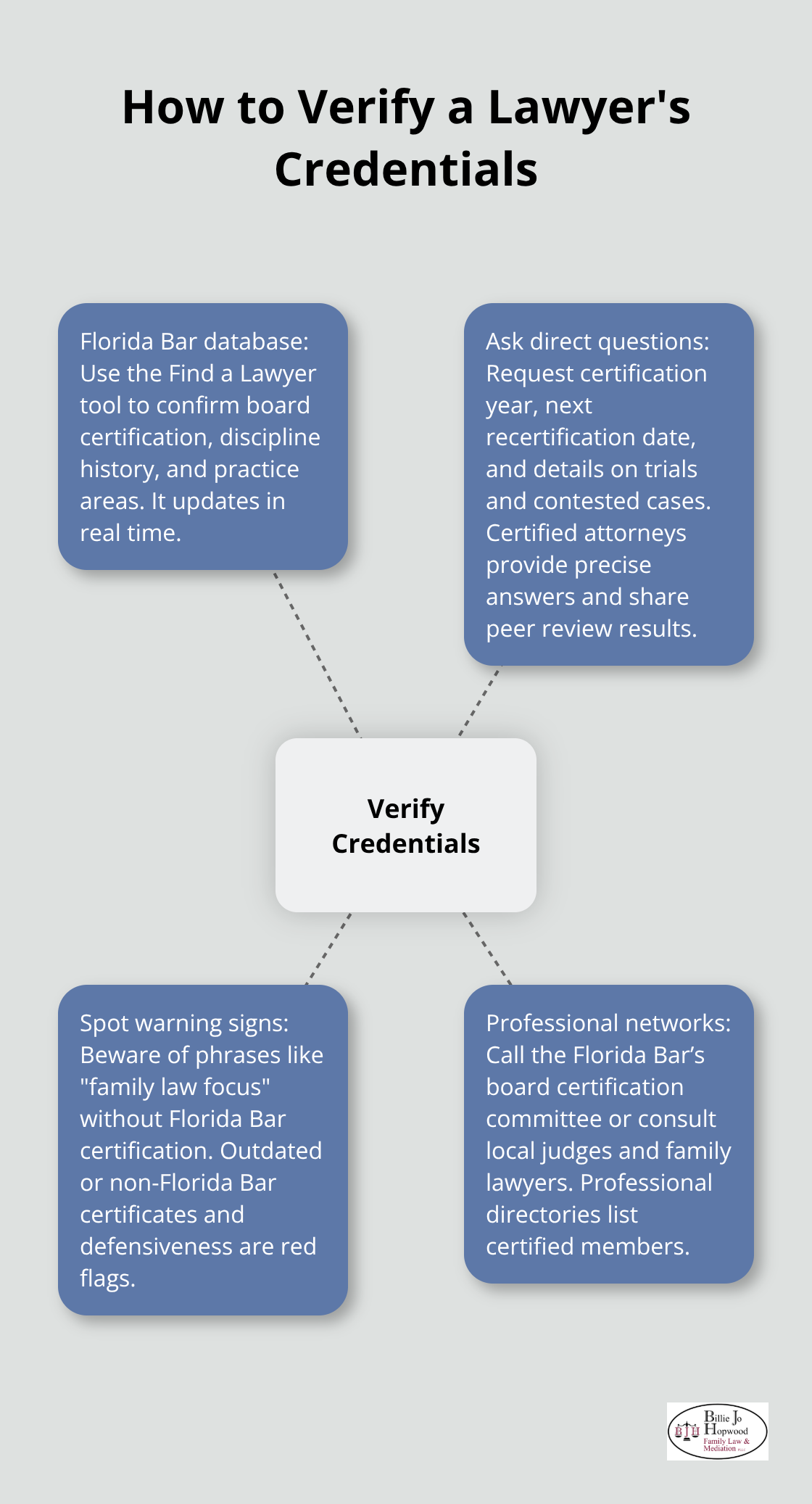
Hub-and-spoke diagram showing four reliable ways to verify an attorney’s board certification

How Do You Check Your Attorney’s Credentials

The Florida Bar’s Official Database

The Florida Bar maintains a comprehensive online attorney search database that provides instant access to board certification status for all licensed attorneys in the state. Navigate to the Florida Bar website and use their Find a Lawyer tool, which displays certification details, disciplinary history, and practice areas for each attorney. This database updates in real-time, so you can verify current certification status rather than rely on outdated marketing materials or website claims.

Direct Questions That Reveal True Qualifications

Ask your prospective attorney specific questions about their certification timeline and maintenance requirements. Request the exact year they received board certification and when their next recertification comes due. Certified attorneys will provide precise dates and discuss their ongoing education requirements without hesitation. Ask how many contested family law cases they handled during their five-year certification period and request specific details about their trial experience. Legitimate board certified attorneys will readily share their peer review results and examination scores. If an attorney provides vague responses or deflects these questions, they likely lack proper certification credentials.

Warning Signs of Misleading Representation

Attorneys who claim to practice family law but cannot produce board certification documentation often use misleading language like “family law focus” or “family law concentration” instead of certified credentials. The Florida Bar reports that attorneys sometimes display outdated certificates or certifications from organizations other than the Florida Bar (which do not carry the same weight or requirements). Watch for attorneys who emphasize years of experience without mentioning board certification, as longevity alone does not indicate advanced competence. Any attorney who refuses to provide their Florida Bar number for verification or becomes defensive about credential questions should raise immediate concerns about their qualifications and transparency.

Verification Through Professional Networks

Contact local family court judges or other family law attorneys for references about your prospective attorney’s reputation and certification status. The Florida Bar’s board certification committee maintains records of all certified attorneys and can confirm certification status when you call their offices directly. Professional legal organizations often publish directories of board certified members (making verification straightforward for potential clients).

Final Thoughts

Board certified family law attorneys provide measurable advantages in divorce and custody proceedings through their proven competence and advanced training. The rigorous certification process creates attorneys who understand Florida’s complex family law statutes and deliver superior courtroom performance when your family’s future depends on skilled representation. These attorneys have met the highest standards that the Florida Bar establishes for family law practice.

You must verify your attorney’s credentials through the Florida Bar’s official database and ask direct questions about their certification status to make an informed decision about legal representation. The 6% of Florida attorneys who hold board certification have demonstrated their commitment to excellence through peer evaluations, comprehensive examinations, and ongoing education requirements. This verification process protects you from attorneys who may misrepresent their qualifications or experience levels.

When you face challenging family legal situations in Melbourne Florida, proper credentials matter significantly in complex family law proceedings. Board certified family law attorneys possess the advanced knowledge and proven trial experience that can influence the outcome of your case. Billie Jo Hopwood Family Law & Mediation, PLLC provides dedicated representation in divorce, child custody, alimony, and child support matters (with the understanding that your choice of attorney impacts your family’s future).

How to Find a Family Law Attorney with Low Retainer Fees

Family law cases often require significant upfront costs that can strain household budgets during already difficult times. Many Melbourne Florida families struggle to afford legal representation when facing divorce or custody matters.

At Billie Jo Hopwood Family Law & Mediation, PLLC, we understand that finding a family law attorney with low retainer fees requires careful research and planning. The right approach can help you secure quality legal help without breaking your budget.

What Do Family Law Retainer Fees Actually Cover

Understanding What Your Retainer Payment Includes

Family law retainer fees function as advance payments that attorneys hold in trust to cover their services throughout your case. The retainer covers attorney time for document preparation, court appearances, negotiations with opposing counsel, research, and client communications. Most Melbourne Florida family law attorneys draw from this retainer as they work on your case at their hourly rate, which typically ranges from $300 to $600 according to Florida Bar data.

Melbourne Florida Retainer Fee Reality

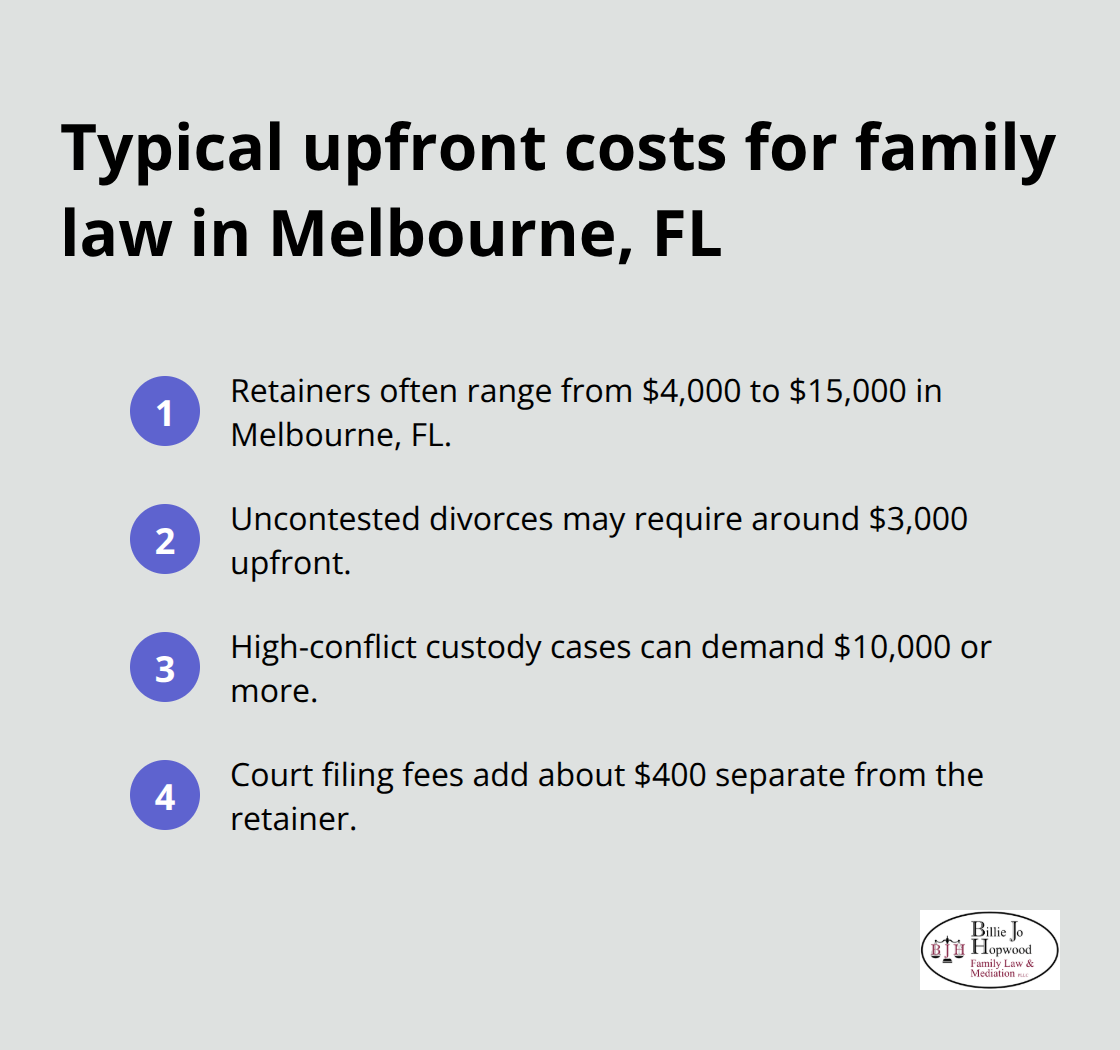
Retainer fees for family law cases in Melbourne Florida range from $4,000 to $15,000 based on case complexity and attorney experience. Simple uncontested divorces may require lower retainers around $3,000, while high-conflict custody battles can demand $10,000 or more upfront. Court filing fees in Florida add approximately $400 to your initial costs (separate from the attorney retainer).

Snapshot of common upfront costs for Melbourne, Florida family law matters

The Key Difference Between Retainers and Hourly Rates

Many people confuse retainer fees with flat fees, but they work completely differently. Your retainer acts like a bank account that depletes as your attorney bills time at their hourly rate. When the retainer runs low, you must replenish it to continue representation. Hourly rates represent the actual cost of legal work, while retainers simply hold money to pay those hourly charges.

How Attorneys Track and Bill Against Your Retainer

Attorneys track their time in increments (usually six-minute blocks) and bill against your retainer monthly. They document phone calls, email exchanges, document review, and court preparation time. Most firms provide detailed billing statements showing how they used your retainer funds and remaining balance. Litigation burns through retainer fees at $300-500 per hour for attorney time spent in depositions, document discovery, and court appearances.

Once you understand how retainer fees work, you can begin researching strategies to find affordable legal representation that fits your budget.

How Can You Find Affordable Legal Help in Melbourne Florida

Research Multiple Attorneys Through Verified Platforms

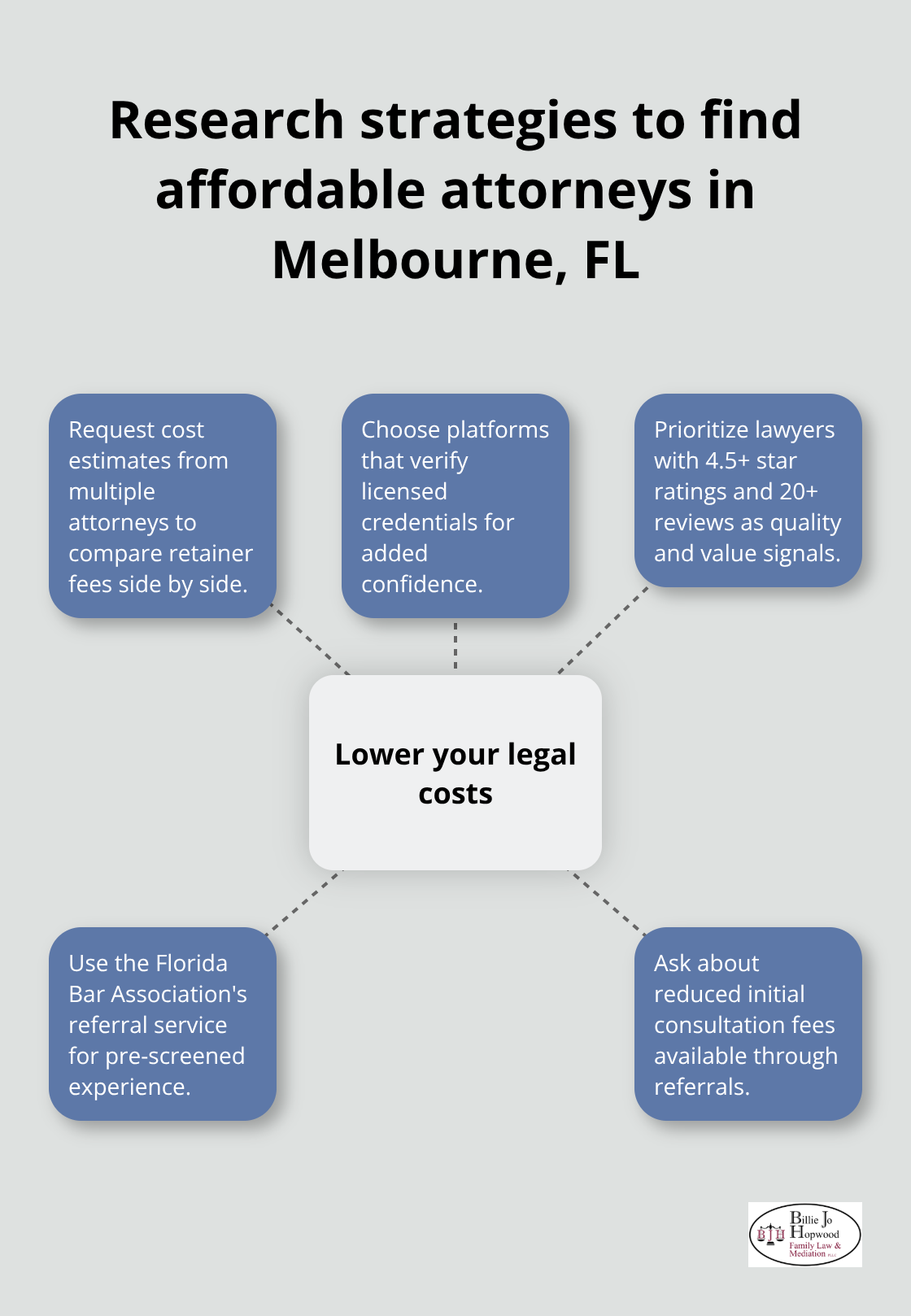
Strategic research goes beyond basic online searches when you need affordable family law representation. Thumbtack allows you to request cost estimates from multiple Melbourne Florida attorneys and compare their retainer fees side by side. The platform requires licensed professionals to verify their credentials, which gives you confidence in their qualifications. Focus on attorneys with ratings above 4.5 stars and at least 20 reviews, as these indicators often correlate with both quality service and reasonable pricing. The Florida Bar Association’s lawyer referral service provides another reliable source for pre-screened attorneys who meet specific experience requirements and often offer reduced initial consultation fees.

Hub-and-spoke diagram of research tactics to lower family law costs in Melbourne, Florida - family law attorney with low retainer fee

Payment Plans Make Legal Help More Accessible

Many Melbourne Florida family law attorneys offer payment plans that break retainer fees into manageable monthly installments instead of lump sum payments. Some firms accept credit card payments, which allows you to spread costs over time while you secure immediate representation. Request detailed fee agreements that outline exactly when additional retainer replenishments become due and whether you can pause services if funds run low. Unbundled legal services represent another cost-saving option where you hire an attorney for specific tasks like document preparation or court appearances rather than full case representation.

Alternative Dispute Resolution Cuts Costs Dramatically

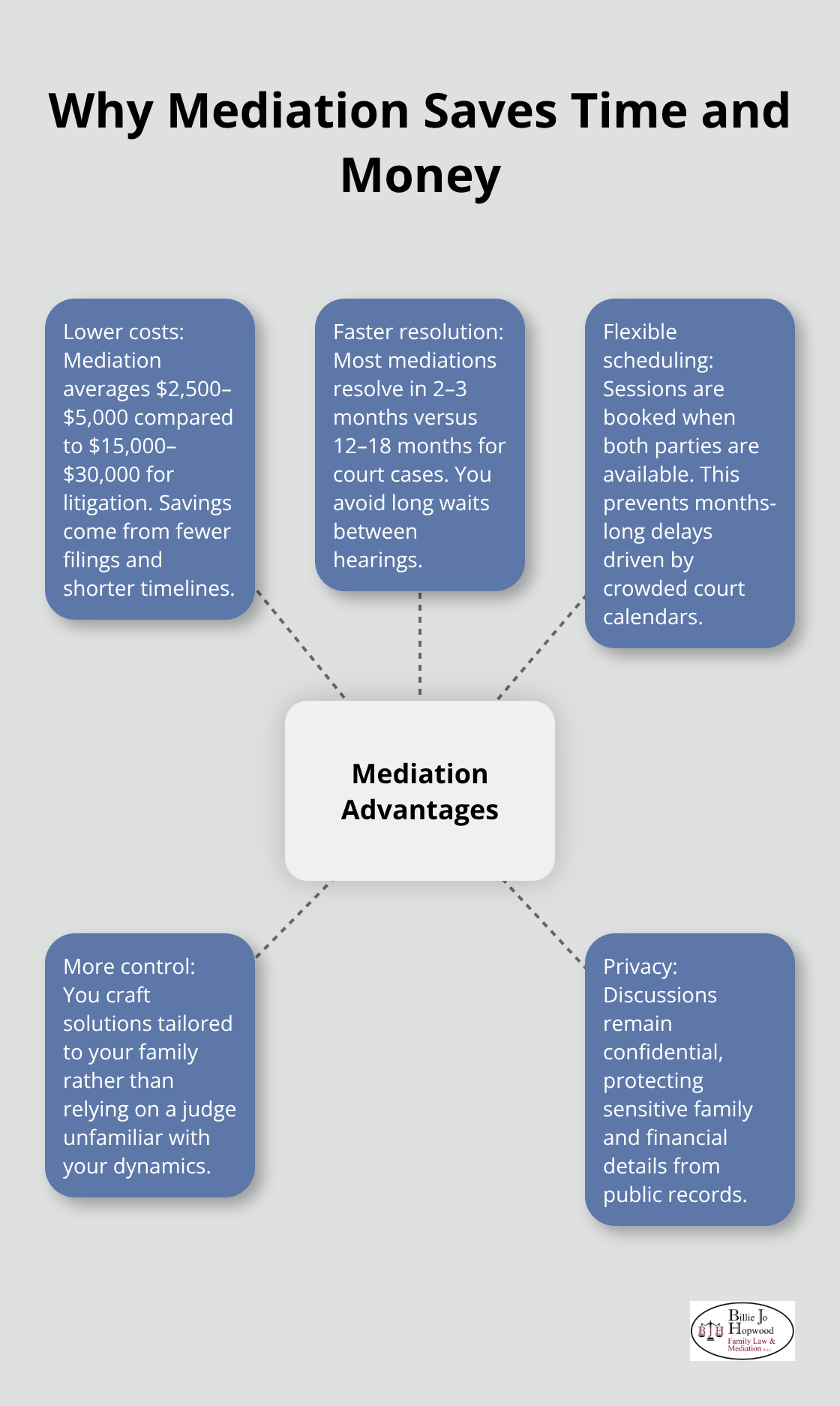
Mediation costs between $3,000 to $7,000 for both parties combined, compared to $15,000 to $30,000 for litigated divorces (according to Florida Dispute Resolution Center studies). Most mediations resolve within 3 to 10 hours across 2 to 4 sessions, which makes them significantly faster than court battles that can drag on for months. Virtual mediation sessions cost approximately 20% less than in-person meetings while they eliminate travel expenses and time off work. Courts in Brevard County offer sliding scale mediation fees based on income levels, with couples who earn under $50,000 qualifying for free services and those who earn $50,000 to $100,000 paying just $60 per party for 1.5-hour sessions.

Once you identify potential attorneys through these research methods, you need to ask the right questions to evaluate their true costs and services.

What Questions Should You Ask Before Hiring an Attorney

Get Every Cost in Writing Before You Sign

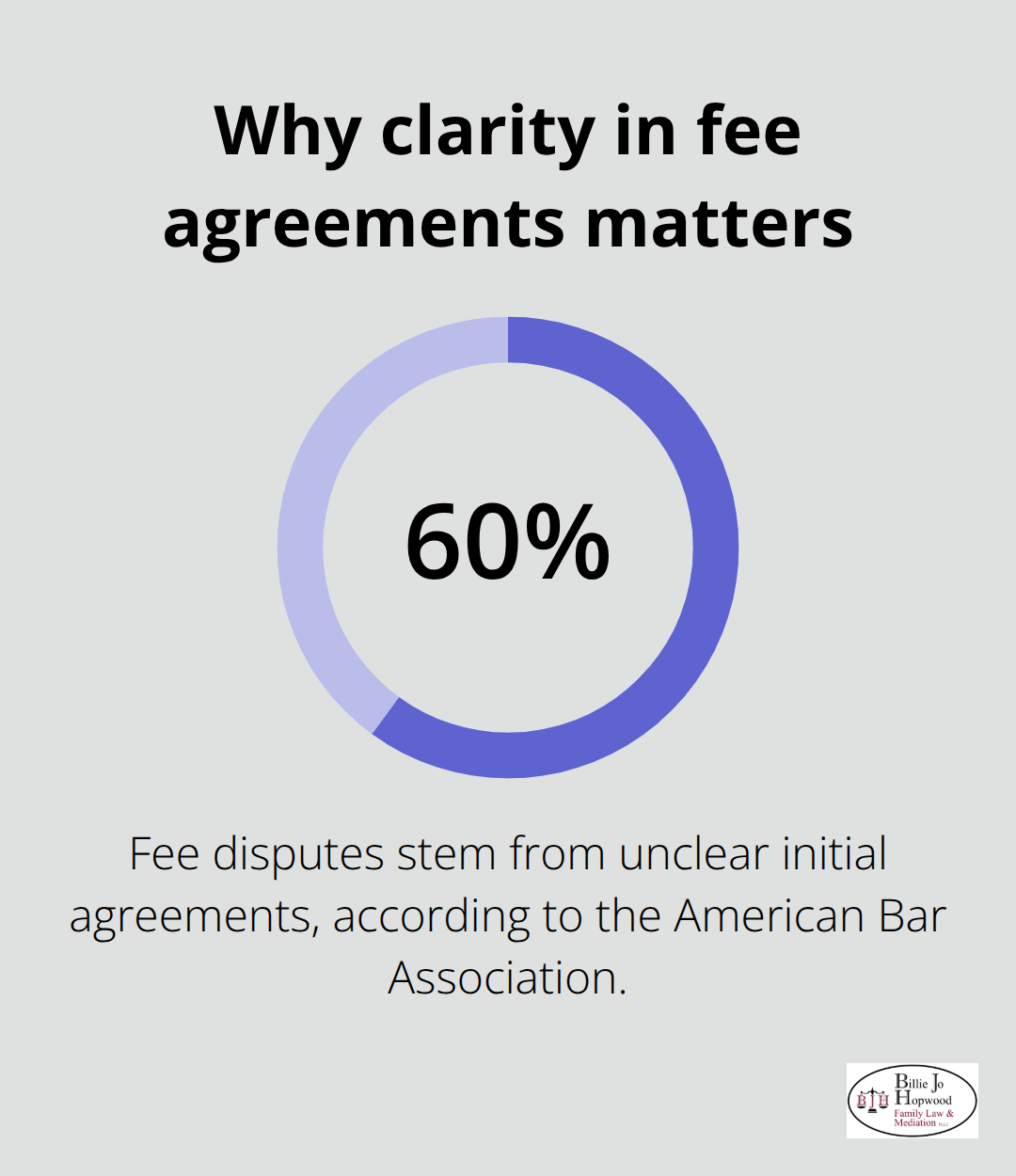
Most attorneys provide vague estimates during initial consultations, but you need specific numbers to make informed decisions. Request a written fee agreement that lists the exact retainer amount, hourly rates for attorneys versus paralegals, and minimum billing increments (most firms bill in six-minute blocks). Ask for the cost of common tasks like document preparation ($100-$300), court appearances ($500-$1,500 per day), and depositions ($300-$500 per hour). The American Bar Association reports that 60% of fee disputes stem from unclear initial agreements, so demand transparency upfront.

Percentage showing how unclear agreements drive fee disputes - family law attorney with low retainer fee

Get estimates for additional expenses including court filing fees, process server costs ($75-$150), and potential appraisal fees ($300-$800) for property valuation. Many Melbourne Florida attorneys charge administrative fees for copying, faxing, and postage that can add $200-$500 to your total bill.

Define Exactly What Services Your Retainer Covers

Attorneys often provide different service levels at various price points, so you must understand what your retainer includes. Some firms offer limited representation where they handle specific tasks like drafting agreements or court appearances, while full representation covers every aspect of your case. Ask whether your retainer covers all communication methods including phone calls, emails, and text messages, as some attorneys charge separately for each contact.

Determine if paralegal work gets billed at reduced rates ($75-$150 per hour) compared to attorney time ($300-$600 per hour). Find out whether document review, research time, and travel to court appearances count against your retainer. Request a timeline that shows when you might need to replenish your retainer and under what circumstances additional fees might apply.

Clarify Timeline Expectations and Potential Delays

Ask your potential attorney for realistic timelines based on similar cases they have handled in Melbourne Florida courts. Most uncontested divorces take 3-6 months to complete, while contested custody cases can extend 12-18 months or longer. Request information about factors that commonly cause delays, such as discovery disputes, scheduling conflicts, or opposing party cooperation issues.

Find out how the attorney handles unexpected complications that might increase costs. Some attorneys cap their fees for specific services, while others bill additional time as cases become more complex. Ask about their policy for emergency consultations and whether weekend or evening communications incur premium charges.

Final Thoughts

You can find a family law attorney with low retainer fees through systematic research and careful evaluation of your options. Start with verified platforms like Thumbtack to compare multiple attorneys, then request detailed written fee agreements that outline all costs upfront. Payment plans and unbundled services make legal representation more affordable, while mediation offers significant savings compared to traditional litigation.

The key lies in balance between affordability and quality representation. A slightly higher retainer fee might save money long-term if the attorney resolves your case efficiently (most cases settle within 6-12 months with skilled representation). Ask specific questions about service scope, billing practices, and timeline expectations to avoid unexpected costs.

Melbourne Florida families face difficult decisions when they need legal help for divorce or custody matters. Schedule consultations with multiple attorneys to compare their approaches and fees before you make your final choice. At Billie Jo Hopwood Family Law & Mediation, PLLC, we provide guidance through challenging legal situations while we offer transparent fee structures.

Family Law Web Design: Crafting Digital Success

Family law practices face intense online competition, with 73% of potential clients researching attorneys digitally before making contact. Your website serves as the first impression for families navigating difficult legal situations.

At Billie Jo Hopwood Family Law & Mediation, PLLC, we understand that effective family law web design directly impacts client acquisition and trust-building. A well-crafted digital presence can transform how potential clients perceive your practice and influence their decision to seek your services.

What Makes a Family Law Website Actually Work?

Navigation That Guides Distressed Clients

Mobile search accounts for 57% of all search queries, which makes responsive design non-negotiable for family law practices. Your website must adapt seamlessly across smartphones, tablets, and desktops without compromising functionality. Google prioritizes responsive websites in search rankings, directly affecting your visibility when potential clients search for legal help.

Chart showing 57% of searches are mobile and 73% of clients research attorneys online before contact. - family law web design

Sites that load within 2 seconds have bounce rates of just 9%, while those taking 5 seconds see bounce rates jump to 38%. Compress images, implement caching, and optimize your hosting to achieve sub-3-second loading times consistently. Fast loading speeds prevent frustrated clients from abandoning your site before they can access your services.

Contact Methods That Drive Immediate Action

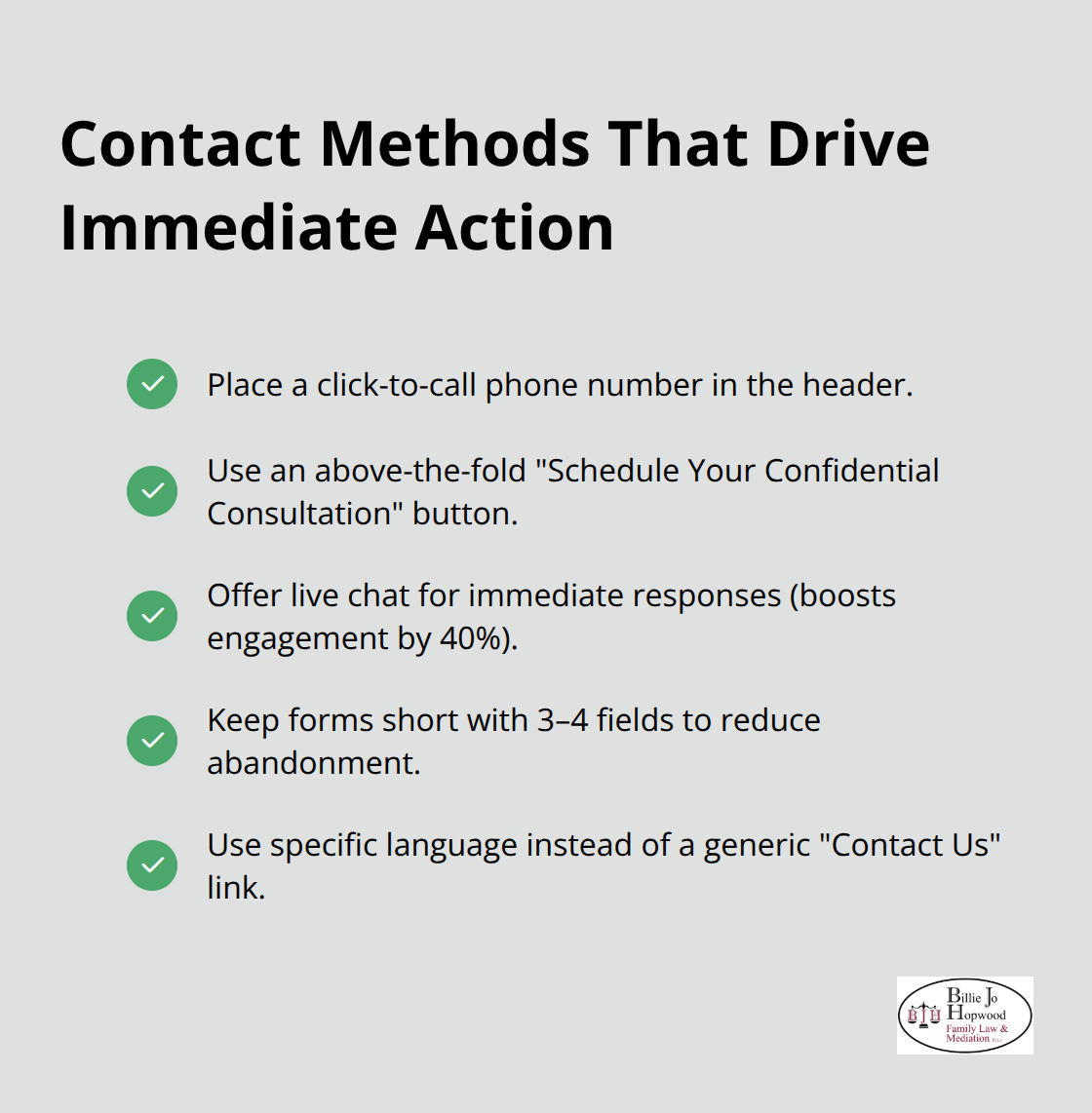
Clear contact methods drive conversions more effectively than complex forms. Place your phone number prominently in the header with click-to-call functionality for mobile users. Schedule consultation buttons should appear above the fold and use specific language like “Schedule Your Confidential Consultation” rather than generic “Contact Us” text.

Live chat features increase engagement by 40% and allow immediate response to urgent family law questions. Simplified contact forms with just 3-4 fields reduce abandonment rates compared to lengthy intake questionnaires that overwhelm already stressed clients.

Checklist of high-converting contact methods for family law websites.

Mobile Optimization That Converts Visitors

Mobile users expect instant access to attorney information and contact options. Design your mobile interface with thumb-friendly buttons and readable fonts (minimum 16px) that don’t require zooming. Touch targets should measure at least 44px to prevent accidental clicks that frustrate users.

Mobile-first design principles guide successful family law websites because distressed clients often search for legal help during emotional moments when desktop access isn’t available. This foundation sets the stage for building the trust elements that transform website visitors into committed clients.

How Trust Converts Website Visitors Into Clients

Client Testimonials That Drive Conversions

Testimonials from real clients convert 34% more visitors than websites without social proof. This makes client feedback your most powerful trust-building tool. Display specific testimonials that mention outcomes like custody arrangements or mediation success rates rather than generic praise.

Include first names and last initials with photos when possible. Faces increase credibility by 89% according to Nielsen research. Position testimonials strategically near consultation forms and contact sections where conversion decisions happen.

Professional Credentials That Establish Authority

Attorney credentials work differently than testimonials because they establish competence before emotional connection. List bar admissions, certifications, and professional memberships prominently on attorney bio pages. Professional headshots should convey approachability while maintaining authority.

Avoid overly formal courtroom photos that distance you from stressed families who seek help. The right balance creates immediate trust while maintaining professional standards that family law clients expect.

Security Features That Close Hesitant Clients

Secure client portals and SSL certificates directly impact conversion rates because family law clients worry about privacy more than other legal clients. Display security badges and encryption notifications visibly on contact forms and consultation pages.

Implement two-factor authentication for client portals and prominently advertise this protection. Privacy policies should use plain language that explains how you protect sensitive family information rather than legal jargon that confuses potential clients.

Case Results That Demonstrate Success

Case results displays require careful balance between success demonstration and client confidentiality maintenance. Use anonymous case summaries with specific outcomes like settlement amounts or custody percentages achieved (rather than vague statements like “achieved favorable outcome”).

Specify concrete results such as “reduced child support by 40%” or “secured primary custody rights.” This concrete approach demonstrates competence while respecting privacy boundaries that family law demands.

These trust elements work together to convert visitors, but they need visibility to generate leads. Strategic search optimization makes your trustworthy website discoverable when families need legal help most.

How Search Optimization Drives Family Law Leads

Local search optimization generates 80% more leads than traditional advertising for family law practices according to Google research. Geographic targeting starts with Google My Business optimization where your listing must include accurate practice areas, hours, and location data.

Chart showing 80% more leads from local SEO, 67% better conversion from long-tail posts, and 45% traffic lift from two monthly posts. - family law web design

Google My Business Optimization That Converts

Add high-quality photos of your office interior and team to increase click-through rates by 35%. Respond to every review within 24 hours because Google factors response time into local ranking algorithms. Negative reviews require professional responses that demonstrate accountability while positive reviews need specific acknowledgment that mentions the client’s situation type (like custody or divorce mediation).

Content Marketing That Captures Search Traffic

Legal blog posts that target long-tail keywords convert 67% better than general practice pages. Write posts that address specific questions like “Florida child support modification requirements” rather than broad topics like “family law basics.” Two blog posts published monthly increase organic traffic by 45% within six months according to HubSpot data.

Each post should target one primary keyword with 1,500-2,000 words that directly answer client questions. Include location-specific content like local court procedures or state law changes that competitors often ignore. This approach captures search traffic when families need immediate legal guidance.

Review Management That Builds Authority

Online reviews influence 93% of family law client decisions which makes reputation management non-negotiable. Automated review requests sent 48 hours after case completion generate 40% more responses than manual outreach. Monitor review platforms including Google, Avvo, and Martindale-Hubbell weekly because delayed responses damage credibility permanently.

Encourage satisfied clients to mention specific outcomes and attorney names in reviews rather than generic praise. Five-star ratings with detailed content rank higher in local search results than brief positive reviews that lack substance (detailed reviews also provide more social proof for potential clients).

Final Thoughts

Family law web design directly impacts your practice’s ability to attract and convert clients during their most vulnerable moments. The data shows clear patterns: mobile-responsive sites with fast loading speeds, strategic local SEO, and prominent client testimonials generate significantly more leads than basic attorney websites. These digital foundations create the trust and accessibility that distressed families seek when they search for legal help online.

We at Billie Jo Hopwood Family Law & Mediation, PLLC focus on divorce, child custody, alimony, and child support cases in Melbourne, Florida. Our practice understands that families need immediate access to trustworthy legal guidance online. The right digital strategy transforms how potential clients perceive your services and influences their decision to contact your firm.

Google My Business optimization, mobile-first design implementation, and consistent content marketing should take priority in your digital strategy. Review management and secure client portals build the trust foundation that converts website visitors into committed clients (these elements work together to create sustainable practice growth). Family law practices that implement these strategies reach families precisely when they need legal help most.

What Does Family Law Cover?

Family law touches nearly every aspect of personal relationships and domestic matters. From divorce proceedings to child custody arrangements, this legal field addresses the most personal challenges families face.

At Billie Jo Hopwood Family Law & Mediation, PLLC, we regularly help clients understand what family law covers. The scope extends far beyond simple divorce cases to include financial support, property division, and various dispute resolution methods.

What Areas Does Family Law Actually Cover

Family law addresses three primary areas that directly impact your daily life and financial future. Divorce proceedings affect approximately 50% of all marriages in the United States according to national statistics, which makes this the most common family law matter. Legal separation offers an alternative path for couples who want to live apart while they remain legally married, often for religious reasons or to maintain health insurance benefits.

Infographic showing divorce rate, joint custody prevalence, and Texas child support percentage. - what does family law cover

The process typically takes 3-6 months when both parties cooperate, but contested cases can extend beyond a year.

Child Custody Arrangements Shape Your Parental Rights

Courts make custody decisions based solely on the child’s best interests, not parental preferences. Joint custody arrangements now represent 60% of all custody cases nationwide and require detailed agreements about decision-making authority, residential schedules, and holiday rotations. Physical custody determines where children live, while legal custody governs major decisions about education, healthcare, and religious upbringing. Grandparents and other relatives can petition for custody when parents cannot provide adequate care (with courts evaluating safety concerns and existing relationships).

Financial Support Obligations Follow State Guidelines

Child support calculations use specific state formulas based on both parents’ incomes, custody time, and the child’s needs. Texas guidelines, for example, set support at 20% of net income for one child and 25% for two children. Spousal support varies dramatically by state – some limit duration to half the marriage length, while others allow permanent support for long-term marriages. Modification requests require proof of substantial income changes (typically 20% or more), and courts review cases every three years for adjustments.

These core areas represent just the foundation of family law’s reach. The financial implications of these decisions extend far beyond monthly payments and custody schedules.

Financial Aspects of Family Law

Financial calculations in family law follow strict state formulas that directly impact your monthly budget for years. Child support amounts vary dramatically by location – Florida uses 20% of net income for one child while California considers both parents’ income and custody time. The Texas Attorney General reports average monthly support payments range from $400 to $1,200 per child, but high-income families often pay substantially more. Support modifications require documented income changes of at least 20% or three years since the last order, and courts rarely approve reductions without compelling evidence.

Property Division Rules Determine Asset Distribution

Equitable distribution states like Florida divide marital assets based on fairness, not equality, which means one spouse might receive 60% while the other gets 40%. Community property states split everything 50-50, but separate property acquired before marriage stays with the original owner. Retirement accounts need Qualified Domestic Relations Orders for division, and 401k plans cost $500-2,000 in QDRO preparation fees. The National Center for Health Statistics shows couples with assets over $100,000 spend 40% more on legal fees during property division disputes.

Hub-and-spoke chart showing key property division rules and cost factors in family cases. - what does family law cover

Debt Responsibility Follows Marriage Law

Marital debt gets divided just like assets, but credit card companies can still pursue either spouse for joint accounts regardless of court orders. Student loans remain with the borrower in most states, though some judges consider them marital debt if used for family expenses. Mortgage responsibility typically follows property ownership, but both names on the loan create ongoing liability until refinancing occurs. The Federal Reserve reports average divorce-related debt division affects credit scores for 18 months post-decree.

Support Modification Procedures Require Documentation

Courts review support orders every three years for potential adjustments based on income changes or custody modifications. The requesting party must prove substantial circumstances have changed since the original order (typically a 20% income variation). Job loss, disability, or significant promotion can trigger modification hearings. Documentation requirements include tax returns, pay stubs, and employment verification letters.

Understanding these financial implications helps families prepare for the legal processes that lie ahead in their family law cases.

How Do Family Law Procedures Actually Work

Family law cases begin with precise paperwork requirements that differ by state and case type. Florida courts require financial affidavits within 45 days of divorce petitions, while Texas demands complete asset and debt disclosure within 30 days of initial filings. The American Bar Association reports that incomplete financial documentation causes 85% of filing delays, which adds an average of $2,500 in additional legal fees for families. Initial filing fees range from $200 in Arkansas to $435 in California, plus service costs of $75-150 for process servers. Contested cases mandate discovery periods that last 120-180 days, during which both parties exchange financial records, property valuations, and witness lists.

Court Filing Requirements Demand Complete Documentation

Courts reject incomplete petitions and return them for correction, which delays case progress by 2-4 weeks. Financial affidavits must include three years of tax returns, current pay stubs, and bank statements from all accounts. Property disclosure forms require appraisals for real estate, vehicles, and valuable personal items worth more than $500. Missing documents trigger automatic case delays and additional court fees (typically $50-100 per amended filing).

Mediation Resolves 90% of Family Disputes

Mediation sessions cost $150-400 per hour compared to $3,000-15,000 for court trials, which makes this the most cost-effective resolution method. The success rate reaches 90-95% for family law cases according to the American Arbitration Association, with agreements typically reached within 4-8 hours of mediation time. Mediators require advance preparation that includes asset lists, debt statements, and proposed parenting plans.

Three key reasons mediation resolves most family disputes quickly and affordably.

Virtual mediation options have increased accessibility by 40% since 2020, which allows parties to participate from separate locations when tensions run high.

Case Timelines Depend on Cooperation Levels

Uncontested divorces take 30-90 days from initial filing to final decree, while contested cases average 12-18 months according to the National Center for State Courts. Child custody modifications require 60-120 days for court approval when both parents agree, but disputed modifications can extend 6-12 months. Emergency custody hearings get scheduled within 24-72 hours for immediate safety concerns. Courts in major metropolitan areas face 6-month backlogs for trial dates, which makes settlement negotiations through mediation the fastest path to resolution. Simple name changes process in 4-6 weeks, while complex adoption cases require 6-12 months for completion.

Final Thoughts

Family law covers divorce proceedings, child custody arrangements, financial support obligations, property division, and court procedures that affect millions of families annually. The 50% divorce rate in America means half of all married couples will navigate these complex legal waters at some point. Financial calculations follow strict state formulas, with child support amounts that average $400-1,200 monthly per child and property division rules that vary dramatically between equitable distribution and community property states.

The mediation process resolves 90-95% of family disputes at significantly lower costs than court trials, which makes it the preferred resolution method for most families. Court procedures demand precise documentation and can extend 12-18 months for contested cases, while uncontested matters resolve within 30-90 days. Professional legal guidance becomes vital when families face these life-changing decisions (particularly when children and significant assets are involved).

We at Billie Jo Hopwood Family Law & Mediation, PLLC help families understand what does family law cover and provide representation in divorce, child custody, alimony, and child support matters throughout Melbourne, Florida. Our mediation services help families reach agreements faster and with less emotional stress than traditional litigation. Schedule a consultation to understand your rights and options when you face family legal issues.

How to Prepare for Family Law Mediation

Family law mediation offers a collaborative path to resolve disputes without the stress and expense of court battles. Understanding how to prepare for mediation family law cases can make the difference between a successful resolution and prolonged conflict.

At Billie Jo Hopwood Family Law & Mediation, PLLC, we’ve seen how proper preparation transforms outcomes for families in Melbourne Florida. The right preparation sets you up for productive discussions and fair agreements.

What Happens During Family Law Mediation

Family law mediation places you and your spouse in a private conference room with a neutral mediator who facilitates discussions about your divorce or custody issues. The mediator cannot make decisions for you but guides conversations toward mutually acceptable solutions. Sessions typically last 2-4 hours, and most cases resolve within 1-3 sessions according to Florida court statistics. The mediator begins with an explanation of confidentiality rules, then helps you identify key issues like property division, child custody schedules, and financial support obligations.

How Mediation Saves Time and Money

Traditional litigation costs Florida families an average of $15,000-$30,000 and takes 12-18 months to complete, while mediation averages $2,500-$5,000 and resolves within 2-3 months. Court schedules control litigation timelines and force you to wait months between hearings. Mediation lets you schedule sessions when both parties are available. You also retain control over outcomes instead of leaving decisions to a judge who knows nothing about your family dynamics. The confidential nature of mediation protects sensitive information from public court records (unlike traditional litigation).

Key advantages of mediation that reduce time, cost, and stress for Florida families

When Florida Courts Require Mediation

Florida Statute 44.102 mandates mediation in most family law cases before trial, including divorce, custody modifications, and paternity disputes. Courts waive this requirement only in domestic violence cases or when one party lives outside Florida. Some judges order mediation even in uncontested divorces to address potential future conflicts. The court provides a list of certified mediators, but you can select your own qualified professional. Failure to attend court-ordered mediation can result in sanctions and delays your case resolution.

What to Expect on Mediation Day

The mediator opens each session with ground rules and confidentiality agreements that protect your discussions. You and your spouse sit in the same room (or separate rooms if needed) while the mediator moves between parties to facilitate negotiations. Most mediators use a combination of joint sessions and private caucuses to address sensitive topics. The process remains flexible – you can take breaks, request private time with your attorney, or pause sessions if emotions run high. Success depends on your willingness to communicate openly and consider creative solutions that work for both parties.

With this foundation of what mediation involves, you can now focus on gathering the essential documents and information that will make your sessions productive and efficient.

Essential Documents and Information to Gather

Complete financial documentation forms the backbone of productive mediation sessions. Florida courts require complete financial affidavits under Family Rule 12.285, and incomplete records delay agreements and increase costs. You must gather three years of tax returns, bank statements, retirement account statements, and credit card statements. Include pay stubs from the past six months, property deeds, mortgage statements, and vehicle titles. Create a detailed spreadsheet that lists every asset and debt with current values – this saves hours during mediation and prevents disputes over forgotten items.

Checklist of financial and property documents to prepare for family law mediation in Florida - how to prepare for mediation family law

Insurance policies, business financial statements, and investment account records complete your financial picture.

Child Custody Documentation Requirements

Parents must provide school records, medical information, and current schedules for all children. Document current parenting time arrangements with specific dates and times to establish patterns. Include photographs of children’s bedrooms, school districts, and neighborhood amenities that support your custody position. Gather receipts for child-related expenses like medical bills, school supplies, and activity fees from the past year. Text messages, emails, and voicemails between parents about children provide evidence of communication patterns and cooperation levels.

Communication Evidence That Matters

Save all written communications between you and your spouse from the past two years, including text messages, emails, and social media interactions. Print bank records that show unusual spending patterns or hidden assets – these documents often reveal financial misconduct that impacts property division. Document any instances of missed visits, late support payments, or violation of temporary orders with dates and details. Phone records that show excessive calls or harassment support requests for communication restrictions. Marriage counseling records and therapy notes demonstrate efforts to save the relationship and can influence alimony decisions.

Property and Asset Documentation

Real estate appraisals, vehicle valuations, and business assessments provide accurate values for property division discussions. Collect mortgage statements, property tax records, and homeowners insurance policies for all real estate holdings. Vehicle titles, loan statements, and current market valuations help determine fair distribution of automobiles and recreational vehicles. Business owners need profit and loss statements, balance sheets, and tax returns for the past three years (these documents often require professional valuation). Retirement account statements, pension benefit summaries, and 401k loan information complete the asset documentation process.

Once you have organized all necessary documents, the next step involves preparing yourself mentally and emotionally for the mediation process itself.

How Do You Mentally Prepare for Mediation

Emotional preparation for mediation requires specific strategies that address the psychological challenges of divorce negotiations. Research from the American Bar Association shows that 73% of mediation failures stem from emotional reactions rather than legal disagreements. You must acknowledge that mediation will trigger intense feelings about your marriage, children, and financial future. Schedule therapy sessions or counseling appointments in the weeks before mediation to process anger, grief, and anxiety. Practice stress management exercises that you can use during sessions when emotions escalate. Sleep eight hours the night before mediation and avoid alcohol or caffeine that morning (these substances impair judgment and increase emotional volatility).

Set Clear Goals and Boundaries

Write down your top three priorities before you enter mediation and rank them in order of importance. Florida divorce statistics indicate that couples who identify specific goals beforehand reach agreements 68% faster than those who enter mediation without clear objectives. Create three lists: must-have outcomes, acceptable compromises, and absolute deal-breakers. For child custody, decide whether overnight visits matter more than holiday schedules or school district preferences. Financial priorities might include keeping the family home versus maximizing retirement savings. Share these priorities with your attorney but keep your deal-breakers private until negotiations require disclosure. Research typical outcomes for cases similar to yours to set realistic expectations about property division percentages and custody arrangements.

Use Communication Strategies That Work

Prepare specific phrases for high-stress moments during mediation sessions. Practice phrases like “I need a five-minute break” or “Let me discuss this with my attorney” instead of reacting emotionally to provocative statements. Studies from the Association of Family and Conciliation Courts show that couples who maintain neutral language during mediation reach settlements 45% more often than those who use accusatory or emotional language.

Key percentages that influence success or failure in family law mediation - how to prepare for mediation family law

Focus conversations on future arrangements rather than past grievances (mediation addresses how to move forward, not who caused the divorce). Take notes during sessions to stay focused on facts rather than emotions. Avoid personal attacks or blame language that derails productive discussions and extends mediation timelines.

Final Thoughts

Successful mediation outcomes depend on thorough preparation that addresses both practical and emotional aspects of your case. Complete financial documentation, child-related records, and mental preparation create the foundation for productive discussions. Florida families who understand how to prepare for mediation family law cases reach agreements 68% faster and spend significantly less on legal fees compared to those who enter mediation unprepared.

Your preparation directly impacts your ability to communicate effectively, make informed decisions, and protect your family’s interests during negotiations. The time you invest in document collection and priority setting pays dividends when you sit across from your spouse and mediator. Proper preparation transforms what could be a contentious process into a collaborative solution (rather than an adversarial battle).

We at Billie Jo Hopwood Family Law & Mediation, PLLC guide Melbourne Florida families through every step of the mediation process. Our approach helps you prepare thoroughly while you maintain focus on your family’s future. Contact our firm to discuss your specific situation and develop a preparation strategy that positions you for mediation success.