Blog

What Is Family Mediation and How Does It Work?

Family disputes can feel overwhelming, but there’s a path forward that doesn’t require courtroom battles. At Billie Jo Hopwood Family Law & Mediation, PLLC, we help families understand what family mediation is and how it can resolve conflicts more peacefully.

This guide walks you through the mediation process, its advantages, and whether it’s right for your situation.

What Family Mediation Actually Is

Family mediation is a structured process where a trained neutral third party helps family members communicate and negotiate their own solutions to disputes. The mediator does not decide outcomes or provide legal advice-instead, they facilitate conversation, identify underlying interests, and guide parties toward agreements they can both accept. This distinction matters because it means you retain complete control over the final result rather than having a judge impose one. The mediator creates a safe environment where each person can express their perspective without the adversarial pressure of courtroom litigation. Maryland Rule 9-205 governs court-ordered mediation, typically limiting sessions to four hours across two meetings, though private mediation has no such restrictions and can continue as long as needed.

Where mediation fits in family disputes

Mediation works across the full spectrum of family conflicts. Divorce mediation addresses property division, support obligations, and custody arrangements-the three issues that consume most court time and money. When custody or visitation disputes land in circuit court, judges often refer cases to mediation specifically because it focuses on children’s actual needs rather than courtroom positioning. The process also handles paternity cases, alimony disagreements, and ongoing modifications to existing custody agreements. A University of Virginia study published in The Journal of Consulting and Clinical Psychology found that nonresidential parents are three times more likely to see their children weekly after mediation than after litigation, and four times more likely to talk to their children weekly. That outcome reflects mediation’s core strength: it builds agreements people actually follow because they created them together rather than resisting court orders.
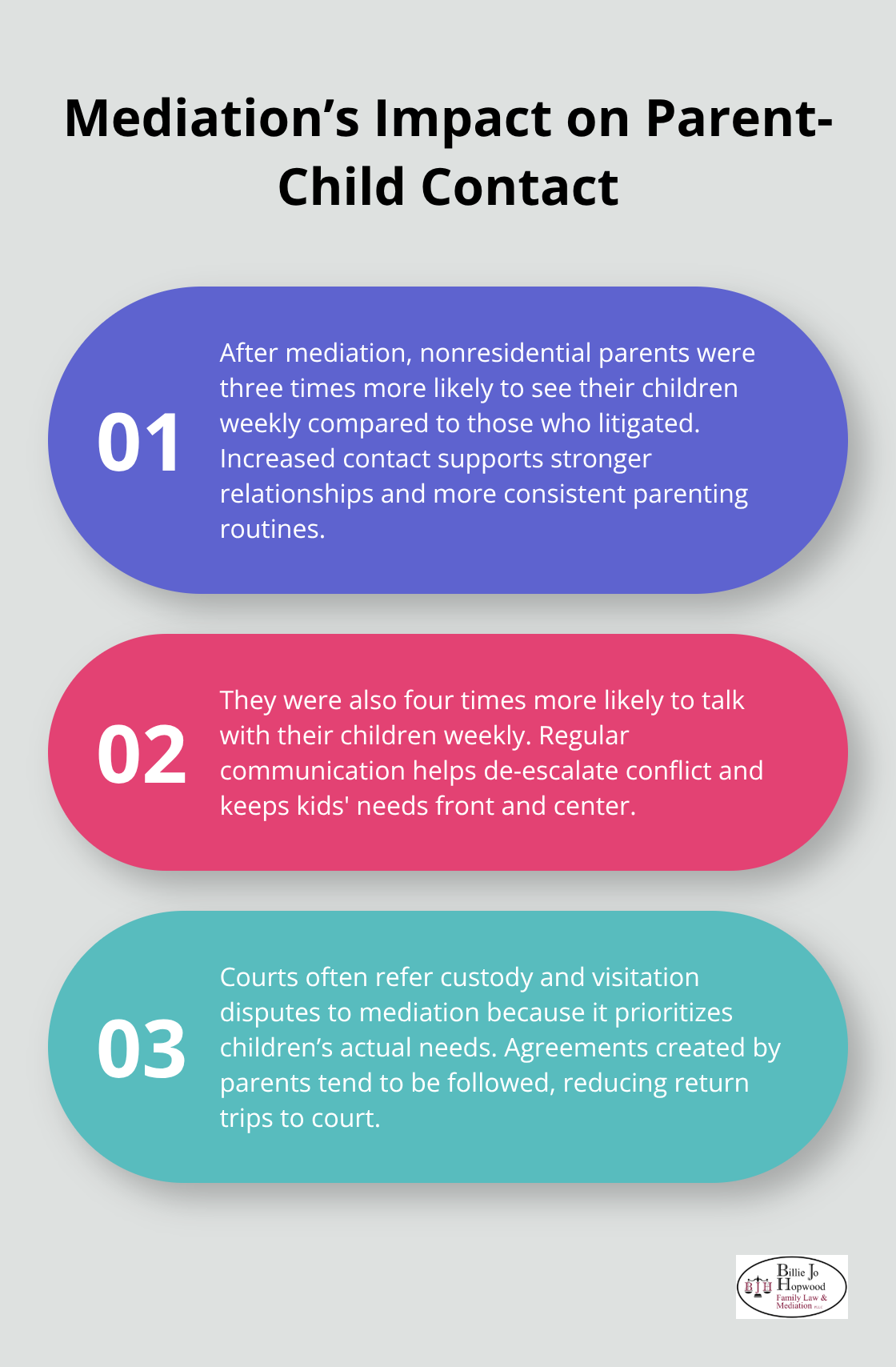
Key ways mediation increases parent–child contact compared with litigation

How mediation differs from fighting in court

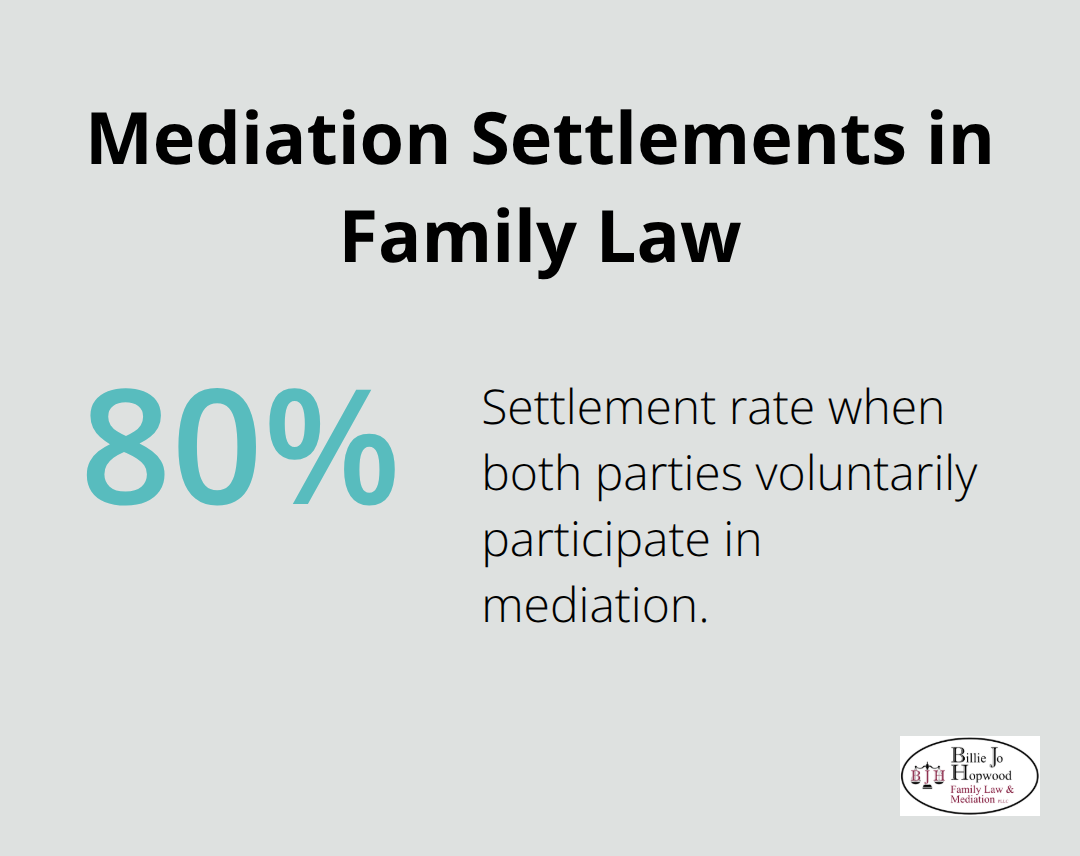
Litigation forces binary outcomes-one person wins, the other loses. A judge reviews evidence, applies law, and decides property splits, custody arrangements, and support amounts based on legal standards. This approach takes time (fully litigated divorces often take a year or longer), costs substantially more (typical attorney fees run thousands of dollars monthly), and produces public court records. Mediation compresses timelines to weeks or months, costs range from about $3,000 to $8,000 total, and keeps everything confidential since discussions never enter the public record. The McCammon Group reports approximately 85% of cases reach settlement through mediation, and mediated agreements show greater compliance than court judgments because people honor customized solutions they shaped themselves. Arbitration occupies middle ground-a neutral arbitrator hears both sides and renders a binding decision, more formal than mediation but faster than litigation. Mediation remains fundamentally different because the parties control whether agreement happens, not the decision-maker.

What happens next in the mediation process

Understanding the structure of mediation helps you prepare for what comes next. The process unfolds in distinct phases, each designed to move you from conflict toward resolution. Your mediator will walk you through each step, explaining what to expect and how you can participate effectively.

How Mediation Moves From Start to Settlement

The Initial Consultation Sets the Foundation

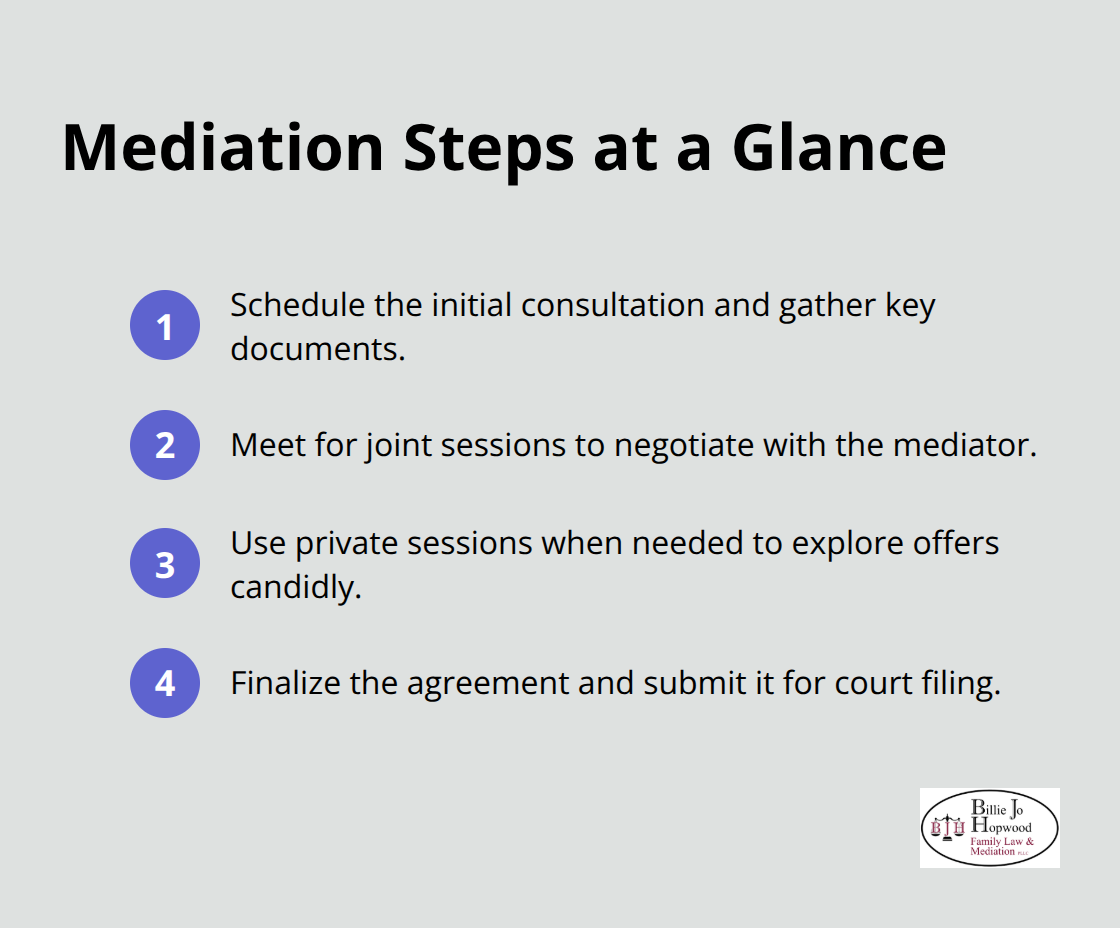
The mediation process begins weeks before you sit down with anyone. During the initial consultation, you and your mediator discuss what brought you to mediation, what issues need resolution, and whether mediation makes sense for your situation. This conversation typically happens over the phone or video call and takes 30 to 60 minutes. The mediator screens for domestic violence, substance abuse, or severe power imbalances that might make mediation unsafe or ineffective. Both parties must sign a mediation agreement that outlines confidentiality rules, cancellation policies, and fee arrangements. This step matters because it establishes ground rules before emotions run high in joint sessions. Many mediators ask you to gather financial documents, custody proposals, or property lists beforehand so sessions focus on negotiation rather than information gathering. Once both parties agree to proceed, scheduling becomes flexible-you choose in-person, virtual, or hybrid formats that fit your work and family commitments.

Joint Sessions and Separate Caucuses Drive Progress

Joint sessions bring both parties and the mediator into the same room or video call. The mediator explains the process, establishes communication ground rules, and lets each person present their perspective without interruption or cross-examination. This isn’t a courtroom where lawyers tear apart testimony; it’s a structured conversation where you explain what matters to you and why. After both sides present, the real work begins. The mediator identifies common ground, clarifies misunderstandings, and separates emotional positions from underlying interests. When conversations stall or tension rises, the mediator may call separate caucuses-private meetings with each party alone. These caucuses let you speak candidly about your actual bottom line, fears, and willingness to compromise without the other person hearing. The mediator shuttles information between caucuses, exploring creative solutions and testing whether proposals might work.

From Agreement to Binding Contract

Research shows mediation typically concludes within three to six sessions depending on complexity, with each session lasting two to three hours. Once parties move toward agreement, the mediator or your attorney drafts a settlement agreement that spells out custody schedules, support amounts, property divisions, and any other resolved issues. Before signing, have an independent attorney review the draft to protect your legal interests. A signed mediation agreement becomes a binding contract and can be incorporated into a court order, giving it the same enforceability as a judge’s decision but without the public record exposure or years of litigation.
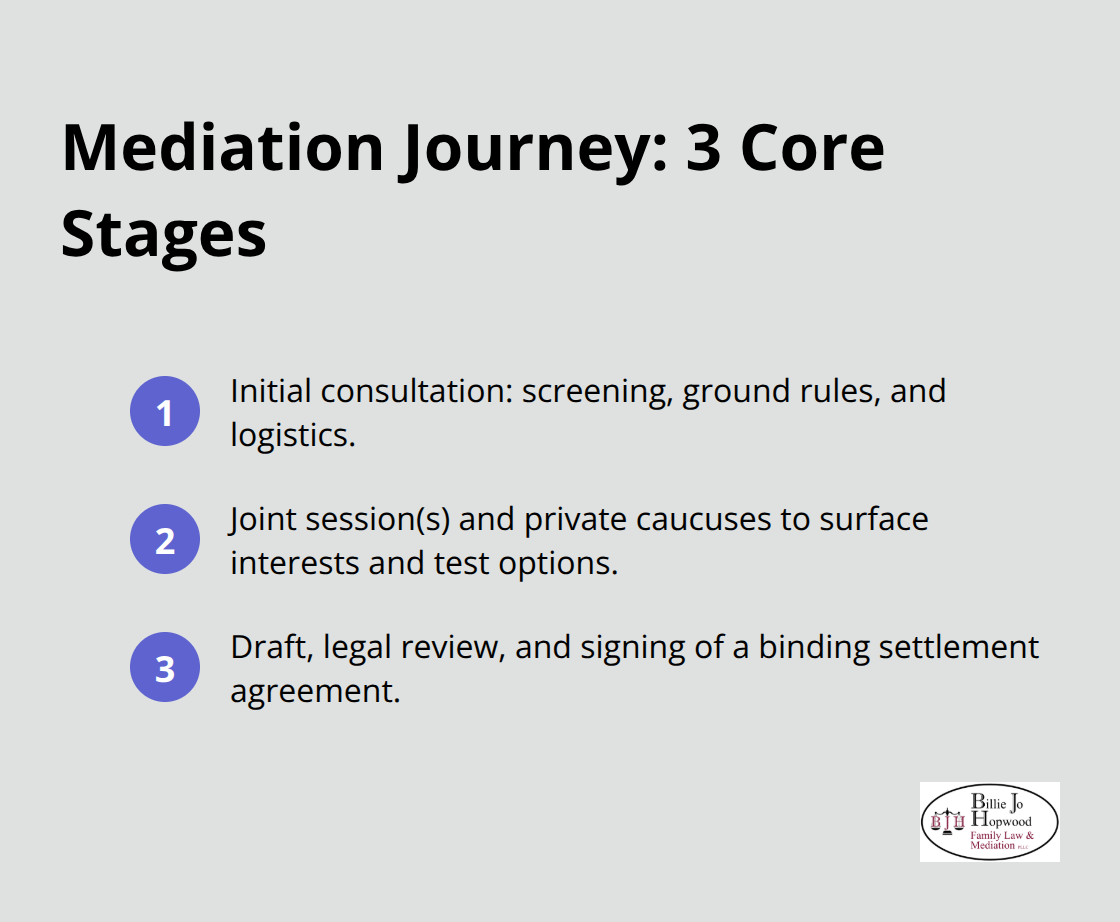
The three core stages from starting mediation to a binding agreement - what is family mediation

This binding nature means both parties must follow the terms they negotiated, and violations carry legal consequences just as court orders do.

With your settlement agreement finalized and legally binding, the next step involves understanding what happens when mediation doesn’t resolve all issues or when you need to formalize the agreement through the court system.

Advantages of Family Mediation Over Court Proceedings

Mediation Costs Far Less Than Litigation

Mediation costs between $3,000 and $8,000 total, split between both parties, while litigated divorces routinely consume $15,000 to $30,000 or more in attorney fees alone depending on case complexity and how long disputes drag through court. The financial difference compounds when you factor in lost work time, stress-related expenses, and the compounding costs of prolonged conflict. A typical mediation resolves within three to six sessions over a span of weeks or months, whereas fully litigated divorces take a year or longer from filing to final judgment. This speed matters practically because you stop paying mediator fees much faster than you stop paying hourly attorneys, and you return to normal life sooner instead of managing ongoing court dates and discovery demands. The University of Virginia study published in The Journal of Consulting and Clinical Psychology found that mediated agreements show greater compliance than court judgments because people honor customized solutions they shaped themselves rather than resisting imposed orders. When someone follows an agreement willingly, you avoid the additional costs of enforcement actions, contempt proceedings, or modification battles that plague litigated cases. Virtual and hybrid mediation options reduce travel time and childcare expenses further, letting you participate from home or your workplace without disrupting your schedule. You choose when sessions happen instead of waiting for court docket availability, which compresses timelines substantially.

Confidentiality Shields Your Family From Public Exposure

Litigation creates a permanent public record accessible to anyone with an internet connection, exposing your finances, parenting conflicts, health issues, and personal disputes to public scrutiny. Mediation keeps everything confidential since discussions never enter court filings or public records. This privacy matters enormously when children are involved because they won’t find their custody arrangements or parental conflicts documented online for future employers, peers, or strangers to discover. Your financial information, property details, and support amounts stay completely private rather than published in court documents. Mediation agreements can include provisions protecting sensitive information further, something impossible in litigated cases where discovery forces disclosure of nearly everything. This confidentiality extends to the mediator, who cannot testify in court or share mediation discussions with judges or third parties. If mediation fails and you eventually litigate, nothing discussed in mediation can be used against you in court, meaning you can speak openly without fear of those statements being weaponized later. That protection encourages honest conversation and creative problem-solving that courtroom positioning prevents.

You Retain Control Over Decisions Rather Than Surrendering Them to a Judge

Mediation puts decision-making power directly in your hands instead of handing it to a stranger in a black robe who spends twenty minutes reviewing your entire life. You and your spouse craft the custody schedule, decide how to divide property, and set support amounts based on your actual circumstances and priorities rather than applying generic legal formulas. This autonomy produces agreements reflecting what actually works for your family instead of what satisfies legal standards. The McCammon Group reports approximately 85% of cases reach settlement through mediation because people invest in solutions they designed, not solutions imposed upon them.
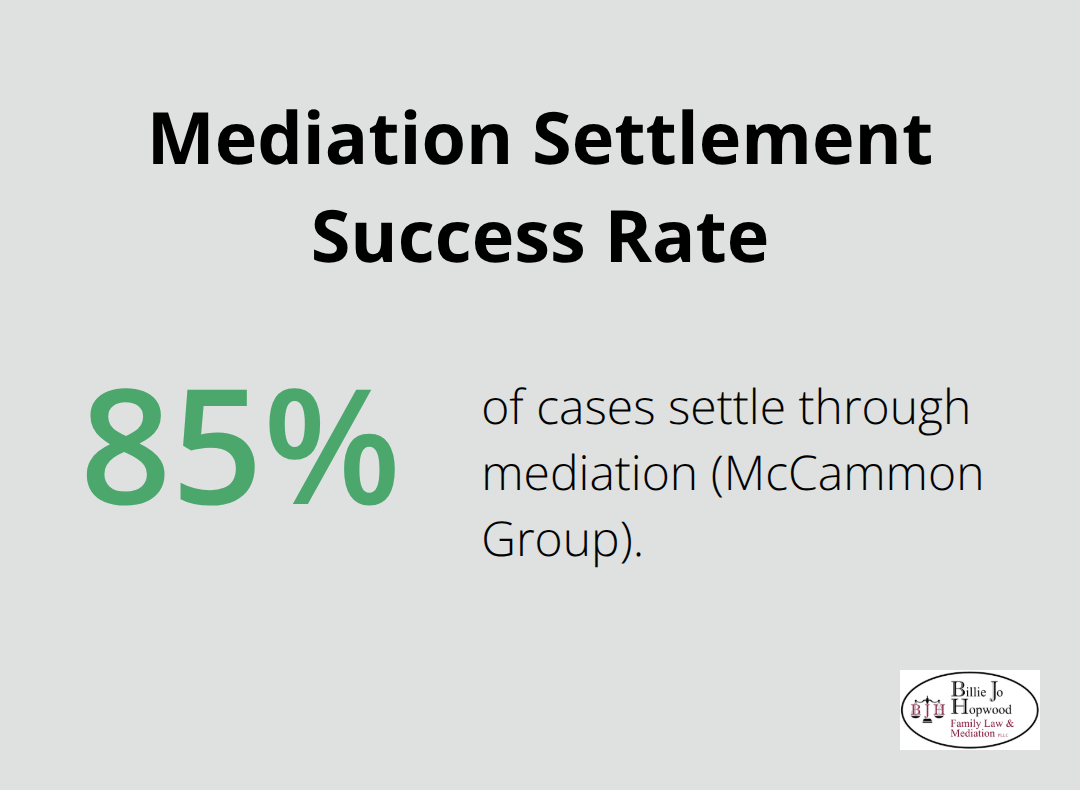
Share of cases that settle through mediation - what is family mediation

You can modify agreements more easily when circumstances change because you understand the reasoning behind each term and can discuss adjustments cooperatively rather than filing modification petitions and returning to court. The process accommodates unusual situations that rigid legal frameworks struggle with (like allowing one parent flexibility during certain business seasons or structuring support to reflect changing income patterns). You also avoid the unpredictability of judges whose personal philosophies shape custody and support decisions in ways you cannot control.

Final Thoughts

Family mediation offers a fundamentally different path through family disputes than courtroom litigation. What is family mediation at its core: a process where you and your spouse control the outcome while a neutral third party facilitates productive conversation. This approach costs between $3,000 and $8,000 compared to litigation expenses that often exceed $15,000 to $30,000, and it resolves in weeks or months rather than years.

Mediation works best when both spouses genuinely want to resolve disputes cooperatively and are willing to compromise on major issues. If you face domestic violence, severe power imbalances, or a spouse unwilling to negotiate honestly, mediation may not be appropriate and litigation might become necessary. However, most families benefit from attempting mediation first because the worst outcome means you return to litigation with no harm done, while the best outcome saves substantial money, time, and emotional strain.

If you’re considering mediation, start by gathering financial documents and thinking clearly about your priorities and bottom-line needs. Contact us to discuss your family law matter and explore whether mediation can help your family move forward. We at Billie Jo Hopwood Family Law & Mediation, PLLC in Melbourne, Florida help families navigate these decisions and guide you through mediation or litigation depending on what your situation requires.
How to Use Mediation for Family Issues

Family conflicts don’t have to end up in court. Mediation for family issues offers a practical path forward when relationships are strained and decisions need to be made.

At Billie Jo Hopwood Family Law & Mediation, PLLC in Melbourne, Florida, we’ve seen how mediation transforms difficult situations into manageable conversations. This guide walks you through when mediation works, what the process looks like, and why many families choose it over litigation.

When Mediation Solves Family Disputes

Divorce and Separation: Taking Control of Your Future

Mediation works best when both parties want to move forward but disagree on the details. Divorce and separation disputes top the list because mediation lets each spouse control the outcome rather than leaving decisions to a judge. Florida is an equitable distribution state, meaning assets and debts acquired during marriage divide fairly-not equally-based on each person’s resources and contributions. Mediation lets couples negotiate this division directly, which means you keep control over how retirement accounts, homes, and debts actually split.

A spouse earning significantly more might reasonably contribute more to shared debts, while a spouse who sacrificed career advancement for childcare can discuss how that factors into asset division. This flexibility disappears in court, where a judge applies the law without knowing your family’s specific circumstances. By promoting cooperation and mutual respect, mediation creates a more positive environment for resolving disputes compared to adversarial court proceedings.

Child Custody and Visitation: Keeping Parents in the Driver’s Seat

Child custody and visitation disagreements are mediation’s sweet spot because parents care deeply about the outcome and want to stay involved in decisions. Courts in Florida increasingly prefer parent-child custody arrangements developed through mediation rather than imposed by judges, because these plans tend to work better for children and parents alike. Mediation also handles property division cleanly by letting you decide which spouse keeps what, rather than watching a judge distribute your belongings.

When you bring financial records, business documents, and a clear picture of shared expenses, the mediator helps you identify what matters most to each person and finds solutions that actually work for your family.

Property Division: Speed and Specificity

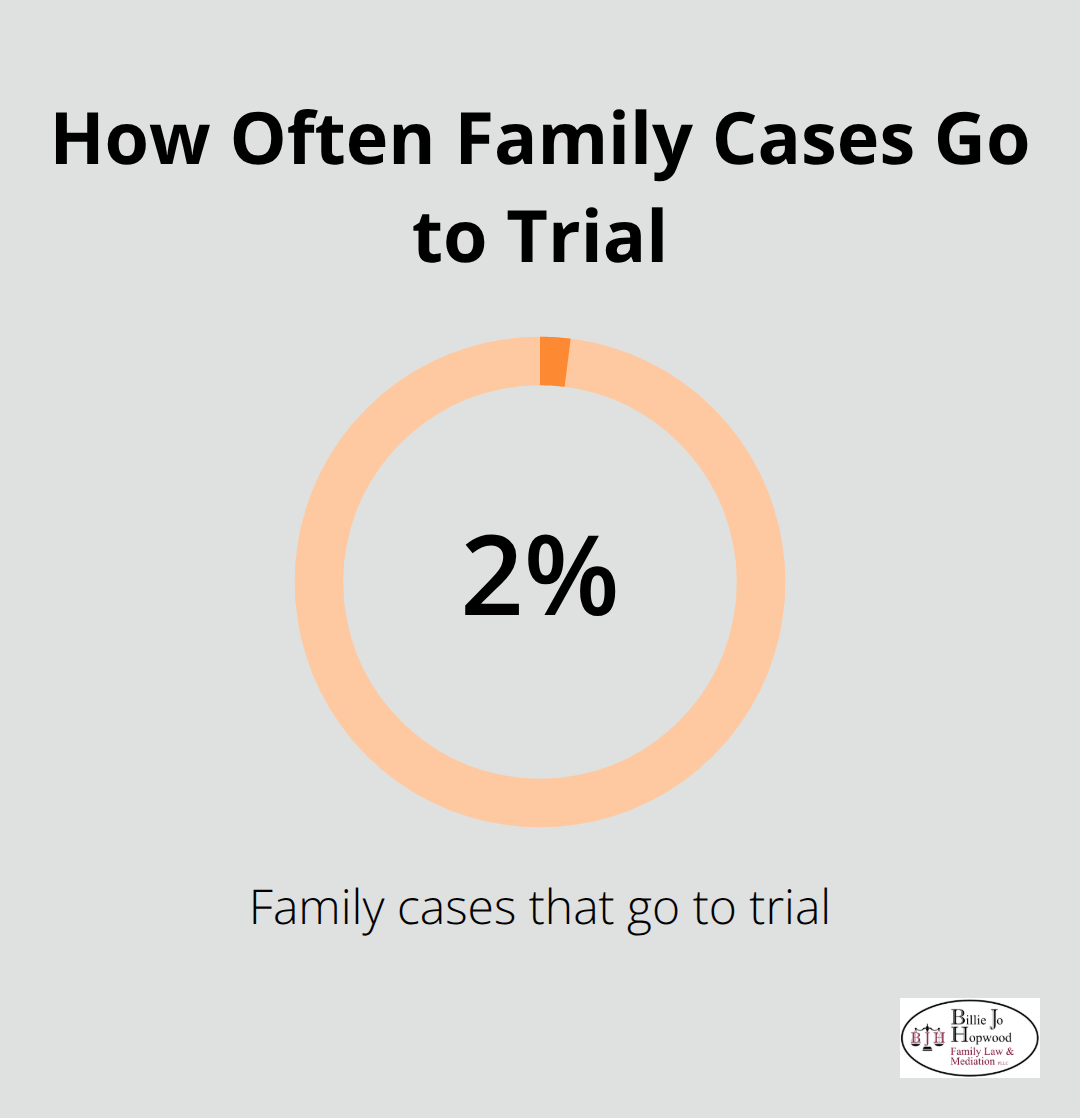
Property disputes resolve faster through mediation because you negotiate directly instead of exchanging court motions for months. Research from court systems shows that under 2% of family cases actually go to trial, which means most families settle anyway-mediation just gets you there faster and at lower cost. The next section walks you through exactly what happens during the mediation process and what you should prepare before your first session.

Share of family cases that reach trial in court systems

What Happens During Mediation in Melbourne, Florida

Initial Consultation and Document Preparation

Mediation starts with a clear-eyed assessment of your situation. During your initial consultation, the mediator reviews your financial documents, custody arrangements, and the core issues you need to resolve. Bring tax returns, mortgage statements, retirement account statements, business ownership documents, and anything showing shared debts or assets. The mediator isn’t there to judge who’s right or wrong-they’re there to identify what each person actually needs and find paths forward. This first phase typically takes an hour or two, and many mediators in the Melbourne, Florida area offer flexible scheduling from 9 a.m. to 8 p.m., including weekends, so you don’t have to miss work.

Joint Sessions: Where Negotiation Happens

Once the mediator understands your positions, you’ll move into joint sessions where both parties sit together with the mediator present. This is where real negotiation happens. The mediator keeps the conversation focused, prevents arguments from derailing progress, and helps both sides hear what actually matters to the other person. Don’t expect this to feel comfortable-it won’t always-but structure prevents the conversation from becoming personal attacks.

Private Sessions: Speaking Candidly About Your Limits

If tension rises, the mediator shifts to private sessions, moving between you and the other party to share proposals without everyone in the same room. This shuttle approach works because each side can speak candidly to the mediator about their concerns, their walk-away points, and what they’re willing to compromise on. The mediator carries information back and forth, testing whether movement is possible on specific issues without forcing direct confrontation.

Key stages from consultation to filing in Melbourne, Florida - mediation for family issues

Understanding Costs and Timeline

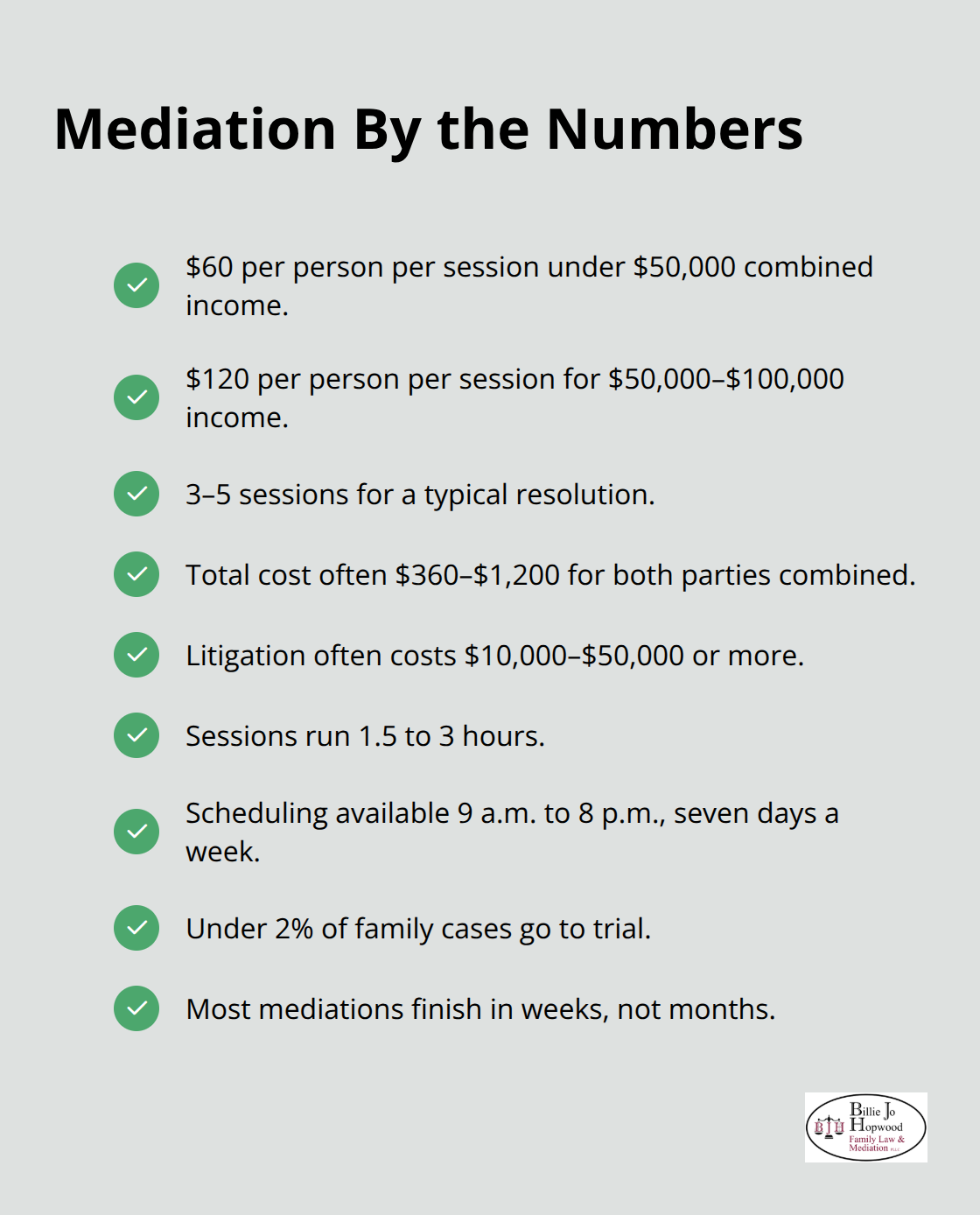
For family mediation in Florida, costs depend on combined household income: under $50,000 total, you pay $60 per person per session; $50,000 to $100,000, you pay $120 per person per session. Sessions typically run 1.5 to 3 hours. The entire process often takes weeks instead of months, and because you controlled the decisions, enforcement tends to go smoother than court-ordered arrangements.

From Agreement to Court Filing

Once both parties reach agreement on the major issues-property split, custody schedule, support amounts-the mediator documents everything in writing. This written agreement becomes your settlement, and you take it to a family law attorney to file with the court. With your mediated agreement in hand, the attorney handles the filing and ensures compliance with Florida law, transforming your negotiated terms into a court-enforceable order.

Advantages of Choosing Mediation Over Court

Lower Costs Compared to Litigation

Litigation devours money and time in ways that blindside families. Court battles involve discovery costs, depositions, multiple attorney appearances, and judge scheduling that stretches cases across months or years. Mediation sidesteps nearly all of this. For a family with combined income under $50,000, you pay $60 per person per mediation session; between $50,000 and $100,000, the cost rises to $120 per person per session. A typical mediation resolves in three to five sessions, putting your total cost between $360 and $1,200 for both parties combined. Litigation routinely costs $10,000 to $50,000 or more because attorneys bill hourly for every motion, every email exchange, and every court appearance.

Court systems report that under 2 percent of family cases actually proceed to trial, which means most families settle anyway-mediation just gets you there without burning through money waiting for a trial date that may never come. Sessions run 1.5 to 3 hours, and mediators in the Melbourne, Florida area offer flexible scheduling from 9 a.m. to 8 p.m. seven days a week, so you don’t lose income taking time off work.

Faster Resolution Timeline

Once you reach agreement through mediation, enforcement works smoother because both parties negotiated the terms directly instead of resisting a judge’s imposed order. That cooperation translates to fewer post-settlement disputes and fewer follow-up attorney consultations to handle violations or modifications. The entire process often takes weeks instead of months, and because you controlled the decisions, your agreement actually functions in real life.

Cost, time, and scheduling facts for family mediation - mediation for family issues

Greater Control Over Outcomes

A judge applies the law mechanically; you apply common sense and knowledge of your actual circumstances. If one spouse spent fifteen years as a stay-at-home parent while the other built a career, mediation lets you factor that sacrifice into asset division and support calculations in ways that reflect your values. In court, the judge sees a balance sheet and income figures, not the reality of your family’s choices.

Child custody arrangements developed through mediation tend to work better because parents design schedules around their children’s actual needs and their own realistic availability, rather than following a template the judge imposed. When you control property division decisions, you keep the assets that matter most to you and trade away items the other person values more (one spouse keeps the house and the other gets retirement accounts, or you split everything differently). That flexibility means your agreement actually functions in real life instead of creating resentment and conflict that leads to modification battles down the road.

Final Thoughts

Mediation for family issues works because it puts decisions back in your hands instead of leaving them to a judge who doesn’t know your family. Families spend $360 to $1,200 total on mediation compared to $10,000 to $50,000 or more on litigation, and most mediations resolve in weeks rather than months. You keep control over outcomes that matter most: how assets split, what custody schedule works for your children, and how support gets calculated based on your actual circumstances rather than a judge’s formula.

Mediation isn’t suitable when domestic violence, controlling behavior, or serious trust issues are present, but for most families dealing with divorce, custody, or property disputes, it offers a faster, more affordable path forward. The process respects both parties’ need to be heard while keeping focus on practical solutions that actually work in real life. Because you negotiated the terms directly, enforcement tends to go smoothly without follow-up disputes.

Contact Billie Jo Hopwood Family Law & Mediation, PLLC in Melbourne, Florida to discuss whether mediation fits your situation and what the next steps look like for your family.

How to Navigate Florida Family Law Mediation Rules

Florida family law mediation rules can feel overwhelming if you’re facing divorce or custody issues. At Billie Jo Hopwood Family Law & Mediation, PLLC, we’ve seen how understanding these rules upfront prevents costly mistakes and protects your interests.

This guide walks you through what Florida requires, what mediators must do, and where people go wrong.

When Florida Requires You to Go to Mediation

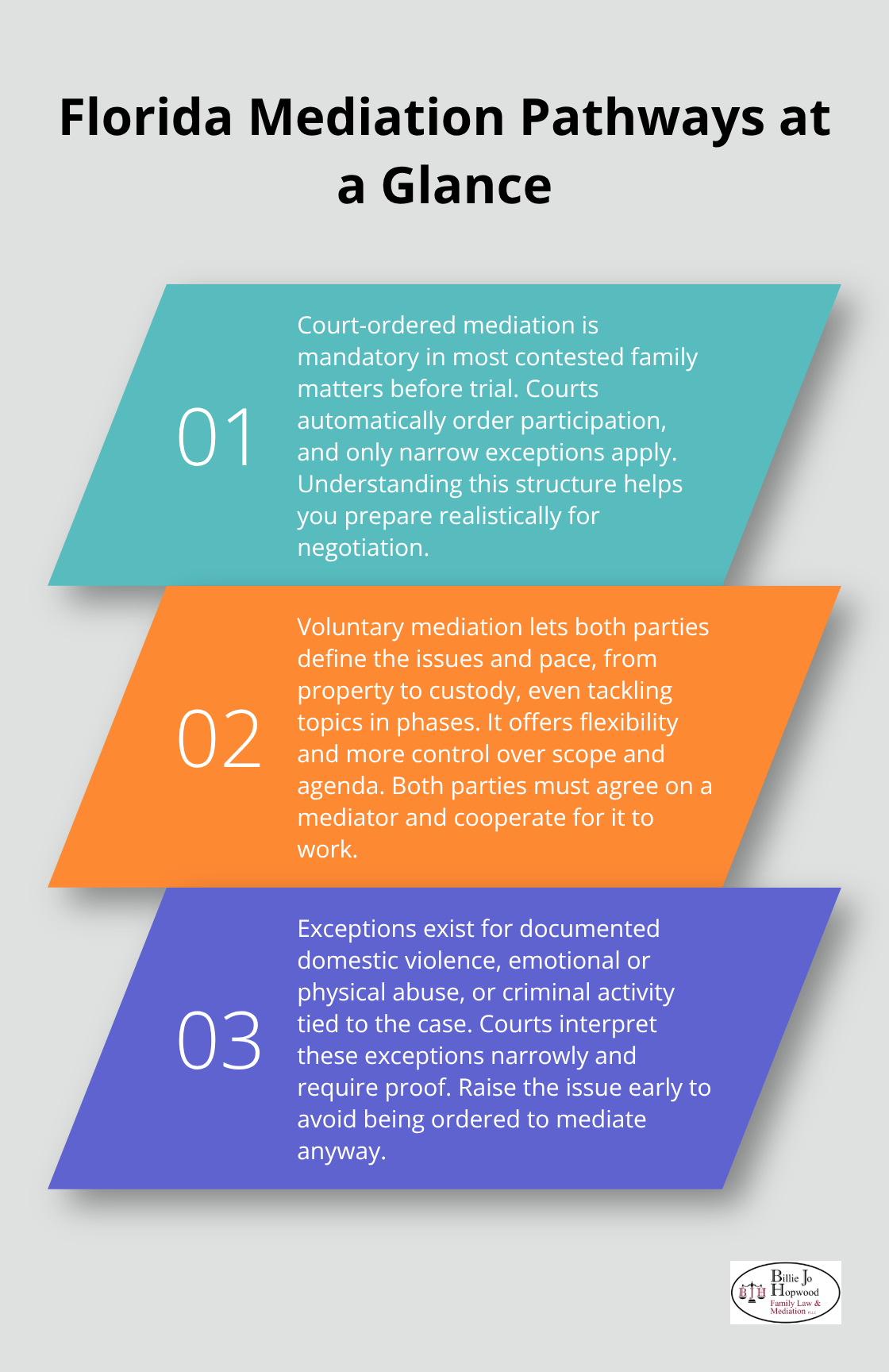
Florida law mandates mediation in most contested family law cases before you can take your dispute to trial. Under Florida Statute 44.102, all contested family matters-including divorce, custody, child support, and alimony disputes-must go through mediation unless specific exceptions apply. The court will order mediation in your case automatically, meaning you do not have a choice about participating. This is not optional. The only way out is if your case falls under narrow exceptions: a history of domestic violence between you and the other party, documented emotional or physical abuse, or evidence of criminal activity directly related to your case. Simply having concerns about the other person is not enough to avoid mediation. Even if a temporary protective order exists, Florida courts still frequently require mediation to proceed, so do not assume you are automatically exempt.

What the 75-Day Timeline Means for Your Case

Once the court orders mediation, you have 75 days from your first conference to complete it. This deadline is firm, and missing your scheduled mediation session without good cause can result in court sanctions, including having to pay the mediator’s fees and potentially facing other penalties. If you cannot attend a scheduled session, contact the court and the mediator immediately to reschedule. Courts take this deadline seriously because mediation moves cases forward quickly. Unlike litigation, which stretches months or years, mediation under Florida law must happen fast. Court-ordered mediation typically resolves cases within weeks, often in a single three-hour session. This compressed timeline works in your favor if you arrive prepared, but it works against you if you show up unprepared or with unrealistic expectations about what you can achieve.

Voluntary Mediation Gives You More Control Over Scope

If you and the other party agree to mediation before the court orders it, you enter voluntary mediation. This option exists for couples who want to resolve issues outside the court system entirely. Voluntary mediation allows you and the other party to define exactly what issues the mediator will address-property division, custody, support, or any combination. Court-ordered mediation has a narrower scope; the mediator may not cover every final issue, and unresolved matters return to the judge. With voluntary mediation, you control the agenda. You decide whether to include all issues or tackle them in phases. This flexibility is powerful if you want to craft solutions that work for your family rather than accept whatever a judge imposes. However, voluntary mediation requires both parties to cooperate and agree on a mediator. If the other party refuses to mediate voluntarily, the court will eventually order it anyway, and you lose the advantage of defining the process on your own terms.

Three key pathways: court-ordered mediation, voluntary mediation, and exceptions in Florida family law.

How Exceptions to Mandatory Mediation Work in Practice

Florida recognizes that mediation does not work in every situation. If you have experienced domestic violence, emotional abuse, or physical abuse from the other party, you may qualify for an exception. You must document this history and present it to the court. Criminal activity directly tied to your case also qualifies as an exception. However, courts interpret these exceptions narrowly. A temporary protective order does not automatically exempt you from mediation-the court may still require it. You must prove that mediation itself would be unsafe or unproductive. If you believe your case qualifies for an exception, raise this issue with the court before your mediation date is set. Waiting until the last minute weakens your position and may result in the court ordering mediation anyway.

Who Certifies Florida Mediators and What That Means for You

Florida Supreme Court certification is the only credential that matters when evaluating a mediator. All mediators handling family law cases in Florida must complete rigorous training and pass certification requirements set by the Florida Supreme Court. This is not a suggestion or preference-it is a legal mandate. The certification process requires mediators to complete comprehensive training in mediation techniques, ethics, and Florida family law before they can legally conduct sessions. Once certified, mediators must complete 16 hours of continuing mediation education every two years to maintain their credential. This ongoing requirement matters because it keeps mediators current on changes to Florida law and best practices.

Verify Mediator Credentials Before Your Session

When you sit down with a mediator, you can verify their certification status through the Florida Supreme Court’s official records. If a mediator cannot produce proof of current certification, walk away. An uncertified mediator has no legal authority to conduct your session, and any agreement reached may not hold up in court. You have the right to request documentation of certification before your first session begins. Courts expect you to confirm this credential, and mediators understand this expectation. Do not hesitate to ask questions about qualifications or training background.

Confidentiality Rules Protect Your Statements-With Important Limits

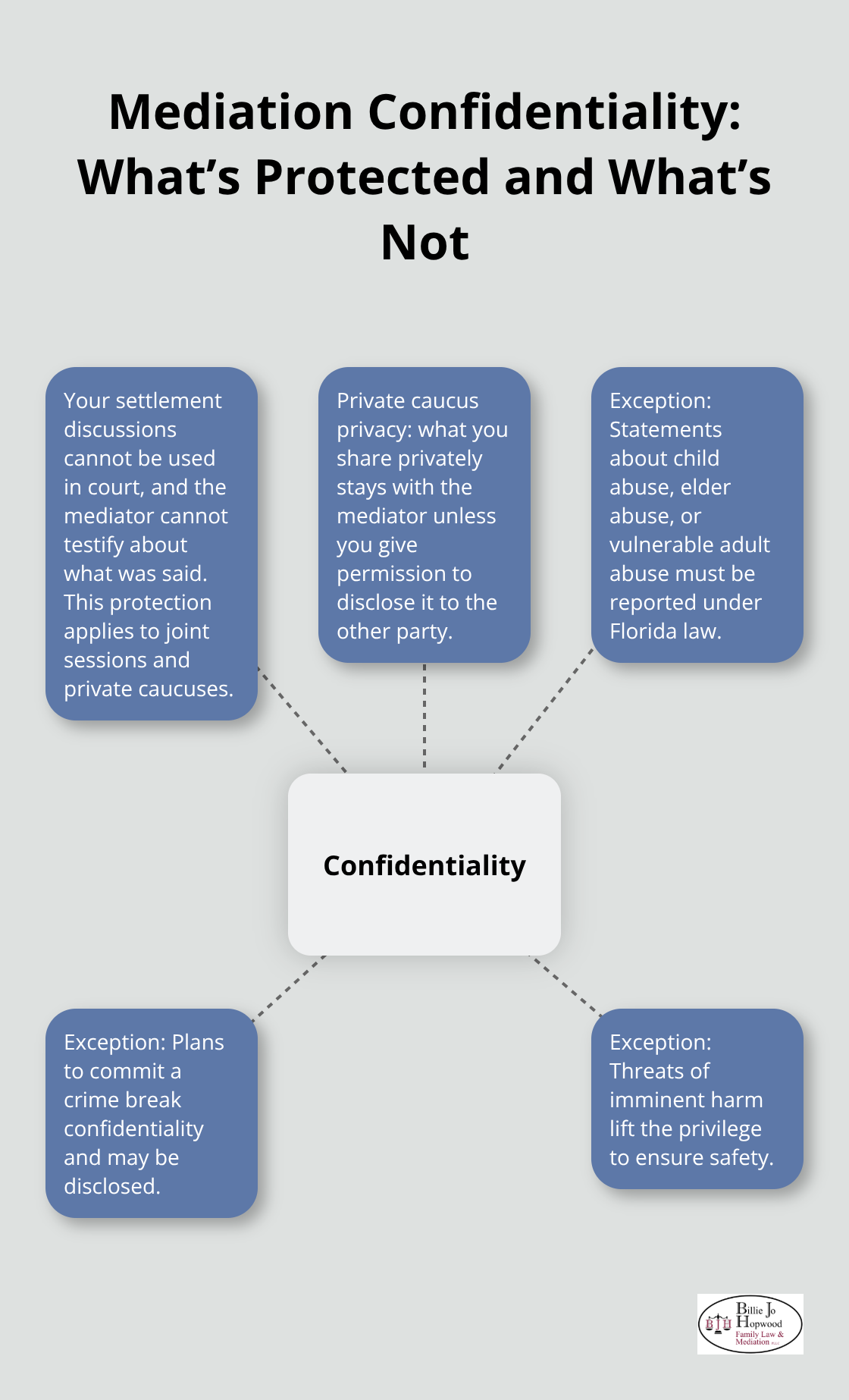
Everything you say during mediation is confidential under Florida’s Mediation Confidentiality and Privilege Act. This protection is powerful. Your settlement discussions cannot be used against you in court if mediation fails and your case goes to trial. The mediator cannot testify about what was said.

Hub-and-spoke showing confidentiality protections and the three Florida exceptions. - florida family law mediation rules

Neither party can introduce statements made during mediation as evidence. This confidentiality applies to joint sessions and private caucuses where the mediator meets with you alone. What you disclose in a private caucus stays between you and the mediator unless you give permission to share it with the other party.

This confidentiality rule is absolute-with three specific exceptions. Statements about child abuse, elder abuse, or vulnerable adult abuse must be reported. Plans to commit a crime also break confidentiality. Threats of imminent harm lift the privilege. Outside these narrow exceptions, mediation discussions remain sealed. This protection encourages honesty. You can explore settlement options, admit weaknesses in your position, and test ideas without fear that your words will be weaponized later. The confidentiality shield makes mediation fundamentally different from court proceedings, where every statement becomes part of the public record.

Written Agreements Must Be Signed Before They Become Binding

Reaching verbal agreement during mediation is only half the battle. Florida law requires that any settlement be put in writing and signed by all parties before it becomes legally binding. The mediator will draft a memorandum of understanding or deed of agreement that spells out every term you negotiated. Read this document carefully. Verify that it reflects what you actually agreed to. Ambiguities now become disputes later.

Once you and the other party sign the written agreement, it becomes a contract enforceable by the court. You cannot change your mind after signing based on buyer’s remorse or second thoughts. The court will enforce the terms as written. If you want attorney review before signing, request time to have your lawyer examine the agreement. This is your right. Some mediators build in a review period specifically for this purpose. Do not skip this step if cost concerns you-spending a few hundred dollars on attorney review now prevents thousands in litigation costs if disputes arise over what the agreement means.

After both parties sign, the agreement goes to the court for approval in a brief hearing. The judge reviews it to confirm it was reached voluntarily and does not violate Florida law. In most cases, the judge approves it without modification. Once approved, the agreement becomes a court order with full enforcement power. If either party violates the terms later, the other party can return to court to enforce it. This enforcement mechanism transforms your negotiated settlement into something the court will actively protect.

Common Mistakes People Make During Mediation in Florida

Arrive Unprepared and Waste Critical Time

Walking into mediation without financial documents is the fastest way to waste time and money. People frequently show up without bank statements, tax returns, or any clear picture of their assets and debts. Florida courts expect you to know your financial situation before mediation starts. If you cannot answer basic questions about what you own, what you owe, or what income flows into your household, the mediator cannot help you reach a real settlement. The 75-day timeline does not extend because you forgot documents at home. Mediation typically resolves in a single three-hour session or across a few sessions spanning weeks. Every hour counts.

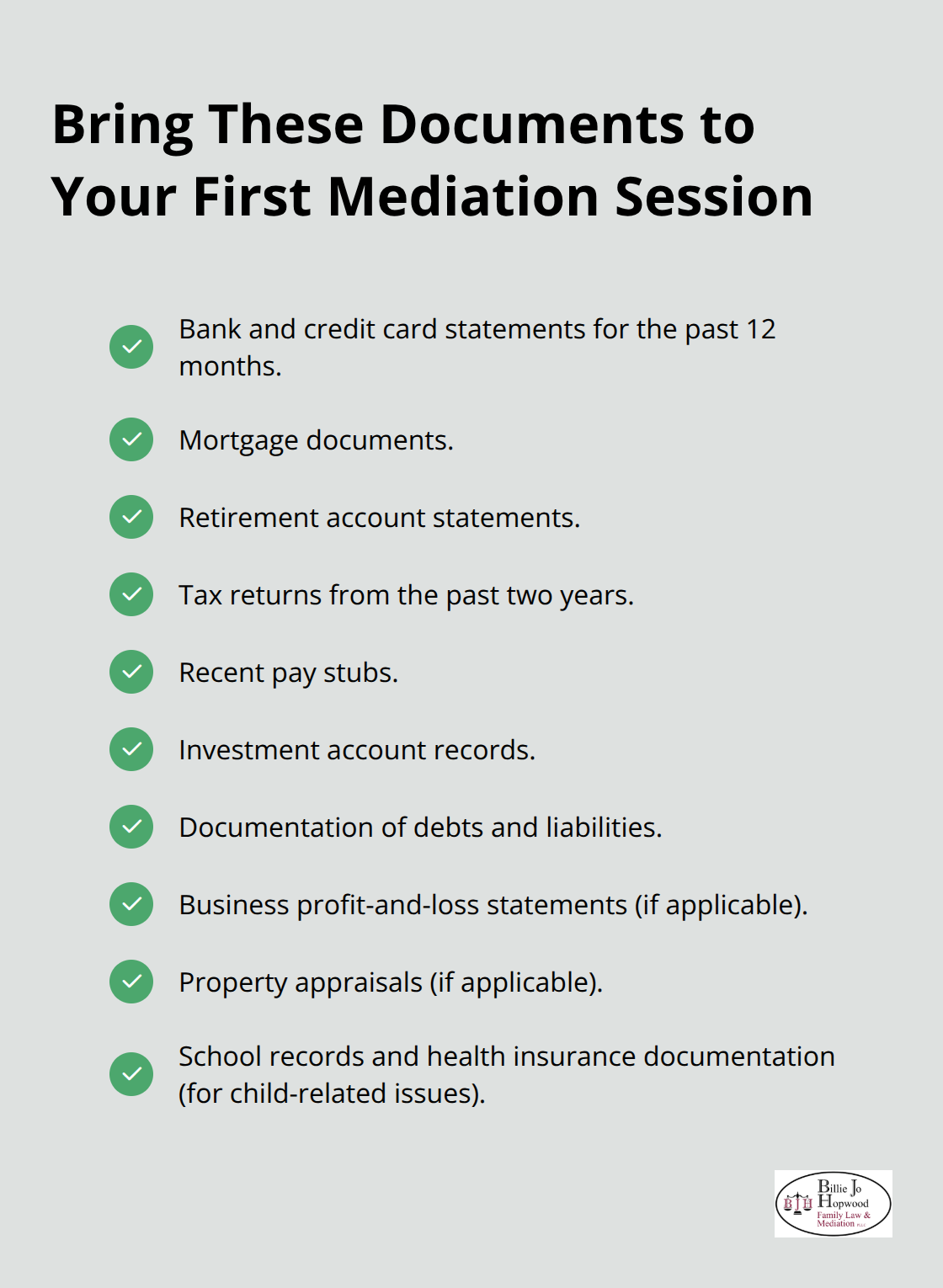
Bring complete financial records before your first session: bank and credit card statements for the past 12 months, mortgage documents, retirement account statements, tax returns from the past two years, recent pay stubs, and investment account records. Include any documentation of debts or liabilities. If you own a business or rental property, bring profit-and-loss statements and appraisals.

Checklist of financial and case documents to prepare for Florida family mediation. - florida family law mediation rules

For child-related issues, gather school records and health insurance documentation. The other party will exchange these same records, so hiding information or arriving with incomplete data wastes everyone’s time and signals bad faith to the mediator.

Enter With Unrealistic Expectations About Outcomes

Many people approach mediation believing they will convince the mediator to side with them or that the process exists to validate their position. That is not how mediation works. The mediator is neutral and does not decide who is right or wrong. You will not get everything you are asking for-that is the fundamental reality of settlement negotiation. Florida courts expect you to identify your top three to five priorities and determine what you are willing to concede to reach agreement.

If your goal is 100 percent custody, 100 percent of assets, and zero spousal support, you are not mentally prepared for mediation and should delay until you reset your expectations with an attorney. Unrealistic demands derail negotiations quickly. The other party will reject your position outright, and the mediator will struggle to find common ground. Successful mediation requires both sides to move toward the middle. You must accept that compromise is the only path forward.

Miss Sessions or Arrive Late Without Consequences

Missing scheduled sessions or arriving late signals to the mediator and the other party that you do not take the process seriously. Courts sanction people who fail to attend mediation without good cause, and those sanctions include paying the mediator’s fees-typically $120 to $240 per party per session depending on your income level under Florida’s fee schedule. One missed session can cost you hundreds of dollars and extend your timeline beyond the 75-day requirement, triggering additional court involvement.

If you cannot attend, contact the mediator and court immediately to reschedule rather than simply not showing up. Courts view no-shows as contempt and may impose additional penalties beyond mediator fees. Your case will stall, and the judge may order you to pay the other party’s attorney fees for delays you caused. Custodial parents who deny court-ordered visitation face similar enforcement actions. Treat mediation dates with the same respect you would give a court appearance.

Final Thoughts

Florida family law mediation rules create a structured path that moves your case forward efficiently while protecting your rights and controlling costs. Mandatory mediation in contested family matters, strict 75-day timelines, certified mediators bound by confidentiality, and written agreements that become enforceable court orders form the backbone of this system. Following these rules prevents delays, reduces expenses, and gives you control over outcomes rather than leaving decisions to a judge.

People who succeed in mediation arrive prepared with financial documents, enter with realistic expectations about compromise, and treat scheduled sessions with the seriousness they deserve. Those who struggle typically show up unprepared, demand outcomes the other party will never accept, or miss sessions without consequences. The difference between these outcomes often comes down to preparation and mindset.

We at Billie Jo Hopwood Family Law & Mediation, PLLC in Melbourne, Florida help families navigate mediation and understand what Florida family law mediation rules mean for their specific situation. Having qualified professionals review your agreement before signing and advising you on realistic settlement positions transforms mediation from an intimidating process into a manageable path forward.

How to Navigate Florida Family Law Mediation Successfully

Family law mediation in Florida offers a path forward when relationships end, but many people feel uncertain about what happens in the room.

We at Billie Jo Hopwood Family Law & Mediation, PLLC know that preparation and clear communication make the difference between mediation that stalls and mediation that resolves your situation. This guide walks you through what to expect, how to prepare, and the strategies that actually work.

What Happens During Florida Family Law Mediation

The Mediation Process and Timeline

Florida requires mandatory mediation in most family law cases, and understanding the actual mechanics of the process removes much of the anxiety people carry into the room. A Florida Supreme Court-certified mediator guides discussions but never makes decisions for you-that’s a critical distinction that changes how the process works. From the moment you arrive, the mediator establishes ground rules, clarifies their neutral role, and gives both parties space to share initial positions.

The first session typically lasts up to three hours, though complex cases often require additional sessions scheduled within 60 days of the court’s referral order. You’ll need to bring a completed financial affidavit showing assets, debts, income, and expenses-this isn’t optional, and without it, you won’t receive the court’s order to proceed. Most initial mediation conferences happen via Zoom unless you file an objection requesting in-person attendance.

What You Must Bring and Pay

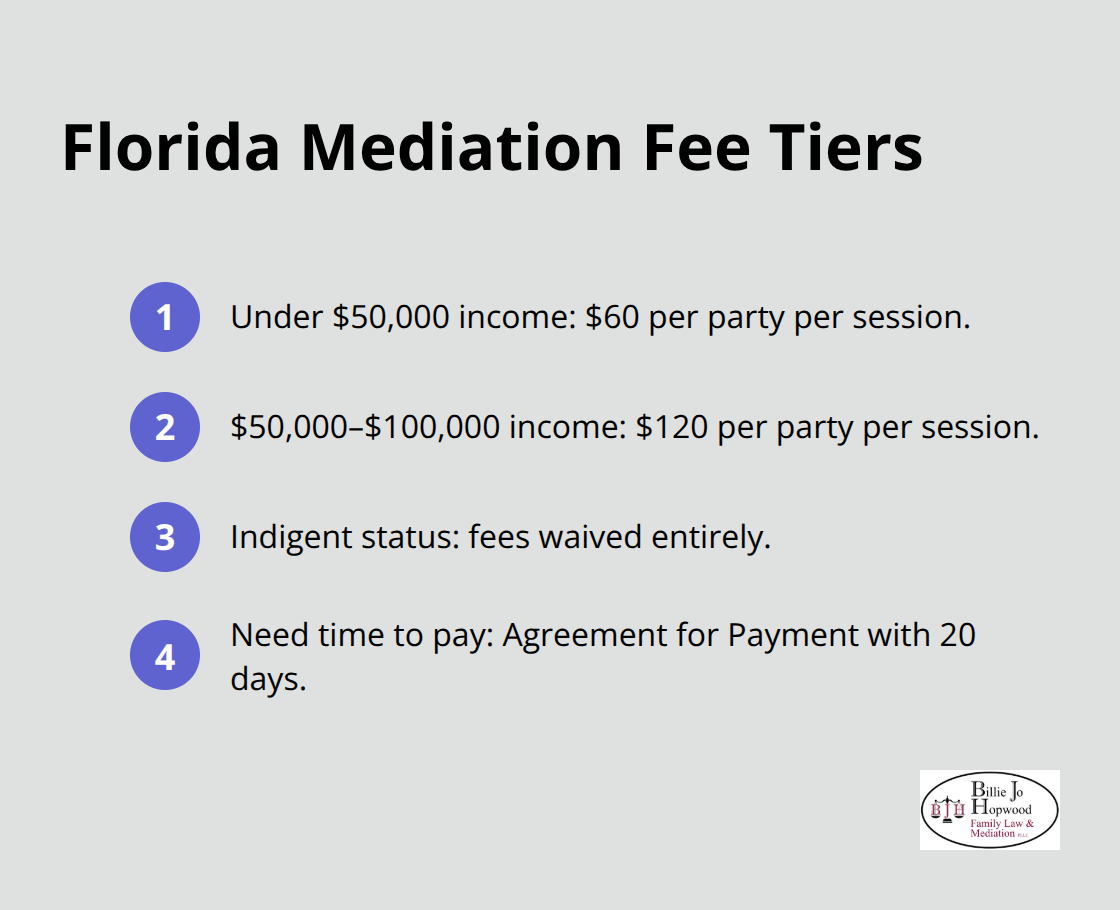
If you have children, you must bring a drafted Parenting Plan to mediation; forms are available from the Florida State Courts website or your county Clerk of Court. The cost depends on your household income-if your combined gross income is under $50,000, you’ll pay $60 per party per session; between $50,000 and $100,000, it’s $120 per party per session. Those deemed indigent have fees waived entirely. If you can’t pay at scheduling, you can enter an Agreement for Payment with 20 days to settle the bill.

Income-based fees and payment options for Florida family law mediation

The Mediator’s Role and Your Control

The mediator’s job is to guide you toward your own solutions, not impose them. Property division, child custody and visitation, child support, and alimony all come to the table in mediation. You control the outcomes and can craft arrangements that a judge would never approve-flexible custody schedules, creative asset divisions, or payment plans tailored to your actual situation. This flexibility is why mediation often works better than litigation for families.

The mediator won’t give legal advice, so consider consulting an attorney before signing any agreement to understand tax consequences and long-term implications. If tensions run high, the mediator will work with you separately, shuttling between rooms to keep conversations productive. This structure matters because it allows honest negotiation without the adversarial heat of a courtroom.

From Settlement to Court Approval

If you reach a settlement, the mediator drafts an agreement covering all resolved issues. This document goes to the court for approval, and uncontested divorces typically move straight to a final decree if terms meet legal requirements. Even if some issues remain contested, mediation narrows the battlefield significantly-you might walk away with custody and support resolved, leaving only property division for trial. That alone saves time and money.

The process respects confidentiality throughout; nothing said in mediation can be used against you in court if talks break down. This protection encourages honest conversation because you’re not building a trial record with every statement. With the mediation framework clear, your next move is preparing the documents and mindset that actually move negotiations forward.

Preparing Documents That Actually Move Mediation Forward

Gather Your Financial Records First

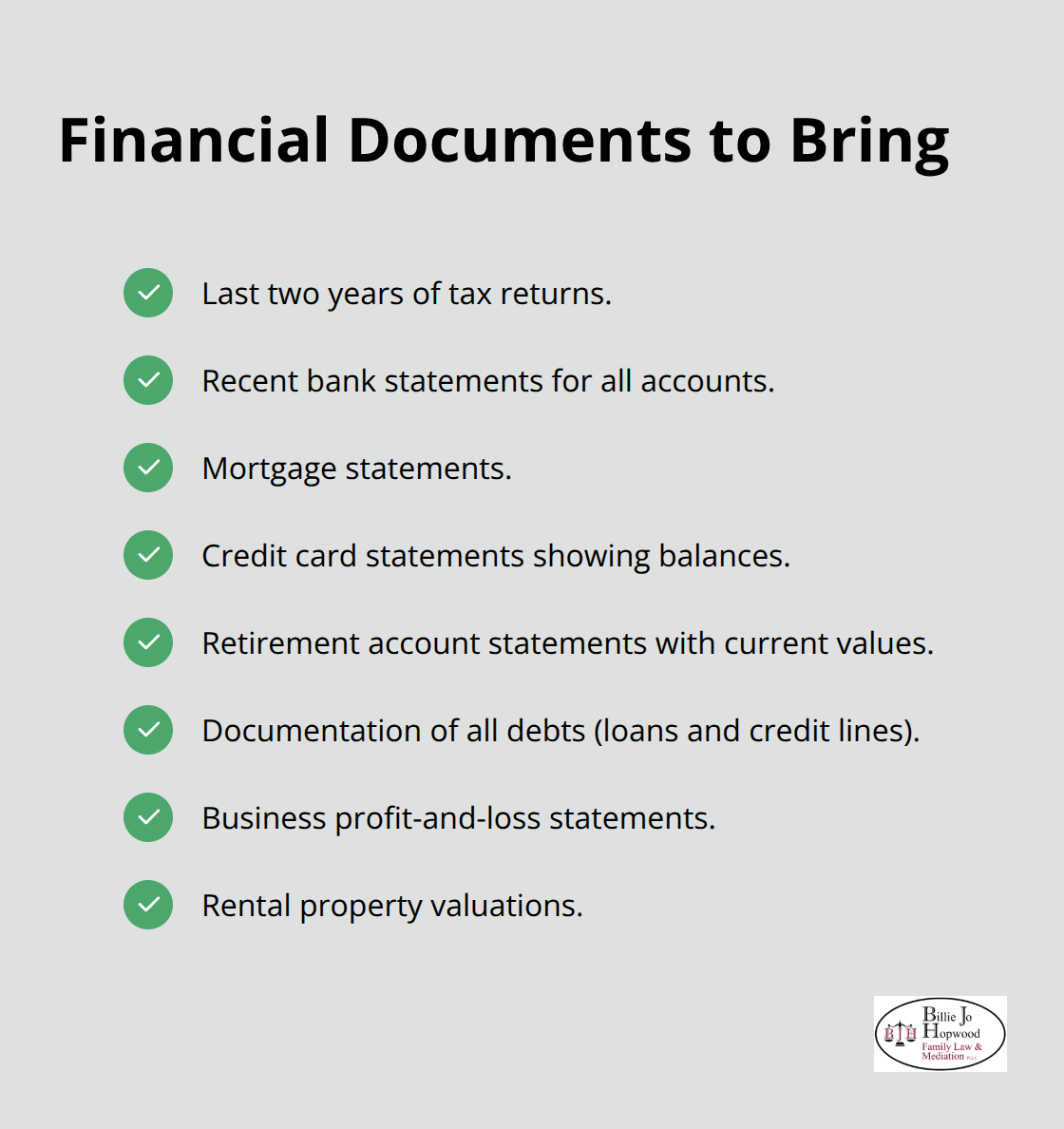
Walking into mediation without your financial records is like showing up to a negotiation blindfolded. Florida law requires both parties to file current financial affidavits before the court issues your Order of Referral, and this requirement exists for a reason-the mediator cannot guide productive discussions about property division, support, or custody without seeing the full financial picture. Bring your last two years of tax returns, recent bank statements from all accounts, mortgage statements, credit card statements showing balances, and retirement account statements with current values. Document any debts including loans and credit lines. If you own a business or rental property, bring profit-and-loss statements and property valuations.

Checklist of required financial records for Florida family law mediation

The Florida State Courts website provides the official financial affidavit form, and accuracy matters because inaccurate disclosures can invalidate agreements later or trigger court sanctions. Don’t estimate-pull actual statements. If accounts are held jointly, get statements for both names. This groundwork takes three to four hours but prevents the mediator from wasting session time (at $60 to $120 per party per session) asking for missing documents or scheduling follow-up meetings.

Identify Your Core Interests, Not Just Your Positions

Clarity about what you actually want separates people who leave mediation satisfied from those who feel they compromised too much. Write down your priorities in order: Is keeping primary custody of your children non-negotiable, or would you accept a 50-50 schedule if spousal support covers your mortgage? Can you accept less alimony if you retain the family home, or is a clean break with equal asset division more important?

Most people conflate positions with interests-you might say you want the house, but your real interest is housing stability for your kids or avoiding relocation. A mediator skilled at untangling these motivations will help you find solutions you didn’t see, but only if you’ve done honest internal work first. Identify three to five core interests and rank them.

Know Your Bottom Line Before You Sit Down

Establish your actual bottom line: the point where you walk away and go to trial. Know your numbers. If child support guidelines say you owe $800 monthly, decide whether you can sustain that or whether $650 is your realistic floor. If the marital home is worth $400,000 with a $150,000 mortgage, know whether you’d accept $100,000 in equity or whether you need $125,000 to feel the division was fair.

This precision prevents the common mediation trap where you agree to something in the moment and regret it within weeks because you hadn’t thought through the actual impact on your monthly budget or long-term financial security. Proper preparation leads to productive mediation sessions, and with your documents organized and your priorities clear, you’re ready to enter the mediation room with confidence and direction-and that preparation directly shapes how the mediator guides your discussions toward solutions that actually work for your family.

How to Actually Influence the Mediation Room

The mediator’s job is to facilitate; your job is to shape the conversation toward outcomes that protect your interests. Most people walk into mediation hoping the other party will suddenly become reasonable, but that’s not how negotiation works. What happens in the mediation room depends on how you communicate, what you listen for, and whether you stay anchored to solutions or get pulled into blame cycles that waste time and money.

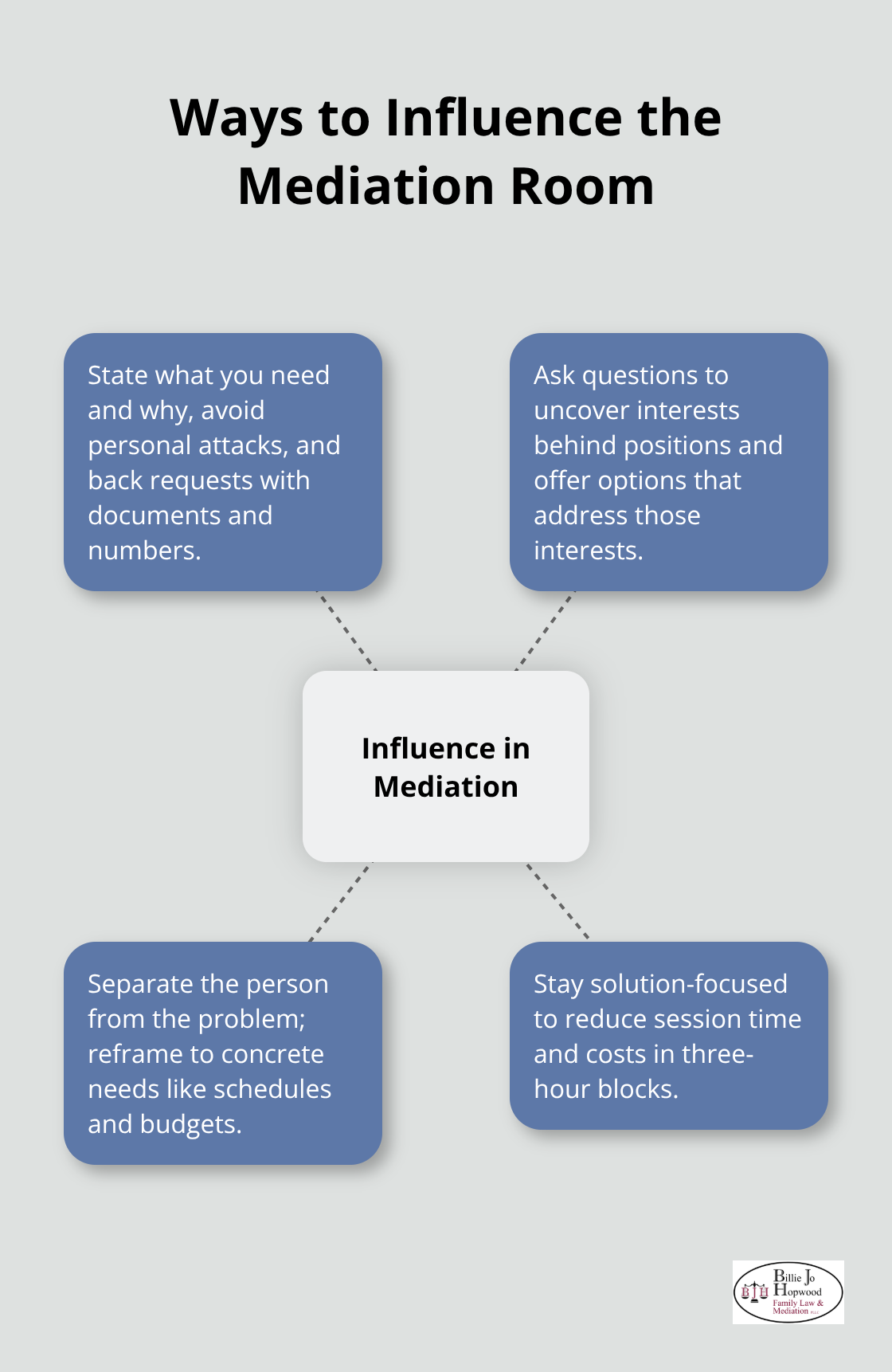
Key strategies to guide outcomes during mediation

The difference between mediation that costs $500 total and mediation that drags into multiple sessions costing $1,500 or more often comes down to how deliberately you engage in those first hours.

State Your Position Without Attacking the Person

Say what you need and why you need it, then stop. Don’t explain why the other party is wrong or unreasonable-that triggers defensiveness and shuts down listening. If you need primary custody because your work schedule is flexible and the children’s school is three blocks from your home, state that fact. If you need $1,200 monthly in child support because your income is $2,800 and childcare costs $900 monthly, show the math. Mediators respond to specific, documented positions far more than to emotional arguments or character attacks. The Florida Supreme Court-certified mediators working in these sessions have heard anger and blame hundreds of times; what moves them is clarity backed by facts. When you present information without personal attacks, the other party can actually hear you instead of spending mental energy defending themselves. This matters because mediation sessions last three hours per block, and every minute spent on conflict is a minute not spent solving problems.

Listen for Interests Hidden Behind Positions

The other party says they want the house. That’s their position. Their actual interest might be avoiding relocation disruption for the kids, maintaining a sense of stability, or keeping the home as an investment. Ask questions instead of assuming. What specifically about the house matters to them? If it’s stability for the children, you might offer a longer timeline before sale, a right of first refusal if they want to buy you out later, or a custody schedule that keeps the kids in the same school district even if they move. If it’s financial-they see the house as their security-you might offer a larger share of retirement accounts in exchange for you keeping the home. Mediators skilled at this work will help you dig into these motivations, but you accelerate the process when you ask genuine questions and listen to the answers without planning your rebuttal. This approach cuts session time dramatically because you solve actual problems instead of trading rigid positions back and forth.

Separate the Problem from the Person and Stay on Track

You might feel angry at the other party. That anger is valid. But in the mediation room, anger is a liability that costs you money and delays resolution. Focus on what needs to happen, not on what they did wrong. Instead of saying, “You never helped with the kids and you shouldn’t get equal custody,” say, “I need a schedule that keeps the children in their current school and provides consistency on weeknights because they need that structure.” The second approach gives the mediator something concrete to work with. It also prevents the other party from spending the session defending their parenting or justifying their choices. Cases that should settle in two sessions stretch to four because parties cannot move past blame. The moment you shift from character judgment to problem-solving, the energy in the room changes. The mediator can actually help you build agreements instead of refereeing conflict.

Final Thoughts

After you reach an agreement in mediation, the mediator drafts a settlement document covering all resolved issues, and you must review this agreement carefully before signing to understand tax consequences and long-term financial implications. If questions arise about how child support calculations work or whether the property division meets Florida law requirements, ask the mediator directly-they provide guidance on these matters, though they cannot give legal advice. Consulting an attorney before you sign protects your interests and prevents costly mistakes that could affect your finances for years.

Even if Florida family law mediation doesn’t resolve everything, you’ve narrowed the issues significantly and eliminated the need for a full trial on every matter. Cases that might have required months of litigation now proceed with only one or two contested issues remaining, which saves thousands in legal fees and reduces the emotional toll on your family. After the court approves your agreement and issues the final decree, you implement the terms by transferring assets, updating custody schedules, and establishing support payments according to the timeline you negotiated.

If circumstances change later-your income shifts, the children’s needs evolve, or custody arrangements no longer work-you can pursue modifications through the court with proper documentation of the changed conditions. Contact our Melbourne office if you’re uncertain whether an agreement protects your interests or need guidance navigating the legal requirements of Florida family law mediation, and we’ll discuss your situation with you directly.

How to Navigate the Collaborative Family Law Process

Family law disputes don’t have to mean courtroom battles and mounting legal bills. The collaborative family law process offers Melbourne, Florida families a different path-one where both sides work together with trained professionals to reach fair agreements.

We at Billie Jo Hopwood Family Law & Mediation, PLLC see this approach transform how families handle separation and divorce. This guide walks you through each stage and shows why many local families choose collaboration over litigation.

What Collaborative Family Law Actually Means

The Core Structure and Commitment

Collaborative family law is a structured process where both spouses and their attorneys commit upfront to resolving disputes without court involvement. Each party hires a lawyer trained specifically in collaborative methods, and together they assemble a team of neutral professionals-typically a financial specialist, a child specialist, and sometimes a mental health professional. The American Bar Association approved the Uniform Collaborative Law Act in 2024, recognizing this approach as a standardized framework that’s gaining traction across states. What separates collaboration from traditional litigation is fundamental: in court, a judge makes binding decisions after hearing arguments from both sides. In collaborative law, you and your spouse make the decisions together through structured negotiations, which means you retain control over outcomes that directly affect your family’s future.

How Costs Stack Up in Practice

The financial difference alone makes collaboration worth serious consideration. Mediation in Florida typically costs between $2,000 and $8,000, while traditional litigation frequently exceeds $20,000 per person according to data tracked by Florida family law practitioners. Collaborative divorce falls somewhere in the middle but stays significantly cheaper than court battles because you avoid lengthy discovery processes, depositions, and trial preparation. The participation agreement that all parties sign creates a powerful incentive structure: if the collaborative process fails to reach settlement, both attorneys must withdraw, which means everyone has strong motivation to solve problems cooperatively rather than fight in court.

The Professionals Who Support Your Family

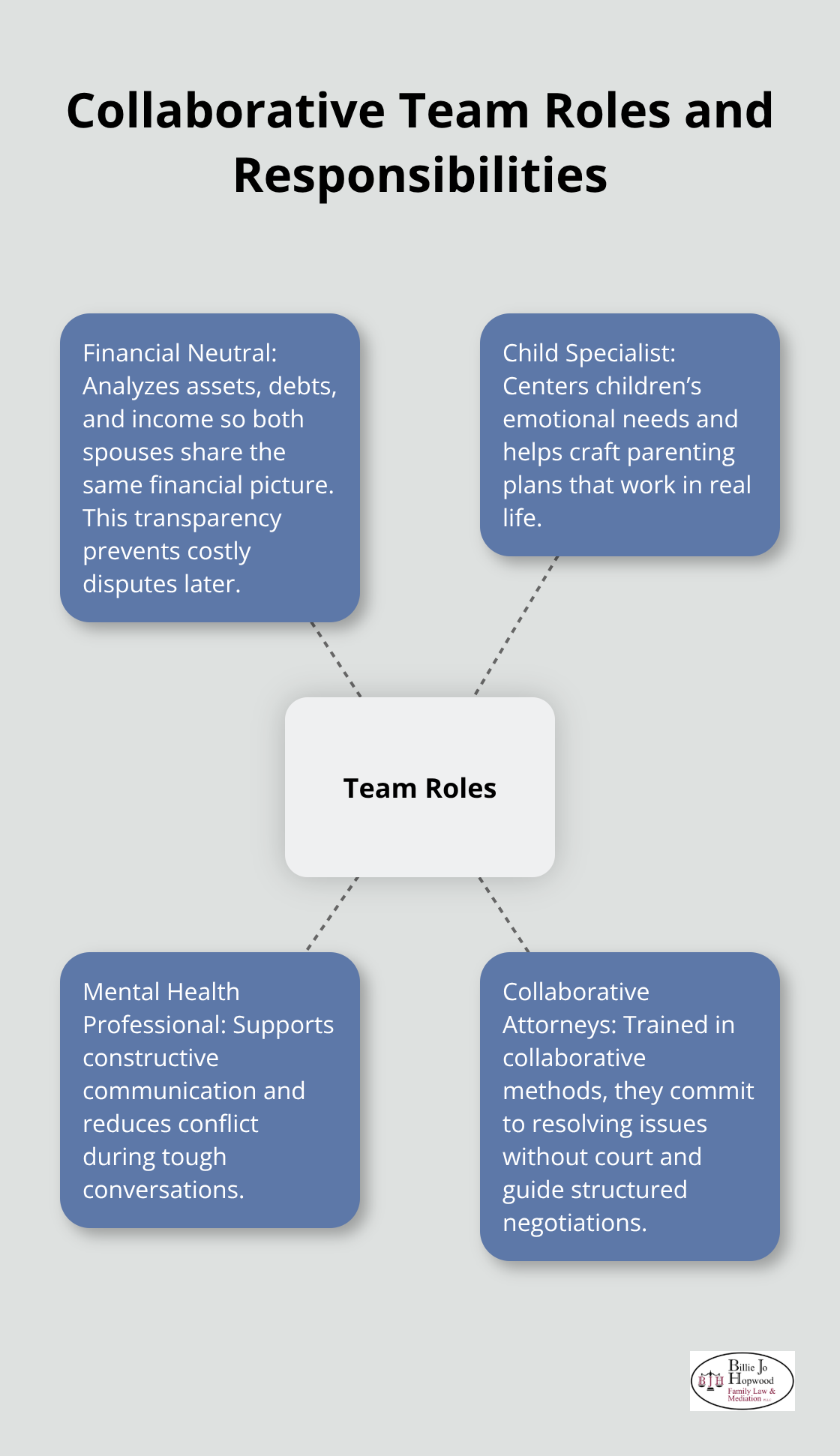
The key professionals in a collaborative team serve specific roles. A financial neutral analyzes complex assets, debts, and income to ensure both parties understand the true financial picture-this transparency prevents costly disputes later. A child specialist focuses on your children’s emotional needs and helps develop parenting plans that actually work in real life, not just on paper. Mental health professionals address the emotional toll of separation and improve communication between spouses, which directly reduces conflict during negotiations.

Diagram showing core roles in a collaborative family law team and what each contributes. - collaborative family law process

All parties commit to full disclosure, respectful communication, and prioritizing children’s needs through the participation agreement.

Why This Structure Works

This framework succeeds because it aligns everyone’s interests toward resolution. The financial neutral prevents misunderstandings about money. The child specialist ensures parenting plans reflect what your children actually need. Mental health professionals keep conversations constructive when emotions run high. Together, these professionals create an environment where both spouses can negotiate from a position of clarity rather than fear or anger-and that shift changes everything about how families move forward.

The next section walks you through exactly what happens at each stage, from the initial team assembly through the final settlement negotiations.

How the Collaborative Process Actually Works

The Participation Agreement Sets the Foundation

Starting collaborative family law means signing a participation agreement that commits both spouses to resolving disputes without court. This agreement carries real consequences-if either party walks away, both attorneys must withdraw, which means hiring new lawyers and starting over in court. This built-in consequence keeps both sides focused on settlement rather than posturing. The participation agreement also establishes ground rules: full financial disclosure, respectful communication, and a commitment to prioritize children’s needs. These aren’t suggestions-they’re binding commitments that shape how every conversation unfolds.

Assembling Your Team Based on Actual Needs

During the initial team assembly phase, you’ll meet with your attorney to identify which professionals your family actually needs. Not every case requires a child specialist or mental health coach-a financial neutral is almost always essential, but the specific team composition depends on your situation’s complexity. Your collaborative attorney helps you determine what professionals will add real value rather than just adding cost. The financial neutral analyzes complex assets, debts, and income to ensure both parties understand the true financial picture (this transparency prevents costly disputes later). A child specialist focuses on your children’s emotional needs and helps develop parenting plans that actually work in real life, not just on paper. Mental health professionals address the emotional toll of separation and improve communication between spouses, which directly reduces conflict during negotiations.

Information Gathering Through Structured Exchange

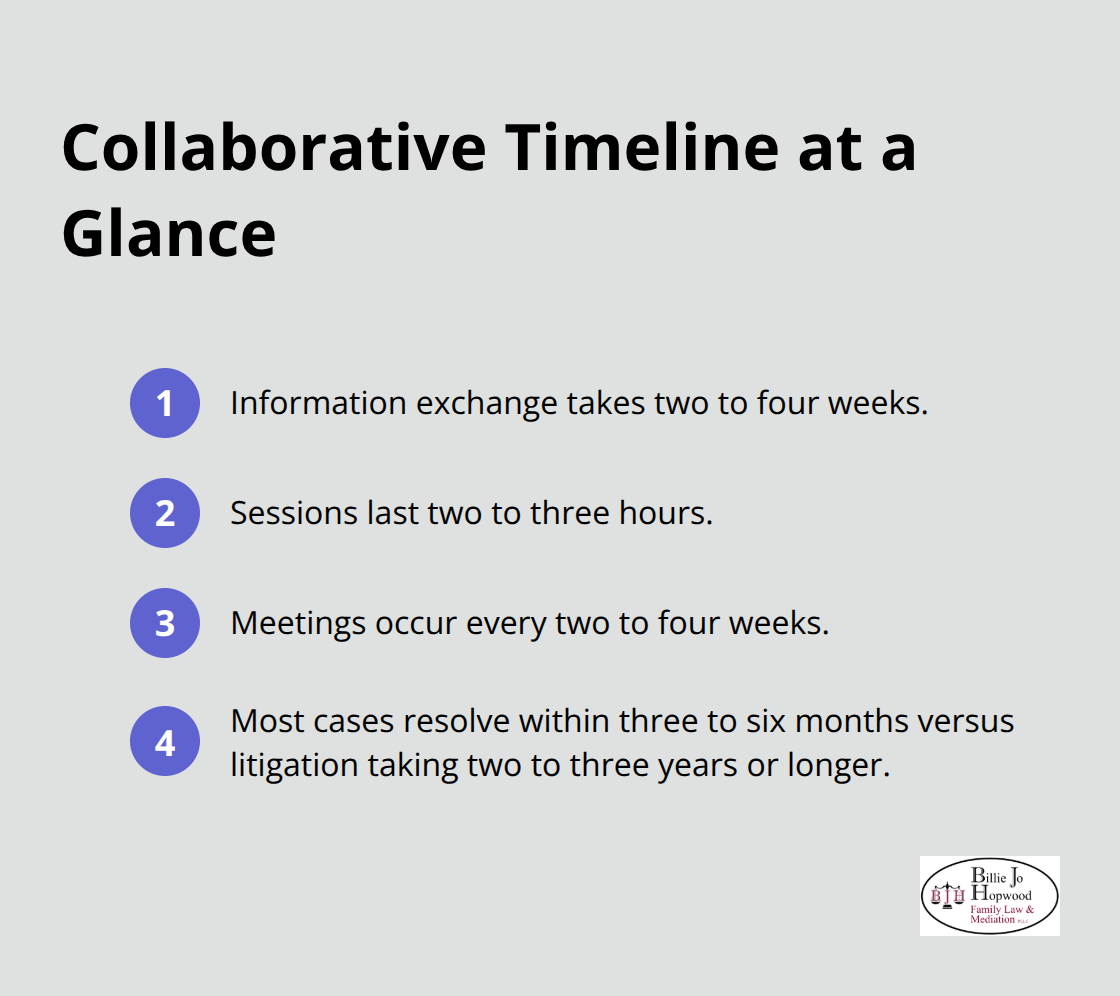
Information gathering happens through structured exchange rather than adversarial discovery. Both parties provide complete financial documents, asset valuations, and income records upfront, which typically takes two to four weeks depending on complexity. This transparency prevents the hidden-asset hunting that drives up litigation costs. Once everyone has the same information, negotiation sessions begin with a focus on identifying common interests rather than fighting over positions.

Negotiation Sessions That Produce Results

The financial neutral presents analysis that both parties trust because they selected this person together. Approximately 80 percent of couples who enter collaborative divorce reach settlement according to data tracked by Florida family law practitioners, and these agreements tend to stick because both parties shaped them directly. Negotiation sessions usually run two to three hours and happen roughly every two to four weeks, meaning most cases resolve within three to six months. This timeline beats litigation by months or years, and the cumulative cost stays substantially lower than court battles that can stretch for years and exceed $20,000 per person.

Percentage showing settlement rate achieved in Florida collaborative divorce cases. - collaborative family law process

Understanding how these stages work prepares you for what comes next-the concrete financial and emotional benefits that families in Melbourne, Florida experience when they choose this path.

Why Collaborative Divorce Saves Money and Time in Melbourne, Florida

The Real Cost Difference That Matters

Collaborative divorce in Melbourne, Florida delivers measurable financial advantages that matter when your family’s resources are already stretched thin. Mediation in Florida typically costs between $2,000 and $8,000, while traditional litigation frequently exceeds $20,000 per person according to data tracked by Florida family law practitioners. Collaborative divorce generally lands between these figures but stays significantly cheaper than court because you avoid the adversarial machinery-no lengthy discovery battles, no depositions, no trial preparation. The participation agreement structure creates an incentive that traditional litigation lacks: if either party abandons the process, both attorneys must withdraw, meaning you would hire new lawyers and restart in court. This consequence keeps both spouses motivated to solve problems rather than stall.

Timeline Advantages That Add Up Fast

Most collaborative cases in Florida resolve within three to six months, whereas litigation routinely stretches two to three years or longer. Faster resolution means lower total attorney fees, fewer missed workdays, and less cumulative stress on your children. The financial neutral in your collaborative team prevents the asset-hunting and valuation disputes that drive litigation costs upward-everyone works from the same numbers from day one.

Compact list summarizing the typical timeline for collaborative divorce versus litigation.

You avoid the expensive back-and-forth that characterizes court battles, where each side hires separate financial experts who often reach conflicting conclusions about asset values.

Control Over Outcomes Protects Your Family’s Future

Control over outcomes matters more than people realize when you make decisions that reshape your family’s structure. In court, a judge you have never met makes binding decisions about child custody, support amounts, and asset division based on limited courtroom testimony and legal standards that may not fit your family’s actual needs. In collaborative divorce, you and your spouse negotiate directly with professional support, which means your parenting plan reflects what your children actually need rather than what fits a judge’s template. Approximately 80 percent of couples who choose collaborative divorce reach settlement according to Florida family law data, and these agreements hold because both parties shaped them.

Protecting Your Long-Term Relationships

The less adversarial environment also protects your long-term co-parenting relationship-research shows children adjust better when parents use collaborative methods instead of battling through trial. Mental health professionals embedded in your collaborative team help keep conversations constructive when emotions run high, which prevents the scorched-earth communication patterns that plague litigated divorces. You retain dignity and agency throughout the process instead of becoming witnesses in your own family’s dissolution. The collaborative structure allows you to move forward as co-parents who respect each other, rather than as adversaries who fought in court.

Final Thoughts

Collaborative family law offers Melbourne, Florida families a fundamentally different approach to separation and divorce. Rather than fighting through court, both spouses work together with trained professionals to reach agreements that reflect their family’s actual needs. The collaborative family law process moves faster than litigation, costs significantly less, and gives you control over outcomes that directly affect your children’s future.

Melbourne, Florida families choose this approach because it protects what matters most. Your children adjust better when parents cooperate rather than battle through trial, and your long-term co-parenting relationship survives intact when you negotiate respectfully instead of becoming adversaries in a courtroom. The financial neutral prevents misunderstandings about money, the child specialist ensures parenting plans reflect what your kids actually need, and mental health professionals keep conversations constructive when emotions run high.

Contact Billie Jo Hopwood Family Law & Mediation, PLLC in Melbourne, Florida to discuss whether this approach fits your situation. We help families navigate separation with compassion and clarity, offering guidance through divorce, child custody, alimony, and child support matters. A consultation with our team clarifies your options and answers questions about how the collaborative family law process works for your family’s specific circumstances.

How to Navigate Spousal Support Through Mediation

Spousal support mediation offers a faster, more affordable path than court battles when determining alimony in Melbourne, Florida. Rather than letting a judge decide, you and your spouse can work together with a mediator to reach an agreement that works for both of you.

At Billie Jo Hopwood Family Law & Mediation, PLLC, we’ve seen how mediation transforms difficult conversations into productive negotiations. This guide walks you through preparing for mediation, presenting your financial situation clearly, and reaching a fair spousal support agreement.

Understanding Florida Spousal Support Before Mediation

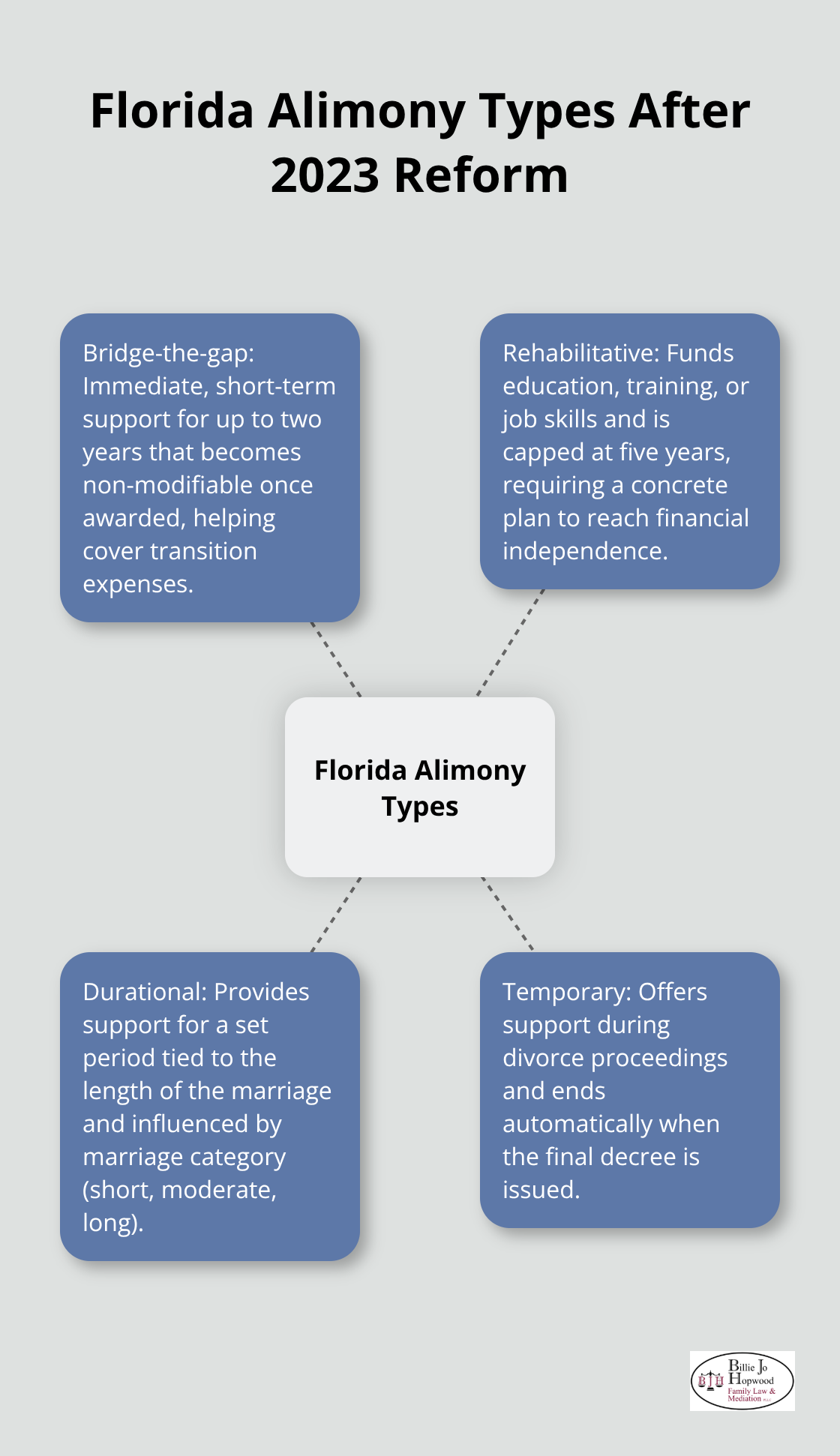
Florida’s approach to spousal support shifted dramatically on July 1, 2023, when Governor DeSantis signed Senate Bill 1416, which eliminated permanent alimony for new divorce cases. This change means the four types of alimony now available are bridge-the-gap, rehabilitative, durational, and temporary support. Bridge-the-gap alimony covers immediate, short-term needs for up to two years and becomes non-modifiable once awarded, making it ideal for covering transition expenses during the divorce process. Rehabilitative alimony funds education, training, or job skills and is capped at five years, requiring a detailed, realistic plan for how the recipient will achieve financial independence. Durational alimony provides support for a set period tied directly to how long the marriage lasted.

Visual summary of Florida's four alimony types with key purpose and duration notes. - spousal support mediation

Courts categorize marriages as short-term (under 7 years), moderate-term (7 to 17 years), or long-term (17 years or more), with each category influencing both the type and length of support awarded. Temporary alimony provides support during the divorce proceedings and ends automatically when the final decree is issued.

What Florida Courts Actually Examine

When determining spousal support, Florida courts examine far more than just current salaries. Courts evaluate the complete financial picture, including non-marital assets, retirement accounts, investments, debt obligations, and earning potential. The standard of living established during the marriage carries significant weight-if one spouse maintained a certain lifestyle, courts consider whether spousal support should help preserve that standard. Age and health significantly influence awards; if health limits earning capacity, courts often justify longer or higher support. Non-financial contributions like homemaking and child-rearing receive real consideration and can justify alimony even when one spouse has some earning ability. Courts also weigh each spouse’s education level and vocational skills when assessing earning capacity. Under the Tax Cuts and Jobs Act of 2017, alimony payments are no longer tax-deductible for the payer or taxable income for the recipient in divorces finalized after December 31, 2018-a shift that changes how support amounts should be structured to reflect the after-tax impact.

How Mediation Changes the Outcome

Mediation fundamentally differs from court decisions because you and your spouse control the result rather than having a judge impose one. In court, a judge applies statutory factors to determine support based on the evidence presented, but in mediation, both parties can propose creative solutions that a court might never consider. Mediation typically costs significantly less than litigation while moving faster-court battles over spousal support can stretch months or years, whereas mediation often resolves support terms in weeks. The confidential nature of mediation means discussions cannot be used as evidence if negotiations fail, protecting both parties throughout the process. In mediation, you can address risks specific to your situation, such as how remarriage or cohabitation might affect payments, and structure terms with clear timelines and review dates that work for your family’s circumstances.

Moving Forward With Mediation Strategy

Understanding these distinctions between court-imposed orders and mediated agreements prepares you to make informed decisions about your spousal support case. The flexibility that mediation offers-combined with knowledge of Florida’s four alimony types and what courts examine-positions you to negotiate terms that reflect your actual financial needs and circumstances. With this foundation, preparing your financial documents and setting realistic goals before mediation begins becomes the next logical step in protecting your financial future.

Getting Your Financial House in Order for Mediation

Walking into mediation unprepared with your finances is like showing up to negotiate without knowing your own bottom line-you’ll either accept unfavorable terms or derail the entire process by scrambling for information. Before mediation, you need complete financial documentation that shows exactly where you stand.

Assembling Your Financial Documents

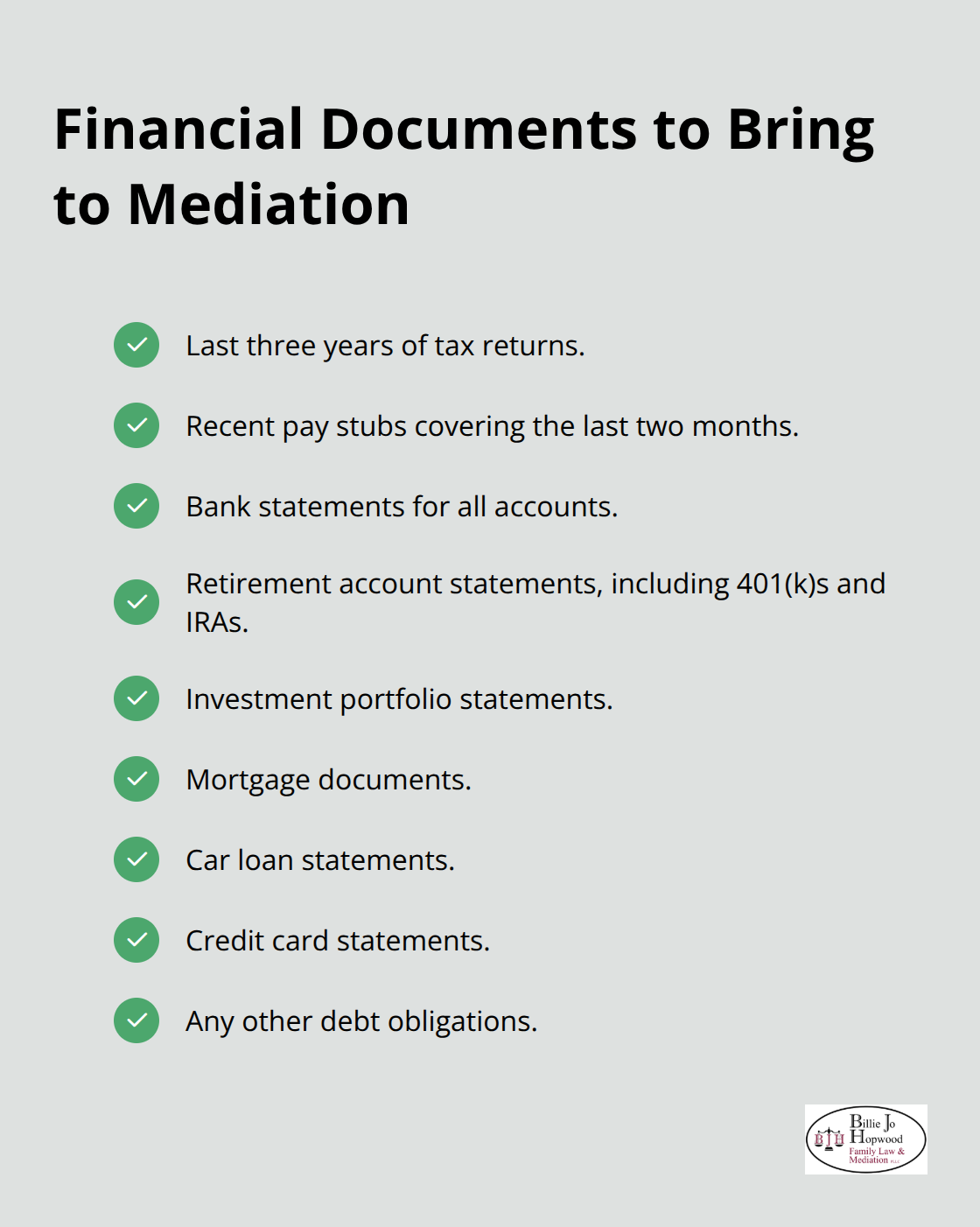
Gather the last three years of tax returns, recent pay stubs covering the last two months, bank statements for all accounts, retirement account statements (including 401(k)s and IRAs), investment portfolios, mortgage documents, car loans, credit card statements, and any other debt obligations. Courts in Florida require this level of transparency anyway, so assembling it now prevents delays and demonstrates good faith to your spouse and the mediator.

Checklist of financial documents to prepare before mediation.

Florida courts evaluate the complete financial picture to determine spousal support, which means hidden assets or downplayed debts will surface during discovery-and if they do, you lose credibility in mediation.

Creating a Realistic Monthly Budget

Create a detailed monthly budget that reflects your actual living expenses, not inflated or minimized numbers. Include housing costs, utilities, groceries, insurance, healthcare, transportation, childcare if applicable, and any other regular expenses. This budget becomes your foundation for determining what spousal support you need or can afford to pay. If you’re the spouse seeking support, your budget demonstrates financial need with specificity that judges and mediators take seriously. If you’re the potential payer, a realistic budget helps you propose sustainable payment terms rather than amounts that strain your finances and lead to modification requests later.

Setting Goals Anchored in Reality

Your goals in mediation must be realistic and anchored in actual numbers, not emotions or what you think is fair in principle. Research what spousal support typically looks like for marriages similar to yours in Brevard County by consulting with a family law attorney who understands local court patterns. The length of your marriage directly influences the type and duration of support available under Florida law-short marriages under seven years rarely qualify for durational alimony, while moderate marriages of seven to seventeen years can justify it for shorter periods, and long marriages over seventeen years historically received permanent alimony before the 2023 law change.

Know which type of alimony fits your situation and what realistic payment ranges look like based on the income difference between spouses and the standard of living during your marriage. Courts often calculate durational alimony using the recipient’s actual needs or 35 percent of the income difference between spouses, whichever is lower, so run both calculations to understand your realistic range. Set a primary goal and a fallback position before mediation begins-if you seek support, decide your ideal monthly amount, your acceptable range, and the duration you can justify. If you’re paying support, determine what you can genuinely afford each month without compromising your own financial stability or ability to meet child support obligations.

Entering Mediation Prepared

Mediation works best when both parties have completed this homework and enter the room ready to negotiate within realistic parameters rather than making demands that the other side cannot accept. With your financial documents organized, your budget finalized, and your goals clearly defined, you’re positioned to present your situation effectively during mediation sessions.

Making Your Financial Case Work in Mediation

Present Your Budget With Clarity and Context

Presenting your financial situation effectively in mediation means moving beyond numbers on a spreadsheet to tell a coherent story about what you actually need or can afford to pay. The mediator and your spouse won’t understand your position unless you frame it clearly, and vague or poorly organized financial presentations often lead to rejected proposals that derail negotiations. Walk through your budget line by line during the mediation session rather than simply handing over documents and expecting others to interpret them. If you’re seeking spousal support, explain why each expense category matters to your financial stability-whether it’s healthcare costs due to a chronic condition, retraining expenses to re-enter the workforce, or housing costs tied to maintaining the marital standard of living. Courts in Florida examine the standard of living established during the marriage as a central factor, so connect your current needs directly to how you lived together during the marriage itself. If you’re paying support, present your own budget with equal transparency to demonstrate that proposed payment amounts won’t force you into financial hardship or prevent you from meeting existing child support obligations. Many mediators recommend using a needs-based approach where you calculate actual monthly expenses first, then determine whether spousal support is appropriate to bridge gaps between income and reasonable living costs. This method proves more persuasive than simply anchoring to a number you think is fair. Bring recent tax returns, pay stubs, and account statements to mediation sessions so you can address questions immediately rather than promising to send documents later-delays create frustration and stall progress.

Choose the Right Alimony Type for Your Situation

Negotiating payment terms and duration requires understanding Florida’s four alimony types and which one actually fits your marriage length and circumstances. Durational alimony, which provides support for a set period tied to marriage length, typically works well in mediation because both parties can agree on a specific end date rather than fighting over permanent or temporary arrangements that courts would impose. If your marriage lasted twelve years, you might negotiate durational support for six to eight years rather than indefinite payments. Bridge-the-gap alimony covering up to two years works particularly well when one spouse needs immediate financial relief while transitioning to independence, and its non-modifiable nature appeals to payers who want certainty. Rehabilitative alimony makes sense when the receiving spouse has a concrete plan-specific training program, degree pursuit, or job certification with a realistic timeline-rather than vague promises of future employment.

Use Benchmarks to Ground Your Proposals

When discussing payment amounts, reference the 35 percent income difference calculation that Florida courts often use: if one spouse earns $80,000 and the other earns $40,000, the income difference is $40,000, and 35 percent of that equals $14,000 annually or roughly $1,167 monthly. This gives both parties a benchmark grounded in judicial practice rather than arbitrary demands.

Percentage benchmark example: 35% of the income difference between spouses. - spousal support mediation

Propose multiple payment structures during mediation-monthly payments, lump sum options, or hybrid arrangements combining different alimony types-because flexibility often unlocks agreements that rigid positions cannot. Address termination events explicitly in your mediated agreement, including what happens if the recipient remarries, cohabits with a partner, or completes their rehabilitative plan, since these scenarios directly affect payment obligations under Florida law.

Final Thoughts

Spousal support mediation in Melbourne, Florida transfers control of a major financial decision from the courtroom to your negotiating table. You and your spouse craft an agreement that reflects your actual circumstances rather than accepting terms a judge imposes based on statutory factors. Preparation determines outcomes-when you organize financial documents, build honest budgets, and understand which alimony type fits your marriage length, you eliminate delays and confusion that derail negotiations.

Filing your mediated settlement with the court transforms it into a legally binding, enforceable order once the judge approves it. Precision matters at this stage, so payment amounts, frequency, duration, and termination events must be clearly stated in your agreement. Set up a payment tracking system from day one, since Florida law provides enforcement mechanisms like income withholding and asset seizure if payments are missed.

A family law attorney should review your agreement before you sign it to identify tax implications, modification triggers, or enforcement gaps that mediation alone might miss. We at Billie Jo Hopwood Family Law & Mediation, PLLC help families navigate spousal support mediation and understand how agreements affect long-term financial stability. Contact us in Melbourne, Florida to discuss your situation and move forward with confidence.

Family Law Litigation: Your Complete Legal Guide

Family law litigation is often the path forward when mediation doesn’t resolve your case. Court proceedings can feel overwhelming, but understanding what lies ahead makes a real difference.

We at Billie Jo Hopwood Family Law & Mediation, PLLC have guided families through litigation in Melbourne, Florida for years. This guide walks you through the process, from initial filing to final judgment.

When Family Law Cases Go to Court

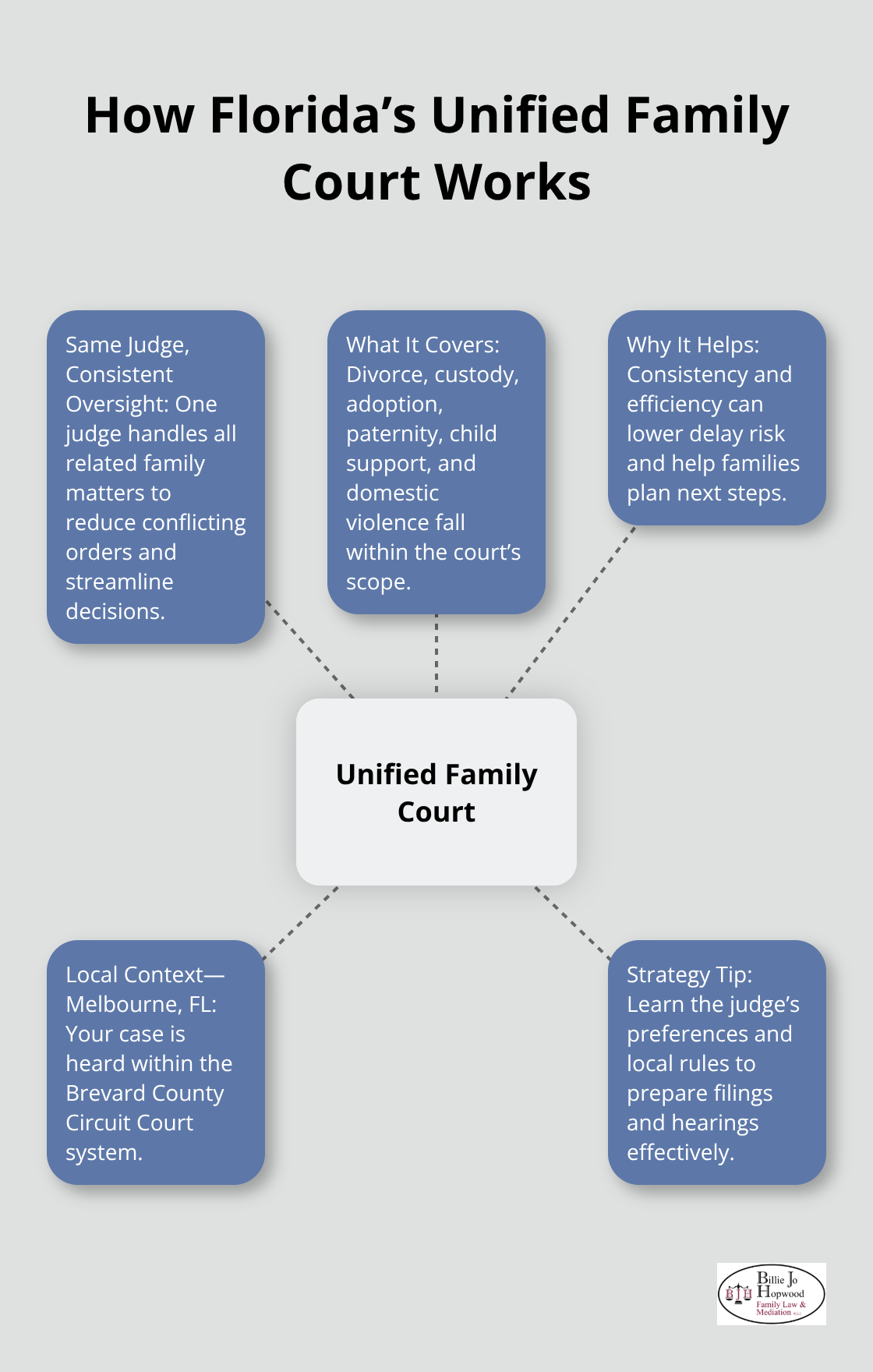
The Unified Family Court model in Florida assigns all cases involving a single family to the same judge to promote consistency and efficiency. This means one judge works with you throughout your case rather than rotating judges at different stages. The Melbourne Florida Family Court, part of the Brevard County Circuit Court, handles divorce, child custody, adoption, paternity, child support, and domestic violence matters. Understanding this system helps you prepare strategically for what lies ahead.

Overview of Florida’s Unified Family Court with key benefits and what it covers - family law litigation

How litigation differs from mediation in practice

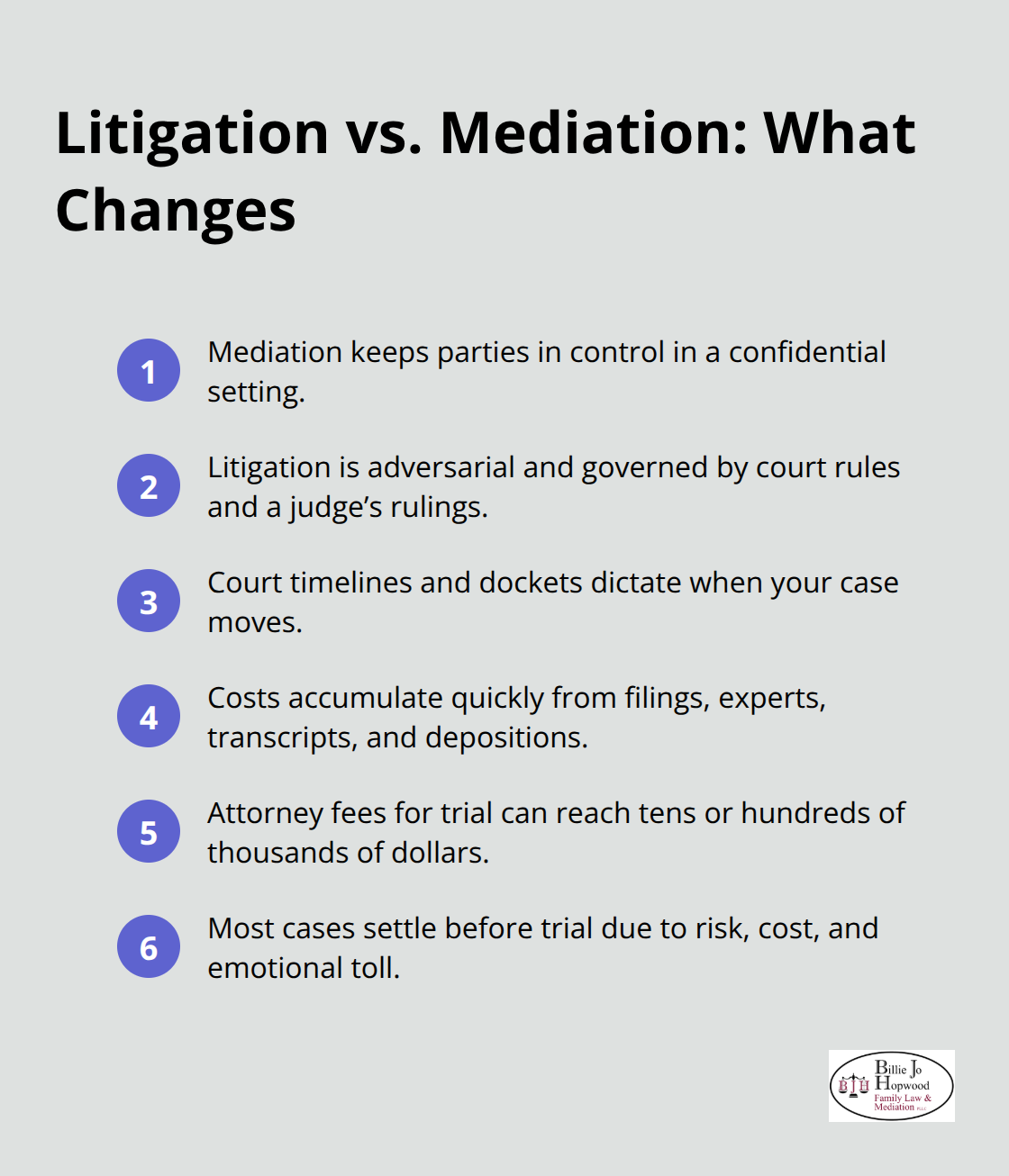
Mediation keeps both parties in control-you work toward a mutually acceptable agreement with a neutral mediator in a confidential setting. Litigation operates differently: it becomes adversarial, public, and governed by court rules and judicial decisions. A judge makes final decisions on contested issues, and court schedules determine when things move forward. The financial difference is stark. Uncontested divorces without children finalize in 4-6 weeks through mediation or settlement, while contested divorces or cases with children typically take 6-12 months in litigation, with complex scenarios exceeding a year.

Compact list of key differences between mediation and litigation in Florida family cases - family law litigation

Court filing fees, service fees, expert witness fees, appraisals, transcripts, and depositions accumulate rapidly. Attorney fees for a family law trial can reach tens of thousands or hundreds of thousands of dollars, even if you represent yourself. Most family law matters settle before trial because the risk of trial outcomes often outweighs potential gains, and the emotional and financial toll becomes overwhelming.

What happens during court proceedings

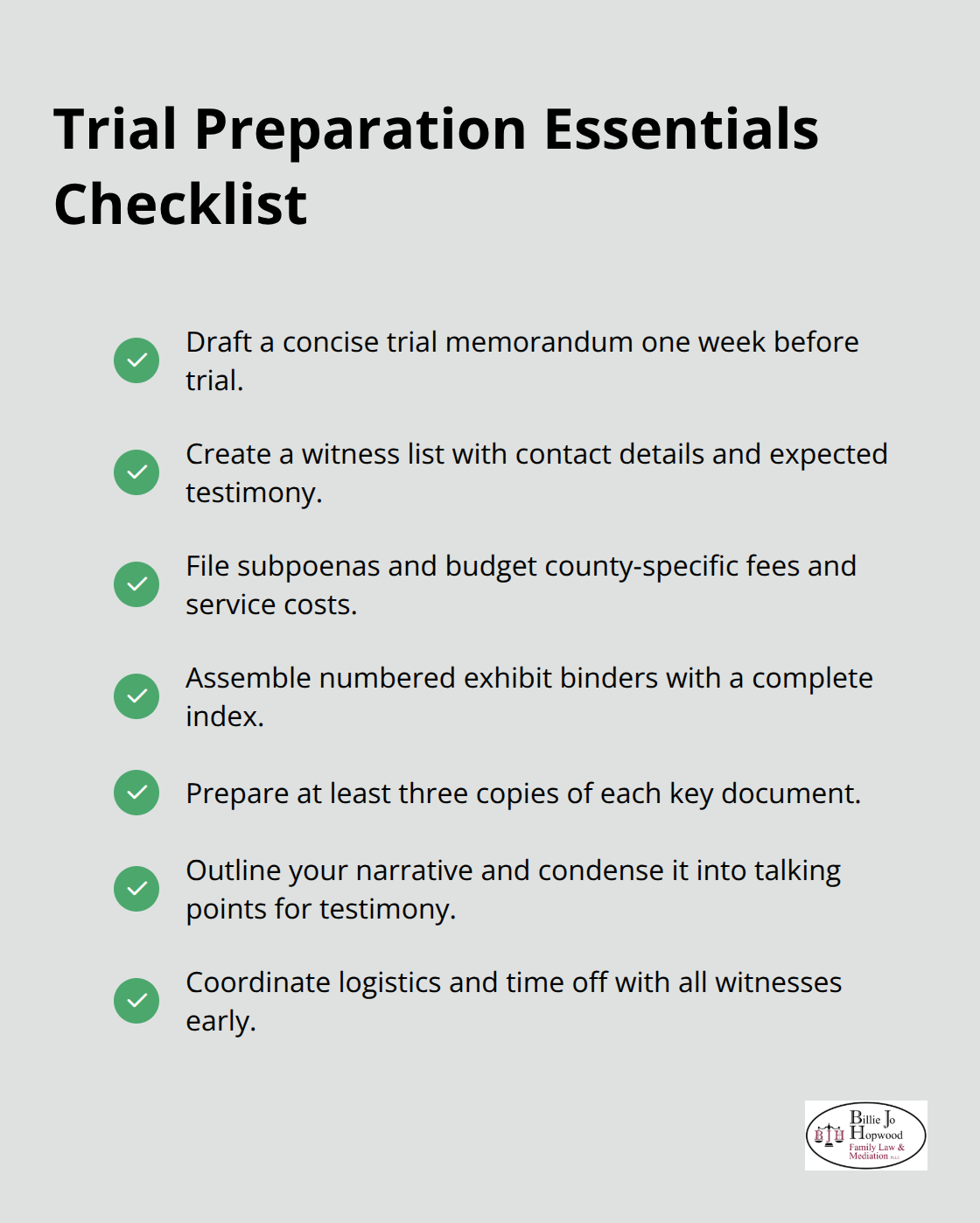
The Melbourne Family Court requires mandatory mediation before most hearings or trials. Florida Statute §61.21(4) mandates parenting classes for cases involving children. You’ll interact with judges, case managers, mediators, and court clerks who manage records and procedures. Professional dress matters: men should wear a suit or dress pants with a collared shirt and tie; women should wear a business suit or conservative dress. Arrive early for security checks and show respect to the judge. Organize your documents in a binder with dividers and bring at least three copies of each document. When presenting your case, focus on facts, stay concise, and avoid emotional language. Self-representation is possible with help from the Florida Courts Help app, but professional representation typically produces better outcomes due to the complexity and high stakes involved. Court backlogs, discovery disputes, and the need for expert evaluations extend timelines unpredictably, making preparation and legal guidance invaluable.

Moving through discovery and pretrial preparation

Discovery allows both parties to exchange information and evidence before trial. This phase determines what documents, witness statements, and expert reports each side can present. Subpoenas compel witnesses to testify or produce documents. Expert evaluations (such as child custody assessments or property appraisals) often become necessary and add both time and expense. The court’s scheduling system controls when discovery deadlines occur and when pretrial conferences happen. These conferences give you and the other party a final chance to settle before trial proceeds. Many cases resolve at this stage because both sides gain clarity on the other’s position and evidence strength.

Preparing for what comes next

The complexity of family law litigation demands careful preparation. You need organized documentation, clear understanding of court procedures, and realistic expectations about timelines and costs. The next section covers how to gather evidence, work with your legal team, and understand the specific deadlines that control your case’s progression toward trial or settlement.

Common Issues Resolved Through Family Law Litigation

Family law litigation in Melbourne, Florida resolves disputes that mediation couldn’t settle. The court handles three major categories of family law conflicts, each with distinct financial and emotional consequences that shape how judges approach their decisions.

Child Custody and Timesharing Disputes

Child custody disputes represent some of the most contested litigation matters in Florida courts. When parents cannot agree on timesharing schedules, one parent typically seeks primary custody while the other fights for expanded visitation rights. The court applies the best interests of the child standard, examining factors like each parent’s relationship with the child, the child’s needs, school stability, and each parent’s ability to meet those needs. Florida courts increasingly favor shared parenting arrangements unless one parent poses a safety risk.

You must document everything regarding your involvement in the child’s daily life, school activities, medical appointments, and extracurricular participation. Courts weight demonstrated commitment over promises. Judges scrutinize parenting plans carefully because these decisions affect children for years. A parent who has consistently handled school pickups, medical care, and homework support has stronger evidence than one who claims equal capability without that history.

Alimony and Spousal Support Determinations

Alimony and spousal support disputes turn on income disparity and marriage length. Florida courts award alimony when one spouse lacks the financial ability to meet reasonable needs while the other spouse has the ability to pay. The length of your marriage directly impacts award duration. Marriages under ten years typically qualify for temporary alimony; marriages over seventeen years often result in permanent alimony.

The court examines both spouses’ earning capacity, education level, work history, and age. A spouse who left the workforce to raise children has stronger claims than one who chose not to work. Income calculations include salary, bonuses, commissions, rental income, and investment returns. Courts regularly impute income to spouses who deliberately underemploy themselves. If you earn fifty thousand dollars annually but possess credentials for eighty thousand dollar positions, the judge may calculate support based on the higher figure.

Division of Marital Assets and Debts

Asset and debt division follows Florida’s equitable distribution model, which doesn’t mean fifty-fifty but rather fair and just. The court classifies property as marital or non-marital. Marital assets acquired during the marriage get divided, while separate property brought into the marriage or inherited individually remains with that spouse.

Valuation disputes create significant litigation costs. Real estate appraisals, business valuations, and retirement account analyses require witnesses who charge thousands of dollars for reports. A business owner facing divorce must expect detailed financial scrutiny of company value, owner compensation, and hidden assets. Courts examine bank statements, tax returns, and financial affidavits carefully.

Hidden assets discovered during litigation damage credibility and often result in unfavorable rulings. Transparency about finances (even when unfavorable) produces better judicial outcomes than later-discovered concealment. The court’s ability to uncover financial deception through discovery and expert analysis means that attempting to hide assets typically backfires. Understanding these three major dispute categories helps you prepare evidence and realistic expectations for your specific situation, which directly influences how you should structure your case preparation and legal strategy moving forward.

Preparing Your Case for Trial

Organize Your Documentation Early

Start collecting documents immediately after you decide to litigate. The Melbourne Family Court requires specific paperwork before your case moves forward, and delays in submission extend your timeline significantly. You need your marriage certificate, financial affidavit (Forms 12.902(b) or 12.902(c)), parenting course certificate if children are involved, recent pay stubs, three years of tax returns, bank statements, and a comprehensive list of assets and debts. For child custody cases, add birth certificates, school records, medical records, and a proposed parenting plan.

Organize everything in a binder with dividers and create at least three complete copies of each document-one for yourself, one for the judge, and one for the opposing party or their attorney. This preparation prevents delays caused by missing documents and demonstrates to the court that you take the case seriously. Request documents from the IRS and medical providers early, as these often take weeks to arrive.

Build Your Trial Timeline and Strategy

Start two months before your trial date if one is scheduled. A practical rule of thumb for trial preparation is to begin collecting and organizing evidence at least eight weeks out, which gives you time to locate missing items, request records from schools or medical providers, and work with your legal team on strategy. Many people underestimate how long it takes to obtain three years of tax returns from the IRS or medical records from multiple providers.

Your legal team coordinates discovery, manages deadlines, and handles communication with the opposing party’s counsel. If you choose to represent yourself, understand that you are held to the same standards as licensed attorneys under the Florida Rules of Evidence. You must file a Notice to Set for Trial with the court, and in Brevard County, a Settlement Conference typically occurs before trial for divorce cases.

Prepare Your Trial Materials and Witnesses

Prepare a trial memorandum at least one week before trial-this brief document outlines your case history, the issues in dispute, applicable law, and what you are requesting from the judge. Create a witness list with up to five lay witnesses, including their names, phone numbers, addresses, and what they will testify about. If you have witnesses, file a Motion for Order for Issuance of Subpoenas and budget the associated fees, which vary by county but typically range from fifty to one hundred dollars per subpoena plus service fees. Notify witnesses well in advance so they can arrange time off work.

Checklist of must-do tasks to get ready for a Florida family law trial

Prepare trial exhibit binders using three-ring binders with numbered exhibits and a complete index. Try to have these ready at least one week before trial. Draft a narrative of events since you and the other party met, then condense it into a concise outline you can reference during testimony-you cannot read directly from prepared statements while testifying.

Leverage Settlement Opportunities Before Trial

Court scheduling controls when discovery deadlines occur and when pretrial conferences happen. These conferences often become settlement opportunities because both sides gain clarity on evidence strength and the other party’s position. Judges can mandate mediation at any point during proceedings, typically after initial pleadings but before trial preparation begins, which may resolve your case without proceeding to trial. Many contested cases resolve at pretrial conferences rather than proceeding to trial, which saves thousands in additional attorney fees and reduces the emotional toll on your family.

Final Thoughts

Family law litigation in Melbourne, Florida demands both strategic thinking and compassionate guidance when mediation stalls and disputes require judicial intervention. Court orders are enforceable, and violations can result in contempt charges, so compliance matters immediately after your case resolves through trial judgment or settlement. The emotional transition after litigation ends deserves attention, and many people benefit from counseling or therapy after contentious proceedings conclude, particularly when children are involved.

Rebuilding stability for your family takes time, but clear court orders or settlement agreements provide the framework for that transition. Implementation of custody schedules, financial obligations, and property transfers must occur as specified in your final judgment or settlement agreement. Understanding what comes next helps you move forward with confidence rather than uncertainty about your obligations and rights.

We at Billie Jo Hopwood Family Law & Mediation, PLLC assist families through family law litigation with representation in divorce, child custody, alimony, and child support matters. If you’re facing family law litigation or considering whether court is necessary for your situation, contact our office to discuss your specific circumstances and explore your options.

How to Understand Retainer Fees for Family Law Attorneys

Family law cases involve significant financial commitments, and understanding how attorneys bill for their services matters. A retainer fee for a family law attorney is one of the most common billing structures, yet many people find it confusing.

We at Billie Jo Hopwood Family Law & Mediation, PLLC want to break down how retainers work, what you can expect to pay, and how to manage these costs throughout your case.

What Retainers Actually Mean for Your Budget

A retainer is a down payment deposited into a trust account that your attorney draws from as they work on your case. Unlike paying per task, a retainer reserves your attorney’s availability and guarantees they’ll work on your matter within a specific timeframe. Florida family law retainers typically start at $3,500 for most contested divorces, custody disputes, and paternity cases, though this amount increases if a significant trial is likely within 120 days or an emergency hearing is needed. According to LegalMatch, retainer fees in family law generally range from $2,500 to $5,000, though the actual amount depends entirely on your case’s complexity and the issues pending before the court.

Visual showing how a retainer works, including trust deposit, reserved availability, and typical starting amounts in Florida. - retainer fee for family law attorney

How Your Retainer Gets Used

The retainer isn’t a flat fee you pay once-it’s a reserve that gets drawn down monthly as your attorney logs billable hours. Most family law attorneys in Florida bill hourly rates between $254 and $500 per hour, with rates in the Tampa Bay area running higher than rural regions. Your attorney typically sends an itemized invoice between the 1st and 15th of each month showing exactly what work was performed and how much was charged against your retainer. If your case requires more hours than the retainer covers, you’ll need to replenish it or pay additional amounts as the work progresses.

Why Retainers Protect Both Sides

Retainers exist because family law cases are unpredictable. Your attorney can’t know whether your case will settle in two months or drag into a contested trial lasting six. A retainer secures the firm’s commitment to having time available for your case while you commit to covering anticipated work. This structure creates accountability on both sides. The retainer also means you’re not paying for every phone call or email individually-those communications get bundled into your hourly rate and charged against the reserved amount.

Fee Awards Can Offset Your Costs

Courts in Florida may award attorney fees and costs to the party with greater financial need, which can offset some of your retainer costs if you’re the lower-earning spouse. This fee-shifting provision exists specifically to ensure equal access to competent counsel, so discussing your financial circumstances with your attorney during the initial consultation matters significantly. A $150 consultation fee is standard, and that amount gets credited toward your retainer if you hire the firm, making it easy to start the conversation without major upfront investment.

Understanding how your retainer applies to your case is only half the battle-knowing what happens when that initial reserve runs low and how to track expenses along the way will help you stay in control of your budget throughout the process.

How Retainer Fees Compare to Other Billing Methods

Hourly Billing Without a Retainer

Retainers aren’t the only way family law attorneys charge for their services, and understanding the alternatives helps you make the right choice for your situation. Hourly billing without a retainer means you pay for time as it’s logged, with no upfront commitment or reserved availability. This approach sounds cheaper initially, but it creates real problems in family law cases.

Compact list comparing retainers to hourly billing without a retainer for Florida family law cases.

Your attorney has no guaranteed time set aside for you, so your case may sit idle while they handle retained clients. You also face unpredictable monthly bills that fluctuate based on case activity.

With retainers, you know roughly what to expect each month since you’re drawing down a set amount, and your attorney prioritizes your case because they’ve reserved time for it. In Tampa Bay, where hourly rates range from $254 to $500 per hour according to LegalMatch, a retainer actually protects your budget better than paying hourly without one.

Flat-Fee Arrangements and Their Limitations

Flat-fee arrangements work differently and appeal to people who want certainty. An attorney quotes a single price to handle your entire case from start to finish, which works only for straightforward, uncontested matters. Most family law cases don’t qualify because custody disputes, property division, and alimony negotiations create unpredictability that flat fees can’t accommodate. If your case involves significant disagreement between parties, a flat fee becomes risky for the attorney, so they won’t offer one.

Some firms offer unbundled flat-fee services for specific tasks (like document preparation or limited consultation), giving you flexibility depending on your case’s complexity and budget constraints.

Why Contingency Fees Don’t Apply to Family Law

Contingency fees, where attorneys take a percentage of money recovered, simply don’t exist in family law. Florida courts don’t allow contingency arrangements for divorce, custody, or support cases because these matters involve rights and relationships, not money damages. This means you’ll always pay either a retainer, hourly rate, or flat fee regardless of the outcome. That’s why discussing fee structure upfront matters so much, because you’re committing to payment regardless of whether your case settles favorably or requires litigation.

Understanding which billing method fits your case sets the foundation for managing costs effectively, which brings us to the practical steps you’ll take to track your retainer and handle expenses as your case moves forward.

Managing Your Retainer and Understanding Costs

How Your Retainer Depletes Each Month

Your retainer sits in a trust account, untouched until your attorney begins work. Once they do, the clock starts and hours accumulate against that reserve. Most Florida family law attorneys bill in one-hour increments, meaning a 45-minute phone call rounds to one billable hour. This matters because those increments add up fast. If your attorney charges $350 per hour and handles three brief emails, a short phone call, and document review in a single day, you could lose $700 from your retainer even though the actual work time felt minimal.

The itemized invoice you receive monthly should list each task separately with the date, description, and time spent, so you can see exactly where your money went. If you notice inconsistencies or tasks you don’t recognize, raise the issue immediately. Courts in Florida expect attorneys to bill fairly, and most firms will correct errors if you catch them.

Comparing Your Costs Against Real Case Outcomes

Uncontested custody cases resolved through mediation or negotiation cost roughly $2,500 to $7,500 total according to LegalMatch, while contested matters with significant disagreement can reach $10,000 to $50,000 or more. The difference comes down to hours spent, which is why tracking every charge matters. Request an estimate of total anticipated costs during your initial consultation, then compare monthly invoices against that projection. If your case tracks higher than expected, discuss it with your attorney before the problem compounds.

What Happens When Your Retainer Runs Out

When your retainer depletes, you face a critical decision point. Some attorneys require immediate replenishment before continuing work, while others allow you to pay additional amounts as invoices arrive. This variation matters significantly for your cash flow.

Checkmark list of typical payment methods used to replenish family law retainers in Florida. - retainer fee for family law attorney

Before signing any retainer agreement, ask whether the firm accepts installment payments or requires lump-sum replenishment, what payment methods they accept (LawPay, credit cards with merchant fees, cashier’s checks, and in-office cash are common options), and whether a second retainer will be necessary if your case extends beyond the initial estimate.

Separate Costs Beyond Your Retainer

Court costs and expenses like filing fees, deposition costs, subpoena fees, and expert witness charges are billed separately from attorney time, so budget for those additional expenses beyond your retainer. If you face financial hardship, discuss fee awards with your attorney. Florida courts may shift attorney fees and costs to the higher-earning spouse to ensure equal access to competent counsel, which could offset your remaining obligation.

Planning for Unpredictable Case Expenses

A stable income helps manage retainer replenishment, but delays or unexpected complications can increase costs beyond initial projections. Discuss your attorney’s typical settlement versus litigation split before committing, since cases that settle quickly drain retainers far more slowly than those requiring extensive discovery and trial preparation.

Final Thoughts

Retainer fees for family law attorneys in Melbourne, Florida work best when you understand exactly what you’re paying for and why that structure protects your case. A retainer reserves your attorney’s time and creates predictability in an unpredictable process, so you know roughly what to expect each month while your attorney prioritizes your matter. Before committing to any retainer agreement, ask what hourly rate applies to your case, what happens when your retainer runs out, and what costs beyond the retainer you should anticipate, such as filing fees or expert witness charges.

Making an informed decision about billing structure means comparing your specific situation against the options available. If your case involves significant disagreement, a retainer protects you better than hourly billing without one because your attorney has guaranteed time set aside. Fee awards from the court can offset your costs if you’re the lower-earning spouse, so discuss your financial circumstances openly with your attorney during your initial consultation.

Contact Billie Jo Hopwood Family Law & Mediation, PLLC in Melbourne, Florida to discuss your case and understand exactly what a retainer fee for family law attorney services will look like for your situation.

How to Find Family Law Assistant Jobs

Family law assistant jobs are in demand, and landing one requires more than just submitting applications. We at Billie Jo Hopwood Family Law & Mediation, PLLC know what employers look for in candidates who support family law practices.

This guide walks you through proven strategies to find positions, build a competitive application, and prepare for interviews that get results.

Where to Find Family Law Assistant Jobs That Are Actually Hiring

Specialized Legal Job Boards Beat Generic Sites

Legal job boards are your starting point, but most candidates waste time on generic sites. Focus on specialized platforms where law firms post family law roles. FlexJobs and LawCrossing cater specifically to legal positions and filter out low-quality postings that waste your time. According to the U.S. Bureau of Labor Statistics, there are approximately 45,800 paralegal and legal assistant openings per year, but most appear on niche boards rather than Indeed or LinkedIn.

Three key reasons and actions to use specialized legal job boards for family law assistant roles in the United States. - family law assistant jobs

Start your search on these targeted platforms, then move to Indeed as a secondary option. Set up job alerts with specific keywords like family law assistant, family law paralegal, and divorce support specialist so opportunities land in your inbox automatically.

Build Your Network in the Legal Community

Networking inside the legal community yields faster results than applications alone. Florida has one of the nation’s highest paralegal concentrations, second only to Washington DC, according to the U.S. Bureau of Labor Statistics, which means the competition is fierce but the opportunity pool is substantial. Join the Paralegal Association of Florida or local bar association groups where family law attorneys and paralegals gather. Attend monthly meetings and conferences focused on family law. When you meet someone working in family law, ask directly about upcoming assistant roles or referrals-hiring managers trust internal recommendations far more than cold applications.

Apply Directly to Law Firms in Your Area

Direct applications to law firms matter most when you conduct thorough research first. Research firms in your target area that handle divorce, custody, and mediation cases. Call their main line and ask to speak with the office manager about assistant positions, or submit your resume directly with a brief note explaining why you want to work there specifically. Firms with established practices serving Brevard County appreciate candidates who understand their case types and local court procedures. This direct approach signals serious interest and often gets you an interview faster than online applications.

Many family law firms fill positions through referrals before posting publicly, which makes your networking efforts and direct outreach even more valuable. As you identify potential employers and prepare your materials, understanding what these firms actually look for in candidates becomes your next advantage.

What Skills Do Family Law Firms Actually Want

Master Administrative Systems Before Your First Day

Family law firms hiring assistants care far less about what you claim on paper and far more about what you can actually do from day one. Administrative competence matters most because family law moves fast and mistakes cost clients money and court dates. You manage multiple cases simultaneously, track filing deadlines that vary by county, maintain organized client files, and coordinate schedules between attorneys, clients, and courts. Florida paralegals earn a median salary of around $60,280 according to the U.S. Bureau of Labor Statistics, but those who demonstrate strong organizational systems from the start often advance faster and earn raises sooner. The difference between a mediocre assistant and one who gets promoted comes down to whether you prevent chaos when a firm handles divorce, custody, alimony, and child support cases all at once.

Hub-and-spoke visualization of day-one readiness skills for family law assistants in the United States.

Learn the Family Law Case Timeline and Court Forms

Study the typical family law case timeline before your interview. Learn the forms your target court requires for initial filings, discovery requests, and final judgments. A Florida family law case typically takes 6 to 12 months and involves specific procedural steps that show you understand the real work. Spend time on the Florida Courts website learning the actual forms and procedures used in your target county. When you interview, mention a specific family law concept relevant to the firm’s practice areas and explain why it matters.

Understand Family Law Concepts That Clients Ask About

Knowledge of family law concepts separates competitive candidates from those who flounder. You do not need a paralegal degree to start, but you must understand what equitable distribution means, how Florida child support guidelines work, and the difference between timesharing and child custody terminology. Courts in Florida use specific language and calculations for child support that assistants help explain to clients. Knowing these terms prevents confusion when clients call with questions about their cases.

Handle Client Communication With Clarity and Calm

Communication skills prove themselves through how you handle stressed clients calling about custody concerns or financial questions. Family law clients are often emotional and vulnerable, so your tone, clarity, and ability to set expectations determine whether they trust the firm. Show in interviews that you can explain complex legal timelines in plain language and remain calm when clients are frustrated or confused. Ask the interviewer how assistants currently handle client calls and what communication challenges they face. Your answer should explain how you would document calls, flag urgent issues for the attorney, and follow up with clients professionally.

These skills form your foundation, but employers also want to see how you present yourself on paper and in person.

Getting Hired: What Your Resume and Interview Must Show

Your resume for a family law assistant role needs to prove you understand the work, not just list job titles. Most candidates write generic resumes that could apply to any legal position. Instead, include specific family law terminology and demonstrate familiarity with actual case processes. Mention experience with document organization, filing deadlines, and client scheduling if you have it. If you lack direct family law experience, highlight transferable skills like managing multiple priorities, attention to detail, and administrative systems you built in previous roles.

Tailor Your Resume to Family Law Work

Include any relevant coursework, certificates, or self-study in family law concepts on your resume. Reference knowledge of Florida court procedures, equitable distribution, child support guidelines, or timesharing terminology to show you have done your homework. When you list previous administrative work, quantify your impact: managed 50+ client files, coordinated 200+ court filings annually, or maintained deadline tracking systems that prevented missed court dates. Employers scanning resumes spend seconds deciding whether to call you, so front-load your strongest family law-related accomplishments.

Research the Firm Before Your Interview

Interview preparation means studying the firm’s practice areas before you arrive, then demonstrating that knowledge through specific questions and examples. Research whether the firm handles mediation, collaborative divorce, or contested litigation, and mention this in your opening statement about why you want to work there. Prepare concrete answers to questions about how you would handle a client calling about a custody concern, manage multiple case deadlines simultaneously, or organize discovery documents.

Connect Your Strengths to Family Law Needs

When asked about your strengths, connect them directly to family law: explain how your organizational skills would prevent missed filing deadlines in a fast-moving family law practice. Ask the interviewer about the most common mistakes new assistants make in their first 90 days, then explain how your background or approach would avoid those pitfalls. If asked about salary expectations, research what paralegals earn in your target Florida metro area-Miami paralegals earn around $63,050 annually, while Tampa averages $62,420-then provide a range that reflects your experience level and local market.

Checklist of essential resume and interview actions for U.S. family law assistant candidates. - family law assistant jobs

Ask Questions That Demonstrate Real Understanding

Near the end of your interview, ask a question that shows you understand real family law work: What is the typical timeline from initial consultation to final judgment in your divorce cases, and how does the assistant help clients through that timeline? This question signals that you grasp the case lifecycle and think about client experience (qualities that family law firms value highly). Your preparation and thoughtful questions position you as a candidate who takes the role seriously and understands what the work actually demands.

Final Thoughts

Landing family law assistant jobs requires three concrete actions: target specialized legal job boards like FlexJobs and LawCrossing, build relationships within the Paralegal Association of Florida and local legal networks, and apply directly to firms handling divorce and custody cases in your area. Your resume must demonstrate knowledge of family law timelines and court procedures, not just list administrative duties. Your interview answers should connect your organizational skills directly to preventing missed filing deadlines and managing multiple cases simultaneously.

Court procedures shift, forms get updated, and family law statutes evolve constantly. Stay current through continuing education and regular study of your state court websites to remain valuable to employers long after you land the job. Read case summaries, attend paralegal association meetings, and ask senior paralegals about recent changes in your target practice area.

Update your resume this week with specific family law terminology and quantified accomplishments, then join the Paralegal Association of Florida if you have not already. Research three law firms in your target Florida metro area that handle mediation or divorce cases, call their offices directly, and visit Billie Jo Hopwood Family Law & Mediation, PLLC in Melbourne, Florida to see what a compassionate family law practice looks like.

How to Get a Degree in Family Law

Pursuing a degree in family law opens doors to meaningful work helping families navigate difficult transitions. At Billie Jo Hopwood Family Law & Mediation, PLLC, we know that this career path requires more than just classroom learning.

The journey involves law school, bar certification, and hands-on experience in real cases. This guide walks you through each step toward building a family law career.

Getting Your Foundation Right Before Law School

Your undergraduate degree matters far less than you think. Family law firms do not care whether you majored in political science, business, engineering, or nursing-the American Bar Association does not require any specific undergraduate path either. What matters is that you complete a bachelor’s degree from an accredited institution and maintain a solid GPA, since law school admissions committees weight your undergraduate performance heavily. Some students find that majoring in subjects like accounting or real estate gives them an edge later when handling complex asset divisions in divorce cases, but this advantage is modest compared to performing well on the Law School Admission Test (LSAT). If you are still in undergraduate school, focus on developing strong writing and communication skills through coursework and volunteer work rather than chasing a “perfect” major.

Choosing a Law School with Real Family Law Training

Law school is where your family law foundation actually gets built. Not all law schools offer the same depth in family law coursework. Florida State University College of Law, for example, offers ten credits from courses like Divorce Law, Children and the Law, Domestic Violence, and Family Law that specifically prepare you for this field. When you evaluate law schools, look for programs that offer clinical experience-hands-on work with real clients under attorney supervision. A Family Law Clinic where you draft restraining orders or negotiate custody agreements teaches you more in one semester than a year of lectures. Many law schools also offer externships that place you at the intersection of family law and criminal justice, which is valuable since domestic violence cases often cross both areas. Start this clinical work early in law school so you can confirm family law is actually the right fit before you graduate and accumulate debt.

Key program features that build real family law skills - degree in family law

Passing the Bar and Building Credentials

Florida requires you to pass the General Bar Examination, which consists of three parts: the Florida-prepared section, the Multistate Bar Examination (MBE), and the Multistate Professional Responsibility Examination (MPRE). You must complete your law school graduation requirements before you sit for the exam. If you target February 2026, the final filing deadline is January 15, 2026, so plan ahead. After you pass the bar, you are not done learning. Many family law practitioners pursue additional certifications or coursework in mediation, estate planning, and tax law to handle the full range of issues that arise in divorce cases. Attorneys who combine family law with mediation training serve clients far better than those who only litigate. Consider taking mediation courses early in your career-some law schools offer them during your final year, and many state bar associations recognize mediation credentials that strengthen your practice.

Moving Forward Into Your First Position

The credentials you earn in law school and through bar passage open doors to different career paths. Your next decision involves choosing where to apply those skills and which type of legal work aligns with your values and goals.

How to Build Real Skills That Courts and Clients Respect

Internships Teach You What Classrooms Cannot

Internships during law school matter far more than you realize. A summer spent filing motions at a family law firm teaches you how cases actually move through the system-something no classroom lecture can replicate. Courts in Florida see thousands of cases annually, and judges notice when attorneys come unprepared or miss procedural deadlines. Working under a practicing attorney for even one summer forces you to understand discovery timelines, child custody evaluation processes, and how to communicate with clients who are emotionally vulnerable. The American Bar Association recognizes that early experiential learning through internships, fellowships, and part-time work helps you determine whether family law fits your temperament before you graduate with significant debt. If your law school offers a Family Law Clinic, take it. Clinics provide real client work under supervision-you draft actual restraining orders, negotiate custody agreements, and see the consequences when you miss a filing deadline.

Practical skills gained from family law internships and clinics - degree in family law

This is not theoretical practice; courts enforce your work.

Mediation Training Transforms Your Entire Practice

Mediation training should start during law school, not after you pass the bar. Many attorneys wait years before learning mediation, then discover it transforms how they handle every case. Family law accounts for about one-third of civil filings and trials in the United States, yet alternative dispute resolution resolves the majority of these cases before trial. Courts favor mediators who understand both the legal framework and the emotional dynamics of family conflict. Take mediation courses while still in law school-many programs offer them in your final year-and pursue credentials recognized by your state bar association. Communication skills matter more than legal knowledge in family law. You need to hear what clients actually need beneath their stated demands, recognize when a custody proposal protects children versus when it punishes an ex-spouse, and write agreements that families can follow for years. These skills develop through practice, not reading.

Staying Current Keeps You Competitive

As you move into your first position, stay current with Florida family law changes through continuing legal education hours required for bar membership. The field evolves constantly as courts address new reproductive technologies, same-sex marriage implications, and digital asset division in divorce. Attorneys who ignore these shifts fall behind quickly. Your first job will test whether you can apply what you learned in law school to real clients with real problems. The transition from student to practicing attorney demands that you continue learning long after you pass the bar exam.

Where Family Law Careers Actually Lead

Your first job after passing the bar determines whether you build a sustainable career or burn out within five years. The three main paths-private practice, government work, and mediation-attract different personalities and offer vastly different financial outcomes. Private practice at a boutique family law firm typically pays more but demands longer hours and constant client acquisition. Government positions offer stability and predictable schedules but lower salaries, often 40 to 50 percent less than private practice. Mediation roles sit between these extremes: mediators in Florida earn between 60,000 and 120,000 annually depending on volume and reputation, with far greater flexibility than litigators. The American Bar Association data shows that most family law practitioners work in small firms with fewer than ten attorneys, not large corporate law departments. This matters because small firms force you to handle every aspect of a case yourself-from initial client intake through trial-rather than narrowing your focus to one task.

Small Firms and Solo Practice Demand Real Business Skills

Private practice attorneys in family law must understand business fundamentals that law school never teaches. You need to manage client trust accounts, understand billing structures, and actually collect payment from clients going through financial crisis. Many family law clients delay paying bills during divorce because their assets are frozen or they lack immediate cash. Solo practitioners report that approximately 20 to 30 percent of their cases result in fee disputes or collection problems. The profit margin for a solo family law practice sits around 30 to 40 percent after overhead, making volume critical to survival. Small firms succeed when they develop reputation through consistent results and strong communication, not aggressive marketing. Attorneys in private practice handle mediation, negotiation, and litigation within the same case-you might mediate a custody arrangement one week and prepare trial exhibits the next. This demands mental flexibility and comfort with uncertainty.

Government and Nonprofit Roles Offer Different Rewards

Government agencies employ family law attorneys in child protective services, state attorney offices handling domestic violence prosecution, and public defender offices representing parents in dependency cases. These positions offer job security, defined benefits, and predictable 40-hour weeks that private practice rarely provides. However, caseloads in government positions often reach 200 to 300 cases per attorney annually, compared to 30 to 50 cases for private practitioners. This volume means less individual attention per client and more administrative work. Attorneys working in child welfare agencies navigate constant ethical tension between protecting children and preserving family unity. Nonprofit legal services organizations pay slightly more than government work but still significantly less than private practice. The trade-off is meaningful work-you represent clients who cannot afford attorneys, often immigrants, low-income families, or abuse survivors. Career satisfaction in nonprofit roles tends to be higher than in private practice, though financial stress is greater.

Mediation Creates the Highest Client Satisfaction

Mediators resolve more family law cases than litigation ever will. When both parties voluntarily participate in mediation rather than fighting through trial, settlement rates exceed 80 percent.

Percentage of family law cases that settle when parties mediate voluntarily

Mediators earn income through hourly fees, typically 150 to 300 per hour in Florida, charged equally to both parties. This creates an incentive structure completely opposite to litigation-your income rises when cases resolve quickly, not when they drag on. Attorneys transitioning from litigation to mediation often report dramatically reduced stress and better work-life balance. Mediation training teaches you to identify the actual interests beneath stated positions, a skill that transforms how you handle any legal matter. Courts increasingly mandate mediation before trial, making mediation credentials valuable for any family law attorney. The Florida Supreme Court recognizes family law mediators through certification programs that require specific training hours and demonstrated competence. Mediators who understand both legal frameworks and emotional dynamics of family conflict command higher fees and build strong referral networks (this path suits attorneys who find litigation exhausting but want to remain involved in family law).

Final Thoughts

A degree in family law opens doors to work that genuinely matters. You complete your bachelor’s degree, attend law school with strong clinical training, pass the Florida bar exam, and build practical skills through internships and mediation coursework. The path demands commitment across multiple stages, but the work itself transforms families navigating their most difficult moments.

Career prospects in family law remain strong because family law accounts for roughly one-third of all civil filings in the United States. Your income potential varies significantly by career choice-private practice offers the highest earning potential but demands business acumen and tolerance for uncertainty, while government positions provide stability with lower compensation, and mediation roles sit between these extremes with flexibility and strong hourly rates. The most successful family law attorneys combine legal knowledge with genuine communication skills and emotional intelligence that develop through real experience, not classroom study.

If you are in Melbourne, Florida and considering family law representation or mediation services, Billie Jo Hopwood Family Law & Mediation, PLLC offers guidance in divorce, child custody, alimony, and child support matters. We combine legal knowledge with compassionate representation for families navigating challenging transitions.