Blog

Are Signed Mediation Agreements Legally Enforceable?

Many families going through divorce or separation wonder whether their mediation outcomes carry real legal weight. A signed mediation agreement is enforceable under law when it meets specific Florida requirements.

At Billie Jo Hopwood Family Law & Mediation, PLLC, we help Melbourne Florida families understand exactly what makes these agreements binding and how to protect their interests throughout the process.

What Makes Florida Mediation Agreements Legally Valid?

Florida’s Strict Documentation Requirements

Florida Statutes Section 44.1011 mandates that mediation agreements must be in writing and signed by both parties to become legally enforceable. The Eighteenth Judicial Circuit handles over 3,500 family law cases annually and requires this written documentation in 85% of contested divorce cases. The Florida case Parkland Condo. Ass’n, Inc. v. Henderson established that settlements lack enforceability when parties and their counsel fail to provide proper signatures, regardless of prior negotiations. Rule 1.730(b) of the Florida Rules of Civil Procedure reinforces this requirement and prohibits parties from leaving mediation with just email confirmations or agreements in principle.

Essential Elements That Courts Examine

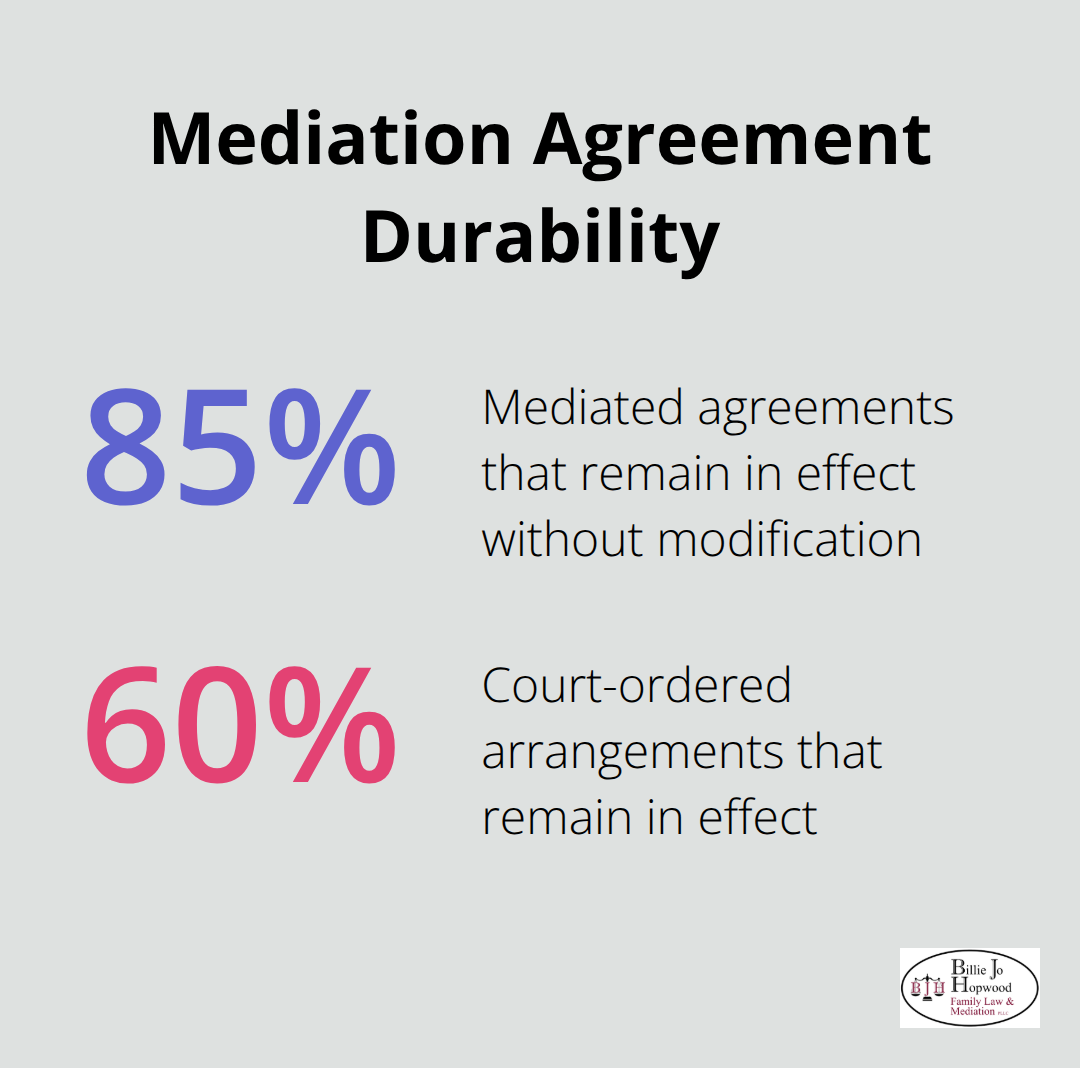
Valid mediation agreements require three components: mutual consent from parties with legal capacity to contract, inclusion of all material terms, and proper documentation with required signatures. Properly executed mediation agreements achieve 87% compliance rates, while court-ordered arrangements experience violation rates above 40%.
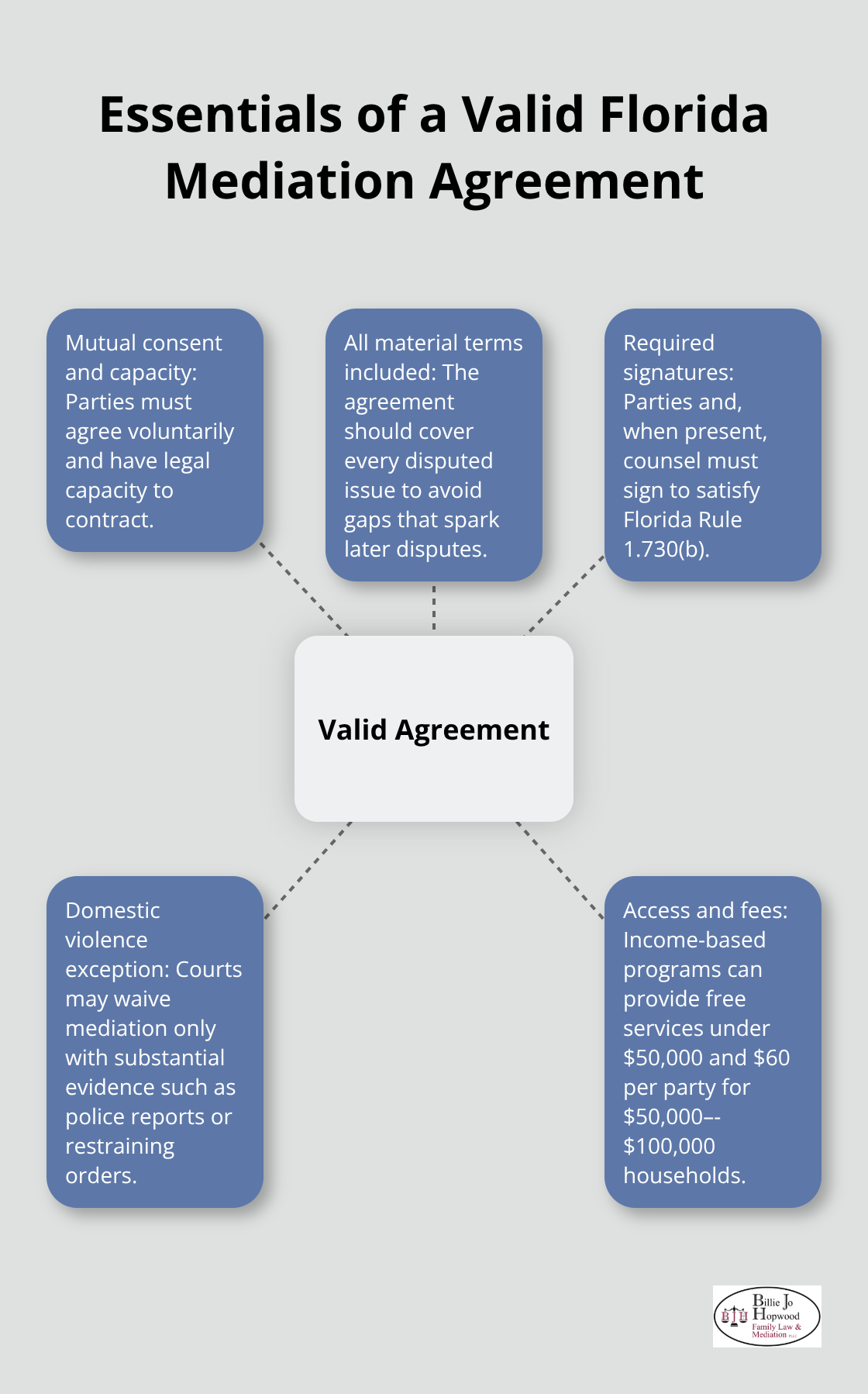
Key elements courts look for to validate a Florida mediation agreement - a signed mediation agreement is enforceable under law

Florida courts waive mediation requirements only in domestic violence cases where substantial evidence (such as police reports or restraining orders) exists. Income verification affects mediation access, with families earning under $50,000 qualifying for free services, while those earning $50,000 to $100,000 pay $60 per party.

How Mediation Agreements Differ From Court Orders

Mediation agreements become enforceable contracts between parties, while court orders carry the full weight of judicial authority with contempt powers. Courts can transform mediation agreements into enforceable judgments, but the original agreement remains a contract subject to breach remedies rather than contempt proceedings. Mediation sessions resolve disputes within 4 to 8 sessions over 3.2 months on average and save families $15,000 to $25,000 compared to litigation that extends 12 to 18 months. The confidential nature of mediation protects sensitive family information from public court records.

Understanding these foundational requirements sets the stage for examining when mediation agreements actually become enforceable and what specific circumstances trigger their legal binding power.

When Mediation Agreements Become Enforceable

The Moment Legal Force Takes Effect

A mediation agreement becomes legally enforceable the instant all parties and their attorneys sign the written document during or immediately after the mediation session. Florida Rules of Civil Procedure Rule 1.730(b) requires signatures from every participant to activate enforceability. The National Center for State Courts reports that agreements signed during mediation sessions have a 94% enforcement success rate, while those signed days later drop to 67% due to buyer’s remorse and procedural challenges.
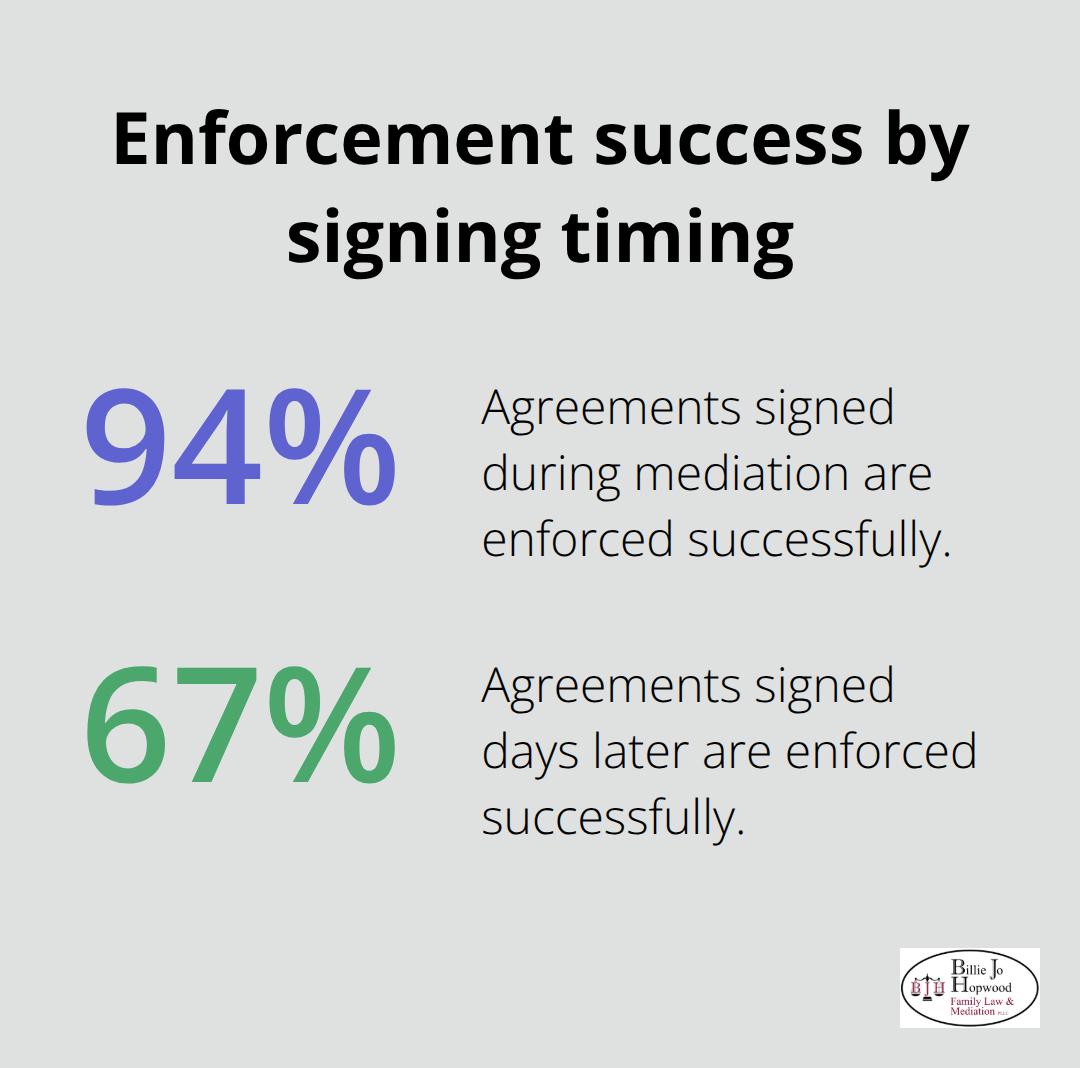
Comparison of enforcement success when signing during mediation versus days later

Immediate execution provides the strongest protection against future disputes and prevents parties from withdrawing from agreements.

Critical Documentation Standards Courts Demand

Courts examine three specific requirements when they determine enforceability: complete written terms that cover all disputed issues, signatures from parties and counsel present during mediation, and clear evidence of mutual consent without coercion. The Second District Court ruling in Parkland Condo. Ass’n, Inc. v. Henderson demonstrates that any missing signature renders agreements unenforceable regardless of extensive negotiations. Electronic signatures are now permitted under 2025 Florida mediation rules, but parties must provide written consent for representatives who sign on their behalf. The American Bar Association found that 73% of enforcement challenges stem from incomplete documentation rather than substantive disagreements about terms.

Transformation Into Court Orders and Timeframes

Mediation agreements can become court orders through a motion to enforce filed within 30 days of signature, which gives them contempt power backing. This transformation process typically takes 15 to 45 days (depending on court schedules and complexity of terms). The Eighteenth Judicial Circuit processes these motions faster than standard litigation because mediated agreements already contain negotiated terms that require minimal judicial review. Once courts convert agreements to orders, violation consequences shift from contract breach remedies to potential jail time for contempt, which makes compliance rates increase to 96% according to Florida Mediation Association data.

However, even properly executed agreements face potential challenges that can undermine their enforceability, making it essential to understand what circumstances might weaken your mediation outcome.

What Weakens Mediation Agreement Enforcement

Missing Signatures Create Immediate Vulnerabilities

The most devastating enforcement failure occurs when attorneys or parties skip signatures during mediation sessions. Florida courts reject 89% of agreements that lack complete signatures, according to Second District Court data from cases like Parkland Condo. Ass’n, Inc. v. Henderson.
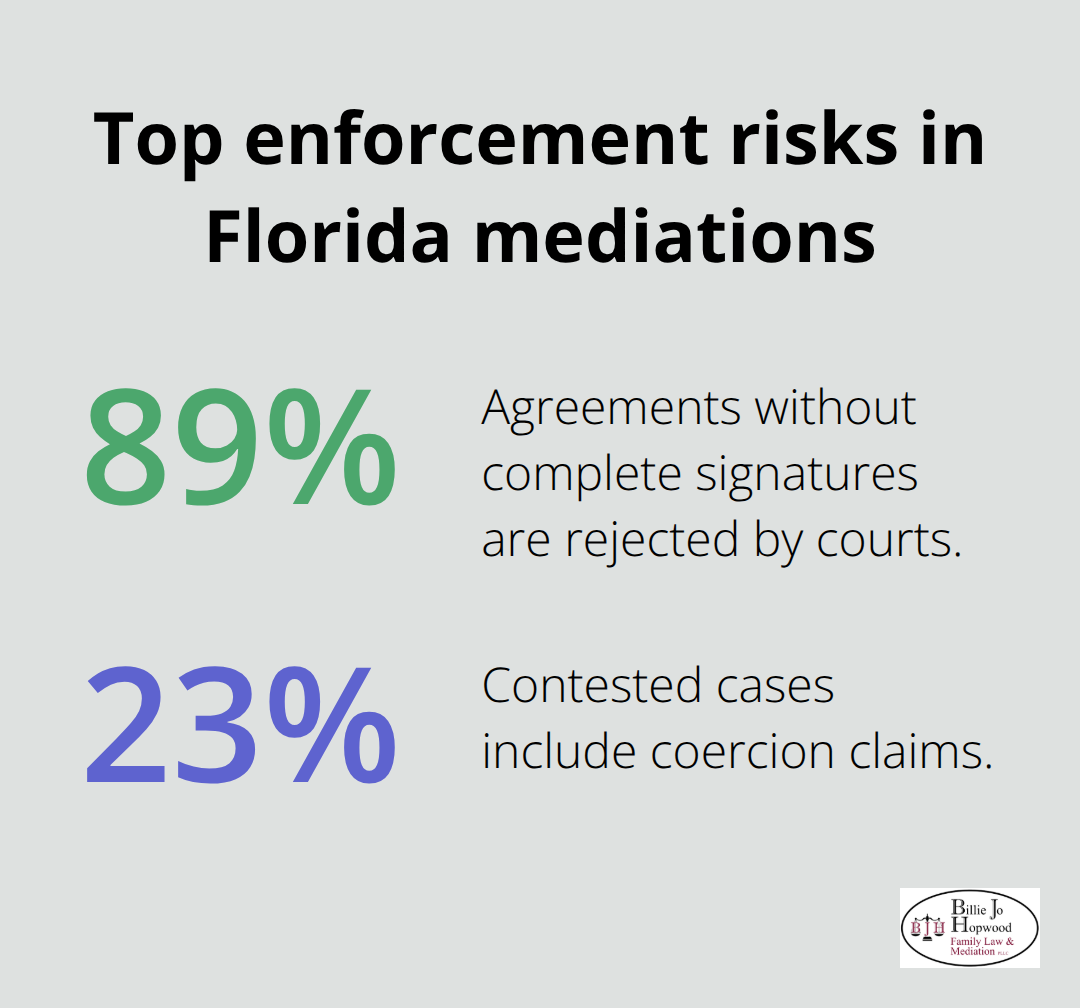
Key statistics on enforcement risks from missing signatures and coercion claims - a signed mediation agreement is enforceable under law

Coercion claims surface in 23% of contested cases, particularly when one spouse alleges pressure from opposing counsel or inadequate legal representation during negotiations.

Capacity issues arise when parties sign agreements while under medication, emotional distress, or without understanding financial implications. The Florida Supreme Court ruled in Moakley v. Smallwood that detailed factual findings are required to prove bad faith conduct (making these challenges time-consuming and expensive to resolve).

Vague Terms and Incomplete Documentation Invite Disputes

Agreements that contain unclear language about asset division, parenting schedules, or support payments face 67% higher challenge rates than those with specific terms. The phrase “reasonable visitation” leads to 45% more enforcement actions than schedules that specify exact dates and times. Financial disclosure violations particularly affect enforcement when parties hide assets or income sources during mediation sessions.

Cox v. Great Am. Ins. Co. established that courts must identify specific breaches and corresponding attorney fees to award sanctions. This requirement makes vague agreements nearly impossible to enforce effectively.

Strategic Documentation Strengthens Agreements

Include detailed timelines for all obligations, specific dollar amounts for all financial terms, and clear consequences for violations in every agreement. Require immediate signature of all parties and counsel before leaving mediation to prevent buyer’s remorse situations. Add attorney fee clauses that specify the prevailing party recovers costs under Florida Rule 1.730(d) for bad faith breaches.

Document any special circumstances like health issues, business valuations, or custody concerns that might affect future enforcement. Exchange complete financial disclosures before mediation begins to prevent later challenges based on hidden assets or income misrepresentation (which account for 31% of enforcement disputes).

Final Thoughts

A signed mediation agreement is enforceable under law when it meets Florida’s strict requirements: written documentation, complete signatures from all parties and attorneys, and clear terms that cover all disputed issues. These agreements achieve 87% compliance rates and save Melbourne Florida families $15,000 to $25,000 compared to litigation costs. Properly executed mediation agreements provide families with control over their outcomes while they maintain confidentiality that court proceedings cannot offer.

The 3.2-month average resolution time through mediation contrasts sharply with 12 to 18 months of litigation delays. Success depends on immediate signature completion during mediation sessions, detailed financial disclosures, and specific language that prevents future disputes. Missing any required element can render agreements unenforceable (regardless of extensive negotiations that occurred beforehand).

We at Billie Jo Hopwood Family Law & Mediation, PLLC guide Melbourne Florida families through every step of the mediation process, from initial documentation through final agreement execution. Our compassionate approach helps families navigate divorce, child custody, and support matters while we protect their legal interests throughout mediation. Contact us today to discuss how mediation can provide the resolution your family needs.
Divorce Lawyer or Mediation: Which Is Right for You?

Facing divorce in Melbourne Florida means choosing between two very different paths. The divorce lawyer vs mediation decision affects your finances, timeline, and family’s emotional wellbeing.

At Billie Jo Hopwood Family Law & Mediation, PLLC, we see families struggle with this choice daily. Understanding both options helps you make the right decision for your unique situation.

Understanding Divorce Mediation vs Traditional Litigation in Melbourne Florida

How Mediation Works in Practice

Divorce mediation places both spouses in the same room with a neutral third party who facilitates conversations about property division, child custody, and support arrangements. The mediator does not make decisions or take sides but guides discussions toward mutually acceptable solutions. Florida requires mediation before contested divorce cases reach trial (this makes the process mandatory for most couples who cannot agree independently). Sessions typically last 2-4 hours and most cases resolve within 2-4 sessions according to Florida court statistics.

Key Differences Between Mediation and Court Proceedings

Traditional litigation means each spouse hires separate attorneys who advocate aggressively for their client’s interests while a judge makes final decisions about your family’s future. Court proceedings become public record, follow rigid schedules, and cost between $15,000 to $30,000 per person in Florida according to recent bar association data. Mediation costs $3,000 to $7,000 total and maintains complete confidentiality. The American Bar Association reports that 80% of mediated divorces reach full settlement compared to the uncertainty and expense of trial outcomes.

When Mediation Makes the Most Sense

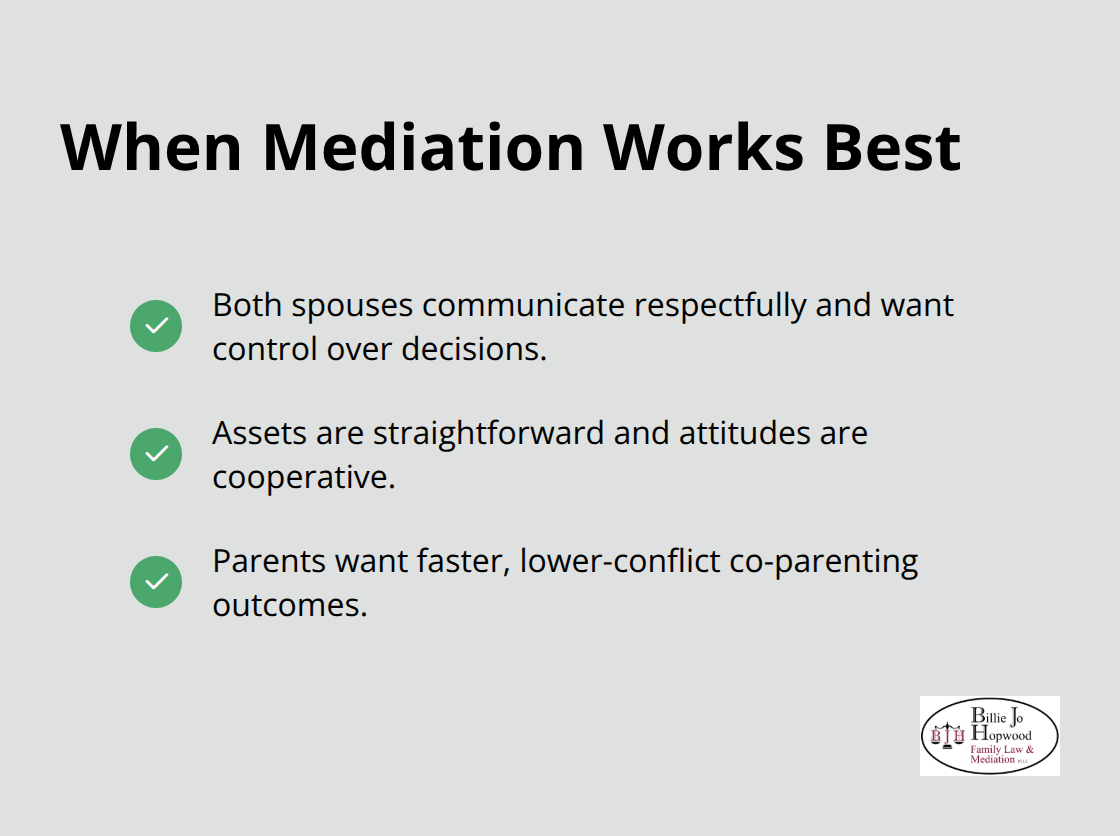
Mediation works best when both spouses can communicate respectfully and want to maintain control over decisions that affect their children and finances. Couples with straightforward asset division and cooperative attitudes benefit from mediation’s speed and cost savings. Parents should strongly consider mediation since collaborative approaches create better long-term co-parenting relationships than adversarial court battles.

Indicators that mediation is the right fit for your divorce - divorce lawyer vs mediation

When Litigation Becomes Necessary

Choose litigation when domestic violence exists, one spouse hides assets, or significant power imbalances prevent fair negotiations. High-asset cases with complex business valuations often require attorney representation (particularly when forensic accounting becomes necessary). Cases with uncooperative spouses who refuse to negotiate in good faith also need the structure and authority that only courts can provide.

These cost differences between mediation and litigation create dramatic variations in what families spend on their divorce process.

Cost Comparison: Mediation vs Hiring a Divorce Attorney

The Real Numbers Behind Litigation Expenses

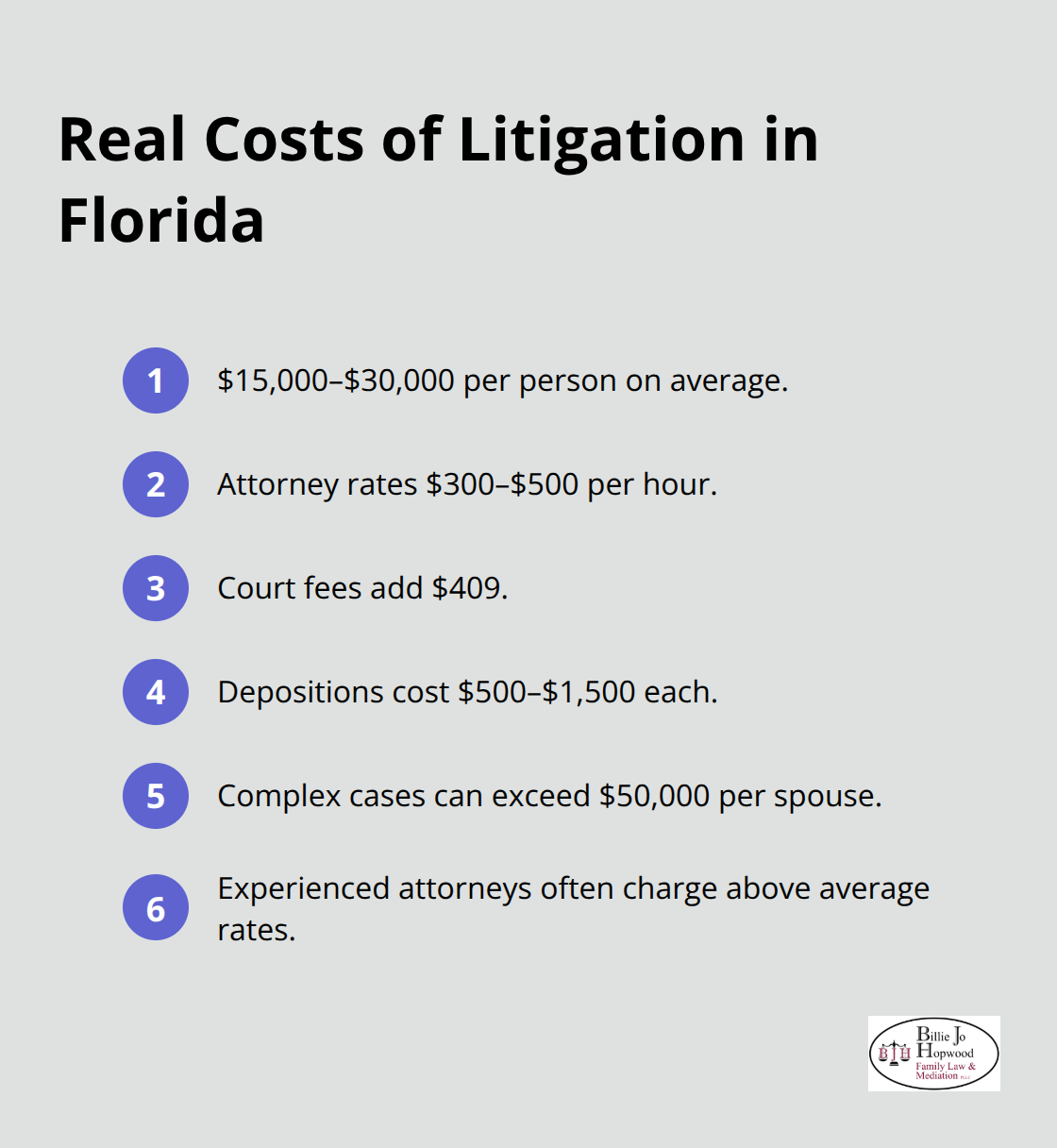
Litigated divorces in Florida average $15,000 to $30,000 per person according to the Florida Bar Association, with attorney fees that range from $300 to $500 per hour. Court fees add $409, plus additional costs for depositions that run $500 to $1,500 each. Financial affidavits, witness testimony for asset valuation, and multiple court appearances drive costs higher.

Key expense figures for litigated divorces in Florida - divorce lawyer vs mediation

Complex cases that involve business valuations or retirement account divisions often exceed $50,000 per spouse. The U.S. Bureau of Labor Statistics shows divorce attorneys average $61 per hour minimum, but experienced family law attorneys charge significantly more.

How Mediation Slashes Your Divorce Budget

Mediation costs $3,000 to $7,000 total for both spouses combined, which represents savings of 40-60% compared to litigation. Mediators in Florida charge $150 to $350 per hour according to state court data, and most cases resolve within 8-12 total hours across 2-4 sessions. Many mediators offer flat-rate packages that eliminate surprises. The American Bar Association confirms that 80% of mediated cases reach full settlement, which avoids trial costs entirely.

The Hidden Financial Traps You Must Avoid

Contested divorces create expenses beyond attorney fees that devastate family budgets. Lost wages from multiple court dates, childcare costs, and decreased work productivity compound the financial damage. Post-divorce modifications cost $2,000 to $5,000 each time circumstances change, but mediated agreements typically require fewer modifications due to better initial plans. Therapy costs for children who experience trauma from contentious proceedings add thousands more. Mediation preserves marital assets (it minimizes legal fees and leaves more money for your family’s future rather than attorney payments).

Smart Financial Preparation Strategies

Couples who organize financial documents before mediation reduce billable hours and control expenses better. Tax returns, bank statements, and asset documentation that you prepare in advance streamline the process. Flat-rate mediation packages provide cost certainty that hourly attorney fees cannot match. Evening and weekend mediation sessions prevent lost wages that court appearances typically cause.

These dramatic cost differences pale in comparison to the time and emotional toll each process takes on Melbourne Florida families.

Timeline and Emotional Impact of Each Process

How Long Each Process Takes to Complete

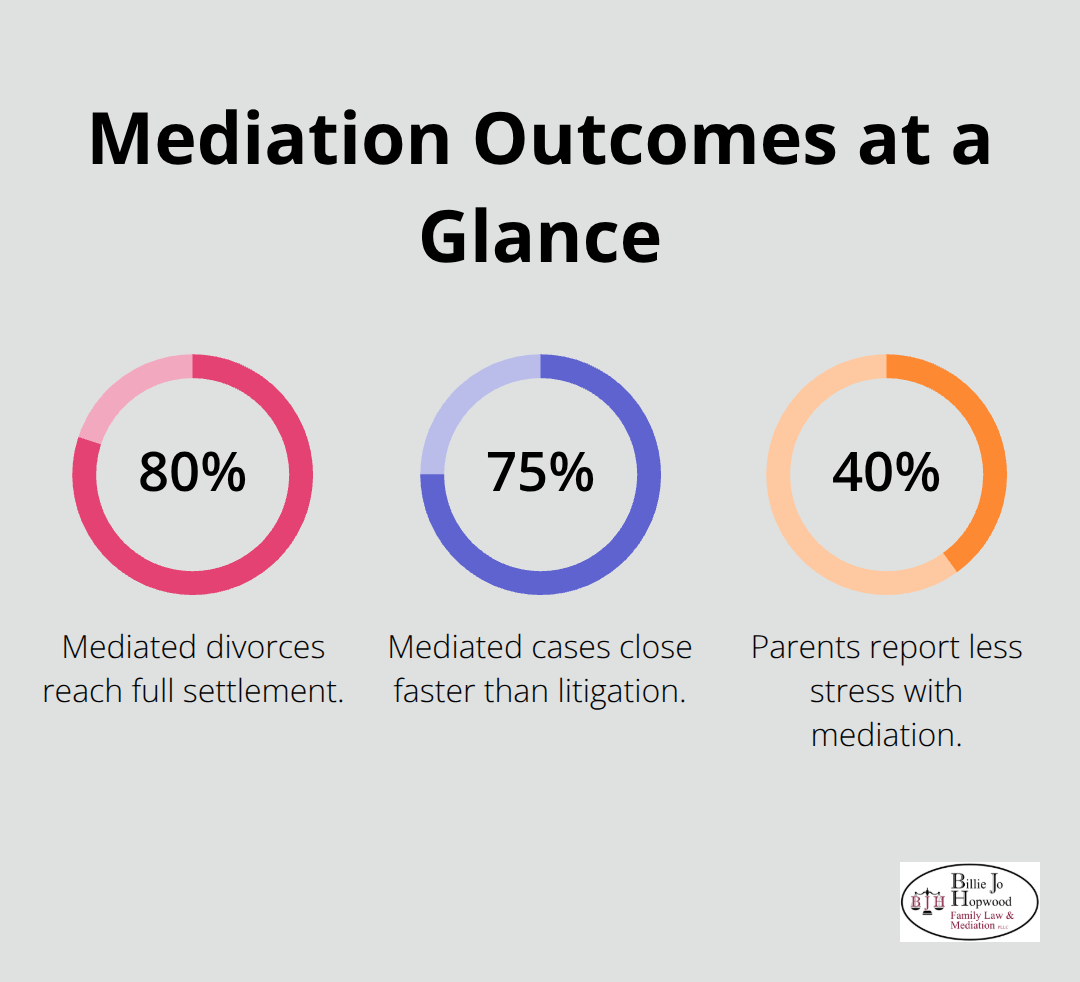
Mediation resolves divorce cases in 60 to 90 days from start to finish, while litigated divorces take 6 months to 2 years according to Florida court statistics. Contested divorces that reach trial face additional delays due to crowded court calendars and conflicts between multiple attorneys. The Florida Supreme Court reports that mediated cases close 75% faster than traditional litigation.

Key mediation success, speed, and stress reduction statistics

Couples who choose mediation attend 2-4 sessions that last 2-4 hours each, while litigation requires dozens of court appearances, depositions, and attorney meetings that stretch across many months. Mediation sessions happen on your schedule during evenings or weekends (court dates follow judicial calendars that often conflict with work and family obligations).

Stress Levels and Emotional Toll on Families

Traditional divorce litigation traumatizes families through adversarial proceedings that pit spouses against each other in public courtrooms. The adversarial nature of litigation destroys any possibility of amicable future relationships, while mediation preserves dignity and respect between former spouses. Litigation forces families to air private matters in public records while mediation maintains complete confidentiality.

Parents who mediate their divorce report 40% less stress and maintain better communication patterns that benefit children long-term. The Journal of Family Psychology found that mediated divorces produce better co-parenting relationships and reduced conflict levels post-divorce.

Impact on Children During Divorce Proceedings

Children suffer measurable psychological damage when parents engage in hostile court battles according to the American Academy of Matrimonial Lawyers. Studies show that children of litigated divorces experience higher rates of anxiety, depression, and behavioral problems compared to mediated divorces.

Children of mediated divorces adapt better to family changes because parents model cooperation rather than conflict. The collaborative approach in mediation teaches children that disagreements can be resolved through respectful communication (this creates healthier relationship patterns for their future).

Long-Term Relationship Consequences

Mediation creates a foundation for successful co-parenting that benefits families for years after divorce. Parents who mediate maintain better communication and experience fewer post-divorce conflicts that require expensive legal intervention. Litigation creates lasting resentment and hostility that makes future cooperation nearly impossible.

Making Your Decision

Your divorce lawyer vs mediation choice shapes your family’s financial future and emotional wellbeing. Mediation serves couples who communicate respectfully and want control over their decisions, while litigation becomes necessary when domestic violence exists or one spouse hides assets. The cost difference alone makes mediation attractive – $3,000 to $7,000 total compared to $15,000 to $30,000 per person for litigation.

Time matters when you face divorce in Melbourne Florida. Mediation resolves cases in 60-90 days while contested divorces drag on for 6 months to 2 years. Your children benefit from mediation’s collaborative approach, which creates better co-parenting relationships and reduces long-term conflict (litigation traumatizes families through adversarial proceedings that damage future cooperation).

Melbourne Florida families need guidance through this difficult decision. We at Billie Jo Hopwood Family Law & Mediation, PLLC help families choose the right path based on their unique situations. Our Melbourne-based firm provides both mediation services and legal representation to protect your family’s interests and future.

New Beginnings Family Law: Fresh Start After Divorce

Divorce marks the end of one chapter, but it also opens the door to new beginnings. Family law mediation in Melbourne Florida helps countless individuals navigate this transition with clarity and purpose.

At Billie Jo Hopwood Family Law & Mediation, PLLC, we understand that moving forward requires more than just legal paperwork. The path ahead involves rebuilding your financial foundation, establishing healthy co-parenting relationships, and creating stability for your family’s future.

Legal Steps for Starting Fresh After Divorce in Melbourne Florida

Your divorce decree represents just the beginning of your legal transition in Melbourne Florida. The Florida Office of the State Courts Administrator reports that 40% of individuals face complications because they fail to complete post-divorce legal requirements within the first six months. Immediate action prevents costly problems and protects your future interests.

Percentages highlighting common post-divorce issues and risks - new beginnings family law

Finalizing Your Divorce Documentation

Florida law requires specific steps after your judge signs the final divorce decree. You must obtain certified copies of all court orders within 30 days, as these documents prove your legal status for financial institutions and government agencies. The clerk’s office in Melbourne charges $2 per page for certified copies, but multiple copies save time later.

Update your Social Security records immediately. The Social Security Administration processes name changes faster when you submit documents within 60 days of your decree. Your driver’s license must reflect any name changes within 30 days under Florida Statute 322.17. The Department of Motor Vehicles requires both your certified divorce decree and updated Social Security card.

Updating Critical Legal Documents

Your estate planning documents become invalid or problematic after divorce unless you take action. Florida Statute 732.507 automatically revokes your ex-spouse as beneficiary in your will, but other documents remain unchanged. Life insurance policies, retirement accounts, and bank accounts still list your former spouse unless you actively change beneficiaries.

The average person has 12-15 accounts that require beneficiary updates (according to the American Bar Association). Contact each financial institution directly, as many require notarized forms and certified divorce copies. Your power of attorney documents need immediate attention since Florida law doesn’t automatically revoke these appointments after divorce.

Checklist of accounts and legal documents to update after divorce - new beginnings family law

Establishing Independent Financial Accounts

Opening individual bank accounts and credit cards becomes essential for your financial independence. Joint accounts remain legally accessible to both spouses until formally closed, which creates potential conflicts. Most Melbourne banks require 7-10 business days to process new account applications, so start this process before your divorce finalizes.

Apply for credit in your name only, as joint credit obligations continue indefinitely without formal agreements. The Federal Trade Commission recommends that you monitor your credit report monthly during the first year post-divorce (23% of divorced individuals discover unauthorized activity on joint accounts). This financial independence sets the foundation for your next major step: rebuilding your entire financial life from the ground up.

Rebuilding Your Financial Life Post-Divorce

Your financial reconstruction after divorce in Melbourne Florida demands immediate and strategic action. The American Institute of CPAs found that divorced individuals who create detailed budgets within 90 days recover financial stability 40% faster than those who delay. Calculate your new monthly income first, including alimony or child support payments, then list every expense from housing to groceries. Most divorced individuals experience a 27% drop in household income according to the U.S. Census Bureau, which makes precise budgets non-negotiable for survival.

Creating Your New Budget and Financial Plan

Your post-divorce budget requires complete restructuring from your married financial plan. Start with fixed expenses like rent, utilities, and insurance payments, then add variable costs such as groceries and transportation. The Consumer Financial Protection Bureau reports that single-income households spend 15% more on basic necessities compared to dual-income families. Track every dollar for the first three months to identify spending patterns and areas where you can cut costs.

Emergency funds become even more important as a single person. Financial advisors recommend saving three to six months of expenses, but divorced individuals should target six to nine months due to income volatility. Open a high-yield savings account separate from your checking account to avoid temptation. Automatic transfers of $100-200 per month build this fund steadily without requiring constant decisions.

Rebuilding Credit and Managing Debt

Your credit score becomes your lifeline for major purchases and housing decisions. The Federal Trade Commission reports that 34% of divorced individuals see their credit scores drop by 50-100 points during the first year. Open credit cards in your name only and make small purchases with full monthly payments to build positive payment history. Remove your ex-spouse as an authorized user on all accounts immediately, as their future financial mistakes will damage your credit.

Request credit limit increases every six months to improve your utilization ratio (keeping balances below 30% of available credit). Meanwhile, tackle debt strategically by paying minimums on all accounts while attacking the highest interest rate debt first. This avalanche method saves thousands in interest payments compared to paying smallest balances first.

Planning for Long-Term Financial Security

Your retirement planning needs complete overhaul after divorce. The Employee Benefit Research Institute shows that divorced women have 25% less retirement savings than married women at age 65. Maximize your 401k contributions immediately, especially if your employer offers matching funds. Open a Roth IRA if you qualify based on income limits, as tax-free withdrawals in retirement provide flexibility.

Purchase adequate life insurance to protect your children’s financial security if you become their sole provider. The National Association of Insurance Commissioners recommends coverage equal to 10-12 times your annual income for single parents. These financial decisions made today determine your long-term stability and directly impact your ability to provide consistent support for your children’s daily needs and future plans.

Co-Parenting and Child Custody Considerations

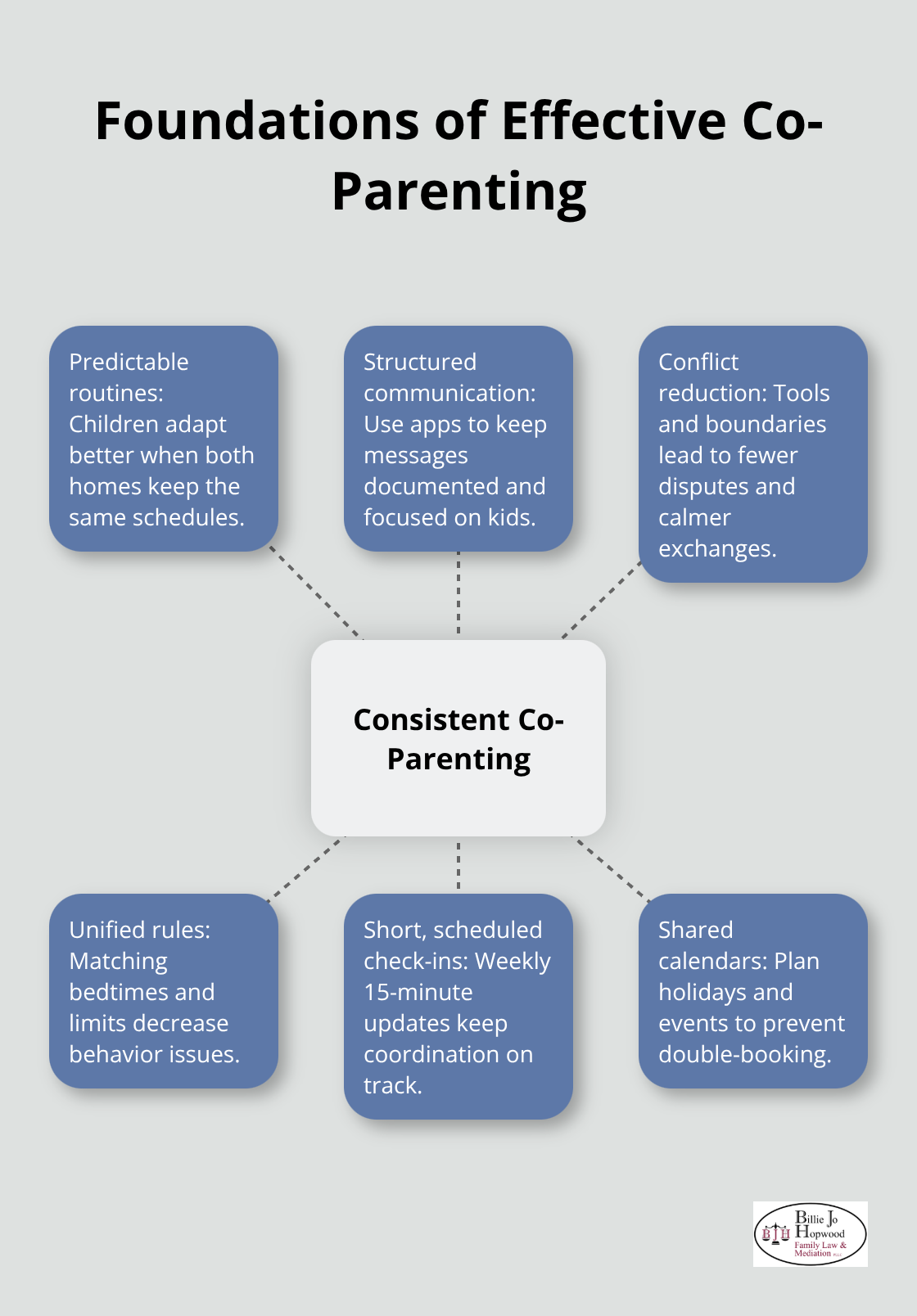
Co-parenting success after divorce in Melbourne Florida requires structured communication and unwavering consistency. The American Academy of Pediatrics reports that children adapt 60% better to divorce when parents maintain predictable routines across both households. Your communication with your ex-spouse must focus solely on your children’s needs while you avoid personal grievances that damage their emotional security. Text messages work best for routine updates about school events or medical appointments, while phone calls handle urgent matters that require immediate discussion.

Core elements that improve child adjustment and reduce conflict after divorce

Effective Communication Strategies

Communication apps like OurFamilyWizard or AppClose provide documented conversation trails that Florida courts recognize during custody modifications. These platforms prevent emotional arguments from escalation because all messages remain visible to attorneys and judges if disputes arise. The National Center for Health Statistics found that divorced parents who use structured communication tools report 45% fewer conflicts within the first year. Schedule weekly check-ins about your children’s activities, grades, and behavioral changes, but limit these conversations to 15 minutes maximum. Longer discussions often drift into personal territory that undermines your co-parenting relationship.

Stable Routines for Children

Children thrive when bedtimes, homework schedules, and disciplinary approaches remain consistent between households. The Journal of Marriage and Family published research that shows consistent rules reduce behavioral problems by 35% in children of divorced parents. You must agree on identical bedtimes, screen time limits, and consequences for misbehavior before you implement these standards. Your child should face the same expectations whether they spend Tuesday night at your house or their other parent’s home. This consistency requires coordination but prevents children from manipulation of different household rules.

Holiday and Vacation Schedules

Holiday schedules require detailed plans months in advance to avoid last-minute conflicts that stress your children. The Florida Chapter of the Association of Family and Conciliation Courts recommends that parents alternate major holidays annually rather than split individual days. Christmas Eve with one parent this year means Christmas Day with the other parent, then complete reversal next year. School events, birthday parties, and extracurricular activities need shared calendars that both parents can access (Google Calendar prevents double-booking and allows both parents to attend important milestones without awkward surprises).

Final Thoughts

Divorce in Melbourne Florida demands systematic action across legal, financial, and family domains. The steps above create your roadmap for stability and independence. Success depends on complete legal documentation updates, realistic budgets, and consistent co-parenting communication.

Professional legal guidance transforms this overwhelming process into manageable steps. We at Billie Jo Hopwood Family Law & Mediation, PLLC provide compassionate support through divorce, child custody, alimony, and child support matters in Melbourne Florida. Our mediation approach helps families reach agreements that protect everyone’s interests while reducing conflict and costs (especially important for new beginnings family law cases).

Your children benefit when parents work together through structured communication and consistent routines. Your financial recovery accelerates when you take immediate action on budgets and credit rebuilding. These combined efforts create the foundation for your family’s positive future, where stability replaces uncertainty and cooperation replaces conflict.

Military Family Law: Unique Challenges and Solutions

Military families face distinct legal challenges that civilian families rarely encounter. Frequent relocations, deployments, and complex benefit structures create obstacles in divorce and custody proceedings.

At Billie Jo Hopwood Family Law & Mediation, PLLC, we understand how military family law requires specialized knowledge of federal protections and interstate regulations. These cases demand strategic planning to protect both service members and their families.

What Makes Military Family Law So Complex?

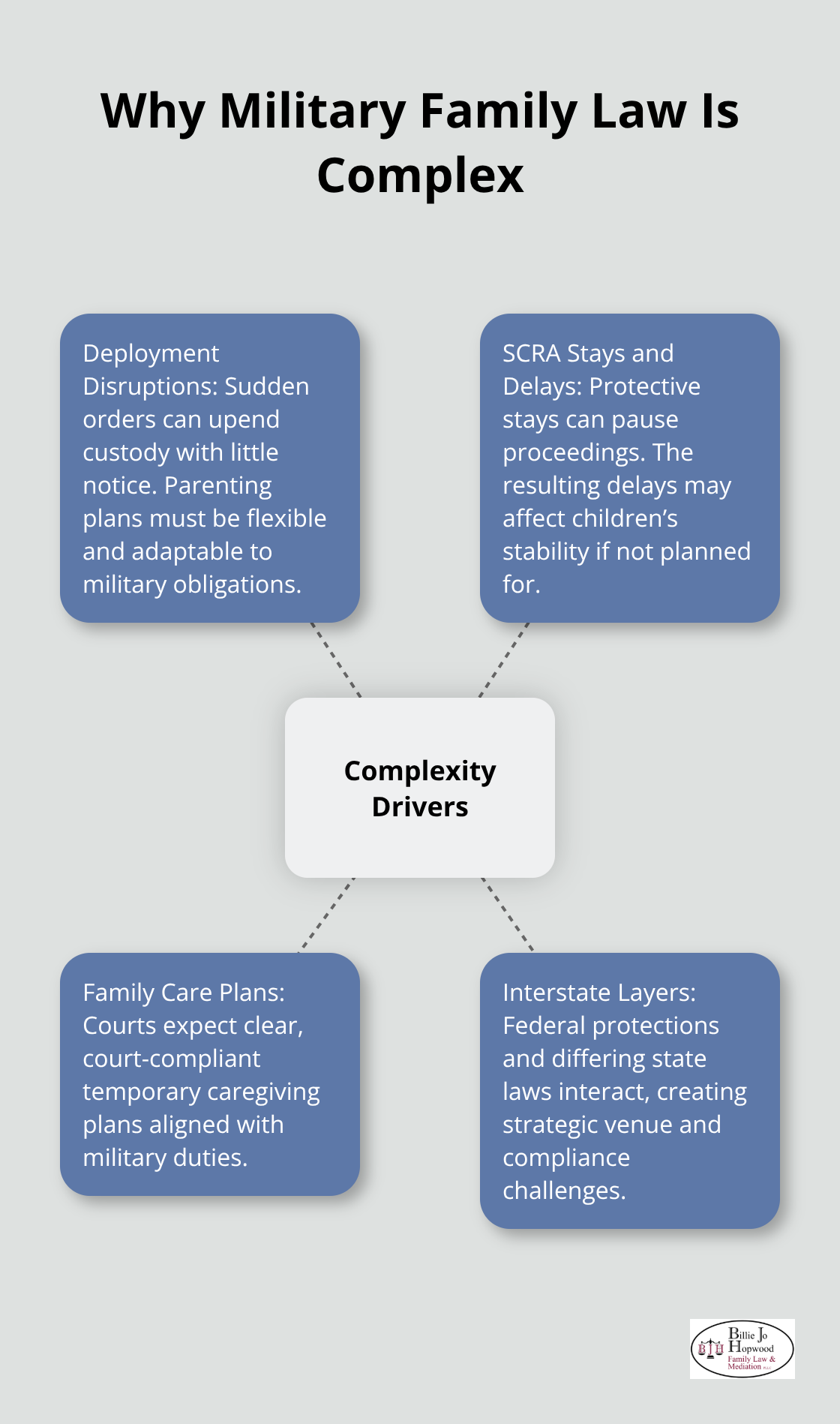
Military families face three interconnected legal challenges that civilian families never encounter. Deployment schedules disrupt custody arrangements without warning, and courts must adapt traditional parenting plans to unpredictable military obligations. The Servicemembers Civil Relief Act provides some protection when service members request stays of proceedings, but this protection creates delays that can harm children’s stability. Courts increasingly require military parents to establish Family Care Plans before deployment, which outline temporary custody arrangements that must comply with existing court orders while they accommodate military duties.

Key drivers that make military family law cases uniquely complex

Jurisdiction Shopping Creates Strategic Advantages

Service members can file for divorce in their state of legal residency, where they’re currently stationed, or where their spouse resides. This jurisdictional flexibility creates significant strategic opportunities since property division laws vary dramatically between states. Community property states like California split assets 50-50, while equitable distribution states like Florida consider multiple factors (including marriage length and economic circumstances). Military families often choose jurisdiction based on which state offers the most favorable laws for their specific situation, which makes early legal consultation essential for protecting financial interests.

Military Benefits Transform Property Division Calculations

Military retirement pay division follows the Uniformed Services Former Spouses Protection Act, which treats pensions as marital property regardless of marriage duration. The 10/10 Rule allows former spouses married for at least 10 years during creditable service to receive direct payments from the Defense Finance Accounting Service. However, the 2017 frozen benefit rule caps former spouse benefits at the service member’s rank and years of service at divorce time (preventing them from benefiting from future promotions). Veterans disability benefits remain non-divisible, but service members can waive retirement pay to receive disability compensation, potentially eliminating the former spouse’s pension share entirely.

These complex legal frameworks set the foundation for understanding how military families must approach custody and support decisions differently than civilian families.

How Do Military Families Navigate Custody and Support

Military custody arrangements demand aggressive advance planning because traditional parenting schedules fail under deployment pressures. Courts now require military parents to submit detailed Family Care Plans before deployment, which must designate temporary caregivers and maintain compliance with existing custody orders. The Department of Defense requires service members to consult with the other parent when they create these plans, but conflicts still arise when Family Care Plans contradict court orders. Smart military parents establish delegation clauses in their original custody agreements, which allow grandparents or other family members to exercise visitation rights during deployments.

Child Support Calculations Include Military-Specific Income

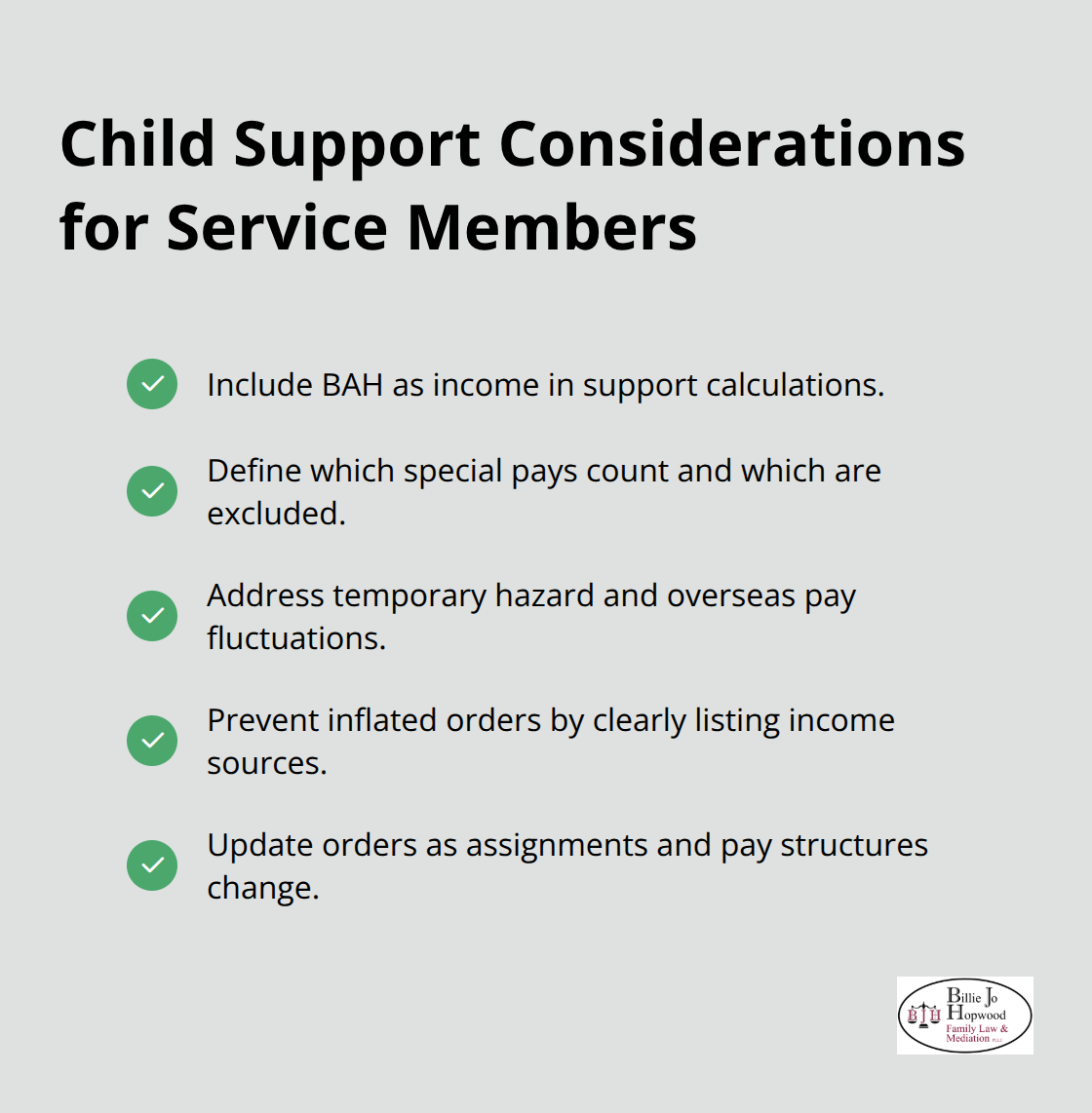
Military child support calculations must include Basic Allowance for Housing and other military-specific compensation beyond base pay. Courts treat BAH as income even though it’s tax-free, which significantly increases support obligations for service members. The challenge intensifies when service members receive overseas duty pay or hazard pay, as these temporary increases can inflate support calculations unfairly. Military parents should request that support orders specify which types of military pay count as income and which should be excluded (preventing future disputes when pay structures change with new assignments).

Military-specific income factors to address in child support orders - military family law

Interstate Enforcement Creates Collection Problems

Military families face unique interstate custody enforcement problems because frequent relocations complicate court jurisdiction and payment processing. The Uniform Interstate Family Support Enforcement Act helps, but delays occur when military parents move between states with different enforcement mechanisms. Service members must update their Defense Finance Accounting Service information immediately after custody modifications to prevent payment errors that can take months to resolve. Military parents should establish automatic payment systems through military pay systems rather than rely on state enforcement agencies (which often struggle to locate frequently moving service members).

Deployment Schedules Disrupt Standard Parenting Plans

Standard parenting plans collapse when deployment orders arrive with little notice. Courts increasingly require military parents to address deployment scenarios in their original custody agreements rather than modify orders each time military duties interfere. The Servicemembers Civil Relief Act allows service members to request stays of proceedings, but this protection creates delays that can harm children’s stability. Military parents who proactively plan for deployment scenarios avoid emergency court hearings and protect their parental rights during extended absences.

These custody and support challenges highlight why military families need legal protections that go beyond standard family law remedies.

What Legal Protections Do Military Families Actually Have

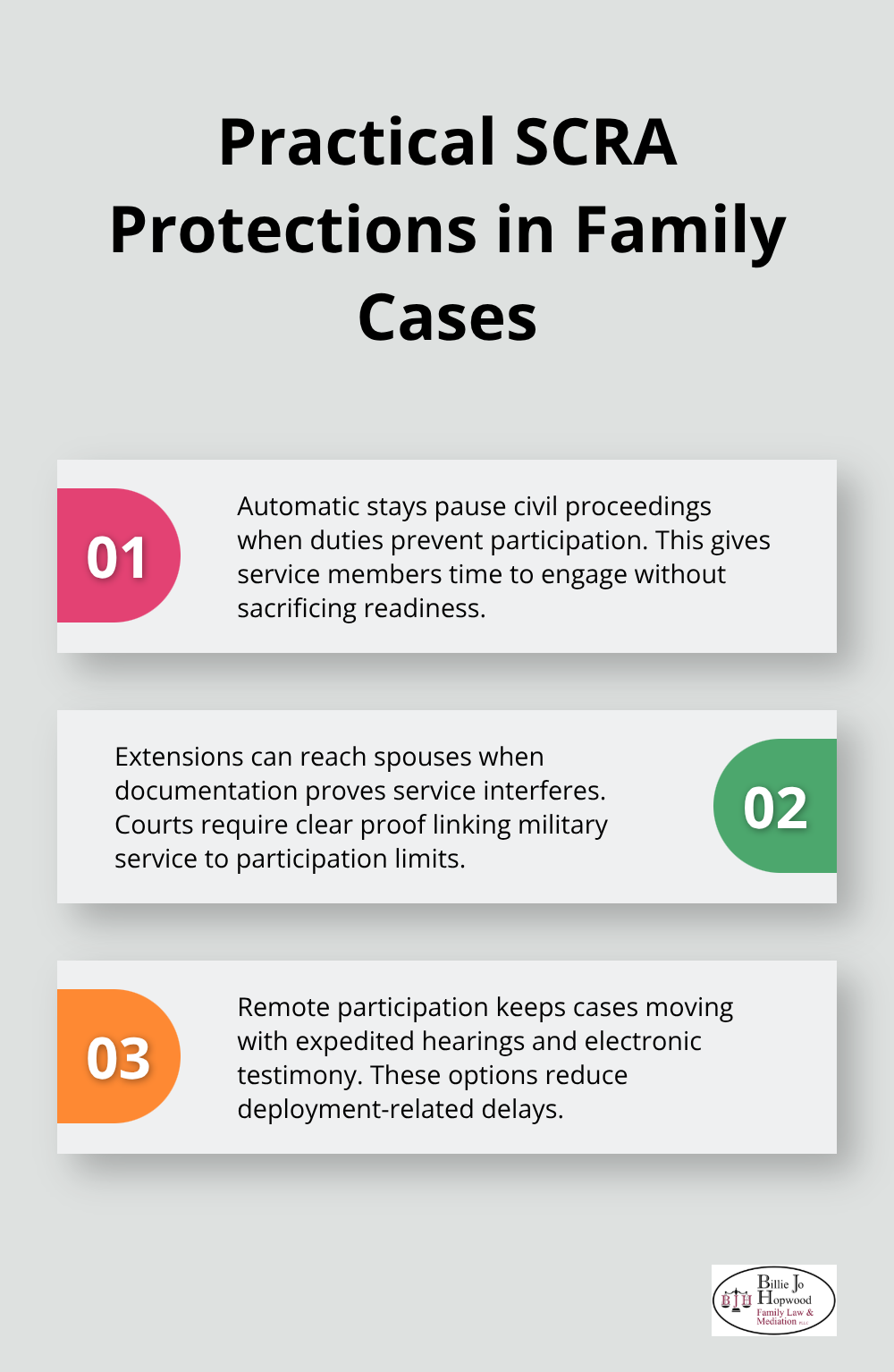
The Servicemembers Civil Relief Act provides military families with powerful but limited legal shields that many families fail to use effectively. Service members can request automatic stays of all civil proceedings, including divorce and custody cases, when military duties prevent their participation. This protection extends to spouses in some circumstances, but courts require specific documentation that proves military service directly interferes with legal participation. The SCRA also allows military parents to request expedited court hearings and electronic testimony when they cannot appear in person, which prevents cases from stalling indefinitely during deployments.

How the SCRA helps service members and families during divorce and custody cases

Military Family Life Counselors Offer Strategic Advantages

Military Family Life Counselors provide confidential support services that can strengthen your position in family law proceedings. These counselors help families develop communication strategies and document family dynamics, which courts often consider when they make custody decisions. MFLCs cannot testify in court proceedings, but their documentation of family counseling efforts demonstrates good faith attempts to resolve conflicts outside of litigation. Smart military families use MFLC services to create paper trails that show their commitment to family stability, which influences judges during custody evaluations.

Base Legal Assistance Office Limitations

Base Legal Assistance Offices provide free initial consultations and document preparation, but they cannot represent service members in contested family law cases or provide strategic litigation advice. These offices excel at preparation of simple divorce paperwork and explanation of military benefit divisions, but they refer complex cases to civilian attorneys. Military legal assistance attorneys cannot advise on state-specific family law variations or represent clients in court (which limits their usefulness for contested custody battles or property division disputes). Service members need civilian attorneys for complex cases that require courtroom representation and strategic planning.

State-Specific Military Protections Vary Significantly

Many states have enacted their own laws that enhance protections for servicemembers beyond federal SCRA requirements. These state laws often prevent permanent custody changes during military deployment and require courts to reinstate original custody orders upon return from deployment. The burden of proof lies with the non-deployed parent when they seek to alter custody arrangements in states with military-specific laws. Service members must research their state’s specific military family law protections because these laws vary dramatically across jurisdictions.

Final Thoughts

Military family law success demands proactive action and strategic decisions that civilian families never face. Service members must establish comprehensive Family Care Plans before deployments, create delegation clauses in custody agreements, and document all military-specific income sources for accurate support calculations. The most successful military families address deployment scenarios in their original custody agreements rather than seek emergency modifications when orders arrive.

Attorneys who understand both federal military protections and state-specific family law variations make the difference between favorable outcomes and costly mistakes. Base Legal Assistance Offices provide valuable initial guidance, but contested cases require civilian representation with courtroom experience and strategic litigation skills. Complex military family law cases need attorneys who can navigate both federal regulations and state court systems effectively.

We at Billie Jo Hopwood Family Law & Mediation, PLLC help military families through divorce, custody, and support matters in Melbourne, Florida. Military families should maintain ongoing relationships with Military Family Life Counselors and stay informed about state laws that affect their rights (particularly during relocations between different jurisdictions). Regular consultation with knowledgeable attorneys prevents small issues from becoming major legal problems during deployments or relocations.

Is Mediation Mandatory in Family Law Cases?

Florida family law cases often leave parents wondering: is mediation compulsory in family law disputes? The answer depends on your specific situation and the judge’s discretion.

We at Billie Jo Hopwood Family Law & Mediation, PLLC see many Melbourne families required to attempt mediation before their case reaches trial. Understanding these requirements can save you time and money while protecting your family’s interests.

When Is Mediation Required in Florida Family Cases

Court Authority to Order Mediation

Florida statutes grant judges broad discretion to order mediation in family law cases. The Eighteenth Judicial Circuit (which includes Brevard County where Melbourne is located) routinely requires mediation before trial in dissolution of marriage and paternity cases. Judges can mandate mediation at any point during proceedings, typically after initial pleadings but before trial preparation begins. This requirement applies to contested divorces, child custody disputes, and modification cases where parties cannot reach agreements independently.

Financial Thresholds and Fee Structure

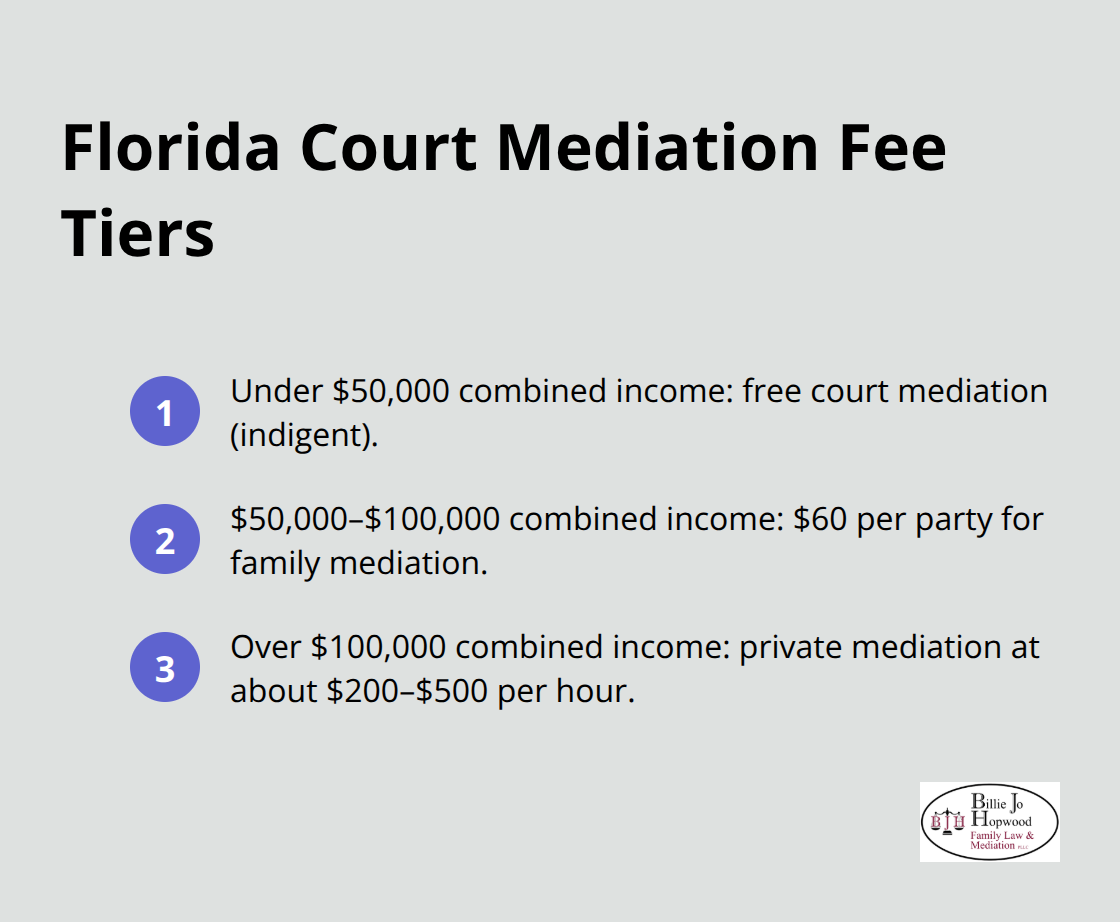
The court mediation program operates on an income-based fee system that determines eligibility. Couples with combined incomes under $50,000 qualify for free mediation as indigents. Those who earn between $50,000 and $100,000 pay $60 per party for family mediation services. Families with combined incomes that exceed $100,000 become ineligible for court-provided mediation and must seek private mediators at significantly higher costs, often from $200 to $500 per hour.

Income-based fee tiers for Florida family court mediation - is mediation compulsory in family law

Domestic Violence and Safety Exceptions

Courts waive mediation requirements when domestic violence allegations exist or child safety concerns arise. These exceptions protect vulnerable parties from power imbalances that could compromise fair negotiations. Judges can bypass mediation entirely in urgent situations that require immediate protective measures. However, parties must prove domestic violence with documentation such as police reports, restraining orders, or medical records. Without substantial evidence, courts rarely grant these exceptions, which makes mediation mandatory for most family disputes in Melbourne.

The specific types of family law cases that trigger these mediation requirements vary significantly based on the nature of your dispute and the complexity of issues involved.

Which Family Cases Trigger Mediation Requirements

Melbourne family courts mandate mediation for three primary categories of disputes that create the highest conflict levels and court backlogs. Dissolution of marriage cases automatically trigger mediation requirements when couples cannot agree on asset division, debt allocation, or retirement account distribution. The Eighteenth Judicial Circuit requires mediation in 85% of contested divorce cases, with property disputes that involve businesses, real estate, or investments over $50,000 that receive immediate mediation orders. Courts also mandate mediation when one spouse seeks alimony modification or disputes the duration of spousal support payments.

Child Custody Disputes Drive Most Mediation Orders

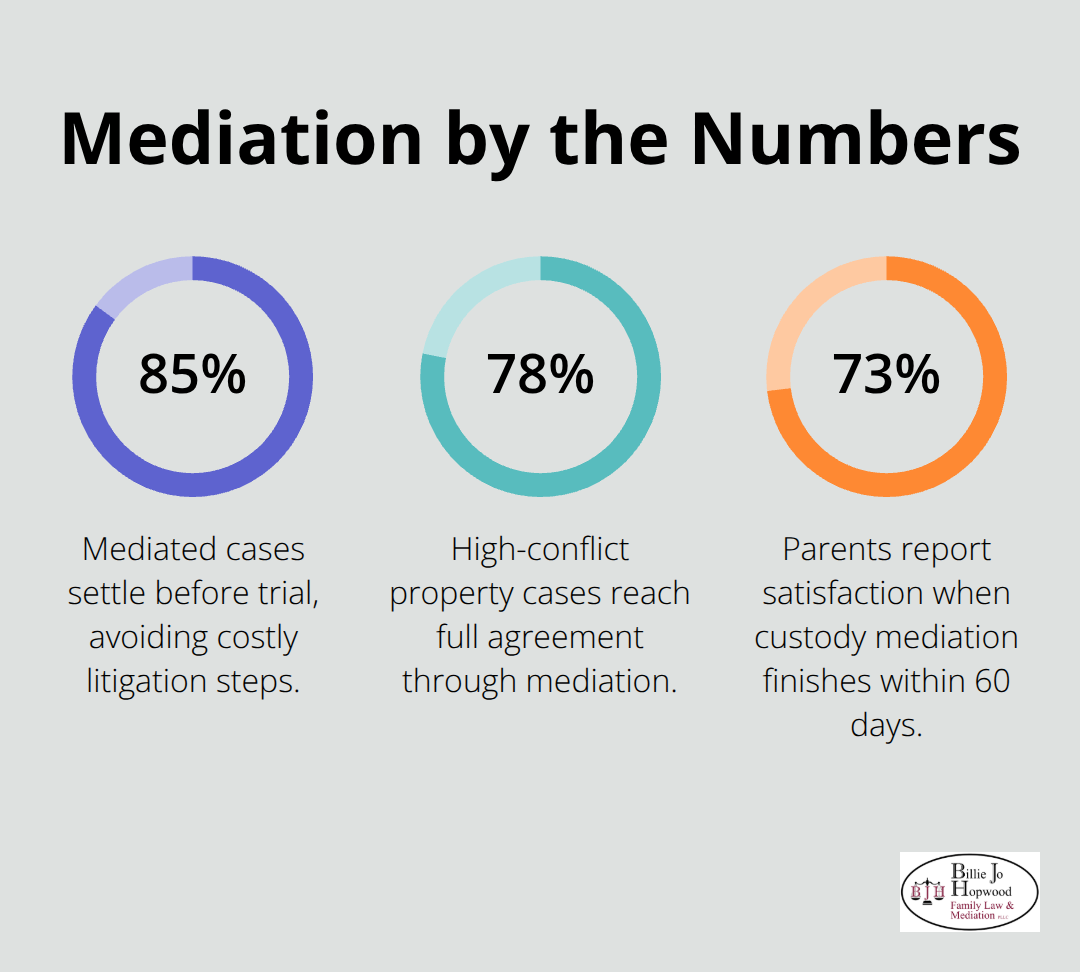
Parenting time conflicts generate the highest number of court-ordered mediations in Brevard County family courts. Judges require mediation when parents disagree on overnight schedules, holiday arrangements, or relocation requests that affect time-sharing. Florida courts mandate mediation for all parenting plan modifications, whether parents seek changes to primary residence, school district decisions, or extracurricular activity participation. Child custody mediations resolve successfully in 78% of cases (according to Florida State Courts data), which makes them highly effective for reduction of trial backlogs.

Key requirement and success rates for family mediation

Support Modification Cases Face Automatic Mediation

Child support and alimony modification petitions trigger automatic mediation requirements when the party who requests demonstrates substantial income changes that exceed 15% or involuntary job loss. Courts require mediation for parents who seek child support adjustments due to shared custody changes, medical expense disputes, or college cost disagreements. Melbourne judges mandate mediation for all retroactive support claims and contempt actions before they schedule enforcement hearings, which gives parties one final opportunity to negotiate payment plans or modification agreements without trial intervention.

Emergency Situations Override Standard Requirements

Courts bypass standard mediation requirements when immediate protection becomes necessary for children or vulnerable family members. Judges can order temporary relief in cases that involve domestic violence allegations, child abuse reports, or threats to family safety. These emergency orders allow courts to establish temporary custody arrangements, protective measures, or financial support without the typical mediation process (though mediation may still be required later for permanent arrangements).

The advantages of mediation extend far beyond simple court compliance, particularly when families consider the financial and emotional costs of traditional litigation.

Why Choose Mediation Over Court Battles

Financial Reality Check

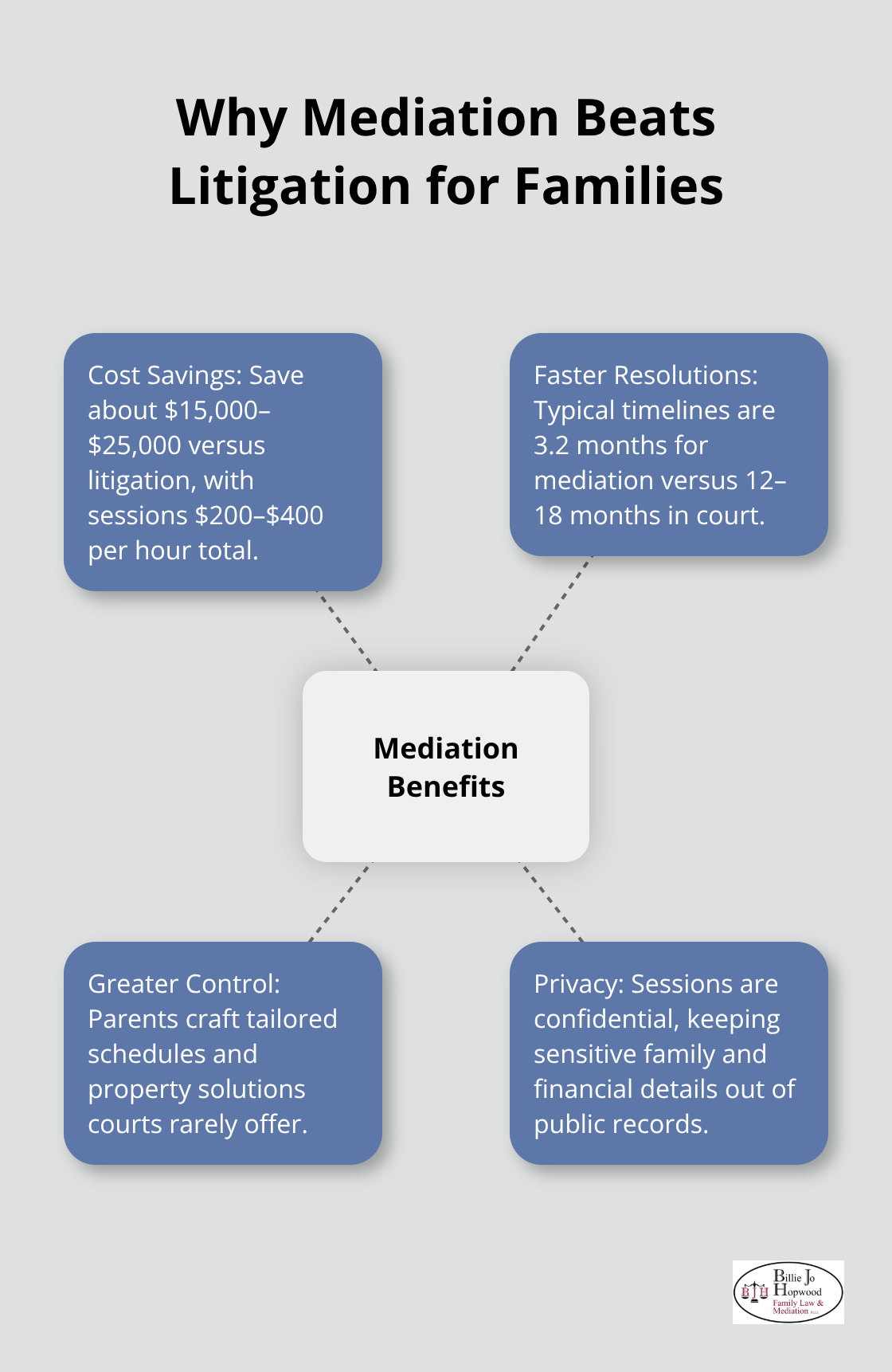
Melbourne families save an average of $15,000 to $25,000 when they choose mediation instead of litigation. Court proceedings drag on for 12 to 18 months and accumulate attorney fees that range from $300 to $500 per hour for each party. Mediation sessions cost between $200 to $400 per hour total (split between parties), and most family disputes resolve within 4 to 8 sessions. The Florida State Courts report that mediated cases conclude in an average of 3.2 months compared to traditional litigation that stretches beyond one year. Discovery costs, court fees, and depositions add another $8,000 to $12,000 in litigation expenses that mediation completely eliminates.

Speed Advantage That Matters

Mediation sessions can be scheduled within 2 to 4 weeks, while court dates often get pushed out 6 to 9 months due to overcrowded dockets in Brevard County. The Eighteenth Judicial Circuit handles over 3,500 family law cases annually and creates significant delays for trial schedules. Mediated agreements become legally bound once signed and filed with the court (typically within 1 to 2 weeks after the final session). Litigation requires multiple court appearances, motions, and procedural delays that keep families in limbo for extended periods.

Core benefits of choosing mediation over court - is mediation compulsory in family law

Control Your Own Outcome

Judges make final decisions based on Florida statutes and precedent, not your family’s unique circumstances. Mediation allows parents to craft creative schedules that work around shift work, travel demands, or special needs children. Property division through mediation can accommodate sentimental attachments, business partnerships, or retirement plans that courts rarely consider. The success rate for voluntary compliance with mediated agreements reaches 87% according to Florida State Courts data, while court-ordered arrangements see violation rates above 40% within the first year after judgment.

Privacy Protection Benefits

Court proceedings become public record and expose sensitive family information to anyone who requests case files. Mediation sessions remain completely confidential (except as required by law for disclosure). Private mediation protects children from public scrutiny of custody disputes and shields financial details from business partners or employers. This privacy advantage becomes particularly valuable for families with professional reputations or business interests that could suffer from public litigation exposure.

Final Thoughts

Florida family courts maintain broad authority to order mediation in contested cases, though the question “is mediation compulsory in family law” depends on your specific circumstances and judicial discretion. The Eighteenth Judicial Circuit routinely requires mediation for dissolution of marriage and paternity disputes, with income-based fees that range from free services for families who earn under $50,000 to $60 per party for moderate-income households. Voluntary mediation offers significant advantages over court orders that families must wait to receive.

Melbourne families who choose mediation early save $15,000 to $25,000 compared to litigation while they resolve disputes in 3.2 months instead of 12 to 18 months. The 87% compliance rate for mediated agreements demonstrates the effectiveness of collaborative solutions. Action before court intervention allows families greater control over outcomes and preserves relationships that matter most for children’s wellbeing.

We at Billie Jo Hopwood Family Law & Mediation, PLLC guide Melbourne families through both voluntary and court-ordered mediation processes. Our compassionate approach helps families navigate divorce, child custody, alimony, and child support matters while we protect their interests and minimize conflict. Contact us today to discuss how mediation can benefit your family’s unique situation (before the court makes that decision for you).

Understanding Family Law Summons

A family law summons represents one of the most serious legal documents you can receive. This official court notice demands your immediate attention and response within strict deadlines.

We at Billie Jo Hopwood Family Law & Mediation, PLLC see many people make costly mistakes when they don’t understand their obligations after receiving a summons family law document. The consequences of mishandling this process can permanently affect your family’s future.

What Exactly Is a Family Law Summons

Legal Function and Court Authority

A family law summons acts as the official trigger for legal proceedings that will reshape your family structure. The Florida FL-110 form (effective since January 1, 2015) carries the full weight of court authority and legally binds you to participate in the case. This document transforms a private family matter into a public legal dispute under judicial oversight.

The summons grants the court jurisdiction over both parties and establishes the legal framework for decisions about your children, finances, and property. Florida courts process approximately 200,000 family law cases annually, with each summons marking the beginning of a process that typically takes 6-12 months to resolve.

Types and Timing in Florida Family Law

Florida family law summons appear in divorce proceedings, child custody modifications, paternity actions, domestic violence cases, and support enforcement matters. The state requires different summons forms depending on whether children are involved and the specific relief requested.

Courts issue summons when one party files a petition that seeks legal action against another family member. Divorce summons represent 65% of all family law filings in Florida, followed by custody modifications at 20% and paternity cases at 10%.

Percent of Florida family law summons by case type: divorce, custody modifications, and paternity cases. - summons family law

Response Deadlines and Default Consequences

The summons activates your 20-day response deadline if served within Florida or 30 days if served outside the state. This timeline starts from the date you receive the documents, not when they were filed with the court.

Missing this deadline triggers default proceedings where the court can grant the other party everything they requested without your input. Default judgments occur in approximately 30% of family law cases statewide, often because respondents fail to understand the urgency of their situation.

Once you receive this document in Melbourne, Florida, you face immediate legal obligations that demand swift action and careful consideration.

Receiving a Family Law Summons in Melbourne Florida

The moment a family law summons arrives at your Melbourne address, you become legally bound to participate in court proceedings whether you want to or not. Florida law treats service of process as complete delivery of legal notice, which means claims that you didn’t understand the document or hoped it would disappear carry zero legal weight. Your signature isn’t required on the summons itself – proper service occurs when the document reaches you through an authorized process server, sheriff’s deputy, or certified mail.

Immediate Legal Obligations After Service

Florida Statute 48.031 requires you to file a written response within the specified timeframe or face automatic default judgment. The court doesn’t care about your work schedule, vacation plans, or financial stress – these deadlines are absolute. Melbourne residents served on a Friday must still meet the same 20-day deadline as someone served on a Monday. The Brevard County Clerk’s office reports that 40% of family law respondents in the county miss their initial deadline, which creates unnecessary complications and expenses. You must file your response with the same court that issued the summons and serve a copy on the attorney for the other party (or the other party directly if they represent themselves). This dual requirement means simply mailing a letter to your spouse won’t satisfy Florida’s legal standards.

Default Judgment Consequences

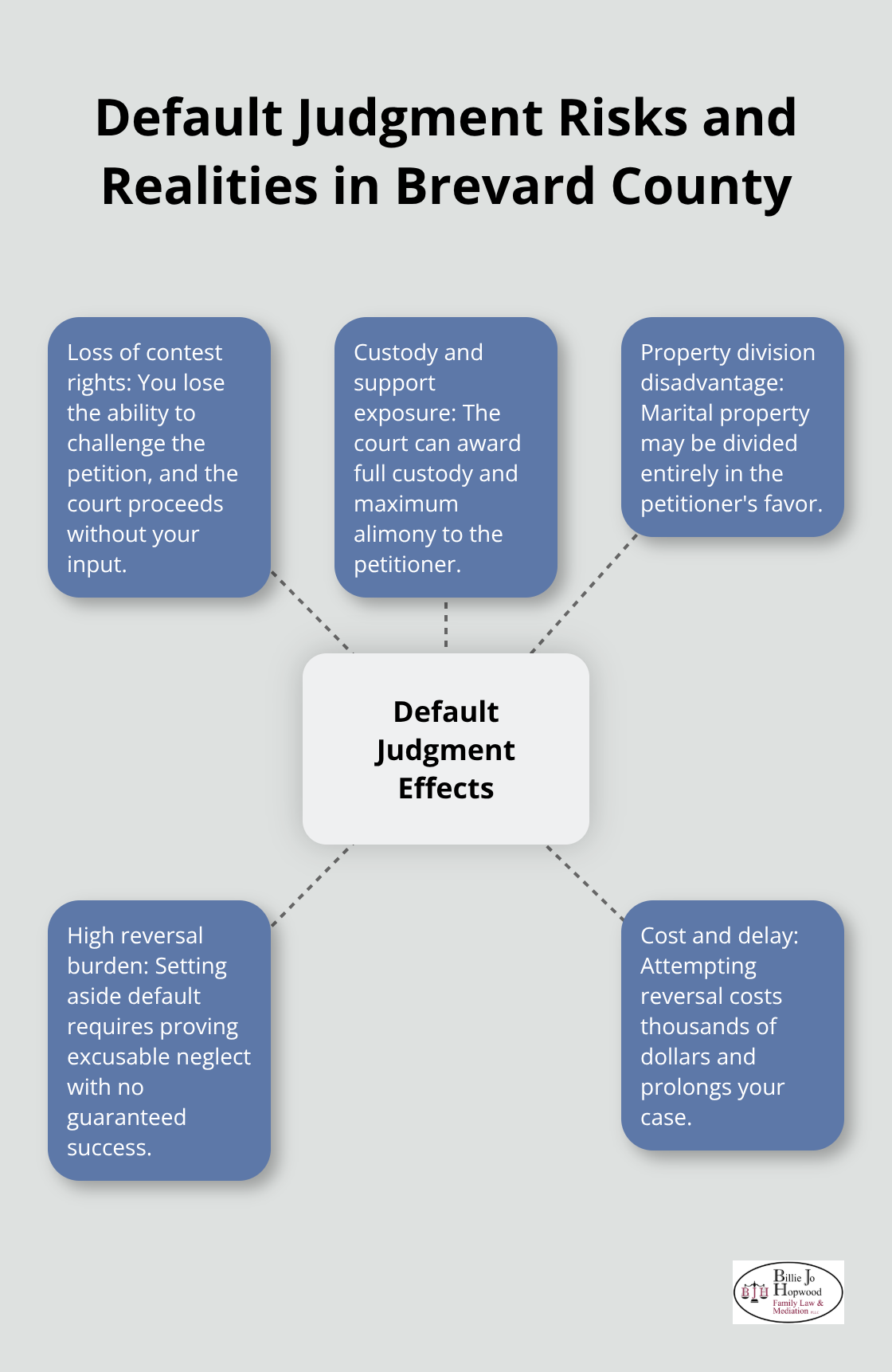
When you ignore a family law summons in Melbourne, you trigger default proceedings that strip away your right to contest any requests in the petition. The court can award the petitioner full custody of your children, maximum alimony payments, and division of marital property entirely in their favor without hearing your side. Brevard County courts granted default judgments in 35% of contested family law cases in 2024, with the majority involving respondents who simply failed to respond to their summons. To reverse a default judgment, you must prove excusable neglect to the court, a process that costs thousands in legal fees and offers no guarantee of success.

Hub-and-spoke diagram showing the effects and risks of default judgments in Brevard County family law cases. - summons family law

Time-Sensitive Actions Required

Once you receive your summons, you must immediately calculate your response deadline and begin preparation of your answer. Florida courts don’t accept late filings except in extraordinary circumstances, and judges rarely show sympathy for missed deadlines. You need to gather financial documents, identify witnesses, and determine what relief you want to request from the court. The clock starts ticking the moment you receive the summons, not when you decide to take action.

How to Respond to a Family Law Summons

Take Action Within 48 Hours of Service

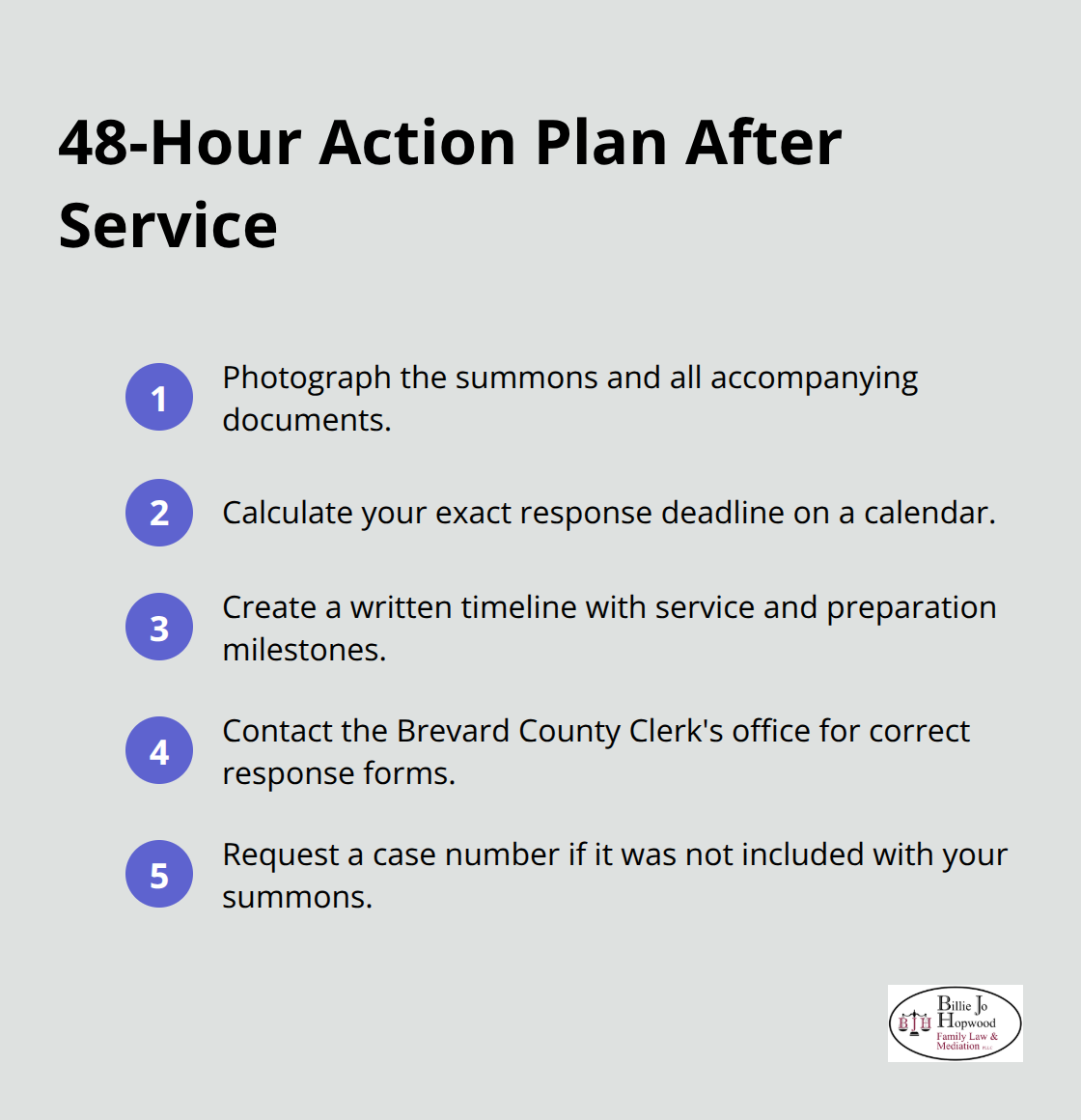
Your first 48 hours after you receive a family law summons determine whether you maintain control over your case or surrender it to the other party. Photograph the summons and all documents that accompany it, then calculate your exact response deadline with a calendar. Florida courts don’t accept excuses about miscounted days or confusion about weekends and holidays.

Create a written timeline that includes your response deadline, the date you must serve the other party, and key preparation milestones. Contact the Brevard County Clerk’s office immediately to obtain the correct response forms for your case type. The clerk’s office processes over 15,000 family law documents annually and can provide the forms you need for divorce responses, custody modifications, or support enforcement cases.

Five quick steps to take within 48 hours after being served a family law summons in Melbourne, Florida.

You must also request a case number if one wasn’t included with your summons, as all future documents require this identifier.

Complete Your Written Response Correctly

Your written response must address every single allegation in the petition. You must either admit, deny, or state you lack sufficient knowledge to form a belief about each claim. Florida law treats any unanswered allegation as automatically admitted, which means silence equals agreement in court.

The standard response form requires your full legal name, current address, telephone number, and case details exactly as they appear on the summons. You must also file any counterclaims or requests for relief in this initial response, as Florida courts rarely allow additional claims after the deadline passes.

Brevard County courts reject approximately 25% of initial responses for technical defects (missing signatures, incorrect case numbers, or incomplete address information). After you complete your response, make three copies: one for the court file, one for the other party or their attorney, and one for your records.

File and Serve Your Response

File the original with the clerk and pay the required fee, which ranges from $295 to $409 based on your case type and whether you request a jury trial. Florida law requires you to serve a copy of your response on the other party within the same timeframe as your court submission.

You can accomplish this through certified mail, personal service by a process server, or hand delivery to the attorney’s office. The person who serves the documents must complete an affidavit of service and file it with the court as proof of compliance.

Prepare for Case Management Conference

After you file your response, the court will schedule a case management conference within 90 days where both parties must appear. This conference covers settlement possibilities, discovery procedures, and trial schedules. Both parties must discuss these matters under judicial supervision, which makes proper preparation vital for protection of your interests throughout the remainder of the case.

Final Thoughts

A summons family law document demands immediate action that can protect or destroy your family’s future. The 20-day response deadline in Florida leaves no room for procrastination or wishful thinking. Default judgments strip away your parental rights, financial security, and voice in decisions that affect your children for years to come.

Professional legal guidance transforms an overwhelming process into manageable steps with clear outcomes. We at Billie Jo Hopwood Family Law & Mediation, PLLC help Melbourne families navigate divorce, child custody, alimony, and child support matters. Our approach protects your interests throughout the legal process while you face the stress and uncertainty that comes with family law proceedings.

Your next step involves immediate action to preserve your rights. Calculate your response deadline, gather required documents, and contact Billie Jo Hopwood Family Law & Mediation, PLLC for guidance tailored to your specific situation. The decisions you make in the coming days will shape your family’s future (making professional representation an investment in your long-term stability and peace of mind).

Legal Definition of Immediate Family Members

The immediate family definition law varies significantly across different legal contexts, creating confusion for many families navigating their rights and obligations.

At Billie Jo Hopwood Family Law & Mediation, PLLC, we see how these varying definitions impact inheritance disputes, medical decisions, and employment benefits daily. Understanding who qualifies as immediate family under different laws protects your family’s interests and prevents costly legal complications.

Who Qualifies as Immediate Family Under Law

Blood Relations and Adoptive Relationships

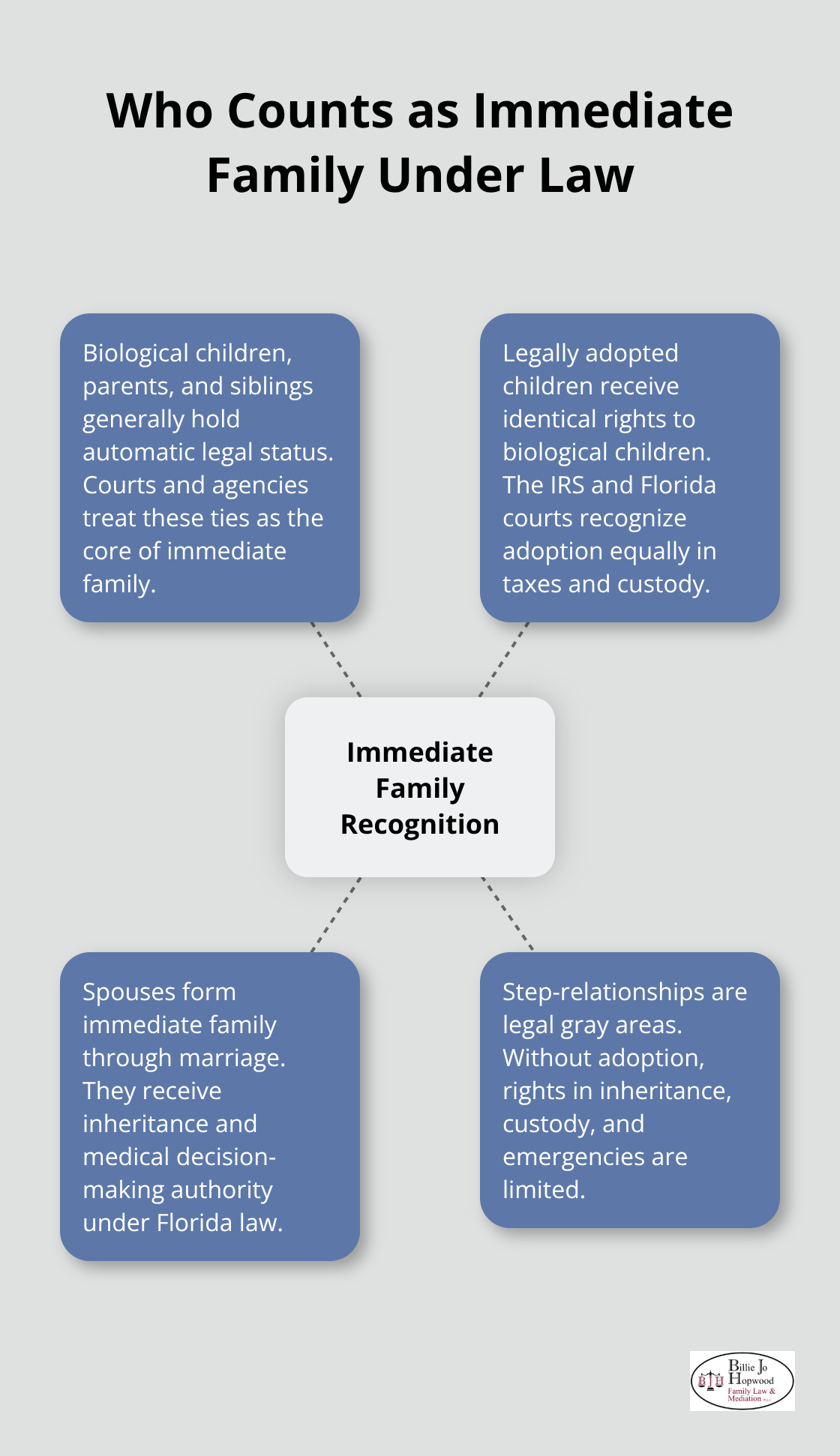
The legal system recognizes specific blood relations and adoptive relationships as immediate family members with equal rights and protections. Biological children, parents, and siblings hold automatic legal status, while legally adopted children gain identical rights to biological offspring under federal and Florida state law. The Internal Revenue Service treats adopted children the same as biological children for tax purposes, and Florida courts prioritize adoptive parents equally with biological parents in custody decisions.

Step-relationships create legal gray areas that often surprise families during medical emergencies or inheritance disputes. Courts view these relationships differently than biological or adoptive connections, which affects legal rights significantly.

Visual overview of recognized immediate family relationships in Florida and federal contexts - immediate family definition law

Marriage and Partnership Recognition

Florida law grants spouses full immediate family status with automatic inheritance rights and medical decision-making authority. When no children exist from previous relationships, spouses inherit entire estates under Florida’s intestate succession laws. The state recognizes marriage as the primary legal bond that creates immediate family status between non-blood relatives.

Domestic partners and unmarried couples receive no automatic legal recognition as immediate family, regardless of relationship duration or emotional bonds. This distinction becomes problematic during medical emergencies when hospitals may deny visitation rights to long-term partners without legal documentation (such as healthcare directives or power of attorney forms).

Blended Family Legal Realities

Step-parents without formal adoption hold no automatic custody rights or inheritance claims, which creates vulnerabilities during divorce or family crises. Florida courts treat step-children as legal strangers to step-parents unless adoption occurs, despite years of caregiving relationships. The Family and Medical Leave Act excludes step-relationships from its immediate family definition, which prevents unpaid leave for step-parent caregiving.

These limitations force blended families to pursue formal adoption or legal guardianship to secure family protections that biological families receive automatically. The next section examines how these family definitions translate into specific legal rights and responsibilities across different areas of law.

What Legal Powers Do Immediate Family Members Hold

Inheritance Rights That Matter Most

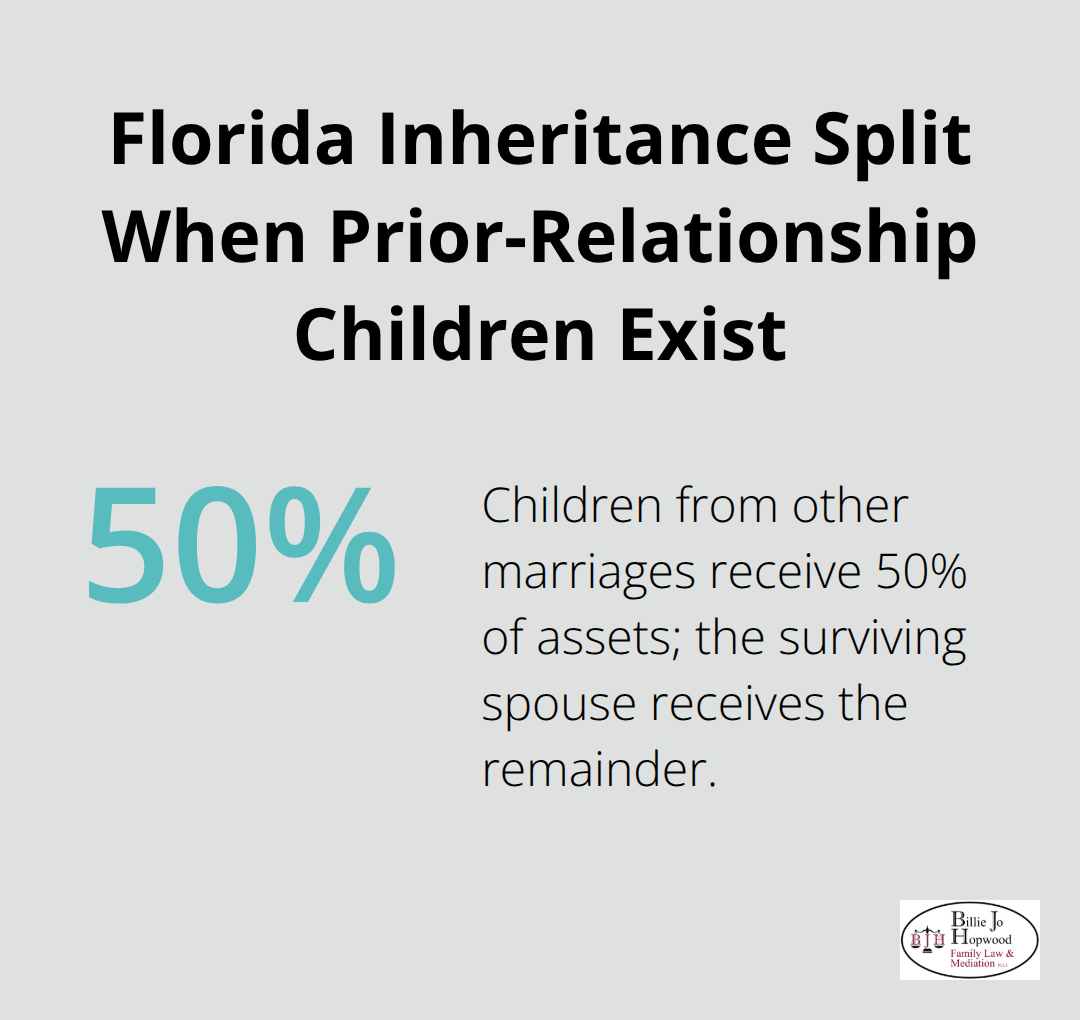
Florida’s intestate succession laws grant immediate family members automatic inheritance rights that bypass probate complications. Spouses receive the entire estate when no children from previous relationships exist, while children from other marriages split 50% of assets with the surviving spouse who receives the remainder. Parents inherit everything only when no spouse or children survive, and siblings gain rights solely when parents, spouses, and children are absent.

Chart showing that children from other marriages receive 50% of assets while the surviving spouse receives the remainder under Florida intestate rules - immediate family definition law

Joint accounts and payable-upon-death designations transfer directly to spouses without court intervention. These tools provide powerful estate planning options that avoid lengthy probate processes. The Family and Medical Leave Act provides 12 weeks of unpaid leave for care of spouses and dependent children under 21, but excludes step-relationships and unmarried partners entirely.

Federal Tax Benefits and Recognition

Federal tax benefits extend to spouses and biological or adopted children through Internal Revenue Service regulations. Step-children receive no automatic recognition without formal adoption proceedings. The IRS treats adopted children identically to biological children for tax purposes, which affects deductions and filing status options.

Tax law recognizes immediate family members for various benefits including dependency exemptions and medical expense deductions. These financial advantages can result in substantial savings for families who qualify under federal definitions.

Medical Decision Authority During Emergencies

Florida law grants immediate family members automatic authority to make medical decisions when you cannot communicate your wishes. Spouses hold primary decision-making power, followed by adult children and parents in the established hierarchy. Unmarried partners and divorced spouses hold zero authority in medical emergencies unless healthcare directives or power of attorney documents exist beforehand.

Emergency rooms routinely deny visitation rights to long-term partners who lack legal documentation. This creates devastating situations during medical crises when emotional bonds mean nothing without legal recognition. Healthcare insurance policies typically extend coverage to spouses and dependent children, but definitions vary between employers and insurance providers.

Step-Parent Limitations in Medical Decisions

Step-parents without adoption papers cannot make medical decisions for step-children, regardless of years spent in caregiving roles. The Centers for Disease Control and Prevention recognizes immediate family members for public health emergency purposes (affecting quarantine and treatment decisions), but step-relationships fall outside these protections.

These medical authority gaps highlight why blended families need formal legal documentation to protect their interests. State and federal laws create different immediate family definitions that affect these rights in various ways.

How Do State and Federal Laws Define Family Differently

Florida State Versus Federal Family Classifications

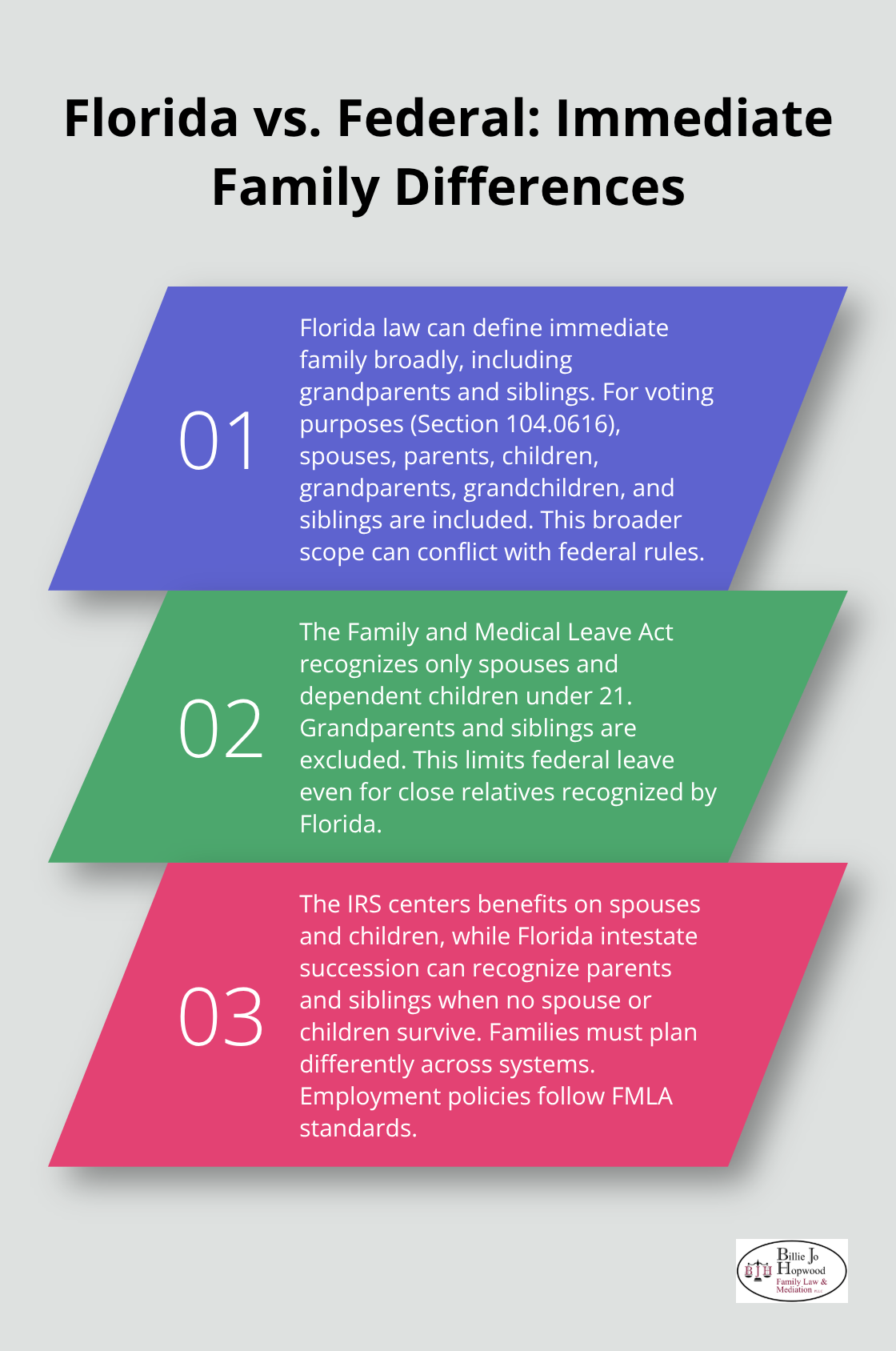
Florida state law defines immediate family more broadly than federal regulations, which creates significant complications for families who navigate multiple legal systems. Under Florida Statutes Section 104.0616, immediate family includes spouses, parents, children, grandparents, grandchildren, and siblings for voting purposes. The Family and Medical Leave Act restricts federal recognition to spouses and dependent children under 21, which excludes grandparents and siblings entirely. This gap means Florida residents can assist grandparents with votes but cannot take federal family leave to care for them during medical emergencies.

Three-point comparison of Florida, FMLA, and IRS definitions of immediate family

The Internal Revenue Service limits immediate family to spouses and children for tax benefits, while Florida intestate succession laws recognize parents and siblings as heirs when spouses and children are absent. These conflicting definitions force families to plan differently for state versus federal legal matters. Employment policies must comply with federal FMLA standards, which often provide fewer protections than Florida families expect based on state definitions.

Immigration Law Family Classifications

United States immigration law grants immediate family status exclusively to spouses and unmarried children under 21 for permanent resident petitions. This creates the narrowest definition across all legal contexts. Parents of US citizens over 21 qualify separately but face longer processing times than immediate relatives. Siblings, grandparents, and married children fall into preference categories with waiting periods that can exceed 20 years.

Immigration attorneys report that families frequently misunderstand these restrictions. Many assume broader state law definitions apply to federal immigration cases, which leads to disappointment and delays in family reunification efforts.

Insurance Coverage Disparities

Healthcare insurance policies vary dramatically between employers, with some extending coverage to domestic partners while others restrict benefits to legally married spouses only. The Centers for Disease Control and Prevention recognizes immediate family during public health emergencies, but individual insurance companies create their own definitions that may exclude step-children or adopted children (depending on policy language).

These inconsistencies require families to review each policy carefully rather than assume uniform coverage across different legal contexts. Workers’ compensation benefits also follow varying immediate family definitions that affect death benefits and medical coverage eligibility.

Final Thoughts

The immediate family definition law creates a complex web of rights and obligations that varies dramatically between state and federal contexts. Florida families face different protections under state intestate succession laws compared to federal employment benefits, while immigration law imposes the strictest limitations on family recognition. These legal inconsistencies demand proactive planning to protect your family’s interests.

Blended families need formal adoption or legal documentation to secure rights that biological families receive automatically. Unmarried couples must create healthcare directives and power of attorney documents to gain medical decision-making authority during emergencies. Estate planning becomes more complex when state and federal definitions conflict, as joint accounts and payable-upon-death designations provide powerful tools that bypass probate complications only for legally recognized immediate family members.

Step-parents without adoption papers hold no automatic inheritance or custody rights, regardless of emotional bonds or caregiving history. We at Billie Jo Hopwood Family Law & Mediation, PLLC help Melbourne families navigate these challenging legal situations through compassionate guidance and representation in divorce, child custody, and family law matters. Professional legal counsel becomes essential when family structures don’t align with standard legal definitions (or when multiple jurisdictions create conflicting obligations).

Collaborative Law vs Mediation: Which to Choose?

Divorce proceedings in Melbourne, Florida don’t have to mean lengthy court battles. Two popular alternatives offer families more control over their outcomes.

At Billie Jo Hopwood Family Law & Mediation, PLLC, we help clients understand the collaborative law vs mediation debate. Both approaches prioritize cooperation over conflict, but they work differently and suit different situations.

How Do These Two Approaches Actually Work?

The Collaborative Law Process

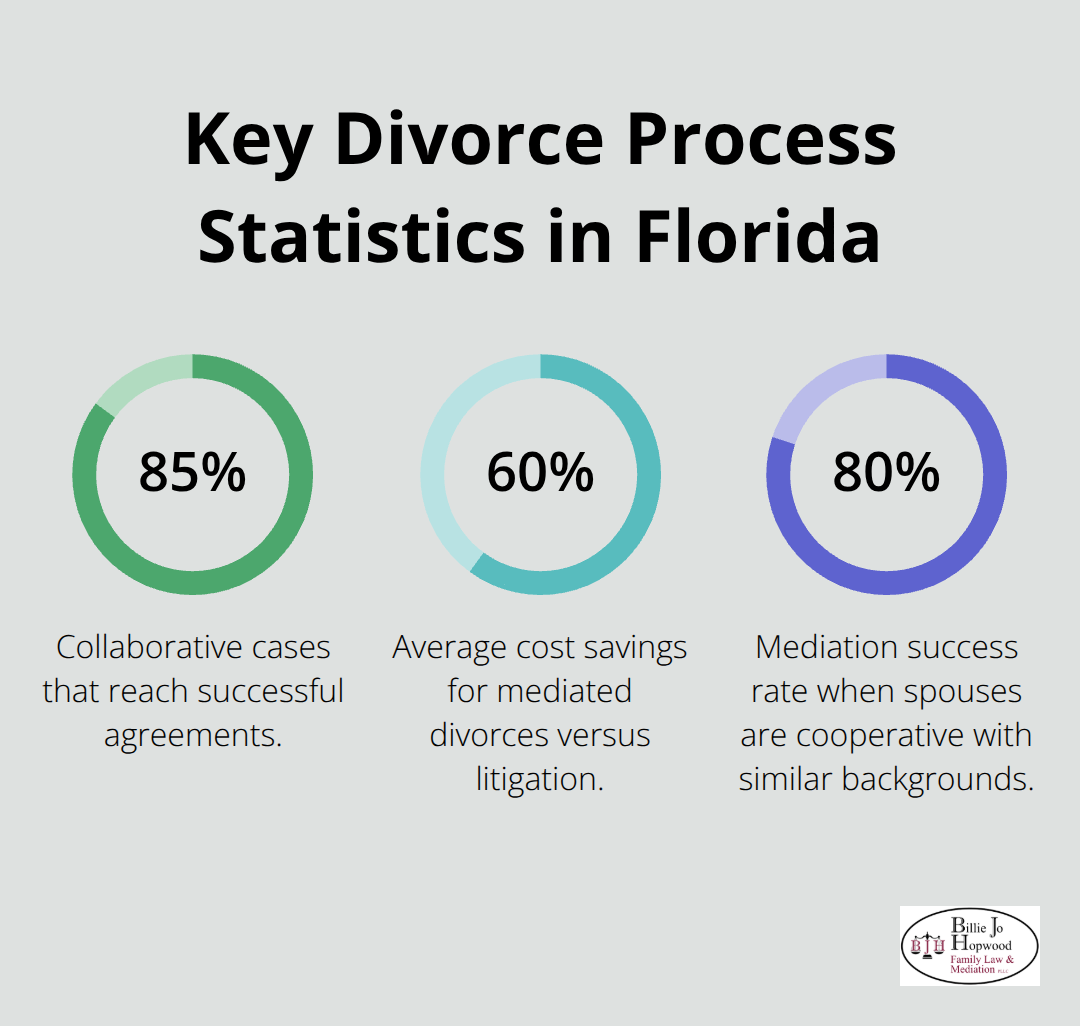
Collaborative law operates through a structured framework where both spouses retain their own attorneys who sign a no-court agreement. This binding commitment means if negotiations fail, both attorneys must withdraw and new legal representation becomes necessary. The Florida Dispute Resolution Center reports that this requirement motivates 85% of collaborative cases to reach successful agreements.

Percentage chart showing 85% collaborative success, 60% mediation cost savings, and 80% mediation success under cooperative conditions. - collaborative law vs mediation

Sessions include both spouses and their attorneys who work together in the same room, often with additional professionals like financial advisors or child custody specialists. The process typically takes 6 to 12 months, with meetings that families schedule around their availability rather than court calendars. Each spouse pays for their own attorney, plus shared costs for any neutral professionals who participate.

The Mediation Framework

Mediation centers around one neutral mediator who facilitates discussions without decisions for the couple. The Florida Bar Association data shows mediated divorces in Melbourne cost approximately 60% less than litigation, with most cases that resolve in 3 to 4 months.

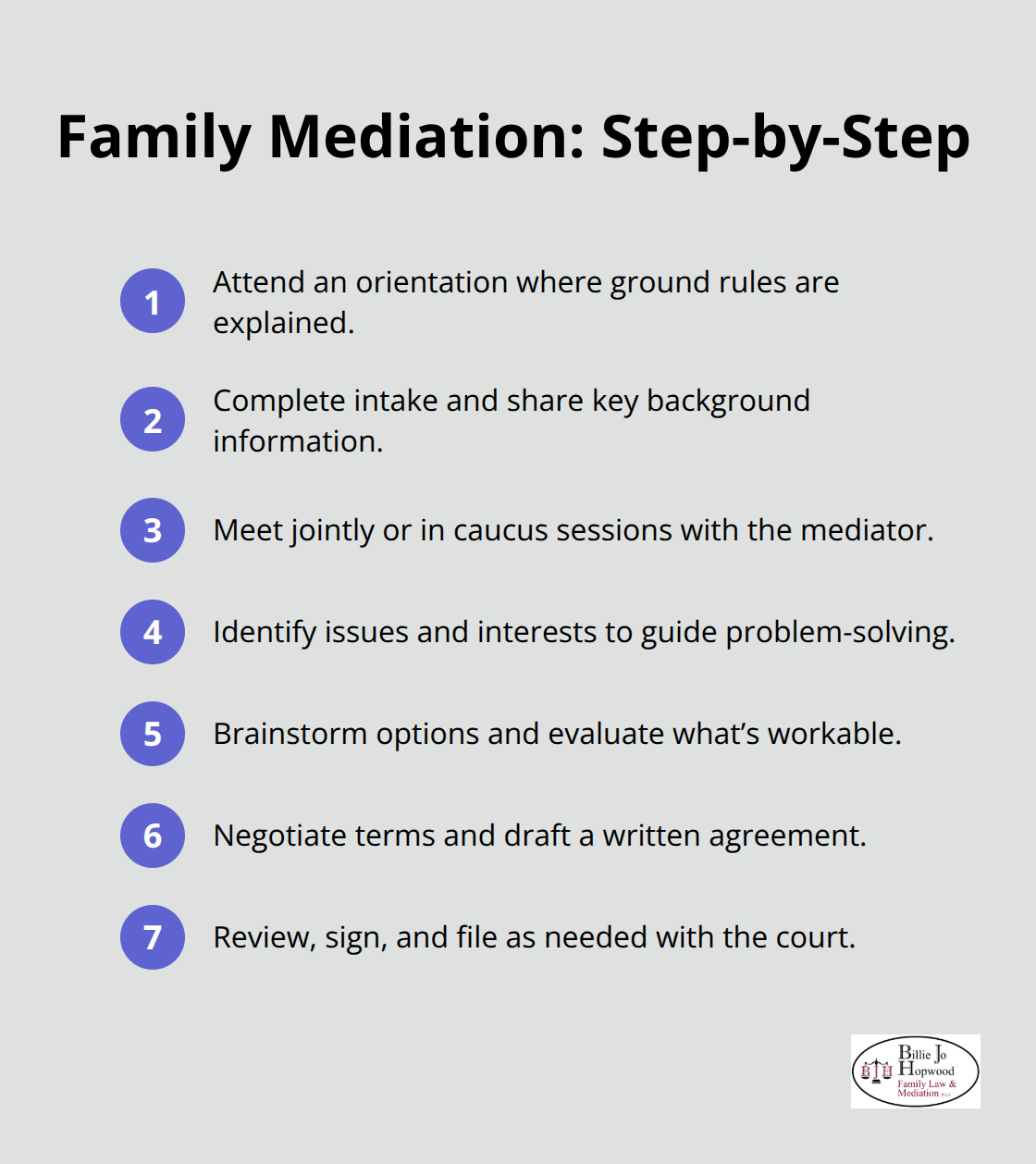
Sessions typically last 2 to 4 hours and allow each party to present their perspective without interruption. The mediator uses techniques like caucusing (private meetings with each spouse) to overcome deadlocks. Unlike collaborative law, couples can consult their own attorneys outside of sessions but attorneys don’t participate directly in negotiations. Once agreements are reached, the mediator drafts a Memorandum of Understanding that becomes the foundation for the final divorce decree.

The Core Distinction

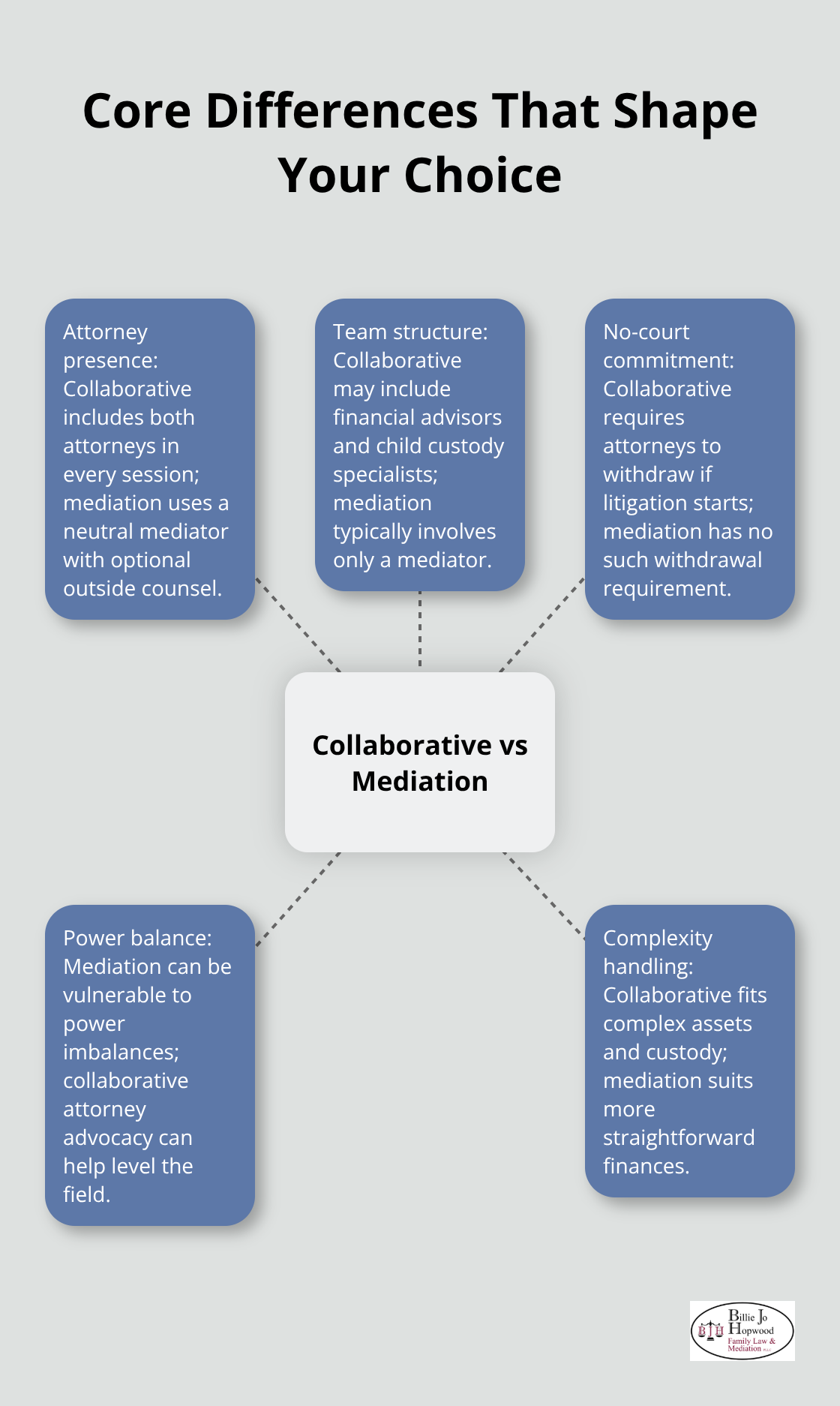
The fundamental difference lies in legal representation during negotiations. Collaborative law provides continuous attorney advocacy throughout discussions, while mediation relies on neutral facilitation with optional outside legal consultation. This distinction shapes how each process handles complex financial matters and emotional dynamics between spouses.

Hub-and-spoke chart comparing collaborative law and mediation on key dimensions. - collaborative law vs mediation

Both approaches offer Melbourne families alternatives to traditional litigation, but their different structures create unique advantages and limitations that affect which method works best for specific situations involving family law disputes.

Why Choose Collaborative Law

Continuous Attorney Support Makes the Difference

Collaborative law provides immediate legal guidance throughout every negotiation session, which sets it apart from other divorce methods. Each spouse has their attorney present during all discussions, creating real-time protection for your interests. The American Bar Association data shows that 85% of collaborative cases reach agreements because attorneys actively guide conversations toward productive solutions rather than let emotions derail progress.

This direct attorney involvement proves particularly valuable when complex financial assets are involved. Financial advisors and child custody specialists often join collaborative teams, providing comprehensive support that addresses every aspect of your divorce. The Florida Dispute Resolution Center reports that collaborative divorces handle intricate property divisions 40% more effectively than unassisted negotiations because legal counsel helps identify potential issues before they become problems.

The No-Court Commitment Creates Accountability

The binding no-court agreement in collaborative law creates powerful motivation for both spouses to reach resolution. When attorneys must withdraw if litigation becomes necessary, everyone involved has strong incentives to make the process work. This commitment eliminates the common litigation threat that can poison negotiations in other divorce methods.

When Collaborative Law Falls Short

This same feature creates the primary drawback of collaborative law. If negotiations fail, both spouses must start over with new attorneys, essentially doubling legal costs and extending timelines. Melbourne families facing this scenario often spend an additional 6 to 8 months finding new representation and rebuilding their cases from scratch (a significant financial and emotional burden).

Best Fit Scenarios

Collaborative law works best when both spouses genuinely commit to cooperation and possess similar negotiation power. This approach proves ideal for couples with complex financial situations who want to preserve ongoing relationships for co-parenting purposes. The structured attorney support particularly benefits families with substantial assets or intricate custody arrangements that require professional guidance.

While collaborative law offers significant advantages, mediation presents a different set of benefits and limitations that may better suit certain family situations.

Why Mediation Often Wins

Speed and Cost Advantages Drive Popular Choice

Mediation delivers Melbourne families the fastest path to divorce resolution.

Ordered list comparing mediation, litigation, and collaborative law timelines and costs.

The Florida Dispute Resolution Center confirms that mediated cases conclude 25% faster than litigation. Most mediation sessions complete within 3 to 4 months compared to the 12 to 18 months that court battles require. The cost difference proves even more dramatic – mediated divorces cost approximately 60% less than litigation according to Florida Bar Association data, with typical mediation expenses that range from $2,000 to $8,000 versus litigation costs that exceed $20,000 per person.

The single mediator structure eliminates the complex schedules that plague collaborative law. While collaborative cases require coordination between multiple attorneys and professionals, mediation sessions adapt to your schedule without bureaucratic delays. The National Mediation Board reports that most successful mediations resolve within 1 to 2 sessions, which makes this approach particularly attractive for couples who seek quick resolution.

Flexibility Creates Custom Solutions

Mediation’s informal structure allows for custom agreements that courts rarely provide. The neutral mediator facilitates creative problem-solving without the rigid legal constraints that bind collaborative attorneys. This flexibility helps couples craft unique custody arrangements or financial settlements that fit their specific circumstances (particularly valuable for families with unconventional work schedules or special needs children).

Power Imbalances Present Real Risks

This same informality creates mediation’s primary weakness – the absence of immediate legal advocacy during negotiations. Without attorneys present, power imbalances between spouses can skew negotiations unfairly. The Ohio State Bar Association notes that mediation works best when both parties possess similar negotiation skills and emotional stability. Complex financial situations often require legal guidance that mediation cannot provide during sessions, which potentially leads to agreements that favor one spouse over another.

Prime Candidates for Mediation Success

Mediation proves most effective for couples with straightforward financial situations who maintain reasonable communication skills. The American Arbitration Association data shows 80% success rates for mediation when both spouses approach the process cooperatively and possess similar education levels or professional backgrounds. With the guidance of a neutral mediator, families can identify what matters most and create solutions that work for their unique situation, making it ideal for couples without significant asset complexity or contentious custody disputes. By focusing on understanding rather than winning, families often leave mediation with agreements they helped shape-agreements they’re more likely to honor long-term.

Final Thoughts

The collaborative law vs mediation choice depends on your specific circumstances and priorities. Mediation offers the most cost-effective solution, with expenses from $2,000 to $8,000 compared to collaborative law’s higher costs due to multiple attorney fees. Time commitments also differ significantly – mediation typically resolves within 3 to 4 months while collaborative law extends 6 to 12 months.

Consider mediation when you and your spouse communicate reasonably well and face straightforward financial situations. Choose collaborative law when you need continuous legal guidance, face intricate financial matters, or require additional professionals like financial advisors. Your comfort level with negotiation plays a major role in this decision (mediation requires you to advocate for yourself with occasional outside legal consultation, while collaborative law provides constant attorney support during every session).

We at Billie Jo Hopwood Family Law & Mediation, PLLC help Melbourne families evaluate their unique situations to determine which approach best serves their needs. Both methods offer significant advantages over traditional litigation. Power imbalances between spouses often favor the collaborative approach where legal representation levels the field.

What Is Mediation in Family Law?

Family disputes don’t have to end up in lengthy court battles. Mediation offers a collaborative path forward that puts families in control of their own outcomes.

At Billie Jo Hopwood Family Law & Mediation, PLLC, we see how understanding what is mediation family law can transform difficult situations into manageable solutions. This alternative approach saves time, money, and emotional stress while protecting relationships that matter most.

How Does Family Law Mediation Actually Work

Family law mediation is a structured negotiation process where a neutral third party helps divorcing couples or separating parents reach agreements outside of court. The mediator facilitates discussions between parties and helps them identify shared interests while they work toward mutually acceptable solutions. Both parties present their positions during mediation sessions while the mediator guides conversations toward productive outcomes. The process typically involves multiple sessions (each lasting two to four hours) with agreements documented in writing once parties reach them.

The Mediation Process Step by Step

Most mediation begins with an orientation session where mediators explain rules and procedures. Parents then meet with the mediator either together or separately, depending on the situation and comfort levels. The mediator helps identify key issues, explores various options, and assists in the creation of detailed parenting plans.

Compact steps outlining the family mediation process - what is mediation family law

In California, mediation is required by law before judges will hear custody cases, while Texas Civil Practice and Remedies Code Section 154.002 promotes mediation as the preferred dispute resolution method. Sessions focus on practical matters like living arrangements, decision-making authority, and parenting schedules rather than blame assignment or past grievance litigation.

Why Mediation Outperforms Traditional Court Battles

Court proceedings follow rigid procedures with judges who make final decisions based on legal arguments and evidence. Mediation allows families to maintain control over their outcomes while they address emotional and practical needs that courts often overlook. Courts reported that 67% of cases reached agreement through mediation in 2024, compared to the unpredictable nature of court trials. Mediated agreements also show higher compliance rates than court-ordered judgments because parties actively participate in solution creation. The confidential nature of mediation encourages open communication, while court proceedings become part of public record and can damage relationships permanently.

These advantages make mediation particularly effective for specific types of family law cases where cooperation and customized solutions matter most.

Why Mediation Saves Money and Time

Family law mediation delivers measurable financial advantages that traditional litigation cannot match. The American Bar Association reports that mediated divorce cases cost an average of $3,000 to $7,000, while litigated divorces range from $15,000 to $30,000 per spouse. Court battles drag on for 12 to 18 months on average, but mediation typically resolves disputes within 2 to 4 months. These numbers reflect real savings that families can redirect toward rebuilding their lives rather than funding attorney fees and court costs.

Mediation Cuts Legal Expenses Dramatically

Attorney fees represent the largest expense in contested divorces, with hourly rates that range from $200 to $500 in most markets. Mediation reduces these costs because attorneys spend fewer hours on case preparation, discovery, and court appearances. Research from the Institute for the Advancement of the American Legal System shows that 85% of mediated cases settle before trial, which eliminates expensive litigation procedures like depositions and expert witness fees. Court filing fees alone can exceed $400, while mediation sessions typically cost $150 to $300 per hour (split between both parties).

Key percentages that highlight mediation’s effectiveness

Speed Creates Additional Value Beyond Cost Savings

Mediation sessions can be scheduled within weeks rather than waiting months for court dates. The McCammon Group reports that approximately 85% of their mediated cases reach settlement, often within a single day or series of shorter sessions. This speed prevents the emotional toll that extended court battles place on families, particularly children who benefit from quick resolution of custody arrangements. Parents who complete mediation within 60 days report 40% less stress compared to those involved in year-long court proceedings (according to studies from the American Psychological Association).

Control Over Outcomes Provides Long-Term Benefits

Mediation empowers families to craft solutions that courts cannot provide through rigid legal frameworks. Parents maintain decision-making authority over their children’s schedules, living arrangements, and future modifications to agreements. This control leads to higher compliance rates with mediated agreements compared to court-ordered judgments, as parties actively participate in creating their own solutions. The flexibility of mediation saves money and allows families to address unique circumstances that standard court orders often overlook, setting the foundation for successful co-parenting relationships.

Which Cases Benefit Most From Mediation

Mediation works best when both parties have assets to divide, children to protect, and relationships to preserve. High-conflict divorces that involve complex property portfolios see the greatest success rates, with 78% of cases that reach full agreement according to the National Center for State Courts. Business owners, real estate investors, and couples with retirement accounts benefit most because mediation allows creative solutions that courts cannot provide. Property division mediation prevents forced sales of family businesses and allows couples to structure asset transfers that minimize tax consequences. Spousal support negotiations through mediation result in agreements that 89% of parties follow voluntarily (compared to 64% compliance with court-ordered alimony).

Hub-and-spoke visualization of cases best suited for mediation - what is mediation family law

Property Division Requires Strategic Mediation Timing

Couples with marital assets that exceed $250,000 should start mediation within 30 days of separation to prevent asset depletion and preserve value. Real estate markets change rapidly, which makes quick resolution essential for maximizing property values during division. Retirement account divisions through mediation avoid the 10% early withdrawal penalties that court orders often trigger, which saves couples thousands in unnecessary fees. Business valuations that are completed before mediation sessions provide concrete numbers that facilitate faster agreements, while delayed valuations create disputes that extend resolution timelines by an average of 4 months.

Child Custody Mediation Succeeds With Proper Preparation

Parents who complete mediation within 60 days of filing custody petitions report 73% satisfaction rates with their parenting plans, according to the American Academy of Matrimonial Lawyers. Successful custody mediation requires both parents to focus on children’s school schedules, extracurricular activities, and medical needs rather than personal grievances. California courts mandate mediation for all custody cases, while Texas courts require it in 85% of contested custody disputes (which reflects the proven effectiveness of this approach). Parents with children under age 10 achieve the highest success rates because younger children adapt more easily to structured parenting schedules that mediation creates.

Final Thoughts

Family law mediation transforms how families resolve disputes by placing control back in their hands. The evidence shows clear advantages: mediated cases cost 50-75% less than litigation, resolve 3-4 times faster, and achieve 85% settlement rates. Parents who understand what is mediation family law gain access to flexible solutions that courts cannot provide through rigid legal frameworks.

The decision to choose mediation depends on your willingness to communicate and compromise. Families with complex assets, business interests, or children benefit most from this collaborative approach. The confidential nature of mediation protects relationships while creating agreements that both parties actively support.

We at Billie Jo Hopwood Family Law & Mediation, PLLC guide Melbourne, Florida families through divorce, child custody, and support matters with compassionate representation. Our approach combines legal knowledge with mediation skills to help families reach agreements that work for everyone involved. The first step toward mediation means choosing a path that prioritizes your family’s future over prolonged conflict (rather than extended court battles).

Finding a Family Law Attorney with Flexible Payments

Legal fees can create significant financial stress during family disputes. Many Melbourne Florida families struggle to afford quality legal representation when they need it most.

We at Billie Jo Hopwood Family Law & Mediation, PLLC understand that finding a family law attorney that takes payments requires careful research. The right payment arrangement can make professional legal help accessible without overwhelming your budget.

What Payment Methods Do Family Law Attorneys Accept?

Family law attorneys in Melbourne Florida typically offer three primary payment structures, each with distinct advantages and drawbacks. Hourly rates remain the most common approach, with fees that range from $200 to $500 per hour based on attorney experience and case complexity. The American Bar Association reports that approximately 35% to 50% of these hourly fees cover overhead costs (office rent and staff salaries). This structure works best for straightforward cases but can become expensive during lengthy disputes or complex negotiations.

Overview of hourly rates, flat fees, payment plans, and retainers in family law

Flat Fee Arrangements Provide Cost Predictability

Flat fee arrangements offer complete cost transparency upfront, which makes them ideal for uncontested divorces and simple custody modifications. These fixed payments typically range from $1,500 to $5,000 for uncontested cases in Florida. Unlike hourly rates, flat fees protect clients from unexpected cost increases if complications arise. However, attorneys may charge additional fees for services beyond the original scope, so clients must clearly define what services the flat fee covers before they sign any agreement.

Payment Plans Make Legal Services Accessible

Monthly payment plans allow families to spread legal costs over several months rather than pay large sums upfront. Most attorneys require an initial retainer of 25% to 50% of the total expected fees, with the remainder paid in installments. Payment plans often include interest charges or administrative fees, so clients should calculate the total cost before they commit. Some firms accept credit card payments (which provide additional flexibility but potentially increase overall costs through credit card interest rates).

Retainer Agreements Function as Legal Fee Insurance

Retainer agreements require clients to deposit funds into a trust account before legal work begins. Attorneys draw from this account as they complete billable hours and provide detailed monthly statements that show the balance. Florida law requires attorneys to keep retainer funds in separate trust accounts and return unused portions to clients. Retainers typically equal one to three months of expected legal fees, with most family law cases that require $2,500 to $10,000 initial deposits based on case complexity and anticipated duration.

Understanding these payment structures helps families make informed decisions, but equally important is knowing what questions to ask potential attorneys about their fee arrangements. For families seeking cost-effective alternatives, divorce mediation offers significantly lower costs compared to traditional litigation.

How Do You Choose Payment-Flexible Attorneys

Attorneys who accommodate flexible payments require direct questions about specific fee arrangements and payment options during initial consultations. Ask potential attorneys to provide written estimates that break down hourly rates, anticipated total costs, and available payment plans with exact monthly amounts and interest rates. The Florida Bar Foundation reports that clients who receive detailed fee breakdowns upfront experience 40% fewer billing disputes later. Request information about retainer requirements (including whether unused portions are refundable and how quickly refunds are processed). Ask about accepted payment methods, as attorneys who accept credit cards or offer financing partnerships typically demonstrate greater payment flexibility.

Compact checklist of key questions to discuss with a payment-flexible family law attorney - family law attorney that takes payments

Warning Signs During Fee Discussions

Attorneys who refuse to discuss fees during consultations or provide only vague cost estimates often lack transparency in their billing practices. Avoid lawyers who demand full payment upfront without payment plans, as this indicates inflexibility that could create financial strain during your case. The American Bar Association found that 60% of client complaints involve billing disputes, with unclear fee agreements as the primary cause. Red flags include attorneys who cannot explain their billing procedures clearly, refuse to provide written fee agreements, or pressure clients to sign retainer agreements immediately without review time. Attorneys who dismiss questions about costs or seem uncomfortable when they discuss payment options may not prioritize client financial concerns throughout the legal process.

Written Payment Agreements Protect Your Interests

All payment arrangements must be documented in writing before legal work begins, as verbal agreements often lead to misunderstandings and disputes. Written agreements should specify hourly rates, flat fee amounts, payment schedules, interest charges on installments, and consequences for missed payments. Florida law requires attorneys to provide written fee agreements for cases expected to exceed $100, and these agreements must clearly outline the scope of services covered. The agreement should include details about additional costs such as court filing fees, copying charges, and expert witness fees (which can add hundreds of dollars to your total legal costs). Clients have the right to request modifications to payment terms before they sign, and attorneys who refuse reasonable payment arrangement requests may not suit budget-conscious families.

These payment considerations become even more important when you explore alternative approaches to traditional legal representation that can significantly reduce your overall costs.

What Cost-Saving Alternatives Exist Beyond Traditional Legal Representation

Legal aid organizations in Melbourne Florida provide free or reduced-cost family law services to individuals who qualify, with income limits typically set at 125% of the federal poverty level (approximately $37,000 annually for a family of four). The Legal Aid Society of Brevard County offers comprehensive family law assistance that includes divorce proceedings, custody modifications, and domestic violence protection orders at no cost to eligible clients. Pro bono programs through the Florida Bar connect low-income families with volunteer attorneys who donate their time, though waiting lists often extend three to six months due to high demand. The National Legal Aid & Defender Association reports that only 20% of individuals who seek legal help receive assistance, which makes early application for these services essential.

Family Law Mediation Reduces Costs by 70%

Family law mediation costs between $150 and $300 per hour compared to $400 to $600 per hour for traditional litigation, with most cases that resolve in four to eight sessions rather than months of court battles. The Florida Dispute Resolution Center found that mediated divorces average $3,000 in total costs while litigated divorces often exceed $15,000 per spouse. Mediation eliminates court fees, reduces attorney hours, and speeds resolution time from 12-18 months to 2-4 months for typical cases. Couples who choose mediation retain control over decisions rather than leave outcomes to judges, and 85% of mediated agreements remain in effect without modification compared to 60% of court-ordered arrangements.

Comparison of how often mediated vs. court-ordered family law agreements remain in effect - family law attorney that takes payments

Unbundled Legal Services Target Specific Needs

Unbundled legal services allow clients to purchase specific legal tasks rather than full representation, which reduces costs by 50% to 80% compared to traditional arrangements. Common unbundled services include document preparation ($500 to $1,000), legal research ($200 to $400), and limited court appearances ($800 to $1,500). Clients handle routine tasks themselves while attorneys focus on complex legal issues that require professional guidance. The American Bar Association reports that unbundled services work best for motivated clients who can follow instructions and meet deadlines independently, which makes this option unsuitable for individuals who need extensive support throughout their case.

Final Thoughts

Melbourne Florida families need a family law attorney that takes payments to make legal representation affordable during difficult times. Direct communication about fee structures prevents misunderstandings and builds trust with your legal counsel. Multiple attorney consultations allow you to compare payment options and find arrangements that fit your budget.

Cost-effective legal help combines traditional representation with alternative approaches that reduce expenses. Legal aid organizations serve qualifying families, mediation cuts costs by 70% compared to litigation, and unbundled services let you purchase only necessary legal assistance. These options make professional guidance accessible without overwhelming financial strain.

Melbourne Florida families who face family law matters should contact attorneys to discuss payment structures and available options. We at Billie Jo Hopwood Family Law & Mediation, PLLC provide guidance through divorce, child custody, alimony, and child support cases (with payment arrangements designed to help families access quality legal representation). Professional legal support becomes achievable when attorneys offer flexible payment solutions that work with your financial situation.