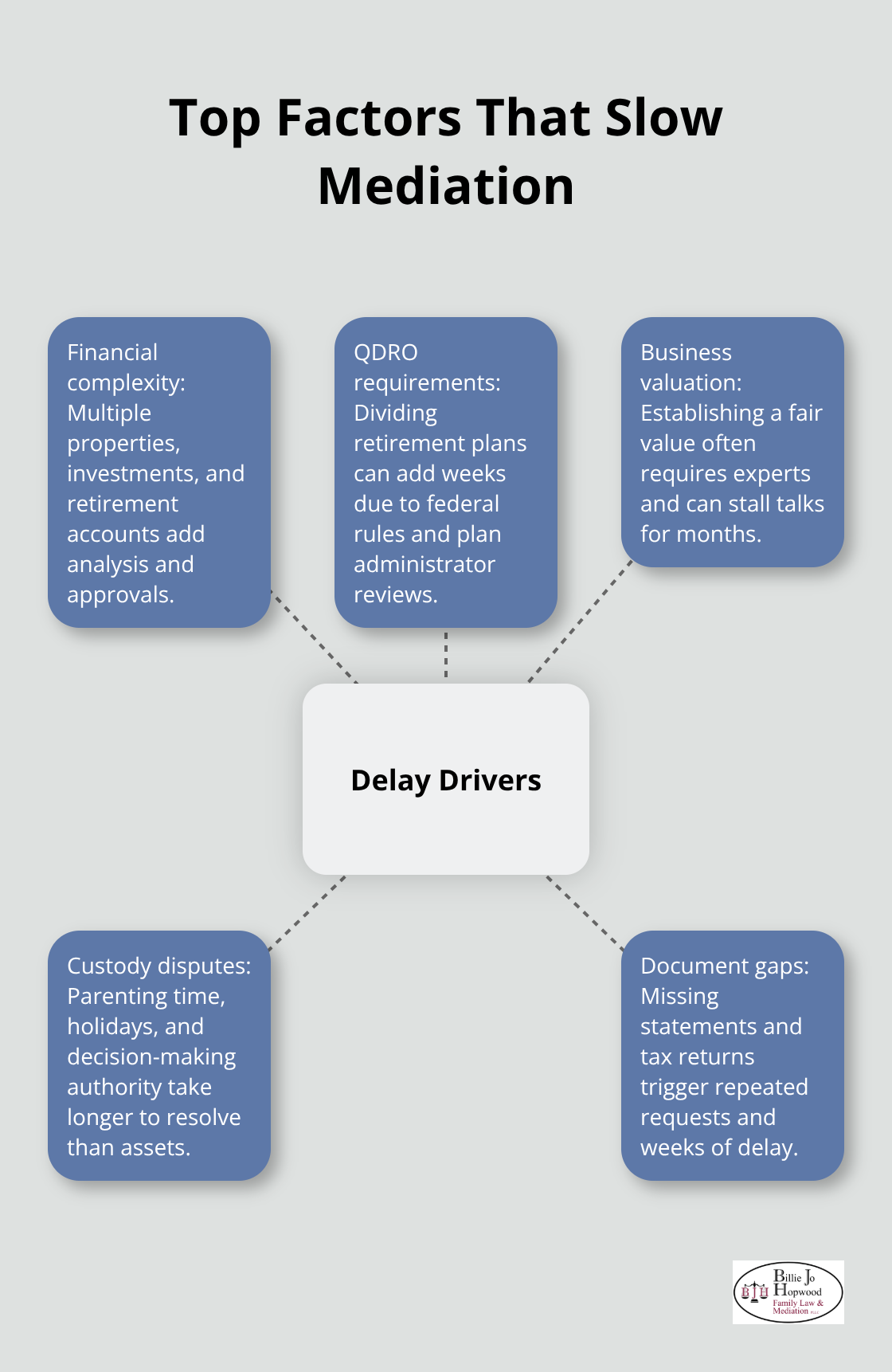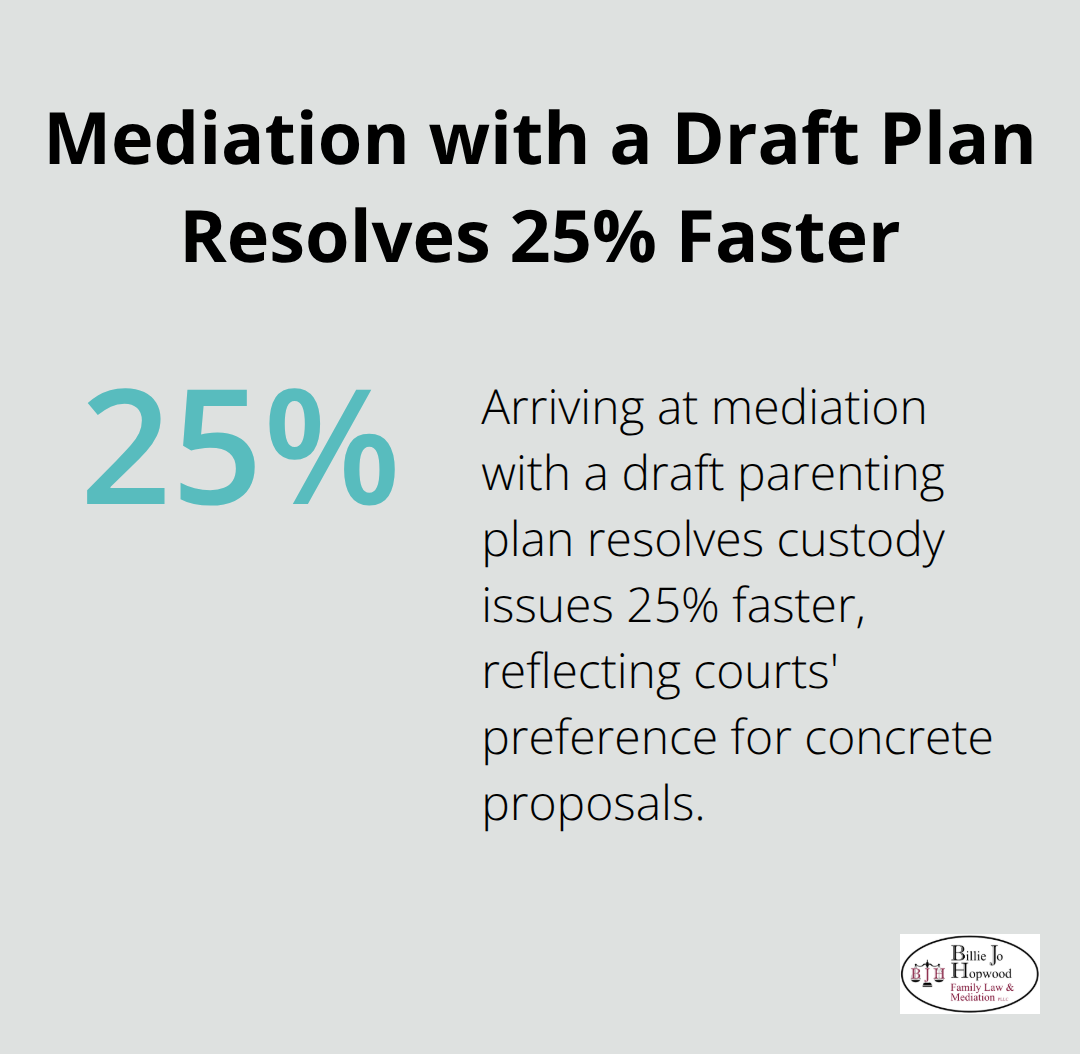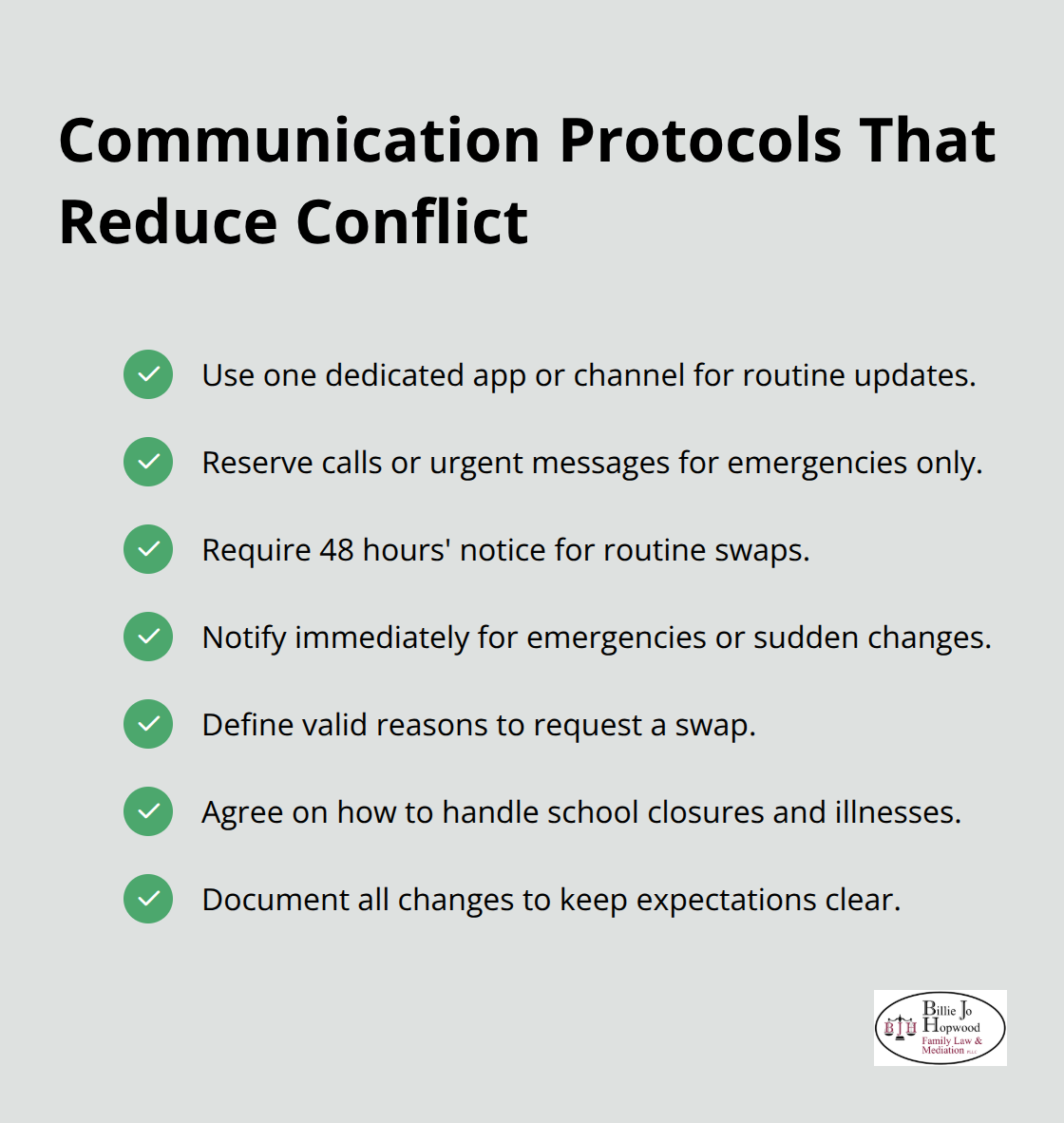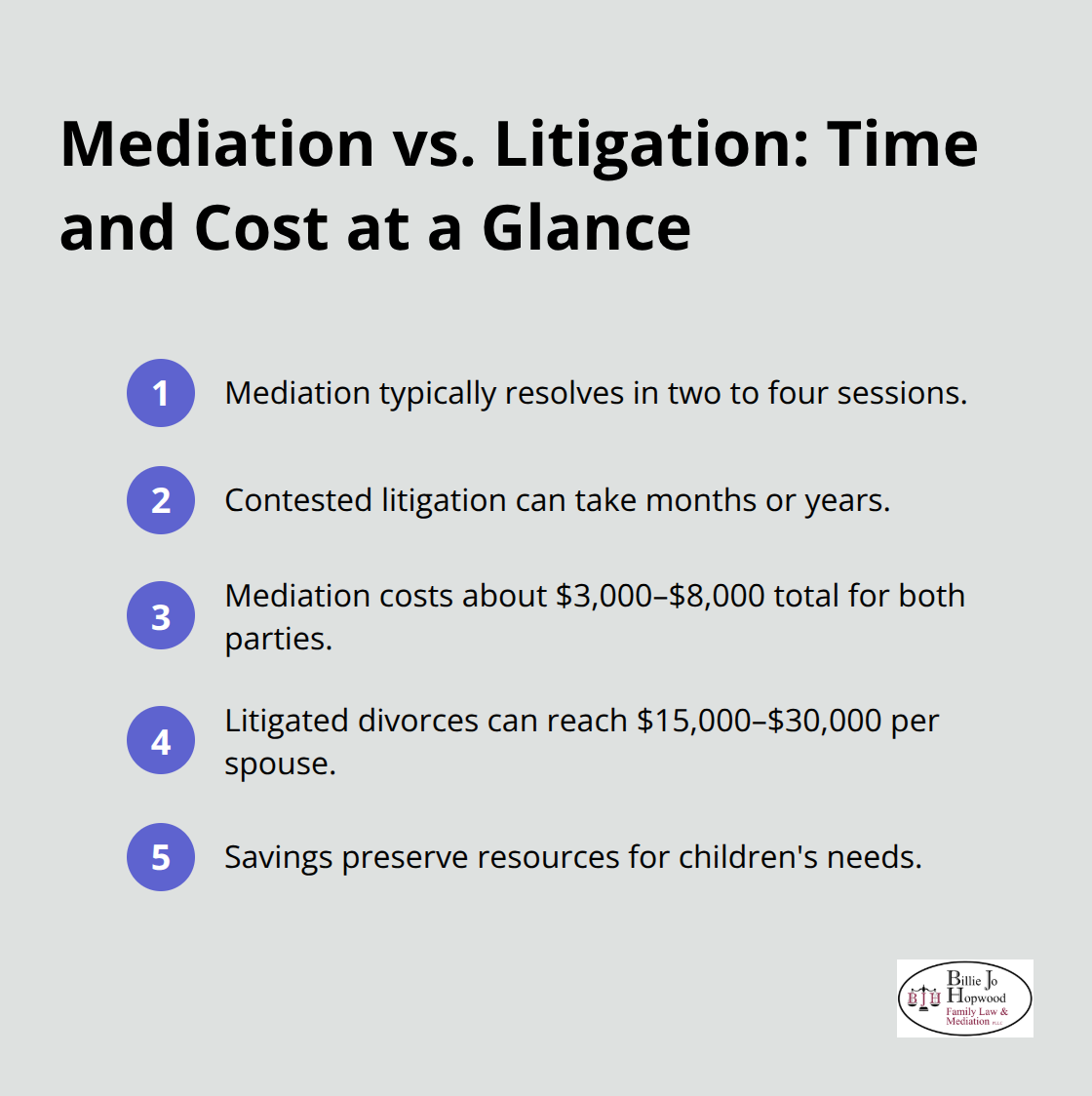
Blog

Mediation for Child Custody: Finding Common Ground in Family Disputes

Child custody disputes test even the strongest families. When parents can’t agree on arrangements, mediation for child custody offers a path that keeps decisions in your hands rather than leaving them to a judge.

At Billie Jo Hopwood Family Law & Mediation, PLLC, we’ve seen how mediation transforms these conversations. This approach costs less, moves faster, and produces agreements both parents can actually live with.

How Mediation Keeps You in Control While Court Doesn’t

The Power of Decision-Making Authority

Mediation and litigation operate on completely different principles, and the difference matters enormously for your family’s future. In court, a judge makes the custody decision for you. You present evidence, your ex presents theirs, and someone who’s never met your children decides how much time each parent gets. Mediation flips this entirely. You and your co-parent work together with a neutral third party to craft an arrangement that actually fits your family’s needs.

The Financial Reality of Each Path

The financial gap between these two paths is staggering. Litigation for custody disputes in Florida averages between $15,000 and $30,000 per parent when cases go to trial, according to data from the American Bar Association. Mediation typically costs $2,000 to $5,000 total, split between both parents-roughly 80% less expensive. Beyond cost, mediation resolves in weeks or months while court cases often drag on for 12 to 18 months.
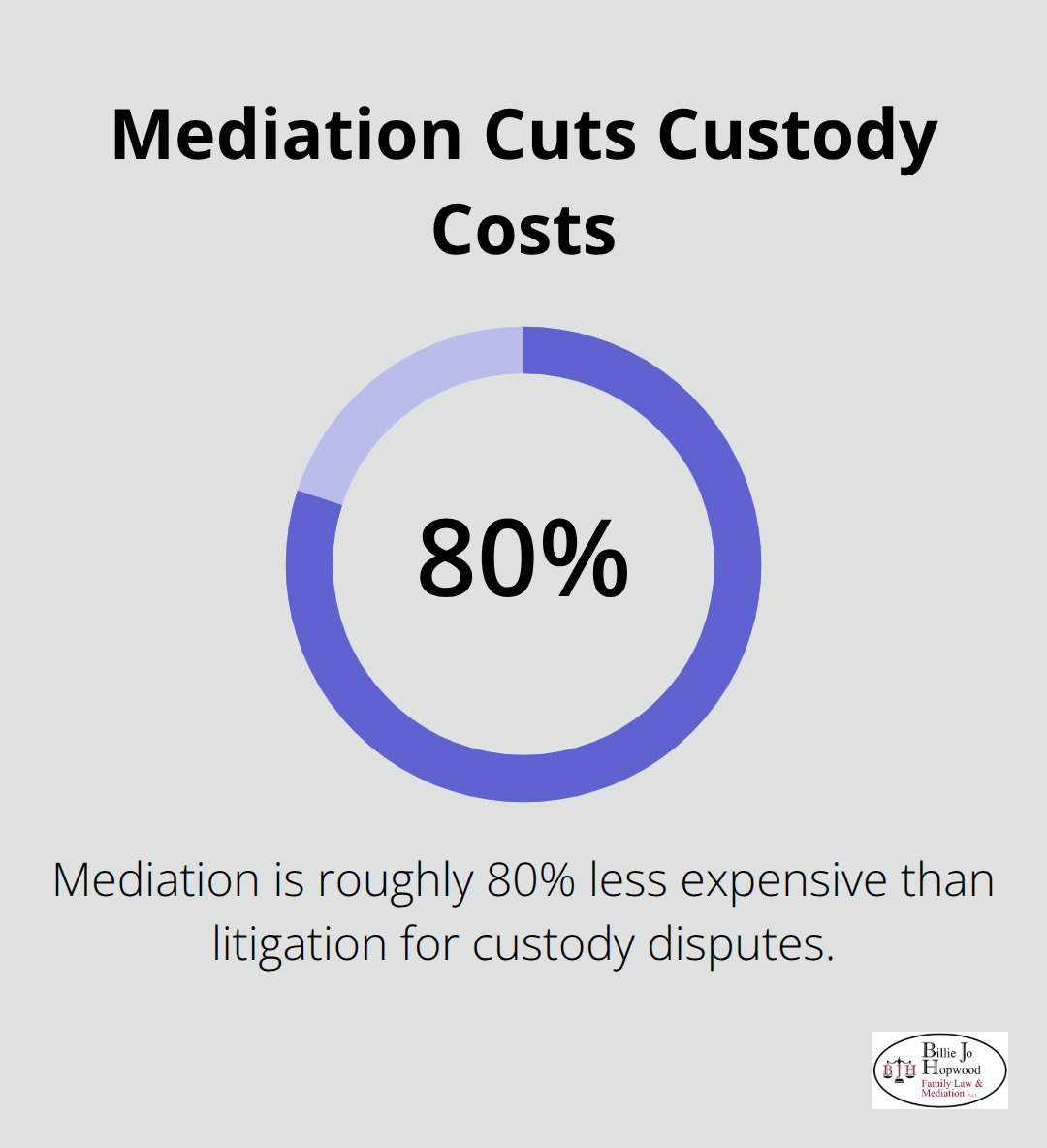
Visualization showing that mediation is roughly 80% less expensive than litigation for child custody disputes in the U.S. - Mediation for child custody

Privacy: A Hidden Advantage of Mediation

Court proceedings are public record. Anyone can walk into the courtroom or review documents filed with the court. Your arguments about your ex’s parenting, financial struggles, or personal issues become part of a permanent public file. Mediation remains completely confidential. Nothing you discuss with the mediator gets recorded in any public database. What happens in mediation stays between you, your co-parent, and the mediator. This privacy protects your children from the embarrassment of having family disputes aired publicly and shields both parents from unnecessary exposure.

Moving Forward with Mediation in Melbourne Florida

When you work with a mediator in Melbourne Florida, you’re choosing a process where you retain decision-making power, save substantially on legal fees, and keep your family’s private matters out of the public eye. The next step involves understanding exactly how the mediation process unfolds and what to expect during each phase.

What Happens During Custody Mediation

The Initial Consultation Sets the Foundation

The mediation process starts with a structured initial consultation where you and your co-parent meet separately with the mediator to discuss your concerns, priorities, and goals for custody arrangements. The mediator explains confidentiality rules, outlines how sessions work, and asks both parents to commit to participating in good faith. This first meeting typically lasts one to two hours and costs between $300 and $500 combined. During this phase, the mediator assesses whether mediation fits your situation-if domestic violence or severe power imbalances exist, mediation may not work, and the mediator will recommend litigation instead. Once both parents agree to proceed, you’ll schedule joint sessions where you sit together with the mediator to discuss custody schedules, holiday arrangements, and decision-making authority.

Joint and Private Sessions Build the Agreement

You and your co-parent alternate between joint sessions and private sessions called caucuses. In joint sessions, you sit together with the mediator to address practical matters. In caucuses, you meet one-on-one with the mediator to explore your underlying concerns without your co-parent present. This back-and-forth approach typically takes three to six sessions over four to eight weeks, compared to court cases that stretch 12 to 18 months. The mediator doesn’t impose solutions but helps you identify common ground and creative options you might not have considered alone.
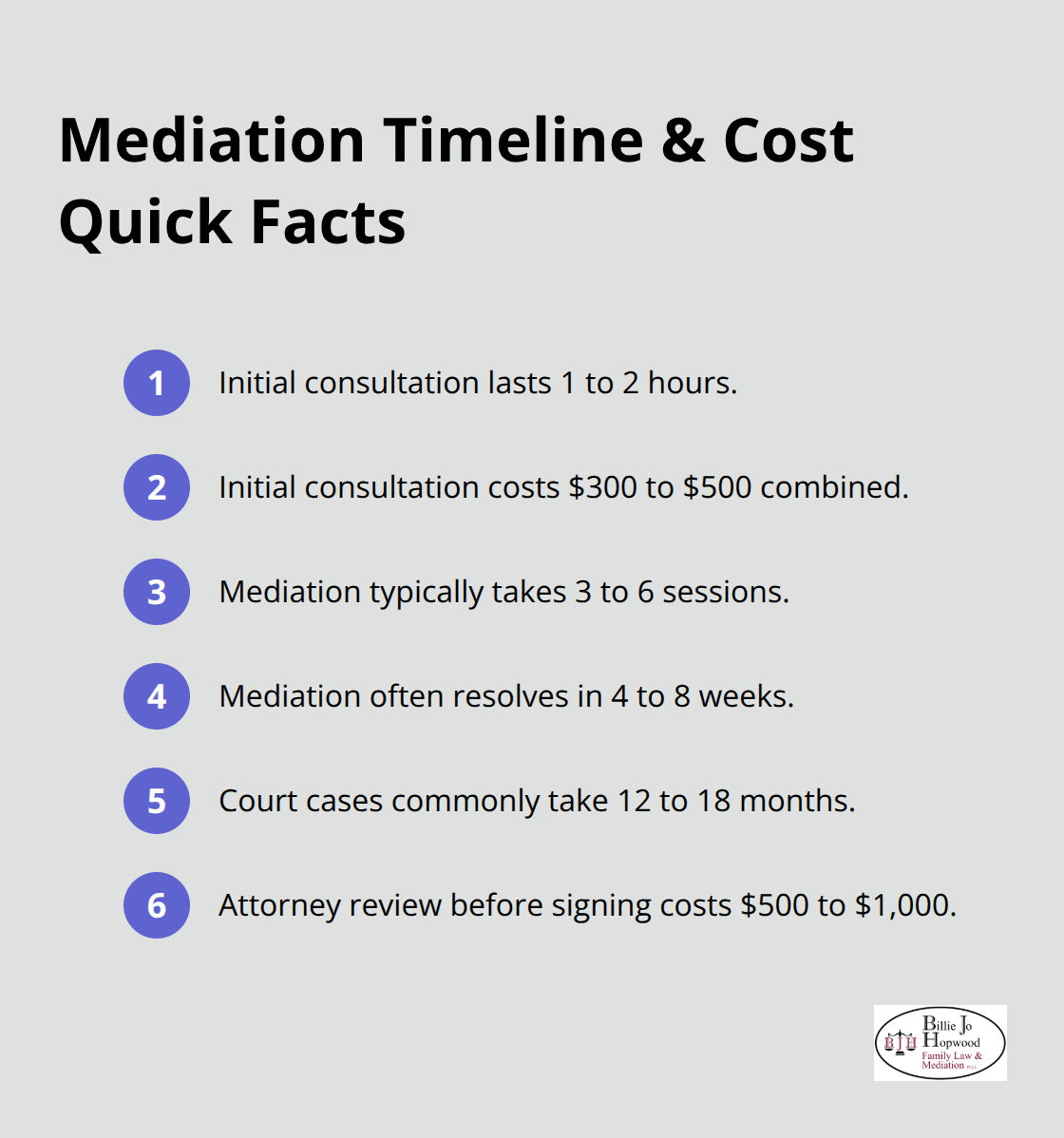
Compact list of key timeframes and costs for custody mediation compared with litigation. - Mediation for child custody

Finalizing Your Custody Agreement

Once you and your co-parent reach agreement on custody terms, the mediator drafts a detailed custody agreement that outlines the schedule, decision-making responsibilities, communication methods, and procedures for handling disputes. You’ll review this draft with a family law attorney before signing-this step costs $500 to $1,000 and protects you from overlooking important provisions. The final agreement becomes your custody order once both parents sign and a judge approves it, giving it the same legal weight as a court-ordered custody arrangement. This legal standing means you can enforce the agreement if either parent violates its terms.

Understanding how mediation actually works prepares you for the conversations ahead. The next phase focuses on the specific strategies that help parents find common ground when emotions run high and disagreements seem impossible to resolve.

Finding Common Ground When Stakes Feel Impossibly High

Child custody mediation succeeds when parents shift their focus from winning against each other to building an arrangement that actually serves their children. The mediator’s job isn’t to referee a battle or declare one parent right and one wrong-it’s to help you both recognize that your children need stability, consistency, and access to both parents. This reframing changes everything. Research from the Journal of Divorce and Remarriage found that parents who participated in mediation reported significantly higher satisfaction with custody arrangements compared to those who litigated, primarily because they felt heard and maintained control over outcomes that affected their children directly. When you sit in mediation, you’re not fighting to prove your ex is a bad parent; you’re solving a practical puzzle together. That distinction matters because it keeps conversations focused on real issues instead of personal attacks.

What Your Child Actually Needs Matters More Than Who Wins

Judges apply a legal standard called the best interests of the child, but they know your family for a few hours during trial. You know your children’s schedules, their relationships with each parent, their school demands, and their emotional needs. Mediation lets you apply this knowledge directly to custody decisions. Instead of arguing that you deserve more time, frame discussions around what your children need: Does one parent handle homework better? Does one parent live closer to school? Does your child have anxiety about transitions that requires a specific schedule? These practical questions produce custody arrangements that actually work. A mediator helps you identify these needs systematically by asking what matters most for each child’s development, education, and emotional wellbeing. The mediator then helps both parents acknowledge these needs and build schedules around them. This approach produces agreements that parents follow voluntarily because the arrangements make sense for their families, not because a judge ordered compliance.

Emotions and Logistics Require Different Conversations

Custody disputes trigger intense emotions-anger about the relationship ending, fear about losing time with your children, resentment about perceived unfairness. These emotions are real and valid, but they sabotage practical negotiations. Mediators separate emotional processing from logistical problem-solving. You might need to express your hurt and frustration, and a skilled mediator creates space for that in private caucuses. Once emotions are acknowledged, the mediator redirects you toward concrete questions: What does the school schedule look like? When does your child’s sports practice happen? What childcare arrangements currently work?
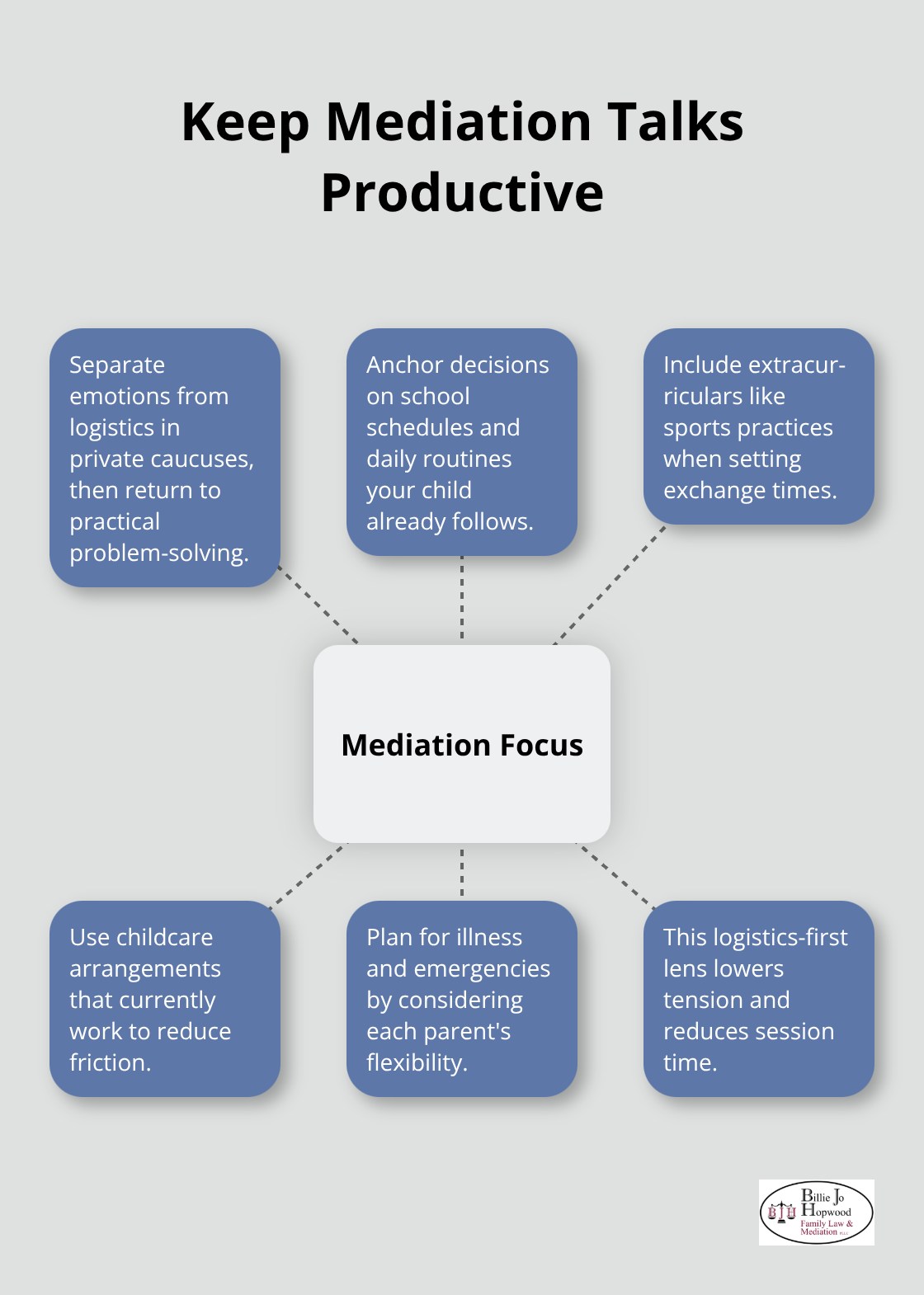
Hub-and-spoke showing how focusing on logistics and child needs moves custody mediation forward.

Which parent has flexibility for illness or emergencies? These questions have answers. Your hurt feelings don’t have answers-they just escalate conflict. When you approach custody through this lens, you stop trying to prove your ex wrong and start solving the schedule puzzle. This shift typically reduces session time and lowers tension significantly. Many parents report that they accomplish more in three mediation sessions than they would in six months of back-and-forth emails or lawyer letters because conversations stay anchored to solvable problems.

Final Thoughts

Mediation for child custody offers something litigation cannot: a process where you remain in control of decisions that shape your children’s lives. You save roughly 80% on costs compared to court battles, and you resolve disputes in weeks rather than months. These differences affect your family’s financial stability and emotional wellbeing in measurable ways.

The real power of mediation emerges when you shift from fighting to problem-solving. Parents who work through custody arrangements with a mediator report higher satisfaction with their agreements because they built them together. Your children benefit too-when both parents participate in creating a custody schedule that actually works for your family’s unique circumstances, compliance happens naturally.

If you’re facing custody disputes in Melbourne Florida, Billie Jo Hopwood Family Law & Mediation, PLLC can guide you through mediation and help you reach agreements that serve everyone involved. Contact us to explore how mediation transforms your custody situation from conflict into cooperation.
Divorce Mediation Benefits Florida: Why Mediation Wins in Divorce

Divorce doesn’t have to drain your bank account or trap you in years of courtroom battles. At Billie Jo Hopwood Family Law & Mediation, PLLC, we’ve seen firsthand how divorce mediation benefits Florida families by cutting costs, speeding up resolution, and keeping control in your hands.

Most couples discover mediation produces better outcomes than litigation-faster, cheaper, and with less damage to relationships and children.

How Mediation Saves Time and Money in Divorce

What Does Mediation Actually Cost Compared to Court?

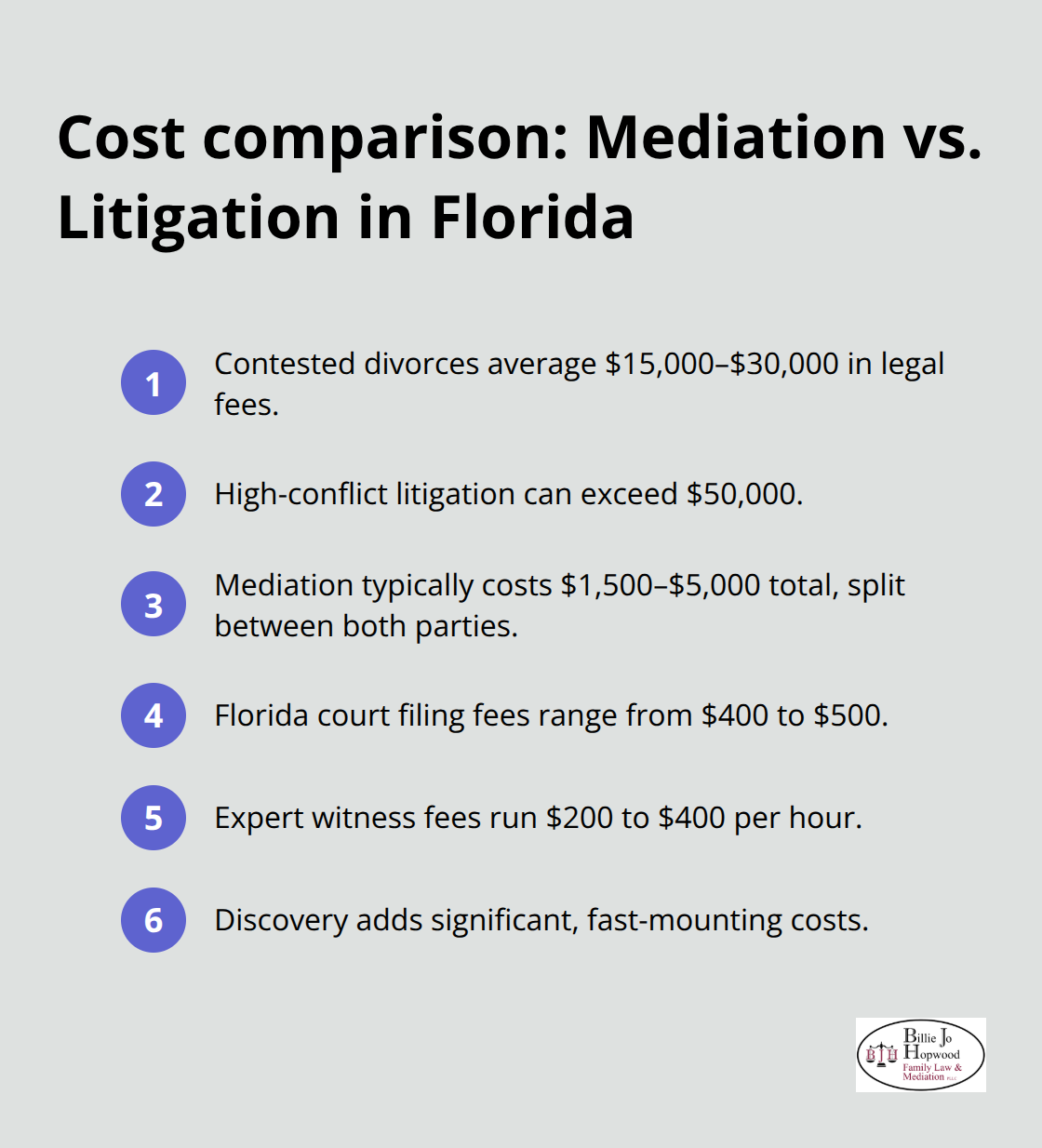
Litigation consumes money at an alarming rate. The American Bar Association reports that contested divorces in court average between $15,000 and $30,000 in legal fees alone, with high-conflict cases exceeding $50,000. Mediation in Florida typically costs between $1,500 and $5,000 total, split between both parties. The difference isn’t marginal-it’s transformational. Couples watch their divorce savings evaporate through years of depositions, motions, and courtroom appearances. One mediation session costs what a single day of litigation does.

Key divorce cost figures in Florida: mediation versus court

Court filing fees in Florida range from $400 to $500, expert witness fees run $200 to $400 per hour, and discovery costs mount quickly. Mediation eliminates most of these expenses because both parties work directly toward solutions rather than fighting over procedural details.

Time Matters More Than People Realize

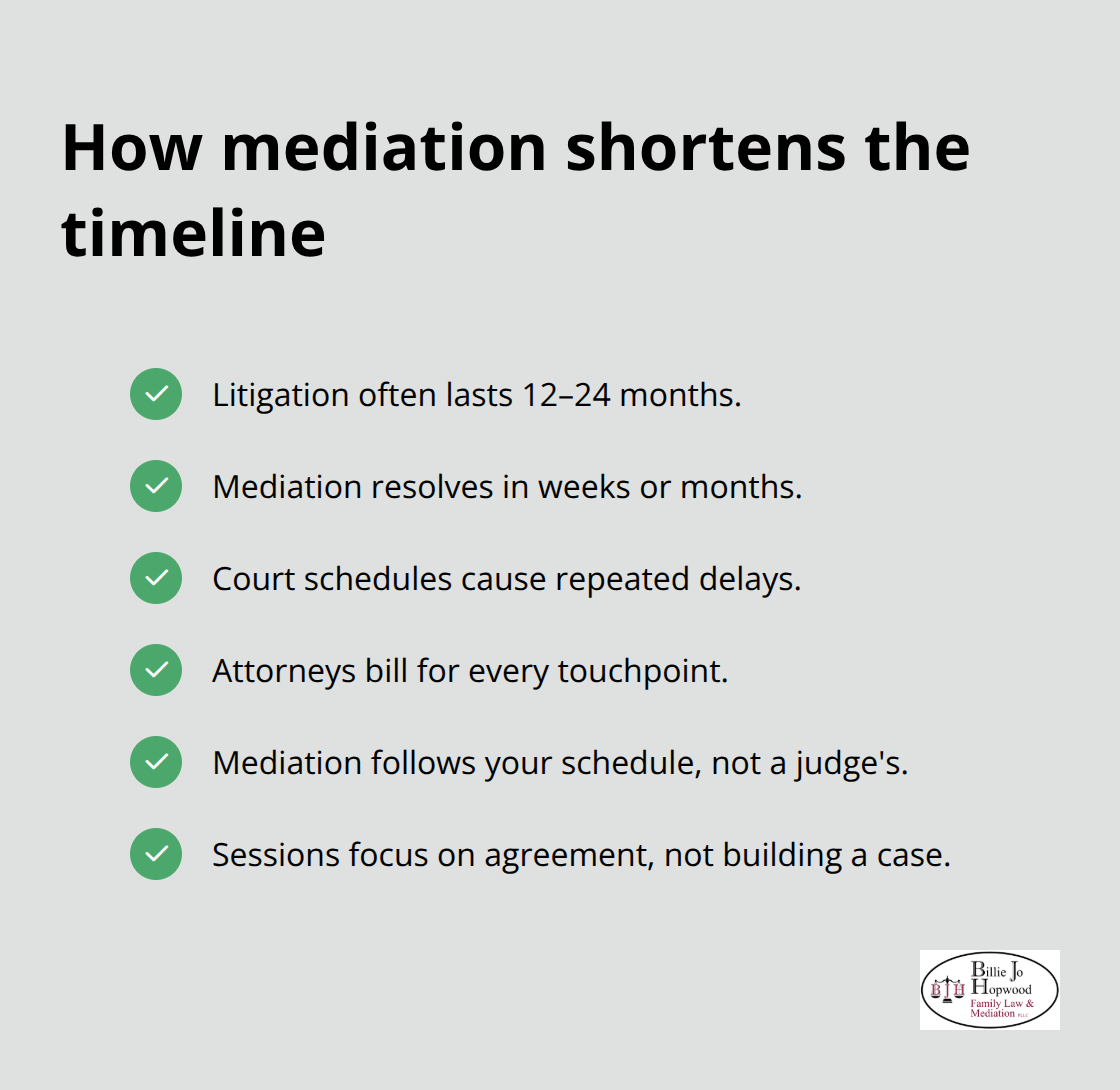
Contested divorces in Florida courts take 12 to 24 months on average, sometimes longer in counties with heavy caseloads. Mediation concludes in weeks or months, not years. During litigation, you wait for court dates, respond to motions, gather evidence, and endure delays that drain emotional reserves and rack up hourly billing. Your attorney bills for every phone call, every email, every moment of preparation.

Time savings of mediation versus litigation in Florida divorces - Divorce mediation benefits Florida

Mediation condenses this timeline dramatically because both parties meet with a neutral mediator on a schedule you control, not a judge’s calendar. Each session focuses on moving toward agreement rather than building a case. Parents stuck in prolonged litigation report higher stress levels and difficulty focusing on their children’s needs. Mediation frees you from this trap by producing resolutions in a fraction of the time.

Hidden Costs Litigation Doesn’t Advertise

Court battles create expenses beyond attorney fees. Time away from work adds up significantly-you might miss dozens of hours for court appearances, depositions, and preparation meetings. Lost income during these absences represents real money. Emotional costs affect your health; prolonged legal conflict correlates with increased medical expenses, therapy costs, and stress-related illness. Mediation keeps you working and reduces the psychological burden that makes litigation so damaging. Melbourne, Florida families frequently report that mediation allowed them to maintain employment stability and avoid the health consequences of prolonged courtroom battles. The financial advantage extends beyond the obvious legal fees to include all these secondary costs that litigation generates.

Why Your Relationship With Your Co-Parent Matters Financially

The way you resolve your divorce shapes your financial future for years. Litigation leaves both parties bitter and defensive, which makes co-parenting decisions (from school choices to medical care) contentious and expensive. You end up back in court arguing about custody modifications, support adjustments, and parenting time disputes. Mediation builds a foundation of communication that prevents these costly conflicts. When you and your former spouse can talk directly about your children’s needs, you avoid attorney fees for every disagreement. This practical benefit compounds over time as your children grow and circumstances change.

Why Mediation Protects Children From Divorce Trauma

Litigation Exposes Children to Ongoing Conflict

Litigation forces children into a war zone. When parents fight in court, kids absorb the hostility, anxiety, and uncertainty that comes with months of legal battles. Research from the American Psychological Association shows that children in high-conflict divorces experience elevated stress hormones, sleep disruption, and difficulty concentrating at school. Mediation eliminates this exposure almost entirely.

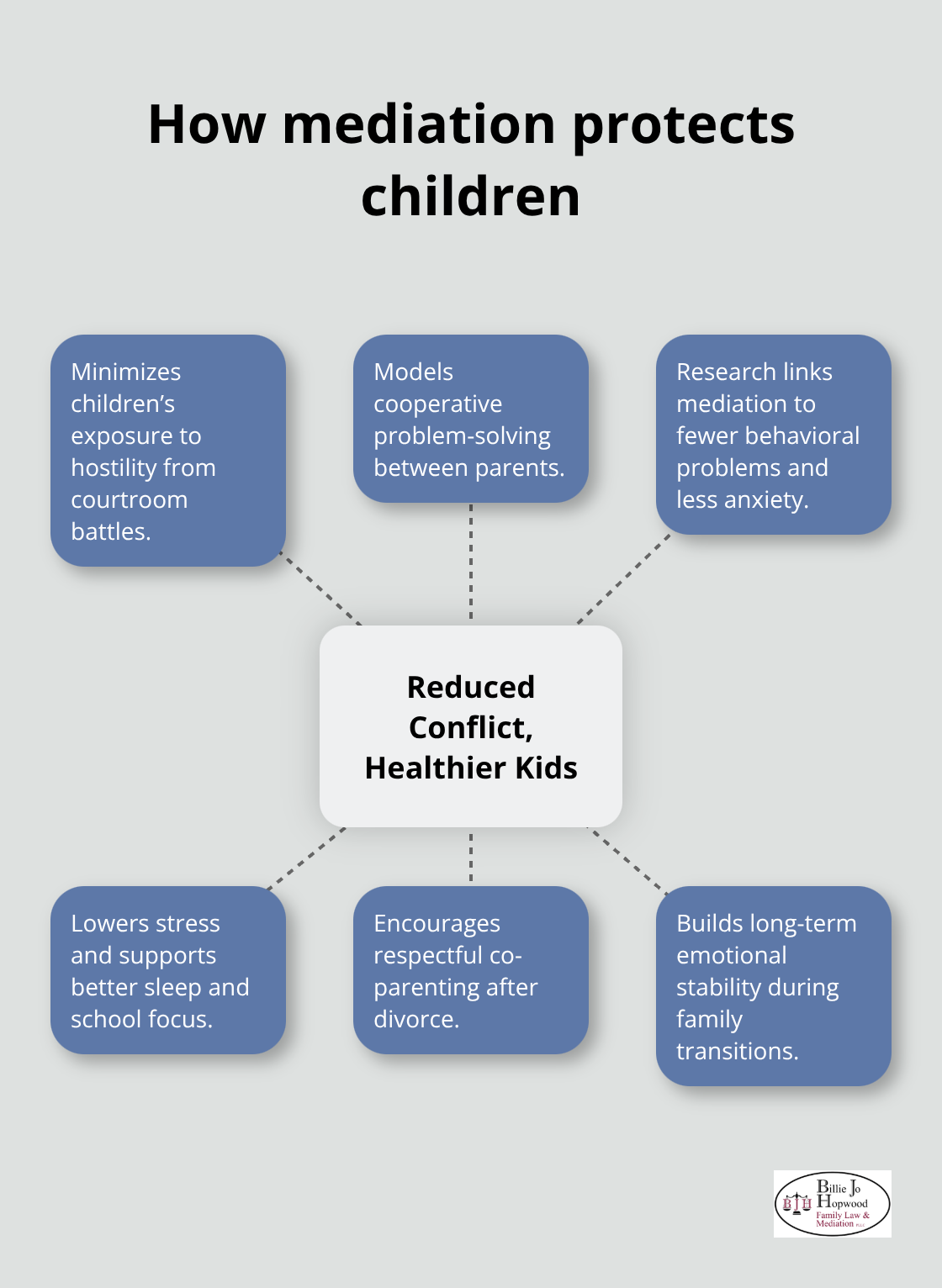
Instead of watching their parents attack each other in depositions and courtrooms, children in mediated divorces see their parents communicate and solve problems together. This fundamentally changes their emotional experience. A study published in the Journal of Divorce and Remarriage found that children whose parents used mediation showed significantly fewer behavioral problems and less anxiety than children whose parents litigated. The difference isn’t subtle-it’s measurable and lasting.

Child-focused benefits of divorce mediation - Divorce mediation benefits Florida

Mediation Teaches Children Healthy Conflict Resolution

The collaborative nature of mediation creates a completely different dynamic than litigation. Instead of each parent hiring an attorney to attack the other side, both parents work with a neutral third party toward solutions that work for the entire family. This approach teaches children that their parents can disagree without destroying each other.

Co-parenting relationships that survive mediation remain functional because the process never required either parent to demonize the other. Parents report attending school events together, making joint medical decisions without conflict, and discussing their children’s needs without triggering litigation. A child who sees parents communicate respectfully about custody schedules and school choices develops healthier relationship patterns themselves.

Long-Term Benefits Compound Over Years

Mediation doesn’t erase the reality that your family structure is changing-but it changes how that transition happens, and that distinction shapes your children’s emotional wellbeing for decades. When you and your co-parent sit down with a mediator in Melbourne, Florida, you protect your children’s mental health during one of life’s most destabilizing events. These practical benefits compound over years as your children grow and circumstances evolve. The foundation of respectful communication that mediation builds carries forward through every parenting decision ahead.

Taking Control: How Mediation Gives You Power Over Your Outcome

Judges Make Decisions Without Knowing Your Family

In litigation, a judge decides your settlement. That judge has never met you, doesn’t know your family’s specific circumstances, and will spend perhaps a few hours reviewing your case before making decisions that affect the rest of your life. Florida judges handle hundreds of cases annually, which means your unique situation receives minimal attention. The judge follows legal standards and precedent, not your family’s actual needs. Mediation flips this entirely-you and your spouse decide everything together with guidance from a neutral mediator.

You Create Solutions That Fit Your Life

This shift in control produces dramatically different outcomes because the people who actually live with the consequences make the decisions. A couple with a blended family, significant assets in multiple states, and complex custody needs can address all these factors directly instead of hoping a judge understands their situation. Mediation allows you to create solutions that fit your actual life rather than forcing your family into the one-size-fits-all framework that courtroom proceedings impose.

You control the timeline, the topics discussed, the pace of negotiations, and ultimately the agreement itself. If a particular arrangement matters deeply to you (whether that’s maintaining your child’s relationship with extended family, structuring business ownership transfers, or creating a flexible custody schedule around work demands), mediation lets you build that directly into your settlement. Litigation offers no such flexibility because judges follow legal standards and precedent, not your family’s needs.

Mediated Agreements Hold Up Better Over Time

Couples who litigated often return to court within three to five years for modifications because the original judgment didn’t account for real-world circumstances. You might need to adjust child support when someone’s income changes, modify custody schedules when a child reaches different developmental stages, or clarify ambiguous terms that created conflict. Mediation-based settlements include language that both parties negotiated and understand, which means fewer disputes about interpretation later.

When you sit across from your spouse and work through custody schedules together, you establish communication patterns that will carry forward through co-parenting. Mediation also accommodates changes without requiring court intervention; you can modify agreements through mutual consent without attorneys and judges (which costs nothing and takes weeks instead of months).

Flexibility Continues After Your Divorce Concludes

Mediated agreements tend to hold up better over time because both parties helped craft them and understand the reasoning behind every provision. The practical advantage becomes obvious when you consider what happens after your divorce concludes. Couples who litigated often return to court within three to five years for modifications because the original judgment didn’t account for real-world circumstances. You might need to adjust child support when someone’s income changes, modify custody schedules when a child reaches different developmental stages, or clarify ambiguous terms that created conflict. Mediation-based settlements include language that both parties negotiated and understand, which means fewer disputes about interpretation later.

Final Thoughts

The evidence proves that mediation outperforms litigation for most divorcing couples. You save thousands of dollars, resolve your divorce in months instead of years, and maintain relationships that matter for your children’s future. Litigation drains your finances, consumes years of your life, and leaves both parents too damaged to co-parent effectively.

Florida families who choose mediation gain control over their outcomes instead of handing decisions to a judge who doesn’t know them. You create solutions that fit your actual circumstances, not legal templates. Your children experience less trauma because they watch their parents communicate and solve problems together rather than attack each other in court.

Mediated agreements hold up better over time because both parties negotiated every provision and understand the reasoning behind it. When circumstances change, you can modify agreements through mutual consent without attorneys and judges. Melbourne, Florida families ready to explore divorce mediation benefits Florida can reach out to Billie Jo Hopwood Family Law & Mediation, PLLC to start a conversation about what mediation can accomplish for your family.

Parenting Disputes Mediation Tips: Keeping Kids First

Parenting disputes during family separation hit hard, and the stakes feel impossibly high when your children are caught in the middle. We at Billie Jo Hopwood Family Law & Mediation, PLLC know that parents in Melbourne, Florida often struggle to separate their own pain from what their kids actually need.

These parenting disputes mediation tips focus on one goal: protecting your children while you work through disagreements with your co-parent. The strategies ahead show you how to communicate better, create stability, and find solutions that genuinely work for your family.

How to Talk to Your Co-Parent Without Letting Kids Pay the Price

Focus on Your Child’s Needs, Not Your Own Preferences

Your children don’t care about who was right in the argument that led to separation. They care about feeling safe, loved, and free from the burden of adult conflict. Research from the American Academy of Pediatrics shows that children exposed to ongoing parental conflict experience higher rates of anxiety, behavioral problems, and difficulty concentrating at school. Kids whose parents communicate respectfully about parenting decisions show better emotional adjustment and stronger relationships with both parents.

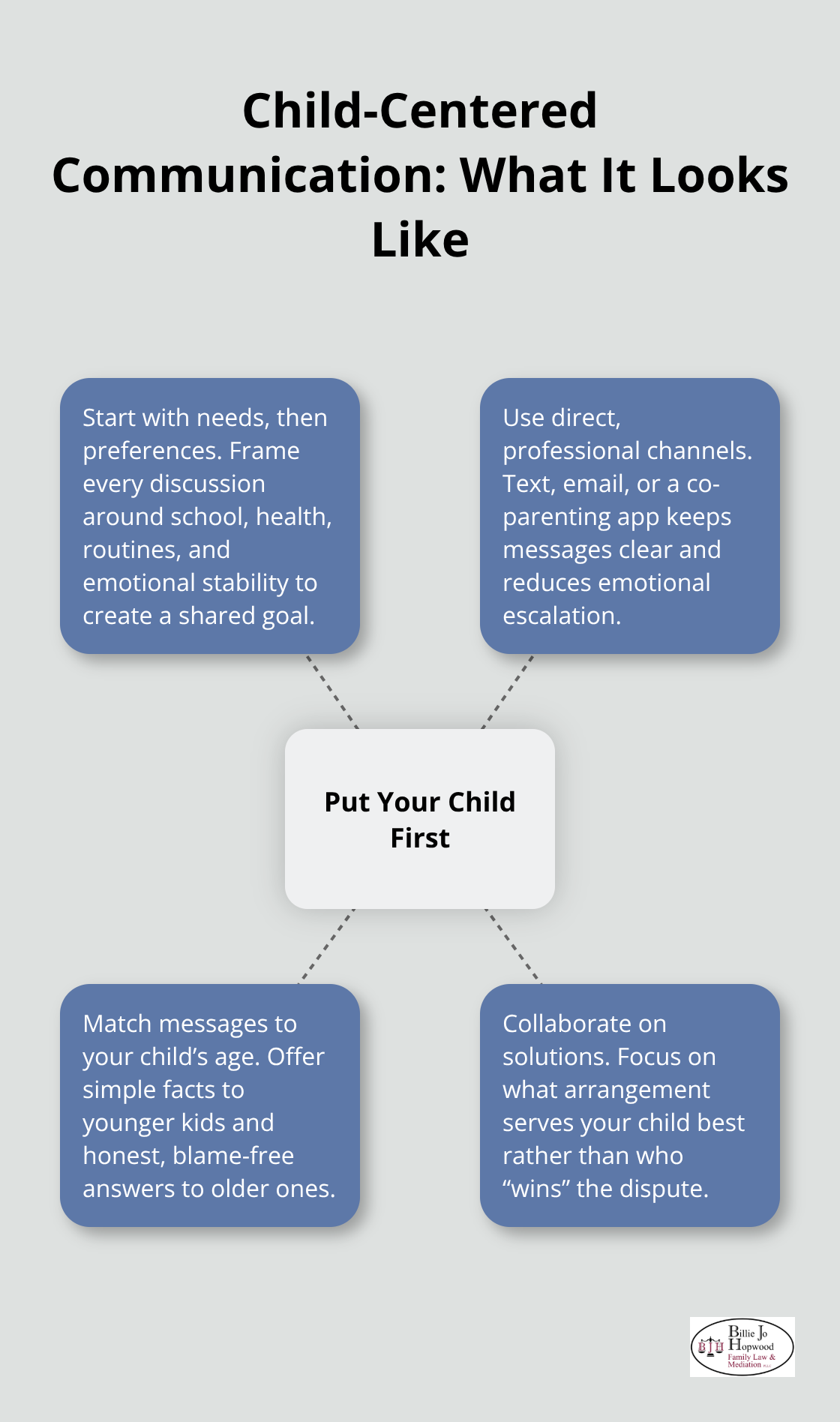
Visual guide showing core elements of child-centered co-parent communication.

Accept a hard truth: your conversations with your co-parent need to address your child’s needs first, your preferences second. This isn’t about being nice for niceness’s sake. It’s practical. When you frame discussions around what your child needs for school, health, activities, or emotional stability, you give both parents a shared goal. Instead of debating who gets more time or who makes decisions, you ask what arrangement actually serves your child best. This shift in focus defuses defensiveness because you’re not attacking your co-parent’s character or choices. You’re solving a problem together.

Communicate Directly and Keep Conversations Professional

Never use your child as a messenger between households. This seems obvious until you’re frustrated and your child is standing right there. Telling your child to relay messages to the other parent puts them in an impossible position: they become responsible for adult communication, they carry emotional weight that isn’t theirs, and they often feel they need to choose sides. Instead, communicate directly with your co-parent through text, email, or a co-parenting app like Our Family Wizard, which creates a written record and keeps conversations professional.

If you struggle with direct communication, a mediator can facilitate these conversations in a structured way that prevents escalation. Mediation in Melbourne helps parents make this transition through structured conversations with a neutral third party who keeps discussions focused on your child’s wellbeing rather than past grievances.

Match Your Words to Your Child’s Age and Understanding

Keep what you say to your child age-appropriate and factual. Young children don’t need to understand the reasons behind custody arrangements or financial disagreements. Older children deserve honest answers to direct questions, but answers that focus on logistics and reassurance, not blame or details meant for adults. This approach protects their emotional development while maintaining their trust in both parents.

When disputes arise over parenting decisions, the way you handle communication sets the tone for how your child processes the separation itself. The next section explores how you create the physical and emotional stability your child needs while these conversations happen.

Building Stability When Disputes Escalate

Parenting disputes thrive in chaos. When routines crumble, boundaries blur, and emotions run hot, your child feels the instability directly. Children in separated households need predictability more than ever.

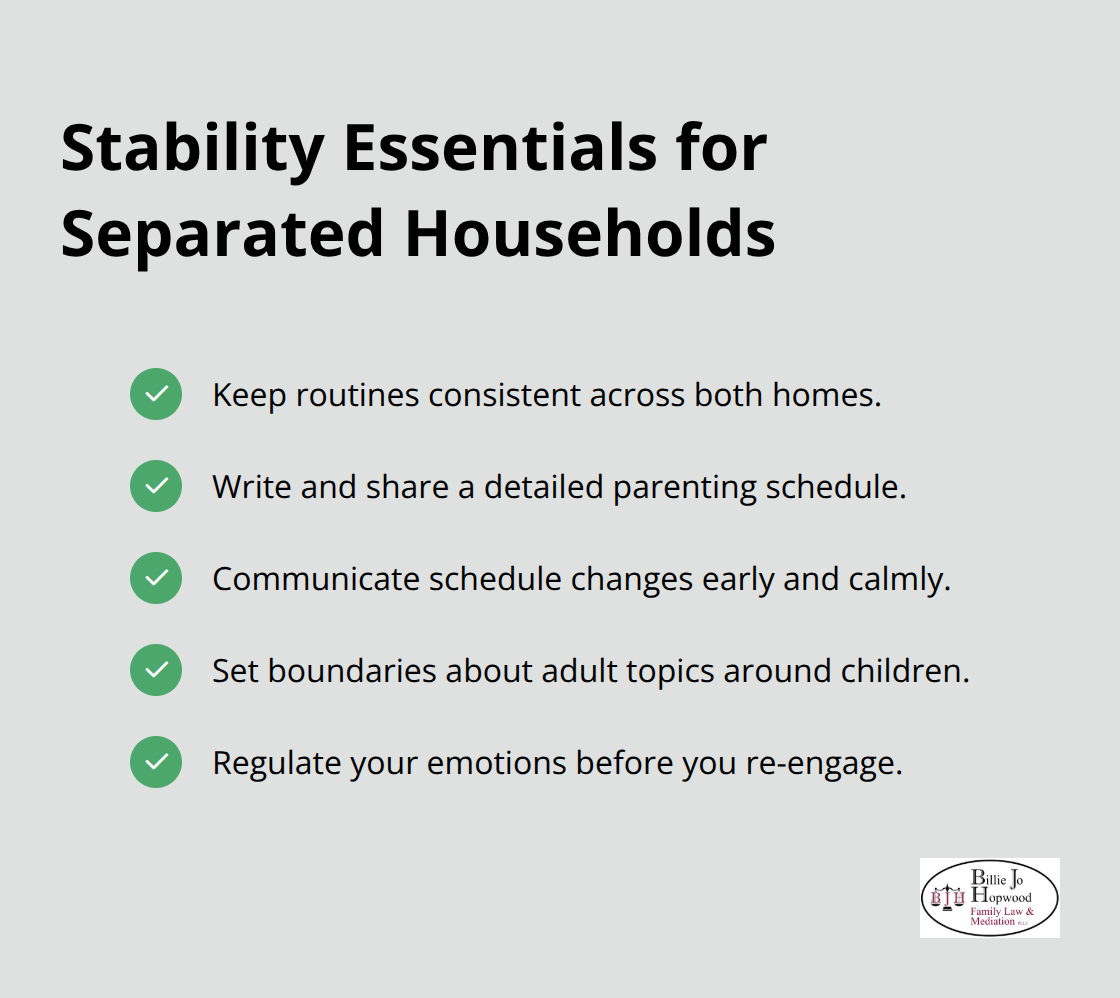
Checklist of practical steps to create stability for children in two-home families. - Parenting disputes mediation tips

A study from the University of Virginia found that children with consistent routines across both homes showed significantly lower anxiety levels and better academic performance than those experiencing frequent schedule changes. This isn’t about rigid control; it’s about giving your child the security of knowing what comes next. Your child needs to know which parent picks them up from school on Tuesday, what time dinner happens, and where they sleep each night. These details matter far more than you might think.

Create a Written Schedule Both Parents Follow

Start with a written parenting schedule that both you and your co-parent commit to following. Use a shared calendar tool like Google Calendar or a co-parenting app such as Our Family Wizard so there’s no confusion about who has the child and when. Melbourne courts generally favor joint custody arrangements when possible, which means both parents share decision-making authority. Your schedule should specify drop-off and pick-up times, locations, and who handles transportation. Include school days, overnight stays, and holiday arrangements. When disputes arise about changes to this schedule, refer back to the written agreement instead of making reactive decisions. This removes emotion from logistics and protects your child from last-minute instability.

Handle Schedule Changes Carefully and Communicate Them Early

If changes become necessary, make them gradually and communicate them clearly to your child in advance so they have time to adjust. Avoid the temptation to use schedule flexibility as a punishment or reward against your co-parent. Your child pays the price for that inconsistency through increased stress and behavioral problems.

Set Firm Boundaries About What You Discuss in Front of Your Child

Boundaries between you and your co-parent prevent disputes from bleeding into your child’s daily life. Set clear limits about what you will and won’t discuss in front of your child. Financial arguments, relationship grievances, and custody disagreements stay between adults. When your co-parent brings up a contentious topic near your child, calmly say you’ll address it separately and change the subject. This boundary protects your child from feeling caught in the middle.

Manage Your Own Emotions So Your Child Doesn’t Absorb Them

Equally important is managing your own emotional response when your co-parent frustrates you. Children absorb parental stress like sponges. Research from the American Psychological Association shows that children exposed to high parental conflict display elevated cortisol levels (the stress hormone), which affects their sleep, immune function, and ability to learn. If you feel anger rising during an interaction with your co-parent, take a break. Step into another room, take three deep breaths, and return when you can speak calmly. Your child doesn’t need to witness your frustration. They need to see a parent who handles difficult situations with composure. This models emotional regulation and teaches them that strong feelings don’t require explosive reactions.

When you establish these foundations-predictable schedules, clear boundaries, and emotional control-you create the conditions where disputes lose their power to harm your child. The next step involves recognizing when professional help can move you past these disputes entirely.

Mediation as Your Path Forward

How Mediation Stops the Escalation

Court battles create a cycle that feeds on itself. When you file for custody in Brevard County, filing fees run around $409 as of 2023, and that’s before attorney fees and court costs pile up. If mediation fails and the case moves to trial, a custody evaluation may cost $1,500 to $6,000 and take several weeks.

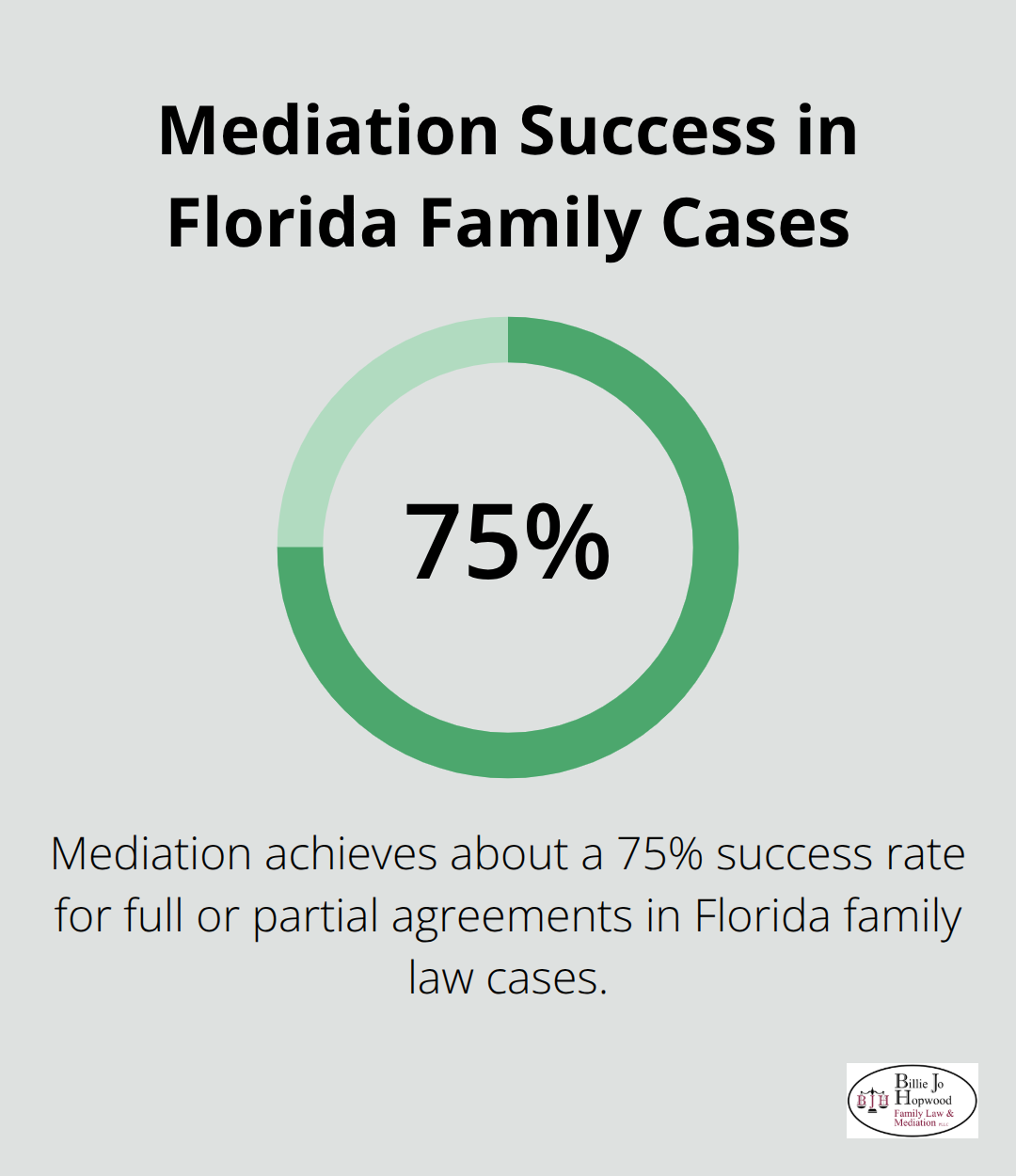
Chart showing the success rate of mediation in Florida family law matters. - Parenting disputes mediation tips

A neutral mediator, trained and certified by the Florida Supreme Court, guides you and your co-parent toward solutions you both control instead of handing the decision to a judge who doesn’t know your family. Mediation achieves about a 75% success rate for full or partial agreements in Florida family law cases. The mediator doesn’t decide outcomes or provide legal advice-you and your co-parent make the decisions together. This matters because when you design the parenting plan yourself, you create something that actually fits your lives instead of following a template the court imposes.

Speed and Confidentiality Work in Your Favor

Mediation happens faster than court proceedings. You schedule sessions on your timeline, not the court’s calendar. In Seminole and Brevard counties, family mediations occur online via video conference, which means you avoid hours spent driving to courthouse meetings. Confidentiality during mediation fosters open conversation in ways court proceedings never can. What you say in mediation stays confidential, with disclosures allowed only as required by law. This means you can explore solutions, acknowledge frustrations, and work toward compromise without worrying that your words become evidence against you later.

A Detailed Plan Prevents Future Disputes

A well-crafted parenting plan addresses daily routines, education decisions, medical care, and extracurricular activities with enough specificity that both parents know exactly what’s expected. You specify drop-off times, exchange locations, how you’ll handle school emergencies, and which parent makes healthcare decisions. This level of detail prevents the disputes that drag families back into conflict months or years later. Mediation also improves post-divorce communication because you’ve practiced resolving disagreements with a neutral person present. You learn how to separate the issue from the person, how to listen when your co-parent explains their perspective, and how to propose solutions that work for both of you. These skills carry forward into your long-term co-parenting relationship.

Understanding the Cost Structure

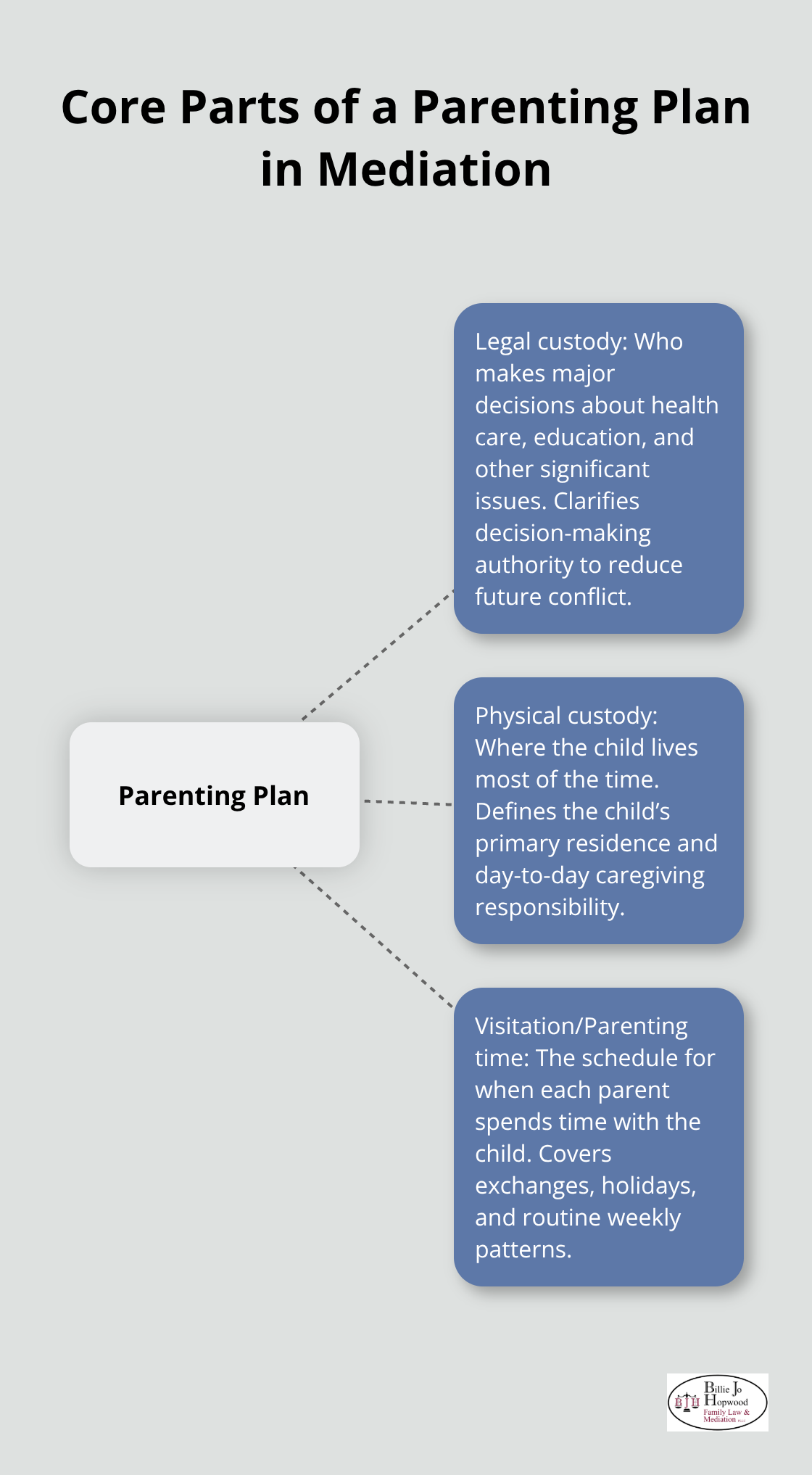
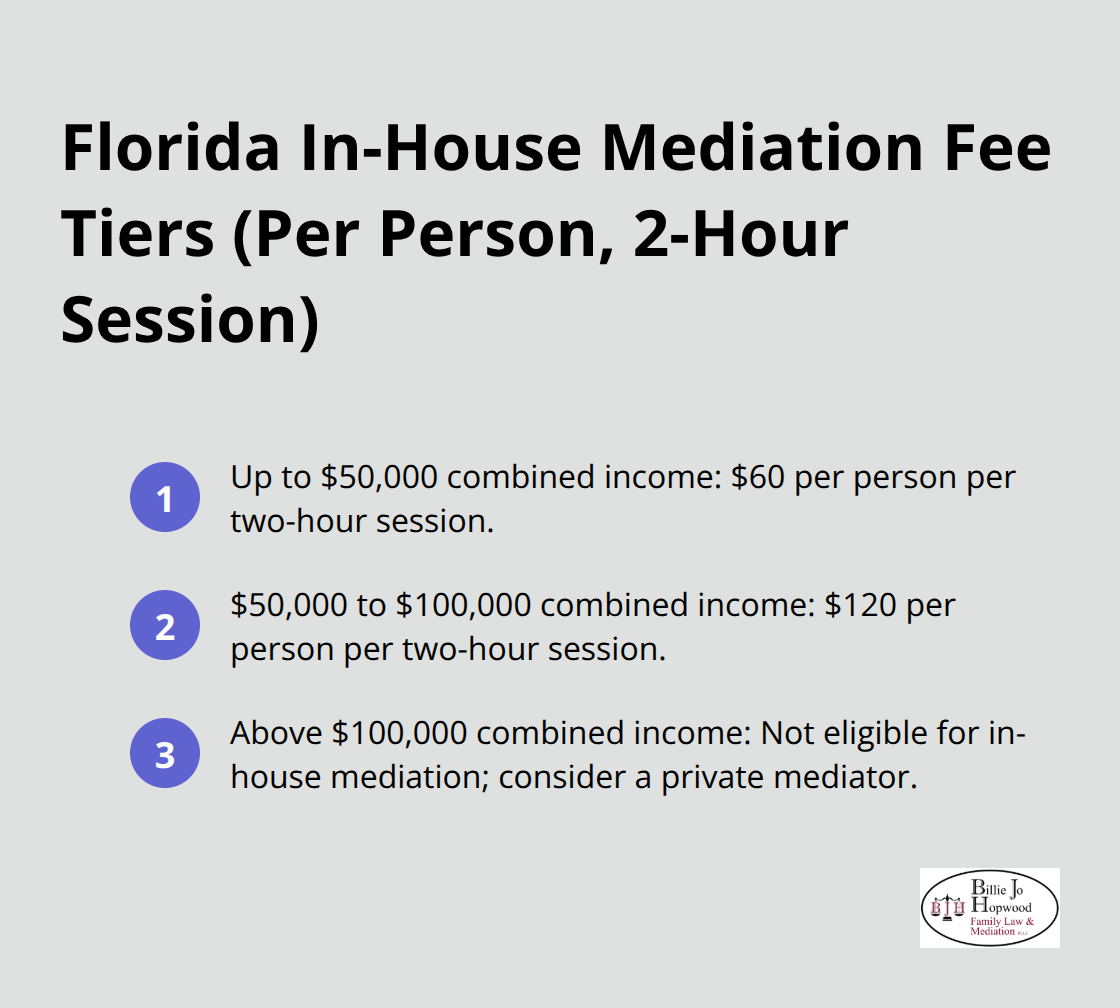
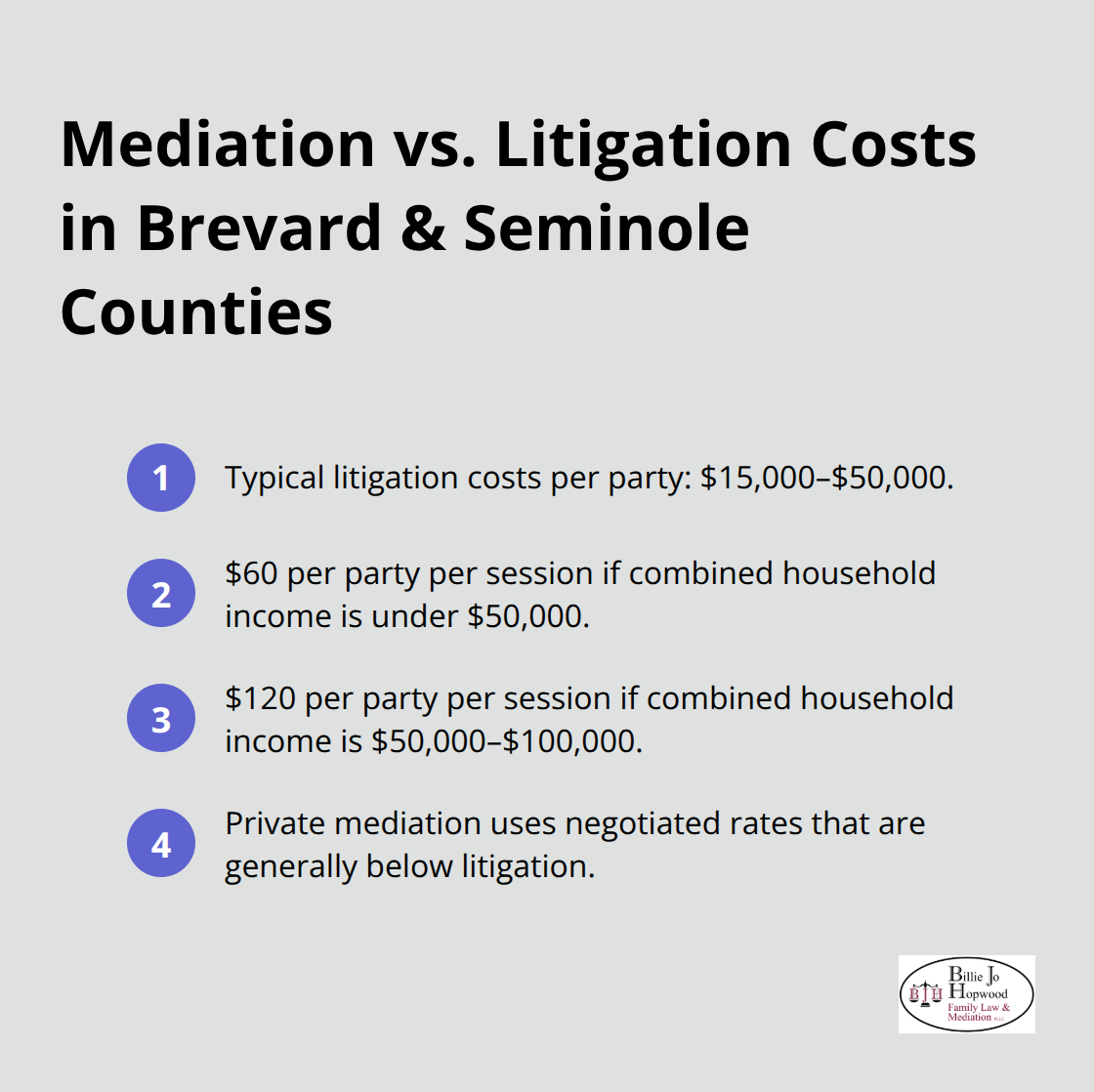
If you qualify as indigent, you can file an Application for Indigency with the Clerk of Court and access family mediation for free. Otherwise, combined income-based fees apply: under $50,000 annual household income costs $60 per party, and $50,000 to $100,000 costs $120 per party. Families earning over $100,000 must pursue private mediation. We at Billie Jo Hopwood Family Law & Mediation, PLLC can help you prepare documents that support a stronger parenting plan, even if you handle mediation without an attorney present.

Final Thoughts

Your child’s wellbeing comes first, and that principle guides every decision you make during a parenting dispute. The parenting disputes mediation tips covered in this post all point toward one outcome: a stable, cooperative arrangement where your child feels secure and loved by both parents. When you focus on your child’s needs instead of winning against your co-parent, when you maintain consistent routines and manage your emotions, and when you choose mediation over court battles, you protect what matters most.

Separation transforms your role as a parent rather than ending it. You and your co-parent remain partners in raising your child, even though you’re no longer partners in marriage. This shift in perspective changes everything-instead of viewing mediation as a loss or compromise, you see it as an opportunity to design a parenting arrangement that actually works for your family’s unique circumstances.

Melbourne, Florida families have access to resources that make this transition smoother, and we at Billie Jo Hopwood Family Law & Mediation, PLLC stand ready to help you navigate family law matters including custody arrangements and child support. Contact us today to learn how we can support your family through this process.

Divorce Mediation Steps: From Start to Settlement

Divorce mediation offers a faster, more affordable path through separation than courtroom battles. We at Billie Jo Hopwood Family Law & Mediation, PLLC guide clients through each divorce mediation step with clarity and support.

This guide walks you through the entire process, from your first meeting to final settlement. You’ll understand what to expect and how to protect your interests along the way.

What Divorce Mediation Actually Is in Melbourne, Florida

The Core of Mediation: Control and Clarity

Divorce mediation is a structured negotiation where a neutral third party helps you and your spouse reach agreements on asset division, parenting arrangements, and support without stepping into a courtroom. A mediator does not decide outcomes for you-they facilitate conversation, clarify positions, and help generate settlement options both parties can accept. The process works because it shifts control from a judge to you. You shape the agreement instead of having terms imposed by someone unfamiliar with your family’s needs.

Speed and Cost Advantages Over Litigation

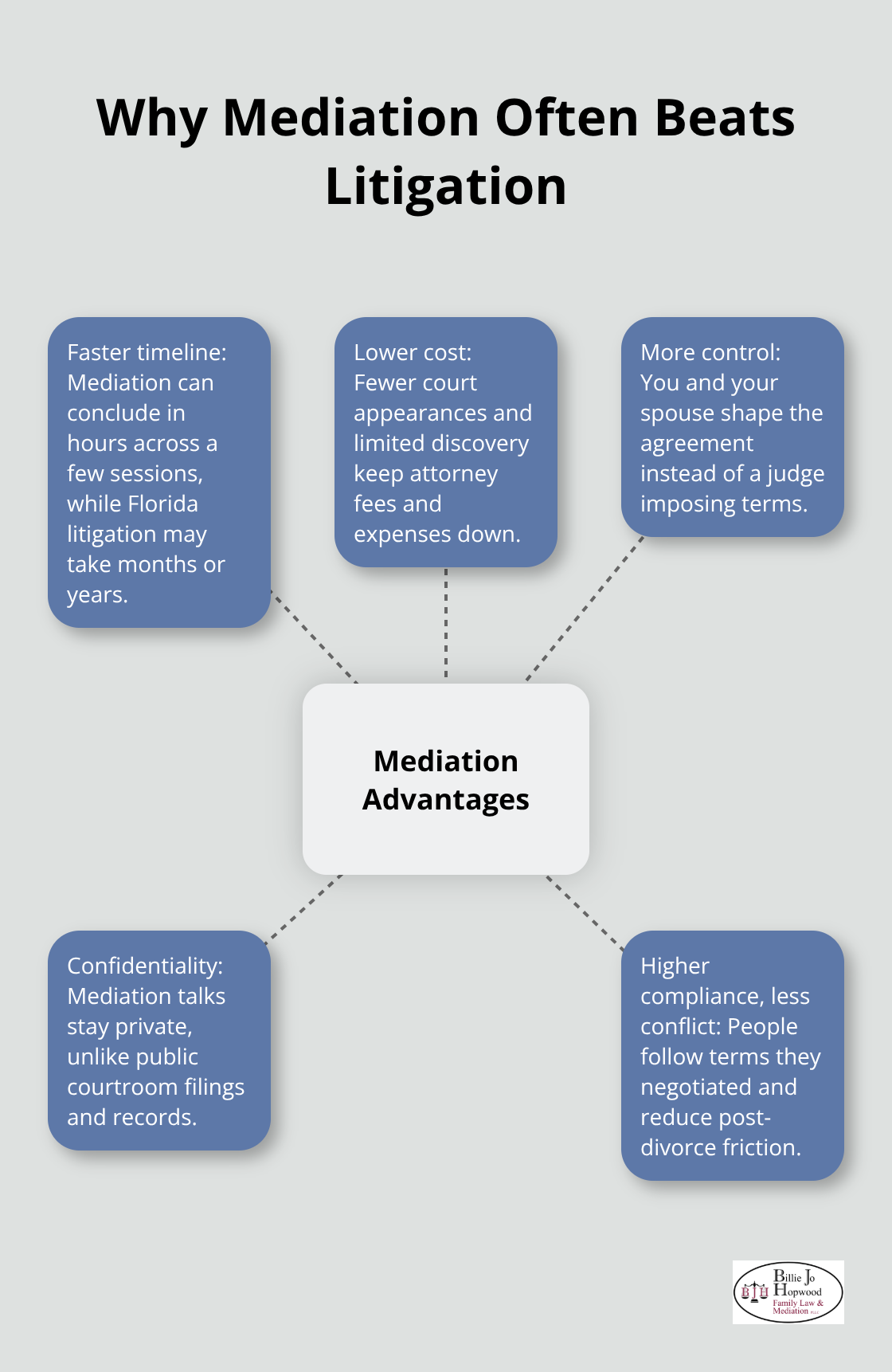
Mediation typically resolves disputes in a few hours across multiple sessions, whereas contested litigation in Florida can drag on for months or years. The cost difference is substantial. Mediation costs significantly less than litigation because you avoid lengthy court appearances, discovery disputes, and trial preparation. Court cases require depositions, motions, and formal proceedings that multiply legal fees quickly.

Infographic showing key advantages of divorce mediation over litigation - divorce mediation steps

Privacy Protection Through Confidentiality

Mediation also keeps financial details private. Court records are public, meaning your asset division, income, and parenting arrangements become part of the public record. Mediation conversations remain confidential under Florida’s Mediation Confidentiality and Privilege Act, protecting sensitive information from public view.

How Mediation Differs From Courtroom Divorce

In court, a judge makes final decisions on custody, property division, and support based on state law and the evidence presented. You have limited input once litigation begins. The judge may order outcomes neither spouse finds satisfactory because the ruling reflects legal standards, not family preferences. Mediation flips this dynamic. You and your spouse control what gets decided. If you cannot reach agreement on an issue, mediation ends and you proceed to court-but mediation often prevents that outcome entirely.

Studies show mediated settlements produce higher long-term compliance than court-imposed orders because both parties agreed to the terms. You follow a parenting schedule or support payment you negotiated more reliably than one a judge ordered. Mediation also reduces conflict. The collaborative tone helps preserve relationships, which matters significantly when children are involved. Co-parenting after divorce requires ongoing communication, and mediation’s problem-solving approach supports that better than adversarial litigation. Court proceedings emphasize winning and losing, which hardens positions and damages family relationships further.

Timing: The Six-Month Waiting Period

Another practical difference lies in timing. Florida imposes a mandatory six-month waiting period from petition filing to finalization regardless of dispute resolution method. However, mediation can resolve all contested issues within weeks, allowing you to move through the waiting period with a complete settlement agreement ready for court approval rather than fighting over details during those six months. This preparation phase sets the stage for addressing the specific issues that mediation handles best.

How the Mediation Process Unfolds

Your First Session: Setting the Foundation

Your first mediation session sets the tone for everything that follows. The mediator explains the ground rules, outlines confidentiality protections under Florida law, and asks each spouse to describe their primary concerns and goals. This initial meeting typically lasts two to three hours and costs between $300 and $500 depending on the mediator’s hourly rate. Arrive with a list of specific questions and topics you want addressed-vague goals produce vague agreements. The mediator gauges what each party wants to accomplish, whether that’s minimizing conflict around parenting time, dividing retirement accounts fairly, or establishing reasonable alimony terms. They also assess whether both spouses will negotiate in good faith. If domestic violence, ongoing abuse, or severe trust erosion exists, the mediator may recommend alternative dispute resolution methods instead.

Private and Joint Meetings

Once ground rules are established, the mediator meets with both spouses and their attorneys together, then holds private sessions to understand each person’s priorities without the other present. This confidentiality protects candid discussion. You should have your attorney present during mediation to explain legal implications, protect your rights, and review any proposed terms before you agree to them. An attorney is not optional in this process-they’re essential.

Gathering Financial and Family Documents

Information exchange comes next. Bring comprehensive financial records: mortgage statements, deed of trust documents, retirement account statements, investment account records, tax returns from the last three years, recent pay stubs, and a complete list of debts with current balances. Also gather family documents including children’s birth certificates, school and health records, marriage certificate, any prenuptial or marital agreements, wills or trusts, and life insurance policy details. Florida uses equitable distribution for asset division, meaning the court aims for fairness rather than a strict 50/50 split. Inheritances stay separate property unless you commingled them with marital funds-the mediator needs to know this distinction.

Negotiation Rounds and Settlement Options

The negotiation rounds that follow involve the mediator proposing settlement options and testing whether both sides can accept proposed terms on custody arrangements, property division, and support calculations. Child support in Florida follows state formulas based on income and parenting time percentages, though mediation can address how to structure payments. Alimony factors include marriage duration, standard of living, each spouse’s earning capacity, education level, age, and physical or emotional condition. Negotiations may span multiple sessions. If progress stalls, the mediator suggests new angles or holds additional private meetings to break through impasses.

Drafting and Reviewing Your Settlement Agreement

Once both parties reach tentative agreement on all issues, your attorney drafts a formal settlement agreement that incorporates the mediated terms. Do not sign this agreement until your attorney reviews it thoroughly and confirms the terms align with your legal rights and Florida law. The mediator cannot provide legal advice, so your attorney’s independent review is your final safeguard before binding yourself to the settlement. With your agreement finalized and reviewed, you move into the next phase: addressing the specific issues that mediation resolves most effectively, from custody arrangements to financial divisions.

What Mediation Actually Resolves in Melbourne, Florida

Mediation in Melbourne, Florida handles the financial and parenting issues that consume most divorce disputes. These three areas represent where couples spend the most time negotiating, and where mediation produces the strongest outcomes because both parties shape the final terms rather than accepting a judge’s decision. Understanding what mediation can address helps you prepare realistic expectations and gather the right documentation before your first session.

Parenting Time and Custody Arrangements

Parenting time arrangements sit at the center of most mediation discussions when children are involved. Florida courts apply the best interest standard to custody decisions, but mediation lets you define what that means for your family rather than having a judge interpret it. The mediator helps you and your spouse work through specific details: which parent handles school decisions, how holidays split between households, whether overnight visits happen on weekends or weekdays, and how you communicate about parenting issues.

These practical arrangements matter far more than a custody label. One parent might have primary physical custody while the other has substantial parenting time on alternating weekends and one weeknight per week. Another arrangement might involve a 50/50 split with alternating weeks. Florida’s parenting time guidelines suggest a minimum of 20 percent time with the non-primary parent, but mediation lets you exceed these minimums if both parents want more involvement.

Your attorney should review any parenting plan to confirm it aligns with Florida law and protects your parental rights, but the mediator facilitates the actual negotiations.

Child Support Calculations and Structures

Child support calculations follow Florida’s income shares model, which considers both parents’ income, the number of overnights each parent has, and childcare costs. The state formula provides a baseline, but mediation can address how you structure payments, whether one parent pays the other’s health insurance premiums, and how you handle future adjustments if income changes significantly.

Asset and Debt Division

Asset and debt division requires the most documentation but often concludes faster than parenting arrangements because numbers are concrete. Florida uses equitable distribution, meaning fair rather than equal. The mediator helps you categorize what’s marital property versus separate property, which affects how items divide. A house purchased during marriage is marital property; an inheritance received during marriage stays separate unless you deposited it into a joint account.

Retirement accounts accumulated during the marriage split as marital property, with specific procedures for dividing 401(k)s and IRAs without tax penalties. The mediator does not calculate these divisions independently but facilitates discussion about who keeps the house, how you divide property, assets, and financial responsibilities, and who assumes which debts. Your attorney handles the technical language that transfers these assets legally.

Alimony Terms and Options

Alimony depends on factors including how long you were married, the income gap between spouses, your standard of living during marriage, and each person’s earning capacity. Florida recognizes multiple alimony types: temporary support during the divorce process, bridge-the-gap alimony for short-term adjustments after divorce, rehabilitative alimony if one spouse needs time to become self-sufficient, durational alimony for marriages of moderate length, and permanent alimony only for longer marriages where one spouse cannot become self-sufficient.

The mediator discusses these options and helps you evaluate what works for your situation. Courts review mediated agreements on alimony to verify the terms comply with Florida law and reflect the statutory factors, so your attorney’s input matters significantly before you commit to any alimony arrangement.

Final Thoughts

Your mediation agreement becomes a binding document once both spouses and your attorneys sign it, then moves to court for judicial review. The judge verifies that you entered the agreement voluntarily, that terms comply with Florida law, and that no coercion occurred. This approval process typically takes weeks rather than months because the judge reviews a completed settlement rather than presiding over contested disputes, and after court approval, your mediation agreement becomes part of the final divorce decree that legally ends your marriage and enforces all terms regarding property division, custody arrangements, and support payments.

Post-divorce life involves practical transitions beyond the legal paperwork. If you share custody, you implement the parenting schedule you negotiated; if you receive or pay alimony or child support, those payments begin according to the terms you agreed to. The collaborative nature of mediation often leaves families better positioned for these transitions than litigation does, since you negotiated terms together rather than fighting over them, which means you understand the reasoning behind each agreement and can implement them more smoothly.

The problem-solving approach you developed during the divorce mediation steps carries forward into co-parenting relationships and other post-divorce interactions. Contact Billie Jo Hopwood Family Law & Mediation, PLLC in Melbourne to discuss your mediation options and next steps.

Parenting Plan Mediation: Crafting Fair Custody Schedules With Care

Custody schedules created through court orders often leave families feeling frustrated and inflexible. At Billie Jo Hopwood Family Law & Mediation, PLLC, we’ve seen how parenting plan mediation transforms this process by putting your family’s actual needs first.

When both parents work together with a neutral mediator, the result is a schedule that works for everyone-including your children.

Why Mediation Breaks Through Parental Communication Barriers

How Mediators Reframe Custody Conversations

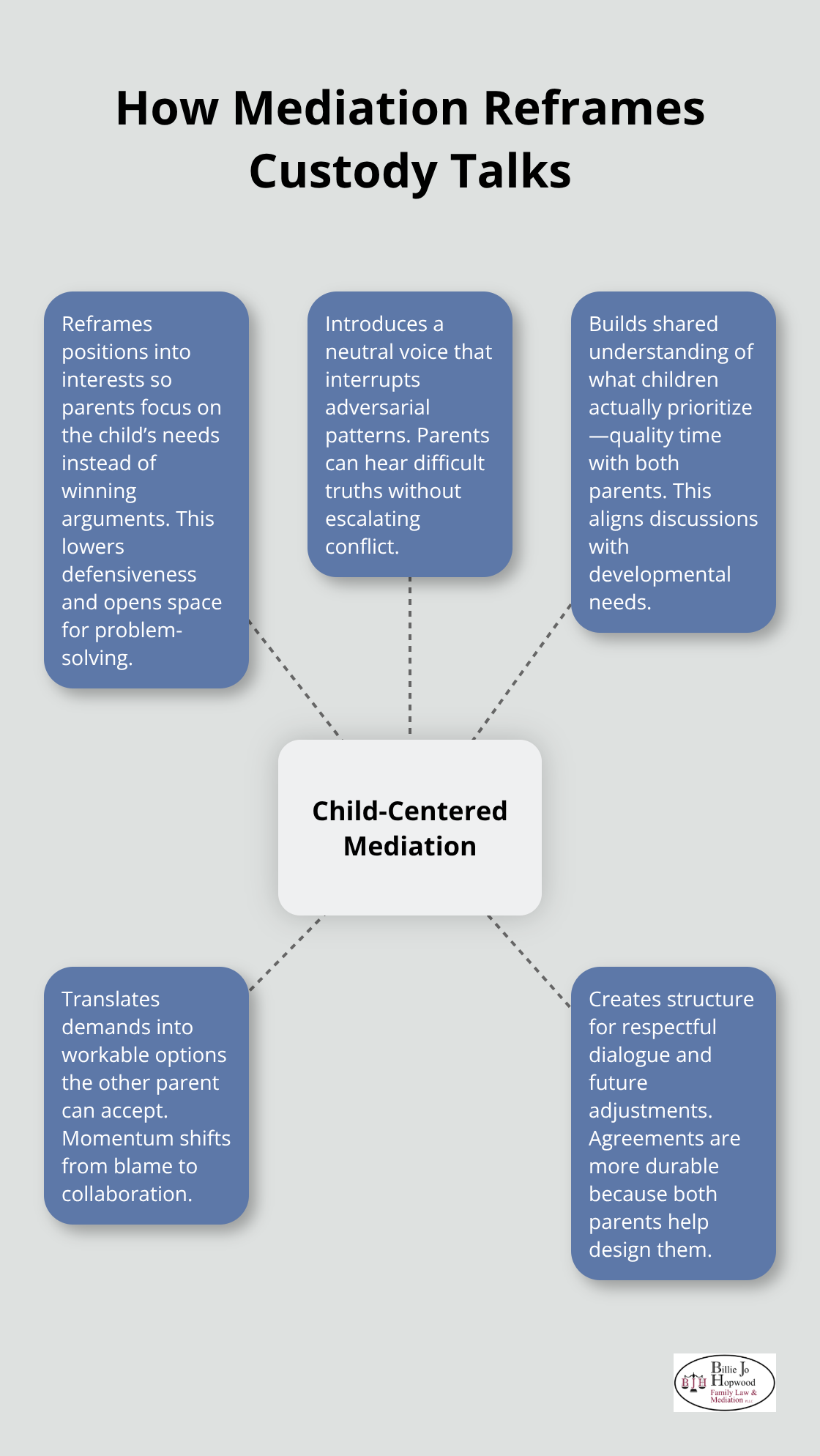
Mediation fundamentally changes how divorced or separating parents talk to each other. Without a neutral third party, conversations about custody become adversarial-one parent’s proposal triggers a defensive response, and both sides dig in. A mediator interrupts this pattern by reframing discussions around the child’s needs rather than parental positions. Research from the Chicago Bar Association in Summer 2024 found that children prioritize quality time with both parents over a specific quantity of hours, yet parents locked in conflict rarely hear this message from each other.

Diagram showing child-centered mediation at the core with benefits that reduce conflict and improve communication.

Mediation creates the space where this shift happens.

Instead of arguing about who gets more weekends, parents discuss what schedule allows their child to maintain strong relationships with both of them while attending soccer practice and staying connected to school friends. The mediator translates demands into interests and helps each parent see the other’s genuine concern for the child. This is not theoretical-it’s practical communication restructuring.

When Parents Stop Competing, Solutions Emerge

When parents stop viewing custody negotiations as a zero-sum competition, they naturally generate schedules neither would have considered alone. One parent might realize their work schedule actually permits midweek overnights they’d dismissed as impossible. The other might recognize that a consistent Thursday evening exchange works better than rigid weekly swaps. These discoveries happen because mediation removes the pressure to win and replaces it with collaborative problem-solving.

Mediators Protect What Courts Cannot

A neutral mediator also protects the child’s best interests in ways courtroom advocacy cannot. Judges apply statutory factors to custody decisions, but they work from limited information presented during hearings. A mediator, by contrast, spends time understanding each family’s actual constraints-rotating shift work, school calendars, extended family relationships, the child’s age and maturity, home stability, and financial realities.

The mediator asks hard questions that attorneys sometimes skip: Can your child thrive on a 50/50 schedule when one parent works nights? Does your child need consistency in schooling location more than equal parenting time? What happens if one parent relocates for a job? Flexible arrangements that emerge from mediation address these specifics, whereas court orders impose standardized templates that often miss what matters most.

Why Mediated Plans Stick

A schedule that works on paper frequently fails in practice because it ignores the child’s developmental needs or a parent’s actual availability. Mediation eliminates this gap. Parents leave with a plan they’ve built together, understand completely, and feel motivated to honor because they shaped it. That commitment translates into fewer post-divorce conflicts and better stability for the child. With this foundation in place, the next step involves understanding which specific custody schedule models actually work for different family situations.

What Should a Parenting Plan Actually Include

A workable parenting plan lives in the details. Courts in Tennessee require a Permanent Parenting Plan in every divorce involving minor children, but mediation produces plans far more nuanced than statutory minimums. The schedule itself matters less than whether it reflects how your family actually functions. If you work rotating shifts, a traditional Monday-to-Friday custody split fails immediately. If your child attends school in one parent’s district, a 50/50 residential swap creates instability that harms academic performance.

Start With Your Family’s Real Constraints

Mediation forces you to map your actual constraints before you draft any language. Collect concrete data: your work hours including commute time, your child’s school calendar and extracurricular commitments, distance between homes, and your child’s age. A four-year-old needs shorter transitions between parents than a teenager who can manage weekly swaps. The Chicago Bar Association found in Summer 2024 that children prioritize quality time with both parents, not equal clock hours, so your plan should prioritize meaningful interaction over mechanical splits.

One parent’s midweek overnight plus a full weekend day often produces better outcomes than rigid alternating weeks because the child maintains stronger weekly connection to both households. This approach reflects what actually matters to your child’s development and emotional security.

Transportation and Exchange Logistics Determine Success

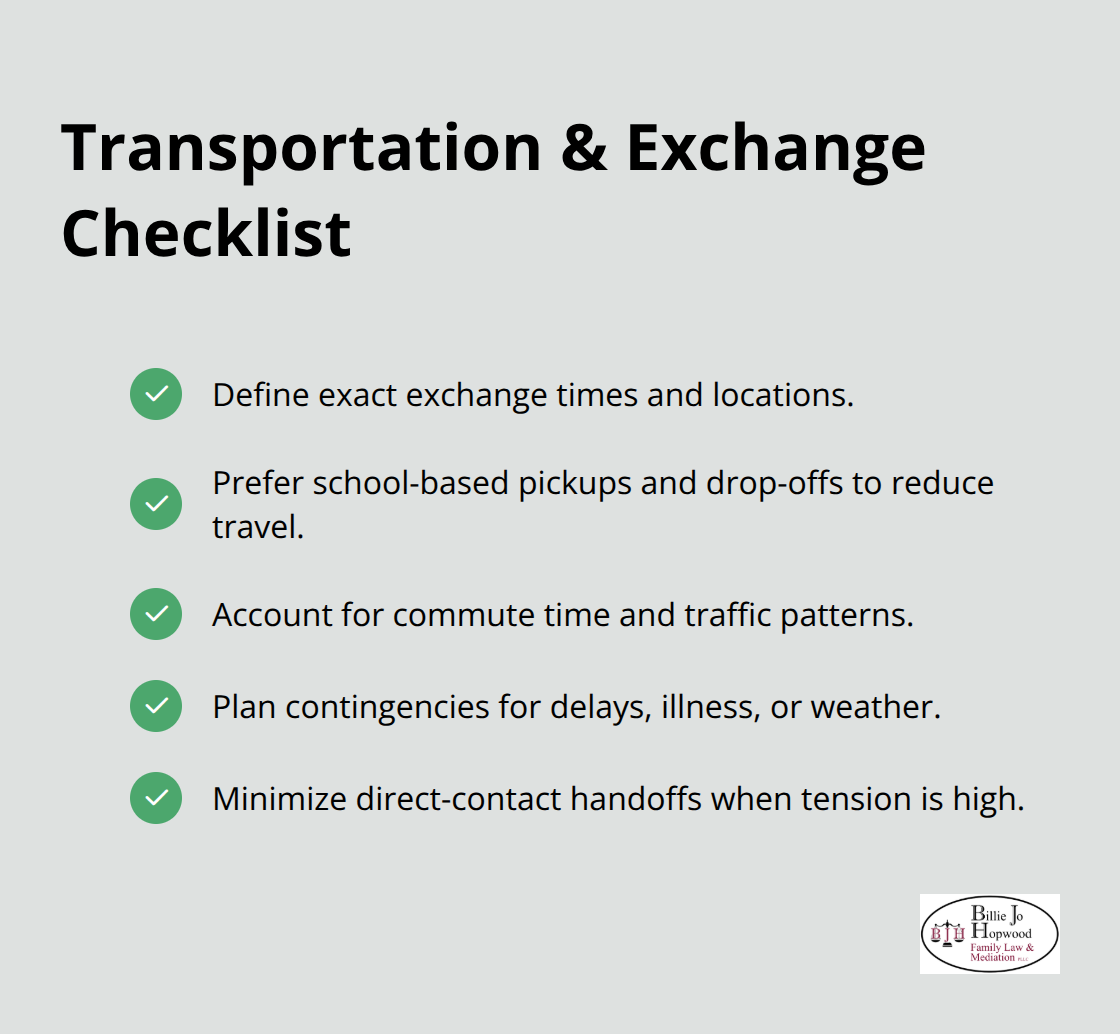
Transportation logistics determine whether a schedule survives first contact with reality. If exchanging your child requires a 45-minute drive, weekly handoffs drain both parents and stress the child. Specify exactly where and when exchanges happen.

Checklist of key transportation and exchange details to include in a parenting plan. - parenting plan mediation

School pickup and drop-off locations work better than neutral meeting points because they eliminate redundant travel. Some families use school-based exchanges entirely, reducing direct contact and timing disputes.

Holiday and Vacation Time Requires Separate Planning

Holiday and vacation allocation deserves its own planning because standard schedules collapse during school breaks. Specify Thanksgiving, Christmas, spring break, and summer vacation in writing rather than leaving them to annual negotiation. The plan should state whether holidays rotate yearly, split within a single day, or follow a fixed pattern. Summer vacation requires particular attention because six weeks of uninterrupted time with one parent upends the regular schedule. Many workable plans extend one parent’s summer time to four weeks while the other receives two, rather than splitting it 50/50, because children adjust better to longer blocks.

Decision-Making Authority for Education and Healthcare

Decision-making authority for education and healthcare cannot remain vague. Tennessee law recognizes sole and joint legal custody, with joint custody meaning both parents share authority over major decisions about schooling, medical treatment, and religious upbringing. If you share legal custody, your plan must specify how you’ll handle disagreements. Will you consult before enrolling your child in private school, or can one parent decide unilaterally? What happens if one parent wants a medical procedure the other opposes?

Mediation forces you to answer these questions now rather than litigating them later. Establish a communication protocol for routine updates on grades, medical appointments, and activities. Tools like OurFamilyWizard create documented records of shared information, reducing conflict and protecting both parents if disputes arise. Your plan should also address who carries health insurance, how medical expenses split beyond insurance coverage, and whether routine decisions like haircuts or dental cleanings require mutual consent or fall within one parent’s authority.

Specificity Prevents Post-Separation Conflict

The more specific your written plan, the fewer post-separation conflicts emerge. Vague terms about “reasonable visitation” or “as agreed” invite disputes when circumstances change or parents disagree on interpretation. Clear language about custody schedules, decision-making processes, and financial responsibilities creates a foundation both parents understand and can follow. This clarity becomes especially valuable when emotions run high or schedules shift unexpectedly. With these foundational elements in place, you’re ready to examine which specific custody schedule models actually work for different family situations and how mediation helps you select the right one for your circumstances.

Which Custody Schedule Actually Works for Your Family

The 50/50 equal split dominates custody conversations, but it fails for most families in practice. Tennessee courts recognize that equal parenting time means roughly 50 percent of the year with each parent, yet this framework ignores how children actually live. A child attending school in one district cannot thrive on weekly alternations between two homes 20 miles apart. A parent working rotating 12-hour shifts cannot maintain a rigid Monday-to-Friday schedule. Mediation reveals these incompatibilities before you commit to a schedule that collapses within weeks.

Why the 2-2-3 Model Outperforms Equal Splits

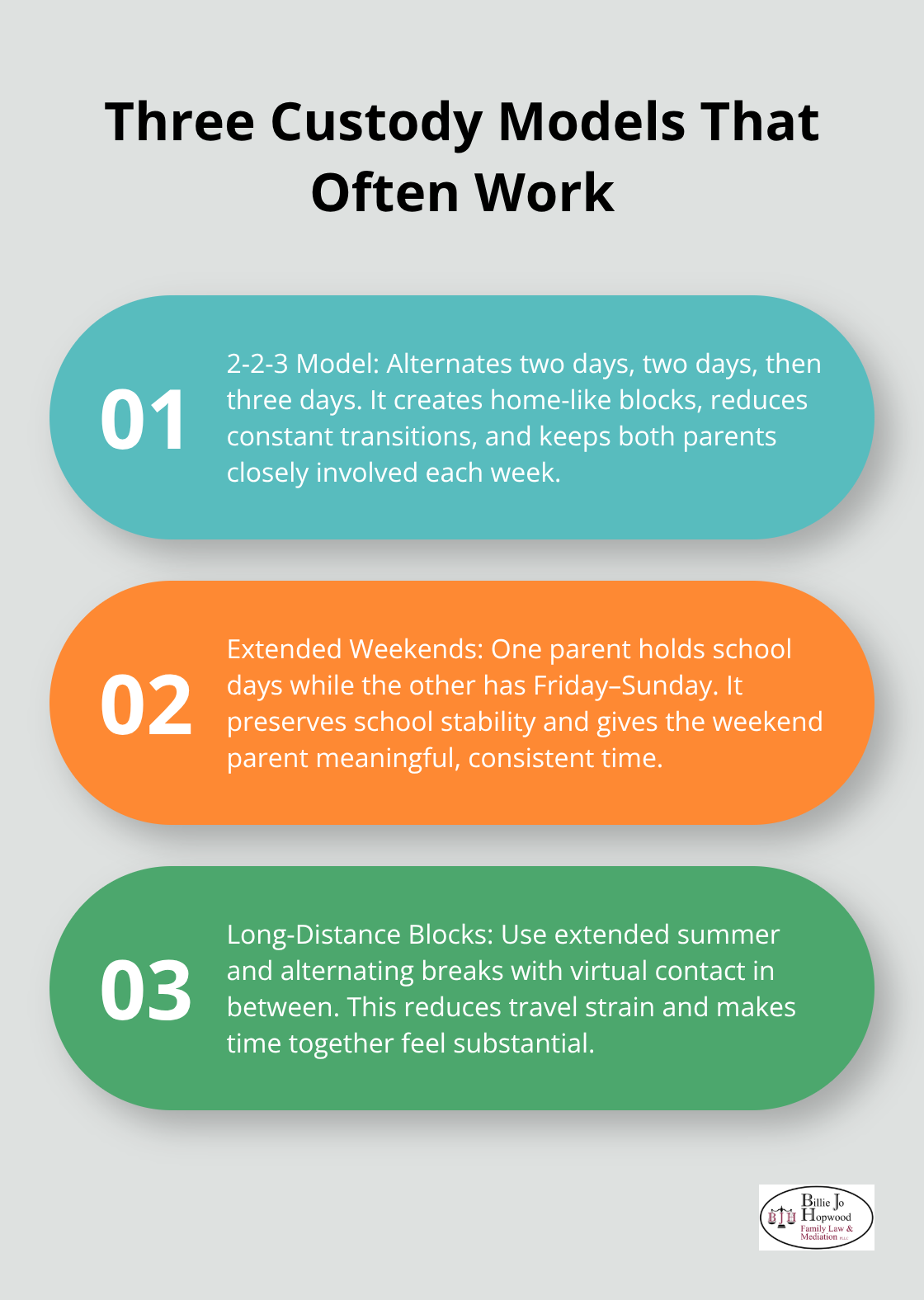
The 2-2-3 model works better than 50/50 splits for most school-age children. One parent has the child for two days, the other for two days, then the first parent for three consecutive days. This schedule creates longer blocks that feel like home rather than constant transition. If you work standard 9-to-5 hours and your co-parent does the same, a 2-2-3 arrangement with midweek overnights on the alternate parent’s off days maintains stronger weekly connection than alternating full weeks.

Stylized list explaining three custody schedule models that support stability and connection. - parenting plan mediation

The child sees both parents regularly without the psychological toll of constant packing and moving.

Extended Weekends Preserve School Stability

Extended weekend arrangements with one parent taking Friday through Sunday while the other maintains school-day custody often prove more sustainable than equal splits, particularly when one parent has been the primary caregiver. This model preserves the child’s school stability, keeps extracurricular routines consistent, and gives the secondary parent meaningful weekend time that feels substantial rather than squeezed into a compressed schedule.

Primary Custodian Arrangements with Scheduled Visitation

Primary custodian arrangements work well when one parent has historically provided most daily care and the other prioritizes quality time over quantity. The visitation parent might have every other weekend plus one weeknight dinner and overnight, plus two weeks in summer. This transparency prevents constant renegotiation and allows both parents to plan their lives with certainty.

Long-Distance Parenting Requires Different Thinking

Long-distance parenting demands completely different thinking. If parents live more than two hours apart, extended blocks become necessary because frequent short transitions waste time in transit. One parent might have the child for full summer breaks and alternating school breaks, while the other maintains video contact and strategic visits. Mediation helps you map your actual constraints before selecting a model. Your work schedule, your child’s school calendar, distance between homes, your child’s age and activity commitments, and each parent’s genuine availability determine which schedule survives contact with reality. A mediator asks whether you can truly maintain a schedule or whether you are describing what you wish were possible. Parents frequently commit to arrangements they cannot sustain, then return to court for modifications. Mediation forces honest assessment now. The schedule that works is the one you will actually follow because it accommodates your real life, not an idealized version of it.

Final Thoughts

Parenting plan mediation produces measurably better outcomes than litigation because it centers on your family’s actual needs rather than courtroom arguments. When you work with a neutral mediator, you build a schedule together instead of accepting one imposed by a judge who spent limited time understanding your constraints. Parents who mediate report higher satisfaction with their arrangements and fewer post-separation conflicts because they shaped the plan themselves and feel invested in making it work.

The schedules that survive long-term are the ones tailored to your specific circumstances-a 2-2-3 model works for one family while extended weekends serve another better, and long-distance parenting requires completely different thinking than co-parenting in the same town. Your child’s age, school location, extracurricular commitments, and each parent’s actual work schedule determine what works, not generic templates. Customized plans also address the details that court orders frequently overlook: transportation logistics, holiday allocation, decision-making authority for education and healthcare, and communication protocols all matter enormously to whether your plan functions smoothly.

If you are ready to create a parenting plan that works for your family, we at Billie Jo Hopwood Family Law & Mediation, PLLC are here to guide you through the process. Based in Melbourne, Florida, we assist families through challenging legal situations including custody arrangements and parenting plan development. Contact us to begin parenting plan mediation in Melbourne, Florida and build a schedule that reflects your family’s unique needs rather than fighting over one in court.

Collaborative Law Alternative: Understanding This ADR Option

Family law disputes don’t have to follow the courtroom path. At Billie Jo Hopwood Family Law & Mediation, PLLC in Melbourne, Florida, we see families choosing collaborative law as an alternative that keeps control in their hands.

This approach brings both parties and their attorneys together to work toward solutions that work for everyone involved.

What Collaborative Law Actually Means

Collaborative law brings both spouses and their attorneys into structured meetings where everyone agrees upfront to resolve disputes without court. Each spouse hires an attorney trained in collaborative practice, and both sides commit to sharing information openly and negotiating in good faith. According to Katherine E. Stoner’s research on divorce without court, this approach typically involves four-way meetings where both spouses, both attorneys, and sometimes additional professionals like financial advisors or parenting coordinators work together on specific issues. The participation agreement signed at the start creates a binding commitment: if either party walks away to pursue litigation, both collaborative attorneys must withdraw, forcing everyone to hire new counsel. This exit consequence makes the process meaningful because it discourages posturing and encourages genuine problem-solving from day one.

How Collaborative Law Differs from Courtroom Battles

Traditional litigation hands control to judges or juries who impose decisions based on legal rules, not family needs. Your case becomes public record, court calendars dictate timing, and discovery costs mount quickly. Collaborative law operates the opposite way: you control the pace, the solutions remain private, and outcomes reflect what actually works for your family rather than what a judge decides is legally correct.

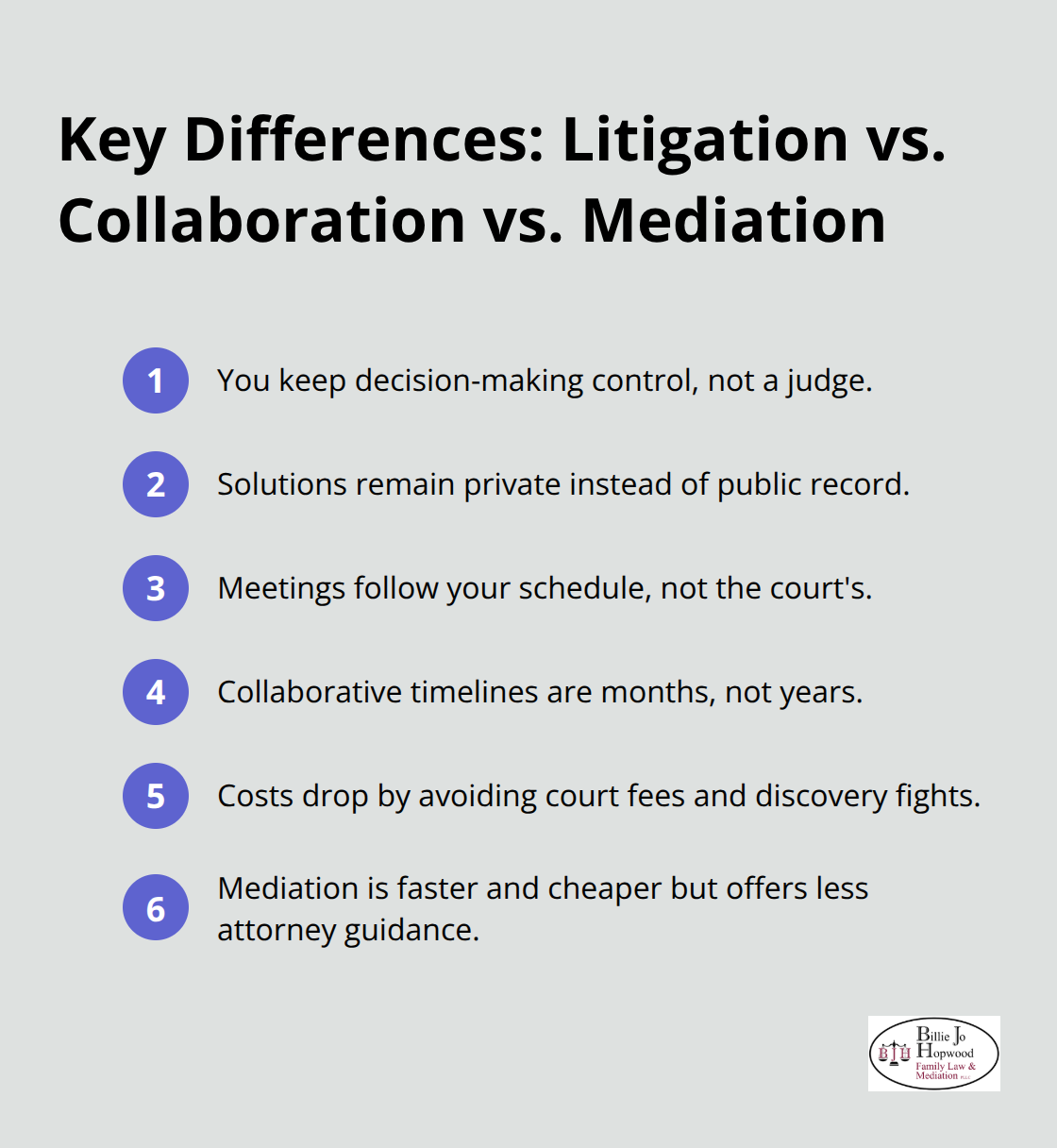
Compact list comparing control, privacy, timing, costs, and attorney involvement across litigation, collaboration, and mediation.

The typical Philadelphia collaborative divorce takes a few months to about a year depending on complexity, whereas litigation often stretches longer due to court backlogs and procedural delays. Cost differences matter significantly-litigation typically runs higher due to court fees, discovery expenses, and multiple hearings. Mediation sits between these approaches: a neutral mediator facilitates discussions without attorneys present at every meeting, making it faster and cheaper than collaboration but offering less attorney guidance during negotiations. Mediation works well for straightforward disputes, but collaborative law gives you active legal counsel steering every conversation, which proves valuable when finances or custody arrangements grow complicated.

The Core Commitment Collaborative Law Requires

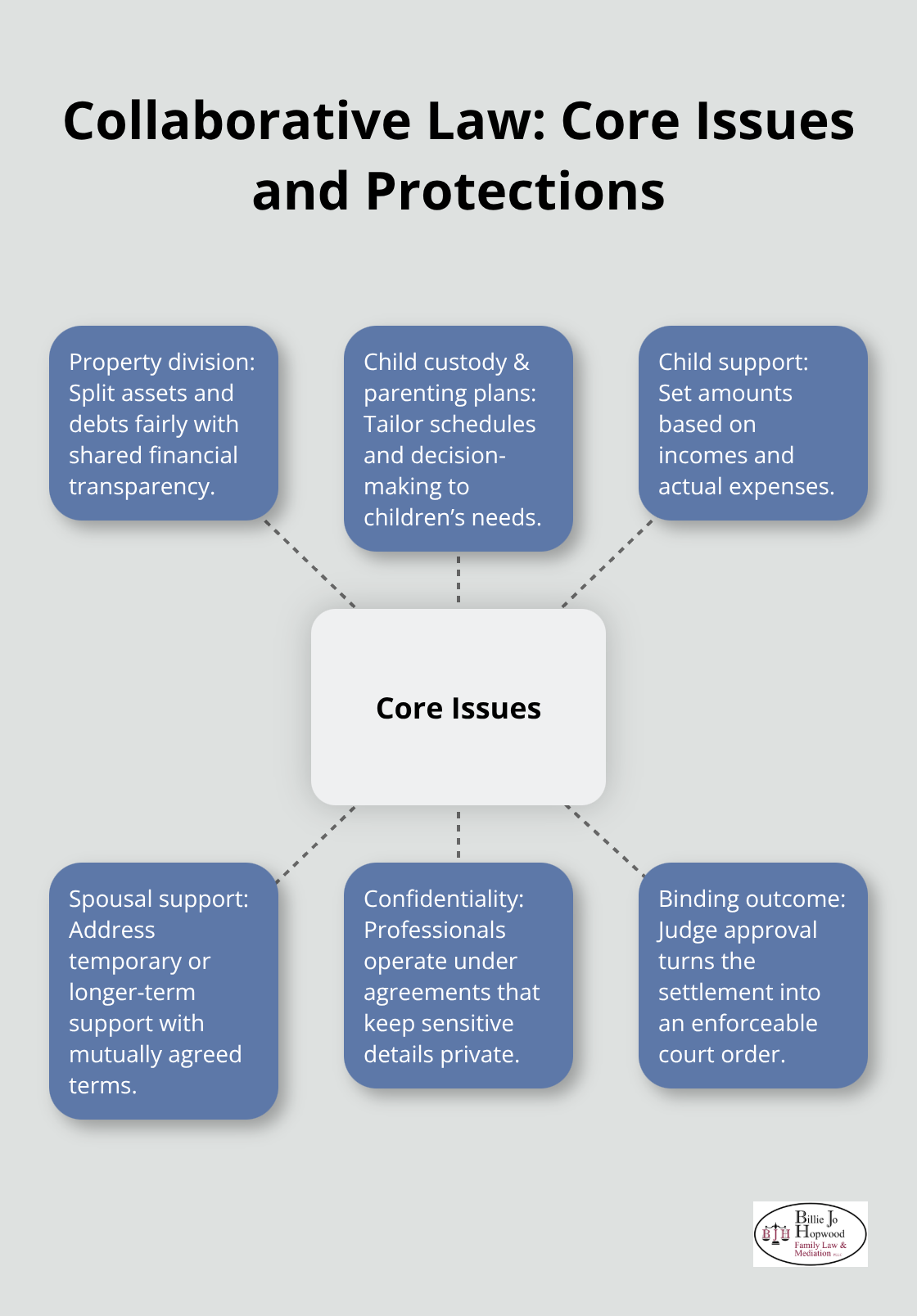
Both spouses must genuinely want to cooperate and share information honestly. The process fails immediately if one person hides assets, uses intimidation, or refuses to negotiate fairly. This reality means collaborative law works best for moderate-conflict situations where both parties recognize that court would harm their family more than compromise would. If domestic violence, abuse, or severe power imbalances exist in your relationship, traditional litigation with its court protections serves you better. The collaborative attorneys guide negotiations on core issues including property division, child custody and parenting plans, child support, and spousal support. Each professional in the room-attorneys, financial advisors, therapists-operates under confidentiality agreements, keeping sensitive family details private. When collaboration succeeds, the final settlement agreement becomes binding once a judge approves it, carrying the same legal weight as a court order.

Hub-and-spoke chart showing the core issues negotiated in collaborative law and the related protections. - Collaborative law alternative

Before you commit to this path, you need to assess whether both spouses can truly cooperate, which brings us to the practical steps that launch the collaborative process itself.

How the Collaborative Process Unfolds in Family Law

The Participation Agreement and Initial Setup

Both spouses sign a participation agreement that commits them to the process and establishes ground rules for how decisions get made. This agreement typically includes a clause requiring both collaborative attorneys to withdraw if either party chooses litigation, which creates real accountability for staying at the negotiation table. Once signed, the first four-way meeting happens within weeks, bringing both spouses and both attorneys together to discuss what matters most to each family. You identify which professionals you need beyond attorneys-a financial advisor helps when property division or business valuations complicate things, while a parenting coordinator addresses custody and scheduling disputes. Katherine E. Stoner’s research on divorce without court shows that adding these professionals early prevents delays later and keeps meetings focused on actual problems rather than legal posturing. The participation agreement also establishes confidentiality protections, meaning what gets discussed stays private and won’t appear in court filings or public records. This privacy matters significantly for families worried about business information, health details, or parenting approaches becoming public knowledge.

Meeting Structure and Professional Costs

Initial meetings typically run two to three hours and cost between $500 and $1,500 total depending on attorney hourly rates in your area, making this startup phase far cheaper than filing court petitions and discovery motions. Information sharing happens on a schedule both parties agree to, not on a judge’s calendar or a lawyer’s pressure tactics. Each spouse provides bank statements, tax returns, property valuations, and income documentation within agreed timeframes-usually two to four weeks between meetings. The structured nature prevents the endless back-and-forth that drains litigation budgets; you know exactly what documents matter and when they’re due.

Focused Negotiations and Shared Experts

Negotiations focus on one issue at a time rather than everything at once, which keeps people from getting overwhelmed or retreating to defensive positions. When property division requires appraisals or business valuations, the collaborative team hires a single neutral appraiser both sides trust rather than each party hiring competing valuers to argue over numbers. This shared-expert model cuts costs roughly in half compared to traditional litigation where both sides maintain separate professionals. Once all issues reach agreement-property split, custody arrangements, support amounts, and any modification clauses for future changes-the attorneys draft a settlement agreement reflecting what you’ve negotiated.

Finalizing Agreements and Legal Binding

A judge reviews and signs these documents, making them legally binding with the same enforceability as a court-imposed order. The entire process typically takes three to nine months for straightforward cases, though complex situations involving businesses or significant assets may extend to a year. The advantages of this timeline and cost structure become even clearer when you compare what collaborative law actually saves your family compared to traditional courtroom battles.

Why Collaborative Law Saves Money and Time

Collaborative law cuts litigation costs dramatically because you avoid the expense machinery that traditional divorce activates. Court filing fees, discovery motions, depositions, and multiple hearings add thousands to your bill within months. Research on divorce without court shows collaborative cases typically cost 30-40% less than litigation when both parties genuinely cooperate.

Percentage chart showing how much less collaborative cases typically cost than litigation. - Collaborative law alternative

Initial four-way meetings run $500 to $1,500 total depending on attorney rates, compared to filing a court petition alone which costs $300-$500 plus attorney fees just to start the adversarial process. A single discovery dispute in litigation can generate $2,000-$5,000 in additional legal fees as attorneys fight over document production and depositions.

Information Sharing Without the Fight

Collaborative law eliminates this waste because information sharing follows an agreed schedule with no fighting over what documents matter. You know exactly which financial statements, tax returns, and property records each side needs within two to four weeks, eliminating the endless back-and-forth that bleeds litigation budgets dry. When shared experts handle valuations, you pay one appraiser instead of two competing professionals charging opposing rates, cutting that specific cost roughly in half. This structured approach prevents the discovery disputes that plague traditional litigation and drain resources that could support your family’s transition instead.

Timeline Advantages That Actually Matter

Collaborative cases reach settlement in three to nine months for straightforward situations, while litigation often stretches 18-24 months due to court calendar backlogs and procedural delays. This speed matters financially because every month your case stays open means additional attorney time, expert fees, and stress that affects your ability to move forward with life decisions. You cannot refinance a home, sell property, or modify custody arrangements until your case closes, so faster resolution means you regain control sooner. The schedule stays in your hands rather than a judge’s docket, so meetings happen when both parties and their attorneys can attend, avoiding continuances that plague court calendars.

Control Over Outcomes That Fit Your Family

Greater control over outcomes means you craft custody arrangements that actually fit your family’s reality instead of accepting a judge’s standard orders that may not work for your schedule or your children’s needs. One parent might need flexibility for a new job, while the other manages school pickups and activities, so your agreement can reflect those specific circumstances rather than generic court templates that treat all families identically. Families recover financially and emotionally faster through collaborative processes because they move deliberately toward solutions rather than waiting months between court dates. This direct path forward allows you to address your family’s actual needs rather than conform to rigid judicial templates.

Final Thoughts

Collaborative law offers families a path forward that traditional litigation cannot match because you maintain control over decisions affecting your children, your finances, and your future rather than handing those choices to a judge unfamiliar with your family’s actual needs. The process costs significantly less since you avoid court fees and discovery battles, and settlement arrives in months rather than years. This collaborative law alternative works best when both spouses genuinely want to resolve disputes fairly and share information honestly.

High-conflict situations with domestic violence or severe power imbalances require traditional litigation’s court protections instead, as the collaborative approach fails when one party refuses to cooperate or hides assets. Assess whether both you and your spouse can commit to good-faith negotiation before pursuing this path, since mutual willingness to negotiate determines whether the process succeeds or stalls. Most importantly, collaborative law preserves relationships when ongoing cooperation matters most, particularly for co-parenting arrangements that will shape your children’s lives for years to come.

We at Billie Jo Hopwood Family Law & Mediation, PLLC in Melbourne, Florida help families navigate this decision and guide you through collaborative processes that protect your interests while preserving your family’s wellbeing. Contact us to discuss whether this approach works for your circumstances and learn how we can support your path forward.

Divorce Mediation Timeline: From First Meeting to Final Agreement

Divorce mediation can wrap up in weeks or stretch across months, depending on your situation. The divorce mediation timeline varies widely based on how complex your finances are, whether you agree on custody, and how willing both parties are to find middle ground.

We at Billie Jo Hopwood Family Law & Mediation, PLLC walk clients through each stage so you know exactly what’s coming. This guide breaks down the real timeline from your first meeting to signing the final agreement.

Your First Mediation Meeting

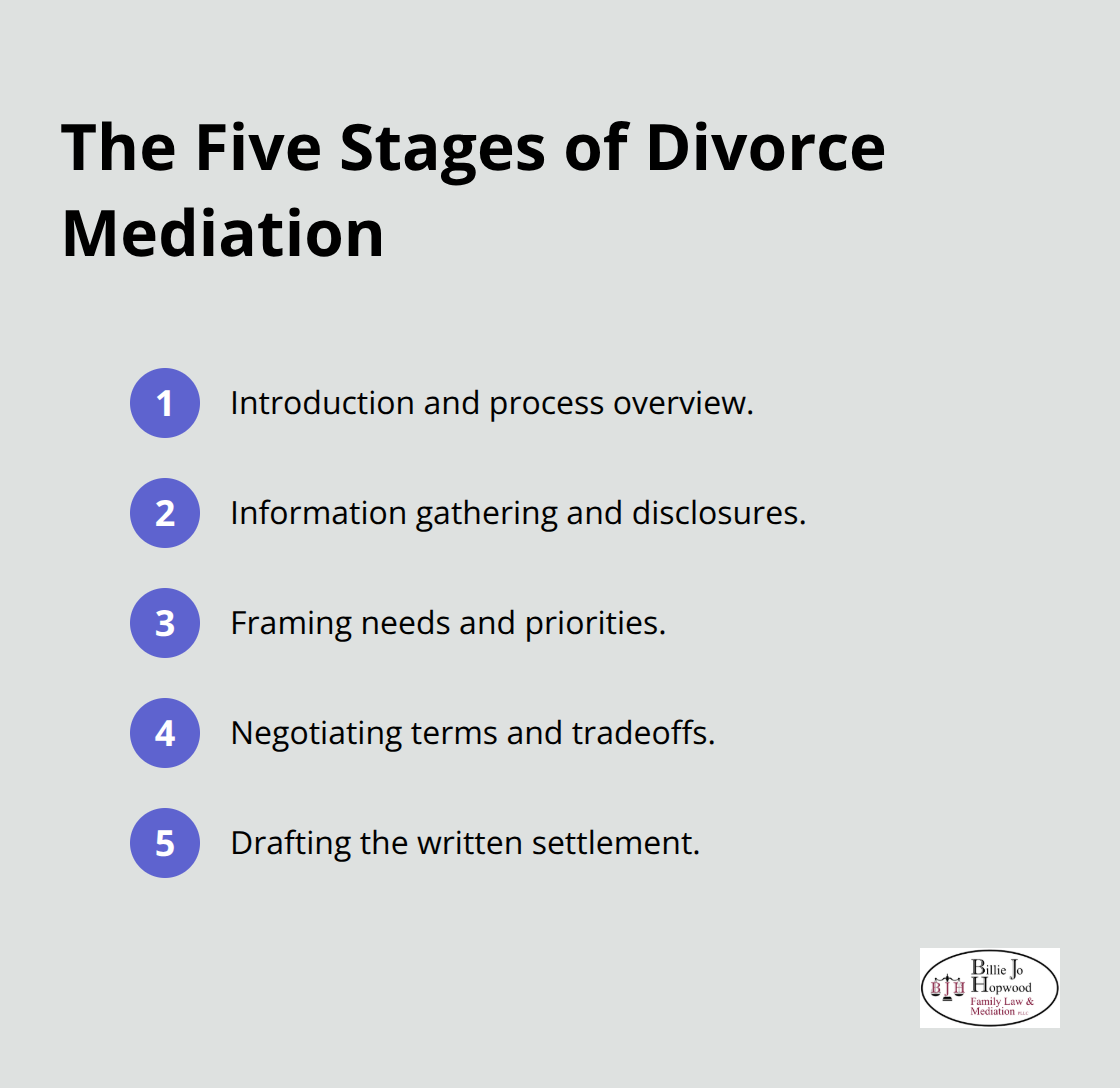
Your first mediation session sets the tone for everything that follows. Most mediators spend this time explaining how the process works rather than addressing your actual disagreements. The mediator will outline the five-stage process: introduction, information gathering, framing needs, negotiating, and drafting a settlement. Expect the mediator to clarify payment terms upfront-typically both parties split costs, ranging from roughly $250 to $400 per hour in private mediation, though court-sponsored mediation in Florida runs about $50 to $150 per party.

Compact list showing the five stages of divorce mediation from introduction to settlement drafting - divorce mediation timeline

The mediator will establish ground rules, which means you’ll hear clear expectations about respectful communication and how separate sessions work if needed. This first meeting often lasts one to two hours and covers administrative details like parking, technology setup for online sessions, and scheduling follow-up appointments. You should arrive with a list of negotiation topics that matter to you-whether that’s holiday visitation schedules, specific asset divisions, or spousal support amounts-so the mediator can organize the agenda and you both understand what needs resolution.

What the Mediator Actually Does

The mediator acts as a neutral facilitator, not as your advocate or legal advisor. This distinction matters because the mediator won’t tell you what’s fair or push you toward any particular outcome; instead, they’ll help you and your spouse understand each other’s priorities and explore options together. Many mediators conduct one-on-one sessions before joint meetings, which allows each party to express concerns privately and helps the mediator understand both perspectives. If you have complex finances-retirement accounts, business interests, or significant real estate-bring documentation to this first meeting so the mediator can assess what information you’ll need to gather. You’ll also discuss whether attorneys will be present during sessions; court-ordered mediation typically excludes lawyers from the room, but private mediation varies. Some couples hire a lawyer on a consulting basis to prepare before mediation or review the final settlement afterward, which can protect your interests without derailing the neutral process.

Preparing Documents Before You Arrive

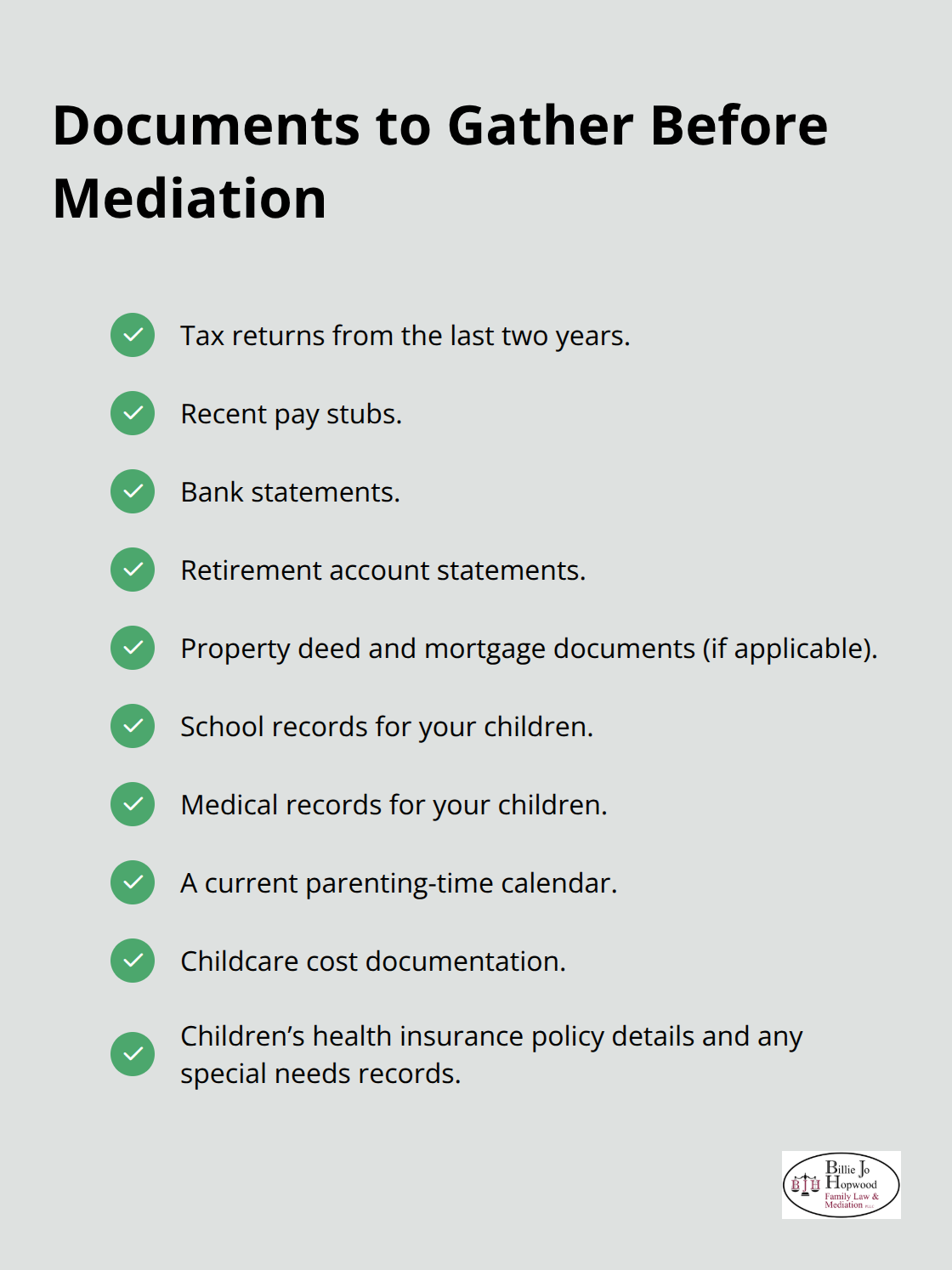
Walking into mediation unprepared extends your timeline significantly. You should gather three years of tax returns, three months of recent pay stubs, six months of bank statements, mortgage and vehicle documents, retirement account statements, and any business records if applicable. Create a comprehensive list of all marital assets and debts-vehicles, bank accounts, property, loans, credit cards-so financial discussions move forward without constant delays. If children are involved, compile their school and activity schedules, medical information, and any existing custody arrangements. Bring all court documents, filings, and orders you’ve received so far. Missing or incomplete financial information stalls progress and requires additional data gathering and follow-up that stretches timelines by weeks. The first meeting is also when you confirm logistics: if mediation is in person, know parking and directions; if online, test your technology and internet connection beforehand. Bring lunch and snacks for longer sessions, and cultivate patience and openness as you enter the process.

What Happens Next

Once you’ve completed your first meeting and submitted your initial documents, the mediator will schedule the information-gathering phase. This stage requires both parties to provide complete financial records and answer questions about assets, debts, income, and expenses. The mediator uses this information to help you both understand the full financial picture before you start negotiating terms. Preparation at this stage accelerates progress considerably, so organize your documents clearly and respond to requests within 24 to 48 hours when possible.

Moving Through the Four Stages That Matter Most

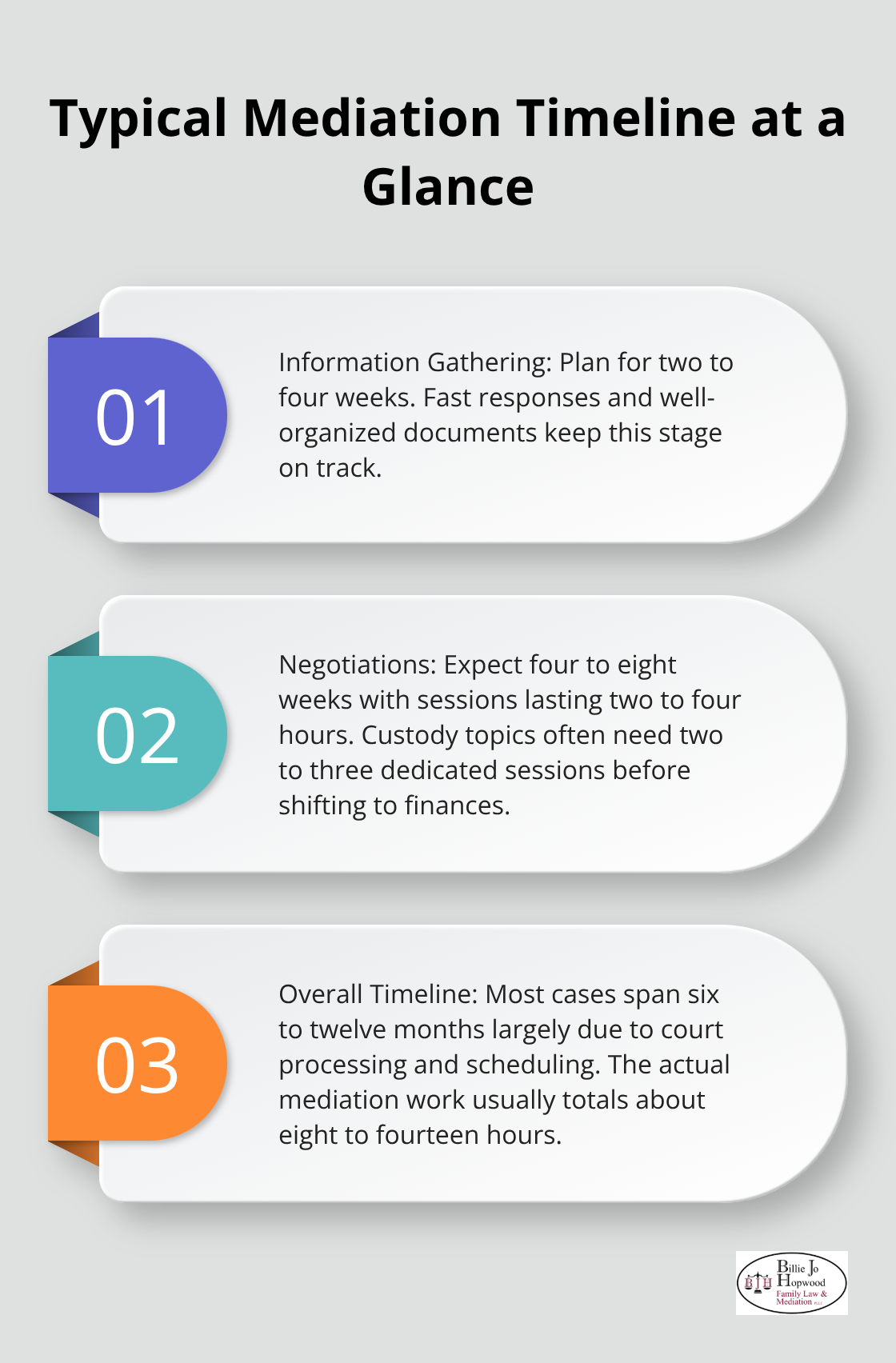
After your first meeting, mediation follows a structured path that moves you from gathering facts to reaching agreement. The information-gathering stage typically takes two to four weeks, depending on how quickly you and your spouse compile documents and respond to the mediator’s requests.

Three-step overview showing durations for info gathering, negotiations, and overall case timeline - divorce mediation timeline

Information Gathering and Financial Disclosure

During this phase, the mediator collects your financial records, reviews them for completeness, and identifies gaps that need filling. You provide bank statements, tax returns, pay stubs, retirement account statements, and documentation of all debts. The mediator explains how Florida’s property division laws and child support guidelines apply to your situation, which grounds your later negotiations in reality rather than assumptions.

Respond to document requests within 24 to 48 hours whenever possible; delays here extend your entire timeline by weeks. If you have complex assets like retirement accounts with QDROs, business interests, or significant real estate holdings, a divorce financial professional can organize numbers and scenarios to accelerate this stage considerably.

Negotiation Sessions and Finding Common Ground

Once financial disclosure is complete, negotiation sessions begin. These typically span multiple meetings over four to eight weeks, with sessions lasting two to four hours each. The mediator helps you and your spouse brainstorm options, evaluate proposals, and gradually narrow disagreements toward settlement.

Contested custody issues take longer than asset division because emotions run higher and the stakes feel personal. Florida’s child support guidelines provide a calculation baseline, but discussions about parenting time, holiday schedules, and decision-making authority require real compromise. Many couples spend two to three sessions on custody alone before moving to financial terms.

Asset Division and Financial Terms

Asset division moves faster when both parties understand the full financial picture from stage two; couples who skip thorough financial disclosure often circle back to gather missing information, costing weeks of delay. If you disagree sharply on major assets, the mediator may propose a midpoint between your last offers to advance the timeline.

Separate sessions can help each party clarify positions privately, though shuttle mediation increases total hours and costs. Willingness to compromise matters most here; if either party refuses to budge on core issues, mediation stalls and you face months of additional delay or court involvement.

What Determines Your Pace Through These Stages

The speed at which you move through information gathering and negotiation depends on three factors: how organized your financial records are, whether you and your spouse can agree on custody arrangements, and how motivated both parties feel to reach settlement. Couples with straightforward finances and no children often complete mediation in a single long session (about 12 hours), while those with multiple properties, retirement accounts, and custody disputes typically need 8 to 14 hours spread across several sessions. Court processing and scheduling create additional delays after you reach agreement, so the overall timeline from first contact with a mediator to final decree often runs 6 to 12 months.

As you move through these stages, the mediator will guide you toward drafting your settlement agreement, which transforms your negotiated terms into a legally binding document.

What Really Slows Down Your Mediation

Financial complexity stands as the single biggest predictor of how long mediation takes, and most couples underestimate it significantly. If you own a home, have retirement accounts, or hold investments, mediation will stretch longer than you anticipated. Retirement account division alone often requires a Qualified Domestic Relations Order (QDRO), which adds weeks to the process because these documents must comply with federal tax law and your plan administrator’s rules. Business interests complicate matters further; valuations take time, and disagreements over what a business is actually worth can stall negotiations for months. Real estate holdings beyond your primary residence trigger appraisal disputes and questions about whether property should be sold or awarded to one party.

Hub-and-spoke diagram highlighting common causes of mediation delays

How Document Organization Affects Your Timeline

Missing or incomplete financial records create the worst delays because the mediator must request documents multiple times, and you lose weeks waiting for responses. Couples who arrive at mediation with three years of tax returns, six months of bank statements, and a complete asset-and-debt inventory move through information gathering in two to four weeks. Those who scramble to find documents or discover accounts they forgot about can stretch this stage to eight weeks or longer. The difference between organized preparation and chaotic document gathering adds two to three months to your entire timeline. A divorce financial professional can organize numbers and scenarios to accelerate this stage considerably if your assets are complex.

Why Custody Disagreements Take Longer

Custody disagreements drag out mediation far more than asset division because emotions override logic and both parents feel their position is non-negotiable. Florida’s child support guidelines provide a mathematical baseline that removes much debate from financial support, but custody involves parenting time, holiday schedules, decision-making authority, and school choice, each of which carries emotional weight. Couples with young children often spend two to three full mediation sessions on custody alone before moving to financial terms.

The Role of Willingness to Compromise

Willingness to compromise determines whether mediation succeeds or stalls entirely. If one party refuses to budge on core issues, the mediator cannot force agreement, and you face months of additional delay or court involvement. Court-ordered mediation, which about 70 to 80 percent of contested Florida divorces undergo, typically occurs four to eight months after filing, so timing matters less than the actual work you do in the room. Couples who enter mediation with clear priorities, realistic expectations about what they can win, and genuine openness to their spouse’s concerns settle in 8 to 14 hours across several sessions. Those who view mediation as a chance to litigate their grievances or prove their ex wrong waste time on unproductive arguments and often walk away without agreement, forcing expensive court battles later.

Final Thoughts

Your divorce mediation timeline typically spans six to twelve months from your first meeting to a finalized agreement, though the actual mediation work often completes in eight to fourteen hours across multiple sessions. Court processing and scheduling create most of the delays rather than mediation itself. If you arrive organized with complete financial records and both parties genuinely want to settle, you move through information gathering and negotiation in two to three months, while contested custody issues and complex assets like retirement accounts or business interests extend this timeline considerably.

Court battles over the same issues stretch eighteen months to two years or longer, with discovery costs, attorney fees, and trial preparation consuming far more money and emotional energy than mediation requires. About seventy to eighty percent of contested Florida divorces settle through mediation or negotiation rather than trial, which demonstrates that mediation works when both parties commit to it. You avoid the uncertainty of a judge’s decision, maintain control over the outcome, and preserve your ability to co-parent effectively after divorce.

After you reach your final mediated agreement, the settlement must be drafted in writing, reviewed by both parties, and signed before filing with the court. Some mediators draft the agreement themselves; others work with attorneys to finalize terms. If you’re considering mediation or need guidance on your divorce mediation timeline, contact our Melbourne office to discuss your situation and explore whether mediation fits your needs.

Parenting Plan Mediation Brevard: Designing a Practical Schedule

A parenting plan mediation Brevard process starts with one goal: creating a schedule that works for both parents and protects your children’s stability.

When parents work together to design their custody arrangement, they avoid costly court battles and reduce the stress their kids experience during transitions. We at Billie Jo Hopwood Family Law & Mediation, PLLC help families build practical schedules that account for school, activities, and real-world logistics.

Why a Structured Parenting Plan Matters in Brevard

A structured parenting plan stops conflict before it starts. When both parents agree on specific pickup times, overnight schedules, and holiday arrangements, there’s no room for disagreement about who’s responsible for what. Florida Statute 61.13 requires comprehensive parenting plans that address daily schedules, school-year and holiday arrangements, and dispute-resolution procedures, which means the court won’t approve vague agreements anyway. Parents who mediate their custody arrangements report fewer ongoing disputes because the schedule itself becomes the answer to scheduling questions. Without a written plan, parents rehash the same arguments repeatedly, burning money on attorney fees and emotional energy that could go toward their children.

Children thrive with consistency across two homes

Children’s stress levels drop significantly when they know what to expect. A child who understands she spends Monday through Thursday with one parent and Friday through Sunday with the other can plan her week around stable routines for meals, homework, and bedtime. Research from the University of Florida shows children fare better when custody decisions are mediated, with reduced stress and improved long-term outcomes compared to court battles. The difference isn’t small: mediated arrangements create predictability that helps kids maintain school performance, manage anxiety, and build confidence in both households. When schedules shift constantly or parents fight over changes, children absorb that conflict and their grades, behavior, and emotional health suffer. A practical parenting plan aligned with your child’s actual school calendar and activity commitments eliminates the chaos that litigation creates.

Florida law demands specifics, not handshake agreements

Florida courts won’t sign off on custody arrangements that lack detail. The statute requires you to specify time-sharing schedules, decision-making responsibilities, and communication protocols. Courts also expect explicit handling of holidays, vacation time, and how transportation works between homes.

Florida DCF statistic showing mediation resolves custody issues 25% faster with a draft parenting plan - Parenting plan mediation Brevard

The Florida Department of Children and Families notes that arriving at mediation with a draft parenting plan can resolve custody issues 25 percent faster, which shows how much courts value concrete proposals. If you walk into court without these specifics, the judge fills in the blanks for you-and you won’t like the result. Mediation forces both parents to think through logistics beforehand, producing an agreement that holds up legally and actually works in practice.

What happens when you skip the details

Vague custody agreements create problems that surface months or years later. One parent assumes the child spends every other weekend at the other home; the other parent thought it was every third weekend. A school closure happens, and neither parent knows who’s responsible for childcare. A parent’s work schedule changes, and the entire arrangement falls apart because the original plan had no flexibility clause. These conflicts land families back in court, where a judge imposes a solution neither parent wanted. The mediation process forces you to address these scenarios upfront, preventing costly disputes down the road.

Moving forward with a practical schedule

The next step involves building a schedule that actually fits your family’s life. Your work hours, your child’s school calendar, extracurricular activities, and transportation logistics all shape what works on paper versus what works in reality. Mediation helps you account for these real-world factors and create a plan both parents can follow consistently.

Building a Schedule That Actually Works

Your child’s school calendar and work schedule form the foundation of any practical parenting plan. Start by mapping out a typical two-week period-mark school days, after-school activities, your work hours, and the other parent’s availability. This exercise reveals scheduling conflicts immediately. If you work until 6 p.m. and your child’s school pickup happens at 3 p.m., one parent must handle pickup consistently. If your child has soccer on Tuesday and Thursday evenings, that parent needs custody during those days or a clear transportation agreement. A practical schedule mirrors reality rather than forcing reality to fit a template. Research from the Florida Department of Children and Families found that parents who arrive at mediation with a draft parenting plan resolve custody issues 25 percent faster because they’ve already identified what actually works logistically. The schedule should reflect your child’s existing routine first, then allocate custody time around those fixed points.

Holidays and vacations require explicit agreements

This is where vague plans collapse. One parent assumes Thanksgiving means the full week; the other thinks it means just Thursday and Friday. Extended school breaks like winter and summer vacation need specific date ranges, pickup times, and transportation responsibility. Many families alternate major holidays by year, which prevents the same parent from always missing Christmas or always hosting Thanksgiving. Spring break and summer vacation deserve attention because they disrupt the regular school-year schedule. Your agreement should specify whether summer is split into two-week blocks, alternating months, or some other arrangement that fits both parents’ work schedules. Holiday plans should also address birthdays, religious observances, and any family traditions that matter to your household. A detailed holiday schedule prevents the scramble that occurs every November when neither parent knows whose turn it is or who’s responsible for transportation.

Communication protocols stop constant renegotiation

The schedule itself is only half the battle. Parents need explicit protocols for how they’ll handle schedule changes, emergency situations, and the inevitable disruptions that arise. Establish which communication channel you’ll use for routine updates and which for urgent matters. Some families use a co-parenting app like Talking Parents, which creates a documented record and reduces conflict because messages are timestamped and visible. Define what counts as a valid reason to swap custody time and how much notice is required.

Checklist of co-parenting communication rules to prevent constant renegotiation

A common approach is 48 hours’ notice for routine swaps and immediate notification for emergencies. Include language about how to handle school closures due to weather, sudden illness, or unexpected work schedule changes. Without these protocols, parents end up in constant negotiation, which exhausts both of you and confuses your child about what to expect. A mediated plan that addresses these specifics up front means you’re not reinventing the wheel every time something unexpected happens.

Transportation logistics prevent daily friction

Who picks up the child from school? Who drives to soccer practice? What happens if one parent runs late? These questions sound simple until they’re not addressed in writing. Your parenting plan should specify pickup and drop-off locations, time windows, and who pays for transportation to activities. If one parent lives 20 minutes from school and the other lives 5 minutes away, the closer parent likely handles school pickup on their custody days. If activities fall on the other parent’s time, you need a clear agreement about whether that parent transports the child or the primary custodian does. Late pickups create resentment fast-define what “late” means and what happens if it occurs repeatedly. Transportation agreements also address safety (car seats, seatbelts, licensed drivers only) and cost-sharing for activities that benefit the child across both households. When transportation logistics are written down, neither parent guesses or improvises, and your child gets to activities on time.

Flexibility clauses keep plans alive as circumstances change

Life happens. A parent’s job changes, a child’s interests shift, or a school schedule gets reorganized. A rigid parenting plan breaks under these pressures and sends families back to court. Build flexibility into your agreement by specifying how temporary changes work and when a change requires formal modification. For example, you might allow either parent to request a one-time schedule swap with 48 hours’ notice, but if a parent needs a permanent change (like a new work shift), that triggers a mediation session before any adjustment takes effect. Include language about how the plan adapts as your child ages-a schedule that works for a 7-year-old won’t work for a 16-year-old. Address potential relocation by stating what happens if one parent moves more than 50 miles away and how that affects custody time. A plan with built-in flexibility mechanisms survives real life and keeps both parents out of the courtroom.

The next step involves addressing the obstacles that emerge during mediation itself-the disagreements that surface when parents sit down to negotiate these details.

Common Obstacles Parents Face During Mediation

Overnight custody schedules expose the first real conflict in mediation. Parents often arrive with competing assumptions about what 50/50 custody means in practice. One parent believes it’s a strict week-on, week-off rotation; the other assumes it’s alternating weekends with weekday custody going to the primary caregiver. Florida custody research shows that 50/50 custody often fails unless both parents live within about 10 minutes of each other, have compatible work schedules, and share parenting values. When a parent works nights and the other works days, a rigid 50/50 split doesn’t work logistically. Transition points themselves become friction zones-if a child switches homes every three days, the logistics of packing, transporting, and managing two sets of belongings create exhaustion that compounds over months.

Mediators reshape the overnight conversation

Mediators address this conflict by proposing a school-week custody arrangement with alternating weekends plus one mid-week overnight, which preserves school routines while maintaining substantial time with the other parent. This variation works better than strict 50/50 because it reduces transitions and aligns with the child’s actual school schedule. The key disagreement parents need to resolve isn’t the percentage of time but the specific days and times that actually fit both households’ rhythms. A mediator with strong conflict-resolution skills shortens timelines and reduces emotional strain by redirecting these conversations toward practical solutions rather than abstract fairness arguments.

Parenting styles clash when schedules don’t align them

Different parenting styles between homes create tension that a schedule alone cannot fix. One parent enforces strict bedtimes and screen limits; the other allows flexibility. One parent prioritizes academic achievement while the other emphasizes play and creativity. Parents often want the mediation agreement to enforce their parenting philosophy across both homes, which is unrealistic and creates ongoing conflict. A functional agreement acknowledges that each parent runs their household differently and focuses instead on non-negotiable safety standards and communication about major decisions like education and healthcare. This shift-from philosophy battles to practical boundaries-allows both parents to maintain their approach while protecting the child’s well-being across both homes.

Financial responsibilities tied to custody time generate the most heated disputes

One parent assumes the higher-earning parent covers all child-related expenses; the other believes costs split proportionally to custody time. Childcare, healthcare, extracurricular activities, and camps all carry price tags that need allocation. Without clear language, one parent pays for soccer camp while the other refuses to contribute, leaving the child out of activities. The agreement should specify which parent pays for what and how unexpected costs get split. If one parent’s custody schedule requires childcare while the other’s doesn’t, that parent shouldn’t bear the full childcare expense alone. Mediation works when parents shift from fighting about fairness in the abstract to solving the specific financial problems their custody arrangement creates. Clear allocation of expenses (healthcare, activities, childcare) prevents resentment and ensures your child participates fully in both households.

Final Thoughts

Mediation produces parenting agreements that actually survive contact with real life. When both parents sit down with a mediator to design a schedule, they think through logistics, financial responsibilities, and communication protocols before signing anything. This upfront work prevents the constant renegotiation and courtroom battles that plague families who skip mediation and let a judge impose a schedule neither parent wanted. Research shows mediated parenting plans achieve compliance rates over 80 percent, which translates to fewer disputes about who’s responsible for what and less stress for your children.

Parenting plan mediation in Brevard typically resolves custody disputes in two to four sessions, compared to months or years in contested litigation. The cost difference matters significantly: mediation runs three to eight thousand dollars total for both parties, while litigated divorces can reach fifteen to thirty thousand dollars per spouse. That savings leaves resources available for your children’s actual needs instead of attorney fees.

Compact comparison of mediation sessions and costs versus contested litigation - Parenting plan mediation Brevard

The path forward starts with finding a mediator who understands parenting plans and has experience with Brevard families. Interview at least two mediators, verify their experience with child custody arrangements, and understand their approach to handling disagreements. Contact Billie Jo Hopwood Family Law & Mediation, PLLC to discuss how mediation can help your family build a schedule that protects your children’s stability and reduces conflict between households.

Court Ordered Mediation: What It Means For Your Case

Court-ordered mediation can feel overwhelming when you’re facing a family law case. The good news is that this process often leads to faster resolutions and lower costs than traditional litigation.

At Billie Jo Hopwood Family Law & Mediation, PLLC, we’ve guided countless clients through court-ordered mediation and helped them understand what to expect. This guide walks you through how the process works, its real benefits, and how to prepare effectively.

How Court-Ordered Mediation Works

What the Judge’s Order Means

When a judge orders mediation in your family law case, you receive a court order that directs you to attend a mediation session before your trial date. This order is not optional-you must participate. The court recognizes that mediation often resolves disputes faster and at lower cost than litigation, which is why judges frequently mandate it early in the process.

The Mediator’s Role and Training

The mediator is a trained mental health professional who understands child development, family dynamics, and the effects of separation. During the session, the mediator meets with both you and the other parent to listen to each side’s concerns and help you develop an agreement on parenting time and custody decisions. The mediator remains neutral and does not take sides. Mediation focuses specifically on custody, visitation, and related parenting issues-not on child support, spousal support, or evidence against the other parent.

What Happens in the Session

Most mediation sessions last up to two hours. The mediator may hold confidential individual meetings with each party to explore options and facilitate negotiation without the other parent present. If you have safety concerns due to domestic violence, tell the mediator immediately so separate rooms or different session times can be arranged. Sessions are confidential under Florida Statutes Chapter 44, meaning discussions are privileged and generally cannot be used as evidence in court.

Building Your Parenting Plan

A parenting plan developed during mediation addresses three core areas: legal custody (who makes major decisions about health care and education), physical custody (where the child lives most of the time), and visitation or parenting time schedules. Within 15 days of receiving the court order for mediation, you and the other parent can negotiate with a private mediator if you both agree on one. If you cannot agree on a private mediator, the court’s mediation division will be assigned.

Visual showing the three core areas of a parenting plan developed in mediation and what each covers.

Costs and What Happens Next

The cost of in-house mediation is split equally between parties based on combined income-up to $50,000 combined income costs $60 per person per two-hour session, while $50,000 to $100,000 combined income costs $120 per person per two-hour session. Income above $100,000 makes you ineligible for in-house mediation, though you can hire a private mediator instead.

Compact list of Florida in-house mediation fee tiers by combined income. - court ordered mediation

Indigent parties mediate for free after completing an Affidavit of Indigency with the Clerk’s Office. Once you reach an agreement, it goes in writing and is submitted to the judge for approval. The agreement becomes legally binding only after the judge approves it and issues a court order-until then, it remains an agreement in principle. If you don’t reach an agreement, the judge will decide custody and visitation, which can happen the same day or require you to return to court.

Why Court-Ordered Mediation Saves Time and Money

The Real Cost Difference Between Mediation and Litigation

Court-ordered mediation cuts your family law costs dramatically compared to litigation. In-house mediation in Florida runs $60 to $120 per person per two-hour session depending on your combined household income, while private litigation easily costs $5,000 to $15,000 or more once attorney fees, court costs, and expert witnesses accumulate. A contested custody trial requires multiple court appearances, depositions, document discovery, and potentially psychological evaluations-each adding weeks to your case and hundreds of dollars in fees. Mediation compresses this timeline. Most sessions conclude in one or two meetings, meaning you avoid the back-and-forth scheduling that stretches litigation across months or years.

How Mediation Accelerates Your Case Resolution

If you reach an agreement in mediation, the judge approves it and issues a court order within days. If you don’t reach agreement, you proceed to trial, but you’ve still narrowed the disputed issues, which reduces trial time and costs. The confidentiality of mediation also protects your privacy-nothing discussed leaks into public court records, which matters when sensitive family details are at stake. You control the outcome instead of handing that power to a judge who knows nothing about your family’s unique needs.

Creating Flexible Solutions That Courts Cannot Offer

Mediation gives you flexibility that courtrooms cannot. A judge decides custody and visitation based on legal standards, but your parenting plan in mediation can reflect creative solutions tailored to your children’s schedules, your work demands, and your family’s actual circumstances. You might arrange alternating weeks, split weeks, or a schedule that adjusts seasonally-options a judge would never consider because the courtroom operates within rigid frameworks. This control extends to the tone of your agreement.

Building Cooperation for Your Children’s Benefit

Mediation encourages cooperation and communication between parents, which research shows directly benefits children’s adjustment after separation. Studies consistently demonstrate that children fare better when parents maintain low conflict and work together on parenting decisions, something litigation actively undermines by positioning parents as adversaries. When you walk out of mediation with an agreement you both crafted, you’ve already begun the collaborative parenting relationship your children need. That foundation matters far more than winning arguments in front of a judge, and it sets the stage for the practical steps you’ll take to prepare for your mediation session.

Preparing for Your Court-Ordered Mediation Session

Gather Documents That Strengthen Your Position

Preparation separates clients who walk out with solid agreements from those who feel blindsided. Start collecting financial documents now-tax returns from the last two years, pay stubs, bank statements, and retirement account statements. The mediator won’t review these in detail like a judge would, but knowing your numbers cold prevents you from making concessions based on guesses. If you own property, pull the deed and any mortgage documents. For child-related issues, compile school records, medical records, and a calendar showing your current parenting time. Most clients underestimate how specific they need to be about schedules. Instead of saying you see the kids on weekends, write down the exact days and times you currently have them.

Checklist of key documents to prepare for family mediation. - court ordered mediation

The mediator uses this baseline to build your parenting plan.

Bring documentation of childcare costs, health insurance policy details covering your children, and records of any special needs or ongoing medical treatment your children receive. This matters because parenting plans must account for who manages appointments and decisions. One critical document people forget: a list of questions for the mediator about how your specific situation will be handled. Organizing documents in a binder with clear tabs helps you reference them quickly during mediation sessions.

Work With Your Attorney Before You Enter Mediation

Your attorney should meet with you before mediation to review your realistic goals and walk through what to expect in the room. This conversation prevents you from making emotionally driven decisions that harm your long-term interests. Tell your attorney what outcome you actually want, not what sounds good in theory. If you need to maintain a flexible work schedule to parent, say that. If you cannot afford to pay substantial child support, discuss it now rather than discovering it during mediation.

Your attorney can advise on what concessions are negotiable and which ones protect your fundamental interests. Many clients arrive at mediation without clear priorities, which leads to unfavorable agreements they regret later. You need to know whether you prefer primary physical custody, shared parenting time, or something in between. You need to understand how child support calculations work in Florida so you recognize a fair offer when you hear one. Do not walk into mediation unprepared on these points.

Understand Your Leverage and Limitations

If the other parent brings an attorney and you do not, you face a disadvantage. You don’t need an attorney present in the mediation room itself-mediators cannot provide legal advice, and their role is to stay neutral-but having one available by phone during breaks gives you real-time guidance when unexpected proposals emerge. Set realistic expectations about what mediation can resolve. It handles custody, visitation, and parenting decisions only. It does not cover child support, spousal support, or property division unless both parties agree to expand the scope. If your case involves disputed assets or alimony, mediation alone will not settle everything, and you’ll need either separate negotiation or litigation on those points.

Final Thoughts

Court-ordered mediation fundamentally changes how your family law case unfolds. Instead of spending months in litigation with mounting attorney fees and court appearances, you move through a structured process designed to produce agreements faster and at a fraction of the cost. The mediator facilitates communication between you and the other parent, helping you build a parenting plan that actually works for your family rather than one imposed by a judge who has never met your children.

If you reach an agreement, the judge approves it and issues a court order within days, giving you certainty and closure. If you don’t reach full agreement, you’ve still narrowed the disputed issues, which reduces what remains to be litigated. Either way, you’ve avoided the adversarial posturing that damages co-parenting relationships long after the case ends, and your children benefit from parents who learned to negotiate rather than fight.

We at Billie Jo Hopwood Family Law & Mediation, PLLC understand that court-ordered mediation raises questions specific to your situation. Our firm in Melbourne, Florida assists families through family law matters including custody, divorce, and support issues. Contact us to discuss how we can help you navigate this critical phase of your case.

Family Law Mediation Melbourne: Local Strategies for Resolution

Family law mediation in Melbourne offers a faster, more affordable path than court battles. When families face divorce, custody disputes, or property division, mediation keeps control in your hands rather than leaving decisions to a judge.

At Billie Jo Hopwood Family Law & Mediation, PLLC, we’ve seen how mediation transforms difficult situations into workable solutions. This guide walks you through local strategies that help Melbourne families resolve conflicts while protecting relationships and finances.

Why Mediation Beats Court for Melbourne Families

Speed Matters When Your Family’s Future Is at Stake

Litigation in Florida family law cases moves slowly. Court calendars in Brevard County back up months, sometimes years, before judges hear contested custody or property disputes. Mediation compresses this timeline dramatically. Most mediation sessions resolve in weeks rather than waiting through multiple court appearances. Families reach binding agreements in a fraction of the time court requires.

Costs Add Up Fast in Courtroom Battles

The cost difference between mediation and litigation proves stark. Court litigation in family law routinely costs $15,000 to $50,000 per party when attorney fees, court costs, and expert witnesses accumulate. Mediation in Brevard and Seminole counties follows a means-tested fee structure: families earning under $50,000 combined income pay $60 per party per session, while those earning $50,000 to $100,000 pay $120 per party. Families with higher incomes access private mediation at negotiated rates, which still undercut litigation expenses substantially.

Comparison of typical family law litigation costs versus means-tested mediation fees in Brevard and Seminole counties. - Family law mediation Melbourne

You Control the Outcome, Not a Judge

You retain control of outcomes in mediation rather than accepting whatever a judge decides. A judge sees your case for hours; a mediator works with you over sessions to understand your priorities, your children’s needs, and your financial reality. This fundamental difference shifts power back to you and your family.

Local Knowledge Changes Everything

Melbourne mediators understand the local landscape in ways distant judges cannot. They know how Brevard County schools operate, what custody arrangements work in our community, and how local employment patterns affect child support calculations. Mediators trained through the Florida Supreme Court system bring consistency and credibility to the process. They cannot force agreements or impose decisions, but they identify realistic solutions grounded in local practice.

Cooperation Protects Your Children’s Future

When you preserve relationships through mediation, your children benefit most directly. Parents who negotiate custody and parenting plans together maintain communication channels necessary for co-parenting decisions about school, healthcare, and extracurricular activities. Litigation creates adversarial positions that damage these relationships permanently. Research consistently shows children adjust better after divorce when parents cooperate. Mediation builds that cooperation from the start rather than destroying it through courtroom battles. With these advantages clear, understanding the specific family law issues Melbourne residents face helps you recognize where mediation applies to your situation.

Common Family Law Issues Melbourne Residents Face

Divorce in Melbourne triggers three interconnected problems that families must resolve simultaneously. Child custody arrangements determine where children live and how parents share decision-making authority. Property division splits marital assets accumulated during the marriage, from the family home to retirement accounts. Spousal support addresses financial dependency when one partner earned significantly less during the marriage. These issues overlap constantly, making mediation particularly valuable because a single negotiation process addresses all three rather than fighting them separately in court.

Key family law issues commonly resolved through mediation: custody, property division, and spousal support.

Custody Disputes Shape Children’s Lives

Custody disputes dominate family law in Brevard County because Florida courts prioritize the best interests of the child standard, which remains deliberately vague. Parents disagree on timesharing schedules, school selection, healthcare decisions, and which parent handles extracurricular activities. Mediation lets parents craft specific arrangements matching their actual lives rather than accepting generic court orders. One parent works nights while the other manages daytime responsibilities, creating natural custody patterns a mediator can formalize into sustainable agreements.

Property Division Requires Strategic Thinking

Property division becomes contentious when couples accumulated significant assets during marriage. The family home represents the largest asset for most Melbourne families, but retirement accounts, business ownership, and investment portfolios create additional complexity. Spouses often hold conflicting views about what constitutes fair distribution, especially when one partner sacrificed career advancement to raise children. Mediation allows couples to weight different assets differently based on their priorities rather than splitting everything equally by formula.

Spousal Support Calculations Affect Long-Term Finances

Spousal support calculations in Florida depend on income, earning capacity, standard of living during marriage, and marriage length according to Florida Statute 61.08. One spouse earning $35,000 annually while the other earned $120,000 creates support obligations that extend years into the future. Mediation permits flexible support arrangements including temporary support during job retraining, support ending when a recipient remarries, or gradual reductions as earning capacity increases. These negotiated terms often prove more workable than rigid court-imposed support orders because both parties helped design them.

Understanding these three core issues prepares you to move forward with mediation. The next section walks you through practical steps to start the mediation process in Melbourne.

Practical Steps to Start Mediation in Melbourne

Locate a Qualified Mediator in Brevard County

Three concrete steps move you from decision to action. First, locate a mediator qualified to handle family law in Brevard County. Florida Supreme Court certification matters significantly because certified mediators complete 16 hours of continuing education every two years and maintain training standards across the state. You can verify mediator credentials through the Florida State Courts website or contact Brevard County Court Administration directly at the Viera location to request qualified mediator referrals. The court maintains lists of approved mediators who handle divorce, custody, child support, and property division cases.

Gather Financial Documents Before Your First Session

Second, collect financial documents before your first session because mediators cannot negotiate fairly without complete income and asset information. Pull together recent tax returns for both spouses, mortgage statements, bank account records, retirement account statements, and documentation of any business ownership or investment accounts. This preparation typically takes one to two weeks and prevents delays once mediation sessions begin. Having these documents ready accelerates the entire process and allows the mediator to focus on negotiation rather than information collection.

Understand the Mediation Timeline and Costs

Third, understand that mediation in Brevard and Seminole counties follows a structured timeline. Initial consultations with a mediator last approximately one hour and cost $60 per party if your combined household income falls below $50,000 annually, or $120 per party for combined income between $50,000 and $100,000 according to the court’s means-tested fee schedule. Most families resolve custody and property disputes within three to five mediation sessions, though complex cases involving significant assets may require additional meetings. Each session typically spans two to three hours, and mediators maintain strict confidentiality about discussions unless law requires disclosure.

How the Mediation Process Unfolds

The mediation process itself follows a predictable pattern. The mediator explains ground rules and neutrality, each party describes their priorities, the mediator identifies common ground and realistic options, and finally both parties work toward written agreements that become legally binding once properly documented through your attorney or the court. This structured approach combined with the mediator’s training in Florida family law creates a framework where productive negotiation replaces adversarial positioning. Sessions move forward systematically, addressing one issue at a time until all major concerns reach resolution.

Hub-and-spoke diagram showing the main steps of the family mediation process from ground rules to binding agreements. - Family law mediation Melbourne

Final Thoughts

Family law mediation in Melbourne puts decisions back in your hands rather than leaving outcomes to a judge. You control the timeline, the costs stay manageable, and your relationships with your children and co-parent remain intact for the future. Most families complete mediation within weeks, not months or years, because both parties commit to negotiation rather than courtroom battles.

Mediation works even when disagreements exist between parents who hold conflicting views on custody, support, or property division. The confidentiality of mediation sessions protects your privacy throughout the process, and once you reach written agreements, they become legally binding and enforceable. Your priorities shape the agreements you reach, not judicial formulas applied to thousands of cases annually.

At Billie Jo Hopwood Family Law & Mediation, PLLC, we help Melbourne families navigate family law mediation with compassion and practical guidance. Contact us today to discuss how mediation can work for your family’s specific situation and move toward the peaceful resolution you deserve.